Berbere: What It Is, Flavor, Cooking Use and Health Facts
Berbere is a hot, warm and earthy Ethiopian and Eritrean chili blend used in stews and rubs; it has not been studied as a blend, and its fenugreek brings a legume-allergy and pregnancy caution.
Content last updated . This page has not been medically reviewed.
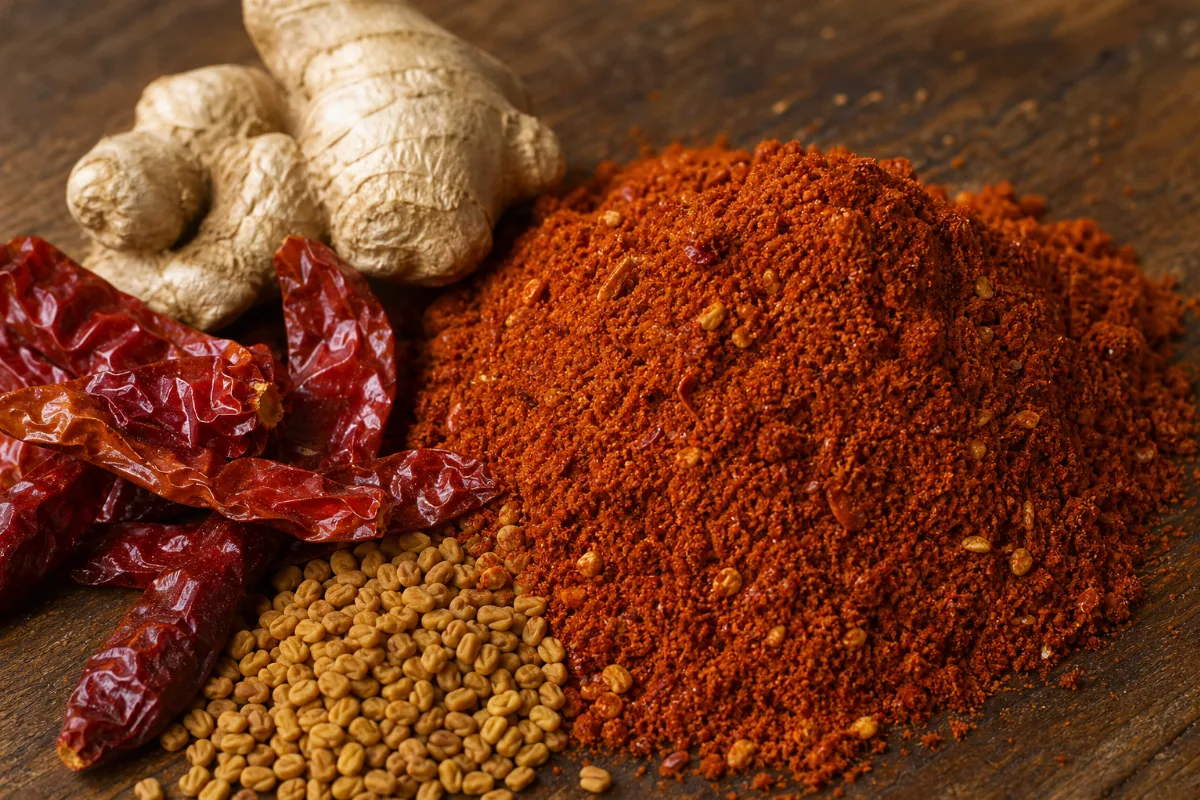
In the kitchen at a glance
Flavor:Hot / pungentWarm / woodyEarthy
Aroma: Fiery and warm, with sweet spice and a hint of maple from fenugreek.
Used in: soups and stews, grilling and rubs, vegetables
Usual amount in food: We found no source for a usual amount per dish; USDA has no berbere entry, and its chili powder entry lists 2.7 g per teaspoon.
What it is
Berbere is a red chili-based spice blend, central to the cooking of Ethiopia and Eritrea. [1] Its name is said to mean "hot" in Amharic. [2][3] Every household has its own version, so the lists below are "typical", not a fixed recipe. [2][3]| Typical ingredient | Role in flavor | Link |
|---|---|---|
| Dried red chili, hot paprika | Heat and red color; the base of the blend [1][2][3] | Chili, Paprika |
| Fenugreek seed | Called essential in one recipe; maple-like, slightly bitter notes [2] | More about Fenugreek seed → |
| Korarima (Ethiopian cardamom) | Cardamom-like aroma; a ginger-family seed, not true cardamom [2][4] | Cardamom is a substitute [2] |
| Cumin, coriander seed | Earthy base [2][3] | Cumin, Coriander seed |
| Ginger, garlic | Pungent warmth [1][3] | Ginger, Garlic |
| Cloves, cinnamon, nutmeg, allspice, black pepper | Sweet and warm notes [2][3] | Cloves, Cinnamon, Nutmeg, Allspice, Black pepper |
| Ajwain, nigella, long pepper | Named in some versions [1][3] | Ajwain, Black seed, Long pepper |
| Rue | Named in some versions [1] | More about Rue → |
| Salt | Added in at least one recipe [3] |
Flavor and aroma
Berbere is hot but layered: earthy and warming, with sweetness from cinnamon and a maple-citrus note from fenugreek. [2] Burnt cumin turns bitter, so toast gently. [2] To make it milder, one recipe uses sweet paprika and less chili and keeps the aromatic spices the same. [2]How it is used in cooking
Berbere is the base of doro wat, Ethiopia's spicy chicken stew, which is served on injera flatbread. [3] It also goes into misir wat (lentils), zigni, roasted vegetables, eggs, and spiced butter. [2] It works as a rub for meat and fish. [2][3] Mixed with oil it becomes the paste called awaze. [3]Home recipes toast the whole spices in a dry pan for a few minutes, cool them fully, then grind. [2][3] Substitute for korarima: green cardamom, in a smaller amount because it is stronger. [2] The sources we read do not say when in the cooking to add it, so we give no rule.
Normal food amounts
USDA FoodData Central has no berbere entry. The nearest are its chili powder (itself a blend) and curry powder entries, so the numbers below are only a stand-in. [5]| Measure | Grams | Source |
|---|---|---|
| 1 teaspoon chili powder | 2.7 g | USDA [5] |
| 1 tablespoon chili powder | 8.0 g | USDA [5] |
| Typical recipe amount | Not found | We opened no source that states one |
What one teaspoon of USDA chili powder (2.7 g) provides, calculated from per-100 g values:
| Nutrient | One teaspoon |
|---|---|
| Energy | about 8 kcal |
| Iron | about 0.5 mg |
| Sodium | about 77 mg |
The USDA data are from 2018 and real berbere differs. [5] The sodium figure in that chili powder entry shows that some blends carry salt; berbere depends on the maker. [5][3] A teaspoon gives small amounts, so berbere is not a "good source" of anything.
Buying, storing and preparing
- Freshness: one recipe says to keep it in a sealed jar in a cool, dark place and use it within about a month for best flavor; it fades rather than spoils. [2] Another says up to 3 months in an airtight container. [3]
- On the label: look for salt, and for fenugreek and other seeds if you avoid legumes. We found no source on fillers in berbere.
- Colored powders: illegal Sudan dyes have been found in chili powders. [12]
Health: what research says
Eating berbere in a stew is different from taking concentrated supplements of its spices. We found no study of berbere as a blend, so the evidence belongs to the single spices.Food amounts vs supplements
| In normal cooking | In supplements and extracts | |
|---|---|---|
| Typical amount | No usual amount found; about 2.7 g per teaspoon of USDA chili powder [5] | Not sold as a supplement that we found |
| What studies mostly used | No berbere study found | Single spices, such as fenugreek or capsaicin products [6][8] |
| What we can say about benefit | Nothing about the blend | NCCIH: fenugreek may lower blood sugar in type 2 diabetes, but many studies were weak [6] |
| Main safety limit | Allergy, heat, and food-safety quality [7][8][10] | Pregnancy, blood sugar medicines, other medicines [6][8] |
What the evidence shows
| Use | What the sources found | Strength of evidence | Form and population |
|---|---|---|---|
| Berbere itself | No study found | Insufficient evidence | Blend |
| Chili (main ingredient) | An umbrella review of 11 reviews found links with lower metabolic problems, mortality and heart disease, and higher stomach, food-pipe and gallbladder cancer; overall effect unclear. [9] | Mixed | Spicy food or chili intake in cohort studies |
| Fenugreek | NCCIH says it may lower blood sugar in type 2 diabetes, but many studies were weak. [6] | Promising but limited | Fenugreek products, adults with type 2 diabetes |
| Ginger, cumin, coriander, cloves, black pepper | See their pages: ginger promising for pregnancy nausea but mixed elsewhere; cumin mixed; coriander one small trial; cloves mostly oil research; pepper fine in food. | Mixed to insufficient | Mostly supplements; see Ginger, Cumin, Coriander seed, Cloves, Black pepper |
For supplement forms, trials and interactions in depth, see the full herb guides: Fenugreek and Cayenne.
Official statements
- EMA (EU), monograph revised 2022: fenugreek seed is traditional use for loss of appetite; not for under-18s, pregnancy, breastfeeding or legume allergy. [7]
- FDA (US), 2017 update: risk profile on pathogens and filth in spices. [10][11]
- NCCIH (US): fenugreek safe in food amounts; not safe in pregnancy above food amounts. [6]
- We found no official statement about berbere.
Related pages
Health connections for Berbere
What research links to this spice, and how strong the evidence is. Most studies use concentrated extracts or doses far above what you eat; each card says which.
Chili intake and health outcomes (main ingredient)
Preliminary or mixedAn umbrella review of 11 reviews found chili and spicy food linked to lower metabolic problems, mortality and heart disease, and to higher stomach, food-pipe and gallbladder cancer. The overall effect is unclear.
Supplements: Food-intake findings from observational studies; no supplement finding and no study of berbere.
Fenugreek and blood sugar (component evidence)
Preliminary or mixedNCCIH says fenugreek may lower blood sugar in type 2 diabetes, but many studies were not of high quality.
Supplements: Finding is for fenugreek products, not for berbere in food. It does not replace diabetes care.
Connected topics
Open a group to see how each topic connects and how strong the evidence is.
Body systems (3)
- Immune SystemDocumented risk
Fenugreek in berbere can trigger allergic reactions, and EMA lists peanut, soya and legume allergy as a reason not to use fenugreek medicines.
- Reproductive SystemDocumented risk
NCCIH says fenugreek is not safe in pregnancy above food amounts; rue in some recipes is poisonous in larger amounts. No berbere limit exists in the sources.
- Digestive SystemDocumented risk
MSK lists stomach irritation as a common effect of chili.
Body parts (1)
- StomachDocumented risk
MSK lists stomach irritation as a common effect of chili; the umbrella review links chili intake to higher stomach cancer in some studies (observational, unclear overall).
Root causes (2)
- Heavy Metal ExposureDocumented risk
Some chili powder samples from home lead investigations in North Carolina had high lead; not typical of shop products and not berbere-specific.
- Medication Side EffectsDocumented risk
MSK says cayenne supplements may affect blood pressure medicines and cyclosporine; it does not state this for food.
Conditions & symptoms (1)
- Food AllergyDocumented risk
Fenugreek in berbere can cause allergic reactions, including serious ones; EMA lists peanut, soya and legume allergy as a reason to avoid fenugreek medicines.
Documented risks and interactions (5)
- Legume allergy (fenugreek). Fenugreek can cause allergic reactions, some serious. EMA lists allergy to peanut, soya and other legumes as a reason not to use fenugreek medicines.
- Pregnancy and breastfeeding cautions. NCCIH says fenugreek is not safe in pregnancy above food amounts. MSK says to avoid cayenne in pregnancy and cites skin reactions in breastfed infants. Rue, named in some recipes, is poisonous in larger amounts.
- Contamination: Salmonella, illegal dyes, lead. FDA's risk profile covers Salmonella in spices and a 2018 update found lower rates in retail than imported spice for 9 of 11 types. Illegal Sudan dyes were reported in chili pepper, and some home-investigation chili powder samples had high lead.
- Chili irritation and medicine interactions. MSK lists sweating, eye, nose and stomach irritation as common effects, and says cayenne supplements may affect blood pressure medicines and cyclosporine.
- Salt in blends. Some berbere recipes add salt, and USDA's chili powder entry lists about 77 mg sodium per teaspoon. Amounts depend on the maker.
Frequently asked questions
Is berbere hot?
Yes. Its name is said to mean "hot", and chili is the base. [2][3] Less chili and sweet paprika make a milder mix. [2]
How much is normal?
We found no source for a usual amount. USDA lists 2.7 g per teaspoon of chili powder, the nearest entry. [5]
Is it safe in pregnancy?
NCCIH says fenugreek is not safe in pregnancy above food amounts, and some recipes include rue. [6][1][14] The sources set no berbere limit, so ask your midwife or doctor.
Can I take it with medicines?
In food, the sources we read name no problems. NCCIH advises talking to a provider about fenugreek and medicines. [6]
How long does it keep?
One recipe says best within about a month; another says up to 3 months. [2][3]
More details: evidence, limits and cautions
The details behind this page: cautions, limits of the evidence and where sources disagree. Open any note to read it.
Safety note at a glance
Safety in more detail
- Medicines: see the pages of the spices in it. NCCIH says to talk to a provider about fenugreek if you take medicines, and large doses may drop blood sugar. [6] MSK says cayenne supplements may affect blood pressure medicines and cyclosporine; the sources do not state this for food. [8]
- Pregnancy: NCCIH says fenugreek is not safe above food amounts. [6] MSK says to avoid cayenne in pregnancy. [8] Rue is poisonous in larger amounts. [14] The sources do not give a berbere limit.
- Breastfeeding: MSK cites red, inflamed skin in infants whose mothers ate red pepper. [8]
- Children: the EU monograph excludes under-18s from fenugreek medicines; the sources do not describe berbere in food. [7]
- Allergy: fenugreek can cause allergic reactions, including serious ones. [6] EMA lists allergy to peanut, soya and other legumes as a reason not to use fenugreek medicines. [7]
- Liver and kidney: the sources we read do not describe berbere. Rue is linked to liver and kidney harm when swallowed in poisoning. [14]
- Surgery: the sources we read do not describe this. Tell the surgical team about supplements.
- Quality and contamination: FDA lists Salmonella as a concern in spices, and a 2018 update found lower rates in retail than in imported spice for 9 of 11 types. [10][11] Sudan dyes were reported in chili pepper in EU notifications. [12] In North Carolina home investigations, some chili powder samples had high lead (up to 170 mg/kg); these are not typical of shop products. [13]
- Amounts that cause trouble: chili commonly causes sweating and eye, nose or stomach irritation. [8]
References
- Wikipedia — Berbere. https://en.wikipedia.org/wiki/Berbere (accessed 2026-10-24)
- End of the Fork — Berbere: Ethiopian and Eritrean spice blend (recipe). https://www.endofthefork.com/berbere-spice/ (accessed 2026-10-24)
- Travel Food Atlas — Ethiopian berbere spice blend recipe. https://travelfoodatlas.com/ethiopian-berbere-spice-blend-recipe (accessed 2026-10-24)
- Wikipedia — Aframomum corrorima (korarima). https://en.wikipedia.org/wiki/Aframomum_corrorima (accessed 2026-10-24)
- USDA FoodData Central, SR Legacy (April 2018) — Spices, chili powder (fdc_id 171319) and curry powder (170924), from the site's USDA data file.
- NCCIH (US) — Fenugreek. https://www.nccih.nih.gov/health/fenugreek (accessed 2026-10-24)
- EMA (EU) — Trigonellae foenugraeci semen, herbal medicinal product page. https://www.ema.europa.eu/en/medicines/herbal/trigonellae-foenugraeci-semen (accessed 2026-10-24)
- Memorial Sloan Kettering Cancer Center — About Herbs: Cayenne. https://www.mskcc.org/cancer-care/integrative-medicine/herbs/cayenne (accessed 2026-10-24)
- Spicy food and chili peppers and multiple health outcomes: umbrella review. Mol Nutr Food Res 2022; abstract read via Europe PMC. https://pubmed.ncbi.nlm.nih.gov/36111960/ (accessed 2026-10-24)
- FDA (US) — Risk profile: pathogen and filth in spices. http://www.fda.gov/food/risk-and-safety-assessments-food/risk-profile-pathogen-and-filth-spices (accessed 2026-10-24)
- FDA (US) — FDA updates spice risk profile, adds information about lower Salmonella prevalence in retail products, 2018. https://www.fda.gov/food/hfp-constituent-updates/fda-updates-spice-risk-profile-adds-information-about-lower-salmonella-prevalence-retail-products (accessed 2026-10-24)
- Pesticide residues and unauthorized dyes as adulteration markers in chilli pepper and tomato. Int J Food Sci 2023. https://pmc.ncbi.nlm.nih.gov/articles/PMC9859701/ (accessed 2026-10-24)
- Angelon-Gaetz KA et al. — Lead levels in spices from market basket and home lead investigation samples in North Carolina. Public Health Rep 2022. https://pmc.ncbi.nlm.nih.gov/articles/PMC9730183/ (accessed 2026-10-24)
- alternativemed.com — Rue (site page, citing the Hong Kong Hospital Authority poisonous plant atlas). https://alternativemed.com/herbs-botanicals/rue (accessed 2026-10-24)