Long pepper: Flavor, Cooking Use and Health Facts
Long pepper is a peppery, slightly sweet spice used in pickles, lentil dishes and stews; its piperine can change how some medicines act, and there are no human trials of the spice itself.
Content last updated . This page has not been medically reviewed.
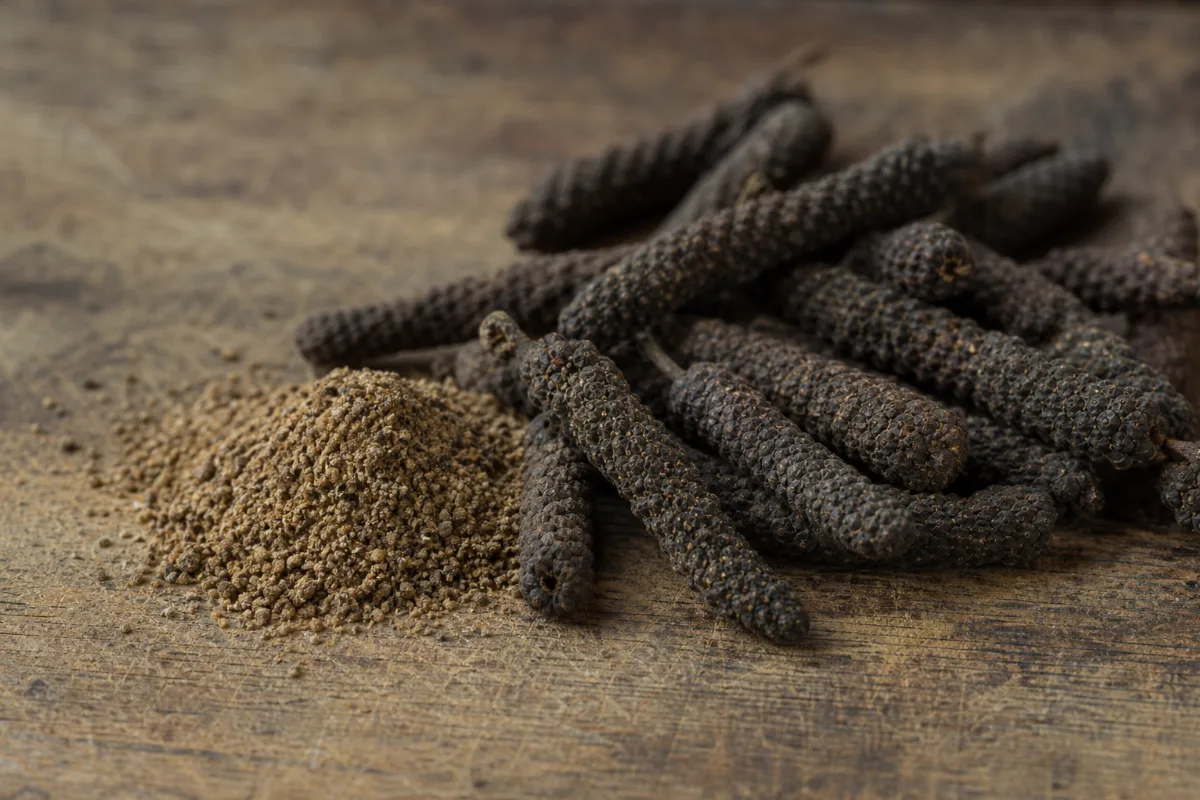
In the kitchen at a glance
Flavor:Hot / pungentSweetWarm / woody
Aroma: Peppery and a little sweet, with hints of clove, nutmeg and pine, and a musky note when heated.
Used in: curries, pickling, soups and stews
Usual amount in food: We found no USDA entry and no source that gives a usual recipe amount; it can generally stand in for black peppercorns.
What it is
Long pepper is the dried fruit of Piper longum, a flowering vine of the pepper family (Piperaceae) that is native to India. [1] The fruits are tiny, about the size of a poppy seed, and sit together in a spike that looks like a small hazel catkin. [2] In Sanskrit it is called pippali, and the English word "pepper" comes from that name. [2] Do not mix it up with black pepper (Piper nigrum) or with chili. A related plant, Piper retrofractum, grows in Java and is sometimes sold as Javanese long pepper. [1][2]Flavor and aroma
It tastes like black pepper, but sweeter and more pungent. [1][3] Its heat comes from piperine, the same compound as in black pepper. [1] One culinary source lists notes of clove, nutmeg, pine and sometimes vanilla, and says it can turn musky when heated, which some people dislike. [3] Because it is sweeter, it suits dishes that already carry warm spices. A 2025 review groups it with other spices called "pepper" that are in fact different plants. [13]How it is used in cooking
Long pepper is usually used whole and can also be ground. [3] The fruits are picked unripe and dried in the sun. [3] It was common in ancient Greece and Rome and in medieval blends, then faded from European kitchens. [1][2]- India and Nepal: vegetable pickles and lentil curries. [2][3]
- Nihari: a slow-cooked meat stew from Lucknow in which pippali is the main spice. It is also one of Pakistan's national dishes. [1][2]
- North Africa: spice mixes such as ras el hanout and felfla harra. [3]
- Ethiopia, Malaysia and Indonesia: stews and other dishes. [3][1]
For a swap, one source says long pepper can generally replace black peppercorns but tastes more pungent and sweeter. [3] The same source says chili is nothing like it and is not a substitute. [3] The sources we opened do not say when to add it, whether to toast it, or how much to use, so we give no rules here.
Normal food amounts
USDA SR Legacy has no entry for this spice, so we show no gram or nutrient figures.| Measure | Grams | Source |
|---|---|---|
| 1 teaspoon or 1 tablespoon | Not available | No USDA entry |
| Typical recipe amount | Not found | We opened no source that states one |
We do not call long pepper a source of any nutrient. It is used in small amounts, for flavor.
Buying, storing and preparing
- Forms: dried whole spikes are the usual form, and they can be ground. [3]
- Where to find it: rare in ordinary shops. Indian grocery stores often sell it as pippali. [1][3]
- Species: check the label. Javanese long pepper is picked ripe and red, unlike P. longum. [3]
- Shelf life, storage and adulteration: the sources we read give no information. Keeping spices dry and away from heat is general good practice, not something a source here states.
Health: what research says
Eating a little long pepper in cooking is very different from taking concentrated extracts or isolated piperine.Food amounts vs supplements
| In normal cooking | In supplements and extracts | |
|---|---|---|
| Typical amount | No usual amount found; no USDA entry | Not set by any official body we found |
| What studies mostly used | No studies of long pepper eaten as food were found | Isolated piperine, extracts, and the three-spice mix trikatu, often in animals or cells [5][8][9] |
| What we can say about benefit | Nothing reliable; no human trial of the spice alone | Lab and animal findings only [10] |
| Main safety limit | Not studied in food amounts | Possible changes in medicine levels [4][5][6] |
What the evidence shows
| Use | What the sources found | Strength of evidence | Form and population |
|---|---|---|---|
| Any health condition | Our Europe PMC search found no completed human trial of the fruit alone. | Insufficient evidence | Fruit or extract |
| Antioxidant, anti-inflammatory, heart, blood sugar, cancer | A 2026 review lists these as activities, mostly from preclinical work. [10] | Lab or animal only | Fruit, extracts, compounds |
| Raising blood levels of other medicines | Piperine blocks P-glycoprotein and CYP3A4 in cell and liver-tissue tests. [5] BfR reviewers found it often raised drug levels in humans and animals. [4] | Promising but limited (this is a safety signal, not a benefit) | Isolated piperine |
| Lowering levels of a painkiller | Trikatu lowered diclofenac levels and its effect in rabbits and rats. [8] | Lab or animal only | Trikatu, animals |
| Cholesterol | A trial of trikatu added to statins is planned; no results yet. [12] | Insufficient evidence | Trikatu, adults at heart risk |
| Traditional use | Trikatu has long been used in Ayurveda; one review suggests it works by raising absorption of other medicines. [9] | Insufficient evidence (tradition is not proof) | Trikatu |
For supplement forms, trials and interactions in depth, see the full herb guide: Long pepper.
Official statements
- BfR (Germany), 2021: advises weighing the health risks of isolated piperine in supplements. It contrasts this with pepper used as seasoning. [4]
- We found no EMA, WHO, FDA or NCCIH statement about long pepper.
Related pages
Health connections for Long pepper
What research links to this spice, and how strong the evidence is. Most studies use concentrated extracts or doses far above what you eat; each card says which.
Trikatu mix lowering a painkiller in animals
Lab or animal research onlyIn rabbits and rats, pretreatment with trikatu (black pepper, long pepper, ginger) lowered diclofenac blood levels and its anti-inflammatory effect.
Supplements: Animal study of a three-spice mix; no human benefit shown.
Liver-cell injury markers in a cell study
Lab or animal research onlyAn extract of Piper longum raised liver-injury markers in cultured liver cells in a 2026 screening study.
Supplements: Not a finding about food use; no human liver report found.
Traditional use in the Ayurvedic mix trikatu
Lab or animal research onlyLong pepper is one of three spices in trikatu; one review suggests the mix may work by raising absorption of the other medicines in a prescription.
Supplements: Tradition is not evidence of benefit.
Antimicrobial, antioxidant, anti-inflammatory and other lab activities
Lab or animal research onlyA 2026 review lists many activities of the fruit and its compounds, mostly from preclinical work.
Supplements: No human trial of the fruit alone found.
Blood fats (trikatu add-on trial planned)
Not enough evidenceA randomized trial of trikatu added to statins in adults at heart risk is registered; no results were available to us.
Supplements: Insufficient evidence.
Connected topics
Open a group to see how each topic connects and how strong the evidence is.
Root causes (1)
- Medication Side EffectsDocumented risk
Piperine, found in long pepper, can change how some medicines are absorbed or cleared. This is mostly shown for isolated piperine; a case report links long pepper to a warfarin problem.
Conditions & symptoms (1)
- Ischemic StrokeDocumented risk
One 2026 case report judged an interaction between warfarin and a long-pepper toothache solution as probable, in a patient who then had a stroke.
Documented risks and interactions (4)
- Possible change in how medicines are absorbed. Piperine, the pungent compound in long pepper and black pepper, blocks a medicine transporter and a liver enzyme in lab tests; reviews report it often raises drug levels.
- Probable warfarin interaction (case report). A 2026 case report judged an interaction between warfarin and a toothache solution containing long pepper as probable, with unstable INR results and an ischemic stroke.
- Monitoring with phenytoin. A 2025 review suggests monitoring when piperine is taken with the seizure medicine phenytoin, because blood levels may rise.
- Reproductive and embryo effects of isolated piperine (animals). BfR reviewers noted that animal studies with high daily doses of isolated piperine showed disturbed sperm production and harm to mothers and embryos.
Frequently asked questions
Is long pepper hot?
Yes, but it is sweeter than black pepper and a little more pungent. [1][3]
How much is normal?
We found no source for a usual amount, and USDA has no entry. It can generally replace black peppercorns. [3]
Is it safe in pregnancy?
We found no source on long pepper as a food in pregnancy. Animal studies of high-dose isolated piperine raised concerns. [4] Ask your midwife or doctor.
Can I take it with medicines?
Piperine can change levels of some medicines, and one case report links long pepper to a warfarin problem. [4][7] Ask a pharmacist if you take prescription drugs.
Is it the same as black pepper or chili?
No. It is a different plant from both. [1][3]
More details: evidence, limits and cautions
The details behind this page: cautions, limits of the evidence and where sources disagree. Open any note to read it.
Safety note at a glance
Safety in more detail
- Medicines: piperine blocks P-glycoprotein and CYP3A4, which help control how much of a drug reaches the blood. [5] A BfR review saw interactions with several drugs, mostly raising drug levels. [4] A 2025 review says piperine with phenytoin should be monitored. [6] A 2026 case report describes a probable interaction between warfarin and a toothache solution containing long pepper, with unstable INR results and a stroke. [7] Trikatu lowered diclofenac in animals, so the direction can vary. [8]
- Pregnancy: BfR noted that animal studies with high daily doses of isolated piperine showed signs of disturbed sperm production and harm to mothers and embryos. [4] The sources we read do not describe long pepper as food in pregnancy.
- Breastfeeding: the sources we read do not describe this.
- Children: the sources we read do not describe this.
- Allergy: the sources we read do not describe allergy to long pepper.
- Liver and kidney: extract of Piper longum raised liver-injury markers in cultured liver cells, which does not show harm in people. [11] We found no human liver report and no kidney information.
- Surgery: no source we read links it to bleeding, but the warfarin case suggests telling your care team. [7]
- Quality and contamination: the sources we read do not describe any.
- Amounts that cause trouble: not defined for food. The BfR concern is about isolated piperine taken as a bolus in supplements. [4]
References
- Wikipedia — Piper longum. https://en.wikipedia.org/wiki/Piper_longum (accessed 2026-10-24)
- Wikipedia — Long pepper (cites Toussaint-Samat, Cobb 2018, Rawlinson 2001). https://en.wikipedia.org/wiki/Long_pepper (accessed 2026-10-24)
- CulinaryLore — What Is Long Pepper? https://culinarylore.com/spices:what-is-long-pepper (accessed 2026-10-24)
- Ziegenhagen R et al. (BfR) — Safety aspects of the use of isolated piperine ingested as a bolus. Foods 2021; abstract read via Europe PMC. https://pubmed.ncbi.nlm.nih.gov/34574230/ (accessed 2026-10-24)
- Bhardwaj RK et al. — Piperine, a major constituent of black pepper, inhibits human P-glycoprotein and CYP3A4. J Pharmacol Exp Ther 2002; abstract read via Europe PMC. https://pubmed.ncbi.nlm.nih.gov/12130727/ (accessed 2026-10-24)
- Optimizing phenytoin therapy: a systematic review of clinically relevant food and herb interactions. 2025; abstract read via Europe PMC. https://pubmed.ncbi.nlm.nih.gov/41560756/ (accessed 2026-10-24)
- Probable interaction between warfarin and a toothache solution containing Piper longum L. leading to ischemic stroke: a case report. 2026; abstract read via Europe PMC. https://pubmed.ncbi.nlm.nih.gov/42066825/ (accessed 2026-10-24)
- Lala LG et al. — Pharmacokinetic and pharmacodynamic studies on interaction of "Trikatu" with diclofenac sodium. J Ethnopharmacol 2004; abstract read via Europe PMC. https://pubmed.ncbi.nlm.nih.gov/15120451/ (accessed 2026-10-24)
- Johri RK, Zutshi U — An Ayurvedic formulation "Trikatu" and its constituents. J Ethnopharmacol 1992; abstract read via Europe PMC. https://pubmed.ncbi.nlm.nih.gov/1434692/ (accessed 2026-10-24)
- From Ancient Spice to Advanced Science: insights into the fruits of Piper longum Linn. 2026; abstract read via Europe PMC. https://pubmed.ncbi.nlm.nih.gov/41710585/ (accessed 2026-10-24)
- UHPLC profiling and network analysis to predict herb-induced liver injury (HepG2 cell study). 2026; abstract read via Europe PMC. https://pubmed.ncbi.nlm.nih.gov/41794385/ (accessed 2026-10-24)
- Trikatu as an add-on to standard care in dyslipidemia: study protocol. PLoS One 2026; abstract read via Europe PMC. https://pubmed.ncbi.nlm.nih.gov/42113738/ (accessed 2026-10-24)
- "Pepper": different spices, one name — analysis of sensory and biological aspects. 2025; abstract read via Europe PMC. https://pubmed.ncbi.nlm.nih.gov/40363698/ (accessed 2026-10-24)