Cumin: Flavor, Cooking Use and Health Facts
Cumin is earthy and warm and a base of curries, chili and stews; trials of cumin supplements on blood sugar are mixed, and some people are allergic to it.
Content last updated . This page has not been medically reviewed.
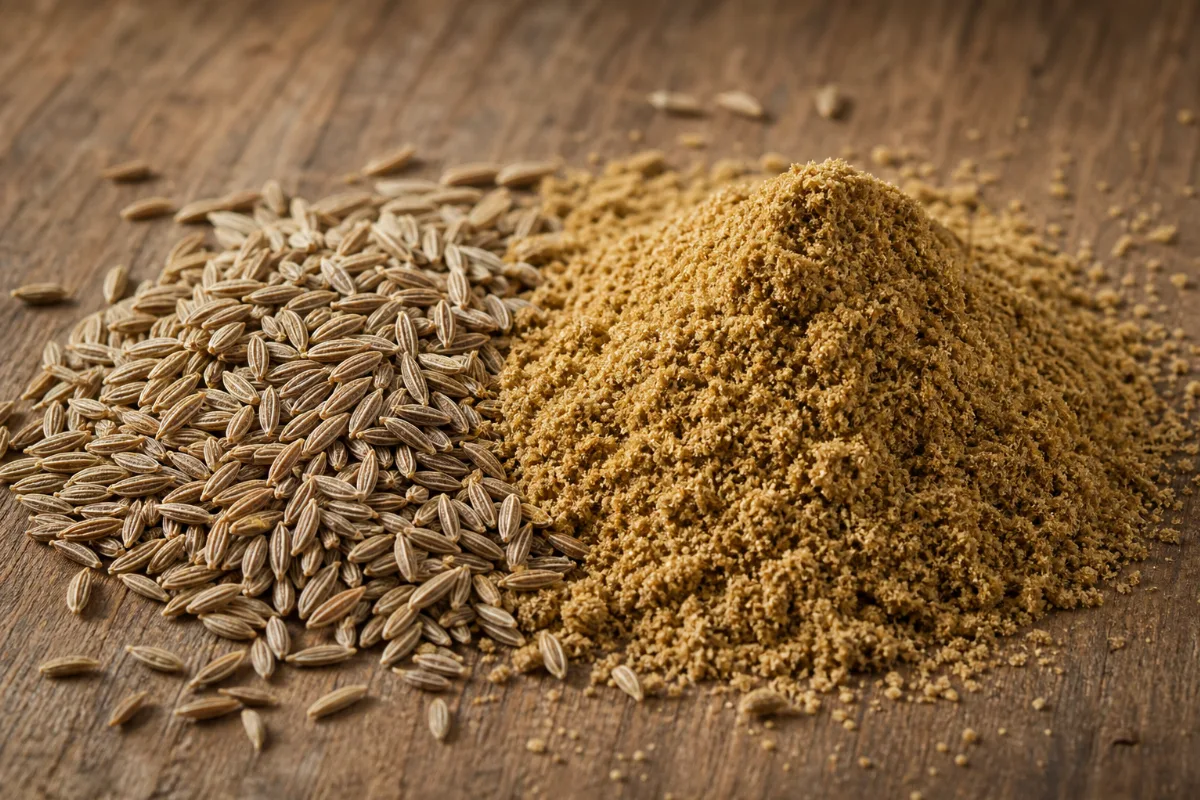
In the kitchen at a glance
Flavor:EarthyWarm / woody
Aroma: Warm, earthy and slightly musky, and stronger after toasting.
Used in: curries, soups and stews, pickling
Usual amount in food: USDA lists 2.1 g per teaspoon of whole seed; we found no source that sets a usual recipe amount.
What it is
Cumin is the dried seed of Cuminum cyminum, a small annual plant in the parsley family (Apiaceae). Each "seed" is really a dried fruit that holds one seed. [1] The plant likely began in Central Asia, southwest Asia or the eastern Mediterranean. Today most of the world's crop, about 70 percent, comes from India, with Syria, Turkey, Iran and others growing the rest. [1]Cumin looks a lot like caraway, and some languages use one word for both. "Black cumin" is a different plant (Nigella sativa and others), not a darker kind of cumin. [1]
Flavor and aroma
Cumin tastes earthy and warm. It is not sweet and not hot like chili. [1] Cuminaldehyde is the main aroma compound in the seed. [1] Toasting adds new aroma compounds called pyrazines, which is why toasted cumin smells deeper and nuttier. [1]McCormick says that warming cumin in a dry pan on medium-low heat, stirring until it smells noticeably more fragrant, can revive a fading jar. Frying it in hot oil just before cooking is another way, and it is especially useful for cumin. Ground spice burns easily, so watch the pan. [2]
How it is used in cooking
Cumin is used either as whole seeds or ground. [1]- India and Pakistan: a staple in many dishes and the base of many spice blends. It is often paired with ground coriander in a mix called dhana jeera. [1]
- Persia: both black and green cumin are used. [1]
- Mexico and Tex-Mex: a common part of chili powder. [1]
- Elsewhere: some French breads and Leyden cheese contain it. In Morocco a bowl of cumin still sits on the table, a habit the source traces to ancient Greece. [1]
- Dishes: stews, soups, curries, chili, pickles and pastries. [1]
- Blends that include it: garam masala, curry powder, chili powder, adobo, sofrito, achiote blends and bahaarat. [1]
The sources we read do not give rules for when to add it, or reliable swaps, so we give none here. [1][2]
Normal food amounts
| Measure | Grams | Source |
|---|---|---|
| 1 teaspoon, whole seed | 2.1 g | USDA [13] |
| 1 tablespoon, whole seed | 6.0 g | USDA [13] |
| Typical recipe amount | Not found | We opened no source that states one |
What one teaspoon (2.1 g) of whole cumin seed provides, calculated from USDA values per 100 g:
| Nutrient | One teaspoon |
|---|---|
| Energy | about 8 kcal |
| Fiber | about 0.2 g |
| Iron | about 1.4 mg |
| Calcium | about 20 mg |
| Magnesium | about 8 mg |
| Potassium | about 38 mg |
The USDA SR Legacy data are from 2018, and real products vary. [13] Per 100 g, cumin looks rich in iron, but nobody eats 100 g. We did not compare these numbers with official daily values, so we do not call cumin a "good source" of anything. A teaspoon is mostly flavor.
Buying, storing and preparing
- Forms: whole seeds and ground powder. Whole seeds keep their flavor longer. [2]
- Shelf life: McCormick lists ground cumin at 2 to 4 years and whole spices at 3 to 4 years. Other cooking sites give much shorter times, so treat any number as a guide. Aroma is the real test: when the smell fades, the spice is past its best. [2]
- Storing: keep it away from direct sun and heat, and not on the ledge above the stove. Write the opening date on the jar. [2]
- Grinding at home: the sources we read do not cover it. Toasting whole seeds first and grinding them yourself is a common cook's habit but we did not find a source that states it.
- Contamination: in April 2023 a company recalled one lot of ground cumin in 16 US states because it might carry Salmonella. No illnesses were reported. [12] This is one recall, not proof that cumin is generally unsafe.
Health: what research says
Eating cumin in cooking is different from taking concentrated cumin products.Food amounts vs supplements
| In normal cooking | In supplements and extracts | |
|---|---|---|
| Typical amount | About 2.1 g per teaspoon (USDA); no usual recipe amount found [13] | Not stated in the abstracts we read; they do not say which form each trial used [5][7] |
| What studies mostly used | We found no study of cumin used as a food spice | "Cumin supplementation" given to adults with diabetes or metabolic problems, for 8 to 24 weeks in one review [5][7] |
| What we can say about benefit | Nothing from trials. The US National Library of Medicine says cumin is generally well tolerated [3] | Lower blood sugar in some pooled analyses but not others; lower cholesterol in one [5][6][8] |
| Main safety limit | Allergy; the FDA treats it as safe as a spice [3][9][11] | Pregnancy: large amounts not advised; breastfeeding data lacking [3][4] |
What the evidence shows
| Use | What the sources found | Strength of evidence | Form and population |
|---|---|---|---|
| Fasting blood sugar | A 2021 review of 8 trials (552 adults) found no significant change in fasting blood sugar, insulin or insulin resistance and said the results do not support cumin for this. [5] Another 2021 review of 8 studies found lower fasting blood sugar and HbA1c. [6] A 2025 review of 9 trials found lower fasting blood sugar, with very large differences between studies. [7] | Mixed | Cumin supplements; adults, including people with long-term disease [5][6][7] |
| Blood fats | A 2018 review of 6 trials (376 adults) found lower total and LDL cholesterol and higher HDL. Triglycerides did not change significantly overall. [8] The 2025 review found lower triglycerides and higher HDL. [7] | Promising but limited | Cumin supplements; adults [7][8] |
| Waist size | The 2025 review found a smaller waist measurement and asked for larger, better trials. [7] | Promising but limited | Adults with metabolic disorders; supplements [7] |
| Digestion, immunity, weight loss | Not reported in the sources we read | Insufficient evidence | None identified |
| Use in cooking | No study found | Insufficient evidence | Food amounts |
Changes in blood tests are not the same as fewer heart attacks or better long-term health. The reviews did not report such outcomes.
For supplement forms, trials and interactions in depth, see the full herb guide: Cumin.
Official statements
- FDA (US), 21 CFR 182.10: lists cumin among spices and natural seasonings. [11]
- LactMed (US National Library of Medicine): cumin is "generally recognized as safe" as a spice and flavoring, and generally well tolerated. [3]
We found no EFSA or EMA opinion that we could open.
Related pages
Health connections for Cumin
What research links to this spice, and how strong the evidence is. Most studies use concentrated extracts or doses far above what you eat; each card says which.
Fasting blood sugar markers
Preliminary or mixedPooled trials of cumin supplements disagree: one review of 8 trials found no significant change in fasting blood sugar, while two others found lower fasting blood sugar.
Supplements: Supplement finding only; the abstracts do not name the form used; no study of food amounts found. It does not replace diabetes care.
Blood cholesterol
Preliminary or mixedA 2018 pooling of 6 trials (376 adults) found lower total and LDL cholesterol and higher HDL after cumin supplements.
Supplements: Supplement finding only; small trials; no study of cooking amounts.
Triglycerides and waist size
Preliminary or mixedA 2025 pooling of 9 trials in adults with metabolic disorders found lower triglycerides and a smaller waist measurement, with very large differences between studies.
Supplements: Supplement finding only; high variation between studies.
Traditional use for milk supply
Not enough evidenceLactMed says cumin has been used traditionally in India, Pakistan and Turkey to support milk supply, with some literature support, but no data exist on safety or effect in nursing mothers.
Supplements: No good evidence of benefit; no breastfeeding safety data.
Connected topics
Open a group to see how each topic connects and how strong the evidence is.
Health goals (3)
- Blood Sugar BalancePreliminary or mixed
Pooled trials of cumin supplements disagree on blood sugar; evidence is for supplements, not food amounts.
- Cholesterol BalancePreliminary or mixed
A pooled analysis of 6 supplement trials found lower total and LDL cholesterol; small trials, supplements only.
- Metabolic HealthPreliminary or mixed
A 2025 pooling found changes in blood sugar, triglycerides, HDL and waist size in adults with metabolic disorders; authors ask for larger trials.
Body systems (4)
- Blood Sugar SupportPreliminary or mixed
Pooled trials of cumin supplements disagree on blood sugar; evidence is for supplements, not food amounts.
- Metabolism & WeightPreliminary or mixed
Supplement trials report changes in several metabolic-syndrome markers; evidence limited.
- Heart & CirculationPreliminary or mixed
A 2018 pooling found lower total and LDL cholesterol; no heart outcomes were measured.
- Immune SupportDocumented risk
Allergic reactions to cumin and related spices are reported. This is a risk, not a benefit.
Body parts (1)
- SkinDocumented risk
LactMed reports occasional skin reactions to sunlight after contact with the oil.
Functional actions (1)
- Blood Sugar RegulationPreliminary or mixed
Pooled trials of cumin supplements disagree on blood sugar; evidence is for supplements, not food amounts.
Root causes (1)
- Blood Sugar ImbalancePreliminary or mixed
Pooled trials of cumin supplements disagree on blood sugar; evidence is for supplements, not food amounts.
Biomarkers (6)
- Blood GlucosePreliminary or mixed
Fasting blood sugar: no significant change in one review, lower in two others.
- LDL CholesterolPreliminary or mixed
A 2018 pooling of 6 trials found lower LDL after cumin supplements.
- HbA1cPreliminary or mixed
One 2021 review reported lower HbA1c; not measured in the others we read.
- HDL CholesterolPreliminary or mixed
HDL was higher in a 2018 and a 2025 pooling of supplement trials, with large differences between studies in 2025.
- InsulinPreliminary or mixed
Two 2021 reviews found no significant change in insulin.
- TriglyceridesPreliminary or mixed
Not significantly changed overall in 2018; lower in a 2025 pooling with very high variation.
Conditions & symptoms (3)
- Food AllergyDocumented risk
Cumin is among spices reported to cause allergic reactions, with possible cross-reaction in people allergic to birch or mugwort pollen or celeriac.
- Metabolic Syndrome XPreliminary or mixed
A 2025 pooling of supplement trials in adults with metabolic disorders found changes in several markers; authors call for larger trials.
- Salmonella InfectionsDocumented risk
One lot of ground cumin was recalled in 2023 over possible Salmonella; no illnesses were reported. This is one recall, not a general finding.
Documented risks and interactions (4)
- Allergy to cumin and related spices. Cumin is among spices reported to cause allergic reactions; people allergic to birch or mugwort pollen or celeriac may react to cumin proteins.
- Pregnancy: information lacking. A 2017 review lists cumin as 'information unavailable' for human pregnancy and advises food amounts only.
- Skin reactions to sunlight after contact with the oil. LactMed reports occasional skin reactions to sunlight after contact with cumin oil.
- Salmonella contamination in one recalled lot. In April 2023 one lot of ground cumin was recalled in 16 US states over possible Salmonella; no illnesses were reported.
Frequently asked questions
Is cumin hot or sweet?
Neither. It is earthy and warm, with a deeper aroma after toasting. [1]
How much is normal?
USDA lists 2.1 g per teaspoon of whole seed. [13] We found no source that sets a usual recipe amount.
Is cumin the same as black cumin?
No. Black cumin names other plants, such as Nigella sativa. [1]
Is it safe in pregnancy?
A 2017 review says food amounts only, and notes that information on larger amounts is lacking. [4] Ask your midwife or doctor.
Can I take it with medicines?
In food amounts, the sources we read name no problems. If you take diabetes medicine, ask a pharmacist before using supplements. [5][6]
Can I be allergic to cumin?
Yes. It is among the spices reported to cause allergic reactions, and people allergic to related plants may react. [3][9][10]
More details: evidence, limits and cautions
The details behind this page: cautions, limits of the evidence and where sources disagree. Open any note to read it.
Safety note at a glance
Safety in more detail
- Medicines: the sources we read describe no drug interaction. Because some trials measured lower blood sugar, ask a pharmacist if you take diabetes medicine and are considering supplements. That is a precaution, not a documented interaction. [5][6]
- Pregnancy: a 2017 review lists cumin as "information unavailable" for human pregnancy. It advises that everyday food herbs such as cumin be used only in the amounts found in food. [4]
- Breastfeeding: LactMed says no data exist on cumin components in breastmilk or on its safety in nursing mothers or infants. It notes cumin has been used traditionally in India, Pakistan and Turkey to support milk supply. [3]
- Children: a 2025 review lists cumin among spices implicated in allergic reactions in children. [10] The sources we read give no other child-specific advice.
- Allergy: a 1997 laboratory study found that blood from some people allergic to birch or mugwort pollen or celeriac reacted to anise, fennel, coriander and cumin proteins. [9] The 2025 review reports reactions from mild mouth symptoms to anaphylaxis for spices in general. [10] LactMed says people allergic to cumin or related herbs should avoid it. [3]
- Skin: LactMed reports occasional skin reactions to sunlight after contact with the oil. [3]
- Liver and kidney: the sources we read do not describe liver or kidney problems.
- Surgery: the sources we read do not describe a surgery warning. Tell the surgical team about any supplement.
- Quality and contamination: one ground cumin lot was recalled in 2023 for possible Salmonella. [12] LactMed notes supplement contents can differ from the label. [3]
- Amounts that cause trouble: the sources we read give no food amount that causes harm. For pregnancy, see above. [4]
References
- Wikipedia — Cumin (cites USDA, Britannica and spice-trade references). https://en.wikipedia.org/wiki/Cumin (accessed 2026-10-24)
- McCormick — How long do spices last? https://www.mccormick.com/blogs/how-to/how-long-do-spices-last (accessed 2026-10-24)
- LactMed, US National Library of Medicine — Cumin; record read via Europe PMC. https://pubmed.ncbi.nlm.nih.gov/30000933/ (accessed 2026-10-24)
- Ahmed M et al. — Safety classification of herbal medicines used among pregnant women in Asian countries: a systematic review. BMC Complement Altern Med 2017; full text via Europe PMC. https://pmc.ncbi.nlm.nih.gov/articles/PMC5686907/ (accessed 2026-10-24)
- The effect of cumin supplementation on glycemic indices: a systematic review and meta-analysis of randomized controlled trials. Phytother Res 2021; abstract read via Europe PMC. https://pubmed.ncbi.nlm.nih.gov/33720457/ (accessed 2026-10-24)
- The effects of Cuminum cyminum on glycemic parameters: a systematic review and meta-analysis of controlled clinical trials. J Ethnopharmacol 2021; abstract read via Europe PMC. https://pubmed.ncbi.nlm.nih.gov/34371114/ (accessed 2026-10-24)
- Potential benefits of Cuminum cyminum L supplementation on components of metabolic syndrome in adults with metabolic disorders. Front Nutr 2025; abstract read via Europe PMC. https://pubmed.ncbi.nlm.nih.gov/41608519/ (accessed 2026-10-24)
- Cumin is a safe approach for management of lipid parameters: a systematic review and meta-analysis of randomized controlled trials. Phytother Res 2018; abstract read via Europe PMC. https://pubmed.ncbi.nlm.nih.gov/30088304/ (accessed 2026-10-24)
- Characterization of allergens in Apiaceae spices: anise, fennel, coriander and cumin. Clin Exp Allergy 1997; abstract read via Europe PMC. https://pubmed.ncbi.nlm.nih.gov/9420134/ (accessed 2026-10-24)
- Spices, herbs and allergic reactions in children: myth or reality. Front Allergy 2025; abstract read via Europe PMC. https://pubmed.ncbi.nlm.nih.gov/41306764/ (accessed 2026-10-24)
- US eCFR — 21 CFR 182.10, Spices and other natural seasonings and flavorings. https://www.ecfr.gov/current/title-21/chapter-I/subchapter-B/part-182/subpart-A/section-182.10 (accessed 2026-10-24)
- WTOP — Ground cumin recalled in 16 states, including Va., over salmonella risk (reporting a company announcement posted by FDA), 24 April 2023. https://wtop.com/recalls/2023/04/ground-cumin-recalled-in-16-states-including-va-over-salmonella-risk/ (accessed 2026-10-24)
- USDA FoodData Central, SR Legacy (April 2018) — Spices, cumin seed (fdc_id 170923), per-100 g values and household portions from the site's USDA data file.