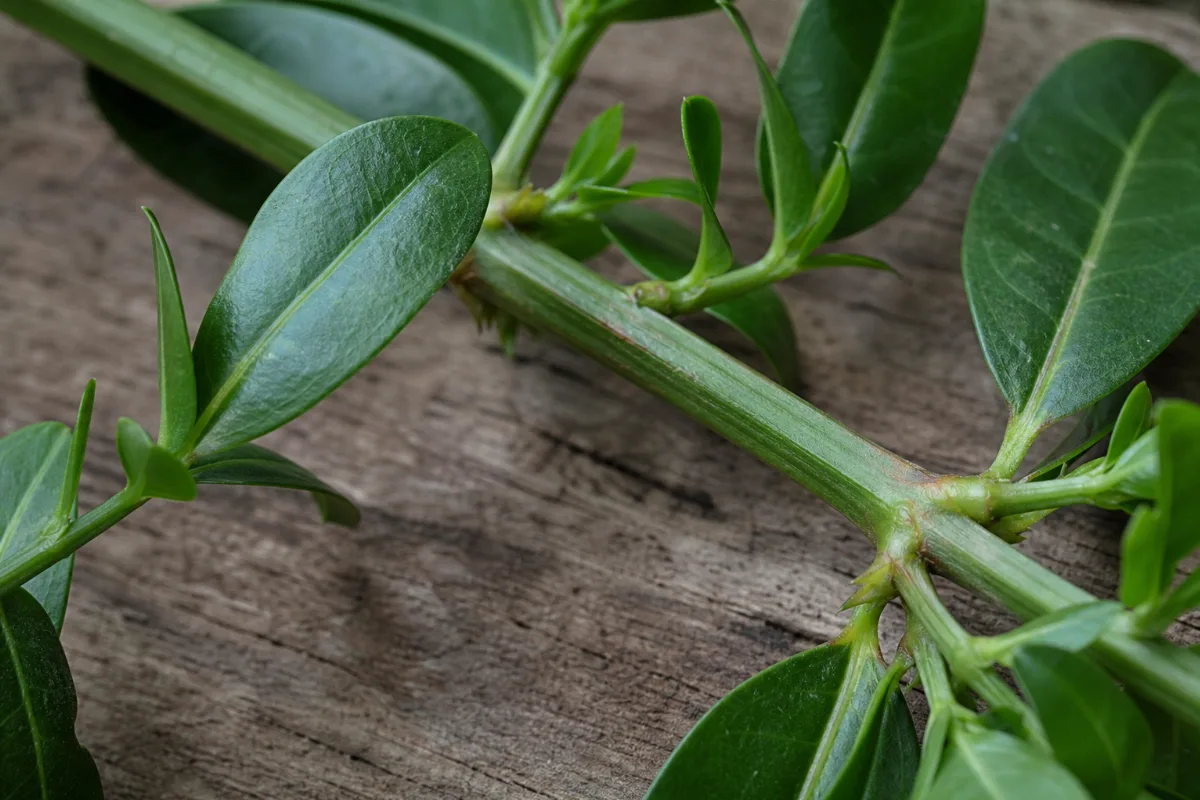
Herbs & Botanicals · Marketed testosterone herb
Fadogia agrestis
Fadogia agrestis · also called Fadogia
Fadogia agrestis is an African shrub whose stem or root is sold as a "testosterone booster". That claim rests on a few rat studies, and no controlled trial in people was found. In rats, the same extract also changed testicular measures the researchers called adverse and showed liver and kidney cell stress. Supplements vary widely in what they hold, so talk to a doctor before using it.
General information, not medical advice. Last substantive update · Not medically reviewed. A named clinician has not signed off on this page. How this page is made
About Fadogia agrestis
Fadogia agrestis is a shrub from tropical Africa, sold mainly as a testosterone supplement. The research is a handful of rat studies by one group. There is no controlled human trial. The same rat work points to testicular, liver and kidney warning signs.
What it is
Fadogia agrestis is a shrub from tropical Africa in the coffee family (Rubiaceae). The plant database GBIF now lists the name as a synonym of Vangueria agrestis, but labels and papers still say Fadogia agrestis. NCBI Taxonomy returns the same record (ID 1285872) for both names.
Do not confuse it with tongkat ali or Tribulus. Those are different plants with their own evidence. Many products blend several 'testosterone' herbs, and no study tests Fadogia together with them.
What is in it
Chemists have found saponins related to pomolic acid, flavonoids such as rutin and hyperoside, and monoterpene sugar compounds in the roots and aerial parts. A 2005 screen of the stem extract reported alkaloids and saponins without naming them. Nobody knows which compound, if any, explains the rat results.
The rat studies used a water extract of the stem. Chemistry papers and quality tests used roots and aerial parts, so the results may not carry across from one to the other.
What the research shows
The testosterone claim comes from one 2005 rat study: blood testosterone and mating behaviour rose in treated male rats. A 2023 rat study found that the extract moved erection-related tissue markers toward normal in rats given a drug that causes erection problems. Its authors say clinical trials must come first.
We found no controlled trial in people and no human study of any kind. A review of 52 studies of 27 'testosterone boosters' concluded most fail to raise testosterone, and a survey of 50 products found data for a rise for only about a quarter of them. Neither names Fadogia.
At a glance
Traditional uses history, not proof
- Pain reliever and anti-inflammatory in traditional African medicine
- Aphrodisiac in traditional African medicine
- Decoction for fever, pain and malaria
Studied for research
- Testosterone: rats only, no human trial
- Sexual behaviour and erection markers: rats only
- Male fertility: rat testicular findings called adverse
- Malaria and sleeping-sickness parasites: lab only
- Muscle and strength claims: no study found
Main compounds
- Pomolic acid glycosides (core: PubChem CID 382831)
- Rutin (CID 5280805)
- Hyperoside (CID 5281643)
- Narcissoside (narcissin, CID 5481663)
- Monoterpene rhamnosides
Common forms
- Capsule or powder
- Stem or root extract
- Multi-ingredient blends
Research links: Yakubu 2005: testosterone and behaviour in rats (PubMed) · Yakubu 2008: testicular indices in rats (PubMed) · Yakubu 2009: liver and kidney in rats (PubMed) · Avula 2019: what is in Fadogia supplements (PubMed) · Clemesha 2020: testosterone booster claims (PubMed) · Research Library · Genes & Biomarkers Library
The plant and its history
- Accepted scientific name
- Vangueria agrestis (Schweinf. ex Hiern) Lantz
- Naming authority
- (Schweinf. ex Hiern) Lantz
- Synonyms
- Fadogia agrestis Schweinf. ex Hiern (GBIF key 2917834); Fadogia agrestis Schweinf. (GBIF key 8649977)
- Common names
- Fadogia (English)
- Botanical family
- Rubiaceae (coffee or madder family)
- Classification
- Plantae > Tracheophyta > Magnoliopsida > Gentianales > Rubiaceae > Vangueria > Vangueria agrestis
- Native range
- Tropical Africa (Avula 2020). Used in traditional medicine in Burkina Faso and exported from Ghana; the full native range was not looked up.
- Habitat
- Not found in the sources read.
- What the plant looks like
- Roots: Roots are analysed in chemistry papers; no description of appearance found.; Stems: Aqueous stem extract used in the rat studies; no description found.; Leaves: Not described in sources read.; Flowers: Not described in sources read.; Fruit: Not described in sources read.
- Cultivation
- Not found. Ghana's herbal market survey lists F. agrestis bark among material exported each year; farming was not described.
- Harvest and processing
- Not found. The authors of the Ghana survey call for research on the ecological impact of extraction.
- Look-alikes and adulterants
- Name: Other Fadogia and Vangueria species; Note: Related species in the same family cause gousiekte in livestock (for example Fadogia homblei); the papers read do not say whether F. agrestis does. Correct species identity matters.; Name: Tongkat ali (Eurycoma longifolia) and Tribulus terrestris; Note: Not look-alikes, but sold in the same 'testosterone' products. Different plants with different evidence.
- Sustainability and conservation
- No conservation assessment was found. Wild-collected bark is exported from Ghana (van Andel 2012).
Traditional use and history history, not clinical proof
| Tradition or era | Documented use | Source |
|---|---|---|
| Traditional African medicine | Used as a pain reliever, anti-inflammatory and aphrodisiac. | p30170324 |
| Traditional medicine (decoction) | Decoction for fever, pain and malaria. | p32251526 |
| Traditional practitioners in Burkina Faso | Cited among plants for malaria in an ethnobotanical survey. | p12738078 |
| Modern supplement marketing | Sold as a 'testosterone booster', often in blends. Social-media claims were NOT used as sources and are NOT verified; the scientific basis is a few rat studies. | p31385468 |
Traditional use shows how a plant was used. It does not show that a supplement works or is safe today.
What is inside, and how it may work
What the plant contains and how those compounds act in cells and animals. Laboratory and animal mechanisms are not proven effects in people.
Main compounds
| Compound | Family | Where it is concentrated | Activity studied | Level of evidence |
|---|---|---|---|---|
| Pomolic acid glycosides (ursane saponins) PubChem 382831 | Triterpenoid saponin | Roots and aerial parts | Structures only. CID is for the sugar-free core pomolic acid; the plant holds sugar-attached forms. Some root glycosides were active against Trypanosoma brucei in the lab. 12 13 | Laboratory research |
| Rutin PubChem 5280805 | Flavonoid glycoside | Aerial parts | Identified only; used as a marker compound. 13 3 | Lab analysis |
| Hyperoside PubChem 5281643 | Flavonoid glycoside | Aerial parts | Identified only. 13 | Lab analysis |
| Narcissoside (PubChem title: narcissin) PubChem 5481663 | Flavonoid glycoside | Aerial parts | Identified only. 13 | Lab analysis |
| Monoterpene rhamnosides (including vangagrestosides A to C) | Monoterpene glycoside | Aerial parts and plant extract | Structures only; no health activity reported. No single PubChem record was matched. 2 13 | Lab analysis |
| Benzophenone glycosides and an iridoid glucoside | Phenolic and iridoid glycosides | Roots | One benzophenone glycoside was active against Trypanosoma brucei in the lab. 12 | Laboratory research |
| Alkaloids and saponins (unnamed) | Screening result | Stem (aqueous extract) | A 2005 phytochemical screen reported these classes without naming compounds. Which compound, if any, raises testosterone is unknown. 17 | Animal research |
Mechanisms, receptors and pathways
| Target or pathway | Gene or receptor | What was found | Level |
|---|---|---|---|
| Testosterone (blood level) | Not specified | Higher serum testosterone in rats given the stem extract; mechanism not shown. 17 | Animal research |
| Nitric oxide and cGMP signalling; PDE5 enzyme | PDE5 (enzyme) | In a paroxetine rat model the extract raised nitric oxide and cGMP and lowered PDE5, like sildenafil. 11 | Animal research |
| Antioxidant enzymes (catalase, SOD, glutathione) and TBARS/H2O2 | Not specified | Raised antioxidant enzymes and lowered oxidation markers in the paroxetine rat model. 11 | Animal research |
| Cell-membrane lipid peroxidation in liver and kidney | Not specified | Serum malondialdehyde rose and tissue membrane enzymes leaked into blood in healthy rats given the extract; the authors propose disrupted membranes. This conflicts with the antioxidant story in the other model. 19 | Animal research |
| Plasmodium falciparum and Trypanosoma brucei growth | Not specified | Growth slowed in culture by an alkaloid extract and by isolated root compounds. 14 12 | Laboratory research |
Absorption, metabolism and elimination
- Absorption
- No data in people or animals were found.
- Distribution
- Not found.
- Metabolism
- Not found.
- Elimination
- Not found.
- Bioavailability
- Not found.
Isolated compounds versus whole extracts
The rat studies used a water extract of the stem. The chemistry papers analysed roots and aerial parts, and the product analysis used a method for roots and aerial parts, so we cannot tell which of the identified compounds are in the rat extract. Supplements are sold as capsules or powders of unstated part and strength. Results from one preparation should not be assumed for another.
Nutritional composition
Fadogia is a medicinal or supplement plant, not a food source of nutrients.
8 not enough evidence
What is Fadogia agrestis good for?
The studied uses and how strong the human evidence is. For Fadogia agrestis it is very weak: there is no controlled human trial, only rat and lab work.
Benefits, one by one
Each card is a research question, not a promise. Tap a goal to filter. Open a card to see the studies, doses and limits.
Blood testosterone (rats only)
Not enough evidenceIn one 2005 study, male rats given a water extract of the stem had higher blood testosterone. This is the study behind most online claims. No human trial has tested it.
3 studiesRat studies used 18, 50 and 100 mg/kg of an aqueous stem extract. Rat…
Studies, doses and limits
What the trials found
No controlled trial in people was found in PubMed or Europe PMC, and no human study of any kind on this use.
Results
Serum testosterone rose in all three dose groups, in a pattern the authors call suggestive of dose dependence. The abstract's statistics are unreadable, so only the direction of change is stated.
Effect sizes as reported
No numbers can be quoted from the abstract.
Why this rating
Rat data from one research group; no human trial; no replication by an independent group was found.
Form and dose studied
Rat studies used 18, 50 and 100 mg/kg of an aqueous stem extract. Rat doses cannot be turned into a human amount. Shop products may differ in plant part and strength.
Who was studied
Male rats.
Limits
Rats are not men. The same research group also found harm signals in the testes and in liver and kidney tissue (see the safety tab). A 2024 systematic review of 'testosterone boosters' concluded most fail to raise testosterone in controlled studies, and it did not list Fadogia.
Why researchers looked
Fadogia is sold as a 'testosterone booster', and this rat study is the main source for that claim.
Traditional use
Used in traditional African medicine as an aphrodisiac, a pain reliever and an anti-inflammatory (per Avula 2019).
Proposed mechanism Animal research
Not shown. The authors suggest the testosterone rise explains the behaviour changes. Screening of the extract found alkaloids and saponins.
A proposed mechanism does not show that the effect happens in people.
See the safety tab, especially the rat testicular findings.
Sexual behaviour (rats only)
Not enough evidenceTreated male rats mounted and entered more often and started sooner. This is animal behaviour and does not show a benefit for sex drive in men.
1 studiesRat doses of 18 to 100 mg/kg daily for 5 days. Rat doses cannot be tu…
Studies, doses and limits
What the trials found
No controlled trial in people was found in PubMed or Europe PMC, and no human study of any kind on this use.
Results
Mount frequency and intromission frequency rose, mount and intromission latency fell, and ejaculatory latency was longer, at all three doses over five days of dosing.
Effect sizes as reported
Direction only; P values unreadable in the abstract.
Why this rating
Animal behaviour test from one group; no human data.
Form and dose studied
Rat doses of 18 to 100 mg/kg daily for 5 days. Rat doses cannot be turned into a human amount.
Who was studied
Male rats.
Limits
Animal mating behaviour is a poor model of human libido, and the study lasted only five days.
Why researchers looked
Tested because the plant is traditionally used as an aphrodisiac.
Traditional use
Aphrodisiac use is described in traditional African medicine (per Avula 2019).
Proposed mechanism Animal research
Not shown; the authors link it to the testosterone rise.
A proposed mechanism does not show that the effect happens in people.
See the safety tab.
Erection-related tissue markers (rats only)
Not enough evidenceIn rats given the drug paroxetine to cause erection problems, the extract moved tissue markers toward normal, much like sildenafil. The authors say clinical trials must come first.
1 studiesRat doses of 18, 50 and 100 mg/kg. Rat doses cannot be turned into a …
Studies, doses and limits
What the trials found
No controlled trial in people was found in PubMed or Europe PMC, and no human study of any kind on this use.
Results
Markers moved toward the levels of healthy control rats, as they did with sildenafil (50 mg/kg).
Effect sizes as reported
Statistically significant versus the paroxetine-only group (P < 0.05); no effect sizes in the abstract.
Why this rating
Small rat model (5 per group), markers not human erections.
Form and dose studied
Rat doses of 18, 50 and 100 mg/kg. Rat doses cannot be turned into a human amount.
Who was studied
Male Wistar rats with drug-induced erection problems.
Limits
Tissue markers do not equal erections; the effect on PDE5 means a possible overlap with erection medicines, which has not been studied in people.
Why researchers looked
Tested to find out how the extract might act on erection chemistry.
Traditional use
Aphrodisiac use is traditional.
Proposed mechanism Animal research
In rat penile and testicular tissue the extract raised nitric oxide, cGMP and antioxidant enzymes and lowered PDE5, arginase, ACE and oxidative markers.
A proposed mechanism does not show that the effect happens in people.
Possible overlap with medicines such as sildenafil is untested (see interactions).
Sex drive and energy in men (claimed, no human trial)
Not enough evidenceOnline and in shops, Fadogia is promoted for libido, drive and vitality in men. We found no human study of any kind to support this.
3 studiesNot applicable.
Studies, doses and limits
What the trials found
No controlled trial in people was found in PubMed or Europe PMC, and no human study of any kind on this use. Europe PMC titles show chemistry, rat, product and lab papers only.
Results
No human results exist.
Effect sizes as reported
None.
Why this rating
No human evidence at all.
Form and dose studied
Not applicable.
Who was studied
Not applicable.
Limits
A broad review of 50 'testosterone booster' products found data for a testosterone rise for about a quarter of them and none for most; the abstract does not name Fadogia.
Why researchers looked
This is what the product claims are about.
Traditional use
None documented for this specific claim.
Proposed mechanism Pharmacological theory
None established in people.
A proposed mechanism does not show that the effect happens in people.
See the safety tab before any use.
Male fertility and testicular function (rat harm signals)
Not enough evidenceIn rats given the extract for 28 days, testicular measures changed in ways the researchers called adverse. This is the opposite of a benefit and is the main reason for caution for men who want children.
1 studiesRat doses of 18, 50 and 100 mg/kg. Rat doses cannot be turned into a …
Studies, doses and limits
What the trials found
No human fertility or semen study was found.
Results
At 18, 50 and 100 mg/kg for 28 days the testes-to-body-weight ratio, testicular cholesterol and some enzymes rose, while testicular alkaline phosphatase, glutamate dehydrogenase and protein fell. The authors read this as adverse effects on testicular function. Some measures recovered during 10 days off, mainly at 18 mg/kg.
Effect sizes as reported
No sperm counts or fertility outcomes in the abstract.
Why this rating
Single rat study; no human data. The direction is a warning, not proof of harm to men.
Form and dose studied
Rat doses of 18, 50 and 100 mg/kg. Rat doses cannot be turned into a human amount.
Who was studied
Male rats.
Limits
Short recovery period; relevance to men unknown.
Why researchers looked
Tested to check the safety of the extract on the testes.
Traditional use
Not applicable.
Proposed mechanism Animal research
Not established; the authors describe changes in testicular enzymes, cholesterol, sialic acid, glycogen and protein.
A proposed mechanism does not show that the effect happens in people.
Men trying to conceive, or with fertility concerns, should treat this as a reason to avoid it unless a doctor agrees.
Activity against malaria and sleeping-sickness parasites (lab only)
Not enough evidenceIn test tubes, an alkaloid extract slowed the malaria parasite and two root compounds slowed a sleeping-sickness parasite. This does not make it a treatment.
2 studiesNot applicable.
Studies, doses and limits
What the trials found
No animal or human malaria study was found.
Results
Alkaloid extract of F. agrestis: IC50 between 4 and 10 micrograms/mL against chloroquine-resistant Plasmodium falciparum in the lab. Two root compounds: IC50 22.3 and 11.1 micromolar against Trypanosoma brucei.
Effect sizes as reported
Lab potency only; one other plant in the malaria study did better.
Why this rating
Test-tube results only.
Form and dose studied
Not applicable.
Who was studied
Parasites in culture.
Limits
Test tube results often do not carry over to animals or people. Do not use it to treat malaria; see a doctor for fever.
Why researchers looked
The plant is used in West African traditional medicine for fever and malaria.
Traditional use
Traditional practitioners in Burkina Faso cite it (Sanon 2003); decoctions are used for fever, pain and malaria (Avula 2020).
Proposed mechanism Laboratory research
Not established.
A proposed mechanism does not show that the effect happens in people.
Fever after travel to a malaria area is an emergency.
Pain, inflammation and fever (traditional use)
Not enough evidenceTraditional African medicine uses the plant for pain, fever and inflammation. We found no study that tests this in animals or people.
2 studiesNot applicable.
Studies, doses and limits
What the trials found
No human study was found.
Results
No results exist.
Effect sizes as reported
None.
Why this rating
Tradition only. Tradition is not proof that it works.
Form and dose studied
Not applicable.
Who was studied
Not applicable.
Limits
These statements come from the introductions of chemistry papers, not from tests.
Why researchers looked
Described as traditional use in the chemistry papers.
Traditional use
Pain reliever and anti-inflammatory use in traditional African medicine; decoction for fever, pain and malaria.
Proposed mechanism Pharmacological theory
None established.
A proposed mechanism does not show that the effect happens in people.
None specific.
Muscle, strength and body composition (claimed, no study)
Not enough evidenceGym and online claims say Fadogia builds muscle. We found no study of muscle, strength or body composition in people or animals.
2 studiesNot applicable.
Studies, doses and limits
What the trials found
No human study was found.
Results
No results exist.
Effect sizes as reported
None.
Why this rating
No evidence at all.
Form and dose studied
Not applicable.
Who was studied
Not applicable.
Limits
Muscle supplements are a known source of undeclared drugs in some products (see safety).
Why researchers looked
Claims come from the testosterone idea.
Traditional use
None documented.
Proposed mechanism Pharmacological theory
None established.
A proposed mechanism does not show that the effect happens in people.
See the safety tab.
Connections to the rest of health
How Fadogia agrestis connects to the rest of our health knowledge graph. Every link says what kind of connection it is. A safety link (for example to the liver) is a warning, not a benefit. A study that merely mentions a topic never creates a benefit link.
Explore every connection: goals, body systems, organs, symptoms, genes
A. Wellness goals
| Connected to | Kind of connection | Evidence status | Context | Studies |
|---|---|---|---|---|
| Mens Vitality | Not enough evidence | Blood testosterone (rats only): In one 2005 study, male rats given a water extract of the stem had higher blood testosterone. This is the study behind most online claims. No human trial has tested it. Sexual behaviour (rats only): Treated male rats mounted and entered more often and started sooner. This is animal behaviour and does not show a benefit for sex drive in men. | 17 9 5 | |
| Hormone Balance | Not enough evidence | Blood testosterone (rats only): In one 2005 study, male rats given a water extract of the stem had higher blood testosterone. This is the study behind most online claims. No human trial has tested it. | 17 9 5 | |
| Libido Support | Not enough evidence | Sexual behaviour (rats only): Treated male rats mounted and entered more often and started sooner. This is animal behaviour and does not show a benefit for sex drive in men. Erection-related tissue markers (rats only): In rats given the drug paroxetine to cause erection problems, the extract moved tissue markers toward normal, much like sildenafil. The authors say clinical trials must come first. | 17 11 | |
| Mens Vitality | Not enough evidence | Sex drive and energy in men (claimed, no human trial): Online and in shops, Fadogia is promoted for libido, drive and vitality in men. We found no human study of any kind to support this. | 6 5 9 | |
| Libido Support | Not enough evidence | Sex drive and energy in men (claimed, no human trial): Online and in shops, Fadogia is promoted for libido, drive and vitality in men. We found no human study of any kind to support this. | 6 5 9 | |
| Fertility Support | Adverse effect or risk | Not enough evidence | Male fertility and testicular function (rat harm signals): In rats given the extract for 28 days, testicular measures changed in ways the researchers called adverse. This is the opposite of a benefit and is the main reason for caution for men who want children. | 18 |
| Joint Support | Traditional use | Not enough evidence | Pain, inflammation and fever (traditional use): Traditional African medicine uses the plant for pain, fever and inflammation. We found no study that tests this in animals or people. | 3 4 |
B. Body systems
| Connected to | Kind of connection | Evidence status | Context | Studies |
|---|---|---|---|---|
| Endocrine System | Biological association | Not enough evidence | Studied for: Blood testosterone (rats only) Studied for: Sex drive and energy in men (claimed, no human trial) | 17 9 5 6 |
| Reproductive System | Biological association | Not enough evidence | Studied for: Sexual behaviour (rats only) Studied for: Erection-related tissue markers (rats only) | 17 11 6 5 9 18 |
| Immune System | Biological association | Not enough evidence | Studied for: Activity against malaria and sleeping-sickness parasites (lab only) Studied for: Pain, inflammation and fever (traditional use) | 14 12 3 4 |
| Musculoskeletal System | Biological association | Not enough evidence | Studied for: Muscle, strength and body composition (claimed, no study) | 6 8 |
E. Health conditions
| Connected to | Kind of connection | Evidence status | Context | Studies |
|---|---|---|---|---|
| Male infertility | Adverse effect or risk | Not enough evidence | Rat testicular indices were called adverse; no human data. Preparation or compound: Aqueous stem extract (rats) |
18 |
I. Biomarkers
| Connected to | Kind of connection | Evidence status | Context | Studies |
|---|---|---|---|---|
| Testosterone | Not enough evidence | Raised in rats in one study; no human data. Preparation or compound: Aqueous stem extract (rats) |
17 | |
| Serum testosterone (rats) | Biological association | Not enough evidence | Measured in trials: raised. A lab change is not the same as a health benefit. | 17 |
| Nitric oxide and cGMP in penile and testicular tissue (rats) | Biological association | Not enough evidence | Measured in trials: raised. A lab change is not the same as a health benefit. | 11 |
| PDE5 enzyme activity in penile and testicular tissue (rats) | Biological association | Not enough evidence | Measured in trials: lowered. A lab change is not the same as a health benefit. | 11 |
| Oxidative stress markers TBARS and H2O2 in tissue (rats) | Biological association | Not enough evidence | Measured in trials: lowered. A lab change is not the same as a health benefit. | 11 19 |
| Testicular protein, alkaline phosphatase and glutamate dehydrogenase (rats) | Biological association | Not enough evidence | Measured in trials: lowered. A lab change is not the same as a health benefit. | 18 |
| Testicular cholesterol and testes-to-body-weight ratio (rats) | Biological association | Not enough evidence | Measured in trials: raised. A lab change is not the same as a health benefit. | 18 |
| Antiplasmodial potency, IC50 (lab) | Biological association | Not enough evidence | Measured in trials: lowered. A lab change is not the same as a health benefit. | 14 |
J. Genes, receptors and enzymes
| Connected to | Kind of connection | Evidence status | Context | Studies |
|---|---|---|---|---|
| PDE5 (phosphodiesterase 5) | Preliminary mechanism | Animal | Lowered in the same rat model, like sildenafil. | 11 |
K. Biological pathways
| Connected to | Kind of connection | Evidence status | Context | Studies |
|---|---|---|---|---|
| Nitric oxide / cGMP signalling | Preliminary mechanism | Animal | Raised in rat penile and testicular tissue by the extract. | 11 |
| Lipid peroxidation | Preliminary mechanism | Animal | Higher serum malondialdehyde in rats given the extract. | 19 |
| Testosterone | Preliminary mechanism | Animal | Higher serum level in rats; not tested in people. | 17 |
L. Active compounds
| Connected to | Kind of connection | Evidence status | Context | Studies |
|---|---|---|---|---|
| Pomolic acid glycosides (ursane saponins) | Biological association | In vitro | Structures only. CID is for the sugar-free core pomolic acid; the plant holds sugar-attached forms. Some root glycosides were active against Trypanosoma brucei in the lab. Preparation or compound: Roots and aerial parts |
12 13 |
| Rutin | Biological association | Lab analysis | Identified only; used as a marker compound. Preparation or compound: Aerial parts |
13 3 |
| Hyperoside | Biological association | Lab analysis | Identified only. Preparation or compound: Aerial parts |
13 |
| Narcissoside (PubChem title: narcissin) | Biological association | Lab analysis | Identified only. Preparation or compound: Aerial parts |
13 |
| Monoterpene rhamnosides (including vangagrestosides A to C) | Biological association | Lab analysis | Structures only; no health activity reported. No single PubChem record was matched. Preparation or compound: Aerial parts and plant extract |
2 13 |
| Benzophenone glycosides and an iridoid glucoside | Biological association | In vitro | One benzophenone glycoside was active against Trypanosoma brucei in the lab. Preparation or compound: Roots |
12 |
| Alkaloids and saponins (unnamed) | Biological association | Animal | A 2005 phytochemical screen reported these classes without naming compounds. Which compound, if any, raises testosterone is unknown. Preparation or compound: Stem (aqueous extract) |
17 |
Each connection is stored with the ingredient, the connected record, the kind of connection, the evidence status, the supporting studies, the preparation or compound involved, and a review date (last reviewed October 25, 2026).
The evidence
The research centre for Fadogia agrestis. Every record here was checked against PubMed or the publisher's page; we never list a study we have not verified.
Evidence by outcome
Bars show how many studies we found for each outcome, not how well it works. People are added up across trials only (reviews are not added, to avoid double counting).
How we rate evidence
High certainty
Several well-run trials or reviews agree; further research is unlikely to change the picture much.
Moderate certainty
Good trials point the same way, but some doubt remains.
Low certainty
Small, short or inconsistent trials. The finding could change with better research.
Very low certainty
Very little or very weak human data. Treat as a possibility only.
Mixed findings
Trials or reviews disagree with each other.
Not enough evidence
Not enough human research to say either way.
Evidence against
Good research found no benefit, or found harm.
We take the reviewers' own risk-of-bias and GRADE statements where they exist, and otherwise judge from study size, design, consistency, directness and whether a product matches what is sold. Many publications do not make evidence high. Method note: We started from our existing Fadogia summary, read the abstract of every PubMed study cited, checked the plant name in GBIF and NCBI Taxonomy and compounds in PubChem, and searched Europe PMC. NCCIH, Memorial Sloan Kettering, LiverTox and LactMed were checked and nothing was found; EMA and FDA could not be checked properly.
Study library: every study we checked 20
| Study | Design | People | Product, dose, length | Result |
|---|---|---|---|---|
| AlternativeMed research check 2026 Regulator and reference check for Fadogia agrestis (NCCIH, MSK, NCBI Bookshelf, EMA, FDA) Own web and API check, 2026-10-25 · Source |
Negative search not applicable |
Fadogia agrestis / Vangueria agrestis not applicable Not applicable Not applicable · vs Not applicable |
NCCIH page address returned 404. Memorial Sloan Kettering herb page address returned 404. A search of NCBI Bookshelf (where LiverTox and LactMed are held) for 'fadogia' and for 'Vangueria agrestis' returned 0 results. The EMA website search refused automated access (HTTP 401), and the FDA page address tried returned 404, so those two were not checked properly. Methods, limits and fundingLimitations: A quick check, not proof that nothing exists anywhere. Read: search | |
| Anero 2008 Monoterpene glycosides isolated from Fadogia agrestis. Phytochemistry · PMID 17988698 · DOI |
Lab analysis plant analysis |
Plant chemistry | Extract of Fadogia agrestis not stated in abstract Not applicable Not applicable · vs Not applicable |
Six monoterpene glycosides (rhamnose-based) were isolated and their structures worked out. Chemistry only Methods, limits and fundingOutcomes: Compounds isolated Limitations: No health or safety result; plant part not given in the abstract. Read: abstract |
| Avula 2019 Quantification of Phenolic Compounds from Fadogia agrestis and Dietary Supplements using UHPLC-PDA-MS. Planta Medica · PMID 30170324 · DOI |
Product analysis product analysis |
17 17 dietary supplements sold as containing Fadogia agrestis, plus plant samples |
Roots and aerial parts of F. agrestis; commercial supplements roots and aerial parts (supplement parts not stated) Not applicable Not applicable · vs Not applicable |
The paper notes the plant is used in traditional African medicine as a pain reliever, an anti-inflammatory and an aphrodisiac. Twelve of the 17 supplements contained the marker phenolic compounds (0.3 to 2.7 mg per day) and five contained none. Content of the marker compounds differed widely between products Methods, limits and fundingOutcomes: Level of 11 marker phenolic compounds Limitations: Only 11 marker compounds were measured; the abstract does not compare them with label claims; absence of the markers does not prove a product has no Fadogia. Read: abstract |
| Avula 2020 Chemical profiling and characterization of phenolic acids, flavonoids, terpene glycosides from Vangueria agrestis using ultra-high-performance liquid chromatography/ion mobility quadrupole time-of-flight mass spectrometry and metabolomics approach. Biomedical Chromatography · PMID 32251526 · DOI |
Lab analysis plant and product analysis |
Dried aerial parts and roots of Vangueria agrestis, plus dietary supplements | Methanol extracts of the plant parts and dietary supplements roots and aerial parts Not applicable Not applicable · vs Not applicable |
The authors describe the shrub as native to tropical Africa and traditionally used as a decoction for fever, pain and malaria. They identified 73 compounds (flavonoids, monoterpene and triterpene glycosides) and say the method can help judge the quality of supplements and tell roots from aerial parts. A quality-testing method; no health outcome Methods, limits and fundingOutcomes: Chemical profile and markers separating roots, aerial parts and supplements Limitations: Chemistry only; no health or safety result. Read: abstract |
| Clemesha 2020 'Testosterone Boosting' Supplements Composition and Claims Are not Supported by the Academic Literature. World Journal of Men's Health · PMID 31385468 · DOI |
Survey product survey |
50 50 'testosterone booster' supplements found by Google search |
Review of product labels and of PubMed literature for each ingredient various Not applicable Not applicable · vs Not applicable |
Ninety percent of products claimed to boost testosterone, but only 24.8% had data showing a rise. 10.1% had data suggesting a fall, 18.3% showed no change and 61.5% had no data. Products often held very high vitamin and mineral amounts and 13 exceeded the US upper limit for zinc, vitamin B3 or magnesium. The abstract does not name Fadogia. Most marketing claims lack human support Methods, limits and fundingOutcomes: Claims, ingredients, and whether PubMed supports a testosterone rise Limitations: Does not name Fadogia in the abstract; products found by Google search. Read: abstract |
| Europe PMC / EMBL-EBI 2026 Europe PMC search for 'fadogia agrestis' (titles read 2026-10-25) Europe PMC REST API · Source |
Search record not applicable |
Fadogia agrestis not applicable Not applicable Not applicable · vs Not applicable |
Of the first 40 records returned, the papers specifically about Fadogia agrestis were chemistry, rat studies, product analysis and lab tests. No human clinical trial of it appeared among the titles read. Methods, limits and fundingLimitations: Titles only for most records; the search can miss papers that use other names. Read: search | |
| GBIF Secretariat 2026 GBIF Backbone Taxonomy: Fadogia agrestis Schweinf. ex Hiern (key 2917834) GBIF API (api.gbif.org), read 2026-10-25 · Source |
Database record not applicable |
Fadogia agrestis not applicable Not applicable Not applicable · vs Not applicable |
GBIF treats Fadogia agrestis Schweinf. ex Hiern (key 2917834) as a synonym of the accepted species Vangueria agrestis (Schweinf. ex Hiern) Lantz (key 2917833), family Rubiaceae, order Gentianales. Methods, limits and fundingLimitations: Taxonomy databases can change; labels and papers still use Fadogia agrestis. Read: api | |
| Kozhuharov 2022 Dietary Supplements as Source of Unintentional Doping. BioMed Research International · PMID 35496041 · DOI |
Narrative review product review |
3132 3,132 dietary supplements in 50 studies |
Review of studies that looked for undeclared banned substances not applicable Not applicable Not applicable · vs Not applicable |
Of 3,132 analysed supplements, 875 held undeclared substances. The most common were sibutramine and anabolic-androgenic steroids. More than 28% posed a risk of unintentional doping. Undeclared drugs are common in sports and muscle supplements Methods, limits and fundingOutcomes: Share of supplements with undeclared substances Limitations: About supplements in general; Fadogia is not mentioned in the abstract. Read: abstract |
| Morgado 2024 Do "testosterone boosters" really increase serum total testosterone? A systematic review. International Journal of Impotence Research · PMID 37697053 · DOI |
Systematic review human review |
52 Male athletes, men with late-onset hypogonadism, infertile men and healthy men |
27 proposed testosterone boosters, versus placebo various Not applicable Not applicable · vs Placebo |
Across 52 studies of 27 boosters the authors conclude most fail to raise total testosterone. Exceptions were HMB and betaine in athletes; Eurycoma longifolia and some others were rated possibly effective in some groups. Fadogia is not named in the abstract, so no controlled human study of it is among the studies listed there. Most boosters fail to raise testosterone in controlled studies Methods, limits and fundingOutcomes: Total testosterone Limitations: Fadogia is not named in the abstract; some of the included studies may have industry links (not checked). Read: abstract |
| NCBI Taxonomy 2026 NCBI Taxonomy: Vangueria agrestis (taxonomy ID 1285872) NCBI Entrez API, read 2026-10-25 · Source |
Database record not applicable |
Vangueria agrestis not applicable Not applicable Not applicable · vs Not applicable |
A search for Fadogia agrestis and for Vangueria agrestis both return taxonomy ID 1285872, rank species, in Plants and Fungi. Methods, limits and fundingLimitations: Record details beyond name, rank and division were not read. Read: api | |
| Ogunro 2023 Fadogia agrestis (Schweinf. Ex Hiern) Stem Extract Restores Selected Biomolecules of Erectile Dysfunction in the Testicular and Penile Tissues of Paroxetine-Treated Wistar Rats. Reproductive Sciences · PMID 35969364 · DOI |
Animal research animal |
30 Male Wistar rats given paroxetine to cause erectile dysfunction (6 groups of 5) |
Aqueous (water) extract of Fadogia agrestis stem stem 18, 50 and 100 mg/kg body weight by mouth (sildenafil 50 mg/kg as positive control) Not given in abstract · vs Sham control, paroxetine-only control and sildenafil |
Paroxetine worsened erection-related behaviour and markers. Like sildenafil, the extract raised penile and testicular nitric oxide, cGMP and antioxidant markers and lowered PDE5, arginase, ACE, TBARS and H2O2 toward the levels in healthy control rats. The authors recommend using the extract for erectile dysfunction only after clinical trials. Tissue markers moved toward normal in a rat model Methods, limits and fundingOutcomes: Nitric oxide, cGMP, antioxidant enzymes, PDE5, arginase, ACE and oxidative markers in penile and testicular tissue Limitations: Rat model made with a drug; only 5 rats per group; markers, not human erections. Rat studies of this aqueous stem extract cannot be turned into a human amount. Read: abstract |
| Osman 2020 Glycosides of ursane-type triterpenoid, benzophenone, and iridoid from Vangueria agrestis (Fadogia agrestis). Natural Product Research · PMID 30325205 · DOI |
Laboratory research in-vitro |
Isolated compounds tested against Trypanosoma brucei in the lab | Compounds isolated from dried roots roots Not applicable Not applicable · vs Not given in abstract |
Four ursane-type triterpenoid glycosides, two benzophenone glycosides and one iridoid glucoside were isolated, two of them new. Two compounds inhibited Trypanosoma brucei in the lab (IC50 22.3 and 11.1 micromolar). Lab activity against a parasite Methods, limits and fundingOutcomes: Compound structures; activity against Trypanosoma brucei Limitations: Test tube only; the parasite causes sleeping sickness; no animal or human result. Read: abstract |
| Osman 2021 Three undescribed monoterpene rhamnosides from the aerial parts of Vangueria agrestis. Natural Product Research · PMID 32093520 · DOI |
Lab analysis plant analysis |
Plant chemistry | Methanol extract of aerial parts aerial parts Not applicable Not applicable · vs Not applicable |
Four monoterpene rhamnosides (three new, named vangagrestosides A to C), two ursane saponins (pomolic acid glycosides) and six flavonoid glycosides (narcissoside, rutin, hyperoside, guajavarin, biorobin, nicotifloroside) were isolated. Chemistry only Methods, limits and fundingOutcomes: Compounds isolated Limitations: No health or safety result. Read: abstract |
| Sanon 2003 Ethnobotanical survey and in vitro antiplasmodial activity of plants used in traditional medicine in Burkina Faso. Journal of Ethnopharmacology · PMID 12738078 · DOI |
Laboratory research in-vitro |
Chloroquine-resistant Plasmodium falciparum (W2 strain) in the lab | Basic, chloroform, methanol, water-methanol and aqueous extracts of seven plants including Fadogia agrestis not stated in abstract Not applicable Not applicable · vs Not applicable |
The alkaloid extract of Fadogia agrestis showed significant activity against the malaria parasite in the lab (IC50 between 4 and 10 micrograms/mL). The authors say this supports the traditional use of these plants. One other plant in the study did better. Lab activity against the malaria parasite Methods, limits and fundingOutcomes: Antiplasmodial activity (IC50) Limitations: Test tube only; not a treatment for malaria in people. Read: abstract |
| Van Elst 2013 Production of toxic pavettamine and pavettamine conjugates in the gousiekte-causing Fadogia homblei plant and its relation to the bacterial endosymbiont. Phytochemistry · PMID 23009874 · DOI |
Laboratory plant analysis |
Leaves of Fadogia homblei (a different species) | Leaf samples measured for pavettamine leaves Not applicable Not applicable · vs Not applicable |
Six Rubiaceae species cause gousiekte through the toxin pavettamine. In Fadogia homblei, a gousiekte plant, the toxin was highest in the youngest leaves and mostly in a bound form. Names the livestock toxin in a related Fadogia species Methods, limits and fundingOutcomes: Pavettamine in leaves Limitations: A different species; leaves, not stem or root; nothing about people or Fadogia agrestis. Read: abstract |
| Verstraete 2011 Endophytic bacteria in toxic South African plants: identification, phylogeny and possible involvement in gousiekte. PLoS One · PMID 21541284 · DOI |
Laboratory plant and bacteria analysis |
Plants of the genera Fadogia, Pavetta and Vangueria | Leaf bacteria in plants that cause gousiekte in livestock leaves Not applicable Not applicable · vs Not applicable |
The authors say plants of the genera Fadogia, Pavetta and Vangueria cause gousiekte, a fatal heart poisoning of ruminants with acute heart failure four to eight weeks after eating the plant. Burkholderia bacteria were found in all the implicated plants. Related plants poison livestock; Fadogia agrestis is not named in the abstract Methods, limits and fundingOutcomes: Bacteria found inside the plants Limitations: Livestock poisoning, not people. The abstract does not say whether F. agrestis itself is a gousiekte plant. Read: abstract |
| Yakubu 2005 Aphrodisiac potentials of the aqueous extract of Fadogia agrestis (Schweinf. Ex Hiern) stem in male albino rats. Asian Journal of Andrology · PMID 16281088 · DOI |
Animal research animal |
Male albino rats | Aqueous (water) extract of Fadogia agrestis stem stem 18, 50 and 100 mg/kg body weight by mouth Once every 24 hours; measured on days 1, 3 and 5 · vs Control rats (details not in abstract) |
Screening found alkaloids and saponins (anthraquinones and flavonoids weakly present). All doses raised mount and intromission frequency, prolonged ejaculatory latency and shortened mount and intromission latency. Serum testosterone rose in all groups, in a pattern the authors call suggestive of dose dependence. The P values are garbled in the abstract, so only the direction of change is stated. Higher testosterone and more mating behaviour in treated male rats Methods, limits and fundingOutcomes: Sexual behaviour (mounting, intromission, ejaculatory latency) and serum testosterone Limitations: Rats only; sample size and exact numbers not readable in the abstract. Rat studies of this aqueous stem extract cannot be turned into a human amount. Read: abstract |
| Yakubu 2008 Effects of oral administration of aqueous extract of Fadogia agrestis (Schweinf. Ex Hiern) stem on some testicular function indices of male rats. Journal of Ethnopharmacology · PMID 18023305 · DOI |
Animal research animal |
Male rats (Rattus norvegicus) | Aqueous (water) extract of Fadogia agrestis stem stem 18, 50 and 100 mg/kg body weight by mouth daily 28 days, then a 10-day recovery check · vs Control rats given distilled water |
At all doses, testes-to-body-weight ratio, testicular cholesterol, sialic acid, glycogen and some enzyme activities rose, while testicular alkaline phosphatase, glutamate dehydrogenase and protein fell (the abstract lists acid phosphatase in both directions, so it is not summarised). The authors read these changes as signs of adverse effects on male rat testicular function. Some indices recovered, mainly at 18 mg/kg. They say that recovery suggests no permanent toxicity at that dose. Changes in testicular measures that the authors call adverse Methods, limits and fundingOutcomes: Testicular function indices Limitations: Rats only; no sperm count or fertility outcome in the abstract; the recovery period was only 10 days. Rat studies of this aqueous stem extract cannot be turned into a human amount. Read: abstract |
| Yakubu 2009 Mode of cellular toxicity of aqueous extract of Fadogia agrestis (Schweinf. Ex Hiern) stem in male rat liver and kidney. Human & Experimental Toxicology · PMID 19755438 · DOI |
Animal research animal |
Male rats | Aqueous (water) extract of Fadogia agrestis stem stem 18, 50 and 100 mg/kg body weight by mouth daily 28 days · vs Control rats given 1 mL distilled water |
No clinical signs of toxicity and no deaths were seen. Alkaline phosphatase, lactate dehydrogenase and gamma-glutamyl transferase fell in liver and kidney tissue and rose in serum. Serum malondialdehyde rose in all treated groups. Organ-to-body-weight ratios were normal and there was no swelling, shrinking or enlargement of the organs. The authors conclude the extract disrupts the fatty membranes of liver and kidney cells, probably through fat peroxidation. Signs of liver and kidney cell membrane stress with no visible organ damage Methods, limits and fundingOutcomes: Liver and kidney enzymes in tissue and serum, serum malondialdehyde, organ weights, clinical signs Limitations: Rats only; 28 days only; no tissue pathology in the abstract. Rat studies of this aqueous stem extract cannot be turned into a human amount. Read: abstract |
| van Andel 2012 Ghana's herbal market. Journal of Ethnopharmacology · PMID 22306470 · DOI |
Survey survey |
27 market stalls in Ghana, 2010 | Market survey of medicinal plant products bark (Fadogia agrestis) Not applicable August 2010 · vs Not applicable |
Tons of Fadogia agrestis bark, with Griffonia simplicifolia and Voacanga africana seeds, are exported from Ghana each year, but income data are scarce. These species were not sold on the domestic market. The authors call for research on the ecological impact of harvesting. Shows an export trade in wild-collected plant material Methods, limits and fundingOutcomes: Plants traded and their economic value Limitations: Market survey; says nothing about health effects. Read: abstract |
What we do not know yet
- No controlled trial of Fadogia agrestis in people for any use.
- No human safety, liver, kidney or fertility data.
- All four rat studies come from one research group; no independent replication was found.
- No interaction studies, and no studies of blends with tongkat ali or other herbs.
- EMA and FDA status could not be checked properly; WHO and Commission E not searched.
- Whether Fadogia agrestis itself carries the livestock toxin pavettamine is not stated in the papers read.
How new research is added
New studies are found by a saved PubMed search and placed in a review queue. A person reads each one before it changes any rating or safety wording.
Lab markers
What changed in blood or saliva tests during trials. A changed number is not the same as feeling or being healthier, and we give no "normal ranges".
Hormonal 1
Serum testosterone (rats)
Raised in trials
The main male sex hormone measured in blood.
Not enough evidenceResults and what it means
Why it was measured
To test whether the extract raises testosterone, as marketed.
Statistical vs. clinical meaning
Animal finding only; the direction of change is all that can be stated. A rise in rats is not shown in men.
Safety implication
A raised hormone is not automatically a benefit; hormone-sensitive conditions are a concern (see safety).
| Study | Result | People | Product |
|---|---|---|---|
| 17 | Rose in all three dose groups, in a pattern suggesting dose dependence (statistics unreadable in the abstract) | Male albino rats | Aqueous stem extract, 18, 50 and 100 mg/kg daily, measured on days 1, 3 and 5 |
Other 6
Nitric oxide and cGMP in penile and testicular tissue (rats)
Raised in trials
A chemical signal that relaxes blood vessels and drives an erection.
Not enough evidenceResults and what it means
Why it was measured
Low nitric oxide is linked to erection problems.
Statistical vs. clinical meaning
Tissue chemistry in a drug-made rat model; not a result in people.
Safety implication
Overlap with erection medicines and nitrates has not been tested.
| Study | Result | People | Product |
|---|---|---|---|
| 11 | Raised toward the levels of healthy control rats, similar to sildenafil (P < 0.05 versus the paroxetine-only group) | Paroxetine-treated male Wistar rats | Aqueous stem extract, 18, 50 and 100 mg/kg |
PDE5 enzyme activity in penile and testicular tissue (rats)
Lowered in trials
The enzyme that sildenafil blocks; it breaks down cGMP.
Not enough evidenceResults and what it means
Why it was measured
To see whether the extract acts like erection medicines.
Statistical vs. clinical meaning
Animal tissue marker only.
Safety implication
A theoretical reason to ask a doctor before combining with erection medicines or nitrates.
| Study | Result | People | Product |
|---|---|---|---|
| 11 | Lowered toward the level of healthy control rats, like sildenafil | Paroxetine-treated male Wistar rats | Aqueous stem extract, 18, 50 and 100 mg/kg |
Oxidative stress markers TBARS and H2O2 in tissue (rats)
Lowered in trials
Chemical signs of damage to fats and cells from oxidation.
Not enough evidenceResults and what it means
Why it was measured
The authors proposed an antioxidant mechanism.
Statistical vs. clinical meaning
Animal marker. In a separate rat study, serum malondialdehyde (another oxidation marker) rose in healthy rats given the same extract, so the antioxidant picture is mixed.
Safety implication
See the liver and kidney section of the safety tab.
| Study | Result | People | Product |
|---|---|---|---|
| 11 | Lowered toward the levels of healthy control rats (P < 0.05 versus the paroxetine-only group) | Paroxetine-treated male Wistar rats | Aqueous stem extract, 18, 50 and 100 mg/kg |
Testicular protein, alkaline phosphatase and glutamate dehydrogenase (rats)
Lowered in trials
Tissue measures of testicular cell health and activity.
Not enough evidenceResults and what it means
Why it was measured
Used to judge whether the extract disturbs testicular function.
Statistical vs. clinical meaning
Read by the authors as adverse effects on testicular function. Animal marker only.
Safety implication
A warning signal for fertility; not tested in men.
| Study | Result | People | Product |
|---|---|---|---|
| 18 | Decreased (P < 0.05) at all doses after 28 days | Male rats | Aqueous stem extract, 18, 50 and 100 mg/kg daily for 28 days |
Testicular cholesterol and testes-to-body-weight ratio (rats)
Raised in trials
Cholesterol stored in testis tissue, and testis weight compared with body weight.
Not enough evidenceResults and what it means
Why it was measured
Used to judge testicular function.
Statistical vs. clinical meaning
Part of the pattern the authors called adverse. Animal marker only.
Safety implication
A warning signal for fertility; not tested in men.
| Study | Result | People | Product |
|---|---|---|---|
| 18 | Increased (P < 0.05) at all doses after 28 days | Male rats | Aqueous stem extract, 18, 50 and 100 mg/kg daily for 28 days |
Antiplasmodial potency, IC50 (lab)
Lowered in trials
The concentration that stops half the parasites growing in a dish; lower means more potent.
Not enough evidenceResults and what it means
Why it was measured
Screening of plants used for fever.
Statistical vs. clinical meaning
A lab screen, not an effect in people.
Safety implication
None.
| Study | Result | People | Product |
|---|---|---|---|
| 14 | Alkaloid extract of F. agrestis: IC50 between 4 and 10 micrograms/mL (parasite growth reduced) | Chloroquine-resistant P. falciparum, W2 strain, in culture | Alkaloid extract |
Safety
What studies and official sources say about side effects, medicines and who should check first. Each point shows what kind of evidence it comes from.
Main points to know 7
- No safety trial in people. We found no controlled trial and no human safety study of Fadogia agrestis. What is known about harm comes from rats, so safety in people is unknown. 'Natural' on a label is not a safety test. Authoritative guidance 6
- Testicular and fertility warning signals in rats. In male rats given a water extract of the stem for 28 days, testicular measures changed (testis weight ratio, cholesterol, enzymes and protein). The researchers called these adverse effects on testicular function. Some measures recovered during 10 days off, mainly at the lowest dose. Men trying to have children, or with fertility problems, should not assume it is safe. Animal research 18
- Liver and kidney cell stress in rats. In rats given the same extract for 28 days, enzymes fell in liver and kidney tissue and rose in the blood, and an oxidation marker (malondialdehyde) rose. The authors read this as damage to the outer membranes of liver and kidney cells. The organs looked normal in size and no rat died or showed outward signs of poisoning. No human liver or kidney data exist. Animal research 19
- Hormone-sensitive conditions (precaution, not from a study). Fadogia is marketed to raise testosterone, and one rat study found a rise. No source we read tests this in people with hormone-sensitive conditions such as prostate cancer, breast cancer or other hormone-driven disease. As a precaution, people with these conditions, or on hormone treatment, should ask their specialist first. Pharmacological theory 17
- Pregnancy and breastfeeding. No data exist for pregnancy or breastfeeding, and no LactMed entry was found. All studies used male rats. Avoid it unless a clinician says otherwise. Authoritative guidance 1
- Unregulated supplements: contents vary and may include unlisted drugs. In a lab analysis of 17 products sold as Fadogia agrestis, 12 held the marker plant compounds and 5 held none. A review of 3,132 supplements found 875 with undeclared substances, most often sibutramine and anabolic steroids. That review was about supplements in general and does not name Fadogia, but 'testosterone' and muscle products are a known risk area. Many are blends with other herbs and large vitamin amounts. Product analysis 3 8 5
- Related plants poison livestock (relevance to people unknown). Some plants of the genera Fadogia, Pavetta and Vangueria cause gousiekte, a fatal heart failure in grazing animals, linked to the toxin pavettamine in Fadogia homblei. The papers we read do not say whether Fadogia agrestis is one of them, and nothing shows this in people. We flag it only because the research has not ruled it out. Animal research 16 15
Side effects 3
| Effect | How often | Severity and recovery | Evidence |
|---|---|---|---|
| Changes in testicular function markers (rats) Rats only; 28 days of daily dosing at 18, 50 and 100 mg/kg. | Not established | Called adverse by the authors; no structural damage reported in the abstract Partly reversible at the lowest rat dose after 10 days off | Animal research 18 |
| Liver and kidney cell-membrane stress markers (rats) Rats only; 28 days at 18, 50 and 100 mg/kg. | Not established | Enzyme and oxidation changes; organs normal in size; no deaths or outward toxic signs Not tested | Animal research 19 |
| Side effects in people No human trial or case report of Fadogia agrestis alone was found, so human side effects are not documented, which is not the same as none. | Not established | Unknown Unknown | Authoritative guidance 6 |
Liver
No human liver injury report for Fadogia agrestis was found, and NCBI Bookshelf (which holds LiverTox) returned no entry. In rats, 28 days of the stem extract lowered liver enzymes in the liver tissue and raised them in the blood, with higher malondialdehyde, which the authors read as damage to the outer membrane of liver cells. The liver looked normal in size. 19 1
How often. No frequency is available for people.
Monitoring. No monitoring advice was found. Stop and seek care for yellow skin or eyes, dark urine, pale stools or severe tiredness.
This is a safety connection. It is not evidence that Fadogia agrestis supports liver health.
Medicines and supplements 5
| With | Why it matters | Importance | Evidence | What to do |
|---|---|---|---|---|
| Testosterone treatment, anabolic steroids and other hormone therapy prescription | Both raise or affect male hormone levels. Whether Fadogia does so in people is unknown. | Unknown; extra hormone effects cannot be excluded | Pharmacological theory Not enough evidence 17 | No interaction study exists. Tell your prescriber before combining. |
| Erection medicines (sildenafil, tadalafil) and nitrate heart medicines prescription | In a rat model the extract lowered PDE5 and raised nitric oxide and cGMP, the same pathway these medicines use. Nitrates plus PDE5 blockers can cause a dangerous drop in blood pressure. | Unknown; theoretical overlap from a rat finding | Animal research Not enough evidence 11 | No human study. Ask a doctor or pharmacist before combining, especially if you take nitrates. |
| Medicines or alcohol that stress the liver or kidneys prescription | The rat study found liver and kidney cell stress markers, so adding other organ-stressing substances could in theory add to the load. | Unknown; extrapolation from rat tissue markers | Pharmacological theory Not enough evidence 19 | No interaction study. Check with a pharmacist, and avoid it with existing liver or kidney disease. |
| Prostate, fertility and hormone-blocking medicines (for example androgen-deprivation therapy, finasteride, clomiphene) prescription | These medicines work on male hormone pathways, which the extract might affect. | Unknown | Pharmacological theory Not enough evidence 17 18 | No study. Ask the prescribing specialist first. |
| Other 'testosterone booster' herbs and blends (tongkat ali, tribulus, ashwagandha and others) herb | These are different plants with their own evidence. No study tests Fadogia together with any of them. The combined safety of products that stack several of them is unknown. | Unknown | Authoritative guidance Not enough evidence 5 6 | Do not assume a blend is safer than a single herb; each ingredient adds its own risks. Check each one on its own page. |
Who should check first 6
| Situation | Advice | Evidence |
|---|---|---|
| Pregnancy and breastfeeding | Avoid; there is no safety information. | Authoritative guidance 1 |
| Men trying to conceive or with fertility problems | Avoid unless a doctor agrees; rat testicular findings were called adverse. | Animal research 18 |
| Liver or kidney disease | Avoid; rat liver and kidney stress markers, and no human data. | Animal research 19 |
| Hormone-sensitive conditions (for example prostate or breast cancer) and people on hormone therapy | Ask the specialist first. This is a precaution, not a finding from a study. | Pharmacological theory 17 |
| Children and teenagers | Avoid; hormones are still developing and no data exist. | Authoritative guidance 6 |
| Women, and anyone with a heart condition | No study covers them. Ask a doctor first. | Authoritative guidance 6 16 |
Overdose, product quality and regulators
Summary. There is no human toxicity study. The warning signals come from four rat studies by one research group and from related plants that poison livestock.
Animal. Male rats given the water extract of stem for 28 days at 18, 50 and 100 mg/kg: testicular measures changed (read as adverse), and liver and kidney tissue enzymes moved in a way the authors linked to cell-membrane stress. No deaths or outward toxic signs were seen. The extract was not found to enlarge or shrink the liver or kidney.
Human doses studied. None.
High dose or long term signals. Only 28-day rat studies exist. Long-term and higher-dose effects are unknown.
Overdose response. Not found.
Genotoxicity. Not found.
Toxic plant parts. Rat toxicity data are for the stem extract. Chemistry papers use roots and aerial parts. In a related species (Fadogia homblei) the livestock toxin pavettamine was highest in the youngest leaves; no equivalent finding for Fadogia agrestis was found.
Supplements are not checked before sale in the US, and testosterone and muscle products are a known place for hidden drugs. Content of Fadogia products varies a lot, and the plant is also traded wild-collected from West Africa.
Marker compounds missing. In a lab analysis, 12 of 17 supplements sold as Fadogia agrestis held the marker phenolic compounds (0.3 to 2.7 mg per day) and 5 held none. The abstract does not compare the results with the labels. 3
Undeclared drugs in supplements generally. A review of 50 studies of 3,132 supplements found 875 with undeclared substances, most often sibutramine and anabolic-androgenic steroids. Fadogia is not named. Athletes may fail drug tests. 8
Blends and very high vitamin or mineral amounts. In 50 'testosterone booster' products, the mean was 8.3 ingredients each, some held very high vitamin and mineral amounts, and 13 exceeded the US upper limit for zinc, vitamin B3 or magnesium. 5
Wild-collected supply. Tons of F. agrestis bark are exported from Ghana each year; nothing in the abstract describes quality control. 20
| Body | Action | Date |
|---|---|---|
| NCCIH (United States) | No Fadogia agrestis page found (the expected address returned 404). source | 2026-10-25 |
| Memorial Sloan Kettering (About Herbs) (United States) | No Fadogia agrestis page found (the expected address returned 404). source | 2026-10-25 |
| LiverTox (NIH) (United States) | No entry found (NCBI Bookshelf search for 'fadogia' and 'Vangueria agrestis' returned 0 results). source | 2026-10-25 |
| LactMed (NIH) (United States) | No entry found (same Bookshelf search returned 0 results). source | 2026-10-25 |
When to get medical help
- Yellow skin or eyes, dark urine, pale stools, or severe tiredness or belly pain: stop and get medical help.
- Pain, swelling or a lump in the testicles, or sudden changes in urine amount or leg swelling: get medical help.
- Chest pain, shortness of breath, fainting or a racing heartbeat (especially when taken with erection medicines or nitrates): call emergency services.
- Swelling of the face or throat, hives or trouble breathing: call emergency services.
Stop the supplement and contact a clinician or emergency service. In the US, Poison Control is 1-800-222-1222.
General information only, not medical advice. Ask a clinician or pharmacist before use, especially with medicines, in pregnancy or with a health condition. See the Natural Remedy Safety guide.
Frequently asked questions
Does Fadogia agrestis raise testosterone?
Is there any human trial of Fadogia?
No. We searched PubMed and Europe PMC and found rat studies, chemistry papers and lab tests, but no controlled human trial.
What did the rat studies find about the testes?
After 28 days of a water extract of the stem, testicular measures changed in ways the researchers called adverse effects on testicular function. Some measures recovered during 10 days off, mainly at the lowest dose. Relevance to men is unknown.
Can it harm the liver or kidneys?
Is it safe if I want to have children?
That is unknown, and the rat testicular findings are a reason for caution. Talk to a doctor before using it while trying to conceive.
Is it safe in pregnancy or breastfeeding?
No safety information exists, and no LactMed entry was found. Avoid it unless a clinician says otherwise.
Should people with prostate cancer or other hormone-sensitive conditions avoid it?
Ask your specialist first. This is a precaution: no study tests it in these conditions, but it is marketed to raise testosterone and one rat study found a rise.
Does it interact with medicines?
Is Fadogia the same as tongkat ali or Tribulus?
Do Fadogia supplements contain what the label says?
Has any health agency approved or reviewed it?
We found none. No NCCIH or Memorial Sloan Kettering page, and no LiverTox or LactMed entry, was found. EMA and FDA status could not be checked properly, so this is not proof that none exists.
Explore by health goal
Mens VitalityLibido SupportHormone BalanceFertility SupportJoint Support
Editorial transparency
- Written by
- AlternativeMed editorial team. Research compiled with AI assistance, then checked against PubMed records.
- Medical review
- None. This page has not been reviewed by a physician or pharmacist.
- First published
- 2026-10-25
- Last substantive update
- 2026-10-25
- How we research
- We started from our existing Fadogia summary, read the abstract of every PubMed study cited, checked the plant name in GBIF and NCBI Taxonomy and compounds in PubChem, and searched Europe PMC. NCCIH, Memorial Sloan Kettering, LiverTox and LactMed were checked and nothing was found; EMA and FDA could not be checked properly.
- How we rate evidence
- See "How we rate evidence" in the Evidence tab.
- Independence
- No product is promoted on this page.
Sources 20
Each source was opened and checked. Where we read only the abstract, it says so. The small numbers in the text point here.
- AlternativeMed research check. Regulator and reference check for Fadogia agrestis (NCCIH, MSK, NCBI Bookshelf, EMA, FDA). Own web and API check, 2026-10-25. 2026. (search)
- Anero R, Diaz-Lanza A, Ollivier E, et al.. Monoterpene glycosides isolated from Fadogia agrestis.. Phytochemistry. 2008. PMID 17988698. DOI 10.1016/j.phytochem.2007.09.024. (abstract)
- Avula B, Bae JY, Raman V, et al.. Quantification of Phenolic Compounds from Fadogia agrestis and Dietary Supplements using UHPLC-PDA-MS.. Planta Medica. 2019. PMID 30170324. DOI 10.1055/a-0715-1801. (abstract)
- Avula B, Bae JY, Wang YH, et al.. Chemical profiling and characterization of phenolic acids, flavonoids, terpene glycosides from Vangueria agrestis using ultra-high-performance liquid chromatography/ion mobility quadrupole time-of-flight mass spectrometry and metabolomics approach.. Biomedical Chromatography. 2020. PMID 32251526. DOI 10.1002/bmc.4840. (abstract)
- Clemesha CG, Thaker H, Samplaski MK. 'Testosterone Boosting' Supplements Composition and Claims Are not Supported by the Academic Literature.. World Journal of Men's Health. 2020. PMID 31385468. DOI 10.5534/wjmh.190043. (abstract)
- Europe PMC / EMBL-EBI. Europe PMC search for 'fadogia agrestis' (titles read 2026-10-25). Europe PMC REST API. 2026. (search)
- GBIF Secretariat. GBIF Backbone Taxonomy: Fadogia agrestis Schweinf. ex Hiern (key 2917834). GBIF API (api.gbif.org), read 2026-10-25. 2026. (api)
- Kozhuharov VR, Ivanov K, Ivanova S. Dietary Supplements as Source of Unintentional Doping.. BioMed Research International. 2022. PMID 35496041. DOI 10.1155/2022/8387271. (abstract)
- Morgado A, Tsampoukas G, Sokolakis I, et al.. Do "testosterone boosters" really increase serum total testosterone? A systematic review.. International Journal of Impotence Research. 2024. PMID 37697053. DOI 10.1038/s41443-023-00763-9. (abstract)
- NCBI Taxonomy. NCBI Taxonomy: Vangueria agrestis (taxonomy ID 1285872). NCBI Entrez API, read 2026-10-25. 2026. (api)
- Ogunro OB, Yakubu MT. Fadogia agrestis (Schweinf. Ex Hiern) Stem Extract Restores Selected Biomolecules of Erectile Dysfunction in the Testicular and Penile Tissues of Paroxetine-Treated Wistar Rats.. Reproductive Sciences. 2023. PMID 35969364. DOI 10.1007/s43032-022-01050-6. (abstract)
- Osman AG, Ali Z, Fantoukh O, et al.. Glycosides of ursane-type triterpenoid, benzophenone, and iridoid from Vangueria agrestis (Fadogia agrestis).. Natural Product Research. 2020. PMID 30325205. DOI 10.1080/14786419.2018.1497031. (abstract)
- Osman AG, Fantoukh O, Ali Z, et al.. Three undescribed monoterpene rhamnosides from the aerial parts of Vangueria agrestis.. Natural Product Research. 2021. PMID 32093520. DOI 10.1080/14786419.2020.1731744. (abstract)
- Sanon S, Ollivier E, Azas N, et al.. Ethnobotanical survey and in vitro antiplasmodial activity of plants used in traditional medicine in Burkina Faso.. Journal of Ethnopharmacology. 2003. PMID 12738078. DOI 10.1016/s0378-8741(02)00381-1. (abstract)
- Van Elst D, van Wyk B, Schultz A, Prinsen E. Production of toxic pavettamine and pavettamine conjugates in the gousiekte-causing Fadogia homblei plant and its relation to the bacterial endosymbiont.. Phytochemistry. 2013. PMID 23009874. DOI 10.1016/j.phytochem.2012.08.025. (abstract)
- Verstraete B, Van Elst D, Steyn H, et al.. Endophytic bacteria in toxic South African plants: identification, phylogeny and possible involvement in gousiekte.. PLoS One. 2011. PMID 21541284. DOI 10.1371/journal.pone.0019265. (abstract)
- Yakubu MT, Akanji MA, Oladiji AT. Aphrodisiac potentials of the aqueous extract of Fadogia agrestis (Schweinf. Ex Hiern) stem in male albino rats.. Asian Journal of Andrology. 2005. PMID 16281088. DOI 10.1111/j.1745-7262.2005.00052.x. (abstract)
- Yakubu MT, Akanji MA, Oladiji AT. Effects of oral administration of aqueous extract of Fadogia agrestis (Schweinf. Ex Hiern) stem on some testicular function indices of male rats.. Journal of Ethnopharmacology. 2008. PMID 18023305. DOI 10.1016/j.jep.2007.10.004. (abstract)
- Yakubu MT, Oladiji AT, Akanji MA. Mode of cellular toxicity of aqueous extract of Fadogia agrestis (Schweinf. Ex Hiern) stem in male rat liver and kidney.. Human & Experimental Toxicology. 2009. PMID 19755438. DOI 10.1177/0960327109106973. (abstract)
- van Andel T, Myren B, van Onselen S. Ghana's herbal market.. Journal of Ethnopharmacology. 2012. PMID 22306470. DOI 10.1016/j.jep.2012.01.028. (abstract)