Maca
Maca (Lepidium meyenii) is an Andean root eaten as food and sold as a supplement; this guide separates traditional use from trial results and covers safety questions.
Content last updated . This page has not been medically reviewed.
Safety first. Supplements can cause side effects and interact with medicines. Read mushroom safety and interactions before you use any mushroom product.
What is Maca good for?
What the body uses it for, and how strong the evidence is. A normal job in the body is not proof that extra supplements add benefit; each card says which.
Menopausal symptoms
Preliminary or mixedFour small placebo-controlled trials found lower symptom scores with maca, but the reviewers said the evidence was too limited for firm conclusions.
Supplements: Promising but limited; small trials, varied products, safety not yet proven.
Sexual function and desire
Preliminary or mixedOf four placebo-controlled trials, two suggested benefit, one in men with erectile dysfunction was positive, and one in healthy cyclists found no effect. The review called the evidence limited.
Supplements: Limited evidence; results from one product do not carry to another.
Symptoms of late-onset hypogonadism in men
Preliminary or mixedOne 12-week trial of 80 men with symptoms of late-onset hypogonadism found better symptom questionnaire scores with gelatinized maca than placebo.
Supplements: Single trial; needs repeating before conclusions.
Semen quality and male fertility
Preliminary or mixedA meta-analysis of five trials found unclear effects on semen quality and no significant gain in sperm concentration.
Supplements: Unclear effect; too few trials to draw firm conclusions.
Hormone levels in early postmenopause
Preliminary or mixedOne trial of early-postmenopausal women reported higher estradiol, lower FSH and fewer symptoms on gelatinized maca.
Supplements: Preliminary; changes in a lab marker are not a clinical outcome.
Energy and nutrition as a food
Not enough evidenceMaca root is eaten as a food in the Andes and is traditionally used as a tonic for energy. A review noted published clinical studies relate to nutrition, male fertility and energy, but the sources we read did not show an energy benefit in trials.
Supplements: No verified evidence that maca raises energy in people eating an adequate diet.
Traditional use as a tonic and fertility aid
Not enough evidenceAndean people have used maca as food and medicine for well over a thousand years, as a tonic and for fertility in people and cattle. Long use does not by itself show benefit.
Supplements: Traditional use is not evidence of an effect.
Laboratory and animal research
Lab or animal research onlyMaca contains compounds such as macamides and glucosinolates that are studied in the lab, but a review said medicinal effects ascribed to them cannot be confirmed for lack of data.
Supplements: None shown for people from lab findings alone.
Connected topics
Open a group to see how each topic connects and how strong the evidence is.
Health goals (4)
- Libido SupportPreliminary or mixed
Two of four small trials suggested better sexual desire or function; one found no effect. Evidence is limited.
- Menopause SupportPreliminary or mixed
Four small placebo-controlled trials found lower menopausal symptom scores, but reviewers called the evidence limited and safety unproven.
- Men’s VitalityPreliminary or mixed
One 12-week trial in men with symptoms of late-onset hypogonadism reported better symptom scores; it has not been repeated in the sources we read.
- Women’s WellnessPreliminary or mixed
Menopause-symptom trials in women were favourable but small and limited.
Body systems (2)
- Reproductive HealthPreliminary or mixed
Most human research is on sexual function, menopause symptoms and male fertility; results are promising for some uses but limited.
- Reproductive SystemPreliminary or mixed
Trials concern sexual function, menopause symptoms and semen quality; evidence is limited and mixed.
Body parts (1)
- Reproductive OrgansPreliminary or mixed
Human research centres on sexual function and semen quality, with limited and mixed results.
Root causes (2)
- Hormone DeclinePreliminary or mixed
Maca has been tested for symptoms linked to hormone decline (menopause, late-onset hypogonadism) with limited, favourable but small trials.
- Medication Side EffectsDocumented risk
One adverse-event report linked maca with the antidepressant mianserin and restless legs syndrome. These are reports, not trials.
Biomarkers (1)
- EstrogenPreliminary or mixed
One trial in early-postmenopausal women reported higher estradiol on gelatinized maca. A single, small, product-specific result.
Conditions & symptoms (3)
- Menopausal SymptomPreliminary or mixed
Four small placebo-controlled trials found lower symptom scores; evidence limited and safety unproven.
- Erectile DysfunctionPreliminary or mixed
One trial in men with erectile dysfunction was positive; a review called the total evidence limited.
- HypogonadismPreliminary or mixed
One 12-week trial in men with late-onset hypogonadism symptoms reported better symptom scores; single trial.
Documented risks and interactions (4)
- Liver safety. NIH LiverTox says maca has not been implicated in liver injury. This is a statement about reports to date, not a guarantee for every product.
- Possible interaction with antidepressants. A review of adverse-event reports listed one report of restless legs syndrome with maca and the antidepressant mianserin. These are reports, not trials.
- Safety not yet proven in menopause trials. The menopause systematic review said safety has not been proved and called for larger studies. Pregnancy, breastfeeding, children, kidney disease and thyroid disease are not described in the sources we read.
- Product quality and variety. Maca comes in many colours and is grown and processed in different ways, which may change its content. A critical review said mass production outside the Andes may affect quality and safety.
What maca is
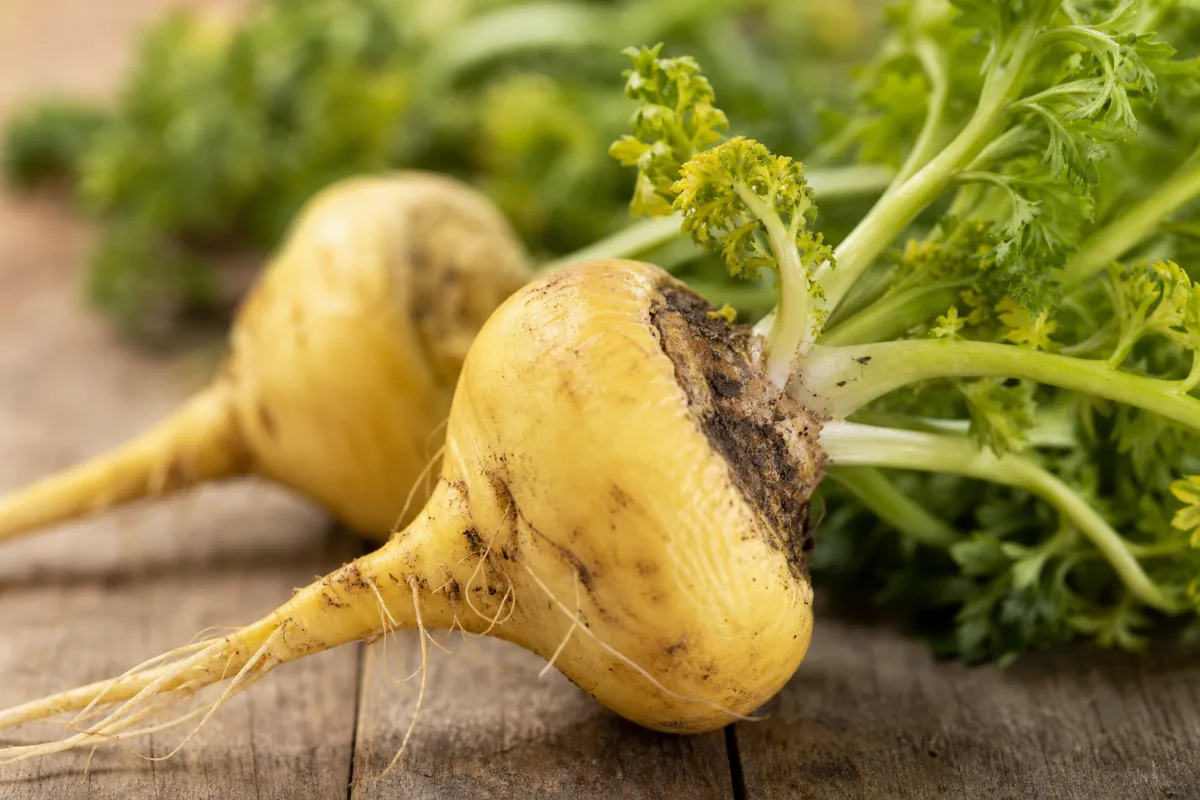
Maca is the root (more precisely the hypocotyl, the swollen part between root and stem) of Lepidium meyenii Walp., a member of the mustard family (Brassicaceae). [2] GBIF lists this as the accepted name. [4] It grows at high altitude in the Peruvian Andes, and the edible part is the hypocotyl. [5]Is maca an adaptogen?
"Adaptogen" is a contested term (see What are adaptogens?). One systematic review describes maca as having been used in the Andes "as an adaptogenic plant," and a plant-chemistry review groups it with other plants called adaptogenic. [2][6] Another review notes it is marketed as "Peruvian Ginseng" and says its health claims cannot be fully supported scientifically. [7] The label tells you how it is sold, not whether it works.Traditional use (not proof)
Maca has been cultivated and used by Andean people in Peru as food and medicine for a very long time; one review gives over 1300 to 2000 years. [7] Traditionally it is used as a tonic and to support fertility in people and cattle, and the root is cooked, baked, fermented into a drink or made into porridge. [7] These are traditional food and medicine uses, described in the authors' words, and they do not by themselves show that maca causes any health effect.What research shows
Most human research is on sexual function, menopause symptoms and male fertility. Trials are few, small and use different maca products.| Use | What the source found | Strength of evidence | Population and form |
|---|---|---|---|
| Menopausal symptoms | Four placebo-controlled trials all favored maca on symptom scores, but the authors said trial number, size and quality were too limited for firm conclusions. [2] | Promising but limited | Perimenopausal and postmenopausal women; various maca products |
| Sexual function | Of four trials, two suggested benefit, one in healthy cyclists found no effect, one in men with erectile dysfunction was positive. [8] | Promising but limited | Healthy and menopausal adults, men with erectile dysfunction |
| Late-onset hypogonadism symptoms | In one 12-week trial of 80 men, gelatinized maca improved symptom questionnaires versus placebo. [9] | Promising but limited (single trial) | Men with symptoms of late-onset hypogonadism; gelatinized maca |
| Semen quality | A meta-analysis of five trials found unclear effects and no significant gain in sperm concentration. [10] | Mixed | Men with infertility and healthy men |
| Hormone levels in early postmenopause | One trial reported higher estradiol and lower FSH on maca, with fewer symptoms. [11] | Promising but limited; hormone levels are biomarkers, not outcomes | 124 early-postmenopausal women; gelatinized maca capsules |
The 12-week men's trial used 1,000 mg of maca, two pills at a time, three times per day. [9] The postmenopause trial used two 500 mg capsules twice daily with meals. [11] These are amounts used in those studies, not advice for readers; a clinician or pharmacist decides what is right for a person.
A critical review found that trials so far gave inconclusive results because of small samples and method limits. [7] Another review found that research separating maca by color and its clinical use remains limited; its authors disclosed a commercial interest in a maca supplement. [12]
Proper evidence not found for maca as a stress or "adrenal" remedy: we searched PubMed for maca trials and reviews and the sources we read cover sexual function, menopause, fertility and hypogonadism symptoms only. See Adrenal fatigue and adrenal support claims. More trial detail is in maca for libido, energy and menopause.
Forms and why they matter
Maca is sold as powder, capsules and extracts. Several of the trials above used gelatinized maca, and results for one product do not transfer to another. [9][11] Maca comes in many colors (up to seventeen phenotypes reported), and growing place, size and processing may change nutrients and plant compounds. [12]Quality and sourcing
Demand for maca has shifted some growing from traditional methods to mass production with fertilizers and pesticides, and in places outside the Andes. The authors say this may affect product quality and safety and threatens local producers and supply in Peru. [7] Another review stressed standardization. [5] See quality testing and certifications and maca side effects and cautions.Frequently asked questions
Is maca an adaptogen?
It is described that way by some authors and in marketing, but the term is contested and the evidence is for specific uses, not for "adapting to stress." [2][7]
Does maca help menopause symptoms?
Four small placebo-controlled trials favored maca, but a systematic review said the evidence was limited and the safety unproven. [2]
Does maca raise testosterone or fertility?
A semen-quality meta-analysis found unclear effects. [10] One 12-week trial in men with late-onset hypogonadism symptoms reported better questionnaire scores. [9]
Is maca safe for the liver?
NIH LiverTox says maca has not been implicated in liver injury. [1]
Can I take maca with antidepressants?
Ask a pharmacist or prescriber; a review of adverse-event reports listed one maca and mianserin report. [3] If you feel hopeless or in crisis in the US, call or text 988.
More details: evidence, limits and cautions
The details behind this page: cautions, limits of the evidence and where sources disagree. Open any note to read it.
Quick safety points
- Maca is both a food and a supplement. No source we read reports serious harm from the root, and NIH's LiverTox says maca has not been implicated in liver injury. [1]
- One review of menopause trials said safety "has not been proved yet" and called for larger studies. [2]
- If you take antidepressants or other medicines, or have a condition that is affected by hormones, ask a pharmacist or clinician before adding maca. A published review of adverse-event reports listed one report of restless legs syndrome with maca and the antidepressant mianserin. [3]
- Pregnancy, breastfeeding, children, kidney disease, thyroid disease and surgery: these points are not described in the sources we read. See pregnancy and breastfeeding and supplements before surgery.
Safety and cautions
- Liver: LiverTox says maca has not been implicated in liver injury. [1]
- Toxicity data: a review reported low acute oral toxicity in animals and low cell toxicity in laboratory studies; that is not the same as long-term human safety. [5]
- Medicines: the interaction evidence is a small set of reports, not trials. [3] Read how interactions work.
- Hormones: one trial reported estradiol changes in postmenopausal women. [11] No source we read gives a formal warning for hormone-sensitive conditions, so this is a reason to ask a clinician, not a documented rule.
- Allergy, kidney, thyroid, bleeding and surgery: not described in the sources we read. Tell the surgical team about every supplement.
References
- NIH LiverTox, Maca, 2019. Read 2026-10-23.
- Lee MS et al., Maturitas 2011, Maca for treatment of menopausal symptoms: a systematic review. Read 2026-10-23.
- Siwek M et al., Frontiers in Pharmacology 2023, Retrospective chart review of adverse events of interactions between adaptogens and antidepressant drugs. Read 2026-10-23.
- GBIF Backbone Taxonomy name match, Lepidium meyenii Walp., accessed 2026-10-23. Read 2026-10-23.
- Valerio LG, Gonzales GF, Toxicological Reviews 2005, Toxicological aspects of cat's claw and maca. Read 2026-10-23.
- Plants (Basel) 2021, Comparison between the biological active compounds in plants with adaptogenic properties. Read 2026-10-23.
- Beharry S, Heinrich M, Journal of Ethnopharmacology 2018, Is the hype around the reproductive health claims of maca justified?. Read 2026-10-23.
- Shin BC et al., BMC Complementary and Alternative Medicine 2010, Maca for improving sexual function: a systematic review. Read 2026-10-23.
- Shin D et al., World Journal of Men's Health 2023, Maca in late-onset hypogonadism symptoms: randomized trial. Read 2026-10-23.
- Lee HW et al., Frontiers in Pharmacology 2022, Maca on semen quality parameters: systematic review and meta-analysis. Read 2026-10-23.
- Meissner HO et al., International Journal of Biomedical Science 2006, Pre-gelatinized organic maca in early-postmenopausal women. Read 2026-10-23.
- Minich DM et al., Nutrients 2024, Not all maca is created equal. Read 2026-10-23.