Tribulus (Tribulus terrestris): Uses, Evidence and Safety
Tribulus (Tribulus terrestris) is marketed to raise testosterone. What systematic reviews found for testosterone and erectile function, a kidney and liver case report, and doping-test studies.
Content last updated . This page has not been medically reviewed.
Safety first. Natural products can cause side effects and interact with medicines. Read herb safety and interactions before you use anything on this page.
What is Tribulus good for?
What the body uses it for, and how strong the evidence is. A normal job in the body is not proof that extra supplements add benefit; each card says which.
Testosterone claims (marketing)
Preliminary or mixedTribulus is sold to raise testosterone. Reviews found no robust rise, mainly in men whose levels were normal.
Supplements: No good evidence that it raises testosterone in men with normal levels; two small studies in men with low testosterone showed a small rise.
Erectile function
Preliminary or mixedReviews are more positive for erection scores, but the evidence is low quality.
Supplements: Promising but limited; trial products and extracts differed.
Sports performance and muscle
Not enough evidenceTribulus alone has not been shown to improve strength, muscle mass or performance.
Supplements: No good evidence of benefit.
Female sexual function
Not enough evidenceSmall studies suggest possible help for women's sexual desire and function; larger studies are needed.
Supplements: Insufficient evidence.
Traditional use as a tonic and diuretic
Not enough evidenceIn Chinese and Ayurvedic medicine the fruit and aerial parts are used as a tonic, diuretic and aphrodisiac, and for kidney stones. This is tradition, not proof.
Supplements: Traditional use is not evidence of benefit.
Laboratory and animal findings
Lab or animal research onlyMSK notes tribulus may reduce exercise-induced oxidative stress and muscle damage in athletes, and animal studies link it to GABA receptor effects.
Supplements: None shown in people.
Connected topics
Open a group to see how each topic connects and how strong the evidence is.
Body systems (7)
- Hepatic / Liver SystemDocumented risk
Case reports describe very high liver enzymes after tribulus; he recovered after stopping.
- Kidney & UrinaryDocumented risk
Case reports describe acute kidney injury after tribulus products. Case reports cannot show how common this is.
- Liver & DetoxDocumented risk
Case reports describe severe liver injury with tribulus products. These are individual cases.
- Reproductive HealthPreliminary or mixed
Reviews suggest possible improvement in erection scores, but the evidence is low quality and results are mixed.
- Reproductive SystemPreliminary or mixed
Studied for male sexual function; testosterone did not rise robustly. Evidence is limited.
- Urinary SystemDocumented risk
Case reports describe kidney injury; traditional use as a diuretic and for kidney stones is not proven.
- Nervous SystemDocumented risk
One case report of seizure alongside liver and kidney injury; animal work links tribulus to GABA receptor effects.
Body parts (4)
- KidneysDocumented risk
Case reports of acute kidney injury; individual cases only.
- LiverDocumented risk
Case reports of severe liver injury; individual cases only.
- Reproductive OrgansPreliminary or mixed
Studied for erectile function; improvement was reported in some trials but evidence is low quality.
- Nervous SystemDocumented risk
A seizure was reported in one case with liver and kidney injury.
Root causes (1)
- Medication Side EffectsDocumented risk
Possible added effects with diuretics, blood pressure and diabetes medicines; stent thrombosis reported with clopidogrel plus a tribulus-containing formula.
Biomarkers (3)
- ALTDocumented risk
Very high liver enzymes were reported in case reports of tribulus use.
- ASTDocumented risk
Raised aminotransferases were reported in case reports of tribulus use.
- CreatinineDocumented risk
Raised creatinine (kidney marker) was reported in case reports of tribulus use.
Conditions & symptoms (4)
- Drug-Induced Liver DiseaseDocumented risk
Case reports describe severe liver injury with tribulus products.
- Erectile DysfunctionPreliminary or mixed
Reviews report better erection scores in some trials, but the evidence is low quality and mixed.
- Acute Kidney Tubular NecrosisDocumented risk
MSK describes acute tubular necrosis in one case.
- SeizuresDocumented risk
One case report of seizure with liver and kidney injury after an herbal water of the plant.
Documented risks and interactions (5)
- Liver, kidney and nerve toxicity (case reports). Case reports describe severe liver and kidney injury and a seizure after tribulus products or herbal water. Case reports cannot show how common this is.
- Interactions with medicines. Possible added effects with diuretics, blood pressure medicines and diabetes medicines; one report of stent thrombosis with clopidogrel plus a herbal formula containing tribulus.
- Doping-test concerns for athletes. In two small studies, short-term tribulus did not push urinary steroid markers over anti-doping cut-offs. Products may contain other ingredients.
- Pregnancy, breastfeeding and prostate cancer cautions. No source we read shows safety in pregnancy, breastfeeding or children. MSK advises people with prostate cancer to check with their doctor because of possible hormonal activity.
- Product quality and variation. Trials varied in dose, duration and whether tribulus was alone or combined, so results cannot be pooled; product content varies.
Key points first
- The claim that tribulus raises testosterone is not supported in the reviews we read. A 2014 systematic review concluded that the evidence to date suggests it is ineffective for increasing testosterone in humans, and a 2025 review found no robust evidence of a rise. [1] [2]
- For erectile dysfunction, reviews are more positive but of low quality. One says the level of evidence is low, and another meta-analysis of 8 trials found better scores than placebo. [2] [3]
- A case report describes severe liver, kidney and nerve toxicity in a man after drinking a herbal water made from the plant for 2 days. It is a single case, and the person recovered after stopping. [4]
- If you are worried about low testosterone, a clinician can test and explain options. See testosterone and low testosterone and testosterone booster claim check.
Overview
Tribulus is a herbal plant widely used by athletes and bodybuilders, based on the belief, fueled by marketing, that it can raise testosterone. [1] This page covers the herb. For how the traditional use in Chinese and Ayurvedic medicine differs from supplement claims, see Tribulus (Bai Ji Li): traditional use vs supplement claims.Names and plant part
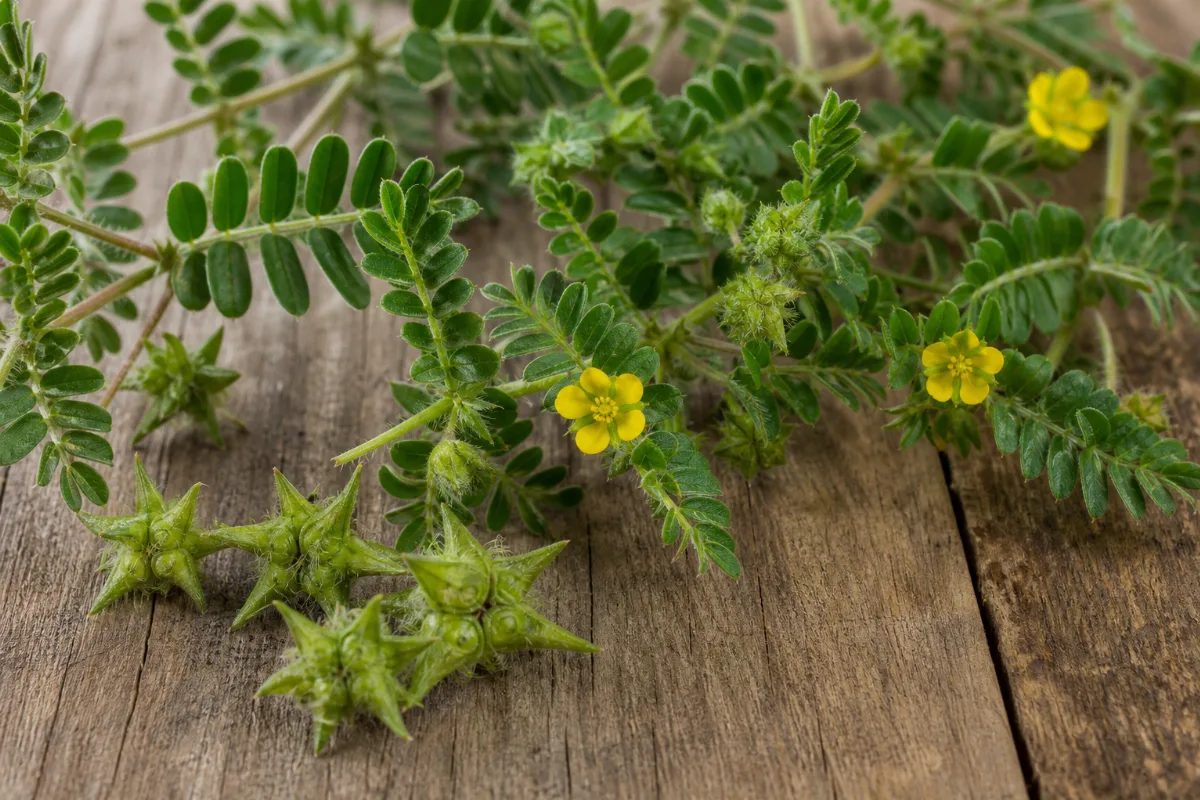
The accepted scientific name is Tribulus terrestris L., in the family Zygophyllaceae. [5] The aerial parts (parts above ground) and fruits are the parts described as used in traditional medicine. [1] Check the Latin name and plant part on any label (botanical names and plant parts on labels).Traditional use (not proof of effect)
A 2014 review says extracts of the aerial parts and fruits have been used in traditional medicine for diuretic, tonic and aphrodisiac properties. [1] A 2010 case report notes the plant is traditionally used for its aphrodisiac and antiurolithiatic (kidney-stone-preventing) activities. [4] Traditional use is not evidence that it works, and the case report below shows why it should not be treated as harmless.What research shows
| Use | What the source found | Strength of evidence | Population and form studied |
|---|---|---|---|
| Testosterone levels | Eight of 10 studies reported no significant change in androgen (male hormone) profile. Only 2 showed a small rise (60 to 70 ng/dL) and they involved men with hypogonadism (low testosterone). [2] A 2014 review found an effect on testosterone in humans only when tribulus was part of a combined supplement. [1] | No good evidence of benefit | 10 studies, 483 men, doses of 400 to 750 mg a day for 1 to 3 months [2] |
| Testosterone, among many "boosters" | A 2024 systematic review of 27 proposed testosterone boosters, including 4 tribulus studies, found most fail to increase total testosterone. [6] | No good evidence of benefit | Athletes, older men, infertile men and healthy men [6] |
| Erectile dysfunction | A 2025 review found tribulus improved erectile dysfunction in 3 of 5 studies that assessed it, and rated the evidence level as low. [2] A 2026 meta-analysis of 8 randomized trials found higher erectile function scores than placebo, no difference in total testosterone and no difference in adverse events. [3] | Promising but limited | Men with erectile dysfunction; various extracts [2] [3] |
| Sports performance and muscle | Proper evidence not found. We searched PubMed for tribulus systematic reviews and read the 2014 and 2025 reviews, which looked at testosterone and sexual function and did not report muscle or performance results. The 2014 review concluded the marketing claims about testosterone are unsubstantiated. [1] | No good evidence found | None |
We did not read studies on tribulus for women's sexual function or for kidney stones, so we make no statement on them. Remember that a testosterone number is a lab marker. A rise in a lab value does not by itself show better sexual function or muscle.
Forms and why the form matters
Tribulus is sold as capsules, tablets and extracts, often within combination supplements. A 2014 review found that trials varied in duration, dose, and whether tribulus was used alone or combined, so it could not combine results. [1] The amounts above (400 to 750 mg a day) are what the trials in the 2025 review used, not a recommendation. A clinician or pharmacist decides what is right for a person.Safety
- Kidney, liver and brain: the 2010 case report described a man who presented with a seizure and very high liver enzymes and creatinine (a kidney marker) after drinking an herbal water of the plant for 2 days to prevent kidney stones. His symptoms improved and liver enzymes normalized after he stopped. [4] See liver safety and supplements and kidney disease and supplements.
- Adverse events in trials: the 2026 meta-analysis found no difference in adverse events compared with placebo, with a relatively good safety profile. [3]
- Drug-test concerns for athletes: in a 2008 study, two women who took 500 mg three times a day for two days had no steroid values above the World Anti-Doping Agency cut-offs. [7] A 2026 pilot study of 15 recreational athletes found no statistically significant changes in urinary steroid profiles. [8] The 2008 paper was prompted by two athletes who blamed tribulus for an adverse doping finding, and in its volunteers tribulus did not change the steroid markers. [7] These are small studies. Anti-doping rules for a particular sport are set by that sport's authority, and products may contain other ingredients. See herbs for athletes and doping rules.
- Medicines, pregnancy and breastfeeding, children, older adults, surgery and allergy: not described in the sources we read. Ask a pharmacist (how interactions work) and tell the surgical team about any herb (supplements before surgery).
- Quality: see quality testing and certifications.
Frequently asked questions
Does tribulus raise testosterone?
Reviews we read found no robust evidence that it does, especially in men whose levels were normal. [2] [1]
Does tribulus help erectile dysfunction?
Results are mixed. A 2025 review rated the evidence level low, and a 2026 meta-analysis of 8 trials found better scores than placebo. [2] [3]
Can tribulus harm the kidneys or liver?
A single case report describes severe liver and kidney toxicity after an herbal water of the plant, with recovery after stopping. [4] Trials did not find more adverse events than placebo. [3]
Will tribulus show up on a drug test?
In two small studies, short-term use did not push steroid markers over anti-doping cut-offs. This does not guarantee any product is safe for a tested athlete. [7] [8]
What is the scientific name?
Tribulus terrestris L., family Zygophyllaceae. [5]
References
- A systematic review on the herbal extract Tribulus terrestris and the roots of its putative aphrodisiac and performance enhancing effect. J Diet Suppl 2014. Read 2026-10-23.
- Effects of Tribulus (Tribulus terrestris L.) Supplementation on Erectile Dysfunction and Testosterone Levels in Men: a systematic review of clinical trials. Nutrients 2025. Read 2026-10-23.
- Tribulus terrestris for management of patients with erectile dysfunction: a systematic review and meta-analysis of randomized trials. Int J Impot Res 2026. Read 2026-10-23.
- Tribulus terrestris-induced severe nephrotoxicity in a young healthy male. Nephrol Dial Transplant 2010. Read 2026-10-23.
- GBIF Backbone Taxonomy, species match: Tribulus terrestris. Read 2026-10-23.
- Do "testosterone boosters" really increase serum total testosterone? A systematic review. Int J Impot Res 2024. Read 2026-10-23.
- Short term impact of Tribulus terrestris intake on doping control analysis of endogenous steroids. Forensic Sci Int 2008. Read 2026-10-23.
- Impact of Tribulus terrestris supplementation on urinary steroid profiles: a short term pilot study. J Pharm Biomed Anal 2026. Read 2026-10-23.