Panch phoron: What It Is, Flavor, Cooking Use and Health Facts
Panch phoron is a Bengali blend of five whole seeds, fried in hot oil at the start of a dish; it is not studied as a blend, so health facts come from its seeds, and mustard and fenugreek can cause allergy.
Content last updated . This page has not been medically reviewed.
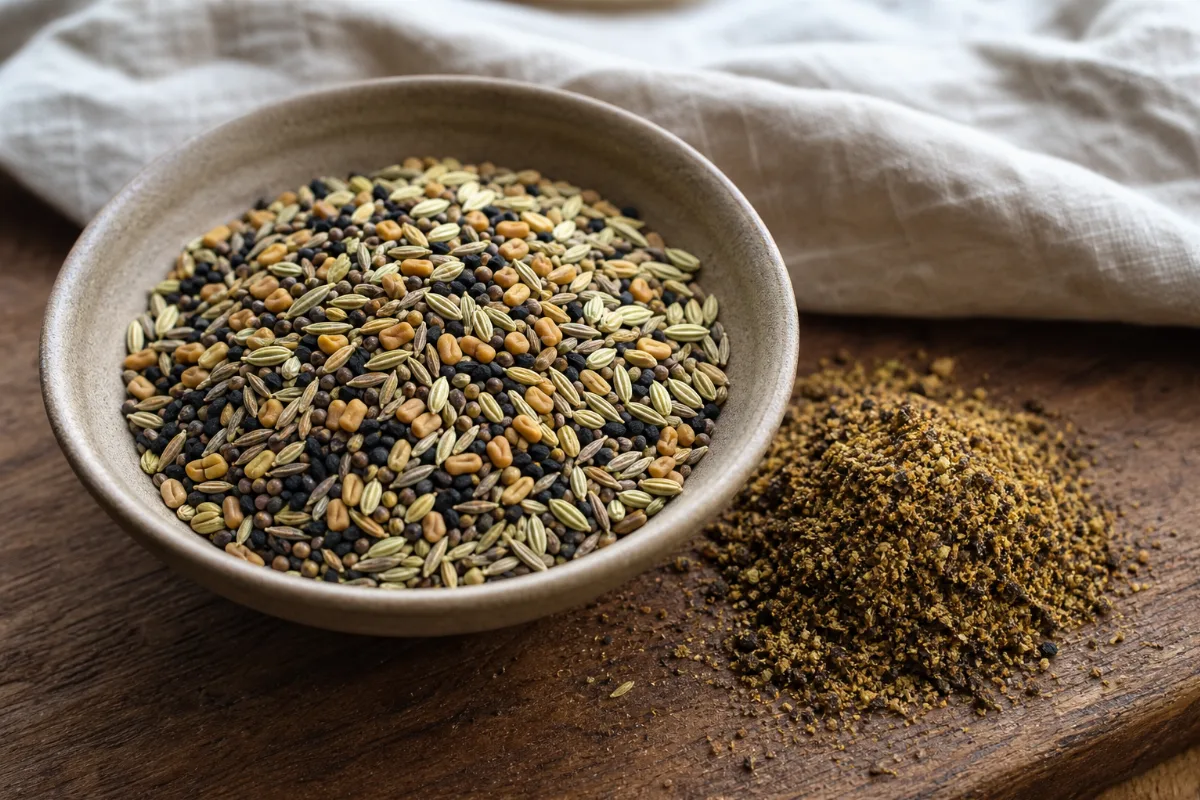
In the kitchen at a glance
Flavor:EarthyBitterLicorice / anise
Aroma: A mixed seed smell that turns toasty and fragrant when the seeds sizzle in oil.
Used in: curries, pickling, vegetables, soups and stews
Usual amount in food: Home recipes make about 5 tablespoons of blend from equal parts of five seeds; we found no source for the amount per dish, and USDA has no entry for the blend.
What it is
Panch phoron means "five spices." It is a whole-seed blend from Bangladesh and eastern India, used in Bengali cooking and in nearby regions such as Odisha, Assam and Nepal. [1] Recipes vary by cook and region. [1]| Typical ingredient | Role in flavor | Link |
|---|---|---|
| Fenugreek seed (methi) | Mildly bitter, so some cooks use less of it [1] | More about Fenugreek seed (methi) → |
| Cumin seed (jeera) | A standard part of the mix [1] | More about Cumin seed (jeera) → |
| Nigella seed (kalonji) | A standard part of the mix [1] | More about Nigella seed (kalonji) → |
| Black mustard seed | A standard part of the mix; wild celery seed (radhuni) sometimes replaces it [1] | More about Black mustard seed → |
| Fennel seed (saunf) | A standard part of the mix [1] | More about Fennel seed (saunf) → |
One Bengali cooking site lists radhuni as the fifth seed instead of mustard or cumin, and suggests cumin if you cannot find it. [2] So lists differ.
Flavor and aroma
The sources we read describe only one flavor note of the blend: fenugreek is mildly bitter. [1] They do not describe the blend's overall taste or smell, so the short aroma line above is our summary of its seeds, not a quoted description.The recipes we read contain only the five whole seeds, with no ground spices and no salt. [1][2]
How it is used in cooking
Panch phoron is always used whole, unlike most spice blends. [1] A Bengali cooking site calls it a tempering blend for dals (lentil dishes), vegetables, chutneys and pickles. [2] Tempering means frying whole spices briefly in hot oil, then using the oil and seeds in the dish. Its dishes include moong and masoor dal, potato curries, a pumpkin dish and several chutneys. [2]- Mix at home: equal parts of each seed, stored airtight. [2]
- Substitutes: cumin for radhuni, per the same site. [2] The sources we read give no other substitute.
- When to add it: the sources we read name the step as tempering, but do not give timing or how long the seeds fry, so we give no rule here.
Normal food amounts
| Measure | Grams | Source |
|---|---|---|
| Panch phoron, 1 teaspoon or tablespoon | Not found | USDA has no entry for the blend [7] |
| Home blend recipe | 1 tablespoon of each seed makes about 5 tablespoons | Bengali cooking site [2] |
| Typical amount per dish | Not found | We opened no source that states one |
With no USDA entry we list no nutrients for the blend. For the seeds, USDA SR Legacy (2018) lists per teaspoon: whole cumin 2.1 g, whole fennel 2.0 g, fenugreek 3.7 g and ground mustard 2.0 g. [7] Nigella is not in the file, so these are only a rough guide.
Buying, storing and preparing
- Forms: whole-seed blend, which is the traditional form. [1] We found no source on ground versions.
- Label check: the recipes we read contain only the five seeds, no salt. [2] Shop products may differ, so read the label for salt, fillers and allergens such as mustard, sesame or celery.
- Storing: one site says an airtight container; no shelf life is given in the sources we read. [2]
- Lead: a North Carolina study found lead at or above 1 mg/kg in 28.8% of 386 spice and related samples (22.0% of 344 food items), and says the US has no permitted lead limit for spices in general. [3] Panch phoron was not among the products it named, and we have no data on it.
- Salmonella: FDA import testing found Salmonella in about 6.6% of spice shipments, according to a news report on its 2013 draft report. [4]
Health: what research says
Eating a spice blend in cooking is different from taking concentrated seed products. We found no study of panch phoron as a blend. The evidence belongs to the five seeds, and a blend contains different amounts of each, so single-seed results do not carry over.Food amounts vs supplements
| In normal cooking | In supplements and extracts | |
|---|---|---|
| Typical amount | A spoonful or less of whole seeds in tempering oil; no usual amount found | Not sold as a blend supplement that we found |
| What studies mostly used | None on the blend | Single seeds as powders, extracts or oils (see each page) |
| What we can say about benefit | No health benefit shown for the blend | Not applicable |
| Main safety limit | Allergy to mustard or fenugreek; contamination of ground and imported spices [3][5][6] | Fenugreek above food amounts is not considered safe in pregnancy [5] |
What the evidence shows
| Use | What the sources found | Strength of evidence | Form and population |
|---|---|---|---|
| Panch phoron as a blend | No study found | Insufficient evidence | Food |
| Fenugreek | NCCIH says fenugreek may lower blood sugar in type 2 diabetes, but many studies were not high quality. [5] | Promising but limited | Seed preparations; adults with raised blood sugar |
| Cumin | Our cumin page reports mixed trial results on blood sugar and promising results on blood fats. | Mixed | Supplements; adults |
| Black seed | Our page reports mixed results on blood pressure and limited results on blood sugar. | Mixed | Powder and oil; adults |
| Fennel seed | Our page reports promising infant colic findings with study flaws; EMA accepts other uses only as traditional. | Promising but limited | Oil or tea; infants and adults |
| Mustard seed | Our page reports only small trials and lab work. | Insufficient evidence | Preparations, lab |
The last four rows summarize our own single-seed pages; open them for sources.
Official statements
- NCCIH (US): fenugreek is not safe above food amounts in pregnancy; evidence for diabetes is not high quality. [5] The page we opened gave no year.
- CDC (US), 2018: no US permissible lead limit for spices exists. [3]
- Health Canada: mustard is a priority food allergen; the page we opened is an archived review. [6]
Related pages
Health connections for Panch phoron
What research links to this spice, and how strong the evidence is. Most studies use concentrated extracts or doses far above what you eat; each card says which.
Fenugreek and blood sugar
Preliminary or mixedNCCIH says fenugreek may lower blood sugar in type 2 diabetes, but many studies were not high quality and large doses may drop blood sugar too far.
Supplements: Supplement-level finding; not shown for a pinch of seeds in a blend.
Blend not studied for health effects
Not enough evidenceWe found no study that tested panch phoron as a blend. Evidence belongs to its five seeds.
Supplements: No supplement form of the blend found.
Connected topics
Open a group to see how each topic connects and how strong the evidence is.
Root causes (2)
- Heavy Metal ExposureDocumented risk
Lead was found in a share of spice samples in New York City. Panch phoron was not named in the data and the US has no lead limit for spices.
- Medication Side EffectsDocumented risk
NCCIH advises talking with a provider before using fenugreek with any medicine. No source on the blend and medicines was found.
Conditions & symptoms (3)
- Food AllergyDocumented risk
Mustard and fenugreek, two of the five seeds, can cause allergic reactions, sometimes severe. Not tested on the blend.
- Lead PoisoningDocumented risk
Lead contamination was found in some spices; panch phoron was not named and no poisoning was measured.
- Salmonella InfectionsDocumented risk
Salmonella was found in about 6.6 percent of imported spice shipments in FDA testing (news report). Not shown for panch phoron.
Documented risks and interactions (4)
- Mustard allergy. Health Canada's review calls mustard allergy not uncommon and able to cause severe reactions, with cross-reactions to other cabbage-family seeds.
- Fenugreek allergy and pregnancy caution. NCCIH says fenugreek can cause allergic reactions, including serious ones, and is not safe above food amounts in pregnancy.
- Lead found in some spices. A New York City study found lead at or above 1 mg/kg in 28.8 percent of 386 samples; the article says the US has no permissible lead limit for spices.
- Salmonella in imported spices. FDA import testing found Salmonella in about 6.6 percent of spice shipments, per a news report on the 2013 draft risk profile.
Frequently asked questions
What is in panch phoron?
Five whole seeds: fenugreek, cumin, nigella, black mustard and fennel, usually in equal parts. [1] Some cooks use radhuni (wild celery seed) in place of mustard. [1]
Is it hot?
The sources we read do not describe heat. They name fenugreek as mildly bitter. [1]
How much is normal?
We found no usual amount per dish. A home recipe makes about 5 tablespoons of blend from equal parts. [2] USDA has no entry for the blend. [7]
Is it safe in pregnancy?
NCCIH says fenugreek above food amounts is not safe in pregnancy. [5] The sources we read do not describe the blend itself. Ask your midwife or doctor.
Can I take it with medicines?
We found no source on the blend and medicines. NCCIH advises asking a provider about fenugreek and any medicine. [5]
Is it a good substitute for garam masala?
No. Panch phoron is whole seeds fried in oil. [1][2] Garam masala is a different blend; see its page.
More details: evidence, limits and cautions
The details behind this page: cautions, limits of the evidence and where sources disagree. Open any note to read it.
Safety note at a glance
Safety in more detail
- Medicines: NCCIH advises talking with a health professional before taking fenugreek with any medicine. [5] For the other seeds, see their pages. We found no source on panch phoron and medicines.
- Pregnancy: NCCIH says fenugreek is not safe above food amounts, with birth defect risks in animals and people. [5] See the other seed pages; the sources we read do not describe the blend.
- Breastfeeding: the sources we read do not describe the blend. See each seed page.
- Children: the sources we read do not describe the blend.
- Allergy: NCCIH says fenugreek can cause allergic reactions, including serious ones. [5] Health Canada's review calls mustard allergy not uncommon and able to cause severe reactions, with cross-reactions to other cabbage-family seeds. [6] Cumin, fennel and nigella have their own allergy notes on their pages.
- Liver and kidney: the sources we read do not describe this for the blend.
- Surgery: NCCIH advises telling your provider about fenugreek use; we found no surgery warning for the blend. [5]
- Quality and contamination: lead and Salmonella have been found in spices in general; none was shown for this blend. [3][4]
- Amounts that cause trouble: NCCIH says large fenugreek doses may harm by dropping blood sugar and cause diarrhea or nausea. [5] A pinch of whole seeds in oil is far less.
References
- Wikipedia — Panch phoron. https://en.wikipedia.org/wiki/Panch_phoron (accessed 2026-10-24)
- Bong Eats — Panch phoron. https://bongeats.com/recipe/panch-phoron (accessed 2026-10-24)
- CDC — MMWR 2018;67(46): Lead in spices, North Carolina. https://www.cdc.gov/mmwr/volumes/67/wr/mm6746a2.htm (accessed 2026-10-24)
- CIDRAP — FDA report says 12% of imported spices tainted (news report on FDA 2013 draft risk profile). https://www.cidrap.umn.edu/foodborne-disease/fda-report-says-12-imported-spices-tainted (accessed 2026-10-24)
- NCCIH (US) — Fenugreek. https://www.nccih.nih.gov/health/fenugreek (accessed 2026-10-24)
- Health Canada — Mustard: a priority food allergen in Canada, systematic review (archived). https://www.canada.ca/en/health-canada/services/food-nutrition/reports-publications/food-labelling/appendices-1-2-mustard-priority-food-allergen-canada-systematic-review.html (accessed 2026-10-24)
- USDA FoodData Central, SR Legacy (April 2018) — Spices: cumin seed (170923), mustard seed ground (170929), fennel seed (171323), fenugreek seed (171324), household portions from the site's USDA data file.