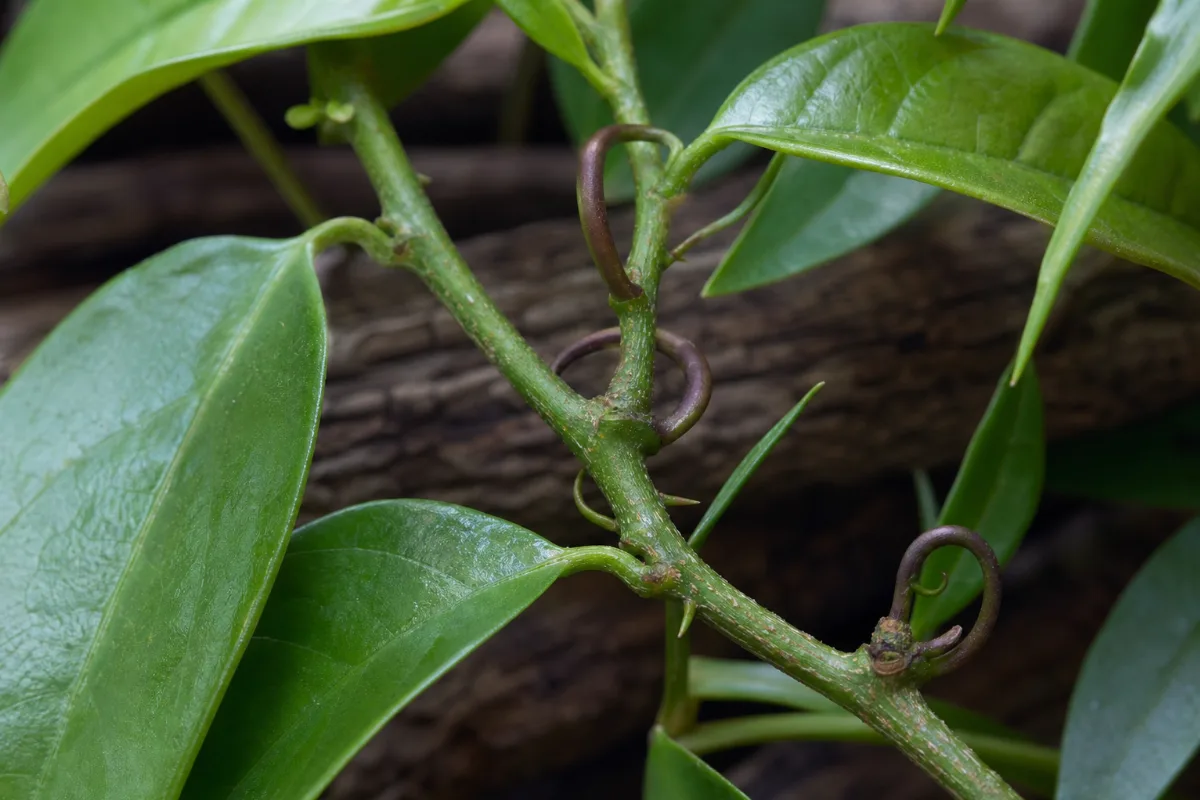
Herbs & Botanicals · Chinese hooked-stem herb
Uncaria (Gou Teng)
Uncaria rhynchophylla · also called Gou teng, gouteng, Uncaria hook
Gou teng is the hooked stem of a Chinese climbing plant, used in Chinese medicine for high blood pressure, headache and dizziness. It is also one ingredient of the Japanese formula Yokukansan. Nearly all trials tested multi-herb formulas, not gou teng alone, and the evidence is small and low quality. The key caution: it may lower blood pressure further in people already on blood pressure medicine.
General information, not medical advice. Last substantive update · Not medically reviewed. A named clinician has not signed off on this page. How this page is made
About Uncaria (Gou Teng)
Gou teng (Uncaria rhynchophylla) is a Chinese climbing plant whose hooked stems are used in Chinese medicine, mainly for high blood pressure with headache and dizziness, and in the Japanese formula Yokukansan. Human trials test formulas, not the herb alone, and are small.
What it is
Gou teng is the dried hooked stem of Uncaria rhynchophylla, a plant of the coffee family from southern China to Southeast Asia. In Chinese medicine it is paired with tian ma (gastrodia) in a classic formula for high blood pressure.
Its main alkaloids are rhynchophylline, isorhynchophylline and hirsutine. It is not cat's claw: that is Uncaria tomentosa, a South American plant with different chemistry and its own safety record.
Formulas, not the herb alone
Almost every human trial tested a formula. Tianma Gouteng formulas have about a dozen herbs. Yokukansan has seven: Angelica, Atractylodes, Bupleurum, poria, licorice, Cnidium and Uncaria. So a result in one of these trials cannot be credited to gou teng alone.
This page covers gou teng. The formulas have their own pages where available.
What the evidence shows
For blood pressure, the best human evidence is two meta-analyses of small Chinese trials of a formula added to drugs, and a 251-person placebo trial in masked high blood pressure. The reviewers call the trials small and low quality. A Cochrane review found no trial of the formula alone.
For dementia behaviour, Yokukansan trials disagree. A larger Japanese placebo trial did not reach its main goal; a smaller 2026 trial did. Brain-protection and blood vessel results come from cells and animals.
At a glance
Traditional uses history, not proof
- Chinese medicine: 'Liver Wind' and 'Liver Yang rising' patterns, with convulsions, tremor, headache, dizziness and tinnitus
- Classic Tianma Gouteng Yin formula for high blood pressure; Japanese Kampo formula Yokukansan
Studied for research
- High blood pressure (formula added to drugs), low certainty
- Masked high blood pressure, low certainty (one 4-week trial)
- Behavioural symptoms in dementia (Yokukansan), mixed results
- High blood pressure (formula alone), insufficient (Cochrane found no trial)
- Brain protection and calming, lab and animal only
Main compounds
- Rhynchophylline (CID 5281408)
- Isorhynchophylline (CID 3037048)
- Hirsutine (CID 3037884)
- Corynoxeine (CID 44568160)
Common forms
- Dried hooked stem
- Decoction (hooks added late)
- Granules and pills (formulas)
- Multi-herb formulas such as Tianma Gouteng Yin and Yokukansan
Research links: Cochrane review: Tianma Gouteng Yin for hypertension (2012) · Meta-analysis: Tianma Gouteng granules plus drugs (2021) · Masked hypertension placebo trial (2020) · Yokukansan dementia meta-analysis (2013) · Yokukansan low potassium cohort (2017) · Uncaria rhynchophylla review (2026) · Research Library · Genes & Biomarkers Library
The plant and its history
- Accepted scientific name
- Uncaria rhynchophylla (Miq.) Miq.
- Naming authority
- (Miq.) Miq. (written 'Miq. ex Havil.' in some pharmacopoeia texts)
- Common names
- Gou teng (Chinese (pinyin)); Gouteng (Chinese (pinyin)); Uncaria hook (English); Uncariae Ramulus cum Uncis (Pharmacopoeia name)
- Botanical family
- Rubiaceae (coffee family)
- Classification
- Plantae > Tracheophyta > Magnoliopsida > Gentianales > Rubiaceae > Uncaria > Uncaria rhynchophylla
- Native range
- Southern China to Southeast Asia (2026 review only).
- Habitat
- Not described in sources read.
- What the plant looks like
- Roots: Not described in sources read; Stems: The used part is the dried stem segment with hooks visible (Pharmacopoeia, per the 2026 review); Leaves: Not described in sources read; Flowers: Not described in sources read; Fruit: Not described in sources read
- Cultivation
- Only U. rhynchophylla was available on the herbal market in a 2025 study; the other four officially listed species were wild-collected.
- Harvest and processing
- Dried hooked stem; used whole or cut, as decoction (hooks added late), powder or pill.
- Look-alikes and adulterants
- Species: Uncaria tomentosa (cat's claw); Difference: South American vine with different alkaloids and its own safety record (a 2026 case report of severe delirium and slow heartbeat after a high-dose supplement).; Species: Four other officially listed Uncaria species (U. macrophylla, U. sinensis, U. hirsuta, U. sessilifructus); Difference: Different alkaloid profiles; only U. rhynchophylla and U. macrophylla had the most stable profiles in a 2025 study.
- Sustainability and conservation
- Not covered in the sources read.
Traditional use and history history, not clinical proof
| Tradition or era | Documented use | Source |
|---|---|---|
| Chinese medicine (ancient) | First recorded in the ancient text Mingyi Bielu; used for 'Liver Wind' and 'Liver Yang rising' patterns with convulsions, tremor, headache, dizziness and tinnitus. | p38336181 |
| Classic formula Tianma Gouteng Yin | A decoction of about a dozen herbs including gou teng and tian ma, used for high blood pressure with headache and dizziness. | p41868131 |
| Japanese Kampo | Yokukansan (TJ-54), seven herbs including Uncaria rhynchophylla, used for irritability, insomnia and neurological conditions; later tested for dementia symptoms. | p20812276 |
| Modern pharmacopoeia | The Chinese Pharmacopoeia lists the hooked stem and recognises five source species; a 2025 paper urges using U. rhynchophylla only. | p40630029 |
Traditional use shows how a plant was used. It does not show that a supplement works or is safe today.
What is inside, and how it may work
What the plant contains and how those compounds act in cells and animals. Laboratory and animal mechanisms are not proven effects in people.
Main compounds
| Compound | Family | Where it is concentrated | Activity studied | Level of evidence |
|---|---|---|---|---|
| Rhynchophylline PubChem 5281408 | Oxindole alkaloid | Hooked stem | Calcium-channel blocker in lab tests; relaxes human small-artery tissue; nerve-protective effects in animal models. 7 12 22 | Laboratory research |
| Isorhynchophylline PubChem 3037048 | Oxindole alkaloid | Hooked stem | Studied with rhynchophylline for blood pressure and nerve protection in lab and animal work. 12 2 22 | Animal research |
| Hirsutine PubChem 3037884 | Indole alkaloid | Hooked stem | Converted by CYP3A4 into reactive products that could harm the liver at high dose or long use (lab; clinical link not shown). 9 22 | Laboratory research |
| Corynoxeine PubChem 44568160 | Oxindole alkaloid | Hooked stem | Main alkaloid together with isocorynoxeine in U. rhynchophylla; flagged in a computer prediction of possible liver toxicity. 3 18 22 | In silico |
| Corynoxine and corynoxine B | Oxindole alkaloids | Hooked stem | Nerve-protection research compounds; dominant in U. macrophylla. 2 3 | Animal research |
Mechanisms, receptors and pathways
| Target or pathway | Gene or receptor | What was found | Level |
|---|---|---|---|
| L-type calcium channels in artery muscle | L-type voltage-gated Ca2+ channel | Rhynchophylline relaxed human mesenteric artery tissue mainly by blocking calcium entry; potassium channels not involved. 7 | Laboratory research |
| Endothelium and smooth muscle | Nitric oxide pathway | A gastrodia plus gou teng pair lowered blood pressure in mice; gou teng was credited with stabilising smooth muscle cells. 10 | Animal research |
| Nerve-cell survival and autophagy | Various | Alkaloids reported to protect nerve cells in Alzheimer's and Parkinson's models. 2 1 | Animal research |
| Drug-metabolising enzymes | CYP3A4, CYP2D6, PXR | Possible inhibition of CYP3A4/2D6 and activation of PXR. 9 | Laboratory research |
Absorption, metabolism and elimination
- Absorption
- Low to moderate oral absorption of the alkaloids; poor in rodents (2026 review).
- Distribution
- Not found.
- Metabolism
- CYP3A4 first-pass metabolism; hirsutine is activated by CYP3A4; species differences are large.
- Elimination
- Stereoselective elimination (2026 review).
- Bioavailability
- Low (2026 review); human figures not found.
Isolated compounds versus whole extracts
Keep four things apart: the gou teng hooked stem on its own, a multi-herb formula that contains it (such as Tianma Gouteng Yin or Yokukansan), a gastrodia-uncaria granule, and isolated alkaloids such as rhynchophylline. Nearly all human trials tested formulas, so their results cannot be credited to gou teng alone. Lab results on isolated alkaloids do not show the same effect from the herb in people.
Nutritional composition
Gou teng is a medicinal stem, not a food. It supplies no nutrients of note.
1 mixed findings2 low certainty5 not enough evidence
What is Uncaria (Gou Teng) good for?
The studied uses and how strong the human evidence is. 'Low' means a few small or low-quality trials. 'Mixed' means trials disagree. 'Insufficient' means no usable human trial. Almost all human results are for multi-herb formulas, not gou teng alone. Safety comes first: see the Safety tab.
Benefits, one by one
Each card is a research question, not a promise. Tap a goal to filter. Open a card to see the studies, doses and limits.
High blood pressure: Tianma Gouteng formulas added to blood pressure drugs
Low certaintyTwo meta-analyses of small Chinese trials found that adding a multi-herb Tianma Gouteng formula to a blood pressure drug lowered pressure more than the drug alone. The formula has about a dozen herbs, so nobody knows how much is due to gou teng. The trials were small and low quality.
3 studiesMulti-herb decoction or granules added to a standard blood pressure d…
Studies, doses and limits
What the trials found
Tai 2020: 14 studies, 1,537 people, Tianma Gouteng decoction plus nifedipine versus nifedipine alone; response rate RR 1.17 (95% CI 1.12 to 1.22). Liu 2021: 15 trials, 1,508 people, Tianma Gouteng granules plus conventional drugs; systolic pressure MD -10.24 mmHg and diastolic MD -5.33 mmHg lower than drug alone. The two reviews probably share trials, so the counts must not be added.
Results
Bigger blood pressure falls and higher response rates when the formula was added. No significant difference in adverse reactions in the 2021 review.
Effect sizes as reported
Systolic MD -10.24 (95% CI -13.54 to -6.95); diastolic MD -5.33 (-7.21 to -3.45); response RR 1.22 (1.15 to 1.28) (Liu 2021). Response RR 1.17 (1.12 to 1.22) (Tai 2020).
Why this rating
Small trials, authors themselves cite low quality and small samples, no rating of bias in the 2021 abstract, and a multi-herb formula so the part played by gou teng is unknown.
Form and dose studied
Multi-herb decoction or granules added to a standard blood pressure drug (nifedipine or other drugs). Not gou teng alone.
Who was studied
Adults with primary (essential) high blood pressure, mostly in China.
Limits
Formula, not the single herb. Add-on to drugs, so it does not show gou teng can replace treatment. Two reviews overlap. Regional trial quality varies.
Why researchers looked
Gou teng is the classic partner of tian ma (gastrodia) in a formula used in China for high blood pressure with headache and dizziness.
Traditional use
Used in Chinese medicine for 'Liver Yang rising' and 'Liver Wind' patterns, with headache, dizziness and tremor. These are traditional terms, not diagnoses.
Proposed mechanism Laboratory research
In lab work the alkaloid rhynchophylline blocks L-type calcium channels in artery muscle (including human mesenteric artery tissue), which relaxes the vessel. Animal work also reports nitric-oxide effects. This does not prove the same in people.
A proposed mechanism does not show that the effect happens in people.
Adding a blood-pressure-lowering herb to blood pressure medicine can lower pressure further; see the Safety tab. Never stop or change blood pressure medicine on your own.
High blood pressure: the Tianma Gouteng formula on its own
Not enough evidenceA Cochrane review looked for trials of the formula alone against placebo or no treatment and found none that qualified. So nobody can say whether it works by itself.
1 studiesNot applicable.
Studies, doses and limits
What the trials found
Cochrane 2012 (searched to 2011): no randomised or quasi-randomised trial of Tianma Gouteng Yin versus placebo or no treatment met the rules. The authors say well-designed randomised trials are needed.
Results
No conclusion possible.
Effect sizes as reported
None.
Why this rating
No qualifying trial was found, so there is nothing to rate.
Form and dose studied
Not applicable.
Who was studied
Adults with primary hypertension (planned).
Limits
The search ended in 2011. Newer trials are mostly add-on designs (see the previous benefit).
Why researchers looked
To test whether the classic formula lowers pressure without other drugs.
Traditional use
The classic formula is a decoction of about a dozen herbs including gou teng and tian ma (gastrodia).
Proposed mechanism Pharmacological theory
Not applicable: no qualifying trial.
A proposed mechanism does not show that the effect happens in people.
Do not replace treatment for high blood pressure with a herb.
Masked high blood pressure (normal at the clinic, raised at home)
Low certaintyOne 4-week placebo-controlled trial of 251 people tested a gastrodia-uncaria granule formula. Average 24-hour pressure fell about 2.3/1.5 mmHg more than with placebo. Clinic and night-time pressure did not differ significantly. The effect was small.
1 studiesGastrodia-uncaria granules.
Studies, doses and limits
What the trials found
Zhang 2020 (Circulation): 251 people in China, formula versus placebo twice daily for 4 weeks. Daytime pressure reduction was 5.44/3.39 mmHg (formula) and 2.91/1.60 (placebo); difference 2.52/1.79 daytime and 2.33/1.49 over 24 hours. One adverse event (daytime sleepiness), no serious events.
Results
Small but significant extra fall in daytime and 24-hour pressure; not in clinic or night-time pressure.
Effect sizes as reported
24-hour difference 2.33/1.49 mmHg (P 0.012 or lower).
Why this rating
One short placebo-controlled trial, modest effect, multi-herb formula, outcome is blood pressure not heart attacks or strokes.
Form and dose studied
Gastrodia-uncaria granules.
Who was studied
Adults with masked hypertension, China.
Limits
Four weeks only; formula not herb alone; one trial.
Why researchers looked
Masked high blood pressure is linked to heart and stroke risk but has no proven drug treatment trials.
Traditional use
The formula is a modern granule form of the classic gastrodia-uncaria combination.
Proposed mechanism Pharmacological theory
Not tested in this trial.
A proposed mechanism does not show that the effect happens in people.
Daytime sleepiness reported once; watch for dizziness if you already take blood pressure medicine.
Behavioural symptoms in dementia (Yokukansan)
Mixed findingsYokukansan is a Japanese Kampo formula of seven herbs that includes Uncaria hooks. Pooled older trials found it better than usual care for agitation-type symptoms, one 145-person placebo trial missed its main target, and a 2026 trial of 100 people beat placebo. Memory scores did not clearly change.
4 studiesYokukansan (TJ-54) granules, a seven-herb formula.
Studies, doses and limits
What the trials found
Matsuda 2013 pooled 4 studies (236 people) against usual care: total NPI score WMD -7.20 (p = 0.0009), better delusions, hallucinations and agitation/aggression scores, better daily living (SMD -0.32), no change in MMSE. Furukawa 2017 (145 people, placebo, 22 Japanese sites): main 4-week NPI-Q result not significant; agitation/aggression fell more in a subgroup with MMSE under 20 (P = 0.007). Yuan 2026 (100 people, Shanghai, placebo): NPI fell more than placebo at week 4; no significant cognition or mood change.
Results
Mixed: positive in pooled older trials against usual care and in one small 2026 placebo trial, not significant in the larger Japanese placebo trial.
Effect sizes as reported
NPI total WMD -7.20 (Matsuda 2013). Main outcome not significant in Furukawa 2017.
Why this rating
Results differ between trials; two of the four pooled studies used usual care not placebo; small samples; a seven-herb formula, so the part due to Uncaria cannot be separated.
Form and dose studied
Yokukansan (TJ-54) granules, a seven-herb formula.
Who was studied
People with Alzheimer's disease or other dementia and behavioural symptoms, in Japan and China.
Limits
Formula, not gou teng alone. Several abstracts do not list ingredients; the ingredient list comes from a 2010 review. Short trials (4 to 12 weeks).
Why researchers looked
Agitation, delusions and hallucinations in dementia are hard to treat, and Yokukansan has been used for them in Japan.
Traditional use
A Kampo formula used for irritability, insomnia and nervous tension. Uncaria is one of its seven herbs; the others include liquorice, which causes the main safety concern.
Proposed mechanism Preliminary mechanism
The formula is thought to act as a whole preparation, not through single compounds (2010 review). Gou teng alkaloids were reported in lab studies to protect nerve cells, but this is not shown in people.
A proposed mechanism does not show that the effect happens in people.
The licorice in Yokukansan can lower potassium and raise blood pressure, especially in older, low-weight people on diuretics. See the Safety tab.
Nerve-cell protection (Alzheimer's and Parkinson's models)
Not enough evidenceReviews report that gou teng and its alkaloids protect nerve cells in lab and rodent models of Alzheimer's and Parkinson's disease. No human trial exists, and the reviewers say human data are needed.
3 studiesExtracts and isolated alkaloids in lab studies. The alkaloids are poo…
Studies, doses and limits
What the trials found
None found for gou teng alone. The 2026 and 2024 reviews summarise lab and rodent studies only.
Results
Lab and animal findings only; no human result.
Effect sizes as reported
Not applicable.
Why this rating
No human evidence.
Form and dose studied
Extracts and isolated alkaloids in lab studies. The alkaloids are poorly absorbed by mouth (2026 review).
Who was studied
Cells and rodents.
Limits
Preclinical only; rodent absorption overstates human absorption (2026 review).
Why researchers looked
Gou teng is traditionally used for tremor and convulsions, so its alkaloids were tested in nerve-cell models.
Traditional use
First recorded in the ancient text Mingyi Bielu (per a 2024 review).
Proposed mechanism Laboratory research
Corynoxine B, corynoxine, rhynchophylline and isorhynchophylline were reported to act on signalling pathways in nerve cells; a 2026 review notes methodological flaws such as small samples and no blinding.
A proposed mechanism does not show that the effect happens in people.
Do not treat memory loss with a herb in place of medical care.
Blood pressure lowering in animals and lab tissue
Not enough evidenceIn hypertensive mice a gastrodia plus gou teng herb pair lowered blood pressure. In human artery tissue in a dish, the alkaloid rhynchophylline relaxed the vessel by blocking calcium channels. This shows how the herb may act, not that it works in people.
3 studiesIsolated alkaloids and a two-herb extract in the lab.
Studies, doses and limits
What the trials found
No human trial of the herb alone; one lab study used human artery tissue.
Results
Vessel relaxation in tissue; lower blood pressure in mice.
Effect sizes as reported
Not applicable.
Why this rating
Lab and animal work only.
Form and dose studied
Isolated alkaloids and a two-herb extract in the lab.
Who was studied
Mice and human artery tissue.
Limits
Isolated compounds, not products; poor oral absorption of the alkaloids per the 2026 review.
Why researchers looked
To explain the traditional blood pressure use.
Traditional use
Traditional use for high blood pressure with dizziness and headache.
Proposed mechanism Laboratory research
Blocking L-type calcium channels in artery muscle (human mesenteric artery tissue); a 2003 review adds potassium-channel opening and effects on heart rate and rhythm in animals.
A proposed mechanism does not show that the effect happens in people.
The same actions explain why blood-pressure-lowering and calcium-channel drug interactions are a concern; see the Safety tab.
Traditional use: convulsions, tremor, headache and dizziness
Not enough evidenceIn Chinese medicine gou teng is used for 'Liver Wind' and 'Liver Yang rising' patterns, which include convulsions, tremor, headache, dizziness and tinnitus. This is tradition. No human trial for headache or dizziness was found.
2 studiesDried hooked stem, decoction or formulas.
Studies, doses and limits
What the trials found
No clinical trial of the herb alone for headache, migraine or dizziness was found in the sources read; the 2024 review mentions migraine only as a lab finding.
Results
None.
Effect sizes as reported
Not applicable.
Why this rating
Tradition only; no controlled human data.
Form and dose studied
Dried hooked stem, decoction or formulas.
Who was studied
Not applicable.
Limits
Traditional terms are not medical diagnoses.
Why researchers looked
Long traditional use.
Traditional use
Hooked stem used in decoction; hooks are traditionally added late because heat-sensitive alkaloids can break down (2026 review).
Proposed mechanism Pharmacological theory
Traditional explanation only.
A proposed mechanism does not show that the effect happens in people.
New severe headache or dizziness needs a doctor.
Calming and sedation
Not enough evidenceThe alkaloids caused sedation in animals, and a 2026 review says overdose may cause dizziness or sedation. In the masked-hypertension trial one person reported daytime sleepiness. No sleep or anxiety trial of gou teng alone was found.
4 studiesNot applicable.
Studies, doses and limits
What the trials found
No trial of gou teng alone for sleep or anxiety. Yokukansan trials did not show significant mood change in the 2026 trial.
Results
Not shown in people.
Effect sizes as reported
Not applicable.
Why this rating
Animal and lab data; no human trial.
Form and dose studied
Not applicable.
Who was studied
Animals.
Limits
Sedation is also a possible side effect, not only a benefit.
Why researchers looked
Traditional use for tension and tremor.
Traditional use
Used in formulas for irritability and tension.
Proposed mechanism Laboratory research
Reported effects on nerve transmitters; a catechin from the stems activated melatonin receptors in lab tests (2026 review).
A proposed mechanism does not show that the effect happens in people.
Take care with driving and with sedatives or alcohol.
Connections to the rest of health
How Uncaria (Gou Teng) connects to the rest of our health knowledge graph. Every link says what kind of connection it is. A safety link (for example to the liver) is a warning, not a benefit. A study that merely mentions a topic never creates a benefit link.
Explore every connection: goals, body systems, organs, symptoms, genes
A. Wellness goals
| Connected to | Kind of connection | Evidence status | Context | Studies |
|---|---|---|---|---|
| Blood Pressure Support | Potential benefit | Low certainty | High blood pressure: Tianma Gouteng formulas added to blood pressure drugs: Two meta-analyses of small Chinese trials found that adding a multi-herb Tianma Gouteng formula to a blood pressure drug lowered pressure more than the drug alone. The formula has about a dozen herbs, so nobody knows how much is due to gou teng. The trials were small and low quality. High blood pressure: the Tianma Gouteng formula on its own: A Cochrane review looked for trials of the formula alone against placebo or no treatment and found none that qualified. So nobody can say whether it works by itself. | 14 8 7 16 17 |
| Calm Relaxation | Potential benefit | Mixed findings | Behavioural symptoms in dementia (Yokukansan): Yokukansan is a Japanese Kampo formula of seven herbs that includes Uncaria hooks. Pooled older trials found it better than usual care for agitation-type symptoms, one 145-person placebo trial missed its main target, and a 2026 trial of 100 people beat placebo. Memory scores did not clearly change. | 11 4 15 19 |
| Brain Health | Potential benefit | Mixed findings | Behavioural symptoms in dementia (Yokukansan): Yokukansan is a Japanese Kampo formula of seven herbs that includes Uncaria hooks. Pooled older trials found it better than usual care for agitation-type symptoms, one 145-person placebo trial missed its main target, and a 2026 trial of 100 people beat placebo. Memory scores did not clearly change. | 11 4 15 19 |
| Brain Health | Preliminary mechanism | Not enough evidence | Nerve-cell protection (Alzheimer's and Parkinson's models): Reviews report that gou teng and its alkaloids protect nerve cells in lab and rodent models of Alzheimer's and Parkinson's disease. No human trial exists, and the reviewers say human data are needed. | 2 1 9 |
| Memory Support | Preliminary mechanism | Not enough evidence | Nerve-cell protection (Alzheimer's and Parkinson's models): Reviews report that gou teng and its alkaloids protect nerve cells in lab and rodent models of Alzheimer's and Parkinson's disease. No human trial exists, and the reviewers say human data are needed. | 2 1 9 |
| Blood Pressure Support | Preliminary mechanism | Not enough evidence | Blood pressure lowering in animals and lab tissue: In hypertensive mice a gastrodia plus gou teng herb pair lowered blood pressure. In human artery tissue in a dish, the alkaloid rhynchophylline relaxed the vessel by blocking calcium channels. This shows how the herb may act, not that it works in people. | 10 7 12 |
| Calm Relaxation | Traditional use | Not enough evidence | Traditional use: convulsions, tremor, headache and dizziness: In Chinese medicine gou teng is used for 'Liver Wind' and 'Liver Yang rising' patterns, which include convulsions, tremor, headache, dizziness and tinnitus. This is tradition. No human trial for headache or dizziness was found. | 9 1 |
| Calm Relaxation | Preliminary mechanism | Not enough evidence | Calming and sedation: The alkaloids caused sedation in animals, and a 2026 review says overdose may cause dizziness or sedation. In the masked-hypertension trial one person reported daytime sleepiness. No sleep or anxiety trial of gou teng alone was found. | 12 9 17 15 |
B. Body systems
| Connected to | Kind of connection | Evidence status | Context | Studies |
|---|---|---|---|---|
| Cardiovascular System | Biological association | Low certainty | Studied for: High blood pressure: Tianma Gouteng formulas added to blood pressure drugs Studied for: High blood pressure: the Tianma Gouteng formula on its own | 14 8 7 16 17 10 12 |
| Heart Circulation | Biological association | Low certainty | Studied for: High blood pressure: Tianma Gouteng formulas added to blood pressure drugs | 14 8 7 |
| Nervous System | Biological association | Mixed findings | Studied for: Behavioural symptoms in dementia (Yokukansan) Studied for: Nerve-cell protection (Alzheimer's and Parkinson's models) | 11 4 15 19 2 1 9 12 17 |
| Stress Mood | Biological association | Mixed findings | Studied for: Behavioural symptoms in dementia (Yokukansan) Studied for: Calming and sedation | 11 4 15 19 12 9 17 |
E. Health conditions
| Connected to | Kind of connection | Evidence status | Context | Studies |
|---|---|---|---|---|
| Low potassium (hypokalaemia) | Adverse effect or risk | Moderate certainty | Cohort and reporting-database data; attributed to liquorice. Yokukansan's licorice; cohort and reporting-database data. Preparation or compound: Yokukansan (liquorice component) |
13 6 |
| High blood pressure | Drug or supplement interaction | Low certainty | Extra lowering when added to blood pressure drugs in small trials. Extra lowering when formulas were added to blood pressure drugs. Preparation or compound: Gou teng formulas |
8 14 |
| Pregnancy | Contraindication | Not enough evidence | No human data. Preparation or compound: All forms |
9 |
I. Biomarkers
| Connected to | Kind of connection | Evidence status | Context | Studies |
|---|---|---|---|---|
| Blood pressure (systolic and diastolic) | Biological association | Low certainty | Measured in trials: lowered. A lab change is not the same as a health benefit. | 8 17 |
| Neuropsychiatric Inventory (NPI) score | Biological association | Mixed findings | Measured in trials: lowered. A lab change is not the same as a health benefit. | 11 4 15 |
| Mini-Mental State Examination (MMSE) | Biological association | Low certainty | Measured in trials: no-change. A lab change is not the same as a health benefit. | 11 4 |
| Nitric oxide, endothelin-1 and inflammation markers | Biological association | Very low certainty | Measured in trials: mixed. A lab change is not the same as a health benefit. | 8 |
J. Genes, receptors and enzymes
L. Active compounds
| Connected to | Kind of connection | Evidence status | Context | Studies |
|---|---|---|---|---|
| Rhynchophylline | Biological association | In vitro | Calcium-channel blocker in lab tests; relaxes human small-artery tissue; nerve-protective effects in animal models. Preparation or compound: Hooked stem |
7 12 22 |
| Isorhynchophylline | Biological association | Animal | Studied with rhynchophylline for blood pressure and nerve protection in lab and animal work. Preparation or compound: Hooked stem |
12 2 22 |
| Hirsutine | Biological association | In vitro | Converted by CYP3A4 into reactive products that could harm the liver at high dose or long use (lab; clinical link not shown). Preparation or compound: Hooked stem |
9 22 |
| Corynoxeine | Biological association | In silico | Main alkaloid together with isocorynoxeine in U. rhynchophylla; flagged in a computer prediction of possible liver toxicity. Preparation or compound: Hooked stem |
3 18 22 |
| Corynoxine and corynoxine B | Biological association | Animal | Nerve-protection research compounds; dominant in U. macrophylla. Preparation or compound: Hooked stem |
2 3 |
Each connection is stored with the ingredient, the connected record, the kind of connection, the evidence status, the supporting studies, the preparation or compound involved, and a review date (last reviewed October 25, 2026).
Evidence at a glance: what changed in 4 lab markers
Tap a number to show only those markers. Counts are markers, not people.
The evidence
The research centre for Uncaria (Gou Teng). Every record here was checked against PubMed or the publisher's page; we never list a study we have not verified.
Evidence by outcome
Bars show how many studies we found for each outcome, not how well it works. People are added up across trials only (reviews are not added, to avoid double counting).
How we rate evidence
High certainty
Several well-run trials or reviews agree; further research is unlikely to change the picture much.
Moderate certainty
Good trials point the same way, but some doubt remains.
Low certainty
Small, short or inconsistent trials. The finding could change with better research.
Very low certainty
Very little or very weak human data. Treat as a possibility only.
Mixed findings
Trials or reviews disagree with each other.
Not enough evidence
Not enough human research to say either way.
Evidence against
Good research found no benefit, or found harm.
We take the reviewers' own risk-of-bias and GRADE statements where they exist, and otherwise judge from study size, design, consistency, directness and whether a product matches what is sold. Many publications do not make evidence high. Method note: We searched PubMed, read the abstracts of every study cited, and checked names against GBIF, NCBI Taxonomy and PubChem. Pages that could not be found or opened are marked as not found. Where only a summary was available, we say so.
Study library: every study we checked 23
| Study | Design | People | Product, dose, length | Result |
|---|---|---|---|---|
| Cao 2024 Advanced researches of traditional uses, phytochemistry, pharmacology, and toxicology of medical Uncariae Ramulus Cum Uncis J Ethnopharmacol · PMID 38336181 · DOI |
Narrative review review |
Review of the genus herb | Uncariae Ramulus cum Uncis (five species: U. rhynchophylla, U. macrophylla, U. sinensis, U. hirsuta, U. sessilifructus) Hooked stem Not stated in the abstract Not stated in the abstract · vs Not applicable |
Describes effects reported for the herb in neurodegenerative disease, cancer, cardiovascular disease, diabetes and migraine in lab work; says dose, frequency and drug interactions matter for both efficacy and toxicity, and that toxicity, low bioavailability and poor permeability are main obstacles. First recorded in the ancient text Mingyi Bielu. Overview; no human trial data (Not applicable) Methods, limits and fundingOutcomes: Traditional use, chemistry, pharmacology, toxicology Limitations: Abstract read only. Narrative review; effects are mostly lab-based. Funding and conflicts: No conflicts declared Read: abstract |
| Chen 2024 The beneficial pharmacological effects of Uncaria rhynchophylla in neurodegenerative diseases: focus on alkaloids Front Pharmacol · PMID 39170707 · DOI |
Narrative review in-vitro/animal (review) |
Review of lab and animal work | Uncaria rhynchophylla and its alkaloids (corynoxine B, corynoxine, rhynchophylline, isorhynchophylline) Hooked stem / isolated alkaloids Not stated in the abstract Not stated in the abstract · vs Not applicable |
Summarises reported nerve-protective effects and signalling pathways of herbal formulas containing U. rhynchophylla and of its main alkaloids in models of Parkinson's and Alzheimer's disease. It is a summary of preclinical work. Lab and animal findings only (Not applicable) Methods, limits and fundingOutcomes: Neuroprotection pathways Limitations: Abstract read only. No human trial in the review. Funding and conflicts: No competing interests declared Read: abstract |
| Fung 2025 Call for Standardizing Uncaria rhynchophylla as the Sole Origin of Uncariae Ramulus cum Uncis Phytochem Anal · PMID 40630029 · DOI |
Laboratory analysis laboratory |
50 Ten batches of each of five Uncaria species from China (50 samples) |
Hooked stems of five Uncaria species Hooked stem Not stated in the abstract Not stated in the abstract · vs Not applicable |
The Chinese Pharmacopoeia recognises five Uncaria species as sources, but there is no species-specific quality control. Only U. rhynchophylla could be bought on the herbal market; the other four came from the wild. U. rhynchophylla and U. macrophylla had the most stable chemical profiles. The authors recommend U. rhynchophylla as the sole source. Species differ chemically; standardisation urged (Not applicable) Methods, limits and fundingOutcomes: Alkaloid profile and market availability Limitations: Chemical analysis, not clinical; funding not stated in the abstract. Funding and conflicts: Not stated in the abstract Read: abstract |
| Furukawa 2017 Randomized double-blind placebo-controlled multicenter trial of Yokukansan for neuropsychiatric symptoms in Alzheimer's disease Geriatr Gerontol Int · PMID 26711658 · DOI |
Controlled trial |
145 People with Alzheimer's disease and behavioural symptoms (22 sites, Japan) |
Yokukansan (Kampo formula) Multi-herb formula Per paper 4 weeks main outcome; 12 weeks follow-up · vs Placebo |
The main outcome did not differ between groups, nor did 12-week NPI-Q or MMSE. In a subgroup with MMSE under 20, agitation/aggression fell more with Yokukansan (P = 0.007). No serious adverse effects. The authors say they did not reach significance for the main aim. Missed its main target; a subgroup signal (Main outcome not significant) Methods, limits and fundingOutcomes: Change in NPI-Q total score at 4 weeks Limitations: Subgroup finding is exploratory; formula not the herb alone. Funding and conflicts: Not stated in the abstract Read: abstract |
| Giovane 2026 Severe Delirium and Refractory Bradycardia Associated With Uncaria tomentosa Toxicity: A Case Report Cureus · PMID 42712860 · DOI |
Case report |
1 53-year-old woman who tried to stop a high-dose cat's claw supplement |
Uncaria tomentosa (cat's claw), a different species Supplement High-dose (not stated) Not stated · vs Not applicable |
Severe insomnia, anxiety and stomach upset after trying to wean off; then severe delirium needing intensive care and a very slow heartbeat (29 to 40 per minute) with first-degree heart block that did not respond to drugs and needed a pacemaker. Cause not proven; underlying sick sinus syndrome was suspected. One case; cause not proven (Not applicable) Methods, limits and fundingOutcomes: Delirium, heart rate Limitations: A different plant (cat's claw); one case cannot show cause. Used here only as a look-alike warning. Funding and conflicts: No conflicts declared Read: abstract |
| Ishida 2020 Risk Factors for Pseudoaldosteronism with Yokukansan Use: Analysis Using the Japanese Adverse Drug Report (JADER) Database Biol Pharm Bull · PMID 32999167 · DOI |
Pharmacovigilance analysis |
Japanese national adverse-drug-report database | Yokukansan (contains licorice) compared with other licorice-containing Kampo formulas Multi-herb formula Not stated in the abstract Not stated in the abstract · vs Other licorice-containing Kampo formulas |
Yokukansan had a higher reporting rate of pseudoaldosteronism than other licorice-containing Kampo formulas (ROR 2.4, 95% CI 1.9 to 2.8). Risk factors: licorice amount (OR 1.5), older age, dementia (OR 2.8), body weight under 50 kg (OR 2.2). Loop diuretics tended to raise risk (OR 1.8, p = 0.059, not significant). The authors note the condition can lead to death. Higher reporting risk than other licorice formulas (ROR 2.4 (1.9 to 2.8)) Methods, limits and fundingOutcomes: Reports of pseudoaldosteronism (high blood pressure, low potassium, muscle weakness) Limitations: Spontaneous reports cannot give true rates; the cause is the licorice, not Uncaria. Funding and conflicts: Not stated in the abstract Read: abstract |
| Li 2013 Rhynchophylline-induced vasodilation in human mesenteric artery is mainly due to blockage of L-type calcium channels in vascular smooth muscle cells Naunyn Schmiedebergs Arch Pharmacol · PMID 23812676 · DOI |
Laboratory research in-vitro |
Human mesenteric artery tissue (endothelium removed) and isolated smooth-muscle cells | Rhynchophylline (isolated alkaloid) Isolated alkaloid Lab concentrations Acute · vs Untreated tissue |
Rhynchophylline relaxed human small arteries in a dose-dependent way, mainly by blocking L-type calcium channels, which lowers calcium inside muscle cells. Potassium-channel blockers did not change the relaxing effect. Vessel relaxation in human tissue in the lab (Not applicable) Methods, limits and fundingOutcomes: Artery constriction, calcium currents Limitations: Human tissue in a dish, not people taking a herb; isolated alkaloid, not whole herb. Funding and conflicts: Not stated in the abstract Read: abstract |
| Liu 2021 Systematic evaluation and trial sequential analysis of Tianma Gouteng Granules combined with anti-hypertensive drugs in treatment of essential hypertension Zhongguo Zhong Yao Za Zhi · PMID 33787150 · DOI |
Systematic review |
1508 Adults with essential hypertension (15 trials, Chinese databases included) |
Tianma Gouteng Granules (multi-herb) plus conventional blood pressure drugs Multi-herb granules Not stated in the abstract Not stated in the abstract · vs Conventional blood pressure drugs alone |
Larger falls with the add-on: systolic MD -10.24 mmHg (95% CI -13.54 to -6.95), diastolic MD -5.33 mmHg (-7.21 to -3.45); response RR 1.22 (1.15 to 1.28). Nitric oxide higher (MD 9.59), endothelin-1 lower (MD -10.74), TNF lower (MD -0.28), IL-6 lower (MD -39.71). No significant difference in adverse reactions; no liver or kidney dysfunction occurred. Effect looked larger with ARB drugs in a subgroup. The abstract gives no risk-of-bias rating. Add-on lowered blood pressure more than the drug alone (SBP MD -10.24 (-13.54 to -6.95); DBP MD -5.33 (-7.21 to -3.45)) Methods, limits and fundingOutcomes: Systolic and diastolic blood pressure, efficacy, nitric oxide, endothelin-1, inflammation markers, adverse events Limitations: Abstract in Chinese/English; no certainty rating given; trials were mostly small and open; may overlap with the 2020 meta-analysis. Funding and conflicts: Not stated in the abstract Read: abstract |
| Liu 2026 Uncaria rhynchophylla: an ethnopharmacological review integrating traditional Chinese medicine uses with phytochemical and pharmacological evidence Front Pharmacol · PMID 41868131 · DOI |
Narrative review review |
Review of the plant | Uncaria rhynchophylla hooked stem and its alkaloids Hooked stem Not stated in the abstract Not stated in the abstract · vs Not applicable |
Most evidence is from cell and animal work with methodological flaws; human clinical trials are needed. Notes calcium-channel blocking and nitric-oxide vasodilation behind blood-pressure effects, poor oral absorption and CYP3A4 first-pass metabolism, possible CYP3A4/2D6 inhibition and PXR activation (could raise levels of drugs such as simvastatin, midazolam, ciclosporin or warfarin), possible liver injury at high dose or long use via a reactive hirsutine metabolite (clinical link not shown), rare human adverse effects (nausea, diarrhoea; others extrapolated from cat's claw), a pregnant-rat study of an alkaloid extract that reported no fetal toxicity (original paper not read), alkaloid loss with long boiling, and that the Chinese Pharmacopoeia lists five species. FDA/EMA: no specific monograph for this plant. Mostly preclinical; safety in people not established (Not applicable) Methods, limits and fundingOutcomes: Traditional use, chemistry, pharmacology, safety, quality, regulation Limitations: Full text read (PMC). A narrative review, not a systematic one; its human-adverse-effect statement is partly extrapolated from a different species. Funding and conflicts: No competing interests stated in the text read Read: full-text |
| Liu 2026 Complementary antihypertensive mechanisms of the Tianma-Gouteng herb pair targeting the endothelium and smooth muscle J Ethnopharmacol · PMID 42833368 · DOI |
Animal and cell study animal |
Mice made hypertensive with L-NAME; cultured endothelial and smooth-muscle cells | Tianma (Gastrodia elata) plus Gouteng (Uncaria rhynchophylla) herb pair Herb pair Not applicable (animal) Per paper · vs Untreated hypertensive mice |
The herb pair reduced blood pressure and vessel thickening in mice. The authors attribute endothelial protection mainly to Tianma and stabilised contractile smooth-muscle cells to Gouteng. Blood pressure fell in mice (Not applicable) Methods, limits and fundingOutcomes: Blood pressure, vessel structure, nitric oxide Limitations: Mice and cells only; a two-herb pair, not Gouteng alone; does not show the same in people. Funding and conflicts: No competing interests declared Read: abstract |
| Matsuda 2013 Yokukansan in the treatment of behavioral and psychological symptoms of dementia: a systematic review and meta-analysis of randomized controlled trials Hum Psychopharmacol · PMID 23359469 · DOI |
Systematic review |
236 People with dementia and behavioural symptoms (4 studies, Japan) |
Yokukansan (Kampo formula) Multi-herb formula Not stated in the abstract Not stated in the abstract · vs Usual care |
Yokukansan beat usual care on total NPI (weighted mean difference -7.20, p = 0.0009), and on delusions, hallucinations and agitation/aggression subscales. Activities of daily living improved (SMD -0.32, p = 0.04). MMSE did not differ. Dropouts for any cause did not differ. The authors say it seems well tolerated. Better than usual care on behavioural scores; no change in MMSE (WMD -7.20 (NPI total); SMD -0.32 (ADL)) Methods, limits and fundingOutcomes: Neuropsychiatric Inventory (NPI), activities of daily living, MMSE Limitations: Only 4 studies; controls were usual care (not placebo) in the pooled trials; the abstract does not list the formula's ingredients. Funding and conflicts: Not stated in the abstract Read: abstract |
| Shi 2003 Pharmacological actions of Uncaria alkaloids, rhynchophylline and isorhynchophylline Acta Pharmacol Sin · PMID 12546715 |
Narrative review animal/in-vitro (review) |
Review of animal and lab pharmacology | Rhynchophylline and isorhynchophylline from Uncaria rhynchophylla Isolated alkaloids Not stated in the abstract Not stated in the abstract · vs Not applicable |
The alkaloids mainly act on the cardiovascular and central nervous systems, including lowering blood pressure, slowing the heart rate, preventing abnormal rhythms, protecting against brain ischaemia and sedation. Mechanisms include blocking calcium channels, opening potassium channels and changing nerve transmitter handling. Pharmacology summary, not human trials (Not applicable) Methods, limits and fundingOutcomes: Cardiovascular and nervous-system actions Limitations: Old (2003) review of lab and animal work. Not evidence of the same effects at herb-product amounts in people. Funding and conflicts: Not stated Read: abstract |
| Shimada 2017 Liquorice-induced hypokalaemia in patients treated with Yokukansan preparations: identification of the risk factors in a retrospective cohort study BMJ Open · PMID 28619768 · DOI |
Retrospective cohort |
389 389 patients (mean age 68.6) given Yokukansan preparations for dementia and other psychiatric disorders, Tsukuba University Hospital, Japan |
Yokukansan or Yokukansan-ka-chinpihange (both contain liquorice) Multi-herb formula Full dose was a risk factor (see paper) Median 231 days · vs Not applicable (cohort) |
94 of 389 (24.2%) developed low potassium, a median 34 days after starting. Risk factors: plain Yokukansan rather than the chinpihange version (HR 3.093, 95% CI 1.408 to 6.798), taking other potassium-lowering drugs (diuretics, glucocorticoids, mineralocorticoids, glycyrrhizin; HR 2.743, 1.754 to 4.289), low blood albumin (HR 2.145, 1.360 to 3.384) and full-dose treatment (HR 1.600, 1.005 to 2.549). The authors advise at least monthly potassium checks with these risk factors. About 1 in 4 developed low potassium (HRs as listed) Methods, limits and fundingOutcomes: New hypokalaemia (potassium below 3.6 mEq/L) Limitations: Single hospital, retrospective, no control group; the low potassium is attributed to the liquorice, not to Uncaria. Funding and conflicts: No competing interests declared Read: abstract |
| Tai 2020 Randomized Controlled Trials of Tianma Gouteng Decoction Combined with Nifedipine in the Treatment of Primary Hypertension: A Systematic Review and Meta-Analysis Evid Based Complement Alternat Med · PMID 32089726 · DOI |
Systematic review |
1537 Adults with primary hypertension (14 studies, mostly Chinese) |
Tianma Gouteng decoction (multi-herb) plus nifedipine Multi-herb decoction Not stated in the abstract Not stated in the abstract · vs Nifedipine alone |
Total efficacy rate better with the combination: RR 1.17 (95% CI 1.12 to 1.22). The authors conclude the combination has a better effect, but say the findings must be handled with care because of small sample size and low quality of the trials. (The abstract text is partly garbled by repetition; only the clearly readable figures are used.) Higher response rate with the add-on (RR 1.17 (1.12 to 1.22)) Methods, limits and fundingOutcomes: Total efficacy rate, blood pressure, traditional Chinese medicine symptom scores Limitations: Small, low-quality trials; abstract partly garbled; may overlap with the 2021 meta-analysis (do not add their trial counts). Funding and conflicts: No conflicts declared Read: abstract |
| Yuan 2026 The efficacy and safety of Yokukansan for concomitant behavioral and psychological symptoms of Alzheimer's disease: a randomized, double-blinded clinical trial J Ethnopharmacol · PMID 41956228 · DOI |
Controlled trial |
100 People with Alzheimer's disease and behavioural symptoms (one centre, Shanghai) |
Yokukansan (Kampo formula) Multi-herb granules Three times daily (amount per paper) 4 weeks; follow-up to 8 weeks · vs Placebo (identical granules) |
NPI fell more with Yokukansan than placebo at week 4 (P under 0.05). Trends for daily living and MMSE; no significant cognition or mood change at week 4. 89 of 100 finished. The authors call for larger studies. Better than placebo on behavioural score; no cognition or mood change (NPI P under 0.05) Methods, limits and fundingOutcomes: Change in NPI score at week 4 Limitations: Single centre, 4 weeks, small; the formula, not the herb alone. Funding and conflicts: No competing interests declared Registration: ChiCTR2300069404 Read: abstract |
| Zhang 2012 Tianma Gouteng Yin Formula for treating primary hypertension Cochrane Database Syst Rev · PMID 22696374 · DOI |
Systematic review |
0 Adults with primary hypertension |
Tianma Gouteng Yin formula (multi-herb, includes Uncaria hooks) Multi-herb formula Not stated in the abstract Not stated in the abstract · vs Placebo or no treatment |
No trial met the inclusion rules, so the review could draw no conclusions about the formula. The authors call for well-designed randomised trials. No conclusion possible Methods, limits and fundingOutcomes: Blood pressure, quality of life, cardiovascular risk factors Limitations: Searches ran to 2011; newer trials are covered by other reviews. About the formula, not the herb alone. Funding and conflicts: Conflict of interest: none known (as stated) Read: abstract |
| Zhang 2020 Treatment of Masked Hypertension with a Chinese Herbal Formula: A Randomized, Placebo-Controlled Trial Circulation · PMID 33019798 · DOI |
Controlled trial |
251 Adults with masked hypertension (clinic pressure under 140/90, daytime ambulatory pressure raised), China |
Gastrodia-uncaria granules (multi-herb formula) Multi-herb granules Twice daily (amount per paper) 4 weeks · vs Placebo |
Daytime pressure fell 5.44/3.39 mmHg with the formula and 2.91/1.60 with placebo. The between-group difference was 2.52/1.79 mmHg for daytime and 2.33/1.49 mmHg over 24 hours (significant), but not significant for clinic and night-time pressure. One adverse event (daytime sleepiness); no serious adverse events. Modest extra fall over placebo (Daytime 2.52/1.79 mmHg (P 0.025 or lower); 24-hour 2.33/1.49 mmHg (P 0.012 or lower)) Methods, limits and fundingOutcomes: Change in daytime ambulatory blood pressure Limitations: Four weeks only; a multi-herb formula so the share due to Uncaria is unknown; blood pressure outcome, not heart attacks or strokes. Funding and conflicts: Not stated in the abstract Registration: NCT02156024 Read: abstract |
| Zhang 2022 Rapid screening of hepatotoxic components in Uncariae Ramulus Cum Uncis based on "component-target-pathway" network J Pharm Biomed Anal · PMID 35926328 · DOI |
Computer prediction computer model |
Chemical profiling of U. rhynchophylla and U. sinensis plus computer prediction | Uncaria rhynchophylla and Uncaria sinensis hooked stems Hooked stem Not stated in the abstract Not stated in the abstract · vs Not applicable |
The abstract says liver toxicity of the herb has been reported repeatedly in recent years. By computer network analysis the authors flagged cadambine, rhynchophylline, corynoxeine, isocorynoxeine, strictosamide and mitraphylline as potential liver-toxic ingredients, possibly acting through the IL-17 pathway. Predicted, not proven (Not applicable) Methods, limits and fundingOutcomes: Predicted liver-toxic components Limitations: Prediction only; the underlying human case reports were not identified or read. Funding and conflicts: Not stated in the abstract Read: abstract |
| de Caires 2010 Use of Yokukansan (TJ-54) in the treatment of neurological disorders: a review Phytother Res · PMID 20812276 · DOI |
Narrative review review |
Review of Yokukansan use | Yokukansan (Kampo formula) Seven herbs Not stated in the abstract Not stated in the abstract · vs Not applicable |
States that Yokukansan (TJ-54) is made of seven herbs: Angelica acutiloba, Atractylodes lancea, Bupleurum falcatum, Poria cocos, Glycyrrhiza uralensis, Cnidium officinale and Uncaria rhynchophylla. It concludes the benefit is probably due to the whole preparation, not single compounds. Ingredient list; whole-formula effect (Not applicable) Methods, limits and fundingOutcomes: Ingredients and uses Limitations: Old narrative review; its claim of no reported adverse effects is contradicted by later low-potassium reports (see the Safety tab). Funding and conflicts: Not stated in the abstract Read: abstract |
| s-gbif-uncaria 2026 GBIF species match: Uncaria rhynchophylla (Miq.) Miq. (usageKey 8104601); U. sinensis (5338113); U. macrophylla Wall. (5338193) · Source |
Database record |
All three: exact match, status ACCEPTED (confidence 97, 99, 99). Plantae, Tracheophyta, Magnoliopsida, Gentianales, Rubiaceae, genus Uncaria. Not applicable Methods, limits and fundingOutcomes: Record read Limitations: Names and family only. Funding and conflicts: Public body Read: full-text | ||
| s-ncbi-taxonomy-uncaria 2026 NCBI Taxonomy search: Uncaria rhynchophylla (taxid 43575); genus Uncaria (taxid 43574) · Source |
Database record |
Search returned the single id 43575 for the species name and 43574 for the genus. The records themselves were not opened. Not applicable Methods, limits and fundingOutcomes: Record read Limitations: Ids from search results only. Funding and conflicts: Public body Read: search-result-only | ||
| s-pubchem-cids 2026 PubChem compound records: rhynchophylline CID 5281408; isorhynchophylline (7-isorhyncophylline) CID 3037048; hirsutine CID 3037884; corynoxeine CID 44568160 · Source |
Database record |
Rhynchophylline and isorhynchophylline are both C22H28N2O4; hirsutine C22H28N2O3; corynoxeine C22H26N2O4. Matched by name through the PubChem API. Not applicable Methods, limits and fundingOutcomes: Record read Limitations: Names and formulas only; the spelling of isorhynchophylline differs in PubChem. Funding and conflicts: Public body Read: full-text | ||
| s-regulators-not-found 2026 Regulator searches with no Uncaria rhynchophylla / gou teng entry found (EMA/HMPC, NCCIH, LiverTox, LactMed) · Source |
Search note |
EMA: the site search needs a login and returned 401, so no EMA/HMPC herbal monograph for Uncaria rhynchophylla could be found or read. NCCIH: the /health/gou-teng address returned 404; a cat's claw page exists but is a different plant and was not read. LiverTox and LactMed: a PubMed Books search for Uncaria rhynchophylla and gou teng returned nothing; cat's claw has book hits that were not opened. FDA and WHO: not checked directly; the 2026 review states there is no specific EMA or FDA monograph for this plant. Not applicable Methods, limits and fundingOutcomes: Record read Limitations: Not found does not mean absent or safe; some pages could not be searched directly. Funding and conflicts: Public body Read: not-found |
What we do not know yet
- No human trial of gou teng alone for any use.
- Blood pressure trials are small, low quality and test formulas with about a dozen herbs.
- Yokukansan dementia trials are short and disagree.
- No pregnancy, breastfeeding or long-term safety data.
- Liver safety is predicted but not shown either way.
- EMA, NCCIH, LiverTox and LactMed entries were not found.
How new research is added
New studies are found by a saved PubMed search and placed in a review queue. A person reads each one before it changes any rating or safety wording.
Lab markers
What changed in blood or saliva tests during trials. A changed number is not the same as feeling or being healthier, and we give no "normal ranges".
Other 4
Blood pressure (systolic and diastolic)
Lowered in trials
The pressure of blood in the arteries, in mmHg: upper (systolic) and lower (diastolic) numbers.
Low certaintyResults and what it means
Why it was measured
It is the main measure of high blood pressure treatment.
Statistical vs. clinical meaning
Statistically real in small trials, but a pressure number is a stand-in for heart and stroke risk, which these trials did not measure.
Safety implication
Further lowering on top of blood pressure drugs can cause dizziness or fainting.
| Study | Result | People | Product |
|---|---|---|---|
| 8 | Systolic MD -10.24 mmHg and diastolic MD -5.33 mmHg more than drug alone | 1,508 people, 15 trials | Tianma Gouteng granules plus blood pressure drugs |
| 17 | 24-hour pressure 2.33/1.49 mmHg more than placebo; clinic and night-time not significant | 251 people with masked hypertension | Gastrodia-uncaria granules, 4 weeks |
Neuropsychiatric Inventory (NPI) score
Lowered in trials
A caregiver-rated score of behavioural symptoms in dementia such as agitation, delusions and hallucinations. Lower is better.
Mixed findingsResults and what it means
Why it was measured
It is the standard measure of behavioural symptoms in dementia trials.
Statistical vs. clinical meaning
Results disagree between trials.
Safety implication
Behavioural symptoms need a doctor's assessment; Yokukansan has its own risks (low potassium).
Mini-Mental State Examination (MMSE)
No clear change in trials
A short test of memory and thinking.
Low certaintyResults and what it means
Why it was measured
To see whether thinking changed alongside behaviour.
Statistical vs. clinical meaning
Thinking scores did not clearly change.
Safety implication
None specific.
Nitric oxide, endothelin-1 and inflammation markers
Mixed results in trials
Blood markers of how well blood vessel lining works (nitric oxide, endothelin-1) and of inflammation (TNF, IL-6).
Very low certaintyResults and what it means
Why it was measured
They are proposed explanations for blood pressure changes with the formula.
Statistical vs. clinical meaning
Lab numbers in small trials of a multi-herb formula; they do not show a health benefit by themselves.
Safety implication
None specific.
| Study | Result | People | Product |
|---|---|---|---|
| 8 | Nitric oxide higher (MD 9.59), endothelin-1 lower (MD -10.74), TNF lower (MD -0.28), IL-6 lower (MD -39.71) with the add-on | 15 trials, 1,508 people | Tianma Gouteng granules plus blood pressure drugs |
Safety
What studies and official sources say about side effects, medicines and who should check first. Each point shows what kind of evidence it comes from.
Main points to know 5
- May lower blood pressure further when taken with blood pressure medicine. Gou teng alkaloids relax artery muscle by blocking calcium channels in lab work, and a review of animal studies lists lowered blood pressure, a slower heart rate and sedation. In trials of multi-herb formulas added to blood pressure drugs, pressure fell more than with the drug alone. That is the aim in a trial, but outside one it can mean dizziness or fainting. No report of harm from the herb alone was found; it is a reason to tell your prescriber, not a proven danger. Laboratory research 7 12 8 14
- Yokukansan contains liquorice: low potassium and high blood pressure (pseudoaldosteronism). Yokukansan is a seven-herb formula that includes Uncaria hooks and liquorice. In a hospital cohort of 389 people, 94 (24.2%) developed low potassium, a median of 34 days after starting. Risk rose with other potassium-lowering drugs, low blood albumin and full-dose use. A Japanese reporting database found a higher rate of pseudoaldosteronism (high blood pressure, low potassium, muscle weakness) with Yokukansan than with other liquorice formulas, with older age, dementia and body weight under 50 kg as risk factors. The authors say it can lead to death. The cause is the liquorice, not Uncaria, so this applies to Yokukansan and similar liquorice formulas, not to gou teng alone. Cohort study 13 6 19
- Do not mix it up with cat's claw (Uncaria tomentosa). Gou teng is a different plant from the South American cat's claw. A 2026 case report describes a woman who tried to stop a high-dose cat's claw supplement and developed severe delirium and a dangerously slow heartbeat that needed a pacemaker. One case cannot show cause and it concerns another species, but it shows why the exact plant matters. Case report 5 9
- Human safety data for gou teng alone are very thin. A 2026 review says adverse effects in people are rare (nausea, diarrhoea; kidney effects and nerve problems are extrapolated from cat's claw) and that long-term safety is not studied. Sleepiness was reported once in a 4-week trial of a formula. No regulator monograph was found. Review 9 17 23
- Quality differs by species and region. The Chinese Pharmacopoeia allows five Uncaria species, which differ chemically. In a 2025 study of 50 samples, only U. rhynchophylla could be bought on the herbal market; the others came from the wild. Alkaloid content varies, and long boiling can destroy heat-sensitive alkaloids. Products and trials may not be comparable. Laboratory analysis 3 9
Side effects 5
| Effect | How often | Severity and recovery | Evidence |
|---|---|---|---|
| Low potassium, high blood pressure and muscle weakness (from the liquorice in Yokukansan) Applies to liquorice-containing Yokukansan preparations, not to gou teng alone. | 24.2% (94 of 389) developed low potassium in one hospital cohort | Can be serious; death reported as possible Not stated | Cohort study 13 6 |
| Daytime sleepiness Multi-herb formula versus placebo. | 1 adverse event reported among 251 people (formula, 4 weeks) | Mild Not stated | Controlled trial 17 |
| Nausea, diarrhoea Kidney effects and nerve problems in the same sentence are extrapolated from cat's claw. | Described as rare; no figure | Mild Not stated | Review 9 |
| Dizziness or sedation at overdose From a review of traditional and animal data. | Not established | Not stated Not stated | Review 9 12 |
| Formula add-on trials: no significant difference in adverse reactions; no liver or kidney dysfunction Small, low-quality trials of Tianma Gouteng granules plus drugs; not proof of safety. | 15 trials, 1,508 people | Not applicable Not applicable | Systematic review 8 |
Liver
No LiverTox entry for gou teng was found. A 2022 paper says liver toxicity of the herb 'has been reported repeatedly in recent years', but the underlying human case reports were not identified or read, and its own analysis was a computer prediction (cadambine, rhynchophylline, corynoxeine, isocorynoxeine, strictosamide and mitraphylline flagged as possible). The 2026 review says hirsutine is converted by CYP3A4 into reactive products that could harm the liver at high dose or long use, but a clinical link is not shown. In the formula add-on meta-analysis no liver dysfunction occurred. Treat liver safety as not established. 18 9 8 23
How often. No frequency of liver injury is available.
Monitoring. No monitoring advice was found. Stop and seek care for yellow skin or eyes, dark urine, pale stools or severe tiredness.
This is a safety connection. It is not evidence that Uncaria (Gou Teng) supports liver health.
Medicines and supplements 5
| With | Why it matters | Importance | Evidence | What to do |
|---|---|---|---|---|
| Blood pressure medicines (calcium-channel blockers such as nifedipine, ARBs and others) prescription | Gou teng alkaloids block calcium channels and relax arteries; effects may add up. | In trials, adding a formula to nifedipine or other drugs lowered pressure more than the drug alone. Outside a monitored trial this could mean dizziness or low blood pressure. | Controlled trial Low certainty 14 8 7 | Tell your prescriber. Do not stop or change blood pressure medicine on your own. |
| Diuretics (especially loop diuretics), steroids and other potassium-lowering drugs, with Yokukansan or other liquorice formulas prescription | Liquorice in Yokukansan lowers potassium; other potassium-lowering drugs add to it. | Taking potassium-lowering drugs was a risk factor for low potassium (HR 2.743). Loop diuretics tended to raise pseudoaldosteronism risk (OR 1.8, not significant). | Cohort study Moderate certainty 13 6 | If you take Yokukansan, ask your prescriber about potassium checks; the cohort authors advise at least monthly checks when risk factors are present. |
| Drugs broken down by CYP3A4 or CYP2D6 (examples named in the review: simvastatin, midazolam, ciclosporin, warfarin) prescription | Gou teng alkaloids may inhibit CYP3A4 and CYP2D6 and activate PXR (lab work). | Could raise or alter levels of those drugs in theory. No human interaction case was found. | Laboratory research Very low certainty 9 | Ask a pharmacist if you take any of these. |
| Sedatives, sleeping pills, alcohol prescription | The alkaloids caused sedation in animals. | Theoretical add-on drowsiness. One case of daytime sleepiness in a formula trial. | Animal research Very low certainty 12 17 9 | Take care when driving until you know how you react. |
| Drugs that slow the heart (beta-blockers, digoxin and similar) prescription | A review of animal work lists a slower heart rate and anti-arrhythmic action for the alkaloids. | Theoretical; no human report for gou teng alone was found. The slow-heartbeat case concerned cat's claw. | Animal research Very low certainty 12 5 | Ask a prescriber if you have a slow heartbeat or take heart-rate drugs. |
Who should check first 7
| Situation | Advice | Evidence |
|---|---|---|
| Taking blood pressure medicine or having low blood pressure or a slow heartbeat | Ask a prescriber before use; this is a precaution based on lab and animal effects. | Laboratory research 7 12 |
| Yokukansan or another liquorice formula in older, low-weight people, people with dementia, or those on potassium-lowering drugs | Ask about potassium checks; these groups had higher risk. | Cohort study 13 6 |
| Pregnancy | Avoid unless a doctor agrees. No human safety data were found. A 2019 pregnant-rat study of an alkaloid extract reported no fetal toxicity (reported in the 2026 review; original paper not read), which is not enough to call it safe, and the review warns of possible hormonal effects with long use. | Review 9 |
| Breastfeeding | No data found; LactMed has no entry for gou teng. Avoid unless a doctor agrees. | Search note 23 |
| Children | No data found. | Search note 23 |
| Liver disease | Liver safety is not established; ask a doctor. | Computer prediction 18 9 |
| Before surgery or anaesthesia | No source on this was found. Tell the surgical team about any blood-pressure-lowering herb. | Search note 23 |
Overdose, product quality and regulators
Summary. No human poisoning with gou teng alone was found in the sources read. Animal tests found no acute toxicity.
Animal. A 2026 review (citing earlier work) reports an oral LD50 for rhynchophylline above 5 g/kg in mice with no acute toxicity, and no organ changes in a 90-day rat study. Rodent data may overstate human safety.
Human doses studied. Trials used multi-herb formulas. Ask a doctor or pharmacist about amounts.
High dose or long term signals. The review flags possible liver injury at high dose or long use through a reactive hirsutine metabolite and says long-term safety is understudied.
Overdose response. Dizziness or sedation (review, from traditional and animal data). Seek medical care for fainting or a very slow pulse.
Genotoxicity. Not found.
Toxic plant parts. The hooked stem is the used part. Other parts were not covered by the sources read, and no toxic part was identified.
The main concern is knowing which species is in a product and how much active alkaloid it holds.
Five legal source species. The Chinese Pharmacopoeia accepts five Uncaria species with different alkaloid profiles. Only U. rhynchophylla was available on the herbal market in a 50-sample study; the other four were wild-collected. 3
Alkaloid loss with cooking. Heat-sensitive alkaloids degrade with long boiling, which is why the hooks are traditionally added late. 9
Look-alike confusion. Cat's claw (Uncaria tomentosa) is a different plant with its own safety record. 5
| Body | Action | Date |
|---|---|---|
| Chinese Pharmacopoeia (China) | Recognises five Uncaria species as sources of the hooked stem; no species-specific quality control exists yet. source |
When to get medical help
- Fainting, severe dizziness or a very slow pulse: seek urgent care.
- Muscle weakness or cramps, palpitations, new swelling or sharply higher blood pressure while taking Yokukansan or another liquorice formula: seek medical care promptly (possible low potassium).
- Yellow skin or eyes, dark urine or severe tiredness: stop and seek care (possible liver injury).
- Severe confusion or agitation after using or stopping any Uncaria supplement: seek urgent care.
Stop the supplement and contact a clinician or emergency service. In the US, Poison Control is 1-800-222-1222.
General information only, not medical advice. Ask a clinician or pharmacist before use, especially with medicines, in pregnancy or with a health condition. See the Natural Remedy Safety guide.
Frequently asked questions
What is gou teng?
Is gou teng the same as cat's claw?
Does it lower blood pressure?
Can I take it with blood pressure medicine?
Does it help dementia?
What is the problem with Yokukansan and potassium?
Can it harm the liver?
Does it interact with other drugs?
Possibly. Lab work suggests it could affect the enzymes CYP3A4 and CYP2D6, which break down drugs such as simvastatin, midazolam, ciclosporin and warfarin. No human interaction case was found. Ask a pharmacist.
Is it safe in pregnancy or breastfeeding?
Does it make you sleepy?
Is the quality of gou teng products reliable?
Not always. Five species are allowed in China and their chemistry differs; only one could be bought in a 2025 study. Choose products that name Uncaria rhynchophylla and the hooked stem.
Explore by health goal
Blood Pressure SupportCalm RelaxationBrain HealthMemory Support
Editorial transparency
- Written by
- AlternativeMed editorial team. Research compiled with AI assistance, then checked against PubMed records.
- Medical review
- None. This page has not been reviewed by a physician or pharmacist.
- First published
- 2026-10-25
- Last substantive update
- 2026-10-25
- How we research
- We searched PubMed, read the abstracts of every study cited, and checked names against GBIF, NCBI Taxonomy and PubChem. Pages that could not be found or opened are marked as not found. Where only a summary was available, we say so.
- How we rate evidence
- See "How we rate evidence" in the Evidence tab.
- Independence
- No product is promoted on this page. No affiliate links are shown.
Sources 23
Each source was opened and checked. Where we read only the abstract, it says so. The small numbers in the text point here.
- Cao R, Wang Y, Zhou Y, et al.. Advanced researches of traditional uses, phytochemistry, pharmacology, and toxicology of medical Uncariae Ramulus Cum Uncis. J Ethnopharmacol. 2024. PMID 38336181. DOI 10.1016/j.jep.2024.117848. (abstract)
- Chen L, Liu Y, Xie J. The beneficial pharmacological effects of Uncaria rhynchophylla in neurodegenerative diseases: focus on alkaloids. Front Pharmacol. 2024. PMID 39170707. DOI 10.3389/fphar.2024.1436481. (abstract)
- Fung HY, Lai CH, Li Q, et al.. Call for Standardizing Uncaria rhynchophylla as the Sole Origin of Uncariae Ramulus cum Uncis. Phytochem Anal. 2025. PMID 40630029. DOI 10.1002/pca.70004. (abstract)
- Furukawa K, Tomita N, Uematsu D, et al.. Randomized double-blind placebo-controlled multicenter trial of Yokukansan for neuropsychiatric symptoms in Alzheimer's disease. Geriatr Gerontol Int. 2017. PMID 26711658. DOI 10.1111/ggi.12696. (abstract)
- Giovane R. Severe Delirium and Refractory Bradycardia Associated With Uncaria tomentosa Toxicity: A Case Report. Cureus. 2026. PMID 42712860. DOI 10.7759/cureus.114193. (abstract)
- Ishida T, Kawada K. Risk Factors for Pseudoaldosteronism with Yokukansan Use: Analysis Using the Japanese Adverse Drug Report (JADER) Database. Biol Pharm Bull. 2020. PMID 32999167. DOI 10.1248/bpb.b20-00424. (abstract)
- Li PY, Zeng XR, et al.. Rhynchophylline-induced vasodilation in human mesenteric artery is mainly due to blockage of L-type calcium channels in vascular smooth muscle cells. Naunyn Schmiedebergs Arch Pharmacol. 2013. PMID 23812676. DOI 10.1007/s00210-013-0888-6. (abstract)
- Liu ML, Fan GH, Zhang HL. Systematic evaluation and trial sequential analysis of Tianma Gouteng Granules combined with anti-hypertensive drugs in treatment of essential hypertension. Zhongguo Zhong Yao Za Zhi. 2021. PMID 33787150. DOI 10.19540/j.cnki.cjcmm.20200702.501. (abstract)
- Liu T, Ren W, Geng X, et al.. Uncaria rhynchophylla: an ethnopharmacological review integrating traditional Chinese medicine uses with phytochemical and pharmacological evidence. Front Pharmacol. 2026. PMID 41868131. DOI 10.3389/fphar.2026.1723499. (full-text)
- Liu D, Wu Y, Zhang Y, et al.. Complementary antihypertensive mechanisms of the Tianma-Gouteng herb pair targeting the endothelium and smooth muscle. J Ethnopharmacol. 2026. PMID 42833368. DOI 10.1016/j.jep.2026.122483. (abstract)
- Matsuda Y, Kishi T, Shibayama H, Iwata N. Yokukansan in the treatment of behavioral and psychological symptoms of dementia: a systematic review and meta-analysis of randomized controlled trials. Hum Psychopharmacol. 2013. PMID 23359469. DOI 10.1002/hup.2286. (abstract)
- Shi JS, Yu JX, et al.. Pharmacological actions of Uncaria alkaloids, rhynchophylline and isorhynchophylline. Acta Pharmacol Sin. 2003. PMID 12546715. (abstract)
- Shimada S, Arai T, et al.. Liquorice-induced hypokalaemia in patients treated with Yokukansan preparations: identification of the risk factors in a retrospective cohort study. BMJ Open. 2017. PMID 28619768. DOI 10.1136/bmjopen-2016-014218. (abstract)
- Tai J, Zou J, Zhang X, et al.. Randomized Controlled Trials of Tianma Gouteng Decoction Combined with Nifedipine in the Treatment of Primary Hypertension: A Systematic Review and Meta-Analysis. Evid Based Complement Alternat Med. 2020. PMID 32089726. DOI 10.1155/2020/5759083. (abstract)
- Yuan M, Gu C, Nguyen TTT, et al.. The efficacy and safety of Yokukansan for concomitant behavioral and psychological symptoms of Alzheimer's disease: a randomized, double-blinded clinical trial. J Ethnopharmacol. 2026. PMID 41956228. DOI 10.1016/j.jep.2026.121644. (abstract)
- Zhang HW, Tong J, Zhou G, et al.. Tianma Gouteng Yin Formula for treating primary hypertension. Cochrane Database Syst Rev. 2012. PMID 22696374. DOI 10.1002/14651858.CD008166.pub2. (abstract)
- Zhang DY, Cheng YB, Guo QH, et al.. Treatment of Masked Hypertension with a Chinese Herbal Formula: A Randomized, Placebo-Controlled Trial. Circulation. 2020. PMID 33019798. DOI 10.1161/CIRCULATIONAHA.120.046685. (abstract)
- Zhang X, Wang S, Shu L, et al.. Rapid screening of hepatotoxic components in Uncariae Ramulus Cum Uncis based on "component-target-pathway" network. J Pharm Biomed Anal. 2022. PMID 35926328. DOI 10.1016/j.jpba.2022.114968. (abstract)
- de Caires S, Steenkamp V. Use of Yokukansan (TJ-54) in the treatment of neurological disorders: a review. Phytother Res. 2010. PMID 20812276. DOI 10.1002/ptr.3146. (abstract)
- . GBIF species match: Uncaria rhynchophylla (Miq.) Miq. (usageKey 8104601); U. sinensis (5338113); U. macrophylla Wall. (5338193). . 2026. (full-text)
- . NCBI Taxonomy search: Uncaria rhynchophylla (taxid 43575); genus Uncaria (taxid 43574). . 2026. (search-result-only)
- . PubChem compound records: rhynchophylline CID 5281408; isorhynchophylline (7-isorhyncophylline) CID 3037048; hirsutine CID 3037884; corynoxeine CID 44568160. . 2026. (full-text)
- . Regulator searches with no Uncaria rhynchophylla / gou teng entry found (EMA/HMPC, NCCIH, LiverTox, LactMed). . 2026. (not-found)