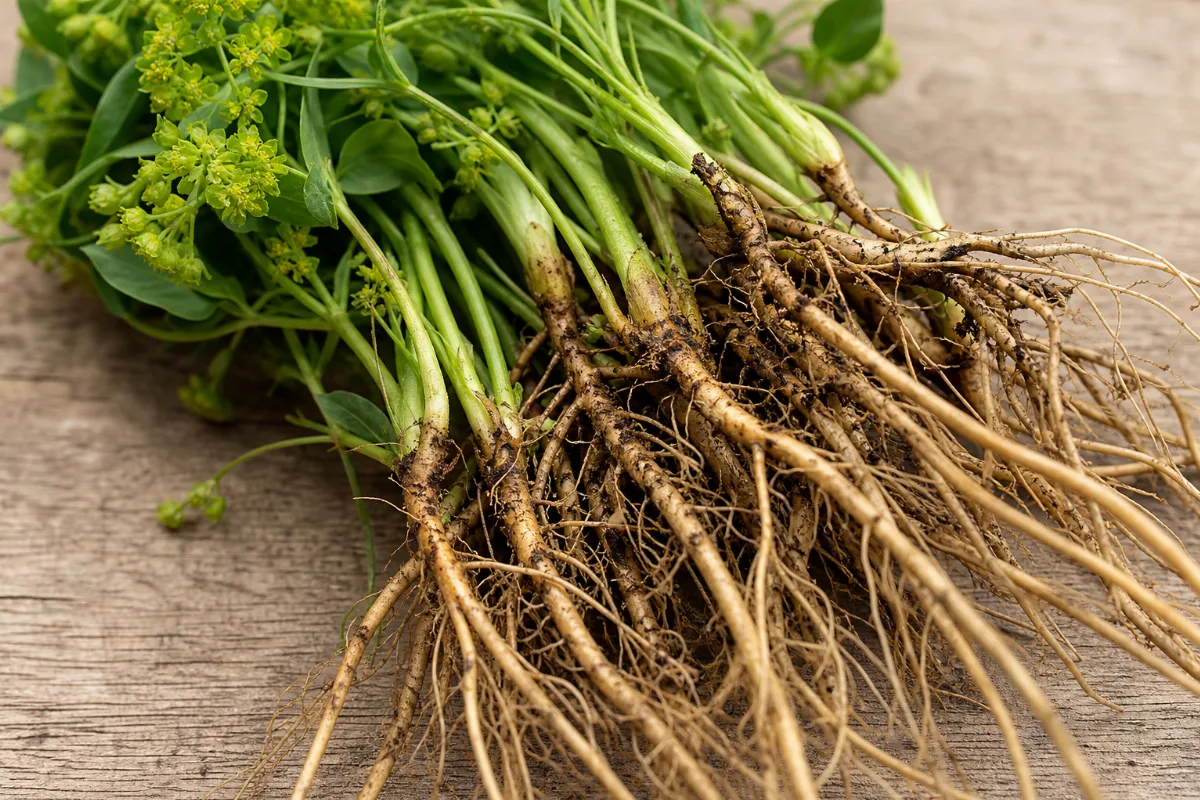
Herbs & Botanicals · Herbs · Classic Chinese and Japanese root with trials only of multi-herb formulas, and real liver and lung cautions
Bupleurum (Chai Hu)
Bupleurum chinense DC. and B. scorzonerifolium Willd. (root) · also called Bupleurum, chai hu, Radix Bupleuri, saiko, thorowax root
Bupleurum is the dried root of Bupleurum chinense or B. scorzonerifolium, a carrot-family plant used in Chinese, Japanese and Korean medicine for over 2,000 years. It is almost always taken inside a formula. Its main compounds are saikosaponins. The formula Xiao Chai Hu Tang (Sho-saiko-to) contains bupleurum but also six other herbs, and results for the formula are not results for bupleurum alone.
General information, not medical advice. Last substantive update · Not medically reviewed. A named clinician has not signed off on this page. How this page is made
About Bupleurum (Chai Hu)
Bupleurum root has an ancient reputation but almost no research on the root alone. Trials are of multi-herb formulas and are low to very low quality. The real story is safety: liver injury, lung inflammation with the formula Sho-saiko-to (especially with interferon), a poisonous look-alike, and a possible interaction with quetiapine.
What it is
Bupleurum (chai hu) is the dried root of Bupleurum chinense DC. and Bupleurum scorzonerifolium Willd., plants in the carrot family (Apiaceae). It has been used in China, Japan and Korea for more than 2,000 years for fever, colds, malaria, menstrual problems and liver complaints. It is usually taken inside a formula. Xiao Chai Hu Tang (Sho-saiko-to) is one such formula, with bupleurum, pinellia, scutellaria, ginseng, jujube, licorice and ginger. This page keeps the single herb and the formulas apart.
What the research shows
No trial of bupleurum root alone was found. Pooled Chinese trials of formulas found lower depression scores than SSRIs (low quality), and a Cochrane review of Xiao Chai Hu Tang for hepatitis B found the effect unclear. A 2021 meta-analysis found better ulcer responses than drugs alone and a 2013 one found better dyspepsia symptoms with a different formula, but trial quality was weak or not reported. One 1995 trial in cirrhosis missed statistical significance overall.
Memorial Sloan Kettering says studies of bupleurum in humans are lacking, rates the depression evidence as low quality, and cautions that herb quality varies.
How it may work
Saikosaponins are the main compounds. Laboratory and animal studies show anti-inflammatory and immune effects, and the same compounds cause dose-dependent liver toxicity in animals. In healthy volunteers Sho-saiko-to lowered the activity of the liver enzyme CYP1A2. None of this proves a benefit in people.
At a glance
Traditional uses history, not proof
- Traditional Chinese medicine: chai hu for fever, colds, influenza, malaria, menstrual problems and liver complaints
- Chinese formulas: Xiao Yao San and Xiao Chai Hu Tang
- Japanese Kampo: Sho-saiko-to, widely given for chronic hepatitis
Studied for research
- Depression (formulas), low
- Chronic hepatitis B (formula), very low
- Liver cancer prevention in cirrhosis (formula), very low
- Peptic ulcer (formula), very low
- Functional dyspepsia (a different formula), very low
- Fever and infections, insufficient (no human trial)
Main compounds
- Saikosaponins a and d (triterpenoid saponins)
- Other saikosaponins (b, c, g and more)
- Essential oil
Common forms
- Dried root, decoction or powder
- Extracts (saikosaponin content varies)
- Multi-herb formulas such as Sho-saiko-to (Xiao Chai Hu Tang)
- Not the same as the poisonous look-alike Bupleurum longiradiatum
Research links: Bupleurum, Memorial Sloan Kettering · Sho-saiko-to, Memorial Sloan Kettering · Cochrane review: Xiao Chai Hu Tang for hepatitis B (2019) · Bupleurum chinense formulas for depression: meta-analysis (2020) · Japanese herbal medicine pneumonitis, 73 patients (2017) · Radix Bupleuri review incl. toxicology (2017) · Research Library · Genes & Biomarkers Library
The plant and its history
- Accepted scientific name
- Bupleurum chinense DC.
- Naming authority
- DC.; ACCEPTED in the GBIF backbone (key 6027145). Bupleurum scorzonerifolium Willd. is also accepted (key 6026926). Radix Bupleuri comes from the dried roots of both (Yang 2017).
- Synonyms
- Not listed; GBIF synonym list was not retrieved. Our graph summary also lists B. falcatum; Lee 2011 names B. falcatum and B. chinense as the officially listed species in its study.
- Common names
- Bupleurum (English); Chai hu (Radix Bupleuri) (Chinese (pinyin)); Saiko (Japanese); Thorowax root (English); Hare's ear root (English)
- Botanical family
- Apiaceae (the carrot or parsley family, which also includes fennel and celery).
- Classification
- Plantae > Tracheophyta > Apiales > Apiaceae > Bupleurum > Bupleurum chinense
- Native range
- East Asia. Yang 2017 says B. scorzonerifolium is widely cultivated in China, Japan and Korea; other range detail not verified.
- Habitat
- Per Yang 2017, B. scorzonerifolium grows on shrub forest margins, sunny mountain slopes and dry grasslands at roughly 200 to 3,000 m.
- What the plant looks like
- Roots: B. scorzonerifolium root is twisting, reddish brown, about 4 to 10 cm long (Yang 2017); root is the part used.; Stems: B. scorzonerifolium stems are 1 to 3, about 30 to 60 cm high (Yang 2017).; Leaves: Linear or linear-lanceolate blades (B. scorzonerifolium, Yang 2017).; Flowers: Yellow petals in compound umbels; flowers July to August (B. scorzonerifolium, Yang 2017).; Fruit: Dark brown ellipsoid fruits, 2 to 3 mm (B. scorzonerifolium, Yang 2017).
- Cultivation
- Widely cultivated in East Asia (Yang 2017); otherwise not verified.
- Harvest and processing
- Not verified from the sources read.
- Look-alikes and adulterants
- Name: Bupleurum longiradiatum Turcz.; Note: Poisonous; polyacetylenes are its main toxic ingredients and it has been misused as a substitute for chai hu (Huang 2011). Lab profiles can separate it: no polyacetylenes in authentic chai hu samples, and no saikosaponin b3 in B. longiradiatum (Lee 2011). GBIF accepts it (key 6027041).; Name: Bupleurum hamiltonii Balak.; Note: Said by Yang 2017 to have very little active content.; Name: Bupleurum sibiricum; Note: Lacks saikosaponin c in the profile study (Lee 2011); not one of the officially listed species there.; Name: Bupleurum falcatum; Note: Named with B. chinense as an officially listed species by Lee 2011; Japanese pharmacopoeia use was not verified here.
- Sustainability and conservation
- Not verified.
Traditional use and history history, not clinical proof
| Tradition or era | Documented use | Source |
|---|---|---|
| Traditional Chinese medicine, Japan and Korea | Dried root (chai hu, Radix Bupleuri) used for more than 2,000 years for influenza, fever, inflammation, malaria, menstrual disorders and hepatitis; in theory it regulates exterior and interior, soothes the liver and lifts yang qi. | p28593176 |
| Kampo and modern East Asian practice | Sho-saiko-to (Xiao Chai Hu Tang), seven herbs including bupleurum root, is widely given to people with chronic hepatitis in Japan. | p14713367 |
| Japan, late 1980s | A cluster of pneumonitis, liver injury and deaths with Xiao Chaihu preparations; a 2014 re-evaluation judged them probably multi-factor, including interferon co-use. | p25423845 |
| Regulators | No EMA/HMPC monograph and no NCCIH page found; Memorial Sloan Kettering has herb pages for both the root and the formula. | s-nccih-bupleurum |
Traditional use shows how a plant was used. It does not show that a supplement works or is safe today.
What is inside, and how it may work
What the plant contains and how those compounds act in cells and animals. Laboratory and animal mechanisms are not proven effects in people.
Main compounds
| Compound | Family | Where it is concentrated | Activity studied | Level of evidence |
|---|---|---|---|---|
| Saikosaponin A PubChem 167928 | Triterpenoid saponin | Root | Main marker compound with saikosaponin D; lab anti-inflammatory and immune effects; linked to dose-dependent liver toxicity. 7 25 23 | Laboratory research |
| Saikosaponin D PubChem 107793 | Triterpenoid saponin | Root | Isomer of saikosaponin A; immunoregulatory in the lab; implicated in liver toxicity and enzyme changes. 7 25 1 | Laboratory research |
| Saikosaponin C and other saikosaponins | Triterpenoid saponins | Root | Saikosaponins a, c and d are the main ones in B. chinense and B. falcatum; used to tell species apart. 15 | Lab analysis |
| Polyacetylenes | Polyacetylenes | Not stated in the abstract | Main toxic ingredients of B. longiradiatum; none detected in authentic chai hu samples (Huang 2011). The 2017 review lists four polyacetylenes under Radix Bupleuri, so the sources do not fully agree. 11 23 | Lab analysis |
| Essential oil | Volatile oil | Root | Caused acute liver toxicity in animals per Yang 2017. 23 | Animal research |
Mechanisms, receptors and pathways
| Target or pathway | Gene or receptor | What was found | Level |
|---|---|---|---|
| Liver cells (oxidative stress, cell death, autophagy) | NF-kB, STAT3 (protective); stress pathways (toxic) | In lab and animal work saikosaponins both protect and damage liver cells depending on amount (Zhu 2026 review). 25 23 | Lab animal |
| Drug-clearing enzymes | CYP1A2, CYP3A4, xanthine oxidase | In 26 healthy volunteers Sho-saiko-to lowered CYP1A2 by 16% and xanthine oxidase by 20 to 25%. In human liver cells saikosaponins lowered CYP3A4 and raised CYP1A2. 19 20 | Human (formula) and in vitro |
| Lung immune reaction | Lymphocytes (CD8+ in lung fluid) | Four hepatitis patients with pneumonitis showed lung lymphocytosis with dominant CD8+ T cells and a positive blood lymphocyte test to interferon or Sho-saiko-to, pointing to an allergic-immune mechanism. 12 | Human (case series, formula) |
| Inflammation and immunity | Arachidonic acid pathway, TLR4, interleukin-2 | Memorial Sloan Kettering lists anti-inflammatory and immune-modulating effects of saikosaponins and polysaccharides from lab studies. 1 | Laboratory research |
Absorption, metabolism and elimination
- Absorption
- In rats, saikosaponins a, b2, c and d were absorbed rapidly after oral extract (Yang 2017). Human data were not found.
- Distribution
- Not covered in the sources read.
- Metabolism
- Sho-saiko-to lowered CYP1A2 and xanthine oxidase in healthy volunteers; cell and animal data point in different directions for CYP3A4.
- Elimination
- Not covered.
- Bioavailability
- Not found for people.
Isolated compounds versus whole extracts
Isolated saikosaponins, whole root extracts and multi-herb formulas are different products. Toxicity and enzyme effects of isolated saikosaponins in cells and animals cannot be assumed for tea or capsules, and formula results (Sho-saiko-to, Xiao Chai Hu Tang, Chaihu Shugan) cannot be given to bupleurum alone because the other herbs, such as pinellia, scutellaria and licorice, also have effects.
Nutritional composition
Bupleurum root is a medicinal herb, not a food, and is not a meaningful source of vitamins or minerals.
1 low certainty4 very low certainty3 not enough evidence
What is Bupleurum (Chai Hu) good for?
The main studied uses and how strong the human evidence is. Every human result below is for a multi-herb formula, not for bupleurum alone, unless stated.
Benefits, one by one
Each card is a research question, not a promise. Tap a goal to filter. Open a card to see the studies, doses and limits.
Depression (Bupleurum chinense formulas, not the herb alone)
Low certaintyChinese trials of herbal formulas built around bupleurum root found lower depression scores than an SSRI antidepressant alone, and lower scores when the formula was added to an SSRI. The pooled evidence is low quality and every result is for a multi-herb formula. No trial of bupleurum root on its own for depression was found.
2 studiesMulti-herb formulas containing Bupleurum chinense root; the specific …
Studies, doses and limits
What the trials found
Yang 2020 pooled randomised trials in adults aged 18 to 65 with major depressive disorder. In 30 trials, a Bupleurum chinense formula gave a lower Hamilton depression score than an SSRI antidepressant (SMD -0.35, 95% CI -0.52 to -0.18, I2 81.2%). In 25 trials, a formula plus an SSRI gave a lower score than the SSRI alone (SMD -1.03, 95% CI -1.43 to -0.62, I2 94.2%). Adverse events were fewer and less severe in the formula groups. The authors call the evidence low quality and at risk of bias, with high heterogeneity. The abstract does not name the formulas.
Results
Lower depression scores with formula versus SSRI and with formula plus SSRI versus SSRI alone; fewer adverse events; evidence rated low quality by the authors.
Effect sizes as reported
SMD -0.35 (formula alone vs SSRI); SMD -1.03 (formula + SSRI vs SSRI alone); I2 81.2% and 94.2%.
Why this rating
The reviewers themselves rate the evidence low quality with high risk of bias and very high heterogeneity. The formulas differ between trials and are combinations, so the result cannot be given to bupleurum alone.
Form and dose studied
Multi-herb formulas containing Bupleurum chinense root; the specific formulas and amounts are not given in the abstract.
Who was studied
Adults aged 18 to 65 with major depressive disorder. People with post-stroke depression, bipolar disorder or physical comorbidities were excluded.
Limits
Combination products; high heterogeneity; low-quality trials; abstract gives no trial count for blinding or placebo control; no information on long-term effects; the comparison was with SSRIs, not with placebo.
Why researchers looked
Bupleurum is the lead herb in several classic Chinese formulas used for low mood and irritability. Memorial Sloan Kettering names Xiao Yao San and Xiao Chai Hu Tang as formulas that contain it and lists depression among its traditional uses.
Traditional use
Radix Bupleuri (chai hu) is the dried root of Bupleurum chinense DC. and B. scorzonerifolium Willd. It has been used for more than 2,000 years in China, Japan and Korea, mostly inside formulas. Memorial Sloan Kettering says it is usually prescribed in combination with other herbs.
Proposed mechanism Preliminary mechanism
How it might work in depression is not established in people. Memorial Sloan Kettering describes anti-inflammatory and immune effects of bupleurum from laboratory and animal studies only.
A proposed mechanism does not show that the effect happens in people.
A 2026 Japanese claims study found more CNS depression when a Bupleuri Radix formula was taken with the antipsychotic quetiapine (see the safety tab). Liver injury and lung inflammation have been reported with bupleurum formulas.
Stress, anxiety and sleep
Not enough evidenceBupleurum-based formulas are used in Chinese medicine for tension and low mood, but no human trial of bupleurum for stress, anxiety or sleep was found. Memorial Sloan Kettering says studies of bupleurum in humans are lacking.
1 studiesNot applicable.
Studies, doses and limits
What the trials found
No trial of bupleurum, alone or in a formula, for stress, anxiety or sleep was found in the searches run for this page. Memorial Sloan Kettering states that studies of bupleurum in humans are lacking.
Results
No human result to report.
Effect sizes as reported
Not available.
Why this rating
No human trial found.
Form and dose studied
Not applicable.
Who was studied
Not applicable.
Limits
Absence of a trial found in a limited search does not prove there is none.
Why researchers looked
Formulas such as Xiao Yao San are used traditionally for mood and tension. This is the traditional claim, not a tested result.
Traditional use
Traditional Chinese medicine uses bupleurum to regulate and soothe the liver, a concept with no direct modern medical meaning.
Proposed mechanism No evidence
No mechanism has been shown in people.
A proposed mechanism does not show that the effect happens in people.
Do not combine with sedating medicines such as quetiapine without medical advice (see the safety tab).
Chronic hepatitis B (Xiao Chai Hu Tang formula)
Very low certaintyA Cochrane review of Chinese trials of the seven-herb formula Xiao Chai Hu Tang for chronic hepatitis B found the effects unclear. The trials were small and weak, and none measured deaths, serious side effects or quality of life. There is no trial of bupleurum alone.
2 studiesDifferent forms of the formula for 3 to 8 months; amounts not pooled.
Studies, doses and limits
What the trials found
Kong 2019 (Cochrane) found 10 randomised trials with 934 people, but only 5 trials (490 people) gave usable data. All compared the formula with no treatment, were done in China, and were at high risk of bias. Detectable HBV DNA was less common with the formula (RR 0.62, 95% CI 0.45 to 0.85; 3 trials, 222 people; very low certainty). HBeAg was not clearly different (RR 0.72, 95% CI 0.50 to 1.02; 2 trials, 160 people; very low certainty). No trial reported deaths, serious adverse events, quality of life or hepatitis B complications.
Results
Possibly fewer people with detectable HBV DNA; HBeAg unclear; no clinical outcomes measured; certainty very low.
Effect sizes as reported
HBV DNA detectable RR 0.62; HBeAg detectable RR 0.72 (not significant).
Why this rating
Cochrane graded all outcomes with data as very low certainty: high risk of bias, inconsistency, indirect surrogate outcomes, imprecision and publication bias.
Form and dose studied
Different forms of the formula for 3 to 8 months; amounts not pooled.
Who was studied
People with chronic hepatitis B, including one trial with TB and one with cirrhosis; all in China.
Limits
Combination formula; no placebo; surrogate outcomes only; the review says applicability outside China is uncertain.
Why researchers looked
Sho-saiko-to (Xiao Chai Hu Tang) has long been given to people with chronic liver disease, especially in Japan.
Traditional use
The formula contains bupleurum root, pinellia, scutellaria, ginseng, jujube, licorice and ginger, per Memorial Sloan Kettering.
Proposed mechanism Preliminary mechanism
Lab and animal work suggests anti-inflammatory and antiviral effects. This is not shown in people.
A proposed mechanism does not show that the effect happens in people.
Pneumonitis and liver injury have been reported with the formula, and Memorial Sloan Kettering relays a label caution against use in cirrhosis or chronic hepatitis with low platelets. See the safety tab.
Liver cancer prevention in cirrhosis (Sho-saiko-to)
Very low certaintyOne 1995 Japanese trial of 260 people with cirrhosis found fewer liver cancers and better survival with Sho-saiko-to, but the main result was not statistically significant. It was positive only in people without hepatitis B surface antigen, and the trial was open-label. The formula label itself cautions against use in cirrhosis.
3 studiesSho-saiko-to extract (TJ-9), 7.5 g a day by mouth in the trial.
Studies, doses and limits
What the trials found
Oka 1995: 260 people with cirrhosis were randomised, without blinding or placebo, to usual drugs with or without Sho-saiko-to (7.5 g a day, as TJ-9 extract) and followed 60 months. The 5-year cancer incidence was lower in the Sho-saiko-to group but not significantly (P = 0.071). Among people without hepatitis B surface antigen the difference was significant (P = 0.024). Survival: P = 0.053 overall and P = 0.043 without the antigen. A 2011 review (Lee) says trials show lower liver cancer rates but also that interstitial pneumonia risk rises with interferon, longer use and older age.
Results
Lower liver cancer incidence (not significant overall; significant in a subgroup) and a similar survival pattern.
Effect sizes as reported
P = 0.071 overall and P = 0.024 in HBsAg-negative people for cancer incidence; no effect size given in the abstract.
Why this rating
One older unblinded trial; the main result missed statistical significance and the positive finding is a subgroup. No independent replication was found here.
Form and dose studied
Sho-saiko-to extract (TJ-9), 7.5 g a day by mouth in the trial.
Who was studied
Japanese people with cirrhosis; 5-year follow-up.
Limits
Open-label; subgroup finding; 1995; formula not bupleurum alone; Memorial Sloan Kettering says the product's prescribing information recommends against use in cirrhosis or liver cancer.
Why researchers looked
Liver cancer usually arises in cirrhosis, so a safe preventive would matter.
Traditional use
Japanese Kampo treatment of chronic liver disease.
Proposed mechanism Preliminary mechanism
Lee 2011 says basic studies show less liver scarring in animals and cells; the mechanism in people is unknown.
A proposed mechanism does not show that the effect happens in people.
Pneumonitis risk is higher with interferon and with low platelets, which are common in advanced liver disease.
Peptic ulcer (Xiao Chai Hu Tang formula)
Very low certaintyA 2021 meta-analysis of 13 Chinese trials (1,334 people) found a higher clinical response and fewer symptoms with Xiao Chai Hu Tang than with ulcer drugs alone. Recurrence was not clearly lower for the formula versus drugs. The trial quality was not reported in the abstract.
1 studiesXiao Chai Hu Tang, as monotherapy or add-on; amounts not given in the…
Studies, doses and limits
What the trials found
Li 2021: formula beat conventional drugs for the clinical efficacy rate (RR 1.20, 95% CI 1.08 to 1.34). Poor appetite (RR 0.30), abdominal distension (RR 0.61), vomiting (RR 0.33) and stomach pain (RR 0.36) were less frequent, and adverse events were fewer (RR 0.23, 95% CI 0.07 to 0.69). Recurrence was lower for formula plus drugs (RR 0.29) but not clearly different for formula versus drugs (RR 0.45, 95% CI 0.07 to 3.10). Acid reflux showed no clear difference (RR 0.76).
Results
Higher clinical efficacy rate and fewer symptoms than drugs alone; recurrence benefit only for formula plus drugs; no clear difference in reflux.
Effect sizes as reported
Clinical efficacy RR 1.20; adverse events RR 0.23; recurrence RR 0.29 (formula + drugs) or 0.45 (formula vs drugs, not significant).
Why this rating
The abstract does not report trial quality, and Chinese open trials of this type are often at high risk of bias; we have therefore rated it conservatively. Reviewers' own GRADE was not given.
Form and dose studied
Xiao Chai Hu Tang, as monotherapy or add-on; amounts not given in the abstract.
Who was studied
People with peptic ulcer, 13 trials.
Limits
Combination formula; quality not seen; mainly Chinese trials.
Why researchers looked
The formula has been used for ulcers and stomach pain in China.
Traditional use
Traditional Chinese medicine for digestive complaints.
Proposed mechanism Preliminary mechanism
Not established in people.
A proposed mechanism does not show that the effect happens in people.
See the safety tab for liver and lung warnings with this formula.
Functional dyspepsia (modified Chaihu Shugan powder)
Very low certaintyA 2013 meta-analysis of 22 Chinese trials (1,998 people) found symptoms improved more with modified Chaihu Shugan powder than with prokinetic drugs alone. All trials were at high risk of bias. This is a different formula from Xiao Chai Hu Tang.
1 studiesModified Chaihu Shugan powder; amounts not given in the abstract.
Studies, doses and limits
What the trials found
Yang 2013: the formula alone was better than prokinetic drugs for symptoms (RR 1.20, 95% CI 1.14 to 1.27) and so was the formula plus prokinetics (RR 1.18, 95% CI 1.11 to 1.25). No serious adverse events were described. All trials were at high risk of bias, according to the authors.
Results
Better symptom response than prokinetic drugs alone; no serious adverse events reported.
Effect sizes as reported
RR 1.20 (formula) and RR 1.18 (formula + prokinetic).
Why this rating
The authors state that all included trials were at high risk of bias, with poor methodological quality.
Form and dose studied
Modified Chaihu Shugan powder; amounts not given in the abstract.
Who was studied
People with functional dyspepsia, 22 trials.
Limits
Combination formula, modified differently in each trial; high risk of bias; 2013.
Why researchers looked
Chaihu Shugan San is a classic formula with bupleurum used for upper-stomach discomfort and tension.
Traditional use
Traditional Chinese medicine; bupleurum is one ingredient.
Proposed mechanism Preliminary mechanism
Not established in people.
A proposed mechanism does not show that the effect happens in people.
Not assessed beyond the absence of serious adverse events in the included trials.
Fever, colds and infections
Not enough evidenceBupleurum is a traditional remedy for fever, colds, influenza and malaria, but no human trial supporting this use was found. Memorial Sloan Kettering says studies of bupleurum in humans are lacking.
3 studiesNot applicable.
Studies, doses and limits
What the trials found
No human trial of bupleurum for fever or infections was found in the sources read. Memorial Sloan Kettering lists cold, fever and infections as purported uses and says human studies are lacking.
Results
No human result to report.
Effect sizes as reported
Not available.
Why this rating
No human trial found.
Form and dose studied
Not applicable.
Who was studied
Not applicable.
Limits
Traditional use only.
Why researchers looked
It is one of the best-known traditional fever herbs in China, Japan and Korea.
Traditional use
Yang 2017 lists influenza, fever, inflammation, malaria, menstrual disorders and hepatitis as long-standing uses.
Proposed mechanism Preliminary mechanism
Lab studies describe anti-inflammatory and antiviral effects; not shown in people.
A proposed mechanism does not show that the effect happens in people.
A Bupleuri Radix injection used in China has caused hypersensitivity reactions and, in one report, a fatal shock; it is not an oral product (Wu 2014).
Liver protection (laboratory and animal studies only)
Not enough evidenceIn cells and animals, saikosaponins from the root reduce liver inflammation and scarring, but the same compounds can damage the liver at higher amounts. None of this has been shown to protect the liver in healthy people, and bupleurum has caused liver injury in people.
2 studiesIsolated saikosaponins and extracts in animals.
Studies, doses and limits
What the trials found
None. Laboratory and animal evidence only.
Results
Protective and toxic effects in animals and cells; no human result.
Effect sizes as reported
Not applicable.
Why this rating
Lab and animal studies cannot show a benefit in people, and the same review says the compounds can be toxic.
Form and dose studied
Isolated saikosaponins and extracts in animals.
Who was studied
Animals and cells.
Limits
Review of mostly lab studies; not human.
Why researchers looked
Saikosaponins are the main active compounds in the root.
Traditional use
Used to support the liver in Chinese medicine.
Proposed mechanism Animal and laboratory
Zhu 2026 reviews lab and animal findings: effects on NF-kB, STAT3, stellate cells and fat pathways, and dose-dependent liver toxicity through oxidative stress and cell death.
A proposed mechanism does not show that the effect happens in people.
Real liver injury reports exist; see the safety tab.
Connections to the rest of health
How Bupleurum (Chai Hu) connects to the rest of our health knowledge graph. Every link says what kind of connection it is. A safety link (for example to the liver) is a warning, not a benefit. A study that merely mentions a topic never creates a benefit link.
Explore every connection: goals, body systems, organs, symptoms, genes
A. Wellness goals
| Connected to | Kind of connection | Evidence status | Context | Studies |
|---|---|---|---|---|
| Mood Balance | Potential benefit | Low certainty | Depression (Bupleurum chinense formulas, not the herb alone): Chinese trials of herbal formulas built around bupleurum root found lower depression scores than an SSRI antidepressant alone, and lower scores when the formula was added to an SSRI. The pooled evidence is low quality and every result is for a multi-herb formula. No trial of bupleurum root on its own for depression was found. | 24 1 |
| Stress Reduction | Traditional use | Not enough evidence | Stress, anxiety and sleep: Bupleurum-based formulas are used in Chinese medicine for tension and low mood, but no human trial of bupleurum for stress, anxiety or sleep was found. Memorial Sloan Kettering says studies of bupleurum in humans are lacking. | 1 |
| Anxiety Support | Traditional use | Not enough evidence | Stress, anxiety and sleep: Bupleurum-based formulas are used in Chinese medicine for tension and low mood, but no human trial of bupleurum for stress, anxiety or sleep was found. Memorial Sloan Kettering says studies of bupleurum in humans are lacking. | 1 |
| Better Sleep | Traditional use | Not enough evidence | Stress, anxiety and sleep: Bupleurum-based formulas are used in Chinese medicine for tension and low mood, but no human trial of bupleurum for stress, anxiety or sleep was found. Memorial Sloan Kettering says studies of bupleurum in humans are lacking. | 1 |
| Liver Support | Potential benefit | Very low certainty | Chronic hepatitis B (Xiao Chai Hu Tang formula): A Cochrane review of Chinese trials of the seven-herb formula Xiao Chai Hu Tang for chronic hepatitis B found the effects unclear. The trials were small and weak, and none measured deaths, serious side effects or quality of life. There is no trial of bupleurum alone. Liver cancer prevention in cirrhosis (Sho-saiko-to): One 1995 Japanese trial of 260 people with cirrhosis found fewer liver cancers and better survival with Sho-saiko-to, but the main result was not statistically significant. It was positive only in people without hepatitis B surface antigen, and the trial was open-label. The formula label itself cautions against use in cirrhosis. | 13 2 18 14 |
| Immune Support | Potential benefit | Very low certainty | Chronic hepatitis B (Xiao Chai Hu Tang formula): A Cochrane review of Chinese trials of the seven-herb formula Xiao Chai Hu Tang for chronic hepatitis B found the effects unclear. The trials were small and weak, and none measured deaths, serious side effects or quality of life. There is no trial of bupleurum alone. | 13 2 |
| Digestive Support | Potential benefit | Very low certainty | Peptic ulcer (Xiao Chai Hu Tang formula): A 2021 meta-analysis of 13 Chinese trials (1,334 people) found a higher clinical response and fewer symptoms with Xiao Chai Hu Tang than with ulcer drugs alone. Recurrence was not clearly lower for the formula versus drugs. The trial quality was not reported in the abstract. Functional dyspepsia (modified Chaihu Shugan powder): A 2013 meta-analysis of 22 Chinese trials (1,998 people) found symptoms improved more with modified Chaihu Shugan powder than with prokinetic drugs alone. All trials were at high risk of bias. This is a different formula from Xiao Chai Hu Tang. | 16 22 |
| Gut Health | Potential benefit | Very low certainty | Peptic ulcer (Xiao Chai Hu Tang formula): A 2021 meta-analysis of 13 Chinese trials (1,334 people) found a higher clinical response and fewer symptoms with Xiao Chai Hu Tang than with ulcer drugs alone. Recurrence was not clearly lower for the formula versus drugs. The trial quality was not reported in the abstract. Functional dyspepsia (modified Chaihu Shugan powder): A 2013 meta-analysis of 22 Chinese trials (1,998 people) found symptoms improved more with modified Chaihu Shugan powder than with prokinetic drugs alone. All trials were at high risk of bias. This is a different formula from Xiao Chai Hu Tang. | 16 22 |
| Immune Support | Traditional use | Not enough evidence | Fever, colds and infections: Bupleurum is a traditional remedy for fever, colds, influenza and malaria, but no human trial supporting this use was found. Memorial Sloan Kettering says studies of bupleurum in humans are lacking. | 1 23 21 |
| Liver Support | Not enough evidence | Liver protection (laboratory and animal studies only): In cells and animals, saikosaponins from the root reduce liver inflammation and scarring, but the same compounds can damage the liver at higher amounts. None of this has been shown to protect the liver in healthy people, and bupleurum has caused liver injury in people. | 25 14 |
B. Body systems
| Connected to | Kind of connection | Evidence status | Context | Studies |
|---|---|---|---|---|
| Hepatic / liver system | Adverse effect or risk | Low certainty | Raised enzymes, hepatitis and jaundice in reports. Preparation or compound: Bupleurum root and formulas |
23 1 |
| Respiratory system | Adverse effect or risk | Low certainty | Interstitial pneumonitis, about 1 in 20,000. Interstitial pneumonitis, about 1 in 20,000, sometimes fatal; higher risk with interferon. Preparation or compound: Sho-saiko-to (formula) |
2 10 |
| Nervous system | Drug or supplement interaction | Low certainty | More CNS depression in a cohort study. Preparation or compound: Bupleuri Radix formulas with quetiapine |
17 |
| Stress Mood | Biological association | Low certainty | Studied for: Depression (Bupleurum chinense formulas, not the herb alone) Studied for: Stress, anxiety and sleep | 24 1 |
| Nervous System | Biological association | Low certainty | Studied for: Depression (Bupleurum chinense formulas, not the herb alone) Studied for: Stress, anxiety and sleep | 24 1 |
| Sleep Recovery | Biological association | Not enough evidence | Studied for: Stress, anxiety and sleep | 1 |
| Hepatic System | Biological association | Very low certainty | Studied for: Chronic hepatitis B (Xiao Chai Hu Tang formula) Studied for: Liver cancer prevention in cirrhosis (Sho-saiko-to) | 13 2 18 14 25 |
| Immune System | Biological association | Very low certainty | Studied for: Chronic hepatitis B (Xiao Chai Hu Tang formula) Studied for: Fever, colds and infections | 13 2 1 23 21 |
| Digestive System | Biological association | Very low certainty | Studied for: Peptic ulcer (Xiao Chai Hu Tang formula) Studied for: Functional dyspepsia (modified Chaihu Shugan powder) | 16 22 |
| Respiratory System | Biological association | Not enough evidence | Studied for: Fever, colds and infections | 1 23 21 |
I. Biomarkers
| Connected to | Kind of connection | Evidence status | Context | Studies |
|---|---|---|---|---|
| Hamilton Depression Rating Scale (HRSD) score | Biological association | Low certainty | Measured in trials: lowered. A lab change is not the same as a health benefit. | 24 |
| Detectable hepatitis B virus DNA (HBV DNA) | Biological association | Very low certainty | Measured in trials: lowered. A lab change is not the same as a health benefit. | 13 |
| Hepatitis B e-antigen (HBeAg) | Biological association | Very low certainty | Measured in trials: no-change. A lab change is not the same as a health benefit. | 13 |
| Liver cancer (HCC) incidence over 5 years | Biological association | Very low certainty | Measured in trials: lowered. A lab change is not the same as a health benefit. | 18 |
| Peptic ulcer clinical efficacy rate | Biological association | Very low certainty | Measured in trials: improved. A lab change is not the same as a health benefit. | 16 |
| Functional dyspepsia symptom improvement | Biological association | Very low certainty | Measured in trials: improved. A lab change is not the same as a health benefit. | 22 |
J. Genes, receptors and enzymes
| Connected to | Kind of connection | Evidence status | Context | Studies |
|---|---|---|---|---|
| CYP3A4 / CYP1A2 | Drug or supplement interaction | Very low certainty | Opposite effects in cells and people; clinical meaning unknown. Preparation or compound: Saikosaponins; Sho-saiko-to |
19 20 |
| CYP1A2 | Preliminary mechanism | Human (formula) and in vitro | Activity fell 16% with Sho-saiko-to in volunteers and rose in cells exposed to saikosaponins. | 19 20 |
| CYP3A4 | Preliminary mechanism | In vitro | Lowered by saikosaponins in liver cells; animals suggest induction. Direction unsettled. | 20 1 |
| Xanthine oxidase | Preliminary mechanism | Human (formula) | Activity fell 20 to 25% with Sho-saiko-to in volunteers. | 19 |
L. Active compounds
| Connected to | Kind of connection | Evidence status | Context | Studies |
|---|---|---|---|---|
| Saikosaponin A | Biological association | In vitro | Main marker compound with saikosaponin D; lab anti-inflammatory and immune effects; linked to dose-dependent liver toxicity. Preparation or compound: Root |
7 25 23 |
| Saikosaponin D | Biological association | In vitro | Isomer of saikosaponin A; immunoregulatory in the lab; implicated in liver toxicity and enzyme changes. Preparation or compound: Root |
7 25 1 |
| Saikosaponin C and other saikosaponins | Biological association | Lab analysis | Saikosaponins a, c and d are the main ones in B. chinense and B. falcatum; used to tell species apart. Preparation or compound: Root |
15 |
| Polyacetylenes | Biological association | Lab analysis | Main toxic ingredients of B. longiradiatum; none detected in authentic chai hu samples (Huang 2011). The 2017 review lists four polyacetylenes under Radix Bupleuri, so the sources do not fully agree. Preparation or compound: Not stated in the abstract |
11 23 |
| Essential oil | Biological association | Animal | Caused acute liver toxicity in animals per Yang 2017. Preparation or compound: Root |
23 |
Each connection is stored with the ingredient, the connected record, the kind of connection, the evidence status, the supporting studies, the preparation or compound involved, and a review date (last reviewed October 25, 2026).
Evidence at a glance: what changed in 4 lab markers
Tap a number to show only those markers. Counts are markers, not people.
The evidence
The research centre for Bupleurum (Chai Hu). Every record here was checked against PubMed or the publisher's page; we never list a study we have not verified.
Evidence by outcome
Bars show how many studies we found for each outcome, not how well it works. People are added up across trials only (reviews are not added, to avoid double counting).
How we rate evidence
High certainty
Several well-run trials or reviews agree; further research is unlikely to change the picture much.
Moderate certainty
Good trials point the same way, but some doubt remains.
Low certainty
Small, short or inconsistent trials. The finding could change with better research.
Very low certainty
Very little or very weak human data. Treat as a possibility only.
Mixed findings
Trials or reviews disagree with each other.
Not enough evidence
Not enough human research to say either way.
Evidence against
Good research found no benefit, or found harm.
We take the reviewers' own risk-of-bias and GRADE statements where they exist, and otherwise judge from study size, design, consistency, directness and whether a product matches what is sold. Many publications do not make evidence high. Method note: We read Memorial Sloan Kettering's pages on bupleurum and Sho-saiko-to, searched PubMed and read each abstract directly, and checked taxonomy through GBIF and compound IDs through PubChem. NCCIH had no bupleurum page, EMA and LactMed had nothing we could find, LiverTox could not be read, and FDA and WHO were not checked. This is stated where it matters.
Study library: every study we checked 25
| Study | Design | People | Product, dose, length | Result |
|---|---|---|---|---|
| 2022 Bupleurum (About Herbs), Memorial Sloan Kettering Cancer Center · Source |
Authoritative guidance |
unspecified |
Page last updated 1 June 2022, read 2026-10-25. Says studies of bupleurum in humans are lacking; a meta-analysis suggests B. chinense formulas may reduce depression severity but the evidence is low quality. Notes poor quality control, with one bupleurum sample contaminated with the kidney-harming compound aristolactone and unclear screening for toxic polyacetylenes. Says saikosaponins are the likely cause of dose-dependent liver injury. Case reports: increased risk of liver injury in hepatitis B patients using Chinese herbal products with more than 19 g of bupleurum (as reported by MSK); liver injury and hepatitis with Sho-saiko-to. Interactions: lab extracts inhibit CYP2C9; animal studies suggest induction of CYP2E1, 2D6 and 3A4, more likely at higher doses; clinical relevance not determined. Pregnancy and breastfeeding are not addressed. Methods, limits and fundingRead: full-text | |
| 2022 Sho-saiko-to (Xiao-chai-hu-tang) (About Herbs), Memorial Sloan Kettering Cancer Center · Source |
Authoritative guidance |
unspecified |
Page last updated 1 June 2022, read 2026-10-25. Formula of 7 herbs: bupleurum root, pinellia, scutellaria, ginseng, jujube, licorice, ginger. Warns it may cause interstitial pneumonitis, potentially fatal; interferon or low platelet counts may raise the risk; stop at once if fever, cough, breathlessness or abnormal lung sounds. Contraindications listed: nursing or pregnant women; people on interferon; people with liver cancer, cirrhosis, or chronic hepatitis with low platelets. Pneumonitis reported in 74 patients (about 1 in 20,000). Case report of recurrent drug-induced liver injury where scutellaria was suspected. Adverse reactions: rash with fever, loss of appetite, nausea, diarrhoea, cystitis. Prescribing information recommends against use in liver cirrhosis or cancer and says patients should have a moderately strong constitution. A meta-analysis found efficacy for chronic hepatitis B unclear. Use only under a qualified practitioner. Methods, limits and fundingRead: full-text | |
| 2026 LiverTox (NIDDK) bupleurum entry (not read) · Source |
Authoritative guidance |
unspecified |
No dedicated bupleurum page was found. NCBI Books lists bupleurum in LiverTox's 'Chinese and other Asian Herbal Medicines' chapter (NBK548589), but the page returned an automated browser check and could not be read, so no LiverTox statement is used. Methods, limits and fundingRead: not-found | |
| 2026 NCCIH bupleurum page (checked, not found) · Source |
Authoritative guidance |
unspecified |
The address https://www.nccih.nih.gov/health/bupleurum returned HTTP 404 on 2026-10-25. No NCCIH bupleurum page was found. Methods, limits and fundingRead: not-found | |
| 2026 EMA / HMPC herbal monograph for Bupleuri radix (checked, not found) · Source |
Authoritative guidance |
unspecified |
A guessed monograph address returned HTTP 404 and the EMA search page returned HTTP 401 on 2026-10-25. No EMA/HMPC monograph on Bupleurum was found; none is claimed to exist or not exist. Methods, limits and fundingRead: not-found | |
| 2026 LactMed (NLM) bupleurum entry (checked, not found) · Source |
Authoritative guidance |
unspecified |
An NCBI Books search for bupleurum with LactMed returned only LiverTox chapter pages. No LactMed entry on bupleurum was found. Methods, limits and fundingRead: not-found | |
| 2026 PubChem records for saikosaponin A and saikosaponin D · Source |
Database record |
unspecified |
PubChem PUG REST, 2026-10-25. Saikosaponin A: CID 167928, formula C42H68O13, molecular weight 781.0. Saikosaponin D: CID 107793, formula C42H68O13, molecular weight 781.0 (the two are isomers). Methods, limits and fundingRead: full-text | |
| 2026 GBIF species match: Bupleurum chinense DC., B. scorzonerifolium Willd., B. longiradiatum Turcz. · Source |
Database record |
unspecified |
GBIF species match API, 2026-10-25. Bupleurum chinense DC.: ACCEPTED, key 6027145, family Apiaceae, order Apiales. Bupleurum scorzonerifolium Willd.: ACCEPTED, key 6026926, family Apiaceae. Bupleurum longiradiatum Turcz.: ACCEPTED, key 6027041, family Apiaceae. Methods, limits and fundingRead: full-text | |
| Aiba 2007 Liver injury induced by a Japanese herbal medicine, sairei-to (TJ-114, Bupleurum and Hoelen Combination, Chai-Ling-Tang) R1. J Gastroenterol Hepatol · PMID 17444872 · DOI |
Case report |
1 One man with acute hepatitis and jaundice after sairei-to |
Sairei-to (Bupleurum and Hoelen Combination), a multi-herb formula formula not applicable not applicable · vs not applicable |
A lymphocyte migration inhibition test pointed to Pinellia ternata tuber, not bupleurum, as the cause. Cause traced to Pinellia (NA) Methods, limits and fundingOutcomes: Which ingredient caused the liver injury Limitations: One case; the test is not definitive. Funding and conflicts: Not stated in the abstract. Read: abstract |
| Enomoto 2017 Japanese herbal medicine-induced pneumonitis: A review of 73 patients. Respir Investig · PMID 28274529 · DOI |
Case series |
73 73 patients with pneumonitis blamed on Japanese herbal medicines, from 59 articles published 1996 to 2015 (7 English, 52 Japanese) |
Japanese herbal medicines; Sho-saiko-to was the most often reported (26%) formula not applicable Pneumonitis began within 3 months in 89% · vs not applicable |
Sho-saiko-to 26%, sairei-to 16%, seishin-renshi-in 8%, bofu-tsusyo-san 8%. 89% became ill within 3 months. 36% recovered by stopping the herbal medicine; the rest needed immunosuppressive drugs; 18% needed a ventilator; 4% (3 patients) died. The authors note these medicines commonly contain skullcap (ougon) and licorice (kanzo). Sho-saiko-to 26% of 73 cases; 4% died (NA) Methods, limits and fundingOutcomes: Pneumonitis course and outcome Limitations: Collected case reports: no rate can be calculated, reporting bias likely, and the cause could be any ingredient (the authors point to skullcap and licorice, not bupleurum specifically). Funding and conflicts: Not stated in the abstract. Read: abstract |
| Huang 2011 Qualitative and quantitative determination of polyacetylenes in different Bupleurum species by high performance liquid chromatography with diode array detector and mass spectrometry. J Chromatogr A · PMID 21256495 · DOI |
Lab analysis lab |
27 27 Bupleurum samples of several species |
Polyacetylenes in Bupleurum species root and plant samples (part not stated in the abstract) not applicable not applicable · vs not applicable |
Says polyacetylenes are the main toxic ingredients of Bupleurum longiradiatum, a poisonous plant that has been misused as a substitute for Chaihu. Polyacetylenes were the main ingredients in B. longiradiatum and were found in a few other species, but none were detected in the authentic Chaihu samples or the other medicinal species tested. The toxic species can be told apart by its polyacetylene profile. Acute toxicity of the B. longiradiatum ethanol extract was also tested (numbers not in the abstract). not applicable (NA) Methods, limits and fundingOutcomes: Polyacetylene content by species Limitations: Laboratory chemistry; abstract gives no toxicity numbers and no human case data. Funding and conflicts: Not stated in the abstract. Read: abstract |
| Ishizaki 1996 Pneumonitis during interferon and/or herbal drug therapy in patients with chronic active hepatitis. Eur Respir J · PMID 8980988 · DOI |
Case series |
4 Four people with chronic active hepatitis who developed acute pneumonitis |
Interferon, Sho-saiko-to, or both formula not applicable not applicable · vs not applicable |
Fever, dry cough, breathlessness and low oxygen with diffuse lung changes. A blood lymphocyte stimulation test was positive to interferon in one case and to Sho-saiko-to in another. All responded to prednisolone and were symptom-free at 1 to 3 years. The authors conclude the pneumonitis may be allergic-immunological rather than a direct toxic effect. 4 cases; all recovered with prednisolone (NA) Methods, limits and fundingOutcomes: Clinical course; lymphocyte tests; response to prednisolone Limitations: Four cases only; cannot separate interferon from the herbal drug in cases given both. Funding and conflicts: Not stated in the abstract. Read: abstract |
| Kong 2019 Xiao Chai Hu Tang, a herbal medicine, for chronic hepatitis B. Cochrane Database Syst Rev · PMID 31697415 · DOI |
Systematic review |
934 People with chronic hepatitis B; 10 randomised trials (934 people), only 5 trials (490 people) gave usable data; all trials done in China |
Xiao Chai Hu Tang, a multi-herb formula (bupleurum is one of seven herbs) formula (root plus six other herbs) Forms varied between trials 3 to 8 months · vs No treatment |
No trial measured deaths, serious adverse events, quality of life or hepatitis B complications. Detectable HBV DNA: RR 0.62 (3 trials, 222 people; very low certainty). HBeAg: RR 0.72 (2 trials, 160 people; uncertain; very low certainty). Non-serious adverse events: RR 0.43, wide interval, uncertain. All trials at high risk of bias. HBV DNA detectable: RR 0.62; HBeAg detectable: RR 0.72 (HBV DNA RR 0.62 (95% CI 0.45 to 0.85); HBeAg RR 0.72 (0.50 to 1.02); non-serious adverse events RR 0.43 (0.02 to 11.98)) Methods, limits and fundingOutcomes: Deaths, serious adverse events, quality of life, HBV DNA, HBeAg Limitations: Small trials, all high risk of bias, all in China, compared with no treatment (no placebo), surrogate outcomes only. 47 further trials could not be included for missing method detail. Funding and conflicts: Two of the 10 trials had academic funding; the other eight did not report funding. Cochrane authors declared no conflicts. Read: abstract |
| Lee 2011 Therapeutic effects of the oriental herbal medicine Sho-saiko-to on liver cirrhosis and carcinoma. Hepatol Res · PMID 21682829 · DOI |
Narrative review mixed |
Narrative review | Sho-saiko-to (seven-herb formula) formula not applicable not applicable · vs not applicable |
Says clinical trials have shown lower liver cancer rates in people with cirrhosis, and that basic studies show less liver fibrosis. Says case reports of interstitial pneumonia and acute respiratory failure with Sho-saiko-to in Japan show that incidence and risk go up with interferon co-administration, longer treatment and older age. not applicable (NA) Methods, limits and fundingOutcomes: Liver effects, side effects Limitations: Narrative review (not a systematic search); mechanism of benefit not established. Funding and conflicts: Not stated in the abstract. Read: abstract |
| Lee 2011 Species discrimination of Radix Bupleuri through the simultaneous determination of ten saikosaponins by high performance liquid chromatography with evaporative light scattering detection and electrospray ionization mass spectrometry. J Chromatogr B Analyt Technol Biomed Life Sci · PMID 22105022 · DOI |
Lab analysis lab |
20 20 real samples of four Bupleurum species (B. falcatum, B. chinense, B. sibiricum and the poisonous B. longiradiatum) |
Saikosaponin profiles of Bupleurum roots root not applicable not applicable · vs not applicable |
Saikosaponins a, c and d were the main ones in B. falcatum, B. chinense and B. longiradiatum. Saikosaponin b3 was not found in B. longiradiatum, so the toxic species may tentatively be told apart from the officially listed B. falcatum and B. chinense by its saikosaponin profile. not applicable (NA) Methods, limits and fundingOutcomes: Saikosaponin profile by species Limitations: Laboratory method study on 20 samples; says discrimination is tentative. Funding and conflicts: Not stated in the abstract. Read: abstract |
| Li 2021 Xiao Chai Hu Tang for Peptic Ulcers: A Systematic Review and Meta-Analysis of Randomized Controlled Trials. Evid Based Complement Alternat Med · PMID 34012475 · DOI |
Meta-analysis |
1334 People with peptic ulcer; 13 randomised trials, 1,334 people |
Xiao Chai Hu Tang, a multi-herb formula (bupleurum is one of seven herbs) formula (root plus six other herbs) Not given in the abstract Not given in the abstract · vs Conventional drug treatment (CPT), alone or as the base |
Clinical efficacy rate was higher with the formula than with drugs alone (RR 1.20). Poor appetite, abdominal distension, vomiting and stomach pain were less frequent, and adverse events fewer (RR 0.23). Recurrence was lower for formula plus drugs (RR 0.29) but not clearly different for formula versus drugs alone (RR 0.45, wide interval). Acid reflux: no clear difference (RR 0.76). Clinical efficacy RR 1.20 versus drugs alone (Efficacy RR 1.20 (95% CI 1.08 to 1.34); recurrence formula + drugs RR 0.29 (0.16 to 0.52); recurrence formula vs drugs RR 0.45 (0.07 to 3.10); acid reflux RR 0.76 (0.47 to 1.23); adverse events RR 0.23 (0.07 to 0.69)) Methods, limits and fundingOutcomes: Clinical efficacy rate, symptoms, recurrence, acid reflux, adverse events Limitations: The abstract does not report risk of bias or GRADE, so trial quality was not seen; formula is a combination, not the single herb. Funding and conflicts: No conflicts declared. Read: abstract |
| Mu 2026 Risk of adverse events associated with co-administration of quetiapine and Bupleuri Radix: A population-based cohort study. Pharmacol Res · PMID 42150732 · DOI |
Cohort study |
37643 Japanese claims database: 7,552 adults aged 18 to 75 taking quetiapine plus a Bupleuri Radix-containing formulation, matched to 30,091 taking quetiapine only |
Bupleuri Radix-containing formulations taken with quetiapine root (within formulas) not applicable Concurrent use during quetiapine treatment · vs Quetiapine alone |
Composite adverse events 50.59 versus 32.21 per 1,000 person-years (weighted HR 1.28). CNS depression HR 1.35. The absolute difference was about 2 extra events per 100 person-years. Composite HR 1.28; CNS depression HR 1.35 (Composite HR 1.28 (95% CI 1.04 to 1.57); CNS depression HR 1.35 (95% CI 1.05 to 1.74)) Methods, limits and fundingOutcomes: Acute adverse events (CNS depression, orthostatic hypotension, tachycardia) Limitations: Observational claims data: cannot prove cause; formulations, not the single herb; other drugs and illness may differ between groups. Funding and conflicts: Authors declared no conflicts. Read: abstract |
| Oka 1995 Prospective study of chemoprevention of hepatocellular carcinoma with Sho-saiko-to (TJ-9). Cancer · PMID 8625175 · DOI |
Controlled trial |
260 260 people with liver cirrhosis, followed for 60 months |
Sho-saiko-to (TJ-9), an extract of seven herbs including bupleurum root formula (root plus six other herbs) 7.5 g a day by mouth, added to usual drugs 60 months · vs Usual drugs only (no placebo) |
Five-year HCC incidence was lower in the Sho-saiko-to group, but not significantly (P = 0.071). In people without hepatitis B surface antigen the difference was significant (P = 0.024). Survival: P = 0.053 overall; P = 0.043 in people without HBsAg. HCC incidence curve lower (P = 0.071 overall; P = 0.024 without HBsAg) (Not given in the abstract) Methods, limits and fundingOutcomes: Cumulative incidence of liver cancer (HCC); survival Limitations: Randomised but not blinded; no placebo; the main result was not statistically significant, and the positive result is a subgroup; 1995 trial; a combination product. Funding and conflicts: Not stated in the abstract. Read: abstract |
| Saruwatari 2003 The in-vivo effects of sho-saiko-to, a traditional Chinese herbal medicine, on two cytochrome P450 enzymes (1A2 and 3A) and xanthine oxidase in man. J Pharm Pharmacol · PMID 14713367 · DOI |
Clinical trial |
26 26 healthy volunteers |
Sho-saiko-to (seven herbs: bupleurum root, pinellia, scutellaria, jujube, ginseng, licorice, ginger) formula 2.5 g twice a day 5 days · vs Own baseline (before-and-after) |
CYP1A2 activity fell by 16% on day 1 and day 5 (P = 0.001). Xanthine oxidase activity fell by 25% on day 1 and 20% on day 5 (P < 0.0001). CYP3A tended to be lower on day 5 (P = 0.146, not significant). CYP1A2 -16%; xanthine oxidase -20 to -25% (NA) Methods, limits and fundingOutcomes: CYP1A2, CYP3A and xanthine oxidase activity (caffeine and cortisol tests) Limitations: Small, healthy volunteers, no control group, formula not single herb. Funding and conflicts: Not stated in the abstract. Read: abstract |
| Tang 2024 Effects of total saikosaponins on CYP3A4 and CYP1A2 in HepaRG cells. Exp Ther Med · PMID 38590569 · DOI |
Laboratory research in-vitro |
HepaRG human liver cell line | Total saikosaponins root extract fraction 5 to 15 ug/mL in cells Cell culture · vs Untreated cells |
At 10 and 15 ug/mL, total saikosaponins reduced CYP3A4 mRNA and protein. At 15 ug/mL they raised CYP1A2 mRNA and protein. The authors say drug interactions with preparations containing saikosaponins or bupleurum need to be considered. CYP3A4 down; CYP1A2 up (in cells) (NA) Methods, limits and fundingOutcomes: CYP3A4 and CYP1A2 mRNA and protein Limitations: Cell study only; not shown in people. Funding and conflicts: Authors declared no competing interests. Read: abstract |
| Wu 2014 "Re-evaluation upon suspected event" is an approach for post-marketing clinical study: lessons from adverse drug events related to Bupleuri Radix preparations (article in Chinese). Zhongguo Zhong Yao Za Zhi · PMID 25423845 |
Narrative review mixed |
Review of the 1980s Japanese Xiao Chaihu Decoction events and Chinese adverse-reaction reports | Xiao Chaihu Decoction and Bupleuri Radix preparations (including an injection) formula and injection not applicable not applicable · vs not applicable |
The authors think the interstitial pneumonitis, drug-induced liver injury and deaths in Japan probably came from several factors, including use together with interferon, use guided by a disease diagnosis rather than traditional pattern diagnosis, and Kampo use under modern medical guidance. Chinese reports mostly describe skin hypersensitivity and heavy sweating. For Bupleuri Radix injection: hypersensitivity-like reactions, two cases of low potassium and kidney failure after intravenous infusion, and one death from severe hypersensitivity shock. No Chinese report of the Japanese pneumonitis or liver injury pattern was found by the authors. not applicable (NA) Methods, limits and fundingOutcomes: Causes of the Japanese events; Chinese reports Limitations: Review in Chinese (English abstract read); no large monitoring data exist, as the authors say. Funding and conflicts: Not stated in the abstract. Read: abstract |
| Yang 2013 Modified chaihu shugan powder for functional dyspepsia: meta-analysis for randomized controlled trial. Evid Based Complement Alternat Med · PMID 23762161 · DOI |
Meta-analysis |
1998 People with functional dyspepsia; 22 trials, 1,998 people |
Modified Chaihu Shugan powder, a multi-herb formula (bupleurum is one ingredient; this is a different formula from Xiao Chai Hu Tang) formula Not given in the abstract Not given in the abstract · vs Prokinetic drugs |
The formula alone (RR 1.20) and the formula plus prokinetic drugs (RR 1.18) were better than prokinetic drugs alone at improving symptoms. No serious adverse events were described. All included trials were at high risk of bias. Symptom improvement RR 1.20 (formula) and RR 1.18 (formula + prokinetic) (RR 1.20 (95% CI 1.14 to 1.27); RR 1.18 (95% CI 1.11 to 1.25)) Methods, limits and fundingOutcomes: Symptom improvement; adverse events Limitations: All trials at high risk of bias per the authors; formula, not the single herb; modified formulas differ between trials. Funding and conflicts: Not stated in the abstract. Read: abstract |
| Yang 2017 Radix Bupleuri: A Review of Traditional Uses, Botany, Phytochemistry, Pharmacology, and Toxicology. Biomed Res Int · PMID 28593176 · DOI |
Narrative review mixed |
Narrative review | Radix Bupleuri (root of Bupleurum chinense and B. scorzonerifolium) root not applicable not applicable · vs not applicable |
States that Radix Bupleuri comes from the dried roots of B. chinense DC. and B. scorzonerifolium Willd.; used for more than 2,000 years in China, Japan and Korea for influenza, fever, inflammation, malaria, menstrual disorders and hepatitis. Says the liver is the main organ affected by toxicity, particularly in long-term use, with raised liver enzymes, hepatitis and jaundice; liver function can return to normal after a period; cases with a mean daily intake above the Chinese Pharmacopoeia range are noted; two Chinese herbal products containing the root may raise liver injury risk in people with hepatitis B. In animals, total saponins caused dose-dependent liver damage and the essential oil caused acute liver toxicity. Notes B. longiradiatum as a toxic look-alike and B. hamiltonii as having very little active content. Saikosaponins a, b2, c and d were absorbed rapidly in rats after oral extract. not applicable (NA) Methods, limits and fundingOutcomes: Uses, botany, chemistry, pharmacology, toxicology Limitations: Narrative review. The abstract, introduction, botany and toxicology sections were read, not every section; it is a secondary source for case reports. Funding and conflicts: Not stated in the abstract. Read: full-text |
| Yang 2020 Managing Depression with Bupleurum chinense Herbal Formula: A Systematic Review and Meta-Analysis of Randomized Controlled Trials. J Altern Complement Med · PMID 31328996 · DOI |
Meta-analysis |
Adults aged 18 to 65 with major depressive disorder (post-stroke and other types excluded); 30 trials of formula versus antidepressant, 25 trials of formula plus antidepressant versus antidepressant alone | Herbal formulas containing Bupleurum chinense root (the abstract does not name the formulas) root (within formulas) Not given in the abstract Not given in the abstract · vs SSRI antidepressants (alone or as the base treatment) |
Formula alone gave a lower HRSD score than an antidepressant: SMD -0.35. Formula plus SSRI gave a lower score than SSRI alone: SMD -1.03. Heterogeneity was high and quality low. Adverse events were fewer and less severe in the formula groups. HRSD: SMD -0.35 (formula vs antidepressant); SMD -1.03 (formula + SSRI vs SSRI) (SMD -0.35 (95% CI -0.52 to -0.18; I2 81.2%); SMD -1.03 (95% CI -1.43 to -0.62; I2 94.2%)) Methods, limits and fundingOutcomes: Hamilton Depression Rating Scale (HRSD); adverse events Limitations: Authors rate the evidence as low quality and at risk of bias; very high heterogeneity; formulas differ between trials; combination products, not the single herb. Funding and conflicts: Not stated in the abstract. Read: abstract |
| Zhu 2026 The Dual Role of Saikosaponins in Liver Disease Treatment: A Comprehensive Review of Pharmacological Activities and Toxicological Characteristics. Biol Pharm Bull · PMID 42091451 · DOI |
Narrative review mixed |
Review of lab and animal studies, 2000 to 2025 | Saikosaponins (isolated compounds from Radix Bupleuri) root compounds not applicable not applicable · vs not applicable |
Says saikosaponins act on inflammation, scarring and fat pathways in the liver in lab studies, but that accumulating evidence shows they may cause dose-dependent liver toxicity through oxidative stress and cell death. Says effects depend on CYP regulation, bioavailability and possible drug interactions, and calls for well-designed clinical trials. not applicable (NA) Methods, limits and fundingOutcomes: Liver effects of saikosaponins Limitations: Review of mostly lab and animal evidence; not human. Funding and conflicts: Not stated in the abstract. Read: abstract |
What we do not know yet
- No trial of bupleurum root on its own for any condition.
- Formula trials are small, mostly Chinese, and low or very low quality.
- No frequency data for liver injury with the single herb.
- No pregnancy, breastfeeding or children data for the single herb.
- Sedative, immunosuppressant and blood-thinner interactions are theory only.
How new research is added
New studies are found by a saved PubMed search and placed in a review queue. A person checks each one before it is added.
Lab markers
What changed in blood or saliva tests during trials. A changed number is not the same as feeling or being healthier, and we give no "normal ranges".
Other 6
Hamilton Depression Rating Scale (HRSD) score
Lowered in trials
A clinician-rated score of how severe depression symptoms are. Lower is better.
Low certaintyResults and what it means
Why it was measured
It is the standard way trials measure change in depression severity.
Statistical vs. clinical meaning
A symptom score that matters to patients, but the pooled trials are low quality and very inconsistent.
Safety implication
Fewer adverse events were reported with the formula than with SSRIs, but see the interaction and liver warnings on the safety tab.
| Study | Result | People | Product |
|---|---|---|---|
| 24 | SMD -0.35 (95% CI -0.52 to -0.18; I2 81.2%) | Adults with major depressive disorder, 30 trials | Bupleurum chinense formula compared with an SSRI |
| 24 | SMD -1.03 (95% CI -1.43 to -0.62; I2 94.2%) | Adults with major depressive disorder, 25 trials | Bupleurum chinense formula plus SSRI compared with SSRI alone |
Detectable hepatitis B virus DNA (HBV DNA)
Lowered in trials
Whether virus genetic material can be found in the blood, a measure of how active the infection is.
Very low certaintyResults and what it means
Why it was measured
A surrogate for viral activity in chronic hepatitis B.
Statistical vs. clinical meaning
A lab marker, not a health outcome; Cochrane says the evidence is uncertain.
Safety implication
See liver and lung warnings on the safety tab.
| Study | Result | People | Product |
|---|---|---|---|
| 13 | RR 0.62 (95% CI 0.45 to 0.85), very low certainty | 222 people, 3 trials | Xiao Chai Hu Tang formula compared with no treatment |
Hepatitis B e-antigen (HBeAg)
No clear change in trials
A blood marker linked to active hepatitis B virus multiplication.
Very low certaintyResults and what it means
Why it was measured
Loss of HBeAg is a milestone in chronic hepatitis B.
Statistical vs. clinical meaning
Interval crosses 1, so no clear effect.
Safety implication
None noted beyond the formula warnings.
| Study | Result | People | Product |
|---|---|---|---|
| 13 | RR 0.72 (95% CI 0.50 to 1.02): not statistically clear | 160 people, 2 trials | Xiao Chai Hu Tang formula compared with no treatment |
Liver cancer (HCC) incidence over 5 years
Lowered in trials
How many people in a group developed hepatocellular carcinoma during follow-up.
Very low certaintyResults and what it means
Why it was measured
The main goal of cancer prevention in cirrhosis.
Statistical vs. clinical meaning
A real clinical outcome, but the overall result was not significant and the benefit was seen in a subgroup of an open-label trial.
Safety implication
Label caution against use in cirrhosis relayed by Memorial Sloan Kettering.
| Study | Result | People | Product |
|---|---|---|---|
| 18 | Lower curve, P = 0.071 overall (not significant); P = 0.024 in people without HBsAg | 260 people with cirrhosis | Sho-saiko-to (TJ-9) 7.5 g a day plus usual drugs for up to 60 months, compared with usual drugs |
Peptic ulcer clinical efficacy rate
Improved in trials
The share of people judged improved by the trial's own criteria.
Very low certaintyResults and what it means
Why it was measured
The main outcome of the ulcer trials.
Statistical vs. clinical meaning
Trial-defined responses; quality not reported in the abstract.
Safety implication
Fewer adverse events than drugs (RR 0.23) in the meta-analysis.
| Study | Result | People | Product |
|---|---|---|---|
| 16 | RR 1.20 (95% CI 1.08 to 1.34); symptoms such as stomach pain RR 0.36 | 1,334 people, 13 trials | Xiao Chai Hu Tang compared with conventional drugs |
Functional dyspepsia symptom improvement
Improved in trials
The share of people whose upper-stomach symptoms improved by the trial's criteria.
Very low certaintyResults and what it means
Why it was measured
The main outcome of the dyspepsia trials.
Statistical vs. clinical meaning
All trials at high risk of bias per the authors.
Safety implication
No serious adverse events described in the included trials.
| Study | Result | People | Product |
|---|---|---|---|
| 22 | RR 1.20 (95% CI 1.14 to 1.27) formula alone; RR 1.18 (1.11 to 1.25) formula plus prokinetic | 1,998 people, 22 trials | Modified Chaihu Shugan powder compared with prokinetic drugs |
Safety
What studies and official sources say about side effects, medicines and who should check first. Each point shows what kind of evidence it comes from.
Main points to know 5
- Liver injury has been reported with bupleurum and with bupleurum formulas. A 2017 review says the liver is the main organ affected, especially in long-term use: raised liver enzymes, hepatitis and jaundice, with liver tests returning to normal after a period in the cases it describes. Memorial Sloan Kettering lists case reports of liver injury and says saikosaponins are the suspected cause of dose-dependent injury. In formula cases the culprit is not always bupleurum: one sairei-to case was traced to Pinellia, and a Sho-saiko-to case pointed to scutellaria. No rate can be given. Case report 23 1 2 9
- Lung inflammation (interstitial pneumonitis) with Sho-saiko-to, which can be fatal. Memorial Sloan Kettering reports pneumonitis in 74 people with Sho-saiko-to, about 1 in 20,000 (its figure), and calls it potentially fatal. A review of 73 Japanese herbal pneumonitis cases found Sho-saiko-to the most common cause (26%); 89% fell ill within 3 months, 36% got better just by stopping, 18% needed a ventilator and 3 people (4%) died. These are formula reports: the review says the medicines in question commonly contain skullcap and licorice, and a 2014 re-evaluation judged the 1980s Japanese events as probably multi-factor. They are not proven for bupleurum alone. Case series 2 10 21
- Do not combine Sho-saiko-to with interferon. Memorial Sloan Kettering lists interferon use as a contraindication and says concurrent use may raise the pneumonitis risk. A 1996 case series of four people with hepatitis found pneumonitis from interferon, Sho-saiko-to or both, which responded to prednisolone; a 2011 review and a 2014 re-evaluation also point to interferon co-use as a risk factor. Case series 2 12 14 21
- Look-alike plant: Bupleurum longiradiatum is poisonous. Polyacetylenes are the main toxic ingredients of B. longiradiatum, which has been misused as a substitute for chai hu. Laboratory analysis found these compounds in it, not in authentic chai hu samples, and the two can be told apart by lab profiles. Buying from a seller that names the species (B. chinense or B. scorzonerifolium) matters. Laboratory 11 15 23
- More central nervous system depression when taken with quetiapine. A 2026 Japanese claims study of 7,552 people taking quetiapine with a Bupleuri Radix formula and 30,091 taking quetiapine alone found more acute adverse events (HR 1.28) and more CNS depression (HR 1.35). It is observational and cannot prove cause. Cohort study 17
Side effects 5
| Effect | How often | Severity and recovery | Evidence |
|---|---|---|---|
| Raised liver enzymes, hepatitis, jaundice Reported with the root and with formulas; high amounts and long use are mentioned most often. | Not known; no rate found | mild to severe Liver tests returned to normal after a period in cases described by the 2017 review | Case report 23 1 |
| Interstitial pneumonitis (fever, dry cough, breathlessness) Formula reports (Sho-saiko-to and other Japanese herbal formulas). | About 1 in 20,000 with Sho-saiko-to per Memorial Sloan Kettering | can be severe or fatal 36% recovered by stopping alone; others needed immunosuppressive drugs (Enomoto 2017) | Case series 2 10 12 |
| Rash with fever, loss of appetite, nausea, diarrhoea, cystitis Listed by Memorial Sloan Kettering for the formula. | Not known | mild to moderate Not stated | Authoritative guidance 2 |
| Skin hypersensitivity and heavy sweating Most Chinese reports for the formula. | Not known | mild to moderate Not stated | Review 21 |
| Hypersensitivity shock, low potassium and kidney failure after intravenous use Concerns a Radix Bupleuri injection, not a tea or capsule. | Rare, 3 cases mentioned | severe; one death Not stated | Case report 21 |
Liver
Liver injury is the most important single-herb safety signal. The 2017 review says bupleurum has been linked to raised enzymes, hepatitis, jaundice, acute hepatitis and acute hepatic necrosis, mostly with high amounts or long use, and says two Chinese herbal products containing the root may raise liver injury risk in people with hepatitis B. Memorial Sloan Kettering reports a risk with Chinese herbal products containing more than 19 g of bupleurum in people with hepatitis B (its report, not advice) and says saikosaponins are the suspected cause. Animal work shows total saponins and the essential oil cause dose-dependent liver damage, and a 2026 review calls saikosaponins hepatoprotective and hepatotoxic at once. Formula cases are muddy: one Kampo case was traced to Pinellia and one Sho-saiko-to case to scutellaria. A 2014 re-evaluation of the Japanese events judged liver injury probably multi-factor and found no Chinese report of the same pattern. Memorial Sloan Kettering also relays that the Sho-saiko-to label recommends against use in cirrhosis or liver cancer, which sits oddly with the cirrhosis trial. No LiverTox bupleurum entry could be read. 23 1 2 9 25 21 3
How often. No frequency can be given.
Monitoring. No official monitoring advice was found; Memorial Sloan Kettering advises using the formula only under a qualified practitioner.
- Aiba 2007 (J Gastroenterol Hepatol).
- Memorial Sloan Kettering (Sho-saiko-to page).
This is a safety connection. It is not evidence that Bupleurum (Chai Hu) supports liver health.
Medicines and supplements 6
| With | Why it matters | Importance | Evidence | What to do |
|---|---|---|---|---|
| Interferon (with Sho-saiko-to) drug | Unknown; case reports suggest an allergic-immune mechanism for the pneumonitis. | Possibly serious: pneumonitis can be fatal and the label-based guidance lists interferon as a contraindication. | Case series Low certainty 2 12 14 21 | Do not combine Sho-saiko-to with interferon. |
| Quetiapine drug | Not established; lab data suggest bupleurum may change CYP3A4, the main route that clears quetiapine. | Observational signal of more acute adverse events and CNS depression; about 2 extra events per 100 person-years. | Cohort study Low certainty 17 20 | Tell your prescriber before taking bupleurum formulas with quetiapine. |
| Other sedatives (benzodiazepines, sleep medicines, alcohol) drug | Theoretical; no study of these combinations was found. | Unknown. The quetiapine finding is the nearest human signal. | Theoretical Not enough evidence 17 | Ask a pharmacist before combining. |
| Medicines cleared by liver enzymes (CYP1A2, CYP3A4, CYP2C9, CYP2E1, CYP2D6) drug | Mixed. In 26 healthy volunteers Sho-saiko-to lowered CYP1A2 activity by 16% and xanthine oxidase by 20 to 25%; CYP3A tended lower (not significant). In liver cells, saikosaponins lowered CYP3A4 and raised CYP1A2. Memorial Sloan Kettering cites lab CYP2C9 inhibition and animal induction of CYP2E1, 2D6 and 3A4. | Not known; effects are in different directions between human, cell and animal data. | Human pharmacokinetic (formula), laboratory, animal Very low certainty 19 20 1 | Ask a pharmacist about medicines with a narrow safe range, such as warfarin-type drugs, theophylline or tacrolimus. |
| Immunosuppressants (cyclosporine, tacrolimus, steroids) drug | Theoretical: Memorial Sloan Kettering describes immune-modulating effects of saikosaponin-d in the lab, and tacrolimus and cyclosporine are cleared by CYP3A4. | Unknown; no interaction study found. | Theoretical Not enough evidence 1 | Transplant and autoimmune patients should not add bupleurum without specialist advice. |
| Anticoagulants and antiplatelet drugs drug | Theoretical only. None of the sources read reports a bleeding interaction. | Unknown. | Theoretical Not enough evidence 1 | Ask a pharmacist; monitor closely if combined. |
Who should check first 6
| Situation | Advice | Evidence |
|---|---|---|
| Pregnancy and breastfeeding | Avoid. Memorial Sloan Kettering lists Sho-saiko-to as contraindicated in nursing or pregnant women; no data on the single herb were found. | Authoritative guidance 2 1 |
| Taking interferon | Avoid Sho-saiko-to. | Authoritative guidance 2 12 |
| Liver cancer, cirrhosis, or chronic hepatitis with low platelets | The Sho-saiko-to label advises against use (as relayed by Memorial Sloan Kettering); ask a liver specialist. | Authoritative guidance 2 |
| Existing liver disease or abnormal liver tests | Use only under supervision. | Case report 23 1 |
| Past lung reaction to a Japanese herbal medicine | Avoid the same formula and ask your doctor. | Case series 10 |
| Taking quetiapine | Tell your prescriber first. | Cohort study 17 |
Overdose, product quality and regulators
Summary. The liver is the main target; the lung is a concern with the formula Sho-saiko-to.
Animal. Total saponins from the root caused dose-dependent liver damage, and the essential oil caused acute liver toxicity in animals (2017 review).
Human doses studied. Not stated here; trials of formulas ran for 3 to 8 months and up to 60 months.
High dose or long term signals. The 2017 review links liver injury to high amounts and long use, and notes cases with intakes above the Chinese Pharmacopoeia range.
Overdose response. Not found.
Genotoxicity. Not covered in the sources read.
Toxic plant parts. The root is the part used. The look-alike Bupleurum longiradiatum is poisonous (polyacetylenes); the part is not stated in the abstract. The essential oil was toxic in animals.
Wrong-species substitution and contamination are the quality worries.
Wrong species (B. longiradiatum). A poisonous species has been misused as a substitute for chai hu; lab methods can tell them apart. 11 15
Aristolactone contamination. Memorial Sloan Kettering says one bupleurum sample was contaminated with the kidney-harming compound aristolactone. 1
Polyacetylene screening. Memorial Sloan Kettering says it is unclear how often products are screened for toxic polyacetylenes. 1
| Body | Action | Date |
|---|---|---|
| Memorial Sloan Kettering Cancer Center (bupleurum) (United States) | Herb page: human studies lacking; liver injury case reports; CYP interaction cautions; contamination concerns; pregnancy not addressed. source | 2022 |
| Memorial Sloan Kettering Cancer Center (Sho-saiko-to) (United States) | Formula page: pneumonitis warning; contraindicated in pregnancy, breastfeeding, with interferon, and in liver cancer, cirrhosis or chronic hepatitis with low platelets. source | 2022 |
| NCCIH (US National Center for Complementary and Integrative Health) (United States) | No bupleurum page found. source |
When to get medical help
- New fever, dry cough or breathlessness, especially in the first three months of a formula such as Sho-saiko-to: stop it and get medical care the same day.
- Yellow skin or eyes, dark urine, pale stools, severe tiredness, nausea or pain under the right ribs: stop and get liver tests.
- Swelling of the face or throat, wheeze, fainting, or a widespread rash with fever: call emergency services.
- Unusual drowsiness or low blood pressure if you also take quetiapine or other sedating medicines.
Stop the supplement and contact a clinician or emergency service. In the US, Poison Control is 1-800-222-1222.
General information only, not medical advice. Ask a clinician or pharmacist before use, especially with medicines, in pregnancy or with a health condition. See the Natural Remedy Safety guide.
Frequently asked questions
What is bupleurum?
Is bupleurum the same as Sho-saiko-to?
Does bupleurum help depression?
Does it treat hepatitis or protect the liver?
Can it prevent liver cancer in cirrhosis?
Can bupleurum or Sho-saiko-to harm the liver?
Can Sho-saiko-to cause lung problems?
Is it safe with interferon?
Is bupleurum safe in pregnancy or breastfeeding?
Does it interact with medicines?
What is the poisonous look-alike?
Explore by health goal
Liver SupportImmune SupportDigestive SupportGut HealthMood BalanceStress ReductionAnxiety SupportBetter Sleep
Editorial transparency
- Written by
- AlternativeMed editorial team. Research compiled with AI assistance, then checked against the original sources.
- Medical review
- None. This page has not been reviewed by a physician or pharmacist.
- First published
- 2026-10-25
- Last substantive update
- 2026-10-25
- How we research
- We read Memorial Sloan Kettering's pages on bupleurum and Sho-saiko-to, searched PubMed and read each abstract directly, and checked taxonomy through GBIF and compound IDs through PubChem. NCCIH had no bupleurum page, EMA and LactMed had nothing we could find, LiverTox could not be read, and FDA and WHO were not checked. This is stated where it matters.
- How we rate evidence
- See "How we rate evidence" in the Evidence tab.
- Independence
- No product is promoted on this page. No affiliate links are shown. Most trials are of formulas; funding was usually not stated in the abstracts.
Sources 25
Each source was opened and checked. Where we read only the abstract, it says so. The small numbers in the text point here.
- . Bupleurum (About Herbs), Memorial Sloan Kettering Cancer Center. . 2022. (full-text)
- . Sho-saiko-to (Xiao-chai-hu-tang) (About Herbs), Memorial Sloan Kettering Cancer Center. . 2022. (full-text)
- . LiverTox (NIDDK) bupleurum entry (not read). . 2026. (not-found)
- . NCCIH bupleurum page (checked, not found). . 2026. (not-found)
- . EMA / HMPC herbal monograph for Bupleuri radix (checked, not found). . 2026. (not-found)
- . LactMed (NLM) bupleurum entry (checked, not found). . 2026. (not-found)
- . PubChem records for saikosaponin A and saikosaponin D. . 2026. (full-text)
- . GBIF species match: Bupleurum chinense DC., B. scorzonerifolium Willd., B. longiradiatum Turcz.. . 2026. (full-text)
- Aiba T, Takahashi T, Suzuki K, Okoshi S, Nomoto M, Uno K, Aoyagi Y. Liver injury induced by a Japanese herbal medicine, sairei-to (TJ-114, Bupleurum and Hoelen Combination, Chai-Ling-Tang) R1.. J Gastroenterol Hepatol. 2007. PMID 17444872. DOI 10.1111/j.1440-1746.2006.03373.x. (abstract)
- Enomoto Y, Nakamura Y, Enomoto N, Fujisawa T, Inui N, Suda T. Japanese herbal medicine-induced pneumonitis: A review of 73 patients.. Respir Investig. 2017. PMID 28274529. DOI 10.1016/j.resinv.2016.11.007. (abstract)
- Huang HQ, Su J, Zhang X, Shan L, Zhang WD. Qualitative and quantitative determination of polyacetylenes in different Bupleurum species by high performance liquid chromatography with diode array detector and mass spectrometry.. J Chromatogr A. 2011. PMID 21256495. DOI 10.1016/j.chroma.2010.12.007. (abstract)
- Ishizaki T, Sasaki F, Ameshima S, Shiozaki K, Takahashi H, Abe Y, Ito S, Kuriyama M, Nakai T, Kitagawa M. Pneumonitis during interferon and/or herbal drug therapy in patients with chronic active hepatitis.. Eur Respir J. 1996. PMID 8980988. DOI 10.1183/09031936.96.09122691. (abstract)
- Kong Z, Liang N, Yang GL, Zhang Z, Liu Y, Li J, Liu X, Liang S, Nikolova D, Jakobsen JC, Gluud C, Liu JP. Xiao Chai Hu Tang, a herbal medicine, for chronic hepatitis B.. Cochrane Database Syst Rev. 2019. PMID 31697415. DOI 10.1002/14651858.CD013090.pub2. (abstract)
- Lee JK, Kim JH, Shin HK. Therapeutic effects of the oriental herbal medicine Sho-saiko-to on liver cirrhosis and carcinoma.. Hepatol Res. 2011. PMID 21682829. DOI 10.1111/j.1872-034X.2011.00829.x. (abstract)
- Lee J, Yang DH, Suh JH, Kim U, Eom HY, Kim J, Lee MY, Kim J, Han SB. Species discrimination of Radix Bupleuri through the simultaneous determination of ten saikosaponins by high performance liquid chromatography with evaporative light scattering detection and electrospray ionization mass spectrometry.. J Chromatogr B Analyt Technol Biomed Life Sci. 2011. PMID 22105022. DOI 10.1016/j.jchromb.2011.10.040. (abstract)
- Li M, Dan W, Zhang H, Yun Y, He Q. Xiao Chai Hu Tang for Peptic Ulcers: A Systematic Review and Meta-Analysis of Randomized Controlled Trials.. Evid Based Complement Alternat Med. 2021. PMID 34012475. DOI 10.1155/2021/6693677. (abstract)
- Mu X, Tian W, Song S, Huang Y, Wei C, Hu Y, Xu Z, Chu RYK, Ng APP, Lo HKY, Lau CB, Wong WCW, Lai FTT. Risk of adverse events associated with co-administration of quetiapine and Bupleuri Radix: A population-based cohort study.. Pharmacol Res. 2026. PMID 42150732. DOI 10.1016/j.phrs.2026.108251. (abstract)
- Oka H, Yamamoto S, Kuroki T, Harihara S, Marumo T, Kim SR, Monna T, Kobayashi K, Tango T. Prospective study of chemoprevention of hepatocellular carcinoma with Sho-saiko-to (TJ-9).. Cancer. 1995. PMID 8625175. DOI 10.1002/1097-0142(19950901)76:5<743::aid-cncr2820760506>3.0.co;2-v. (abstract)
- Saruwatari J, Nakagawa K, Shindo J, Nachi S, Echizen H, Ishizaki T. The in-vivo effects of sho-saiko-to, a traditional Chinese herbal medicine, on two cytochrome P450 enzymes (1A2 and 3A) and xanthine oxidase in man.. J Pharm Pharmacol. 2003. PMID 14713367. DOI 10.1211/0022357022061. (abstract)
- Tang Y, Li H, Tang J, Hu L, Ma F, Liu Y, Tang F. Effects of total saikosaponins on CYP3A4 and CYP1A2 in HepaRG cells.. Exp Ther Med. 2024. PMID 38590569. DOI 10.3892/etm.2024.12505. (abstract)
- Wu SX, Sun HF, Yang XH, Long HZ, Ye ZG, Ji SL, Zhang L. "Re-evaluation upon suspected event" is an approach for post-marketing clinical study: lessons from adverse drug events related to Bupleuri Radix preparations (article in Chinese).. Zhongguo Zhong Yao Za Zhi. 2014. PMID 25423845. (abstract)
- Yang N, Jiang X, Qiu X, Hu Z, Wang L, Song M. Modified chaihu shugan powder for functional dyspepsia: meta-analysis for randomized controlled trial.. Evid Based Complement Alternat Med. 2013. PMID 23762161. DOI 10.1155/2013/791724. (abstract)
- Yang F, Dong X, Yin X, Wang W, You L, Ni J. Radix Bupleuri: A Review of Traditional Uses, Botany, Phytochemistry, Pharmacology, and Toxicology.. Biomed Res Int. 2017. PMID 28593176. DOI 10.1155/2017/7597596. (full-text)
- Yang L, Shergis JL, Di YM, Zhang AL, Lu C, Guo X, Fang Z, Xue CC, Li Y. Managing Depression with Bupleurum chinense Herbal Formula: A Systematic Review and Meta-Analysis of Randomized Controlled Trials.. J Altern Complement Med. 2020. PMID 31328996. DOI 10.1089/acm.2019.0105. (abstract)
- Zhu S, Hao D, Mao B, Hua Y, Wang B, Wang P, Yuan W. The Dual Role of Saikosaponins in Liver Disease Treatment: A Comprehensive Review of Pharmacological Activities and Toxicological Characteristics.. Biol Pharm Bull. 2026. PMID 42091451. DOI 10.1248/bpb.b25-00787. (abstract)