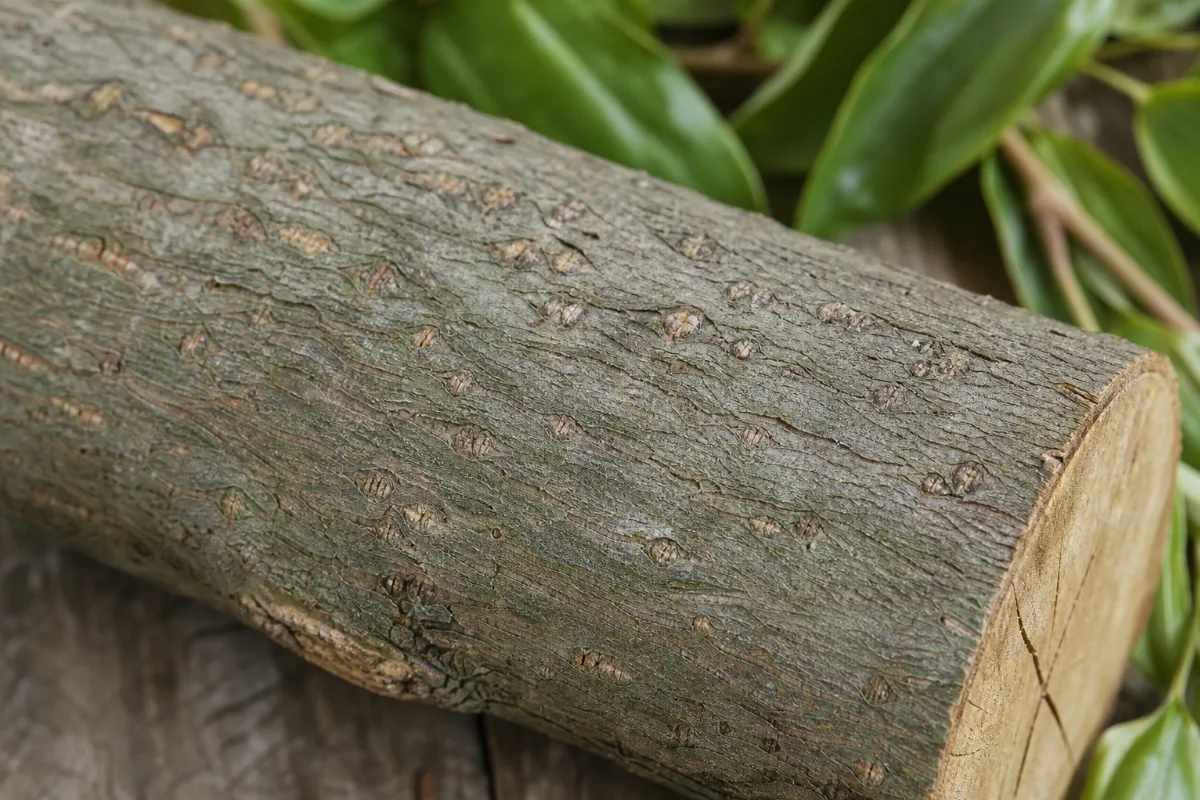
Herbs & Botanicals · Chinese bark tonic herb
Eucommia
Eucommia ulmoides · also called Du zhong, hardy rubber tree, tochu
Eucommia, or du zhong, is a tree whose bark and leaves are used in Chinese and Japanese traditional medicine. It is mainly taken for blood pressure and for bones and the lower back. Human research is small and short, and many results come from herb mixes. Check with a doctor first if you take blood pressure, blood thinning or diabetes medicine, or if you are pregnant.
General information, not medical advice. Last substantive update · Not medically reviewed. A named clinician has not signed off on this page. How this page is made
About Eucommia
Eucommia ulmoides is a tree used in Chinese medicine (bark) and Japanese tea (leaf). Human trials are small and short, and several come from herb mixes or the maker of one capsule. Safety in pregnancy, with other medicines and over the long term has not been properly studied.
What it is
Eucommia ulmoides is the only species in its genus, in the family Eucommiaceae. GBIF and NCBI both list it as an accepted species.
Bark (du zhong) and leaf (tochu) are different parts with their own studies. We keep them apart.
Traditional and current uses
Chinese medicine uses the bark as a tonic for kidneys, bones and back pain, and in blood pressure formulas. Japan drinks leaf tea.
Human trials exist for blood pressure and, in mixes, for bone, sugar and muscle.
Safety in short
Short trials reported mild effects and no severe liver or kidney problems. No regulator monograph was found, and pregnancy, long-term use and drug interactions are not studied in people.
The main theory-based cautions are extra blood pressure lowering, beta-blocker-like activity in a lab test, and a possible effect on clotting from a formula study. If you take regular medicine, ask a doctor or pharmacist.
At a glance
Traditional uses history, not proof
- Bark as a tonic for kidneys, liver, muscles and bones (Chinese medicine).
- Lower back and knee pain.
- Steadying a threatened pregnancy (traditional use only; no safety data).
- Leaf and bark tea in Japan (tochu).
Studied for research
- Blood pressure, small mixed trials, very low certainty
- Bone density, strong in rats, insufficient in people
- Blood sugar, one combination trial, very low
- Cholesterol and muscle, combination products only
Main compounds
- Pinoresinol diglucoside: a lignan used as the marker in one bark extract.
- Geniposidic acid and aucubin: iridoids, mostly lab and animal research.
- Chlorogenic acid: a phenolic found in the leaf.
Common forms
- Bark extract capsule
- Leaf extract tablet
- Tea or decoction (no trials found)
- Mixed Chinese formulas
Research links: Osteoporosis in rats: meta-analysis · Bark capsule for grade 1 hypertension · Eucommia ulmoides review · Research Library · Genes & Biomarkers Library
The plant and its history
- Accepted scientific name
- Eucommia ulmoides Oliv.
- Naming authority
- Oliv. (GBIF species key 3723584)
- Common names
- Eucommia (English); Du zhong (Chinese (pinyin)); Hardy rubber tree (English); Tochu (Japanese)
- Botanical family
- Eucommiaceae, a small plant family; Eucommia ulmoides is described as the sole species of its genus (2014 review).
- Classification
- Plantae > Tracheophyta > Magnoliopsida > Garryales > Eucommiaceae > Eucommia > Eucommia ulmoides
- Native range
- Central China (from a 2016 review via our summary; not re-verified).
- Habitat
- Not verified.
- What the plant looks like
- Roots: Not described in the sources read.; Stems: Bark is the part used in Chinese medicine; the plant is a tree.; Leaves: Leaves are used separately, for example as tea in Japan.; Flowers: Male flowers are also traditionally used (2014 review).; Fruit: Seed oil is studied in one 2025 paper (not read).
- Cultivation
- Not verified.
- Harvest and processing
- Not verified in the sources read.
- Look-alikes and adulterants
- Name: Other plants sold as du zhong; Note: Not verified in the sources read; buy products that name Eucommia ulmoides.
- Sustainability and conservation
- Not verified.
Traditional use and history history, not clinical proof
| Tradition or era | Documented use | Source |
|---|---|---|
| Traditional Chinese medicine | Du zhong bark is a tonic for the kidneys, liver, muscles and bones, used for lower back and knee pain and, traditionally, to steady a threatened pregnancy. | p36703729 |
| China, Japan and Korea | Leaf, stem, bark and male flowers are used as medicine and health food. | p24296089 |
| Japan | A tea of leaves and bark is part of the Japanese diet (Tochu tea). | p22214253 |
| Modern Europe | No EU herbal monograph was found. | s-ema-eucommia-notfound |
Traditional use shows how a plant was used. It does not show that a supplement works or is safe today.
What is inside, and how it may work
What the plant contains and how those compounds act in cells and animals. Laboratory and animal mechanisms are not proven effects in people.
Main compounds
| Compound | Family | Where it is concentrated | Activity studied | Level of evidence |
|---|---|---|---|---|
| Chlorogenic acid PubChem 1794427 | phenolic acid | leaf (phenolics listed in a 2016 review) | Listed as an antioxidant phenolic; lab and animal work only here. 10 3 | Laboratory research |
| Geniposidic acid PubChem 443354 | iridoid glycoside | Not verified by part in sources read | Cell and animal work on inflammation, metabolism, kidney and liver; poor bioavailability; clinical and safety studies lacking. 10 11 | Animal research |
| Aucubin PubChem 91458 | iridoid glycoside | Not verified by part in sources read | Named with geniposide and rutin as bone-active in cell and animal work. 10 23 | Animal research |
| Pinoresinol diglucoside PubChem 174003 | lignan glycoside | bark (a bark extract was standardised to 8% of it) 8% in the Greenway 2011 extract | Used as the marker compound of a bark extract tested for blood pressure; bone-active in animal work. 10 12 23 | Human data |
Mechanisms, receptors and pathways
| Target or pathway | Gene or receptor | What was found | Level |
|---|---|---|---|
| Bone-building and bone-breakdown signalling (BMP/SMAD, Wnt/beta-catenin, OPG/RANKL, MAPK/NF-kB) | Not specified | Eucommia compounds raised bone-forming cell activity and lowered bone-breakdown in cells and animals. 23 2 | Animal research |
| Beta-adrenergic signalling in fat cells | Beta-adrenergic receptor (functional assay) | Bark extract reduced isoproterenol-stimulated fat breakdown in a human fat-cell assay (lab). 12 | Laboratory research |
| Oxidative stress and heart hormone ANP | Not specified | In 17 adults, an oxidative-stress index fell and ANP rose slightly after leaf extract (uncontrolled). 19 | Human data |
| Platelet clumping and clotting | Not specified | A formula containing Eucommia bark reduced platelet aggregation in test-tube and rat tests. 1 | Animal research |
Absorption, metabolism and elimination
- Absorption
- No human data found. Geniposidic acid has poor bioavailability in preclinical work.
- Distribution
- No data.
- Metabolism
- No human data.
- Elimination
- No data.
- Bioavailability
- Unknown in people.
Isolated compounds versus whole extracts
Trials used whole bark extracts (one standardised to 8% pinoresinol diglucoside), a bark capsule product and a leaf extract tablet. Isolated compounds such as aucubin and geniposide have only lab and animal data. Bark and leaf are different parts and are not interchangeable.
Nutritional composition
Eucommia tea is a drink, not a source of vitamins or minerals; the sources read give no nutrient content.
5 very low certainty5 not enough evidence
What is Eucommia good for?
The main uses and how strong the evidence is. 'Very low' or 'insufficient' means the research is too thin to rely on. Bark and leaf are different parts, and mixes cannot be credited to eucommia alone.
Benefits, one by one
Each card is a research question, not a promise. Tap a goal to filter. Open a card to see the studies, doses and limits.
Blood pressure: bark extract in short trials
Very low certaintyTwo small trials of a standardised bark extract gave mixed results. One found no change, another found a small drop over two weeks. A placebo-controlled trial of a bark capsule saw a lower office reading but no difference on 24-hour monitoring.
2 studiesNot applicable: no amounts are given here. Ask a doctor or pharmacist…
Studies, doses and limits
What the trials found
Greenway 2011 (24 and 30 healthy adults, an 8-week and a 2-week study) found no change in the first and an average 7.5/3.9 mmHg drop in the second. Xu 2023 (60 adults with grade 1 hypertension, 4 weeks, capsule vs sham) found lower office readings but, on 24-hour monitoring, only blood pressure variability differed.
Results
Mixed: one null, one small fall, one fall in office readings only.
Effect sizes as reported
Greenway study 3: -7.5/-3.9 mmHg (P<0.008). Xu: office SBP -7.62 and DBP -4.66 mmHg (p<0.05); 24-hour mean pressure not different.
Why this rating
Tiny, short trials with mixed results; the 2023 trial has manufacturer-linked authors.
Form and dose studied
Not applicable: no amounts are given here. Ask a doctor or pharmacist about amounts.
Who was studied
Healthy adults with normal-to-high blood pressure; adults with grade 1 hypertension (China).
Limits
Short (2 to 8 weeks); main 24-hour endpoint not met in the best trial; industry links; not shown to replace prescribed treatment.
Why researchers looked
Eucommia bark is a classic Chinese tonic that is also used in blood pressure formulas.
Traditional use
Du zhong bark is long used in China as a tonic for the kidneys, liver, muscles and bones, and in blood pressure formulas.
Proposed mechanism Animal research
Lab and animal work suggests nitric oxide and other vessel effects; this does not show the same in people.
A proposed mechanism does not show that the effect happens in people.
Could add to the effect of blood pressure medicines; ask a doctor or pharmacist before combining.
Blood pressure rhythm: bark capsule added to usual medicines
Not enough evidenceA 12-week trial added a bark capsule to usual blood pressure medicines in 136 people. It did not improve the main measures of daily blood pressure rhythm. A helpful signal appeared only in people not taking calcium channel blockers.
1 studiesNot applicable: no amounts are given here. Ask a doctor or pharmacist…
Studies, doses and limits
What the trials found
Tang 2025: 136 adults on usual drugs were randomised to extra capsules or usual care. Overall SD and CV of blood pressure did not differ. In the subgroup without calcium channel blockers, 24-hour diastolic SD was better (P<0.05).
Results
Null on the main outcomes; positive only in one subgroup.
Effect sizes as reported
No overall group difference; subgroup P<0.05.
Why this rating
One open add-on trial, null overall, subgroup finding, manufacturer-employed authors.
Form and dose studied
Not applicable: no amounts are given here. Ask a doctor or pharmacist about amounts.
Who was studied
Adults with essential hypertension and abnormal blood pressure rhythm (China).
Limits
No placebo; subgroup result may be chance; industry links.
Why researchers looked
Blood pressure that does not dip at night is linked to more organ damage.
Traditional use
Quanduzhong is a bark extract capsule made in China.
Proposed mechanism Pharmacological theory
No mechanism established in the abstract.
A proposed mechanism does not show that the effect happens in people.
Used alongside blood pressure drugs without a stated safety problem in the abstract; hypotension was not reported either way in the abstract.
Blood pressure: leaf extract (Japan, single group)
Not enough evidenceA very small Japanese study of 17 adults taking a leaf extract tablet saw a small fall in the top blood pressure number. There was no comparison group, so the result is not reliable.
1 studiesNot applicable: no amounts are given here. Ask a doctor or pharmacist…
Studies, doses and limits
What the trials found
Satonaka 2025: 17 adults (9 with mild kidney disease), median 33 days. Systolic pressure fell from 128.3 to 123.8 mmHg; in kidney disease from 130.7 to 121.2 mmHg.
Results
Small drop in an uncontrolled group.
Effect sizes as reported
SBP 128.3 to 123.8 mmHg (p<0.05).
Why this rating
Single arm, 17 people, no control; the leaf is a different part from the bark.
Form and dose studied
Not applicable: no amounts are given here. Ask a doctor or pharmacist about amounts.
Who was studied
17 adults in Japan.
Limits
No control, tiny, short, no blinding.
Why researchers looked
Eucommia leaf is a Japanese tea and health food (tochu).
Traditional use
Leaf is used as a tea in Japan, separate from the bark used in Chinese medicine.
Proposed mechanism Preliminary mechanism
Authors suggest effects on oxidative stress and a heart hormone (ANP).
A proposed mechanism does not show that the effect happens in people.
Not enough data to judge safety in kidney disease.
Blood pressure: Chinese kidney-tonic formulas (combinations)
Very low certaintyA review of 18 studies found that Chinese kidney-tonic herb combinations added to usual care lowered blood pressure more than usual care alone. Eucommia bark was one of six core herbs, so the effect cannot be credited to it alone.
2 studiesNot applicable: no amounts are given here. Ask a doctor or pharmacist…
Studies, doses and limits
What the trials found
Wang 2022: meta-analysis of 18 studies with 2,024 patients; the combinations plus routine treatment beat routine treatment alone on blood pressure and blood fats, with no obvious adverse reactions.
Results
Better than routine care alone in mixed formulas.
Effect sizes as reported
Not given in the abstract.
Why this rating
Many herbs together; study quality not rated in the abstract; mostly Chinese trials.
Form and dose studied
Not applicable: no amounts are given here. Ask a doctor or pharmacist about amounts.
Who was studied
Adults with hypertension, mainly in China.
Limits
Cannot isolate Eucommia; possible regional publication bias.
Why researchers looked
Eucommia is a core herb in these formulas.
Traditional use
Kidney-tonifying is a Chinese medicine idea; formulas are tailored to the person.
Proposed mechanism Pharmacological theory
Network-pharmacology predictions only (computer-based).
A proposed mechanism does not show that the effect happens in people.
Add-on to usual care; discuss with the prescriber.
Blood pressure in pregnancy (rats only)
Not enough evidenceIn rats with pre-eclampsia, Eucommia granules lowered blood pressure and improved pup and placenta weight. No human trial was found. This is not a reason to use it in pregnancy.
2 studiesNot applicable: no amounts are given here. Ask a doctor or pharmacist…
Studies, doses and limits
What the trials found
Huang 2024: six pregnant rats per group; lower blood pressure and urine protein, heavier pups and placentas with higher doses. No human trial found.
Results
Rat finding only.
Effect sizes as reported
Dose-related improvement in rats.
Why this rating
Animal only.
Form and dose studied
Not applicable: no amounts are given here. Ask a doctor or pharmacist about amounts.
Who was studied
Pregnant rats.
Limits
Rats; tiny groups; granule recipe not given.
Why researchers looked
Chinese practice uses Eucommia in pregnancy complications.
Traditional use
Du zhong is traditionally used to steady a threatened pregnancy.
Proposed mechanism Animal research
Wnt/beta-catenin and oxidative stress pathways in rats.
A proposed mechanism does not show that the effect happens in people.
Human safety in pregnancy is unknown: see the safety file.
Bone density and osteoporosis
Not enough evidenceIn rats, Eucommia extracts clearly improved bone density. In people the research is limited to combination formulas of low or unclear quality. It is not shown to prevent or treat osteoporosis in people.
4 studiesNot applicable: no amounts are given here. Ask a doctor or pharmacist…
Studies, doses and limits
What the trials found
A meta-analysis of 18 rat studies found large gains in bone density (SMD 2.44, 95% CI 1.83-3.05). A scoping review of 90 studies says human studies are preliminary and mostly use formulations such as Quanduzhong capsules. A Chinese trial of a multi-herb recipe including eucommia bark in ankylosing spondylitis reported bone density gains within the treated group.
Results
Strong in rats; preliminary and combination-only in people.
Effect sizes as reported
Rats: BMD SMD 2.44 (95% CI 1.83-3.05). People: no pooled estimate.
Why this rating
Animal evidence is large but may be biased; human evidence is combination products and regional trials.
Form and dose studied
Not applicable: no amounts are given here. Ask a doctor or pharmacist about amounts.
Who was studied
Ovariectomised or drug-induced osteoporosis rats; people with ankylosing spondylitis in one trial.
Limits
The rat effect size is unusually large; the human trial used many herbs and an unequal control group, so effect from Eucommia cannot be separated.
Why researchers looked
Du zhong is traditionally used to strengthen bones and the lower back.
Traditional use
Used for lumbar and knee pain, 'strengthening sinews and bones'.
Proposed mechanism Laboratory research
Aucubin, geniposide, rutin and pinoresinol diglucoside affect bone-building and bone-breakdown cells in lab and animal work (BMP/SMAD, Wnt, OPG/RANKL, MAPK/NF-kB).
A proposed mechanism does not show that the effect happens in people.
Do not replace osteoporosis medicine with it.
Blood sugar
Very low certaintyOne placebo-controlled trial of an 8-ingredient paste that contained Eucommia lowered fasting glucose in older adults with diabetes-related muscle loss, but HbA1c did not change. The paste is a combination, so the effect cannot be credited to Eucommia. Animal results are not proof for people.
2 studiesNot applicable: no amounts are given here. Ask a doctor or pharmacist…
Studies, doses and limits
What the trials found
Hua 2026: 90 adults, 12 weeks, placebo paste. Fasting glucose and CRP improved more than placebo (glucose p=0.018); HbA1c, fasting insulin and insulin resistance did not.
Results
Mixed in a combination product.
Effect sizes as reported
Fasting glucose interaction p=0.018; HbA1c not different.
Why this rating
Combination of eight ingredients; only some endpoints changed.
Form and dose studied
Not applicable: no amounts are given here. Ask a doctor or pharmacist about amounts.
Who was studied
Older adults with diabetic sarcopenia in China.
Limits
Cannot isolate Eucommia; short; one regional trial.
Why researchers looked
Lab and animal work reports effects on glucose and fat metabolism.
Traditional use
Used as a general tonic; no specific diabetes tradition was read.
Proposed mechanism Animal research
Animal and cell studies point to several metabolic pathways.
A proposed mechanism does not show that the effect happens in people.
May add to the effect of diabetes medicines (theory); ask a doctor or pharmacist.
Cholesterol and blood fats
Very low certaintyCombination formulas that included Eucommia were linked to lower LDL cholesterol in two Chinese studies. Neither isolates Eucommia.
2 studiesNot applicable: no amounts are given here. Ask a doctor or pharmacist…
Studies, doses and limits
What the trials found
The kidney-tonic meta-analysis reported lower cholesterol and triglycerides with combinations. A fluorosis trial linked Xianling Gubao plus Eucommia to lower LDL-C (P<0.05).
Results
Combination products only.
Effect sizes as reported
Not given in the abstracts.
Why this rating
Cannot assign effect to Eucommia.
Form and dose studied
Not applicable: no amounts are given here. Ask a doctor or pharmacist about amounts.
Who was studied
Adults with hypertension or skeletal fluorosis in China.
Limits
Mixed products; abstracts lack numbers.
Why researchers looked
Reviews of lab work report effects on blood fats.
Traditional use
Part of kidney-tonic formulas.
Proposed mechanism Animal research
Animal work suggests effects on fat oxidation.
A proposed mechanism does not show that the effect happens in people.
None specific.
Muscle strength in older adults (combination)
Very low certaintyThe same 8-ingredient paste improved grip strength and muscle mass in older adults with diabetes-related muscle loss. Eucommia was only one ingredient.
1 studiesNot applicable: no amounts are given here. Ask a doctor or pharmacist…
Studies, doses and limits
What the trials found
Hua 2026: grip strength, muscle mass index and chair-stand time improved versus placebo over 12 weeks (interaction p<0.001 for each).
Results
Positive for the whole paste.
Effect sizes as reported
p<0.001 on three muscle outcomes.
Why this rating
One trial, eight ingredients, regional.
Form and dose studied
Not applicable: no amounts are given here. Ask a doctor or pharmacist about amounts.
Who was studied
Adults 60 and over with diabetic sarcopenia and spleen-kidney deficiency pattern.
Limits
Cannot separate Eucommia; tradition-based diagnosis.
Why researchers looked
Du zhong is traditionally a tonic for muscles and bones.
Traditional use
Tonic for sinews and bones.
Proposed mechanism Pharmacological theory
Not established.
A proposed mechanism does not show that the effect happens in people.
No serious adverse events reported.
Other lab and animal findings
Not enough evidenceReviews describe lab and animal effects on obesity, ageing, memory disease and the immune system. These are lab and animal findings only, with no human trial found in this work.
3 studiesNot applicable: no amounts are given here. Ask a doctor or pharmacist…
Studies, doses and limits
What the trials found
Reviews list possible benefits in several diseases from cell and animal work and ask for clinical studies. No human trial was found for these uses.
Results
Lab and animal only.
Effect sizes as reported
Not applicable.
Why this rating
No human data.
Form and dose studied
Not applicable: no amounts are given here. Ask a doctor or pharmacist about amounts.
Who was studied
Cells and animals.
Limits
Do not infer benefit for people.
Why researchers looked
Active lignans and iridoids are studied widely.
Traditional use
Used for ageing and weakness.
Proposed mechanism Laboratory research
Antioxidant and anti-inflammatory signalling in cells and animals.
A proposed mechanism does not show that the effect happens in people.
Not applicable.
Connections to the rest of health
How Eucommia connects to the rest of our health knowledge graph. Every link says what kind of connection it is. A safety link (for example to the liver) is a warning, not a benefit. A study that merely mentions a topic never creates a benefit link.
Explore every connection: goals, body systems, organs, symptoms, genes
A. Wellness goals
| Connected to | Kind of connection | Evidence status | Context | Studies |
|---|---|---|---|---|
| Blood Pressure Support | Potential benefit | Very low certainty | Blood pressure: bark extract in short trials: Two small trials of a standardised bark extract gave mixed results. One found no change, another found a small drop over two weeks. A placebo-controlled trial of a bark capsule saw a lower office reading but no difference on 24-hour monitoring. Blood pressure rhythm: bark capsule added to usual medicines: A 12-week trial added a bark capsule to usual blood pressure medicines in 136 people. It did not improve the main measures of daily blood pressure rhythm. A helpful signal appeared only in people not taking calcium channel blockers. | 12 24 20 19 |
| Heart Health | Potential benefit | Very low certainty | Blood pressure: bark extract in short trials: Two small trials of a standardised bark extract gave mixed results. One found no change, another found a small drop over two weeks. A placebo-controlled trial of a bark capsule saw a lower office reading but no difference on 24-hour monitoring. | 12 24 |
| Blood Pressure Support | Traditional use | Very low certainty | Blood pressure: Chinese kidney-tonic formulas (combinations): A review of 18 studies found that Chinese kidney-tonic herb combinations added to usual care lowered blood pressure more than usual care alone. Eucommia bark was one of six core herbs, so the effect cannot be credited to it alone. | 22 18 |
| Heart Health | Traditional use | Very low certainty | Blood pressure: Chinese kidney-tonic formulas (combinations): A review of 18 studies found that Chinese kidney-tonic herb combinations added to usual care lowered blood pressure more than usual care alone. Eucommia bark was one of six core herbs, so the effect cannot be credited to it alone. | 22 18 |
| Blood Pressure Support | Preliminary mechanism | Not enough evidence | Blood pressure in pregnancy (rats only): In rats with pre-eclampsia, Eucommia granules lowered blood pressure and improved pup and placenta weight. No human trial was found. This is not a reason to use it in pregnancy. | 16 15 |
| Womens Wellness | Preliminary mechanism | Not enough evidence | Blood pressure in pregnancy (rats only): In rats with pre-eclampsia, Eucommia granules lowered blood pressure and improved pup and placenta weight. No human trial was found. This is not a reason to use it in pregnancy. | 16 15 |
| Joint Support | Preliminary mechanism | Not enough evidence | Bone density and osteoporosis: In rats, Eucommia extracts clearly improved bone density. In people the research is limited to combination formulas of low or unclear quality. It is not shown to prevent or treat osteoporosis in people. | 2 23 21 13 |
| Healthy Aging | Preliminary mechanism | Not enough evidence | Bone density and osteoporosis: In rats, Eucommia extracts clearly improved bone density. In people the research is limited to combination formulas of low or unclear quality. It is not shown to prevent or treat osteoporosis in people. Other lab and animal findings: Reviews describe lab and animal effects on obesity, ageing, memory disease and the immune system. These are lab and animal findings only, with no human trial found in this work. | 2 23 21 13 15 3 |
| Blood Sugar Balance | Potential benefit | Very low certainty | Blood sugar: One placebo-controlled trial of an 8-ingredient paste that contained Eucommia lowered fasting glucose in older adults with diabetes-related muscle loss, but HbA1c did not change. The paste is a combination, so the effect cannot be credited to Eucommia. Animal results are not proof for people. | 14 13 |
| Metabolic Health | Potential benefit | Very low certainty | Blood sugar: One placebo-controlled trial of an 8-ingredient paste that contained Eucommia lowered fasting glucose in older adults with diabetes-related muscle loss, but HbA1c did not change. The paste is a combination, so the effect cannot be credited to Eucommia. Animal results are not proof for people. | 14 13 |
| Cholesterol Balance | Potential benefit | Very low certainty | Cholesterol and blood fats: Combination formulas that included Eucommia were linked to lower LDL cholesterol in two Chinese studies. Neither isolates Eucommia. | 22 18 |
| Muscle Recovery | Traditional use | Very low certainty | Muscle strength in older adults (combination): The same 8-ingredient paste improved grip strength and muscle mass in older adults with diabetes-related muscle loss. Eucommia was only one ingredient. | 14 |
| Healthy Aging | Traditional use | Very low certainty | Muscle strength in older adults (combination): The same 8-ingredient paste improved grip strength and muscle mass in older adults with diabetes-related muscle loss. Eucommia was only one ingredient. | 14 |
| Brain Health | Preliminary mechanism | Not enough evidence | Other lab and animal findings: Reviews describe lab and animal effects on obesity, ageing, memory disease and the immune system. These are lab and animal findings only, with no human trial found in this work. | 13 15 3 |
B. Body systems
| Connected to | Kind of connection | Evidence status | Context | Studies |
|---|---|---|---|---|
| Reproductive system | Traditional use | Not enough evidence | Traditional use in pregnancy; no human safety data. Preparation or compound: Bark |
15 |
| Cardiovascular System | Biological association | Very low certainty | Studied for: Blood pressure: bark extract in short trials Studied for: Blood pressure rhythm: bark capsule added to usual medicines | 12 24 20 19 22 18 16 15 |
| Reproductive System | Biological association | Not enough evidence | Studied for: Blood pressure in pregnancy (rats only) | 16 15 |
| Musculoskeletal System | Biological association | Not enough evidence | Studied for: Bone density and osteoporosis Studied for: Muscle strength in older adults (combination) | 2 23 21 13 14 |
| Metabolism Weight | Biological association | Very low certainty | Studied for: Blood sugar Studied for: Other lab and animal findings | 14 13 15 3 |
| Nervous System | Biological association | Not enough evidence | Studied for: Other lab and animal findings | 13 15 3 |
C. Body parts and organs
| Connected to | Kind of connection | Evidence status | Context | Studies |
|---|---|---|---|---|
| Blood vessels | Drug or supplement interaction | Very low certainty | Possible added blood pressure lowering with medicines; beta-blocker-like lab finding. Preparation or compound: Bark extract |
12 24 |
| Blood vessels | Potential benefit | Very low certainty | Small blood pressure trials, mixed. Preparation or compound: Bark extract |
12 24 |
I. Biomarkers
| Connected to | Kind of connection | Evidence status | Context | Studies |
|---|---|---|---|---|
| Office blood pressure | Biological association | Very low certainty | Measured in trials: lowered. A lab change is not the same as a health benefit. | 24 19 |
| 24-hour ambulatory blood pressure | Biological association | Very low certainty | Measured in trials: mixed. A lab change is not the same as a health benefit. | 12 24 |
| Blood pressure variability and daily rhythm | Biological association | Not enough evidence | Measured in trials: mixed. A lab change is not the same as a health benefit. | 20 24 |
| Oxidative stress index and atrial natriuretic peptide | Biological association | Not enough evidence | Measured in trials: mixed. A lab change is not the same as a health benefit. | 19 |
| Bone mineral density | Biological association | Not enough evidence | Measured in trials: raised. A lab change is not the same as a health benefit. | 2 21 |
| Fasting blood glucose | Biological association | Very low certainty | Measured in trials: lowered. A lab change is not the same as a health benefit. | 14 |
| LDL cholesterol | Biological association | Very low certainty | Measured in trials: lowered. A lab change is not the same as a health benefit. | 18 22 |
| C-reactive protein | Biological association | Very low certainty | Measured in trials: lowered. A lab change is not the same as a health benefit. | 14 |
K. Biological pathways
| Connected to | Kind of connection | Evidence status | Context | Studies |
|---|---|---|---|---|
| Preliminary mechanism | Fat-cell assay suggested beta-blocker-like activity; no human interaction shown. | 12 |
L. Active compounds
| Connected to | Kind of connection | Evidence status | Context | Studies |
|---|---|---|---|---|
| Chlorogenic acid | Biological association | In vitro | Listed as an antioxidant phenolic; lab and animal work only here. Preparation or compound: leaf (phenolics listed in a 2016 review) |
10 3 |
| Geniposidic acid | Biological association | Animal | Cell and animal work on inflammation, metabolism, kidney and liver; poor bioavailability; clinical and safety studies lacking. Preparation or compound: Not verified by part in sources read |
10 11 |
| Aucubin | Biological association | Animal | Named with geniposide and rutin as bone-active in cell and animal work. Preparation or compound: Not verified by part in sources read |
10 23 |
| Pinoresinol diglucoside | Biological association | Human | Used as the marker compound of a bark extract tested for blood pressure; bone-active in animal work. Preparation or compound: bark (a bark extract was standardised to 8% of it) |
10 12 23 |
Each connection is stored with the ingredient, the connected record, the kind of connection, the evidence status, the supporting studies, the preparation or compound involved, and a review date (last reviewed October 25, 2026).
Evidence at a glance: what changed in 8 lab markers
Tap a number to show only those markers. Counts are markers, not people.
The evidence
The research centre for Eucommia. Every record here was checked against PubMed or the publisher's page; we never list a study we have not verified.
Evidence by outcome
Bars show how many studies we found for each outcome, not how well it works. People are added up across trials only (reviews are not added, to avoid double counting).
How we rate evidence
High certainty
Several well-run trials or reviews agree; further research is unlikely to change the picture much.
Moderate certainty
Good trials point the same way, but some doubt remains.
Low certainty
Small, short or inconsistent trials. The finding could change with better research.
Very low certainty
Very little or very weak human data. Treat as a possibility only.
Mixed findings
Trials or reviews disagree with each other.
Not enough evidence
Not enough human research to say either way.
Evidence against
Good research found no benefit, or found harm.
We take the reviewers' own risk-of-bias and GRADE statements where they exist, and otherwise judge from study size, design, consistency, directness and whether a product matches what is sold. Many publications do not make evidence high. Method note: We read PubMed abstracts for the trials and reviews. EMA, NCCIH, LiverTox and LactMed entries were not found.
Study library: every study we checked 24
| Study | Design | People | Product, dose, length | Result |
|---|---|---|---|---|
| Chang 2005 Anti-thrombic activity of Korean herbal medicine, Dae-Jo-Whan and its herbs Vascular Pharmacology · PMID 16226922 · DOI |
Animal research animal |
Rats and lab blood tests | Dae-Jo-Hwan, an 11-herb COMBINATION that includes Eucommiae cortex (9%) bark Not applicable Not applicable · vs Not applicable |
Extracts of the formula and of most of its herbs, including Eucommia bark, reduced thrombosis in rats and platelet aggregation in the test tube. Not tested in people. Not applicable Methods, limits and fundingOutcomes: Clotting, platelet aggregation Limitations: Formula-level and animal/in vitro; no human data. Funding and conflicts: Not stated Read: abstract |
| Chen 2025 Therapeutic effects of Eucommia ulmoides extract on osteoporosis rat models: a systematic review and meta-analysis Frontiers in Pharmacology · PMID 41059187 · DOI |
Meta-analysis animal |
18 18 rat studies of osteoporosis models |
Eucommia ulmoides extracts (various) unspecified Not applicable Varied · vs Untreated osteoporotic rats |
Bone mineral density improved (SMD 2.44), trabecular number, thickness and bone volume improved; estradiol up; resorption markers down. BMD SMD 2.44 (95% CI 1.83-3.05) (1.83-3.05) Methods, limits and fundingOutcomes: Bone density and structure Limitations: Rats only; the abstract calls the studies RCTs; very large effects suggest bias risk; says nothing about people. Funding and conflicts: No conflicts declared Read: abstract |
| Database record 2026 Health-promoting properties of Eucommia ulmoides: a review Review (Evidence-Based Complementary and Alternative Medicine, 2016). Lists chlorogenic acid, rutin and other phenolics in leaves; mostly animal and lab; no safety or toxicity section found. · Source |
Systematic review not-applicable |
Not applicable | Not applicable unspecified Not applicable Not applicable · vs Not applicable |
Review (Evidence-Based Complementary and Alternative Medicine, 2016). Lists chlorogenic acid, rutin and other phenolics in leaves; mostly animal and lab; no safety or toxicity section found. Not applicable Methods, limits and fundingOutcomes: Identity or status record Limitations: Narrative review; part-read from open full text. Read: full-text |
| Database record 2026 EMA/HMPC herbal monograph for Eucommia: not found No Eucommia (Eucommiae cortex or folium) monograph page was found in a quick check; guessed monograph URLs returned 404 and the search page blocked the request. · Source |
Authoritative guidance not-applicable |
Not applicable | Not applicable unspecified Not applicable Not applicable · vs Not applicable |
No Eucommia (Eucommiae cortex or folium) monograph page was found in a quick check; guessed monograph URLs returned 404 and the search page blocked the request. Not applicable Methods, limits and fundingOutcomes: Identity or status record Limitations: Not found does not prove none exists. NOT verified. Read: not-found |
| Database record 2026 NCCIH: no Eucommia page found The guessed NCCIH page returned 404 and a site search found no Eucommia text. · Source |
Authoritative guidance not-applicable |
Not applicable | Not applicable unspecified Not applicable Not applicable · vs Not applicable |
The guessed NCCIH page returned 404 and a site search found no Eucommia text. Not applicable Methods, limits and fundingOutcomes: Identity or status record Limitations: Not found in the quick check. NOT verified beyond that. Read: not-found |
| Database record 2026 LiverTox and LactMed: no Eucommia entry found A NCBI Bookshelf search for Eucommia with LiverTox or LactMed returned only an unrelated bibliography item. · Source |
Authoritative guidance not-applicable |
Not applicable | Not applicable unspecified Not applicable Not applicable · vs Not applicable |
A NCBI Bookshelf search for Eucommia with LiverTox or LactMed returned only an unrelated bibliography item. Not applicable Methods, limits and fundingOutcomes: Identity or status record Limitations: Not found; absence of an entry is not proof of safety. Read: not-found |
| Database record 2026 Our nutrient-graph summary for Eucommia (herb-eucommia.json) Internal summary of identity, forms and the same trials; used for identity, forms and the unverified notes. · Source |
Other not-applicable |
Not applicable | Not applicable unspecified Not applicable Not applicable · vs Not applicable |
Internal summary of identity, forms and the same trials; used for identity, forms and the unverified notes. Not applicable Methods, limits and fundingOutcomes: Identity or status record Limitations: Summary-only; items not re-opened are marked so. Read: summary-only |
| Database record 2026 GBIF: Eucommia ulmoides Oliv. (species key 3723584) Accepted species, family Eucommiaceae, order Garryales (GBIF API, checked 2026-10-25). · Source |
Authoritative guidance not-applicable |
Not applicable | Not applicable unspecified Not applicable Not applicable · vs Not applicable |
Accepted species, family Eucommiaceae, order Garryales (GBIF API, checked 2026-10-25). Not applicable Methods, limits and fundingOutcomes: Identity or status record Limitations: Taxonomy only. Read: full-text |
| Database record 2026 NCBI Taxonomy: Eucommia ulmoides (taxid 4392) Species in family Eucommiaceae, order Garryales (NCBI efetch, checked 2026-10-25). · Source |
Authoritative guidance not-applicable |
Not applicable | Not applicable unspecified Not applicable Not applicable · vs Not applicable |
Species in family Eucommiaceae, order Garryales (NCBI efetch, checked 2026-10-25). Not applicable Methods, limits and fundingOutcomes: Identity or status record Limitations: Taxonomy only. Read: full-text |
| Database record 2026 PubChem compound records (chlorogenic acid, geniposidic acid, aucubin, pinoresinol diglucoside) CIDs 1794427, 443354, 91458, 174003 returned by the PubChem name lookup with matching titles. · Source |
Authoritative guidance not-applicable |
Not applicable | Not applicable unspecified Not applicable Not applicable · vs Not applicable |
CIDs 1794427, 443354, 91458, 174003 returned by the PubChem name lookup with matching titles. Not applicable Methods, limits and fundingOutcomes: Identity or status record Limitations: Identity only, not activity. Read: full-text |
| Ellutla 2026 Unveiling the pharmacological landscape of geniposidic acid: mechanisms of action, therapeutic benefits, and scientific challenges Naunyn-Schmiedeberg's Archives of Pharmacology · PMID 42538424 · DOI |
Systematic review animal |
Preclinical literature | Geniposidic acid (iridoid found in Eucommia and Gardenia) unspecified Not applicable Not applicable · vs Not applicable |
Cell and animal studies show effects through several signalling pathways; bioavailability is poor and pharmacokinetic, toxicology and clinical studies are lacking. Not applicable Methods, limits and fundingOutcomes: Mechanisms, bioavailability Limitations: Preclinical only. Funding and conflicts: No competing interests Read: abstract |
| Greenway 2011 A clinical trial testing the safety and efficacy of a standardized Eucommia ulmoides Oliver bark extract to treat hypertension Alternative Medicine Review · PMID 22214253 |
Controlled trial |
54 Healthy adults with blood pressure 120-160/80-100 mmHg (24 in study 1, 30 in study 3); plus a human fat-cell lab assay |
Aqueous bark extract standardized to 8% pinoresinol di-beta-D-glucoside bark Not given here 8 weeks (study 1); 2 weeks (study 3) · vs Not clearly described in abstract |
Study 1: no difference in blood pressure between groups, no toxicity. Study 3: blood pressure fell on average 7.5/3.9 mmHg (P<0.008). Lab assay: reduced isoproterenol-stimulated fat breakdown (beta-blocker-like). Study 3: -7.5/-3.9 mmhg (P<0.008); study 1 no difference Methods, limits and fundingOutcomes: 24-hour ambulatory blood pressure; fat-cell lipolysis Limitations: Very small; healthy or high-normal volunteers; study design only briefly described in abstract; authors' conclusion is stronger than the data. Funding and conflicts: Not stated in abstract Read: abstract |
| He 2014 Eucommia ulmoides Oliv.: ethnopharmacology, phytochemistry and pharmacology of an important traditional Chinese medicine Journal of Ethnopharmacology · PMID 24296089 · DOI |
Systematic review |
Narrative review of lab, animal and some human work | Whole plant, extracts and compounds unspecified Not applicable Not applicable · vs Not applicable |
112 compounds isolated; lignans and iridoids are the main active groups. Lab and animal work suggests many actions; the authors call for toxicity and clinical studies. Not applicable Methods, limits and fundingOutcomes: Botany, chemistry, pharmacology, toxicology Limitations: Narrative review; mostly lab and animal. Funding and conflicts: Not stated Read: abstract |
| Hua 2026 Efficacy and safety of medicine-food homology Shenqi paste in older adults with diabetic sarcopenia: a randomized, double-blind, placebo-controlled trial Journal of Ethnopharmacology · PMID 41763617 · DOI |
Controlled trial |
90 90 randomised older adults with diabetic sarcopenia in China |
Shenqi paste: an 8-ingredient COMBINATION including Eucommia ulmoides unspecified Not given here 12 weeks · vs Placebo paste |
Better grip strength, muscle mass index and chair-stand time; fasting glucose and CRP fell more than placebo; HbA1c, fasting insulin and insulin resistance did not differ. No serious adverse events. Fasting glucose interaction p=0.018; HbA1c no difference Methods, limits and fundingOutcomes: Muscle mass, grip strength, chair-stand time, blood glucose and CRP; safety labs Limitations: Eight herbs and foods together, so Eucommia's share is unknown; regional TCM-syndrome selection; 74 of 90 had secondary outcomes. Funding and conflicts: Not stated in abstract Read: abstract |
| Huang 2021 Traditional application and modern pharmacological research of Eucommia ulmoides Oliv. Chinese Medicine · PMID 34362420 · DOI |
Systematic review |
Narrative review | Whole plant and extracts unspecified Not applicable Not applicable · vs Not applicable |
Lists traditional uses including lumbar and knee pain, osteoporosis, vaginal bleeding and abortion (threatened miscarriage); reports effects in hypertension, diabetes, obesity and bone mainly from lab and animal work. Not applicable Methods, limits and fundingOutcomes: Traditional uses and pharmacology Limitations: Narrative review. Funding and conflicts: No competing interests Read: abstract |
| Huang 2024 Eucommia granules activate Wnt/beta-catenin pathway, and improve oxidative stress, inflammation, and endothelial injury in preeclampsia rats Acta Cirurgica Brasileira · PMID 38629649 · DOI |
Animal research animal |
Pregnant rats with induced pre-eclampsia (6 per group) | Eucommia granules unspecified Three doses Not given in abstract · vs Untreated model rats |
Treated rats had lower blood pressure and urine protein and heavier pups and placentas. No human data. Dose-related improvement Methods, limits and fundingOutcomes: Blood pressure, urine protein, pup and placenta weights Limitations: Rats only, small groups; granule composition not given in abstract. Funding and conflicts: Nothing to declare Read: abstract |
| Hwang 2026 Assessment of local and systemic safety of aqueous Eucommia ulmoides bark extract for a cosmetics ingredient Regulatory Toxicology and Pharmacology · PMID 42264169 · DOI |
Other in-vitro |
Lab tests (skin, eye, genotoxicity) and modelling | Aqueous bark extract bark Not applicable Not applicable · vs Not applicable |
No concern in the in vitro tests; cosmetic exposure below the thresholds used. This concerns skin products, not swallowed supplements. No concern Methods, limits and fundingOutcomes: Skin and eye irritation, genotoxicity, systemic exposure Limitations: Cosmetic use only; in vitro and modelling. Funding and conflicts: No competing interests declared Read: abstract |
| Lu 2026 Exploring the therapeutic synergy of drug-lifestyle interventions in fluorosis: a randomized trial on cardiovascular metabolic outcomes from the China fluorosis cohort Frontiers in Pharmacology · PMID 41988524 · DOI |
Controlled trial |
1480 1,480 people with skeletal fluorosis in China |
Xianling Gubao combined with Eucommia ulmoides (one of three TCM combinations) plus lifestyle changes unspecified Not given here Not given in abstract · vs Not clear from abstract |
The Xianling Gubao plus Eucommia combination was linked to lower risk of treatment failure and lower LDL-C (P<0.05) when paired with better sleep and diet. Treatment-failure OR 0.461 Methods, limits and fundingOutcomes: Treatment failure, blood pressure, LDL cholesterol, sleep Limitations: Combination product in a specific regional disease; design details unclear; effect cannot be assigned to Eucommia. Funding and conflicts: No conflicts declared Read: abstract |
| Satonaka 2025 An exploratory single-arm clinical trial on Eucommia ulmoides leaf extract effects on blood pressure, oxidative stress, and atrial natriuretic peptide in individuals with and without chronic kidney disease International Journal of Nephrology · PMID 40575587 · DOI |
Other |
17 17 adults in Japan, 9 with mild chronic kidney disease |
Tablet containing Tochu leaf extract leaf Not given here Median 33 days · vs None (single arm) |
Systolic pressure fell from 128.3 to 123.8 mmHg overall (p<0.05); larger fall in the kidney disease group (130.7 to 121.2 mmHg). Oxidative stress index fell and ANP rose slightly. SBP 128.3 -> 123.8 mmHg (p<0.05) Methods, limits and fundingOutcomes: Blood pressure, oxidative stress index, atrial natriuretic peptide Limitations: No control group, very small, short; chance and regression to the mean cannot be excluded. Funding and conflicts: No conflicts declared Read: abstract |
| Tang 2025 Efficacy of Quanduzhong capsules in regulating blood pressure circadian rhythm in essential hypertension: a multicenter, randomized, add-on controlled clinical trial Frontiers in Pharmacology · PMID 41132538 · DOI |
Controlled trial |
136 136 adults with essential hypertension and abnormal blood pressure rhythm, all on usual blood pressure drugs |
Quanduzhong capsules added to usual drugs bark Twice daily (amount not repeated here) 12 weeks · vs Usual drugs alone (open add-on design) |
No significant group difference in SD or CV overall. Only in people not taking calcium channel blockers was 24-hour diastolic SD better (P<0.05). Primary outcomes not different; subgroup P<0.05 Methods, limits and fundingOutcomes: Dipper rhythm recovery rate, blood pressure SD and CV Limitations: Add-on without placebo; the positive finding is a subgroup; manufacturer-linked authors. Funding and conflicts: Three authors employed by Jiangxi Puzheng Pharmaceutical Read: abstract |
| Wang 2011 Effect of Bushen Qiangdu Recipe on osteoporosis and bone loss of patients with ankylosing spondylitis (in Chinese) Zhongguo Zhong Xi Yi Jie He Za Zhi · PMID 21608215 |
Controlled trial |
360 360 patients with ankylosing spondylitis (288 treated, 72 controls), China |
Bushen Qiangdu Recipe, a multi-herb COMBINATION containing eucommia bark bark One dose daily in two portions 6 months · vs Standard drugs (sulfasalazine and others) |
Bone density at several sites and disease scores improved within the treated group; no obvious adverse reaction. Within-group changes P<0.05 Methods, limits and fundingOutcomes: Bone density, bone markers, disease activity Limitations: Unequal groups, many herbs, regional Chinese-language trial; abstract gives no head-to-head numbers. Funding and conflicts: Not stated Read: abstract |
| Wang 2022 Traditional Chinese medicine method of tonifying kidney for hypertension: clinical evidence and molecular mechanisms Frontiers in Cardiovascular Medicine · PMID 36465462 · DOI |
Meta-analysis |
18 18 studies, 2,024 patients with hypertension |
Kidney-tonifying herbal COMBINATIONS (Eucommia bark was among the core herbs) added to routine treatment bark Not applicable Varied · vs Routine treatment alone |
Combinations plus routine care lowered blood pressure and blood fats more than routine care alone, with no obvious adverse reactions. Eucommia was one of six core herbs. Not given in abstract Methods, limits and fundingOutcomes: Blood pressure, blood fats, vessel markers Limitations: Mixed multi-herb formulas, so no effect can be assigned to Eucommia; quality not rated in abstract. Funding and conflicts: No conflicts declared Read: abstract |
| Wang 2025 Traditional medicine in a modern light: a scoping review on the osteoprotective potential of Eucommia ulmoides Frontiers in Pharmacology · PMID 41646940 · DOI |
Systematic review |
90 90 cell, animal and human studies |
E. ulmoides extracts and compounds (aucubin, geniposide, rutin, pinoresinol diglucoside); formulations such as Quanduzhong capsules and Eucommia granules unspecified Not applicable Varied · vs Varied |
Animal studies show better bone density; the clinical studies are called preliminary and used formulations. Authors ask for standardised extracts and large trials. Not pooled Methods, limits and fundingOutcomes: Bone outcomes Limitations: Scoping review; no quality rating of human studies in the abstract. Funding and conflicts: No conflicts declared Read: abstract |
| Xu 2023 Quanduzhong capsules for the treatment of grade 1 hypertension patients with low-to-moderate risk: a multicenter, randomized, double-blind, placebo-controlled clinical trial Frontiers in Pharmacology · PMID 36703729 · DOI |
Controlled trial |
60 60 randomised (58 entered the 4-week phase) adults with grade 1 hypertension, low-to-moderate risk, 3 centres in China |
Quanduzhong capsules (a standardised bark extract product) bark Not given here 4 weeks after a 1-week sham lead-in · vs Sham capsules |
Only blood pressure variability (diastolic CV) differed on 24-hour monitoring. Office systolic fell 7.62 mmHg and diastolic 4.66 mmHg (p<0.05). No other differences; adverse events mild; no severe liver or kidney abnormalities. Office SBP -7.62 +/- 9.32, DBP -4.66 +/- 6.03 mmHg (p<0.05); 24-h mean BP not different Methods, limits and fundingOutcomes: 24-hour ambulatory and office blood pressure; safety Limitations: Small, short; main 24-hour endpoints did not differ; authors include employees of the manufacturer (affiliation list). Funding and conflicts: Manufacturer-linked authors (Jiangxi Puzheng Pharmaceutical) Read: abstract |
What we do not know yet
- What the evidence supports: nothing firmly. Small blood pressure trials and rat bone studies.
- What is uncertain: bark versus leaf, tea versus extract, and eucommia alone versus mixes.
- Safety gaps: pregnancy, breastfeeding, interactions, long-term use; no regulator record found.
How new research is added
New studies are found by a saved PubMed search and placed in a review queue. A person reads each one before it changes any rating.
Lab markers
What changed in blood or saliva tests during trials. A changed number is not the same as feeling or being healthier, and we give no "normal ranges".
Metabolic 2
Fasting blood glucose
Lowered in trials
Sugar in the blood after not eating.
Very low certaintyResults and what it means
Why it was measured
Used to judge diabetes control.
Statistical vs. clinical meaning
One endpoint in a combination trial; HbA1c unchanged.
Safety implication
Low sugar risk if combined with diabetes medicine.
| Study | Result | People | Product |
|---|---|---|---|
| 14 | Fasting glucose fell more than placebo (interaction p=0.018); HbA1c not different | Older adults with diabetic sarcopenia | 8-ingredient paste including Eucommia |
LDL cholesterol
Lowered in trials
The cholesterol that can build up in artery walls.
Very low certaintyResults and what it means
Inflammatory 1
C-reactive protein
Lowered in trials
A blood marker of inflammation.
Very low certaintyOther 5
Office blood pressure
Lowered in trials
Blood pressure measured in a clinic.
Very low certaintyResults and what it means
Why it was measured
Easy to measure but varies with stress and the setting.
Statistical vs. clinical meaning
Small statistical changes; office readings can fall for reasons unrelated to treatment.
Safety implication
A drop on top of blood pressure medicine could cause dizziness.
24-hour ambulatory blood pressure
Mixed results in trials
Blood pressure recorded every few minutes over a full day.
Very low certaintyResults and what it means
Why it was measured
More reliable than clinic readings.
Statistical vs. clinical meaning
The best trial missed its 24-hour target.
Safety implication
None known beyond low blood pressure.
Blood pressure variability and daily rhythm
Mixed results in trials
How much pressure swings across the day and whether it dips at night.
Not enough evidenceResults and what it means
Why it was measured
Large swings and no night dip are linked to organ damage.
Statistical vs. clinical meaning
Overall null; subgroup finding.
Safety implication
Not applicable.
| Study | Result | People | Product |
|---|---|---|---|
| 20 | No overall difference in SD or CV after 12 weeks; diastolic SD better in people not on calcium channel blockers | 136 adults with hypertension | Bark capsule added to usual drugs |
Oxidative stress index and atrial natriuretic peptide
Mixed results in trials
A blood marker of oxidative stress, and a heart hormone that lowers blood pressure.
Not enough evidenceResults and what it means
Why it was measured
The leaf study measured these to explore how blood pressure might fall.
Statistical vs. clinical meaning
Tiny uncontrolled change; not a clinical benefit.
Safety implication
Not applicable.
| Study | Result | People | Product |
|---|---|---|---|
| 19 | Oxidative stress index 300.2 to 285.9 U.CARR (p<0.05); ANP median 8.1 to 8.8 pg/mL (p<0.05) | 17 adults | Leaf extract tablet |
Bone mineral density
Raised in trials
How much mineral is in bone; a measure of bone strength.
Not enough evidenceResults and what it means
Why it was measured
Low density is the main marker of osteoporosis.
Statistical vs. clinical meaning
Rat data large; human data combination and uncontrolled comparison.
Safety implication
A better scan is not the same as fewer fractures.
Safety
What studies and official sources say about side effects, medicines and who should check first. Each point shows what kind of evidence it comes from.
Main points to know 4
- Short trials found mostly mild effects. In 4-week to 8-week bark trials and a roughly one-month leaf study, side effects were mild and no severe liver or kidney abnormalities were reported. These trials were small and short, so rarer problems would not show up. Controlled trial 24 12 19
- Blood pressure medicines: theory of added effect. Bark extracts lower blood pressure a little in some trials, and a lab test suggested beta-blocker-like activity. Taken with blood pressure or heart-rhythm medicines this could add up, though no human interaction has been reported. Pharmacological theory 12 24
- No regulator monograph found. No EMA, NCCIH, LiverTox or LactMed record for Eucommia was found in the quick checks done, so there is no official dose, warning or safe-use statement to rely on. Authoritative guidance 4 5 6
- Pregnancy: tradition versus data. Chinese medicine uses du zhong to steady a threatened pregnancy, but no human safety study in pregnancy was found. Do not treat tradition as proof of safety. Traditional use 24 15
Side effects 3
| Effect | How often | Severity and recovery | Evidence |
|---|---|---|---|
| Mild adverse events in bark trials Xu 2023: adverse events and drug reactions were mild, with no significant safety-indicator differences between capsule and sham after 4 weeks. The abstract gives no event list. | Not established | mild Not stated | Controlled trial 24 |
| No toxicity reported in healthy-volunteer bark study Greenway 2011: no toxicity in the 8-week study and the extract was well tolerated in the 2-week study (abstract). | Not established | none reported Not applicable | Controlled trial 12 |
| Low blood pressure or dizziness (not reported, but plausible) Trials found blood pressure falls; none in the abstracts reported symptomatic low pressure. | Not established | unknown Not applicable | Pharmacological theory 12 24 19 |
Liver
No LiverTox entry was found and no case report of liver injury from Eucommia was found. In the 4-week bark trial no severe liver abnormality was seen, and the older-adult paste trial (8 ingredients) tested liver function and reported no serious adverse events. Animal studies mostly look at Eucommia protecting the liver. Absence of reports does not prove safety. 6 24 14
How often. Unknown.
Monitoring. No agency monitoring advice found.
This is a safety connection. It is not evidence that Eucommia supports liver health.
Medicines and supplements 6
| With | Why it matters | Importance | Evidence | What to do |
|---|---|---|---|---|
| Blood pressure medicines (ACE inhibitors, ARBs, calcium channel blockers, diuretics) prescription | Bark and leaf extracts lowered blood pressure in small trials, so effects could add up. | Possible extra drop in pressure; a 12-week add-on trial gave capsules to people already on usual drugs without a safety problem stated in the abstract, and its only positive result was in people not taking calcium channel blockers. | Controlled trial Very low certainty 20 24 | Tell your doctor or pharmacist, and keep checking blood pressure. |
| Beta-blockers and heart-rhythm medicines prescription | A human fat-cell assay showed reduced isoproterenol-stimulated fat breakdown, consistent with beta-blocker-like activity. | Lab finding only; no interaction shown in people. | Laboratory research Very low certainty 12 | Ask a pharmacist before combining. |
| Blood thinners and antiplatelet medicines (warfarin, aspirin, clopidogrel and similar) prescription | An 11-herb Korean formula containing Eucommia bark, and most of its herbs, reduced platelet clumping in the test tube and thrombosis in rats. | Theory only: formula-level, animal and test-tube; no human bleeding report was found. | Pharmacological theory Very low certainty 1 | Ask your clinician, especially before surgery. |
| Diabetes medicines prescription | A combination paste that included Eucommia lowered fasting glucose in one trial. | Theory: combined effect could cause low sugar; no report found. | Pharmacological theory Very low certainty 14 | Check blood sugar more closely and tell your clinician. |
| Liver-processed medicines (CYP enzymes) and transporters prescription | No enzyme or transporter study of Eucommia in people was found. | Unknown. | Pharmacological theory Not enough evidence 13 | No evidence either way. |
| Other herbs or supplements that lower blood pressure or sugar supplement | Many Chinese formulas combine Eucommia with other herbs. | Unknown; products often contain mixtures. | Traditional use Not enough evidence 22 | Read labels and tell your clinician. |
Who should check first 4
| Situation | Advice | Evidence |
|---|---|---|
| Pregnancy | No human safety data; avoid unless a clinician who knows the product advises it. | Pharmacological theory 15 16 |
| Taking blood pressure, beta-blocker, blood-thinning or diabetes medicines | Do not combine without telling the prescriber. | Pharmacological theory 12 1 14 |
| Before surgery | Theory about clotting and blood pressure: ask the surgical team. | Pharmacological theory 1 |
| Allergy to Eucommia products | No allergy record was found; stop with rash, swelling or breathing trouble. NOT verified from any official source. | Pharmacological theory 4 |
Overdose, product quality and regulators
Summary. No human toxicity data beyond short trials. A cosmetic-use assessment of aqueous bark extract found no concern for skin, eye or genotoxicity tests; that is skin products only.
Animal. Lab and animal toxicity work is called incomplete by the 2014 review, which asks for more toxicity studies.
Human doses studied. Trials used bark capsules and extracts for 2 to 12 weeks, and a leaf tablet for about a month; amounts are not given here.
High dose or long term signals. None found; no long-term human safety study was found.
Overdose response. No overdose case was found.
Genotoxicity. In vitro tests of aqueous bark extract showed no concern (cosmetic assessment).
Toxic plant parts. None known in the sources read. NOT verified from a regulator.
No adulteration or contamination report specific to Eucommia was found. Bark and leaf differ in chemistry and have been tested separately, so labels matter.
Bark versus leaf. The bark trials (Greenway, Quanduzhong) and the leaf study (Japan) used different parts, so results should not be mixed. 12 24 19
| Body | Action | Date |
|---|
When to get medical help
- Fainting, a very slow pulse or severe dizziness
- Black stools, unusual bruising or bleeding
- Yellow skin or eyes, dark urine
- Rash, swelling or trouble breathing
- Pregnancy bleeding or pain: call a clinician rather than self-treating
Stop the supplement and contact a clinician or emergency service. In the US, Poison Control is 1-800-222-1222.
General information only, not medical advice. Ask a clinician or pharmacist before use, especially with medicines, in pregnancy or with a health condition. See the Natural Remedy Safety guide.
Frequently asked questions
Does eucommia lower blood pressure?
Is bark the same as leaf?
Does eucommia help bones or osteoporosis?
Does eucommia lower blood sugar?
One trial of an 8-ingredient paste lowered fasting glucose but HbA1c did not change. Eucommia alone is untested in that way.
Does it interact with blood pressure medicines?
Does it thin the blood?
A formula with eucommia bark reduced platelet clumping in the test tube and rats. No human bleeding report was found. Ask before surgery.
Is it safe in pregnancy or breastfeeding?
Is it safe for the liver and kidneys?
Has any health agency approved eucommia?
Are the capsule trials independent?
Is the bone research in people?
Should I ask a doctor about amounts?
Yes. This page does not give amounts. A doctor or pharmacist can advise, especially with medicines or health conditions.
Explore by health goal
Blood Pressure SupportHealthy AgingHeart HealthWomens WellnessJoint SupportBlood Sugar BalanceMetabolic HealthCholesterol BalanceMuscle RecoveryBrain Health
Editorial transparency
- Written by
- AlternativeMed editorial team. Research compiled with AI assistance, then checked against PubMed records.
- Medical review
- None. This page has not been reviewed by a physician or pharmacist.
- First published
- 2026-10-25
- Last substantive update
- 2026-10-25
- How we research
- We read PubMed abstracts for the trials and reviews. EMA, NCCIH, LiverTox and LactMed entries were not found.
- How we rate evidence
- See "How we rate evidence" in the Evidence tab.
- Independence
- No product is promoted on this page. No affiliate links are shown.
Sources 24
Each source was opened and checked. Where we read only the abstract, it says so. The small numbers in the text point here.
- Chang GT, Min SY, Kim JH, et al.. Anti-thrombic activity of Korean herbal medicine, Dae-Jo-Whan and its herbs. Vascular Pharmacology. 2005. PMID 16226922. DOI 10.1016/j.vph.2005.08.014. (abstract)
- Chen Z, Leng C, Rui T, et al.. Therapeutic effects of Eucommia ulmoides extract on osteoporosis rat models: a systematic review and meta-analysis. Frontiers in Pharmacology. 2025. PMID 41059187. DOI 10.3389/fphar.2025.1619687. (abstract)
- Database record. Health-promoting properties of Eucommia ulmoides: a review. Review (Evidence-Based Complementary and Alternative Medicine, 2016). Lists chlorogenic acid, rutin and other phenolics in leaves; mostly animal and lab; no safety or toxicity section found.. 2026. (full-text)
- Database record. EMA/HMPC herbal monograph for Eucommia: not found. No Eucommia (Eucommiae cortex or folium) monograph page was found in a quick check; guessed monograph URLs returned 404 and the search page blocked the request.. 2026. (not-found)
- Database record. NCCIH: no Eucommia page found. The guessed NCCIH page returned 404 and a site search found no Eucommia text.. 2026. (not-found)
- Database record. LiverTox and LactMed: no Eucommia entry found. A NCBI Bookshelf search for Eucommia with LiverTox or LactMed returned only an unrelated bibliography item.. 2026. (not-found)
- Database record. Our nutrient-graph summary for Eucommia (herb-eucommia.json). Internal summary of identity, forms and the same trials; used for identity, forms and the unverified notes.. 2026. (summary-only)
- Database record. GBIF: Eucommia ulmoides Oliv. (species key 3723584). Accepted species, family Eucommiaceae, order Garryales (GBIF API, checked 2026-10-25).. 2026. (full-text)
- Database record. NCBI Taxonomy: Eucommia ulmoides (taxid 4392). Species in family Eucommiaceae, order Garryales (NCBI efetch, checked 2026-10-25).. 2026. (full-text)
- Database record. PubChem compound records (chlorogenic acid, geniposidic acid, aucubin, pinoresinol diglucoside). CIDs 1794427, 443354, 91458, 174003 returned by the PubChem name lookup with matching titles.. 2026. (full-text)
- Ellutla LN, Rajput A, Sahu BD. Unveiling the pharmacological landscape of geniposidic acid: mechanisms of action, therapeutic benefits, and scientific challenges. Naunyn-Schmiedeberg's Archives of Pharmacology. 2026. PMID 42538424. DOI 10.1007/s00210-026-05762-3. (abstract)
- Greenway F, Liu Z, Yu Y, et al.. A clinical trial testing the safety and efficacy of a standardized Eucommia ulmoides Oliver bark extract to treat hypertension. Alternative Medicine Review. 2011. PMID 22214253. (abstract)
- He X, Wang J, Li M, et al.. Eucommia ulmoides Oliv.: ethnopharmacology, phytochemistry and pharmacology of an important traditional Chinese medicine. Journal of Ethnopharmacology. 2014. PMID 24296089. DOI 10.1016/j.jep.2013.11.023. (abstract)
- Hua L, Wang Y, Yuan X, et al.. Efficacy and safety of medicine-food homology Shenqi paste in older adults with diabetic sarcopenia: a randomized, double-blind, placebo-controlled trial. Journal of Ethnopharmacology. 2026. PMID 41763617. DOI 10.1016/j.jep.2026.121444. (abstract)
- Huang L, Lyu Q, Zheng W, et al.. Traditional application and modern pharmacological research of Eucommia ulmoides Oliv.. Chinese Medicine. 2021. PMID 34362420. DOI 10.1186/s13020-021-00482-7. (abstract)
- Huang X, Xing G, Zhang C, et al.. Eucommia granules activate Wnt/beta-catenin pathway, and improve oxidative stress, inflammation, and endothelial injury in preeclampsia rats. Acta Cirurgica Brasileira. 2024. PMID 38629649. DOI 10.1590/acb391524. (abstract)
- Hwang JH, Lee H, Koo YJ, et al.. Assessment of local and systemic safety of aqueous Eucommia ulmoides bark extract for a cosmetics ingredient. Regulatory Toxicology and Pharmacology. 2026. PMID 42264169. DOI 10.1016/j.yrtph.2026.106157. (abstract)
- Lu Y, Tao F, Wei S, et al.. Exploring the therapeutic synergy of drug-lifestyle interventions in fluorosis: a randomized trial on cardiovascular metabolic outcomes from the China fluorosis cohort. Frontiers in Pharmacology. 2026. PMID 41988524. DOI 10.3389/fphar.2026.1737666. (abstract)
- Satonaka H, Yokoyama S, Ishimitsu A, et al.. An exploratory single-arm clinical trial on Eucommia ulmoides leaf extract effects on blood pressure, oxidative stress, and atrial natriuretic peptide in individuals with and without chronic kidney disease. International Journal of Nephrology. 2025. PMID 40575587. DOI 10.1155/ijne/5598055. (abstract)
- Tang BH, Zhou CH, He RM, et al.. Efficacy of Quanduzhong capsules in regulating blood pressure circadian rhythm in essential hypertension: a multicenter, randomized, add-on controlled clinical trial. Frontiers in Pharmacology. 2025. PMID 41132538. DOI 10.3389/fphar.2025.1659073. (abstract)
- Wang H, Yan XP, Kong WP. Effect of Bushen Qiangdu Recipe on osteoporosis and bone loss of patients with ankylosing spondylitis (in Chinese). Zhongguo Zhong Xi Yi Jie He Za Zhi. 2011. PMID 21608215. (abstract)
- Wang Q, Lin J, Li C, et al.. Traditional Chinese medicine method of tonifying kidney for hypertension: clinical evidence and molecular mechanisms. Frontiers in Cardiovascular Medicine. 2022. PMID 36465462. DOI 10.3389/fcvm.2022.1038480. (abstract)
- Wang Y, Chen G, Wang Q, et al.. Traditional medicine in a modern light: a scoping review on the osteoprotective potential of Eucommia ulmoides. Frontiers in Pharmacology. 2025. PMID 41646940. DOI 10.3389/fphar.2025.1673870. (abstract)
- Xu X, Tian W, Duan W, et al.. Quanduzhong capsules for the treatment of grade 1 hypertension patients with low-to-moderate risk: a multicenter, randomized, double-blind, placebo-controlled clinical trial. Frontiers in Pharmacology. 2023. PMID 36703729. DOI 10.3389/fphar.2022.1014410. (abstract)