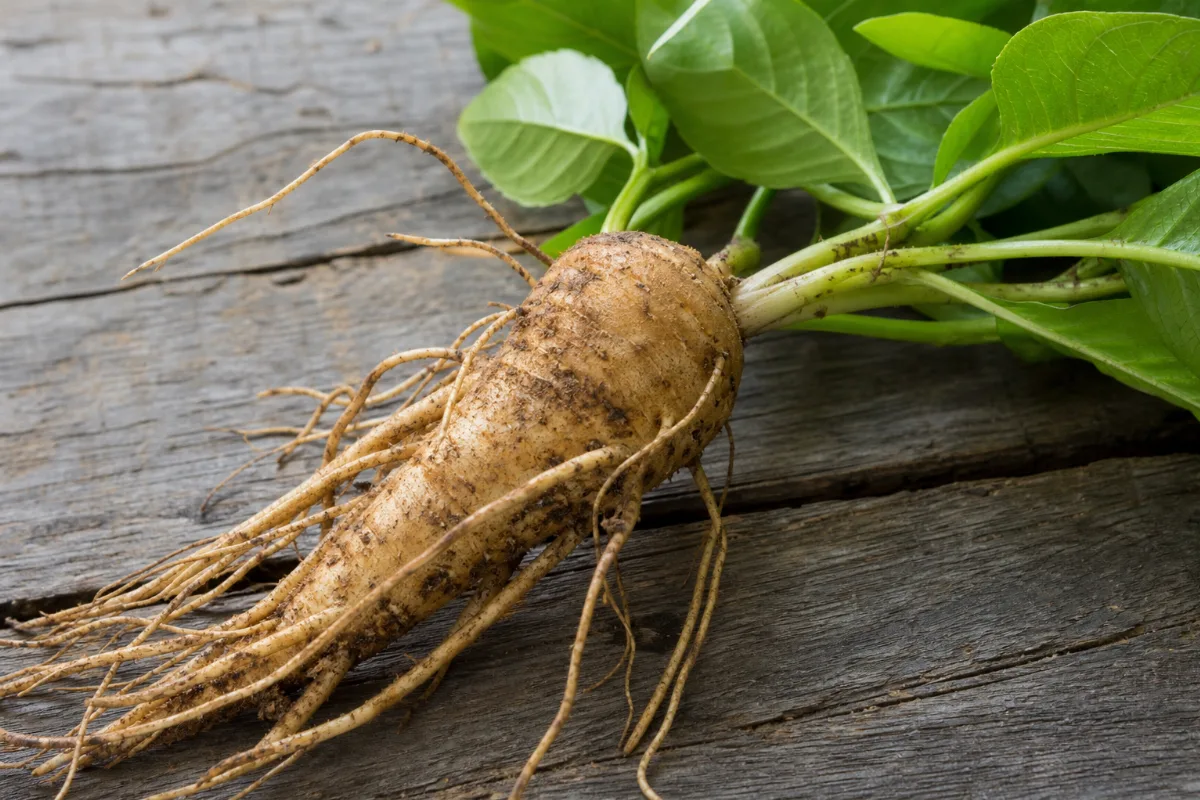
Herbs & Botanicals · Brazilian tonic root
Suma
Hebanthe eriantha (Pfaffia paniculata), root · also called Brazilian ginseng, para tudo
Suma, or Brazilian ginseng, is the root of a South American vine that is sold as an energy and stress tonic and for sports. It is not related to Asian ginseng. We found almost no human research: one small sickle cell trial, one skin test, and sports trials of ecdysterone supplements that did not use suma. The main caution is that safety has not been studied, and lab and animal work raises questions about hormones, fertility and pregnancy.
General information, not medical advice. Last substantive update · Not medically reviewed. A named clinician has not signed off on this page. How this page is made
About Suma
Suma is a South American root with a long reputation as a tonic. Human research is almost absent. The plant is not Asian ginseng. Safety is the main question: nothing is established for pregnancy, breastfeeding, children, hormone-sensitive conditions or use with medicines.
What it is
Suma is the root of a South American vine. Its accepted botanical name in the GBIF database is Hebanthe erianthos; older papers call it Pfaffia paniculata or Hebanthe eriantha. 'Brazilian ginseng' is also used for a different species, Pfaffia glomerata, and it has no botanical link to Asian ginseng (Panax ginseng). Indigenous peoples called the root para tudo, 'for everything'.
What the research shows
There are almost no human trials. The best human item is a Cochrane review of plant medicines for sickle cell disease, which includes one small trial of a powdered suma root extract and found the effect uncertain (very low-quality evidence). Sports claims rest on trials of ecdysterone, a compound in the root, using other products, with mixed results. A 2025 trial found its commercial product held under 1% of the labelled amount. One 21-person test of a three-plant eye serum is the only other human study. The rest is test-tube and animal work.
How it may work
The root holds ecdysteroids (including 20-hydroxyecdysone), saponins, plant sterols and allantoin. Computer models suggest ecdysterone binds estrogen receptor beta, and animal work links it to the Mas1 receptor in the renin-angiotensin system. In people, a single dose of isolated ecdysterone was mostly cleared in urine with a half-life of about three hours. None of this has been shown for suma root.
At a glance
Traditional uses history, not proof
- Indigenous South American tonic, called para tudo ('for everything')
- Folk use as an aphrodisiac and for diabetes and rheumatism in Brazil
- Modern herbal use as an adaptogen for stress and tiredness
Studied for research
- Stress, tiredness and general tonic use, insufficient
- Anxiety, mood and memory, insufficient
- Muscle and sports performance (ecdysterone), insufficient for suma
- Sickle cell disease, very low
- Sex hormones, fertility and libido, insufficient
- Skin around the eyes (cosmetic serum), very low
- Blood sugar, blood pressure and cholesterol, insufficient
- Cancer, inflammation and germs (lab only), insufficient
Main compounds
- 20-Hydroxyecdysone (beta-ecdysone) and other ecdysteroids
- Pfaffic acid and root saponins (triterpenoids)
- Plant sterols (beta-sitosterol, stigmasterol) and allantoin
Common forms
- Powdered root
- Capsules and tablets
- Liquid extracts and teas
- Skin serums (cosmetic)
- Not the same as Asian ginseng or Pfaffia glomerata
Research links: Phytomedicines for sickle cell disease, Cochrane (2020) · Suma and sex hormones in mice (2003) · Beta-ecdysone genotoxic in rodents (2016) · Ecdysterone supplement trial in men (2019) · Labeling of a phytosteroid product, trial (2025) · Suma's therapeutic uses (EBSCO, 2024) · Research Library · Genes & Biomarkers Library
The plant and its history
- Accepted scientific name
- Hebanthe erianthos (Poir.) Pedersen
- Naming authority
- ACCEPTED in the GBIF backbone (species key 10855609, checked 2026-10-25). Pfaffia paniculata (Mart.) Kuntze (key 5548115) and Hebanthe eriantha (Poir.) Pedersen (key 7323468) are both listed as synonyms of it. Plants of the World Online was not checked.
- Synonyms
- Pfaffia paniculata (Mart.) Kuntze; Hebanthe eriantha (Poir.) Pedersen (spelling variant used in many papers)
- Common names
- Suma (English / trade); Brazilian ginseng (English); Para tudo (Portuguese ('for everything'))
- Botanical family
- Amaranthaceae (the amaranth family, which also includes quinoa and beets).
- Classification
- Plantae > Amaranthaceae > Hebanthe > Hebanthe erianthos
- Native range
- Central and South America, per EBSCO. Not verified from a botanical source.
- Habitat
- Not verified.
- What the plant looks like
- Roots: The root is the part used. EBSCO calls the plant a large ground vine.; Stems: Not verified.; Leaves: Not verified.; Flowers: Not verified.; Fruit: Not verified.
- Cultivation
- Not verified.
- Harvest and processing
- Not verified.
- Look-alikes and adulterants
- Name: Pfaffia glomerata (Spreng.) Pedersen; Note: A separate accepted species (GBIF key 7323527) also called Brazilian ginseng. Much of the lab and animal research, including the fertility studies, used it. Results do not automatically carry over to suma.; Name: Panax ginseng C.A.Mey. (Asian ginseng); Note: Unrelated plant in another family (Araliaceae). Shares only the nickname.
- Sustainability and conservation
- Not verified.
Traditional use and history history, not clinical proof
| Tradition or era | Documented use | Source |
|---|---|---|
| Indigenous peoples of Central and South America | Used to promote health and treat 'practically all illnesses'; called para toda or para tudo, meaning 'for everything'. | s-ebsco-suma; s-healthline-suma |
| Brazilian folk literature | A survey of 24 Brazilian books on plants used in ways that resemble adaptogens: Pfaffia paniculata and Pfaffia glomerata were noted but listed in fewer than four books; the authors called for clinical studies. | p17030478 |
| Folk medicine in Brazil | Tonic and aphrodisiac, and for diabetes and rheumatism, per the introduction to a genotoxicity paper (about Pfaffia species in general). | p26626488 |
| Modern US herbal use | Promoted as an adaptogen, energy tonic and aphrodisiac; EBSCO says Russian Olympic athletes 'reportedly' used suma. That claim is NOT verified. | s-ebsco-suma |
Traditional use shows how a plant was used. It does not show that a supplement works or is safe today.
What is inside, and how it may work
What the plant contains and how those compounds act in cells and animals. Laboratory and animal mechanisms are not proven effects in people.
Main compounds
| Compound | Family | Where it is concentrated | Activity studied | Level of evidence |
|---|---|---|---|---|
| 20-Hydroxyecdysone (beta-ecdysone, ecdysterone) PubChem 5459840 | Ecdysteroid (plant steroid) | Root (isolated from Pfaffia paniculata roots) | Anabolic, lipid-lowering and other effects in animals and cells; estrogen receptor beta binding in models; Mas1 receptor activation in animals. Genotoxic in rodent and onion tests as a pure compound. 14 6 23 17 | Animal research |
| Ecdysone PubChem 19212 | Ecdysteroid | Root | Isolated from the root; no activity data in the sources read. Pterosterone and rapisterone were also isolated (no CID checked). 14 | Laboratory research |
| Pfaffic acid PubChem 441936 | Triterpenoid (nortriterpenoid acid) | Root | Marker compound and aglycone of root saponins; EBSCO mentions anticancer promise from test-tube and animal studies. 14 20 8 | Laboratory research |
| Pfaffosides and other saponins | Triterpenoid saponins | Root | Listed in the root chemistry; activity data in the sources read are lab only. 20 8 | Laboratory research |
| Beta-sitosterol and stigmasterol PubChem 222284 | Plant sterols (phytosterols) | Root | Reported in the root; their role in the mouse hormone changes was not tested. 20 21 | Laboratory research |
| Allantoin PubChem 204 | Urea derivative | Root | Reported in the root; no activity data in the sources read. 20 | Laboratory research |
Mechanisms, receptors and pathways
| Target or pathway | Gene or receptor | What was found | Level |
|---|---|---|---|
| Estrogen receptor beta (ER-beta) | ESR2 | Computer simulations suggest ecdysterone binds ER-beta stably; a human sports paper also says its anabolic effect is thought to work through estrogen receptors. Not shown for suma. 23 13 | In silico |
| Mas1 receptor / renin-angiotensin system | MAS1 | A review says 20-hydroxyecdysone activates the Mas1 receptor in animal models, which could explain many effects. Not shown for suma. 6 | Animal research |
| Red blood cell mechanics | Extract improved sickle red cell deformability in a test tube. 16 | Laboratory research | |
| Cell survival in cancer cell lines | Methanol root extract lowered viability of colon cancer and mouse breast tumour cells, and was toxic to brine shrimp, so it is cytotoxic in general. 22 | Laboratory research | |
| Sex hormone levels | Higher plasma estradiol, progesterone and testosterone in mice drinking root-enriched water for 30 days. 20 | Animal research |
Absorption, metabolism and elimination
- Absorption
- Not studied for suma. In 12 volunteers given a single dose of isolated ecdysterone, urine levels peaked 2.8-8.5 hours after the dose.
- Distribution
- Not found.
- Metabolism
- Two metabolites of ecdysterone (14-deoxy-ecdysterone and 14-deoxy-poststerone) appeared in urine later than the parent compound.
- Elimination
- About 18% of the ecdysterone dose was excreted unchanged in urine; half-life about three hours; detected for more than two days. No sex difference.
- Bioavailability
- Not measured (urine only). The ecdysterone content of suma root is not known, so these figures cannot be applied to a suma product.
Isolated compounds versus whole extracts
The ecdysterone trials used isolated or commercial ecdysterone products, not suma root. The root also holds saponins, sterols and other compounds, and no study compared whole root with 20-hydroxyecdysone. Results and warnings for the isolated compound (genotoxicity in animals, estrogen receptor models, sports trials) do not transfer automatically to the whole root.
Nutritional composition
EBSCO says suma is rich in vitamins and minerals, but gives no amounts and no source was read that does. No nutrient table is given.
2 very low certainty6 not enough evidence
What is Suma good for?
The main studied and promoted uses and how strong the human evidence is. For suma itself there is almost none; where a result comes from ecdysterone products or a related species it is said so.
Benefits, one by one
Each card is a research question, not a promise. Tap a goal to filter. Open a card to see the studies, doses and limits.
General tonic, stress and tiredness
Not enough evidenceSuma is sold as a tonic that helps the body cope with stress and tiredness. We found no human trial that tested this. The claim rests on tradition and on its nickname 'Brazilian ginseng'.
3 studiesNot covered. Products vary in plant part and content.
Studies, doses and limits
What the trials found
No human trial of suma for stress, fatigue or energy was found in PubMed. A public reference article says there is no reliable scientific evidence that suma benefits chronic fatigue or stress.
Results
No outcome data in people.
Effect sizes as reported
None.
Why this rating
No human trial; only tradition and a literature survey.
Form and dose studied
Not covered. Products vary in plant part and content.
Who was studied
None studied.
Limits
The adaptogen label is a tradition-based idea, not a proven effect. Species names are mixed in the literature (Pfaffia paniculata, Pfaffia glomerata and Hebanthe eriantha are all called Brazilian ginseng).
Why researchers looked
Indigenous peoples of South America are reported to have called the root 'for everything' (para tudo / para toda). Herbalists today call it an adaptogen, a word for herbs said to help the body adapt to stress.
Traditional use
A survey of 24 Brazilian books found Pfaffia paniculata and Pfaffia glomerata had been studied in ways that support a possible adaptogen role, but each was named in fewer than four books, and the authors said clinical studies were missing. One reference also says Russian Olympic athletes reportedly used suma; that claim was not checked.
Proposed mechanism Pharmacological theory
No tested mechanism for stress or tiredness. The root contains ecdysteroids and saponins, and a related species has lab and animal activity, but nothing links these to stress relief in people.
A proposed mechanism does not show that the effect happens in people.
Safety has not been established in pregnancy, breastfeeding, children, or severe liver or kidney disease (see the safety file).
Anxiety, mood, memory and thinking
Not enough evidenceSome reference articles say suma may help mood and memory. These statements come from lab and animal findings. No human trial was found.
2 studiesNot covered.
Studies, doses and limits
What the trials found
None found for suma. A public reference article says comprehensive human studies are necessary.
Results
No outcome data in people.
Effect sizes as reported
None.
Why this rating
No human evidence; related-species animal work only.
Form and dose studied
Not covered.
Who was studied
None studied.
Limits
Evidence comes from another species and from animals.
Why researchers looked
Marketing and reference texts list anxiety, mood and memory among suma's 'proposed uses'.
Traditional use
Part of the general 'tonic' reputation.
Proposed mechanism Animal research
A review of the related species Pfaffia glomerata lists antidepressant activity in laboratory and animal studies. That is a different species, and the findings are not human data.
A proposed mechanism does not show that the effect happens in people.
Nothing specific found. Because hormones may be affected in animals (see body file), people on hormone treatment or with hormone-sensitive conditions should ask a doctor.
Muscle building and sports performance (ecdysterone)
Not enough evidenceThe root contains ecdysteroids, including 20-hydroxyecdysone (ecdysterone), which are sold to athletes as natural muscle builders. Two trials of ecdysterone supplements gave mixed results and neither used suma. No trial of suma itself was found.
6 studiesNot covered.
Studies, doses and limits
What the trials found
A 10-week strength-training study in 46 young men reported larger gains in muscle mass and bench-press strength with ecdysterone-containing supplements and no rise in liver or kidney markers. A later 12-week randomised, placebo-controlled trial of 28 men found no difference from placebo for a commercial product, which held under 1% of the labelled ecdysterone. Neither tested suma, and the suma root's ecdysterone content is not known.
Results
Mixed for ecdysterone products; no suma data.
Effect sizes as reported
No numbers in the abstracts for the first trial. Second trial: no group difference (both groups improved with training).
Why this rating
No suma trial. Ecdysterone trials are small and contradict each other, and one product was mislabelled.
Form and dose studied
Not covered.
Who was studied
Young men doing resistance training (ecdysterone trials only).
Limits
Suma has not been tested. Product labels often do not match contents. The first trial's authors also argue ecdysterone should be banned in sport.
Why researchers looked
Four ecdysteroids were isolated from the root. Ecdysterone supplements are marketed for muscle gain, and suma is sometimes mentioned alongside them.
Traditional use
Suma's use by athletes is described in a reference as reported, not documented.
Proposed mechanism Preliminary mechanism
Computer modelling suggests ecdysterone binds estrogen receptor beta; a review also describes activation of the Mas1 receptor in the renin-angiotensin system in animals. Neither was shown for suma.
A proposed mechanism does not show that the effect happens in people.
Ecdysterone is on the WADA Monitoring Program (not the Prohibited List), per a US Department of Defense supplement-safety article that was not checked against the current WADA list. Athletes in tested sports should check before use.
Sickle cell disease
Very low certaintyIn a test-tube study, a suma extract made red blood cells from people with sickle cell disease more flexible. A Cochrane review found one small trial of a powdered suma root extract in patients and could not tell whether it helped.
3 studiesPowdered root extract in the Cochrane-reviewed trial; details not rea…
Studies, doses and limits
What the trials found
The 2020 Cochrane review included three trials (212 people) of three plant medicines; one was a powdered Pfaffia paniculata root extract. The reviewers were uncertain of its effect on lab tests and symptoms (very low-quality evidence) and reported no adverse effects with it (low- to very low-quality evidence). The 2015 study used blood from 7 people with sickle cell disease and 4 without; nobody took the herb.
Results
Test-tube: better deformability at 0.5 mg/mL in sickle cell samples only. Trial: no conclusion.
Effect sizes as reported
No numbers in the abstracts.
Why this rating
Cochrane rated the evidence for the Pfaffia trial very low quality. The details of that trial were not read.
Form and dose studied
Powdered root extract in the Cochrane-reviewed trial; details not read.
Who was studied
People with sickle cell disease.
Limits
Tiny and old evidence. A sickle cell crisis is a medical emergency; suma is not a treatment.
Why researchers looked
Sickle-shaped red cells are stiff and can block small vessels, so researchers tested whether the extract makes them more flexible.
Traditional use
None specific.
Proposed mechanism Laboratory research
Extract made sickle red cells more deformable in a test tube at high shear stress. How it does this was not shown.
A proposed mechanism does not show that the effect happens in people.
Anyone with sickle cell disease should discuss any herb with their haematology team first.
Sex hormones, fertility and libido
Not enough evidenceSuma is sold as an aphrodisiac and fertility aid. The only direct evidence is one mouse study in which hormones rose. Studies of a related species show mixed or even harmful effects on fertility in mice. No human study was found.
5 studiesNot covered.
Studies, doses and limits
What the trials found
None for suma.
Results
Mice drinking root-enriched water for 30 days had higher estradiol, progesterone (females) and testosterone (males). In Pfaffia glomerata (a different species), mice exposed in the womb and during nursing mostly showed no testis damage, but a tetraploid laboratory line lowered sperm production and increased embryo loss in male mice.
Effect sizes as reported
No numbers in the abstracts.
Why this rating
Animal data only, different species, mixed direction.
Form and dose studied
Not covered.
Who was studied
Mice.
Limits
Higher hormones in mice are not a proven benefit in people and could be a risk for some people (see safety file). The fertility studies are of a different species.
Why researchers looked
Folk use as an aphrodisiac and a tonic.
Traditional use
Reputation as an aphrodisiac is repeated in reference articles but no human trial supports it.
Proposed mechanism Preliminary mechanism
Phytosteroids (beta-sitosterol, stigmasterol) and ecdysteroids are in the root. Ecdysterone may act through estrogen receptor beta in computer models. How these affect hormone levels was not shown.
A proposed mechanism does not show that the effect happens in people.
Ask a doctor first if you are pregnant, trying to conceive, or have a hormone-sensitive condition.
Skin around the eyes (dark circles, a cosmetic serum)
Very low certaintyA 28-day test of a serum made from three plants (suma was one) on the skin of 21 people found about 90% had a lighter tone. This was not a swallowed supplement and not suma alone.
1 studiesSkin serum (cosmetic).
Studies, doses and limits
What the trials found
One 28-day uncontrolled test in 21 volunteers with a serum containing 5.0% of a Pfaffia paniculata, Ptychopetalum olacoides and Lilium candidum compound applied twice daily.
Results
Skin tone and luminance improved in about 90% of volunteers; they also reported less obvious dark circles.
Effect sizes as reported
No numbers in the abstract.
Why this rating
Small, no control group mentioned, combination product, cosmetic outcome.
Form and dose studied
Skin serum (cosmetic).
Who was studied
21 volunteers with periorbital hyperchromia.
Limits
Cannot say suma alone worked. Sponsor not named in the abstract.
Why researchers looked
Tested as a cosmetic ingredient for dark circles.
Traditional use
None found.
Proposed mechanism Laboratory research
In a skin-culture model the compound lowered inflammatory mediators and raised an antioxidant enzyme.
A proposed mechanism does not show that the effect happens in people.
Skin reactions were not described in the abstract.
Blood sugar, blood pressure and cholesterol
Not enough evidenceReference articles say suma 'showed promise' for lowering blood sugar, blood pressure and cholesterol. We found no human trial. The promise comes from lab and animal work, much of it on ecdysterone or related species.
3 studiesNot covered.
Studies, doses and limits
What the trials found
None. A PubMed search for Pfaffia or Hebanthe with diabetes, glucose or blood pressure found no human study.
Results
No human outcome data.
Effect sizes as reported
None.
Why this rating
No human evidence.
Form and dose studied
Not covered.
Who was studied
None studied.
Limits
Based on a different compound and related species in animals.
Why researchers looked
Folk use for diabetes and rheumatism is mentioned in the introduction to a genotoxicity paper.
Traditional use
Pfaffia species were used in Brazil for diabetes, among many other uses.
Proposed mechanism Animal research
A review of pharmaceutical-grade 20-hydroxyecdysone reports lipid-lowering and anti-diabetic effects in animals and activation of a renin-angiotensin pathway (Mas1 receptor). This was not shown for suma root.
A proposed mechanism does not show that the effect happens in people.
Because of this theory, people taking diabetes or blood pressure medicines should ask a doctor or pharmacist (see interactions).
Cancer, inflammation and infection (lab and animal only)
Not enough evidenceMany lab and animal papers report that suma or related-species extracts kill cancer cells, reduce inflammation or block germs. These are not human results.
3 studiesRoot methanol extract (lab).
Studies, doses and limits
What the trials found
None.
Results
Cell tests: IC50 272.6 ug/mL (HCT116 colon cancer cells) and 88.5 ug/mL (4T1 mouse breast cells) at 72 hours; brine shrimp LC50 589.4 ug/mL.
Effect sizes as reported
See results.
Why this rating
Lab and animal only.
Form and dose studied
Root methanol extract (lab).
Who was studied
Cell lines.
Limits
Laboratory concentrations do not tell what happens in the body. One review states members of the subfamily 'do not present toxicity', which is an overstatement given the genotoxicity and fertility findings in the safety file.
Why researchers looked
Cancer-cell and germ tests are quick and common.
Traditional use
Reference articles list anti-cancer and anti-inflammatory 'proposed uses'.
Proposed mechanism Laboratory research
A methanol extract of the root lowered the viability of human colon cancer cells and mouse breast tumour cells and was moderately toxic to brine shrimp. That shows the extract can harm cells, not that it treats disease.
A proposed mechanism does not show that the effect happens in people.
Do not use suma in place of cancer treatment.
Connections to the rest of health
How Suma connects to the rest of our health knowledge graph. Every link says what kind of connection it is. A safety link (for example to the liver) is a warning, not a benefit. A study that merely mentions a topic never creates a benefit link.
Explore every connection: goals, body systems, organs, symptoms, genes
A. Wellness goals
| Connected to | Kind of connection | Evidence status | Context | Studies |
|---|---|---|---|---|
| Stress Reduction | Traditional use | Not enough evidence | General tonic, stress and tiredness: Suma is sold as a tonic that helps the body cope with stress and tiredness. We found no human trial that tested this. The claim rests on tradition and on its nickname 'Brazilian ginseng'. | 15 8 12 |
| Reduce Fatigue | Traditional use | Not enough evidence | General tonic, stress and tiredness: Suma is sold as a tonic that helps the body cope with stress and tiredness. We found no human trial that tested this. The claim rests on tradition and on its nickname 'Brazilian ginseng'. | 15 8 12 |
| Energy Boost | Traditional use | Not enough evidence | General tonic, stress and tiredness: Suma is sold as a tonic that helps the body cope with stress and tiredness. We found no human trial that tested this. The claim rests on tradition and on its nickname 'Brazilian ginseng'. | 15 8 12 |
| Anxiety Support | Preliminary mechanism | Not enough evidence | Anxiety, mood, memory and thinking: Some reference articles say suma may help mood and memory. These statements come from lab and animal findings. No human trial was found. | 4 8 |
| Mood Balance | Preliminary mechanism | Not enough evidence | Anxiety, mood, memory and thinking: Some reference articles say suma may help mood and memory. These statements come from lab and animal findings. No human trial was found. | 4 8 |
| Memory Support | Preliminary mechanism | Not enough evidence | Anxiety, mood, memory and thinking: Some reference articles say suma may help mood and memory. These statements come from lab and animal findings. No human trial was found. | 4 8 |
| Muscle Recovery | Preliminary mechanism | Not enough evidence | Muscle building and sports performance (ecdysterone): The root contains ecdysteroids, including 20-hydroxyecdysone (ecdysterone), which are sold to athletes as natural muscle builders. Two trials of ecdysterone supplements gave mixed results and neither used suma. No trial of suma itself was found. | 14 13 7 23 6 19 |
| Physical Stamina | Preliminary mechanism | Not enough evidence | Muscle building and sports performance (ecdysterone): The root contains ecdysteroids, including 20-hydroxyecdysone (ecdysterone), which are sold to athletes as natural muscle builders. Two trials of ecdysterone supplements gave mixed results and neither used suma. No trial of suma itself was found. | 14 13 7 23 6 19 |
| Peak Performance | Preliminary mechanism | Not enough evidence | Muscle building and sports performance (ecdysterone): The root contains ecdysteroids, including 20-hydroxyecdysone (ecdysterone), which are sold to athletes as natural muscle builders. Two trials of ecdysterone supplements gave mixed results and neither used suma. No trial of suma itself was found. | 14 13 7 23 6 19 |
| Healthy Circulation | Preliminary mechanism | Very low certainty | Sickle cell disease: In a test-tube study, a suma extract made red blood cells from people with sickle cell disease more flexible. A Cochrane review found one small trial of a powdered suma root extract in patients and could not tell whether it helped. | 18 16 8 |
| Libido Support | Biological association | Not enough evidence | Sex hormones, fertility and libido: Suma is sold as an aphrodisiac and fertility aid. The only direct evidence is one mouse study in which hormones rose. Studies of a related species show mixed or even harmful effects on fertility in mice. No human study was found. | 20 3 5 23 12 |
| Fertility Support | Biological association | Not enough evidence | Sex hormones, fertility and libido: Suma is sold as an aphrodisiac and fertility aid. The only direct evidence is one mouse study in which hormones rose. Studies of a related species show mixed or even harmful effects on fertility in mice. No human study was found. | 20 3 5 23 12 |
| Hormone Balance | Biological association | Not enough evidence | Sex hormones, fertility and libido: Suma is sold as an aphrodisiac and fertility aid. The only direct evidence is one mouse study in which hormones rose. Studies of a related species show mixed or even harmful effects on fertility in mice. No human study was found. | 20 3 5 23 12 |
| Healthy Skin | Potential benefit | Very low certainty | Skin around the eyes (dark circles, a cosmetic serum): A 28-day test of a serum made from three plants (suma was one) on the skin of 21 people found about 90% had a lighter tone. This was not a swallowed supplement and not suma alone. | 9 |
| Blood Sugar Balance | Preliminary mechanism | Not enough evidence | Blood sugar, blood pressure and cholesterol: Reference articles say suma 'showed promise' for lowering blood sugar, blood pressure and cholesterol. We found no human trial. The promise comes from lab and animal work, much of it on ecdysterone or related species. | 6 17 8 |
| Blood Pressure Support | Preliminary mechanism | Not enough evidence | Blood sugar, blood pressure and cholesterol: Reference articles say suma 'showed promise' for lowering blood sugar, blood pressure and cholesterol. We found no human trial. The promise comes from lab and animal work, much of it on ecdysterone or related species. | 6 17 8 |
| Cholesterol Balance | Preliminary mechanism | Not enough evidence | Blood sugar, blood pressure and cholesterol: Reference articles say suma 'showed promise' for lowering blood sugar, blood pressure and cholesterol. We found no human trial. The promise comes from lab and animal work, much of it on ecdysterone or related species. | 6 17 8 |
| Inflammation Balance | Preliminary mechanism | Not enough evidence | Cancer, inflammation and infection (lab and animal only): Many lab and animal papers report that suma or related-species extracts kill cancer cells, reduce inflammation or block germs. These are not human results. | 22 4 2 |
| Immune Support | Preliminary mechanism | Not enough evidence | Cancer, inflammation and infection (lab and animal only): Many lab and animal papers report that suma or related-species extracts kill cancer cells, reduce inflammation or block germs. These are not human results. | 22 4 2 |
B. Body systems
| Connected to | Kind of connection | Evidence status | Context | Studies |
|---|---|---|---|---|
| Endocrine system | Preliminary mechanism | Not enough evidence | Raised sex hormones in mice; estrogen receptor beta binding in computer models. Higher sex hormones in mice; a reason for caution in hormone-sensitive conditions. Preparation or compound: Powdered root (mice); ecdysterone (models) |
20 23 |
| Reproductive system | Adverse effect or risk | Not enough evidence | Lower sperm production and more embryo loss in mice; not shown for suma. Preparation or compound: Pfaffia glomerata tetraploid root extract (mice) |
5 3 |
| Stress Mood | Biological association | Not enough evidence | Studied for: General tonic, stress and tiredness | 15 8 12 |
| Nervous System | Biological association | Not enough evidence | Studied for: Anxiety, mood, memory and thinking | 4 8 |
| Musculoskeletal System | Biological association | Not enough evidence | Studied for: Muscle building and sports performance (ecdysterone) | 14 13 7 23 6 19 |
| Cardiovascular System | Biological association | Very low certainty | Studied for: Sickle cell disease Studied for: Blood sugar, blood pressure and cholesterol | 18 16 8 6 17 |
| Reproductive System | Biological association | Not enough evidence | Studied for: Sex hormones, fertility and libido | 20 3 5 23 12 |
| Endocrine System | Biological association | Not enough evidence | Studied for: Sex hormones, fertility and libido | 20 3 5 23 12 |
| Integumentary System | Biological association | Very low certainty | Studied for: Skin around the eyes (dark circles, a cosmetic serum) | 9 |
| Metabolism Weight | Biological association | Not enough evidence | Studied for: Blood sugar, blood pressure and cholesterol | 6 17 8 |
| Immune System | Biological association | Not enough evidence | Studied for: Cancer, inflammation and infection (lab and animal only) | 22 4 2 |
E. Health conditions
| Connected to | Kind of connection | Evidence status | Context | Studies |
|---|---|---|---|---|
| Hormone-sensitive conditions | Contraindication | Not enough evidence | Precaution based on animal hormone data. Preparation or compound: Whole root (precaution) |
20 |
| Sickle cell disease | Preliminary mechanism | Very low certainty | Test-tube and one small trial; Cochrane could not judge. Preparation or compound: Pfaffia paniculata extract |
18 16 |
I. Biomarkers
| Connected to | Kind of connection | Evidence status | Context | Studies |
|---|---|---|---|---|
| Estradiol (an estrogen) | Biological association | Not enough evidence | Measured in trials: raised. A lab change is not the same as a health benefit. | 20 |
| Progesterone | Biological association | Not enough evidence | Measured in trials: raised. A lab change is not the same as a health benefit. | 20 |
| Testosterone | Biological association | Not enough evidence | Measured in trials: raised. A lab change is not the same as a health benefit. | 20 |
| Red blood cell deformability | Biological association | Very low certainty | Measured in trials: mixed. A lab change is not the same as a health benefit. | 16 |
J. Genes, receptors and enzymes
L. Active compounds
| Connected to | Kind of connection | Evidence status | Context | Studies |
|---|---|---|---|---|
| 20-Hydroxyecdysone (beta-ecdysone, ecdysterone) | Biological association | Animal | Anabolic, lipid-lowering and other effects in animals and cells; estrogen receptor beta binding in models; Mas1 receptor activation in animals. Genotoxic in rodent and onion tests as a pure compound. Preparation or compound: Root (isolated from Pfaffia paniculata roots) |
14 6 23 17 |
| Ecdysone | Biological association | In vitro | Isolated from the root; no activity data in the sources read. Pterosterone and rapisterone were also isolated (no CID checked). Preparation or compound: Root |
14 |
| Pfaffic acid | Biological association | In vitro | Marker compound and aglycone of root saponins; EBSCO mentions anticancer promise from test-tube and animal studies. Preparation or compound: Root |
14 20 8 |
| Pfaffosides and other saponins | Biological association | In vitro | Listed in the root chemistry; activity data in the sources read are lab only. Preparation or compound: Root |
20 8 |
| Beta-sitosterol and stigmasterol | Biological association | In vitro | Reported in the root; their role in the mouse hormone changes was not tested. Preparation or compound: Root |
20 21 |
| Allantoin | Biological association | In vitro | Reported in the root; no activity data in the sources read. Preparation or compound: Root |
20 |
Each connection is stored with the ingredient, the connected record, the kind of connection, the evidence status, the supporting studies, the preparation or compound involved, and a review date (last reviewed October 25, 2026).
The evidence
The research centre for Suma. Every record here was checked against PubMed or the publisher's page; we never list a study we have not verified.
Evidence by outcome
Bars show how many studies we found for each outcome, not how well it works. People are added up across trials only (reviews are not added, to avoid double counting).
How we rate evidence
High certainty
Several well-run trials or reviews agree; further research is unlikely to change the picture much.
Moderate certainty
Good trials point the same way, but some doubt remains.
Low certainty
Small, short or inconsistent trials. The finding could change with better research.
Very low certainty
Very little or very weak human data. Treat as a possibility only.
Mixed findings
Trials or reviews disagree with each other.
Not enough evidence
Not enough human research to say either way.
Evidence against
Good research found no benefit, or found harm.
We take the reviewers' own risk-of-bias and GRADE statements where they exist, and otherwise judge from study size, design, consistency, directness and whether a product matches what is sold. Many publications do not make evidence high. Method note: We searched PubMed and read each abstract directly, and checked plant names through GBIF and compound IDs through PubChem. EBSCO, Healthline and a US defense supplement-safety article were read. NCCIH has no suma page; EMA, LiverTox and LactMed could not be confirmed; Commission E and WHO were not checked. Full texts were mostly not read.
Study library: every study we checked 26
| Study | Design | People | Product, dose, length | Result |
|---|---|---|---|---|
| Ambrosio 2021 Urinary Elimination of Ecdysterone and Its Metabolites Following a Single-Dose Administration in Humans Metabolites · PMID 34207569 · DOI |
Pharmacokinetic |
12 Twelve volunteers |
Single dose of ecdysterone (not suma) n/a (isolated compound) Single 50 mg dose Urine collected for more than 2 days · vs None |
Ecdysterone was the most abundant compound, detected for more than 2 days, peaking at 2.8-8.5 hours; two metabolites appeared later. About 18% of the dose was excreted as ecdysterone; half-life about three hours. No sex difference. 18% excreted unchanged; half-life about 3 hours Methods, limits and fundingOutcomes: Urine levels of ecdysterone and metabolites Limitations: Urine only (no blood levels), 12 people, isolated ecdysterone not suma. Funding and conflicts: Authors declare no conflict of interest Read: abstract |
| Araque Gelves 2025 Ethnomedicinal Uses, Phytochemistry, Pharmacological Activities, and Toxicology of the Subfamily Gomphrenoideae (Amaranthaceae): A Comprehensive Review Chem Biodivers · PMID 40273036 · DOI |
Narrative review in-vitro |
About 480 species of the subfamily that includes Pfaffia/Hebanthe | Extracts and compounds from the subfamily various n/a n/a · vs n/a |
512 compounds reported; extracts show antimicrobial, antioxidant, anticancer, anti-inflammatory and antidiabetic activity in studies; the authors state members of the subfamily do not present toxicity. Narrative review Methods, limits and fundingOutcomes: Compounds, activities, toxicity Limitations: Covers hundreds of species and mostly lab studies; the 'no toxicity' statement is not a safety clearance for suma in people. Funding and conflicts: Authors declare no conflicts Read: abstract |
| Auharek 2019 Evaluation of the testis function of mice exposed in utero and during lactation to Pfaffia glomerata (Brazilian ginseng) Andrologia · PMID 31145510 · DOI |
Animal research animal |
Male mice exposed in the womb and while nursing | Hydroalcoholic extract of Pfaffia glomerata (a different species) root (not stated in the abstract) Several doses (not given in the abstract) In utero and during lactation · vs Control |
No change in body weight, tubule diameter or testis function. Testis weight was lower in animals dosed directly in early life at the highest dose. The authors concluded the extract may not act as an endocrine disruptor. Mostly no effect; one testis-weight reduction Methods, limits and fundingOutcomes: Body weight, testis structure and function Limitations: Different species (P. glomerata). Mice. Abstract has no numbers. Read: abstract |
| Cotrim Ribeiro 2024 A comprehensive review of Pfaffia glomerata botany, ethnopharmacology, phytochemistry, biological activities, and biotechnology J Ethnopharmacol · PMID 38484957 · DOI |
Narrative review animal |
76 studies on Pfaffia glomerata (a different species also called Brazilian ginseng) | Pfaffia glomerata (not suma) root and other parts n/a n/a · vs n/a |
40 compounds (ecdysteroids, triterpenes, saponins and others); 20-hydroxyecdysone is the main root compound; in vitro and in vivo activities reported (anti-inflammatory, antidepressant, aphrodisiac and others). Narrative review Methods, limits and fundingOutcomes: Botany, compounds, activities Limitations: Covers a different species. Lab and animal findings; not human evidence. Funding and conflicts: Authors declare no competing interests Read: abstract |
| Dias 2023 Pfaffia glomerata polyploid accession compromises male fertility and fetal development J Ethnopharmacol · PMID 37230282 · DOI |
Animal research animal |
Adult male Swiss mice (4 per group for mating, 6 per group for lab analysis) | Hydroalcoholic root extract of a tetraploid Pfaffia glomerata line (a different species and a laboratory-bred line) root 100, 200 or 400 mg/kg in mice Not stated in the abstract · vs Water; sildenafil group |
Daily sperm production and sperm number and quality fell; embryo loss after implantation rose in treated groups (except the lowest dose); markers of oxidative stress changed. Harm signal in male mice Methods, limits and fundingOutcomes: Fertility, sperm, testis tissue, oxidative stress markers Limitations: Different species and a tetraploid line, so it may not apply to suma. Mice only. Funding and conflicts: Authors declare no competing interests Read: abstract |
| Dinan 2021 20-Hydroxyecdysone, from Plant Extracts to Clinical Use: Therapeutic Potential for the Treatment of Neuromuscular, Cardio-Metabolic and Respiratory Diseases Biomedicines · PMID 33947076 · DOI |
Narrative review animal |
Review of 20-hydroxyecdysone studies | Pharmaceutical-grade 20-hydroxyecdysone (not suma) n/a n/a n/a · vs n/a |
Animal and cell studies report anabolic, lipid-lowering, anti-diabetic, anti-inflammatory and liver-protective effects; a main mechanism is activation of the Mas1 receptor in the renin-angiotensin system. Preclinical regulatory studies assessed a lack of toxicity; early trials were done in healthy volunteers and patients. The authors say safety and pharmacology need better evaluation. Narrative review Methods, limits and fundingOutcomes: Mechanism, safety, early trials Limitations: Not suma. Only the abstract was read; author affiliations were not checked. Mostly animal and cell data plus early trials. Funding and conflicts: Authors declare no conflict of interest Read: abstract |
| Dissemond 2025 How reliable is the labeling of a commercial phytosteroid product? A 12-week randomized double-blind training study J Int Soc Sports Nutr · PMID 40781783 · DOI |
Controlled trial |
28 Resistance-trained young men (24 finished) |
Commercial 20-hydroxyecdysone plus diosgenin supplement (not suma) unspecified Taken three times daily as the label advised 12 weeks · vs Placebo |
Both groups improved with training and did not differ. Capsules held less than 1% of the claimed 20-hydroxyecdysone and 10.4% of the claimed diosgenin; the extract showed no activity in muscle cells. No difference between groups Methods, limits and fundingOutcomes: Strength, muscle and fat-free mass, liver, kidney and hormone blood tests; lab analysis of the capsules Limitations: Not suma. Product contained almost none of the labelled compound, so the trial says little about real 20-hydroxyecdysone. Small. Read: abstract |
| EBSCO CAM Review Board (Research Starters) 2024 Suma's therapeutic uses EBSCO CAM Review Board (Research Starters) · Source |
Consumer reference |
Suma (Pfaffia paniculata / Hebanthe eriantha) root |
Reference article: no reliable scientific evidence for the conditions suma is promoted for; one test-tube sickle cell study; not associated with serious adverse reactions but comprehensive safety studies have not been done; safety in young children, pregnant or nursing women, and people with severe liver or kidney disease not established. Methods, limits and fundingLimitations: A reference summary for the public, not primary research. It also lists a typical dose, which this page does not repeat. Read: full-text | |
| Eberlin 2009 Effects of a Brazilian herbal compound as a cosmetic eyecare for periorbital hyperchromia ('dark circles') J Cosmet Dermatol · PMID 19527337 · DOI |
Uncontrolled trial |
21 Volunteers with dark circles under the eyes |
Serum with 5.0% of a three-plant compound (Pfaffia paniculata, Ptychopetalum olacoides and Lilium candidum) applied to the skin root (not stated) Twice a day on the skin 28 days · vs None stated in the abstract |
Skin tone and luminance improved in about 90% of volunteers, who reported less obvious dark circles. In a skin-culture model the compound lowered inflammatory mediators and raised an antioxidant enzyme. About 90% improved (no numbers given) Methods, limits and fundingOutcomes: Skin colour and luminance around the eyes; questionnaire; skin-culture markers Limitations: Three-plant cosmetic used on the skin, not a swallowed supplement and not suma alone. No control group is mentioned. Only 21 people. Funding and conflicts: Not stated in the abstract Read: abstract |
| European Medicines Agency 2026 EMA / HMPC herbal monograph search for Pfaffia / suma European Medicines Agency · Source |
Authoritative guidance |
Suma (Pfaffia paniculata / Hebanthe eriantha) root |
Not found: no HMPC monograph for Pfaffia paniculata or Hebanthe was found. The agency search page returned an access error when queried from the command line, so absence is not confirmed. Methods, limits and fundingRead: not-found | |
| GBIF 2026 GBIF Backbone Taxonomy species match: Pfaffia paniculata, Hebanthe eriantha, Hebanthe erianthos, Pfaffia glomerata, Panax ginseng GBIF · Source |
Database |
Suma (Pfaffia paniculata / Hebanthe eriantha) root |
Checked 2026-10-25. Pfaffia paniculata (Mart.) Kuntze (key 5548115) and Hebanthe eriantha (Poir.) Pedersen (key 7323468) are both SYNONYMS of Hebanthe erianthos (Poir.) Pedersen (key 10855609, ACCEPTED, family Amaranthaceae). Pfaffia glomerata (key 7323527) is a separate accepted species. Panax ginseng (key 5372262) is in family Araliaceae. Methods, limits and fundingLimitations: Accepted name not cross-checked in Plants of the World Online. Read: full-text | |
| Healthline 2021 Suma root: nutrients, benefits, downsides, and more Healthline · Source |
Consumer reference |
Suma (Pfaffia paniculata / Hebanthe eriantha) root |
Consumer health article: little scientific evidence for claims, especially in people; no recent studies on side effects or overall safety; children, pregnant or breastfeeding people and those on medicines may want to avoid it until more is known. Methods, limits and fundingLimitations: Consumer article, used only for the caution statements and for what is promoted, not as evidence of benefit. Read: full-text | |
| Isenmann 2019 Ecdysteroids as non-conventional anabolic agent: performance enhancement by ecdysterone supplementation in humans Arch Toxicol · PMID 31123801 · DOI |
Controlled intervention study |
46 Young men doing strength training |
Ecdysterone-containing supplements (not suma) unspecified Different doses (not given in the abstract) 10 weeks · vs Lower or no ecdysterone (details not in the abstract) |
Significantly higher muscle mass gain and bench-press gains in the ecdysterone-dosed men; no increase in liver or kidney toxicity markers. Positive (no numbers in the abstract) Methods, limits and fundingOutcomes: Muscle mass, one-repetition bench press, blood and urine markers Limitations: Not suma. Only abstract read. Design details (blinding, doses) not in the abstract. The authors conclude ecdysterone should be a prohibited sports substance. Read: abstract |
| Li 2010 Triterpenoids from Brazilian ginseng, Pfaffia paniculata Planta Med · PMID 19941264 · DOI |
Phytochemistry in-vitro |
Roots of Pfaffia paniculata (Mart.) Kuntze | Root extracts for compound isolation root n/a n/a · vs n/a |
Two new nortriterpenoids (pfaffine A and B) and ten known compounds, including four ecdysteroids (ecdysone, 20-hydroxyecdysone, pterosterone, rapisterone) and triterpenoids such as pfaffic acid. Compound list only; no amounts given in the abstract Methods, limits and fundingOutcomes: Compounds isolated and identified Limitations: Does not report how much of each compound a root or product contains. Read: abstract |
| Mendes 2007 Brazilian plants as possible adaptogens: an ethnopharmacological survey of books edited in Brazil J Ethnopharmacol · PMID 17030478 · DOI |
Survey |
24 Brazilian books, 766 plants cited | Survey of traditional use n/a n/a n/a · vs n/a |
Pfaffia glomerata and Pfaffia paniculata had been the object of pharmacological studies that support their use as possible adaptogens, but each was listed in fewer than four books. Brazil is rich in such plants but lacks pharmacological studies, mostly clinical ones, to confirm the properties. Survey of traditional literature Methods, limits and fundingOutcomes: Plants used in ways resembling adaptogens Limitations: A survey of books and studies up to 2006, not a trial. Read: abstract |
| Mozar 2015 Pfaffia paniculata extract improves red blood cell deformability in sickle cell patients Clin Hemorheol Microcirc · PMID 26444603 · DOI |
Laboratory research in-vitro |
11 Blood samples from 7 people with sickle cell disease and 4 without (not a treatment trial) |
Pfaffia paniculata extract added to washed red blood cells in a test tube unspecified 0.2 or 0.5 mg/mL 5 hours at 37 C · vs 0.0 mg/mL |
Red cell deformability improved in sickle cell samples at 0.5 mg/mL versus none; not in healthy cells. Fragility of sickle cells was not changed. Improved deformability, mainly at high shear stress (no numbers in the abstract) Methods, limits and fundingOutcomes: Red cell deformability, aggregation and fragility Limitations: Test-tube work on 11 blood samples; no one took the herb. Abstract gives no numbers. Read: abstract |
| Neves 2016 The phytoecdysteroid beta-ecdysone is genotoxic in Rodent Bone Marrow Micronuclei and Allium cepa L. Assays J Ethnopharmacol · PMID 26626488 · DOI |
Animal research animal |
Rodents (micronucleus test) and onion root cells | Pure beta-ecdysone (20-hydroxyecdysone), not suma root n/a (isolated compound) Three concentrations chosen 'based in human therapeutic dosage' 2 consecutive days (rodents); 24 hours (onion) · vs Untreated controls |
Increased micronucleated cells at all three concentrations in rodent bone marrow; onion cells showed spindle and chromosome abnormalities. The authors say use of Pfaffia and other beta-ecdysone species 'should be considered with caution'. Positive genotoxic signal Methods, limits and fundingOutcomes: Micronucleated cells; cell abnormalities Limitations: Isolated compound, not the whole root; animal and plant-cell tests, no human data. Abstract gives no numbers or animal counts. Read: abstract |
| Oniyangi 2020 Phytomedicines (medicines derived from plants) for sickle cell disease Cochrane Database Syst Rev · PMID 32977351 · DOI |
Systematic review |
212 People with sickle cell disease; 3 trials in total (Niprisan, Ciklavit, and one of a powdered Pfaffia paniculata extract) |
Powdered extract of Pfaffia paniculata (one of three phytomedicines) unspecified (powdered extract) not given in the abstract not given in the abstract · vs Placebo or conventional treatment |
The review was uncertain of the effect of Pfaffia paniculata on laboratory parameters and symptoms (very low-quality evidence). No adverse effects were reported with it (low- to very low-quality evidence). No conclusions on efficacy. Uncertain; very low-quality evidence Methods, limits and fundingOutcomes: Laboratory parameters and symptoms of sickle cell disease Limitations: Only abstract read. The single Pfaffia trial is small and of low quality in the reviewers' view; its own details were not read. The 212 participants are across all three trials. Funding and conflicts: Cochrane authors: none known Read: abstract |
| Operation Supplement Safety (OPSS 2026 Ecdysterone and turkesterone dietary supplements Operation Supplement Safety (OPSS, US Department of Defense programme) · Source |
Authoritative guidance |
Suma (Pfaffia paniculata / Hebanthe eriantha) root |
Ecdysterone supplements: results of small human studies inconsistent; safety as a supplement ingredient unknown; labelled amounts can vary from batch to batch; risk of contamination or unlisted ingredients; on the WADA Monitoring Program since 2020 (not on the Prohibited List). Methods, limits and fundingLimitations: About ecdysterone products in general, not suma. WADA status taken from this article and not checked against the current WADA list. Read: full-text | |
| Oshima 2003 Pfaffia paniculata-induced changes in plasma estradiol-17beta, progesterone and testosterone levels in mice J Reprod Dev · PMID 14967943 · DOI |
Animal research animal |
Mice (female for estradiol and progesterone, male for testosterone); group sizes not given in the abstract | Powdered Pfaffia paniculata root dissolved in drinking water root ad libitum (amount not given in the abstract) 30 days · vs Plain drinking water |
Estradiol, progesterone and testosterone were clearly higher in mice drinking root-enriched water than in controls; no adverse reactions were seen within 30 days. The authors concluded long-term use 'appears safe'. Higher sex-hormone levels in mice; no numbers in the abstract Methods, limits and fundingOutcomes: Plasma estradiol-17beta, progesterone, testosterone; root chemistry Limitations: Mice, not people. Abstract gives no group sizes or numbers. 30 days only. The safety conclusion is the authors' and does not follow from a 30-day mouse study; raised sex hormones are a reason for caution in hormone-sensitive people, not proof of benefit. Read: abstract |
| PubChem 2026 PubChem compound records (name lookup) PubChem · Source |
Database |
Suma (Pfaffia paniculata / Hebanthe eriantha) root |
Checked 2026-10-25 by name: 20-hydroxyecdysone CID 5459840 (C27H44O7); ecdysone CID 19212 (C27H44O6); pfaffic acid CID 441936 (C29H44O3); allantoin CID 204; beta-sitosterol CID 222284; stigmasterol CID 5280794. Methods, limits and fundingRead: full-text | |
| Rahamouz-Haghighi 2024 Antiproliferative assay of suma or Brazilian ginseng (Hebanthe eriantha) methanolic extract on HCT116 and 4T1 cancer cell lines, in vitro toxicity on Artemia salina larvae, and antibacterial activity Nat Prod Res · PMID 37337697 · DOI |
Laboratory research in-vitro |
Human colon cancer cells (HCT116), mouse breast tumour cells (4T1), brine shrimp larvae, bacteria | Methanolic extract of Hebanthe eriantha (suma) root root n/a 72 hours (cell test) · vs Untreated cells |
Extract reduced cell viability (IC50 272.6 ug/mL in HCT116 and 88.5 ug/mL in 4T1 at 72 h); moderate toxicity to brine shrimp (LC50 589.4 ug/mL); it blocked some bacteria (MIC 500 ug/mL). IC50 272.6 and 88.5 ug/mL Methods, limits and fundingOutcomes: Cell viability, brine-shrimp toxicity, bacterial growth Limitations: Test-tube and brine-shrimp work only; shows the extract is toxic to cells at these concentrations, not that it treats cancer. Read: abstract |
| Tariq 2025 Molecular insights into the role of Estrogen Receptor Beta in Ecdysterone Mediated Anabolic Activity PLoS One · PMID 40455734 · DOI |
In silico in-vitro |
Computer models of ecdysterone binding to androgen receptor and estrogen receptors alpha and beta | Ecdysterone (isolated compound) n/a n/a 250 ns simulations · vs n/a |
Simulations suggested ecdysterone binds estrogen receptor beta in a stable way, stronger-looking binding to alpha but with more fluctuation. The authors argue its anabolic effect may work through estrogen receptor beta rather than the androgen receptor. Computer modelling only Methods, limits and fundingOutcomes: Binding behaviour Limitations: Computer simulation, no living cells, animals or people. It does not show that suma changes hormones. Read: abstract |
| US NIH LactMed 2026 NIH LactMed entry for suma / Pfaffia US NIH LactMed · Source |
Authoritative guidance |
Suma (Pfaffia paniculata / Hebanthe eriantha) root |
No suma or Pfaffia entry was found in the searches made; not confirmed absent. Methods, limits and fundingRead: not-found | |
| US NIH LiverTox 2026 NIH LiverTox entry for suma / Pfaffia US NIH LiverTox · Source |
Authoritative guidance |
Suma (Pfaffia paniculata / Hebanthe eriantha) root |
No suma or Pfaffia entry was found; the NCBI Bookshelf search returned only unrelated hits. Not confirmed absent (LiverTox pages were blocked in the earlier summary check). Methods, limits and fundingRead: not-found | |
| US National Center for Complementary and Integrative Health 2026 NIH NCCIH page for suma US National Center for Complementary and Integrative Health · Source |
Authoritative guidance |
Suma (Pfaffia paniculata / Hebanthe eriantha) root |
Not found: the address https://www.nccih.nih.gov/health/suma returned 'page not found' (404) on 2026-10-25. No NCCIH page for suma, Brazilian ginseng or Pfaffia was located. Methods, limits and fundingRead: not-found |
What we do not know yet
- No human trial of suma for stress, energy, sport, hormones, fertility, blood sugar or blood pressure.
- The one Pfaffia paniculata sickle cell trial in the Cochrane review was not read in full.
- The ecdysterone content of suma root and suma products is unknown.
- No human safety, interaction or liver data; hormone effects only in mice and related species.
- EMA, LiverTox, LactMed and the current anti-doping list could not be confirmed.
How new research is added
New studies are found by a saved PubMed search and placed in a review queue. A person checks each one before it is added.
Lab markers
What changed in blood or saliva tests during trials. A changed number is not the same as feeling or being healthier, and we give no "normal ranges".
Hormonal 3
Estradiol (an estrogen)
Raised in trials
The main estrogen sex hormone.
Not enough evidenceResults and what it means
Why it was measured
Raised or lowered estrogen matters for hormone-sensitive conditions.
Statistical vs. clinical meaning
Animal finding only. A rise in an estrogen is not a benefit and may be unwanted in hormone-sensitive conditions.
Safety implication
Reason for caution with hormone-sensitive conditions and hormone treatments.
| Study | Result | People | Product |
|---|---|---|---|
| 20 | Plasma estradiol-17beta clearly higher than in controls (no numbers in the abstract) | Female mice | Powdered root in drinking water for 30 days |
Progesterone
Raised in trials
A sex hormone important in the menstrual cycle and pregnancy.
Not enough evidenceResults and what it means
Testosterone
Raised in trials
The main male sex hormone; also present in women.
Not enough evidenceResults and what it means
Why it was measured
Sold for libido and muscle.
Statistical vs. clinical meaning
Animal finding only; no human measurement.
Safety implication
Hormone-sensitive conditions (for example prostate) are a reason to ask a doctor first.
| Study | Result | People | Product |
|---|---|---|---|
| 20 | Plasma testosterone clearly higher than in controls (no numbers in the abstract) | Male mice | Powdered root in drinking water for 30 days |
Other 1
Red blood cell deformability
Mixed results in trials
How easily red blood cells bend to squeeze through small vessels.
Very low certaintyResults and what it means
Why it was measured
Stiff red cells are a problem in sickle cell disease.
Statistical vs. clinical meaning
A test-tube measure; not a symptom or crisis outcome.
Safety implication
None reported.
| Study | Result | People | Product |
|---|---|---|---|
| 16 | Deformability improved in sickle cell blood at 0.5 mg/mL, not in healthy cells; fragility unchanged | Blood from 7 people with sickle cell disease and 4 without (test tube) | Extract added for 5 hours at 37 C |
Safety
What studies and official sources say about side effects, medicines and who should check first. Each point shows what kind of evidence it comes from.
Main points to know 4
- Almost no safety data exist for suma in people. A reference article says suma has not been linked to serious adverse reactions, but comprehensive safety studies have not been done. Another consumer article found no recent studies on side effects. Not having reports is not the same as being safe. Authoritative guidance 8 12
- Hormone effects: raised sex hormones in mice, mixed fertility results in related species. Mice given root-enriched water for 30 days had higher estradiol, progesterone and testosterone. A related species (Pfaffia glomerata) did not harm testes in mice exposed in the womb, but a laboratory-bred tetraploid line cut sperm production and raised embryo loss in male mice. Computer models suggest the root compound ecdysterone binds estrogen receptor beta. None of this has been tested in people, which is why anyone with a hormone-sensitive condition or on hormone treatment should ask a doctor first. Animal research 20 3 5 23
- A root compound damaged chromosomes in animal tests. Pure beta-ecdysone (20-hydroxyecdysone), a compound found in the root, increased micronucleated cells in rodent bone marrow and caused chromosome abnormalities in onion cells at concentrations chosen from human therapeutic amounts. The authors advised caution with Pfaffia species. Other sources describe a lack of toxicity for pharmaceutical-grade 20-hydroxyecdysone, and a human sports trial saw no rise in liver or kidney markers, so the evidence points both ways. Animal research 17 6 13
- Product contents are unreliable. A 12-week trial found a commercial ecdysterone product held under 1% of the amount on its label. A US defense supplement-safety programme warns that contents vary from batch to batch and that bodybuilding products can hide unlisted ingredients. The ecdysterone content of suma products is unknown. Controlled trial 7 19
Side effects 5
| Effect | How often | Severity and recovery | Evidence |
|---|---|---|---|
| No specific side effects documented EBSCO says no serious adverse reactions have been associated with suma; Healthline says no recent studies on side effects exist. Neither gives a frequency. The single Pfaffia paniculata trial in sickle cell disease reported no adverse effects (very low-quality evidence). | Not established | unknown unknown | Authoritative guidance 8 12 |
| Stomach and bowel upset (nausea, loose stools, cramps) No source read reports or measured stomach or bowel effects from suma. The root contains saponins (including pfaffic acid-type triterpenoids), and saponin-rich herbs can irritate the gut in theory. This is a possibility, not an observed effect. | Not established | unknown unknown | Pharmacological theory 14 |
| Hormone-related changes (cycle, breast tenderness, libido, mood) Based only on raised estradiol, progesterone and testosterone in mice. No human report of such effects was found. | Not established | unknown unknown | Animal research 20 |
| Genetic damage markers (micronuclei) Found with the pure compound in rodents and onion cells. Not tested with whole suma root or in people. | Not established | unknown unknown | Animal research 17 |
| No rise in liver or kidney blood markers with ecdysterone supplements 46 young men for 10 weeks, ecdysterone-containing products (not suma); abstract gives no numbers. | Not established | none seen n/a | Controlled trial 13 |
Liver
No liver injury case reports for suma were found in the sources read, and no LiverTox entry was found (LiverTox pages could not be opened by command line, so absence of an entry is not confirmed). In a 10-week study of ecdysterone supplements (not suma) liver and kidney blood markers did not rise. A reference article says safety is not established in people with severe liver or kidney disease. 13 8 25
How often. No frequency data for suma.
Monitoring. No monitoring advice from any source read. People with liver or kidney disease should ask their clinician before use.
This is a safety connection. It is not evidence that Suma supports liver health.
Medicines and supplements 5
| With | Why it matters | Importance | Evidence | What to do |
|---|---|---|---|---|
| Diabetes medicines (insulin, metformin, sulfonylureas and others) drug | Reference articles say suma 'showed promise' in lowering blood sugar, and a review reports anti-diabetic effects of 20-hydroxyecdysone in animals. If true in people, it could add to a blood-sugar-lowering medicine. | Possible low blood sugar. No human interaction report or trial was found. | Pharmacological theory Not enough evidence 6 8 | If you take diabetes medicines, ask your doctor or pharmacist before using suma and watch for shakiness, sweating or confusion. |
| Blood pressure medicines (including ACE inhibitors and ARBs) drug | 20-Hydroxyecdysone activates the Mas1 receptor in the renin-angiotensin system in animals; reference articles also say suma showed promise in lowering blood pressure. | Possible extra blood pressure lowering, or unpredictable effects with renin-angiotensin drugs. Theory only. | Pharmacological theory Not enough evidence 6 8 | Tell your doctor or pharmacist before combining; check blood pressure if you start. |
| Hormone medicines (birth control, hormone replacement, anti-estrogens such as tamoxifen, anti-androgens, testosterone) drug | Raised sex hormones in mice and computer models showing ecdysterone binding estrogen receptor beta suggest a possible effect on hormone-driven medicines. | Unknown. Could in theory weaken or add to a hormone treatment. | Animal research Not enough evidence 20 23 | Do not combine without your prescriber's agreement, particularly in hormone-sensitive cancers. |
| Other sports or muscle-building supplements, and anabolic products supplement | Ecdysterone and other phytosteroids are often combined in sports products. Unlisted ingredients are possible in bodybuilding products. | Unknown; a labelling and contamination concern more than a pharmacological one. | Authoritative guidance Not enough evidence 19 7 | Choose products with independent testing if you use any, and check anti-doping rules in tested sport. |
| Documented human interactions none-found | No case report, trial or pharmacokinetic interaction study of suma with any medicine was found. | Unknown, not safe by default. | Authoritative guidance Not enough evidence 12 | Treat all of the above as theory. Ask a pharmacist. |
Who should check first 7
| Situation | Advice | Evidence |
|---|---|---|
| Pregnancy | Avoid. Safety has not been established (EBSCO), and animal studies of a related species show embryo loss in one line. | Authoritative guidance 8 12 5 |
| Breastfeeding | Avoid. Safety has not been established; no LactMed entry was found. | Authoritative guidance 8 12 24 |
| Children | Avoid. Safety has not been established. | Authoritative guidance 8 |
| Hormone-sensitive conditions (breast, ovarian, uterine or prostate cancer, endometriosis, fibroids) or being treated with hormone-blocking drugs | Avoid unless a specialist agrees. This is a precaution based on mouse hormone findings and computer modelling, not a documented harm in people. | Animal research 20 23 |
| Severe liver or kidney disease | Avoid; safety not established. | Authoritative guidance 8 |
| Planning pregnancy or fertility treatment | Ask a doctor; animal fertility findings in related species are mixed. | Animal research 3 5 |
| Taking diabetes or blood pressure medicines | Ask a pharmacist first (theory only). | Pharmacological theory 6 |
Overdose, product quality and regulators
Summary. No human toxicity data for suma. Animal and lab data are mixed and mostly from related species or from isolated ecdysterone.
Animal. Mice drinking root-enriched water for 30 days showed no adverse reactions (authors' statement, no detail). Brine shrimp: moderate toxicity (LC50 589.4 ug/mL) from a methanol root extract. Pure beta-ecdysone was genotoxic in rodent bone marrow and onion cells. A tetraploid Pfaffia glomerata line reduced sperm and raised embryo loss in male mice.
Human doses studied. Not given; no human trial of suma dosing is cited here. Ecdysterone supplement trials (not suma) lasted 10 and 12 weeks.
High dose or long term signals. None identified for suma; long-term safety is unknown.
Overdose response. Not found.
Genotoxicity. Positive for pure beta-ecdysone in rodent micronucleus and onion tests (p26626488). Not tested for whole suma root.
Toxic plant parts. The root is the part used. Toxicity of other parts was not covered.
Mislabelled contents and species mix-ups are the main quality worries. No heavy-metal or pesticide testing of suma products was found.
Label accuracy. A commercial 20-hydroxyecdysone and diosgenin product held under 1% of the labelled 20-hydroxyecdysone and 10.4% of the labelled diosgenin. Not a suma product. 7
Unlisted ingredients. The OPSS article says some bodybuilding products may illegally contain steroids or steroid-like substances. Not tested for suma. 19
Species confusion. 'Brazilian ginseng' is used for Pfaffia paniculata, Pfaffia glomerata and Hebanthe eriantha. GBIF treats the first and the last as synonyms of Hebanthe erianthos, and Pfaffia glomerata as a separate species. It is unrelated to Panax ginseng. 11 4
| Body | Action | Date |
|---|---|---|
| NIH NCCIH (US) (United States) | No suma page found; the address /health/suma returns page not found. source | 2026-10-25 |
When to get medical help
- Itching, hives, swelling of lips or face, or trouble breathing after taking it (possible allergy; seek urgent care).
- Yellow skin or eyes, dark urine or pale stools (liver warning signs; not reported for suma but worth acting on).
- Shakiness, sweating or confusion if you take diabetes medicines (possible low blood sugar).
- Dizziness or fainting if you take blood pressure medicines.
- Unexpected vaginal bleeding, new breast pain or a lump, or large cycle changes (hormone-related; a general precaution).
- If you are pregnant or think you might be, stop and call a doctor or midwife.
Stop the supplement and contact a clinician or emergency service. In the US, Poison Control is 1-800-222-1222.
General information only, not medical advice. Ask a clinician or pharmacist before use, especially with medicines, in pregnancy or with a health condition. See the Natural Remedy Safety guide.
Frequently asked questions
What is suma?
Is suma the same as ginseng?
No. Asian ginseng is Panax ginseng, in a different plant family. Suma shares only the nickname. Research on one cannot be applied to the other.
Is there good evidence that suma works?
Does suma build muscle?
Does suma affect hormones?
Is suma safe with hormone-sensitive conditions?
Can it affect blood sugar or blood pressure medicines?
Does it cause stomach problems?
Is it safe in pregnancy or breastfeeding?
Can it damage the liver or genes?
Can I trust the label on a suma product?
Is there an official opinion?
Explore by health goal
Stress ReductionReduce FatigueEnergy BoostAnxiety SupportMood BalanceMemory SupportMuscle RecoveryPhysical StaminaPeak PerformanceHealthy CirculationLibido SupportFertility SupportHormone BalanceHealthy SkinBlood Sugar BalanceBlood Pressure SupportCholesterol BalanceInflammation BalanceImmune Support
Editorial transparency
- Written by
- AlternativeMed editorial team. Research compiled with AI assistance, then checked against the original sources.
- Medical review
- None. This page has not been reviewed by a physician or pharmacist.
- First published
- 2026-10-25
- Last substantive update
- 2026-10-25
- How we research
- We searched PubMed and read each abstract directly, and checked plant names through GBIF and compound IDs through PubChem. EBSCO, Healthline and a US defense supplement-safety article were read. NCCIH has no suma page; EMA, LiverTox and LactMed could not be confirmed; Commission E and WHO were not checked. Full texts were mostly not read.
- How we rate evidence
- See "How we rate evidence" in the Evidence tab.
- Independence
- No product is promoted on this page. No affiliate links are shown. Some ecdysterone trials come from a group that argues for banning the compound in sport, which is flagged.
Sources 26
Each source was opened and checked. Where we read only the abstract, it says so. The small numbers in the text point here.
- Ambrosio G, Yuliandra T, Wuest B, et al.. Urinary Elimination of Ecdysterone and Its Metabolites Following a Single-Dose Administration in Humans. Metabolites. 2021. PMID 34207569. DOI 10.3390/metabo11060366. (abstract)
- Araque Gelves DI, de Andreoli Souza GC, Hernandez Tasco AJ, et al.. Ethnomedicinal Uses, Phytochemistry, Pharmacological Activities, and Toxicology of the Subfamily Gomphrenoideae (Amaranthaceae): A Comprehensive Review. Chem Biodivers. 2025. PMID 40273036. DOI 10.1002/cbdv.202500530. (abstract)
- Auharek SA, Carollo CA, Oliveira RJ, et al.. Evaluation of the testis function of mice exposed in utero and during lactation to Pfaffia glomerata (Brazilian ginseng). Andrologia. 2019. PMID 31145510. DOI 10.1111/and.13328. (abstract)
- Cotrim Ribeiro ST, Gancedo NC, Braz de Oliveira AJ, et al.. A comprehensive review of Pfaffia glomerata botany, ethnopharmacology, phytochemistry, biological activities, and biotechnology. J Ethnopharmacol. 2024. PMID 38484957. DOI 10.1016/j.jep.2024.118003. (abstract)
- Dias FCR, Matta SLP, Lima GDA, et al.. Pfaffia glomerata polyploid accession compromises male fertility and fetal development. J Ethnopharmacol. 2023. PMID 37230282. DOI 10.1016/j.jep.2023.116680. (abstract)
- Dinan L, Dioh W, Veillet S, et al.. 20-Hydroxyecdysone, from Plant Extracts to Clinical Use: Therapeutic Potential for the Treatment of Neuromuscular, Cardio-Metabolic and Respiratory Diseases. Biomedicines. 2021. PMID 33947076. DOI 10.3390/biomedicines9050492. (abstract)
- Dissemond J, Havers T, Held S, et al.. How reliable is the labeling of a commercial phytosteroid product? A 12-week randomized double-blind training study. J Int Soc Sports Nutr. 2025. PMID 40781783. DOI 10.1080/15502783.2025.2540408. (abstract)
- EBSCO CAM Review Board (Research Starters). Suma's therapeutic uses. EBSCO CAM Review Board (Research Starters). 2024. (full-text)
- Eberlin S, Del Carmen Velazquez Pereda M, de Campos Dieamant G, et al.. Effects of a Brazilian herbal compound as a cosmetic eyecare for periorbital hyperchromia ('dark circles'). J Cosmet Dermatol. 2009. PMID 19527337. DOI 10.1111/j.1473-2165.2009.00438.x. (abstract)
- European Medicines Agency. EMA / HMPC herbal monograph search for Pfaffia / suma. European Medicines Agency. 2026. (not-found)
- GBIF. GBIF Backbone Taxonomy species match: Pfaffia paniculata, Hebanthe eriantha, Hebanthe erianthos, Pfaffia glomerata, Panax ginseng. GBIF. 2026. (full-text)
- Healthline. Suma root: nutrients, benefits, downsides, and more. Healthline. 2021. (full-text)
- Isenmann E, Ambrosio G, Joseph JF, et al.. Ecdysteroids as non-conventional anabolic agent: performance enhancement by ecdysterone supplementation in humans. Arch Toxicol. 2019. PMID 31123801. DOI 10.1007/s00204-019-02490-x. (abstract)
- Li J, Jadhav AN, Khan IA. Triterpenoids from Brazilian ginseng, Pfaffia paniculata. Planta Med. 2010. PMID 19941264. DOI 10.1055/s-0029-1240631. (abstract)
- Mendes FR, Carlini EA. Brazilian plants as possible adaptogens: an ethnopharmacological survey of books edited in Brazil. J Ethnopharmacol. 2007. PMID 17030478. DOI 10.1016/j.jep.2006.08.024. (abstract)
- Mozar A, Charlot K, Sandor B, et al.. Pfaffia paniculata extract improves red blood cell deformability in sickle cell patients. Clin Hemorheol Microcirc. 2015. PMID 26444603. DOI 10.3233/CH-151972. (abstract)
- Neves CS, Gomes SS, dos Santos TR, et al.. The phytoecdysteroid beta-ecdysone is genotoxic in Rodent Bone Marrow Micronuclei and Allium cepa L. Assays. J Ethnopharmacol. 2016. PMID 26626488. DOI 10.1016/j.jep.2015.11.038. (abstract)
- Oniyangi O, Cohall DH. Phytomedicines (medicines derived from plants) for sickle cell disease. Cochrane Database Syst Rev. 2020. PMID 32977351. DOI 10.1002/14651858.CD004448.pub7. (abstract)
- Operation Supplement Safety (OPSS, US Department of Defense programme). Ecdysterone and turkesterone dietary supplements. Operation Supplement Safety (OPSS, US Department of Defense programme). 2026. (full-text)
- Oshima M, Gu Y. Pfaffia paniculata-induced changes in plasma estradiol-17beta, progesterone and testosterone levels in mice. J Reprod Dev. 2003. PMID 14967943. DOI 10.1262/jrd.49.175. (abstract)
- PubChem. PubChem compound records (name lookup). PubChem. 2026. (full-text)
- Rahamouz-Haghighi S, Sharafi A. Antiproliferative assay of suma or Brazilian ginseng (Hebanthe eriantha) methanolic extract on HCT116 and 4T1 cancer cell lines, in vitro toxicity on Artemia salina larvae, and antibacterial activity. Nat Prod Res. 2024. PMID 37337697. DOI 10.1080/14786419.2023.2225688. (abstract)
- Tariq SS, Sardar M, Shafiq M, et al.. Molecular insights into the role of Estrogen Receptor Beta in Ecdysterone Mediated Anabolic Activity. PLoS One. 2025. PMID 40455734. DOI 10.1371/journal.pone.0320865. (abstract)
- US NIH LactMed. NIH LactMed entry for suma / Pfaffia. US NIH LactMed. 2026. (not-found)
- US NIH LiverTox. NIH LiverTox entry for suma / Pfaffia. US NIH LiverTox. 2026. (not-found)
- US National Center for Complementary and Integrative Health. NIH NCCIH page for suma. US National Center for Complementary and Integrative Health. 2026. (not-found)