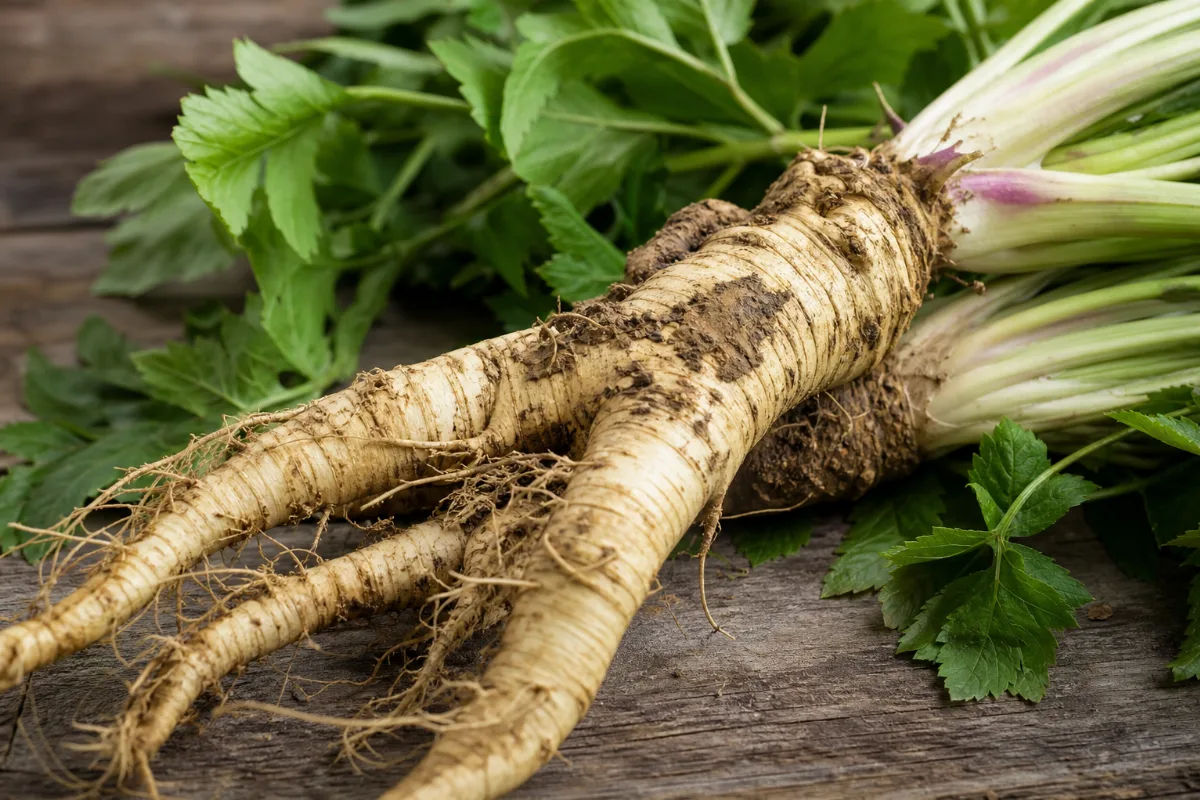
Herbs & Botanicals · Traditional wind-cold root
Fang Feng
Saposhnikovia divaricata · also called Fang feng, fangfeng, Saposhnikovia root, Saposhnikoviae Radix
Fang feng is the dried root of a carrot-family plant, used in Chinese, Korean and Japanese medicine for colds, headache and joint pain. Chinese trials of a three-herb formula that contains it show some benefit for allergy and asthma, but the root alone has not been tested in people. The main caution is possible sun sensitivity and buying the wrong root.
General information, not medical advice. Last substantive update · Not medically reviewed. A named clinician has not signed off on this page. How this page is made
About Fang Feng
Fang feng (Saposhnikovia divaricata) is a root used in East Asian medicine for colds, headache and joint pain. The only human trials test a three-herb formula, so benefits for allergy and asthma cannot be credited to fang feng. Arthritis effects are shown in mice. Take care with sun exposure, other medicines, pregnancy and look-alike roots.
What it is
Saposhnikovia divaricata is a plant of the carrot family (Apiaceae). The dried root is called fang feng in Chinese and Saposhnikoviae Radix in Latin. Its older name is Ledebouriella divaricata.
It is not the same as the formula Yu Ping Feng San, which also contains astragalus and atractylodes. It is also not the counterfeit Libanotis root or other carrot-family roots that look like it.
What the research shows
We found no human trial of fang feng alone. A 2025 review of 39 trials (4,578 people) found better nose-symptom scores and lower IgE when the three-herb formula was added to usual drugs. A 2026 review of 20 trials in adults with asthma found a response rate of 86.8% vs 72.3% with usual treatment alone, and better lung-function scores. Both reviews are of a formula, mostly Chinese trials, with low to moderate quality.
For rheumatoid arthritis the evidence is from mice and cells: extracts and the chromone prim-O-glucosylcimifugin reduced inflammation. The reviews list many other lab effects. None is shown in people.
At a glance
Traditional uses history, not proof
- Common cold with chills and headache (Chinese, Korean and Kampo medicine)
- Rheumatic joint pain, 'wind and dampness' conditions
- Itchy rashes and muscle spasms
- As one herb of the formula Yu Ping Feng San, taken to resist colds
Studied for research
- Allergic rhinitis: formula trials, very-low
- Adult asthma: formula trials added to usual care, low
- Colds and immune support: traditional and formula only, insufficient
- Rheumatoid arthritis: lab and mouse studies only, insufficient
- Pain, fever and other lab effects: insufficient
Main compounds
- Chromones such as prim-O-glucosylcimifugin, cimifugin and 5-O-methylvisamminol (quality markers)
- Coumarins, including furanocoumarins such as imperatorin
- Polyacetylenes
- About 160 compounds reported
Common forms
- Dried sliced root
- Decoction inside formulas
- Yu Ping Feng San granules, capsules or powder (contains astragalus and atractylodes too)
- Laboratory extracts (water or alcohol)
Research links: Review of the botany, uses and chemistry of Saposhnikovia divaricata (2026) · Meta-analysis: Yu Ping Feng San in allergic rhinitis (2025) · Meta-analysis: Yupingfeng powder in adult asthma (2026) · Detecting counterfeit Libanotis root in fang feng (2025) · Research Library · Genes & Biomarkers Library
The plant and its history
- Accepted scientific name
- Saposhnikovia divaricata (Turcz. ex Ledeb.) Schischk.
- Naming authority
- Schischk.; ACCEPTED species in the GBIF backbone (key 3638241, exact match, confidence 99), family Apiaceae.
- Synonyms
- Ledebouriella divaricata (Turcz. ex Ledeb.) M.Hiroe; Siler divaricatum (Turcz. ex Ledeb.) Benth. & Hook.fil. ex Franch. & Sav.; Stenocoelium divaricatum Turcz. ex Ledeb.; Trinia dahurica Turcz. ex Besser; Ledebouriella seseloides (Hoffm.) H.Wolff
- Common names
- Fang feng (Chinese (pinyin)); Saposhnikovia root (English); Saposhnikoviae Radix (Latin (drug name)); Bofu (Japanese (Kampo; not verified))
- Botanical family
- Apiaceae (carrot or parsley family)
- Classification
- Plantae > Tracheophyta > Magnoliopsida > Apiales > Apiaceae > Saposhnikovia > Saposhnikovia divaricata
- Native range
- Not verified in the sources read. Reviews place its medicinal use in China, Korea and Japan.
- Habitat
- Not verified in the sources read.
- What the plant looks like
- Roots: The dried root is the medicinal part; over-flowered (bolted) roots become woody and are not usable (summary-only).; Stems: Not verified.; Leaves: Not verified.; Flowers: Not verified.; Fruit: Not verified.
- Cultivation
- Cultivated and wild roots exist; a 2026 J Nat Med paper compares them (title only, not read). Details not verified.
- Harvest and processing
- Sliced dried root; usually decocted inside formulas (summary-only).
- Look-alikes and adulterants
- Name: Libanotis root (Libanotidis Radix); Note: A counterfeit of fang feng that can be detected by mass spectrometry; thought more toxic per one paper's introduction (summary-only).; Name: Other carrot-family roots (Peucedanum, Angelica, Ligusticum, Notopterygium); Note: Look-alike roots exist in Chinese pharmacy. This site covers Angelica, Chuanxiong and Notopterygium on their own pages. Peucedanum and Angelica substitution for fang feng was not documented in the sources read.; Name: Yu Ping Feng San (formula); Note: A three-herb formula that contains fang feng with astragalus and atractylodes. It is not the herb.
- Sustainability and conservation
- Not assessed in the sources read.
Traditional use and history history, not clinical proof
| Tradition or era | Documented use | Source |
|---|---|---|
| Traditional Chinese medicine | Recorded as a top-grade herb in the Shen Nong Ben Cao Jing; used to dispel wind, relieve surface symptoms, remove dampness, ease pain and calm spasms. Used for common cold, headache, rheumatoid arthralgia, itchy rubella-type rash and tetanus. | p42586391 |
| Chinese medicine, early use | Root used since the Western Han Dynasty (202 B.C.). | p37733271 |
| Korean medicine and Japanese Kampo | Widely used in East Asian traditional systems per the 2026 review. | p42586391 |
| Yu Ping Feng San | Three-herb formula (astragalus, atractylodes, fang feng) for resistance to colds; studied in modern trials for allergy and asthma. Formula age not verified here. | p42182585 |
| Regulatory | No EMA/HMPC monograph or NCCIH page found. | s-ema |
Traditional use shows how a plant was used. It does not show that a supplement works or is safe today.
What is inside, and how it may work
What the plant contains and how those compounds act in cells and animals. Laboratory and animal mechanisms are not proven effects in people.
Main compounds
| Compound | Family | Where it is concentrated | Activity studied | Level of evidence |
|---|---|---|---|---|
| Prim-O-glucosylcimifugin PubChem 14034912 | chromone glycoside | Root | A quality-marker chromone. In mice it reduced arthritis signs by acting on GBP5 and the NLRP3 inflammasome. Acts as a prodrug converted to an aglycone. 15 18 | Animal research |
| Cimifugin PubChem 441960 | chromone | Root | Raised passage of two herbal compounds across a cell layer and lowered P-glycoprotein in cells. Rat pharmacokinetics: whole extract gave a different plasma pattern from the pure compound. 12 11 | Laboratory research |
| 5-O-Methylvisamminol PubChem 441970 | chromone | Root | A chromone used as a marker of the root; the abstracts read here do not discuss it individually. 18 | Laboratory research |
| Imperatorin PubChem 10212 | furanocoumarin | Root (per summary-only read of Jing 2025) | Furanocoumarin found in several plants. Strongly inhibited CYP2A6.1 and CYP2A13 in recombinant human enzymes. Furanocoumarins plus UV light are the cause of phytophotodermatitis in the carrot family. 10 5 6 | Laboratory research |
| Coumarins (13 reported in one extract) | coumarin | Root | Thirteen coumarins and twelve chromones were identified in one alcohol extract; reviews say 160 compounds are known. 6 18 | Laboratory research |
Mechanisms, receptors and pathways
| Target or pathway | Gene or receptor | What was found | Level |
|---|---|---|---|
| TNF-alpha / RAGE signalling and macrophage polarisation | TNF, AGER | Aqueous root extract eased arthritis in IL-1RA-deficient mice, slowed joint-lining cell growth and shifted macrophages from M1 to M2. 16 | Animal research |
| GBP5 / NLRP3 inflammasome pyroptosis | GBP5, NLRP3 | Prim-O-glucosylcimifugin lowered IL-1beta and IL-18 and synovial pyroptosis in mice by acting on GBP5. 15 | Animal research |
| NF-kB, MAPK and PI3K/AKT | NFKB1, MAPK, AKT1 | Reviews say chromones act on these pathways in lab studies. 18 4 | Laboratory research |
| P-glycoprotein and MRP1 transporters | ABCB1, ABCC1 | Cimifugin and prim-O-glucosylcimifugin lowered both proteins in cultured cells. 12 | Laboratory research |
Absorption, metabolism and elimination
- Absorption
- In rats, whole root extract and pure cimifugin gave different plasma patterns (two peaks for the extract, one for the pure compound). Human data: not found.
- Distribution
- Not studied in the sources read.
- Metabolism
- Root glycosides behave as prodrugs converted to active aglycones (reviews, mouse data). Imperatorin inhibits CYP2A enzymes in the test tube.
- Elimination
- Not studied in the sources read.
- Bioavailability
- Not known in people.
Isolated compounds versus whole extracts
Trials test a three-herb formula; lab work uses water or alcohol extracts, or isolated compounds such as prim-O-glucosylcimifugin and imperatorin. These are not interchangeable. A rat study found the whole extract behaved differently from the pure compound.
Nutritional composition
Fang feng is a medicinal root, not a food, and has no nutritional role.
1 low certainty1 very low certainty4 not enough evidence
What is Fang Feng good for?
The studied uses and how strong the evidence is. 'Very-low' means studies are few, small or poorly designed. Formula results are labelled as combinations. 'Insufficient' means traditional or lab evidence only.
Benefits, one by one
Each card is a research question, not a promise. Tap a goal to filter. Open a card to see the studies, doses and limits.
Allergic rhinitis (hay fever), as part of the Yu Ping Feng San formula
Very low certaintyTrials in China tested a three-herb formula that contains fang feng, added to usual drugs. A review of 39 trials found better nose-symptom scores, lower IgE and fewer relapses. The root alone was not tested, so the result cannot be credited to fang feng.
2 studiesFormula granules, capsules or powder in the trials. Results do not ca…
Studies, doses and limits
What the trials found
One systematic review of 39 randomized trials (4,578 people), nearly all in China, comparing the formula (with or without usual drugs) against usual drugs. No trial tested fang feng alone.
Results
Formula plus usual drugs improved the Total Nasal Symptom Score, lowered IgE, IL-4 and IL-6, raised overall effectiveness and lowered relapse versus usual drugs alone. The formula alone also improved symptom scores, but immune-balance data were limited.
Effect sizes as reported
Numbers are not in the abstract.
Why this rating
The reviewers' own GRADE rating, as we read it earlier from the full text, was low to very low (summary-only). Trials were small, mostly unblinded and from one country, and the formula is not the root.
Form and dose studied
Formula granules, capsules or powder in the trials. Results do not carry over to fang feng alone.
Who was studied
People with allergic rhinitis in China.
Limits
Formula, not herb; many trials gave no side-effect data; no trial checked liver or kidney tests (summary-only).
Why researchers looked
The formula (astragalus, atractylodes and fang feng) is a classic Chinese remedy for people who catch colds easily and have allergic symptoms.
Traditional use
Fang feng is the herb in the formula traditionally used to 'dispel wind' from the surface of the body.
Proposed mechanism Animal research
Lab and mouse studies of the formula, and of fang feng chromones, report effects on inflammatory signals such as NF-kB. Whether this explains any benefit in people is not known.
A proposed mechanism does not show that the effect happens in people.
See the Safety tab, including sun sensitivity and look-alike roots.
Adult asthma, as part of the Yupingfeng powder formula
Low certaintyA 2026 review of 20 trials found that adding the same three-herb formula to usual asthma treatment gave a higher response rate and better lung-function scores. The root alone was not tested, and none of the trials used a placebo.
2 studiesYupingfeng powder or granules given with standard asthma drugs. Not s…
Studies, doses and limits
What the trials found
One systematic review of 20 randomized trials (1,896 adults) comparing the formula plus usual treatment against usual treatment alone.
Results
Response rate was 86.8% with the formula plus usual treatment versus 72.3% with usual treatment alone. Lung-function measures (FEV1, FVC, FEV1/FVC, PEF) and Asthma Control Test scores were better. The CD4+/CD8+ blood-cell ratio did not differ.
Effect sizes as reported
Risk ratio 1.20 (95% CI 1.16 to 1.25) for response; standardised differences from 1.09 to 1.80 for lung function and control scores.
Why this rating
The authors call method quality moderate, but trials were small, from China, mostly without placebo, and gave little safety data. We rate it low for the formula and insufficient for fang feng alone.
Form and dose studied
Yupingfeng powder or granules given with standard asthma drugs. Not studied as a single herb.
Who was studied
Adults with bronchial asthma in China.
Limits
Formula, not herb; add-on to usual care, so it does not show the formula can replace asthma drugs; only 2 of 20 trials reported side effects.
Why researchers looked
The formula is traditionally used to strengthen resistance and reduce frequent attacks in people with weak defences.
Traditional use
Traditional Chinese practice uses the formula for recurrent respiratory problems.
Proposed mechanism Animal research
Reviews of the formula describe effects on immune pathways in lab work (for example PI3K-Akt and NF-kB). These are not proven in people.
A proposed mechanism does not show that the effect happens in people.
Never swap asthma medicine for an herb. See the Safety tab.
Resistance to colds and general immune support (traditional, formula only)
Not enough evidenceFang feng is one of three herbs in a formula traditionally used to help people who catch colds often. Trials measured blood markers, but changes in markers do not show fewer infections, and no trial tested the root alone.
3 studiesNot studied for the root alone.
Studies, doses and limits
What the trials found
No trial of fang feng alone for colds or infection was found. The formula reviews measure symptom scores and immune markers in allergy and asthma, not infection rates.
Results
No infection-prevention results for the root. The rhinitis and asthma reviews report lower relapse and better scores for the formula, with a CD4+/CD8+ ratio that did not differ in the asthma review.
Effect sizes as reported
None for infection.
Why this rating
Traditional use and lab data only for the root; formula reviews do not measure infection.
Form and dose studied
Not studied for the root alone.
Who was studied
None tested.
Limits
Long use is not proof of benefit; marker changes are not clinical benefit.
Why researchers looked
The root is used in Chinese, Korean and Japanese (Kampo) medicine for common cold and 'wind' conditions.
Traditional use
Listed as a top-grade herb in the ancient Shen Nong Ben Cao Jing for relieving surface symptoms of the common cold and headache.
Proposed mechanism Laboratory research
Lab studies report immune-modulating activity of fang feng extracts and chromones. These are cell and animal findings.
A proposed mechanism does not show that the effect happens in people.
See the Safety tab.
Rheumatoid arthritis and joint inflammation (lab and mouse studies only)
Not enough evidenceFang feng is a traditional remedy for joint pain, and many Chinese formulas for rheumatoid arthritis contain it. We found no human trial of the root alone. Cell and mouse studies show anti-inflammatory effects of the extract and of its main chromone, prim-O-glucosylcimifugin.
5 studiesNot studied in people.
Studies, doses and limits
What the trials found
None for the root alone. No randomized trial of fang feng for rheumatoid arthritis was found.
Results
Water and alcohol extracts, and the isolated chromone prim-O-glucosylcimifugin, eased arthritis signs in mouse models. A cell and gene study of astragalus plus fang feng extracts in human joint-lining cells also lowered MMP2 and MMP9 genes linked to osteoarthritis.
Effect sizes as reported
None in people.
Why this rating
Lab and animal findings only; no human data for the herb.
Form and dose studied
Not studied in people.
Who was studied
None tested.
Limits
Mouse arthritis models often fail to predict human results. Isolated compounds are not the whole root.
Why researchers looked
Traditionally used to 'dispel wind and dampness' and relieve rheumatic pain.
Traditional use
Used in Chinese medicine for rheumatoid arthralgia (joint pain).
Proposed mechanism Animal research
In mice and cells, extracts and chromones reduced TNF-alpha/RAGE signalling, shifted macrophages from M1 to M2, and lowered IL-1beta and IL-18 through the NLRP3 inflammasome. Root glycosides are converted to more active aglycones.
A proposed mechanism does not show that the effect happens in people.
Do not replace arthritis medicines with an herb. See the Safety tab.
Other lab findings: pain, fever, antioxidant, tumour, bone, nerve and anticoagulant activity (lab only)
Not enough evidenceReviews list many lab effects of fang feng extracts and compounds, including anti-inflammatory, antioxidant, antitumour, bone and nerve protective and anticoagulant activity. These come from cells and animals; none are shown in people.
2 studiesNot studied in people.
Studies, doses and limits
What the trials found
No human data in the reviews we read.
Results
A 2023 review lists antipyretic, analgesic, anti-inflammatory, antioxidant, antitumour and anticoagulant activities; a 2026 review lists neuroprotective, osteoprotective, immunomodulatory and antimicrobial effects.
Effect sizes as reported
None.
Why this rating
Reviews of lab work only.
Form and dose studied
Not studied in people.
Who was studied
None tested.
Limits
Lab activity does not mean a benefit when swallowed; the root's compounds are poorly characterised in people.
Why researchers looked
Chromones and coumarins in the root show many activities in the test tube.
Traditional use
Traditional uses include relieving pain and calming spasms.
Proposed mechanism Laboratory research
Chromones act on NF-kB, MAPK and PI3K/AKT pathways in lab studies.
A proposed mechanism does not show that the effect happens in people.
The anticoagulant lab report is relevant to bleeding precautions (Safety tab).
Common cold, headache and itchy rashes (traditional use only)
Not enough evidenceIn Chinese, Korean and Japanese medicine the root is used for colds with chills, headache, joint pain, itchy rashes and spasms. This is tradition. We found no trial of the root for these uses.
3 studiesTraditionally decocted, mostly inside formulas.
Studies, doses and limits
What the trials found
No human trial of the root for these uses was found.
Results
No trial results.
Effect sizes as reported
None.
Why this rating
Traditional use only.
Form and dose studied
Traditionally decocted, mostly inside formulas.
Who was studied
None tested.
Limits
Long use is not proof of benefit.
Why researchers looked
Recorded as a top-grade herb in an ancient Chinese text.
Traditional use
Used since the Western Han Dynasty (202 B.C.), according to a 2023 review.
Proposed mechanism Pharmacological theory
Not worked out. Lab anti-inflammatory effects are suggested as a possible basis.
A proposed mechanism does not show that the effect happens in people.
See the Safety tab.
Connections to the rest of health
How Fang Feng connects to the rest of our health knowledge graph. Every link says what kind of connection it is. A safety link (for example to the liver) is a warning, not a benefit. A study that merely mentions a topic never creates a benefit link.
Explore every connection: goals, body systems, organs, symptoms, genes
A. Wellness goals
| Connected to | Kind of connection | Evidence status | Context | Studies |
|---|---|---|---|---|
| Seasonal Wellness | Potential benefit | Very low certainty | Allergic rhinitis (hay fever), as part of the Yu Ping Feng San formula: Trials in China tested a three-herb formula that contains fang feng, added to usual drugs. A review of 39 trials found better nose-symptom scores, lower IgE and fewer relapses. The root alone was not tested, so the result cannot be credited to fang feng. | 13 4 |
| Immune Support | Potential benefit | Very low certainty | Allergic rhinitis (hay fever), as part of the Yu Ping Feng San formula: Trials in China tested a three-herb formula that contains fang feng, added to usual drugs. A review of 39 trials found better nose-symptom scores, lower IgE and fewer relapses. The root alone was not tested, so the result cannot be credited to fang feng. | 13 4 |
| Lung Support | Potential benefit | Low certainty | Adult asthma, as part of the Yupingfeng powder formula: A 2026 review of 20 trials found that adding the same three-herb formula to usual asthma treatment gave a higher response rate and better lung-function scores. The root alone was not tested, and none of the trials used a placebo. | 17 4 |
| Breathing Support | Potential benefit | Low certainty | Adult asthma, as part of the Yupingfeng powder formula: A 2026 review of 20 trials found that adding the same three-herb formula to usual asthma treatment gave a higher response rate and better lung-function scores. The root alone was not tested, and none of the trials used a placebo. | 17 4 |
| Immune Support | Traditional use | Not enough evidence | Resistance to colds and general immune support (traditional, formula only): Fang feng is one of three herbs in a formula traditionally used to help people who catch colds often. Trials measured blood markers, but changes in markers do not show fewer infections, and no trial tested the root alone. | 18 4 17 |
| Seasonal Wellness | Traditional use | Not enough evidence | Resistance to colds and general immune support (traditional, formula only): Fang feng is one of three herbs in a formula traditionally used to help people who catch colds often. Trials measured blood markers, but changes in markers do not show fewer infections, and no trial tested the root alone. Common cold, headache and itchy rashes (traditional use only): In Chinese, Korean and Japanese medicine the root is used for colds with chills, headache, joint pain, itchy rashes and spasms. This is tradition. We found no trial of the root for these uses. | 18 4 17 3 7 |
| Joint Support | Traditional use | Not enough evidence | Rheumatoid arthritis and joint inflammation (lab and mouse studies only): Fang feng is a traditional remedy for joint pain, and many Chinese formulas for rheumatoid arthritis contain it. We found no human trial of the root alone. Cell and mouse studies show anti-inflammatory effects of the extract and of its main chromone, prim-O-glucosylcimifugin. | 6 16 15 19 18 |
| Mobility Support | Traditional use | Not enough evidence | Rheumatoid arthritis and joint inflammation (lab and mouse studies only): Fang feng is a traditional remedy for joint pain, and many Chinese formulas for rheumatoid arthritis contain it. We found no human trial of the root alone. Cell and mouse studies show anti-inflammatory effects of the extract and of its main chromone, prim-O-glucosylcimifugin. | 6 16 15 19 18 |
| Inflammation Balance | Not enough evidence | Other lab findings: pain, fever, antioxidant, tumour, bone, nerve and anticoagulant activity (lab only): Reviews list many lab effects of fang feng extracts and compounds, including anti-inflammatory, antioxidant, antitumour, bone and nerve protective and anticoagulant activity. These come from cells and animals; none are shown in people. | 18 3 | |
| Cellular Protection | Not enough evidence | Other lab findings: pain, fever, antioxidant, tumour, bone, nerve and anticoagulant activity (lab only): Reviews list many lab effects of fang feng extracts and compounds, including anti-inflammatory, antioxidant, antitumour, bone and nerve protective and anticoagulant activity. These come from cells and animals; none are shown in people. | 18 3 |
B. Body systems
| Connected to | Kind of connection | Evidence status | Context | Studies |
|---|---|---|---|---|
| Skin | Adverse effect or risk | Very low certainty | Possible sun sensitivity from plant-family chemistry; not shown for fang feng in people. Preparation or compound: Furanocoumarins (e.g. imperatorin) |
5 6 |
| Immune Support | Biological association | Very low certainty | Studied for: Allergic rhinitis (hay fever), as part of the Yu Ping Feng San formula Studied for: Adult asthma, as part of the Yupingfeng powder formula | 13 4 17 18 3 7 |
| Respiratory Health | Biological association | Very low certainty | Studied for: Allergic rhinitis (hay fever), as part of the Yu Ping Feng San formula Studied for: Adult asthma, as part of the Yupingfeng powder formula | 13 4 17 |
| Bones Joints Muscles | Biological association | Not enough evidence | Studied for: Rheumatoid arthritis and joint inflammation (lab and mouse studies only) | 6 16 15 19 18 |
| Pain Inflammation | Biological association | Not enough evidence | Studied for: Rheumatoid arthritis and joint inflammation (lab and mouse studies only) Studied for: Other lab findings: pain, fever, antioxidant, tumour, bone, nerve and anticoagulant activity (lab only) | 6 16 15 19 18 3 |
I. Biomarkers
| Connected to | Kind of connection | Evidence status | Context | Studies |
|---|---|---|---|---|
| Total Nasal Symptom Score (TNSS) | Biological association | Very low certainty | Measured in trials: lowered. A lab change is not the same as a health benefit. | 13 |
| Serum IgE, IL-4 and IL-6 | Biological association | Very low certainty | Measured in trials: lowered. A lab change is not the same as a health benefit. | 13 |
| Overall response rate in asthma | Biological association | Low certainty | Measured in trials: raised. A lab change is not the same as a health benefit. | 17 |
| Lung function (FEV1, FVC, PEF) and Asthma Control Test | Biological association | Low certainty | Measured in trials: raised. A lab change is not the same as a health benefit. | 17 |
| CD4+/CD8+ T-cell ratio | Biological association | Low certainty | Measured in trials: no-change. A lab change is not the same as a health benefit. | 17 |
| IL-1beta and IL-18 in arthritic mouse joints | Biological association | Not enough evidence | Measured in trials: lowered. A lab change is not the same as a health benefit. | 15 |
| MMP2 and MMP9 in human joint-lining cells | Biological association | Not enough evidence | Measured in trials: lowered. A lab change is not the same as a health benefit. | 19 |
J. Genes, receptors and enzymes
| Connected to | Kind of connection | Evidence status | Context | Studies |
|---|---|---|---|---|
| CYP2A6 / CYP2A13 | Drug or supplement interaction | Very low certainty | Strong enzyme inhibition in recombinant human enzymes. Preparation or compound: Imperatorin (isolated) |
10 |
| ABCB1 (P-glycoprotein) | Drug or supplement interaction | Very low certainty | Lowered P-glycoprotein in cultured cells. Preparation or compound: Cimifugin, prim-O-glucosylcimifugin |
12 |
| CYP2A6 / CYP2A13 | Preliminary mechanism | In vitro | Inhibited by imperatorin in recombinant human enzymes. | 10 |
| ABCB1 (P-glycoprotein) | Preliminary mechanism | In vitro | Lowered by fang feng chromones in cultured cells. | 12 |
K. Biological pathways
L. Active compounds
| Connected to | Kind of connection | Evidence status | Context | Studies |
|---|---|---|---|---|
| Prim-O-glucosylcimifugin | Biological association | Animal | A quality-marker chromone. In mice it reduced arthritis signs by acting on GBP5 and the NLRP3 inflammasome. Acts as a prodrug converted to an aglycone. Preparation or compound: Root |
15 18 |
| Cimifugin | Biological association | In vitro | Raised passage of two herbal compounds across a cell layer and lowered P-glycoprotein in cells. Rat pharmacokinetics: whole extract gave a different plasma pattern from the pure compound. Preparation or compound: Root |
12 11 |
| 5-O-Methylvisamminol | Biological association | In vitro | A chromone used as a marker of the root; the abstracts read here do not discuss it individually. Preparation or compound: Root |
18 |
| Imperatorin | Biological association | In vitro | Furanocoumarin found in several plants. Strongly inhibited CYP2A6.1 and CYP2A13 in recombinant human enzymes. Furanocoumarins plus UV light are the cause of phytophotodermatitis in the carrot family. Preparation or compound: Root (per summary-only read of Jing 2025) |
10 5 6 |
| Coumarins (13 reported in one extract) | Biological association | In vitro | Thirteen coumarins and twelve chromones were identified in one alcohol extract; reviews say 160 compounds are known. Preparation or compound: Root |
6 18 |
Each connection is stored with the ingredient, the connected record, the kind of connection, the evidence status, the supporting studies, the preparation or compound involved, and a review date (last reviewed October 25, 2026).
Evidence at a glance: what changed in 7 lab markers
Tap a number to show only those markers. Counts are markers, not people.
The evidence
The research centre for Fang Feng. Every record here was checked against PubMed or the publisher's page; we never list a study we have not verified.
Evidence by outcome
Bars show how many studies we found for each outcome, not how well it works. People are added up across trials only (reviews are not added, to avoid double counting).
How we rate evidence
High certainty
Several well-run trials or reviews agree; further research is unlikely to change the picture much.
Moderate certainty
Good trials point the same way, but some doubt remains.
Low certainty
Small, short or inconsistent trials. The finding could change with better research.
Very low certainty
Very little or very weak human data. Treat as a possibility only.
Mixed findings
Trials or reviews disagree with each other.
Not enough evidence
Not enough human research to say either way.
Evidence against
Good research found no benefit, or found harm.
We take the reviewers' own risk-of-bias and GRADE statements where they exist, and otherwise judge from study size, design, consistency, directness and whether a product matches what is sold. Many publications do not make evidence high. Method note: We started from our internal summary of fang feng, then read the PubMed abstracts of the reviews, formula meta-analyses and lab studies cited here, checked plant names in GBIF and NCBI, and compounds in PubChem. We looked for NCCIH, EMA, LiverTox and LactMed entries and found none (EMA and LiverTox searches were not exhaustive). Only abstracts were read for most papers; some details come from our earlier read and are marked summary-only. Certainty ratings are the compiler's own reading unless the reviewers' own GRADE is quoted. No study is cited that we could not verify.
Study library: every study we checked 19
| Study | Design | People | Product, dose, length | Result |
|---|---|---|---|---|
| EMA 2026 EMA/HMPC: no herbal monograph found for Saposhnikoviae radix ema.europa.eu · Source |
Regulator/agency check record |
Not applicable | Not applicable Not applicable Not applicable Not applicable · vs Not applicable |
A guessed monograph address (/medicines/herbal/saposhnikoviae-radix) returned 404 and the EMA search page returned 401 (blocked) on 2026-10-25. No monograph was found. A guessed monograph address (/medicines/herbal/saposhnikoviae-radix) returned 404 and the EMA search page returned 401 (blocked) on 2026-10-25. No monograph was found. (Not applicable) Methods, limits and fundingOutcomes: Record check Limitations: The EMA database was not searched successfully. Treat as not found, not as proven absent. Funding and conflicts: Not applicable Read: record page / API read |
| GBIF Secretariat 2026 GBIF Backbone Taxonomy: Saposhnikovia divaricata (Turcz. ex Ledeb.) Schischk. (usage key 3638241) api.gbif.org · Source |
Taxonomy database record record |
Not applicable | Not applicable Not applicable Not applicable Not applicable · vs Not applicable |
Read by API on 2026-10-25: exact match, status ACCEPTED, rank species, family Apiaceae, order Apiales, class Magnoliopsida, confidence 99. Synonyms include Ledebouriella divaricata (Turcz. ex Ledeb.) M.Hiroe, Siler divaricatum, Stenocoelium divaricatum and Trinia dahurica. Read by API on 2026-10-25: exact match, status ACCEPTED, rank species, family Apiaceae, order Apiales, class Magnoliopsida, confidence 99. Synonyms include Ledebouriella divaricata (Turcz. ex Ledeb.) M.Hiroe, Siler divaricatum, Stenocoelium divaricatum and Trinia dahurica. (Not applicable) Methods, limits and fundingOutcomes: Record check Limitations: Names only; no botany description. Funding and conflicts: Not applicable Read: record page / API read |
| Gao 2023 Advances in Phytochemistry and Modern Pharmacology of Saposhnikovia Divaricata (Turcz.) Schischk. Chin J Integr Med · PMID 37733271 · DOI |
Narrative review review |
Not applicable | Saposhnikovia divaricata root root Not applicable Not applicable · vs Not applicable |
Chromones and coumarins are the active substances. Lab studies report fever-lowering, pain-relieving, anti-inflammatory, antioxidant, antitumour and anticoagulant activities. The root has been used since the Western Han Dynasty (202 B.C.). Narrative (Not applicable) Methods, limits and fundingOutcomes: Chemistry and pharmacology Limitations: Reviews lab findings; the anticoagulant activity is a lab report with no human data in the abstract. Funding and conflicts: Not stated in the abstract. Read: abstract |
| Gao 2026 Advances in Yupingfeng San Research: Multi-Target Mechanisms and Clinical Evidence. Drug Des Devel Ther · PMID 42182585 · DOI |
Narrative review review |
Not applicable (review of formula research) | Yu Ping Feng San / Yupingfeng powder (astragalus + atractylodes + Saposhnikovia root), a three-herb formula root (one of three herbs) Not applicable Not applicable · vs Not applicable |
The review says the formula contains flavonoids, coumarins and terpenoids, and shows immune-modulating, anti-inflammatory, antiviral, antibacterial and antitumour activity in lab work. Limited trials and meta-analyses suggest that, with usual treatment, it can improve efficacy and is well tolerated, but evidence quality is low and there are no standardised quality-control measures. Narrative; no pooled numbers (Not applicable) Methods, limits and fundingOutcomes: Chemistry, mechanisms and clinical evidence of the formula Limitations: A narrative review of a formula, not of the root alone. Read in part (summary-only for details). Funding and conflicts: Not stated in the abstract. Read: abstract (details summary-only) |
| Grosu Dumitrescu 2024 New Insights Concerning Phytophotodermatitis Induced by Phototoxic Plants. Life (Basel) · PMID 39202761 · DOI |
Narrative review review |
Not applicable | Plants containing furanocoumarins and psoralens various Not applicable Not applicable · vs Not applicable |
Phytophotodermatitis is a non-immune skin reaction when plant chemicals such as furanocoumarins and psoralens meet UV light, causing redness, fluid blisters, swelling and darkening of the skin. The review names the carrot family (Apiaceae), citrus family and fig family as common phototoxic plant families. Background on the reaction (Not applicable) Methods, limits and fundingOutcomes: How plant chemicals plus sunlight (UV) injure skin Limitations: The abstract does not name Saposhnikovia. It is used here only to explain the reaction in the plant family. Funding and conflicts: Not stated in the abstract. Read: abstract |
| Jing 2025 Anti-Inflammatory Pharmacological Mechanism Mediated by the Conversion of Glycosides to Aglycones in Fangfeng (Saposhnikoviae Radix) in Rheumatoid Arthritis Models. Int J Mol Sci · PMID 40806221 · DOI |
Lab and mouse study animal |
Mouse cells (RAW264.7) and a mouse model of rheumatoid arthritis | Alcohol extract of Saposhnikoviae Radix root Not applicable to people Not given in the abstract · vs Untreated model |
The extract contained 12 chromones and 13 coumarins. The extract and its core components had anti-inflammatory activity in cells. In the arthritis mouse model, the root glycosides were converted into aglycones, which the authors link to the anti-inflammatory effect. Anti-inflammatory activity in cells and mice (Not applicable) Methods, limits and fundingOutcomes: Inflammation markers, serum metabolites, network pharmacology Limitations: Lab and animal only. Computer (network and docking) predictions are not human data. Our earlier read of the full text noted imperatorin among the coumarins (summary-only). Funding and conflicts: Not stated in the abstract. Read: abstract (details summary-only) |
| Li 2023 Apiaceae Medicinal Plants in China: A Review of Traditional Uses, Phytochemistry, Bolting and Flowering (BF), and BF Control Methods. Molecules · PMID 37298861 · DOI |
Narrative review review |
Not applicable | Apiaceae (carrot family) medicinal plants including Saposhnikovia various Not applicable Not applicable · vs Not applicable |
About 228 carrot-family plants are recorded as Chinese medicines. The review covers traditional uses, main chemical groups and how early flowering (bolting) changes yield and quality. Our earlier read of the text says over-grown (bolted) fang feng root becomes woody and unusable (summary-only). Background (Not applicable) Methods, limits and fundingOutcomes: Traditional uses, chemistry, quality effects of bolting (early flowering) Limitations: Fang feng is only one of many plants covered. Details beyond the abstract are summary-only. Funding and conflicts: Not stated in the abstract. Read: abstract (details summary-only) |
| NCCIH 2026 NCCIH: no herb page found for Saposhnikovia / fang feng nccih.nih.gov · Source |
Regulator/agency check record |
Not applicable | Not applicable Not applicable Not applicable Not applicable · vs Not applicable |
Page addresses /health/saposhnikovia and /health/fang-feng returned 404 on 2026-10-25. No NCCIH page was found. Page addresses /health/saposhnikovia and /health/fang-feng returned 404 on 2026-10-25. No NCCIH page was found. (Not applicable) Methods, limits and fundingOutcomes: Record check Limitations: A missing page is not proof that NCCIH has said nothing. Funding and conflicts: Not applicable Read: record page / API read |
| NIH 2026 NIH LiverTox / LactMed: no Saposhnikovia entry found ncbi.nlm.nih.gov/books · Source |
Regulator/agency check record |
Not applicable | Not applicable Not applicable Not applicable Not applicable · vs Not applicable |
A Bookshelf search for saposhnikovia with LiverTox or LactMed returned two "Drug Levels and Effects" pages (NBK501793, NBK501880) that we could not open (reCAPTCHA block) and so could not identify. A search for "fang feng" returned nothing. No dedicated entry for the herb was found. A Bookshelf search for saposhnikovia with LiverTox or LactMed returned two "Drug Levels and Effects" pages (NBK501793, NBK501880) that we could not open (reCAPTCHA block) and so could not identify. A search for "fang feng" returned nothing. No dedicated entry for the herb was found. (Not applicable) Methods, limits and fundingOutcomes: Record check Limitations: Not a full check. The two unread pages might be LactMed entries for a product that mentions the herb. Funding and conflicts: Not applicable Read: record page / API read |
| Ueng 2025 Time-dependent inactivation of human cytochrome P450 2A6 variants and 2A13 by imperatorin: natural coumarins and imperatorin oxidation. Biochem Pharmacol · PMID 40659132 · DOI |
Test tube enzyme study in-vitro |
Recombinant human enzymes (CYP2A6 variants, CYP2A13) | Imperatorin and 12 other natural coumarins (isolated compounds) not applicable Not applicable to people Not applicable · vs Other coumarins |
Imperatorin, a furanocoumarin with a prenyloxy group, strongly and time-dependently inhibited CYP2A6.1 and CYP2A13 in the test tube; the CYP2A6.10 variant was less affected. The authors say structure and genotype should be considered in benefit and toxicity evaluations. Strong enzyme inhibition in vitro (Not given in the abstract) Methods, limits and fundingOutcomes: Inhibition of drug-metabolising enzymes Limitations: Test-tube study of an isolated compound found in several plants, not of fang feng. Whether imperatorin from fang feng reaches levels that matter in people is not known. Imperatorin being present in fang feng is from our earlier read of Jing 2025 (summary-only). Funding and conflicts: Not stated in the abstract. Read: abstract |
| Wang 2008 Pharmacokinetics of cimifugin in rat plasma after oral administration of the extract of Saposhnikovia divaricatae root. Arzneimittelforschung · PMID 18972874 · DOI |
Rat pharmacokinetic study animal |
Rats | Saposhnikovia divaricatae root extract vs pure cimifugin root Matched on cimifugin content Single oral dose · vs Pure cimifugin |
When the extract and pure cimifugin were given at matched cimifugin amounts, the extract produced two plasma peaks and the pure compound one. The authors read this as showing a difference between the whole extract and the isolated compound. Different blood-level pattern for extract vs isolated compound (Not applicable) Methods, limits and fundingOutcomes: Plasma levels of cimifugin Limitations: Rats only, 2008, one compound. Funding and conflicts: Not stated in the abstract. Read: abstract |
| Wang 2024 Evaluation of drug interactions of Saposhnikoviae Radix and its major components with astragaloside IV and paeoniflorin using in vitro and in vivo experiments. J Chromatogr A · PMID 38640881 · DOI |
Rat pharmacokinetics plus cell transport study animal |
Rats and dog-kidney (MDCK-MDR1) cells | Saposhnikoviae Radix and its chromones cimifugin and prim-O-glucosylcimifugin, with astragaloside IV and paeoniflorin root 28 uM and 120 uM of the isolated chromones in cells Not given · vs Without the chromones |
In cells, cimifugin and prim-O-glucosylcimifugin raised the passage (Papp) of astragaloside IV by 71.5% and 50.3% and of paeoniflorin by 87.6% and 61.0%. They lowered P-glycoprotein and MRP1 proteins and weakened cell tight-junction proteins. In rats, adding the root changed the timing of the two compounds. Higher passage of two herbal compounds across a cell layer (Not given in the abstract) Methods, limits and fundingOutcomes: Absorption of two other herbal compounds; P-glycoprotein and tight-junction proteins Limitations: Lab and rat work only; whether this happens in people, or with prescription drugs, is unknown. P-glycoprotein is a pump that affects how some drugs are absorbed, so this is a theoretical signal. Funding and conflicts: Not stated in the abstract. Read: abstract |
| Wang 2025 The efficacy and safety of Yupingfengsan in the treatment of allergic rhinitis: a systematic review and meta-analysis. Front Pharmacol · PMID 41031154 · DOI |
Systematic review and meta analysis of randomized trials |
4578 People with allergic rhinitis (39 trials, 4,578 participants, mostly in China) |
Yu Ping Feng San / Yupingfeng powder (astragalus + atractylodes + Saposhnikovia root), a three-herb formula root (one of three herbs) Not given in the abstract Varies by trial · vs Usual (conventional) drug treatment |
The formula added to usual drugs improved nasal symptom scores, lowered IgE, IL-4 and IL-6, raised overall effectiveness and lowered relapse versus usual drugs alone. The formula alone also improved symptom scores and lowered IgE, IL-4 and IL-6 versus usual treatment, but effects on immune balance and IL-4 were uncertain because data were limited. No specific adverse reactions to the formula were reported in trials that checked, but many trials did not report adverse events. Better symptom scores and lower relapse for the formula plus usual care (numbers not in the abstract) (Not given in the abstract) Methods, limits and fundingOutcomes: Total Nasal Symptom Score, IgE, IL-4, IL-6, immune-cell balance, relapse, adverse events Limitations: This tests the three-herb formula, not Saposhnikovia root alone. Our earlier read of the full text rated the evidence low to very low certainty (GRADEpro) (summary-only). Many trials did not report side effects; no trial checked liver or kidney tests (summary-only). Funding and conflicts: Not stated in the abstract. Registration: PROSPERO CRD420251009897 Read: abstract (full-text details summary-only) |
| Wang 2025 Analysis of Saposhnikoviae Radix and Libonotidis Radix Based on "Characteristic Ion Set" and Chemometrics. J Mass Spectrom · PMID 40794015 · DOI |
Laboratory analytical study lab |
Reference and market root samples | Saposhnikoviae Radix and Libonotidis Radix (the adulterant) root Not applicable Not applicable · vs Not applicable |
A method based on mass-spectrometry "characteristic ions" detected 3% Libanotis root mixed into fang feng. Two market samples tested blind were identified as adulterated. Xanthalin was identified as a marker found in the Libanotis root. Method detects 3% adulteration; 2 market blind samples adulterated (number of samples tested not in the abstract) (Not applicable) Methods, limits and fundingOutcomes: Detection of adulteration of fang feng by Libanotis root Limitations: Small method study. The statement that the counterfeit is thought to be more toxic comes from the paper's introduction and was not tested (summary-only). Funding and conflicts: Not stated in the abstract. Read: abstract (introduction details summary-only) |
| Wang 2026 Prim-O-glucosylcimifugin ameliorates rheumatoid arthritis by targeting GBP5 to suppress pyroptosis and inhibit synovial cell proliferation. Biochem Pharmacol · PMID 42184927 · DOI |
Lab and mouse study animal |
Human-type joint-lining cells and collagen-induced arthritis mice | Prim-O-glucosylcimifugin (isolated chromone from the root) root compound Not applicable to people Not given in the abstract · vs Untreated model |
The isolated chromone reduced joint-lining cell growth and, in mice, paw swelling and arthritis scores. It lowered IL-1beta and IL-18 and the NLRP3 inflammasome, by acting on a protein called GBP5. Less arthritis in mice (Not applicable) Methods, limits and fundingOutcomes: Paw swelling, arthritis score, IL-1beta, IL-18, NLRP3 inflammasome Limitations: Single isolated compound in cells and mice; not the whole root; no human data. Funding and conflicts: Not stated in the abstract. Read: abstract |
| Xu 2025 Aqueous extract of Saposhnikovia divaricata root alleviates rheumatoid arthritis by acting on TNF-alpha and RAGE signaling pathways. Biochem Biophys Rep · PMID 40688514 · DOI |
Lab and mouse study animal |
IL-1RA-deficient arthritis mice and joint-lining cells | Aqueous (water) extract of Saposhnikovia divaricata root root Not applicable to people Not given in the abstract · vs Untreated model |
The extract eased arthritis in mice, slowed abnormal growth of joint-lining cells and shifted macrophages from the inflammatory M1 type toward the M2 type, through TNF-alpha and RAGE signalling. The authors note over 130 Chinese formulas containing the root are used for rheumatoid arthritis. Improved arthritis in mice (Not applicable) Methods, limits and fundingOutcomes: Arthritis signs, synovial cell growth, macrophage types Limitations: Mouse and cell work only. No human trial. Funding and conflicts: Not stated in the abstract. Read: abstract |
| Zhang 2026 Efficacy of Yupingfeng powder in the treatment of bronchial asthma in adults: a systematic review and meta-analysis. Front Pharmacol · PMID 42147341 · DOI |
Systematic review and meta analysis of randomized trials |
1896 Adults with bronchial asthma (20 trials, 1,896 participants, 950 vs 946) |
Yu Ping Feng San / Yupingfeng powder (astragalus + atractylodes + Saposhnikovia root), a three-herb formula root (one of three herbs) Not given in the abstract Varies by trial · vs Conventional asthma treatment alone |
Response rate was higher with the formula plus usual treatment (86.8% vs 72.3%; risk ratio 1.20). Lung-function measures and Asthma Control Test scores were better. CD4+/CD8+ ratio did not differ. Only two trials reported adverse events (mild stomach upset, dry mouth), with no difference between groups and no serious events. Risk ratio 1.20 for response; standardised differences 1.09 to 1.80 for lung function and control scores (RR 1.20 (95% CI 1.16 to 1.25)) Methods, limits and fundingOutcomes: Overall response rate, lung function (FEV1, FVC, FEV1/FVC, PEF), Asthma Control Test, CD4+/CD8+ ratio, adverse events Limitations: Authors call method quality moderate; trials were small, from China, unblinded or without placebo, and gave little safety data. The formula, not the root alone, was tested. Funding and conflicts: Not stated in the abstract. Registration: PROSPERO CRD420251172600 Read: abstract |
| Zhang 2026 Saposhnikovia divaricata (Turcz.) Schischk.: A review of botany, ethnomedicinal uses, phytochemistry, pharmacology, pharmacokinetics, toxicology, and quality control. J Ethnopharmacol · PMID 42586391 · DOI |
Narrative review review |
Not applicable (review of lab and traditional literature) | Saposhnikovia divaricata root root Not applicable Not applicable · vs Not applicable |
The root is a top-grade herb in the ancient Shen Nong Ben Cao Jing, used in Chinese, Korean and Japanese (Kampo) medicine for common cold, headache, rheumatoid arthralgia, itchy rashes and tetanus. 160 compounds are reported, mainly chromones (e.g. cimifugin, prim-O-glucosylcimifugin), coumarins and polyacetylenes. Lab studies report anti-inflammatory, anti-rheumatic, immune-modulating, antitumour, antioxidant and antimicrobial effects. Glycosides act as prodrugs that gut processing converts to active aglycones. The authors state toxicology evaluations confirm a safety profile. Narrative; no pooled human data (Not applicable) Methods, limits and fundingOutcomes: Botany, traditional use, chemistry, pharmacology, toxicology Limitations: The abstract describes no human trials. The "safety profile" statement was not independently checked and the toxicology details were not read. PubMed lists the issue date as 2027; the paper is dated 2026 by its DOI. Funding and conflicts: Not stated in the abstract. Read: abstract only |
| Zhou 2025 Identification of target genes of Astragalus mongholicus and Saposhnikovia divaricata extracts in human synoviocytes for potential osteoarthritis treatment. Hereditas · PMID 41063226 · DOI |
Gene data analysis plus cell experiment in-vitro |
Human joint-lining cells (synoviocytes) in culture | Astragalus + Saposhnikovia extracts (combination) root Not applicable to people Not given in the abstract · vs Untreated cells |
Treating cells with the two extracts raised some transcription factors (AR, CITED2) and lowered MMP2 and MMP9, two genes tied to osteoarthritis. Gene changes in cultured cells (Not applicable) Methods, limits and fundingOutcomes: Gene expression (MMP2, MMP9 and others) Limitations: Combination of two herbs in cells; not a human trial. Funding and conflicts: Not stated in the abstract. Read: abstract |
What we do not know yet
- What the evidence supports: low-quality Chinese trials of a three-herb formula added to usual care for allergic rhinitis and asthma; nothing for fang feng alone.
- What is uncertain: whether fang feng contributes to the formula results, whether it causes sun sensitivity in people, and whether it interacts with medicines.
- Not verified: EMA/HMPC (search blocked), LiverTox, LactMed, FDA, Commission E, WHO and the Chinese pharmacopoeia; furanocoumarin content of commercial roots; details of the 2026 review beyond its abstract.
How new research is added
New studies are found by a saved PubMed search and are placed in a review queue. A person reads each one before it changes any evidence rating or safety wording.
Lab markers
What changed in blood or saliva tests during trials. A changed number is not the same as feeling or being healthier, and we give no "normal ranges".
Other 7
Total Nasal Symptom Score (TNSS)
Lowered in trials
A score where people rate nasal symptoms such as sneezing, runny nose, itching and blockage. Lower is better.
Very low certaintyResults and what it means
Why it was measured
The standard way to track hay-fever symptoms.
Statistical vs. clinical meaning
A symptom score from small, mostly unblinded trials of a formula.
Safety implication
None for the marker.
| Study | Result | People | Product |
|---|---|---|---|
| 13 | Lower scores with the formula plus usual drugs than usual drugs alone (numbers not in the abstract) | People with allergic rhinitis, 39 trials | Yu Ping Feng San formula (contains Saposhnikovia root) |
Serum IgE, IL-4 and IL-6
Lowered in trials
Blood markers of allergic and inflammatory activity. IgE is the antibody linked to allergy; IL-4 and IL-6 are inflammation signals.
Very low certaintyResults and what it means
Why it was measured
To see whether allergic activity falls.
Statistical vs. clinical meaning
Marker changes do not prove people feel better; IL-4 effect was uncertain for the formula alone.
Safety implication
None for the marker.
| Study | Result | People | Product |
|---|---|---|---|
| 13 | Lower IgE, IL-4 and IL-6 with the formula (alone or added to usual drugs) than with usual treatment | People with allergic rhinitis | Yu Ping Feng San formula |
Overall response rate in asthma
Raised in trials
The share of people judged improved by the trial's own criteria.
Low certaintyResults and what it means
Why it was measured
A summary of clinical improvement.
Statistical vs. clinical meaning
Response criteria differ between trials and most trials were unblinded.
Safety implication
None for the marker.
| Study | Result | People | Product |
|---|---|---|---|
| 17 | 86.8% with formula plus usual treatment vs 72.3% with usual treatment alone (RR 1.20, 95% CI 1.16 to 1.25) | Adults with asthma, 20 trials | Yupingfeng powder added to usual treatment |
Lung function (FEV1, FVC, PEF) and Asthma Control Test
Raised in trials
Breathing tests that measure how much and how fast air leaves the lungs, and a questionnaire of asthma control.
Low certaintyResults and what it means
Why it was measured
Standard objective and symptom measures in asthma.
Statistical vs. clinical meaning
Large standardised differences from small trials with a possibility of bias.
Safety implication
None for the marker.
| Study | Result | People | Product |
|---|---|---|---|
| 17 | Better FEV1, FVC, FEV1/FVC, PEF and ACT scores (standardised differences 1.09 to 1.80) | Adults with asthma, 20 trials | Yupingfeng powder added to usual treatment |
CD4+/CD8+ T-cell ratio
No clear change in trials
A blood-test ratio of two types of immune cells.
Low certaintyResults and what it means
Why it was measured
To see whether the formula changes immune balance.
Statistical vs. clinical meaning
A null result worth knowing: the immune-modulating idea was not shown on this marker.
Safety implication
None.
| Study | Result | People | Product |
|---|---|---|---|
| 17 | No significant difference (SMD 0.50, 95% CI -0.44 to 1.44) | Adults with asthma | Yupingfeng powder added to usual treatment |
IL-1beta and IL-18 in arthritic mouse joints
Lowered in trials
Inflammation signals released by an immune complex called the NLRP3 inflammasome.
Not enough evidenceResults and what it means
Why it was measured
To see whether a compound dampens joint inflammation in a mouse arthritis model.
Statistical vs. clinical meaning
Mouse data for one isolated compound; not shown in people.
Safety implication
None.
| Study | Result | People | Product |
|---|---|---|---|
| 15 | Lower IL-1beta and IL-18 and less NLRP3 activity in collagen-induced arthritis mice given prim-O-glucosylcimifugin | Mice | Isolated chromone from the root |
MMP2 and MMP9 in human joint-lining cells
Lowered in trials
Enzymes involved in breakdown of joint tissue in osteoarthritis.
Not enough evidenceResults and what it means
Why it was measured
A lab marker of joint tissue damage.
Statistical vs. clinical meaning
Cells in a dish; combination of two herbs.
Safety implication
None.
| Study | Result | People | Product |
|---|---|---|---|
| 19 | Lower MMP2 and MMP9 in cultured human synoviocytes treated with astragalus plus fang feng extracts | Cultured human cells | Two combined herb extracts |
Safety
What studies and official sources say about side effects, medicines and who should check first. Each point shows what kind of evidence it comes from.
Main points to know 5
- Sun sensitivity is a plausible risk, but it is not shown for fang feng in people. Fang feng belongs to the carrot family (Apiaceae), a family the 2024 review names among the plant families whose furanocoumarins and psoralens can cause skin reactions with sunlight. Reviews of fang feng list coumarins among its compounds, and our earlier read of one paper identified imperatorin (a furanocoumarin) in an extract. We found no case report or study measuring sun sensitivity from fang feng in people, so this is an inference from chemistry and plant family. Pharmacological theory 5 6 18
- Human safety data for the root alone are almost missing. All human data are from the three-herb formula given with usual care. In the asthma review only 2 of 20 trials reported side effects (mild stomach upset, dry mouth). In the rhinitis review many trials did not report side effects (summary-only). Absence of reports is not proof of safety. Controlled trial 17 13
- Look-alike and counterfeit roots. A 2025 paper describes Libanotis root as a counterfeit of fang feng that can be detected by mass spectrometry; two market samples tested blind were adulterated. The paper's introduction says the counterfeit is thought to be more toxic (summary-only, not tested there). Authoritative guidance 14
- Possible effects on how other medicines are absorbed or broken down (lab only). In test-tube and cell work, fang feng chromones lowered the drug pump P-glycoprotein and raised passage of two other herbal compounds, and imperatorin (a furanocoumarin found in several plants) strongly inhibited CYP2A6 and CYP2A13 enzymes. No human interaction study was found. Laboratory research 12 10
- Pregnancy, breastfeeding and children: no data. No human safety data in pregnancy, breastfeeding or children were found. No regulator advice was found. Authoritative guidance 8 1 9
Side effects 3
| Effect | How often | Severity and recovery | Evidence |
|---|---|---|---|
| Mild stomach upset Reported by 2 of 20 asthma trials of the three-herb formula, with no difference between groups; the formula is not the root alone. | Not established | mild Not stated. | Controlled trial 17 |
| Dry mouth Same trials; formula. | Not established | mild Not stated. | Controlled trial 17 |
| Sun-triggered skin reaction (phytophotodermatitis) A recognised reaction to furanocoumarin plants in the carrot family. Not documented for fang feng in the sources read. | Not established | moderate Usually settles, but darkening can last (general reaction). | Pharmacological theory 5 |
Liver
No LiverTox entry for fang feng was found and no case report of liver injury linked to the root was found in the sources read. The formula reviews did not check liver tests (summary-only). A 2026 review states toxicology evaluations confirm a safety profile, but we read only its abstract. 9 18 13
How often. No frequency data. Absence of case reports is not proof of safety.
Monitoring. No agency monitoring advice was found. People with liver disease should ask a doctor or pharmacist before use.
This is a safety connection. It is not evidence that Fang Feng supports liver health.
Medicines and supplements 7
| With | Why it matters | Importance | Evidence | What to do |
|---|---|---|---|---|
| Medicines handled by the CYP2A6 or CYP2A13 enzymes (for example nicotine metabolism) drug | Imperatorin, a furanocoumarin reported in fang feng extract (summary-only), strongly and time-dependently inhibited CYP2A6.1 and CYP2A13 in recombinant human enzymes. | Unknown. Test-tube result for an isolated compound; no human study with fang feng. | Laboratory research Very low certainty 10 6 | Tell your pharmacist or doctor about any fang feng product, especially if you take several medicines. |
| Drugs moved by the P-glycoprotein pump drug | Cimifugin and prim-O-glucosylcimifugin lowered P-glycoprotein and MRP1 and weakened tight junctions in cultured cells, raising passage of two herbal compounds. | Unknown. Theoretical effect on absorption of some drugs. | Laboratory research Very low certainty 12 | Ask a pharmacist before combining with drugs that have narrow safety margins. |
| Blood thinners (warfarin, antiplatelet drugs) and planned surgery drug | A 2023 review lists anticoagulant activity of fang feng in lab studies. No human clotting or bleeding study was found. | Theoretical added bleeding risk. Not shown in people. | Pharmacological theory Very low certainty 3 | If you take a blood thinner or have surgery planned, tell your doctor about the herb. |
| Blood-pressure medicines drug | No source read describes an effect of fang feng on blood pressure. | Not found: no human or animal blood-pressure data in the sources read. | None found Not enough evidence | Nothing specific to avoid is known; keep checking your blood pressure as usual and tell your doctor about herbs. |
| Asthma and allergy medicines (inhalers, steroids, antihistamines) drug | In the formula trials the herbs were added to usual treatment with no clear problem reported, but few trials reported safety. | Do not replace asthma controller medicine with an herb. | Controlled trial Low certainty 17 13 | Keep using prescribed medicines; talk to your doctor before adding a formula. |
| Sun exposure and tanning or UV treatments other | Furanocoumarins plus UV light can injure skin in plants of the carrot family. | Possible sun sensitivity; not shown for fang feng. | Pharmacological theory Very low certainty 5 | Cover skin and use sunscreen if you notice a rash after sun exposure while taking it, and report it. |
| Other herbs in a formula (astragalus, atractylodes) herb | Cimifugin and prim-O-glucosylcimifugin changed the passage of astragaloside IV and paeoniflorin in cells; astragalus has its own immune-related cautions. | Formula results cannot be split between herbs. | Laboratory research Very low certainty 12 4 | Read the safety notes of each herb in a formula. |
Who should check first 6
| Situation | Advice | Evidence |
|---|---|---|
| Pregnancy | No human safety data and no regulator advice were found. Avoid unless a clinician who knows the herb advises otherwise. | Authoritative guidance 8 1 |
| Breastfeeding | No data. No LactMed entry was identified (two unread pages are noted). Avoid unless a clinician advises otherwise. | Authoritative guidance 9 |
| Children | No trial of the root in children was found in the sources read. Ask a clinician. | Authoritative guidance |
| History of sun-triggered rashes or taking light-sensitising medicines | Be cautious; furanocoumarin plants can add to sun reactions. | Pharmacological theory 5 |
| Bleeding disorders, blood thinners or surgery within 2 weeks | Tell your doctor. Anticoagulant activity is a lab finding only. | Pharmacological theory 3 |
| Allergy to carrot-family plants (celery, parsley, angelica) | Possible cross-reaction is not documented for fang feng in the sources read; be cautious. | Pharmacological theory 7 |
Overdose, product quality and regulators
Summary. No poisoning case or dose-toxicity study of fang feng was found in the sources read. A 2026 review abstract states that toxicology evaluations confirmed a safety profile; we did not read the details. The main theoretical concern is furanocoumarin sun sensitivity, and the main quality concern is look-alike roots.
Animal. Not read beyond the review abstract.
Human doses studied. Not given here. Trial amounts are not recommendations.
High dose or long term signals. None found; long-term safety is unstudied.
Overdose response. Not covered in the sources read. For severe symptoms call a doctor or poison control.
Genotoxicity. Not assessed in the sources read.
Toxic plant parts. The dried root is the medicinal part. A 2023 review notes that over-flowered (bolted) roots become woody and unusable (summary-only). Leaves and stems are not used medicinally in the sources read.
Identity and quality are the main contamination concerns. We found no heavy-metal or pesticide study of fang feng products.
Counterfeit Libanotis root. Libanotis root (Libanotidis Radix) is a counterfeit of fang feng. Mass spectrometry detected 3% mixed in and found two of the market blind samples adulterated; xanthalin marks the counterfeit. 14
Other carrot-family substitutes (Peucedanum, Angelica, Ligusticum). Fang feng is one of many carrot-family roots that look alike. Our earlier summary says Ligusticum roots are named among counterfeits (summary-only). We found no source documenting Peucedanum or Angelica substitution for fang feng; Angelica and Peucedanum roots can themselves contain furanocoumarins, so mix-ups could change the sun-sensitivity picture (inference, not shown). 7 5
Variable quality. The formula review says herbal sources vary and there are no unified quality standards or stable chemical fingerprints for the formula. 4
Formula is not the herb. Yu Ping Feng San contains astragalus, atractylodes and fang feng. Safety and results of the formula apply to the mix, not to fang feng alone. 4
| Body | Action | Date |
|---|---|---|
| NCCIH (US National Institutes of Health) (United States) | No NCCIH herb page found for Saposhnikovia or fang feng. source |
When to get medical help
- Blistering, burning or painful rash after sun exposure while using any herb: stop it, keep the skin covered and get medical advice.
- Swelling of the face or lips, hives or trouble breathing (allergy): call emergency services.
- Unusual bruising or bleeding, especially if you take a blood thinner: contact a doctor.
- Yellow skin or eyes, dark urine or severe stomach pain: stop and get medical care.
- Asthma getting worse or needing the rescue inhaler more: see a doctor; do not rely on an herb.
Stop the supplement and contact a clinician or emergency service. In the US, Poison Control is 1-800-222-1222.
General information only, not medical advice. Ask a clinician or pharmacist before use, especially with medicines, in pregnancy or with a health condition. See the Natural Remedy Safety guide.
Frequently asked questions
What is fang feng (Saposhnikovia)?
Does fang feng help allergies or hay fever?
No trial tested fang feng alone. A review of 39 Chinese trials found better nose-symptom scores when a three-herb formula that contains it was added to usual drugs. The reviewers' certainty was low to very low, and the result cannot be credited to fang feng.
Does it help asthma?
A 2026 review of 20 trials found a higher response rate (86.8% vs 72.3%) when the formula was added to usual asthma treatment. Quality was moderate, trials were small and the root alone was not tested. It does not replace asthma medicine.
Is fang feng the same as Yu Ping Feng San?
No. Yu Ping Feng San is a formula of astragalus, atractylodes and fang feng. Trial results belong to the mix. Fang feng is just one of its three herbs.
Does fang feng help rheumatoid arthritis or joint pain?
Can fang feng make skin sensitive to the sun?
Does fang feng interact with medicines?
Does it affect blood pressure or bleeding?
We found no data on blood pressure. A 2023 review lists anticoagulant activity in lab studies, so people on blood thinners or having surgery should tell their doctor. This is a theory, not a proven bleeding risk.
Is fang feng safe in pregnancy or while breastfeeding?
Is it safe for the liver?
Can I get the wrong root when I buy fang feng?
Explore by health goal
Seasonal WellnessImmune SupportLung SupportBreathing SupportJoint SupportMobility SupportInflammation BalanceCellular Protection
Editorial transparency
- Written by
- AlternativeMed editorial team. Research compiled with AI assistance, then checked against PubMed records.
- Medical review
- None. This page has not been reviewed by a physician or pharmacist.
- First published
- 2026-10-25
- Last substantive update
- 2026-10-25
- How we research
- We started from our internal summary of fang feng, then read the PubMed abstracts of the reviews, formula meta-analyses and lab studies cited here, checked plant names in GBIF and NCBI, and compounds in PubChem. We looked for NCCIH, EMA, LiverTox and LactMed entries and found none (EMA and LiverTox searches were not exhaustive). Only abstracts were read for most papers; some details come from our earlier read and are marked summary-only. Certainty ratings are the compiler's own reading unless the reviewers' own GRADE is quoted. No study is cited that we could not verify.
- How we rate evidence
- See "How we rate evidence" in the Evidence tab.
- Independence
- No product is promoted on this page. No affiliate links are shown. If one is added later it will be labelled and kept apart from the evidence.
Sources 19
Each source was opened and checked. Where we read only the abstract, it says so. The small numbers in the text point here.
- EMA. EMA/HMPC: no herbal monograph found for Saposhnikoviae radix. ema.europa.eu. 2026. (record page / API read)
- GBIF Secretariat. GBIF Backbone Taxonomy: Saposhnikovia divaricata (Turcz. ex Ledeb.) Schischk. (usage key 3638241). api.gbif.org. 2026. (record page / API read)
- Gao JW, Zhan Y, Wang YH, et al.. Advances in Phytochemistry and Modern Pharmacology of Saposhnikovia Divaricata (Turcz.) Schischk.. Chin J Integr Med. 2023. PMID 37733271. DOI 10.1007/s11655-023-3746-5. (abstract)
- Gao S, Wang Y, Li X, et al.. Advances in Yupingfeng San Research: Multi-Target Mechanisms and Clinical Evidence.. Drug Des Devel Ther. 2026. PMID 42182585. DOI 10.2147/DDDT.S603491. (abstract (details summary-only))
- Grosu Dumitrescu C, Jijie AR, Manea HC, et al.. New Insights Concerning Phytophotodermatitis Induced by Phototoxic Plants.. Life (Basel). 2024. PMID 39202761. DOI 10.3390/life14081019. (abstract)
- Jing W, Lin X, Pi W, et al.. Anti-Inflammatory Pharmacological Mechanism Mediated by the Conversion of Glycosides to Aglycones in Fangfeng (Saposhnikoviae Radix) in Rheumatoid Arthritis Models.. Int J Mol Sci. 2025. PMID 40806221. DOI 10.3390/ijms26157088. (abstract (details summary-only))
- Li M, Li M, Wang L, et al.. Apiaceae Medicinal Plants in China: A Review of Traditional Uses, Phytochemistry, Bolting and Flowering (BF), and BF Control Methods.. Molecules. 2023. PMID 37298861. DOI 10.3390/molecules28114384. (abstract (details summary-only))
- NCCIH. NCCIH: no herb page found for Saposhnikovia / fang feng. nccih.nih.gov. 2026. (record page / API read)
- NIH. NIH LiverTox / LactMed: no Saposhnikovia entry found. ncbi.nlm.nih.gov/books. 2026. (record page / API read)
- Ueng YF, Chih JS, Li WT, et al.. Time-dependent inactivation of human cytochrome P450 2A6 variants and 2A13 by imperatorin: natural coumarins and imperatorin oxidation.. Biochem Pharmacol. 2025. PMID 40659132. DOI 10.1016/j.bcp.2025.117155. (abstract)
- Wang X, Wang Z, Sun H, et al.. Pharmacokinetics of cimifugin in rat plasma after oral administration of the extract of Saposhnikovia divaricatae root.. Arzneimittelforschung. 2008. PMID 18972874. DOI 10.1055/s-0031-1296537. (abstract)
- Wang QY, Liu SY, Yu DH, et al.. Evaluation of drug interactions of Saposhnikoviae Radix and its major components with astragaloside IV and paeoniflorin using in vitro and in vivo experiments.. J Chromatogr A. 2024. PMID 38640881. DOI 10.1016/j.chroma.2024.464716. (abstract)
- Wang Y, Tang Y, Xu J, et al.. The efficacy and safety of Yupingfengsan in the treatment of allergic rhinitis: a systematic review and meta-analysis.. Front Pharmacol. 2025. PMID 41031154. DOI 10.3389/fphar.2025.1628640. (abstract (full-text details summary-only))
- Wang X, He F, Wu H, et al.. Analysis of Saposhnikoviae Radix and Libonotidis Radix Based on "Characteristic Ion Set" and Chemometrics.. J Mass Spectrom. 2025. PMID 40794015. DOI 10.1002/jms.5164. (abstract (introduction details summary-only))
- Wang Y, Guan W, Wang S, et al.. Prim-O-glucosylcimifugin ameliorates rheumatoid arthritis by targeting GBP5 to suppress pyroptosis and inhibit synovial cell proliferation.. Biochem Pharmacol. 2026. PMID 42184927. DOI 10.1016/j.bcp.2026.118100. (abstract)
- Xu A, Wen Y, Hou B, et al.. Aqueous extract of Saposhnikovia divaricata root alleviates rheumatoid arthritis by acting on TNF-alpha and RAGE signaling pathways.. Biochem Biophys Rep. 2025. PMID 40688514. DOI 10.1016/j.bbrep.2025.102153. (abstract)
- Zhang Q, Zhang N, Zheng Y, et al.. Efficacy of Yupingfeng powder in the treatment of bronchial asthma in adults: a systematic review and meta-analysis.. Front Pharmacol. 2026. PMID 42147341. DOI 10.3389/fphar.2026.1757474. (abstract)
- Zhang H, Liu Y, Zhang J, et al.. Saposhnikovia divaricata (Turcz.) Schischk.: A review of botany, ethnomedicinal uses, phytochemistry, pharmacology, pharmacokinetics, toxicology, and quality control.. J Ethnopharmacol. 2026. PMID 42586391. DOI 10.1016/j.jep.2026.122297. (abstract only)
- Zhou J, Gao X, Liu X, et al.. Identification of target genes of Astragalus mongholicus and Saposhnikovia divaricata extracts in human synoviocytes for potential osteoarthritis treatment.. Hereditas. 2025. PMID 41063226. DOI 10.1186/s41065-025-00581-7. (abstract)