
Herbs & Botanicals · Herbs · Aromatic European root used as a digestive bitter, with no trial of the herb on its own
Angelica
Angelica archangelica L. (garden or European angelica); root and rhizome, also fruit and leaf · also called Garden angelica, European angelica, angelica root, angélica (Spanish). Not dong quai (Angelica sinensis) and not Korean angelica (Angelica gigas).
Angelica archangelica is a tall aromatic plant of the carrot family. Its dried root is used in teas, tinctures and bitter digestive blends, and its fruit and oil flavour drinks and foods. This profile covers European garden angelica only. It also contains furanocoumarins, which can make skin react to sunlight.
General information, not medical advice. Last substantive update · Not medically reviewed. A named clinician has not signed off on this page. How this page is made
About Angelica
Garden angelica is an aromatic European root used for digestion for a long time. The research is thin: no trial of the herb on its own, two small papers on a 9-herb product, and lab or animal work for everything else. Safety is the main story. Furanocoumarins in the plant can make skin react to sunlight, the EU committee says pregnant women and children should be contraindicated, and the EU has not issued a monograph and lists the root as a low-priority herb for safety reasons.
What it is
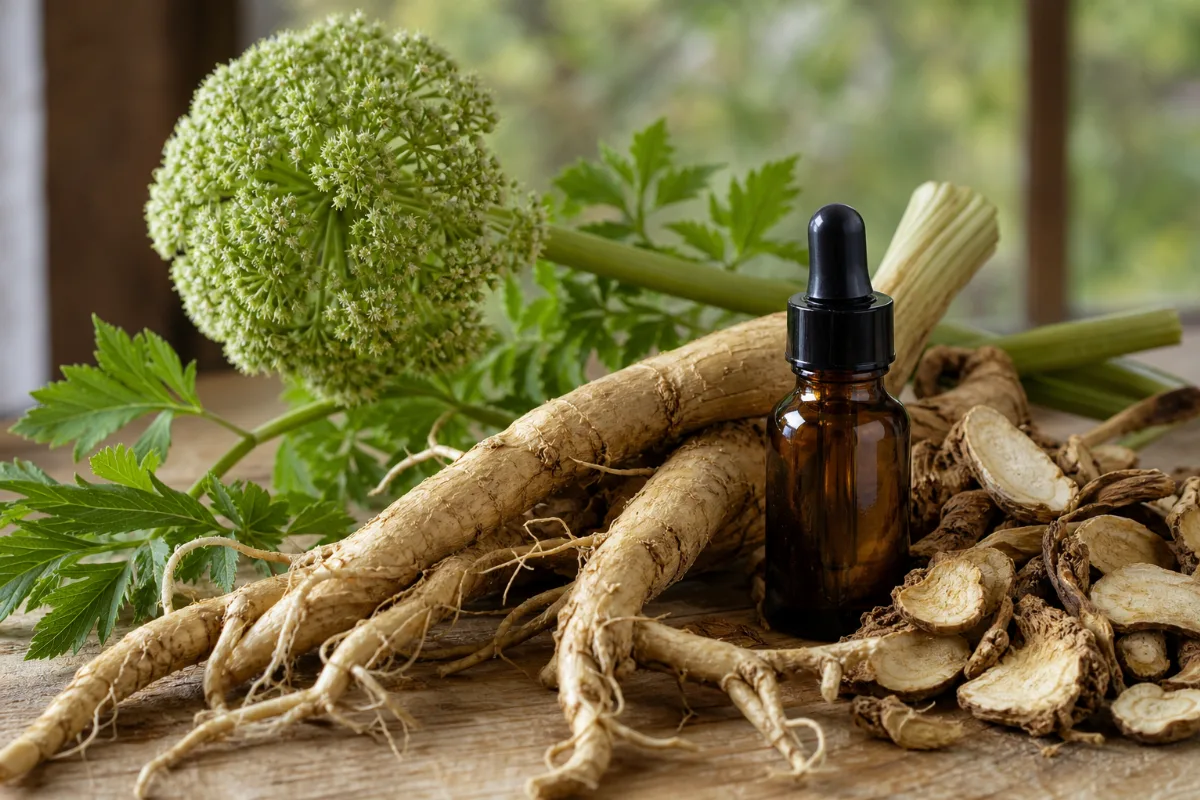
Angelica archangelica L. is the accepted name in GBIF and NCBI. It belongs to the carrot family (Apiaceae). The root and rhizome are the medicinal part; the fruit, leaf and oil are also used.
It is a different plant from dong quai (Angelica sinensis) and Korean angelica (Angelica gigas). Their results and warnings do not carry over.
Traditional and current uses
The ESCOP summary lists dyspeptic complaints (mild stomach cramps, sluggish digestion, wind) and bronchitis, and says there are no clinical data on single-ingredient angelica root products. A 2021 review calls it an aromatic food plant and an "Angel plant" in traditional medicine.
We found no EU herbal monograph for angelica root. The EU committee wrote a furocoumarin risk paper in 2007 and in 2015 listed the root among herbs not to be prioritised because of safety concerns.
What is in it and how it works
The root holds furanocoumarins (imperatorin, bergapten, xanthotoxin, angelicin and others), other coumarins and an essential oil rich in monoterpenes. Furanocoumarins bind DNA when exposed to UVA light, which is why they can burn skin and, over years, raise cancer risk. In cells their effects add up. One of them, xanthotoxin, blocks the liver enzyme CYP2A6 in test tubes.
In rat cells, root coumarins increased insulin release. All of this is lab work; how angelica is absorbed and cleared in people has not been studied.
What the research shows
For digestion, a 60-person trial (Madisch 2001) and a pooled analysis (Melzer 2004: 138 on the product, 135 on placebo) found the 9-herb liquid beat placebo, with side effects like placebo. The pooled analysis drew on the producer's data and neither paper isolates angelica.
Other findings are from cells and rats: more insulin release in a rat cell line, better pain thresholds in diabetic rats, and a liver stress marker returning toward normal. No human trial of these exists.
At a glance
Traditional uses history, not proof
- European herbal tradition: dyspeptic complaints such as mild stomach cramps, sluggish digestion and wind, and bronchitis (ESCOP summary).
- Culinary flavouring, and regarded as an "Angel plant" in traditional medicine (2021 review).
Studied for research
- Indigestion, only inside a 9-herb product, insufficient for angelica itself
- Blood sugar, cell study only, insufficient
- Diabetic nerve pain, rat study only, insufficient
- Calming, anti-seizure and memory effects, lab and animal only, insufficient
- Night-time urination (leaf supplement), claim not supported, insufficient
Main compounds
- Furanocoumarins (imperatorin, bergapten, xanthotoxin, isoimperatorin, angelicin, psoralen), which cause the sun-sensitivity risk
- Other coumarins, including prenylated ones
- Essential oil rich in monoterpenes such as phellandrenes and pinenes
Common forms
- Dried root, tea and tincture
- Essential oil
- Leaf tablets (a different plant part)
- Multi-herb digestive liquids that include angelica root
Research links: EU furocoumarin risk paper on Angelica archangelica (European Medicines Agency, 2007) · EU priority statement on herbs with safety concerns (European Medicines Agency, 2015) · ESCOP summary: Angelicae radix · Research Library · Genes & Biomarkers Library
The plant and its history
- Accepted scientific name
- Angelica archangelica L.
- Naming authority
- L. (Linnaeus)
- Synonyms
- Angelica sativa Gaterau; Archangelica alpina Simonk.; Archangelica archangelica (L.) Huth; Archangelica litoralis C.Agardh
- Common names
- Garden angelica (English); European angelica (English); Angelica (English); Angélica (Spanish)
- Botanical family
- Apiaceae (the carrot or celery family, which includes many furanocoumarin plants).
- Classification
- Plantae > Tracheophyta > Magnoliopsida > Apiales > Apiaceae > Angelica > Angelica archangelica
- Native range
- Not verified from a source read.
- Habitat
- Not verified from a source read.
- What the plant looks like
- Roots: Root and rhizome are the medicinal part (ESCOP summary). Further botany not verified.; Stems: Not verified.; Leaves: Leaves contain coumarins (EU paper table); a leaf supplement exists.; Flowers: Not verified.; Fruit: Fruit (seed) contains furanocoumarins (EU paper table).
- Cultivation
- Not verified from a primary source read.
- Harvest and processing
- Not verified.
- Look-alikes and adulterants
- Name: Dong quai (Angelica sinensis); Note: A different species with its own page; evidence and warnings do not transfer.; Name: Korean angelica (Angelica gigas); Note: A different species with different compounds (e.g. decursin); not covered here.; Name: Wild angelica (Angelica sylvestris); Note: Listed as a separate species in the EU paper's table.; Name: Poisonous carrot-family wild plants such as hemlock; Note: Picking wild angelica carries a mix-up risk with toxic look-alikes. NOT verified from a source read.
- Sustainability and conservation
- Not verified.
The plant and the parts used
Traditional use and history history, not clinical proof
| Tradition or era | Documented use | Source |
|---|---|---|
| European traditional herbal medicine | The ESCOP summary lists dyspeptic complaints (mild stomach cramps, sluggish digestion, wind) and bronchitis for the dried root. | s-escop-angelicae-radix |
| Culinary and folk medicine | A 2021 review calls it an aromatic food plant used as a flavouring and regarded in traditional medicine as an "Angel plant" for its healing reputation. | p34254374 |
| Legends of angels and plague protection | Popular accounts link the name to an archangel and to plague remedies. NOT verified: only Wikipedia-type sources, none read. | none (NOT verified) |
| Modern regulation | EU committee wrote a furocoumarin risk paper (2007) and in 2015 listed the root as a low-priority herb because of safety concerns. | s-ema-hmpc-priority-2015 |
Traditional use shows how a plant was used. It does not show that a supplement works or is safe today.
What is inside, and how it may work
What the plant contains and how those compounds act in cells and animals. Laboratory and animal mechanisms are not proven effects in people.
Main compounds
| Compound | Family | Where it is concentrated | Activity studied | Level of evidence |
|---|---|---|---|---|
| Imperatorin PubChem 10212 | linear furanocoumarin | Root and fruit Reported in the EU paper's table; the exact percentage columns could not be read reliably, so no figure is given. | Furanocoumarin found in angelica; light-sensitising potential assumed from the group. 1 | Laboratory research |
| Bergapten (5-methoxypsoralen, 5-MOP) PubChem 2355 | linear furanocoumarin | Root and fruit Present per the EU table; figure not given here. | Phototoxic with UVA; IARC Group 2A (probably carcinogenic with UVA), per the EU paper. 1 | Authoritative guidance |
| Xanthotoxin (8-methoxypsoralen, 8-MOP) PubChem 4114 | linear furanocoumarin | Root; also leaf supplement (280 µg per tablet) 280 µg per SagaPro leaf tablet. | Phototoxic with UVA; IARC Group 1 with UVA; typical CYP2A6 inhibitor in test tubes. 1 8 17 | Laboratory research |
| Isoimperatorin PubChem 68081 | linear furanocoumarin | Root and fruit Present per EU table; figure not given. | Furanocoumarin; no separate effect read. 1 | Authoritative guidance |
| Angelicin (isopsoralen) PubChem 10658 | angular furanocoumarin | Root Present per EU table. | Angular types may be less phototoxic than linear ones (EU paper); limited animal carcinogenicity evidence with UVA. 1 | Authoritative guidance |
| Psoralen PubChem 6199 | linear furanocoumarin | Root Present per EU table. | Parent linear furanocoumarin; phototoxic. 1 | Authoritative guidance |
| Beta-phellandrene, alpha-phellandrene and alpha-pinene PubChem 11142 | monoterpenes (essential oil) | Root essential oil The EU table gives ranges, but its column layout was too garbled to quote reliably. | Give the aroma; no health effect established. PubChem CIDs for alpha-phellandrene 7460 and alpha-pinene 6654. 1 11 | Authoritative guidance |
| Isoquercitrin PubChem 5484006 | flavonoid | Leaf (supplement) 158 µg per leaf tablet. | Authors judge this far too little to act on night-time urination. 8 | Other |
Mechanisms, receptors and pathways
| Target or pathway | Gene or receptor | What was found | Level |
|---|---|---|---|
| Light-triggered DNA binding | DNA, membrane lipids, proteins | Photo-activated furocoumarins bind DNA and also proteins and membrane lipids; this is the basis of phototoxicity. 1 | Authoritative guidance |
| Additive phototoxicity of mixtures | Not applicable | In hamster cells with UVA, 13 furocoumarins differed widely in potency but acted additively in mixtures, including one modelled on angelica extract. 15 | Laboratory research |
| Drug-metabolising enzyme CYP2A6 | CYP2A6 | 8-Methoxypsoralen is a typical CYP2A6 inhibitor; potency depends on the gene variant. 17 | Laboratory research |
| Insulin release | Pancreatic beta cell (INS-1) | Root extracts increased glucose-triggered insulin release; isoprenyl-coumarins responsible. 13 | Laboratory research |
| Inflammation signals | TNF-α, IL-6 | Lowered in diabetic rats by an angelica extract. 16 | Animal research |
| Other lab activities | Cholinesterase and others | Review lists anti-anxiety, anti-convulsant, cognition, antiviral and cholinesterase-inhibiting activity in lab and animal work. 7 | Animal research |
Absorption, metabolism and elimination
- Absorption
- No human absorption study of angelica was found. The EU paper says glycosides may be broken down before absorption.
- Distribution
- Not studied.
- Metabolism
- The EU paper says aglycones are extensively metabolised in the liver before reaching the blood (first-pass), and that this breakdown may explain a blood-level threshold for skin reactions (30 to 50 ng/mL for 8-MOP).
- Elimination
- Not known.
- Bioavailability
- Unknown for herbal furocoumarins; studies with herbal products are absent (EU paper).
Isolated compounds versus whole extracts
Furanocoumarins in angelica form a mixture whose effects appear to add up in cells, and the EU paper treats 8-MOP as a worst-case stand-in. Which compounds (if any) cause the digestive effect seen with the 9-herb product is unknown.
Nutritional composition
A nutrient table does not apply to angelica root, which is used as a bitter flavouring and herbal medicine, not a food source of vitamins or minerals.
8 not enough evidence
What is Angelica good for?
The main proposed uses and how strong the human evidence is for each. "Insufficient" means there is no human test of angelica itself, whatever the lab work or the traditional use suggests.
Benefits, one by one
Each card is a research question, not a promise. Tap a goal to filter. Open a card to see the studies, doses and limits.
Indigestion (functional dyspepsia): tested only inside a 9-herb product
Not enough evidenceTwo papers show that a liquid made from nine herbs, one of which is angelica root, eased indigestion symptoms better than placebo. Nobody has tested angelica root by itself, so these results cannot be credited to angelica.
3 studiesCombination liquid (STW 5) with angelica root as one of nine herbs; a…
Studies, doses and limits
What the trials found
Madisch 2001: 60 adults with functional dyspepsia took STW 5, a research version without bitter candy tuft, or placebo for 4 weeks. Both herbal versions beat placebo on a 10-symptom score at 2 and 4 weeks (p < 0.001). Melzer 2004: a meta-analysis pooled three placebo-controlled trials (138 on STW 5, 135 on placebo) and found a clear advantage for the most bothersome symptom (odds ratio 0.22, 95% CI 0.11 to 0.47). Side effects matched placebo and none were serious. Neither paper separates out the effect of angelica root.
Results
Positive for the nine-herb product; no result for angelica root alone.
Effect sizes as reported
Melzer 2004: odds ratio 0.22 (95% CI 0.11 to 0.47) for the most bothersome symptom, STW 5 versus placebo. Madisch 2001: p < 0.001 versus placebo; size not given in the abstract.
Why this rating
For angelica itself there is no human test at all, so certainty is insufficient. For the nine-herb product the small trials point one way, but the abstracts give no GRADE rating and the meta-analysis authors drew on the producer's raw data.
Form and dose studied
Combination liquid (STW 5) with angelica root as one of nine herbs; amounts per herb are not given in the abstracts.
Who was studied
Adults with functional dyspepsia.
Limits
Combination product; small trials; possible industry link; no angelica-only arm. A newer meta-analysis (Andresen 2024) was found, but it covers a six-herb version (STW 5-II) that is not the 9-herb product, so it is not counted here.
Why researchers looked
Angelica root is one of the bitter, aromatic herbs long used in European digestive remedies, so it is part of the commercial product STW 5 (Iberogast).
Traditional use
The ESCOP summary lists angelica root for dyspeptic complaints such as mild stomach cramps, sluggish digestion and flatulence. It says there are no clinical data on single-ingredient angelica root products.
Proposed mechanism Animal research
Lab and animal work lists gastroprotective, anti-inflammatory and other effects for angelica extracts, linked to coumarins and volatile oils. How the nine herbs work together in the product is not shown by these papers.
A proposed mechanism does not show that the effect happens in people.
Side effects in the combination trials matched placebo. That says nothing about the furanocoumarin skin risk of angelica taken alone; see the safety section.
Poor appetite, wind and mild stomach cramps (traditional use)
Not enough evidenceAngelica root is an old European bitter and aromatic digestive herb. This use rests on tradition and on a European expert body's summary, not on trials of angelica alone.
3 studiesNot covered here; ask a doctor or pharmacist about amounts.
Studies, doses and limits
What the trials found
None found for angelica root alone. The ESCOP page says there are no clinical data on single-ingredient angelica root products.
Results
No human test of angelica root alone.
Effect sizes as reported
Not applicable.
Why this rating
Tradition only; the ESCOP monograph text and any traditional-use proof were not read. The EU herbal committee has not issued a monograph.
Form and dose studied
Not covered here; ask a doctor or pharmacist about amounts.
Who was studied
Not studied.
Limits
Tradition is not proof. Only a web summary of the ESCOP monograph was read.
Why researchers looked
Bitter, aromatic roots are traditionally taken to stimulate digestion.
Traditional use
The ESCOP summary (2021) lists dyspeptic complaints such as mild gastrointestinal spasms, sluggish digestion and flatulence. A review notes that garden angelica is also a culinary flavouring.
Proposed mechanism Animal research
Not shown in people. The review says lab experiments found gastroprotective and anti-inflammatory activity.
A proposed mechanism does not show that the effect happens in people.
Furanocoumarins in the root can make skin react to sunlight, and pregnancy and children are advised against by the EU committee.
Blood sugar and insulin release (cell study only)
Not enough evidenceIn a lab study, extracts of garden angelica root made rat insulin-producing cells release more insulin when sugar was present. No animal or human test of blood sugar was found for this plant.
1 studiesRoot extracts in cell culture only.
Studies, doses and limits
What the trials found
None.
Results
Cell study: root extract at 12.5 to 50 µg/mL boosted glucose-induced insulin release.
Effect sizes as reported
Not given in the abstract.
Why this rating
Cell-culture work in one lab; no animal or human data.
Form and dose studied
Root extracts in cell culture only.
Who was studied
None (rat cell line).
Limits
Test-tube result; the same coumarins include the light-sensitising furanocoumarins.
Why researchers looked
Several Asian angelica roots are used traditionally for diabetes symptoms, so researchers tested European pharmacopoeia roots.
Traditional use
The authors say angelica roots are used for type 2 diabetes in several cultures; the abstract does not say this applies to garden angelica.
Proposed mechanism Laboratory research
Coumarins with an isoprenyl side-chain were responsible for the boost in glucose-triggered insulin release in the cell line.
A proposed mechanism does not show that the effect happens in people.
In theory a plant that raises insulin release could add to diabetes medicines; this has not been tested in people.
Nerve pain from diabetes (rat study only)
Not enough evidenceIn diabetic rats, an angelica extract raised pain thresholds and lowered two inflammation signals. Mulberry did better. Nothing has been tried in people.
1 studiesExtract by mouth in rats (200 mg/kg/day for 15 days).
Studies, doses and limits
What the trials found
None.
Results
Rats: better pain thresholds and lower cytokines than diabetic controls after 15 days.
Effect sizes as reported
Described as significant; numbers not given in the abstract.
Why this rating
One rat study; extract details missing.
Form and dose studied
Extract by mouth in rats (200 mg/kg/day for 15 days).
Who was studied
Rats with alloxan-induced diabetes.
Limits
Plant part and extraction not stated in the abstract.
Why researchers looked
Researchers tested several plant extracts as options for painful diabetic nerve damage.
Traditional use
None reported in the abstract.
Proposed mechanism Animal research
Lowered TNF-α and IL-6 in brain and liver of the rats. Computer docking predicted possible effects on a pain-signalling kinase (a prediction, not a result).
A proposed mechanism does not show that the effect happens in people.
No safety finding in the abstract.
Anxiety, seizures, memory and other lab findings
Not enough evidenceA 2021 review lists many lab and animal findings for garden angelica, including calming, anti-seizure and memory effects. It reports no human trial for these.
1 studiesCrude extracts and fractions in lab work.
Studies, doses and limits
What the trials found
None in the review abstract.
Results
Animal and lab findings only.
Effect sizes as reported
Not given.
Why this rating
Review of lab and animal work; no human data.
Form and dose studied
Crude extracts and fractions in lab work.
Who was studied
None in humans.
Limits
Narrative review; no numbers in the abstract.
Why researchers looked
Angelica is called the "Angel plant" in traditional medicine for its healing reputation.
Traditional use
The review says it is regarded as an "Angel plant" in traditional medicine.
Proposed mechanism Animal research
The reviewers credit coumarins and volatile oils. Cholinesterase inhibition (an enzyme linked to memory) was seen in lab work.
A proposed mechanism does not show that the effect happens in people.
Sun-sensitivity and pregnancy cautions apply to the plant regardless.
Liver protection from radiation damage (rat study only)
Not enough evidenceIn rats given a radioactive tracer, pre-treatment with angelica brought a liver cell-death ratio back toward normal. This is not a test of liver safety in people.
1 studiesNot described in the abstract.
Studies, doses and limits
What the trials found
None.
Results
Rats: ratio returned toward normal (p < 0.05).
Effect sizes as reported
Not given in the abstract.
Why this rating
One small rat study with an unspecified preparation.
Form and dose studied
Not described in the abstract.
Who was studied
68 rats.
Limits
Liver was the measuring site, not a medical claim about the herb.
Why researchers looked
Researchers tested antioxidant herbs as shields against radiation damage.
Traditional use
None reported.
Proposed mechanism Animal research
The ratio of the cell-death protein p53 to the survival protein Bcl2 in liver moved back toward normal.
A proposed mechanism does not show that the effect happens in people.
Not a liver safety study.
Night-time urination (leaf supplement; claim not supported)
Not enough evidenceAn Icelandic leaf supplement is marketed for night-time urination. A chemistry paper found the ingredient suggested as the cause is present at a level the authors say is too low to act in humans.
1 studiesLeaf tablets (a different plant part from the root).
Studies, doses and limits
What the trials found
No clinical trial was read.
Results
No human result.
Effect sizes as reported
Not applicable.
Why this rating
A claim with no human trial read, and the chemistry paper argues against the proposed explanation.
Form and dose studied
Leaf tablets (a different plant part from the root).
Who was studied
None.
Limits
The same tablets contain furanocoumarins (xanthotoxin 280 µg and imperatorin 2 µg per tablet).
Why researchers looked
Marketing claim for SagaPro, a food supplement from Angelica archangelica leaf.
Traditional use
Not a traditional root use.
Proposed mechanism Pharmacological theory
Isoquercitrin was suggested as the active compound, but the authors found only 158 µg per tablet.
A proposed mechanism does not show that the effect happens in people.
Leaf products can also contain the light-sensitising furanocoumarins.
Bronchitis (traditional use)
Not enough evidenceThe ESCOP summary lists bronchitis among the traditional uses for angelica root. No trial was found.
1 studiesNot covered.
Studies, doses and limits
What the trials found
None found.
Results
No human result.
Effect sizes as reported
Not applicable.
Why this rating
Tradition only; the full ESCOP text was not read.
Form and dose studied
Not covered.
Who was studied
Not studied.
Limits
Only a web summary was read.
Why researchers looked
Long-standing European herbal use.
Traditional use
Listed as an indication on the ESCOP summary page.
Proposed mechanism Pharmacological theory
Not studied.
A proposed mechanism does not show that the effect happens in people.
Persistent cough needs a doctor.
Connections to the rest of health
How Angelica connects to the rest of our health knowledge graph. Every link says what kind of connection it is. A safety link (for example to the liver) is a warning, not a benefit. A study that merely mentions a topic never creates a benefit link.
Explore every connection: goals, body systems, organs, symptoms, genes
A. Wellness goals
| Connected to | Kind of connection | Evidence status | Context | Studies |
|---|---|---|---|---|
| Digestive Support | Potential benefit | Not enough evidence | Indigestion (functional dyspepsia): tested only inside a 9-herb product: Two papers show that a liquid made from nine herbs, one of which is angelica root, eased indigestion symptoms better than placebo. Nobody has tested angelica root by itself, so these results cannot be credited to angelica. | 9 10 3 |
| Digestive Support | Traditional use | Not enough evidence | Poor appetite, wind and mild stomach cramps (traditional use): Angelica root is an old European bitter and aromatic digestive herb. This use rests on tradition and on a European expert body's summary, not on trials of angelica alone. | 3 7 4 |
| Blood Sugar Balance | Preliminary mechanism | Not enough evidence | Blood sugar and insulin release (cell study only): In a lab study, extracts of garden angelica root made rat insulin-producing cells release more insulin when sugar was present. No animal or human test of blood sugar was found for this plant. | 13 |
| Inflammation Balance | Preliminary mechanism | Not enough evidence | Nerve pain from diabetes (rat study only): In diabetic rats, an angelica extract raised pain thresholds and lowered two inflammation signals. Mulberry did better. Nothing has been tried in people. | 16 |
| Anxiety Support | Preliminary mechanism | Not enough evidence | Anxiety, seizures, memory and other lab findings: A 2021 review lists many lab and animal findings for garden angelica, including calming, anti-seizure and memory effects. It reports no human trial for these. | 7 |
| Memory Support | Preliminary mechanism | Not enough evidence | Anxiety, seizures, memory and other lab findings: A 2021 review lists many lab and animal findings for garden angelica, including calming, anti-seizure and memory effects. It reports no human trial for these. | 7 |
| Liver Support | Preliminary mechanism | Not enough evidence | Liver protection from radiation damage (rat study only): In rats given a radioactive tracer, pre-treatment with angelica brought a liver cell-death ratio back toward normal. This is not a test of liver safety in people. | 14 |
| Lung Support | Traditional use | Not enough evidence | Bronchitis (traditional use): The ESCOP summary lists bronchitis among the traditional uses for angelica root. No trial was found. | 3 |
B. Body systems
| Connected to | Kind of connection | Evidence status | Context | Studies |
|---|---|---|---|---|
| Skin | Adverse effect or risk | Low certainty | Sun-triggered skin reactions and long-term skin cancer concern, judged from related compounds (EU paper). Sun-triggered skin reactions; a safety relationship, not a benefit. Preparation or compound: Angelica archangelica preparations; furanocoumarins |
1 6 |
| Reproductive system | Contraindication | Low certainty | EU committee: contraindicate in pregnancy because of uncertainty. EU committee: pregnant women and children should be contraindicated. Preparation or compound: Angelica archangelica preparations |
1 |
| Blood | Drug or supplement interaction | Not enough evidence | Blood-thinner interaction unproven for this species. Preparation or compound: Angelica archangelica (not dong quai) |
|
| Digestive System | Biological association | Not enough evidence | Studied for: Indigestion (functional dyspepsia): tested only inside a 9-herb product Studied for: Poor appetite, wind and mild stomach cramps (traditional use) | 9 10 3 7 4 |
| Endocrine System | Biological association | Not enough evidence | Studied for: Blood sugar and insulin release (cell study only) | 13 |
| Nervous System | Biological association | Not enough evidence | Studied for: Nerve pain from diabetes (rat study only) Studied for: Anxiety, seizures, memory and other lab findings | 16 7 |
| Hepatic System | Biological association | Not enough evidence | Studied for: Liver protection from radiation damage (rat study only) | 14 |
| Urinary System | Biological association | Not enough evidence | Studied for: Night-time urination (leaf supplement; claim not supported) | 8 |
| Respiratory System | Biological association | Not enough evidence | Studied for: Bronchitis (traditional use) | 3 |
I. Biomarkers
| Connected to | Kind of connection | Evidence status | Context | Studies |
|---|---|---|---|---|
| Dyspepsia symptom score | Biological association | Not enough evidence | Measured in trials: lowered. A lab change is not the same as a health benefit. | 9 10 |
| Glucose-induced insulin release (rat cell line) | Biological association | Not enough evidence | Measured in trials: raised. A lab change is not the same as a health benefit. | 13 |
| TNF-α and IL-6 (inflammation signals) in diabetic rats | Biological association | Not enough evidence | Measured in trials: lowered. A lab change is not the same as a health benefit. | 16 |
| Liver p53 to Bcl2 ratio (rats) | Biological association | Not enough evidence | Measured in trials: lowered. A lab change is not the same as a health benefit. | 14 |
J. Genes, receptors and enzymes
| Connected to | Kind of connection | Evidence status | Context | Studies |
|---|---|---|---|---|
| CYP2A6 (liver drug-metabolism enzyme) | Preliminary mechanism | In vitro | Inhibited by 8-methoxypsoralen in test tubes. | 17 |
K. Biological pathways
| Connected to | Kind of connection | Evidence status | Context | Studies |
|---|---|---|---|---|
| Glucose-stimulated insulin secretion (beta cell) | Preliminary mechanism | In vitro | Raised by angelica root extracts in rat cells. | 13 |
L. Active compounds
| Connected to | Kind of connection | Evidence status | Context | Studies |
|---|---|---|---|---|
| Imperatorin | Biological association | In vitro | Furanocoumarin found in angelica; light-sensitising potential assumed from the group. Preparation or compound: Root and fruit |
1 |
| Bergapten (5-methoxypsoralen, 5-MOP) | Biological association | Authoritative guidance | Phototoxic with UVA; IARC Group 2A (probably carcinogenic with UVA), per the EU paper. Preparation or compound: Root and fruit |
1 |
| Xanthotoxin (8-methoxypsoralen, 8-MOP) | Biological association | In vitro | Phototoxic with UVA; IARC Group 1 with UVA; typical CYP2A6 inhibitor in test tubes. Preparation or compound: Root; also leaf supplement (280 µg per tablet) |
1 8 17 |
| Isoimperatorin | Biological association | Authoritative guidance | Furanocoumarin; no separate effect read. Preparation or compound: Root and fruit |
1 |
| Angelicin (isopsoralen) | Biological association | Authoritative guidance | Angular types may be less phototoxic than linear ones (EU paper); limited animal carcinogenicity evidence with UVA. Preparation or compound: Root |
1 |
| Psoralen | Biological association | Authoritative guidance | Parent linear furanocoumarin; phototoxic. Preparation or compound: Root |
1 |
| Beta-phellandrene, alpha-phellandrene and alpha-pinene | Biological association | Authoritative guidance | Give the aroma; no health effect established. PubChem CIDs for alpha-phellandrene 7460 and alpha-pinene 6654. Preparation or compound: Root essential oil |
1 11 |
| Isoquercitrin | Biological association | Other | Authors judge this far too little to act on night-time urination. Preparation or compound: Leaf (supplement) |
8 |
Each connection is stored with the ingredient, the connected record, the kind of connection, the evidence status, the supporting studies, the preparation or compound involved, and a review date (last reviewed October 25, 2026).
Evidence at a glance: what changed in 4 lab markers
Tap a number to show only those markers. Counts are markers, not people.
The evidence
The research centre for Angelica. Every record here was checked against PubMed or the publisher's page; we never list a study we have not verified.
Evidence by outcome
Bars show how many studies we found for each outcome, not how well it works. People are added up across trials only (reviews are not added, to avoid double counting).
How we rate evidence
High certainty
Several well-run trials or reviews agree; further research is unlikely to change the picture much.
Moderate certainty
Good trials point the same way, but some doubt remains.
Low certainty
Small, short or inconsistent trials. The finding could change with better research.
Very low certainty
Very little or very weak human data. Treat as a possibility only.
Mixed findings
Trials or reviews disagree with each other.
Not enough evidence
Not enough human research to say either way.
Evidence against
Good research found no benefit, or found harm.
We take the reviewers' own risk-of-bias and GRADE statements where they exist, and otherwise judge from study size, design, consistency, directness and whether a product matches what is sold. Many publications do not make evidence high. Method note: We searched PubMed, read the abstracts of every cited study, and read the full EU furocoumarin risk paper and priority statement. Plant names were checked in GBIF and NCBI Taxonomy. We looked for EU monograph, NCCIH, LiverTox and LactMed entries and could not find or open them.
Study library: every study we checked 17
| Study | Design | People | Product, dose, length | Result |
|---|---|---|---|---|
| EMA Committee on Herbal Medicinal Products (HMPC) 2007 Final reflection paper on the risks associated with furocoumarins contained in preparations of Angelica archangelica L. (EMEA/HMPC/317913/2006) EMEA/HMPC/317913/2006 · Source |
Authoritative guidance |
Risk assessment for herbal preparations of garden angelica | Adopted 31 October 2007. Linear furocoumarins (8-MOP, 5-MOP) are phototoxic with UVA and cause itching, pigmentation and erythema. Because data on angelica itself are almost lacking, the assessment uses these two as models. The committee proposed: pregnant women and children should be contraindicated because of uncertainties, and a warning about UV light. It also notes furocoumarins influence the cytochrome (liver enzyme) system. Methods, limits and fundingOutcomes: Phototoxicity, photo-carcinogenicity, risk-management thresholds, groups to exclude Limitations: A 2007 risk paper, not a monograph. It says toxicological data on angelica preparations are almost lacking, so the risk is judged from better-studied relatives. It does not mention bleeding, diabetes or the liver. Read: full-text | |
| EMA Committee on Herbal Medicinal Products (HMPC) 2015 Public statement on prioritisation for assessment of herbal substances associated with safety concerns (EMA/HMPC/682247/2013 Rev. 1) EMA/HMPC/682247/2013 Rev. 1 · Source |
Authoritative guidance |
Herbal substances proposed for EU monographs | Adopted 29 September 2015. Angelica archangelica root is on the annex of substances the HMPC says should not be given priority, because an EU monograph would probably not be established owing to an unfavourable benefit-risk assessment. The list can be reconsidered if new information arrives. Methods, limits and fundingOutcomes: Priority for monograph assessment Limitations: Says nothing about which specific concern applies to angelica root. It is a priority statement, not a safety ruling. Read: full-text | |
| ESCOP (European Scientific Cooperative on Phytotherapy) 2021 ESCOP monograph: Angelicae radix (Angelica root), 2021 (web summary page) ESCOP, Exeter; web summary page only · Source |
Authoritative guidance |
Dried rhizome and root of Angelica archangelica L. | The ESCOP page lists dyspeptic complaints such as mild gastrointestinal spasms, sluggish digestion and flatulence, and bronchitis. It says no clinical data exist for single-ingredient angelica root products, and that randomised studies found the root safe when used in a herbal combination. Methods, limits and fundingOutcomes: Listed indications Limitations: Only the summary page was read. The contraindications, warnings, pregnancy and interaction sections were not visible, and ESCOP is a trade-linked scientific body, not a regulator. Read: summary-only | |
| European Medicines Agency 2026 EMA herbal medicines pages checked for an Angelica archangelica monograph (checked 2026-10-25) ema.europa.eu (medicines/herbal pages and web search) · Source |
Database |
EU herbal monographs and list entries | No HMPC monograph, assessment report or list entry for Angelica archangelica root was found. The EMA page guessed from the usual naming (angelicae-archangelicae-radix and similar) returned 404. The only EMA items found were the 2007 reflection paper and the 2015 priority statement. An Angelica sinensis (dong quai) public statement exists, which is a different species. Methods, limits and fundingOutcomes: Whether an EU herbal monograph exists Limitations: Absence is only shown for the EMA pages and searches we could reach. The EMA site search itself needed a login and could not be used. Read: summary-only | |
| GBIF Secretariat 2026 GBIF Backbone Taxonomy: Angelica archangelica L. GBIF species API (api.gbif.org), checked 2026-10-25 · Source |
Database |
Plant names | Accepted species in Apiaceae (order Apiales), GBIF key 5371808. Synonyms listed: Angelica sativa Gaterau, Archangelica alpina Simonk., Archangelica archangelica (L.) Huth, Archangelica litoralis C.Agardh. Methods, limits and fundingOutcomes: Accepted name, family, synonyms Limitations: Name database, not a botanical source. Read: full-text | |
| Grosu Dumitrescu 2024 New Insights Concerning Phytophotodermatitis Induced by Phototoxic Plants Life (Basel) · PMID 39202761 · DOI |
Narrative review |
Review of plant-triggered skin reactions caused by sunlight | Phototoxic plants and their furanocoumarins and psoralens (general) unspecified not applicable not applicable · vs not applicable |
The review describes a non-immune skin reaction when furanocoumarins and psoralens meet ultraviolet light, causing redness, fluid blisters, swelling and dark patches. It names the carrot family (Apiaceae) among the commonest phototoxic plant families. The abstract does not name garden angelica. Methods, limits and fundingOutcomes: Mechanism, plant families and plant species, diagnosis and prevention of phytophotodermatitis Limitations: General review; no angelica-specific data in the abstract. Used here only for the type of skin reaction that furanocoumarin plants can cause. Funding and conflicts: Not stated in the abstract (an erratum was published in 2025) Read: abstract |
| Kaur 2021 Understanding the phytochemistry and molecular insights to the pharmacology of Angelica archangelica L. (garden angelica) and its bioactive components Phytother Res · PMID 34254374 · DOI |
Narrative review animal |
Review of lab and animal experiments on garden angelica | Angelica archangelica crude extracts and fractions unspecified not applicable not applicable · vs not applicable |
The authors say in vivo and in vitro experiments suggest wide pharmacological potential, credited to coumarins and volatile oils. The abstract describes no human trial. Methods, limits and fundingOutcomes: Reported activities: anti-anxiety, anti-convulsant, cognition-enhancing, antiviral, cholinesterase-inhibiting, anti-inflammatory, gastroprotective, radioprotective Limitations: Narrative review, not a systematic one. Lab and animal findings only; the abstract gives no numbers. Funding and conflicts: Not stated in the abstract Read: abstract |
| Kowal 2017 Investigations on the constituents of SagaPro tablets, a food supplement manufactured from Angelica archangelica leaf Pharmazie · PMID 29441889 · DOI |
Lab analysis |
Chemical analysis of an Icelandic food supplement tablet | SagaPro tablets (Angelica archangelica leaf) leaf per tablet analysed not applicable · vs not applicable |
Isoquercitrin 158 µg per tablet, a level the authors call highly unlikely to have an effect on nocturia or any pharmacological effect in humans. Xanthotoxin 280 µg and imperatorin 2 µg per tablet. Methods, limits and fundingOutcomes: Amounts of flavonoids and furanocoumarins per tablet Limitations: Chemistry only; no person was tested. It is a leaf product, not the root. Funding and conflicts: Not stated in the abstract Read: abstract |
| Madisch 2001 A plant extract and its modified preparation in functional dyspepsia. Results of a double-blind placebo controlled comparative study (German-language paper) Z Gastroenterol · PMID 11505331 · DOI |
Controlled trial |
60 60 adults with functional dyspepsia (mean age 46.8, 38 women) |
STW 5 (Iberogast): 9-herb liquid with bitter candy tuft, chamomile flower, peppermint leaf, caraway fruit, licorice root, lemon balm leaf, angelica root, greater celandine herb and milk thistle fruit angelica root (one of nine herbs) not given in abstract 4 weeks · vs Placebo, and a research version without bitter candy tuft (STW-5-S) |
Both herbal preparations beat placebo on the symptom score after 2 and 4 weeks (p < 0.001). STW-5 worked earlier than the version without bitter candy tuft (p = 0.023). Symptom score improved significantly more than placebo (p < 0.001); size not given in the abstract Methods, limits and fundingOutcomes: Gastrointestinal symptom score (10 dyspeptic symptoms) at baseline, 2 and 4 weeks Limitations: Small trial. It tests the 9-herb mix, so it cannot show that angelica root does anything on its own. The abstract does not state who paid for it. Funding and conflicts: Not stated in the abstract; the product is a commercial one. Read: abstract |
| Melzer 2004 Meta-analysis: phytotherapy of functional dyspepsia with the herbal drug preparation STW 5 (Iberogast) Aliment Pharmacol Ther · PMID 15606389 · DOI |
Meta-analysis |
Adults with functional dyspepsia: 3 placebo-controlled trials pooled (138 on STW 5, 135 on placebo); a fourth trial against cisapride; safety data on 199 on STW 5 and 198 controls | STW 5 (Iberogast), a multi-herb liquid that contains angelica root (the abstract names only Iberis, peppermint and chamomile as examples) angelica root (one of nine herbs) not given in abstract not given in abstract · vs Placebo (3 trials); cisapride (1 trial) |
STW 5 beat placebo on the most bothersome symptom (P = 0.001). It did not differ from cisapride. Side effects were similar to placebo and no serious ones occurred. Odds ratio 0.22 for the most bothersome symptom (as reported) (95% CI 0.11 to 0.47) Methods, limits and fundingOutcomes: Severity of the most bothersome gastrointestinal symptom; adverse events Limitations: Small pooled sample; combination product. The authors consulted the producer to find trials and re-analysed raw data, so industry involvement is possible. The abstract gives no funding statement and no GRADE rating. Funding and conflicts: Not stated in the abstract; producer consulted for trial data Read: abstract |
| NCBI PubChem 2026 PubChem compound records checked for angelica constituents (CIDs) PubChem PUG REST, checked 2026-10-25 · Source |
Database |
Chemical names | Imperatorin 10212 (C16H14O4); bergapten 2355 (C12H8O4); xanthotoxin (8-methoxypsoralen) 4114 (C12H8O4); isoimperatorin 68081 (C16H14O4); angelicin (isopsoralen) 10658 (C11H6O3); psoralen 6199 (C11H6O3); beta-phellandrene 11142; alpha-phellandrene 7460; alpha-pinene 6654; isoquercitrin 5484006 (C21H20O12). Methods, limits and fundingOutcomes: CID and formula Limitations: Database lookup only. It confirms the identity of each compound, not that it is in a particular product. Read: full-text | |
| NCBI Taxonomy 2026 NCBI Taxonomy: Angelica archangelica (taxid 40949) NCBI Taxonomy via E-utilities, checked 2026-10-25 · Source |
Database |
Plant names | Taxonomy ID 40949, rank species, division eudicots. Methods, limits and fundingOutcomes: Taxonomy ID and rank Limitations: Name database only. Read: full-text | |
| Patyra 2024 Pharmacological and phytochemical insights on the pancreatic β-cell modulation by Angelica L. roots J Ethnopharmacol · PMID 38580187 · DOI |
Laboratory research in-vitro |
Rat insulin-producing cell line (INS-1) exposed to root extracts and isolated compounds | Root extracts of Angelica archangelica, A. dahurica, A. biserrata and A. sinensis, and 23 isolated coumarins root Extracts 1.6 to 50 µg/mL; compounds 5 to 40 µmol/L not applicable · vs Untreated cells |
A. archangelica, A. dahurica and A. biserrata root extracts at 12.5 to 50 µg/mL boosted glucose-induced insulin release in the cells, linked to their coumarin content. Coumarins with an isoprenyl group were responsible. Increased glucose-induced insulin secretion in rat cells (size not given in the abstract) Methods, limits and fundingOutcomes: Glucose-induced insulin secretion; 41 root compounds identified (mostly coumarins) Limitations: Cell-culture study only. No animal or human data in the abstract. The authors say this may be relevant to the traditional use of angelica roots for diabetes, which is a hypothesis. Funding and conflicts: No competing interests declared Read: abstract |
| Raafat 2013 Ginkgo biloba and Angelica archangelica bring back an impartial hepatic apoptotic to anti-apoptotic protein ratio after exposure to technetium-99m-sestamibi Toxicol Ind Health · PMID 22294442 · DOI |
Animal research animal |
68 68 adult Wistar rats |
Angelica archangelica (preparation not described in the abstract) unspecified dose based on body weight; amount not given 7 days before radioisotope · vs Untreated and isotope-only groups |
After an injected radioisotope, the liver's death-signal to survival-signal protein ratio returned toward normal in rats given angelica (or ginkgo) first. Ratio returned toward normal (p < 0.05) Methods, limits and fundingOutcomes: Liver p53, Bcl2 and malondialdehyde; liver microscopy Limitations: Rat study of radiation damage; not a test of liver safety in people. Preparation, part and dose are not described in the abstract. Funding and conflicts: Not stated in the abstract Read: abstract |
| Raquet 2014 Application of the equivalency factor concept to the phototoxicity and -genotoxicity of furocoumarin mixtures Food Chem Toxicol · PMID 24680798 · DOI |
Laboratory research in-vitro |
Hamster V79 cells exposed to 13 furocoumarins, nine mixtures (one built on the furocoumarin pattern of an Angelica archangelica extract) and UVA light | Single furocoumarins and furocoumarin mixtures, including one modelled on an Angelica archangelica extract not applicable not given in abstract not applicable · vs 5-methoxypsoralen set as 1.00 for comparison |
Furocoumarins differed widely in potency, but their effects added up in a predictable way, even in mixtures of up to nine, including the angelica-pattern mixture. Methods, limits and fundingOutcomes: Light-triggered cell toxicity, gene mutation and chromosome damage Limitations: Cell-culture study. It models the furocoumarin pattern of an extract; it did not test a real product or any person. Funding and conflicts: Not stated in the abstract Read: abstract |
| Suciu 2025 Evaluation of the Antihyperalgesic Potential of Morus alba, Angelica archangelica, Valeriana officinalis, and Passiflora incarnata in Alloxan-Induced Diabetic Neuropathy in Rats Curr Issues Mol Biol · PMID 41020842 · DOI |
Animal research animal |
Male Wistar rats with alloxan-induced diabetic neuropathy | Angelica archangelica extract (one of four plant extracts) unspecified 200 mg/kg/day by mouth 15 days · vs Diabetic control and gabapentin 100 mg/kg/day |
All four extracts improved pain thresholds versus diabetic controls, and lowered TNF-α and IL-6; the angelica and mulberry extracts lowered the cytokines most. Mulberry had the most consistent profile overall. Significant improvement versus diabetic control (numbers not given in the abstract) Methods, limits and fundingOutcomes: Heat and pressure pain thresholds; TNF-α and IL-6 in brain and liver Limitations: Rat study. Plant part and extraction method are not given in the abstract. Docking results are predictions only. Funding and conflicts: Not stated in the abstract Read: abstract |
| Tiong 2014 Inhibitory potency of 8-methoxypsoralen on cytochrome P450 2A6 (CYP2A6) allelic variants CYP2A6 15, CYP2A6 16, CYP2A6 21 and CYP2A6 22: differential susceptibility due to different sequence locations of the mutations PLoS One · PMID 24475091 · DOI |
Laboratory research in-vitro |
Lab-made human CYP2A6 enzyme variants | 8-methoxypsoralen (xanthotoxin), one of the furanocoumarins found in angelica not applicable not applicable not applicable · vs Wild-type enzyme |
The authors call 8-methoxypsoralen a typical CYP2A6 inhibitor. It blocked the enzyme variants to different degrees depending on the gene variant. Methods, limits and fundingOutcomes: Inhibition of the liver enzyme CYP2A6 (IC50 values) Limitations: Test-tube study with the pure compound, not with an angelica product. It does not show what happens in people taking angelica. Funding and conflicts: No competing interests declared Read: abstract |
What we do not know yet
- What the evidence supports: nothing about angelica reaches low certainty. Indigestion has trial support only for a 9-herb product; every other use is lab, animal or traditional only.
- What is uncertain: whether angelica root does anything for digestion on its own, how much furanocoumarin reaches the blood from herbal products, and whether any EU herbal monograph exists (none was found).
- What was not found: any human safety study of angelica alone, any P-glycoprotein or bleeding study, any case report of a sun reaction, and the contents of the LiverTox, LactMed, NCCIH, Commission E and full ESCOP texts.
How new research is added
New studies are found by a saved PubMed search and are placed in a review queue. A person reads each one before it changes any evidence rating or safety wording. New publications never change ratings automatically.
Lab markers
What changed in blood or saliva tests during trials. A changed number is not the same as feeling or being healthier, and we give no "normal ranges".
Other 4
Dyspepsia symptom score
Lowered in trials
A questionnaire score that adds up how bad symptoms such as fullness, pain and nausea are.
Not enough evidenceResults and what it means
Why it was measured
It is the main way indigestion trials judge whether people feel better.
Statistical vs. clinical meaning
Statistically clear for the combination, but small trials and the effect cannot be assigned to angelica.
Safety implication
Side effects matched placebo in the combination trials.
| Study | Result | People | Product |
|---|---|---|---|
| 9 | Symptom score improved more than placebo at 2 and 4 weeks (p < 0.001); size not given in the abstract. | 60 adults with functional dyspepsia | STW 5, a 9-herb liquid containing angelica root |
| 10 | Most bothersome symptom: odds ratio 0.22 (95% CI 0.11 to 0.47) versus placebo. | Pooled three placebo trials, 138 on STW 5 and 135 on placebo | STW 5, a 9-herb liquid containing angelica root |
Glucose-induced insulin release (rat cell line)
Raised in trials
How much insulin cells release when sugar is added.
Not enough evidenceResults and what it means
Why it was measured
A first lab screen for plants that might help the pancreas.
Statistical vs. clinical meaning
A cell result; says nothing about blood sugar in people.
Safety implication
Theoretical extra effect with diabetes medicines.
| Study | Result | People | Product |
|---|---|---|---|
| 13 | Root extracts at 12.5 to 50 µg/mL boosted glucose-induced insulin secretion; size not given in the abstract. | Rat INS-1 cells | Root extracts of A. archangelica, A. dahurica, A. biserrata |
TNF-α and IL-6 (inflammation signals) in diabetic rats
Lowered in trials
Proteins that the body releases during inflammation.
Not enough evidenceResults and what it means
Why it was measured
Used to judge whether an extract calms inflammation in nerve pain models.
Statistical vs. clinical meaning
Animal only.
Safety implication
None identified.
| Study | Result | People | Product |
|---|---|---|---|
| 16 | Angelica extract (with mulberry) gave the largest falls in TNF-α and IL-6 in brain and liver versus diabetic controls; numbers not given in the abstract. | Alloxan-diabetic Wistar rats | Angelica archangelica extract, 200 mg/kg/day for 15 days |
Liver p53 to Bcl2 ratio (rats)
Lowered in trials
The balance between a cell-death signal (p53) and a survival signal (Bcl2).
Not enough evidenceResults and what it means
Why it was measured
A lab marker for cell stress.
Statistical vs. clinical meaning
Animal marker, not a clinical outcome.
Safety implication
Not a safety study.
| Study | Result | People | Product |
|---|---|---|---|
| 14 | Ratio returned toward normal after the isotope in pre-treated rats (p < 0.05). | 68 Wistar rats | A. archangelica for 7 days before radioisotope |
Safety
What studies and official sources say about side effects, medicines and who should check first. Each point shows what kind of evidence it comes from.
Main points to know 5
- Sun sensitivity: skin can react to sunlight. Garden angelica contains furanocoumarins (imperatorin, bergapten, xanthotoxin, angelicin and others). The EU herbal committee says linear furocoumarins react with UVA light and cause itching, redness and darker patches, and advised a warning about UV light. Data on angelica products themselves are almost lacking, so the committee judged the risk from better-studied relatives. Authoritative guidance 1 6 15
- Pregnancy and children: do not use. Because of the uncertainties, the EU committee said pregnant women and children should be contraindicated. Some consumer pages say angelica may stimulate the womb or cause miscarriage, but no study or authoritative source we could read shows this; treat it as unproven but a reason for caution. Authoritative guidance 1
- Possible long-term cancer concern from furocoumarins plus sunlight. The committee notes that the medicine oral 8-MOP with UVA (PUVA) raises squamous skin cancer risk about 6- to 12-fold after 8 to 10 years, and says furocoumarins from herbs are an avoidable exposure. No study has tested whether angelica products raise cancer risk. Authoritative guidance 1
- No EU herbal monograph; flagged by the EU committee. We found no EU monograph for angelica root. In 2015 the EU committee listed Angelica archangelica root among herbal substances it will not prioritise because the benefit-risk balance is likely to be unfavourable. Authoritative guidance 2 4
- Dong quai warnings are about another plant. Angelica sinensis (dong quai) and Angelica gigas are different species with their own pages and warnings. Do not assume dong quai results (for example on blood thinners) apply to garden angelica, or the reverse. Authoritative guidance 5
Side effects 3
| Effect | How often | Severity and recovery | Evidence |
|---|---|---|---|
| Sun-triggered skin reaction (itching, redness, darker patches; blistering is described for the plant group) No case report of a reaction to garden angelica was found in PubMed. The reaction type comes from the EU paper on 8-MOP and 5-MOP and from a general review of phototoxic plants, not from angelica case data. | Not established | moderate Not stated for angelica; pigmentation after long-term PUVA treatment can persist (EU paper). | Authoritative guidance 1 6 |
| Combined skin damage risk from furocoumarin mixtures In hamster cells with UVA light, furocoumarins added up predictably, including a mixture modelled on an angelica extract. This is a cell result. | Not established | unknown Unknown | Laboratory research 15 |
| Digestive upset in combination trials In the 9-herb product trials side effects were similar to placebo and none was serious. Angelica alone was not tested. | Not established | mild Not stated | Meta-analysis 10 |
Liver
No human liver-injury case linked to garden angelica was found in the sources read. The LiverTox and LactMed pages could not be opened (a bot check blocked them), so whether they have an angelica entry is not verified. A rat study shows a liver protective trend after radiation, which is not a safety test. The EU papers do not discuss the liver, but the committee notes that furocoumarin first-pass breakdown in the liver affects how much reaches the blood. 14 1
How often. No frequency was found. Absence of reports is not proof of safety.
Monitoring. No agency monitoring advice was found. People with liver disease should ask a doctor first, and stop and seek care for yellow skin or eyes, dark urine or severe upper-right stomach pain.
This is a safety connection. It is not evidence that Angelica supports liver health.
Medicines and supplements 5
| With | Why it matters | Importance | Evidence | What to do |
|---|---|---|---|---|
| Medicines cleared by the liver enzyme CYP2A6 (for example nicotine, as a drug-metabolism example) prescription | Xanthotoxin (8-methoxypsoralen), a furanocoumarin found in angelica, is described as a typical CYP2A6 inhibitor in a test-tube study. | Not tested with angelica products in people. Amounts reaching the blood from herbal products are not known. | Laboratory research Very low certainty 17 | If you take medicines with a narrow safety margin, ask your pharmacist before using angelica. |
| Other liver-enzyme (CYP) substrates and the P-gp pump prescription | The EU paper says furocoumarins influence the cytochrome system and that mixtures in herbal preparations are hard to assess. No angelica-specific CYP3A4 or P-glycoprotein study was found. | Unknown. Absence of a P-gp study is a gap, not evidence of no effect. | Authoritative guidance Not enough evidence 1 | Tell your pharmacist you use angelica if you take prescription medicines. |
| Psoralen-UV treatment (PUVA) and other light-sensitising medicines prescription | Same chemical family as the medicine 8-MOP used in PUVA; effects on the skin would be expected to add up. Not tested. | Theoretical but plausible. | Pharmacological theory Very low certainty 1 15 | Do not combine without your skin specialist's advice. |
| Blood thinners (warfarin, antiplatelets) prescription | Some consumer pages say angelica may add to blood thinners, but we found no study of garden angelica and bleeding. Most blood-thinner warnings concern dong quai, a different species. | Unknown for garden angelica. | Pharmacological theory Not enough evidence | If you take a blood thinner, ask your prescriber before using angelica, and watch for unusual bruising or bleeding. |
| Diabetes medicines prescription | In rat insulin-producing cells, angelica root extracts boosted glucose-triggered insulin release. No animal blood-sugar or human study exists. | Theoretical only. | Laboratory research Very low certainty 13 | If you use insulin or tablets for diabetes, tell your prescriber and check your sugar as usual. |
Who should check first 5
| Situation | Advice | Evidence |
|---|---|---|
| Pregnancy | Avoid. The EU committee advises contraindicating pregnant women because of uncertainties. | Authoritative guidance 1 |
| Children | Avoid, for the same reason. | Authoritative guidance 1 |
| Breastfeeding | No data were found (LactMed could not be opened). Avoid unless a doctor agrees. | Pharmacological theory |
| Sunbathing, tanning beds or light therapy | Avoid strong sun or UV while using it; the EU paper calls for a UV warning. | Authoritative guidance 1 |
| History of skin cancer or sun-sensitive skin | Ask a doctor first. This is a sensible precaution drawn from the furocoumarin cancer concern, not a labelled contraindication. | Pharmacological theory 1 |
Overdose, product quality and regulators
Summary. The EU committee says toxicity data on angelica preparations are almost lacking. Its concern is long-term photo-genotoxicity and skin cancer from furocoumarins.
Animal. No animal toxicity study of garden angelica was read.
Human doses studied. Not given in the abstracts of the combination trials.
High dose or long term signals. The EU paper's illustration: 200 PUVA exposures with 30 mg of 8-MOP raised skin cancer risk. To limit risk, it suggested total furocoumarins in an herbal product at or below 15 µg a day need no phototoxicity data, and above 1.5 mg a day need a detailed benefit-risk assessment. These are regulator thresholds, not dose advice.
Overdose response. Not documented in sources read.
Genotoxicity. Linear furocoumarins plus UVA are genotoxic in cells and carcinogenic in animals (IARC), per the EU paper; whole angelica products have not been tested.
Toxic plant parts. The EU table lists furanocoumarins in root and fruit (seed), and coumarins in the leaf. The EU paper notes root coumarin content can rise 20- to 200-fold with fungal infection.
Furanocoumarin content varies with origin, age, plant part and extraction, and the EU paper says it can jump with fungal infection of the root. We found no survey of contaminants or adulteration of angelica products.
Variable furanocoumarin content. A leaf supplement contained 280 µg xanthotoxin and 2 µg imperatorin per tablet; the EU paper says content depends on origin, age, species and extraction method. 8 1
Species mix-ups. "Angelica" products may be dong quai (Angelica sinensis) or other species. No survey of mislabelling was found. 5
| Body | Action | Date |
|---|---|---|
| European Medicines Agency, Committee on Herbal Medicinal Products (HMPC) (European Union) | Final reflection paper on furocoumarin risks in Angelica archangelica preparations (EMEA/HMPC/317913/2006): UV warning, children and pregnant women contraindicated. source | 2007-10-31 |
| European Medicines Agency, HMPC (European Union) | Public statement on prioritisation (EMA/HMPC/682247/2013 Rev. 1): Angelica archangelica, radix is on the list not to be prioritised because of safety concerns. source | 2015-09-29 |
When to get medical help
- A painful, blistering or spreading rash after sun exposure.
- Swelling of the face, lips or throat or trouble breathing (allergic reaction).
- Unusual bleeding or bruising, especially if you take blood thinners.
- Yellow skin or eyes, dark urine or severe upper-right stomach pain.
- Vaginal bleeding or cramps in pregnancy.
Stop the supplement and contact a clinician or emergency service. In the US, Poison Control is 1-800-222-1222.
General information only, not medical advice. Ask a clinician or pharmacist before use, especially with medicines, in pregnancy or with a health condition. See the Natural Remedy Safety guide.
Frequently asked questions
What is angelica?
Is angelica the same as dong quai?
No. Dong quai is Angelica sinensis, a Chinese plant with its own evidence and warnings. Garden angelica is Angelica archangelica. Do not apply one plant's results or warnings to the other.
Does angelica help digestion or indigestion?
Is there an EU herbal monograph for angelica root?
Can angelica make my skin sensitive to the sun?
Is angelica safe in pregnancy or for children?
No. The EU committee said pregnant women and children should be contraindicated because of the uncertainties. No breastfeeding data were found, so avoid it then too unless a doctor agrees.
Does angelica cause miscarriage or act on the womb?
Some consumer pages say so, but we found no study or authoritative source showing it. The EU advice to avoid it in pregnancy stands because of furocoumarin uncertainty.
Does angelica interact with medicines?
Is angelica a blood thinner, or unsafe with warfarin?
Not shown for garden angelica. Some pages say it may add to blood thinners, but we found no study, and most such warnings come from dong quai. If you take a blood thinner, ask your prescriber first.
Does angelica affect diabetes or blood sugar?
Is angelica bad for the liver?
No human liver-injury report was found, but the main liver databases (LiverTox, LactMed) could not be read, so this is not confirmed. Rat work does not test safety.
Is the angelica leaf supplement for night-time urination proven?
No. A chemistry paper found the suggested active ingredient in far too small an amount, and no trial was read. The same tablets contain furanocoumarins.
Explore by health goal
Digestive SupportBlood Sugar BalanceInflammation BalanceAnxiety SupportMemory SupportLiver SupportLung Support
Editorial transparency
- Written by
- AlternativeMed editorial team. Research compiled with AI assistance, then checked against PubMed records.
- Medical review
- None. This page has not been reviewed by a physician or pharmacist.
- First published
- 2026-10-25
- Last substantive update
- 2026-10-25
- How we research
- We searched PubMed, read the abstracts of every cited study, and read the full EU furocoumarin risk paper and priority statement. Plant names were checked in GBIF and NCBI Taxonomy. We looked for EU monograph, NCCIH, LiverTox and LactMed entries and could not find or open them.
- How we rate evidence
- See "How we rate evidence" in the Evidence tab.
- Independence
- No product is promoted on this page. No affiliate links are shown. If one is added later it will be labelled and kept apart from the evidence.
Sources 17
Each source was opened and checked. Where we read only the abstract, it says so. The small numbers in the text point here.
- EMA Committee on Herbal Medicinal Products (HMPC). Final reflection paper on the risks associated with furocoumarins contained in preparations of Angelica archangelica L. (EMEA/HMPC/317913/2006). EMEA/HMPC/317913/2006. 2007. (full-text)
- EMA Committee on Herbal Medicinal Products (HMPC). Public statement on prioritisation for assessment of herbal substances associated with safety concerns (EMA/HMPC/682247/2013 Rev. 1). EMA/HMPC/682247/2013 Rev. 1. 2015. (full-text)
- ESCOP (European Scientific Cooperative on Phytotherapy). ESCOP monograph: Angelicae radix (Angelica root), 2021 (web summary page). ESCOP, Exeter; web summary page only. 2021. (summary-only)
- European Medicines Agency. EMA herbal medicines pages checked for an Angelica archangelica monograph (checked 2026-10-25). ema.europa.eu (medicines/herbal pages and web search). 2026. (summary-only)
- GBIF Secretariat. GBIF Backbone Taxonomy: Angelica archangelica L.. GBIF species API (api.gbif.org), checked 2026-10-25. 2026. (full-text)
- Grosu Dumitrescu C, Jîjie AR, Manea HC, et al.. New Insights Concerning Phytophotodermatitis Induced by Phototoxic Plants. Life (Basel). 2024. PMID 39202761. DOI 10.3390/life14081019. (abstract)
- Kaur A, Bhatti R. Understanding the phytochemistry and molecular insights to the pharmacology of Angelica archangelica L. (garden angelica) and its bioactive components. Phytother Res. 2021. PMID 34254374. DOI 10.1002/ptr.7206. (abstract)
- Kowal NM, Eyjolfsson R, Olafsdottir ES. Investigations on the constituents of SagaPro tablets, a food supplement manufactured from Angelica archangelica leaf. Pharmazie. 2017. PMID 29441889. DOI 10.1691/ph.2017.6807. (abstract)
- Madisch A, Melderis H, Mayr G, et al.. A plant extract and its modified preparation in functional dyspepsia. Results of a double-blind placebo controlled comparative study (German-language paper). Z Gastroenterol. 2001. PMID 11505331. DOI 10.1055/s-2001-16142. (abstract)
- Melzer J, Rösch W, Reichling J, et al.. Meta-analysis: phytotherapy of functional dyspepsia with the herbal drug preparation STW 5 (Iberogast). Aliment Pharmacol Ther. 2004. PMID 15606389. DOI 10.1111/j.1365-2036.2004.02275.x. (abstract)
- NCBI PubChem. PubChem compound records checked for angelica constituents (CIDs). PubChem PUG REST, checked 2026-10-25. 2026. (full-text)
- NCBI Taxonomy. NCBI Taxonomy: Angelica archangelica (taxid 40949). NCBI Taxonomy via E-utilities, checked 2026-10-25. 2026. (full-text)
- Patyra A, et al.. Pharmacological and phytochemical insights on the pancreatic β-cell modulation by Angelica L. roots. J Ethnopharmacol. 2024. PMID 38580187. DOI 10.1016/j.jep.2024.118133. (abstract)
- Raafat BM, Saleh A, Shafaa MW, et al.. Ginkgo biloba and Angelica archangelica bring back an impartial hepatic apoptotic to anti-apoptotic protein ratio after exposure to technetium-99m-sestamibi. Toxicol Ind Health. 2013. PMID 22294442. DOI 10.1177/0748233711433938. (abstract)
- Raquet N, Schrenk D. Application of the equivalency factor concept to the phototoxicity and -genotoxicity of furocoumarin mixtures. Food Chem Toxicol. 2014. PMID 24680798. DOI 10.1016/j.fct.2014.03.014. (abstract)
- Suciu F, Pușcașu C, Mihai DP, et al.. Evaluation of the Antihyperalgesic Potential of Morus alba, Angelica archangelica, Valeriana officinalis, and Passiflora incarnata in Alloxan-Induced Diabetic Neuropathy in Rats. Curr Issues Mol Biol. 2025. PMID 41020842. DOI 10.3390/cimb47090719. (abstract)
- Tiong KH, Mohammed Yunus NA, Yiap BC, et al.. Inhibitory potency of 8-methoxypsoralen on cytochrome P450 2A6 (CYP2A6) allelic variants CYP2A6 15, CYP2A6 16, CYP2A6 21 and CYP2A6 22: differential susceptibility due to different sequence locations of the mutations. PLoS One. 2014. PMID 24475091. DOI 10.1371/journal.pone.0086230. (abstract)