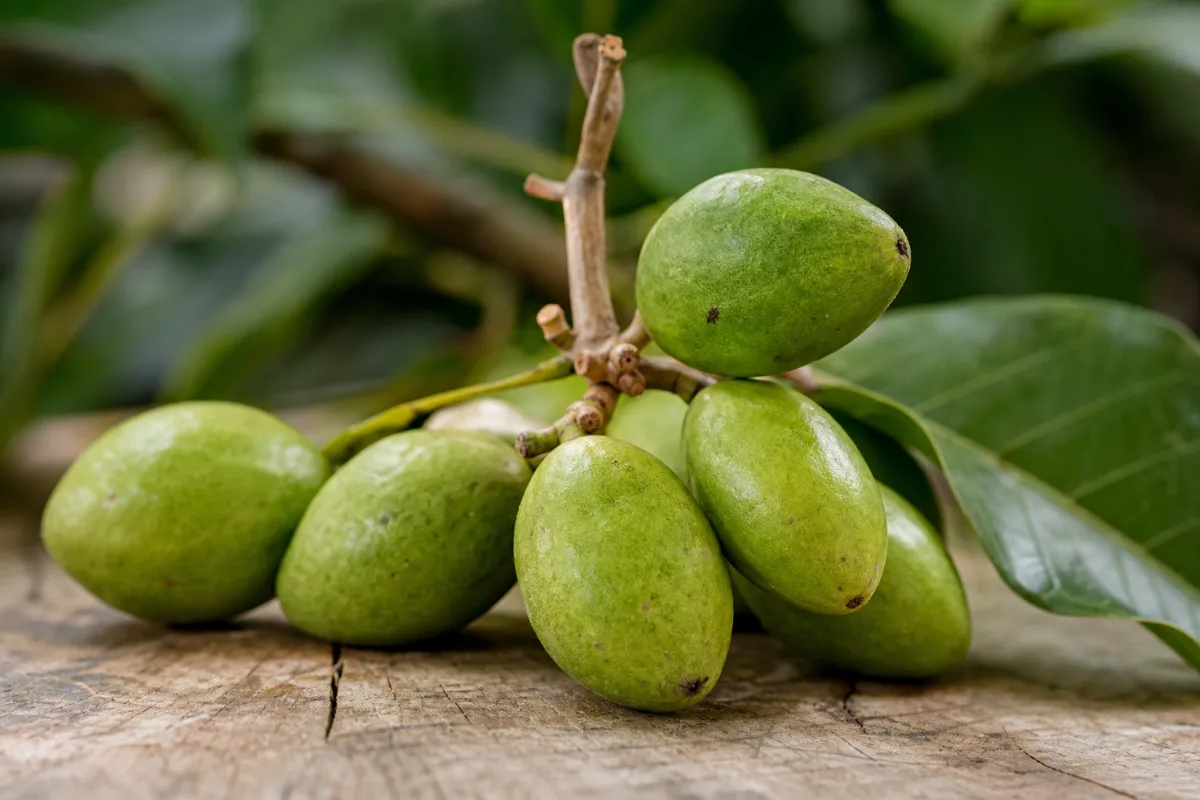
Herbs & Botanicals · Ayurvedic tannin-rich fruit
Haritaki
Terminalia chebula · also called Chebulic myrobalan, black myrobalan, harad, abhaya
Haritaki is the dried fruit of a South Asian tree, used for centuries in Ayurveda for digestion and general health. Small trials suggest possible help for knee comfort and blood-vessel markers in type 2 diabetes, and a mouth rinse has worked like an antiseptic, but each finding rests on one or two small studies. Its bowel effects, its possible effect on how the liver handles medicines, and its tannins that can reduce iron absorption are the main cautions. Some Ayurvedic products also contain lead, mercury or arsenic.
General information, not medical advice. Last substantive update · Not medically reviewed. A named clinician has not signed off on this page. How this page is made
About Haritaki
Haritaki is a tannin-rich fruit used in Ayurveda. Human research is small. The main cautions are bowel effects, medicines handled by liver enzymes, effects on iron absorption, heavy metals in some Ayurvedic products, and a lack of data in pregnancy and breastfeeding.
Safety first
Bowel effects: haritaki is used traditionally for both constipation and diarrhoea. No trial of haritaki alone measured loose stools or cramps. If you have diarrhoea, bowel disease or take other laxatives, ask a doctor or pharmacist first.
Medicines: in rats, a haritaki extract slowed the clearance of two test drugs (for CYP2E1 and CYP2C19), and an isolated fruit compound raised other liver enzymes. Memorial Sloan Kettering warns against its triphala blend with medicines cleared by CYP3A4 and CYP2D6. These are animal and indirect findings, and no human study was found. We found no study of P-glycoprotein. Tell your pharmacist about all your medicines.
Diabetes and blood-pressure medicines: one trial in people with type 2 diabetes reported better vessel markers, but no interaction study exists. If you take these medicines, tell your doctor and keep checking your numbers.
Iron: haritaki is rich in tannins. In human meal studies, tannic acid and tea strongly reduced iron absorption. This has not been measured for haritaki, but ask your doctor if you have low iron.
Heavy metals: about one in five Ayurvedic products bought online in a 2008 study contained detectable lead, mercury or arsenic. This is about Ayurvedic products in general, not haritaki alone. Ask for independent test results.
Pregnancy and breastfeeding: no haritaki-specific data were found. NCCIH advises asking a health care provider before using Ayurvedic products. Ask a doctor or pharmacist about amounts and your medicines.
What it is
Haritaki is the dried fruit of Terminalia chebula, a medium-to-large tree native to South and Southeast Asia, in the Combretaceae family. The fruit is named first in the Ayurvedic materia medica and is highly regarded in Tibetan medicine. It contains about 149 compounds, many of them tannins.
Haritaki is one of the three fruits in triphala (with amla and bibhitaki). Triphala has its own page; advice about the blend is not the same as advice about haritaki alone.
What the research shows
Joints: a branded aqueous extract improved knee scores in overweight adults with discomfort on activity. The trial was funded by the maker and not done in people with arthritis.
Diabetes: a 12-week trial in 60 people reported better blood-vessel function. It is small, and the abstract does not give blood-sugar numbers.
Mouth: two small trials found a haritaki rinse worked about as well as chlorhexidine for plaque and gum inflammation.
Bowel: the one trial used a mix that included senna.
Brain and skin: single small trials of 4 and 8 weeks, one with an author employed by the extract's maker.
Lab and animal work reports antioxidant, anti-inflammatory and liver-protective effects. These do not show effects in people.
At a glance
Traditional uses history, not proof
- Digestion, including chronic diarrhoea and constipation
- Haemorrhoids and indigestion
- Cough and throat complaints
- Skin conditions
- Memory and general tonic use
Studied for research
- Knee comfort with activity: low
- Blood-vessel markers in type 2 diabetes: low
- Gum health and plaque (mouth rinse): low
- Constipation (mixed capsule with senna): insufficient
- Thinking skills in schizophrenia (add-on): very low
- Facial oil and wrinkles: very low
Main compounds
- Chebulagic acid
- Chebulinic acid
- Gallic acid
- Ellagic acid
- Corilagin
Common forms
- Dried fruit powder
- Water (aqueous) extract capsule
- Standardised branded extract
- Mouth rinse
- Triphala blend (a different product)
Research links: Lopez 2017: knee comfort trial, 105 adults (PubMed) · Pingali 2020: type 2 diabetes trial, 60 people (PubMed) · Gupta 2015: haritaki mouth rinse vs chlorhexidine (PubMed) · Wang 2024: review of the fruit (Molecules) · Saper 2008: metals in Ayurvedic products (PubMed) · Research Library · Genes & Biomarkers Library
The plant and its history
- Accepted scientific name
- Terminalia chebula
- Naming authority
- Retz.
- Synonyms
- Myrobalanus chebula (Retz.) Gaertn.; Terminalia chebula var. gangetica (Roxb.) C.B.Clarke; Terminalia gangetica Roxb.; Terminalia parviflora Thwaites; Terminalia tomentella Kurz
- Common names
- Haritaki (Hindi/Sanskrit (Ayurveda)); Chebulic myrobalan (en); Black myrobalan (en); Harad (Hindi); Hartaki / Abhaya (Sanskrit names); Chebulae Fructus (Latin pharmacopoeia name)
- Botanical family
- Combretaceae (the combretum or indian almond family)
- Classification
- Plantae > Tracheophyta > Magnoliopsida > Myrtales > Combretaceae > Terminalia > Terminalia chebula
- Native range
- South and Southeast Asia (per the Molecules 2024 review).
- Habitat
- Not found in the sources read.
- What the plant looks like
- Roots: Not found.; Stems: Medium-to-large tree.; Leaves: Not found.; Flowers: Not found.; Fruit: The dried fruit (Chebulae Fructus) is the part used.
- Cultivation
- Not found.
- Harvest and processing
- Sunlight drying breaks down some tannins into simpler acids such as gallic, ellagic and chebulic acid, so processing changes the chemistry (Molecules 2024 review).
- Look-alikes and adulterants
- Name: Terminalia bellirica (bibhitaki); Note: Another triphala fruit with a different name and chemistry; not interchangeable.; Name: Phyllanthus emblica (amla); Note: The third triphala fruit; separate plant, family Phyllanthaceae.; Name: Triphala and other blends; Note: Products sold as 'haritaki' may be triphala or mixed formulas; check the label.
- Sustainability and conservation
- Not found.
Traditional use and history history, not clinical proof
| Tradition or era | Documented use | Source |
|---|---|---|
| Ayurveda and Siddha | Chronic diarrhoea, gastroenteritis, constipation, malabsorption, dyspepsia, haemorrhoids, cough, skin diseases, memory loss, diabetes and cardiovascular conditions are among the uses listed. Named first in the Ayurvedic materia medica. | s-molecules-2024 |
| Tibetan and Chinese medicine | Called the king of Tibetan medicines. In Chinese medicine, prescribed to astringe the lungs and intestines for chronic diarrhoea, long coughs, throat pain and voice loss, among other uses. | s-molecules-2024 |
| Triphala (Ayurveda) | Haritaki is one of three fruits in the blend triphala, with amla and bibhitaki. | s-msk-triphala |
Traditional use shows how a plant was used. It does not show that a supplement works or is safe today.
What is inside, and how it may work
What the plant contains and how those compounds act in cells and animals. Laboratory and animal mechanisms are not proven effects in people.
Main compounds
| Compound | Family | Where it is concentrated | Activity studied | Level of evidence |
|---|---|---|---|---|
| Chebulagic acid PubChem 442674 | hydrolysable tannin | fruit | A main tannin of the fruit; degrades into simpler acids on sunlight drying. Other activity is from cell studies. 19 21 | Laboratory research |
| Chebulinic acid PubChem 99937814 | hydrolysable tannin | fruit | Induced several rat liver CYP enzymes; oral bioavailability about 37.6% in rats. 19 3 | Animal research |
| Gallic acid PubChem 370 | phenolic acid | fruit About 2.5% w/w in one standardised hydroalcoholic extract of fruit pulp | Blocks iron absorption per galloyl group in human meal studies (with tannic acid); inhibited rat P450 in vitro as part of an extract. 19 18 5 | Human indirect |
| Ellagic acid PubChem 5281855 | phenolic acid | fruit | A breakdown product of ellagitannins on drying; activity from cell studies. 19 21 | Laboratory research |
| Corilagin PubChem 73568 | ellagitannin | fruit | A tannin reported in the fruit; not specifically studied in what we read. 19 | Laboratory research |
| Chebulic acid PubChem 71308174 | phenolic acid | fruit | Forms when other tannins break down on drying. 19 21 | Laboratory research |
Mechanisms, receptors and pathways
| Target or pathway | Gene or receptor | What was found | Level |
|---|---|---|---|
| Cytochrome P450 drug-metabolising enzymes | CYP2E1, CYP2C19 (inhibition, rat); CYP1A2, 2D, 2E1 (induction by chebulinic acid, rat) | Whole extract slowed clearance of CYP2E1 and CYP2C19 probes in rats; isolated chebulinic acid induced several CYP enzymes after 14 days; a standardised extract inhibited total P450 in rat liver preparations. 22 3 18 | Animal research |
| Iron binding in the gut | Not applicable | Hydrolysable tannins and gallic acid bind iron and reduce absorption (human meal studies of tannic acid and tea; not tested with haritaki). 5 7 | Human indirect |
| Antioxidant and anti-inflammatory activity | Not specified | Reviews describe antioxidant and anti-inflammatory effects of the tannins in cells and animals; in the knee trial the inflammation marker COMP only tended to fall. 21 1 12 | Laboratory research |
| Oral bacteria and plaque | Not applicable | A rinse reduced plaque and gum inflammation in two small human trials; the exact cause is not shown. 11 10 | Human data |
Absorption, metabolism and elimination
- Absorption
- No human data found. Isolated chebulinic acid had about 37.6% oral bioavailability in rats.
- Distribution
- Chebulinic acid was 85-96% bound to plasma proteins (rat set-up).
- Metabolism
- Tannins break down into simpler acids such as gallic and ellagic acid on drying; human metabolism not found.
- Elimination
- Not found.
- Bioavailability
- Rat data only for one compound.
Isolated compounds versus whole extracts
Rat work with the whole extract (CYP inhibition) and with isolated chebulinic acid (CYP induction) point in different directions, so which part drives an effect in people is not clear. Human trials used different products: aqueous extracts, a branded standardised extract, capsules of fruit powder, mouth rinse and mixed formulas. Results cannot be carried from one product to another.
Nutritional composition
Haritaki is a medicinal fruit, not a source of any essential nutrient we found. Its tannins can lower iron absorption from meals.
3 low certainty2 very low certainty3 not enough evidence
What is Haritaki good for?
The studied uses and how strong the evidence is. Human research is small: one or two trials per use, mostly of aqueous or branded extracts, not whole-fruit powder.
Benefits, one by one
Each card is a research question, not a promise. Tap a goal to filter. Open a card to see the studies, doses and limits.
Knee comfort with activity
Low certaintyIn one 84-day trial of 105 overweight adults whose knees were uncomfortable only with activity, a branded haritaki fruit extract improved knee scores, walking distance and activity discomfort compared with placebo. It is one sponsor-funded trial in people without diagnosed arthritis.
2 studiesOne branded standardised aqueous fruit extract (AyuFlex). Amounts are…
Studies, doses and limits
What the trials found
One randomised, double-blind, placebo-controlled trial (NCT02589249) of a standardised aqueous fruit extract in three groups.
Results
Versus placebo at day 84: mKOOS global score improved (P=0.023), knee discomfort with activity improved (P=0.001), whole-body joint function improved (P<0.029), and 6-minute walk distance rose (P=0.047). Safety blood markers stayed normal and no adverse events were reported.
Effect sizes as reported
mKOOS global P=0.023; activity discomfort P=0.001; 6-minute walk P=0.047
Why this rating
Low: one trial, funded by the extract's maker, in healthy overweight adults rather than people with arthritis, and not repeated by others.
Form and dose studied
One branded standardised aqueous fruit extract (AyuFlex). Amounts are for a doctor or pharmacist to decide.
Who was studied
Overweight adults aged 35-70 with knee discomfort only on activity.
Limits
Not people with osteoarthritis. One product. Some results are described against baseline. Sponsor was Natreon, Inc.
Why researchers looked
Haritaki has antioxidant and anti-inflammatory reputation in lab work, and the trial authors cite it as a candidate for joint comfort.
Traditional use
Haritaki is a major Ayurvedic fruit; we did not find a source that names joint use specifically, so this is a reason for study rather than an established tradition.
Proposed mechanism Preliminary mechanism
Lab work suggests antioxidant and anti-inflammatory effects. In this trial the inflammation marker COMP only tended to fall (not significant). How it might work in knees is not shown.
A proposed mechanism does not show that the effect happens in people.
Reported without adverse events in this trial. See the safety tab for the wider picture.
Blood-vessel and heart-risk markers in type 2 diabetes
Low certaintyA 12-week trial of 60 people with type 2 diabetes found that an aqueous haritaki extract improved a blood-vessel function measure (reflection index) and other risk markers compared with placebo. It is a single small trial and does not show haritaki can replace diabetes medicine.
2 studiesAqueous extract of the fruit. Amounts are for a doctor or pharmacist …
Studies, doses and limits
What the trials found
One randomised, double-blind, placebo-controlled trial of an aqueous fruit extract at two strengths.
Results
Reflection index (a blood-vessel stiffness measure) improved by 2.55 and 5.21 percentage points on the two strengths against a 1.40 worsening on placebo. The authors say other risk markers also improved; the abstract gives no further numbers.
Effect sizes as reported
Reflection index -2.55 and -5.21 vs +1.40 (placebo)
Why this rating
Low: one small trial, abstract-level detail only, funding not stated, not repeated.
Form and dose studied
Aqueous extract of the fruit. Amounts are for a doctor or pharmacist to decide.
Who was studied
Adults with type 2 diabetes.
Limits
Which diabetes medicines people took is not in the abstract. HbA1c and lipid numbers were not given in the abstract, so blood-sugar benefit cannot be stated.
Why researchers looked
People with type 2 diabetes are at higher heart and blood-vessel risk, and the trial authors describe haritaki as having antioxidant and fat-lowering activity.
Traditional use
Ayurvedic and Siddha sources list diabetes and cardiovascular conditions among its uses (Molecules 2024 review).
Proposed mechanism Preliminary mechanism
Possible antioxidant and nitric oxide effects are suggested. Not proven in people.
A proposed mechanism does not show that the effect happens in people.
If you take diabetes medicines, see the safety tab. Never swap haritaki for prescribed treatment.
Gum health and plaque (mouthwash)
Low certaintyTwo small trials found that a haritaki mouth rinse reduced plaque and gum bleeding compared with water or saline, and did about as well as the antiseptic chlorhexidine. The rinse is spat out, so the results say little about swallowing the fruit.
3 studiesHaritaki extract mouth rinse (10% in one trial). Not a swallowed prod…
Studies, doses and limits
What the trials found
Two small randomised, double-blind trials from the same research group, 78 and 90 people.
Results
Both rinses beat water or saline for plaque and gum inflammation. In the 90-student trial, bleeding and plaque indices fell in both groups over 15 and 30 days. In the 78-patient trial there was no significant difference from chlorhexidine.
Effect sizes as reported
No significant difference from chlorhexidine in either trial
Why this rating
Low: two small, short trials by one group, in young volunteers, using a rinse. Not shown to replace dental care.
Form and dose studied
Haritaki extract mouth rinse (10% in one trial). Not a swallowed product.
Who was studied
University students; people with plaque and gingivitis.
Limits
Same research group. Rinse only. An erratum exists for the 2015 paper.
Why researchers looked
Haritaki is rich in tannins, and its extracts have antibacterial reputation in lab work.
Traditional use
The Molecules 2024 review lists throat pain and other uses; a specific gum or mouth-care tradition was not confirmed in the sources read.
Proposed mechanism Preliminary mechanism
Tannins may bind bacteria and tighten tissue (astringent action). This is a lab-based idea.
A proposed mechanism does not show that the effect happens in people.
Rinse and spit; do not swallow. Dental problems need a dentist.
Constipation and bowel movements
Not enough evidenceHaritaki is traditionally used for both constipation and diarrhoea. The only controlled trial found tested a nine-ingredient capsule that included senna, a known laxative, so haritaki's own effect is unknown.
2 studiesCombination capsule. Haritaki alone was not tested. Amounts are for a…
Studies, doses and limits
What the trials found
One randomised, triple-blind, placebo-controlled trial of a combination capsule in 64 postmenopausal women.
Results
Bowel movements were more frequent on the capsule than on placebo, and straining and symptom scores were lower (symptom score difference -15.4, p<0.001).
Effect sizes as reported
Symptom score difference -15.4 (95% CI -11.5 to -19.29)
Why this rating
Insufficient for haritaki alone: the capsule had nine ingredients including senna, so the result cannot be given to haritaki.
Form and dose studied
Combination capsule. Haritaki alone was not tested. Amounts are for a doctor or pharmacist to decide.
Who was studied
Postmenopausal women with chronic constipation.
Limits
Combination product. Short and small. No trial of haritaki alone.
Why researchers looked
Haritaki is one of the three fruits in triphala, which is widely used for bowel regularity.
Traditional use
Described in Ayurveda and Siddha medicine for chronic diarrhoea, constipation, indigestion and haemorrhoids.
Proposed mechanism Traditional use
The tannins are astringent (they tighten tissue), which fits use for diarrhoea. How the fruit could also move the bowels is not settled.
A proposed mechanism does not show that the effect happens in people.
Any herb that loosens the bowel can cause cramps or loose stools. See the safety tab.
Thinking skills in chronic schizophrenia (add-on)
Very low certaintyOne 4-week trial added black myrobalan (haritaki) capsules to usual treatment in people with chronic schizophrenia and reported better scores on a thinking-skills test and on negative-symptom and excitement scores. It was small and short.
1 studiesBlack myrobalan (haritaki fruit) capsules as an add-on. Amounts are f…
Studies, doses and limits
What the trials found
One randomised, double-blind, placebo-controlled trial added to usual treatment.
Results
After 4 weeks versus placebo: cognitive scores (SCIP, p=0.004), negative symptoms (p=0.017) and excitement/activity (p=0.003) improved. No serious adverse effects were reported.
Effect sizes as reported
SCIP p=0.004; negative symptoms p=0.017
Why this rating
Very low: one small, 4-week trial in a serious illness, group size not in the abstract, and not repeated.
Form and dose studied
Black myrobalan (haritaki fruit) capsules as an add-on. Amounts are for a doctor or pharmacist to decide.
Who was studied
Adults with chronic schizophrenia.
Limits
Short, small, single trial. Not a treatment on its own.
Why researchers looked
The trial authors note antioxidant, acetylcholinesterase-blocking and anti-inflammatory effects, which they thought could lessen schizophrenia symptoms.
Traditional use
Ayurvedic and Siddha sources list memory loss and epilepsy among its uses (Molecules 2024 review).
Proposed mechanism Preliminary mechanism
Lab work suggests it blocks the enzyme that breaks down acetylcholine and reduces oxidative stress. Not shown to work this way in people.
A proposed mechanism does not show that the effect happens in people.
Never use as a substitute for prescribed psychiatric care. Tell your prescriber about any herb.
Facial oil, redness and wrinkles (oral extract)
Very low certaintyAn 8-week trial in healthy women found that a standardised haritaki fruit extract reduced forehead oil in those who started with oily skin, and slightly reduced redness and wrinkle severity versus placebo. It is a single small trial linked to the extract's maker.
2 studiesStandardised oral fruit extract (Synastol TC). Amounts are for a doct…
Studies, doses and limits
What the trials found
One randomised, double-blind, placebo-controlled trial of an oral standardised fruit extract.
Results
In the high-oil subgroup, forehead sebum fell 33% against a 29% rise on placebo at 8 weeks (p<0.01). Cheek redness fell 2.2% against a 1.5% rise (p<0.05). Wrinkle severity fell 4.3% against a 3.9% rise (p<0.05).
Effect sizes as reported
Sebum -33% vs +29% (p<0.01); wrinkles -4.3% vs +3.9% (p<0.05)
Why this rating
Very low: one short trial, a subgroup finding for sebum, small changes, group size not in the abstract, and an author works for the extract's maker.
Form and dose studied
Standardised oral fruit extract (Synastol TC). Amounts are for a doctor or pharmacist to decide.
Who was studied
Healthy women aged 25-65.
Limits
Industry-linked. Short. Subgroup result. Healthy people, not people with acne.
Why researchers looked
The trial authors describe antioxidant, anti-inflammatory and antibacterial properties and wide use in Ayurveda and herbal formulations.
Traditional use
Ayurvedic and Siddha sources list skin diseases among its uses (Molecules 2024 review).
Proposed mechanism Preliminary mechanism
Antioxidant and anti-inflammatory activity in the lab. Not shown as the cause in this trial.
A proposed mechanism does not show that the effect happens in people.
Skin creams containing the extract have caused allergic contact dermatitis (title-level report).
Diarrhoea, indigestion and haemorrhoids (traditional use)
Not enough evidenceHaritaki is traditionally used for chronic diarrhoea, constipation, indigestion, gastroenteritis and haemorrhoids. We found no trial of haritaki alone for these. Evidence is traditional and lab-based only.
1 studiesFruit powder, decoction. Amounts are for a doctor or pharmacist to de…
Studies, doses and limits
What the trials found
No controlled trial of haritaki alone for these uses was found.
Results
None to report.
Effect sizes as reported
Not applicable
Why this rating
Insufficient: traditional use only.
Form and dose studied
Fruit powder, decoction. Amounts are for a doctor or pharmacist to decide.
Who was studied
Not applicable.
Limits
Traditional claims are not proof. Diarrhoea can be serious; see a doctor if it lasts.
Why researchers looked
The fruit is rich in tannins, which tighten tissue (astringent action); the Molecules review describes it as astringing the intestines.
Traditional use
Named first in the Ayurvedic materia medica; Ayurveda and Siddha list chronic diarrhoea, gastroenteritis, constipation, dyspepsia and haemorrhoids.
Proposed mechanism Traditional use
Tannins are astringent. No human mechanism study was found.
A proposed mechanism does not show that the effect happens in people.
See the safety tab, including interactions and the effect of tannins on iron.
Antioxidant, anti-inflammatory, liver-protective and anticancer effects (lab and animal only)
Not enough evidenceReviews describe antioxidant, anti-inflammatory, liver-protective and anticancer findings for haritaki compounds in cells and animals. These results are lab and animal work only and do not show benefits in people.
3 studiesIsolated compounds and extracts in cells and animals.
Studies, doses and limits
What the trials found
No human trial of these claims was found. Reviews summarise cell and animal work.
Results
Not applicable (cell and animal work).
Effect sizes as reported
Not applicable
Why this rating
Insufficient for people: lab and animal work only.
Form and dose studied
Isolated compounds and extracts in cells and animals.
Who was studied
Cells and animals.
Limits
Results from cells and rodents often do not carry over to people. MSK notes anticancer effects of triphala are lab-only and human data are lacking.
Why researchers looked
The fruit contains about 149 compounds, many of them tannins and phenolic acids, that are active in test tubes.
Traditional use
The fruit is described as highly regarded in Ayurvedic and Tibetan medicine and named first in the Ayurvedic materia medica.
Proposed mechanism Laboratory research
Tannins such as chebulagic and chebulinic acid scavenge free radicals and affect inflammation pathways in cells. Whether this happens in people is not shown.
A proposed mechanism does not show that the effect happens in people.
None specific; see the safety tab.
Connections to the rest of health
How Haritaki connects to the rest of our health knowledge graph. Every link says what kind of connection it is. A safety link (for example to the liver) is a warning, not a benefit. A study that merely mentions a topic never creates a benefit link.
Explore every connection: goals, body systems, organs, symptoms, genes
A. Wellness goals
| Connected to | Kind of connection | Evidence status | Context | Studies |
|---|---|---|---|---|
| Joint Support | Low certainty | Knee comfort with activity: In one 84-day trial of 105 overweight adults whose knees were uncomfortable only with activity, a branded haritaki fruit extract improved knee scores, walking distance and activity discomfort compared with placebo. It is one sponsor-funded trial in people without diagnosed arthritis. | 12 1 | |
| Mobility Support | Low certainty | Knee comfort with activity: In one 84-day trial of 105 overweight adults whose knees were uncomfortable only with activity, a branded haritaki fruit extract improved knee scores, walking distance and activity discomfort compared with placebo. It is one sponsor-funded trial in people without diagnosed arthritis. | 12 1 | |
| Blood Sugar Balance | Low certainty | Blood-vessel and heart-risk markers in type 2 diabetes: A 12-week trial of 60 people with type 2 diabetes found that an aqueous haritaki extract improved a blood-vessel function measure (reflection index) and other risk markers compared with placebo. It is a single small trial and does not show haritaki can replace diabetes medicine. | 17 15 | |
| Healthy Circulation | Low certainty | Blood-vessel and heart-risk markers in type 2 diabetes: A 12-week trial of 60 people with type 2 diabetes found that an aqueous haritaki extract improved a blood-vessel function measure (reflection index) and other risk markers compared with placebo. It is a single small trial and does not show haritaki can replace diabetes medicine. | 17 15 | |
| Cholesterol Balance | Low certainty | Blood-vessel and heart-risk markers in type 2 diabetes: A 12-week trial of 60 people with type 2 diabetes found that an aqueous haritaki extract improved a blood-vessel function measure (reflection index) and other risk markers compared with placebo. It is a single small trial and does not show haritaki can replace diabetes medicine. | 17 15 | |
| Healthy Skin | Low certainty | Gum health and plaque (mouthwash): Two small trials found that a haritaki mouth rinse reduced plaque and gum bleeding compared with water or saline, and did about as well as the antiseptic chlorhexidine. The rinse is spat out, so the results say little about swallowing the fruit. Facial oil, redness and wrinkles (oral extract): An 8-week trial in healthy women found that a standardised haritaki fruit extract reduced forehead oil in those who started with oily skin, and slightly reduced redness and wrinkle severity versus placebo. It is a single small trial linked to the extract's maker. | 11 10 1 6 4 | |
| Immune Support | Low certainty | Gum health and plaque (mouthwash): Two small trials found that a haritaki mouth rinse reduced plaque and gum bleeding compared with water or saline, and did about as well as the antiseptic chlorhexidine. The rinse is spat out, so the results say little about swallowing the fruit. | 11 10 1 | |
| Digestive Support | Not enough evidence | Constipation and bowel movements: Haritaki is traditionally used for both constipation and diarrhoea. The only controlled trial found tested a nine-ingredient capsule that included senna, a known laxative, so haritaki's own effect is unknown. | 8 21 | |
| Gut Health | Not enough evidence | Constipation and bowel movements: Haritaki is traditionally used for both constipation and diarrhoea. The only controlled trial found tested a nine-ingredient capsule that included senna, a known laxative, so haritaki's own effect is unknown. | 8 21 | |
| Brain Health | Very low certainty | Thinking skills in chronic schizophrenia (add-on): One 4-week trial added black myrobalan (haritaki) capsules to usual treatment in people with chronic schizophrenia and reported better scores on a thinking-skills test and on negative-symptom and excitement scores. It was small and short. | 2 | |
| Memory Support | Very low certainty | Thinking skills in chronic schizophrenia (add-on): One 4-week trial added black myrobalan (haritaki) capsules to usual treatment in people with chronic schizophrenia and reported better scores on a thinking-skills test and on negative-symptom and excitement scores. It was small and short. | 2 | |
| Hair Support | Very low certainty | Facial oil, redness and wrinkles (oral extract): An 8-week trial in healthy women found that a standardised haritaki fruit extract reduced forehead oil in those who started with oily skin, and slightly reduced redness and wrinkle severity versus placebo. It is a single small trial linked to the extract's maker. | 6 4 | |
| Digestive Support | Traditional use | Not enough evidence | Diarrhoea, indigestion and haemorrhoids (traditional use): Haritaki is traditionally used for chronic diarrhoea, constipation, indigestion, gastroenteritis and haemorrhoids. We found no trial of haritaki alone for these. Evidence is traditional and lab-based only. | 21 |
| Gut Health | Traditional use | Not enough evidence | Diarrhoea, indigestion and haemorrhoids (traditional use): Haritaki is traditionally used for chronic diarrhoea, constipation, indigestion, gastroenteritis and haemorrhoids. We found no trial of haritaki alone for these. Evidence is traditional and lab-based only. | 21 |
| Cellular Protection | Not enough evidence | Antioxidant, anti-inflammatory, liver-protective and anticancer effects (lab and animal only): Reviews describe antioxidant, anti-inflammatory, liver-protective and anticancer findings for haritaki compounds in cells and animals. These results are lab and animal work only and do not show benefits in people. | 21 1 13 | |
| Liver Support | Not enough evidence | Antioxidant, anti-inflammatory, liver-protective and anticancer effects (lab and animal only): Reviews describe antioxidant, anti-inflammatory, liver-protective and anticancer findings for haritaki compounds in cells and animals. These results are lab and animal work only and do not show benefits in people. | 21 1 13 | |
| Inflammation Balance | Not enough evidence | Antioxidant, anti-inflammatory, liver-protective and anticancer effects (lab and animal only): Reviews describe antioxidant, anti-inflammatory, liver-protective and anticancer findings for haritaki compounds in cells and animals. These results are lab and animal work only and do not show benefits in people. | 21 1 13 |
B. Body systems
| Connected to | Kind of connection | Evidence status | Context | Studies |
|---|---|---|---|---|
| Digestive system | Adverse effect or risk | Traditional use | Possible loose stools or cramps; not measured for haritaki alone. Preparation or compound: Fruit |
21 13 |
| Bones Joints Muscles | Biological association | Low certainty | Studied for: Knee comfort with activity | 12 1 |
| Pain Inflammation | Biological association | Low certainty | Studied for: Knee comfort with activity Studied for: Antioxidant, anti-inflammatory, liver-protective and anticancer effects (lab and animal only) | 12 1 21 13 |
| Blood Sugar Support | Biological association | Low certainty | Studied for: Blood-vessel and heart-risk markers in type 2 diabetes | 17 15 |
| Cardiovascular System | Biological association | Low certainty | Studied for: Blood-vessel and heart-risk markers in type 2 diabetes | 17 15 |
| Immune System | Biological association | Low certainty | Studied for: Gum health and plaque (mouthwash) | 11 10 1 |
| Gut Health | Biological association | Not enough evidence | Studied for: Constipation and bowel movements Studied for: Diarrhoea, indigestion and haemorrhoids (traditional use) | 8 21 |
| Digestive System | Biological association | Not enough evidence | Studied for: Constipation and bowel movements Studied for: Diarrhoea, indigestion and haemorrhoids (traditional use) | 8 21 |
| Nervous System | Biological association | Very low certainty | Studied for: Thinking skills in chronic schizophrenia (add-on) | 2 |
| Skin Hair Beauty | Biological association | Very low certainty | Studied for: Facial oil, redness and wrinkles (oral extract) | 6 4 |
| Liver Detox | Biological association | Not enough evidence | Studied for: Antioxidant, anti-inflammatory, liver-protective and anticancer effects (lab and animal only) | 21 1 13 |
I. Biomarkers
| Connected to | Kind of connection | Evidence status | Context | Studies |
|---|---|---|---|---|
| Reflection index (blood-vessel function) | Biological association | Low certainty | Measured in trials: decreased. A lab change is not the same as a health benefit. | 17 |
| Knee function score (mKOOS global) | Biological association | Low certainty | Measured in trials: increased. A lab change is not the same as a health benefit. | 12 |
| COMP (a cartilage turnover marker) | Biological association | Not enough evidence | Measured in trials: decreased. A lab change is not the same as a health benefit. | 12 |
| Dental plaque and gum bleeding scores | Biological association | Low certainty | Measured in trials: decreased. A lab change is not the same as a health benefit. | 11 10 |
| Bowel movement frequency | Biological association | Not enough evidence | Measured in trials: increased. A lab change is not the same as a health benefit. | 8 |
| Cognitive screening score (SCIP) | Biological association | Very low certainty | Measured in trials: increased. A lab change is not the same as a health benefit. | 2 |
| Forehead sebum excretion rate | Biological association | Very low certainty | Measured in trials: decreased. A lab change is not the same as a health benefit. | 6 4 |
| Facial wrinkle severity | Biological association | Very low certainty | Measured in trials: decreased. A lab change is not the same as a health benefit. | 6 |
J. Genes, receptors and enzymes
| Connected to | Kind of connection | Evidence status | Context | Studies |
|---|---|---|---|---|
| CYP2E1 | Preliminary mechanism | Animal | Slowed probe-drug clearance in rats; raised by chebulinic acid in another rat study. | 22 3 |
| CYP2C19 | Preliminary mechanism | Animal | Slowed probe-drug clearance in rats. | 22 |
| CYP1A2 | Preliminary mechanism | Animal | Induced by chebulinic acid in rats. | 3 |
| CYP3A4 and CYP2D6 | Preliminary mechanism | Animal | No effect in the rat haritaki study; MSK advises caution for triphala. | 22 13 |
K. Biological pathways
L. Active compounds
| Connected to | Kind of connection | Evidence status | Context | Studies |
|---|---|---|---|---|
| Chebulagic acid | Biological association | In vitro | A main tannin of the fruit; degrades into simpler acids on sunlight drying. Other activity is from cell studies. Preparation or compound: fruit |
19 21 |
| Chebulinic acid | Biological association | Animal | Induced several rat liver CYP enzymes; oral bioavailability about 37.6% in rats. Preparation or compound: fruit |
19 3 |
| Gallic acid | Biological association | Human indirect | Blocks iron absorption per galloyl group in human meal studies (with tannic acid); inhibited rat P450 in vitro as part of an extract. Preparation or compound: fruit |
19 18 5 |
| Ellagic acid | Biological association | In vitro | A breakdown product of ellagitannins on drying; activity from cell studies. Preparation or compound: fruit |
19 21 |
| Corilagin | Biological association | In vitro | A tannin reported in the fruit; not specifically studied in what we read. Preparation or compound: fruit |
19 |
| Chebulic acid | Biological association | In vitro | Forms when other tannins break down on drying. Preparation or compound: fruit |
19 21 |
Each connection is stored with the ingredient, the connected record, the kind of connection, the evidence status, the supporting studies, the preparation or compound involved, and a review date (last reviewed October 25, 2026).
The evidence
The research centre for Haritaki. Every record here was checked against PubMed or the publisher's page; we never list a study we have not verified.
Evidence by outcome
Bars show how many studies we found for each outcome, not how well it works. People are added up across trials only (reviews are not added, to avoid double counting).
How we rate evidence
High certainty
Several well-run trials or reviews agree; further research is unlikely to change the picture much.
Moderate certainty
Good trials point the same way, but some doubt remains.
Low certainty
Small, short or inconsistent trials. The finding could change with better research.
Very low certainty
Very little or very weak human data. Treat as a possibility only.
Mixed findings
Trials or reviews disagree with each other.
Not enough evidence
Not enough human research to say either way.
Evidence against
Good research found no benefit, or found harm.
We take the reviewers' own risk-of-bias and GRADE statements where they exist, and otherwise judge from study size, design, consistency, directness and whether a product matches what is sold. Many publications do not make evidence high. Method note: We read our existing herb summary, searched PubMed, read the abstract of each PubMed record cited, and checked names in GBIF and NCBI Taxonomy and compounds in PubChem. Pages that could not be opened or checked are marked not found or not verified.
Study library: every study we checked 22
| Study | Design | People | Product, dose, length | Result |
|---|---|---|---|---|
| Authors not recorded in our summary 2022 A comprehensive review on the diverse pharmacological perspectives of Terminalia chebula Retz. Heliyon (review) · Source |
Narrative review |
unspecified |
Review cited in our earlier summary for the mouthwash and knee-comfort trials and for lab and animal findings (antioxidant, anti-inflammatory, anticancer). Methods, limits and fundingLimitations: Summary-only: not re-opened in this build. Details of its mouthwash trial mention were not verified at source. Read: summary-only | |
| Banazadeh 2022 Evaluating the effect of black myrobalan on cognitive, positive, and negative symptoms in patients with chronic schizophrenia: A randomized, double-blind, placebo-controlled trial. Phytother Res · PMID 34814232 · DOI |
Rct 2 arm |
Adults with chronic schizophrenia (group size not stated in the abstract) | Black myrobalan (Terminalia chebula) capsules, added to usual treatment fruit (dried; part implied, not stated in the abstract) not given here 4 weeks · vs placebo |
Versus placebo after 4 weeks, cognitive scores (SCIP, p=0.004), negative symptoms (p=0.017) and excitement/activity (p=0.003) improved. No serious adverse effects were reported. SCIP p=0.004; negative symptoms p=0.017 Methods, limits and fundingOutcomes: Cognition (SCIP) and PANSS subscales Limitations: Four weeks only, small, group size not in the abstract, and one trial. Add-on to prescribed medicine, so it is not a treatment on its own. Funding and conflicts: Not stated in abstract Read: abstract |
| Biswas 2023 Preclinical Pharmacokinetics and CYP Modulation Activity of Chebulinic Acid: A Potent Molecule Against Metabolic Disease. Curr Drug Metab · PMID 37592800 · DOI |
Animal research animal |
Male Sprague-Dawley rats and rat liver preparations | Chebulinic acid (isolated compound) isolated compound from the fruit not given here 14 days · vs none stated |
Absolute oral bioavailability of chebulinic acid at one dose was 37.56% in rats. After 14 days it induced (switched up) rat CYP1A2, 2C11, 2D2 and 2E1, in both enzyme and gene-expression tests. Plasma protein binding was 85-96%. Oral bioavailability 37.56 +/- 7.3% (rat) Methods, limits and fundingOutcomes: Bioavailability, plasma protein binding, liver CYP activity and gene expression Limitations: Rats and an isolated compound, not the whole fruit. Direction (induction) differs from the inhibition seen in the whole-fruit rat study, so the interaction picture is unsettled. Funding and conflicts: Not stated in abstract Read: abstract |
| Blanchard 2026 Allergic Contact Dermatitis to Terminalia Chebula Fruit Extract in Antiaging Creams. Contact Dermatitis · PMID 41261872 · DOI |
Case report title only |
Skin allergy report | Terminalia chebula fruit extract in creams fruit extract not given here not applicable · vs none |
Only the title was read: the report concerns allergic skin reactions to haritaki fruit extract in anti-ageing creams. No abstract was available, so no numbers are given. Not applicable Methods, limits and fundingOutcomes: Allergic contact dermatitis Limitations: Title only. No details on number of people or severity. Funding and conflicts: No conflict declared Read: title-only |
| Brune 1989 Iron absorption and phenolic compounds: importance of different phenolic structures. Eur J Clin Nutr · PMID 2598894 |
Human absorption study |
Human volunteers (numbers not in abstract) | Tannic acid (a hydrolysable tannin), gallic acid, and foods such as tea not applicable not given here single test meals · vs meals without added phenolics |
Tannic acid cut iron absorption in a dose-related way: about 20% at 5 mg, 67% at 25 mg and 88% at 100 mg. Gallic acid blocked iron to the same extent per galloyl group. Condensed tannins and catechin did not interfere. Iron absorption fell 20% / 67% / 88% Methods, limits and fundingOutcomes: Iron absorption (extrinsic tag method) Limitations: Not a haritaki study. Haritaki is rich in hydrolysable (galloyl-type) tannins, so a similar effect is plausible but was not measured. Funding and conflicts: Not stated in abstract Read: abstract |
| Chakkalakal 2023 Randomized Double-Blind Placebo-Controlled Supplementation with Standardized Terminalia chebula Fruit Extracts Reduces Facial Sebum Excretion, Erythema, and Wrinkle Severity. J Clin Med · PMID 36836126 · DOI |
Rct 2 arm |
Healthy women aged 25-65 (group size not stated in the abstract) | Standardised Terminalia chebula fruit extract (Synastol TC) fruit not given here 8 weeks · vs placebo |
In the women with high baseline forehead oil, forehead sebum fell 33% against a 29% rise on placebo at 8 weeks (p<0.01). Cheek redness fell 2.2% against a 1.5% rise (p<0.05). Wrinkle severity fell 4.3% against a 3.9% rise (p<0.05). The sebum result was a subgroup finding. Sebum -33% vs +29% (p<0.01, high-sebum subgroup); wrinkles -4.3% vs +3.9% (p<0.05) Methods, limits and fundingOutcomes: Facial wrinkles, sebum excretion, moisture, water loss, melanin and erythema indices Limitations: Healthy women, short, one branded extract, subgroup analysis. One author is an employee of the extract's maker (Sytheon); others report consulting for skin and supplement companies. Funding and conflicts: Industry-linked: an author is employed by Sytheon, maker of the extract Read: abstract |
| Disler 1975 The effect of tea on iron absorption. Gut · PMID 1168162 · DOI |
Human absorption study |
Human volunteers | Tea (tannin-containing drink) not applicable not given here single test meals · vs no tea |
Tea reduced absorption of non-haem iron from salts, bread and a vegetable meal. The authors attribute this to insoluble iron-tannate complexes and suggest tannin drinks with meals may contribute to iron deficiency when the diet is mostly vegetarian. Absorption inhibited (numbers not in abstract) Methods, limits and fundingOutcomes: Absorption of non-haem iron Limitations: Tea, not haritaki. Old study. Funding and conflicts: Not stated in abstract Read: abstract |
| Eliasvandi 2019 Effect of an herbal capsule on chronic constipation among menopausal women: A randomized controlled clinical trial. Avicenna J Phytomed · PMID 31763211 · DOI |
Rct 2 arm combination |
64 Postmenopausal women with chronic constipation |
Traditional 9-ingredient herbal capsule (cloves, anise, violet, Terminalia chebula, green raisins, senna leaves, Alhagi maurorum and others) mixed; haritaki fruit is one ingredient among nine not given here not stated in the abstract we read · vs placebo |
Bowel movement frequency was higher on the capsule than on placebo, and straining, incomplete emptying and constipation symptom score were lower. The capsule contains senna, a known stimulant laxative, so the result cannot be credited to haritaki. Symptom score difference -15.4 (95% CI -11.5 to -19.29), p<0.001 Methods, limits and fundingOutcomes: Constipation questionnaire and symptom scale; bowel movement frequency Limitations: Combination product: haritaki's own effect cannot be separated, especially from senna. Authors report no conflict. Short and small. Funding and conflicts: No conflict of interest declared Read: abstract |
| GBIF 2026 GBIF species match: Terminalia chebula Retz. GBIF API · Source |
Reference |
unspecified |
Accepted species, key 3189388, family Combretaceae, order Myrtales. About 20 synonyms listed including Myrobalanus chebula and Terminalia chebula var. gangetica. Methods, limits and fundingLimitations: Name check only. Read: api | |
| Gupta 2014 Effect of Terminalia chebula extract and chlorhexidine on salivary pH and periodontal health: 2 weeks randomized control trial. Phytother Res · PMID 24123617 · DOI |
Rct 3 arm |
78 Patients with dental plaque and gingivitis |
Terminalia chebula 10% mouth rinse not stated in abstract not given here 2 weeks · vs chlorhexidine 0.12% and saline |
Both haritaki and chlorhexidine rinses reduced plaque and gum inflammation compared with saline, with no significant difference between the two (P>0.05). Salivary pH was neutralised. No significant difference vs chlorhexidine (P>0.05) Methods, limits and fundingOutcomes: Periodontal indices on days 0, 7, 14; salivary pH Limitations: Small, 2 weeks. Rinse only. Same research group as the 2015 trial. Funding and conflicts: Not stated in abstract Read: abstract |
| Gupta 2015 Comparative evaluation of Terminalia chebula extract mouthwash and chlorhexidine mouthwash on plaque and gingival inflammation - 4-week randomised control trial. Oral Health Prev Dent · PMID 25386630 · DOI |
Rct 3 arm |
90 Volunteer undergraduate students |
Terminalia chebula extract mouthwash (rinsed and spat out) not stated in abstract not given here 30 days (checked at 15 and 30 days) · vs chlorhexidine 0.2% and distilled water |
Plaque and gingival bleeding indices fell significantly in both the haritaki and chlorhexidine groups compared with distilled water. The authors say the haritaki rinse was as effective as chlorhexidine. An erratum was later published for the paper. Both rinses beat water; no difference between haritaki and chlorhexidine reported Methods, limits and fundingOutcomes: Plaque score and gingival score Limitations: Young healthy students, 30 per group, short. Rinse is spat out, so it says nothing about swallowing the fruit. Not shown to replace dental care. An erratum exists; we did not read what it changed. Funding and conflicts: Not stated in abstract Read: abstract |
| Lopez 2017 Effects of dietary supplementation with a standardized aqueous extract of Terminalia chebula fruit (AyuFlex) on joint mobility, comfort, and functional capacity in healthy overweight subjects: a randomized placebo-controlled clinical trial. BMC Complement Altern Med · PMID 28969626 · DOI |
Rct 3 arm |
105 Overweight adults aged 35-70 with no knee discomfort at rest but discomfort with activity (VAS 30 or more of 100) |
Standardised aqueous extract of Terminalia chebula fruit (AyuFlex, two strengths) fruit not given here 84 days after a 2-week placebo lead-in · vs placebo |
Versus placebo at day 84, mKOOS global score improved (P=0.023), knee discomfort with activity improved (P=0.001), whole-body joint function improved (P<0.029), and 6-minute walk distance rose (P=0.047). COMP tended to fall (P=0.104, not significant). Safety markers stayed in normal limits and no adverse events were reported. Low back health did not reach significance. mKOOS global P=0.023; knee discomfort with activity P=0.001; 6-min walk P=0.047 Methods, limits and fundingOutcomes: mKOOS global and mWOMAC (primary); VAS joint scores, 6-minute walk, knee range of motion (secondary); hsCRP, TNF-alpha, COMP and safety labs (tertiary) Limitations: Participants were healthy overweight adults, not people with diagnosed arthritis. One branded extract. Several results are described relative to baseline rather than only against placebo. Authors' centre does contract research for supplement companies. Funding and conflicts: Sponsored by Natreon, Inc (maker of the extract); authors state they have no personal financial conflict with the product, and the research centre is paid by supplement companies Read: abstract |
| Memorial Sloan Kettering Cancer Center 2026 Triphala MSK About Herbs · Source |
Institutional reference |
unspecified |
Page is about the three-fruit blend triphala, which includes haritaki, not haritaki alone. Lists rare gastrointestinal side effects. Says do not take with CYP substrate drugs because triphala may increase side effects of drugs metabolised by CYP3A4 and CYP2D6. Notes that anticancer effects are lab-only and human data are lacking; a double-blind triphala-with-guggulu study showed no benefit on cholesterol, BMI or waist. Methods, limits and fundingLimitations: About triphala as a whole, so applies to haritaki only by inference. Read: full-text | |
| NCBI 2026 NCBI Taxonomy search: Terminalia chebula NCBI Taxonomy · Source |
Reference |
unspecified |
Taxonomy ID 155022. Methods, limits and fundingLimitations: Name check only. Read: api | |
| NCCIH (NIH) 2019 Ayurvedic Medicine: In Depth NCCIH · Source |
Regulator reference |
unspecified |
Says some Ayurvedic preparations may contain toxic amounts of lead, mercury or arsenic; a 2015 survey found 40% of users had raised blood lead. Says a few small studies suggest benefit for osteoarthritis pain and type 2 diabetes symptoms but most are small or poorly designed. Advises anyone pregnant or nursing to consult a health care provider because some Ayurvedic products may be harmful. Methods, limits and fundingLimitations: General Ayurveda page, not about haritaki specifically. Read: full-text | |
| Our searches 2026 Regulator and database checks for haritaki NCBI Bookshelf, EMA, FDA · Source |
Search not found |
unspecified |
NCBI Books search for LiverTox/LactMed entries for triphala, Terminalia chebula and haritaki returned no records (2026-10-25). EMA/HMPC, FDA, Commission E and WHO were not checked in this build. Methods, limits and fundingLimitations: Absence of a record found is not proof none exists. Read: search-result | |
| Pingali 2020 Effect of an aqueous extract of Terminalia chebula on endothelial dysfunction, systemic inflammation, and lipid profile in type 2 diabetes mellitus: A randomized double-blind, placebo-controlled clinical study. Phytother Res · PMID 32618037 · DOI |
Rct 3 arm |
60 Adults with type 2 diabetes |
Aqueous extract of Terminalia chebula (two strengths) fruit (extract; part implied by the species name, not stated in the abstract) not given here 12 weeks · vs placebo |
Both strengths improved endothelial function (reflection index) versus placebo: absolute change -2.55% and -5.21% on the extract against +1.40% on placebo. The authors report that other cardiovascular risk markers also improved versus placebo; the abstract gives no further numbers. Reflection index change -2.55 and -5.21 vs +1.40 (placebo) Methods, limits and fundingOutcomes: Endothelial function (reflection index), nitric oxide, malondialdehyde, glutathione, hsCRP, HbA1c, lipid profile Limitations: Small. Abstract does not say what diabetes medicines people took, nor give HbA1c or lipid numbers. Funding not stated in the abstract. Single trial, not repeated. Funding and conflicts: Not stated in abstract Read: abstract |
| Ponnusankar 2011 Cytochrome P450 inhibition assay for standardized extract of Terminalia chebula Retz. Phytother Res · PMID 20623819 · DOI |
Laboratory research in-vitro |
Rat liver microsomes | Standardised hydroalcoholic extract of Terminalia chebula fruit pulp, a fraction, and gallic acid fruit pulp not given here laboratory assay · vs ketoconazole (reference inhibitor) |
The extract and its fraction inhibited total cytochrome P450 in rat liver preparations in a concentration-dependent way, less strongly than ketoconazole. The fraction inhibited more than the whole extract or gallic acid. Concentration-dependent inhibition; weaker than ketoconazole Methods, limits and fundingOutcomes: Total cytochrome P450 inhibition Limitations: Test-tube work in rat liver preparations measuring total P450, not specific human enzymes. Not shown in people. Funding and conflicts: Not stated in abstract Read: abstract |
| PubChem 2026 PubChem name lookups for haritaki compounds PubChem API · Source |
Reference |
unspecified |
CIDs: chebulagic acid 442674, chebulinic acid 99937814, gallic acid 370, ellagic acid 5281855, corilagin 73568, chebulic acid 71308174. Methods, limits and fundingLimitations: Name lookups only; chebulinic acid CID resolved by name search. Read: api | |
| Saper 2008 Lead, mercury, and arsenic in US- and Indian-manufactured Ayurvedic medicines sold via the Internet. JAMA · PMID 18728265 · DOI |
Cross sectional product testing product-testing |
193 Ayurvedic products bought online in 2005 |
Ayurvedic medicines in general (not specific to haritaki) various not given here not applicable · vs US- vs Indian-made; rasa shastra vs other |
20.7% of 193 products had detectable lead, mercury or arsenic (similar in US- and Indian-made products). Products made by the metal-containing rasa shastra method had more metals (40.6% vs 17.1%). Every metal-containing product exceeded at least one daily-intake standard. 20.7% (95% CI 15.2-27.1%) contained metals Methods, limits and fundingOutcomes: Prevalence of detectable lead, mercury or arsenic Limitations: Products from 2005 and not specific to haritaki; most plain fruit powders were not separated out in the abstract. Funding and conflicts: Not stated in abstract Read: abstract |
| Wang 2024 Comprehensive Review on Fruit of Terminalia chebula: Traditional Uses, Phytochemistry, Pharmacology, Toxicity, and Pharmacokinetics Molecules (review) · Source |
Narrative review |
unspecified |
Review of the fruit (Chebulae Fructus). Tree native to South and Southeast Asia, family Combretaceae. About 149 compounds, many tannins (chebulagic acid, chebulinic acid, gallic acid, ellagic acid). Traditional use in Ayurveda and Siddha includes both chronic diarrhoea and constipation. Rat toxicity: a water extract had no acute (LD50 over 5000 mg/kg) or chronic oral toxicity, while a 28-day study at a high dose caused weight loss, raised urea, glucose and AST, and liver inflammation (granulomas). Chebulinic acid induced several rat CYP enzymes. Methods, limits and fundingLimitations: Read in part (introduction, chemistry, toxicity and pharmacokinetic sections found by text search); not every section read. A review of mostly lab and animal work. Read: partial-text | |
| Wu 2020 Effects of mongolian medicine Terminalia chebula Retz. on 6 CYP450 enzymes in rats. Int J Clin Exp Pathol · PMID 33425113 |
Animal research animal |
Male Wistar rats | Terminalia chebula (Mongolian medicine) water extract, 15 days fruit (implied) not given here 15 days · vs control and positive-control groups |
Clearance of the CYP2E1 probe (chlorzoxazone) and the CYP2C19 probe (omeprazole) fell and their blood levels rose, so haritaki mainly inhibited CYP2E1 and CYP2C19 in rats. No effect was seen on CYP1A2, 2C9, 3A4 or 2D6. The authors suggest tannins may be responsible. Cmax and AUC of two probes up; four enzymes unchanged Methods, limits and fundingOutcomes: Plasma levels of probe drugs for CYP2C19, 2E1, 2D6, 2C9, 3A4, 1A2 Limitations: Rats, not people. Human CYP enzymes can differ. Not about P-glycoprotein. Funding and conflicts: None declared Read: abstract |
What we do not know yet
- No trial of haritaki alone for bowel effects.
- No human interaction study with any medicine; no P-glycoprotein study.
- No second trial for knee, diabetes, schizophrenia or skin findings.
- No LiverTox, LactMed, EMA, FDA or WHO record found or checked.
- No pregnancy, breastfeeding or children data.
- Iron and heavy-metal cautions are indirect, not measured for haritaki.
How new research is added
New studies are found by a saved PubMed search and placed in a review queue. A person reads each one before it changes any rating or safety wording.
Lab markers
What changed in blood or saliva tests during trials. A changed number is not the same as feeling or being healthier, and we give no "normal ranges".
Other 8
Reflection index (blood-vessel function)
Decreased in trials
A finger-pulse measure of how stiff or relaxed the small blood vessels are. Lower is better.
Low certaintyResults and what it means
Why it was measured
Used to track blood-vessel health in diabetes, where vessel dysfunction raises heart risk.
Statistical vs. clinical meaning
A surrogate marker. It was better with haritaki than placebo in one small trial, but it is not a heart attack or stroke outcome.
Safety implication
Does not replace diabetes or heart medicines.
| Study | Result | People | Product |
|---|---|---|---|
| 17 | Fell by 2.55 and 5.21 percentage points on two extract strengths, against a 1.40 rise on placebo | Adults with type 2 diabetes | Aqueous T. chebula extract, 12 weeks |
Knee function score (mKOOS global)
Increased in trials
A questionnaire score of knee pain, stiffness and function.
Low certaintyResults and what it means
Why it was measured
Tracks how a knee feels and works in daily life.
Statistical vs. clinical meaning
A self-reported score; could be affected by expectation, although the trial was placebo-controlled and blinded.
Safety implication
See the safety tab for general cautions.
| Study | Result | People | Product |
|---|---|---|---|
| 12 | Global score improved versus placebo (P=0.023) at day 84 | Overweight adults with knee discomfort on activity | Standardised aqueous T. chebula extract |
COMP (a cartilage turnover marker)
Decreased in trials
A blood protein that rises when joint cartilage is being broken down.
Not enough evidenceResults and what it means
Why it was measured
Used as a blood sign of joint tissue stress.
Statistical vs. clinical meaning
Did not reach significance, so no effect can be claimed.
Safety implication
None specific.
| Study | Result | People | Product |
|---|---|---|---|
| 12 | Tended to fall (P=0.104), which is not statistically significant | Overweight adults with knee discomfort on activity | Standardised aqueous T. chebula extract |
Dental plaque and gum bleeding scores
Decreased in trials
Dentist-scored measures of plaque on teeth and bleeding gums.
Low certaintyResults and what it means
Why it was measured
Standard measures of mouth health in rinse trials.
Statistical vs. clinical meaning
Reduced in two small trials. The rinse is spat out.
Safety implication
Do not swallow. See a dentist for persistent bleeding.
| Study | Result | People | Product |
|---|---|---|---|
| 11 | Both indices fell versus distilled water and were similar to chlorhexidine at 15 and 30 days | Undergraduate students | T. chebula mouth rinse |
| 10 | Plaque and gingival indices fell versus saline, with no significant difference from chlorhexidine | People with plaque and gingivitis | T. chebula 10% rinse, 2 weeks |
Bowel movement frequency
Increased in trials
How often someone passes stool in a week.
Not enough evidenceResults and what it means
Why it was measured
A basic sign of constipation.
Statistical vs. clinical meaning
Cannot be credited to haritaki because the capsule also contains senna.
Safety implication
Overuse of laxative herbs can cause cramps and loose stools.
| Study | Result | People | Product |
|---|---|---|---|
| 8 | Higher than placebo on a nine-ingredient capsule that included senna; symptom score difference -15.4 | Postmenopausal women with chronic constipation | Combination capsule containing T. chebula and senna |
Cognitive screening score (SCIP)
Increased in trials
A short test of memory, attention and thinking speed used in psychiatric illness.
Very low certaintyResults and what it means
Why it was measured
Used to track thinking problems in schizophrenia.
Statistical vs. clinical meaning
One small 4-week trial. Not a treatment on its own.
Safety implication
Tell your prescriber about any herb.
| Study | Result | People | Product |
|---|---|---|---|
| 2 | Improved versus placebo after 4 weeks (p=0.004) | Adults with chronic schizophrenia | Black myrobalan capsules added to usual care |
Forehead sebum excretion rate
Decreased in trials
The amount of skin oil released on the forehead over a set time.
Very low certaintyResults and what it means
Why it was measured
A measure of oily skin.
Statistical vs. clinical meaning
A subgroup result in one industry-linked trial.
Safety implication
Skin creams containing the extract have caused allergic reactions.
| Study | Result | People | Product |
|---|---|---|---|
| 6 | Down 33% vs up 29% on placebo at 8 weeks in the high-oil subgroup (p<0.01) | Healthy women with high baseline sebum | Standardised T. chebula fruit extract |
Facial wrinkle severity
Decreased in trials
Computer-assisted image score of how deep and widespread facial wrinkles are.
Very low certaintyResults and what it means
Safety
What studies and official sources say about side effects, medicines and who should check first. Each point shows what kind of evidence it comes from.
Main points to know 6
- Loose stools, cramps and laxative effects. Haritaki is traditionally used for both constipation and diarrhoea. No trial of haritaki alone measured bowel side effects. A nine-ingredient capsule that included haritaki and senna increased bowel movements, which cannot be credited to haritaki. MSK lists gastrointestinal side effects as rare for triphala, the three-fruit blend that contains haritaki. If you have diarrhoea, a bowel condition, or you take other laxatives, the effects are unpredictable. Stop and seek advice if loose stools continue. Traditional and reference 21 8 13
- Medicines cleared by liver enzymes (CYP) and transporters. In rats, a haritaki water extract slowed the clearance of probe drugs for CYP2E1 and CYP2C19, but did not change CYP3A4, 2D6, 1A2 or 2C9. In rat liver preparations, a standardised extract inhibited total cytochrome P450. A separate rat study found the isolated compound chebulinic acid induced (raised) CYP1A2, 2C11, 2D2 and 2E1. MSK advises against triphala with medicines cleared by CYP3A4 and CYP2D6. The animal results disagree with each other and with MSK's wording, and no human study was found. We found no haritaki study of P-glycoprotein (P-gp). Treat the interaction picture as unsettled and tell your pharmacist. Animal and reference 22 18 3 13
- Diabetes and blood-pressure medicines. One 12-week trial in people with type 2 diabetes reported better blood-vessel function and other risk markers with an aqueous extract. Which medicines the volunteers took was not in the abstract, and no interaction study with diabetes or blood-pressure medicines was found. Blood pressure was not an outcome we read. If you take diabetes or blood-pressure medicines, tell your doctor or pharmacist before using haritaki and keep checking your numbers, because a combined effect on blood sugar or vessels cannot be ruled out. Preliminary clinical 17 15
- Tannins can block iron absorption. Haritaki fruit is rich in hydrolysable tannins (including chebulagic and chebulinic acid) and gallic acid. In human meal studies, tannic acid and tea reduced iron absorption strongly, with larger amounts blocking more iron. No study tested haritaki itself, so the size of the effect for haritaki is unknown. If you have low iron or anaemia, or take iron tablets, ask your doctor about timing and amounts. Indirect human 5 7 21
- Heavy metals in some Ayurvedic products. A 2008 JAMA study found detectable lead, mercury or arsenic in 20.7% of 193 Ayurvedic products bought online, in both US- and Indian-made products, and more in products made by the metal-using 'rasa shastra' method. NCCIH repeats this warning. This is about Ayurvedic products in general, not haritaki fruit powder specifically, and plain fruit products were not separated out in the abstract. Ask the maker for independent heavy-metal test results. Product testing 20 15
- Pregnancy and breastfeeding: no haritaki-specific data. No source we could read gives haritaki-specific advice for pregnancy or breastfeeding, and no LactMed entry was found. NCCIH advises anyone pregnant or nursing to ask their health care provider before using Ayurvedic products. Absence of data is not safety. Regulator reference 15 16
Side effects 4
| Effect | How often | Severity and recovery | Evidence |
|---|---|---|---|
| No adverse events reported in the knee-comfort trial One branded extract; short trial; weak at finding rare harms. | None reported in 105 people over 84 days; safety blood markers stayed in normal limits | not applicable not applicable | Controlled trial 12 |
| No serious adverse effects in the schizophrenia add-on trial 4 weeks only. | Not quantified in the abstract | not stated not stated | Controlled trial 2 |
| Gastrointestinal upset (triphala blend) Applies to the three-fruit blend, not haritaki alone. | Described as rare | not stated not stated | Reference 13 |
| Allergic skin reaction to creams containing haritaki fruit extract Title only was read; details unknown. | Unknown | not stated not stated | Case report 4 |
Liver
No LiverTox record was found for haritaki, and no human liver-injury report was identified in the searches done. In rats, a 28-day high-dose study reported raised AST, urea and glucose and granulomatous liver inflammation, while a water extract showed no acute or chronic oral toxicity in other rat work. Lab studies also suggest liver-protective effects. None of this is shown in people. Absence of reports is not proof of safety. 21 16
How often. Unknown.
Monitoring. No specific advice from a source we read. Tell your doctor if you develop yellow skin or eyes, dark urine, pale stools or unusual tiredness.
This is a safety connection. It is not evidence that Haritaki supports liver health.
Medicines and supplements 8
| With | Why it matters | Importance | Evidence | What to do |
|---|---|---|---|---|
| Medicines cleared by CYP2C19 or CYP2E1 (for example, omeprazole and chlorzoxazone were the rat probe drugs) drug | Rat whole-extract study found slower clearance of the CYP2C19 and CYP2E1 probes; tannins were suspected. | Could raise levels of such medicines. Rat data only; not tested in people. | Animal research Very low certainty 22 | Tell your pharmacist; do not start haritaki alongside narrow-margin medicines without advice. |
| Medicines cleared by CYP3A4 and CYP2D6 drug | MSK advises against triphala with these substrates; the rat haritaki study found no effect on CYP3A4 or 2D6. | Conflicting. Caution is advised by MSK for the blend; the haritaki-only animal work did not show an effect. | Reference Low certainty 13 22 | Ask a pharmacist about your medicines. |
| Medicines affected by induction of CYP1A2, 2D2/2D6 or 2E1 drug | Isolated chebulinic acid raised these enzymes in rats after 14 days; in rat microsomes the whole extract inhibited total P450. | Opposite directions in different set-ups, so the real effect in people is unknown. | Animal research Very low certainty 3 18 | Tell your pharmacist; levels of some medicines might fall. |
| P-glycoprotein (P-gp) transporter substrates drug | No haritaki P-gp study was found. | Unknown. | None Not enough evidence 16 | No specific advice; see the CYP rows. |
| Diabetes medicines (insulin, metformin, sulfonylureas and others) drug | A trial found better vessel markers in people with type 2 diabetes; any effect on blood sugar was not given in the abstract. | A combined effect on blood sugar cannot be ruled out. No interaction study. | Preliminary clinical Not enough evidence 17 15 | Tell your doctor; keep checking blood sugar. |
| Blood-pressure medicines drug | No blood-pressure result was read; the reflection index is a vessel-function measure, not blood pressure. | Unknown. No interaction study. | None Not enough evidence 17 | Tell your doctor; keep checking blood pressure. |
| Iron supplements and iron-poor diets nutrient | Hydrolysable tannins bind iron in the gut and reduce absorption (tannic acid and tea in human meal studies). | Possible lower iron absorption; not measured for haritaki. | Indirect human Low certainty 5 7 | Ask your doctor about timing if you have low iron. |
| Stimulant laxatives such as senna, and other bowel-active herbs herb | Haritaki is traditionally bowel-active; the only constipation trial combined it with senna. | Effects could add up to cramps or loose stools. Not studied. | Traditional use Not enough evidence 8 | Avoid stacking laxative products without advice. |
Who should check first 7
| Situation | Advice | Evidence |
|---|---|---|
| Pregnancy | No haritaki-specific data; ask a health care provider first. Absence of data is not safety. | Regulator reference 15 |
| Breastfeeding | No LactMed entry found and no data; ask a health care provider first. | Regulator reference 15 16 |
| Children | No data were found. | None 16 |
| Diarrhoea, bowel disease or taking other laxatives | Ask a health care provider first. Effects on the bowel are not predictable. | Traditional use 21 8 |
| Low iron or anaemia | Tannins may reduce iron absorption; ask your doctor. | Indirect human 5 |
| Taking diabetes, blood-pressure or CYP-metabolised medicines | Tell your prescriber or pharmacist first. | Mixed 22 13 17 |
| Before surgery | No source we read addresses this; tell your surgical team about any herb. | None 16 |
Overdose, product quality and regulators
Summary. A rat water extract showed no acute (LD50 over 5000 mg/kg) or chronic oral toxicity in one study; a 28-day high-dose study in rats caused weight loss, raised urea, glucose and AST, and liver inflammation. The review says toxicology data are limited.
Animal. Water extract: no acute or chronic toxicity in rats. Higher-dose 28-day study: weight loss, raised AST, urea and glucose, granulomatous liver inflammation. Another rat study saw slight lymphocyte hyperplasia in the spleen.
Human doses studied. Trials of up to 84 days reported no adverse events in the knee-comfort trial and no serious adverse effects in the schizophrenia trial. Amounts are not given here.
High dose or long term signals. Animal high-dose liver and kidney changes; no human long-term data found.
Overdose response. Not described in any source read.
Genotoxicity. The review cites a mutagenicity and oral toxicity study; we did not read its result.
Toxic plant parts. Fruit is the part used. No toxic plant part was named in the sources read.
Contamination risk is documented for Ayurvedic products in general, not specifically for haritaki.
Heavy metals. 20.7% of Ayurvedic products bought online had detectable lead, mercury or arsenic; more in rasa shastra (metal-containing) products. 20
Blood lead in users. NCCIH cites a 2015 survey in which 40% of users of Ayurvedic preparations had raised blood lead. 15
Product variety. Studies used different products (aqueous extract, branded extract, capsule, mouth rinse, blends), so strength and content differ between products. 12 17 6
Blends vs single herb. Triphala and mixed capsules are not the same as haritaki alone; look for the herb and plant part on the label. 13 8
| Body | Action | Date |
|---|---|---|
| NCCIH (NIH): Ayurvedic Medicine in Depth (United States) | General warning that some Ayurvedic preparations may contain toxic amounts of lead, mercury or arsenic; consult a provider if pregnant or nursing. source | 2019 |
| Memorial Sloan Kettering (triphala) (United States) | Rare GI side effects; do not take triphala with CYP3A4/CYP2D6 substrate drugs. source | 2026 |
When to get medical help
- Severe or lasting diarrhoea, bloody stools, or severe belly pain.
- Yellow skin or eyes, dark urine or pale stools.
- Skin rash, swelling or itching after using a product containing the extract.
- Signs of lead or metal poisoning from an Ayurvedic product: belly pain, constipation, tiredness, numbness or tingling.
- If pregnant or breastfeeding: stop and ask your doctor or midwife before using it.
Stop the supplement and contact a clinician or emergency service. In the US, Poison Control is 1-800-222-1222.
General information only, not medical advice. Ask a clinician or pharmacist before use, especially with medicines, in pregnancy or with a health condition. See the Natural Remedy Safety guide.
Frequently asked questions
What is haritaki?
What is haritaki used for?
Does haritaki help knee discomfort?
One 84-day trial of 105 overweight adults found a branded extract improved knee scores versus placebo. It was funded by the maker and did not study people with arthritis, so the evidence is low in certainty.
Does it help with blood sugar or diabetes?
Is haritaki a laxative or does it stop diarrhoea?
Can haritaki interact with my medicines?
Is it safe with diabetes or blood-pressure medicines?
No interaction study was found. One diabetes trial reported better vessel markers, so a combined effect cannot be ruled out. Tell your doctor and keep checking your blood sugar and blood pressure.
Does haritaki affect iron?
Can I take it in pregnancy or while breastfeeding?
Are there heavy metals in haritaki products?
Is haritaki the same as triphala?
No. Triphala blends haritaki with amla and bibhitaki. Advice and research on the blend do not automatically apply to haritaki alone.
Explore by health goal
Healthy SkinDigestive SupportGut HealthJoint SupportMobility SupportBlood Sugar BalanceHealthy CirculationCholesterol BalanceImmune SupportBrain HealthMemory SupportHair SupportCellular ProtectionLiver SupportInflammation Balance
Editorial transparency
- Written by
- AlternativeMed editorial team. Research compiled with AI assistance, then checked against PubMed records.
- Medical review
- None. This page has not been reviewed by a physician or pharmacist.
- First published
- 2026-10-25
- Last substantive update
- 2026-10-25
- How we research
- We read our existing herb summary, searched PubMed, read the abstract of each PubMed record cited, and checked names in GBIF and NCBI Taxonomy and compounds in PubChem. Pages that could not be opened or checked are marked not found or not verified.
- How we rate evidence
- See "How we rate evidence" in the Evidence tab.
- Independence
- No product is promoted on this page. No affiliate links are shown.
Sources 22
Each source was opened and checked. Where we read only the abstract, it says so. The small numbers in the text point here.
- Authors not recorded in our summary. A comprehensive review on the diverse pharmacological perspectives of Terminalia chebula Retz.. Heliyon (review). 2022. (summary-only)
- Banazadeh M, Mehrabani M, Banazadeh N, Dabaghzadeh F, Shahabi F. Evaluating the effect of black myrobalan on cognitive, positive, and negative symptoms in patients with chronic schizophrenia: A randomized, double-blind, placebo-controlled trial.. Phytother Res. 2022. PMID 34814232. DOI 10.1002/ptr.7340. (abstract)
- Biswas A, Verma SK, Kumar S, et al.. Preclinical Pharmacokinetics and CYP Modulation Activity of Chebulinic Acid: A Potent Molecule Against Metabolic Disease.. Curr Drug Metab. 2023. PMID 37592800. DOI 10.2174/1389200224666230817101950. (abstract)
- Blanchard M, Marchal O, Blanchard G, Piletta-Zanin P. Allergic Contact Dermatitis to Terminalia Chebula Fruit Extract in Antiaging Creams.. Contact Dermatitis. 2026. PMID 41261872. DOI 10.1111/cod.70060. (title-only)
- Brune M, Rossander L, Hallberg L. Iron absorption and phenolic compounds: importance of different phenolic structures.. Eur J Clin Nutr. 1989. PMID 2598894. (abstract)
- Chakkalakal M, Pan A, Nadora D, et al.. Randomized Double-Blind Placebo-Controlled Supplementation with Standardized Terminalia chebula Fruit Extracts Reduces Facial Sebum Excretion, Erythema, and Wrinkle Severity.. J Clin Med. 2023. PMID 36836126. DOI 10.3390/jcm12041591. (abstract)
- Disler PB, Lynch SR, Charlton RW, et al.. The effect of tea on iron absorption.. Gut. 1975. PMID 1168162. DOI 10.1136/gut.16.3.193. (abstract)
- Eliasvandi P, Khodaie L, Mohammad Alizadeh Charandabi S, Mirghafourvand M. Effect of an herbal capsule on chronic constipation among menopausal women: A randomized controlled clinical trial.. Avicenna J Phytomed. 2019. PMID 31763211. DOI 10.22038/AJP.2019.13109. (abstract)
- GBIF. GBIF species match: Terminalia chebula Retz.. GBIF API. 2026. (api)
- Gupta D, Bhaskar DJ, Gupta RK, et al.. Effect of Terminalia chebula extract and chlorhexidine on salivary pH and periodontal health: 2 weeks randomized control trial.. Phytother Res. 2014. PMID 24123617. DOI 10.1002/ptr.5075. (abstract)
- Gupta D, Gupta RK, Bhaskar DJ, Gupta V. Comparative evaluation of Terminalia chebula extract mouthwash and chlorhexidine mouthwash on plaque and gingival inflammation - 4-week randomised control trial.. Oral Health Prev Dent. 2015. PMID 25386630. DOI 10.3290/j.ohpd.a32994. (abstract)
- Lopez HL, Habowski SM, Sandrock JE, et al.. Effects of dietary supplementation with a standardized aqueous extract of Terminalia chebula fruit (AyuFlex) on joint mobility, comfort, and functional capacity in healthy overweight subjects: a randomized placebo-controlled clinical trial.. BMC Complement Altern Med. 2017. PMID 28969626. DOI 10.1186/s12906-017-1977-8. (abstract)
- Memorial Sloan Kettering Cancer Center. Triphala. MSK About Herbs. 2026. (full-text)
- NCBI. NCBI Taxonomy search: Terminalia chebula. NCBI Taxonomy. 2026. (api)
- NCCIH (NIH). Ayurvedic Medicine: In Depth. NCCIH. 2019. (full-text)
- Our searches. Regulator and database checks for haritaki. NCBI Bookshelf, EMA, FDA. 2026. (search-result)
- Pingali U, Sukumaran D, Nutalapati C. Effect of an aqueous extract of Terminalia chebula on endothelial dysfunction, systemic inflammation, and lipid profile in type 2 diabetes mellitus: A randomized double-blind, placebo-controlled clinical study.. Phytother Res. 2020. PMID 32618037. DOI 10.1002/ptr.6771. (abstract)
- Ponnusankar S, Pandit S, Venkatesh M, Bandyopadhyay A, Mukherjee PK. Cytochrome P450 inhibition assay for standardized extract of Terminalia chebula Retz.. Phytother Res. 2011. PMID 20623819. DOI 10.1002/ptr.2993. (abstract)
- PubChem. PubChem name lookups for haritaki compounds. PubChem API. 2026. (api)
- Saper RB, Phillips RS, Sehgal A, et al.. Lead, mercury, and arsenic in US- and Indian-manufactured Ayurvedic medicines sold via the Internet.. JAMA. 2008. PMID 18728265. DOI 10.1001/jama.300.8.915. (abstract)
- Wang C, Zhang H, Wang X, et al.. Comprehensive Review on Fruit of Terminalia chebula: Traditional Uses, Phytochemistry, Pharmacology, Toxicity, and Pharmacokinetics. Molecules (review). 2024. (partial-text)
- Wu G, Dong Z, Dong J, et al.. Effects of mongolian medicine Terminalia chebula Retz. on 6 CYP450 enzymes in rats.. Int J Clin Exp Pathol. 2020. PMID 33425113. (abstract)