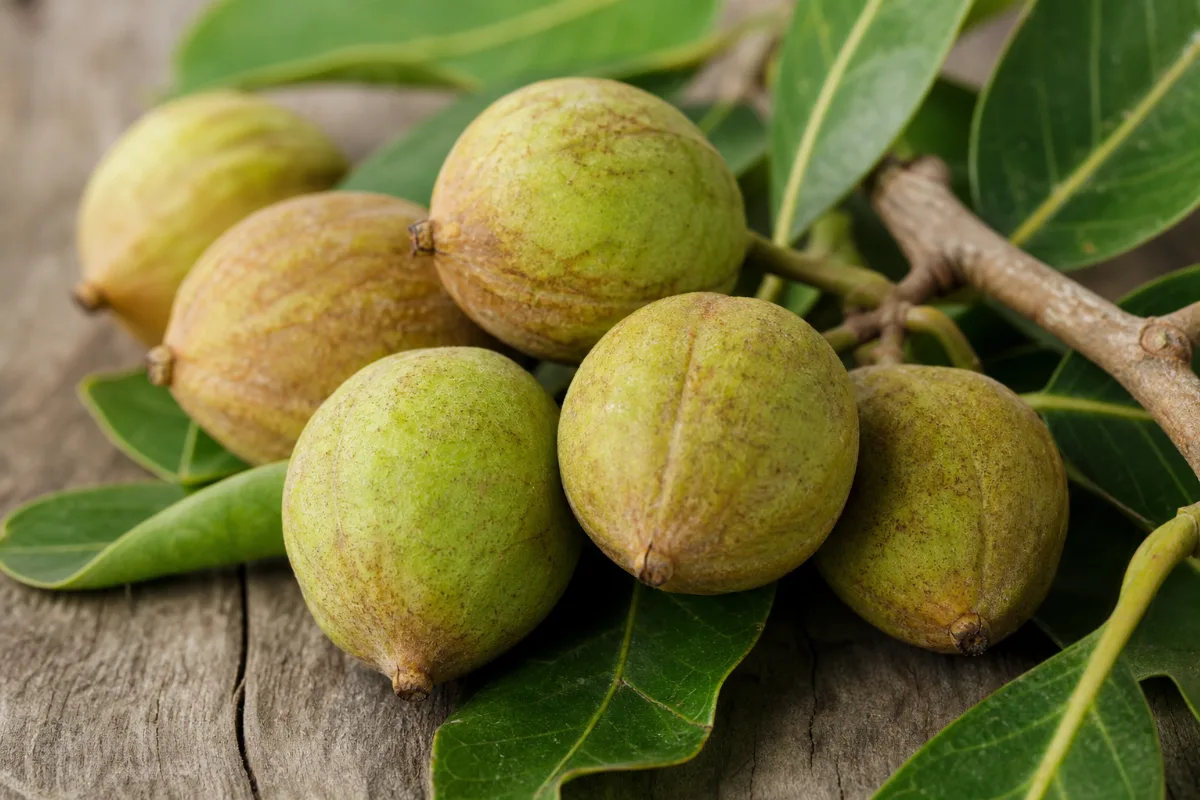
Herbs & Botanicals · Ayurvedic triphala fruit
Bibhitaki
Terminalia bellirica · also called Bahera, baheda, belleric myrobalan
Bibhitaki is the dried fruit of a South Asian tree and one of the three fruits in the Ayurvedic blend triphala. It is used for digestion and as a mouth rinse. Human trials tested triphala, not bibhitaki alone, so its own benefits are unproven. The main caution is that it may lower blood sugar and is not advised in pregnancy.
General information, not medical advice. Last substantive update · Not medically reviewed. A named clinician has not signed off on this page. How this page is made
About Bibhitaki
Bibhitaki is a traditional Ayurvedic fruit and part of triphala. Human evidence is for the blend, and safety research on bibhitaki alone is thin.
What it is
Bibhitaki is the dried fruit of Terminalia bellirica, a tree from South Asia. It is one of the three fruits of triphala, with haritaki and amla.
Its main compounds are tannins, gallic acid and ellagic acid.
How it may work
In the lab, its tannins and phenolic compounds are antioxidant and anti-inflammatory. Tannins also bind iron.
None of this has been shown to help people when bibhitaki is taken alone.
What the research shows
Human trials tested triphala. A review of 12 trials found lower cholesterol and weight in some, and lower fasting glucose in people with diabetes. Triphala mouthwash did about as well as chlorhexidine for gum inflammation in adults.
For bibhitaki alone, we found only lab and animal studies and one short mouth-rinse trial measuring bacteria.
At a glance
Traditional uses history, not proof
- Digestive remedy in Ayurveda
- One of the three fruits of triphala
- Used in Unani, Siddha and traditional Chinese medicine, per a review
Studied for research
- Cholesterol, weight and blood sugar (triphala blend), insufficient
- Gum health and mouth rinses (triphala blend), moderate
- Constipation and digestion, insufficient
- Antioxidant and organ protection (lab and animal), insufficient
Main compounds
- Tannins
- Gallic acid (PubChem CID 370)
- Ellagic acid (PubChem CID 5281855)
Common forms
- Dried fruit
- Powder
- Capsules or tablets
- Extract
- Triphala blend
Research links: Gupta 2020: Terminalia bellirica review (PubMed) · Phimarn 2021: Triphala, lipids, glucose and weight (PubMed) · AlJameel 2020: Triphala mouthrinse meta-analysis (PubMed) · Saper 2008: Metals in Ayurvedic medicines (PubMed) · Research Library · Genes & Biomarkers Library
The plant and its history
- Accepted scientific name
- Terminalia bellirica (Gaertn.) Roxb. (GBIF ACCEPTED, exact match, confidence 99)
- Naming authority
- (Gaertn.) Roxb.
- Synonyms
- Terminalia belerica; Terminalia bellerica; Myrobalanus bellirica
- Common names
- Bibhitaki (Sanskrit); Bahera (Hindi); Baheda (Hindi); Belleric myrobalan (English)
- Botanical family
- Combretaceae
- Classification
- Plantae > Tracheophyta > Magnoliopsida > Myrtales > Combretaceae > Terminalia > Terminalia bellirica
- Native range
- A review describes it as one of the oldest medicinal herbs of India, Pakistan, Nepal, Bangladesh, Sri Lanka and South-East Asia. Exact native range not verified.
- Habitat
- Not covered in the sources read.
- What the plant looks like
- Roots: Not covered.; Stems: Large tree; details not covered.; Leaves: Not covered.; Flowers: Not covered.; Fruit: The dried fruit is the part used.; Seeds: Not covered.; Cultivation: Not covered.
- Harvest and processing
- Not covered in the sources read.
- Look-alikes and adulterants
- Name: Terminalia chebula (haritaki) and amla (Phyllanthus emblica); Note: The other two triphala fruits; different species with their own pages. A consumer reference warns of mix-ups between Terminalia species.
- Sustainability and conservation
- Not covered in the sources read.
Traditional use and history history, not clinical proof
| Tradition or era | Documented use | Source |
|---|---|---|
| Ayurveda, Unani, Siddha and traditional Chinese medicine | Described as one of the oldest medicinal herbs of South Asia and used as one of the three fruits of triphala. | p32781393 |
| Triphala in Ayurveda | Triphala combines the three myrobalan fruits, often in equal parts per the Ayurvedic Formulary (as stated in a dental trial). | p28384980 |
Traditional use shows how a plant was used. It does not show that a supplement works or is safe today.
What is inside, and how it may work
What the plant contains and how those compounds act in cells and animals. Laboratory and animal mechanisms are not proven effects in people.
Main compounds
| Compound | Family | Where it is concentrated | Activity studied | Level of evidence |
|---|---|---|---|---|
| Gallic acid PubChem 370 | Phenolic acid | Fruit | Antioxidant in the lab; tannins release it. 13 3 | Lab |
| Ellagic acid PubChem 5281855 | Polyphenol | Fruit | Antioxidant in the lab. 14 3 | Lab |
| Tannins (including chebulagic acid, corilagin, galloyl glucose) | Hydrolysable tannins | Fruit | Astringent; bind iron and proteins. Content varies by maker. 3 2 | Lab |
Mechanisms, receptors and pathways
| Target or pathway | Gene or receptor | What was found | Level |
|---|---|---|---|
| Antioxidant and anti-inflammatory pathways | Not detailed in the sources read | The 2020 review attributes bibhitaki's effects to its tannins and phenolic compounds in lab and animal studies. 3 | Lab and animal |
| Iron binding in the gut | n/a | Tannins form insoluble complexes with iron and reduce its absorption (shown for tea tannins in people, not for bibhitaki). 2 | Human (tea tannins) |
Absorption, metabolism and elimination
- Absorption
- Not found for bibhitaki in people.
- Distribution
- Not found.
- Metabolism
- Not found.
- Elimination
- Not found.
- Bioavailability
- No human blood-level study was found.
Isolated compounds versus whole extracts
Lab studies test bibhitaki extracts and single compounds such as gallic acid. Human trials use the triphala blend. No source compares isolated compounds with the whole fruit.
Nutritional composition
Bibhitaki is a medicinal fruit used dried, not a nutrient source. Its tannins can reduce iron absorption.
1 moderate certainty6 not enough evidence
What is Bibhitaki good for?
The studied uses and how strong the human evidence is for each. Most human evidence is for the triphala blend, not bibhitaki alone.
Benefits, one by one
Each card is a research question, not a promise. Tap a goal to filter. Open a card to see the studies, doses and limits.
Blood sugar, cholesterol and weight (triphala blend; bibhitaki alone is lab and animal only)
Not enough evidenceTriphala, the three-fruit blend, lowered cholesterol and weight in some small trials. Bibhitaki on its own has only been tested in cells and animals for this.
3 studiesTriphala is a three-fruit blend; ratios and products varied between t…
Studies, doses and limits
What the trials found
No human trial of bibhitaki alone was found. A 2021 systematic review of 12 triphala trials (749 people) found lower LDL, total cholesterol and triglycerides in 6 studies, lower body weight, BMI and waist in 5 trials in obese people, and lower fasting glucose in people with diabetes but not in people without it.
Results
Triphala blend: lipids and weight improved in several small trials. Bibhitaki alone: no human results.
Effect sizes as reported
Blend only; no pooled numbers in the abstract.
Why this rating
For bibhitaki alone the evidence is lab and animal only. The triphala trials are small and varied, and the reviewers ask for larger trials.
Form and dose studied
Triphala is a three-fruit blend; ratios and products varied between trials.
Who was studied
Adults with high cholesterol, obesity or diabetes in the triphala trials.
Limits
Results cannot be credited to bibhitaki alone. The review authors call for large well-designed trials.
Why researchers looked
Reviews of bibhitaki describe blood-sugar-lowering and cholesterol-lowering effects in lab and animal work, and triphala trials measured these numbers.
Traditional use
Bibhitaki is a standard part of triphala in Ayurveda.
Proposed mechanism Lab and animal
Lab and animal extracts act on blood sugar and fat handling; the reviews do not settle how.
A proposed mechanism does not show that the effect happens in people.
Bibhitaki may lower blood sugar and has little safety research. See the Safety tab, especially if you take diabetes medicine or are pregnant.
Gum health and mouth bacteria (triphala rinse)
Moderate certaintyTriphala mouthwash did about as well as the standard antiseptic rinse in trials of gum inflammation. A small trial also tested a bibhitaki-only rinse on mouth bacteria.
3 studiesRinses of triphala or bibhitaki extract; not a swallowed supplement.
Studies, doses and limits
What the trials found
Meta-analysis of 7 trials: triphala mouthwash improved gingival and plaque scores and the authors judged it similar to chlorhexidine (gingival index difference -0.29, plaque -0.43; very high heterogeneity). In children, 5 studies showed no significant difference from chlorhexidine. In a crossover trial a 10% bibhitaki rinse lowered Streptococcus mutans counts in saliva, though triphala lowered them more.
Results
Triphala rinses matched chlorhexidine in adults; no difference in children; bibhitaki-only rinse lowered bacteria counts.
Effect sizes as reported
Gingival index -0.29 (95% CI -0.40 to -0.17); plaque index -0.43 (-0.54 to -0.31), triphala blend.
Why this rating
Several controlled trials point the same way, but they are small, differ a lot and test the blend, not bibhitaki alone.
Form and dose studied
Rinses of triphala or bibhitaki extract; not a swallowed supplement.
Who was studied
Adults and children with gingivitis; healthy adults for the bacteria trial.
Limits
Very high heterogeneity; the bacteria trial measured counts, not gum disease.
Why researchers looked
Triphala rinses are a traditional oral-care use and have been compared with chlorhexidine.
Traditional use
Triphala is used in Ayurvedic oral care.
Proposed mechanism Lab
Tannins and other compounds slow bacteria in the lab.
A proposed mechanism does not show that the effect happens in people.
Rinses are not swallowed, but the safety notes still apply if swallowed.
Constipation and digestion
Not enough evidenceBibhitaki is used in Ayurveda for digestion, but no good human trial of bibhitaki alone was found.
2 studiesNot applicable.
Studies, doses and limits
What the trials found
A consumer reference lists constipation and diarrhea as traditional uses with no good scientific evidence. One open-label study of a powder containing psyllium, senna and triphala extract in 34 people with constipation found more weekly bowel movements, but senna is a laxative so the result says nothing about bibhitaki.
Results
No bibhitaki-only numbers.
Effect sizes as reported
Not applicable.
Why this rating
No controlled trial of bibhitaki alone; the one combination study had no control group.
Form and dose studied
Not applicable.
Who was studied
Not tested alone.
Limits
Combination product and no control group.
Why researchers looked
Traditional digestive use as one of the three triphala fruits.
Traditional use
Triphala is a traditional bowel and digestive remedy.
Proposed mechanism None
Not established.
A proposed mechanism does not show that the effect happens in people.
Bibhitaki's tannins can be constipating or irritating to some people; see the Safety tab.
Gut bacteria (triphala blend)
Not enough evidenceA small trial of triphala in healthy adults found changes in gut bacteria that differed from person to person. It did not show a health benefit.
1 studiesTriphala blend (bibhitaki, haritaki and amla).
Studies, doses and limits
What the trials found
A 4-week randomized, placebo-controlled pilot in 31 healthy adults found responses were highly personalized and no bacterial group changed in everyone. Both herb groups tended toward more Akkermansia and a lower Firmicutes to Bacteroidetes ratio. No health outcome was measured.
Results
Trends only.
Effect sizes as reported
Not applicable.
Why this rating
Tiny pilot, healthy people, blend, no health outcome.
Form and dose studied
Triphala blend (bibhitaki, haritaki and amla).
Who was studied
31 healthy adults, 29 analysed.
Limits
Pilot with 9 people in the triphala group.
Why researchers looked
Triphala is thought to act partly through gut bacteria.
Traditional use
Triphala is a traditional gut remedy.
Proposed mechanism Lab
Tannins and fibre-like compounds may feed or change gut bacteria; not shown.
A proposed mechanism does not show that the effect happens in people.
See the Safety tab.
Antioxidant, anti-inflammatory, liver and kidney protection (lab and animal only)
Not enough evidenceIn cells and animals, bibhitaki extracts show antioxidant, anti-inflammatory, liver-protective and kidney-protective effects. None of this has been shown in people.
2 studiesVarious extracts in the lab studies.
Studies, doses and limits
What the trials found
No human trial of bibhitaki for these uses was found. The 2020 review says clinical trials are still needed.
Results
None in people.
Effect sizes as reported
Not applicable.
Why this rating
Lab and animal evidence only.
Form and dose studied
Various extracts in the lab studies.
Who was studied
Not tested in people.
Limits
A test-tube antioxidant effect does not mean a health effect after swallowing.
Why researchers looked
Bibhitaki is rich in tannins, gallic acid and ellagic acid, which are strong antioxidants in the test tube.
Traditional use
Used in Ayurveda, Unani, Siddha and traditional Chinese medicine, per a review.
Proposed mechanism Lab and animal
Gallic acid, ellagic acid, corilagin and chebulagic acid are antioxidant and anti-inflammatory in lab work.
A proposed mechanism does not show that the effect happens in people.
See the Safety tab.
Cancer cells (lab only)
Not enough evidenceBibhitaki compounds slow some cancer cells in the lab. There is no human evidence, and it is not a cancer treatment.
2 studiesNot applicable.
Studies, doses and limits
What the trials found
No human trial found. MSK says anticancer effects of triphala were seen only in the laboratory (our earlier summary).
Results
None in people.
Effect sizes as reported
Not applicable.
Why this rating
Cell studies only.
Form and dose studied
Not applicable.
Who was studied
Not tested in people.
Limits
A lab effect on cancer cells is not a treatment. People with cancer should ask their care team before using any herb.
Why researchers looked
Lab screening of tannin-rich fruits.
Traditional use
Not documented for cancer.
Proposed mechanism Lab
Antiproliferative effects in cells.
A proposed mechanism does not show that the effect happens in people.
See the Safety tab.
Traditional Ayurvedic use as part of triphala
Not enough evidenceBibhitaki is one of the oldest medicinal fruits of South Asia and one of the three fruits of triphala. Tradition is not proof that it works.
2 studiesDried fruit, powder or triphala blend.
Studies, doses and limits
What the trials found
Traditional use only; no human trial of bibhitaki alone.
Results
Not applicable.
Effect sizes as reported
Not applicable.
Why this rating
Tradition without trial evidence.
Form and dose studied
Dried fruit, powder or triphala blend.
Who was studied
Not applicable.
Limits
Tradition is not evidence of benefit.
Why researchers looked
Triphala is a classic Ayurvedic rejuvenating blend.
Traditional use
One of the oldest medicinal herbs of India, Pakistan, Nepal, Bangladesh, Sri Lanka and South-East Asia, per a review.
Proposed mechanism None
Not applicable.
A proposed mechanism does not show that the effect happens in people.
See the Safety tab.
Connections to the rest of health
How Bibhitaki connects to the rest of our health knowledge graph. Every link says what kind of connection it is. A safety link (for example to the liver) is a warning, not a benefit. A study that merely mentions a topic never creates a benefit link.
Explore every connection: goals, body systems, organs, symptoms, genes
A. Wellness goals
| Connected to | Kind of connection | Evidence status | Context | Studies |
|---|---|---|---|---|
| Blood Sugar Balance | Not enough evidence | Blood sugar, cholesterol and weight (triphala blend; bibhitaki alone is lab and animal only): Triphala, the three-fruit blend, lowered cholesterol and weight in some small trials. Bibhitaki on its own has only been tested in cells and animals for this. | 3 7 16 | |
| Cholesterol Balance | Not enough evidence | Blood sugar, cholesterol and weight (triphala blend; bibhitaki alone is lab and animal only): Triphala, the three-fruit blend, lowered cholesterol and weight in some small trials. Bibhitaki on its own has only been tested in cells and animals for this. | 3 7 16 | |
| Weight Management | Not enough evidence | Blood sugar, cholesterol and weight (triphala blend; bibhitaki alone is lab and animal only): Triphala, the three-fruit blend, lowered cholesterol and weight in some small trials. Bibhitaki on its own has only been tested in cells and animals for this. | 3 7 16 | |
| Healthy Teeth Gums | Moderate certainty | Gum health and mouth bacteria (triphala rinse): Triphala mouthwash did about as well as the standard antiseptic rinse in trials of gum inflammation. A small trial also tested a bibhitaki-only rinse on mouth bacteria. | 1 4 9 | |
| Digestive Support | Not enough evidence | Constipation and digestion: Bibhitaki is used in Ayurveda for digestion, but no good human trial of bibhitaki alone was found. | 16 5 | |
| Gut Health | Not enough evidence | Constipation and digestion: Bibhitaki is used in Ayurveda for digestion, but no good human trial of bibhitaki alone was found. | 16 5 | |
| Microbiome Balance | Preliminary mechanism | Not enough evidence | Gut bacteria (triphala blend): A small trial of triphala in healthy adults found changes in gut bacteria that differed from person to person. It did not show a health benefit. | 6 |
| Gut Health | Preliminary mechanism | Not enough evidence | Gut bacteria (triphala blend): A small trial of triphala in healthy adults found changes in gut bacteria that differed from person to person. It did not show a health benefit. | 6 |
| Cellular Protection | Preliminary mechanism | Not enough evidence | Antioxidant, anti-inflammatory, liver and kidney protection (lab and animal only): In cells and animals, bibhitaki extracts show antioxidant, anti-inflammatory, liver-protective and kidney-protective effects. None of this has been shown in people. Cancer cells (lab only): Bibhitaki compounds slow some cancer cells in the lab. There is no human evidence, and it is not a cancer treatment. | 3 10 11 |
| Inflammation Balance | Preliminary mechanism | Not enough evidence | Antioxidant, anti-inflammatory, liver and kidney protection (lab and animal only): In cells and animals, bibhitaki extracts show antioxidant, anti-inflammatory, liver-protective and kidney-protective effects. None of this has been shown in people. | 3 10 |
| Liver Support | Preliminary mechanism | Not enough evidence | Antioxidant, anti-inflammatory, liver and kidney protection (lab and animal only): In cells and animals, bibhitaki extracts show antioxidant, anti-inflammatory, liver-protective and kidney-protective effects. None of this has been shown in people. | 3 10 |
| Holistic Balance | Not enough evidence | Traditional Ayurvedic use as part of triphala: Bibhitaki is one of the oldest medicinal fruits of South Asia and one of the three fruits of triphala. Tradition is not proof that it works. | 3 11 |
B. Body systems
| Connected to | Kind of connection | Evidence status | Context | Studies |
|---|---|---|---|---|
| Metabolism Weight | Biological association | Not enough evidence | Studied for: Blood sugar, cholesterol and weight (triphala blend; bibhitaki alone is lab and animal only) | 3 7 16 |
| Digestive System | Biological association | Moderate certainty | Studied for: Gum health and mouth bacteria (triphala rinse) Studied for: Constipation and digestion | 1 4 9 16 5 6 |
| Immune System | Biological association | Not enough evidence | Studied for: Antioxidant, anti-inflammatory, liver and kidney protection (lab and animal only) Studied for: Cancer cells (lab only) | 3 10 11 |
| Hepatic System | Biological association | Not enough evidence | Studied for: Antioxidant, anti-inflammatory, liver and kidney protection (lab and animal only) | 3 10 |
| Whole Body Balance | Biological association | Not enough evidence | Studied for: Traditional Ayurvedic use as part of triphala | 3 11 |
I. Biomarkers
| Connected to | Kind of connection | Evidence status | Context | Studies |
|---|---|---|---|---|
| Gingival index and plaque index (gum redness and plaque score) | Biological association | Measured in trials: lowered. A lab change is not the same as a health benefit. |
K. Biological pathways
| Connected to | Kind of connection | Evidence status | Context | Studies |
|---|---|---|---|---|
| Iron (non-haem) | Preliminary mechanism | Human (tea tannins) | Tannins bind iron and reduce absorption; shown for tea. | 2 |
L. Active compounds
| Connected to | Kind of connection | Evidence status | Context | Studies |
|---|---|---|---|---|
| Gallic acid | Biological association | Lab | Antioxidant in the lab; tannins release it. Preparation or compound: Fruit |
13 3 |
| Ellagic acid | Biological association | Lab | Antioxidant in the lab. Preparation or compound: Fruit |
14 3 |
| Tannins (including chebulagic acid, corilagin, galloyl glucose) | Biological association | Lab | Astringent; bind iron and proteins. Content varies by maker. Preparation or compound: Fruit |
3 2 |
Each connection is stored with the ingredient, the connected record, the kind of connection, the evidence status, the supporting studies, the preparation or compound involved, and a review date (last reviewed October 25, 2026).
Evidence at a glance: what changed in 1 lab markers
Tap a number to show only those markers. Counts are markers, not people.
The evidence
The research centre for Bibhitaki. Every record here was checked against PubMed or the publisher's page; we never list a study we have not verified.
Evidence by outcome
Bars show how many studies we found for each outcome, not how well it works. People are added up across trials only (reviews are not added, to avoid double counting).
How we rate evidence
High certainty
Several well-run trials or reviews agree; further research is unlikely to change the picture much.
Moderate certainty
Good trials point the same way, but some doubt remains.
Low certainty
Small, short or inconsistent trials. The finding could change with better research.
Very low certainty
Very little or very weak human data. Treat as a possibility only.
Mixed findings
Trials or reviews disagree with each other.
Not enough evidence
Not enough human research to say either way.
Evidence against
Good research found no benefit, or found harm.
We take the reviewers' own risk-of-bias and GRADE statements where they exist, and otherwise judge from study size, design, consistency, directness and whether a product matches what is sold. Many publications do not make evidence high. Method note: We started from our existing bibhitaki summary, then added PubMed reviews and trials read as abstracts. Names were checked in GBIF and NCBI Taxonomy and compounds in PubChem. LiverTox could not be read.
Study library: every study we checked 17
| Study | Design | People | Product, dose, length | Result |
|---|---|---|---|---|
| AlJameel 2020 Effect of triphala mouthrinse on plaque and gingival inflammation: A systematic review and meta-analysis of randomized controlled trials. Int J Dent Hyg · PMID 32383334 · DOI |
Meta-analysis |
7 randomized trials of plaque-induced gingivitis | Triphala mouthwash (three-fruit blend including bibhitaki) Dried fruits (blend) Not stated in the abstract Not stated · vs Chlorhexidine mouthwash |
The pooled difference versus chlorhexidine was -0.29 for gingival index and -0.43 for plaque index, both statistically significant. Heterogeneity was very high (I2 above 90%). The authors concluded triphala mouthwash had clinical efficacy equal to chlorhexidine. GI WMD -0.29; PI WMD -0.43 (GI -0.40 to -0.17; PI -0.54 to -0.31) Methods, limits and fundingOutcomes: Gingival index and plaque index Limitations: Very high heterogeneity; small trials; blend, not bibhitaki alone. The abstract's wording on direction versus chlorhexidine is not fully clear, so we state only the authors' conclusion of similar effect. Funding and conflicts: None stated in the abstract. Read: abstract |
| Disler 1975 The effect of tea on iron absorption. Gut · PMID 1168162 · DOI |
Human physiology study |
Human volunteers | Tea (tannin-rich drink), not bibhitaki n/a Not stated in the abstract Single meals · vs Meals without tea |
Tea inhibited absorption of non-haem iron from several test meals, which the authors ascribed to insoluble iron tannate complexes. This is about tea tannins, not bibhitaki, and is used only as the general tannin and iron principle. Inhibited iron absorption Methods, limits and fundingOutcomes: Non-haem iron absorption Limitations: Old study; different tannin source. No study of bibhitaki and iron was found. Funding and conflicts: Not stated in the abstract. Read: abstract |
| Gupta 2020 Terminalia bellirica (Gaertn.) roxb. (Bahera) in health and disease: A systematic and comprehensive review. Phytomedicine · PMID 32781393 · DOI |
Systematic review mostly lab and animal |
Published literature 1980 to March 2020, mostly lab and animal studies | Terminalia bellirica extracts and compounds Mostly fruit Not stated in the abstract Not stated · vs Not stated |
The abstract lists antioxidant, anti-inflammatory, immunomodulatory, antimicrobial, liver-protective, kidney-protective, antidiabetic, cholesterol-lowering and anticancer effects in lab and animal studies. It says more animal studies and clinical trials are needed. Not stated in the abstract Methods, limits and fundingOutcomes: Reported biological activities and clinical studies Limitations: Abstract only; the abstract gives no list of human trials. Mostly lab and animal evidence. Funding and conflicts: No competing interests declared. Read: abstract |
| Minervini 2024 Comparative anti-plaque and anti-gingivitis efficiency of Triphala versus chlorhexidine mouthwashes in children: a systematic review and meta-analysis J Clin Pediatr Dent · PMID 39275820 · DOI |
Meta-analysis |
5 studies in children | Triphala mouthwash (blend) Dried fruits (blend) Not stated in the abstract Not stated · vs Chlorhexidine mouthwash |
No significant difference between triphala and chlorhexidine for gingivitis or plaque in children (p = 0.83 and 0.96). No significant difference Methods, limits and fundingOutcomes: Plaque index and gingival index Limitations: Five studies; blend, not bibhitaki alone; abstract gives no certainty rating. Funding and conflicts: None declared. Read: abstract |
| Munshi 2011 An open-label, prospective clinical study to evaluate the efficacy and safety of TLPL/AY/01/2008 in the management of functional constipation. J Ayurveda Integr Med · PMID 22022157 · DOI |
Open label study |
34 34 patients with functional constipation |
Proprietary powder with psyllium (isabgol) husk, senna extract and triphala extract Mixed Not stated here 14 days · vs None (open-label) |
Weekly bowel movements rose from 10.19 to 18.29 (P < 0.05) and stool form improved. The product also contains senna, a known laxative, so the effect cannot be credited to triphala or bibhitaki. 10.19 to 18.29 bowel movements per week Methods, limits and fundingOutcomes: Weekly bowel movements and stool form Limitations: No control group; combination with senna and psyllium; says nothing about bibhitaki alone. Possible industry link not stated in the abstract. Funding and conflicts: Not stated in the abstract. Read: abstract |
| Peterson 2020 Modulatory Effects of Triphala and Manjistha Dietary Supplementation on Human Gut Microbiota: A Double-Blind, Randomized, Placebo-Controlled Pilot Study. J Altern Complement Med · PMID 32955913 · DOI |
Randomized controlled trial |
31 31 healthy adults (29 completed analysis: triphala 9, manjistha 9, placebo 11) |
Triphala supplement (blend of amla, T. bellirica, T. chebula) Dried fruits (blend) 2,000 mg daily (per abstract) 4 weeks · vs Placebo |
Responses were highly personalized and no bacterial group changed uniformly. Both herb groups tended toward a lower Firmicutes to Bacteroidetes ratio and more Akkermansia muciniphila, and both had less Rikenellaceae. The authors say there was no clear response signature. No uniform change; trends only Methods, limits and fundingOutcomes: Gut bacteria profile (16S) Limitations: Pilot with 9 people in the triphala group; healthy volunteers; blend; no health outcome measured. Funding not stated in the abstract. Funding and conflicts: Not stated in the abstract. Read: abstract |
| Phimarn 2021 Effects of Triphala on Lipid and Glucose Profiles and Anthropometric Parameters: A Systematic Review. J Evid Based Integr Med · PMID 33886393 · DOI |
Systematic review |
749 12 randomized trials, 749 patients |
Triphala (three-fruit blend including bibhitaki) Dried fruits (blend) Varied; not stated in the abstract Varied · vs Placebo or other comparators in the included trials |
Triphala groups had lower LDL cholesterol, total cholesterol and triglycerides in 6 studies. Five trials showed lower body weight, BMI and waist in obese patients. Fasting glucose fell in people with diabetes but not in people without it. No serious adverse event was reported. Statistically significant lowering in several trials; no pooled numbers in the abstract Methods, limits and fundingOutcomes: LDL, total cholesterol, triglycerides, body weight, BMI, waist, fasting glucose, safety Limitations: Triphala is a blend, so results cannot be credited to bibhitaki alone. Trials were small and varied; the authors say large well-designed trials are needed. Funding and conflicts: No conflicts declared. Read: abstract |
| Saper 2008 Lead, mercury, and arsenic in US- and Indian-manufactured Ayurvedic medicines sold via the Internet. JAMA · PMID 18728265 · DOI |
Cross sectional survey human (product testing) |
193 193 Ayurvedic medicines bought online in 2005 |
Ayurvedic products of many kinds (not bibhitaki-specific) Mixed n/a n/a · vs n/a |
20.7% (95% CI 15.2 to 27.1) contained detectable lead, mercury or arsenic; similar in US-made (21.7%) and Indian-made (19.5%) products. Products made with metals on purpose (rasa shastra) were more likely to contain them (40.6% vs 17.1%). All metal-containing products exceeded at least one daily-intake standard. 20.7% of products had detectable metals (15.2 to 27.1) Methods, limits and fundingOutcomes: Detectable lead, mercury or arsenic Limitations: Products from 2005; not a test of herb-only fruit powders such as bibhitaki, and the study did not single out triphala or bibhitaki. Funding and conflicts: NIH extramural support (per publication type); no industry link stated. Read: abstract |
| Saxena 2017 Anti Bacterial Efficacy of Terminalia Chebula, Terminalia Bellirica, Embilica Officinalis and Triphala on Salivary Streptococcus Mutans Count - A Linear Cross Over Study. J Clin Diagn Res · PMID 28384980 · DOI |
Crossover trial |
People aged 15 to 40 visiting a dental public health department (size not stated in the abstract) | 10% aqueous fruit-extract rinses: T. bellirica alone, T. chebula, amla, and triphala Dried fruit 15 ml of 10% rinse (per abstract) Single rinse; saliva at 5 and 60 minutes · vs Other rinses in the same people |
All four rinses reduced S. mutans counts. Triphala reduced counts more than its single fruits (p = 0.001); amla reduced them least. The abstract does not give the bellirica-only numbers. Triphala > single fruits; bellirica-only figure not given Methods, limits and fundingOutcomes: Salivary Streptococcus mutans colony counts Limitations: Short-term bacteria counts, not cavities or gum disease. Not blinded to the extent a placebo trial would be; no placebo arm stated. Bellirica-only numbers not in the abstract. Funding and conflicts: None stated in the abstract. Read: abstract |
| n/a 2020 Plants of the Genus Terminalia: An insight on its biological potentials, pre-clinical and clinical studies Frontiers in Pharmacology (review, summary-only) · Source |
Review n/a |
n/a | n/a n/a n/a n/a · vs n/a |
Our earlier summary lists the genus review as covering lab, animal and clinical work on Terminalia species. Not re-opened for this build. n/a Methods, limits and fundingOutcomes: Identity or regulatory status Limitations: Summary-only: not re-opened. Genus-level review, not specific to bibhitaki. Funding and conflicts: n/a Read: summary-only |
| n/a 2022 Triphala (Memorial Sloan Kettering Cancer Center, About Herbs) Memorial Sloan Kettering Cancer Center (summary-only) · Source |
Database or regulator record n/a |
n/a | n/a n/a n/a n/a · vs n/a |
Our earlier summary says MSK describes triphala, notes that anticancer effects are lab only and mentions possible medicine interactions through liver enzymes. Not re-opened for this build. n/a Methods, limits and fundingOutcomes: Identity or regulatory status Limitations: Summary-only: not re-opened. About triphala, not bibhitaki alone. Funding and conflicts: n/a Read: summary-only |
| n/a 2026 Regulator and reference search for Terminalia bellirica (EMA/HMPC, NCCIH, WHO, LiverTox, LactMed) Search record (2026-10-25) · Source |
Database or regulator record n/a |
n/a | n/a n/a n/a n/a · vs n/a |
No EMA/HMPC, NCCIH or WHO monograph for T. bellirica was found in the earlier search. LiverTox returned a bot-check page and could not be read. LactMed was not searched. n/a Methods, limits and fundingOutcomes: Identity or regulatory status Limitations: Record of what could not be read; not evidence of safety. Funding and conflicts: n/a Read: full-text |
| n/a 2026 PubChem compound record: gallic acid (CID 370) PubChem PUG REST (checked 2026-10-25) · Source |
Database or regulator record n/a |
n/a | n/a n/a n/a n/a · vs n/a |
CID 370, gallic acid, formula C7H6O5, IUPAC name 3,4,5-trihydroxybenzoic acid. n/a Methods, limits and fundingOutcomes: Identity or regulatory status Limitations: Identity only. Funding and conflicts: n/a Read: full-text |
| n/a 2026 PubChem compound record: ellagic acid (CID 5281855) PubChem PUG REST (checked 2026-10-25) · Source |
Database or regulator record n/a |
n/a | n/a n/a n/a n/a · vs n/a |
CID 5281855, ellagic acid, formula C14H6O8. n/a Methods, limits and fundingOutcomes: Identity or regulatory status Limitations: Identity only. Funding and conflicts: n/a Read: full-text |
| n/a 2026 GBIF Backbone Taxonomy species match: Terminalia bellirica GBIF API (checked 2026-10-25) · Source |
Database or regulator record n/a |
n/a | n/a n/a n/a n/a · vs n/a |
Terminalia bellirica (Gaertn.) Roxb. returned ACCEPTED, exact match, confidence 99, key 3189390, family Combretaceae, order Myrtales. n/a Methods, limits and fundingOutcomes: Identity or regulatory status Limitations: Taxonomy only. Funding and conflicts: n/a Read: full-text |
| n/a n.d. Terminalia bellirica monograph (Natural Medicines content via vital.ly) Consumer drug reference (summary-only) · Source |
Database or regulator record n/a |
n/a | n/a n/a n/a n/a · vs n/a |
Our earlier summary says it lists traditional use for constipation, diarrhea and high cholesterol with no good scientific evidence, a moderate possible interaction with diabetes medicines, and precautions in pregnancy and before surgery. n/a Methods, limits and fundingOutcomes: Identity or regulatory status Limitations: Summary-only: not re-opened. Consumer reference; it cites animal and lab work for the diabetes and surgery cautions. Sources disagree on oral safety wording. Funding and conflicts: n/a Read: summary-only |
| n/a n.d. Terminalia (RxList supplements) RxList consumer drug reference (summary-only) · Source |
Database or regulator record n/a |
n/a | n/a n/a n/a n/a · vs n/a |
Our earlier summary says it covers possible blood-sugar lowering, a caution before surgery, pregnancy and breastfeeding, and species mix-ups in products. n/a Methods, limits and fundingOutcomes: Identity or regulatory status Limitations: Summary-only: not re-opened. Consumer reference, genus level. Funding and conflicts: n/a Read: summary-only |
What we do not know yet
- No human trial of bibhitaki alone.
- LiverTox could not be read; no EMA, NCCIH or WHO monograph was found.
- No testing of bibhitaki products for species or heavy metals.
How new research is added
New studies are found by a saved PubMed search and placed in a review queue. A person reads each one before it changes any rating or safety wording.
Lab markers
What changed in blood or saliva tests during trials. A changed number is not the same as feeling or being healthier, and we give no "normal ranges".
Other 1
Gingival index and plaque index (gum redness and plaque score)
Lowered in trials
Dentist-scored measures of gum inflammation and plaque on the teeth. Lower scores mean healthier gums.
Results and what it means
Why it was measured
Main outcome of triphala mouthwash trials.
| Study | Result | People | Product |
|---|---|---|---|
| 1 | Gingival index -0.29 (CI -0.40 to -0.17); plaque index -0.43 (CI -0.54 to -0.31); judged similar to chlorhexidine | 7 randomized trials, plaque-induced gingivitis | Triphala mouthwash (blend) |
| 4 | No significant difference from chlorhexidine (p = 0.83 gingival, 0.96 plaque) | 5 studies in children | Triphala mouthwash (blend) |
Safety
What studies and official sources say about side effects, medicines and who should check first. Each point shows what kind of evidence it comes from.
Main points to know 4
- Very little human safety research on bibhitaki alone. We found no human trial of bibhitaki on its own and no regulator monograph. Safety statements come mostly from consumer references and from triphala trials, where no serious side effect was reported. Gap 7 16 12
- May lower blood sugar. Consumer references rate a possible interaction with diabetes medicines as moderate, based on animal and lab findings. Triphala trials found lower fasting glucose in people with diabetes. Ask a doctor or pharmacist if you use diabetes medicine. Authoritative guidance 16 17 7
- Pregnancy and breastfeeding: avoid. Consumer references advise against use in pregnancy and breastfeeding because safety is not established. No human study was found. Authoritative guidance 16 17
- Heavy metals in some Ayurvedic products. A JAMA survey of Ayurvedic medicines bought online found about one in five contained detectable lead, mercury or arsenic. It did not test bibhitaki products specifically, but it is a reason to choose products with independent testing. Human observational 8
Side effects 2
| Effect | How often | Severity and recovery | Evidence |
|---|---|---|---|
| No serious adverse event reported in triphala trials This is for the triphala blend, not bibhitaki alone, and trials were small and short. | Not established | Not applicable Not applicable | Human trial review 7 |
| Stomach upset, constipation or loose stools A consumer reference lists digestive use both for constipation and diarrhea. Specific side-effect rates for bibhitaki were not found. | Not established | Mild to moderate (expected for tannin-rich fruits) Not stated | Authoritative guidance 16 |
Liver
No case report of liver injury linked to bibhitaki was found, but LiverTox returned a bot-check page and could not be read, so its rating is unknown. Lab and animal studies describe liver-protective effects, which are not proof of safety. 3 12
How often. No rate is known.
Monitoring. No monitoring advice was found. Stop and seek care for yellow skin or eyes, dark urine or severe tiredness.
This is a safety connection. It is not evidence that Bibhitaki supports liver health.
Medicines and supplements 5
| With | Why it matters | Importance | Evidence | What to do |
|---|---|---|---|---|
| Diabetes medicines (insulin, metformin, sulfonylureas and others) prescription | Bibhitaki may lower blood sugar in animal and lab work; triphala trials lowered fasting glucose in people with diabetes. | Possible low blood sugar; no interaction study in people. | Authoritative guidance and trial review Low certainty 16 17 7 | Ask a doctor or pharmacist before combining, and monitor blood sugar. |
| Blood pressure medicines prescription | No source in our reading shows a blood pressure effect or interaction for bibhitaki. | Not established; no data. | Gap Not enough evidence 12 | Mention any herb to your prescriber if you take blood pressure medicine. |
| Anticoagulants (blood thinners) and surgery prescription | Consumer references advise stopping before surgery because of possible effects on blood sugar and bleeding; evidence is not clear. | Theoretical; no interaction study. | Authoritative guidance Very low certainty 16 17 | Tell your surgeon and avoid before surgery unless a doctor advises. |
| Medicines handled by liver enzymes (as part of triphala) prescription | MSK mentions possible effects of triphala on liver enzymes (our earlier summary). | Not shown for bibhitaki alone. | Authoritative guidance Very low certainty 11 | Ask a doctor or pharmacist before combining with any prescription medicine. |
| Iron supplements and iron-poor diets supplement-or-food | Tannins bind iron in the gut and reduce its absorption; this is shown for tea tannins, not tested for bibhitaki. | Could matter for people with iron deficiency or anemia. | Human physiology (tea), applied by analogy Low certainty 2 | If you have low iron, take tannin-rich herbs apart from iron doses and ask a clinician. |
Who should check first 5
| Situation | Advice | Evidence |
|---|---|---|
| Pregnancy and breastfeeding | Avoid; safety is not established. | Authoritative guidance 16 17 |
| Diabetes treated with medicine | Only with a doctor's advice and blood sugar checks. | Authoritative guidance 16 7 |
| Iron deficiency or anemia | Ask a clinician; tannins can reduce iron absorption. | Human physiology (tea), by analogy 2 |
| Before planned surgery | Stop and tell the surgical team. | Authoritative guidance 16 17 |
| Children | No safety data for bibhitaki; the triphala mouthwash studies in children did not report serious harm in the abstract, but a rinse is not a swallowed product. | Gap 4 |
Overdose, product quality and regulators
Summary. No toxic dose for bibhitaki was found in the sources read. The fruit is the part used and studied.
Animal. The 2020 review describes mostly beneficial animal findings; toxicity details were not in the abstract.
Human doses studied. None for bibhitaki alone.
High dose or long term signals. Not found. One consumer reference says up to 24 weeks may be possibly safe while another says there is insufficient data and to avoid; the sources disagree.
Overdose response. Not found.
Genotoxicity. Not found.
Toxic plant parts. The dried fruit is the traditional part. Other parts of the tree are not covered by the sources read.
Ayurvedic products can contain heavy metals and can be sold under mixed-up Terminalia names.
Heavy metals. Survey of 193 Ayurvedic medicines bought online: 20.7% had detectable lead, mercury or arsenic, similar in US-made and Indian-made products; products made with metals on purpose were most affected. The study did not single out bibhitaki or triphala. 8
Species mix-ups. A consumer reference warns about mix-ups between Terminalia species and products. No identity-testing study of bibhitaki products was found. 17
Haritaki. Haritaki (Terminalia chebula) is a different fruit with its own page; do not assume the two share safety data. 12
| Body | Action | Date |
|---|
When to get medical help
- Yellow skin or eyes, dark urine or severe tiredness.
- Signs of low blood sugar if you take diabetes medicine: shakiness, sweating, confusion.
- Swelling of the face or lips, or trouble breathing (allergy).
- Black stools or severe belly pain.
Stop the supplement and contact a clinician or emergency service. In the US, Poison Control is 1-800-222-1222.
General information only, not medical advice. Ask a clinician or pharmacist before use, especially with medicines, in pregnancy or with a health condition. See the Natural Remedy Safety guide.
Frequently asked questions
What is bibhitaki?
What is bibhitaki used for?
Does bibhitaki work?
Is bibhitaki the same as triphala?
No. Triphala is a blend of bibhitaki, haritaki and amla. Triphala results cannot be credited to bibhitaki alone.
How is it different from haritaki?
Is bibhitaki safe in pregnancy or breastfeeding?
Can bibhitaki affect diabetes medicine?
What about blood pressure medicines or blood thinners?
Does it affect iron?
Tannins can bind iron and reduce its absorption. This is shown for tea, not tested for bibhitaki. People with low iron should ask a clinician.
Can it upset the stomach?
Are Ayurvedic products safe from heavy metals?
Not always. A JAMA survey found about one in five Ayurvedic medicines bought online had detectable lead, mercury or arsenic. It did not test bibhitaki specifically.
Is there liver risk?
No case of liver injury from bibhitaki was found, but the liver reference could not be read, so we cannot rate it. Seek care for yellow skin or eyes.
Explore by health goal
Gut HealthCellular ProtectionBlood Sugar BalanceCholesterol BalanceWeight ManagementHealthy Teeth GumsDigestive SupportMicrobiome BalanceInflammation BalanceLiver SupportHolistic Balance
Editorial transparency
- Written by
- AlternativeMed editorial team. Research compiled with AI assistance, then checked against PubMed records.
- Medical review
- None. This page has not been reviewed by a physician or pharmacist.
- First published
- 2026-10-25
- Last substantive update
- 2026-10-25
- How we research
- We started from our existing bibhitaki summary, then added PubMed reviews and trials read as abstracts. Names were checked in GBIF and NCBI Taxonomy and compounds in PubChem. LiverTox could not be read.
- How we rate evidence
- See "How we rate evidence" in the Evidence tab.
- Independence
- No product is promoted on this page. No affiliate links are shown. Industry funding is flagged where an abstract shows it.
Sources 17
Each source was opened and checked. Where we read only the abstract, it says so. The small numbers in the text point here.
- AlJameel AH, Almalki SA. Effect of triphala mouthrinse on plaque and gingival inflammation: A systematic review and meta-analysis of randomized controlled trials.. Int J Dent Hyg. 2020. PMID 32383334. DOI 10.1111/idh.12444. (abstract)
- Disler PB, Lynch SR, Charlton RW, et al.. The effect of tea on iron absorption.. Gut. 1975. PMID 1168162. DOI 10.1136/gut.16.3.193. (abstract)
- Gupta A, Kumar R, Bhattacharyya P, et al.. Terminalia bellirica (Gaertn.) roxb. (Bahera) in health and disease: A systematic and comprehensive review.. Phytomedicine. 2020. PMID 32781393. DOI 10.1016/j.phymed.2020.153278. (abstract)
- Minervini G, Marrapodi MM, Tirupathi S, et al.. Comparative anti-plaque and anti-gingivitis efficiency of Triphala versus chlorhexidine mouthwashes in children: a systematic review and meta-analysis. J Clin Pediatr Dent. 2024. PMID 39275820. DOI 10.22514/jocpd.2024.103. (abstract)
- Munshi R, Bhalerao S, Rathi P, et al.. An open-label, prospective clinical study to evaluate the efficacy and safety of TLPL/AY/01/2008 in the management of functional constipation.. J Ayurveda Integr Med. 2011. PMID 22022157. DOI 10.4103/0975-9476.85554. (abstract)
- Peterson CT, Pourang A, Dhaliwal S, et al.. Modulatory Effects of Triphala and Manjistha Dietary Supplementation on Human Gut Microbiota: A Double-Blind, Randomized, Placebo-Controlled Pilot Study.. J Altern Complement Med. 2020. PMID 32955913. DOI 10.1089/acm.2020.0148. (abstract)
- Phimarn W, Sungthong B, Itabe H, et al.. Effects of Triphala on Lipid and Glucose Profiles and Anthropometric Parameters: A Systematic Review.. J Evid Based Integr Med. 2021. PMID 33886393. DOI 10.1177/2515690X211011038. (abstract)
- Saper RB, Phillips RS, Sehgal A, et al.. Lead, mercury, and arsenic in US- and Indian-manufactured Ayurvedic medicines sold via the Internet.. JAMA. 2008. PMID 18728265. DOI 10.1001/jama.300.8.915. (abstract)
- Saxena S, Lakshminarayan N, Gudli S, et al.. Anti Bacterial Efficacy of Terminalia Chebula, Terminalia Bellirica, Embilica Officinalis and Triphala on Salivary Streptococcus Mutans Count - A Linear Cross Over Study.. J Clin Diagn Res. 2017. PMID 28384980. DOI 10.7860/JCDR/2017/23558.9355. (abstract)
- n/a. Plants of the Genus Terminalia: An insight on its biological potentials, pre-clinical and clinical studies. Frontiers in Pharmacology (review, summary-only). 2020. (summary-only)
- n/a. Triphala (Memorial Sloan Kettering Cancer Center, About Herbs). Memorial Sloan Kettering Cancer Center (summary-only). 2022. (summary-only)
- n/a. Regulator and reference search for Terminalia bellirica (EMA/HMPC, NCCIH, WHO, LiverTox, LactMed). Search record (2026-10-25). 2026. (full-text)
- n/a. PubChem compound record: gallic acid (CID 370). PubChem PUG REST (checked 2026-10-25). 2026. (full-text)
- n/a. PubChem compound record: ellagic acid (CID 5281855). PubChem PUG REST (checked 2026-10-25). 2026. (full-text)
- n/a. GBIF Backbone Taxonomy species match: Terminalia bellirica. GBIF API (checked 2026-10-25). 2026. (full-text)
- n/a. Terminalia bellirica monograph (Natural Medicines content via vital.ly). Consumer drug reference (summary-only). n.d.. (summary-only)
- n/a. Terminalia (RxList supplements). RxList consumer drug reference (summary-only). n.d.. (summary-only)