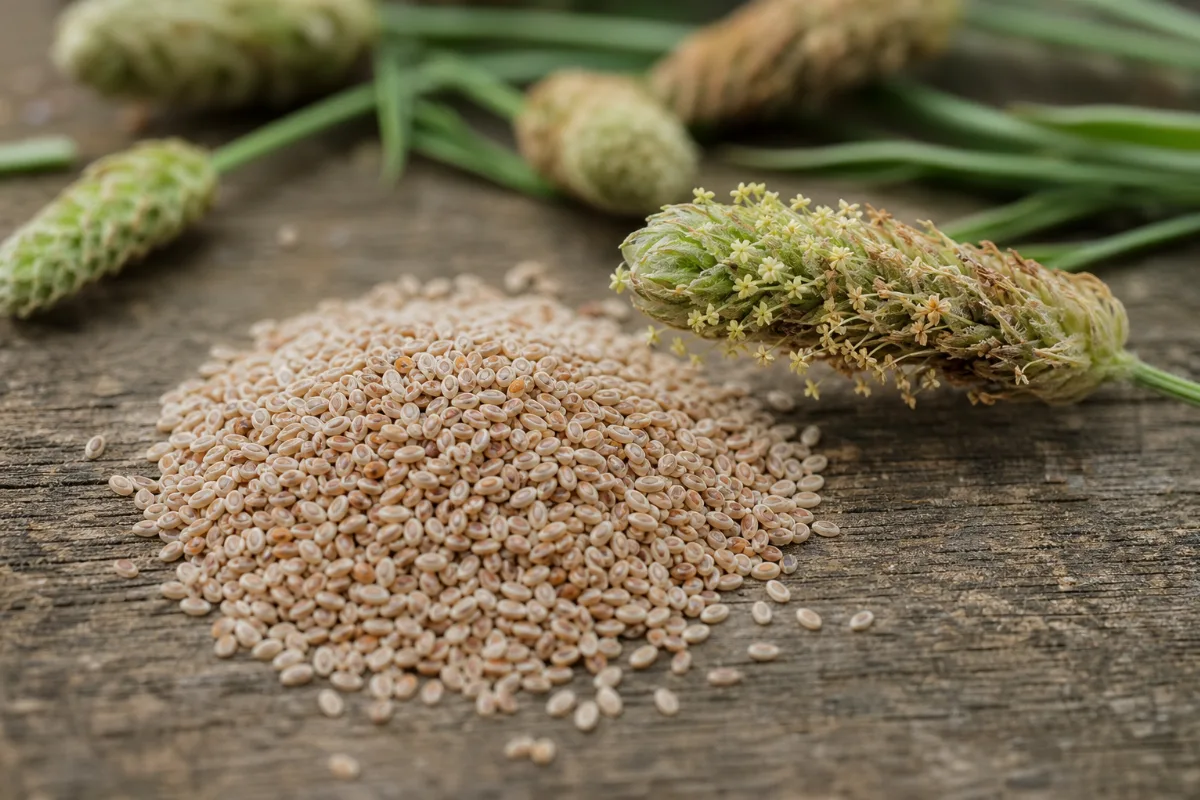
Herbs & Botanicals · Herbs · Soluble fibre from the seed husk, with moderate evidence for constipation and LDL cholesterol
Psyllium
Plantago ovata Forssk. (also Plantago psyllium) · also called Psyllium, ispaghula, ispágula (Spanish), cáscara de psyllium (Spanish)
Psyllium is the outer coat (husk) of the seeds of Plantago ovata, a plant of the plantain family. In water it swells into a thick gel and acts as a bulk-forming fibre. It has the strongest human evidence of any herb-type fibre for constipation and LDL cholesterol, with weaker evidence for blood sugar, IBS and loose-stool leakage. It must be taken with plenty of water.
General information, not medical advice. Last substantive update · Not medically reviewed. A named clinician has not signed off on this page. How this page is made
About Psyllium
Psyllium husk is a gel-forming fibre from Plantago ovata seeds. Trials support it for constipation and for lowering LDL cholesterol, with weaker evidence for blood sugar, IBS and leakage of loose stool. The main safety points are choking or blockage if taken without enough water, allergy, gas and bloating, and spacing from other medicines.
What it is
Psyllium is the husk of the seed of Plantago ovata (family Plantaginaceae), accepted in GBIF as Plantago ovata Forssk. Psyllium and ispaghula are the same ingredient. Plantago psyllium is a related accepted species also used. It is not the leaf herb broadleaf plantain, and it is not related to the plantain banana.
Traditional and current uses
EMA lists the husk for habitual constipation, for softer stools where straining hurts, and for extra fibre in IBS with constipation or with diet for high cholesterol, under medical supervision. We found no NCCIH page on psyllium. Older traditional history is not verified here.
What the research shows
Reviews of trials find psyllium helps constipation and lowers LDL cholesterol by about a third of a mmol/L. In type 2 diabetes it lowered fasting glucose and HbA1c in pooled trials, but results vary a lot and one large review was by authors from a psyllium maker. Soluble fibre eased IBS in a 2014 review, though not all those trials used psyllium. One trial found fewer leakage episodes in people with loose stool. Blood pressure fell only about 2 mmHg.
At a glance
Traditional uses history, not proof
- Not verified: older traditional use in India, Persia and elsewhere is often described but no source was read for this page.
- The European medicines agency (EMA) lists use for habitual constipation, for soft stools where straining hurts, and for more fibre in IBS with constipation or high cholesterol (medical supervision advised).
Studied for research
- Chronic constipation, moderate
- LDL cholesterol, moderate
- Blood sugar in type 2 diabetes, low
- Irritable bowel syndrome, low
- Loose-stool leakage, low
- Extra LDL lowering with a statin, low
- Blood pressure, low (small change)
- Triglycerides and HDL, mixed
- Weight, insufficient
Main compounds
- Soluble gel-forming mucilage (arabinoxylan type) in the husk
- Sugar building blocks D-xylose and L-arabinose
- Aucubin, an iridoid, not tested in psyllium here
Common forms
- Husk powder or granules mixed in water
- Capsules and wafers
- Psyllium-enriched foods and cereals
- Whole seed (different from husk; EMA has a separate monograph)
Research links: Psyllium and LDL cholesterol meta-analysis (abstract) · Fibre and chronic constipation meta-analysis (abstract) · Fibre in IBS meta-analysis (abstract) · EMA ispaghula husk monograph page · LactMed psyllium entry · Research Library · Genes & Biomarkers Library
The plant and its history
- Accepted scientific name
- Plantago ovata Forssk.
- Naming authority
- Forssk. (GBIF)
- Synonyms
- Plantago psyllium Herb.Aegypt. ex C.Presl (a separate accepted species in GBIF, also sold as psyllium); Plantago afra L. (separate accepted GBIF name, key 7303104)
- Common names
- Psyllium (English); Ispaghula (English); Ispágula (Spanish); Psyllium (Spanish)
- Botanical family
- Plantaginaceae (plantain family). It is not related to the plantain banana.
- Classification
- Plantae > Tracheophyta > Magnoliopsida > Lamiales > Plantaginaceae > Plantago > Plantago ovata
- Native range
- Not verified from a primary source here.
- Habitat
- Not verified.
- What the plant looks like
- Roots: Not verified.; Stems: Not verified.; Leaves: Not verified.; Flowers: Not verified.; Fruit: Not verified. The part used is the seed husk (outer coat of the seed).
- Cultivation
- Not verified.
- Harvest and processing
- Not verified.
- Look-alikes and adulterants
- Name: Plantago psyllium and Plantago afra; Note: Other psyllium species, both accepted in GBIF. Product labels may use either name. EMA's monograph covers Plantago ovata husk.; Name: Plantago major (broadleaf plantain); Note: A different plant used as a leaf herb; psyllium husk evidence does not apply to it. Not checked here.
- Sustainability and conservation
- Not verified.
Traditional use and history history, not clinical proof
| Tradition or era | Documented use | Source |
|---|---|---|
| European regulation | EMA's herbal monograph covers ispaghula husk for habitual constipation and related uses (first published 2013). | s-ema-ispaghula-husk |
| Older use in India, Persia and other traditions | Often written about but NOT verified here; no source was read. | none |
Traditional use shows how a plant was used. It does not show that a supplement works or is safe today.
What is inside, and how it may work
What the plant contains and how those compounds act in cells and animals. Laboratory and animal mechanisms are not proven effects in people.
Main compounds
| Compound | Family | Where it is concentrated | Activity studied | Level of evidence |
|---|---|---|---|---|
| Arabinoxylan (husk mucilage) | Soluble gel-forming polysaccharide of xylose and arabinose | Seed husk Not read | Forms the thick gel that holds water; only psyllium formed a gel in stool in the leakage trial. Composition of the husk gel as arabinoxylan is general knowledge not checked in the abstracts read. 2 10 | Human data |
| D-Xylose PubChem 135191 | Sugar building block | Seed husk (as part of the polymer) Not read | Building block only. 17 | None |
| L-Arabinose PubChem 439195 | Sugar building block | Seed husk (as part of the polymer) Not read | Building block only. 17 | None |
| Aucubin PubChem 91458 | Iridoid glycoside | Not verified for psyllium Not read | Not tested in psyllium products here. 17 | None |
Mechanisms, receptors and pathways
| Target or pathway | Gene or receptor | What was found | Level |
|---|---|---|---|
| Water holding and gel formation | Not applicable | The husk holds water, forms a gel and adds soft bulk; a narrative review lists water holding, gel formation and viscosity as key properties. 10 2 | Human data |
| Bile acid binding and cholesterol | Not applicable | A narrative review lists bile acid binding as a mechanism for lower cholesterol. 10 | Review |
| Gut bacteria and short-chain fatty acids | Not applicable | The same review says psyllium raises Bifidobacterium, Lactobacillus and short-chain fatty acids; the evidence behind this was not read. 10 | Review |
| Slower stomach emptying and fullness | Not applicable | Listed in the narrative review; not tested in the studies read. 10 | Review |
Absorption, metabolism and elimination
- Absorption
- LactMed states psyllium is not absorbed from the gut.
- Distribution
- Not absorbed, so not applicable.
- Metabolism
- No data found.
- Elimination
- Passes through the gut; the leakage trial found psyllium gel in stool.
- Bioavailability
- Not absorbed (LactMed).
Isolated compounds versus whole extracts
Psyllium is used as the whole husk. The effects seem to come from the gel it forms, and other fibres do not behave the same: in the leakage trial only psyllium formed a gel in stool and carboxymethylcellulose made leakage worse. In IBS, soluble fibre helped but bran did not.
Nutritional composition
Psyllium husk is mostly soluble fibre and is not a meaningful source of vitamins or minerals. No nutrient table was built.
2 moderate certainty1 mixed findings5 low certainty3 not enough evidence
What is Psyllium good for?
The main proposed uses and how strong the human evidence is for each. Moderate means consistent trials with some inconsistency, low means small or varied studies, mixed means results differ, and insufficient means not enough to judge. Several of the larger reviews on blood sugar and statins have authors from a psyllium maker.
Benefits, one by one
Each card is a research question, not a promise. Tap a goal to filter. Open a card to see the studies, doses and limits.
Chronic constipation
Moderate certaintyPsyllium husk is a bulk-forming fibre that holds water. Reviews find it helps people pass stools more often and more softly.
2 studiesStudies used psyllium seed husk (Plantago ovata) powder, granules or …
Studies, doses and limits
What the trials found
A 2022 meta-analysis of 16 RCTs (1,251 adults) found 66% responded to fibre versus 41% to control, and psyllium and pectin had significant effects. A 2021 systematic review graded psyllium as moderate evidence (grade B), below polyethylene glycol and senna (grade A).
Results
More stools and softer stools; more gas.
Effect sizes as reported
Responders RR 1.48 (95% CI 1.17 to 1.88); stool frequency SMD 0.72 (0.36 to 1.08); consistency SMD 0.32 (0.18 to 0.46); flatulence SMD 0.80 (0.47 to 1.13).
Why this rating
Two systematic reviews agree. The 2021 review rated psyllium grade B (moderate). Heterogeneity was high (I2 86% for stool frequency). The 2021 review was funded by Bayer.
Form and dose studied
Studies used psyllium seed husk (Plantago ovata) powder, granules or wafers, usually taken with water. Ask a doctor or pharmacist about amounts. The 2022 review found gains mainly with higher fibre doses and at least 4 weeks of use.
Who was studied
Adults with chronic constipation. Children and older frail adults were not separated in the abstracts read.
Limits
Considerable heterogeneity; many trials were small; trials mix fibre types.
Why researchers looked
It is one of the oldest and most common over-the-counter fibre laxatives.
Traditional use
Used as a bulk laxative; EMA lists habitual constipation as a recognised use (s-ema-ispaghula-husk).
Proposed mechanism Pharmacological theory
The husk is not broken down by gut bacteria and swells into a gel that adds soft bulk to stool.
A proposed mechanism does not show that the effect happens in people.
Gas and bloating were more common. Take with water; see safety file for choking and blockage cautions.
Irritable bowel syndrome (IBS)
Low certaintySoluble fibre such as psyllium modestly improves overall IBS symptoms. Wheat bran does not.
2 studiesStudies used psyllium seed husk (Plantago ovata) powder, granules or …
Studies, doses and limits
What the trials found
A 2014 meta-analysis of 14 RCTs (906 adults) found fibre lowered the chance of staying symptomatic. The benefit came only from soluble fibre, not bran.
Results
Fewer people remained symptomatic after soluble fibre.
Effect sizes as reported
All fibre RR 0.86 (0.80 to 0.94), NNT 10; soluble fibre RR 0.83 (0.73 to 0.94), NNT 7; bran RR 0.90 (0.79 to 1.03).
Why this rating
One systematic review, no heterogeneity (I2 0%), but the abstract does not say how many trials used psyllium itself and symptoms were self-rated. No GRADE given. Rated low for psyllium specifically.
Form and dose studied
Studies used psyllium seed husk (Plantago ovata) powder, granules or wafers, usually taken with water. Ask a doctor or pharmacist about amounts.
Who was studied
Adults with IBS of all subtypes in the pooled trials.
Limits
Pooled soluble fibre, not psyllium alone.
Why researchers looked
Fibre has long been tried for IBS, especially when constipation is the main problem.
Traditional use
EMA lists increased fibre intake in constipation-predominant IBS, with medical supervision (s-ema-ispaghula-husk).
Proposed mechanism Pharmacological theory
Gel-forming fibre may soften hard stool and slow fast transit; this mechanism is theoretical here.
A proposed mechanism does not show that the effect happens in people.
Gas and bloating can worsen IBS symptoms in some people; this was not measured in the abstract read.
LDL (bad) cholesterol
Moderate certaintyPsyllium reliably lowers LDL cholesterol by a modest amount in people with and without high cholesterol.
2 studiesStudies used psyllium seed husk (Plantago ovata) powder, granules or …
Studies, doses and limits
What the trials found
A 2018 meta-analysis of 28 RCTs (1,924 people) found lower LDL, non-HDL cholesterol and apoB. A 2024 meta-analysis of 29 RCTs (2,769 people) found lower total and LDL cholesterol and no clear effect on HDL or triglycerides.
Results
About a third of a mmol/L lower LDL.
Effect sizes as reported
2018: LDL MD -0.33 mmol/L (-0.38 to -0.27); non-HDL -0.39 (-0.50 to -0.27); apoB -0.05 g/L (-0.08 to -0.03). 2024: LDL -0.35, total -0.28 mmol/L.
Why this rating
The 2018 reviewers graded LDL and non-HDL as moderate quality (downgraded for inconsistency) and apoB as high. A lower LDL is a marker, not proof of fewer heart attacks; the 2024 '7% lower risk' is a modelled estimate.
Form and dose studied
Studies used psyllium seed husk (Plantago ovata) powder, granules or wafers, usually taken with water. Ask a doctor or pharmacist about amounts. The 2018 review pooled trials of about 10 g a day of psyllium.
Who was studied
Adults with and without high cholesterol.
Limits
Heart events were not measured; inconsistency between trials.
Why researchers looked
The husk binds bile acids in the gut, so the body uses more cholesterol to make new ones.
Traditional use
The US FDA recognises a health claim linking psyllium husk to lower heart disease risk, but its text was not read here.
Proposed mechanism Pharmacological theory
Binding of bile acids and slower fat absorption.
A proposed mechanism does not show that the effect happens in people.
Same as for constipation: gas, bloating and the need for water.
Blood sugar in type 2 diabetes
Low certaintyPsyllium lowers fasting glucose and HbA1c in people with type 2 diabetes in pooled trials, but the trials differ a lot and some are industry-linked.
2 studiesStudies used psyllium seed husk (Plantago ovata) powder, granules or …
Studies, doses and limits
What the trials found
A 2020 meta-analysis of 8 RCTs (395 people with diabetes) found lower fasting glucose and HbA1c. A 2015 meta-analysis of 35 RCTs found the benefit was largest in people being treated for type 2 diabetes and absent in people with normal glucose. The 2015 analysis was done by Procter & Gamble authors.
Results
Lower fasting glucose and HbA1c in diabetes.
Effect sizes as reported
2020: HbA1c -0.91% (-1.31 to -0.51); fasting glucose -31.71 mg/dL (-50.04 to -13.38). 2015: fasting glucose -37.0 mg/dL (P < 0.001); HbA1c -0.97% (P = 0.048).
Why this rating
Both reviews are positive, but heterogeneity is very high (I2 97 to 99%), trials are small, and the larger review is industry-linked. No formal GRADE. Rated low.
Form and dose studied
Studies used psyllium seed husk (Plantago ovata) powder, granules or wafers, usually taken with water. Ask a doctor or pharmacist about amounts. The 2015 review notes psyllium was dosed before meals.
Who was studied
Adults with type 2 diabetes; people with normal glucose showed no glucose lowering.
Limits
Very high heterogeneity; small trials; industry involvement.
Why researchers looked
Gel-forming fibre slows how fast sugar enters the blood after meals.
Traditional use
Not a traditional or EMA use.
Proposed mechanism Pharmacological theory
Thick gel slows stomach emptying and sugar absorption.
A proposed mechanism does not show that the effect happens in people.
Can add to diabetes medicines; blood sugar should be monitored (see safety file).
Loose stool leakage (fecal incontinence)
Low certaintyIn one trial, psyllium reduced leakage episodes in people with loose or liquid stool.
1 studiesStudies used psyllium seed husk (Plantago ovata) powder, granules or …
Studies, doses and limits
What the trials found
One single-blind RCT of 189 adults compared psyllium, gum arabic, carboxymethylcellulose and placebo for 32 days. Psyllium cut leakage episodes versus placebo; carboxymethylcellulose raised them.
Results
About 2.5 episodes a week with psyllium vs 5.5 with placebo.
Effect sizes as reported
Episodes per week: placebo 5.5, psyllium 2.5, gum arabic 4.3, carboxymethylcellulose 6.2. Quality of life did not differ.
Why this rating
One trial, single-blind, short; no review confirms it.
Form and dose studied
Studies used psyllium seed husk (Plantago ovata) powder, granules or wafers, usually taken with water. Ask a doctor or pharmacist about amounts.
Who was studied
Community adults with leakage of loose or liquid stool.
Limits
One trial; quality of life no different.
Why researchers looked
The gel can firm up loose stool.
Traditional use
Not a traditional or EMA use in the pages read.
Proposed mechanism Human data
Only psyllium formed a gel in stool in the trial.
A proposed mechanism does not show that the effect happens in people.
Intolerance was low in the trial.
Diarrhoea in general
Not enough evidencePsyllium is sometimes used to firm loose stool, but we found no good trial or review on ordinary diarrhoea.
1 studiesSee safety file.
Studies, doses and limits
What the trials found
No randomised trial or review of psyllium for ordinary diarrhoea was found in this search; the fecal incontinence trial is the closest.
Results
Not available.
Effect sizes as reported
None.
Why this rating
No evidence read; the stool-firming idea is theoretical.
Form and dose studied
See safety file.
Who was studied
Not studied.
Limits
No evidence.
Why researchers looked
The same water-holding gel is used both ways.
Traditional use
Not read.
Proposed mechanism Pharmacological theory
Gel absorbs water in the gut.
A proposed mechanism does not show that the effect happens in people.
Not applicable.
Extra cholesterol lowering with a statin
Low certaintyAdding psyllium to a statin lowered LDL more than the statin alone in three trials.
1 studiesStudies used psyllium seed husk (Plantago ovata) powder, granules or …
Studies, doses and limits
What the trials found
A 2018 meta-analysis of 3 RCTs (4 to 12 weeks) found a significant extra LDL reduction that the authors compared to doubling the statin dose.
Results
Greater LDL reduction than statin alone.
Effect sizes as reported
p = 0.001; numbers not in abstract.
Why this rating
Only three short trials; the authors work for a psyllium maker (Procter & Gamble).
Form and dose studied
Studies used psyllium seed husk (Plantago ovata) powder, granules or wafers, usually taken with water. Ask a doctor or pharmacist about amounts.
Who was studied
People already on statins.
Limits
Three trials; industry link; numbers not read.
Why researchers looked
Some people cannot take high statin doses.
Traditional use
Not traditional.
Proposed mechanism Pharmacological theory
Different route: binds bile acids while statins block cholesterol making.
A proposed mechanism does not show that the effect happens in people.
Ask your doctor before changing any heart medicine.
Blood pressure
Low certaintyPsyllium lowered the top blood pressure number by about 2 mmHg, a small change.
1 studiesStudies used psyllium seed husk (Plantago ovata) powder, granules or …
Studies, doses and limits
What the trials found
A 2020 meta-analysis of 11 RCTs (592 people) found a 2.04 mmHg fall in systolic pressure, stronger in people with higher starting pressure.
Results
Small systolic fall.
Effect sizes as reported
Systolic WMD -2.04 mmHg (-2.82 to -1.63 as printed).
Why this rating
One review of small trials; the effect is small and a clinical benefit was not shown.
Form and dose studied
Studies used psyllium seed husk (Plantago ovata) powder, granules or wafers, usually taken with water. Ask a doctor or pharmacist about amounts.
Who was studied
Mostly people with raised blood pressure.
Limits
Small effect; diastolic result not read.
Why researchers looked
Fibre intake is linked to lower pressure.
Traditional use
Not traditional.
Proposed mechanism Pharmacological theory
Not established.
A proposed mechanism does not show that the effect happens in people.
Not a replacement for blood pressure medicine.
Triglycerides and HDL cholesterol
Mixed findingsResults are mixed: no clear effect on HDL or triglycerides overall, but lower triglycerides in people with diabetes.
2 studiesStudies used psyllium seed husk (Plantago ovata) powder, granules or …
Studies, doses and limits
What the trials found
The 2024 meta-analysis found no substantial effect on HDL or triglycerides. The 2020 diabetes meta-analysis found triglycerides fell 19.18 mg/dL (-31.76 to -6.60) with no change in HDL.
Results
HDL unchanged; triglycerides mixed.
Effect sizes as reported
See above.
Why this rating
Two reviews differ by population; heterogeneity in the diabetes review was very high (I2 98%).
Form and dose studied
Studies used psyllium seed husk (Plantago ovata) powder, granules or wafers, usually taken with water. Ask a doctor or pharmacist about amounts.
Who was studied
General adults and people with diabetes.
Limits
Different populations.
Why researchers looked
Part of the full blood fat picture.
Traditional use
Not traditional.
Proposed mechanism Pharmacological theory
Not established.
A proposed mechanism does not show that the effect happens in people.
None specific.
Body weight and BMI
Not enough evidenceNo clear weight loss was seen in people with diabetes.
2 studiesStudies used psyllium seed husk (Plantago ovata) powder, granules or …
Studies, doses and limits
What the trials found
The 2020 diabetes meta-analysis found no significant change in BMI or weight. A review titled as supportive of weight loss exists but its abstract was not read.
Results
No change in diabetes trials.
Effect sizes as reported
Not significant.
Why this rating
One review found no effect in diabetes; others not read.
Form and dose studied
Studies used psyllium seed husk (Plantago ovata) powder, granules or wafers, usually taken with water. Ask a doctor or pharmacist about amounts.
Who was studied
People with diabetes.
Limits
Single population.
Why researchers looked
Gel fibre can make people feel full.
Traditional use
Not traditional.
Proposed mechanism Pharmacological theory
Fullness and slower stomach emptying (stated in a narrative review).
A proposed mechanism does not show that the effect happens in people.
None specific.
Haemorrhoids and anal fissure (softer stools)
Not enough evidenceRegulators list softer stool as a use where straining hurts, but no trial was read here.
1 studiesStudies used psyllium seed husk (Plantago ovata) powder, granules or …
Studies, doses and limits
What the trials found
No trial or review on haemorrhoids or fissure was read in this pass.
Results
Not available.
Effect sizes as reported
None.
Why this rating
Only a regulator statement; no trial abstract read.
Form and dose studied
Studies used psyllium seed husk (Plantago ovata) powder, granules or wafers, usually taken with water. Ask a doctor or pharmacist about amounts.
Who was studied
Not studied here.
Limits
No evidence read.
Why researchers looked
Softer stool means less straining.
Traditional use
EMA lists softening stool for anal fissures, haemorrhoids and after anal or rectal surgery (s-ema-ispaghula-husk).
Proposed mechanism Pharmacological theory
Softer stool from the gel.
A proposed mechanism does not show that the effect happens in people.
Persistent rectal bleeding needs a doctor.
Connections to the rest of health
How Psyllium connects to the rest of our health knowledge graph. Every link says what kind of connection it is. A safety link (for example to the liver) is a warning, not a benefit. A study that merely mentions a topic never creates a benefit link.
Explore every connection: goals, body systems, organs, symptoms, genes
A. Wellness goals
| Connected to | Kind of connection | Evidence status | Context | Studies |
|---|---|---|---|---|
| Cholesterol balance | Demonstrated clinical effect | Moderate certainty | LDL lowering. LDL (bad) cholesterol: Psyllium reliably lowers LDL cholesterol by a modest amount in people with and without high cholesterol. Preparation or compound: Psyllium husk |
8 27 3 26 |
| Digestive Support | Demonstrated clinical effect | Moderate certainty | Chronic constipation: Psyllium husk is a bulk-forming fibre that holds water. Reviews find it helps people pass stools more often and more softly. Irritable bowel syndrome (IBS): Soluble fibre such as psyllium modestly improves overall IBS symptoms. Wheat bran does not. | 28 22 12 2 |
| Gut Health | Demonstrated clinical effect | Moderate certainty | Chronic constipation: Psyllium husk is a bulk-forming fibre that holds water. Reviews find it helps people pass stools more often and more softly. Irritable bowel syndrome (IBS): Soluble fibre such as psyllium modestly improves overall IBS symptoms. Wheat bran does not. | 28 22 12 2 |
| Heart Health | Demonstrated clinical effect | Moderate certainty | LDL (bad) cholesterol: Psyllium reliably lowers LDL cholesterol by a modest amount in people with and without high cholesterol. Extra cholesterol lowering with a statin: Adding psyllium to a statin lowered LDL more than the statin alone in three trials. | 8 27 3 4 |
| Blood Sugar Balance | Demonstrated clinical effect | Low certainty | Blood sugar in type 2 diabetes: Psyllium lowers fasting glucose and HbA1c in people with type 2 diabetes in pooled trials, but the trials differ a lot and some are industry-linked. | 26 6 |
| Metabolic Health | Demonstrated clinical effect | Low certainty | Blood sugar in type 2 diabetes: Psyllium lowers fasting glucose and HbA1c in people with type 2 diabetes in pooled trials, but the trials differ a lot and some are industry-linked. Triglycerides and HDL cholesterol: Results are mixed: no clear effect on HDL or triglycerides overall, but lower triglycerides in people with diabetes. | 26 6 27 |
| Digestive Support | Biological association | Not enough evidence | Diarrhoea in general: Psyllium is sometimes used to firm loose stool, but we found no good trial or review on ordinary diarrhoea. | 2 |
| Blood Pressure Support | Demonstrated clinical effect | Low certainty | Blood pressure: Psyllium lowered the top blood pressure number by about 2 mmHg, a small change. | 4 |
| Weight Management | Biological association | Not enough evidence | Body weight and BMI: No clear weight loss was seen in people with diabetes. | 26 10 |
| Digestive Support | Traditional use | Not enough evidence | Haemorrhoids and anal fissure (softer stools): Regulators list softer stool as a use where straining hurts, but no trial was read here. | 15 |
B. Body systems
| Connected to | Kind of connection | Evidence status | Context | Studies |
|---|---|---|---|---|
| Digestive system | Adverse effect or risk | Moderate certainty | Gas, bloating; obstruction with too little water. Preparation or compound: Psyllium husk |
28 7 |
| Immune system | Adverse effect or risk | Low certainty | IgE sensitization and anaphylaxis. Preparation or compound: Psyllium dust or ingestion |
9 1 11 |
| Digestive system | Demonstrated clinical effect | Moderate certainty | Constipation relief; gas and, obstruction. Preparation or compound: Psyllium husk |
28 22 7 |
| Cardiovascular system | Demonstrated clinical effect | Moderate certainty | Lower LDL; small blood pressure fall. Preparation or compound: Psyllium husk |
8 4 |
| Digestive System | Biological association | Moderate certainty | Studied for: Chronic constipation Studied for: Irritable bowel syndrome (IBS) | 28 22 12 2 15 |
| Cardiovascular System | Biological association | Moderate certainty | Studied for: LDL (bad) cholesterol Studied for: Extra cholesterol lowering with a statin | 8 27 3 4 26 |
| Endocrine System | Biological association | Low certainty | Studied for: Blood sugar in type 2 diabetes | 26 6 |
| Metabolism Weight | Biological association | Low certainty | Studied for: Blood sugar in type 2 diabetes Studied for: Body weight and BMI | 26 6 10 |
I. Biomarkers
| Connected to | Kind of connection | Evidence status | Context | Studies |
|---|---|---|---|---|
| LDL cholesterol | Demonstrated clinical effect | Moderate certainty | Lowered in meta-analyses. Lowered in two meta-analyses. Preparation or compound: Psyllium husk |
8 27 |
| HbA1c | Demonstrated clinical effect | Low certainty | Lowered in type 2 diabetes. Lowered in type 2 diabetes; high variability. Preparation or compound: Psyllium husk |
26 6 |
| LDL cholesterol | Biological association | Moderate certainty | Measured in trials: lowered. A lab change is not the same as a health benefit. | 8 27 |
| Non-HDL cholesterol | Biological association | Moderate certainty | Measured in trials: lowered. A lab change is not the same as a health benefit. | 8 |
| Apolipoprotein B (apoB) | Biological association | High certainty | Measured in trials: lowered. A lab change is not the same as a health benefit. | 8 |
| Fasting blood glucose | Biological association | Low certainty | Measured in trials: lowered. A lab change is not the same as a health benefit. | 26 6 |
| HbA1c | Biological association | Low certainty | Measured in trials: lowered. A lab change is not the same as a health benefit. | 26 6 |
| Stool frequency | Biological association | Moderate certainty | Measured in trials: raised. A lab change is not the same as a health benefit. | 28 |
| Triglycerides | Biological association | Mixed findings | Measured in trials: mixed. A lab change is not the same as a health benefit. | 27 26 |
| HDL cholesterol | Biological association | Moderate certainty | Measured in trials: no-change. A lab change is not the same as a health benefit. | 27 26 |
| Systolic blood pressure | Biological association | Low certainty | Measured in trials: lowered. A lab change is not the same as a health benefit. | 4 |
K. Biological pathways
| Connected to | Kind of connection | Evidence status | Context | Studies |
|---|---|---|---|---|
| Bile acid metabolism | Preliminary mechanism | Review | Bile acid binding is named as a mechanism; not tested in the studies read. | 10 |
L. Active compounds
| Connected to | Kind of connection | Evidence status | Context | Studies |
|---|---|---|---|---|
| Arabinoxylan (husk mucilage) | Biological association | Human | Forms the thick gel that holds water; only psyllium formed a gel in stool in the leakage trial. Composition of the husk gel as arabinoxylan is general knowledge not checked in the abstracts read. Preparation or compound: Seed husk |
2 10 |
| D-Xylose | Biological association | None | Building block only. Preparation or compound: Seed husk (as part of the polymer) |
17 |
| L-Arabinose | Biological association | None | Building block only. Preparation or compound: Seed husk (as part of the polymer) |
17 |
| Aucubin | Biological association | None | Not tested in psyllium products here. Preparation or compound: Not verified for psyllium |
17 |
Each connection is stored with the ingredient, the connected record, the kind of connection, the evidence status, the supporting studies, the preparation or compound involved, and a review date (last reviewed October 25, 2026).
The evidence
The research centre for Psyllium. Every record here was checked against PubMed or the publisher's page; we never list a study we have not verified.
Evidence by outcome
Bars show how many studies we found for each outcome, not how well it works. People are added up across trials only (reviews are not added, to avoid double counting).
How we rate evidence
High certainty
Several well-run trials or reviews agree; further research is unlikely to change the picture much.
Moderate certainty
Good trials point the same way, but some doubt remains.
Low certainty
Small, short or inconsistent trials. The finding could change with better research.
Very low certainty
Very little or very weak human data. Treat as a possibility only.
Mixed findings
Trials or reviews disagree with each other.
Not enough evidence
Not enough human research to say either way.
Evidence against
Good research found no benefit, or found harm.
We take the reviewers' own risk-of-bias and GRADE statements where they exist, and otherwise judge from study size, design, consistency, directness and whether a product matches what is sold. Many publications do not make evidence high. Method note: We searched PubMed and read abstracts of about 22 papers, checked plant names in GBIF and NCBI Taxonomy and compounds in PubChem, and read the EMA herbal medicine page and the LactMed entry. No NCCIH page was found. Not verified: the FDA health claim, LiverTox, Commission E, WHO, the lithium letter's findings and older traditional history. Only abstracts were read. Certainty ratings are the compiler's own reading unless a review's own GRADE is quoted. Several larger psyllium reviews have authors from Procter & Gamble, a psyllium maker (flagged in the text), and the 2021 constipation review was funded by Bayer. No study is cited that we could not verify.
Study library: every study we checked 28
| Study | Design | People | Product, dose, length | Result |
|---|---|---|---|---|
| Bardy 1987 Occupational asthma and IgE sensitization in a pharmaceutical company processing psyllium. Am Rev Respir Dis · PMID 3579003 · DOI |
Cross sectional |
140 Workers at a pharmaceutical plant processing psyllium |
Occupational exposure to psyllium dust seed husk Occupational Processing about 5 times a year, under 10 days each |
19% (23/120) had a positive skin test to psyllium and 26% (31/118) had raised specific IgE; 32% had at least one of the two. Five of 18 tested workers had an immediate bronchoconstriction reaction on challenge. Sensitization 32% of tested workers Methods, limits and fundingOutcomes: Occupational asthma, skin test, IgE antibodies Limitations: Abstract truncated; cross-sectional. Read: abstract |
| Bliss 2014 Dietary fiber supplementation for fecal incontinence: a randomized clinical trial. Res Nurs Health · PMID 25155992 · DOI |
Controlled trial |
189 Community adults with fecal incontinence of loose or liquid stool |
Psyllium vs gum arabic vs carboxymethylcellulose vs placebo seed husk 16 g total fibre/day 32 days (after 14-day baseline) · vs Placebo |
Psyllium cut episodes versus placebo; carboxymethylcellulose increased them. Only psyllium formed a gel in stool. Intolerance was low. Quality of life did not differ. Estimated episodes per week: placebo 5.5, psyllium 2.5, gum arabic 4.3, carboxymethylcellulose 6.2 Methods, limits and fundingOutcomes: Fecal incontinence episodes per week Limitations: Single-blind; short; quality of life no different. Funding and conflicts: Not stated in abstract Read: abstract |
| Brum 2018 Meta-Analysis of Usefulness of Psyllium Fiber as Adjuvant Antilipid Therapy to Enhance Cholesterol Lowering Efficacy of Statins. Am J Cardiol · PMID 30078477 · DOI |
Meta-analysis |
People already taking statins; 3 RCTs | psyllium (Plantago ovata) seed husk plus statin seed husk Not given in abstract 4 to 12 weeks · vs Statin alone |
Adding psyllium lowered LDL more than the statin alone; the authors say the reduction was equal to doubling the statin dose. Significant extra LDL lowering (p = 0.001); numbers not in abstract Methods, limits and fundingOutcomes: LDL cholesterol Limitations: Only 3 trials, short; numeric effects not in the abstract. Funding and conflicts: Industry-linked: authors from Procter & Gamble Health Care (maker of a psyllium brand). Read: abstract |
| Clark 2020 The effect of psyllium supplementation on blood pressure: a systematic review and meta-analysis of randomized controlled trials. Korean J Intern Med · PMID 32066221 · DOI |
Meta-analysis |
592 Adults, mostly with raised blood pressure; 11 RCTs |
psyllium (Plantago ovata) seed husk seed husk Not given in abstract Varied · vs Control |
Small fall in systolic pressure; larger when baseline pressure was higher (meta-regression). Systolic WMD -2.04 mmHg (-2.82 to -1.63 as printed in abstract) Methods, limits and fundingOutcomes: Systolic blood pressure Limitations: A 2 mmHg change is small; diastolic result not stated in abstract. Funding and conflicts: No conflict reported Read: abstract |
| Drugs and Lactation Database (NICHD) 2021 Psyllium (LactMed entry) Drugs and Lactation Database (LactMed) · PMID 30000405 |
Authoritative guidance |
Breastfeeding | Psyllium seed husk |
LactMed (2021 update): few data on psyllium in breastfeeding, but it is not absorbed from the gut so it cannot enter breast milk; acceptable to use during breastfeeding. Methods, limits and fundingOutcomes: Lactation safety Limitations: Short entry; relies on two references. Funding and conflicts: Public database (NICHD) Read: abstract |
| Gibb 2015 Psyllium fiber improves glycemic control proportional to loss of glycemic control: a meta-analysis of data in euglycemic subjects, patients at risk of type 2 diabetes mellitus, and patients being treated for type 2 diabetes mellitus. Am J Clin Nutr · PMID 26561625 · DOI |
Meta-analysis |
35 RCTs in people without diabetes, at risk of type 2 diabetes, and with type 2 diabetes | psyllium (Plantago ovata) seed husk seed husk Dosed before meals in multi-week studies Multi-week · vs Control |
In type 2 diabetes, fasting glucose fell and HbA1c fell. No significant glucose lowering in people with normal glucose; modest improvement in pre-diabetes. Fasting glucose -37.0 mg/dL (P < 0.001); HbA1c -0.97% (P = 0.048) Methods, limits and fundingOutcomes: Fasting glucose, HbA1c Limitations: Some clinical records came from the company's files, not only published papers. Funding and conflicts: Industry-linked: authors from Procter & Gamble, which makes a psyllium product, and the search used the company's own records. Read: abstract |
| Hefny 2018 Intestinal obstruction caused by a laxative drug (Psyllium): A case report and review of the literature. Int J Surg Case Rep · PMID 30321826 · DOI |
Case report |
1 21-year-old man with constipation |
Psyllium husk (granules) seed husk Two days after discharge |
Developed incomplete intestinal obstruction after taking psyllium husks without enough fluid; treated without surgery. Authors say similar cases include esophageal obstruction in older people and after gastric banding, and that psyllium given with oral contrast may precipitate obstruction where one already exists. Incomplete obstruction Methods, limits and fundingOutcomes: Intestinal obstruction Limitations: One case plus literature review. Read: abstract |
| Jovanovski 2018 Effect of psyllium (Plantago ovata) fiber on LDL cholesterol and alternative lipid targets, non-HDL cholesterol and apolipoprotein B: a systematic review and meta-analysis of randomized controlled trials. Am J Clin Nutr · PMID 30239559 · DOI |
Meta-analysis |
1924 Adults with or without high cholesterol; 28 RCTs of 3 weeks or longer |
psyllium (Plantago ovata) seed husk seed husk Median about 10.2 g/day 3 weeks or longer · vs Control |
Lower LDL, non-HDL and apoB. GRADE: moderate quality for LDL and non-HDL (downgraded for inconsistency), high for apoB. LDL MD -0.33 mmol/L; non-HDL -0.39 mmol/L; apoB -0.05 g/L (LDL -0.38 to -0.27; non-HDL -0.50 to -0.27; apoB -0.08 to -0.03) Methods, limits and fundingOutcomes: LDL cholesterol, non-HDL cholesterol, apolipoprotein B Limitations: Inconsistency between trials; effect on heart events not measured. Funding and conflicts: Not stated in abstract; read abstract only. Authors are from a university nutrition centre; funding not read. Registration: NCT03346733 Read: abstract |
| Khalili 2003 Psyllium-associated anaphylaxis and death: a case report and review of the literature. Ann Allergy Asthma Immunol · PMID 14700444 · DOI |
Case report |
1 42-year-old woman; plus literature review |
Psyllium-based product seed husk |
Fatal anaphylaxis after eating a psyllium-based product. The review found psyllium allergy well described in health care and pharmaceutical workers, from airway symptoms on inhaling to anaphylaxis on swallowing, with a clear link to atopy. Methods, limits and fundingOutcomes: Fatal anaphylaxis; review of psyllium allergy Limitations: One death; the review covered MEDLINE to 2002. Read: abstract |
| Kumar 2026 Psyllium Husk: A Comprehensive Review of its Functional Properties, Health Benefits, Mechanisms of Action, and Potential Adverse Effects. Curr Nutr Rep · PMID 41697448 · DOI |
Narrative review |
Review of psyllium husk | psyllium (Plantago ovata) seed husk seed husk |
Reports improved glucose control, lower cholesterol and better bowel function; mechanisms include bile acid binding, gut bacteria changes, fullness and slower stomach emptying. Adverse effects: bloating, allergic reactions, and gut obstruction from too little water. Methods, limits and fundingOutcomes: Properties, benefits, mechanisms, adverse effects Limitations: Narrative review; not a systematic search. Funding and conflicts: No competing interests declared Read: abstract |
| Malo 1990 Prevalence of occupational asthma and immunologic sensitization to psyllium among health personnel in chronic care hospitals. Am Rev Respir Dis · PMID 2252254 · DOI |
Cross sectional |
193 Health personnel in four chronic care hospitals |
Occupational exposure while preparing psyllium laxative seed husk Occupational |
3% (6/193) had a positive skin test and 12% (20/162) had raised specific IgE. Of those challenged in the lab, 4 had asthma reactions. The authors estimated IgE sensitization at 5 to 12%. IgE sensitization 5 to 12% Methods, limits and fundingOutcomes: Occupational asthma, sensitization Limitations: Abstract truncated; 78% of staff took part. Read: abstract |
| Moayyedi 2014 The effect of fiber supplementation on irritable bowel syndrome: a systematic review and meta-analysis. Am J Gastroenterol · PMID 25070054 · DOI |
Meta-analysis |
906 Adults with irritable bowel syndrome; 14 RCTs |
Fibre supplements (soluble fibre and bran compared) unspecified Varied Varied · vs Placebo, control or usual care |
Fibre helped overall. The benefit was seen only with soluble fibre, not bran. No evidence of harm from bran was found. All fibre RR 0.86, NNT 10; soluble fibre RR 0.83, NNT 7; bran RR 0.90 (not significant) (All 0.80 to 0.94; soluble 0.73 to 0.94; bran 0.79 to 1.03) Methods, limits and fundingOutcomes: Staying symptomatic after treatment Limitations: Soluble fibre trials not all psyllium (abstract does not say how many used psyllium); symptom outcomes self-reported. Funding and conflicts: Not stated in abstract Read: abstract |
| Noble 1984 Acute esophageal obstruction by a psyllium-based bulk laxative. Chest · PMID 6488929 · DOI |
Case report |
1 Not stated (title only; no abstract) |
Psyllium-based bulk laxative seed husk |
Title only was read: acute esophageal obstruction by a psyllium-based bulk laxative. Methods, limits and fundingOutcomes: Acute esophageal obstruction Limitations: No abstract; details not read. Read: title-only |
| Nordström 1987 Influence of wheat bran and of a bulk-forming ispaghula cathartic on the bioavailability of digoxin in geriatric in-patients. Drug Nutr Interact · PMID 3038494 |
Controlled trial |
30 Geriatric hospital in-patients taking digoxin |
Ispaghula bulk cathartic (Vi-Siblin S) vs wheat bran seed husk 4 weeks · vs Wheat bran + digoxin |
Wheat bran lowered digoxin levels at 2 weeks but not at 4. Ispaghula had no influence at any time; authors concluded no clinically relevant effect on digoxin in these patients. No change with ispaghula (14 patients) Methods, limits and fundingOutcomes: Blood digoxin levels Limitations: Small, 1987, one formulation, no true placebo arm. Read: abstract |
| Not applicable 2013 EMA/HMPC Community herbal monograph on Plantago ovata Forssk., seminis tegumentum (ispaghula husk), Revision 1 European Medicines Agency · Source |
Authoritative guidance not applicable |
Plantago ovata / psyllium seed husk |
Status page read 2026-10-25. HMPC conclusions: habitual constipation; softer stools where that reduces pain (anal fissures, haemorrhoids, after anal or rectal surgery); raising dietary fibre intake, such as in constipation-predominant IBS or with diet in high cholesterol (which the page says always needs medical supervision). Monograph reference EMA/HMPC/199774/2012, first published 23/07/2013; revision 2 consultation 15/02/2024 to 15/05/2024; page status 'C: ongoing call for scientific data'. Take with plenty of liquid; not for people with difficulty swallowing or throat problems, narrowing of the stomach or gut, failure to pass stools after a laxative, or undiagnosed rectal bleeding; take at least half an hour to one hour before or after other medicines; not immediately before bedtime. Pregnancy is not mentioned on the page. Methods, limits and fundingLimitations: Web status page read, not the full monograph PDF; pregnancy and children wording not read. Read: summary-only | |
| Not applicable 2026 NCCIH: no psyllium page found NCCIH · Source |
Authoritative guidance not applicable |
Plantago ovata / psyllium seed husk |
The address https://www.nccih.nih.gov/health/psyllium returned not found on 2026-10-25. No NCCIH psyllium page was found. Methods, limits and fundingLimitations: Not exhaustive. Read: not-found | |
| Not applicable 2026 PubChem name searches: D-xylose, L-arabinose, aucubin PubChem · Source |
Database not applicable |
Plantago ovata / psyllium seed husk |
D-xylose CID 135191 (C5H10O5); L-arabinose CID 439195 (C5H10O5); aucubin CID 91458 (C15H22O9), verified by API 2026-10-25. Methods, limits and fundingLimitations: Sugar building blocks and one iridoid; the husk gel itself is a large polymer with no single compound record. Read: full-text | |
| Not applicable 2026 GBIF backbone: Plantago ovata Forssk. GBIF · Source |
Database not applicable |
Plantago ovata / psyllium seed husk |
Accepted species, key 3189723, family Plantaginaceae, order Lamiales (API read 2026-10-25). Methods, limits and fundingLimitations: Name match only. Read: full-text | |
| Not applicable 2026 GBIF backbone: Plantago psyllium Herb.Aegypt. ex C.Presl GBIF · Source |
Database not applicable |
Plantago ovata / psyllium seed husk |
Accepted species, key 8062613, same family (API read 2026-10-25). GBIF also lists Plantago afra L. as accepted (key 7303104). Methods, limits and fundingLimitations: Name match only. Read: full-text | |
| Not applicable 2026 NCBI Taxonomy: Plantago ovata and Plantago psyllium NCBI Taxonomy · Source |
Database not applicable |
Plantago ovata / psyllium seed husk |
Search returned one entry each: Plantago ovata taxid 185002 and Plantago psyllium taxid 197794. Methods, limits and fundingLimitations: Search count only. Read: full-text | |
| Perlman 1990 Interaction between lithium salts and ispaghula husk. Lancet · PMID 1968148 · DOI |
Case report |
Not stated (letter, no abstract) | Lithium salts with ispaghula husk seed husk |
Title only was read: a letter on an interaction between lithium salts and ispaghula husk. Its findings were not read. Methods, limits and fundingOutcomes: Lithium and ispaghula interaction Limitations: No abstract; the direction and size of the interaction are not verified here. Read: title-only |
| Rao 2021 Efficacy and Safety of Over-the-Counter Therapies for Chronic Constipation: An Updated Systematic Review. Am J Gastroenterol · PMID 33767108 · DOI |
Systematic review |
Adults with chronic constipation; 41 RCTs of 4 weeks or longer, over-the-counter products | Over-the-counter laxatives including psyllium unspecified Varied 4 weeks or longer · vs Placebo or comparator |
Psyllium had moderate evidence (grade B). Polyethylene glycol and senna had good evidence (grade A). Diarrhea, nausea, bloating and abdominal pain were common adverse events; no serious adverse events were reported. Grade B recommendation for psyllium Methods, limits and fundingOutcomes: Strength of evidence per product class Limitations: Variable study design, outcome measures, duration and small samples. Funding and conflicts: Funded by Bayer US LLC; authors report consulting for Bayer and other industry ties. Read: abstract |
| Salguero Molpeceres 2003 [Esophageal obstruction caused by dietary fiber from Plantago ovata, a complication preventable by adequate information]. Gastroenterol Hepatol · PMID 12681118 |
Case report |
1 41-year-old woman |
Plantago ovata granules seed husk One tablespoonful of granules Single episode |
Chest pain and regurgitation after swallowing granules held in the mouth then taken with 250 ml of water; a mass blocked the lower esophagus; a mild hiatus hernia was found. The authors reviewed other cases: all used granules, most with too little liquid, some with earlier esophageal disease; powder probably carries lower risk (authors' view). Esophageal obstruction Methods, limits and fundingOutcomes: Esophageal obstruction Limitations: Spanish-language case report; one case. Read: abstract |
| Shin 2022 Acute esophageal obstruction after ingestion of psyllium seed husk powder: A case report. World J Clin Cases · PMID 35321163 · DOI |
Case report |
1 76-year-old man with Parkinson's disease |
Psyllium seed husk powder seed husk Not stated in abstract Single episode |
Severe swallowing difficulty about 10 hours after ingestion; CT showed a 2.0 x 2.5 cm mass near the stomach junction; removed with an endoscopic net after grinding. Esophageal bezoar Methods, limits and fundingOutcomes: Esophageal obstruction Limitations: One case; Parkinson's disease may slow swallowing. Funding and conflicts: None declared Read: abstract |
| Wiesner 2021 Levothyroxine Interactions with Food and Dietary Supplements-A Systematic Review. Pharmaceuticals (Basel) · PMID 33801406 · DOI |
Systematic review |
Levothyroxine users; 63 studies on food and supplements | Fibre (among many foods) unspecified |
Limited evidence that fibre decreased levothyroxine absorption. Keeping a time gap between levothyroxine and food or supplements was suggested as an effective way to avoid such interactions. Methods, limits and fundingOutcomes: Levothyroxine absorption Limitations: Fibre evidence limited and not specific to psyllium. Funding and conflicts: No conflict of interest declared Read: abstract |
| Xiao 2020 The effect of psyllium consumption on weight, body mass index, lipid profile, and glucose metabolism in diabetic patients: A systematic review and dose-response meta-analysis of randomized controlled trials. Phytother Res · PMID 31919936 · DOI |
Meta-analysis |
395 Adults with diabetes; 8 RCTs (9 arms) |
psyllium (Plantago ovata) seed husk seed husk Dose-response analysed; amounts not in abstract Varied · vs Control |
Lower triglycerides, LDL, fasting glucose and HbA1c. No change in HDL, BMI, total cholesterol or weight. HbA1c -0.91%; fasting glucose -31.71 mg/dL; LDL -8.96 mg/dL; triglycerides -19.18 mg/dL (HbA1c -1.31 to -0.51; glucose -50.04 to -13.38; LDL -13.39 to -4.52; TG -31.76 to -6.60) Methods, limits and fundingOutcomes: Triglycerides, LDL, fasting glucose, HbA1c, weight, BMI Limitations: Very high heterogeneity (I2 97 to 99%); small trials. (Abstract prints one glucose unit as ml/dl; read as mg/dL.) Funding and conflicts: Not stated in abstract Read: abstract |
| Zhu 2024 Plantago consumption significantly reduces total cholesterol and low-density lipoprotein cholesterol in adults: A systematic review and meta-analysis. Nutr Res · PMID 38688104 · DOI |
Meta-analysis |
2769 Adults; 29 RCTs |
Plantago products (husk or psyllium, soluble fibre subgroups) seed husk or seed Varied Varied · vs Control |
Total cholesterol and LDL fell; no substantial effect on HDL or triglycerides overall. Authors estimated about a 7% lower cardiovascular event risk (a modelled estimate, not a trial result). Total cholesterol -0.28 mmol/L; LDL -0.35 mmol/L Methods, limits and fundingOutcomes: Total cholesterol, LDL, HDL, triglycerides Limitations: Abstract gives no confidence intervals or heterogeneity; modelled risk figure is an estimate. Funding and conflicts: Not stated in abstract Read: abstract |
| van der Schoot 2022 The Effect of Fiber Supplementation on Chronic Constipation in Adults: An Updated Systematic Review and Meta-Analysis of Randomized Controlled Trials. Am J Clin Nutr · PMID 35816465 · DOI |
Meta-analysis |
1251 Adults with chronic constipation; 16 RCTs |
Fibre supplements (psyllium and pectin had significant effects) unspecified Subgroups by dose; benefit only above 10 g/day Benefit clearer at 4 weeks or more · vs Placebo or control |
66% (311/473) responded to fibre vs 41% (134/329) to control. Stool frequency up. Stool consistency improved. Flatulence higher with fibre. Responders RR 1.48; stool frequency SMD 0.72; consistency SMD 0.32; flatulence SMD 0.80 (RR 1.17 to 1.88; frequency 0.36 to 1.08; consistency 0.18 to 0.46; flatulence 0.47 to 1.13) Methods, limits and fundingOutcomes: Response to treatment, stool frequency, stool consistency, flatulence Limitations: Considerable heterogeneity (I2 86% for stool frequency); all fibre types pooled; psyllium subgroup numbers not in abstract. Funding and conflicts: No conflict statement read in abstract Registration: PROSPERO CRD42020191404 Read: abstract |
What we do not know yet
- What the evidence supports: constipation and LDL cholesterol are moderate; blood sugar, IBS and leakage are low; weight is insufficient.
- No trial on haemorrhoids or anal fissure was read, and none on ordinary diarrhoea.
- The frequency of obstruction and anaphylaxis is unknown.
- No pregnancy safety study was found.
- Lithium interaction unverified; LiverTox, FDA and Commission E were not verified.
- Older traditional use, native range and cultivation were not verified.
How new research is added
New studies are found by a saved PubMed search and are placed in a review queue. A person reads each one before it changes any evidence rating or safety wording. New publications never change ratings automatically.
Lab markers
What changed in blood or saliva tests during trials. A changed number is not the same as feeling or being healthier, and we give no "normal ranges".
Metabolic 5
LDL cholesterol
Lowered in trials
Blood level of the cholesterol carried by low-density lipoprotein.
Moderate certaintyResults and what it means
Why it was measured
A common marker of heart disease risk.
Statistical vs. clinical meaning
Statistically solid; real clinical benefit (fewer heart events) was not measured.
Safety implication
None specific.
Fasting blood glucose
Lowered in trials
Blood sugar after fasting.
Low certaintyResults and what it means
Why it was measured
Core marker of diabetes control.
Statistical vs. clinical meaning
Large changes in diabetes but very high heterogeneity and industry-linked analysis.
Safety implication
With glucose-lowering drugs, blood sugar may fall further; monitor.
HbA1c
Lowered in trials
Average blood sugar over about 3 months.
Low certaintyResults and what it means
Why it was measured
Standard diabetes control marker.
Statistical vs. clinical meaning
About 1 percentage point is clinically meaningful if real, but evidence is uncertain.
Safety implication
As above.
Triglycerides
Mixed results in trials
Blood fat from food and the liver.
Mixed findingsHDL cholesterol
No clear change in trials
The 'good' cholesterol particle.
Moderate certaintyOther 4
Non-HDL cholesterol
Lowered in trials
All cholesterol except the HDL type.
Moderate certaintyApolipoprotein B (apoB)
Lowered in trials
A protein on the particles that carry cholesterol into artery walls.
High certaintyResults and what it means
Stool frequency
Raised in trials
How often a person passes stool.
Moderate certaintySystolic blood pressure
Lowered in trials
Top blood pressure number.
Low certaintySafety
What studies and official sources say about side effects, medicines and who should check first. Each point shows what kind of evidence it comes from.
Main points to know 7
- Take with plenty of water: choking and blockage are real risks. Psyllium swells into a thick gel. Case reports describe the food pipe (esophagus) blocked after swallowing husk powder or granules, including in a man with Parkinson's disease and in a woman who kept granules in her mouth first. Another case describes bowel obstruction after husk taken without enough fluid. EMA says to take it with plenty of liquid and not to use it with difficulty swallowing or throat problems. Case report 24 13 23 7 15
- Do not use with a narrowed or blocked gut. EMA lists narrowing of the stomach or gut, failure to pass stools after a laxative, and undiagnosed rectal bleeding as reasons not to use psyllium. The authors of a bowel obstruction case report warn that psyllium can worsen constipation if not enough fluid is taken, and that it may bring on obstruction when given with oral contrast where a blockage already exists. Authoritative guidance 15 7
- Allergy can be serious, and workers who inhale the dust can become sensitised. Psyllium is a recognised allergen. A review described reactions from airway symptoms on inhaling dust to anaphylaxis on swallowing, with a clear link to atopy, and reported one fatal anaphylaxis. In a psyllium-processing plant 32% of tested workers had a positive skin test or raised IgE. Among hospital staff who prepared the laxative, IgE sensitization was 5 to 12%. Case report 9 1 11
- Gas and bloating are common. In the constipation meta-analysis flatulence was higher with fibre (SMD 0.80). The over-the-counter review lists diarrhea, nausea, bloating and abdominal pain as common, with no serious adverse events reported in those trials. Meta-analysis 28 22
- Timing with other medicines. EMA says to take it at least half an hour to one hour before or after other medicines. A systematic review found limited evidence that fibre lowers levothyroxine absorption and advised spacing doses. A small trial found an ispaghula product did not change digoxin levels. A 1990 letter on lithium and ispaghula exists, but only its title was read. Authoritative guidance 15 25 14 21
- May add to diabetes medicines. Psyllium lowered fasting glucose and HbA1c in people treated for type 2 diabetes. People on glucose-lowering drugs should tell their doctor, because blood sugar may fall further. No low-blood-sugar case report was read. Meta-analysis 6 26
- Breastfeeding is considered acceptable; no pregnancy data found. LactMed says psyllium is not absorbed from the gut, so it cannot enter breast milk, and is acceptable during breastfeeding. EMA's page did not mention pregnancy. No pregnancy safety study was found. Authoritative guidance 5 15
Side effects 5
| Effect | How often | Severity and recovery | Evidence |
|---|---|---|---|
| Flatulence and bloating Flatulence SMD 0.80 (0.47 to 1.13) versus control. | Not established | mild Not stated in the abstract | Meta-analysis 28 |
| Diarrhea, nausea, abdominal pain Common in trials of over-the-counter constipation products; no serious adverse events reported. | Not established | mild Not stated | Systematic review 22 |
| Esophageal obstruction Frequency not given by any source read. Reports involve granules or powder swallowed with too little liquid, and swallowing problems. | Not established | serious Endoscopic removal was needed in the case read | Case report 24 13 23 |
| Intestinal obstruction After husk taken without enough fluid. | Not established | serious Treated without surgery in the case read | Case report 7 |
| Allergic reactions including anaphylaxis Frequency in the general public not given. | Not established | serious One reported death | Case report 9 |
Liver
No liver injury case was found in this search. A LiverTox entry was not read.
How often. Not available.
Monitoring. No routine monitoring suggested by any source read.
This is a safety connection. It is not evidence that Psyllium supports liver health.
Medicines and supplements 6
| With | Why it matters | Importance | Evidence | What to do |
|---|---|---|---|---|
| Other oral medicines in general absorption | The gel may slow or reduce absorption of other medicines taken at the same time (theory). | Spacing advised by EMA | Authoritative guidance Low certainty 15 | EMA: take at least half an hour to one hour before or after other medicines. Ask a pharmacist about your own medicines. |
| Levothyroxine absorption | Fibre may reduce thyroid tablet absorption. | Limited evidence | Systematic review Low certainty 25 | Keep a time gap and check thyroid blood tests with your doctor. |
| Digoxin absorption | Tested directly. | No clinically relevant change in a small trial of 14 patients on an ispaghula product | Controlled trial Low certainty 14 | Small and old; follow the usual spacing. |
| Lithium absorption | Not read. | Unknown; a 1990 letter exists, abstract unavailable | Case report Not enough evidence 21 | Ask a pharmacist before combining. |
| Diabetes medicines (insulin, tablets) pharmacodynamic | Both lower blood sugar. | Possible added lowering | Meta-analysis Low certainty 6 26 | Tell your doctor; monitor blood sugar. |
| Statins pharmacodynamic | Added LDL lowering. | Extra benefit in 3 trials | Meta-analysis Low certainty 3 | Do not change statin doses without a doctor. |
Who should check first 5
| Situation | Advice | Evidence |
|---|---|---|
| Difficulty swallowing, throat problems or esophageal narrowing | Do not use (EMA). | Authoritative guidance 15 24 |
| Narrowing or blockage of the stomach or gut; unexplained failure to pass stool after a laxative | Do not use; see a doctor. | Authoritative guidance 15 7 |
| Undiagnosed rectal bleeding | Do not use before a diagnosis (EMA). | Authoritative guidance 15 |
| Known psyllium allergy, or atopy with dust exposure at work | Avoid; workers handling powder should use protection. | Case report 9 1 11 |
| Taking it just before bed | EMA says not immediately before bedtime. | Authoritative guidance 15 |
Overdose, product quality and regulators
Summary. No toxic plant part was identified in the sources read. The seed husk is a fibre eaten in supplements.
Animal. Not read.
Human doses studied. Trials in the reviews ran from weeks to months; no long-term toxicity data were read.
High dose or long term signals. Not reported in the abstracts read.
Overdose response. Not studied; blockage risk rises with too little water.
Genotoxicity. Not read.
Toxic plant parts. None identified.
The search for contamination or adulteration of psyllium products found nothing relevant.
| Body | Action | Date |
|---|---|---|
| EMA / HMPC (European Union) | Community herbal monograph on Plantago ovata seed husk: use for habitual constipation, soft stools where straining hurts, and more fibre in IBS with constipation or high cholesterol under medical supervision. Warnings as above. Revision 2 consultation closed 15/05/2024; page status 'C: ongoing call for scientific data'. source | 2013-07-23 |
| NCCIH (USA) | No NCCIH psyllium page found at the expected address (404). source | |
| LactMed (USA) | Acceptable during breastfeeding; not absorbed. source | 2021-05-17 |
When to get medical help
- Trouble swallowing, chest pain or a feeling of food stuck after taking it: seek emergency care.
- Severe belly pain, swelling, vomiting or no stool or gas: seek urgent care.
- Hives, lip or throat swelling, wheeze or faintness: emergency care (possible anaphylaxis).
- New rectal bleeding, or bleeding that does not stop: see a doctor.
Stop the supplement and contact a clinician or emergency service. In the US, Poison Control is 1-800-222-1222.
General information only, not medical advice. Ask a clinician or pharmacist before use, especially with medicines, in pregnancy or with a health condition. See the Natural Remedy Safety guide.
Frequently asked questions
What is psyllium?
Psyllium is the seed husk of Plantago ovata, a plant of the plantain family. It swells into a gel in water and is used as a fibre supplement. Ispaghula is another name for it.
Does psyllium help constipation?
Does psyllium lower cholesterol?
Does psyllium help blood sugar or type 2 diabetes?
Does psyllium help irritable bowel syndrome (IBS)?
Soluble fibre modestly reduced IBS symptoms in a 2014 review of 14 trials, while bran did not. Not all trials used psyllium, so certainty is low for psyllium itself.
Can psyllium treat diarrhoea?
We found no trial or review on ordinary diarrhoea. In one trial of 189 people with leakage of loose stool, psyllium cut leakage episodes versus placebo. Certainty is low.
Can psyllium cause choking or a blockage?
Yes. Case reports describe the food pipe and the bowel blocked when psyllium was taken with too little liquid. EMA says to take it with plenty of liquid and not to use it with difficulty swallowing, throat problems or a narrowed gut. Seek urgent help for trouble swallowing or severe belly pain.
Can I be allergic to psyllium?
Does psyllium cause gas and bloating?
Does psyllium interact with medicines?
Is psyllium safe in pregnancy or while breastfeeding?
Explore by health goal
Digestive SupportGut HealthCholesterol BalanceHeart HealthMetabolic HealthBlood Sugar BalanceBlood Pressure SupportWeight Management
Editorial transparency
- Written by
- AlternativeMed editorial team. Research compiled with AI assistance, then checked against PubMed records.
- Medical review
- None. This page has not been reviewed by a physician or pharmacist.
- First published
- 2026-10-25
- Last substantive update
- 2026-10-25
- How we research
- We searched PubMed and read abstracts of about 22 papers, checked plant names in GBIF and NCBI Taxonomy and compounds in PubChem, and read the EMA herbal medicine page and the LactMed entry. No NCCIH page was found. Not verified: the FDA health claim, LiverTox, Commission E, WHO, the lithium letter's findings and older traditional history. Only abstracts were read. Certainty ratings are the compiler's own reading unless a review's own GRADE is quoted. Several larger psyllium reviews have authors from Procter & Gamble, a psyllium maker (flagged in the text), and the 2021 constipation review was funded by Bayer. No study is cited that we could not verify.
- How we rate evidence
- See "How we rate evidence" in the Evidence tab.
- Independence
- No product is promoted on this page. No affiliate links are shown. If one is added later it will be labelled and kept apart from the evidence.
Sources 28
Each source was opened and checked. Where we read only the abstract, it says so. The small numbers in the text point here.
- Bardy JD, Malo JL, Séguin P et al.. Occupational asthma and IgE sensitization in a pharmaceutical company processing psyllium.. Am Rev Respir Dis. 1987. PMID 3579003. DOI 10.1164/arrd.1987.135.5.1033. (abstract)
- Bliss DZ, Savik K, Jung HJ et al.. Dietary fiber supplementation for fecal incontinence: a randomized clinical trial.. Res Nurs Health. 2014. PMID 25155992. DOI 10.1002/nur.21616. (abstract)
- Brum J, Ramsey D, McRorie J et al.. Meta-Analysis of Usefulness of Psyllium Fiber as Adjuvant Antilipid Therapy to Enhance Cholesterol Lowering Efficacy of Statins.. Am J Cardiol. 2018. PMID 30078477. DOI 10.1016/j.amjcard.2018.06.040. (abstract)
- Clark CCT, Salek M, Aghabagheri E et al.. The effect of psyllium supplementation on blood pressure: a systematic review and meta-analysis of randomized controlled trials.. Korean J Intern Med. 2020. PMID 32066221. DOI 10.3904/kjim.2019.049. (abstract)
- Drugs and Lactation Database (NICHD). Psyllium (LactMed entry). Drugs and Lactation Database (LactMed). 2021. PMID 30000405. (abstract)
- Gibb RD, McRorie JW Jr, Russell DA et al.. Psyllium fiber improves glycemic control proportional to loss of glycemic control: a meta-analysis of data in euglycemic subjects, patients at risk of type 2 diabetes mellitus, and patients being treated for type 2 diabetes mellitus.. Am J Clin Nutr. 2015. PMID 26561625. DOI 10.3945/ajcn.115.106989. (abstract)
- Hefny AF, Ayad AZ, Matev N et al.. Intestinal obstruction caused by a laxative drug (Psyllium): A case report and review of the literature.. Int J Surg Case Rep. 2018. PMID 30321826. DOI 10.1016/j.ijscr.2018.10.001. (abstract)
- Jovanovski E, Yashpal S, Komishon A et al.. Effect of psyllium (Plantago ovata) fiber on LDL cholesterol and alternative lipid targets, non-HDL cholesterol and apolipoprotein B: a systematic review and meta-analysis of randomized controlled trials.. Am J Clin Nutr. 2018. PMID 30239559. DOI 10.1093/ajcn/nqy115. (abstract)
- Khalili B, Bardana EJ Jr, Yunginger JW. Psyllium-associated anaphylaxis and death: a case report and review of the literature.. Ann Allergy Asthma Immunol. 2003. PMID 14700444. DOI 10.1016/S1081-1206(10)61538-4. (abstract)
- Kumar A, Patel R, Yadav S et al.. Psyllium Husk: A Comprehensive Review of its Functional Properties, Health Benefits, Mechanisms of Action, and Potential Adverse Effects.. Curr Nutr Rep. 2026. PMID 41697448. DOI 10.1007/s13668-025-00727-z. (abstract)
- Malo JL, Cartier A, L'Archevêque J et al.. Prevalence of occupational asthma and immunologic sensitization to psyllium among health personnel in chronic care hospitals.. Am Rev Respir Dis. 1990. PMID 2252254. DOI 10.1164/ajrccm/142.6_Pt_1.1359. (abstract)
- Moayyedi P, Quigley EM, Lacy BE et al.. The effect of fiber supplementation on irritable bowel syndrome: a systematic review and meta-analysis.. Am J Gastroenterol. 2014. PMID 25070054. DOI 10.1038/ajg.2014.195. (abstract)
- Noble JA, Grannis FW Jr. Acute esophageal obstruction by a psyllium-based bulk laxative.. Chest. 1984. PMID 6488929. DOI 10.1378/chest.86.5.800a. (title-only)
- Nordström M, Melander A, Robertsson E et al.. Influence of wheat bran and of a bulk-forming ispaghula cathartic on the bioavailability of digoxin in geriatric in-patients.. Drug Nutr Interact. 1987. PMID 3038494. (abstract)
- Not applicable. EMA/HMPC Community herbal monograph on Plantago ovata Forssk., seminis tegumentum (ispaghula husk), Revision 1. European Medicines Agency. 2013. (summary-only)
- Not applicable. NCCIH: no psyllium page found. NCCIH. 2026. (not-found)
- Not applicable. PubChem name searches: D-xylose, L-arabinose, aucubin. PubChem. 2026. (full-text)
- Not applicable. GBIF backbone: Plantago ovata Forssk.. GBIF. 2026. (full-text)
- Not applicable. GBIF backbone: Plantago psyllium Herb.Aegypt. ex C.Presl. GBIF. 2026. (full-text)
- Not applicable. NCBI Taxonomy: Plantago ovata and Plantago psyllium. NCBI Taxonomy. 2026. (full-text)
- Perlman BB. Interaction between lithium salts and ispaghula husk.. Lancet. 1990. PMID 1968148. DOI 10.1016/0140-6736(90)90256-5. (title-only)
- Rao SSC, Brenner DM. Efficacy and Safety of Over-the-Counter Therapies for Chronic Constipation: An Updated Systematic Review.. Am J Gastroenterol. 2021. PMID 33767108. DOI 10.14309/ajg.0000000000001222. (abstract)
- Salguero Molpeceres O, Seijas Ruiz-Coello MC, Hernández Núñez J et al.. [Esophageal obstruction caused by dietary fiber from Plantago ovata, a complication preventable by adequate information].. Gastroenterol Hepatol. 2003. PMID 12681118. (abstract)
- Shin S, Kim JH, Mun YH et al.. Acute esophageal obstruction after ingestion of psyllium seed husk powder: A case report.. World J Clin Cases. 2022. PMID 35321163. DOI 10.12998/wjcc.v10.i7.2336. (abstract)
- Wiesner A, Gajewska D, Paśko P. Levothyroxine Interactions with Food and Dietary Supplements-A Systematic Review.. Pharmaceuticals (Basel). 2021. PMID 33801406. DOI 10.3390/ph14030206. (abstract)
- Xiao Z, Chen H, Zhang Y et al.. The effect of psyllium consumption on weight, body mass index, lipid profile, and glucose metabolism in diabetic patients: A systematic review and dose-response meta-analysis of randomized controlled trials.. Phytother Res. 2020. PMID 31919936. DOI 10.1002/ptr.6609. (abstract)
- Zhu R, Lei Y, Wang S et al.. Plantago consumption significantly reduces total cholesterol and low-density lipoprotein cholesterol in adults: A systematic review and meta-analysis.. Nutr Res. 2024. PMID 38688104. DOI 10.1016/j.nutres.2024.03.013. (abstract)
- van der Schoot A, Drysdale C, Whelan K et al.. The Effect of Fiber Supplementation on Chronic Constipation in Adults: An Updated Systematic Review and Meta-Analysis of Randomized Controlled Trials.. Am J Clin Nutr. 2022. PMID 35816465. DOI 10.1093/ajcn/nqac184. (abstract)