Green & Vegetable Juices: Nutrients, What Research Shows and Safety
Green and vegetable juices: raw ingredient values, trials on blood pressure, and oxalate, vitamin K with warfarin, potassium and food safety cautions.
Content last updated . This page has not been medically reviewed.
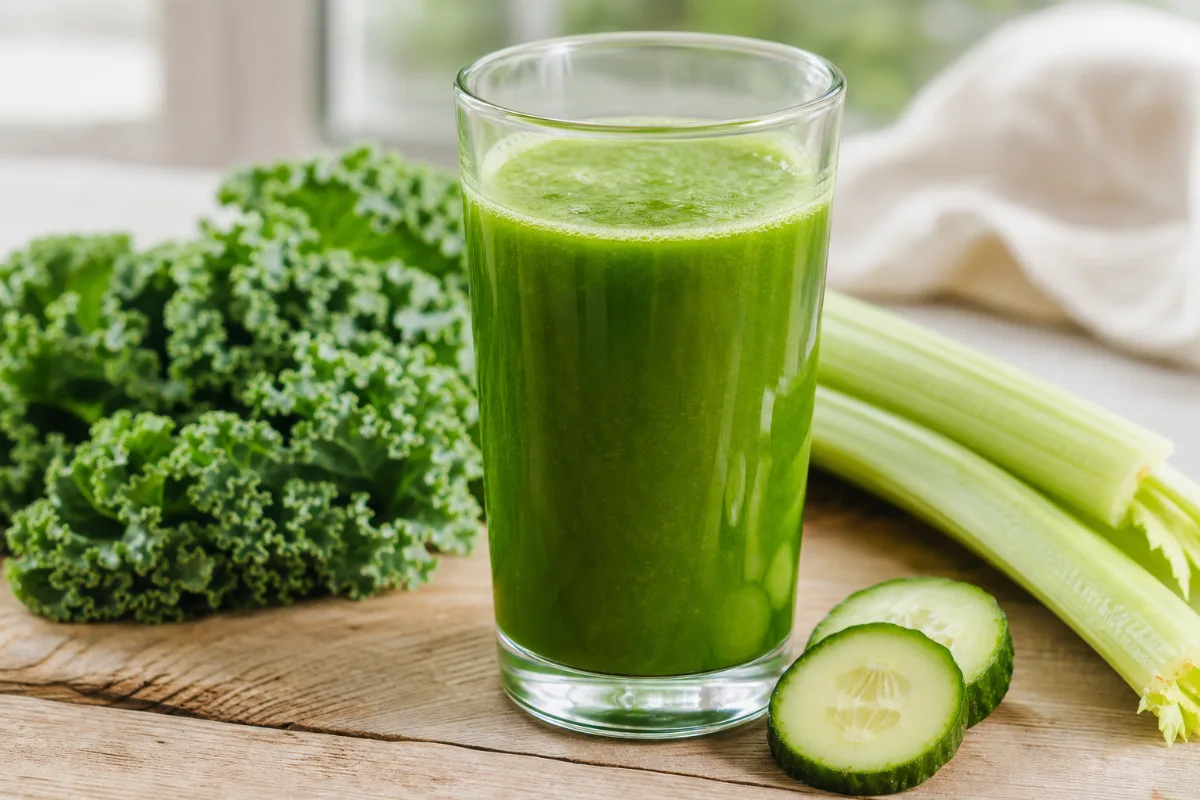
"Green juice" and "vegetable juice" cover very different drinks: juice squeezed at home or at a juice bar from kale, spinach, celery and cucumber, and canned or bottled mixed-vegetable juice. The ingredients, the amounts and the salt vary a lot from one glass to the next, so this page looks at both and says which one a study actually used. It keeps these drinks apart from whole vegetables, from "cleanse" claims and from supplements, and it says plainly what the research does not show.
Read this first
- There is no single "green juice" to measure. USDA has no entry for homemade green juice in our data, so we show the raw vegetables that go into it instead. [1] [2] [3] [4] Real glasses depend on what and how much was juiced.
- Oxalate can hurt the kidneys in some people. Case reports describe sudden kidney failure after green juice and smoothie "cleanses" in people with risk factors such as bowel surgery, antibiotics, diabetes or kidney disease. [6] [7] NIDDK lists spinach among foods to avoid for people prone to calcium oxalate stones. [8]
- Warfarin: leafy greens such as kale and spinach are rich in vitamin K, and MedlinePlus says people on warfarin should keep vitamin K intake steady, because sudden changes can change the medicine's effect. [5]
- Kidney disease: leafy greens contain a lot of potassium; ask a clinician or dietitian before drinking them regularly if you have kidney disease. [2] [15]
- Juice cleanses and "detox" claims are not supported. A critical review found very little clinical evidence for detox diets. [16] See Detox foods and juice cleanse claims.
- Evidence in one line: a few small trials of commercial vegetable juice show it can help people eat more vegetables and may lower blood pressure in some, but those trials were partly industry-funded and small.
- Emergency: for trouble breathing or swelling of the face or throat after any food, call 911 (or your local emergency number).
What is in it (USDA values)
USDA has no value for green juice made at home or at a juice bar, so there is no row for the drink itself. [1] The table shows the raw vegetables often used (USDA FoodData Central, SR Legacy) per 100 g. Juicing does not keep every part: the amount in a glass depends on how many vegetables were used and on how much pulp was strained out. We did not read a source that measured home-made juice.
| Raw vegetable (USDA item) | Vitamin K | Potassium | Fiber | Sodium | Vitamin C |
|---|---|---|---|---|---|
| Kale, raw (168421) [1] | 389.6 mcg | 348 mg | 4.1 g | 53 mg | 93.4 mg |
| Spinach, raw (168462) [2] | 482.9 mcg | 558 mg | 2.2 g | 79 mg | 28.1 mg |
| Celery, raw (169988) [3] | 29.3 mcg | 260 mg | 1.6 g | 80 mg | 3.1 mg |
| Cucumber with peel, raw (168409) [4] | 16.4 mcg | 147 mg | 0.5 g | 2 mg | 2.8 mg |
For comparison, one commercial mixed vegetable juice used in a trial listed, per 8 fluid ounces: 50 calories, 480 mg sodium, 470 mg potassium, 8 g sugars and 2 g fiber. [10] USDA's canned tomato juice lists 253 mg sodium per 100 g with salt added and 10 mg without. [19] [20] Canned and bottled juices can therefore carry a lot of salt, so check the label.
The FDA 2016 Daily Values for these nutrients are 120 mcg vitamin K, 4,700 mg potassium and 2,300 mg sodium, so 100 g of raw kale or spinach already holds several times the vitamin K Daily Value. We did not find an official serving size for home-made green juice. Plant compounds: the sources we read for this page did not measure them in the juice, so we make no antioxidant or polyphenol claim.
What research says
| Health goal | What the sources found | Strength of evidence | What was studied |
|---|---|---|---|
| Eating more vegetables | In a 12-week trial, drinking 8 or 16 fluid ounces of a commercial vegetable juice a day helped healthy adults reach recommended vegetable intake. [10] | Promising but limited | Canned mixed vegetable juice; partly funded by the manufacturer [10] |
| Blood pressure | In that trial, people who started pre-hypertensive had a drop in blood pressure; other heart measures did not change. [10] In a pilot crossover trial of 18 healthy adults, 250 ml of green leafy vegetable juice for 7 days lowered home diastolic pressure, with no significant difference from beetroot juice. [11] | Promising but limited (small, pilot, subgroup findings) | Commercial juice; a green leafy juice with about 340 mg nitrate a day [10] [11] |
| Weight in metabolic syndrome | In 81 adults on a DASH diet plan with a calorie limit, those given 8 or 16 oz of low-sodium vegetable juice lost more weight than those with diet counseling only. [9] | Insufficient evidence (juice cannot be separated from the diet plan; manufacturer support) | Low-sodium commercial vegetable juice [9] |
| "Detox" or cleansing | A critical review found very little clinical evidence for detox diets, and no randomized trials of commercial detox diets in humans. [16] | No good evidence of benefit | Detox diets in general [16] |
| Green juice versus eating the vegetables | Proper evidence not found in the sources we read. | Insufficient evidence | Not applicable |
| Cancer, diabetes, heart disease | We did not read a trial of green juice for these. | No good evidence of benefit found in the sources we read | Not applicable |
Both vegetable juice trials were supported by a soup and juice company, and company employees are among the authors. [9] [10] The nitrate trial was a small pilot. [11] Observational findings about people who drink vegetable juice cannot prove cause, and we did not read one.
Eaten as food vs taken as juice or supplement. The trials used juice drinks, not whole vegetables and not powders or capsules. We did not read a source that compares the same vegetables eaten whole and juiced. The NHS counts vegetable juice as at most one portion of 5 A DAY, with juice and smoothies together limited to 150 ml a day. [12]
How much is a normal serving
There is no official serving size for green juice. The NHS counts fruit juice, vegetable juice and smoothies as one 5 A DAY portion at most, and advises a combined 150 ml a day, partly because crushing produce releases sugars that can harm teeth. [12] WHO says people over 10 should aim for at least 400 g of fruit and vegetables a day. [14] The trials used 8 or 16 fluid ounces of commercial juice [9] [10] and 250 ml of a green leafy juice [11]. That is what the studies tested, not a prescription.
Safety, allergy and medicines
- Oxalate and kidney injury: a case report describes a 65-year-old woman with acute oxalate nephropathy linked in time to a juice "cleanse" made from oxalate-rich leafy greens and fruit; her risk factors included gastric bypass and recent antibiotics, and her condition progressed to end-stage kidney disease. [6] Another case report describes a diabetic man who developed kidney injury needing dialysis after a week-long juice diet. [7] These are case reports, not proof that juice causes the injury, but the authors warn people with risk factors. [6] [7] NIDDK says to avoid spinach if you form calcium oxalate stones and to ask a health care professional about other oxalate sources. [8]
- Warfarin and other medicines: kale, spinach, collards, Swiss chard and romaine are rich in vitamin K. [5] Keep intake steady and tell your prescriber if you start a juice routine. See Foods and medicine interactions.
- Kidney disease and potassium: raw spinach has 558 mg of potassium per 100 g and kale 348 mg. [1] [2] The National Kidney Foundation says people with kidney disease can have potassium levels outside their goal range and may be advised to limit high-potassium foods. [15]
- Sodium: canned and bottled vegetable juices can contain several hundred milligrams of sodium per serving. [10] [19]
- Unpasteurized juice: the FDA says untreated juice must carry a warning label and that children, older adults, pregnant women and people with weakened immune systems can become seriously ill from it. Juice sold by the glass, as at a juice bar, may not carry a label. [13] [17] Pregnant women should avoid unpasteurized juice. [17]
- Pregnancy and breastfeeding: besides juice safety above, the FDA says to rinse raw produce under running water without soap and to avoid raw sprouts of any kind. [17] We did not read a source on specific green juice ingredients in pregnancy.
- Children: the American Academy of Pediatrics says unpasteurized juice should be strongly discouraged for children of all ages. [18]
- Diabetes: we did not find a trial of green juice and blood sugar. Juices with fruit, carrots or beets add sugar; check what is in the glass. Canned tomato juice lists 2.58 g of sugars per 100 g. [20] Ask a clinician or dietitian.
- Allergy: we did not find a source we read describing a common allergy to the vegetables in green juices. Any food can cause a reaction; for trouble breathing or swelling of the face or throat, call 911. See Food allergy basics and emergency signs.
Choosing, storing and food safety
- Wash vegetables under running water (no soap or produce wash), scrub firm produce with a brush, cut away damaged areas and wash your hands for at least 20 seconds. [13]
- At a juice bar, ask whether the juice has been treated; look for the warning label on refrigerated bottles. [13]
- We did not read a source on how long fresh juice keeps; keep it cold and drink it soon, following the label for bottled juice.
Related pages
Health connections for Green & Vegetable Juices
What research links to eating or drinking this food, and how strong the evidence is. Many studies are observational or use juice, powder, oil or extracts rather than the food as eaten; each card says which.
Vegetable juice and eating more vegetables
Preliminary or mixedIn a 12-week trial, drinking 8 or 16 fluid ounces of a commercial vegetable juice a day helped healthy adults reach recommended vegetable intake. The trial was supported by the juice's manufacturer.
Supplements: Commercial canned juice, not home-made green juice.
Vegetable juice and blood pressure
Preliminary or mixedIn the same trial, people who started pre-hypertensive had a drop in blood pressure. In a pilot crossover trial of 18 healthy adults, 250 ml of green leafy vegetable juice for 7 days lowered home diastolic pressure, with no significant difference from beetroot juice.
Supplements: Small, subgroup and pilot findings; manufacturer support for the first trial.
Vegetable juice plus a diet plan and weight
Not enough evidenceIn 81 adults with metabolic syndrome on a DASH diet plan with a calorie limit, those given 8 or 16 oz of low-sodium vegetable juice lost more weight than those with diet counseling only. The juice effect cannot be separated from the plan.
Supplements: Insufficient evidence that juice itself causes weight loss.
Juice cleanses and detox claims
Not enough evidenceA critical review found very little clinical evidence for detox diets and no randomized trials of commercial detox diets in humans.
Supplements: No good evidence of benefit.
Connected topics
Open a group to see how each topic connects and how strong the evidence is.
Health goals (1)
- Blood Pressure SupportPreliminary or mixed
Small trials of vegetable juice found lower blood pressure in some groups (pre-hypertensive adults; green leafy juice in a pilot). Evidence is limited and partly industry-funded.
Body systems (3)
- Kidney & UrinaryDocumented risk
Case reports link oxalate-rich green juice cleanses to kidney injury in people with risk factors; NIDDK advises people prone to calcium oxalate stones to avoid spinach.
- Urinary SystemDocumented risk
Oxalate from large amounts of leafy greens can add to stone risk and, in case reports, kidney injury.
- Heart & CirculationPreliminary or mixed
Small trials suggest vegetable juice may lower blood pressure in some people; evidence is limited.
Body parts (1)
- KidneysDocumented risk
Case reports describe kidney injury after juice cleanses; leafy greens are also high in potassium for people with kidney disease.
Root causes (2)
- Medication Side EffectsDocumented risk
Vitamin K in kale and spinach can change the effect of warfarin; keep intake steady and tell the prescriber.
- Poor DietPreliminary or mixed
Without juice, participants in the trial ate fewer vegetables than recommended; juice helped them reach the target. Does not show juice beats eating vegetables.
Habits (1)
- Balanced NutritionPreliminary or mixed
A 12-week trial found vegetable juice helped adults reach recommended vegetable intake; the NHS counts juice as at most one portion of 5 A DAY.
Conditions & symptoms (3)
- Chronic Kidney InsufficiencyDocumented risk
People with kidney disease may be advised to limit potassium; leafy greens are potassium-rich. Oxalate nephropathy case reports involved kidney disease and other risk factors.
- Essential HypertensionPreliminary or mixed
Pre-hypertensive participants had lower blood pressure in one vegetable juice trial; limited evidence.
- NephrolithiasisDocumented risk
NIDDK advises people prone to calcium oxalate stones to avoid spinach and ask about other oxalate sources; green juice can concentrate leafy greens.
Documented risks and interactions (5)
- Oxalate-rich green juice and kidney injury. Case reports describe acute oxalate nephropathy after a green juice and smoothie cleanse in a woman with gastric bypass and recent antibiotics, and kidney injury after a week-long juice diet in a man with diabetes. NIDDK lists spinach among foods to avoid for people prone to calcium oxalate stones.
- Vitamin K from leafy green juice and warfarin. Kale, spinach, collards, chard and romaine are rich in vitamin K; USDA lists 389.6 mcg per 100 g of raw kale and 482.9 mcg per 100 g of raw spinach. MedlinePlus says people on warfarin should keep vitamin K intake steady because sudden changes can change the medicine's effect.
- Potassium and kidney disease. Raw spinach has 558 mg of potassium per 100 g and kale 348 mg (USDA). The National Kidney Foundation says people with kidney disease may be advised to limit high-potassium foods.
- Sodium in canned and bottled vegetable juice. A commercial vegetable juice used in a trial listed 480 mg of sodium per 8 fl oz; USDA's canned tomato juice lists 253 mg per 100 g with salt added and 10 mg without.
- Unpasteurized green juice. The FDA says untreated juice must carry a warning label and that children, older adults, pregnant women and people with weakened immune systems can become seriously ill from it; juice sold by the glass may not be labeled, and pregnant women should avoid unpasteurized juice.
Frequently asked questions
Is green juice healthier than eating vegetables?
We did not find a source that compares them directly. Trials show vegetable juice can help people eat more vegetables, but they do not show juice is better than whole vegetables. [10] The NHS counts juice as at most one portion of 5 A DAY. [12]
Does a juice cleanse detox the body?
A critical review found very little clinical evidence for detox diets and no randomized trials of commercial detox diets in humans. [16]
Can green juice be harmful?
For most people a small glass is a food. Case reports link juice cleanses rich in oxalate to kidney injury in people with risk factors. [6] [7] People on warfarin or with kidney disease should ask their clinician first. [5] [15]
Can I drink green juice on warfarin?
Kale and spinach are rich in vitamin K, and MedlinePlus says people on warfarin should keep vitamin K intake steady. [5] Ask the prescriber or pharmacist before starting.
Is it safe to drink juice from a juice bar when pregnant?
The FDA advises pregnant women to avoid unpasteurized juice, and juice sold by the glass may not be labeled. [13] [17] Ask the staff whether the juice was pasteurized or otherwise treated.
References
- U.S. Department of Agriculture. FoodData Central: Kale, raw (SR Legacy, FDC 168421). April 2018 release. Read 2026-10-24.
- U.S. Department of Agriculture. FoodData Central: Spinach, raw (SR Legacy, FDC 168462). April 2018 release. Read 2026-10-24.
- U.S. Department of Agriculture. FoodData Central: Celery, raw (SR Legacy, FDC 169988). April 2018 release. Read 2026-10-24.
- U.S. Department of Agriculture. FoodData Central: Cucumber, with peel, raw (SR Legacy, FDC 168409). April 2018 release. Read 2026-10-24.
- MedlinePlus. Vitamin K. Review date 2025-01-21. Read 2026-10-24.
- Makkapati S, D'Agati VD, Balsam L. "Green smoothie cleanse" causing acute oxalate nephropathy. Am J Kidney Dis 2018 (case report abstract read via Europe PMC). Read 2026-10-24.
- Raja N et al. Oxalate nephropathy: a case report of acute kidney injury due to juice diet. Cureus 2023 (case report abstract read via Europe PMC). Read 2026-10-24.
- NIDDK. Eating, diet, and nutrition for kidney stones. Read 2026-10-24.
- Shenoy SF et al. Weight loss in individuals with metabolic syndrome given DASH diet counseling when provided a low sodium vegetable juice: a randomized controlled trial. Nutr J 2010 (abstract and funding statement read via Europe PMC). Read 2026-10-24.
- Shenoy SF et al. The use of a commercial vegetable juice as a practical means to increase vegetable intake: a randomized controlled trial. Nutr J 2010 (full text read via Europe PMC). Read 2026-10-24.
- Elsahoryi NA et al. Effect of high nitrate vegetable juice supplementation on plasma nitrate and blood pressure in adults: a pilot randomized crossover intervention in healthy volunteers. J Nutr Sci 2022 (full text read via Europe PMC). Read 2026-10-24.
- NHS. 5 A DAY: what counts. Read 2026-10-24.
- U.S. Food and Drug Administration. What you need to know about juice safety. Read 2026-10-24.
- WHO. Healthy diet fact sheet. 26 January 2026. Read 2026-10-24.
- National Kidney Foundation. Potassium and your CKD diet. Read 2026-10-24.
- Klein AV, Kiat H. Detox diets for toxin elimination and weight management: a critical review of the evidence. J Hum Nutr Diet 2015 (abstract read via Europe PMC). Read 2026-10-24.
- U.S. Food and Drug Administration. Fruits, veggies and juices (food safety for moms-to-be). Read 2026-10-24.
- American Academy of Pediatrics (HealthyChildren.org). AAP recommends no fruit juice for children under 1 year. Published 22 May 2017. Read 2026-10-24.
- U.S. Department of Agriculture. FoodData Central: Tomato juice, canned, with salt added (SR Legacy, FDC 170458). April 2018 release. Read 2026-10-24.
- U.S. Department of Agriculture. FoodData Central: Tomato juice, canned, without salt added (SR Legacy, FDC 170545). April 2018 release. Read 2026-10-24.