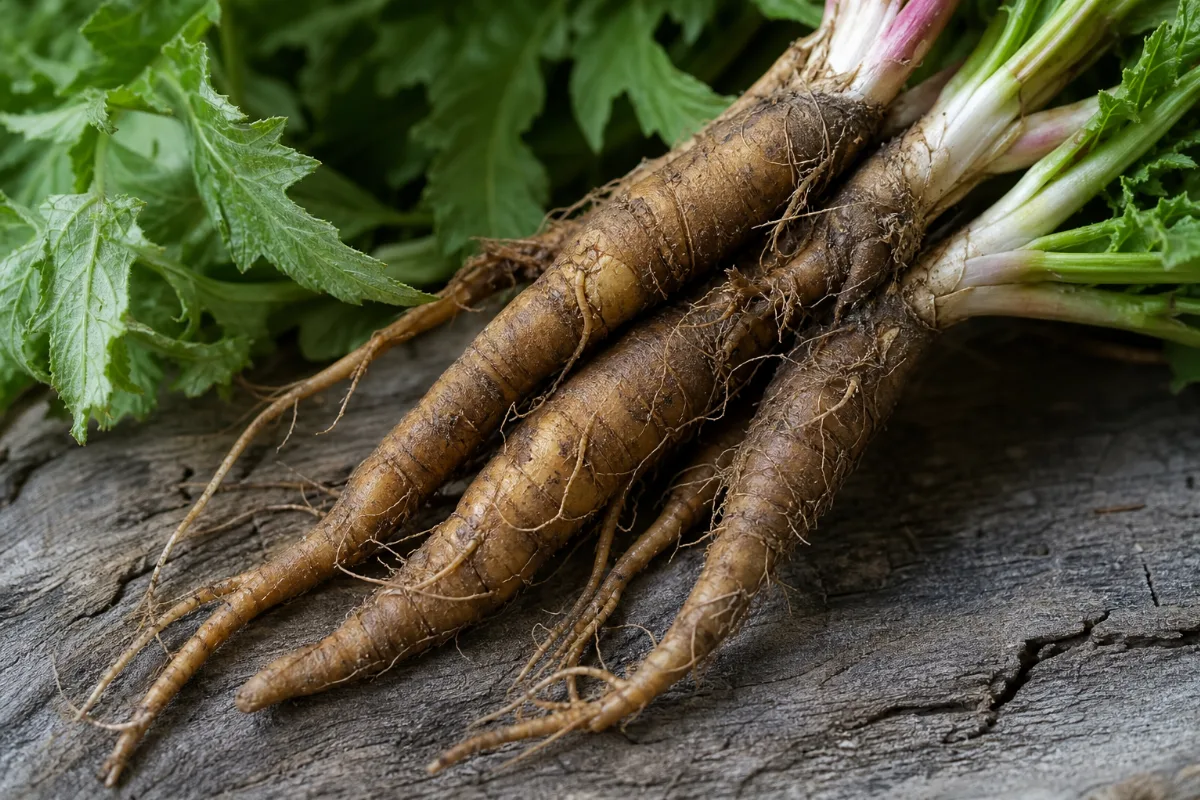
Adaptogens · Herbs & Botanicals · Siberian root with mostly lab and animal evidence
Rhaponticum (Maral Root)
Rhaponticum carthamoides (Willd.) Iljin (GBIF accepted name: Leuzea carthamoides subsp. carthamoides) · also called Maral root, Russian leuzea, Leuzea, Rhaponticum, Maralwurzel
Maral root is the root and rhizome of a Siberian plant in the daisy family, taken for sport and stamina. It is rich in ecdysterone, a steroid-like compound. Most human studies tested ecdysterone alone, not the plant.
General information, not medical advice. Last substantive update · Not medically reviewed. A named clinician has not signed off on this page. How this page is made
About Rhaponticum (Maral Root)
Maral root (Rhaponticum carthamoides) is a Siberian root used by athletes. The research is mostly in animals and cells. The few human trials mostly tested isolated ecdysterone or a purified drug, with mixed or company-sponsored results.
What it is
Maral root is the root and rhizome of Rhaponticum carthamoides, a medicinal plant of Siberia and Kazakhstan in the daisy family. GBIF lists this name as a synonym of Leuzea carthamoides subsp. carthamoides, so you will see both names.
It is often called an adaptogen, a word with no legal definition. It should not be confused with rhapontic rhubarb (Rheum rhaponticum), a different plant.
Traditional and current uses
It is described as a traditional Siberian folk-medicine plant used as a stimulant, and was used by Soviet and Russian athletes. Today it is sold for sport, stamina and stress.
A 2021 review says human trials of plant adaptogens are limited.
What the active compounds are
The best-known compounds are ecdysteroids, mainly 20-hydroxyecdysone (also called ecdysterone), with turkesterone and ponasterone A. The root also has phenolic acids and other compounds.
Most human studies tested isolated ecdysterone or a purified drug (BIO101), not maral root. In one cell test, whole extracts did things that 20-hydroxyecdysone alone did not.
What the research shows
There is very little human research on maral root itself. One trial of a maral root and rhodiola blend found no effect on muscle fatigue.
Isolated ecdysterone gave mixed muscle results: one positive 10-week trial without numbers in its abstract, one negative 8-week trial, and one trial of a mislabelled product.
A purified drug showed a possible walking-speed gain in older adults and a lower rate of respiratory failure in severe COVID-19, in company-sponsored trials. Everything on blood sugar, fats and heart is from animals and cells.
At a glance
Traditional uses history, not proof
- Siberian folk medicine as a stimulant and tonic
- Used by Soviet and Russian athletes as an adaptogen
- Genus Rhaponticum: heat-clearing, colic and joint complaints (mostly Asian species)
Studied for research
- Muscle and strength with isolated ecdysterone: mixed
- Exercise fatigue with a maral root blend: no effect in one trial
- Blood sugar, blood fats and heart: animals only
- Purified drug: muscle loss in older adults and severe COVID-19, low certainty
Main compounds
- 20-Hydroxyecdysone (ecdysterone), the main ecdysteroid
- Turkesterone and ponasterone A
- Caffeoylquinic acids (chlorogenic acid)
Common forms
- Root and rhizome powder
- Root extracts and tinctures
- Isolated ecdysterone supplements
- Blends with rhodiola
Research links: RxList: Maral Root · GBIF: Leuzea carthamoides subsp. carthamoides · PubMed: BIO101 sarcopenia trial · PubMed: ecdysterone supplement trial · PubMed: maral root and rhodiola blend trial · Research Library · Genes & Biomarkers Library
The plant and its history
- Accepted scientific name
- Leuzea carthamoides subsp. carthamoides (as accepted by GBIF). Research papers and shops almost always use the synonym Rhaponticum carthamoides (Willd.) Iljin.
- Naming authority
- GBIF matched Rhaponticum carthamoides (Willd.) Iljin (usageKey 3142238) as a SYNONYM of the accepted subspecies Leuzea carthamoides subsp. carthamoides (key 9713621); the species Leuzea carthamoides (Willd.) DC. is key 3125419. Checked 2026-10-25.
- Synonyms
- Rhaponticum carthamoides (Willd.) Iljin; Leuzea carthamoides (Willd.) DC.; Stemmacantha carthamoides (Willd.) Dittrich; Centaurea carthamoides (Willd.) Benth.; Cnicus carthamoides Willd.; Leuzea altaica Fisch.; Rhaponticum altaicum (Fisch. ex Spreng.) Soskov; Serratula carthamoides (Willd.) Poir.
- Common names
- Maral root (English (used in the research papers read)); Russian leuzea (English); Maralwurzel / Hirschwurzel (German (GBIF)); Левзея сафлоровидная / маралий корень (Russian (GBIF)); lou cao (Chinese (GBIF))
- Botanical family
- Asteraceae (the daisy or sunflower family).
- Classification
- Plantae > Tracheophyta > Magnoliopsida > Asterales > Asteraceae > Leuzea > Leuzea carthamoides
- Native range
- Not verified from a source read. Papers describe it as an important medicinal plant of Siberia and Kazakhstan, and an endemic wild Siberian herb (p41471747, p24444255).
- Habitat
- Not verified from a source read.
- What the plant looks like
- Roots: The root and rhizome are the part used (p37447387). No further description was verified.; Stems: Not verified from a source read.; Leaves: Not verified from a source read.; Flowers: Not verified from a source read.; Fruit: Fruit/seed compounds were studied (lignans in the fruit, N-feruloylserotonins in seed), but no description was verified.
- Cultivation
- Not verified. Lab culture of shoots and hairy roots is studied as an alternative source (p41471747).
- Harvest and processing
- Not verified.
- Look-alikes and adulterants
- Name: Rhapontic rhubarb (Rheum rhaponticum); Note: A different plant. Research on its root extract (ERr 731) exists (titles seen in PubMed, abstracts not read). The names look alike but it is not maral root, and its plant family was not verified.; Name: Other Rhaponticum species (for example R. uniflorum); Note: The genus has 24 species (p42100310). Results for one species should not be applied to another.; Name: Safflower-like names; Note: The species name carthamoides means safflower-like. Safflower is a different plant.
- Sustainability and conservation
- Not verified. No IUCN assessment was retrieved.
Traditional use and history history, not clinical proof
| Tradition or era | Documented use | Source |
|---|---|---|
| Siberia, folk medicine | A methods review calls maral root a traditional Siberian folk-medicine plant used as a stimulant to boost health and fitness. | p30303602 |
| Soviet and Russian sport | The authors of a rat study say it has been commonly used by elite Soviet and Russian athletes for its strength-building and adaptogenic properties. | p33198764 |
| 20th century adaptogen research | A review says plant adaptogens, including Rhaponticum carthamoides, were first used in professional sports about 50 years ago, and that human trials are limited. | p34445021 |
| Kazakhstan and Siberia | Described as an important medicinal plant of Siberia and Kazakhstan. | p41471747 |
| Genus Rhaponticum, traditional use | Genus members were used to clear heat, detoxify, relieve colic and treat arthritis, lumbago and stomach complaints; this is about the genus, mostly Asian species. | p42100310 |
| Russian pharmacopoeia, official status | NOT verified. The pharmacopoeia review abstract (p33309919) does not name this plant. | p33309919 |
Traditional use shows how a plant was used. It does not show that a supplement works or is safe today.
What is inside, and how it may work
What the plant contains and how those compounds act in cells and animals. Laboratory and animal mechanisms are not proven effects in people.
Main compounds
| Compound | Family | Where it is concentrated | Activity studied | Level of evidence |
|---|---|---|---|---|
| 20-Hydroxyecdysone (ecdysterone, beta-ecdysone) PubChem 5459840 | ecdysteroid (plant steroid-like compound) | Root and rhizome (the extract used in studies) Reported as the most abundant ecdysteroid in the root extract in one worm study (p40332350); no percentage given in the abstracts read. | Subject of the muscle, sarcopenia and COVID-19 work. Acts through oestrogen receptor beta and MAS receptor in lab and animal work. 31 29 17 5 | Animal research |
| Turkesterone PubChem 14376672 | ecdysteroid | Root extract Found in the extract by HPTLC (p37447387). Also in Ajuga turkestanica. | Reduced fat build-up in human fat cells in a dish. 29 30 | Laboratory research |
| Ponasterone A PubChem 115127 | ecdysteroid | Root extract Found in the extract (p37447387). | No significant effect on fat cells. 29 | Laboratory research |
| Integristerone A | ecdysteroid | Root Reported as isolated from Rhaponticum carthamoides in a Russian abstract (p22834126). | Lowered blood sugar in rats. 26 | Animal research |
| Caffeoylquinic acids including chlorogenic acid PubChem 1794427 | phenolic acids | Shoots from lab culture (also studied in roots and hairy roots) Chlorogenic acid 2.9 mg/g dry weight in bioreactor shoots (p41471747); not a root value. | Antioxidant in cell-free tests. 25 | Laboratory research |
| Daucosterol PubChem 5742590 | plant sterol glycoside | Extract Not given. | Named as an active component in diabetic mouse cell tests. 16 | Laboratory research |
| Euscaphic acid PubChem 471426 | triterpene | Extract Not given. | Named as an active component in cell tests. 16 | Laboratory research |
| Syringin PubChem 5316860 | phenylpropanoid glycoside | Extract Not given. | Named as an active component in cell tests. 16 | Laboratory research |
| N-feruloylserotonins | serotonin derivatives | Seed Not given. | Reduced anxiety in anxious rats. 36 | Animal research |
Mechanisms, receptors and pathways
| Target or pathway | Gene or receptor | What was found | Level |
|---|---|---|---|
| Oestrogen receptor beta (muscle growth by ecdysterone) | ESR2 | Ecdysterone raised muscle fibre size in rats and muscle-cell size in a dish; the effect was blocked by an anti-oestrogen but not an anti-androgen. A computer model favoured binding to ER beta. 17 27 18 | Animal research |
| MAS receptor and AKT/mTOR (purified 20-hydroxyecdysone) | MAS1, AKT, MTOR | In muscle cells and mice the drug-grade compound activated AKT/mTOR through the MAS receptor and raised muscle cell size 26 percent. 23 5 | Animal research |
| PI3K/Akt/mTOR and NMDA receptor subunit (brain) | GRIN2B, PI3K, AKT, MTOR | Ecdysterones from the root reduced glutamate-driven cell loss in rat hippocampus and raised mTOR/Akt/PI3K signalling. 34 | Animal research |
| SIRT6/Nrf2 (heart and vessels) | SIRT6, NFE2L2 | The extract raised SIRT6 and Nrf2 in injured rat heart tissue and in diabetic mouse aorta. 37 16 | Animal research |
| NF-kappaB (inflammation switch) | NFKB | 20E blocked NF-kB in human cells; some low-20E extracts blocked it strongly and high-20E extracts did not, so 20E does not explain the extract effect. 19 | Lab |
| PPAR-alpha in liver (fat handling) | PPARA | In rats on a high-fat diet the extract raised PPAR-alpha DNA binding and cut liver triglycerides. 8 | Animal research |
| Fat cell formation and breakdown | The extract and 20E reduced fat build-up and raised fat breakdown in human fat precursor cells. 29 | Lab | |
| Stress response in worms | Extract and ecdysterone improved stress resilience and healthspan in C. elegans. 31 | Animal research |
Absorption, metabolism and elimination
- Absorption
- For pure ecdysterone, about 18 percent of a single 50 mg dose was recovered in urine as ecdysterone (p34207569). For purified 20E, exposure rose less than in proportion to dose (p37057316). Nothing is known for maral root extract in people.
- Distribution
- Not found.
- Metabolism
- Ecdysterone is changed to 14-deoxy-ecdysterone and 14-deoxy-poststerone; more than 20 further urinary metabolites were found after 50 mg (p34207569, p37778393).
- Elimination
- Urine half-life about 3 hours; ecdysterone detectable in urine for more than 2 days (p34207569). Plasma half-life of purified 20E 2.4 to 4.9 hours; renal clearance 4.05 to 5.05 L/h (p37057316).
- Bioavailability
- Not established for maral root. The authors of the urine study did not measure blood levels.
Isolated compounds versus whole extracts
Most human evidence is for isolated ecdysterone or the purified drug BIO101, not the plant. Maral root contains several ecdysteroids plus other compounds. In one cell test, extracts with little 20E did things that 20E alone did not, and the authors warn that extracts standardised only to 20E can differ (p21988429). In the human trials: a purified 20E drug (p40026058, p38545090), ecdysterone supplements (p31123801, p18500969), and one 70:30 maral root and rhodiola blend (p32723193). The plant itself has almost no human data.
Nutritional composition
A nutrient table is not meaningful. Ecdysteroids also occur in spinach and quinoa (p38732627), but amounts in food are not compared here.
2 mixed findings2 low certainty11 not enough evidence
What is Rhaponticum (Maral Root) good for?
The main proposed uses and how strong the human evidence is for each. "Low" means small or limited trials. "Insufficient" means no usable human evidence. Many rows describe isolated ecdysterone or a drug, not the plant.
Benefits, one by one
Each card is a research question, not a promise. Tap a goal to filter. Open a card to see the studies, doses and limits.
Muscle size and strength (isolated ecdysterone)
Mixed findingsEcdysterone, the main steroid-like compound in maral root, gave larger muscle and bench-press gains than placebo in one small 10-week trial. Two other human trials found no benefit. Most supplements sold as maral root have not been tested.
6 studiesTrials used ecdysterone supplements, not maral root powder or extract…
Studies, doses and limits
What the trials found
A 10-week trial in 46 young men (p31123801) found larger gains in muscle mass and one-repetition bench press with ecdysterone-containing supplements than placebo or lower doses. No liver or kidney marker rose. The abstract gives no numbers or doses. An 8-week trial in 45 resistance-trained men (p18500969) gave 200 mg a day of ecdysterone and found no difference from placebo in body composition, strength or sprint power. A 12-week trial in 24 men (p40781783) of a commercial ecdysterone plus diosgenin product found no benefit beyond training, but lab tests showed the capsules held under 1 percent of the claimed ecdysterone, so it is not a fair test.
Results
Mixed. One trial positive, one negative, one not a valid test of the label dose.
Effect sizes as reported
No numbers available for the positive trial. The 8-week trial found no significant difference (p > 0.05) on all measures.
Why this rating
Small trials disagree. The positive trial was done by researchers who argue for banning ecdysterone, and its abstract has no numbers. All used isolated ecdysterone or products, not maral root itself.
Form and dose studied
Trials used ecdysterone supplements, not maral root powder or extract. Product contents varied (p41976134).
Who was studied
Young, healthy, resistance-trained men
Limits
Small, short, young men only. No trial of the whole plant for muscle in people. Product content often did not match labels.
Why researchers looked
Rats given ecdysterone grew bigger muscle fibres, so researchers tested it in strength-training men.
Traditional use
Maral root (Rhaponticum carthamoides, also called Leuzea) is a Siberian mountain plant. Its root and rhizome were used in Siberian folk medicine as a tonic and stimulant, and in the Soviet Union it was developed for athletes. A 2018 methods review calls it a traditional Siberian folk-medicine plant used as a stimulant (p30303602). The traditional claims were not tested in modern trials.
Proposed mechanism Animal research
In rats and muscle cells ecdysterone seems to act through oestrogen receptor beta, not the androgen receptor. This is lab and animal work and has not been confirmed in people.
A proposed mechanism does not show that the effect happens in people.
Ecdysterone is under anti-doping monitoring. See the safety file.
Exercise performance and fatigue (maral root extract)
Not enough evidenceThe only human trial of a maral root extract (mixed with rhodiola) found no effect on muscle fatigue in one session. Rat studies suggest more muscle protein building after exercise.
2 studiesBranded blend, 70:30 maral root to rhodiola. Rats got extract orally.
Studies, doses and limits
What the trials found
In 30 healthy young men (p32723193) a 70:30 blend of Rhaponticum carthamoides and Rhodiola rosea extracts, given once, did not change muscle torque, work, effort or mood compared with placebo in five sets of 30 leg extensions. In rats (p33198764) the extract alone or with rhodiola raised protein synthesis after exercise and increased power after 4 weeks of training, with no change in muscle weight or fibre size.
Results
Human: no difference from placebo. Rats: more protein synthesis and power.
Effect sizes as reported
Human: no interaction (p >= 0.317) and no treatment effect (p >= 0.660). Rats: p < 0.05.
Why this rating
One single-dose human trial, null, with a blend. Animal results funded by the extract supplier.
Form and dose studied
Branded blend, 70:30 maral root to rhodiola. Rats got extract orally.
Who was studied
Healthy young men; rats
Limits
Single session only. Blend means maral root alone was not tested in people. The rat study was funded by Naturex.
Why researchers looked
Soviet and Russian athletes used maral root, so researchers tested it with exercise.
Traditional use
Maral root (Rhaponticum carthamoides, also called Leuzea) is a Siberian mountain plant. Its root and rhizome were used in Siberian folk medicine as a tonic and stimulant, and in the Soviet Union it was developed for athletes. A 2018 methods review calls it a traditional Siberian folk-medicine plant used as a stimulant (p30303602). The traditional claims were not tested in modern trials.
Proposed mechanism Animal research
In rats, the extract after exercise raised muscle protein synthesis. This is an animal result.
A proposed mechanism does not show that the effect happens in people.
No side effects were described in the abstracts.
Age-related muscle loss (purified 20-hydroxyecdysone drug)
Low certaintyA purified drug form of 20-hydroxyecdysone made older adults with muscle loss walk slightly faster in a company trial, but the main result was not significant. This is not maral root.
4 studiesPurified drug-grade 20-hydroxyecdysone, not a supplement or herb.
Studies, doses and limits
What the trials found
The phase 2b SARA-INT trial (p40026058) randomised 233 adults aged 65 or more with sarcopenia to the drug (175 mg or 350 mg twice a day) or placebo for 6 to 9 months. In the full analysis the higher dose improved 400-metre walking speed by 0.07 m/s over placebo, which was not significant. In the 156 who followed the plan the gain was 0.09 m/s (p = 0.008). The pandemic cost 55 percent of end-of-treatment tests. Related side effects were similar across groups. An early safety study (p37057316) showed only mild to moderate side effects.
Results
Primary result not significant; per-protocol gain near the smallest clinically useful change.
Effect sizes as reported
0.07 m/s (not significant), 0.09 m/s per-protocol (p = 0.008)
Why this rating
One company-run trial with lost data; main analysis not significant.
Form and dose studied
Purified drug-grade 20-hydroxyecdysone, not a supplement or herb.
Who was studied
Adults 65+, sarcopenia
Limits
Sponsor-run; pandemic data loss; not maral root.
Why researchers looked
Animal work suggested the compound builds muscle, so a company developed it as a drug.
Proposed mechanism Animal research
In mice and muscle cells the drug acts through the MAS receptor and AKT/mTOR signalling (p38064183). Lab and animal evidence.
A proposed mechanism does not show that the effect happens in people.
Side effects related to treatment: 16.0% placebo, 13.3% low dose, 13.5% high dose.
Anabolic ("natural steroid") and hormone claims
Mixed findingsSupplements are sold as natural anabolic steroids. Rat and cell studies show muscle growth through an oestrogen receptor, but human trials are mixed and found no change in testosterone or cortisol.
5 studiesIsolated ecdysterone; rat doses were research doses.
Studies, doses and limits
What the trials found
In rats at 5 mg/kg for 21 days ecdysterone beat three anabolic compounds on muscle fibre size (p26060342). In people, the 8-week trial (p18500969) measured active and free testosterone, cortisol and urea nitrogen and found no change versus placebo. The 12-week trial (p40781783) measured hormones, but the abstract gives no values. No human trial of the plant itself measured hormones.
Results
Rat strong; human null on testosterone and cortisol.
Effect sizes as reported
Human: no significant difference (p > 0.05) in testosterone or cortisol.
Why this rating
Strong effects in rats at pharmacological doses; no human confirmation; human hormone markers did not change.
Form and dose studied
Isolated ecdysterone; rat doses were research doses.
Who was studied
Rats; resistance-trained men
Limits
Hormone data in people come from one small trial.
Why researchers looked
Marketing claims compare ecdysterone with anabolic steroids, so researchers tested hormones and receptors.
Proposed mechanism Animal research
Ecdysterone raised muscle fibre size in rats, increased IGF-1 and lowered corticosterone and oestradiol (p24974955). In cells the growth effect was blocked by an anti-oestrogen but not an anti-androgen. A computer model also favoured oestrogen receptor beta (p40455734). It does not behave like a classic androgen steroid in these tests.
A proposed mechanism does not show that the effect happens in people.
See the safety file: effects on oestrogen-sensitive conditions have not been studied.
Athlete recovery, immunity and clotting (older Russian studies)
Not enough evidenceOld Russian studies in athletes report better working capacity, immune markers and calmer blood clotting after leuzea tinctures or preparations. The abstracts give no numbers and the preparations were mixed.
3 studiesTinctures and Russian preparations. Amounts not given in the abstract…
Studies, doses and limits
What the trials found
A 20-day course of leuzea tincture and Leveton in runners (p9460599) restored IgG, IgA and complement C3 lowered by hard training and raised work capacity by 10 to 15 percent. A 20-day study (p9483409) found that hard training raised blood clotting and that eleutherococcus tincture lowered the clotting tendency and the newer preparations Elton and Leveton (which contain ecdysten) lowered it more. The effect of leuzea tincture alone is not separated in the abstract. A 3-week study (p8704590) found ecdysten and Prime Plus raised muscle mass by skin-fold measures.
Results
Positive in the authors reports; no numbers; no statistics in abstracts.
Effect sizes as reported
Work capacity +10 to 15% (author report)
Why this rating
Old abstracts only, no numbers, mixed preparations, unclear controls.
Form and dose studied
Tinctures and Russian preparations. Amounts not given in the abstracts.
Who was studied
Track and field and other athletes
Limits
Full papers were not read; Russian-language; methods unclear.
Why researchers looked
Used in Soviet sport medicine as an adaptogen.
Traditional use
Maral root (Rhaponticum carthamoides, also called Leuzea) is a Siberian mountain plant. Its root and rhizome were used in Siberian folk medicine as a tonic and stimulant, and in the Soviet Union it was developed for athletes. A 2018 methods review calls it a traditional Siberian folk-medicine plant used as a stimulant (p30303602). The traditional claims were not tested in modern trials.
Proposed mechanism Pharmacological theory
No mechanism is given in the abstracts.
A proposed mechanism does not show that the effect happens in people.
The clotting results mean a possible effect on bleeding. See the safety file.
Fatigue and stress resilience ("adaptogen" claim)
Not enough evidenceMaral root is called an adaptogen. Worm studies show more stress resistance. No human trial of the plant measured fatigue or stress.
3 studiesRoot extract and ecdysterone in worms.
Studies, doses and limits
What the trials found
No human trial of the plant for fatigue or stress was found. Review papers (p34445021, p38732627) say human trials are limited and describe promise for chronic fatigue; their conclusions mostly cover adaptogens in general. In a C. elegans worm study the extract extended lifespan and improved healthspan.
Results
No human results.
Effect sizes as reported
None
Why this rating
Only worm and review evidence.
Form and dose studied
Root extract and ecdysterone in worms.
Who was studied
Nematode worms
Limits
Worm results do not predict human results.
Why researchers looked
Adaptogen reputation from Siberian and Soviet use.
Traditional use
Maral root (Rhaponticum carthamoides, also called Leuzea) is a Siberian mountain plant. Its root and rhizome were used in Siberian folk medicine as a tonic and stimulant, and in the Soviet Union it was developed for athletes. A 2018 methods review calls it a traditional Siberian folk-medicine plant used as a stimulant (p30303602). The traditional claims were not tested in modern trials.
Proposed mechanism Animal research
In worms, maral root extract and ecdysterone improved stress response and lifespan (p40332350).
A proposed mechanism does not show that the effect happens in people.
No data.
Brain cell protection
Not enough evidenceIn rats, ecdysterones from maral root reduced brain cell loss from a toxin. No human data.
1 studiesEcdysterone fraction from root.
Studies, doses and limits
What the trials found
In rats with glutamate-induced hippocampal injury (p28373010) ecdysterones from the root reduced cell loss and raised mTOR/Akt/PI3K signalling.
Results
Fewer lost neurons in treated rats (no numbers in abstract).
Effect sizes as reported
None
Why this rating
One rat study; no human data.
Form and dose studied
Ecdysterone fraction from root.
Who was studied
Rats
Limits
Animal only.
Why researchers looked
Interest in adaptogens as brain protectors.
Proposed mechanism Animal research
Rat work and computer modelling point to mTOR/Akt/PI3K signalling and an NMDA receptor subunit.
A proposed mechanism does not show that the effect happens in people.
No data.
Stress and anxiety (seed compounds in rats)
Not enough evidenceCompounds from Leuzea seeds reduced anxiety in anxious rats only. Not the root, and no human data.
1 studiesSeed compounds.
Studies, doses and limits
What the trials found
In rats (p17442511) N-feruloylserotonins from Leuzea carthamoides seeds reduced anxiety in the elevated plus maze in high-pain-threshold rats but not low-threshold rats.
Results
Selective effect in one subgroup.
Effect sizes as reported
None
Why this rating
One rat study of a seed compound.
Form and dose studied
Seed compounds.
Who was studied
Rats
Limits
Not root; not human.
Why researchers looked
Researchers tested seed compounds for pain and anxiety.
Proposed mechanism Animal research
Not clear. Effects were seen only in rats with a high pain threshold.
A proposed mechanism does not show that the effect happens in people.
No data.
Blood sugar and diabetes
Not enough evidenceIn rats and mice, maral root extract and ecdysterone lowered blood sugar. No human trial has tested this.
4 studiesExtract powder in feed; extract by mouth in mice; pure compounds in r…
Studies, doses and limits
What the trials found
No human trial was found. In rats on a high-fat diet (p24444255) the extract powder lowered basal glucose by 19.4 percent and improved glucose tolerance. In mice with type 2 diabetes (p39418973) 12 weeks of extract lowered blood sugar. In normal and high-sugar rats (p22834126) ecdysterone and turkesterone lowered glucose.
Results
Animal studies point the same way; no human data.
Effect sizes as reported
Rats: glucose -19.4% (p<0.05). Mice: lower glucose (no number in abstract).
Why this rating
Animal only; no human trial.
Form and dose studied
Extract powder in feed; extract by mouth in mice; pure compounds in rats.
Who was studied
Rats and mice
Limits
Animal doses are not comparable to human doses. Mouse study had a company co-author.
Why researchers looked
Russian and Chinese animal researchers tested it for diabetes and metabolic syndrome.
Traditional use
Maral root (Rhaponticum carthamoides, also called Leuzea) is a Siberian mountain plant. Its root and rhizome were used in Siberian folk medicine as a tonic and stimulant, and in the Soviet Union it was developed for athletes. A 2018 methods review calls it a traditional Siberian folk-medicine plant used as a stimulant (p30303602). The traditional claims were not tested in modern trials.
Proposed mechanism Animal research
Not settled. Animal work points to better insulin handling, less inflammation and changes in liver fat genes (PPAR-alpha).
A proposed mechanism does not show that the effect happens in people.
Could add to diabetes medicines. See the safety file.
Body fat and blood fats
Not enough evidenceIn animals the extract reduced fat tissue, cholesterol and triglycerides, and in lab cells it reduced fat build-up. There are no human data.
3 studiesExtract; pure compounds in cells.
Studies, doses and limits
What the trials found
No human trial. In rats (p24444255) epididymal fat fell 19.0 percent, serum lipids improved and liver triglycerides fell. In diabetic mice (p39418973) triglycerides, total and LDL cholesterol fell and HDL rose. In human fat cells in a dish (p37447387) the extract, 20-hydroxyecdysone and turkesterone reduced lipid accumulation.
Results
Animal and cell studies point the same way; no human data.
Effect sizes as reported
Rats: epididymal fat -19.0% (p<0.01).
Why this rating
Animal and cell only.
Form and dose studied
Extract; pure compounds in cells.
Who was studied
Rats, mice, cells
Limits
Doses and cell conditions not comparable to human use.
Why researchers looked
Part of the metabolic syndrome animal work.
Proposed mechanism Laboratory research
Cell work: the extract and 20-hydroxyecdysone reduced fat formation and raised fat breakdown in human fat cells.
A proposed mechanism does not show that the effect happens in people.
No data.
Heart and blood vessel protection
Not enough evidenceRat and mouse studies show less heart injury and healthier blood vessel lining. A rat study found no blood pressure drop. Human data: none.
4 studiesExtract.
Studies, doses and limits
What the trials found
No human trial. In rats given a heart-injuring drug (p35917770) 14 days of extract eased heart injury and oxidative stress. In diabetic mice (p39418973) the extract improved vessel lining function and lowered inflammation. In high-fat-fed rats (p24444255) the extract did not lower systolic blood pressure, while liquorice did. A genus review (p42100310) lists antihypertensive activity from lab and animal studies without grading.
Results
Animal benefits for heart injury; no blood pressure effect in the one rat test.
Effect sizes as reported
Rats: no significant change in systolic blood pressure for the extract.
Why this rating
Animal only; blood pressure evidence is contradictory (genus review vs rat test).
Form and dose studied
Extract.
Who was studied
Rats, mice, cells
Limits
No human blood pressure data.
Why researchers looked
Folk use for weak heart in older people is described in the animal paper; the review lists "antihypertensive" for the genus.
Proposed mechanism Animal research
Rat work points to SIRT6/Nrf2 and nitric oxide pathways.
A proposed mechanism does not show that the effect happens in people.
Blood pressure effects are unknown in people. See safety file.
Severe COVID-19 (purified 20-hydroxyecdysone drug)
Low certaintyIn one company trial a purified drug form of 20-hydroxyecdysone lowered the chance of respiratory failure or early death in hospitalised COVID-19 patients. It is not maral root.
2 studiesPurified drug, 350 mg twice a day in the trial.
Studies, doses and limits
What the trials found
The COVA phase 2/3 trial (p38545090) randomised 238 hospitalised adults to 350 mg twice a day or placebo for up to 28 days. Respiratory failure or early death was 13.5 percent with the drug and 24.3 percent with placebo (p = 0.0426). Discharge after recovery (80.1 vs 70.9 percent) and 90-day death (HR 0.554, CI 0.285 to 1.077) were not significant. Recruitment fell short of the planned 310.
Results
One main outcome significant; others not.
Effect sizes as reported
11.4 percentage point difference (p = 0.0426)
Why this rating
One underpowered sponsor-run trial; key secondary outcomes not significant.
Form and dose studied
Purified drug, 350 mg twice a day in the trial.
Who was studied
Hospitalised adults with severe COVID-19
Limits
Not a supplement, not maral root, early pandemic setting.
Why researchers looked
Animal work suggested the compound activates the protective arm of the renin-angiotensin system.
Proposed mechanism Animal research
It is said to activate the MAS receptor (lab and animal work, p33947076).
A proposed mechanism does not show that the effect happens in people.
Side effect numbers were not given in the abstract.
Giardia infection (Russian drug from ecdysterone)
Not enough evidenceAn old Russian-language report says a drug made from ecdysterone cleared giardia in most patients, similar to metronidazole.
1 studiesEcdisten tablets (isolated ecdysterone).
Studies, doses and limits
What the trials found
Ecdisten, 20 mg a day for 10 days, was compared with metronidazole (p20614521). The authors report the parasite cleared in all patients within 10 days and that recovery was quicker with ecdisten. There are no numbers on group size or statistics in the abstract.
Results
Authors report clearance; no statistics.
Effect sizes as reported
Descriptive
Why this rating
Old Russian abstract with no statistics.
Form and dose studied
Ecdisten tablets (isolated ecdysterone).
Who was studied
People with giardia
Limits
No group sizes; not independently confirmed.
Why researchers looked
Uzbek and Russian drug development.
Proposed mechanism Pharmacological theory
Not described.
A proposed mechanism does not show that the effect happens in people.
No data.
Inflammation and antioxidant effects
Not enough evidenceIn lab dishes, 20-hydroxyecdysone and some root extracts changed the inflammation switch NF-kB, but different extracts did opposite things.
2 studiesDifferent extracts.
Studies, doses and limits
What the trials found
No human trial. A cell study (p21988429) found 20E blocked NF-kB (IC50 31.8 micromolar), extracts high in 20E mildly activated it, and some low-20E extracts blocked it. A genus review (p42100310) lists anti-inflammatory activity from lab and animal work.
Results
Mixed lab results.
Effect sizes as reported
IC50 31.8 micromolar for 20E
Why this rating
Cell lab only; extracts differ.
Form and dose studied
Different extracts.
Who was studied
Human cells in a dish
Limits
Extract makeup matters; no human data.
Why researchers looked
Claims of anti-inflammatory activity.
Proposed mechanism Laboratory research
NF-kB signalling in human cells.
A proposed mechanism does not show that the effect happens in people.
Possible interaction with steroid anti-inflammatory drugs (lab).
Libido and fertility
Not enough evidenceThe only study is in boars with a three-plant mix. Nothing in people.
1 studiesBlend in feed.
Studies, doses and limits
What the trials found
In 10 breeding boars (p21092065) a blend of Eurycoma, Tribulus and Leuzea carthamoides for 10 weeks raised libido score (4.05 vs 3.48) and semen volume and improved sperm shape but lowered sperm concentration.
Results
Mixed results in boars.
Effect sizes as reported
Libido p<0.001; sperm concentration lower (p<0.01)
Why this rating
Ten pigs; three-plant blend.
Form and dose studied
Blend in feed.
Who was studied
Boars
Limits
Cannot assign effect to Leuzea.
Why researchers looked
Marketed in blends for male vitality.
Proposed mechanism Animal research
Not described.
A proposed mechanism does not show that the effect happens in people.
No data.
Connections to the rest of health
How Rhaponticum (Maral Root) connects to the rest of our health knowledge graph. Every link says what kind of connection it is. A safety link (for example to the liver) is a warning, not a benefit. A study that merely mentions a topic never creates a benefit link.
Explore every connection: goals, body systems, organs, symptoms, genes
A. Wellness goals
| Connected to | Kind of connection | Evidence status | Context | Studies |
|---|---|---|---|---|
| Muscle Recovery | Potential benefit | Mixed findings | Muscle size and strength (isolated ecdysterone): Ecdysterone, the main steroid-like compound in maral root, gave larger muscle and bench-press gains than placebo in one small 10-week trial. Two other human trials found no benefit. Most supplements sold as maral root have not been tested. Exercise performance and fatigue (maral root extract): The only human trial of a maral root extract (mixed with rhodiola) found no effect on muscle fatigue in one session. Rat studies suggest more muscle protein building after exercise. | 13 33 7 18 17 32 22 21 9 6 23 5 |
| Physical Stamina | Potential benefit | Mixed findings | Muscle size and strength (isolated ecdysterone): Ecdysterone, the main steroid-like compound in maral root, gave larger muscle and bench-press gains than placebo in one small 10-week trial. Two other human trials found no benefit. Most supplements sold as maral root have not been tested. Exercise performance and fatigue (maral root extract): The only human trial of a maral root extract (mixed with rhodiola) found no effect on muscle fatigue in one session. Rat studies suggest more muscle protein building after exercise. | 13 33 7 18 17 32 22 21 9 6 23 5 |
| Peak Performance | Potential benefit | Mixed findings | Muscle size and strength (isolated ecdysterone): Ecdysterone, the main steroid-like compound in maral root, gave larger muscle and bench-press gains than placebo in one small 10-week trial. Two other human trials found no benefit. Most supplements sold as maral root have not been tested. | 13 33 7 18 17 32 |
| Endurance Support | Potential benefit | Not enough evidence | Exercise performance and fatigue (maral root extract): The only human trial of a maral root extract (mixed with rhodiola) found no effect on muscle fatigue in one session. Rat studies suggest more muscle protein building after exercise. | 22 21 |
| Reduce Fatigue | Potential benefit | Not enough evidence | Exercise performance and fatigue (maral root extract): The only human trial of a maral root extract (mixed with rhodiola) found no effect on muscle fatigue in one session. Rat studies suggest more muscle protein building after exercise. | 22 21 |
| Healthy Aging | Potential benefit | Low certainty | Age-related muscle loss (purified 20-hydroxyecdysone drug): A purified drug form of 20-hydroxyecdysone made older adults with muscle loss walk slightly faster in a company trial, but the main result was not significant. This is not maral root. | 9 6 23 5 |
| Hormone Balance | Biological association | Mixed findings | Anabolic ("natural steroid") and hormone claims: Supplements are sold as natural anabolic steroids. Rat and cell studies show muscle growth through an oestrogen receptor, but human trials are mixed and found no change in testosterone or cortisol. | 17 18 27 33 7 |
| Mens Vitality | Biological association | Mixed findings | Anabolic ("natural steroid") and hormone claims: Supplements are sold as natural anabolic steroids. Rat and cell studies show muscle growth through an oestrogen receptor, but human trials are mixed and found no change in testosterone or cortisol. | 17 18 27 33 7 |
| Muscle Recovery | Biological association | Mixed findings | Anabolic ("natural steroid") and hormone claims: Supplements are sold as natural anabolic steroids. Rat and cell studies show muscle growth through an oestrogen receptor, but human trials are mixed and found no change in testosterone or cortisol. | 17 18 27 33 7 |
| Muscle Recovery | Traditional use | Not enough evidence | Athlete recovery, immunity and clotting (older Russian studies): Old Russian studies in athletes report better working capacity, immune markers and calmer blood clotting after leuzea tinctures or preparations. The abstracts give no numbers and the preparations were mixed. | 2 3 11 |
| Immune Support | Traditional use | Not enough evidence | Athlete recovery, immunity and clotting (older Russian studies): Old Russian studies in athletes report better working capacity, immune markers and calmer blood clotting after leuzea tinctures or preparations. The abstracts give no numbers and the preparations were mixed. | 2 3 11 |
| Physical Stamina | Traditional use | Not enough evidence | Athlete recovery, immunity and clotting (older Russian studies): Old Russian studies in athletes report better working capacity, immune markers and calmer blood clotting after leuzea tinctures or preparations. The abstracts give no numbers and the preparations were mixed. | 2 3 11 |
| Reduce Fatigue | Preliminary mechanism | Not enough evidence | Fatigue and stress resilience ("adaptogen" claim): Maral root is called an adaptogen. Worm studies show more stress resistance. No human trial of the plant measured fatigue or stress. | 31 28 30 |
| Stress Reduction | Preliminary mechanism | Not enough evidence | Fatigue and stress resilience ("adaptogen" claim): Maral root is called an adaptogen. Worm studies show more stress resistance. No human trial of the plant measured fatigue or stress. Stress and anxiety (seed compounds in rats): Compounds from Leuzea seeds reduced anxiety in anxious rats only. Not the root, and no human data. | 31 28 30 36 |
| Resilience Support | Preliminary mechanism | Not enough evidence | Fatigue and stress resilience ("adaptogen" claim): Maral root is called an adaptogen. Worm studies show more stress resistance. No human trial of the plant measured fatigue or stress. | 31 28 30 |
| Brain Health | Preliminary mechanism | Not enough evidence | Brain cell protection: In rats, ecdysterones from maral root reduced brain cell loss from a toxin. No human data. | 34 |
| Anxiety Support | Preliminary mechanism | Not enough evidence | Stress and anxiety (seed compounds in rats): Compounds from Leuzea seeds reduced anxiety in anxious rats only. Not the root, and no human data. | 36 |
| Blood Sugar Balance | Preliminary mechanism | Not enough evidence | Blood sugar and diabetes: In rats and mice, maral root extract and ecdysterone lowered blood sugar. No human trial has tested this. | 8 16 26 5 |
| Metabolic Health | Preliminary mechanism | Not enough evidence | Blood sugar and diabetes: In rats and mice, maral root extract and ecdysterone lowered blood sugar. No human trial has tested this. Body fat and blood fats: In animals the extract reduced fat tissue, cholesterol and triglycerides, and in lab cells it reduced fat build-up. There are no human data. | 8 16 26 5 29 |
| Weight Management | Preliminary mechanism | Not enough evidence | Body fat and blood fats: In animals the extract reduced fat tissue, cholesterol and triglycerides, and in lab cells it reduced fat build-up. There are no human data. | 8 16 29 |
| Cholesterol Balance | Preliminary mechanism | Not enough evidence | Body fat and blood fats: In animals the extract reduced fat tissue, cholesterol and triglycerides, and in lab cells it reduced fat build-up. There are no human data. | 8 16 29 |
| Heart Health | Preliminary mechanism | Not enough evidence | Heart and blood vessel protection: Rat and mouse studies show less heart injury and healthier blood vessel lining. A rat study found no blood pressure drop. Human data: none. | 37 16 8 35 |
| Blood Pressure Support | Preliminary mechanism | Not enough evidence | Heart and blood vessel protection: Rat and mouse studies show less heart injury and healthier blood vessel lining. A rat study found no blood pressure drop. Human data: none. | 37 16 8 35 |
| Immune Support | Demonstrated clinical effect | Low certainty | Severe COVID-19 (purified 20-hydroxyecdysone drug): In one company trial a purified drug form of 20-hydroxyecdysone lowered the chance of respiratory failure or early death in hospitalised COVID-19 patients. It is not maral root. | 15 5 |
| Digestive Support | Potential benefit | Not enough evidence | Giardia infection (Russian drug from ecdysterone): An old Russian-language report says a drug made from ecdysterone cleared giardia in most patients, similar to metronidazole. | 14 |
| Immune Support | Potential benefit | Not enough evidence | Giardia infection (Russian drug from ecdysterone): An old Russian-language report says a drug made from ecdysterone cleared giardia in most patients, similar to metronidazole. | 14 |
| Inflammation Balance | Preliminary mechanism | Not enough evidence | Inflammation and antioxidant effects: In lab dishes, 20-hydroxyecdysone and some root extracts changed the inflammation switch NF-kB, but different extracts did opposite things. | 19 35 |
| Healthy Aging | Preliminary mechanism | Not enough evidence | Inflammation and antioxidant effects: In lab dishes, 20-hydroxyecdysone and some root extracts changed the inflammation switch NF-kB, but different extracts did opposite things. | 19 35 |
| Libido Support | Preliminary mechanism | Not enough evidence | Libido and fertility: The only study is in boars with a three-plant mix. Nothing in people. | 10 |
| Fertility Support | Preliminary mechanism | Not enough evidence | Libido and fertility: The only study is in boars with a three-plant mix. Nothing in people. | 10 |
| Mens Vitality | Preliminary mechanism | Not enough evidence | Libido and fertility: The only study is in boars with a three-plant mix. Nothing in people. | 10 |
B. Body systems
| Connected to | Kind of connection | Evidence status | Context | Studies |
|---|---|---|---|---|
| Cardiovascular system | Drug or supplement interaction | Very low certainty | Possible effect on clotting; ask before use with blood thinners. Preparation or compound: Maral root preparations |
41 3 |
| Musculoskeletal system | Adverse effect or risk | Very low certainty | One rhabdomyolysis case; link unproven. Preparation or compound: Multi-supplement use including beta-ecdysterone |
4 |
| Endocrine system | Biological association | Very low certainty | Oestrogen receptor beta activity in animals and cells. Studied for: Anabolic ("natural steroid") and hormone claims Preparation or compound: Ecdysterone |
17 27 18 33 7 8 16 26 5 |
| Musculoskeletal system | Potential benefit | Mixed findings | Mixed muscle trials. Preparation or compound: Isolated ecdysterone |
13 33 7 |
| Musculoskeletal System | Biological association | Mixed findings | Studied for: Muscle size and strength (isolated ecdysterone) Studied for: Exercise performance and fatigue (maral root extract) | 13 33 7 18 17 32 22 21 9 6 23 5 27 2 3 11 |
| Immune System | Biological association | Not enough evidence | Studied for: Athlete recovery, immunity and clotting (older Russian studies) Studied for: Severe COVID-19 (purified 20-hydroxyecdysone drug) | 2 3 11 15 5 14 19 35 |
| Stress Mood | Biological association | Not enough evidence | Studied for: Fatigue and stress resilience ("adaptogen" claim) Studied for: Stress and anxiety (seed compounds in rats) | 31 28 30 36 |
| Nervous System | Biological association | Not enough evidence | Studied for: Brain cell protection | 34 |
| Metabolism Weight | Biological association | Not enough evidence | Studied for: Blood sugar and diabetes Studied for: Body fat and blood fats | 8 16 26 5 29 |
| Cardiovascular System | Biological association | Not enough evidence | Studied for: Body fat and blood fats Studied for: Heart and blood vessel protection | 8 16 29 37 35 |
| Respiratory System | Biological association | Low certainty | Studied for: Severe COVID-19 (purified 20-hydroxyecdysone drug) | 15 5 |
| Digestive System | Biological association | Not enough evidence | Studied for: Giardia infection (Russian drug from ecdysterone) | 14 |
| Reproductive System | Biological association | Not enough evidence | Studied for: Libido and fertility | 10 |
I. Biomarkers
| Connected to | Kind of connection | Evidence status | Context | Studies |
|---|---|---|---|---|
| Testosterone | Biological association | Low certainty | No change in one 8-week trial; hormone claims are not supported in people. No change in one 8-week human trial. Preparation or compound: Ecdysterone 200 mg a day |
33 |
| Cortisol | Biological association | Low certainty | No change in the human trial; corticosterone lowered in rats. Measured in trials: no-change. A lab change is not the same as a health benefit. Preparation or compound: Ecdysterone |
33 17 |
| Blood glucose | Drug or supplement interaction | Very low certainty | Lowered in rodents; could add to diabetes drugs. Lowered in animals; may add to diabetes medicines. Preparation or compound: Maral root extract; ecdysterone |
8 16 |
| Muscle mass | Biological association | Mixed findings | Measured in trials: mixed. A lab change is not the same as a health benefit. | 13 33 7 |
| One-repetition bench press | Biological association | Mixed findings | Measured in trials: mixed. A lab change is not the same as a health benefit. | 13 33 7 |
| Testosterone (active and free) | Biological association | Low certainty | Measured in trials: no-change. A lab change is not the same as a health benefit. | 33 |
| 400-metre walking speed | Biological association | Low certainty | Measured in trials: raised. A lab change is not the same as a health benefit. | 9 |
| Muscle enzymes (CK-MB and myoglobin) | Biological association | Low certainty | Measured in trials: lowered. A lab change is not the same as a health benefit. | 6 |
| IgG, IgA and complement C3 | Biological association | Not enough evidence | Measured in trials: raised. A lab change is not the same as a health benefit. | 2 |
| Blood glucose | Biological association | Not enough evidence | Measured in trials: lowered. A lab change is not the same as a health benefit. | 8 16 26 |
| LDL cholesterol | Biological association | Not enough evidence | Measured in trials: lowered. A lab change is not the same as a health benefit. | 16 |
| HDL cholesterol | Biological association | Not enough evidence | Measured in trials: raised. A lab change is not the same as a health benefit. | 16 |
| Triglycerides | Biological association | Not enough evidence | Measured in trials: lowered. A lab change is not the same as a health benefit. | 16 8 |
| Systolic blood pressure | Biological association | Not enough evidence | Measured in trials: no-change. A lab change is not the same as a health benefit. | 8 35 |
| IL-6 and TNF-alpha | Biological association | Not enough evidence | Measured in trials: lowered. A lab change is not the same as a health benefit. | 8 16 |
| Respiratory failure or death by day 28 | Biological association | Low certainty | Measured in trials: lowered. A lab change is not the same as a health benefit. | 15 |
J. Genes, receptors and enzymes
| Connected to | Kind of connection | Evidence status | Context | Studies |
|---|---|---|---|---|
| ESR2 (oestrogen receptor beta) | Preliminary mechanism | Animal | Proposed way ecdysterone builds muscle (animal and cell work). | 17 27 |
| MAS1 (MAS receptor) | Preliminary mechanism | Animal | Proposed target of purified 20-hydroxyecdysone. | 23 5 |
| SIRT6 and NRF2 | Preliminary mechanism | Animal | Raised in rat heart and mouse aorta. | 37 16 |
| PPARA | Preliminary mechanism | Animal | Raised DNA binding in rat liver. | 8 |
K. Biological pathways
L. Active compounds
| Connected to | Kind of connection | Evidence status | Context | Studies |
|---|---|---|---|---|
| 20-Hydroxyecdysone (ecdysterone, beta-ecdysone) | Biological association | Animal | Subject of the muscle, sarcopenia and COVID-19 work. Acts through oestrogen receptor beta and MAS receptor in lab and animal work. Preparation or compound: Root and rhizome (the extract used in studies) |
31 29 17 5 |
| Turkesterone | Biological association | In vitro | Reduced fat build-up in human fat cells in a dish. Preparation or compound: Root extract |
29 30 |
| Ponasterone A | Biological association | In vitro | No significant effect on fat cells. Preparation or compound: Root extract |
29 |
| Integristerone A | Biological association | Animal | Lowered blood sugar in rats. Preparation or compound: Root |
26 |
| Caffeoylquinic acids including chlorogenic acid | Biological association | In vitro | Antioxidant in cell-free tests. Preparation or compound: Shoots from lab culture (also studied in roots and hairy roots) |
25 |
| Daucosterol | Biological association | In vitro | Named as an active component in diabetic mouse cell tests. Preparation or compound: Extract |
16 |
| Euscaphic acid | Biological association | In vitro | Named as an active component in cell tests. Preparation or compound: Extract |
16 |
| Syringin | Biological association | In vitro | Named as an active component in cell tests. Preparation or compound: Extract |
16 |
| N-feruloylserotonins | Biological association | Animal | Reduced anxiety in anxious rats. Preparation or compound: Seed |
36 |
Each connection is stored with the ingredient, the connected record, the kind of connection, the evidence status, the supporting studies, the preparation or compound involved, and a review date (last reviewed October 25, 2026).
The evidence
The research centre for Rhaponticum (Maral Root). Every record here was checked against PubMed or the publisher's page; we never list a study we have not verified.
Evidence by outcome
Bars show how many studies we found for each outcome, not how well it works. People are added up across trials only (reviews are not added, to avoid double counting).
How we rate evidence
High certainty
Several well-run trials or reviews agree; further research is unlikely to change the picture much.
Moderate certainty
Good trials point the same way, but some doubt remains.
Low certainty
Small, short or inconsistent trials. The finding could change with better research.
Very low certainty
Very little or very weak human data. Treat as a possibility only.
Mixed findings
Trials or reviews disagree with each other.
Not enough evidence
Not enough human research to say either way.
Evidence against
Good research found no benefit, or found harm.
We take the reviewers' own risk-of-bias and GRADE statements where they exist, and otherwise judge from study size, design, consistency, directness and whether a product matches what is sold. Many publications do not make evidence high. Method note: We searched PubMed, read the abstract of each study listed, checked the plant name in GBIF and NCBI, and labelled each claim by evidence type.
Study library: every study we checked 42
| Study | Design | People | Product, dose, length | Result |
|---|---|---|---|---|
| Ambrosio 2021 Urinary Elimination of Ecdysterone and Its Metabolites Following a Single-Dose Administration in Humans. Metabolites · PMID 34207569 · DOI |
Other clinical |
12 Twelve volunteers, single dose |
Pure ecdysterone (isolated compound) not applicable 50 mg once Single dose, urine collected for days · vs None (single-arm) |
Ecdysterone was found in urine for more than 2 days. About 18 percent of the dose was excreted in urine as ecdysterone and a few percent as two metabolites. Half-life in urine about 3 hours. No sex differences. Cumulative urine excretion 18 percent for ecdysterone Methods, limits and fundingOutcomes: Urine levels of ecdysterone and metabolites Limitations: Doping-control study, not a health study. Small. Funding and conflicts: No conflict of interest reported by the authors. Read: abstract |
| Azizov 1997 [Effects of leuzea tincture and leveton on humoral immunity of athletes]. Eksp Klin Farmakol · PMID 9460599 |
Controlled trial |
Track runners (5,000 and 10,000 m) | Ecdysten-containing leuzea tincture and Leveton unspecified (tincture) Not stated 20 days · vs Not clearly described |
Hard running lowered IgG, IgA and C3. Both preparations helped restore them; Leveton more. The authors report 10 to 15 percent more working capacity. Descriptive Methods, limits and fundingOutcomes: Blood IgG, IgA and complement C3 Limitations: Old Russian abstract, no numbers, no group sizes. Funding and conflicts: Not stated. Read: abstract |
| Azizov 1997 [Effects of eleutherococcus, elton, leuzea, and leveton on the blood coagulation system during training in athletes]. Eksp Klin Farmakol · PMID 9483409 |
Controlled trial |
High-class athletes in training | Leuzea tincture, eleutherococcus tincture, and two new preparations (Elton and Leveton) containing eleutherosides and ecdysten unspecified (tincture) Not stated 20 days · vs Compared between preparations |
Hard training raised blood clotting. Eleutherococcus tincture lowered the clotting tendency. Elton and Leveton lowered it more. Clotting factors were normalised. Descriptive Methods, limits and fundingOutcomes: Blood clotting tests (thromboelastogram, prothrombin, clotting factors, fibrinogen) Limitations: Old Russian abstract with no numbers. The Leuzea tincture alone is not clearly separated in the summary. Funding and conflicts: Not stated. Read: abstract |
| Chowaniec 2026 Exercise-Induced Rhabdomyolysis With Supplements (Creatine, β-Alanine, Citrulline Malate, and β-Ecdysterone). Cureus · PMID 41952948 · DOI |
Case report |
1 A 23-year-old man after a long gym session |
Multi-ingredient supplement use: creatine, beta-alanine, citrulline malate, phosphatidic acid, beta-ecdysterone and others unspecified Not stated for ecdysterone Regular use · vs None |
Severe exercise-induced muscle breakdown (rhabdomyolysis): CK above 120,000 U/L, AST 1,275, ALT 337, kidney function preserved. Recovered in 10 days with fluids. The authors say beta-ecdysterone has not been linked to this before and its role is only theoretical. Single case; cause cannot be assigned Methods, limits and fundingOutcomes: Muscle enzymes, liver enzymes, kidney function Limitations: One person, many supplements, extreme exercise. Cannot say ecdysterone caused it. Funding and conflicts: Authors declared no funding or conflicts. Read: abstract |
| Dinan 2021 20-Hydroxyecdysone, from Plant Extracts to Clinical Use: Therapeutic Potential for the Treatment of Neuromuscular, Cardio-Metabolic and Respiratory Diseases. Biomedicines · PMID 33947076 · DOI |
Narrative review review |
Review of 20-hydroxyecdysone as a drug | 20-Hydroxyecdysone (isolated compound) not applicable Not applicable Not applicable · vs None |
Animal and lab studies show anabolic, blood-fat lowering, anti-diabetic, anti-inflammatory and liver-protective effects. Main action is through the Mas1 receptor. Regulatory animal studies found a lack of toxicity. Early human trials exist. The authors call for a better safety evaluation. Narrative review Methods, limits and fundingOutcomes: Pharmacology, toxicity and early trials Limitations: Written by people linked to the drug company Biophytis. Funding and conflicts: Authors include Biophytis staff; no conflict statement was in the abstract. Read: abstract |
| Dioh 2023 A Phase I study for safety and pharmacokinetics of BIO101 (20-hydroxyecdysone) in healthy young and older adults. J Cachexia Sarcopenia Muscle · PMID 37057316 · DOI |
Other clinical |
34 Healthy young and older adults |
BIO101, purified 20-hydroxyecdysone drug (isolated compound) not applicable (purified compound) Single doses of 100 to 1400 mg; then 14 days of 350 or 450 mg once or twice a day Single dose, then 14 days · vs No placebo comparison described in the abstract |
Only mild to moderate side effects. Half-life 2.4 to 4.9 hours. Two main metabolites found. Myoglobin and CK-MB (muscle markers) were lower than baseline at the highest repeated dose. Good safety and pharmacokinetic profile as judged by the authors Methods, limits and fundingOutcomes: Safety, blood levels, muscle and kidney-related markers Limitations: Early safety study, very small groups (16 young adults and 8 older in single dose; 10 older adults in repeated dose). Company study. Funding and conflicts: Authors are or were employees of Biophytis. Read: abstract |
| Dissemond 2025 How reliable is the labeling of a commercial phytosteroid product? A 12-week randomized double-blind training study. J Int Soc Sports Nutr · PMID 40781783 · DOI |
Controlled trial |
28 Resistance-trained young men (24 finished) |
Commercial supplement of 20-hydroxyecdysone plus diosgenin (a combination product) unspecified Three times a day as on the label 12 weeks · vs Placebo product |
Strength and muscle improved in both groups with no difference between them. Lab analysis found under 1% of the claimed 20-hydroxyecdysone and 10.4% of the claimed diosgenin in the capsules, and the product showed no activity in muscle cells. No group effect; only a time effect from training Methods, limits and fundingOutcomes: 1-rep-max squat and bench, body composition, muscle thickness, liver, kidney and hormone blood tests, product analysis Limitations: Small trial. The product held almost none of what the label claimed, so this trial tells us little about a real ecdysterone dose. Funding and conflicts: No conflict of interest reported by the authors. Read: abstract |
| Dushkin 2014 Effects of rhaponticum carthamoides versus glycyrrhiza glabra and punica granatum extracts on metabolic syndrome signs in rats. BMC Complement Altern Med · PMID 24444255 · DOI |
Animal research animal |
Male rats on a high-fat diet (8 weeks) | Rhaponticum carthamoides extract powder, compared with liquorice and pomegranate extracts unspecified (extract) 300 mg/kg per day in feed 8 weeks · vs Standard diet, high-fat diet, other extracts |
Rhaponticum cut the weight of epididymal fat by 19.0 percent and basal blood glucose by 19.4 percent, improved glucose tolerance and blood fats, lowered IL-6, TNF-alpha and corticosterone and liver triglycerides. It did not lower blood pressure; liquorice did (12.0 percent). Glucose -19.4% (p<0.05); epididymal fat -19.0% (p<0.01) Methods, limits and fundingOutcomes: Fat tissue weight, glucose, lipids, blood pressure, corticosterone, cytokines, liver fat Limitations: Rat study with high-fat diet. Not a human result. Funding and conflicts: Funding and conflicts not stated in the abstract. Read: abstract |
| Fielding 2025 BIO101 in Sarcopenic Seniors at Risk of Mobility Disability: Results of a Double-Blind Randomised Interventional Phase 2b Trial. J Cachexia Sarcopenia Muscle · PMID 40026058 · DOI |
Controlled trial |
233 Adults aged 65 or more with sarcopenia and low walking performance |
BIO101, a purified drug-grade 20-hydroxyecdysone (isolated compound, not a herbal extract) not applicable (purified compound) 175 mg or 350 mg twice a day 6 months (up to 9 months in 50 people) · vs Placebo |
In the whole group the walking-speed gain on the higher dose was 0.07 m/s over placebo and was not significant. In the 156 who followed the plan it was 0.09 m/s (p = 0.008). COVID-19 caused 55 percent of end-of-treatment tests to be lost. Related side effects: 16.0 percent placebo, 13.3 percent low dose, 13.5 percent high dose. Primary analysis not significant (0.07 m/s); per-protocol 0.09 m/s, p = 0.008 Methods, limits and fundingOutcomes: Change in 400-metre walking speed; other physical tests; side effects Limitations: Lost data from the pandemic cut the power. Per-protocol results are less reliable than the full analysis. The sponsor makes the drug. Funding and conflicts: Sponsored by Biophytis, the drug developer. Several authors work for or advise the company. Read: abstract |
| Frydrychová 2011 Effects of herbal preparation on libido and semen quality in boars. Reprod Domest Anim · PMID 21092065 · DOI |
Controlled trial animal |
10 Breeding boars |
Herbal blend of Eurycoma longifolia, Tribulus terrestris and Leuzea carthamoides unspecified In feed 10 weeks · vs Control feed |
Libido score and semen volume were higher; sperm concentration was lower; more normal sperm shape. Three plants mixed, so no part can be assigned to Leuzea. Libido 4.05 vs 3.48 (p<0.001) Methods, limits and fundingOutcomes: Libido, semen volume and quality Limitations: Ten pigs, three-plant blend. Funding and conflicts: Not stated. Read: abstract |
| Gadzhieva 1995 [A comparative study of the anabolic action of ecdysten, leveton and Prime Plus, preparations of plant origin]. Eksp Klin Farmakol · PMID 8704590 |
Controlled trial |
Athletes doing daily training | Ecdysten (isolated ecdysterone), Leveton (a Leuzea-containing preparation) and Prime Plus (ecdysten plus protein) unspecified Not stated in the abstract 3 weeks · vs Not clearly described |
All products reduced fat. Ecdysten and Prime Plus raised muscle mass. All raised total work, most with ecdysten and Prime Plus. Muscle mass was measured by skin-fold calipers, which is a crude method. Descriptive Methods, limits and fundingOutcomes: Skin-fold measurements of fat and muscle, total work per kg Limitations: Old Russian abstract, no numbers, no group sizes, crude measurement method. Funding and conflicts: Not stated. Read: abstract |
| Głazowska 2018 Chromatographic separation, determination and identification of ecdysteroids: Focus on Maral root (Rhaponticum carthamoides, Leuzea carthamoides). J Sep Sci · PMID 30303602 · DOI |
Narrative review review |
Methods review of ecdysteroid chemistry | Maral root ecdysteroids root Not applicable Not applicable · vs None |
Says maral root is a rich source of many ecdysteroids and is a traditional Siberian folk-medicine plant used as a stimulant. It is about lab methods, not health effects. Methods review Methods, limits and fundingOutcomes: Chromatography of ecdysteroids Limitations: Chemistry only. Funding and conflicts: Not stated. Read: abstract |
| Isenmann 2019 Ecdysteroids as non-conventional anabolic agent: performance enhancement by ecdysterone supplementation in humans. Arch Toxicol · PMID 31123801 · DOI |
Controlled trial |
46 Young men doing strength training (10 weeks) |
Ecdysterone-containing supplements (isolated ecdysterone, not the whole plant) unspecified (ecdysterone supplement) Different doses given; exact doses not given in the abstract 10 weeks · vs Placebo/lower-dose groups (details not in the abstract) |
Muscle mass rose more in the ecdysterone groups. One-repetition bench press rose more. No rise in liver or kidney toxicity markers. The same growth effect was seen in muscle cells in the lab. The authors say ecdysterone should be listed as a prohibited anabolic agent in sport. Significantly larger gains in muscle mass and bench press with ecdysterone (numbers not in the abstract) Methods, limits and fundingOutcomes: Muscle mass, one-repetition bench press, blood and urine markers, liver and kidney markers, doping screen Limitations: Small trial. The abstract gives no numbers, doses or group sizes. The product was checked to be free of anabolic steroids. The authors are also the people who argue for a ban. Funding and conflicts: Funding and conflicts not stated in the abstract. Read: abstract |
| Islamova ZhI 2010 [The efficacy of ecdystene versus metronidazole in the treatment of lambliasis]. Med Parazitol (Mosk) · PMID 20614521 |
Controlled trial |
People with giardia infection (lambliasis), primary and persistent | Ecdisten, a drug made from ecdysterone isolated from Rhaponticum carthamoides (Uzbek-Russian drug) not applicable (isolated ecdysterone) 20 mg a day 10 days · vs Metronidazole (standard drug) |
Parasites cleared in all by about 3 to 10 days; the authors say recovery was quicker and immune markers were more normal with ecdisten than with metronidazole. Descriptive percentages only Methods, limits and fundingOutcomes: Clearance of the parasite, immune measures Limitations: Russian-language abstract, group sizes not given, no statistics, and the comparison claim is the authors own. Funding and conflicts: Not stated. Read: abstract |
| Lobo 2024 Efficacy of oral 20-hydroxyecdysone (BIO101), a MAS receptor activator, in adults with severe COVID-19 (COVA): a randomized, placebo-controlled, phase 2/3 trial. EClinicalMedicine · PMID 38545090 · DOI |
Controlled trial |
238 Adults in hospital with severe COVID-19 |
BIO101, purified 20-hydroxyecdysone drug (isolated compound) not applicable (purified compound) 350 mg twice a day Up to 28 days · vs Placebo |
Respiratory failure or early death by day 28: 13.5 percent with BIO101 and 24.3 percent with placebo (p = 0.0426). Discharge after recovery: 80.1 vs 70.9 percent, not significant. Death over 90 days: hazard ratio 0.554, not significant. Difference 11.4 percentage points (p = 0.0426) in the main outcome (Hazard ratio for death over 90 days 0.554 (95% CI 0.285 to 1.077); discharge difference 11.0% (95% CI -0.4 to 22.4)) Methods, limits and fundingOutcomes: Death or respiratory failure by day 28; recovery and discharge Limitations: The planned 310 people were not reached (238 were randomised). Only one of the main results reached significance. Sponsor-run. Funding and conflicts: Funded by Biophytis. Several authors are company employees or consultants. Registration: NCT04472728 Read: abstract |
| Nan 2024 Effects of Rhaponticum carthamoides (Willd.) Iljin on endothelial dysfunction and the inflammatory response in type 2 diabetes mellitus mice. Phytomedicine · PMID 39418973 · DOI |
Animal research animal |
Male mice with type 2 diabetes (12 weeks) | Rhaponticum carthamoides extract unspecified (extract) 60, 120 and 240 mg/kg per day by mouth 12 weeks · vs Untreated diabetic mice |
Lower blood sugar, triglycerides, total and LDL cholesterol; higher HDL; better liver and kidney tests; better vessel lining function and less inflammation in the aorta. 20-hydroxyecdysone, daucosterol, euscaphic acid and syringin were identified as active compounds in cell tests. Descriptive; no numbers in the abstract Methods, limits and fundingOutcomes: Blood sugar, blood fats, liver and kidney tests, vessel lining function, inflammation Limitations: Mouse study with a company co-author (Xinjiang Rongcheng Hake Pharmaceutical). Funding and conflicts: No competing interests declared; one author is at a pharmaceutical company. Read: abstract |
| Parr 2014 Estrogen receptor beta is involved in skeletal muscle hypertrophy induced by the phytoecdysteroid ecdysterone. Mol Nutr Food Res · PMID 24974955 · DOI |
Animal research animal |
Male rats; muscle cells in the lab | Pure ecdysterone not applicable Not stated in the abstract Not stated in the abstract · vs Controls; dihydrotestosterone, IGF-1, estradiol |
In rats ecdysterone increased muscle fibre size and serum IGF-1, and lowered corticosterone and 17-beta-estradiol. In muscle cells the growth effect was blocked by an anti-oestrogen but not an anti-androgen, pointing to oestrogen receptor beta. Descriptive Methods, limits and fundingOutcomes: Muscle fibre size; hormones; receptor assays Limitations: Rat and cell study. Funding and conflicts: Funding and conflicts not stated in the abstract. Read: abstract |
| Parr 2015 Ecdysteroids: A novel class of anabolic agents? Biol Sport · PMID 26060342 · DOI |
Animal research animal |
Rats and muscle cells in the lab | Pure ecdysterone not applicable 5 mg/kg per day in rats 21 days (rats) · vs Metandienone, estradienedione, SARM S1 |
Ecdysterone increased rat muscle fibre size more than the three comparison anabolic compounds at the same dose. In muscle cells it matched dihydrotestosterone and IGF-1. Docking supported action through oestrogen receptor beta. Strong increase in fibre size (numbers not in the abstract) Methods, limits and fundingOutcomes: Rat soleus muscle fibre size; muscle cell tube diameter Limitations: Rat and cell study. The doses given to rats were pharmacological. Not a human result. Funding and conflicts: Funding and conflicts not stated in the abstract. Read: abstract |
| Peschel 2011 Effects of 20-hydroxyecdysone, Leuzea carthamoides extracts, dexamethasone and their combinations on the NF-κB activation in HeLa cells. J Pharm Pharmacol · PMID 21988429 · DOI |
Laboratory research in-vitro |
Human cervical cancer cells (HeLa) carrying a reporter gene | 20-Hydroxyecdysone and Leuzea carthamoides extracts unspecified (extracts) Not applicable Not applicable · vs Dexamethasone and other anti-inflammatory drugs |
20E blocked NF-kB (IC50 31.8 micromolar). Extracts high in 20E gave a mild activating effect; some low-20E extracts blocked it strongly. The extracts, not 20E alone, changed the effect of dexamethasone, so the authors warn of a possible interaction with steroid anti-inflammatory drugs if confirmed in vivo. IC50 31.8 micromolar for 20E Methods, limits and fundingOutcomes: NF-kappaB activation Limitations: Cell lab study; different extracts gave opposite effects. Funding and conflicts: Funding and conflicts not stated in the abstract. Read: abstract |
| Piper 2023 Investigations into the human metabolism of ecdysterone. Drug Test Anal · PMID 37778393 · DOI |
Other clinical |
4 One male volunteer, then two men and one woman |
Ecdysterone (pure compound, one batch labelled with deuterium) not applicable 50 mg unlabelled in the second trial Urine collected up to 14 days (first) and 7 days (second) · vs None |
More than 20 new metabolites were found. People differed a lot in how much they excreted. The authors note that WADA included ecdysterone in its monitoring programme in 2020 and continued to monitor it. Descriptive Methods, limits and fundingOutcomes: Urinary metabolites Limitations: Four people. Doping-control study. Funding and conflicts: Funding and conflicts not stated in the abstract. Read: abstract |
| Roumanille 2020 Acute and chronic effects of Rhaponticum carthamoides and Rhodiola rosea extracts supplementation coupled to resistance exercise on muscle protein synthesis and mechanical power in rats. J Int Soc Sports Nutr · PMID 33198764 · DOI |
Animal research animal |
96 Rats given resistance exercise (acute n=56, chronic n=40) |
Rhaponticum carthamoides extract with or without Rhodiola rosea extract unspecified (extract) Dose adjusted to the acute study, not given in the abstract Single bout; or 4 weeks of training · vs Exercise alone |
After a single bout, Rhaponticum alone or with Rhodiola raised protein synthesis. After 4 weeks, mean power rose with Rhaponticum alone and with the blend, with no change in muscle weight or fibre size. p < 0.05 for protein synthesis and power Methods, limits and fundingOutcomes: Muscle protein synthesis, muscle phenotype, power Limitations: Rat study. Funded by Naturex, the extract supplier. Funding and conflicts: The authors declare a financial competing interest; Naturex funded the study. Read: abstract |
| Ryan 2021 The Acute Effects of a Multi-Ingredient Herbal Supplement on Performance Fatigability: A Double-Blind, Randomized, and Placebo-Controlled Trial. J Diet Suppl · PMID 32723193 · DOI |
Controlled trial |
30 Healthy young men, crossover design |
Branded blend of Rhaponticum carthamoides extract and Rhodiola rosea extract (70:30) unspecified One 350 mg dose or 175 mg plus 175 mg maltodextrin, single dose Single dose, tested 90 minutes later · vs Placebo |
No difference from placebo in torque, work, perceived effort or mood. All men felt better after testing, whatever they took. No interaction (p >= 0.317) and no treatment effect (p >= 0.660) Methods, limits and fundingOutcomes: Muscle fatigue over five sets of 30 leg extensions, perceived effort, mood and arousal Limitations: One dose, one session, young men, and a blend with rhodiola so the effect of rhaponticum alone cannot be separated. Funding and conflicts: Funding and conflicts not stated in the abstract. Read: abstract |
| Serova 2024 BIO101 stimulates myoblast differentiation and improves muscle function in adult and old mice. J Cachexia Sarcopenia Muscle · PMID 38064183 · DOI |
Animal research animal |
Muscle cells; adult and old mice | BIO101, purified 20-hydroxyecdysone not applicable 50 mg/kg per day in adult mice 28 days (adult); 14 weeks (old) · vs Vehicle |
Muscle cell tube diameter rose 26 percent. Mice ran farther and faster. The effect needed the MAS receptor. Myotube diameter +26% (p<0.001) Methods, limits and fundingOutcomes: Muscle cell size, running performance Limitations: Mouse and cell study by company staff. Funding and conflicts: All authors are or were employees of Biophytis. Read: abstract |
| Shikov 2021 Medicinal plants from the 14(th) edition of the Russian Pharmacopoeia, recent updates. J Ethnopharmacol · PMID 33309919 · DOI |
Narrative review review |
Russian Pharmacopoeia, 14th edition | Medicinal plants in the Russian Pharmacopoeia mixed Not applicable Not applicable · vs None |
The abstract does not name maral root, so this paper cannot be used to say it is in the pharmacopoeia. Not applicable Methods, limits and fundingOutcomes: Pharmacopoeia history Limitations: Only the abstract was read, which does not mention Rhaponticum. Funding and conflicts: Not stated. Read: abstract |
| Skała 2025 PlantForm-Grown Shoots of Rhaponticum carthamoides (Willd.) Iljin as a Source of Caffeoylquinic Acid Derivatives and Antioxidant Potential of Shoot Extract. Molecules · PMID 41471747 · DOI |
Other lab in-vitro |
Lab-grown shoots in a bioreactor | Rhaponticum carthamoides shoot culture extract shoot (lab culture) Not applicable 3 to 5 weeks of culture · vs None |
Chlorogenic acid was the main compound (2.9 mg/g dry weight) in lab-grown shoots; the extract showed antioxidant activity in cell-free tests. Descriptive Methods, limits and fundingOutcomes: Caffeoylquinic acid content and cell-free antioxidant tests Limitations: Lab-grown shoots, not wild or field roots; cell-free tests. Funding and conflicts: No conflicts declared. Read: abstract |
| Syrov 2012 [Estimation of the hypoglycemic effect of phytoecdysteroids]. Eksp Klin Farmakol · PMID 22834126 |
Animal research animal |
Rats | Ecdysterone and other plant ecdysteroids, including integristerone A from Rhaponticum carthamoides unspecified (isolated compounds) Not stated in the abstract Not stated · vs Not stated |
Several plant ecdysteroids lowered blood sugar in normal rats; ecdysterone and turkesterone were the most active, including in rats with induced high blood sugar. Descriptive Methods, limits and fundingOutcomes: Blood sugar Limitations: Russian abstract, no numbers. Funding and conflicts: Not stated. Read: abstract |
| Tariq 2025 Molecular insights into the role of Estrogen Receptor Beta in Ecdysterone Mediated Anabolic Activity. PLoS One · PMID 40455734 · DOI |
In silico in-vitro |
Computer simulation | Ecdysterone not applicable Not applicable 250 ns simulations · vs Androgen receptor and oestrogen receptors alpha and beta |
Ecdysterone bound oestrogen receptor beta stably in the model. The paper notes that ecdysterone is in the WADA monitoring programme. Computational Methods, limits and fundingOutcomes: Binding stability Limitations: Computer model only. Funding and conflicts: No competing interests declared. Read: abstract |
| Todorova 2021 Plant Adaptogens-History and Future Perspectives. Nutrients · PMID 34445021 · DOI |
Narrative review review |
Review of plant adaptogens | Adaptogens including Rhaponticum carthamoides mixed Not applicable Not applicable · vs None |
The authors say clinical trials in people are limited and that the meta-analysis they cite showed possible benefit for chronic fatigue, thinking problems and immune protection (for adaptogens in general, not maral root specifically). Plant adaptogens were first used in professional sport about 50 years ago. Narrative review Methods, limits and fundingOutcomes: History and future of plant adaptogens Limitations: The abstract does not separate maral root from other adaptogens. Funding and conflicts: No conflicts declared. Read: abstract |
| Todorova 2023 Anti-Adipogenic Activity of Rhaponticum carthamoides and Its Secondary Metabolites. Nutrients · PMID 37447387 · DOI |
Laboratory research in-vitro |
Human fat precursor cells in the lab | Rhaponticum carthamoides root extract, 20-hydroxyecdysone, turkesterone and ponasterone A root Not applicable Not applicable · vs Untreated cells |
The extract, 20-hydroxyecdysone and turkesterone reduced fat build-up in the cells. The extract and 20-hydroxyecdysone also raised fat breakdown. Ponasterone A did not. The extract held 20-hydroxyecdysone, ponasterone A and turkesterone. Descriptive Methods, limits and fundingOutcomes: Fat accumulation and breakdown in cells Limitations: Cell lab study only. Funding and conflicts: No conflicts declared. Read: abstract |
| Todorova 2024 Ecdysterone and Turkesterone-Compounds with Prominent Potential in Sport and Healthy Nutrition. Nutrients · PMID 38732627 · DOI |
Narrative review review |
Review of ecdysterone and turkesterone | Ecdysterone and turkesterone from plants including Rhaponticum carthamoides, spinach, quinoa and Ajuga turkestanica mixed Not applicable Not applicable · vs None |
Calls the compounds promising for sport and for fatigue, heart and nerve conditions. Abstract gives no grading. Narrative review Methods, limits and fundingOutcomes: Sport and health uses Limitations: Narrative review without stated method or grading. Only the abstract was read. Funding and conflicts: No conflicts declared. Read: abstract |
| Todorova 2025 Maral Root Extract and Its Main Constituent 20-Hydroxyecdysone Enhance Stress Resilience in Caenorhabditis elegans. Int J Mol Sci · PMID 40332350 · DOI |
Animal research animal |
Nematode worms (C. elegans) | Maral root extract and ecdysterone root Not applicable Lifespan and stress assays · vs Untreated worms |
Maral root extended lifespan and improved healthspan and stress resistance in worms. Ecdysterone alone improved healthspan through better stress response. Descriptive Methods, limits and fundingOutcomes: Lifespan, healthspan, stress resistance Limitations: Worm study. Cannot be applied directly to people. Funding and conflicts: No conflicts declared. Read: abstract |
| Todorova 2026 Simultaneous LC-MS Profiling of Bioactive Ecdysteroids in Nutrient-Dense Plant Sources and Dietary Supplements. Molecules · PMID 41976134 · DOI |
Other lab analysis |
Laboratory analysis of 13 commercial supplements and food plants | Supplements labelled as containing Rhaponticum carthamoides, Cyanotis, Ajuga or ecdysteroids mixed Not applicable Not applicable · vs Label claims |
Several products labelled 80 to 95 percent ecdysterone had far less than declared. 20-hydroxyecdysone ranged from below detection to about 50 mg per capsule; some non-standardised products had up to about 105 mg per capsule. Turkesterone also varied. Product-to-product variation Methods, limits and fundingOutcomes: Amount of 20-hydroxyecdysone and turkesterone found Limitations: 13 products only. Funding and conflicts: No conflicts declared. Read: abstract |
| Wilborn 2006 Effects of methoxyisoflavone, ecdysterone, and sulfo-polysaccharide supplementation on training adaptations in resistance-trained males. J Int Soc Sports Nutr · PMID 18500969 · DOI |
Controlled trial |
45 Resistance-trained men, about 20 years old |
Ecdysterone (20-hydroxyecdysone) as a supplement, one of three tested products (methoxyisoflavone, ecdysterone, sulfo-polysaccharide) unspecified 200 mg per day of ecdysterone 8 weeks · vs Placebo |
No differences between groups in body composition, strength or sprint power. No differences in active testosterone, free testosterone, cortisol or markers of muscle breakdown. No significant difference from placebo (p > 0.05) on all measures Methods, limits and fundingOutcomes: Fat-free mass, body fat, bench and leg press, sprint power, active and free testosterone, cortisol, urea nitrogen, creatinine Limitations: Small groups (about 11 per group). One product and one dose. Short. Funding and conflicts: Funding and conflicts not stated in the abstract. Read: abstract |
| Wu 2017 Ecdysterones from Rhaponticum carthamoides (Willd.) Iljin reduce hippocampal excitotoxic cell loss and upregulate mTOR signaling in rats. Fitoterapia · PMID 28373010 · DOI |
Animal research animal |
Rats with hippocampal injury from glutamate | Ecdysterones from Rhaponticum carthamoides root root Not stated in the abstract Not stated · vs Untreated injured rats |
Ecdysterones reduced glutamate-induced cell loss in the hippocampus and raised mTOR/Akt/PI3K signalling in rats. Computer modelling suggested binding to a nerve receptor subunit (GRIN2B). Descriptive Methods, limits and fundingOutcomes: Brain cell loss, signalling proteins Limitations: Rat and computer-model study. Funding and conflicts: Funding and conflicts not stated in the abstract. Read: abstract |
| Wurentuya 2026 Rhaponticum genus: a systematic review on traditional uses, phytochemical profiles and pharmacological activities. Front Pharmacol · PMID 42100310 · DOI |
Systematic review review |
Review of the genus Rhaponticum (24 species) | Various Rhaponticum species mixed Not applicable Studies from the past 4 decades · vs None |
217 compounds found in the genus. The review says lab and animal work confirmed antihypertensive, blood-fat lowering, cancer-cell, nerve-protecting, anti-inflammatory and other activities. It also says research focuses on a few Asian species and toxicity data are insufficient. Narrative review Methods, limits and fundingOutcomes: Traditional uses, compounds, laboratory and animal pharmacology Limitations: Genus-wide, not only maral root. Does not grade evidence. Only the abstract was read. Funding and conflicts: No commercial conflicts declared. Read: abstract |
| Yamamotová 2007 The selective effect of N-feruloylserotonins isolated from Leuzea carthamoides on nociception and anxiety in rats. J Ethnopharmacol · PMID 17442511 · DOI |
Animal research animal |
Rats | N-feruloylserotonins from Leuzea carthamoides seeds seed Not stated in the abstract Not stated · vs Controls |
Reduced stress effects and anxiety in rats that were naturally more anxious. No effect in others. Descriptive Methods, limits and fundingOutcomes: Pain and anxiety tests Limitations: Seed compounds, not the root. Rat study. Funding and conflicts: Funding and conflicts not stated in the abstract. Read: abstract |
| Zheng 2022 Rhaponticum carthamoides improved energy metabolism and oxidative stress through the SIRT6/Nrf2 pathway to ameliorate myocardial injury. Phytomedicine · PMID 35917770 · DOI |
Animal research animal |
Rats given isoproterenol to injure the heart; heart cells in the lab | Rhaponticum carthamoides extract unspecified (extract) 40, 80 and 160 mg/kg by mouth 14 days · vs Untreated injured rats; a reference drug |
The extract eased heart injury and oxidative stress in rats and heart cells and raised SIRT6 and Nrf2. Descriptive Methods, limits and fundingOutcomes: ECG, heart enzymes, energy and oxidative stress markers, SIRT6 and Nrf2 Limitations: Rat and cell study. Funding and conflicts: Funding and conflicts not stated in the abstract. Read: abstract |
| s-gbif-rhaponticum-carthamoides GBIF Backbone: Rhaponticum carthamoides (Willd.) Iljin (usageKey 3142238) and accepted name Leuzea carthamoides subsp. carthamoides (key 9713621) · Source |
Reference database n/a |
Methods, limits and fundingRead: full-text | ||
| s-livertox-search NCBI Bookshelf search of the LiverTox book for ecdysterone, Rhaponticum, Leuzea, maral · Source |
Reference database search n/a |
Methods, limits and fundingRead: full-text | ||
| s-ncbi-taxonomy-leuzea-carthamoides NCBI Taxonomy: Leuzea carthamoides (taxid 362630) · Source |
Reference database n/a |
Methods, limits and fundingRead: full-text | ||
| s-rxlist-maral-root RxList: Maral Root · Source |
Consumer reference n/a |
Methods, limits and fundingRead: summary-only | ||
| s-wada-monitoring-2026 WADA 2026 Monitoring Programme (secondary reports and copies) · Source |
Regulatory document n/a |
Methods, limits and fundingRead: summary-only |
What we do not know yet
- What the evidence supports: little. Isolated ecdysterone has mixed muscle results; a purified drug has company-sponsored low-certainty results.
- What is uncertain: whether maral root itself has any effect on muscle, fatigue or stress in people.
- What is unstudied: long-term safety, pregnancy, blood sugar, blood pressure and hormones in people.
- Product labels often do not match contents.
- Regulatory status was not found for most agencies.
How new research is added
New studies are found by a saved PubMed search and are placed in a review queue. A person checks each before it is added.
Lab markers
What changed in blood or saliva tests during trials. A changed number is not the same as feeling or being healthier, and we give no "normal ranges".
Hormonal 2
Testosterone (active and free)
No clear change in trials
Male sex hormone in the blood.
Low certaintyResults and what it means
Why it was measured
To test the claim that ecdysterone acts like an anabolic steroid.
Statistical vs. clinical meaning
One small trial. Hormone effects of the plant are not studied.
Safety implication
If the hormone system were affected, effects on fertility or hormone-sensitive conditions would matter. No such effect has been shown.
| Study | Result | People | Product |
|---|---|---|---|
| 33 | No significant difference from placebo; no change from start to end | 45 men | Ecdysterone 200 mg a day, 8 weeks |
Cortisol
No clear change in trials
Main stress hormone.
Low certaintyResults and what it means
Why it was measured
Adaptogens are said to lower stress hormones.
Statistical vs. clinical meaning
Human data: one null trial. Rat data: lowered.
Safety implication
None specific.
Metabolic 4
Blood glucose
Lowered in trials
Sugar in the blood.
Not enough evidenceResults and what it means
Why it was measured
Main animal outcome.
Statistical vs. clinical meaning
Animal only.
Safety implication
Could add to diabetes drugs.
LDL cholesterol
Lowered in trials
The "bad" cholesterol.
Not enough evidenceHDL cholesterol
Raised in trials
The "good" cholesterol.
Not enough evidenceTriglycerides
Lowered in trials
Fats in the blood.
Not enough evidenceOther 8
Muscle mass
Mixed results in trials
Lean muscle tissue measured by body scan or calipers.
Mixed findingsResults and what it means
Why it was measured
Main outcome of ecdysterone training trials.
Statistical vs. clinical meaning
Muscle mass is a body measurement, not a health outcome in these healthy men.
Safety implication
None specific.
| Study | Result | People | Product |
|---|---|---|---|
| 13 | Larger increase with ecdysterone than placebo (numbers not in abstract) | 46 young men, strength training | Ecdysterone-containing supplements, 10 weeks |
| 33 | No difference from placebo | 45 resistance-trained men | Ecdysterone 200 mg a day, 8 weeks |
| 7 | No group difference; time effect only | 24 completers, men | 20E plus diosgenin product, 12 weeks |
One-repetition bench press
Mixed results in trials
The heaviest weight a person can bench press once.
Mixed findingsResults and what it means
Why it was measured
Strength outcome.
Statistical vs. clinical meaning
A sport performance measure, not a medical outcome.
Safety implication
None.
400-metre walking speed
Raised in trials
How fast a person walks 400 metres.
Low certaintyResults and what it means
Why it was measured
Primary outcome in the sarcopenia trial.
Statistical vs. clinical meaning
The authors say 0.1 m/s is the smallest clinically relevant change, so the gain was close but not significant in the full analysis.
Safety implication
Side effects were similar to placebo.
| Study | Result | People | Product |
|---|---|---|---|
| 9 | +0.07 m/s versus placebo (full analysis, not significant); +0.09 m/s (per-protocol, p = 0.008) | 233 adults 65+ with sarcopenia | BIO101 350 mg twice a day, 6 to 9 months |
Muscle enzymes (CK-MB and myoglobin)
Lowered in trials
Proteins that leak from muscle when it is stressed.
Low certaintyResults and what it means
Why it was measured
Safety and effect marker in the drug early safety study.
Statistical vs. clinical meaning
No placebo comparison in the abstract; small.
Safety implication
Not a benefit by itself.
| Study | Result | People | Product |
|---|---|---|---|
| 6 | Lower than baseline at 450 mg twice a day | 10 older adults | Purified 20E drug, 14 days |
IgG, IgA and complement C3
Raised in trials
Antibody and immune proteins in blood.
Not enough evidenceResults and what it means
Systolic blood pressure
No clear change in trials
Pressure in arteries when the heart beats.
Not enough evidenceResults and what it means
Why it was measured
Folk heart use; genus review lists antihypertensive.
Statistical vs. clinical meaning
One rat test; no human blood pressure data.
Safety implication
Blood pressure in people is unknown.
| Study | Result | People | Product |
|---|---|---|---|
| 8 | No significant lowering with the extract (liquorice lowered 12.0%) | Rats on high-fat diet | Extract 300 mg/kg per day |
IL-6 and TNF-alpha
Lowered in trials
Inflammation signals in the blood.
Not enough evidenceResults and what it means
Respiratory failure or death by day 28
Lowered in trials
Combined main outcome of the COVID-19 trial.
Low certaintyResults and what it means
Why it was measured
Primary trial outcome.
Statistical vs. clinical meaning
Significant in one underpowered trial.
Safety implication
Drug trial, not a supplement.
| Study | Result | People | Product |
|---|---|---|---|
| 15 | 13.5% vs 24.3% (p = 0.0426) | Hospitalised adults with severe COVID-19 | Purified 20E drug 350 mg twice a day, up to 28 days |
Safety
What studies and official sources say about side effects, medicines and who should check first. Each point shows what kind of evidence it comes from.
Main points to know 8
- Hormone and "natural steroid" claims: read them with care. Ecdysterone is a plant steroid-like compound, and it is sold as a natural anabolic. Rat and cell studies show muscle growth through oestrogen receptor beta, with higher IGF-1 and lower oestradiol and corticosterone in rats. In one 8-week human trial of ecdysterone, testosterone and cortisol did not change. Effects on hormone-sensitive conditions have not been studied in people, so people with such conditions should ask a doctor first. Animal research 17 18 33 27
- Sport: ecdysterone is on the WADA monitoring list. Peer-reviewed papers say the World Anti-Doping Agency (WADA) included ecdysterone in its monitoring programme from 2020 and kept it there (p37778393, p34207569). A web summary of the 2026 programme says it is still listed under anabolic agents. Monitoring is not a ban. The authors of two research papers argue it should be banned. We could not open the official WADA documents, so athletes who are tested should check the current WADA list and their national anti-doping body before using any product. Authoritative guidance 20 1 13 42
- Product contents often do not match labels. A 2026 lab check of 13 supplements found several labelled 80 to 95 percent ecdysterone held far less, and others held a lot. A 2025 trial found a commercial product held under 1 percent of the claimed 20-hydroxyecdysone. This also matters for anti-doping, because contents are not reliable. Other 32 7
- Very little human safety data for the whole plant. No safety trial of maral root powder or extract in people was found. The safe-looking human data come from a purified drug-grade 20-hydroxyecdysone (BIO101) in company trials, which cannot be applied to shop supplements. Authoritative guidance 6 9 5 35
- Possible effect on bleeding: ask before using with blood thinners or before surgery. A consumer reference says maral root may slow blood clotting and may raise bleeding risk, rates the interaction with blood thinners as moderate, and advises stopping 2 weeks before surgery (secondary source, read by summary). An old Russian athlete study found that preparations containing ecdysten (Elton and Leveton) lowered the raised blood-clotting tendency seen after hard training; the abstract does not separate the effect of leuzea tincture alone. No bleeding event from maral root was found in the research. Authoritative guidance 41 3
- Blood sugar and blood pressure: unknown in people. Animal studies show lower blood sugar. No human trial exists. Blood pressure was not lowered in one rat test, while a genus review lists antihypertensive activity. Anyone using diabetes or blood pressure medicines should ask a doctor or pharmacist before trying it. Animal research 8 16 35
- Pregnancy and breastfeeding: no safety data. No study of maral root in pregnancy or breastfeeding was found. A consumer reference advises avoiding it. Hormone-like activity has been shown in animals. Authoritative guidance 41 17
- Possible muscle injury case with many supplements. A 2026 case report describes severe rhabdomyolysis in a man using many supplements, including beta-ecdysterone, after very long training. The authors say a link to ecdysterone is only theoretical. Case report 4
Side effects 4
| Effect | How often | Severity and recovery | Evidence |
|---|---|---|---|
| Mild to moderate side effects (purified 20-hydroxyecdysone drug) Drug-grade compound in company trials; types of events are not named in the abstracts. | Related side effects 16.0% placebo, 13.3% low dose, 13.5% high dose in the sarcopenia trial | mild to moderate Not stated | Controlled trial 9 6 |
| No rise in liver or kidney markers (ecdysterone supplements, 10 weeks) Small trial; the abstract has no numbers. | Not established | none seen Not applicable | Controlled trial 13 |
| Rhabdomyolysis (severe muscle breakdown) in one man using many supplements CK above 120,000 U/L, AST 1,275, ALT 337; kidney function preserved. Cause cannot be assigned to ecdysterone. | Not established | severe Recovered in 10 days with fluids | Case report 4 |
| Possible increased bleeding tendency Secondary consumer source; no case found. | Not established | unknown Not stated | Authoritative guidance 41 |
Liver
No LiverTox entry and no case of liver injury caused by maral root or ecdysterone was found. In a 10-week trial of ecdysterone supplements, liver and kidney markers did not rise. One case report of rhabdomyolysis in a man using many supplements shows high AST and ALT, but muscle breakdown was severe and the cause was not assigned to ecdysterone. 13 4 39
How often. No frequency of liver injury is known.
Monitoring. No agency advice found. Stop and see a doctor for yellow skin or eyes, dark urine with pale stools, or severe tiredness.
This is a safety connection. It is not evidence that Rhaponticum (Maral Root) supports liver health.
Medicines and supplements 7
| With | Why it matters | Importance | Evidence | What to do |
|---|---|---|---|---|
| Blood thinners (warfarin, aspirin, clopidogrel, heparin) prescription | A consumer reference says maral root may slow clotting. | Rated moderate by that reference. No case or trial was found. | Authoritative guidance Very low certainty 41 3 | Ask a doctor or pharmacist before using it together. |
| Diabetes medicines (insulin, sulfonylureas, metformin) prescription | Lowered blood sugar in rats and mice. | Unknown in people. | Animal research Very low certainty 8 16 26 | Ask a doctor or pharmacist. Check blood sugar as advised. |
| Steroid anti-inflammatory drugs such as dexamethasone prescription | In a cell test, Leuzea extracts (not 20-hydroxyecdysone alone) changed the effect of dexamethasone on NF-kB. | Not confirmed in animals or people; authors call for caution. | Laboratory research Very low certainty 19 | Tell your doctor if you take steroid medicines. |
| Hormone treatments and oestrogen-related medicines prescription | Ecdysterone acted through oestrogen receptor beta in rat and cell work. | Unknown; theory only. | Pharmacological theory Very low certainty 17 27 | Ask a doctor if you have a hormone-sensitive condition or take hormone therapy. |
| Blood pressure medicines prescription | A genus review lists blood pressure lowering, but the one rat test found none. | Unknown. | Pharmacological theory Not enough evidence 35 8 | Ask a doctor or pharmacist. |
| Other muscle-building or performance supplements supplement | Additive effects unknown. A case of rhabdomyolysis involved many supplements. | Unknown. | Case report Very low certainty 4 | Tell a doctor about all supplements if you have severe muscle pain or dark urine. |
| Rhodiola and other adaptogen blends supplement | Blends are common; the only extract trial used a rhodiola blend. | No interaction reported. | Controlled trial Not enough evidence 22 | Remember a blend may act differently from one herb. |
Who should check first 8
| Situation | Advice | Evidence |
|---|---|---|
| Pregnancy | Avoid. No safety data; a consumer reference advises avoiding it. | Authoritative guidance 41 |
| Breastfeeding | Avoid. No safety data; LactMed entry not found. | Authoritative guidance 41 |
| Children and teenagers | No studies were found. Ask a doctor. | Authoritative guidance |
| Bleeding disorders, blood-thinning medicines, or surgery within 2 weeks | Ask a doctor. A consumer reference advises stopping 2 weeks before surgery. | Authoritative guidance 41 |
| Diabetes or low blood sugar | Ask a doctor before use, because animal studies show lower blood sugar. | Animal research 8 16 |
| Hormone-sensitive conditions (some breast, uterine or prostate conditions) | Ask a doctor. Hormone-receptor effects were seen in animals and cells; theory only. | Pharmacological theory 17 27 |
| Athletes who are drug-tested | Check the current WADA list and your national body. Ecdysterone is on the monitoring programme according to sources read. | Authoritative guidance 20 1 42 |
| Allergy to plants in the daisy family (Asteraceae) | Take care. Maral root belongs to that family. No allergy case was found. | Pharmacological theory 38 |
Overdose, product quality and regulators
Summary. No toxicity study of maral root was read. For purified 20-hydroxyecdysone, the BIO101 papers say rat and dog studies showed good toxicology and a review says regulatory animal studies found a lack of toxicity.
Animal. Not read in detail; secondhand statements only (p37057316, p33947076).
Human doses studied. Purified 20E: single doses 100 to 1400 mg and 14 days of up to 450 mg twice a day in the early safety study; 350 mg twice a day for 6 to 9 months in older adults. Ecdysterone supplements: 200 mg a day for 8 weeks.
High dose or long term signals. None reported in the abstracts. Long-term human data of the herb do not exist.
Overdose response. No human overdose report found.
Genotoxicity. Not found.
Toxic plant parts. No toxic part was identified in the sources read. The genus review says toxicology data are insufficient (p42100310).
The documented quality problem is label accuracy. Heavy metals and pesticides in maral root products were not found in the sources read.
Ecdysterone content versus label. Several products labelled 80 to 95 percent ecdysterone held much less; levels ranged from below detection to about 50 mg per capsule for those; some non-standardised products held up to about 105 mg per capsule. 32
Commercial 20E plus diosgenin capsule. Under 1 percent of claimed 20-hydroxyecdysone and 10.4 percent of claimed diosgenin were present. 7
Banned steroids in supplements. In the 10-week trial the supplement was tested for absence of anabolic steroid contamination before use. The 2025 trial authors recommend checking for contamination with prohibited substances. 13 7
| Body | Action | Date |
|---|---|---|
| LiverTox (NIH) (United States) | No entry found: the book search returned 0 results for ecdysterone, Rhaponticum and Leuzea. source | 2026-10-25 |
| RxList (consumer reference) (United States) | Says it is not known whether maral root is safe; possible bleeding risk; avoid in pregnancy and breastfeeding. source |
When to get medical help
- Severe muscle pain or weakness with dark brown urine: get urgent care.
- Unusual bruising or bleeding that does not stop.
- Signs of very low blood sugar if you take diabetes medicines: shaking, sweating, confusion.
- Yellow skin or eyes, dark urine, pale stools.
- Swelling of face or throat, hives, or trouble breathing (allergy).
Stop the supplement and contact a clinician or emergency service. In the US, Poison Control is 1-800-222-1222.
General information only, not medical advice. Ask a clinician or pharmacist before use, especially with medicines, in pregnancy or with a health condition. See the Natural Remedy Safety guide.
Frequently asked questions
What is maral root?
Is it the same as ecdysterone?
Does maral root build muscle?
Is maral root a natural steroid or anabolic?
Is it allowed in sport?
Can it lower blood sugar?
Does it affect blood pressure or the heart?
Is it safe in pregnancy or breastfeeding?
No safety data exist. A consumer reference advises avoiding it.
Can it harm the liver?
Does it interact with medicines?
Can supplement labels be trusted?
Is it related to rhapontic rhubarb?
No. Rheum rhaponticum is a different plant with a similar-sounding name.
Explore by health goal
Muscle RecoveryPhysical StaminaImmune SupportReduce FatigueHealthy AgingMens VitalityStress ReductionMetabolic HealthPeak PerformanceEndurance SupportHormone BalanceResilience SupportBrain HealthAnxiety SupportBlood Sugar BalanceWeight ManagementCholesterol BalanceHeart HealthBlood Pressure SupportDigestive SupportInflammation BalanceLibido SupportFertility Support
Editorial transparency
- Written by
- AlternativeMed editorial team. Research compiled with AI assistance, then checked against the sources listed.
- Medical review
- None. This page has not been reviewed by a physician or pharmacist.
- First published
- 2026-10-25
- Last substantive update
- 2026-10-25
- How we research
- We searched PubMed, read the abstract of each study listed, checked the plant name in GBIF and NCBI, and labelled each claim by evidence type.
- How we rate evidence
- See "How we rate evidence" in the Evidence tab.
- Independence
- No product is promoted on this page. No affiliate links are shown. If one is added later it will be marked.
Sources 42
Each source was opened and checked. Where we read only the abstract, it says so. The small numbers in the text point here.
- Ambrosio G, Yuliandra T, Wuest B, et al.. Urinary Elimination of Ecdysterone and Its Metabolites Following a Single-Dose Administration in Humans.. Metabolites. 2021. PMID 34207569. DOI 10.3390/metabo11060366. (abstract)
- Azizov AP, Seĭfulla RD, Chubarova AV. [Effects of leuzea tincture and leveton on humoral immunity of athletes].. Eksp Klin Farmakol. 1997. PMID 9460599. (abstract)
- Azizov AP. [Effects of eleutherococcus, elton, leuzea, and leveton on the blood coagulation system during training in athletes].. Eksp Klin Farmakol. 1997. PMID 9483409. (abstract)
- Chowaniec P, Miedziaszczyk M, Kucia M, et al.. Exercise-Induced Rhabdomyolysis With Supplements (Creatine, β-Alanine, Citrulline Malate, and β-Ecdysterone).. Cureus. 2026. PMID 41952948. DOI 10.7759/cureus.104852. (abstract)
- Dinan L, Dioh W, Veillet S, et al.. 20-Hydroxyecdysone, from Plant Extracts to Clinical Use: Therapeutic Potential for the Treatment of Neuromuscular, Cardio-Metabolic and Respiratory Diseases.. Biomedicines. 2021. PMID 33947076. DOI 10.3390/biomedicines9050492. (abstract)
- Dioh W, Tourette C, Del Signore S, et al.. A Phase I study for safety and pharmacokinetics of BIO101 (20-hydroxyecdysone) in healthy young and older adults.. J Cachexia Sarcopenia Muscle. 2023. PMID 37057316. DOI 10.1002/jcsm.13195. (abstract)
- Dissemond J, Havers T, Held S, et al.. How reliable is the labeling of a commercial phytosteroid product? A 12-week randomized double-blind training study.. J Int Soc Sports Nutr. 2025. PMID 40781783. DOI 10.1080/15502783.2025.2540408. (abstract)
- Dushkin M, Khrapova M, Kovshik G, et al.. Effects of rhaponticum carthamoides versus glycyrrhiza glabra and punica granatum extracts on metabolic syndrome signs in rats.. BMC Complement Altern Med. 2014. PMID 24444255. DOI 10.1186/1472-6882-14-33. (abstract)
- Fielding RA, Dao MM, Cannon K, et al.. BIO101 in Sarcopenic Seniors at Risk of Mobility Disability: Results of a Double-Blind Randomised Interventional Phase 2b Trial.. J Cachexia Sarcopenia Muscle. 2025. PMID 40026058. DOI 10.1002/jcsm.13750. (abstract)
- Frydrychová S, Opletal L, Macáková K, et al.. Effects of herbal preparation on libido and semen quality in boars.. Reprod Domest Anim. 2011. PMID 21092065. DOI 10.1111/j.1439-0531.2010.01703.x. (abstract)
- Gadzhieva RM, Portugalov SN, Paniushkin VV, et al.. [A comparative study of the anabolic action of ecdysten, leveton and Prime Plus, preparations of plant origin].. Eksp Klin Farmakol. 1995. PMID 8704590. (abstract)
- Głazowska J, Kamiński MM, Kamiński M. Chromatographic separation, determination and identification of ecdysteroids: Focus on Maral root (Rhaponticum carthamoides, Leuzea carthamoides).. J Sep Sci. 2018. PMID 30303602. DOI 10.1002/jssc.201800506. (abstract)
- Isenmann E, Ambrosio G, Joseph JF, et al.. Ecdysteroids as non-conventional anabolic agent: performance enhancement by ecdysterone supplementation in humans.. Arch Toxicol. 2019. PMID 31123801. DOI 10.1007/s00204-019-02490-x. (abstract)
- Islamova ZhI, Syrov VN, Khushbaktova ZA, et al.. [The efficacy of ecdystene versus metronidazole in the treatment of lambliasis].. Med Parazitol (Mosk). 2010. PMID 20614521. (abstract)
- Lobo SM, Plantefève G, Nair G, et al.. Efficacy of oral 20-hydroxyecdysone (BIO101), a MAS receptor activator, in adults with severe COVID-19 (COVA): a randomized, placebo-controlled, phase 2/3 trial.. EClinicalMedicine. 2024. PMID 38545090. DOI 10.1016/j.eclinm.2023.102383. (abstract)
- Nan G, Wang B, Lv X, et al.. Effects of Rhaponticum carthamoides (Willd.) Iljin on endothelial dysfunction and the inflammatory response in type 2 diabetes mellitus mice.. Phytomedicine. 2024. PMID 39418973. DOI 10.1016/j.phymed.2024.156134. (abstract)
- Parr MK, Zhao P, Haupt O, et al.. Estrogen receptor beta is involved in skeletal muscle hypertrophy induced by the phytoecdysteroid ecdysterone.. Mol Nutr Food Res. 2014. PMID 24974955. DOI 10.1002/mnfr.201300806. (abstract)
- Parr MK, Botrè F, Naß A, et al.. Ecdysteroids: A novel class of anabolic agents?. Biol Sport. 2015. PMID 26060342. DOI 10.5604/20831862.1144420. (abstract)
- Peschel W, Kump A, Prieto JM. Effects of 20-hydroxyecdysone, Leuzea carthamoides extracts, dexamethasone and their combinations on the NF-κB activation in HeLa cells.. J Pharm Pharmacol. 2011. PMID 21988429. DOI 10.1111/j.2042-7158.2011.01349.x. (abstract)
- Piper T, Thevis M. Investigations into the human metabolism of ecdysterone.. Drug Test Anal. 2023. PMID 37778393. DOI 10.1002/dta.3582. (abstract)
- Roumanille R, Vernus B, Brioche T, et al.. Acute and chronic effects of Rhaponticum carthamoides and Rhodiola rosea extracts supplementation coupled to resistance exercise on muscle protein synthesis and mechanical power in rats.. J Int Soc Sports Nutr. 2020. PMID 33198764. DOI 10.1186/s12970-020-00390-5. (abstract)
- Ryan ED, Gerstner GR, Mota JA, et al.. The Acute Effects of a Multi-Ingredient Herbal Supplement on Performance Fatigability: A Double-Blind, Randomized, and Placebo-Controlled Trial.. J Diet Suppl. 2021. PMID 32723193. DOI 10.1080/19390211.2020.1790709. (abstract)
- Serova M, Didry-Barca B, Deloux R, et al.. BIO101 stimulates myoblast differentiation and improves muscle function in adult and old mice.. J Cachexia Sarcopenia Muscle. 2024. PMID 38064183. DOI 10.1002/jcsm.13326. (abstract)
- Shikov AN, Narkevich IA, Flisyuk EV, et al.. Medicinal plants from the 14(th) edition of the Russian Pharmacopoeia, recent updates.. J Ethnopharmacol. 2021. PMID 33309919. DOI 10.1016/j.jep.2020.113685. (abstract)
- Skała E, Kicel A. PlantForm-Grown Shoots of Rhaponticum carthamoides (Willd.) Iljin as a Source of Caffeoylquinic Acid Derivatives and Antioxidant Potential of Shoot Extract.. Molecules. 2025. PMID 41471747. DOI 10.3390/molecules30244724. (abstract)
- Syrov VN, Iuldasheva NKh, Égamova FR, et al.. [Estimation of the hypoglycemic effect of phytoecdysteroids].. Eksp Klin Farmakol. 2012. PMID 22834126. (abstract)
- Tariq SS, Sardar M, Shafiq M, et al.. Molecular insights into the role of Estrogen Receptor Beta in Ecdysterone Mediated Anabolic Activity.. PLoS One. 2025. PMID 40455734. DOI 10.1371/journal.pone.0320865. (abstract)
- Todorova V, Ivanov K, Delattre C, et al.. Plant Adaptogens-History and Future Perspectives.. Nutrients. 2021. PMID 34445021. DOI 10.3390/nu13082861. (abstract)
- Todorova V, Savova MS, Ivanova S, et al.. Anti-Adipogenic Activity of Rhaponticum carthamoides and Its Secondary Metabolites.. Nutrients. 2023. PMID 37447387. DOI 10.3390/nu15133061. (abstract)
- Todorova V, Ivanova S, Chakarov D, et al.. Ecdysterone and Turkesterone-Compounds with Prominent Potential in Sport and Healthy Nutrition.. Nutrients. 2024. PMID 38732627. DOI 10.3390/nu16091382. (abstract)
- Todorova V, Todorova MN, Savova MS, et al.. Maral Root Extract and Its Main Constituent 20-Hydroxyecdysone Enhance Stress Resilience in Caenorhabditis elegans.. Int J Mol Sci. 2025. PMID 40332350. DOI 10.3390/ijms26083739. (abstract)
- Todorova V, Ivanova S, Ardasheva R, et al.. Simultaneous LC-MS Profiling of Bioactive Ecdysteroids in Nutrient-Dense Plant Sources and Dietary Supplements.. Molecules. 2026. PMID 41976134. DOI 10.3390/molecules31071090. (abstract)
- Wilborn CD, Taylor LW, Campbell BI, et al.. Effects of methoxyisoflavone, ecdysterone, and sulfo-polysaccharide supplementation on training adaptations in resistance-trained males.. J Int Soc Sports Nutr. 2006. PMID 18500969. DOI 10.1186/1550-2783-3-2-19. (abstract)
- Wu J, Gao L, Shang L, et al.. Ecdysterones from Rhaponticum carthamoides (Willd.) Iljin reduce hippocampal excitotoxic cell loss and upregulate mTOR signaling in rats.. Fitoterapia. 2017. PMID 28373010. DOI 10.1016/j.fitote.2017.03.015. (abstract)
- Wurentuya, Huhezhula, Qirigeer, et al.. Rhaponticum genus: a systematic review on traditional uses, phytochemical profiles and pharmacological activities.. Front Pharmacol. 2026. PMID 42100310. DOI 10.3389/fphar.2026.1770524. (abstract)
- Yamamotová A, Pometlová M, Harmatha J, et al.. The selective effect of N-feruloylserotonins isolated from Leuzea carthamoides on nociception and anxiety in rats.. J Ethnopharmacol. 2007. PMID 17442511. DOI 10.1016/j.jep.2007.03.016. (abstract)
- Zheng Z, Xian Y, Jin Z, et al.. Rhaponticum carthamoides improved energy metabolism and oxidative stress through the SIRT6/Nrf2 pathway to ameliorate myocardial injury.. Phytomedicine. 2022. PMID 35917770. DOI 10.1016/j.phymed.2022.154197. (abstract)
- . GBIF Backbone: Rhaponticum carthamoides (Willd.) Iljin (usageKey 3142238) and accepted name Leuzea carthamoides subsp. carthamoides (key 9713621). . . (full-text)
- . NCBI Bookshelf search of the LiverTox book for ecdysterone, Rhaponticum, Leuzea, maral. . . (full-text)
- . NCBI Taxonomy: Leuzea carthamoides (taxid 362630). . . (full-text)
- . RxList: Maral Root. . . (summary-only)
- . WADA 2026 Monitoring Programme (secondary reports and copies). . . (summary-only)