Rhodiola
What rhodiola (Rhodiola rosea) is, what trials found for fatigue, stress and mood, and cautions about antidepressants, other medicines, pregnancy and look-alike products.
Content last updated . This page has not been medically reviewed.
Safety first. Supplements can cause side effects and interact with medicines. Read mushroom safety and interactions before you use any mushroom product.
What is Rhodiola good for?
What the body uses it for, and how strong the evidence is. A normal job in the body is not proof that extra supplements add benefit; each card says which.
Traditional use for stress-related fatigue
Preliminary or mixedIn the EU, rhodiola root is registered as a traditional herbal medicine for short-term relief of stress symptoms such as fatigue and a feeling of weakness, in adults 18 and over. The approval rests on long use, not on strong trials.
Supplements: Traditional-use status only; small placebo-controlled studies showed a possible effect but had shortcomings (EMA).
Fatigue and stress (human trials)
Preliminary or mixedSmall studies suggest possible benefit for fatigue and stress, but NCCIH says there is not enough reliable evidence to know whether rhodiola helps any health purpose.
Supplements: Evidence is limited and mixed; products and extracts differ.
Mood and mild-to-moderate depression
Preliminary or mixedSmall trials have looked at depression and anxiety. In one trial rhodiola caused fewer side effects than sertraline but was less effective. NCCIH calls the evidence insufficient.
Supplements: Not a substitute for treatment; evidence insufficient (NCCIH).
Physical endurance and athletic performance
Not enough evidenceRhodiola is promoted for endurance and sport, but NCCIH finds the evidence insufficient. MSK describes only preliminary human studies.
Supplements: No reliable evidence of benefit established.
Thinking and mental performance
Lab or animal research onlyPromoted for thinking and focus. MSK notes preliminary human studies and promising but high-bias animal work; NCCIH gives no supporting evidence.
Supplements: No reliable evidence in people.
Altitude sickness (traditional use)
Not enough evidenceRhodiola has traditionally been used in cold, high-altitude regions for altitude problems. The sources read do not show that it prevents or treats altitude sickness.
Supplements: Traditional use only; no trial support in the sources read.
Laboratory research on salidroside
Lab or animal research onlyIn laboratory studies salidroside, a main plant compound, showed neuroprotective and anticancer effects. A small breast cancer study hinted at heart protection; larger studies are needed.
Supplements: No clinical benefit established.
Connected topics
Open a group to see how each topic connects and how strong the evidence is.
Health goals (2)
- Reduce FatiguePreliminary or mixed
Small studies suggest possible benefit for stress-related fatigue, but NCCIH says evidence is not enough to say rhodiola is useful, and the EU approval is traditional use only.
- Stress ReductionPreliminary or mixed
Promoted for stress; the EU allows a traditional claim for relief of stress symptoms. Trial evidence is small and mixed.
Body systems (2)
- Energy & FatiguePreliminary or mixed
Small studies suggest possible benefit for stress-related fatigue, but NCCIH says evidence is not enough to say rhodiola is useful, and the EU approval is traditional use only.
- Stress & MoodPreliminary or mixed
The main promoted and traditional use is stress and mood; human evidence is limited and mixed.
Functional actions (1)
- Stress ReductionPreliminary or mixed
EU traditional use for relief of stress symptoms; trial evidence is small and mixed.
Root causes (2)
- Medication Side EffectsDocumented risk
Rhodiola can interact with some medicines (losartan, antidepressants, possibly warfarin and phenytoin). Ask a pharmacist first.
- Chronic StressPreliminary or mixed
Used for stress-related fatigue; evidence limited and mixed.
Documented risks and interactions (5)
- Interaction with antidepressants. A case report described a fast, irregular heartbeat in a woman who took rhodiola with an antidepressant for three days. Lab work shows MAO-inhibiting activity; the clinical meaning is unknown.
- Interaction with other medicines. NCCIH reports interactions with losartan. MSK lists possible effects on drugs cleared by CYP2C9 (warfarin, phenytoin), CYP3A4 and P-glycoprotein, and on blood pressure medicines and stimulants; clinical significance is mostly unknown.
- Pregnancy, breastfeeding and children. NCCIH says little is known about safety in pregnancy and breastfeeding. EMA limits the traditional use to adults 18 and over.
- Common side effects. Dizziness, headache, insomnia, and dry mouth or extra saliva are reported. NCCIH considers rhodiola possibly safe for up to 12 weeks; EMA says see a professional if symptoms last over two weeks.
- Product quality and look-alike species. The site page cites studies finding that some products sold as Rhodiola rosea lacked its marker compound or seemed mixed with other Rhodiola species, so products vary.
What rhodiola is
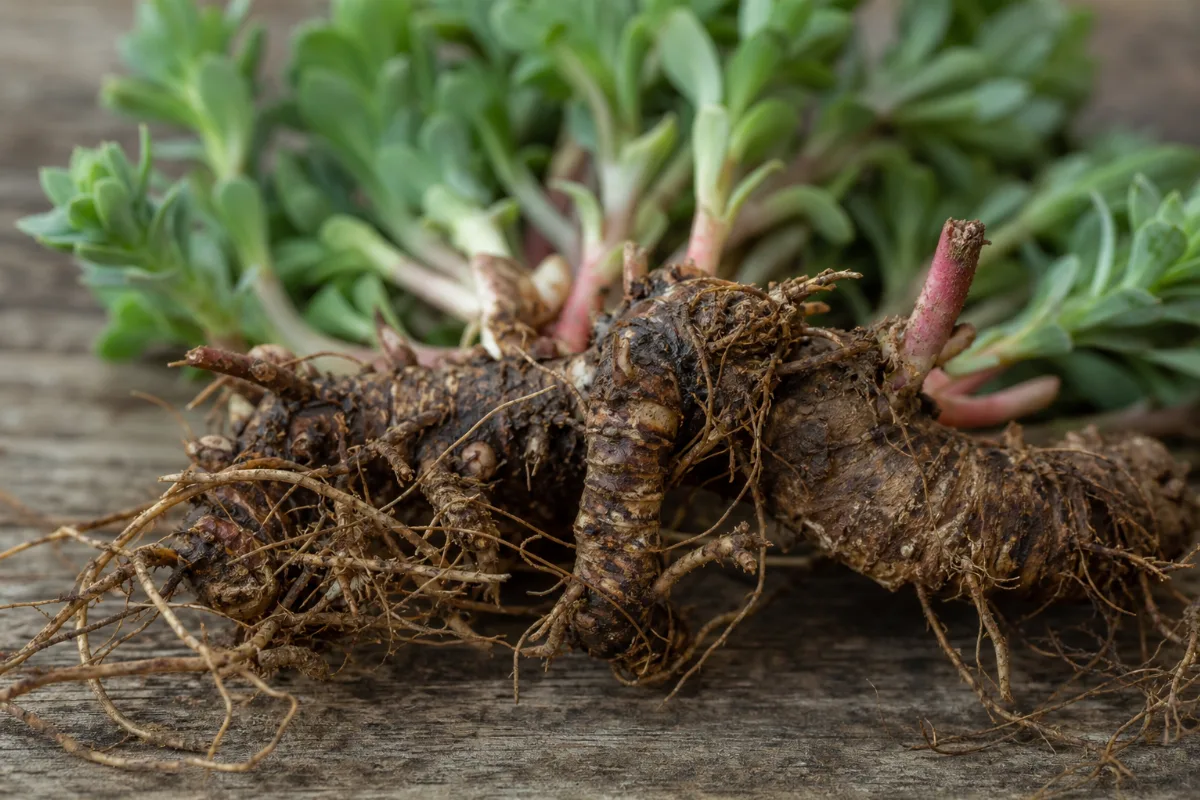
Rhodiola is Rhodiola rosea L., in the stonecrop family (Crassulaceae). [5] The part used is the underground stem (rhizome) and root. [6] NIH lists the common names arctic root, golden root, rose root and rosenroot, and says it grows in cold regions and at high altitudes in Europe, Asia and North America. [2] Many other Rhodiola species exist, which matters for product quality (below).Is it an "adaptogen"?
"Adaptogen" is a contested term. One systematic review says rhodiola has "purported adaptogenic properties". [7] The EU herbal monograph does not use the word in its approved use; it lists a traditional use for relief of symptoms of stress, such as fatigue and exhaustion. [4] See what adaptogens are.Traditional use (not proof)
NIH says rhodiola has a long history of use in Russia, Scandinavia and other parts of Europe, traditionally for work performance, endurance, fatigue, depression and altitude sickness. [2] The EMA committee's approval rests on this long-standing use, not on clinical trials: it concluded that, although clinical evidence is insufficient, effectiveness is plausible and the herb has been used safely for at least 30 years. [6] It applies to adults over 18, and EMA says to seek medical advice if symptoms last more than two weeks. [6][4]What research shows
NIH's overall view: there is not enough reliable evidence to say whether rhodiola is useful for any health purpose, and most human research is of low-to-moderate quality. [2]| Use | What the source found | Strength of evidence | Population and form studied |
|---|---|---|---|
| Physical and mental fatigue | A systematic review of 11 studies found contradictory results; all had a high or unclear risk of bias. [7] | Mixed | Mostly healthy adults; various preparations |
| Stress-related fatigue ("burnout") | In 60 adults with fatigue syndrome, a standardized root extract (576 mg extract per day for 28 days) did better than placebo on a burnout scale and an attention test; both groups improved on several measures, and cortisol response on waking differed. [8] | Promising but limited (one small trial) | Adults aged 20 to 55 in Sweden; standardized root extract |
| Mild to moderate depression | In a 12-week trial of 57 people, rhodiola, sertraline and placebo did not differ significantly; sertraline had the larger drop in scores, and adverse events were more common with sertraline (63.2%) than rhodiola (30.0%). [9] | Insufficient evidence | Adults; standardized extract |
| Athletic performance, thinking, energy | NIH says there is not enough reliable evidence for these promoted uses. [2] | Insufficient evidence | Not applicable |
Cortisol is a biomarker, not how someone feels. See adrenal fatigue claims. For more detail see rhodiola for fatigue, stress and mood.
Quality and look-alike products
A study of rhodiola products available to European buyers analyzed about 40 commercial powders and extracts. About one fifth of products that claimed to be R. rosea did not contain rosavin, the marker used to tell R. rosea from related species, and about 80% of the rest had lower rosavin than registered products and appeared adulterated with other Rhodiola species. [10] A separate DNA study of 100 decoction pieces sold as Rhodiola crenulata found only 40% authentic, with the rest other species. [11] See contamination and adulteration and quality testing.Wild harvest and conservation: Proper evidence not found. We searched PubMed and Europe PMC for rhodiola conservation and wild-harvest sources and did not find a usable statement, so we do not describe its conservation status.
Where to go next
Rhodiola side effects and medicine interactions, ashwagandha versus rhodiola, and standardized extracts and marker compounds.Frequently asked questions
Does rhodiola work for stress or fatigue?
Small trials suggest possible benefit, but a systematic review found contradictory results and NIH says evidence is not enough to say. [7][2]
Is rhodiola safe with antidepressants?
Memorial Sloan Kettering advises caution and reports a case of fast, irregular heartbeat when taken with an antidepressant. Ask a prescriber or pharmacist. [1]
Can I take rhodiola while pregnant or breastfeeding?
NIH says little is known, and the EMA herbal committee does not recommend it. [2][4]
Are all rhodiola products the same plant?
No. Studies found products sold as R. rosea that lacked its marker or appeared mixed with other Rhodiola species. [10]
Is rhodiola an approved medicine?
In the EU it can be a traditional herbal medicine for relief of stress symptoms, based on long-standing use rather than trials. [6]
More details: evidence, limits and cautions
The details behind this page: cautions, limits of the evidence and where sources disagree. Open any note to read it.
Safety points first
- Antidepressants and other medicines. Memorial Sloan Kettering Cancer Center advises caution for people taking prescription antidepressants, citing a case report of a fast, irregular heartbeat in a 26-year-old woman who took rhodiola with her antidepressant for 3 days. [1] The same source notes that rhodiola has MAO-inhibiting activity in laboratory work, so it could add to the effects of antidepressants, blood pressure medicines or stimulants; it says the clinical relevance is not yet determined. [1]
- Losartan and enzyme effects. NIH's complementary health center says interactions between rhodiola and losartan (a blood pressure medicine) have been reported. [2] In a crossover study of 13 healthy volunteers, 14 days of a commercial rhodiola product lowered a marker of CYP2C9 enzyme activity by 21%; the authors said this might matter for medicines with a narrow safety margin such as phenytoin and warfarin. [3] See how interactions work.
- Pregnancy and breastfeeding. NIH says little is known about safety. [2] The European Medicines Agency (EMA) herbal committee says safety has not been established and use is not recommended (2024 monograph). [4]
- Depression. NIH reminds readers that depression can be a serious illness and to see a health care provider. [2] Do not stop or change a prescribed medicine on your own; ask the prescriber or pharmacist. In the US, call or text 988 in a crisis.
- Surgery. Tell the surgical team about any supplement you use.
Other safety notes
- Common effects. NIH lists dizziness, headache, insomnia, and dry mouth or extra saliva; it considers rhodiola possibly safe for up to 12 weeks. [2]
- Blood thinners and seizure medicines. Memorial Sloan Kettering advises talking to a provider if taking warfarin or phenytoin. [1]
- Children. EMA says use under 18 has not been established because of lack of data. [4]
- Older adults, liver and kidney conditions. Not described in the sources we read for this page. A case series of ashwagandha liver injury mentioned rhodiola as a possible contributor in one person who also took ashwagandha, so the cause cannot be separated. [12]
References
- Memorial Sloan Kettering Cancer Center. Rhodiola: Purported Benefits, Side Effects & More. Information About Herbs, Botanicals and Other Products. Read 2026-10-23.
- National Center for Complementary and Integrative Health (NIH). Rhodiola: Usefulness and Safety. Page dated April 2025. Read 2026-10-23.
- Thu et al. Effect of commercial Rhodiola rosea on CYP enzyme activity in humans. European journal of clinical pharmacology 2016. PubMed 26613955. Read 2026-10-23.
- European Medicines Agency, Committee on Herbal Medicinal Products (HMPC). European Union herbal monograph on Rhodiola rosea L., rhizoma et radix (EMA/HMPC/24177/2023, final revision 1, 20 March 2024). Read 2026-10-23.
- GBIF Secretariat. GBIF Backbone Taxonomy. Names checked through the species match API on 2026-10-23. Read 2026-10-23.
- European Medicines Agency, Committee on Herbal Medicinal Products (HMPC). Rhodiolae roseae rhizoma et radix: herbal medicinal product summary. Summary for the public EMA/HMPC/289537/2012, 16 June 2014. Read 2026-10-23.
- Ishaque et al. Rhodiola rosea for physical and mental fatigue: a systematic review. BMC complementary and alternative medicine 2012. PubMed 22643043. Read 2026-10-23.
- Olsson et al. A randomised, double-blind, placebo-controlled, parallel-group study of the standardised extract of the roots of Rhodiola rosea in the treatment of subjects with stress-related fatigue. Planta medica 2009. PubMed 19016404. Read 2026-10-23.
- Mao et al. Rhodiola rosea versus sertraline for major depressive disorder: A randomized placebo-controlled trial. Phytomedicine : international journal of phytotherapy and phytopharmacology 2015. PubMed 25837277. Read 2026-10-23.
- Booker et al. The authenticity and quality of Rhodiola rosea products. Phytomedicine : international journal of phytotherapy and phytopharmacology 2016. PubMed 26626192. Read 2026-10-23.
- Xin et al. Survey of commercial Rhodiola products revealed species diversity and potential safety issues. Scientific reports 2015. PubMed 25661009. Read 2026-10-23.
- Björnsson et al. Ashwagandha-induced liver injury: A case series from Iceland and the US Drug-Induced Liver Injury Network. Liver international : official journal of the International Association for the Study of the Liver 2020. PubMed 31991029. Read 2026-10-23.