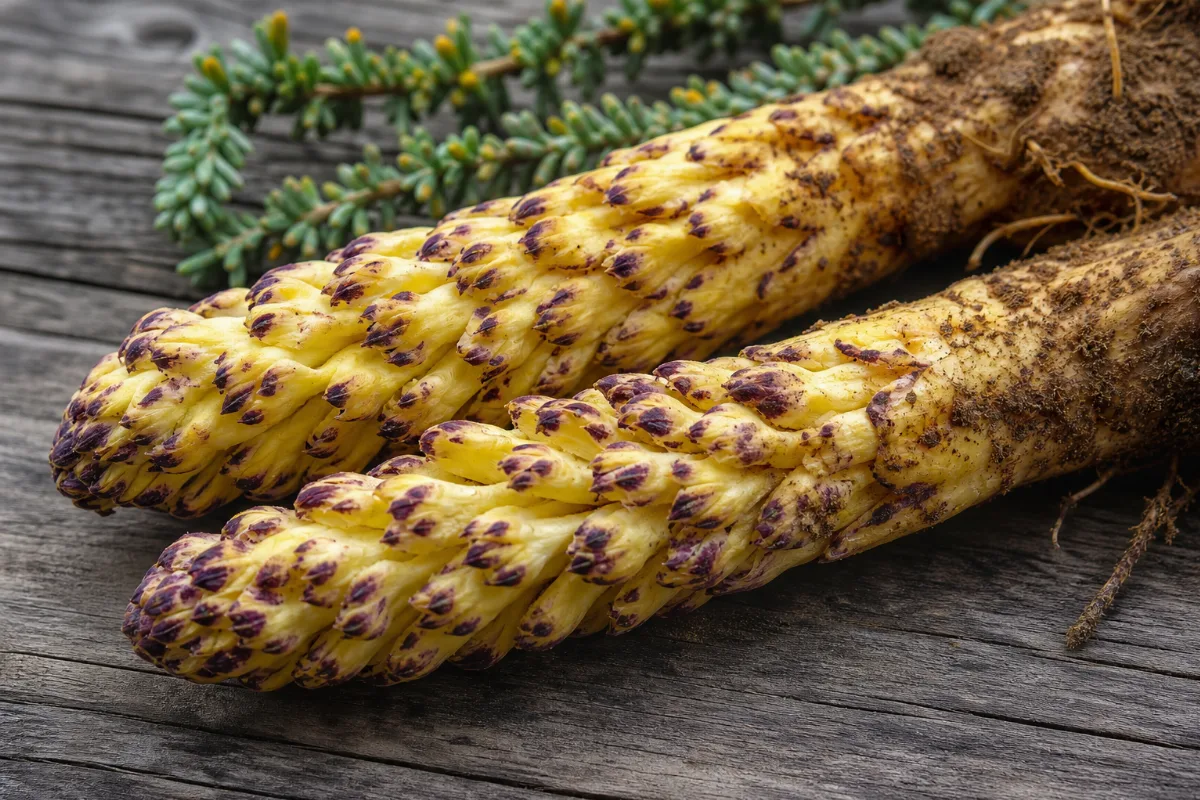
Adaptogens · Herbs & Botanicals · Desert-plant tonic from Chinese medicine, with mostly lab and animal evidence
Cistanche
Cistanche deserticola Y.C. Ma and Cistanche tubulosa (Schenk) Wight · also called Rou cong rong, desert ginseng, desert-broomrape; fleshy stem (Herba Cistanches)
Cistanche is the fleshy stem of a parasitic desert plant, used in Chinese medicine as a "kidney yang" tonic. The main compounds are echinacoside and acteoside. Human research is limited to a few small trials, and most evidence is from rats, mice and cells. Wild stocks were over-harvested, and substitution is a problem.
General information, not medical advice. Last substantive update · Not medically reviewed. A named clinician has not signed off on this page. How this page is made
About Cistanche
Cistanche is a desert-plant tonic with a long history in Chinese medicine. Modern human trials are few, small and mostly company-funded. Hormone and fertility claims rest on mixed animal data. Safety looks reassuring in short trials, but pregnancy, long-term use and medicine interactions are unstudied, and wild stocks need protecting.
What it is
Cistanche (rou cong rong) is the fleshy stem of a desert plant in the broomrape family. Two species are used: Cistanche deserticola and Cistanche tubulosa. The plant has no green leaves and lives as a parasite on the roots of desert shrubs. It is nicknamed "desert ginseng" but is not related to true ginseng.
The main compounds are phenylethanoid glycosides, mainly echinacoside and acteoside (verbascoside), plus polysaccharides and other compounds. Products differ by species, extract and the amount of these compounds.
Traditional and current uses
In Chinese medicine it is a "kidney yang" tonic, used for weakness, impotence, infertility and constipation in older people. "Kidney yang" is a traditional idea, not a medical diagnosis. It is sold as a health food in China and Japan.
Modern research covers memory, muscle, bowel function, hair and hormones. Almost all of it is lab and animal work. The few human trials are small, short and mostly funded by the makers of the product.
What the research shows
The human evidence is thin. Two Cistanche plus Ginkgo trials report better memory scores, a small trial in men reports strength gains, a 180-person trial of a Cistanche-based liquid reports better bowel movements, and a kelp-combination trial reports denser hair. Each has been run once, and none was independent of its maker.
Reports on bone, blood sugar, cholesterol, liver and fertility come from rats, mice and cells. Animal results on hormones are mixed. We found no trial of fertility or sexual function in people, so claims about "boosting" hormones or libido are not supported.
Conservation and quality
Wild Cistanche became endangered and the genus has been listed under CITES Appendix II, according to reviews and a web summary of CITES papers (we could not read the CITES pages). Large farms now supply most of the herb. A 2025 paper says substitution is widespread, and a case report describes poisoning from a homemade herbal wine of a look-alike toxic plant, Aconitum. Choose products that name the species and plant part, and never use wild-gathered material.
At a glance
Traditional uses history, not proof
- Chinese medicine: a "kidney yang" tonic for weakness, impotence and infertility, and for constipation in older people (reviews)
- Health food in China and Japan; China has approved C. deserticola as a functional food ingredient (review)
- Memory support is a newer research theme, not an old use
Studied for research
- Memory scores with a Cistanche plus Ginkgo tablet: low certainty
- Strength, walking, bowel function and hair density: low certainty, single small trials
- Hormones, fertility, bone, blood sugar, cholesterol, liver: animal and lab work only
Main compounds
- Phenylethanoid glycosides: echinacoside and acteoside (verbascoside)
- Iridoids, lignans, polysaccharides and betaine
Common forms
- Dried fleshy stem and decoctions in Chinese medicine
- Standardised extracts and tablets
- Combination products with Ginkgo or kelp
Research links: Cistanches Herba, from an endangered species to a big brand (PubMed) · Cistanches Herba: chemistry, pharmacology and pharmacokinetics (PubMed) · Safety assessment of powdered Cistanche deserticola, 90-day rat study (PubMed) · Research Library · Genes & Biomarkers Library
The plant and its history
- Accepted scientific name
- Cistanche deserticola Ma (written Y.C. Ma in the literature); also Cistanche tubulosa (Schenk) Wight
- Naming authority
- C. deserticola: published by Ma in Acta Sci. Nat. Univ. Intramongol. 1960(1): 63 (GBIF). C. tubulosa: (Schenk) Wight, Icon. Pl. Ind. Orient. 4: t. 1420 bis (1848); basionym Phelipaea tubulosa Schenk (GBIF).
- Synonyms
- C. deserticola: variety Cistanche deserticola var. flabellata R.Cao & Q.Ma (GBIF); C. tubulosa: Phelipaea flava C.A.Mey., Phelipaea gigantea Kar., Phelipaea tubulosa Schenk, Phelypaea tubulosa Schrenk (GBIF)
- Common names
- Rou cong rong (Chinese (pinyin)); 肉蓯蓉 (Chinese); Desert ginseng (English); Desert-broomrape (English (GBIF)); Cistanche (English); ニクジュヨウ (Japanese); Dhanoon / Tartuth (C. tubulosa) (Arabic (GBIF))
- Botanical family
- Orobanchaceae (broomrape family): parasitic plants without green leaves.
- Classification
- Plantae > Tracheophyta > Magnoliopsida > Lamiales > Orobanchaceae > Cistanche > Cistanche deserticola
- Native range
- Arid and semi-arid areas of Eurasia and North Africa (rat safety paper, p27788603); the desert plant is traditionally collected in northwest China and Mongolia. Detail from the abstracts only.
- Habitat
- Deserts and dry sandy areas. The plant is a holoparasite that lives on the roots of host shrubs and has no roots of its own (reviews).
- What the plant looks like
- Roots: None of its own: it attaches to host roots (a CITES annotation discussion notes it lacks roots).; Stems: Fleshy, scale-leaved stem; this fleshy stem is the part used.; Leaves: Reduced to scales; no green leaves (holoparasite). Not described further in the sources read.; Flowers: Not described in the sources read.; Fruit: Not described in the sources read.
- Cultivation
- Because wild supply fell, large-scale cultivation on host shrubs now supplies most of the herb: about 1.26 million mu and 6,000 tons a year (2021 review, p33521978). Atriplex canescens was reported as a new host in a 2021 paper.
- Harvest and processing
- The fleshy stem is dried or processed (for example steamed with rice wine). A 2019 mouse study found drying method changed echinacoside and acteoside content and effect (p31834844).
- Look-alikes and adulterants
- Name: Aconitum brachypodum and other Aconitum (monkshood) plants; Note: A 2025 case report says C. deserticola resembles A. brachypodum and that accidental poisoning is a risk (p41189881).; Name: Other Cistanche species (C. salsa, C. sinensis) sold as rou cong rong; Note: Found in Chinese herb markets; chemistry differs (p19122297). A DNA test can tell C. deserticola from six adulterants (p41669637).
- Sustainability and conservation
- Reviews say the genus was listed in CITES Appendix II when wild stocks were endangered (p33521978); a web-search summary says C. deserticola has been in Appendix II since 2000. NOT verified from CITES itself (pages refused access). Wild populations are declining from over-harvest and habitat loss (p41669637).
Traditional use and history history, not clinical proof
| Tradition or era | Documented use | Source |
|---|---|---|
| Traditional Chinese medicine | Recorded in the Chinese Pharmacopoeia as Cistanches Herba (rou cong rong). Traditional functions: tonifying "kidney yang", treating impotence, female infertility and constipation in older people (review abstracts). In this tradition "kidney yang" is a pattern of weakness, not an organ disease. | p29054705 |
| Two thousand years of use | A 2009 paper says Herba Cistanches has been used to reinforce the vital function of the kidney and induce laxation for more than two thousand years. | p19122297 |
| Modern functional food | China has approved C. deserticola as a functional food ingredient, and it is sold as a health food in China and Japan (reviews). | p40362810 |
Traditional use shows how a plant was used. It does not show that a supplement works or is safe today.
What is inside, and how it may work
What the plant contains and how those compounds act in cells and animals. Laboratory and animal mechanisms are not proven effects in people.
Main compounds
| Compound | Family | Where it is concentrated | Activity studied | Level of evidence |
|---|---|---|---|---|
| Echinacoside PubChem 5281771 | phenylethanoid glycoside | Fleshy stem 43.15 mg/g in one C. deserticola extract (p41106096). | The lead compound. In animals it lowered blood-sugar rise, protected liver, muscle and brain cells, and affected androgen-receptor signalling. Poor oral bioavailability. 29 20 2 11 3 39 | Animal research |
| Acteoside (verbascoside) PubChem 5281800 | phenylethanoid glycoside | Fleshy stem 21,134 mg/kg in C. deserticola (about 2%) in one assay (p16890504). | Lowered cholesterol rise in mice and blood sugar rise in mice; oral bioavailability 0.12% in rats. 30 20 23 39 | Animal research |
| Isoacteoside PubChem 6476333 | phenylethanoid glycoside | Fleshy stem | Blocked rat lens aldose reductase in lab tests (IC50 4.6 uM). 20 39 | Laboratory research |
| Tubuloside A PubChem 21637830 | phenylethanoid glycoside | Fleshy stem | Blocked aldose reductase in lab tests (IC50 8.8 uM). 20 39 | Laboratory research |
| Cistanoside A PubChem 101691130 | phenylethanoid glycoside | Fleshy stem | Named as a component in reviews; separate activity not read. 3 39 | Laboratory research |
| Salidroside PubChem 159278 | phenylethanol glycoside | Fleshy stem | Named with echinacoside, verbascoside, polysaccharides and betaine as contributors to the reproductive effects in animals (p38718638). 16 39 | Animal research |
| Betaine PubChem 247 | amino-acid derivative | Fleshy stem | Named as a contributor to reproductive effects in animals (p38718638). 16 39 | Animal research |
| Polysaccharides (and oligosaccharides) | carbohydrate | Fleshy stem | Changed gut bacteria, raised short-chain fatty acids and improved echinacoside absorption in rats. 4 3 | Animal research |
Mechanisms, receptors and pathways
| Target or pathway | Gene or receptor | What was found | Level |
|---|---|---|---|
| Muscle growth and ferroptosis | IGF-1 / PI3K-AKT | In muscle cells and mice, echinacoside activated IGF-1/PI3K-AKT, reduced ferroptosis and increased fibre size and grip strength; a PI3K inhibitor blocked the benefit. 29 | Animal research |
| Hormone axis and androgen receptor | AR; StAR, CYP11A1, 3beta-HSD | Echinacoside bound the hypothalamic androgen receptor in rats and raised LH and testosterone; glycoside fractions raised testosterone-making enzymes in injured mice. High-dose herb lowered testosterone in healthy mice. 11 27 12 | Animal research |
| Androgen receptor in prostate cancer cells | AR / PSA | Cistanches Herba extract increased tumour growth and androgen-receptor expression in a mouse prostate-cancer model. 32 | Animal research |
| Gut pacemaker cells | SCF / C-kit | C. deserticola improved defecation in constipated rats through SCF/C-kit; blocking the pathway removed the effect. 33 | Animal research |
| Blood sugar and cholesterol | Aldose reductase; liver cholesterol genes | Echinacoside and acteoside lowered blood sugar rise in mice and blocked aldose reductase; the extract changed liver genes for cholesterol handling. 20 23 | Animal research |
| Alcohol liver injury | Nrf2 | Echinacoside raised Nrf2 activity and protected mouse liver cells from alcohol. 2 | Animal research |
| Alzheimer-like brain changes | Amyloid; acetylcholine; dopamine | Extract lowered amyloid deposits and reversed cholinergic and dopamine changes in rats. 31 | Animal research |
| Human findings (not mechanisms) | None proven | Human trials report outcome changes (strength, gait, memory, bowel movements, hair) but none proved a mechanism. 26 10 1 34 | Human data |
Absorption, metabolism and elimination
- Absorption
- Poor. Echinacoside and acteoside cross gut-cell layers poorly; extract raised permeability about threefold in cell layers, partly through a glucose transporter (p26179928). Oral bioavailability of pure acteoside was 0.12% in rats (p16890504).
- Distribution
- Acteoside reached the rat brain at 0.45 to 0.68% of plasma levels; 75.5% bound to plasma protein (p16890504).
- Metabolism
- Reviews say fast and extensive metabolism (p29054705). Gut bacteria are involved in lab work.
- Elimination
- No data found in the abstracts read.
- Bioavailability
- Cistanche polysaccharides improved echinacoside absorption in rats (p31987946). No human pharmacokinetic study was found.
Isolated compounds versus whole extracts
Most lab results use isolated echinacoside or acteoside, but human trials use extracts and combination products. Extracts may behave differently: polysaccharides in the whole herb raised echinacoside absorption in rats, and drying method changed potency in mice. Results from isolated compounds should not be assumed to apply to supplements.
Nutritional composition
A nutrient table is not meaningful. Cistanche is a medicinal stem taken in small amounts; the sources read give no vitamin or mineral content, so none is claimed.
6 low certainty6 not enough evidence
What is Cistanche good for?
The main studied uses and how strong the human evidence is for each. "Low" and "very low" mean the studies are small or funded by the maker. "Insufficient" means there is almost no human evidence.
Benefits, one by one
Each card is a research question, not a promise. Tap a goal to filter. Open a card to see the studies, doses and limits.
Memory in healthy adults (a Cistanche plus Ginkgo product)
Low certaintyOne 30-day trial of a Cistanche tubulosa plus Ginkgo biloba tablet found better memory test scores than placebo in healthy adults aged 30 to 65. We cannot tell how much came from Cistanche, because Ginkgo was in the tablet too.
1 studiesCombination tablet of Cistanche tubulosa and Ginkgo biloba extracts (…
Studies, doses and limits
What the trials found
One randomized, double-blind, placebo-controlled trial (117 healthy adults aged 30 to 65, 30 days, ChiCTR2400084102) tested a tablet with Cistanche tubulosa and Ginkgo biloba extracts. Memory scores, including total memory and Memory Quotient, were higher than placebo (all p<0.01), and results were similar by age and sex. MRI showed small grey-matter reductions in motor areas and more cerebellar activity, linked to the memory gains. Authors from the manufacturer were involved. No second trial was found.
Results
Memory test scores higher than placebo after 30 days; the size of the difference is not given in the abstract.
Effect sizes as reported
The abstract gives p-values only.
Why this rating
A single short, industry-linked trial of a two-herb product. Effects cannot be credited to Cistanche alone, and no one has repeated it.
Form and dose studied
Combination tablet of Cistanche tubulosa and Ginkgo biloba extracts (exact amounts of each are not in the abstract).
Who was studied
Healthy adults aged 30 to 65.
Limits
Combination product; 30 days only; industry-linked; MRI links are correlations; no long-term data.
Why researchers looked
Memory decline with age is common, and extracts rich in echinacoside have been tested in lab models of memory loss.
Traditional use
Cistanche (rou cong rong) is a traditional Chinese tonic made from the fleshy stem of a desert parasite plant. It is called 'desert ginseng'. Old uses centre on 'kidney' tonics, constipation in older people and general vigour. Memory support is a newer research theme (a 2014 rat paper says traditional physicians use C. tubulosa for forgetfulness).
Proposed mechanism Preliminary mechanism
Lab and animal work suggests echinacoside and acteoside may lower amyloid build-up and support brain chemicals (see the rat study below). The 2026 trial reports brain-scan changes linked to memory gains, but these are correlations.
A proposed mechanism does not show that the effect happens in people.
No adverse-event data were reported in the abstract.
Thinking and memory scores in middle-aged and older adults at risk (a Cistanche plus Ginkgo product)
Low certaintyA 90-day trial in 100 middle-aged and older Chinese adults found better memory-test scores after a Cistanche tubulosa plus Ginkgo product. It also reported lower blood tau levels. Again, the product holds two herbs.
1 studiesTablets with echinacoside (72 mg) and flavonol glycosides (27 mg) per…
Studies, doses and limits
What the trials found
In a randomized, double-blind, placebo-controlled trial (100 adults, 90 days), the active group improved on the Mini-Mental State Examination (26.5 to 27.1), the Montreal Cognitive Assessment (23.4 to 25.3) and a quality-of-life scale (81.6 to 84.2), all p<0.001 and described as better than placebo. Cognitrax and Wechsler Memory Scale tests showed better long-term and delayed memory. Blood total tau and several phosphorylated tau forms fell. No treatment-related adverse events were reported, and blood and urine tests stayed stable. The authors work for the manufacturer.
Results
MMSE +0.6 and MoCA +1.9 from baseline; tau markers lower.
Effect sizes as reported
Changes from baseline in the active group; the difference against placebo is not given in the abstract.
Why this rating
One industry-linked trial, a two-herb tablet, and improvements of about half a point on the MMSE are small. A fall in blood tau is a lab marker, not proof of better brain health.
Form and dose studied
Tablets with echinacoside (72 mg) and flavonol glycosides (27 mg) per two tablets, as given in the abstract.
Who was studied
Chinese adults aged middle to older at risk of neurodegenerative disease.
Limits
Two-herb product; 90 days; no long-term follow-up; industry-linked; abstract-level reading only.
Why researchers looked
People with mild memory worries are at higher risk of later decline, so supplements are tested for memory and for brain-related blood markers.
Traditional use
Cistanche (rou cong rong) is a traditional Chinese tonic made from the fleshy stem of a desert parasite plant. It is called 'desert ginseng'. Old uses centre on 'kidney' tonics, constipation in older people and general vigour. Memory support is a newer research theme (a 2014 rat paper says traditional physicians use C. tubulosa for forgetfulness).
Proposed mechanism Preliminary mechanism
Echinacoside is thought to act on oxidative stress and brain-cell signalling in lab models. Why blood tau changed is not known.
A proposed mechanism does not show that the effect happens in people.
No treatment-related adverse events reported; routine labs stable.
People with moderate Alzheimer disease
Not enough evidenceOne small open-label study found that 18 people with moderate Alzheimer disease did not get significantly worse over 48 weeks on a Cistanche tubulosa glycoside capsule. With no placebo group, this cannot show the capsule did anything.
1 studiesCistanche tubulosa glycoside capsules (Memoregain), 48 weeks.
Studies, doses and limits
What the trials found
An open-label study of 18 people with moderate Alzheimer disease took Memoregain capsules (Cistanche tubulosa glycosides) for 48 weeks. The MMSE was 14.78 at the start and 14.06 at the end. Changes in the ADAS-cog were not statistically significant: 10 people improved, 7 worsened, 1 stayed the same. Daily-living and global scores did not change. All adverse reactions were mild. The sponsor supplied the product.
Results
No significant change in any score over 48 weeks.
Effect sizes as reported
MMSE 14.78 to 14.06; ADAS-cog change not significant.
Why this rating
No placebo group and only 18 people. Stable scores in moderate Alzheimer disease cannot be told apart from the natural course without a comparison group.
Form and dose studied
Cistanche tubulosa glycoside capsules (Memoregain), 48 weeks.
Who was studied
People with moderate Alzheimer disease.
Limits
Open-label; tiny; sponsor-supplied product; no comparison group.
Why researchers looked
Echinacoside and acteoside are studied as protectors of nerve cells in lab models.
Traditional use
Cistanche (rou cong rong) is a traditional Chinese tonic made from the fleshy stem of a desert parasite plant. It is called 'desert ginseng'. Old uses centre on 'kidney' tonics, constipation in older people and general vigour. Memory support is a newer research theme (a 2014 rat paper says traditional physicians use C. tubulosa for forgetfulness).
Proposed mechanism Preliminary mechanism
In rats, a Cistanche tubulosa extract lowered amyloid build-up and eased cholinergic and dopamine changes (see below).
A proposed mechanism does not show that the effect happens in people.
Adverse reactions were all mild; the abstract does not list them.
Memory in rat models of Alzheimer-like memory loss (animal evidence only)
Not enough evidenceIn rats given amyloid to cause memory loss, a Cistanche tubulosa extract improved maze and avoidance tests and lowered amyloid deposits. This has not been shown in people.
1 studiesAqueous extract of Cistanche tubulosa (dose not in the abstract).
Studies, doses and limits
What the trials found
No human trial answers this question beyond the studies above. The 2014 rat study used an aqueous extract of Cistanche tubulosa (measured for three phenylpropanoid glycosides) given during amyloid infusion.
Results
Better memory test results and less amyloid in model rats.
Effect sizes as reported
No effect sizes in the abstract.
Why this rating
Rat model with injected amyloid; many herbs that work in rats fail in people.
Form and dose studied
Aqueous extract of Cistanche tubulosa (dose not in the abstract).
Who was studied
Rats with amyloid beta 1-42 infusion.
Limits
Animal data only; one study read; it was not repeated here.
Why researchers looked
Animal work tells researchers whether a plant is worth testing in people.
Traditional use
Cistanche (rou cong rong) is a traditional Chinese tonic made from the fleshy stem of a desert parasite plant. It is called 'desert ginseng'. Old uses centre on 'kidney' tonics, constipation in older people and general vigour. Memory support is a newer research theme (a 2014 rat paper says traditional physicians use C. tubulosa for forgetfulness).
Proposed mechanism Preliminary mechanism
The extract lowered amyloid deposits and reversed changes in acetylcholine and dopamine in the rat brain. Donepezil also helped memory but did not fix the dopamine change.
A proposed mechanism does not show that the effect happens in people.
Not assessed in this paper.
Muscle strength and recovery with resistance training
Low certaintyOne 8-week trial in 48 men found bigger strength gains than placebo with a Cistanche deserticola extract on top of resistance training. It was small and paid for by the maker, and the abstract gives only p-values.
2 studiesCistanche deserticola extract as used in the trial; plant part not st…
Studies, doses and limits
What the trials found
In a randomized, double-blind, placebo-controlled trial (48 men, 24 trained and 24 untrained, 8 weeks of resistance training), the Cistanche group gained more 1RM bench press and squat (untrained: p<0.05), more isometric strength and repetitions to failure (p<0.01). Cortisol was lower (p<0.05); testosterone, CRP and creatine kinase improved (p<0.01). In trained men the squat 1RM and isometric strength rose (p<0.05) with lower CRP and creatine kinase (p<0.01). The abstract gives no effect sizes. The sponsor supplied the product.
Results
Greater strength gains than placebo; values not in the abstract.
Effect sizes as reported
Only p-values reported.
Why this rating
One small, industry-linked trial in men; effect sizes unknown; no repeat trial.
Form and dose studied
Cistanche deserticola extract as used in the trial; plant part not stated.
Who was studied
Healthy men, trained and untrained.
Limits
Men only; 8 weeks; industry-linked; abstract-level reading only.
Why researchers looked
The tonic is traditionally taken for weakness and fatigue, and echinacoside protects muscle cells in lab models.
Traditional use
Cistanche (rou cong rong) is a traditional Chinese tonic made from the fleshy stem of a desert parasite plant. It is called 'desert ginseng'. Old uses centre on 'kidney' tonics, constipation in older people and general vigour. Memory support is a newer research theme (a 2014 rat paper says traditional physicians use C. tubulosa for forgetfulness).
Proposed mechanism Preliminary mechanism
In muscle cells and mice, echinacoside increased muscle fibre size and grip strength through the IGF-1/PI3K-AKT pathway and reduced a cell-death process called ferroptosis. That is lab and animal evidence only.
A proposed mechanism does not show that the effect happens in people.
No adverse-event details in the abstract.
Walking ability in older adults with early movement decline
Low certaintyIn 26 adults with early age-related movement decline, 12 weeks of Cistanche tubulosa extract kept gait speed and step width better than placebo in those over 60. Muscle mass did not change.
1 studiesCistanche tubulosa 30% ethanol extract; dose not in the abstract.
Studies, doses and limits
What the trials found
In a randomized, double-blind, placebo-controlled trial, 26 people finished 12 weeks. In people over 60, step width (two-step test) and gait speed (5 m walk) were better than with placebo (p=0.046). Trunk and limb muscle mass was unchanged. Blood tests showed no obvious adverse events.
Results
Gait speed and step width better than placebo in over-60s (p=0.046).
Effect sizes as reported
Borderline p-value in a sub-group.
Why this rating
Only 26 completers, a sub-group result, a borderline p-value and no repeat trial.
Form and dose studied
Cistanche tubulosa 30% ethanol extract; dose not in the abstract.
Who was studied
Adults with pre-symptomatic or mild locomotive syndrome.
Limits
Tiny; sub-group; muscle mass unchanged.
Why researchers looked
A mouse study from the same group found better walking in casts-immobilised mice, which led to this trial.
Traditional use
Cistanche (rou cong rong) is a traditional Chinese tonic made from the fleshy stem of a desert parasite plant. It is called 'desert ginseng'. Old uses centre on 'kidney' tonics, constipation in older people and general vigour. Memory support is a newer research theme (a 2014 rat paper says traditional physicians use C. tubulosa for forgetfulness).
Proposed mechanism Preliminary mechanism
Not shown in people. In mice, the extract improved walking in a muscle-wasting model (mentioned in the trial paper).
A proposed mechanism does not show that the effect happens in people.
No obvious adverse events on blood tests.
Constipation (functional constipation of the traditional "Yang-deficiency" type)
Low certaintyA 180-person trial of a Cistanche-based liquid (Congrong Runtong Oral Liquid) found about 61% responded at the higher dose compared with about 19% on placebo. The ingredients of the liquid are not given in the abstract, so it may not be Cistanche alone.
2 studiesCongrong Runtong Oral Liquid.
Studies, doses and limits
What the trials found
Multicentre, double-blind, placebo-controlled phase II trial (NCT05803161; 180 adults, 8 weeks). Response: 60.7% (37/61) at 6 g/day, 35.0% (21/60) at 3 g/day, 18.6% (11/59) with placebo (p<0.0001 and p=0.044). Weekly complete spontaneous bowel movements were 2.0, 1.5 and 1.2. Total spontaneous bowel movements did not differ significantly. Treatment-related adverse events were 1.6%, 0% and 3.4%; none were severe.
Results
Response 60.7% vs 18.6% at 6 g/day versus placebo.
Effect sizes as reported
Weekly complete spontaneous bowel movements 2.0 vs 1.2.
Why this rating
A single phase II trial of a product whose ingredients are not stated in the abstract, in people diagnosed under a traditional pattern. The company that made it gave the grant.
Form and dose studied
Congrong Runtong Oral Liquid.
Who was studied
Adults aged 18 to 70 with Rome IV functional constipation of Yang-deficiency type; 80% women.
Limits
One trial; 8 weeks; unknown ingredients; specific diagnosis.
Why researchers looked
Easing constipation in older people is one of the oldest uses of Cistanche in Chinese medicine.
Traditional use
Cistanche (rou cong rong) is a traditional Chinese tonic made from the fleshy stem of a desert parasite plant. It is called 'desert ginseng'. Old uses centre on 'kidney' tonics, constipation in older people and general vigour. Memory support is a newer research theme (a 2014 rat paper says traditional physicians use C. tubulosa for forgetfulness).
Proposed mechanism Preliminary mechanism
In rats with drug-induced constipation, Cistanche deserticola improved stool output through the SCF/C-kit pathway in gut pacemaker cells, and other rat studies point to gut bacteria and bile acids. Animal evidence only.
A proposed mechanism does not show that the effect happens in people.
Few adverse events; because the herb is used to ease bowels, loose stools are plausible (see safety).
Hair density in patterned hair loss (a Cistanche plus kelp product)
Low certaintyA 16-week trial of a Cistanche tubulosa plus Laminaria (kelp) extract found denser and thicker hair than placebo. A 2026 network meta-analysis listed the same product among supplements that improved hair density.
2 studiesCistanche tubulosa extract plus Laminaria japonica extract (MK-R7), 4…
Studies, doses and limits
What the trials found
One double-blind, placebo-controlled trial of MK-R7 (400 mg): after 16 weeks hair density rose 23.29 per cm2 versus 10.35 with control (p<0.05) and hair diameter 0.018 mm versus 0.003 mm (p<0.05); dandruff and scalp-inflammation scores also improved (45 in the test group). The 2026 network meta-analysis (19 trials, 1,658 people, 16 supplements) lists MK-R7 as improving hair density versus placebo and calls all supplements well tolerated, while asking for larger trials.
Results
Hair density +23.29 vs +10.35 hairs per cm2 at 16 weeks.
Effect sizes as reported
No confidence intervals in the abstracts.
Why this rating
One small trial, a two-ingredient product, and a network meta-analysis that relies on it.
Form and dose studied
Cistanche tubulosa extract plus Laminaria japonica extract (MK-R7), 400 mg.
Who was studied
People with mild to moderate patterned hair loss.
Limits
Combination; small; short.
Why researchers looked
Newer research use; it is not a traditional use.
Traditional use
Not a traditional use of Cistanche.
Proposed mechanism Pharmacological theory
Suggested to act through antioxidant and anti-inflammatory effects on the scalp; not shown.
A proposed mechanism does not show that the effect happens in people.
Tolerability reported as good in the meta-analysis abstract.
Male fertility, hormones and the traditional "kidney yang" tonic use
Not enough evidenceCistanche is traditionally a "kidney yang" tonic for sexual and reproductive weakness. Rat and mouse studies show better sperm and testosterone in injured animals, but one mouse study showed the opposite at high doses, and no human fertility trial was found.
9 studiesIsolated echinacoside, glycoside fractions and herb extracts in anima…
Studies, doses and limits
What the trials found
No human trial of fertility or sexual function was found. In the muscle trial, testosterone rose (p<0.05 to <0.01) in healthy men, but the size is not given. The animal evidence is mixed: improved sperm and hormones in injured rats and mice (echinacoside; phenylethanol glycosides; total glycosides), versus lower sperm count and testosterone in healthy mice at 250-1,000 mg/kg and more prostate-tumour growth with Cistanches Herba extract in a mouse model.
Results
Animal results are mixed; no human fertility data.
Effect sizes as reported
No human effect sizes. Mice: sperm count about 223 vs 298 million at 1,000 mg/kg; testosterone about 57% of controls.
Why this rating
Almost all evidence is from rodents and lab models, results conflict, and no human fertility trial exists.
Form and dose studied
Isolated echinacoside, glycoside fractions and herb extracts in animals; nothing equivalent tested in men.
Who was studied
Injured or diabetic male rodents; healthy young men (muscle trial).
Limits
Animal data only; conflicting results; traditional-pattern language.
Why researchers looked
It is among the most-used tonics in Chinese medicine for impotence and infertility.
Traditional use
"Kidney yang" is a traditional-medicine idea, not a medical diagnosis. Do not read it as a hormone treatment.
Proposed mechanism Preliminary mechanism
In rodents, echinacoside and Cistanche glycosides raised LH and testosterone and improved sperm in injury models, with steroid-making enzymes up (CYP11A1, 3beta-HSD) or via hypothalamic androgen-receptor effects. Another mouse study found lower sperm count and testosterone at high doses, and a mouse cancer model found more tumour growth.
A proposed mechanism does not show that the effect happens in people.
Possible effects on hormone-sensitive conditions (see safety).
Bone density after menopause (animal evidence only)
Not enough evidenceIn rats whose ovaries were removed, a Cistanche deserticola extract improved bone density and structure. No human bone trial was found.
2 studiesCistanche deserticola ethanol extract in rats.
Studies, doses and limits
What the trials found
The 2024 rat study (50 female rats, extract at 0.6 and 1.2 g/kg) found better bone-turnover markers, cancellous bone structure and bone mineral density. A 2023 review summarises the cell and animal work. No human trial was found.
Results
Better bone density in ovariectomised rats.
Effect sizes as reported
No numbers in the abstract.
Why this rating
Only animal and cell data.
Form and dose studied
Cistanche deserticola ethanol extract in rats.
Who was studied
Female rats after ovary removal.
Limits
Animal only.
Why researchers looked
Kidney tonics are traditionally linked to strong bones.
Traditional use
Cistanche (rou cong rong) is a traditional Chinese tonic made from the fleshy stem of a desert parasite plant. It is called 'desert ginseng'. Old uses centre on 'kidney' tonics, constipation in older people and general vigour. Memory support is a newer research theme (a 2014 rat paper says traditional physicians use C. tubulosa for forgetfulness).
Proposed mechanism Preliminary mechanism
Reviews describe more bone-building cell activity and less bone-breaking cell activity in animal and cell work.
A proposed mechanism does not show that the effect happens in people.
Not assessed.
Blood sugar and cholesterol (animal evidence only)
Not enough evidenceIn mice, echinacoside and acteoside from Cistanche tubulosa slowed the blood-sugar rise after starch, and an extract lowered the rise in cholesterol on a high-cholesterol diet. No human trial of blood sugar or cholesterol was found.
3 studiesIsolated compounds and extracts.
Studies, doses and limits
What the trials found
No human trial was found. In mice: echinacoside and acteoside (125-500 mg/kg) lowered the post-starch blood-sugar rise and improved glucose tolerance after 2 weeks; a root extract at 400 mg/kg for 14 days blunted the cholesterol rise; in diabetic rats the extract improved blood sugar and insulin resistance.
Results
Lower blood sugar and cholesterol rise in mice and rats.
Effect sizes as reported
No human numbers.
Why this rating
Animal data only, using isolated compounds or fractions at high doses.
Form and dose studied
Isolated compounds and extracts.
Who was studied
Mice and rats.
Limits
Animal only.
Why researchers looked
Lab interest in plant glycosides that block sugar-handling enzymes.
Traditional use
Cistanche (rou cong rong) is a traditional Chinese tonic made from the fleshy stem of a desert parasite plant. It is called 'desert ginseng'. Old uses centre on 'kidney' tonics, constipation in older people and general vigour. Memory support is a newer research theme (a 2014 rat paper says traditional physicians use C. tubulosa for forgetfulness).
Proposed mechanism Preliminary mechanism
The compounds blocked the enzyme aldose reductase and changed liver genes for cholesterol handling.
A proposed mechanism does not show that the effect happens in people.
Possible additive effect with blood-sugar medicines is untested in people (see safety).
Liver protection (animal evidence only)
Not enough evidenceIn mice with alcohol-induced liver injury, echinacoside lowered liver enzymes and tissue damage. This is a lab finding and not a treatment.
1 studiesEchinacoside from Cistanche tubulosa.
Studies, doses and limits
What the trials found
No human trial was found. The 2023 mouse and cell study found lower AST and less liver damage after alcohol with echinacoside from Cistanche tubulosa.
Results
Lower AST and less damage in alcohol-fed mice.
Effect sizes as reported
No numbers in the abstract.
Why this rating
One mouse model; isolated compound.
Form and dose studied
Echinacoside from Cistanche tubulosa.
Who was studied
Mice and mouse liver cells.
Limits
Animal only. Does not show safety in people with liver disease.
Why researchers looked
Liver protection is a frequent topic in lab work on phenylethanoid glycosides.
Traditional use
Cistanche (rou cong rong) is a traditional Chinese tonic made from the fleshy stem of a desert parasite plant. It is called 'desert ginseng'. Old uses centre on 'kidney' tonics, constipation in older people and general vigour. Memory support is a newer research theme (a 2014 rat paper says traditional physicians use C. tubulosa for forgetfulness).
Proposed mechanism Preliminary mechanism
Echinacoside raised Nrf2 activity, an antioxidant switch; removing Nrf2 weakened the effect.
A proposed mechanism does not show that the effect happens in people.
See the safety file for the liver section.
Connections to the rest of health
How Cistanche connects to the rest of our health knowledge graph. Every link says what kind of connection it is. A safety link (for example to the liver) is a warning, not a benefit. A study that merely mentions a topic never creates a benefit link.
Explore every connection: goals, body systems, organs, symptoms, genes
A. Wellness goals
| Connected to | Kind of connection | Evidence status | Context | Studies |
|---|---|---|---|---|
| Memory Support | Potential benefit | Low certainty | Memory in healthy adults (a Cistanche plus Ginkgo product): One 30-day trial of a Cistanche tubulosa plus Ginkgo biloba tablet found better memory test scores than placebo in healthy adults aged 30 to 65. We cannot tell how much came from Cistanche, because Ginkgo was in the tablet too. Thinking and memory scores in middle-aged and older adults at risk (a Cistanche plus Ginkgo product): A 90-day trial in 100 middle-aged and older Chinese adults found better memory-test scores after a Cistanche tubulosa plus Ginkgo product. It also reported lower blood tau levels. Again, the product holds two herbs. | 6 1 7 31 |
| Cognitive Performance | Potential benefit | Low certainty | Memory in healthy adults (a Cistanche plus Ginkgo product): One 30-day trial of a Cistanche tubulosa plus Ginkgo biloba tablet found better memory test scores than placebo in healthy adults aged 30 to 65. We cannot tell how much came from Cistanche, because Ginkgo was in the tablet too. Thinking and memory scores in middle-aged and older adults at risk (a Cistanche plus Ginkgo product): A 90-day trial in 100 middle-aged and older Chinese adults found better memory-test scores after a Cistanche tubulosa plus Ginkgo product. It also reported lower blood tau levels. Again, the product holds two herbs. | 6 1 |
| Brain Health | Potential benefit | Low certainty | Thinking and memory scores in middle-aged and older adults at risk (a Cistanche plus Ginkgo product): A 90-day trial in 100 middle-aged and older Chinese adults found better memory-test scores after a Cistanche tubulosa plus Ginkgo product. It also reported lower blood tau levels. Again, the product holds two herbs. People with moderate Alzheimer disease: One small open-label study found that 18 people with moderate Alzheimer disease did not get significantly worse over 48 weeks on a Cistanche tubulosa glycoside capsule. With no placebo group, this cannot show the capsule did anything. | 1 7 31 |
| Muscle Recovery | Potential benefit | Low certainty | Muscle strength and recovery with resistance training: One 8-week trial in 48 men found bigger strength gains than placebo with a Cistanche deserticola extract on top of resistance training. It was small and paid for by the maker, and the abstract gives only p-values. | 26 29 |
| Physical Stamina | Potential benefit | Low certainty | Muscle strength and recovery with resistance training: One 8-week trial in 48 men found bigger strength gains than placebo with a Cistanche deserticola extract on top of resistance training. It was small and paid for by the maker, and the abstract gives only p-values. Walking ability in older adults with early movement decline: In 26 adults with early age-related movement decline, 12 weeks of Cistanche tubulosa extract kept gait speed and step width better than placebo in those over 60. Muscle mass did not change. | 26 29 10 |
| Peak Performance | Potential benefit | Low certainty | Muscle strength and recovery with resistance training: One 8-week trial in 48 men found bigger strength gains than placebo with a Cistanche deserticola extract on top of resistance training. It was small and paid for by the maker, and the abstract gives only p-values. | 26 29 |
| Healthy Aging | Potential benefit | Low certainty | Walking ability in older adults with early movement decline: In 26 adults with early age-related movement decline, 12 weeks of Cistanche tubulosa extract kept gait speed and step width better than placebo in those over 60. Muscle mass did not change. Bone density after menopause (animal evidence only): In rats whose ovaries were removed, a Cistanche deserticola extract improved bone density and structure. No human bone trial was found. | 10 17 28 |
| Digestive Support | Potential benefit | Low certainty | Constipation (functional constipation of the traditional "Yang-deficiency" type): A 180-person trial of a Cistanche-based liquid (Congrong Runtong Oral Liquid) found about 61% responded at the higher dose compared with about 19% on placebo. The ingredients of the liquid are not given in the abstract, so it may not be Cistanche alone. | 34 33 |
| Gut Health | Potential benefit | Low certainty | Constipation (functional constipation of the traditional "Yang-deficiency" type): A 180-person trial of a Cistanche-based liquid (Congrong Runtong Oral Liquid) found about 61% responded at the higher dose compared with about 19% on placebo. The ingredients of the liquid are not given in the abstract, so it may not be Cistanche alone. | 34 33 |
| Hair Support | Potential benefit | Low certainty | Hair density in patterned hair loss (a Cistanche plus kelp product): A 16-week trial of a Cistanche tubulosa plus Laminaria (kelp) extract found denser and thicker hair than placebo. A 2026 network meta-analysis listed the same product among supplements that improved hair density. | 21 35 |
| Healthy Skin | Potential benefit | Low certainty | Hair density in patterned hair loss (a Cistanche plus kelp product): A 16-week trial of a Cistanche tubulosa plus Laminaria (kelp) extract found denser and thicker hair than placebo. A 2026 network meta-analysis listed the same product among supplements that improved hair density. | 21 35 |
| Mens Vitality | Traditional use | Not enough evidence | Male fertility, hormones and the traditional "kidney yang" tonic use: Cistanche is traditionally a "kidney yang" tonic for sexual and reproductive weakness. Rat and mouse studies show better sperm and testosterone in injured animals, but one mouse study showed the opposite at high doses, and no human fertility trial was found. | 11 27 9 13 12 32 16 8 26 |
| Fertility Support | Traditional use | Not enough evidence | Male fertility, hormones and the traditional "kidney yang" tonic use: Cistanche is traditionally a "kidney yang" tonic for sexual and reproductive weakness. Rat and mouse studies show better sperm and testosterone in injured animals, but one mouse study showed the opposite at high doses, and no human fertility trial was found. | 11 27 9 13 12 32 16 8 26 |
| Libido Support | Traditional use | Not enough evidence | Male fertility, hormones and the traditional "kidney yang" tonic use: Cistanche is traditionally a "kidney yang" tonic for sexual and reproductive weakness. Rat and mouse studies show better sperm and testosterone in injured animals, but one mouse study showed the opposite at high doses, and no human fertility trial was found. | 11 27 9 13 12 32 16 8 26 |
| Hormone Balance | Traditional use | Not enough evidence | Male fertility, hormones and the traditional "kidney yang" tonic use: Cistanche is traditionally a "kidney yang" tonic for sexual and reproductive weakness. Rat and mouse studies show better sperm and testosterone in injured animals, but one mouse study showed the opposite at high doses, and no human fertility trial was found. | 11 27 9 13 12 32 16 8 26 |
| Menopause Support | Potential benefit | Not enough evidence | Bone density after menopause (animal evidence only): In rats whose ovaries were removed, a Cistanche deserticola extract improved bone density and structure. No human bone trial was found. | 17 28 |
| Joint Support | Potential benefit | Not enough evidence | Bone density after menopause (animal evidence only): In rats whose ovaries were removed, a Cistanche deserticola extract improved bone density and structure. No human bone trial was found. | 17 28 |
| Blood Sugar Balance | Potential benefit | Not enough evidence | Blood sugar and cholesterol (animal evidence only): In mice, echinacoside and acteoside from Cistanche tubulosa slowed the blood-sugar rise after starch, and an extract lowered the rise in cholesterol on a high-cholesterol diet. No human trial of blood sugar or cholesterol was found. | 20 23 13 |
| Metabolic Health | Potential benefit | Not enough evidence | Blood sugar and cholesterol (animal evidence only): In mice, echinacoside and acteoside from Cistanche tubulosa slowed the blood-sugar rise after starch, and an extract lowered the rise in cholesterol on a high-cholesterol diet. No human trial of blood sugar or cholesterol was found. | 20 23 13 |
| Cholesterol Balance | Potential benefit | Not enough evidence | Blood sugar and cholesterol (animal evidence only): In mice, echinacoside and acteoside from Cistanche tubulosa slowed the blood-sugar rise after starch, and an extract lowered the rise in cholesterol on a high-cholesterol diet. No human trial of blood sugar or cholesterol was found. | 20 23 13 |
| Liver Support | Potential benefit | Not enough evidence | Liver protection (animal evidence only): In mice with alcohol-induced liver injury, echinacoside lowered liver enzymes and tissue damage. This is a lab finding and not a treatment. | 2 |
B. Body systems
| Connected to | Kind of connection | Evidence status | Context | Studies |
|---|---|---|---|---|
| Digestive system | Adverse effect or risk | Very low certainty | Loose stools are plausible from the intended bowel effect; no frequency found. Preparation or compound: Cistanche extracts |
34 |
| Reproductive system | Adverse effect or risk | Very low certainty | Lower sperm count and testosterone in mice at high doses; opposite effects in other rodent models. Preparation or compound: Cistanches herba (high dose) |
12 11 |
| Endocrine system | Drug or supplement interaction | Not enough evidence | Hormone signals in humans and animals; unexplained thyroid-hormone shifts in one trial. Preparation or compound: Cistanche extracts |
26 1 |
| Liver | Preliminary mechanism | Not enough evidence | Liver protection in mice; no human liver injury cases found. Preparation or compound: Echinacoside |
2 5 |
| Nervous System | Biological association | Low certainty | Studied for: Memory in healthy adults (a Cistanche plus Ginkgo product) Studied for: Thinking and memory scores in middle-aged and older adults at risk (a Cistanche plus Ginkgo product) | 6 1 7 31 |
| Musculoskeletal System | Biological association | Low certainty | Studied for: Muscle strength and recovery with resistance training Studied for: Walking ability in older adults with early movement decline | 26 29 10 17 28 |
| Digestive System | Biological association | Low certainty | Studied for: Constipation (functional constipation of the traditional "Yang-deficiency" type) | 34 33 |
| Integumentary System | Biological association | Low certainty | Studied for: Hair density in patterned hair loss (a Cistanche plus kelp product) | 21 35 |
| Reproductive System | Biological association | Not enough evidence | Studied for: Male fertility, hormones and the traditional "kidney yang" tonic use | 11 27 9 13 12 32 16 8 26 |
| Endocrine System | Biological association | Not enough evidence | Studied for: Male fertility, hormones and the traditional "kidney yang" tonic use | 11 27 9 13 12 32 16 8 26 |
| Metabolism Weight | Biological association | Not enough evidence | Studied for: Blood sugar and cholesterol (animal evidence only) | 20 23 13 |
| Cardiovascular System | Biological association | Not enough evidence | Studied for: Blood sugar and cholesterol (animal evidence only) | 20 23 13 |
| Hepatic System | Biological association | Not enough evidence | Studied for: Liver protection (animal evidence only) | 2 |
D. Symptoms
| Connected to | Kind of connection | Evidence status | Context | Studies |
|---|---|---|---|---|
| Memory scores | Potential benefit | Low certainty | Two industry-linked trials of a Cistanche plus Ginkgo tablet. Preparation or compound: Cistanche tubulosa plus Ginkgo biloba |
6 1 |
| Functional constipation | Potential benefit | Low certainty | One phase II trial of a Cistanche-based liquid. Preparation or compound: Congrong Runtong Oral Liquid |
34 |
| Male reproductive health | Traditional use | Not enough evidence | Mixed rodent results; no human trial. Preparation or compound: Extracts and echinacoside |
12 11 |
I. Biomarkers
| Connected to | Kind of connection | Evidence status | Context | Studies |
|---|---|---|---|---|
| Testosterone | Preliminary mechanism | Very low certainty | Raised in one trial of men; mixed in animals. Preparation or compound: Cistanche extracts |
26 12 |
| TSH | Preliminary mechanism | Very low certainty | TSH fell, T3 rose in one trial. Preparation or compound: Cistanche tubulosa plus Ginkgo |
1 |
| Mini-Mental State Examination (MMSE) and Montreal Cognitive Assessment (MoCA) | Biological association | Low certainty | Measured in trials: raised. A lab change is not the same as a health benefit. | 1 7 |
| Memory tests (Memory Quotient, Wechsler Memory Scale, Cognitrax) | Biological association | Low certainty | Measured in trials: raised. A lab change is not the same as a health benefit. | 6 1 |
| Blood tau and phosphorylated tau | Biological association | Very low certainty | Measured in trials: lowered. A lab change is not the same as a health benefit. | 1 |
| ADAS-cog (Alzheimer disease assessment scale, cognitive part) | Biological association | Not enough evidence | Measured in trials: no-change. A lab change is not the same as a health benefit. | 7 |
| Testosterone | Biological association | Very low certainty | Measured in trials: mixed. A lab change is not the same as a health benefit. | 26 27 12 |
| Cortisol | Biological association | Very low certainty | Measured in trials: lowered. A lab change is not the same as a health benefit. | 26 |
| C-reactive protein (CRP) and creatine kinase (CK) | Biological association | Very low certainty | Measured in trials: lowered. A lab change is not the same as a health benefit. | 26 |
| Thyroid hormones (TSH, T3, free T3) | Biological association | Very low certainty | Measured in trials: mixed. A lab change is not the same as a health benefit. | 1 |
| Gait speed (5 m walking test) and step width | Biological association | Low certainty | Measured in trials: raised. A lab change is not the same as a health benefit. | 10 |
| Complete spontaneous bowel movements (response rate) | Biological association | Low certainty | Measured in trials: raised. A lab change is not the same as a health benefit. | 34 |
| Hair density and diameter (phototrichogram) | Biological association | Low certainty | Measured in trials: raised. A lab change is not the same as a health benefit. | 21 35 |
J. Genes, receptors and enzymes
| Connected to | Kind of connection | Evidence status | Context | Studies |
|---|---|---|---|---|
| AR (androgen receptor) | Preliminary mechanism | Animal | Echinacoside bound hypothalamic AR in rats; herb extract raised AR expression in a mouse tumour model. | 11 32 |
| Nrf2 | Preliminary mechanism | Animal | Raised by echinacoside in mouse liver. | 2 |
| CYP11A1 and 3beta-HSD (steroid making) | Preliminary mechanism | Animal | Raised by glycosides in injured mice. | 27 |
K. Biological pathways
L. Active compounds
| Connected to | Kind of connection | Evidence status | Context | Studies |
|---|---|---|---|---|
| Echinacoside | Biological association | Animal | The lead compound. In animals it lowered blood-sugar rise, protected liver, muscle and brain cells, and affected androgen-receptor signalling. Poor oral bioavailability. Preparation or compound: Fleshy stem |
29 20 2 11 3 39 |
| Acteoside (verbascoside) | Biological association | Animal | Lowered cholesterol rise in mice and blood sugar rise in mice; oral bioavailability 0.12% in rats. Preparation or compound: Fleshy stem |
30 20 23 39 |
| Isoacteoside | Biological association | In vitro | Blocked rat lens aldose reductase in lab tests (IC50 4.6 uM). Preparation or compound: Fleshy stem |
20 39 |
| Tubuloside A | Biological association | In vitro | Blocked aldose reductase in lab tests (IC50 8.8 uM). Preparation or compound: Fleshy stem |
20 39 |
| Cistanoside A | Biological association | In vitro | Named as a component in reviews; separate activity not read. Preparation or compound: Fleshy stem |
3 39 |
| Salidroside | Biological association | Animal | Named with echinacoside, verbascoside, polysaccharides and betaine as contributors to the reproductive effects in animals (p38718638). Preparation or compound: Fleshy stem |
16 39 |
| Betaine | Biological association | Animal | Named as a contributor to reproductive effects in animals (p38718638). Preparation or compound: Fleshy stem |
16 39 |
| Polysaccharides (and oligosaccharides) | Biological association | Animal | Changed gut bacteria, raised short-chain fatty acids and improved echinacoside absorption in rats. Preparation or compound: Fleshy stem |
4 3 |
Each connection is stored with the ingredient, the connected record, the kind of connection, the evidence status, the supporting studies, the preparation or compound involved, and a review date (last reviewed October 25, 2026).
Evidence at a glance: what changed in 11 lab markers
Tap a number to show only those markers. Counts are markers, not people.
The evidence
The research centre for Cistanche. Every record here was checked against PubMed or the publisher's page; we never list a study we have not verified.
Evidence by outcome
Bars show how many studies we found for each outcome, not how well it works. People are added up across trials only (reviews are not added, to avoid double counting).
How we rate evidence
High certainty
Several well-run trials or reviews agree; further research is unlikely to change the picture much.
Moderate certainty
Good trials point the same way, but some doubt remains.
Low certainty
Small, short or inconsistent trials. The finding could change with better research.
Very low certainty
Very little or very weak human data. Treat as a possibility only.
Mixed findings
Trials or reviews disagree with each other.
Not enough evidence
Not enough human research to say either way.
Evidence against
Good research found no benefit, or found harm.
We take the reviewers' own risk-of-bias and GRADE statements where they exist, and otherwise judge from study size, design, consistency, directness and whether a product matches what is sold. Many publications do not make evidence high. Method note: We searched PubMed for Cistanche and its compounds, read the abstracts of the studies we cite, and recorded each study's design, people, product and results. Regulator and conservation pages that refused access are marked as not verified.
Study library: every study we checked 39
| Study | Design | People | Product, dose, length | Result |
|---|---|---|---|---|
| Chen 2024 A randomized, double-blind, placebo-controlled study of Cistanche tubulosa and Ginkgo biloba extracts for the improvement of cognitive function in middle-aged and elderly people Phytother Res · PMID 38972848 · DOI |
Controlled trial |
100 100 middle-aged and older Chinese adults at risk of neurodegenerative disease |
Cistanche tubulosa extract plus Ginkgo biloba extract tablets (combination; each pair of tablets held 72 mg echinacoside and 27 mg flavonol glycosides) unspecified 2 tablets a day (as given in the abstract) 90 days · vs Placebo tablets |
Scores rose in the active group: MMSE 26.5 to 27.1, MoCA 23.4 to 25.3, quality of life 81.6 to 84.2 (all p<0.001, described as better than placebo). Memory tests improved. Blood total tau and phosphorylated tau fell; TSH fell while T3 and free T3 rose. No treatment-related adverse events; routine blood and urine tests stable. MMSE +0.6, MoCA +1.9 from baseline in the active group (change from baseline, not the between-group difference) Methods, limits and fundingOutcomes: MMSE, MoCA, WHO Quality of Life, Cognitrax, Wechsler Memory Scale-Revised, blood tau and phosphorylated tau, thyroid hormones Limitations: A two-herb product, so effects cannot be credited to Cistanche alone; abstract gives within-group changes; company-run; short; the thyroid-hormone shifts were not explained. Funding and conflicts: Authors from Amway (Shanghai) Innovation & Science Co., Ltd. and Amway (China) R&D Center (industry-linked). Read: abstract |
| Ding 2023 Echinacoside from Cistanche tubulosa ameliorates alcohol-induced liver injury and oxidative stress by targeting Nrf2 FASEB J · PMID 36723904 · DOI |
Animal research animal |
Mice with alcohol-induced liver injury and mouse liver cells | Echinacoside from Cistanche tubulosa n/a (isolated compound) Not stated in the abstract Not stated in the abstract · vs Untreated alcohol-fed mice |
Echinacoside lowered AST and liver damage and raised Nrf2 activity; removing Nrf2 weakened the effect. Less liver damage from alcohol in mice Methods, limits and fundingOutcomes: AST, liver tissue, Nrf2 activity Limitations: Mice and cells; isolated compound. Funding and conflicts: Not stated in the abstract Read: abstract |
| Fu 2018 Cistanches Herba: An overview of its chemistry, pharmacology, and pharmacokinetics property J Ethnopharmacol · PMID 29054705 · DOI |
Review n/a |
Review of chemistry, pharmacology and pharmacokinetics of Cistanches Herba | Cistanche species and compounds stem n/a n/a · vs n/a |
Over 100 compounds isolated; phenylethanoid glycosides (echinacoside and acteoside), iridoids, lignans, oligosaccharides, polysaccharides. Traditional functions: kidney deficiency, impotence, female infertility, senile constipation. Poor bioavailability and fast metabolism of the glycosides are named as problems. Methods, limits and fundingOutcomes: Narrative review Limitations: Narrative review. Funding and conflicts: Not stated in the abstract Read: abstract |
| Fu 2020 Cistanche polysaccharides enhance echinacoside absorption in vivo and affect the gut microbiota Int J Biol Macromol · PMID 31987946 · DOI |
Animal research animal |
Sprague-Dawley rats | Cistanche polysaccharides, then echinacoside stem Echinacoside 100 mg/kg after 20 days of polysaccharides 20 days · vs Rats without polysaccharides |
Cistanche polysaccharides changed gut bacteria, raised short-chain fatty acids and improved echinacoside absorption. Better echinacoside absorption in rats Methods, limits and fundingOutcomes: Echinacoside absorption, gut bacteria, short-chain fatty acids Limitations: Rats. Funding and conflicts: No conflict declared. Read: abstract |
| Gao 2017 Safety assessment of powdered Cistanche deserticola Y. C. Ma by a 90-day feeding test in Sprague-Dawley rats Drug Chem Toxicol · PMID 27788603 · DOI |
Animal research animal |
80 80 male and female Sprague-Dawley rats |
Powdered Cistanche deserticola Y.C. Ma mixed into the diet unspecified Diet containing 0, 2, 4 or 8% powder 90 days · vs Control diet |
No signs of toxicity or treatment-related changes. No-observed-adverse-effect level 7.8 g/kg body weight (males) and 8.0 g/kg (females). NOAEL about 7.8 to 8.0 g/kg body weight in rats Methods, limits and fundingOutcomes: Death, body and organ weight, blood chemistry, blood counts, tissue examination Limitations: Rats, not people; plain powder only; 90 days. Funding and conflicts: Not stated in the abstract Read: abstract |
| Gao 2026 Cistanche tubulosa-Ginkgo biloba combination enhances memory via cortico-cerebellar reorganization: a randomized controlled trial Front Pharmacol · PMID 41847135 · DOI |
Controlled trial |
117 117 healthy adults aged 30 to 65 |
Cistanche tubulosa [Schenk] Wight plus Ginkgo biloba L. extract tablets (combination) unspecified Not stated in the abstract 30 days · vs Placebo |
Memory scores were higher than placebo across several tests, including total memory and Memory Quotient (all p<0.01). Small grey-matter reductions in motor areas and more cerebellar activity were seen on MRI and were linked to the memory gains. Memory test scores better than placebo (p<0.01); numbers not given in the abstract Methods, limits and fundingOutcomes: Memory scores (memory quotient and sub-tests), brain MRI (grey matter volume, functional MRI) Limitations: Two-herb product; healthy adults; short (30 days); MRI links are correlations; authors say long-term effects need study. Funding and conflicts: Three authors work for Amway (Shanghai) Innovation & Science Co., Ltd. and two for Amway (China) Co., Ltd. (industry-linked). Registration: ChiCTR2400084102 Read: abstract |
| Guo 2013 An open-label, nonplacebo-controlled study on Cistanche tubulosa glycoside capsules (Memoregain(®)) for treating moderate Alzheimer's Disease Am J Alzheimers Dis Other Demen · PMID 23687177 · DOI |
Case series |
18 18 people with moderate Alzheimer disease |
Cistanche tubulosa glycoside capsules (Memoregain) - a glycoside-enriched product unspecified Not stated in the abstract 48 weeks · vs None (open-label, no placebo) |
MMSE was 14.78 at the start and 14.06 at the end. ADAS-cog change was not statistically significant (improved in 10, worse in 7, unchanged in 1). Daily-living and global scores did not differ from baseline. All adverse reactions were mild. No significant change in any score; scores were stable, not better Methods, limits and fundingOutcomes: ADAS-cog, MMSE, activities of daily living, Blessed Behavioral Scale, Clinical Global Impression Limitations: Open-label, no placebo, only 18 people; cannot tell stability from treatment effect. Funding and conflicts: Sinphar Pharmaceutical Co., Ltd. sponsored the trial and supplied the product (industry-linked). Read: abstract |
| Guo 2019 Enhancement of Kidney Invigorating Function in Mouse Model by Cistanches Herba Dried Rapidly at a Medium High Temperature J Med Food · PMID 31834844 · DOI |
Animal research animal |
Mice with a hydrocortisone-induced "kidney yang deficiency" model | Cistanches Herba extracts from slices dried by different methods unspecified Not stated in the abstract Not stated in the abstract · vs Model mice |
All extracts improved the signs of the model; extracts with more echinacoside and acteoside did better. Better sperm quality and organ weights in model mice Methods, limits and fundingOutcomes: Body and organ weights, semen quality, echinacoside and acteoside content Limitations: Mice; "kidney yang deficiency" is a traditional-medicine label, not a medical diagnosis. Funding and conflicts: Not stated in the abstract Read: abstract |
| Guo 2025 Cistanche total glycoside capsule promotes sperm maturation and fertility by activating the NELL2 Lumicrine pathway in a male reproductive impairment model J Ethnopharmacol · PMID 40659143 · DOI |
Animal research animal |
60 60 male Sprague-Dawley rats with a reproductive-impairment model |
Cistanche total glycoside capsule (from Cistanche deserticola) stem (total glycosides) 90, 180 and 360 mg/kg Not stated in the abstract · vs Model group; L-carnitine as positive control |
Sperm count, viability and fertilisation rate improved and malformations fell versus the model group; HPG-axis hormones were normalised. Better sperm measures than the model group Methods, limits and fundingOutcomes: Sperm count, viability, fertilisation rate, hormones, NELL2 pathway Limitations: Rats; glycoside extract; model-specific. Funding and conflicts: No conflicts declared. Read: abstract |
| Inada 2021 Effects of Cistanche tubulosa Wight Extract on Locomotive Syndrome: A Placebo-Controlled, Randomized, Double-Blind Study Nutrients · PMID 33477648 · DOI |
Controlled trial |
26 26 adults with pre-symptomatic or mild locomotive syndrome (age-related movement decline) who finished; results reported for those over 60 |
Cistanche tubulosa Wight 30% ethanol extract (plant part not stated in abstract) unspecified Not stated in the abstract 12 weeks · vs Placebo |
In people over 60, step width and gait speed were better than placebo (p=0.046). Muscle mass of trunk and limbs did not change. No obvious adverse events on blood tests. Gait speed and step width better than placebo in the over-60 group (p=0.046); muscle mass unchanged Methods, limits and fundingOutcomes: Step width (two-step test), gait speed (5 m walk), muscle mass, blood tests for safety Limitations: Very small; the benefit was in a sub-group; borderline p-value; muscle mass did not change. Funding and conflicts: Authors declare no conflict of interest; funders had no role. Read: abstract |
| Jiang 2018 Echinacoside Increases Sperm Quantity in Rats by Targeting the Hypothalamic Androgen Receptor Sci Rep · PMID 29497114 · DOI |
Animal research animal |
Rats with a sperm-quantity disorder (oligoasthenospermia) | Echinacoside (isolated compound from Cistanche) n/a (isolated compound) Not stated in the abstract Not stated in the abstract · vs Untreated model rats |
Echinacoside lowered androgen receptor in the hypothalamus, which led to more luteinizing hormone and testosterone and more sperm. Docking suggests it binds the receptor. More sperm via hypothalamic androgen receptor in rats Methods, limits and fundingOutcomes: Sperm quantity and quality, LH and testosterone, androgen receptor Limitations: Rats; isolated compound, not the whole plant; mechanism partly from computer docking. Funding and conflicts: Authors declare no competing interests. Read: abstract |
| Kim 2012 Cistanches herba induces testis cytotoxicity in male mice Bull Environ Contam Toxicol · PMID 22002114 · DOI |
Animal research animal |
Male mice | Cistanches herba (extract not described in the abstract) unspecified 250, 500 and 1,000 mg/kg Not stated in the abstract · vs Vehicle |
Sperm count fell with dose (about 223 vs 298 million at 1,000 mg/kg); serum testosterone fell to about 57% of the vehicle group; severe damage to the seminiferous tubules. The authors concluded Cistanches herba is toxic to the testis in mice. Dose-related fall in sperm count and testosterone in mice Methods, limits and fundingOutcomes: Sperm count, serum testosterone, CREM gene, testis tissue Limitations: Mouse study; doses very high (up to 1 g/kg); duration and preparation not given in the abstract; other mouse and rat studies point the other way. Funding and conflicts: Not stated in the abstract Read: abstract |
| Kong 2018 Effect of Cistanche Tubulosa Extracts on Male Reproductive Function in Streptozotocin⁻Nicotinamide-Induced Diabetic Rats Nutrients · PMID 30360409 · DOI |
Animal research animal |
Diabetic male rats (streptozotocin, nicotinamide and high-fat diet) | Cistanche tubulosa extract (CTE), reported by its echinacoside content stem 80, 160 and 320 mg/kg echinacoside in the extract Not stated in the abstract · vs Rosiglitazone as a positive control |
Echinacoside in CTE improved blood sugar, insulin resistance and lipid peroxidation and restored sex-hormone levels and several hypothalamic genes in the rats. Better blood sugar and sex hormones in diabetic rats Methods, limits and fundingOutcomes: Blood sugar, insulin resistance, sex hormones, hypothalamic genes Limitations: Rat model; mixes lab-dish and animal results; no human data. Funding and conflicts: No conflict declared. Read: abstract |
| Lei 2025 Rapid authentication of endangered Cistanche Herba (Rou Cong Rong) using a high-throughput multi-SNP panel and MALDI-TOF MS platform Front Plant Sci · PMID 41669637 · DOI |
Review n/a |
Study building a DNA test (multi-SNP and MALDI-TOF) to authenticate C. deserticola | Cistanche species and compounds stem n/a n/a · vs n/a |
States that wild Cistanche populations are declining from habitat loss and over-harvest and that widespread adulteration occurs in commercial supplies; the test separated C. deserticola from six adulterants and detected 1% powder in a mixture. Methods, limits and fundingOutcomes: Narrative review Limitations: A lab method study; not a survey of how common adulteration is. Funding and conflicts: Authors declare no commercial or financial relationships. Read: abstract |
| Lei 2025 When the cure turns toxic: a case report on toxic alkaloids identified by public mass spectral databases Front Med (Lausanne) · PMID 41189881 · DOI |
Case report |
1 A 54-year-old man who drank homemade herbal medicinal wine |
Homemade herbal wine containing Aconitum alkaloids (Aconitum brachypodum), not Cistanche n/a n/a n/a · vs n/a |
The wine contained aconitum alkaloids (indaconitine, yunaconitine, talatisamine, chasmanine). The authors note that Cistanche deserticola resembles Aconitum brachypodum, so accidental mix-ups are a risk. Case report of aconitine poisoning from a look-alike mix-up risk Methods, limits and fundingOutcomes: Identification of toxic alkaloids Limitations: Single case; the abstract does not say that the wine was labelled as Cistanche. Funding and conflicts: No conflicts declared. Read: abstract |
| Li 2024 The role of Cistanches Herba and its ingredients in improving reproductive outcomes: A comprehensive review Phytomedicine · PMID 38718638 · DOI |
Review n/a |
Review of Cistanches Herba and ingredients for reproductive outcomes (PRISMA-guided) | Cistanche species and compounds stem n/a n/a · vs n/a |
Echinacoside, verbascoside, salidroside, polysaccharides and betaine are named as main contributors; effects on sperm, gonads and erectile function are from lab and animal work; the authors say high-quality clinical studies are required. Methods, limits and fundingOutcomes: Narrative review Limitations: Mostly animal work; the abstract does not count human trials. Funding and conflicts: Not stated in the abstract Read: abstract |
| Li 2024 Cistanche deserticola improves ovariectomized-induced osteoporosis mainly by regulating lipid metabolism: Insights from serum metabolomics using UPLC/Q-TOF-MS J Ethnopharmacol · PMID 38110131 · DOI |
Animal research animal |
50 50 female ovariectomised rats (post-menopause bone loss model) |
Cistanche deserticola ethanol extract (CHE) unspecified 0.6 and 1.2 g/kg Not stated in the abstract · vs Sham, model, and estradiol valerate |
The extract improved bone-turnover markers and cancellous bone structure and reversed the fall in bone mineral density; effects were linked to lipid-metabolism pathways. Improved bone density in ovariectomised rats Methods, limits and fundingOutcomes: Bone mineral density, bone structure, bone-turnover markers, metabolomics Limitations: Rats; no human trial found; the abstract states the herb is "confirmed" to work in people, but no human data are given. Funding and conflicts: No conflict declared. Read: abstract |
| Liao 2018 Safety assessment of the Cistanche tubulosa health food product Memoregain(®): Genotoxicity and 28-day repeated dose toxicity test Food Chem Toxicol · PMID 29886232 · DOI |
Animal research animal |
Salmonella strains, hamster ovary cells, ICR mice and rats | Memoregain (Cistanche tubulosa health-food product) unspecified Up to 5 mg/plate in Ames test; 0, 0.15, 0.3, 0.5 g/kg body weight a day in rats 28 days in rats · vs Untreated controls |
No increase in mutations, chromosome damage or micronuclei; no observable adverse effects in rats at up to 0.5 g/kg a day for 28 days. No genotoxicity and no adverse effects found in these tests Methods, limits and fundingOutcomes: Gene mutation, chromosome damage, micronuclei, repeated-dose toxicity Limitations: Animal and cell tests only; one commercial product; short; says nothing about people with other illnesses or medicines. Funding and conflicts: Not stated in the abstract Read: abstract |
| Liu 2025 Bioactive Components, Pharmacological Properties, and Applications of Cistanche deserticola Y. C. Ma: A Comprehensive Review Nutrients · PMID 40362810 · DOI |
Review n/a |
Review of bioactive components and uses of Cistanche deserticola Y.C. Ma | Cistanche species and compounds stem n/a n/a · vs n/a |
Describes phenylethanol glycosides, iridoids, lignans and polysaccharides; says China has approved C. deserticola as a functional food ingredient; names traditional uses in kidney yang tonification and intestinal health; names sustainable cultivation and clinical application as open problems. Methods, limits and fundingOutcomes: Narrative review Limitations: Narrative review; only the abstract was read. Funding and conflicts: Not stated in the abstract Read: abstract |
| Morikawa 2014 Acylated phenylethanoid glycosides, echinacoside and acteoside from Cistanche tubulosa, improve glucose tolerance in mice J Nat Med · PMID 24748124 · DOI |
Animal research animal |
Starch-loaded mice and rat lens enzyme assays | Echinacoside and acteoside isolated from Cistanche tubulosa stems stem (isolated compounds) 125 to 500 mg/kg by mouth Single doses and 2 weeks · vs Untreated mice |
Both compounds lowered the rise in blood sugar after starch and improved glucose tolerance after 2 weeks, without changes in body weight or food intake. They also blocked the enzyme aldose reductase in lab tests. Lower blood-sugar rise in mice Methods, limits and fundingOutcomes: Blood sugar after starch, glucose tolerance, aldose reductase Limitations: Mice; isolated compounds, not the whole herb. Funding and conflicts: Not stated in the abstract Read: abstract |
| Seok 2015 Efficacy of Cistanche Tubulosa and Laminaria Japonica Extracts (MK-R7) Supplement in Preventing Patterned Hair Loss and Promoting Scalp Health Clin Nutr Res · PMID 25954733 · DOI |
Controlled trial |
People with mild to moderate patterned hair loss (45 in the test group; control size not given in the abstract) | Cistanche tubulosa extract plus Laminaria japonica (kelp) extract, called MK-R7 (combination) unspecified 400 mg (as given in the abstract) 16 weeks · vs Placebo |
At 16 weeks hair density rose 23.29 hairs/cm2 (SD 24.26) with MK-R7 vs 10.35 (SD 20.08) with control (p<0.05); hair thickness +0.018 mm vs +0.003 mm (p<0.05). Dandruff and scalp-inflammation scores also better. Hair density +23.29 vs +10.35 hairs/cm2 at 16 weeks Methods, limits and fundingOutcomes: Hair density and hair diameter by phototrichogram, scalp dandruff and inflammation scores Limitations: Two-herb product; small; short; control group size not given in the abstract. Funding and conflicts: Authors declared no conflicts of interest. Read: abstract |
| Shi 2009 Identification of Cistanche species by chemical and inter-simple sequence repeat fingerprinting Biol Pharm Bull · PMID 19122297 · DOI |
Review n/a |
Study of species identification of four Cistanche species by chemistry and DNA fingerprints | Cistanche species and compounds stem n/a n/a · vs n/a |
Four Cistanche species are found in Chinese herb markets (C. deserticola, C. tubulosa, C. salsa, C. sinensis); echinacoside and acteoside content differs by species and region. Methods, limits and fundingOutcomes: Narrative review Limitations: Lab method study. Funding and conflicts: Not stated in the abstract Read: abstract |
| Shimoda 2009 The hypocholesterolemic effects of Cistanche tubulosa extract, a Chinese traditional crude medicine, in mice Am J Chin Med · PMID 19938221 · DOI |
Animal research animal |
Mice fed a high-cholesterol diet | Aqueous-ethanol extract of Cistanche tubulosa roots (CTE) root (as stated in the paper) 400 mg/kg 14 days · vs Untreated mice |
The extract blunted the rise in serum cholesterol and raised liver genes for cholesterol transport and metabolism. Acteoside did the same in liver cells. Lower cholesterol rise in diet-fed mice Methods, limits and fundingOutcomes: Blood cholesterol, liver genes Limitations: Mice; short; the plant part is given as roots in the abstract although the usable part is the fleshy stem. Funding and conflicts: Not stated in the abstract Read: abstract |
| Song 2021 Cistanches Herba, from an endangered species to a big brand of Chinese medicine Med Res Rev · PMID 33521978 · DOI |
Review n/a |
Narrative review of Cistanches Herba (C. deserticola and C. tubulosa) from endangered species to cultivated crop | Cistanche species and compounds stem n/a n/a · vs n/a |
The two species are those authenticated in the Chinese Pharmacopoeia. Because the plants are parasites, wild supply was once endangered and the genus was listed in CITES Appendix II. Large-scale cultivation (1.26 million mu, about 6,000 tons a year) has since grown. Methods, limits and fundingOutcomes: Narrative review Limitations: Narrative review; abstract only read. Funding and conflicts: Not stated in the abstract Read: abstract |
| Tanino 2015 Phloridzin-sensitive transport of echinacoside and acteoside and altered intestinal absorption route after application of Cistanche tubulosa extract J Pharm Pharmacol · PMID 26179928 · DOI |
Laboratory research in-vitro |
Human Caco-2 gut-cell layers and rat gut perfusion | Cistanche tubulosa extract with echinacoside and acteoside stem Not stated in the abstract Not stated in the abstract · vs Compounds without extract |
The two compounds crossed the gut layer poorly alone; extract raised their permeability about threefold. Part of the uptake used a glucose transporter that phloridzin blocks. Permeability about 3 times higher with the extract Methods, limits and fundingOutcomes: Gut permeability of echinacoside and acteoside Limitations: Cell layers and rats only. Funding and conflicts: Not stated in the abstract Read: abstract |
| Tao 2025 Effects of Cistanche deserticola Y.C. Ma Supplementation on Muscle Strength and Recovery: A Randomized Controlled Trial Nutrients · PMID 41010491 · DOI |
Controlled trial |
48 48 healthy men, 24 with and 24 without resistance-training experience |
Cistanche deserticola Y.C. Ma extract (powder extract; plant part not stated in abstract) unspecified 5 g twice a day 8 weeks, with resistance training 3 times a week · vs Matched placebo |
Untrained men: bigger gains in 1RM bench press and squat than placebo (p<0.05); MVIC and repetitions to failure higher (p<0.01); cortisol lower (p<0.05); testosterone, CRP and creatine kinase improved (p<0.01). Trained men: 1RM squat and MVIC higher (p<0.05); testosterone and cortisol improved (p<0.05); CRP and creatine kinase lower (p<0.01). The abstract gives p-values but not the size of the changes. Greater strength gains than placebo over 8 weeks; effect sizes not given in the abstract Methods, limits and fundingOutcomes: One-repetition-maximum (1RM) bench press and squat, maximal voluntary isometric contraction (MVIC), repetitions to failure, blood testosterone, cortisol, CRP, creatine kinase Limitations: Small (24 per training group, split again into two arms); men only; only p-values in the abstract; the sponsor supplied the product. Funding and conflicts: The sponsor, Hohhot Shancheng Biotechnology Co., Ltd., supplied the product and paid for the trial (industry-linked). University authors declare no conflicts. Read: abstract |
| Wang 2020 Phenylethanol glycosides from Cistanche tubulosa improved reproductive dysfunction by regulating testicular steroids through CYP450-3β-HSD pathway J Ethnopharmacol · PMID 31881320 · DOI |
Animal research animal |
Male mice with hydrocortisone-induced reproductive injury | Phenylethanol glycosides from Cistanche tubulosa (CPhGs) stem (phenylethanol glycoside fraction) 72, 145 and 289 mg/kg 14 days · vs Model mice and testosterone propionate (positive control) |
The lowest dose did nothing; 145 and especially 289 mg/kg improved mating behaviour, organ weights, LH and testosterone and raised CYP11A1 and 3beta-HSD. Higher testosterone and mating behaviour at 289 mg/kg in injured mice Methods, limits and fundingOutcomes: Mating behaviour, organ weights, LH and testosterone, testosterone-making enzymes Limitations: Mice with a drug-induced model of injury, not healthy or ageing animals; fraction, not whole herb. Funding and conflicts: Authors declare no conflict of interest. Read: abstract |
| Wang 2023 Cistanche Deserticola for Regulation of Bone Metabolism: Therapeutic Potential and Molecular Mechanisms on Postmenopausal Osteoporosis Chin J Integr Med · PMID 35930138 · DOI |
Review n/a |
Review of Cistanche deserticola and bone metabolism in postmenopausal osteoporosis | Cistanche species and compounds stem n/a n/a · vs n/a |
Summarises effects on osteoblasts and osteoclasts and the pathways involved; describes low toxicity. Methods, limits and fundingOutcomes: Narrative review Limitations: Narrative review; abstract only read. Funding and conflicts: Not stated in the abstract Read: abstract |
| Wang 2025 Cistanche deserticola extract and its active components, echinacoside, ameliorate sarcopenia by activating the IGF-1/PI3K-AKT pathway to modulate ferroptosis Phytomedicine · PMID 41106096 · DOI |
Animal research animal |
Muscle cells (C2C12) and mice with an induced muscle-loss (sarcopenia) model | Cistanche deserticola extract (43.15 mg/g echinacoside) and echinacoside unspecified Not stated in the abstract Not stated in the abstract · vs Model controls |
High-dose echinacoside increased muscle fibre size, grip strength and endurance in the mouse model and acted through the IGF-1/PI3K-AKT pathway. Better grip strength and endurance in mice Methods, limits and fundingOutcomes: Muscle cell size, grip strength, endurance, ferroptosis markers Limitations: Cells and mice. Funding and conflicts: No competing interests declared. Read: abstract |
| Wu 2006 Determination of acteoside in Cistanche deserticola and Boschniakia rossica and its pharmacokinetics in freely-moving rats using LC-MS/MS J Chromatogr B Analyt Technol Biomed Life Sci · PMID 16890504 · DOI |
Animal research animal |
Freely moving rats | Acteoside (pure compound); acteoside content measured in C. deserticola stem 3 mg/kg intravenous; 100 mg/kg by mouth Single dose · vs Intravenous vs oral |
C. deserticola held 21,134 mg/kg of acteoside. Plasma protein binding 75.5%. Brain levels were 0.45-0.68% of plasma levels. Oral bioavailability was only 0.12%. Oral bioavailability of acteoside about 0.12% in rats Methods, limits and fundingOutcomes: Plasma and brain levels, oral bioavailability, content of acteoside in the plant Limitations: Pure compound in rats, not the whole herb in people. Funding and conflicts: Not stated in the abstract Read: abstract |
| Wu 2014 Reversal by aqueous extracts of Cistanche tubulosa from behavioral deficits in Alzheimer's disease-like rat model: relevance for amyloid deposition and central neurotransmitter function BMC Complement Altern Med · PMID 24968859 · DOI |
Animal research animal |
Rats given amyloid beta 1-42 to model Alzheimer-like memory loss | Aqueous extract of Cistanche tubulosa, measured for three phenylpropanoid glycosides stem Not stated in the abstract During the amyloid infusion period · vs Donepezil; model rats |
The extract eased memory deficits, lowered amyloid deposits and reversed changes in acetylcholine and dopamine systems; donepezil also helped memory. Better memory test results in model rats Methods, limits and fundingOutcomes: Maze and avoidance tests, amyloid deposits, acetylcholine, dopamine Limitations: Rat model; no human data. Funding and conflicts: Not stated in the abstract Read: abstract |
| Zhang 2020 Evaluation of the effects of androgenic Chinese herbal medicines on androgen receptors and tumor growth in experimental prostate cancer models J Ethnopharmacol · PMID 32525068 · DOI |
Animal research animal |
Prostate cancer cell lines (LNCaP, 22Rv1) and a mouse tumour model | 70% ethanol extracts of 21 Chinese herbs, including Cistanches Herba unspecified Not stated in the abstract 48 hours (cells); not stated (mice) · vs Untreated / other herbs |
Cistanches Herba, Epimedii Folium and Codonopsis Radix increased tumour growth and androgen-receptor levels in tumour tissue in the mouse model (p<0.05). The authors advise caution with androgen-like herbs in prostate cancer patients. Cistanches Herba increased tumour growth and androgen receptor in mice (p<0.05) Methods, limits and fundingOutcomes: Cell growth, androgen receptor and PSA, tumour growth in mice Limitations: Mouse model with a human cancer line; not tested in men; 21 herbs screened at once. Funding and conflicts: Not stated in the abstract Read: abstract |
| Zhang 2021 Therapeutic effect of Cistanche deserticola on defecation in senile constipation rat model through stem cell factor/C-kit signaling pathway World J Gastroenterol · PMID 34539140 · DOI |
Animal research animal |
48 48 eight-month-old Sprague-Dawley rats with loperamide-induced constipation |
Cistanche deserticola (preparation not described in the abstract) unspecified Not stated in the abstract 20 days · vs Model group; a blocker group |
Treatment reversed the fall in body weight and stool weight, improved stool quality and colon lining, and raised SCF and C-kit; blocking the pathway removed the benefit. Better stool output in constipated rats Methods, limits and fundingOutcomes: Stool weight and quality, colon tissue, SCF/C-kit pathway Limitations: Rat model; drug-induced constipation. Funding and conflicts: No conflict declared. Read: abstract |
| Zhao 2026 Congrong Runtong oral liquid for functional constipation: A multicenter, placebo-controlled phase II trial Phytomedicine · PMID 41759423 · DOI |
Controlled trial |
180 180 adults aged 18 to 70 with functional constipation of the traditional "Yang-deficiency" type (80% women) |
Congrong Runtong Oral Liquid (a Cistanche-based traditional liquid; the abstract does not list its ingredients) unspecified 3 g or 6 g a day (as given in the abstract) 8 weeks · vs Placebo |
Response rate 60.7% (37/61) with the 6 g/day dose, 35.0% (21/60) with 3 g/day and 18.6% (11/59) with placebo (p<0.0001 and p=0.044 against placebo). Complete spontaneous bowel movements per week: 2.0, 1.5 and 1.2. Total spontaneous bowel movements did not differ significantly. Treatment-related adverse events: 1.6%, 0% and 3.4%. No severe events. Response 60.7% vs 18.6% (6 g/day vs placebo) Methods, limits and fundingOutcomes: Treatment response (3 or more complete spontaneous bowel movements a week plus at least 1 more than at baseline for at least 4 weeks), weekly bowel movements, stool form, quality of life, adverse events Limitations: Phase II; one trial; the product may contain other ingredients (not listed in the abstract); specific to the "Yang-deficiency" type diagnosis; 8 weeks. Funding and conflicts: Investigator-initiated grant from Jiangsu Kangyuan Pharmaceutical Co. Ltd., which supplied the product (industry-linked); authors state no personal relationships with the company. Registration: NCT05803161 Read: abstract |
| Zhou 2025 Effects of dietary supplements on androgenetic alopecia: a systematic review and network meta-analysis Front Nutr · PMID 41561175 · DOI |
Meta-analysis |
1658 19 randomized trials in 1,658 people with androgenetic alopecia; 16 different supplements |
Network meta-analysis of supplements; one of the 16 was MK-R7 (Cistanche plus Laminaria) unspecified n/a n/a · vs Placebo or conventional treatment |
Compared with placebo, five supplement types improved hair density, including the compound Cistanche and Laminaria extract (MK-R7). All supplements were described as well tolerated. The authors call for larger high-quality trials. MK-R7 improved hair density versus placebo; numbers not given in the abstract Methods, limits and fundingOutcomes: Hair density, terminal hair density, doctor-blinded assessments, tolerability Limitations: Mixed supplements; each supplement tested in few trials; the abstract does not give the Cistanche-specific numbers. Funding and conflicts: Authors declare no commercial or financial relationships. Registration: PROSPERO CRD420251130173 Read: abstract |
| s-cites-websearch 2026 CITES Plants Committee documents (PC15 10.2.2, PC16 10.5) and CoP13 proposal 45, seen only as web-search results · Source |
Authoritative guidance n/a |
The pages themselves refused access (HTTP 403) so were not read. A web-search summary said Cistanche deserticola is in CITES Appendix II, first listed in 2000, that a plant-part annotation was removed so parts and derivatives are covered, and that a Chinese export ban on raw material and finished product since 2004 needed confirmation. NOT verified from the primary source. Methods, limits and fundingRead: summary-only | ||
| s-gbif-cistanche 2026 GBIF backbone taxonomy: Cistanche deserticola (key 3730700) and Cistanche tubulosa (key 7332217) · Source |
Authoritative guidance n/a |
Queried 2026-10-25. Cistanche deserticola Ma: accepted species, family Orobanchaceae, order Lamiales, published in Acta Sci. Nat. Univ. Intramongol. 1960(1): 63. Cistanche tubulosa (Schenk) Wight: accepted species, Icon. Pl. Ind. Orient. 4: t. 1420 bis (1848); synonyms Phelipaea flava, Phelipaea gigantea, Phelipaea tubulosa, Phelypaea tubulosa. Methods, limits and fundingRead: summary-only | ||
| s-ncbi-taxonomy-cistanche 2026 NCBI Taxonomy: Cistanche deserticola (taxid 161395), Cistanche tubulosa (161397), Cistanche salsa (161396), Cistanche sinensis (241807) · Source |
Authoritative guidance n/a |
Queried 2026-10-25 via E-utilities. Cistanche deserticola record is active, rank species, division eudicots. Methods, limits and fundingRead: summary-only | ||
| s-pubchem-cistanche-compounds 2026 PubChem compound records: echinacoside 5281771, acteoside (verbascoside) 5281800, isoacteoside 6476333, tubuloside A 21637830, cistanoside A 101691130, salidroside 159278, betaine 247, beta-sitosterol 222284, mannitol 6251 · Source |
Authoritative guidance n/a |
CIDs, formulas and weights read through PUG REST by name on 2026-10-25. Methods, limits and fundingRead: summary-only |
What we do not know yet
- What the evidence supports: low-certainty signals for memory scores (with Ginkgo), strength in men, bowel movements and hair density.
- What is uncertain: whether any of these results hold up in independent, larger and longer trials.
- What is missing: any human trial of fertility, sexual function, bone, blood sugar, cholesterol or liver disease.
- Hormone effects are mixed in animals and unmeasured in size in the one human trial.
- No drug-interaction, pregnancy, breastfeeding or long-term safety data in people.
- The CITES and Pharmacopoeia details were not verified from primary sources.
- Only abstracts were read.
How new research is added
New studies are found by a saved PubMed search and are placed in a review queue. A person reads each one before it changes any evidence rating or safety wording.
Lab markers
What changed in blood or saliva tests during trials. A changed number is not the same as feeling or being healthier, and we give no "normal ranges".
Hormonal 3
Testosterone
Mixed results in trials
The main male sex hormone, also present in women at lower levels.
Very low certaintyResults and what it means
Why it was measured
Reported in the muscle trial and in animal studies of fertility.
Statistical vs. clinical meaning
A hormone change is not a clinical benefit. Human data are from one small trial without values; animal data conflict.
Safety implication
A herb that moves hormone levels may matter in hormone-sensitive conditions.
| Study | Result | People | Product |
|---|---|---|---|
| 26 | Serum testosterone improved versus placebo in both untrained (p<0.01) and trained men (p<0.05); values not in the abstract | 48 healthy men | Cistanche deserticola extract for 8 weeks with resistance training |
| 27 | Testosterone and LH raised at 289 mg/kg in mice with hydrocortisone injury | Mice with induced reproductive injury | Phenylethanol glycosides from Cistanche tubulosa for 14 days |
| 12 | Serum testosterone fell to about 57% of vehicle at high doses (250-1,000 mg/kg), with sperm loss | Male mice | Cistanches herba |
Cortisol
Lowered in trials
A stress hormone made by the adrenal glands.
Very low certaintyResults and what it means
Why it was measured
Used in the muscle trial as a marker of exercise stress.
Statistical vs. clinical meaning
One small, industry-linked trial; no values given.
Safety implication
None for this measure.
| Study | Result | People | Product |
|---|---|---|---|
| 26 | Cortisol lower versus placebo in untrained men (p<0.05) and improved in trained men (p<0.05) | 48 healthy men | Cistanche deserticola extract for 8 weeks |
Thyroid hormones (TSH, T3, free T3)
Mixed results in trials
TSH from the pituitary tells the thyroid how much hormone to make; T3 is an active thyroid hormone.
Very low certaintyResults and what it means
Why it was measured
Reported as a blood marker in the cognition trial.
Statistical vs. clinical meaning
An unexplained shift in thyroid markers from a two-herb product. Its meaning is unknown, and it should be considered by people with thyroid disease or on thyroid medicine.
Safety implication
People on thyroid medicine should ask their doctor or pharmacist before taking it.
| Study | Result | People | Product |
|---|---|---|---|
| 1 | TSH fell and T3 and free T3 rose in the active group (values not in the abstract) | 100 middle-aged and older adults | Cistanche tubulosa plus Ginkgo biloba tablets for 90 days |
Inflammatory 1
C-reactive protein (CRP) and creatine kinase (CK)
Lowered in trials
CRP is a blood marker of inflammation; CK rises after muscle damage.
Very low certaintyResults and what it means
Why it was measured
Used as markers of exercise recovery.
Statistical vs. clinical meaning
Lab markers only; sports-recovery trial with an industry sponsor.
Safety implication
None for this measure.
| Study | Result | People | Product |
|---|---|---|---|
| 26 | CRP and creatine kinase improved in untrained men (p<0.01) and fell markedly in trained men (p<0.01) | 48 healthy men | Cistanche deserticola extract for 8 weeks |
Other 7
Mini-Mental State Examination (MMSE) and Montreal Cognitive Assessment (MoCA)
Raised in trials
Short paper tests of memory, attention, language and orientation. MMSE is scored out of 30 and MoCA is scored out of 30; higher is better.
Low certaintyResults and what it means
Why it was measured
Quick screening tools used to follow mild memory problems over time.
Statistical vs. clinical meaning
Gains of 0.6 (MMSE) and 1.9 (MoCA) are small and in a two-herb product. A score change on a screening test is not the same as better day-to-day thinking.
Safety implication
None for this measure.
| Study | Result | People | Product |
|---|---|---|---|
| 1 | MMSE 26.5 at baseline to 27.1 at day 90; MoCA 23.4 to 25.3 (p<0.001, described as above placebo) | 100 middle-aged and older adults at risk of neurodegenerative disease | Cistanche tubulosa plus Ginkgo biloba tablets for 90 days |
| 7 | MMSE 14.78 at baseline and 14.06 at the end (no significant change) | 18 people with moderate Alzheimer disease | Cistanche tubulosa glycoside capsules for 48 weeks, open-label |
Memory tests (Memory Quotient, Wechsler Memory Scale, Cognitrax)
Raised in trials
Scored tests of short- and long-term memory, learning and recall.
Low certaintyResults and what it means
Why it was measured
Directly measure the memory abilities people care about.
Statistical vs. clinical meaning
Both trials are industry-linked and test a two-herb product.
Safety implication
None for this measure.
| Study | Result | People | Product |
|---|---|---|---|
| 6 | Directional memory, associative learning, graphic free recall, portrait memory, total memory and Memory Quotient higher than placebo (all p<0.01); values not in the abstract | 117 healthy adults aged 30 to 65 | Cistanche tubulosa plus Ginkgo biloba tablets for 30 days |
| 1 | Long-term and delayed memory improved on the Wechsler Memory Scale-Revised and Cognitrax (numbers not in the abstract) | 100 middle-aged and older adults | Cistanche tubulosa plus Ginkgo biloba tablets for 90 days |
Blood tau and phosphorylated tau
Lowered in trials
Tau is a brain-cell protein. Phosphorylated tau (pT181, pS199, pT231, pS396) in blood is studied as a marker of Alzheimer-type changes.
Very low certaintyResults and what it means
Why it was measured
A lab marker linked to brain changes; lower is usually read as favourable.
Statistical vs. clinical meaning
A change in a blood marker does not show that memory loss was slowed. One trial; the abstract gives no values.
Safety implication
None for this measure.
| Study | Result | People | Product |
|---|---|---|---|
| 1 | Total tau, pT181, pS199, pT231 and pS396 all fell significantly in the active group (values not in the abstract) | 100 middle-aged and older adults at risk | Cistanche tubulosa plus Ginkgo biloba tablets for 90 days |
ADAS-cog (Alzheimer disease assessment scale, cognitive part)
No clear change in trials
A clinic test used in Alzheimer trials. Lower scores mean better thinking.
Not enough evidenceResults and what it means
Why it was measured
Standard outcome in Alzheimer trials.
Statistical vs. clinical meaning
No comparison group, so stable scores cannot be called a benefit.
Safety implication
None for this measure.
| Study | Result | People | Product |
|---|---|---|---|
| 7 | Change over 48 weeks not statistically significant; 10 improved, 7 worsened, 1 unchanged | 18 people with moderate Alzheimer disease | Cistanche tubulosa glycoside capsules, open-label |
Gait speed (5 m walking test) and step width
Raised in trials
How fast and how widely a person walks over a short course.
Low certaintyResults and what it means
Why it was measured
Simple measure of mobility in older adults.
Statistical vs. clinical meaning
A borderline result in a sub-group of a very small trial.
Safety implication
None for this measure.
| Study | Result | People | Product |
|---|---|---|---|
| 10 | Better than placebo in people over 60 (p=0.046) | 26 adults with pre-symptomatic or mild locomotive syndrome | Cistanche tubulosa extract for 12 weeks |
Complete spontaneous bowel movements (response rate)
Raised in trials
A bowel movement with no laxative and a feeling of full emptying. Response means at least 3 a week plus at least 1 more than at baseline for 4 weeks.
Low certaintyResults and what it means
Why it was measured
Standard outcome in constipation trials.
Statistical vs. clinical meaning
A real improvement in a bowel measure, but the product contents are not in the abstract.
Safety implication
The same effect on the bowel explains why loose stools are the most plausible side effect.
| Study | Result | People | Product |
|---|---|---|---|
| 34 | Response 60.7% (6 g/day), 35.0% (3 g/day), 18.6% placebo | 180 adults with functional constipation | Congrong Runtong Oral Liquid for 8 weeks |
Hair density and diameter (phototrichogram)
Raised in trials
Hairs per square centimetre and hair thickness measured by close-up scalp photographs.
Low certaintyResults and what it means
Why it was measured
Standard measure in hair-loss trials.
Statistical vs. clinical meaning
Statistically significant, but one small trial of a two-extract product.
Safety implication
None for this measure.
| Study | Result | People | Product |
|---|---|---|---|
| 21 | +23.29 vs +10.35 hairs/cm2 and +0.018 vs +0.003 mm at 16 weeks (p<0.05) | People with mild to moderate patterned hair loss | MK-R7 (Cistanche tubulosa plus Laminaria japonica extract) 400 mg |
Safety
What studies and official sources say about side effects, medicines and who should check first. Each point shows what kind of evidence it comes from.
Main points to know 6
- Short human trials report few side effects, but they are small and the longest placebo-controlled one lasted 12 weeks. In the human trials we found, no treatment-related adverse events were reported in the cognition trial (90 days), none were obvious on blood tests in the walking trial (12 weeks), all adverse reactions were mild in the 48-week Alzheimer open-label study, and treatment-related adverse events were 1.6% (6 g/day), 0% and 3.4% (placebo) in the 8-week constipation trial. These trials are small, mostly industry-linked and mostly use combination products, so rare or long-term effects cannot be excluded. Controlled trial 1 10 7 34
- Loose stools or diarrhoea are plausible because the herb is used to ease constipation. Cistanche is a traditional remedy for constipation in older people, and an 8-week trial of a Cistanche-based liquid raised bowel movements. We found no source giving how often loose stools occur. Anyone with diarrhoea, an irritable bowel or a bowel disease should talk to a doctor first. Traditional use 34 3
- Hormone signals are mixed, and "kidney yang tonic" is not a hormone treatment. In healthy men, testosterone improved with an 8-week extract (p<0.05 to <0.01; values not given). In mice, high doses of Cistanches herba reduced sperm count and testosterone, while echinacoside and glycoside fractions raised them in injured animals. A mouse prostate-cancer model showed more tumour growth and androgen-receptor expression with Cistanches Herba. These are animal and lab findings, but they are reasons for caution in hormone-sensitive conditions. Animal research 26 12 32 11 27
- Animal toxicity tests were reassuring. Powdered C. deserticola fed to rats for 90 days caused no toxicity (no-observed-adverse-effect level about 7.8 to 8.0 g/kg body weight). A C. tubulosa health-food product showed no genotoxicity and no adverse effects in a 28-day rat test at up to 0.5 g/kg a day. Animal tests do not rule out effects in people. Animal research 5 18
- No data for pregnancy, breastfeeding or children. We found no human or animal study of pregnancy, breastfeeding or children, and no entry in LactMed or LiverTox. Because the herb may affect hormones, avoiding it in pregnancy and breastfeeding is the cautious choice. Pharmacological theory
- Wild plants are over-harvested and look-alike mix-ups have been reported. Cistanche is a parasitic desert plant, and wild stocks declined. Reviews say it was once endangered and listed under CITES Appendix II, and a 2025 paper says widespread adulteration occurs in commercial supplies. A 2025 case report describes poisoning from a homemade herbal wine that held aconitum alkaloids; the authors note that Cistanche deserticola resembles the toxic Aconitum plant involved. Authoritative guidance 24 14 15 36
Side effects 6
| Effect | How often | Severity and recovery | Evidence |
|---|---|---|---|
| Loose stools or diarrhoea Plausible from the intended bowel effect. No frequency in any source read. | Not established | mild Expected to stop when stopped (not studied) | Traditional use 34 3 |
| Treatment-related adverse events in a constipation trial The abstract does not name the events. No severe events. | 1.6% at 6 g/day, 0% at 3 g/day, 3.4% placebo | mild Not stated | Controlled trial 34 |
| Mild adverse reactions in moderate Alzheimer disease The abstract says all were mild but does not list them. | Not established | mild Not stated | Case series 7 |
| Lower sperm count and testosterone at high doses Mice at 250 to 1,000 mg/kg; opposite results in other rodent studies of injured animals. | Not established | moderate Not studied | Animal research 12 |
| Changes in thyroid hormone tests (lower TSH, higher T3) Seen with a Cistanche tubulosa plus Ginkgo product; meaning unknown. | Not established | unknown Not stated | Controlled trial 1 |
| Allergic reaction No allergy report was found; this is a general precaution for any plant product. | Not established | unknown Unknown | Pharmacological theory |
Liver
We found no human case report of liver injury linked to Cistanche and no LiverTox entry. Rat tests showed no liver toxicity in 28 and 90 days. In mice, echinacoside from Cistanche protected the liver from alcohol. These animal results are not proof of safety in people with liver disease. 5 18 2 1
How often. No frequency can be given: no human liver case or trial liver-test result was found beyond "routine blood tests stable" in one trial.
Monitoring. No guideline for liver tests in Cistanche users was found. People with liver disease should ask a doctor first.
This is a safety connection. It is not evidence that Cistanche supports liver health.
Medicines and supplements 5
| With | Why it matters | Importance | Evidence | What to do |
|---|---|---|---|---|
| Blood-sugar medicines (insulin, metformin, sulfonylureas) prescription | Echinacoside and acteoside lowered blood sugar in mice and rats; no human blood-sugar trial exists. | Unknown. Possible added effect. | Animal research Not enough evidence 20 13 | Ask a doctor or pharmacist; check blood sugar if you take both. |
| Blood-pressure medicines prescription | No study of Cistanche and blood pressure was found: a PubMed search for blood pressure returned nothing. | Unknown. | Pharmacological theory Not enough evidence | No data. Tell your doctor or pharmacist if you take blood-pressure medicine. |
| Laxatives and bowel medicines prescription | The herb is used to ease constipation, so it may add to laxatives. | Unknown; may increase loose stools. | Traditional use Not enough evidence 34 | Ask a doctor or pharmacist. |
| Hormone treatments, thyroid medicines and anti-androgen cancer drugs prescription | Testosterone rose in one trial, TSH fell and T3 rose in another, and a mouse prostate-cancer model showed more androgen-receptor activity. | Unknown. | Animal research Not enough evidence 26 1 32 | People on hormone, thyroid or prostate-cancer treatment should ask their doctor before use. |
| Other medicines (general) prescription | No drug-interaction study of Cistanche in people was found. | Unknown. | Pharmacological theory Not enough evidence | Tell your doctor or pharmacist what you take. |
Who should check first 7
| Situation | Advice | Evidence |
|---|---|---|
| Pregnancy and breastfeeding | Avoid; no safety data and possible hormone effects. | Pharmacological theory |
| Prostate cancer or other hormone-sensitive cancer | Ask your doctor first. A mouse model showed more tumour growth. | Animal research 32 |
| Diarrhoea or loose stools | Avoid or ask a doctor; the herb eases the bowels. | Traditional use 34 |
| Taking blood-sugar medicines | Ask a doctor or pharmacist before use. | Animal research 20 |
| Thyroid disease | Ask a doctor first; thyroid markers shifted in one trial. | Controlled trial 1 |
| Children | No data; do not give to children. | Pharmacological theory |
| Past reaction to a Cistanche product | Do not use. No allergy report was found, so this is a general precaution. | Pharmacological theory |
Overdose, product quality and regulators
Summary. Animal tests show low toxicity. Human data show few problems in short trials.
Animal. Powdered C. deserticola in the diet for 90 days: no signs of toxicity; NOAEL about 7.8 g/kg (males) and 8.0 g/kg (females) in rats. C. tubulosa product Memoregain: no gene mutation, chromosome damage or micronuclei, and no adverse effects at up to 0.5 g/kg a day for 28 days in rats. High-dose Cistanches herba in mice lowered sperm count and testosterone with testis damage.
Human doses studied. Trials ran 30 days to 48 weeks. Doses are in the study records.
High dose or long term signals. No human study over 48 weeks; the only signal at high dose is the mouse testis and hormone result.
Overdose response. No human overdose report was found.
Genotoxicity. Memoregain: negative in Ames, hamster-cell chromosome and mouse micronucleus tests.
Toxic plant parts. The fleshy stem is the part used. We found no source on other parts. A mix-up with the toxic Aconitum plant has been reported (see contamination).
Two problems: look-alike or substituted material, and over-harvest of wild plants.
Adulteration. A 2025 paper says wild Cistanche populations are declining from habitat loss and over-harvest, leading to widespread adulteration in commercial supplies; a DNA test separated C. deserticola from six adulterants. How common it is was not measured in that abstract. 14
Several species sold as one herb. Four species (C. deserticola, C. tubulosa, C. salsa and C. sinensis) are found in Chinese herb markets, and echinacoside and acteoside content varies by species and region. 22
Look-alike poisoning. A case report describes a man poisoned by a homemade herbal wine with aconitum alkaloids; the authors say C. deserticola resembles the toxic Aconitum brachypodum, so accidental mix-ups are a risk. 15
Heavy metals, pesticides, sulfur dioxide, microbes. Not found in the sources read. No contamination survey was found.
Conservation. Reviews say the genus was listed under CITES Appendix II when wild stocks were endangered and that large-scale cultivation (about 6,000 tons a year) now supplies most of the herb. CITES wording was NOT verified from the primary source. 24 36
| Body | Action | Date |
|---|---|---|
| LactMed / LiverTox (USA) | Not found. NCBI Bookshelf search found no Cistanche entry. | 2026-10-25 |
When to get medical help
- Severe or bloody diarrhoea, or loose stools that do not stop
- Signs of an allergic reaction: rash, swelling, trouble breathing
- Yellow skin or eyes, dark urine or severe stomach pain
- Numbness, tingling, vomiting or a racing heart after drinking a homemade herbal wine (possible look-alike poisoning)
- Pregnancy while using it
Stop the supplement and contact a clinician or emergency service. In the US, Poison Control is 1-800-222-1222.
General information only, not medical advice. Ask a clinician or pharmacist before use, especially with medicines, in pregnancy or with a health condition. See the Natural Remedy Safety guide.
Frequently asked questions
What is Cistanche?
Does Cistanche work?
Does it boost testosterone or libido?
What does "kidney yang tonic" mean?
Can it help constipation?
A 180-person trial of a Cistanche-based liquid found more people responded than on placebo (about 61% at the higher level versus 19%). The liquid's ingredients were not in the abstract, so it may not be Cistanche alone.
Can it cause loose stools or diarrhoea?
Is it safe in pregnancy or breastfeeding?
No safety data exist, so avoid it. It may affect hormones, which is another reason for caution.
Does it affect blood pressure or blood sugar medicines?
Is Cistanche an endangered plant?
Are Cistanche products always the real plant?
Is it a hormone treatment? Does it affect prostate cancer?
No. In a mouse model, a Cistanches Herba extract increased prostate-tumour growth, and the authors advise caution with androgen-like herbs in prostate cancer. People with hormone-sensitive cancers should ask a doctor first.
Where can I learn about amounts or which form to use?
Amounts and forms are best discussed with a doctor or pharmacist, who can check your medicines and health.
Explore by health goal
Memory SupportBrain HealthCognitive PerformancePhysical StaminaHealthy AgingMuscle RecoveryPeak PerformanceDigestive SupportGut HealthHair SupportHealthy SkinMens VitalityFertility SupportLibido SupportHormone BalanceMenopause SupportJoint SupportBlood Sugar BalanceMetabolic HealthCholesterol BalanceLiver Support
Editorial transparency
- Written by
- AlternativeMed editorial team. Research compiled with AI assistance, then checked against PubMed records.
- Medical review
- None. This page has not been reviewed by a physician or pharmacist.
- First published
- 2026-10-25
- Last substantive update
- 2026-10-25
- How we research
- We searched PubMed for Cistanche and its compounds, read the abstracts of the studies we cite, and recorded each study's design, people, product and results. Regulator and conservation pages that refused access are marked as not verified.
- How we rate evidence
- See "How we rate evidence" in the Evidence tab.
- Independence
- No product is promoted on this page. No affiliate links are shown. If one is added later it will be labelled and kept apart from the evidence.
Sources 39
Each source was opened and checked. Where we read only the abstract, it says so. The small numbers in the text point here.
- Chen L, Liu X, Zheng J et al.. A randomized, double-blind, placebo-controlled study of Cistanche tubulosa and Ginkgo biloba extracts for the improvement of cognitive function in middle-aged and elderly people. Phytother Res. 2024. PMID 38972848. DOI 10.1002/ptr.8275. (abstract)
- Ding Y, Zhang Y, Wang Z et al.. Echinacoside from Cistanche tubulosa ameliorates alcohol-induced liver injury and oxidative stress by targeting Nrf2. FASEB J. 2023. PMID 36723904. DOI 10.1096/fj.202201430R. (abstract)
- Fu Z, Fan X, Wang X et al.. Cistanches Herba: An overview of its chemistry, pharmacology, and pharmacokinetics property. J Ethnopharmacol. 2018. PMID 29054705. DOI 10.1016/j.jep.2017.10.015. (abstract)
- Fu Z, Han L, Zhang P et al.. Cistanche polysaccharides enhance echinacoside absorption in vivo and affect the gut microbiota. Int J Biol Macromol. 2020. PMID 31987946. DOI 10.1016/j.ijbiomac.2020.01.216. (abstract)
- Gao Y, Qin G, Wen P et al.. Safety assessment of powdered Cistanche deserticola Y. C. Ma by a 90-day feeding test in Sprague-Dawley rats. Drug Chem Toxicol. 2017. PMID 27788603. DOI 10.1080/01480545.2016.1242013. (abstract)
- Gao Y, Yang B, Wang W et al.. Cistanche tubulosa-Ginkgo biloba combination enhances memory via cortico-cerebellar reorganization: a randomized controlled trial. Front Pharmacol. 2026. PMID 41847135. DOI 10.3389/fphar.2026.1654013. (abstract)
- Guo Q, Zhou Y, Wang CJ et al.. An open-label, nonplacebo-controlled study on Cistanche tubulosa glycoside capsules (Memoregain(®)) for treating moderate Alzheimer's Disease. Am J Alzheimers Dis Other Demen. 2013. PMID 23687177. DOI 10.1177/1533317513488907. (abstract)
- Guo Y, Wang L, Li Q et al.. Enhancement of Kidney Invigorating Function in Mouse Model by Cistanches Herba Dried Rapidly at a Medium High Temperature. J Med Food. 2019. PMID 31834844. DOI 10.1089/jmf.2018.4354. (abstract)
- Guo L, Xu P, Li Z et al.. Cistanche total glycoside capsule promotes sperm maturation and fertility by activating the NELL2 Lumicrine pathway in a male reproductive impairment model. J Ethnopharmacol. 2025. PMID 40659143. DOI 10.1016/j.jep.2025.120289. (abstract)
- Inada Y, Tohda C, Yang X. Effects of Cistanche tubulosa Wight Extract on Locomotive Syndrome: A Placebo-Controlled, Randomized, Double-Blind Study. Nutrients. 2021. PMID 33477648. DOI 10.3390/nu13010264. (abstract)
- Jiang Z, Zhou B, Li X et al.. Echinacoside Increases Sperm Quantity in Rats by Targeting the Hypothalamic Androgen Receptor. Sci Rep. 2018. PMID 29497114. DOI 10.1038/s41598-018-22211-1. (abstract)
- Kim SW, Yoo SH, Lee HJ et al.. Cistanches herba induces testis cytotoxicity in male mice. Bull Environ Contam Toxicol. 2012. PMID 22002114. DOI 10.1007/s00128-011-0428-3. (abstract)
- Kong ZL, Johnson A, Ko FC et al.. Effect of Cistanche Tubulosa Extracts on Male Reproductive Function in Streptozotocin⁻Nicotinamide-Induced Diabetic Rats. Nutrients. 2018. PMID 30360409. DOI 10.3390/nu10101562. (abstract)
- Lei R, Cao Y, Yang Y et al.. Rapid authentication of endangered Cistanche Herba (Rou Cong Rong) using a high-throughput multi-SNP panel and MALDI-TOF MS platform. Front Plant Sci. 2025. PMID 41669637. DOI 10.3389/fpls.2025.1677826. (abstract)
- Lei Y, Yi Q, Lu J et al.. When the cure turns toxic: a case report on toxic alkaloids identified by public mass spectral databases. Front Med (Lausanne). 2025. PMID 41189881. DOI 10.3389/fmed.2025.1681334. (abstract)
- Li Z, Li J, Li Y et al.. The role of Cistanches Herba and its ingredients in improving reproductive outcomes: A comprehensive review. Phytomedicine. 2024. PMID 38718638. DOI 10.1016/j.phymed.2024.155681. (abstract)
- Li J, Zou Z, Su X et al.. Cistanche deserticola improves ovariectomized-induced osteoporosis mainly by regulating lipid metabolism: Insights from serum metabolomics using UPLC/Q-TOF-MS. J Ethnopharmacol. 2024. PMID 38110131. DOI 10.1016/j.jep.2023.117570. (abstract)
- Liao PL, Li CH, Tse LS et al.. Safety assessment of the Cistanche tubulosa health food product Memoregain(®): Genotoxicity and 28-day repeated dose toxicity test. Food Chem Toxicol. 2018. PMID 29886232. DOI 10.1016/j.fct.2018.06.012. (abstract)
- Liu X, Yang Z, Han M et al.. Bioactive Components, Pharmacological Properties, and Applications of Cistanche deserticola Y. C. Ma: A Comprehensive Review. Nutrients. 2025. PMID 40362810. DOI 10.3390/nu17091501. (abstract)
- Morikawa T, Ninomiya K, Imamura M et al.. Acylated phenylethanoid glycosides, echinacoside and acteoside from Cistanche tubulosa, improve glucose tolerance in mice. J Nat Med. 2014. PMID 24748124. DOI 10.1007/s11418-014-0837-9. (abstract)
- Seok J, Kim TS, Kwon HJ et al.. Efficacy of Cistanche Tubulosa and Laminaria Japonica Extracts (MK-R7) Supplement in Preventing Patterned Hair Loss and Promoting Scalp Health. Clin Nutr Res. 2015. PMID 25954733. DOI 10.7762/cnr.2015.4.2.124. (abstract)
- Shi HM, Wang J, Wang MY et al.. Identification of Cistanche species by chemical and inter-simple sequence repeat fingerprinting. Biol Pharm Bull. 2009. PMID 19122297. DOI 10.1248/bpb.32.142. (abstract)
- Shimoda H, Tanaka J, Takahara Y et al.. The hypocholesterolemic effects of Cistanche tubulosa extract, a Chinese traditional crude medicine, in mice. Am J Chin Med. 2009. PMID 19938221. DOI 10.1142/S0192415X09007545. (abstract)
- Song Y, Zeng K, Jiang Y et al.. Cistanches Herba, from an endangered species to a big brand of Chinese medicine. Med Res Rev. 2021. PMID 33521978. DOI 10.1002/med.21768. (abstract)
- Tanino T, Nagai N, Funakami Y. Phloridzin-sensitive transport of echinacoside and acteoside and altered intestinal absorption route after application of Cistanche tubulosa extract. J Pharm Pharmacol. 2015. PMID 26179928. DOI 10.1111/jphp.12450. (abstract)
- Tao B, Lian W, Min R et al.. Effects of Cistanche deserticola Y.C. Ma Supplementation on Muscle Strength and Recovery: A Randomized Controlled Trial. Nutrients. 2025. PMID 41010491. DOI 10.3390/nu17182965. (abstract)
- Wang Q, Dong J, Lu W et al.. Phenylethanol glycosides from Cistanche tubulosa improved reproductive dysfunction by regulating testicular steroids through CYP450-3β-HSD pathway. J Ethnopharmacol. 2020. PMID 31881320. DOI 10.1016/j.jep.2019.112500. (abstract)
- Wang C, Li F, Li Y et al.. Cistanche Deserticola for Regulation of Bone Metabolism: Therapeutic Potential and Molecular Mechanisms on Postmenopausal Osteoporosis. Chin J Integr Med. 2023. PMID 35930138. DOI 10.1007/s11655-022-3518-z. (abstract)
- Wang X, Zhu L, Du R et al.. Cistanche deserticola extract and its active components, echinacoside, ameliorate sarcopenia by activating the IGF-1/PI3K-AKT pathway to modulate ferroptosis. Phytomedicine. 2025. PMID 41106096. DOI 10.1016/j.phymed.2025.157378. (abstract)
- Wu YT, Lin LC, Sung JS et al.. Determination of acteoside in Cistanche deserticola and Boschniakia rossica and its pharmacokinetics in freely-moving rats using LC-MS/MS. J Chromatogr B Analyt Technol Biomed Life Sci. 2006. PMID 16890504. DOI 10.1016/j.jchromb.2006.07.011. (abstract)
- Wu CR, Lin HC, Su MH. Reversal by aqueous extracts of Cistanche tubulosa from behavioral deficits in Alzheimer's disease-like rat model: relevance for amyloid deposition and central neurotransmitter function. BMC Complement Altern Med. 2014. PMID 24968859. DOI 10.1186/1472-6882-14-202. (abstract)
- Zhang ZB, Ip SP, Cho WC et al.. Evaluation of the effects of androgenic Chinese herbal medicines on androgen receptors and tumor growth in experimental prostate cancer models. J Ethnopharmacol. 2020. PMID 32525068. DOI 10.1016/j.jep.2020.113058. (abstract)
- Zhang X, Zheng FJ, Zhang Z. Therapeutic effect of Cistanche deserticola on defecation in senile constipation rat model through stem cell factor/C-kit signaling pathway. World J Gastroenterol. 2021. PMID 34539140. DOI 10.3748/wjg.v27.i32.5392. (abstract)
- Zhao L, Sun X, Zhu L et al.. Congrong Runtong oral liquid for functional constipation: A multicenter, placebo-controlled phase II trial. Phytomedicine. 2026. PMID 41759423. DOI 10.1016/j.phymed.2026.157991. (abstract)
- Zhou L, Zhu W, Chen Y. Effects of dietary supplements on androgenetic alopecia: a systematic review and network meta-analysis. Front Nutr. 2025. PMID 41561175. DOI 10.3389/fnut.2025.1719711. (abstract)
- . CITES Plants Committee documents (PC15 10.2.2, PC16 10.5) and CoP13 proposal 45, seen only as web-search results. . 2026. (summary-only)
- . GBIF backbone taxonomy: Cistanche deserticola (key 3730700) and Cistanche tubulosa (key 7332217). . 2026. (summary-only)
- . NCBI Taxonomy: Cistanche deserticola (taxid 161395), Cistanche tubulosa (161397), Cistanche salsa (161396), Cistanche sinensis (241807). . 2026. (summary-only)
- . PubChem compound records: echinacoside 5281771, acteoside (verbascoside) 5281800, isoacteoside 6476333, tubuloside A 21637830, cistanoside A 101691130, salidroside 159278, betaine 247, beta-sitosterol 222284, mannitol 6251. . 2026. (summary-only)