Canned Beans (Drained, Rinsed): Nutrients, What Research Shows and Safety
Canned beans (drained, rinsed) as a food: USDA fiber, protein and sodium values, what pulse trials show, why canned kidney beans are safe, BPA in cans and gas.
Content last updated . This page has not been medically reviewed.
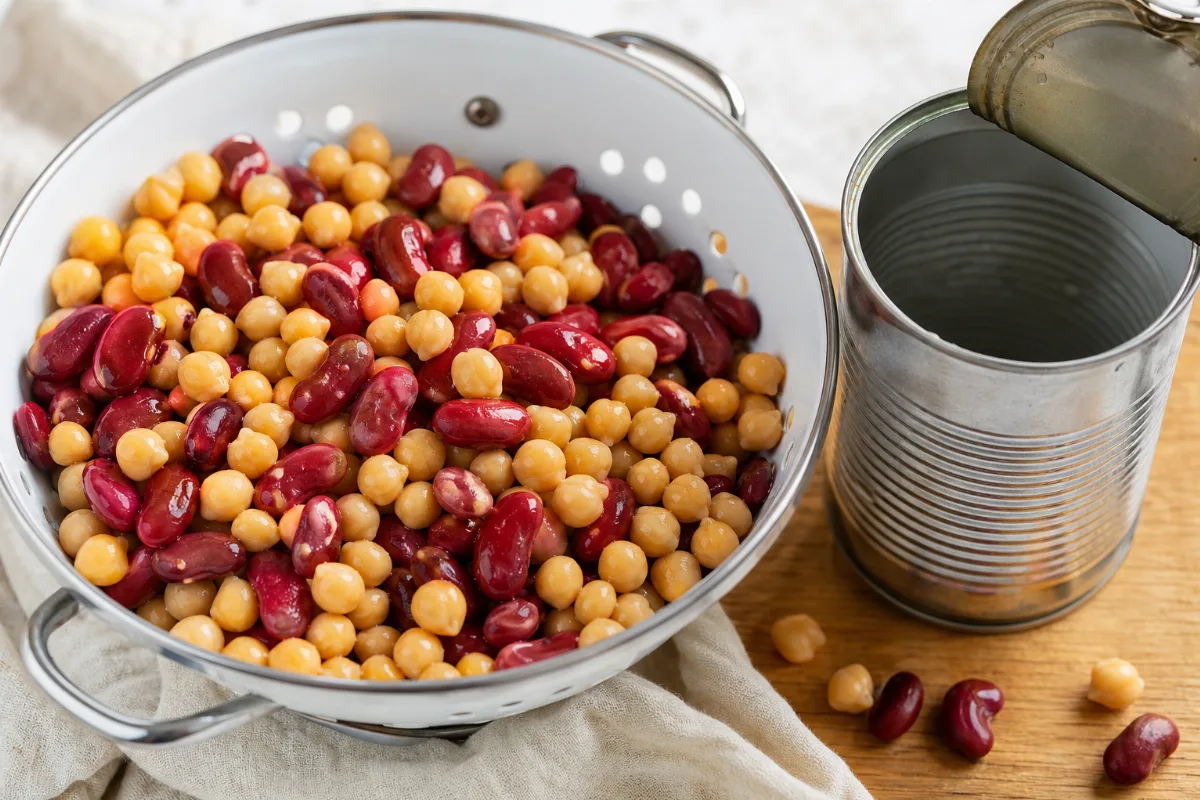
Canned beans are mature beans such as red kidney beans (Phaseolus vulgaris) and chickpeas (Cicer arietinum) that are cooked and sealed in a can, so they are ready to eat. People use them because they save hours of soaking and boiling. The two things worth knowing are sodium, which you can lower by choosing and rinsing wisely, and safety, which is good for canned beans. This page uses USDA values for drained red kidney beans and for drained, rinsed chickpeas, and keeps canned beans apart from dried beans and from hype.
Read this first
- Canned kidney beans are safe to eat as sold. The FDA says the low levels of the lectin phytohaemagglutinin in canned and properly cooked kidney beans will not affect you, while raw or undercooked beans can cause nausea, severe vomiting and diarrhea. [4] The UK Food Standards Agency says supermarket canned beans are safe because they have been pre-soaked and boiled. [5]
- Sodium is the main watch point. USDA lists 231 mg of sodium per 100 g of drained canned kidney beans, about 10% of the FDA Daily Value (less than 2,300 mg a day). [1] [3] The FDA says to choose low sodium or no-salt-added canned vegetables and to rinse canned beans to remove some sodium. [3]
- Evidence in one line: pooled trials found that diets with pulses (beans, chickpeas, lentils, peas) lowered LDL cholesterol a little. The trials did not compare canned with dried beans. [6]
- Gas and bloating are common with beans. [13]
- Allergy: kidney beans and chickpeas are not among the nine major US allergens, but peanuts and soybeans, which are also legumes, are. [18]
What is in it (USDA values)
The values below are for two USDA items (SR Legacy). Red kidney beans are "mature seeds, canned, drained solids" (FoodData Central item 174285). [1] Chickpeas are "canned, drained, rinsed in tap water" (item 173801). [2] USDA lists 1 can drained solids (266 g) for the kidney beans and 1 can drained and rinsed (254 g) or 1 cup drained and rinsed (152 g) for the chickpeas. [1] [2] The serving column is half a cup of the chickpeas, 76 g, which is half of the USDA 1 cup portion.
| Nutrient | Kidney beans, per 100 g | Chickpeas, per 100 g | Chickpeas, per 0.5 cup (76 g) | % Daily Value per serving |
|---|---|---|---|---|
| Energy | 124 kcal | 138 kcal | 105 kcal | not set |
| Protein | 7.98 g | 7.04 g | 5.4 g | 11% |
| Total fat | 1.05 g | 2.47 g | 1.9 g | 2% |
| Carbohydrate | 21.49 g | 22.87 g | 17.4 g | 6% |
| Fiber | 5.5 g | 6.3 g | 4.8 g | 17% |
| Sodium | 231 mg | 212 mg | 161 mg | 7% |
| Potassium | 277 mg | 109 mg | 83 mg | 2% |
| Manganese | 0.384 mg | 0.8 mg | 0.61 mg | 26% |
| Copper | 0.272 mg | 0.25 mg | 0.19 mg | 21% |
| Folate (DFE) | 28 mcg | 41 mcg | 31 mcg | 8% |
| Iron | 1.5 mg | 0.98 mg | 0.75 mg | 4% |
% Daily Value uses the FDA 2016 Daily Values; values vary with bean type, brand, brine and rinsing. The serving figures are the chickpea 100 g values multiplied by 0.76. USDA's rinsed chickpea item still lists 212 mg of sodium per 100 g, so a rinse lowers sodium but does not remove it; the label is the best guide for your brand. [2] [3]
Plant compounds: Harvard describes lectins in beans, which cooking reduces, and says the amount of mineral absorption lost in a usual diet is not known. [14] We did not find a source that measured other plant compounds in canned beans.
What research says
| Health goal | What the sources found | Strength of evidence | What was studied |
|---|---|---|---|
| LDL cholesterol | A pooled analysis of 26 trials (1,037 people) found diets with a median 130 g a day of pulses lowered LDL by 0.17 mmol/L (95% CI -0.25 to -0.09) versus similar diets without pulses; there was no effect on apolipoprotein B or non-HDL cholesterol. [6] | Established, small effect, for pulses | Pulses as a group, in diets of at least 3 weeks; canned versus dried not compared; funded by a Canadian public agency [6] |
| Blood sugar | A 2009 pooled analysis of non-oil-seed pulses found lower fasting glucose and lower HbA1c or fructosamine, with high unexplained variation between studies. [7] A 2020 review of 18 trials found significant effects only in the 5 trials in type 2 diabetes, with very low quality of evidence. [8] | Mixed | Whole pulses, people with and without diabetes |
| Blood pressure | A pooled analysis of 8 feeding trials (554 people) found pulses lowered systolic blood pressure by 2.25 mm Hg; the diastolic change was not significant. [9] | Promising but limited | Pulses in controlled diets |
| Heart disease risk | In cohort studies, higher legume intake was linked with lower coronary heart disease (relative risk 0.90) and cardiovascular disease (0.94), with no link to stroke. [10] An umbrella review rated the certainty as low or very low. [11] | Mixed (observational, not proof of cause) | Legumes as a group |
| Fullness and weight | Observational studies link higher pulse intake with lower body weight, though many did not control for other factors. Short meals with pulses increased fullness for 2 to 4 hours, and trials supported weight loss only along with calorie restriction. [12] | Mixed | Pulses in short trials |
| Canned versus dried beans | Proper evidence not found in the sources we read. | Insufficient evidence | Not applicable |
Canned beans as food vs other forms. The trials above fed people pulses in their diets; the abstracts we read do not say how many used canned beans. The nutrients in canned and dried beans are not the same in every respect (for example sodium), so these results are a guide to beans in general, not proof about the can in your cupboard.
How much is a normal serving
The USDA household portions are listed in the section above (a can of drained kidney beans is 266 g; a cup of drained, rinsed chickpeas is 152 g). [1] [2] The NHS counts 80 g of pulses and beans as one portion of 5 A DAY, and says they only count once a day, however much you eat. [17] These are pieces of information, not a prescription. One can often holds several portions, so check the label for servings per can.
Safety, allergy and medicines
- Sodium. The FDA Daily Value for sodium is less than 2,300 mg a day, and the FDA says Americans eat about 3,400 mg a day. [3] Canned beans are a modest source per serving but can add up with other canned and packaged foods. See Dried vs canned beans: soaking and sodium.
- Lectins and food poisoning. Raw or undercooked red kidney beans are the risk, not canned ones. The FDA says to soak dried kidney beans at least 5 hours and boil them in fresh water for at least 30 minutes, and the FSA warns not to slow-cook raw red kidney beans because it does not destroy the toxin and may increase it. [4] [5] See Lectins in beans: cooking dried beans safely.
- BPA in can linings. The FDA says current approved uses of BPA in food containers and packaging are safe, that small amounts may move from can linings into food, and that in 2012 and 2013 it stopped providing for certain BPA materials in baby bottles, sippy cups and infant formula packaging because manufacturers had abandoned those uses. [15] That FDA page was last updated in 2018, so check for newer statements.
- Damaged or opened cans. CDC says store-bought food can also be contaminated with botulism, to refrigerate opened canned foods, and to throw out food of uncertain safety ("If in doubt, throw it out!"). [16]
- Digestion. NIDDK names beans among foods that can cause gas, and says some people have more gas with a lot of fiber. [13]
- Mineral absorption. Harvard says lectins in beans can interfere with absorption of calcium, iron, phosphorus and zinc, that the amount lost is not known, and that soaking, sprouting or boiling lowers them. [14]
- Kidney disease. USDA lists 277 mg of potassium per 100 g in the kidney bean item. [1] Whether that matters depends on your kidney function; see Foods, kidney disease, potassium and oxalates.
- Medicines. We did not read a source on drug interactions with canned beans.
- Pregnancy and children. Cooked canned beans are not named in the sources we read as a concern. Ask your doctor, midwife or pediatrician about your own diet.
Choosing, storing and food safety
- Look for labels such as low sodium or no-salt-added. [3]
- Drain and rinse before using; the FDA says rinsing canned beans removes some sodium. [3]
- Check the ingredient list: some canned beans come in sauces or with added sugar, salt or meat, which changes the numbers in the table. The USDA items above are plain beans.
- Refrigerate opened cans and follow the label; throw out food of uncertain safety. [16]
Related pages
Health connections for Canned Beans (Drained, Rinsed)
What research links to eating or drinking this food, and how strong the evidence is. Many studies are observational or use juice, powder, oil or extracts rather than the food as eaten; each card says which.
Canned beans as a source of fiber, protein and minerals
Established roleUSDA lists 4.8 g fiber, 5.4 g protein, 26% of the Daily Value for manganese and 21% for copper in 0.5 cup (76 g) of drained, rinsed canned chickpeas, about 105 kcal.
Supplements: Dietary role only; fiber or mineral supplements are a separate question.
Pulses and LDL cholesterol
Clinically supportedA pooled analysis of 26 trials found diets with a median 130 g a day of pulses lowered LDL cholesterol by 0.17 mmol/L compared with similar diets without pulses; apolipoprotein B and non-HDL cholesterol did not change. Canned versus dried beans were not compared.
Supplements: Result is for the LDL measure and pulses as a group; it is a small change.
Pulses and blood sugar control
Preliminary or mixedA 2009 pooled analysis of non-oil-seed pulses found lower fasting glucose and lower HbA1c or fructosamine, with high unexplained variation. A 2020 review of 18 trials found significant effects only in the 5 trials in type 2 diabetes, with very low quality of evidence.
Supplements: Whole pulses, not canned beans specifically.
Pulses and blood pressure
Preliminary or mixedA pooled analysis of 8 controlled feeding trials (554 people) found pulses lowered systolic blood pressure by 2.25 mm Hg; the diastolic change was not significant.
Supplements: Small change; pulses as a group.
Legumes and heart disease risk (observational)
Preliminary or mixedIn cohort studies, higher legume intake was linked with lower coronary heart disease (relative risk 0.90) and cardiovascular disease (0.94) but not stroke; certainty was low or very low.
Supplements: Observational; cannot prove cause.
Pulses, fullness and body weight
Preliminary or mixedObservational studies link higher pulse intake with lower body weight, though many did not control for other factors; short trials found more fullness for 2 to 4 hours, and weight loss was supported only alongside calorie restriction.
Supplements: Short trials; pulses as a group.
Lectins and mineral absorption
Preliminary or mixedHarvard says lectins in beans can reduce absorption of calcium, iron, phosphorus and zinc, that it is not known how much, and that soaking, sprouting or boiling lowers them.
Supplements: Effect in a mixed diet is unknown.
Connected topics
Open a group to see how each topic connects and how strong the evidence is.
Health goals (5)
- Blood Sugar BalancePreliminary or mixed
Pooled trials of pulses found lower fasting glucose and long-term blood sugar markers, with high variation and, in a 2020 review, very low quality of evidence.
- Cholesterol BalanceClinically supported
Diets with pulses lowered LDL cholesterol a little in pooled trials. Canned and dried beans were not compared.
- Heart HealthPreliminary or mixed
Cohort studies link legume intake with lower heart disease risk, with low certainty.
- Blood Pressure SupportPreliminary or mixed
Pooled feeding trials found a 2.25 mm Hg drop in systolic blood pressure with pulses; the diastolic change was not significant.
- Weight ManagementPreliminary or mixed
Pulses increased fullness in short trials; weight loss was supported only with calorie restriction.
Body systems (5)
- Blood Sugar SupportPreliminary or mixed
Pulses lowered fasting glucose and HbA1c-type markers in pooled trials, with high variation.
- Cardiovascular SystemClinically supported
Diets with pulses lowered LDL cholesterol slightly in pooled trials.
- Heart & CirculationPreliminary or mixed
Trials show small LDL and blood pressure changes with pulses; cohort evidence is of low certainty.
- Digestive SystemDocumented risk
NIDDK names beans among foods that can cause gas.
- Metabolism & WeightPreliminary or mixed
Pulses increased fullness in short trials; weight loss was supported only with calorie restriction.
Body parts (1)
- HeartPreliminary or mixed
Small LDL and blood pressure effects in trials of pulses; cohort links to lower heart disease.
Functional actions (2)
- Blood Sugar RegulationPreliminary or mixed
Pulses lowered fasting glucose and HbA1c-type markers in pooled trials, with high variation.
- Cardiovascular SupportClinically supported
Diets with pulses lowered LDL cholesterol slightly in pooled trials.
Root causes (1)
- Blood Sugar ImbalancePreliminary or mixed
Pulses lowered fasting glucose in pooled trials, with high variation and low-quality evidence in diabetes trials.
Habits (1)
- Balanced NutritionEstablished role
A ready-to-use legume that can add fiber and protein to a varied diet; a general dietary role, not a treatment.
Biomarkers (3)
- LDL CholesterolClinically supported
Diets with a median 130 g a day of pulses lowered LDL by 0.17 mmol/L in 26 pooled trials.
- Blood GlucosePreliminary or mixed
Pulses lowered fasting glucose in pooled trials, with high variation.
- HbA1cPreliminary or mixed
HbA1c-type markers fell with pulses in a 2009 pooled analysis; a 2020 review of trials rated the evidence in type 2 diabetes very low quality.
Conditions & symptoms (5)
- Coronary Heart DiseasePreliminary or mixed
Cohort studies link higher legume intake with lower coronary heart disease risk (relative risk 0.90); certainty was low.
- Essential HypertensionPreliminary or mixed
Pulses lowered systolic blood pressure by about 2.25 mm Hg in pooled feeding trials, though canned beans add sodium unless rinsed or low-sodium.
- FlatulenceDocumented risk
NIDDK names beans among foods that can cause gas.
- Food PoisoningDocumented risk
Raw or undercooked red kidney beans can cause vomiting and diarrhea; canned beans are already cooked and considered safe.
- HypercholesterolemiaClinically supported
Diets with pulses lowered LDL cholesterol slightly in 26 pooled trials. It is not a treatment for high cholesterol.
Documented risks and interactions (4)
- Sodium in canned beans. USDA lists 231 mg sodium per 100 g in drained canned kidney beans and 212 mg in rinsed canned chickpeas. The FDA Daily Value is less than 2,300 mg a day, and the FDA advises choosing low sodium or no-salt-added products and rinsing canned beans.
- Kidney bean lectin: canned beans are already cooked. The FDA says canned and properly cooked kidney beans have only low levels of the lectin phytohaemagglutinin, while raw or undercooked beans can cause nausea, severe vomiting and diarrhea. The FSA says supermarket canned beans are safe because they have been pre-soaked and boiled.
- BPA in can linings. The FDA says current approved uses of BPA in food containers and packaging are safe, that small amounts may migrate from can linings, and that certain uses in baby bottles, sippy cups and infant formula packaging were stopped in 2012 and 2013 because they had been abandoned. The page was last updated in 2018.
- Gas and bloating from beans. NIDDK names beans among foods that can cause gas, and says some people have more gas with a lot of fiber.
Frequently asked questions
Are canned beans as healthy as dried beans?
We did not read a head-to-head comparison of canned and dried beans on health outcomes. The canned items in USDA data carry 212 to 231 mg of sodium per 100 g, so sodium is the thing to watch, and draining and rinsing lowers it. [1] [2] [3]
Do I need to boil canned kidney beans?
No. The FDA says canned and properly cooked kidney beans have low levels of the lectin that will not affect you, and the FSA says supermarket canned beans are safe because they have been pre-soaked and boiled. [4] [5] Raw dried kidney beans do need soaking and boiling. [4]
Does rinsing canned beans help?
The FDA advises rinsing canned foods such as beans to remove some of the sodium. [3] USDA's rinsed chickpea item still shows 212 mg per 100 g, so choose low sodium or no-salt-added where you can. [2] [3]
Is BPA in cans a problem?
The FDA says current approved uses of BPA in food packaging are safe, on a page last updated in 2018. [15] People who want to avoid it can ask the maker about the can lining; we did not read a source comparing brands.
Do beans lower cholesterol?
In a pooled analysis of 26 trials, diets with pulses lowered LDL by about 0.17 mmol/L. [6] That is a small change, and canned beans were not studied separately.
References
- U.S. Department of Agriculture. Beans, kidney, red, mature seeds, canned, drained solids (FDC 174285), FoodData Central, SR Legacy, April 2018. Read 2026-10-24.
- U.S. Department of Agriculture. Chickpeas (garbanzo beans, bengal gram), mature seeds, canned, drained, rinsed in tap water (FDC 173801), FoodData Central, SR Legacy, April 2018. Read 2026-10-24.
- U.S. Food and Drug Administration. Sodium in Your Diet, content current March 2024. Read 2026-10-24.
- U.S. Food and Drug Administration. Natural Toxins in Food, content current September 2024. Read 2026-10-24.
- UK Food Standards Agency. Home food fact checker, updated 2026. Read 2026-10-24.
- Effect of dietary pulse intake on established therapeutic lipid targets for cardiovascular risk reduction: a systematic review and meta-analysis of randomized controlled trials. CMAJ 2014. PMID 24710915. Read 2026-10-24 (abstract).
- Effect of non-oil-seed pulses on glycaemic control: a systematic review and meta-analysis of randomised controlled experimental trials in people with and without diabetes. Diabetologia 2009. PMID 19526214. Read 2026-10-24 (abstract).
- The Effects of Legume Consumption on Markers of Glycaemic Control in Individuals with and without Diabetes Mellitus: A Systematic Literature Review of Randomised Controlled Trials. Nutrients 2020. PMID 32708949. Read 2026-10-24 (abstract).
- Effect of dietary pulses on blood pressure: a systematic review and meta-analysis of controlled feeding trials. Am J Hypertens 2014. PMID 24014659. Read 2026-10-24 (abstract).
- Mendes V et al. Intake of legumes and cardiovascular disease: A systematic review and dose-response meta-analysis. Nutr Metab Cardiovasc Dis 2023. PMID 36411221. Read 2026-10-24 (abstract).
- Associations between Dietary Pulses Alone or with Other Legumes and Cardiometabolic Disease Outcomes: An Umbrella Review and Updated Systematic Review and Meta-analysis of Prospective Cohort Studies. Adv Nutr 2019. PMID 31728500. Read 2026-10-24 (abstract).
- Pulse consumption, satiety, and weight management. Adv Nutr 2010. PMID 22043448. Read 2026-10-24 (abstract).
- National Institute of Diabetes and Digestive and Kidney Diseases. Eating, Diet, and Nutrition for Gas in the Digestive Tract, reviewed June 2021. Read 2026-10-24.
- Harvard T.H. Chan School of Public Health. Are Anti-Nutrients Harmful? (The Nutrition Source), last reviewed January 2022. Read 2026-10-24.
- U.S. Food and Drug Administration. Questions and Answers on Bisphenol A (BPA) Use in Food Contact Applications, last updated February 2018. Read 2026-10-24.
- Centers for Disease Control and Prevention. Preventing botulism. Read 2026-10-24.
- NHS. 5 A DAY: what counts. Read 2026-10-24.
- U.S. Food and Drug Administration. Food Allergies, content current March 2026. Read 2026-10-24.