Chickpeas (Garbanzo Beans): Nutrients, What Research Shows and Safety
Chickpeas as a food: USDA values for cooked and canned chickpeas, what trials found on blood sugar and LDL, plus allergy, sodium, gas, kidney and pregnancy notes.
Content last updated . This page has not been medically reviewed.
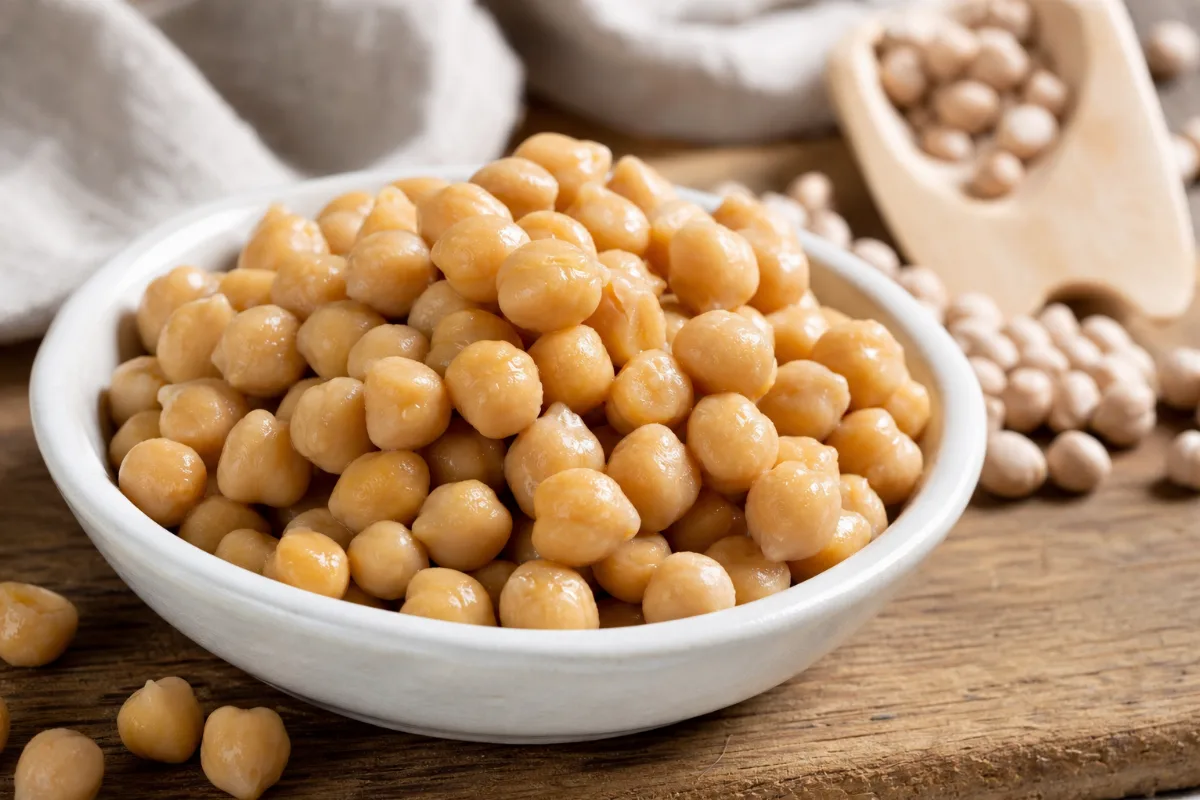
Chickpeas, also called garbanzo beans, are the round, beige seeds of Cicer arietinum, a legume (pulse). They are eaten whole in stews, salads and curries, and mashed into hummus and falafel. People eat them for fiber, plant protein, folate and manganese, and for their possible help with blood sugar and cholesterol. This page covers chickpeas as a food and keeps them apart from flour, snacks and extracts.
Read this first
- Allergy: chickpea allergy is reported, from mild to severe, and exercise-related anaphylaxis has been linked to chickpea. Some people with peanut allergy react to other legumes. For trouble breathing or swelling of the face, lips or throat, call 911 (or your local emergency number). [13]
- Canned chickpeas carry more sodium. USDA lists 212 mg of sodium per 100 g in canned, drained and rinsed chickpeas against 7 mg in home-boiled chickpeas cooked without salt. [3] [1]
- Gas and bloating: chickpeas are among the foods that provide galacto-oligosaccharides, which people on a low-FODMAP plan limit for a short time with a dietitian. [15]
- Kidney disease: chickpeas contain potassium and phosphorus. Ask your kidney dietitian before changing how much you eat. [16]
- Evidence in one line: chickpeas lowered the rise in blood sugar after a single meal in small short trials, and a small trial saw lower LDL cholesterol on a chickpea diet, but long-term evidence for chickpeas alone is thin. [7] [8]
What is in it (USDA values)
The table is for home-cooked chickpeas: mature seeds, boiled, without salt (USDA FoodData Central item 173757, SR Legacy). [1] The serving column is the USDA household portion of 1 cup, 164 g. [1] Raw dry chickpeas (item 173756) are 378 kcal and 20.47 g of protein per 100 g because they hold little water, so do not compare raw and cooked rows. [2]
| Nutrient | Per 100 g | Per 1 cup cooked (164 g) | % Daily Value per serving |
|---|---|---|---|
| Energy | 164 kcal | 269 kcal | not set |
| Protein | 8.86 g | 14.5 g | 29% |
| Total fat | 2.59 g | 4.2 g | 5% |
| Carbohydrate | 27.42 g | 45.0 g | 16% |
| Fiber | 7.6 g | 12.5 g | 45% |
| Folate (DFE) | 172 mcg | 282 mcg | 71% |
| Iron | 2.89 mg | 4.7 mg | 26% |
| Potassium | 291 mg | 477 mg | 10% |
| Magnesium | 48 mg | 78.7 mg | 19% |
| Phosphorus | 168 mg | 276 mg | 22% |
| Manganese | 1.03 mg | 1.7 mg | 73% |
| Copper | 0.352 mg | 0.58 mg | 64% |
| Thiamin (B1) | 0.116 mg | 0.19 mg | 16% |
| Sodium | 7 mg | 11.5 mg | 0% |
% Daily Value uses the FDA 2016 Daily Values; the serving figures are the per-100-g values multiplied by 1.64, and values vary with variety, growing place and cooking.
Canned chickpeas are a different form. USDA lists canned chickpeas, drained and rinsed (item 173801), with these per-100-g values. [3] The USDA portions for this form are 1 cup drained and rinsed (152 g) or one can drained and rinsed (254 g).
| Per 100 g | Boiled, no salt added | Canned, drained and rinsed |
|---|---|---|
| Energy | 164 kcal | 138 kcal |
| Protein | 8.86 g | 7.04 g |
| Fiber | 7.6 g | 6.3 g |
| Sodium | 7 mg | 212 mg |
| Potassium | 291 mg | 109 mg |
| Folate (DFE) | 172 mcg | 41 mcg |
Plant compounds: the sources we read for this page do not measure specific plant compounds in chickpeas, so we do not name any.
What research says
| Health goal | What the sources found | Strength of evidence | What was studied |
|---|---|---|---|
| Blood sugar after a meal | A 2023 analysis of 12 trials (182 mostly healthy adults) found chickpeas gave a lower blood glucose response than potatoes and wheat. [6] A 2025 analysis of 28 acute studies found a lower glucose response overall, with large differences between studies (I-squared 87%), no effect on peak glucose, and low to very low certainty. The authors work for or are funded by a food company (PepsiCo). [7] | Promising but limited, mostly for one meal in healthy adults | Single-meal trials comparing chickpeas with matched carbohydrate foods |
| Longer-term blood sugar | Pulses alone lowered fasting glucose and insulin in 41 trials, with large differences between trials. [10] We read no long-term trial of chickpeas alone in people with diabetes. | Insufficient evidence for chickpeas alone | Pulses as a group |
| LDL cholesterol | In a 5-week crossover trial of 27 adults, LDL was 0.20 mmol/L lower on a chickpea diet than on a wheat diet; the authors say part of this may come from more polyunsaturated fat in the chickpea diet. [8] Pooled pulse trials (26 trials) found about 0.17 mmol/L lower. [4] A 2025 pooled analysis of legume trials found 0.16 mmol/L lower with moderate certainty. [5] | Promising but limited | One small crossover trial of chickpea diet; pulses as a group |
| Bowel function | In the same crossover trial, people reported better general bowel health on the chickpea diet, with large differences between people. [8] | Insufficient evidence | 27 adults, self-reported |
| Heart disease | Higher legume intake was linked to lower coronary heart disease risk (RR 0.90) but not stroke in 26 observational studies. [11] | Mixed; an association, not proof | Legumes as a group |
| Body weight | Pulse-containing diets lowered weight by 0.34 kg over a median of 6 weeks in 21 trials. [12] | Promising but limited (small effect) | Pulses as a group |
| Overall diet quality | In US survey data, chickpea eaters had a higher Healthy Eating Index score (62.1 vs 51.2) than people who ate no legumes. That does not show chickpeas caused it. The first author is affiliated with a food company. [9] | Mixed; observational | NHANES survey data |
Eaten as food vs hummus, flour and snacks. The trials above used whole chickpeas or chickpea meals. We read no trial of hummus, chickpea flour or roasted snacks, so we make no claim about them. See hummus.
How much is a normal serving
The USDA household portion for cooked chickpeas is 1 cup (164 g), about 269 kcal, with 12.5 g of fiber and 14.5 g of protein. [1] For canned chickpeas, drained and rinsed, USDA lists 1 cup (152 g). [3] NHS counts 80 g of pulses as one portion of your 5 A DAY, and pulses count only once a day. [19] In the US, guideline targets of at least 1.5 cups a week of cooked pulses were met by 19.9% of people in 2017-2018. [23] The share of US adults who eat chickpeas rose from 1.9% to 4.5% between 2003-2006 and 2015-2018. [9] Pooled trials of pulses used a median of 130 g a day. [4] This is information, not a prescription for you.
Safety, allergy and medicines
- Allergy: a 2024 review lists chickpea among non-priority legumes that can cause mild to severe reactions, links exercise-related anaphylaxis to soybean, lentils and chickpea, and describes cross-reactions with peanut and lupine. Most data are case reports. [13] See peanuts and food allergy basics and emergency signs. Call 911 for trouble breathing or swelling of the face or throat.
- Lectins and raw chickpeas: Health Canada lists soybeans, lentils, lima beans and kidney beans as legumes with lectins; chickpeas are not named on that page. Its poisoning steps are for red kidney beans. We read no source on raw chickpea poisoning, so eat chickpeas cooked or canned. [14] See lectins in beans.
- Gas, bloating and FODMAPs: a hospital leaflet says galacto-oligosaccharides are mainly found in beans and pulses, asks patients to avoid them for 4 to 6 weeks as a temporary diet with a dietitian, and lists a limit of 2 tbsp (44 g) of canned chickpeas at one meal. That is one hospital's elimination-phase list, not advice from us. [15] See beans, gas, FODMAP and digestion.
- Sodium in canned chickpeas: 212 mg per 100 g drained and rinsed (about 9% of the FDA Daily Value per 100 g). [3] See dried vs canned beans, soaking and sodium.
- Kidney disease: cooked chickpeas have 291 mg potassium and 168 mg phosphorus per 100 g. [1] The National Kidney Foundation says animal sources of phosphorus are absorbed better than plant sources and that additive phosphate is absorbed at more than 90%. [16] A 2021 review found human data suggest at least 50% of phytate phosphorus is absorbed. [17] Ask a kidney dietitian. See foods, kidney disease, potassium and oxalates.
- Pregnancy and breastfeeding: MedlinePlus says anyone pregnant should be sure to get enough folate; low folate is linked to birth defects such as spina bifida. USDA lists 172 mcg folate per 100 g of cooked chickpeas. [18] [1] NHS says to take a folic acid supplement in pregnancy as well; its page does not name chickpeas. [21] See foods in pregnancy.
- Sprouted chickpeas: CDC advises children under 5, adults 65 and older, pregnant women and people with weakened immune systems to avoid raw or lightly cooked sprouts and to cook sprouts thoroughly (the notice is about alfalfa sprouts). [24]
- Young children: CDC lists whole beans among protein foods to avoid for young children, says mashing and cutting food smaller can help prevent choking, and does not name chickpeas. [25]
- Medicines: we did not find a source we could read that ties chickpeas as a food to a specific medicine interaction.
Choosing, storing and food safety
- Canned chickpeas are already cooked. Draining and rinsing is how USDA measured the canned values above. [3]
- We did not read a source with storage times for dry or cooked chickpeas. A 2026 review says fungal infection generally lowers the nutritional value of pulse seeds, so look for mold or damp in dry chickpeas. [26]
- NHS names chickpeas among iron sources and gives adult needs of 8.7 mg a day for men and 14.8 mg for women aged 19 to 49. [20] See foods high in iron.
Related pages
Health connections for Chickpeas (Garbanzo Beans)
What research links to eating or drinking this food, and how strong the evidence is. Many studies are observational or use juice, powder, oil or extracts rather than the food as eaten; each card says which.
Chickpeas and blood sugar after a meal
Preliminary or mixedIn small single-meal trials in mostly healthy adults, chickpeas gave a lower blood sugar response than potatoes or wheat. Certainty is low and some authors are tied to a food company.
Supplements: Food only; we read no chickpea extract trial.
Chickpeas as a source of fiber, folate and manganese
Established roleCooked chickpeas supply fiber, folate, manganese and plant protein. USDA lists 12.5 g fiber, 282 mcg folate and 1.69 mg manganese in 1 cup (164 g).
Supplements: Food source only. We read no trial showing chickpeas correct a deficiency.
Chickpeas and LDL cholesterol
Preliminary or mixedOne small crossover trial saw lower LDL cholesterol on a chickpea diet; pooled trials of pulses found a small drop. Chickpeas alone are not well studied.
Supplements: Whole food only.
Legumes and heart disease risk
Preliminary or mixedObservational studies link higher legume intake to lower coronary heart disease risk but not stroke.
Supplements: Not applicable.
Chickpeas and bowel function
Preliminary or mixedPeople in a small crossover trial reported better general bowel health on a chickpea diet, with large differences between people.
Supplements: Not applicable.
Connected topics
Open a group to see how each topic connects and how strong the evidence is.
Health goals (4)
- Blood Sugar BalancePreliminary or mixed
Pooled trials of pulses as a group found lower fasting glucose and insulin, with large differences between trials. Chickpea-specific single-meal trials (12 and 28 studies) found a lower glucose response than potato or wheat, mostly in healthy adults, with low-certainty evidence.
- Cholesterol BalancePreliminary or mixed
Pooled randomized trials of pulses as a group found a small drop in LDL cholesterol (about 0.16 to 0.17 mmol/L). One 5-week crossover trial of 27 adults saw LDL 0.20 mmol/L lower on a chickpea diet than a wheat diet; the authors say part may be from more polyunsaturated fat.
- Heart HealthPreliminary or mixed
Observational studies link higher legume intake to lower coronary heart disease risk (RR 0.90) but not stroke. That is an association, not proof, and it covers legumes as a group, not Chickpeas alone.
- Weight ManagementPreliminary or mixed
A pooled analysis of 21 trials found pulse-containing diets lowered body weight by a small 0.34 kg over a median of 6 weeks. We read no weight trial of chickpeas alone.
Body systems (8)
- Blood Sugar SupportPreliminary or mixed
Pooled trials of pulses as a group found lower fasting glucose and insulin, with large differences between trials. Chickpea-specific single-meal trials (12 and 28 studies) found a lower glucose response than potato or wheat, mostly in healthy adults, with low-certainty evidence.
- Digestive SystemDocumented risk
Gas is a common effect of pulses; galacto-oligosaccharides are mainly found in beans and pulses (hospital low-FODMAP leaflet), which limits canned chickpeas to 2 tbsp at a meal in its elimination phase.
- Gut HealthDocumented risk
Gas is a common effect of pulses; galacto-oligosaccharides are mainly found in beans and pulses (hospital low-FODMAP leaflet), which limits canned chickpeas to 2 tbsp at a meal in its elimination phase.
- Cardiovascular SystemPreliminary or mixed
Observational studies link higher legume intake to lower coronary heart disease risk (RR 0.90) but not stroke. That is an association, not proof, and it covers legumes as a group, not Chickpeas alone.
- Heart & CirculationPreliminary or mixed
Observational studies link higher legume intake to lower coronary heart disease risk (RR 0.90) but not stroke. That is an association, not proof, and it covers legumes as a group, not Chickpeas alone.
- Immune SystemDocumented risk
Chickpea allergy is reported, from mild to severe, including exercise-related anaphylaxis; peanut cross-reactions are described. Call 911 for trouble breathing or swelling of the face or throat.
- Kidney & UrinaryDocumented risk
Cooked chickpeas contain potassium and phosphorus (USDA). Plant phosphorus is absorbed less than animal or additive phosphorus (National Kidney Foundation); ask a kidney dietitian.
- Metabolism & WeightPreliminary or mixed
Small weight effect in pooled pulse trials (0.34 kg over about 6 weeks); long-term effect unknown.
Body parts (3)
- GutDocumented risk
Gas is a common effect of pulses; galacto-oligosaccharides are mainly found in beans and pulses (hospital low-FODMAP leaflet), which limits canned chickpeas to 2 tbsp at a meal in its elimination phase.
- HeartPreliminary or mixed
Observational studies link higher legume intake to lower coronary heart disease risk (RR 0.90) but not stroke. That is an association, not proof, and it covers legumes as a group, not Chickpeas alone.
- KidneysDocumented risk
Cooked chickpeas contain potassium and phosphorus (USDA). Plant phosphorus is absorbed less than animal or additive phosphorus (National Kidney Foundation); ask a kidney dietitian.
Functional actions (3)
- Blood Sugar RegulationPreliminary or mixed
Pooled trials of pulses as a group found lower fasting glucose and insulin, with large differences between trials. Chickpea-specific single-meal trials (12 and 28 studies) found a lower glucose response than potato or wheat, mostly in healthy adults, with low-certainty evidence.
- Cardiovascular SupportPreliminary or mixed
Pooled randomized trials of pulses as a group found a small drop in LDL cholesterol (about 0.16 to 0.17 mmol/L). One 5-week crossover trial of 27 adults saw LDL 0.20 mmol/L lower on a chickpea diet than a wheat diet; the authors say part may be from more polyunsaturated fat.
- Digestive SupportPreliminary or mixed
In a 5-week crossover trial of 27 adults, people reported better general bowel health on a chickpea diet, with large differences between people.
Root causes (2)
- Blood Sugar ImbalancePreliminary or mixed
Pooled trials of pulses as a group found lower fasting glucose and insulin, with large differences between trials. Chickpea-specific single-meal trials (12 and 28 studies) found a lower glucose response than potato or wheat, mostly in healthy adults, with low-certainty evidence.
- Nutrient DeficiencyEstablished role
USDA lists folate and iron in cooked chickpeas. That shows it is a food source; we read no trial showing it corrects a deficiency.
Habits (1)
- Balanced NutritionPreliminary or mixed
Pulses are part of dietary-guideline patterns in the US, yet only about one in five Americans met the 1.5 cups a week target in 2017-2018. Eating Chickpeas is one way to add pulses; no single food makes a diet balanced.
Biomarkers (3)
- Blood GlucosePreliminary or mixed
Pooled trials of pulses as a group found lower fasting glucose and insulin, with large differences between trials. Chickpea-specific single-meal trials (12 and 28 studies) found a lower glucose response than potato or wheat, mostly in healthy adults, with low-certainty evidence.
- LDL CholesterolPreliminary or mixed
Pooled randomized trials of pulses as a group found a small drop in LDL cholesterol (about 0.16 to 0.17 mmol/L). One 5-week crossover trial of 27 adults saw LDL 0.20 mmol/L lower on a chickpea diet than a wheat diet; the authors say part may be from more polyunsaturated fat.
- InsulinPreliminary or mixed
Pulses alone lowered fasting insulin in pooled trials. Insulin response was lower in some chickpea trials but not consistently (Nam 2023).
Conditions & symptoms (8)
- FlatulenceDocumented risk
Gas is a common reported effect of eating pulses; we read no chickpea-only gas trial.
- Food AllergyDocumented risk
Lentil, chickpea and pea allergy reports exist, from mild to severe; peanut cross-reactions are described. Call 911 for trouble breathing or swelling of the face or throat.
- HypercholesterolemiaPreliminary or mixed
Pooled trials of pulses lowered LDL cholesterol a little. One small chickpea crossover trial agreed. This is a diet effect on a blood measure, not a treatment.
- Chronic Kidney InsufficiencyDocumented risk
Pulses contain potassium and phosphorus; people on kidney diets should ask their dietitian. Plant phosphorus is absorbed less than animal or additive phosphorus.
- Coronary Heart DiseasePreliminary or mixed
Observational studies link higher legume intake to lower coronary heart disease risk (RR 0.90). An association is not proof.
- Irritable Bowel SyndromeDocumented risk
Galacto-oligosaccharides are mainly found in beans and pulses, and a hospital low-FODMAP leaflet limits them during a short dietitian-guided elimination phase.
- OverweightPreliminary or mixed
Pulse-containing diets lowered weight by a small 0.34 kg in pooled trials of about 6 weeks.
- Type 2 Diabetes Mellitus Without ComplicationPreliminary or mixed
Pulses lowered fasting glucose and insulin in pooled trials with and without diabetes, with high differences between trials. Chickpea single-meal trials mostly show a lower glucose response after one meal in healthy adults.
Documented risks and interactions (4)
- Gas, bloating and FODMAPs. Chickpeas can cause gas. People on a low-FODMAP plan are usually asked to limit pulses for a short time with a dietitian.
- Chickpea and legume allergy. Chickpea allergy is reported, from mild to severe, including exercise-related anaphylaxis. People with peanut allergy sometimes react to other legumes. Call 911 for trouble breathing or swelling of the face or throat.
- Sodium in canned chickpeas. Canned, drained and rinsed chickpeas contain 212 mg sodium per 100 g, against 7 mg in home-boiled chickpeas cooked without salt.
- Potassium and phosphorus for people with kidney disease. Cooked chickpeas contain potassium and phosphorus. Plant phosphorus is absorbed less than additive phosphorus; people on kidney diets should ask a dietitian.
Frequently asked questions
Do chickpeas help blood sugar?
In small single-meal trials in mostly healthy adults, chickpeas gave a lower blood glucose response than potatoes or wheat. [6] The 2025 analysis rated the certainty low to very low and was written by authors tied to a food company. [7] It does not show chickpeas treat diabetes.
Are canned chickpeas as healthy as dried?
USDA lists similar protein and fiber per 100 g, with more sodium in canned (rinsed) than in home-boiled chickpeas without salt. [3] [1] Rinsing is how USDA measured the canned values.
Do chickpeas cause gas?
They can, because pulses contain galacto-oligosaccharides. [15] In feeding studies of pinto beans, black-eyed peas and baked beans, reports of extra gas fell after the first week or two. [22] We read no chickpea-only gas trial.
Are chickpeas safe to eat raw?
Proper evidence not found in the sources we read for raw chickpeas. Eat them cooked or canned, and follow the sprout advice if you sprout them. [24]
Can you be allergic to chickpeas?
Yes. Chickpea allergy is reported, and some people with peanut allergy react to other legumes. [13] Call 911 for trouble breathing or swelling of the face or throat.
References
- U.S. Department of Agriculture. FoodData Central: Chickpeas (garbanzo beans, bengal gram), mature seeds, cooked, boiled, without salt (SR Legacy, FDC 173757). April 2018 release. Read 2026-10-24.
- U.S. Department of Agriculture. FoodData Central: Chickpeas, mature seeds, raw (SR Legacy, FDC 173756). April 2018 release. Read 2026-10-24.
- U.S. Department of Agriculture. FoodData Central: Chickpeas, mature seeds, canned, drained, rinsed in tap water (SR Legacy, FDC 173801). April 2018 release. Read 2026-10-24.
- CMAJ. Effect of dietary pulse intake on established therapeutic lipid targets for cardiovascular risk reduction: a systematic review and meta-analysis of randomized controlled trials. 2014 (abstract read via Europe PMC). Read 2026-10-24.
- Hossain MA et al., Eur J Nutr. Legume intakes on cardiometabolic profile and gut microbiome function: systematic review and meta-analyses of randomised controlled trials. 2025 (abstract read via Europe PMC). Read 2026-10-24.
- Nutrients. Effectiveness of chickpeas on blood sugar: a systematic review and meta-analysis of randomized controlled trials. 2023 (abstract read via Europe PMC). Read 2026-10-24.
- Mah E et al., Nutr J. Chickpea attenuates postprandial blood glucose responses: a systematic review and meta-analysis. 2025. Read 2026-10-24.
- Pittaway JK et al., J Am Coll Nutr. Effects of a controlled diet supplemented with chickpeas on serum lipids, glucose tolerance, satiety and bowel function. 2007 (abstract read via Europe PMC). Read 2026-10-24.
- Rehm CD et al., J Nutr. Trends and patterns of chickpea consumption among United States adults: analyses of National Health and Nutrition Examination Survey data. 2023 (abstract read via Europe PMC). Read 2026-10-24.
- Diabetologia. Effect of non-oil-seed pulses on glycaemic control: a systematic review and meta-analysis of randomised controlled experimental trials in people with and without diabetes. 2009 (abstract read via Europe PMC). Read 2026-10-24.
- Mendes V et al., Nutr Metab Cardiovasc Dis. Intake of legumes and cardiovascular disease: a systematic review and dose-response meta-analysis. 2023 (abstract read via Europe PMC). Read 2026-10-24.
- Kim SJ et al., Am J Clin Nutr. Effects of dietary pulse consumption on body weight: a systematic review and meta-analysis of randomized controlled trials. 2016 (abstract read via Europe PMC). Read 2026-10-24.
- Abu Risha M et al., Curr Allergy Asthma Rep. Legume allergens pea, chickpea, lentil, lupine and beyond. 2024 (abstract read). Read 2026-10-24.
- Health Canada. Lectins in dry legumes. page modified 2017-05-04. Read 2026-10-24.
- Cambridge University Hospitals NHS Foundation Trust. Low FODMAP diet: reducing fermentable carbohydrates in your diet. patient leaflet approved 14 Aug 2025. Read 2026-10-24.
- National Kidney Foundation. Smart eating for kidney health: understanding phosphorus in foods. page dated 2024-10-31. Read 2026-10-24.
- Calvo MS, Uribarri J, Adv Nutr. Perspective: plant-based whole-grain foods for chronic kidney disease: the phytate-phosphorus conundrum. 2021 (abstract read via Europe PMC). Read 2026-10-24.
- MedlinePlus. Folate in diet. review date 2025-01-21. Read 2026-10-24.
- NHS. 5 A DAY: what counts?. page read in 2026. Read 2026-10-24.
- NHS. Vitamins and minerals: Iron. page read in 2026. Read 2026-10-24.
- NHS. Have a healthy diet in pregnancy. page read in 2026. Read 2026-10-24.
- Winham DM, Hutchins AM, Nutr J. Perceptions of flatulence from bean consumption among adults in 3 feeding studies. 2011. Read 2026-10-24.
- Drewnowski A et al., Front Nutr. Pulse consumption trends in the US in the context of 2025-30 Dietary Guidelines for Americans: analyses of NHANES data for 1999-2018. 2025 (abstract read via Europe PMC). Read 2026-10-24.
- CDC. Salmonella outbreak linked to alfalfa sprouts, December 2022 (advice on raw sprouts). page updated 2025-01-31. Read 2026-10-24.
- CDC. Choking hazards (infant and toddler nutrition). page dated 2026-03-11. Read 2026-10-24.
- Wyman EM et al., Food Saf (Tokyo). Impacts of fungal infection and mycotoxin contamination on nutritional quality and safety of protein-rich pulses. 2026 (abstract read via Europe PMC). Read 2026-10-24.