Yarrow (Achillea millefolium): Uses, Evidence and Safety
Yarrow (Achillea millefolium): what the EU says about its traditional uses for appetite, cramps and small wounds, why daisy-family allergy matters, and cautions for pregnancy and children.
Content last updated . This page has not been medically reviewed.
Safety first. Natural products can cause side effects and interact with medicines. Read herb safety and interactions before you use anything on this page.
What is Yarrow good for?
What the body uses it for, and how strong the evidence is. A normal job in the body is not proof that extra supplements add benefit; each card says which.
Traditional use for loss of appetite
Lab or animal research onlyYarrow herb is registered in the EU as a traditional herbal medicine for temporary loss of appetite, based only on long-standing use.
Supplements: Registered on tradition only. No human trial shows it works.
Traditional use for mild digestive cramps and bloating
Lab or animal research onlyTraditionally taken as a tea or extract for mild, cramping stomach and gut complaints, bloating and gas. This rests on long use, not on trials.
Supplements: No clinical studies of oral yarrow were found by the EMA.
Traditional use for minor period-related spasm
Lab or animal research onlyThe EU registers yarrow tea or dry extract for minor spasm linked to menstrual periods, based on long-standing use only.
Supplements: No human trial of oral yarrow for period cramps was found in the EMA report.
Small superficial wounds (topical)
Preliminary or mixedYarrow dressings are registered in the EU as a traditional product for small, shallow wounds. One small placebo-controlled trial of an ointment after episiotomy found less pain, redness and swelling.
Supplements: Preliminary evidence from one small trial; wound closure and discharge did not differ from placebo.
Skin calming after irritation
Preliminary or mixedIn a small randomized study of 23 volunteers, yarrow oil extracts helped skin recover from a deliberately applied irritant.
Supplements: Very small study in healthy volunteers; not a proven treatment.
Anti-inflammatory and antioxidant activity (laboratory)
Lab or animal research onlyExtracts reduce inflammation markers and show antioxidant activity in test tubes and animals.
Supplements: No human evidence for these effects.
Liver-protective effect in animals
Lab or animal research onlyExtracts lowered liver enzyme rises in animals given liver-damaging substances.
Supplements: No human evidence.
Connected topics
Open a group to see how each topic connects and how strong the evidence is.
Health goals (1)
- Digestive SupportLab or animal research only
Registered in the EU as a traditional herbal tea or extract for loss of appetite and mild digestive cramps. This rests on long use and lab data; no human trial of oral yarrow was found.
Body systems (2)
- Integumentary SystemDocumented risk
Yarrow is a known cause of allergic contact dermatitis, especially in people sensitive to daisy-family plants. It is also traditionally used on small wounds, with limited trial evidence.
- Digestive SystemLab or animal research only
Traditional EU use for loss of appetite and mild cramping complaints; supported only by tradition and lab findings.
Body parts (1)
- SkinDocumented risk
Allergic contact dermatitis from yarrow has been described since 1899; the plant is also traditionally applied to small wounds.
Functional actions (2)
- Anti-InflammatoryLab or animal research only
Lab studies show anti-inflammatory activity and one small volunteer study showed skin recovery after irritation. This is not proof of benefit in illness.
- Digestive SupportLab or animal research only
Traditional use only; lab findings of gut-muscle relaxation make it plausible.
Conditions & symptoms (1)
- Dermatitis, Allergic ContactDocumented risk
Yarrow can cause allergic contact dermatitis; in already-sensitive people, over half reacted to a yarrow extract on patch testing.
Documented risks and interactions (3)
- Allergic skin reaction (daisy-family allergy). Yarrow can cause allergic contact dermatitis, and people allergic to other daisy-family plants may react to it. In patch testing of already-sensitive people, over half reacted to a yarrow extract.
- Pregnancy and breastfeeding caution. The EU monograph says safety in pregnancy and breastfeeding has not been established and use is not recommended.
- Use in children. Use under 12 years is not recommended because there are not enough data.
Safety first: yarrow is a daisy-family plant, and allergy is its best-documented risk. The European Medicines Agency (EMA) review says cases of allergic contact dermatitis have been described since 1899. [1] In a 5-year follow-up of people already sensitive to daisy-family (Asteraceae) plants, more than 50% reacted to a yarrow extract on patch testing. [1] The EU herbal committee's draft revised monograph (2019) lists hypersensitivity to yarrow and to other Asteraceae plants as a contraindication, and says skin hypersensitivity reactions have been reported. [2] See herbal allergy and cross-reactivity. Pregnancy and breastfeeding use is not recommended in that document. [2]
What yarrow is
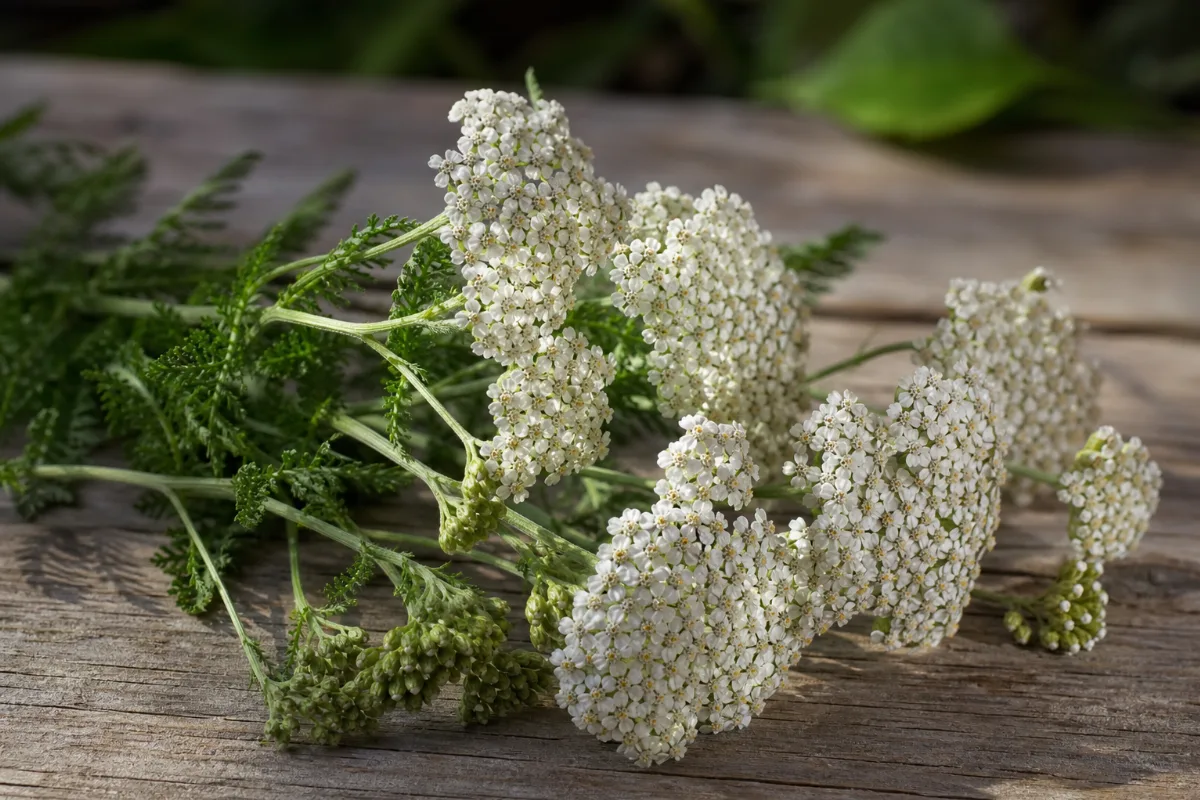
Yarrow is Achillea millefolium L., family Asteraceae (the daisy family). [3] The part used in medicinal products is the herb, meaning the aerial parts ("herba"). [1] We give no plant-identification advice; for wild-plant risks see plant and mushroom poisoning. Several daisy-family plants share allergens, so a label should name the Latin species.Traditional use
This section is tradition, not proof. According to the EMA review, the folk medicine and handbook records it collected describe yarrow used on wounds and ulcers, for bleeding from hemorrhoids and for menstrual problems, in baths, and internally for loss of appetite and mild, cramping digestive complaints. [1] On the basis of long-standing use, the EMA's committee (HMPC; assessment report 2020, draft monograph 2019) describes yarrow herb preparations as traditional herbal medicines for temporary loss of appetite, mild cramping digestive complaints including bloating and gas, minor spasm linked to menstrual periods, and small superficial wounds. [1][2] It stresses these are based exclusively on long-standing use. [2]What research shows
| Use | What the source found | Strength of evidence | Form |
|---|---|---|---|
| Loss of appetite, mild digestive cramps, bloating | EU traditional-use registration only. EMA found no published clinical studies that met its criteria for well-established use. [1] | Traditional use only | Herbal infusion, extracts, tinctures |
| Menstrual cramps | Traditional use only; same EMA conclusion. [1][2] | Traditional use only | Herb preparations by mouth |
| Small superficial wounds | Traditional use only; the draft monograph says to seek medical advice if signs of skin infection appear. [2] | Traditional use only | Preparations for the skin |
| Bleeding (for example from hemorrhoids) | Folk use is described. [1] Proper evidence not found in the sources we read (EMA review) for a controlled trial. | Traditional use only | Not applicable |
| Other claims (fever, colds, inflammation, skin conditions) | Proper evidence not found in the sources we read; we searched the EMA assessment report and monograph. | Insufficient evidence | Not applicable |
Because EMA reviewed the human literature and found nothing that met its bar for well-established use, readers should treat any stronger claim with caution. [1]
Forms and why the form matters
EMA lists comminuted herb for herbal infusion, expressed juice, liquid extract, tinctures and dry extracts. [1] Tinctures and liquid extracts contain ethanol, and the draft monograph asks for alcohol labeling on such products. [2] See alcohol-containing herbal products. The thujone question is often raised: EMA says thujone is a minor component of yarrow oil and its concentrations are too low to present a risk to human health. [1] Essential oil is a separate product; see essential oils safety. Amounts are set by medicine regulators for registered products; a pharmacist can advise on a given product.Safety
- Allergy: see above. A mixture of daisy-family extracts used in patch testing includes yarrow, and the report lists a positive response to yarrow (51.8%) when people sensitive to the mixture were tested with single extracts. [1] The main allergen identified was a sesquiterpene lactone found to be a strong sensitizer in guinea pigs. [1]
- Sun sensitivity: in the allergy testing, worsening of patch-test sites with UV light was never observed, and alcoholic extracts of the aerial parts did not produce a phototoxic response in a cited test. [1]
- Medicines: the draft monograph says no interactions have been reported. [2] That is not proof of safety; see how interactions work.
- Pregnancy and breastfeeding: safety has not been established, and use is not recommended. [2] See pregnancy and breastfeeding.
- Children: use under 12 years has not been established. [2]
- Overdose: no cases were reported. [2]
- Liver, kidney, bleeding disorders and surgery: not described in the sources we read. Because yarrow is traditionally linked to bleeding, tell the surgical team and pharmacist if you use it; see bleeding disorders and supplements.
- Quality: see quality testing and certifications.
Related pages
Chamomile, arnica, calendula, plantain leaf, and herbs for skin, acne, eczema and wounds.Frequently asked questions
Is yarrow safe if I am allergic to ragweed or chamomile?
Possibly not. The EU draft monograph lists hypersensitivity to other daisy-family plants as a contraindication. Ask a clinician. [2]
Does yarrow stop bleeding?
It is described in folk medicine for bleeding. We found no controlled trial in the sources we read. For any serious or ongoing bleeding, get medical care. [1]
Is yarrow tea proven for cramps or digestion?
No. The EU registers it as traditional use only, and found no published clinical studies that met its bar for well-established use. [1]
Is yarrow safe in pregnancy?
Use is not recommended because safety has not been established. [2]
Does yarrow contain thujone?
EMA says thujone is a minor component of yarrow oil, at concentrations too low to present a risk to human health. [1]
References
- EMA/HMPC, Assessment report on Achillea millefolium L., herba, Final - Revision 1 (EMA/HMPC/376415/2019, 23 September 2020). Read 2026-10-23.
- EMA/HMPC, European Union herbal monograph on Achillea millefolium L., herba, Draft - Revision 1 (EMA/HMPC/376416/2019, 20 November 2019). Read 2026-10-23.
- GBIF Backbone Taxonomy, Achillea millefolium match record. Read 2026-10-23.