Plantain Leaf (Herb) (Plantago major): Uses, Evidence and Safety
Plantain leaf (Plantago major): what this common leaf is, how it differs from psyllium and the cooking fruit, and what trials, animal studies and EU monographs say about wounds and cough.
Content last updated . This page has not been medically reviewed.
Safety first. Natural products can cause side effects and interact with medicines. Read herb safety and interactions before you use anything on this page.
What is Plantain herb good for?
What the body uses it for, and how strong the evidence is. A normal job in the body is not proof that extra supplements add benefit; each card says which.
Topical gel in diabetic foot and pressure ulcers
Preliminary or mixedIn one open-label trial, people using a 10% leaf-extract gel with routine care healed sooner over 2 weeks than those on dressings alone. The trial was small and short.
Supplements: Promising but limited. Does not show that a crushed leaf, tea or shop cream works the same way.
Aloe and plantain combination gel for diabetic foot ulcer
Preliminary or mixedA gel mixing aloe and plantain reduced ulcer surface area more than placebo gel in a small double-blind trial, but not ulcer depth.
Supplements: Promising but limited; the plantain contribution cannot be separated from aloe.
Wound healing in animal studies
Lab or animal research onlyA systematic review of animal studies did not find evidence that Plantago major heals wounds in living animals.
Supplements: Animal evidence did not show effectiveness; human evidence is limited to the small gel trials.
Cough, asthma and bronchitis (traditional and experimental)
Not enough evidenceThe leaf is traditionally used for chest complaints. Laboratory and animal studies exist, but clinical studies are limited.
Supplements: No good human evidence that plantain leaf relieves cough or breathing problems.
Antibacterial and anti-inflammatory activity in extracts
Lab or animal research onlyExtracts showed antibacterial and anti-inflammatory activity in laboratory studies.
Supplements: Laboratory findings do not show benefit in people.
Traditional use for skin, digestion, circulation and pain
Not enough evidenceLeaves have been used as a wound remedy for centuries in many parts of the world, and also for skin, breathing, digestive and circulation problems and pain.
Supplements: Tradition is not proof; no trial support for leaf tea or crushed leaf in the sources read.
Not the same as psyllium or cooking plantain
Not enough evidencePlantain herb (Plantago major leaf) is a different plant from psyllium (Plantago ovata), which is the fibre supplement, and from the cooking banana-like fruit.
Supplements: Do not assume psyllium findings apply to plantain leaf.
Connected topics
Open a group to see how each topic connects and how strong the evidence is.
Body systems (1)
- Integumentary SystemPreliminary or mixed
Small trials of leaf-extract gels in foot and pressure ulcers were promising but limited; animal studies did not show wound healing.
Body parts (1)
- SkinPreliminary or mixed
Used on the skin in wound trials with lab-made gels; evidence is limited and does not cover crushed leaf.
Conditions & symptoms (2)
- Diabetic FootPreliminary or mixed
Two small trials of plantain-containing gels in diabetic foot ulcers were promising; the combination trial cannot separate plantain from aloe.
- Pressure UlcerPreliminary or mixed
Included in an open-label trial of a 10% leaf-extract gel with routine care; limited evidence.
Documented risks and interactions (4)
- Safety record is thin. For broadleaf plantain we found no regulator monograph and no source on medicine interactions, pregnancy, children, liver or kidney. Not found is not the same as safe.
- Pregnancy and breastfeeding (ribwort plantain, different species). The EU monograph for ribwort plantain (Plantago lanceolata) does not recommend use in pregnancy or breastfeeding, nor oral use under 3 years. No source covers broadleaf plantain.
- Pollen allergy (ribwort plantain). The EU assessment of ribwort plantain warns about its pollen allergy; about 30% of people with pollen allergy react to it. Broadleaf plantain was not covered.
- Wounds need proper care. The trials used lab-made products alongside routine wound care. Deep, dirty, infected or slow-healing wounds, and any wound in a person with diabetes, need a clinician.
Safety note: the safety record for broadleaf plantain leaf (Plantago major) is thin in the sources we read. We found no regulator monograph for this species, and no source on medicine interactions, pregnancy, children, liver or kidney. Not found is not the same as safe. A related species, ribwort plantain (Plantago lanceolata), has an EU monograph that advises against use in pregnancy and breastfeeding, and its pollen is a documented allergen (details below). [1][2] Do not put a plant you cannot identify with certainty onto a wound or into the mouth; for look-alike and poisoning concerns, see plant and mushroom poisoning. In the US, Poison Help is 1-800-222-1222.
Which plant is this?
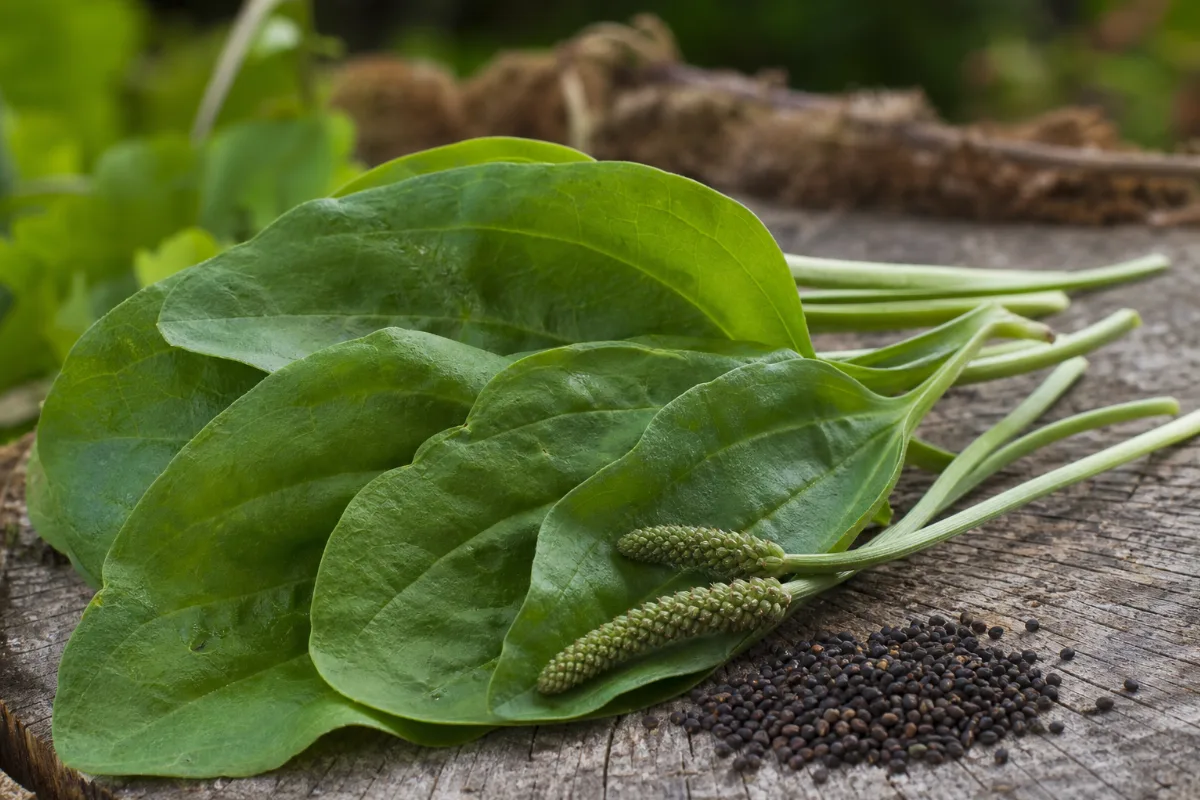
"Plantain" is used for several unrelated things. This page is about the leaf of Plantago major L., a plant in the family Plantaginaceae. [3] It is not the cooking fruit that is also called plantain. It is also not psyllium, which comes from a different species in the same genus, Plantago ovata Forssk. [4][5] For psyllium husk and fiber products, see psyllium and fiber supplements. Ribwort plantain, Plantago lanceolata L., is a third species with its own regulatory monograph. [6][1] Labels do not always make the species clear; see botanical names and plant parts on labels.Traditional use
This is tradition, not proof. A review in the Journal of Ethnopharmacology says P. major leaves have been used as a wound-healing remedy for centuries in almost all parts of the world, and also for conditions of the skin, respiratory organs, digestive organs and circulation, and for pain relief and infections. [7] It does not tie these uses to named peoples in the abstract we read.What research shows
| Use and form | What the source found | Strength of evidence | Who or what was studied |
|---|---|---|---|
| Wound healing, in animals | A systematic review of 4 animal studies found no evidence of in vivo effectiveness for wound healing; all studies had a high risk of bias. [8] | Preclinical (animals) | Animal wound models; topical preparations |
| Diabetic foot and pressure ulcers (10% leaf-extract gel) | In an open-label randomized trial, 64% of 50 people using the gel had complete healing at 2 weeks versus 20.45% of 44 using a dressing alone. [9] | Promising but limited (open-label, 2 weeks, one research group) | Adults with ulcers; hydroalcoholic extract gel plus routine care |
| Diabetic foot ulcer (aloe and plantain combination gel) | In a double-blind trial of 40 people, the combination gel reduced ulcer surface more than placebo gel but not ulcer depth. [10] The effect cannot be separated from aloe. | Promising but limited | Adults with diabetic foot ulcers; combined gel for 4 weeks |
| Cough, asthma, bronchitis | A narrative review says clinical studies on respiratory effects are limited, despite laboratory and animal findings. [11] | Insufficient evidence | Mostly experimental models |
| Antibacterial or anti-inflammatory effects | The 2000 review found these activities in extracts. [7] | Preclinical | Laboratory studies |
| Other uses (skin conditions, digestion, cancer) | Listed as traditional uses. [7] Proper evidence not found for controlled human trials of leaf tea or crushed leaf in the sources we read. | Traditional use only | Not applicable |
Forms and why the form matters
A trial of a laboratory-made 10% extract gel under routine wound care does not show what happens with a chewed or crushed leaf, a tea or a store-bought cream. We found no source that tested those. The EU monograph for ribwort plantain describes herbal tea, extracts and syrups for oral irritation and dry cough, and macerate for skin. [1][2] It is a different species, so this does not transfer to P. major.Safety
- Wounds: the trials above used laboratory-prepared products alongside routine wound care, not raw leaf. [9] Deep, dirty, infected or slow-healing wounds, and any wound in a person with diabetes, need a clinician; see skin and hair safety.
- Allergy: the EMA assessment of ribwort plantain adds a warning about its pollen allergy, and says about 30% of people with pollen allergy react to it. [2] For broadleaf plantain, proper evidence not found. See herbal allergy and cross-reactivity.
- Ribwort plantain monograph (different species): EU monograph says interactions are none reported, undesirable effects are none known, pregnancy and breastfeeding use is not recommended, and oral use under 3 years is not recommended. [1][2]
- Medicines, liver, kidney, surgery: not described for P. major in the sources we read. See how interactions work and ask a pharmacist; tell the surgical team about herbal products.
- Quality: identity matters because several species share the name; see quality testing and certifications.
Related pages
Herbs for skin, acne, eczema and wounds, mullein, marshmallow root, and yarrow.Frequently asked questions
Is plantain herb the same as psyllium?
No. Psyllium husk comes from a different species, Plantago ovata, and is covered on the psyllium page. [4][5]
Does plantain leaf heal wounds?
Animal studies reviewed so far did not show effectiveness. Two small human trials of gels in foot and pressure ulcers were promising but limited. [8][9]
Is plantain leaf good for cough?
Traditional use exists, but clinical studies are limited. [11]
Can I use it in pregnancy?
For broadleaf plantain, we found no source. For ribwort plantain, the EU monograph does not recommend use in pregnancy or breastfeeding. [1]
Is the plantain in my garden the same as the plantain in supplements?
Not necessarily. Several species share the name, so check the Latin name on a label. [3][6]
References
- EMA/HMPC, Community herbal monograph on Plantago lanceolata L., folium (EMA/HMPC/437858/2010; corrigendum 28 January 2014). Read 2026-10-23.
- EMA/HMPC, Assessment report on Plantago lanceolata L., folium, Final - Revision 1 (EMA/HMPC/887981/2022, 9 July 2025). Read 2026-10-23.
- GBIF Backbone Taxonomy, Plantago major match record. Read 2026-10-23.
- GBIF Backbone Taxonomy, Plantago ovata match record. Read 2026-10-23.
- Effect of psyllium husk (Plantago ovata) on chicken sausages. Anim Biosci 2026 (PubMed 42526865), title read for species link. Read 2026-10-23.
- GBIF Backbone Taxonomy, Plantago lanceolata match record. Read 2026-10-23.
- Samuelsen AB, The traditional uses, chemical constituents and biological activities of Plantago major L. A review. J Ethnopharmacol 2000 (PubMed 10904143). Read 2026-10-23.
- Cardoso FCI et al., The Effect of Plantago major on Wound Healing in Preclinical Studies: A Systematic Review. Wound Manag Prev 2021 (PubMed 33448940). Read 2026-10-23.
- Ghanadian M et al., Plantago major hydroalcoholic extract on the healing of diabetic foot and pressure ulcers: a randomized open-label controlled clinical trial. Int J Low Extrem Wounds 2024 (PubMed 35044254). Read 2026-10-23.
- Najafian Y et al., Efficacy of Aloe vera/Plantago major gel in diabetic foot ulcer: a randomized double-blind clinical trial. Curr Drug Discov Technol 2019 (PubMed 29336265). Read 2026-10-23.
- Boskabadi SJ et al., The therapeutic effects of Plantago major and its main constituents on respiratory diseases: a narrative review. Naunyn Schmiedebergs Arch Pharmacol 2025 (PubMed 40663154). Read 2026-10-23.