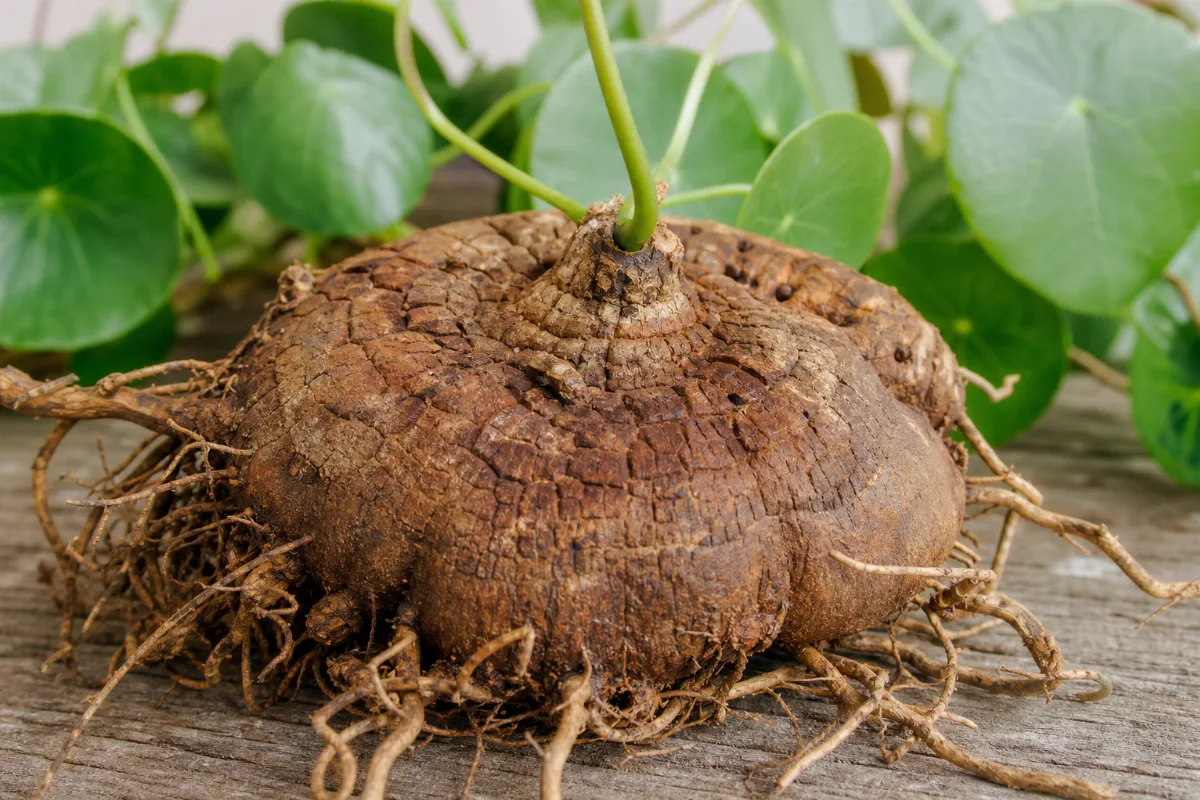
Herbs & Botanicals · Chinese root, kidney warning
Stephania
Stephania tetrandra · also called Fang ji, han fang ji, fangji, stephania root; tetrandrine is its main purified compound
Stephania is a Chinese medicine root called han fang ji, and the source of the drug tetrandrine. Studies of tetrandrine in silicosis and rheumatoid arthritis look hopeful but weak, and the root itself has not been tested. The key caution: the name fang ji is also used for a different root that contains aristolochic acid, which caused kidney failure and urinary tract cancer in Belgian slimming-clinic patients.
General information, not medical advice. Last substantive update · Not medically reviewed. A named clinician has not signed off on this page. How this page is made
About Stephania
Stephania is an alkaloid-rich Chinese root. Its safety risks are better documented than its benefits. The biggest risk is not the plant but a mix-up: the name fang ji is shared with a kidney-toxic Aristolochia root.
What it is
Stephania tetrandra (han fang ji) is a climbing plant of the moonseed family. The dried root is used in Chinese medicine, mainly for rheumatic pain and swelling. Its main alkaloids are tetrandrine and fangchinoline.
Related species include Stephania japonica and Stephania cephalantha. Cepharanthine, a Japanese drug, comes mostly from the latter.
The aristolochic acid scandal
In Brussels in the early 1990s, young women on a slimming regimen listing Stephania tetrandra developed fast kidney scarring. A manufacturing error had put Aristolochia fangchi (guang fang ji) in the pills in place of Stephania. Of 39 patients who had kidneys and ureters removed as a precaution, 18 had urinary tract cancer.
True Stephania tetrandra has not been shown to contain aristolochic acid, but the roots look alike and substitution happens. Authorities in many regions restrict aristolochic acid herbs, yet cases continue. For the wider story see our page on aristolochic acid and herbal nephropathy.
What the research shows
Human studies used the purified drug tetrandrine, not the root. In silicosis, retrospective studies report better scans; in rheumatoid arthritis a pooled analysis shows modest gains. Cepharanthine has a long drug history in Japan. COVID-19 and cancer research is lab and animal work only.
We found no trial of the dried root, a tea or a supplement.
At a glance
Traditional uses history, not proof
- Han fang ji root for rheumatic pain and swelling in Chinese medicine
- Water-draining remedy in traditional use
- Tetrandrine as a modern drug for silicosis in China
Studied for research
- Silicosis, tetrandrine (low certainty)
- Rheumatoid arthritis, tetrandrine (low certainty)
- Low white blood cells and hair loss, cepharanthine in Japan (insufficient)
- High blood pressure and heart rhythm (insufficient)
- COVID-19 and other viruses, cepharanthine (lab only, insufficient)
- Cancer and drug resistance (lab and mouse only, insufficient)
Main compounds
- Tetrandrine (PubChem CID 73078)
- Fangchinoline (CID 73481)
- Cepharanthine (CID 10206), from a related species
Common forms
- Dried root (traditional; identity risk)
- Purified tetrandrine (drug, under medical care)
- Cepharanthine (Japanese drug)
Research links: Nortier 2000: urothelial cancer after Aristolochia fangchi (PubMed) · Vanherweghem 1993: first Belgian report (PubMed) · Wu 2007: why 'fangji' is confusing (PubMed) · Xu 2024: tetrandrine in rheumatoid arthritis, meta-analysis (PubMed) · Research Library · Genes & Biomarkers Library
The plant and its history
- Accepted scientific name
- Stephania tetrandra S.Moore (GBIF ACCEPTED, exact match, confidence 100)
- Naming authority
- S.Moore
- Common names
- Stephania (English); Fang ji (Chinese (pinyin)); Han fang ji (Chinese (pinyin)); Fangji (English)
- Botanical family
- Menispermaceae (moonseed family)
- Classification
- Plantae > Menispermaceae > Stephania > Stephania tetrandra
- Native range
- Not covered in the sources read (the plant is used in Chinese medicine).
- Habitat
- Not covered.
- What the plant looks like
- Roots: Dried root slices are the medicinal part; they resemble Aristolochia fangchi root, which is why substitution occurs.; Stems: Not covered.; Leaves: Not covered.; Flowers: Not covered.; Fruit: Not covered.; Seeds: Not covered.; Cultivation: Not covered.
- Harvest and processing
- Not covered in sources read.
- Look-alikes and adulterants
- Name: Aristolochia fangchi (guang fang ji); Note: Different family (Aristolochiaceae). Contains aristolochic acid, which damages kidneys and causes cancer. Roots look alike.; Name: Cocculus trilobus (mu fang ji); Note: Another root sold under fangji; substitutions with Aristolochia are allowed in practice.; Name: Stephania japonica (Thunb.) Miers; Note: GBIF ACCEPTED, Menispermaceae; a related species with a different alkaloid profile, not the main fang ji source.; Name: Stephania cephalantha Hayata (sold as S. cepharantha); Note: Main source of cepharanthine; GBIF fuzzy match, accepted name Stephania cephalantha.
- Sustainability and conservation
- Not covered.
Traditional use and history history, not clinical proof
| Tradition or era | Documented use | Source |
|---|---|---|
| Traditional Chinese medicine | Han fang ji root is a traditional antirheumatic and water-draining herb. | s-chen2020 |
| 1990 to 1992, Brussels | Slimming regimen listing Stephania tetrandra and Magnolia officinalis; kidney failure in young women. | s-vanherweghem1993 |
| Modern China | Tetrandrine used as a drug for silicosis; described as the only plant-derived silicosis drug approved there. | s-zhou2025 |
| Japan, since the 1950s | Cepharanthine used as a drug for low white blood cells, snake bites, dry mouth and hair loss. | s-bailly2019 |
Traditional use shows how a plant was used. It does not show that a supplement works or is safe today.
What is inside, and how it may work
What the plant contains and how those compounds act in cells and animals. Laboratory and animal mechanisms are not proven effects in people.
Main compounds
| Compound | Family | Where it is concentrated | Activity studied | Level of evidence |
|---|---|---|---|---|
| Tetrandrine PubChem 73078 | Bisbenzylisoquinoline alkaloid | Root | Calcium-channel blocker, anti-inflammatory in lab studies; used as a drug for silicosis in China. 9 15 21 | Human low |
| Fangchinoline PubChem 73481 | Bisbenzylisoquinoline alkaloid | Root | Co-constituent with tetrandrine; mostly lab research. 9 2 | Lab |
| Cepharanthine PubChem 10206 | Bisbenzylisoquinoline alkaloid | Root of Stephania cephalantha (mainly) | Approved drug in Japan; anti-inflammatory and antiviral in the lab. 9 1 18 | Lab |
| Aristolochic acid (NOT in true Stephania tetrandra) | Nitrophenanthrene carboxylic acid | Root of Aristolochia fangchi (the substitute) | Kidney-toxic and carcinogenic; forms DNA adducts. 8 10 2 | Human case report |
Mechanisms, receptors and pathways
| Target or pathway | Gene or receptor | What was found | Level |
|---|---|---|---|
| L-type and T-type calcium channels | Voltage-gated calcium channel alpha-1 subunit | Tetrandrine blocks them in lab preparations. 15 | Lab |
| NLRP3 inflammasome | NLRP3 | Tetrandrine inhibited canonical and non-canonical NLRP3 activation in silicosis mice. 11 | Animal research |
| P-glycoprotein drug pump | ABCB1 | Blocked in cancer cells; no change in doxorubicin levels in mice. 4 | Animal research |
| Toxic bioactivation by CYP3A | CYP3A4, CYP3A5 | CYP3A4 and CYP3A5 make a reactive metabolite linked to lung-cell toxicity. 6 13 | Lab |
| Glutathione S-transferases (liver) | GST | Tetrandrine binds and blocks GST activity in an animal liver-injury model. 3 | Animal research |
| DNA adduct formation (aristolochic acid) | Not applicable | Aristolochic-acid DNA adducts were found in all patients' kidney tissue tested. 10 8 | Human data |
Absorption, metabolism and elimination
- Absorption
- No human pharmacokinetic study was read.
- Distribution
- In mice an injected dose gave plasma tetrandrine around 2 micromolar for many hours (30 mg/kg injected).
- Metabolism
- CYP3A4 and CYP3A5 convert tetrandrine to a reactive quinone-methide metabolite (lab).
- Elimination
- Not found.
- Bioavailability
- Poor solubility is mentioned in drug-delivery papers (not read).
Isolated compounds versus whole extracts
Almost all human evidence is for the purified drug tetrandrine (or cepharanthine), not for the root, decoction or a supplement. The root contains hundreds of alkaloids and is at risk of substitution. Do not assume results for the drug apply to a fang ji product.
Nutritional composition
Stephania is not a food and has no vitamin or mineral role. It is an alkaloid-rich medicinal root and a drug source.
2 low certainty4 not enough evidence
What is Stephania good for?
The studied uses and how strong the human evidence is for each. For Stephania almost all of it concerns the purified drug tetrandrine, not the root.
Benefits, one by one
Each card is a research question, not a promise. Tap a goal to filter. Open a card to see the studies, doses and limits.
Silicosis (lung scarring from silica dust), tetrandrine
Low certaintyTetrandrine, a purified compound from fang ji root, is used in China as a drug for silicosis. Two non-randomised patient studies and two small trials report better scans or lung function. None is strong proof, and none tested the herb root or a supplement.
5 studiesTested forms were the purified drug tetrandrine, not the root, tea or…
Studies, doses and limits
What the trials found
One randomised trial (108 people, 2026) compared tetrandrine plus hydrogen inhalation with tetrandrine alone, so it cannot show tetrandrine works. An older randomised trial (96 people) gave tetrandrine with acetylcysteine versus routine drugs only. Two retrospective studies of artificial-stone silicosis compared patients who took tetrandrine with those who did not.
Results
Retrospective study of 89 workers: 56.5 to 65.4 percent of the tetrandrine group improved on CT and none of the comparison group did; progression 0 to 17.4 percent versus 44.4 to 92.0 percent. Second retrospective study (53 treated, 26 not): 49.1 percent improved on CT versus none; 84.6 percent of the untreated progressed. Adverse reactions in that study included facial pigmentation and mild liver-function abnormalities.
Effect sizes as reported
No pooled effect size. Group comparisons as stated; patients chose treatment, so groups may differ in other ways.
Why this rating
Findings point the same way, but the two best-controlled comparisons are retrospective (not randomised) and the randomised trials either compare add-ons or combine tetrandrine with another drug. All come from China, often single centres.
Form and dose studied
Tested forms were the purified drug tetrandrine, not the root, tea or supplements. Ask a doctor about any use; doses are not given here.
Who was studied
Adults with stage II or artificial-stone silicosis in China.
Limits
Abstracts only. Retrospective design. No untreated randomised comparison was found. Long-term outcomes such as survival were not seen.
Why researchers looked
Silica dust scars the lungs, and no standard drug reverses it. Tetrandrine has been used in China for decades and is described as the only approved plant-derived silicosis drug there.
Traditional use
Stephania tetrandra root (han fang ji) is a traditional Chinese remedy for rheumatic pain and swelling. The silicosis use is a modern drug use of the isolated alkaloid.
Proposed mechanism Animal research
In silicosis mice, tetrandrine reduced lung inflammation and scarring and blocked the NLRP3 inflammasome (an inflammation switch) in lung macrophages.
A proposed mechanism does not show that the effect happens in people.
Tetrandrine is a drug with liver and lung toxicity signals in animals and lab cells, and mild liver-function abnormalities in one study. It is not the same as a fang ji product, which may be mislabelled.
Rheumatoid arthritis and joint pain, tetrandrine
Low certaintyA 2024 meta-analysis of 10 randomised studies found tetrandrine improved joint pain, swelling, stiffness and blood inflammation markers in rheumatoid arthritis. The studies were small and mostly Chinese, and the root itself was not tested.
1 studiesPurified tetrandrine in the trials, not the root. Ask a doctor or pha…
Studies, doses and limits
What the trials found
A meta-analysis of 10 randomised studies (Chinese and international databases), using tetrandrine alone or with other arthritis drugs as in the original trials.
Results
Total effective rate OR 3.27 (95 percent CI 2.01 to 5.37). Improvements in ESR, CRP, pain (VAS), tender and swollen joint counts and morning stiffness. No significant change in rheumatoid factor or in the DAS disease-activity score. Overall adverse events 20 percent (95 percent CI 12 to 27, I2 60 percent), called mild.
Effect sizes as reported
SMD 0.64 to 1.16 for most outcomes with confidence intervals that were wide for ESR (0.06 to 2.19).
Why this rating
A pooled analysis is helpful, but the abstract gives no bias assessment, trials were small, heterogeneity was moderate to high, the key disease-activity score did not change, and a 20 percent adverse-event rate is notable.
Form and dose studied
Purified tetrandrine in the trials, not the root. Ask a doctor or pharmacist about amounts.
Who was studied
Adults with rheumatoid arthritis in trials mostly from China.
Limits
Abstract only. The 'total effective rate' is a loosely defined response measure. The trials' own quality is not reported in the abstract.
Why researchers looked
Han fang ji (Stephania tetrandra root) is a traditional antirheumatic herb in Chinese medicine, and tetrandrine has been tested as an arthritis drug.
Traditional use
Traditional Chinese medicine uses the root for rheumatic pain, swelling and water retention. Products sold as fang ji may be another plant, so tradition cannot be trusted without checking the species.
Proposed mechanism Lab
Lab studies suggest tetrandrine lowers inflammation signals and blocks calcium channels in immune and other cells.
A proposed mechanism does not show that the effect happens in people.
Do not substitute a fang ji product for a prescribed drug. Liver and lung toxicity concerns apply (see Safety).
Low white blood cells, hair loss and other uses of cepharanthine (Japan)
Not enough evidenceCepharanthine, a related compound made mainly from Stephania cephalantha, has been an approved drug in Japan since the 1950s for low white blood cell counts, snake bite, dry mouth and hair loss. We did not find trial data in the abstracts we read, so the benefit is unproven here.
1 studiesA prescription drug in Japan. Not the same as the root or a supplemen…
Studies, doses and limits
What the trials found
We read a 2019 review that states the approved uses. We did not read the clinical studies behind them.
Results
The review states the uses and calls the drug well tolerated, but the abstract gives no trial numbers.
Effect sizes as reported
None available to us.
Why this rating
Approved-drug status in Japan is real, but we could not check the trials behind it.
Form and dose studied
A prescription drug in Japan. Not the same as the root or a supplement. Ask a doctor about any use.
Who was studied
Not stated in the abstract.
Limits
Review abstract only. Different species from fang ji (S. tetrandra).
Why researchers looked
Cepharanthine was developed in Japan as a medicine and later studied for many other lab uses.
Traditional use
Modern drug use of an isolated alkaloid, not a traditional preparation of the root.
Proposed mechanism Lab
Lab work suggests membrane effects and actions on AMPK and NF-kappaB inflammation pathways.
A proposed mechanism does not show that the effect happens in people.
The review calls it well tolerated; independent safety data were not read.
High blood pressure and heart rhythm, tetrandrine
Not enough evidenceIn the lab tetrandrine blocks calcium channels, the same target as some blood-pressure drugs. A 1995 review says it has been used for high blood pressure in China. We read no trial, so benefit in people is unproven.
1 studiesPurified drug tested in the lab. Ask a doctor or pharmacist about any…
Studies, doses and limits
What the trials found
None read. The 1995 review states clinical use but its abstract lists no trial.
Results
No numbers from people available to us.
Effect sizes as reported
None.
Why this rating
Lab mechanism and an old unreferenced statement of use only.
Form and dose studied
Purified drug tested in the lab. Ask a doctor or pharmacist about any use.
Who was studied
None read.
Limits
Old review; abstract only.
Why researchers looked
Blocking calcium channels relaxes blood vessels and slows the heart.
Traditional use
Fang ji has long been a Chinese remedy for swelling and rheumatic pain; the blood pressure use comes from tetrandrine pharmacology.
Proposed mechanism Lab
Tetrandrine blocks L-type and T-type calcium channels at a site on the channel, in lab preparations.
A proposed mechanism does not show that the effect happens in people.
A calcium-channel blocker could add to blood-pressure medicines (see interactions).
Coronavirus and other viruses (cepharanthine and tetrandrine, lab research)
Not enough evidenceCepharanthine blocked SARS-CoV-2 in cells and animals in laboratory studies. We found no human COVID-19 trial in the material we read, so it is not a proven treatment.
1 studiesNot applicable. Do not self-treat an infection with a Stephania produ…
Studies, doses and limits
What the trials found
None read.
Results
A 2023 review reports strong in-vitro and in-vivo (animal) activity and calls it a promising candidate. No human data in the abstract.
Effect sizes as reported
None.
Why this rating
Cell and animal work only.
Form and dose studied
Not applicable. Do not self-treat an infection with a Stephania product.
Who was studied
None.
Limits
Review wording is hopeful; abstract only.
Why researchers looked
Old approved drugs can be repurposed quickly, so cepharanthine was screened during the COVID-19 pandemic.
Traditional use
None; modern research.
Proposed mechanism Lab
Reported to interfere with virus entry and with host inflammation pathways in cells.
A proposed mechanism does not show that the effect happens in people.
Substituted or mislabelled fang ji products carry the aristolochic acid risk (see Safety).
Cancer and drug resistance (tetrandrine and cepharanthine, lab and animal)
Not enough evidenceIn cells and mice, tetrandrine blocked a pump that cancer cells use to expel drugs, and cepharanthine showed anti-cancer properties. We found no human cancer treatment benefit.
2 studiesNot applicable.
Studies, doses and limits
What the trials found
None read.
Results
Mice: tetrandrine reached blood levels that blocked the pump in cells, and did not change doxorubicin levels. Human liver preparations: no noticeable CYP3A4 effect until above 25 micromolar.
Effect sizes as reported
None.
Why this rating
Mouse and lab work.
Form and dose studied
Not applicable.
Who was studied
Mice and cell lines.
Limits
Mouse study with injected doses; abstract only.
Why researchers looked
Blocking the P-glycoprotein pump could make some chemotherapy work better.
Traditional use
None.
Proposed mechanism Lab
Blocks P-glycoprotein (a drug-efflux pump) in cancer cells.
A proposed mechanism does not show that the effect happens in people.
Do not use a herb alongside chemotherapy without the oncology team.
Connections to the rest of health
How Stephania connects to the rest of our health knowledge graph. Every link says what kind of connection it is. A safety link (for example to the liver) is a warning, not a benefit. A study that merely mentions a topic never creates a benefit link.
Explore every connection: goals, body systems, organs, symptoms, genes
A. Wellness goals
| Connected to | Kind of connection | Evidence status | Context | Studies |
|---|---|---|---|---|
| Lung Support | Low certainty | Silicosis (lung scarring from silica dust), tetrandrine: Tetrandrine, a purified compound from fang ji root, is used in China as a drug for silicosis. Two non-randomised patient studies and two small trials report better scans or lung function. None is strong proof, and none tested the herb root or a supplement. | 19 7 17 21 11 | |
| Breathing Support | Low certainty | Silicosis (lung scarring from silica dust), tetrandrine: Tetrandrine, a purified compound from fang ji root, is used in China as a drug for silicosis. Two non-randomised patient studies and two small trials report better scans or lung function. None is strong proof, and none tested the herb root or a supplement. | 19 7 17 21 11 | |
| Joint Support | Low certainty | Rheumatoid arthritis and joint pain, tetrandrine: A 2024 meta-analysis of 10 randomised studies found tetrandrine improved joint pain, swelling, stiffness and blood inflammation markers in rheumatoid arthritis. The studies were small and mostly Chinese, and the root itself was not tested. | 20 | |
| Mobility Support | Low certainty | Rheumatoid arthritis and joint pain, tetrandrine: A 2024 meta-analysis of 10 randomised studies found tetrandrine improved joint pain, swelling, stiffness and blood inflammation markers in rheumatoid arthritis. The studies were small and mostly Chinese, and the root itself was not tested. | 20 | |
| Hair Support | Traditional use | Not enough evidence | Low white blood cells, hair loss and other uses of cepharanthine (Japan): Cepharanthine, a related compound made mainly from Stephania cephalantha, has been an approved drug in Japan since the 1950s for low white blood cell counts, snake bite, dry mouth and hair loss. We did not find trial data in the abstracts we read, so the benefit is unproven here. | 1 |
| Immune Support | Traditional use | Not enough evidence | Low white blood cells, hair loss and other uses of cepharanthine (Japan): Cepharanthine, a related compound made mainly from Stephania cephalantha, has been an approved drug in Japan since the 1950s for low white blood cell counts, snake bite, dry mouth and hair loss. We did not find trial data in the abstracts we read, so the benefit is unproven here. | 1 |
| Blood Pressure Support | Not enough evidence | High blood pressure and heart rhythm, tetrandrine: In the lab tetrandrine blocks calcium channels, the same target as some blood-pressure drugs. A 1995 review says it has been used for high blood pressure in China. We read no trial, so benefit in people is unproven. | 15 | |
| Heart Health | Not enough evidence | High blood pressure and heart rhythm, tetrandrine: In the lab tetrandrine blocks calcium channels, the same target as some blood-pressure drugs. A 1995 review says it has been used for high blood pressure in China. We read no trial, so benefit in people is unproven. | 15 | |
| Immune Support | Not enough evidence | Coronavirus and other viruses (cepharanthine and tetrandrine, lab research): Cepharanthine blocked SARS-CoV-2 in cells and animals in laboratory studies. We found no human COVID-19 trial in the material we read, so it is not a proven treatment. | 18 |
B. Body systems
| Connected to | Kind of connection | Evidence status | Context | Studies |
|---|---|---|---|---|
| Respiratory System | Biological association | Low certainty | Studied for: Silicosis (lung scarring from silica dust), tetrandrine Studied for: Coronavirus and other viruses (cepharanthine and tetrandrine, lab research) | 19 7 17 21 11 18 |
| Lungs | Biological association | Low certainty | Studied for: Silicosis (lung scarring from silica dust), tetrandrine | 19 7 17 21 11 |
| Bones Joints Muscles | Biological association | Low certainty | Studied for: Rheumatoid arthritis and joint pain, tetrandrine | 20 |
| Musculoskeletal System | Biological association | Low certainty | Studied for: Rheumatoid arthritis and joint pain, tetrandrine | 20 |
| Blood Health | Biological association | Not enough evidence | Studied for: Low white blood cells, hair loss and other uses of cepharanthine (Japan) | 1 |
| Skin Hair Beauty | Biological association | Not enough evidence | Studied for: Low white blood cells, hair loss and other uses of cepharanthine (Japan) | 1 |
| Heart Circulation | Biological association | Not enough evidence | Studied for: High blood pressure and heart rhythm, tetrandrine | 15 |
| Immune Support | Biological association | Not enough evidence | Studied for: Coronavirus and other viruses (cepharanthine and tetrandrine, lab research) | 18 |
| Cellular Growth | Biological association | Not enough evidence | Studied for: Cancer and drug resistance (tetrandrine and cepharanthine, lab and animal) | 4 1 |
E. Health conditions
| Connected to | Kind of connection | Evidence status | Context | Studies |
|---|---|---|---|---|
| Aristolochic acid nephropathy | Human case report | Not shown for true Stephania tetrandra. Not shown for true Stephania. Preparation or compound: Substituted Aristolochia fangchi root in 'fang ji' products |
8 22 | |
| Urinary tract (urothelial) cancer | Human case report | 18 of 39 patients in the Belgian cohort. Preparation or compound: Aristolochic acid exposure |
8 | |
| Silicosis | Observational | Approved in China; evidence low-certainty. Preparation or compound: Tetrandrine (isolated) |
17 21 | |
| Rheumatoid arthritis | Meta analysis | Low-certainty benefit, 20 percent adverse events. Preparation or compound: Tetrandrine (isolated) |
20 |
I. Biomarkers
| Connected to | Kind of connection | Evidence status | Context | Studies |
|---|---|---|---|---|
| Chest CT (HRCT) change in silicosis | Biological association | Low certainty | Measured in trials: improved. A lab change is not the same as a health benefit. | 17 21 |
| Lung function (FVC, FEV1, DLCO) in silicosis | Biological association | Low certainty | Measured in trials: improved. A lab change is not the same as a health benefit. | 17 21 19 |
| Interleukin-6 (IL-6) in silicosis | Biological association | Low certainty | Measured in trials: lowered. A lab change is not the same as a health benefit. | 19 |
| ESR and CRP in rheumatoid arthritis | Biological association | Low certainty | Measured in trials: lowered. A lab change is not the same as a health benefit. | 20 |
| Tender and swollen joints, pain and morning stiffness in RA | Biological association | Low certainty | Measured in trials: improved. A lab change is not the same as a health benefit. | 20 |
| Calcium-channel blocking (lab) | Biological association | Not enough evidence | Measured in trials: blocked. A lab change is not the same as a health benefit. | 15 |
| P-glycoprotein drug-pump activity (lab and mouse) | Biological association | Not enough evidence | Measured in trials: lowered. A lab change is not the same as a health benefit. | 4 |
| SARS-CoV-2 activity (cells and animals) | Biological association | Not enough evidence | Measured in trials: lowered. A lab change is not the same as a health benefit. | 18 |
J. Genes, receptors and enzymes
K. Biological pathways
| Connected to | Kind of connection | Evidence status | Context | Studies |
|---|---|---|---|---|
| NLRP3 inflammasome | Preliminary mechanism | Animal | Inhibited in silicosis mice. | 11 |
L. Active compounds
| Connected to | Kind of connection | Evidence status | Context | Studies |
|---|---|---|---|---|
| Tetrandrine | Biological association | Human low | Calcium-channel blocker, anti-inflammatory in lab studies; used as a drug for silicosis in China. Preparation or compound: Root |
9 15 21 |
| Fangchinoline | Biological association | Lab | Co-constituent with tetrandrine; mostly lab research. Preparation or compound: Root |
9 2 |
| Cepharanthine | Biological association | Lab | Approved drug in Japan; anti-inflammatory and antiviral in the lab. Preparation or compound: Root of Stephania cephalantha (mainly) |
9 1 18 |
| Aristolochic acid (NOT in true Stephania tetrandra) | Biological association | Human case report | Kidney-toxic and carcinogenic; forms DNA adducts. Preparation or compound: Root of Aristolochia fangchi (the substitute) |
8 10 2 |
Each connection is stored with the ingredient, the connected record, the kind of connection, the evidence status, the supporting studies, the preparation or compound involved, and a review date (last reviewed October 25, 2026).
Evidence at a glance: what changed in 4 lab markers
Tap a number to show only those markers. Counts are markers, not people.
The evidence
The research centre for Stephania. Every record here was checked against PubMed or the publisher's page; we never list a study we have not verified.
Evidence by outcome
Bars show how many studies we found for each outcome, not how well it works. People are added up across trials only (reviews are not added, to avoid double counting).
How we rate evidence
High certainty
Several well-run trials or reviews agree; further research is unlikely to change the picture much.
Moderate certainty
Good trials point the same way, but some doubt remains.
Low certainty
Small, short or inconsistent trials. The finding could change with better research.
Very low certainty
Very little or very weak human data. Treat as a possibility only.
Mixed findings
Trials or reviews disagree with each other.
Not enough evidence
Not enough human research to say either way.
Evidence against
Good research found no benefit, or found harm.
We take the reviewers' own risk-of-bias and GRADE statements where they exist, and otherwise judge from study size, design, consistency, directness and whether a product matches what is sold. Many publications do not make evidence high. Method note: We started from our existing Stephania summary, re-read its Belgian-case and silicosis abstracts and added about 17 new PubMed lookups. Plant names were checked in GBIF and compound IDs in PubChem. The FDA page returned an error, and EMA, NCCIH, LiverTox, LactMed and Health Canada pages were not read.
Study library: every study we checked 22
| Study | Design | People | Product, dose, length | Result |
|---|---|---|---|---|
| Bailly 2019 Cepharanthine: An update of its mode of action, pharmacological properties and medical applications Phytomedicine · PMID 31132753 · DOI |
Narrative review Cepharanthine, mainly from Stephania cephalantha (the accepted name for S. cepharantha) |
Review of the drug cepharanthine | Cepharanthine Purified alkaloid, mainly from Stephania cepharantha Not reported here n/a · vs n/a |
Cepharanthine has been used in Japan since the 1950s for leukopenia, snake bites, dry mouth and hair loss (alopecia) and is the only approved human drug in the bisbenzylisoquinoline class. It has anti-inflammatory, anti-cancer, antiviral and other lab properties. The review calls it well tolerated but gives no trial numbers in the abstract. Not applicable Methods, limits and fundingOutcomes: Uses, mechanism Limitations: Narrative review by one author; abstract read only; no trial figures or ratings are given in the abstract. Funding and conflicts: Not stated in the abstract Read: abstract |
| Chen et al. 2020 Comprehensive profiling of Stephania tetrandra (Fangji) by stepwise DFI and NL-dependent structure annotation algorithm-based UHPLC-Q-TOF-MS and direct authentication by LMJ-HRMS J Pharm Biomed Anal · PMID 32163850 · DOI |
Laboratory analysis Stephania tetrandra |
Authenticated Stephania tetrandra root slices | Root slice Root Not reported here n/a · vs n/a |
Identified 393 isoquinoline alkaloids over twenty classes in S. tetrandra, including tetrandrine and fangchinoline. No aristolochic-acid-related signals were detected in the authenticated sample. The paper repeats that S. tetrandra is often mistakenly substituted with Aristolochia fangchi. Not applicable Methods, limits and fundingOutcomes: Chemical profile; authentication Limitations: One sample set; a chemistry method paper. Funding and conflicts: Not stated in the abstract Read: abstract |
| Chu 2022 Ursolic acid alleviates tetrandrine-induced hepatotoxicity by competitively binding to the substrate-binding site of glutathione S-transferases Phytomedicine · PMID 35820303 · DOI |
Animal study Animal model; tetrandrine |
Animal liver-injury model | Tetrandrine Purified alkaloid Not reported here n/a · vs n/a |
Tetrandrine caused liver injury in the model by binding to glutathione S-transferase enzymes and blocking them. The authors say tetrandrine-induced liver toxicity has raised safety concerns. Not applicable Methods, limits and fundingOutcomes: Liver injury mechanism Limitations: Animal and lab data; abstract read only. Funding and conflicts: Not stated in the abstract Read: abstract |
| Dai 2007 Tetrandrine achieved plasma concentrations capable of reversing MDR in vitro and had no apparent effect on doxorubicin pharmacokinetics in mice Cancer Chemother Pharmacol · PMID 17273824 · DOI |
Animal study Mouse and human microsomes; tetrandrine |
Mice; human liver microsomes; cancer cells | Tetrandrine with doxorubicin Purified alkaloid Not reported here Single dosing · vs Doxorubicin alone |
Tetrandrine blocked a cancer-cell drug pump in vitro. In mice it did not change doxorubicin levels. In human liver microsomes it did not noticeably affect CYP3A4 activity until above 25 micromolar. Not applicable Methods, limits and fundingOutcomes: Drug-pump (P-gp) blocking, doxorubicin levels, CYP3A4 activity Limitations: Mouse and lab study; shows no big effect in this setup, not that interactions are absent in people. Funding and conflicts: Not stated in the abstract Read: abstract |
| GBIF API (checked 2026-10-25) 2026 GBIF Backbone Taxonomy species matches: Stephania tetrandra, S. japonica, S. cepharantha GBIF API (checked 2026-10-25) · Source |
Database or regulator record n/a |
n/a | n/a n/a n/a n/a · vs n/a |
Stephania tetrandra S.Moore: ACCEPTED, exact, confidence 100, family Menispermaceae (key 5592737). Stephania japonica (Thunb.) Miers: ACCEPTED, exact, confidence 100, Menispermaceae (key 7268792). The name Stephania cepharantha returned a fuzzy match (confidence 96) to the accepted name Stephania cephalantha Hayata, Menispermaceae (key 5592644). Not applicable Methods, limits and fundingOutcomes: Identity or regulatory status Limitations: Taxonomy only. NCBI Taxonomy not queried. Funding and conflicts: n/a Read: full-text |
| Jin 2011 Pulmonary toxicity and metabolic activation of tetrandrine in CD-1 mice Chem Res Toxicol · PMID 21992520 · DOI |
Animal study Mouse and human cells; tetrandrine |
Mice and human lung cells and liver microsomes | Tetrandrine Purified alkaloid Not reported here 24 hours · vs Ketoconazole (CYP3A inhibitor) as a test |
A single high injected dose caused lung bleeding and cell damage in mice. In human lung cell lines, 40 micromolar tetrandrine cut cell survival by up to 60 percent. Human liver and mouse lung preparations made a reactive metabolite, and only CYP3A4 and CYP3A5 did this. Ketoconazole protected the mouse lungs. Not applicable Methods, limits and fundingOutcomes: Lung injury, reactive metabolite Limitations: Very high doses by injection in mice and lab cells; not a human dose. Shows a possible mechanism only. Funding and conflicts: Not stated in the abstract Read: abstract |
| Miao 2013 Clinical efficacy of tetrandrine combined with acetylcysteine effervescent tablets in treatment of silicosis Zhonghua Lao Dong Wei Sheng Zhi Ye Bing Za Zhi (Chinese journal; English abstract) · PMID 24370303 |
RCT Tetrandrine (isolated) |
96 Patients with silicosis in China (49 treated, 47 control) |
Tetrandrine plus acetylcysteine, on top of routine drugs Purified alkaloid, not the root Not reported here Four courses over about a year or more · vs Routine drugs only |
The combination group had higher rates of improvement in cough, phlegm, chest tightness and breathlessness, and higher lung function and SOD; 8 treated patients showed X-ray improvement. The authors call it an option as there is no other specific remedy. See results Methods, limits and fundingOutcomes: Symptoms, lung function, serum SOD, X-ray Limitations: The combination cannot separate tetrandrine from acetylcysteine. Randomisation and blinding methods are not described in the abstract. Old, small, Chinese-language journal. Funding and conflicts: Not stated in the abstract Read: abstract |
| Nortier 2000 Urothelial carcinoma associated with the use of a Chinese herb (Aristolochia fangchi) N Engl J Med · PMID 10841870 · DOI |
Case series Aristolochia fangchi (the substitute) in pills labelled Stephania tetrandra |
39 Belgian patients with end-stage Chinese-herb nephropathy who agreed to preventive removal of kidneys and ureters |
Weight-reducing pills in which Stephania tetrandra was inadvertently replaced by Aristolochia fangchi Root Not reported here Exposure 1990 to 1992 · vs No comparator |
Of 39 patients, 18 had urothelial carcinoma (46 percent, 95 percent CI 29 to 62): 17 in the ureter or kidney pelvis and 1 in the bladder. Nineteen more had mild-to-moderate dysplasia. All tissue samples contained aristolochic-acid DNA adducts. Higher cumulative dose of aristolochia raised cancer risk. Prevalence 46 percent Methods, limits and fundingOutcomes: Urothelial carcinoma, aristolochic-acid DNA adducts, cumulative dose Limitations: Patients who agreed to surgery may not represent all patients. The harm is from Aristolochia, not shown for Stephania. Funding and conflicts: Not stated in the abstract Read: abstract |
| PubChem PUG REST (checked 2026-10-25) 2026 PubChem name lookups: tetrandrine, fangchinoline, cepharanthine PubChem PUG REST (checked 2026-10-25) · Source |
Database or regulator record n/a |
n/a | n/a n/a n/a n/a · vs n/a |
Tetrandrine CID 73078 (C38H42N2O6). Fangchinoline CID 73481 (C37H40N2O6). Cepharanthine CID 10206 (C37H38N2O6). Not applicable Methods, limits and fundingOutcomes: Identity or regulatory status Limitations: Identifiers and formulas only. Funding and conflicts: n/a Read: full-text |
| Schmeiser 1996 Detection of DNA adducts formed by aristolochic acid in renal tissue from patients with Chinese herbs nephropathy Cancer Res · PMID 8616845 |
Cohort study Not specified |
11 Kidney tissue from 5 patients with Chinese herbs nephropathy and 6 with other kidney diseases |
Slimming regimen with Chinese herbs (labelled Stephania tetrandra and Magnolia officinalis) Root Not reported here Past exposure · vs Six patients with other kidney disease |
A distinct aristolochic-acid DNA adduct was found in all 5 Chinese-herbs-nephropathy cases and in none of the 6 controls, linking aristolochic acid to the disease. See results Methods, limits and fundingOutcomes: Aristolochic-acid DNA adduct in kidney tissue Limitations: Very small; shows exposure to aristolochic acid, not which plant carried it. Funding and conflicts: Not stated in the abstract Read: abstract |
| Song 2022 Tetrandrine alleviates silicosis by inhibiting canonical and non-canonical NLRP3 inflammasome activation in lung macrophages Acta Pharmacol Sin · PMID 34417574 · DOI |
Animal study Mouse; tetrandrine |
Silicosis mouse models | Tetrandrine Purified alkaloid Not reported here Early and late treatment · vs Untreated silicosis mice |
Tetrandrine reduced inflammation and fibrosis in silicosis mice and inhibited both canonical and non-canonical NLRP3 inflammasome pathways in lung macrophages. The abstract says tetrandrine is the only approved drug for silicosis in China and that its efficacy and mechanism "remain largely unknown". See results Methods, limits and fundingOutcomes: Lung inflammation, fibrosis, pathways Limitations: Mouse study; not human evidence. Funding and conflicts: Not stated in the abstract Read: abstract |
| Tankeu 2016 Differentiation between two "fang ji" herbal medicines, Stephania tetrandra and the nephrotoxic Aristolochia fangchi, using hyperspectral imaging Phytochemistry · PMID 26632529 · DOI |
Laboratory analysis Stephania tetrandra and Aristolochia fangchi |
Root powders of both plants and mixtures | Root powder Root Not reported here n/a · vs n/a |
The two plants look alike and S. tetrandra is mistakenly substituted or adulterated with A. fangchi. Hyperspectral imaging with a statistical model could identify both and detect adulteration as low as 10 percent. The paper cites 128 Belgian and 116 Chinese cases of aristolochic acid nephropathy. Not applicable Methods, limits and fundingOutcomes: Ability of a scanning method to tell the two roots apart Limitations: Laboratory method on reference samples, not a market survey. Case counts are quoted from other sources. Funding and conflicts: Not stated in the abstract Read: abstract |
| Tian 2016 CYP3A5 mediates bioactivation and cytotoxicity of tetrandrine Arch Toxicol · PMID 26302866 · DOI |
Laboratory analysis Human cell line; tetrandrine |
Human lung cell line engineered to make CYP3A5 | Tetrandrine Purified alkaloid Not reported here n/a · vs Cells without CYP3A5 |
Cells making CYP3A5 were more sensitive to tetrandrine, with more oxidative stress and cell death, supporting CYP3A enzymes as a driver of tetrandrine lung-cell toxicity. Not applicable Methods, limits and fundingOutcomes: Cell toxicity Limitations: Cell-line study only. Funding and conflicts: Not stated in the abstract Read: abstract |
| Vanherweghem 1993 Rapidly progressive interstitial renal fibrosis in young women: association with slimming regimen including Chinese herbs Lancet · PMID 8094166 · DOI |
Case series Labelled Stephania tetrandra; actual content not established |
9 Nine young women in Brussels with kidney failure after one slimming clinic regimen |
Slimming capsules said to contain Stephania tetrandra and Magnolia officinalis Root (as labelled) Not reported here Regimen started May 1990 · vs No comparator; 3 of 25 randomly selected women on the same regimen had impaired kidney function |
Eight of nine biopsies showed extensive interstitial fibrosis. Chemical analysis of some brands found no aristolochic acid or ochratoxin, but the capsules had alkaloid profiles different from those expected in Chinese plants. The cause was not identified in this first report. Not applicable (case series) Methods, limits and fundingOutcomes: Kidney biopsy, kidney function Limitations: First report; it did not find the cause. The brands tested may not be the ones the patients took. Stephania was only the label name. Funding and conflicts: Not stated in the abstract Read: abstract |
| Wang 1995 Tetrandrine: a new ligand to block voltage-dependent Ca2+ and Ca(+)-activated K+ channels Life Sci · PMID 7837929 · DOI |
Narrative review Tetrandrine |
Review of lab pharmacology | Tetrandrine Purified alkaloid Not reported here n/a · vs n/a |
Tetrandrine blocks L-type and T-type calcium channels in lab preparations, at a binding site on the channel. The authors state that its effects in high blood pressure and a type of fast heart rhythm are due mainly to this block, and that it has been used clinically in China for centuries. No trial data are in the abstract. Not applicable Methods, limits and fundingOutcomes: Calcium-channel blocking Limitations: Old review (1995); lab mechanism plus an unreferenced statement of clinical use; no trial figures. Funding and conflicts: Not stated in the abstract Read: abstract |
| Wu 2007 Complexities of the herbal nomenclature system in traditional Chinese medicine (TCM): lessons learned from the misuse of Aristolochia-related species and the importance of the pharmaceutical name during botanical drug product development Phytomedicine · PMID 16863692 · DOI |
Narrative review Aristolochia fangchi, Stephania tetrandra, Cocculus trilobus |
Herb naming in Chinese medicine | n/a Root Not reported here n/a · vs n/a |
The herb name fangji refers to the root of Aristolochia fangchi, Stephania tetrandra or Cocculus trilobus. The first is in a different family (Aristolochiaceae); the other two are Menispermaceae. Only the Aristolochia contains aristolochic acid, shown by the authors' analytical data. Allowed substitutions in practice raise the risk of exposure to the kidney-toxic species. The authors call for using the full pharmaceutical name (species, plant part). Not applicable Methods, limits and fundingOutcomes: Name confusion and analytical data Limitations: Abstract read, not the full text. Funding and conflicts: Not stated in the abstract Read: abstract |
| Wu 2023 Clinical efficacy of tetrandrine in artificial stone-associated silicosis: A retrospective cohort study Front Med (Lausanne) · PMID 36873890 · DOI |
Cohort retrospective Tetrandrine (isolated) |
89 Workers with artificial-stone silicosis at Shanghai Pulmonary Hospital |
Tetrandrine Purified alkaloid, not the root Not reported here 3 to 12 months · vs Patients who declined tetrandrine |
After 3 to 12 months, 56.5 to 65.4 percent of the tetrandrine group improved on HRCT and none of the comparison group did (p below 0.05). Disease progressed in 0 to 17.4 percent of the tetrandrine group versus 44.4 to 92.0 percent of the comparison group. Lung function rose slightly at 3 months in the tetrandrine group and fell in the comparison group; several lung-function differences at 6 months were not significant. See results Methods, limits and fundingOutcomes: Chest HRCT, lung function, symptoms Limitations: Not randomised: patients chose their group, so differences may be due to who chose treatment. Single centre. Abstract read only. Funding and conflicts: Not stated in the abstract Read: abstract |
| Xia 2023 The brief overview, antivirus and anti-SARS-CoV-2 activity, quantitative methods, and pharmacokinetics of cepharanthine: a potential small-molecule drug against COVID-19 Front Pharmacol · PMID 37583901 · DOI |
Narrative review Cepharanthine |
Review of lab and animal anti-coronavirus work | Cepharanthine Purified alkaloid Not reported here n/a · vs n/a |
Reports strong activity against SARS-CoV-2 in cells and animals, with lung as the main target organ, and calls cepharanthine a promising candidate. No human COVID-19 trial results appear in the abstract. Not applicable Methods, limits and fundingOutcomes: Anti-SARS-CoV-2 activity Limitations: Review of lab and animal work. Optimistic wording; not human proof. Funding and conflicts: Not stated in the abstract Read: abstract |
| Xiao 2026 The clinical efficacy of hydrogen combined with tetrandrine in the treatment of silicosis fibrosis: A randomized controlled intervention study Respir Med · PMID 42250702 · DOI |
RCT Tetrandrine (isolated) |
108 Adults with stage II silicosis at one hospital in China (116 enrolled, 108 analysed) |
Tetrandrine plus hydrogen inhalation Purified alkaloid, not the root Not reported here Not stated in the abstract · vs Tetrandrine alone (no untreated group) |
Both groups received tetrandrine. Adding hydrogen gave better DLCO and lower IL-6 than tetrandrine alone (both P below 0.05) and less breathlessness. The abstract's DLCO figures are given in litres, which looks like a unit mix-up, so we quote no numbers. See results Methods, limits and fundingOutcomes: Lung diffusing capacity (DLCO), serum IL-6, symptoms Limitations: It cannot show tetrandrine itself works, because every patient received it. Single centre. Abstract read only. Funding and conflicts: Not stated in the abstract Read: abstract |
| Xu 2024 Efficacy and safety of tetrandrine in treatment of rheumatoid arthritis: a meta-analysis Zhejiang Da Xue Xue Bao Yi Xue Ban · PMID 38650449 · DOI |
Meta-analysis Tetrandrine (isolated) |
Rheumatoid arthritis patients in 10 randomised studies (mostly Chinese databases) | Tetrandrine Purified alkaloid, not the root Not reported here Varied · vs Varied (as in the included trials) |
Tetrandrine improved the total effective rate (OR 3.27, 95 percent CI 2.01 to 5.37), ESR, CRP, pain score, tender and swollen joint counts and morning stiffness. No significant change in rheumatoid factor or disease-activity score. Adverse events overall 20 percent (95 percent CI 12 to 27, I2 60 percent), described as mild. OR 3.27 for total effective rate Methods, limits and fundingOutcomes: Total effective rate, ESR, CRP, VAS pain, tender and swollen joints, morning stiffness, DAS, adverse events Limitations: Abstract does not give trial quality or bias ratings, and the trials were small and mostly in Chinese databases; heterogeneity moderate to high. Abstract read only. Funding and conflicts: Not stated in the abstract Read: abstract |
| Zhou 2025 Tetrandrine slows disease progression on high-resolution computed tomography and lung function decline in artificial stone-associated silicosis: a retrospective cohort study BMC Pulm Med · PMID 40684152 · DOI |
Cohort retrospective Tetrandrine (isolated) |
79 Artificial-stone silicosis patients (53 treated, 26 symptomatic care only) |
Tetrandrine Purified alkaloid, not the root Not reported here 12 months · vs Symptomatic treatment only |
At 12 months 49.1 percent of the tetrandrine group improved on HRCT versus none of the comparison group, in which 84.6 percent progressed. Lung function improved in the treated group and fell in the comparison group (p below 0.001). Adverse reactions included facial pigmentation and liver-function abnormalities, described as mild. The abstract calls tetrandrine the only plant-derived drug approved for silicosis in China. See results Methods, limits and fundingOutcomes: HRCT progression, lung function, adverse reactions Limitations: Retrospective and not randomised; small comparison group; single-region data. Abstract read only. Funding and conflicts: Not stated in the abstract Read: abstract |
| Zhou et al. 2023 Overview of aristolochic acid nephropathy: an update Kidney Res Clin Pract · PMID 37448287 · DOI |
Narrative review Aristolochia species and others |
Aristolochic acid nephropathy worldwide | Aristolochic acid (from Aristolochia and related plants) n/a Not reported here n/a · vs n/a |
Reports that AA-containing herbs have been strictly administrated in many regions and cases have fallen sharply, yet sporadic cases continue. Incidence is unknown and probably underestimated. There is no effective treatment to delay or reverse the kidney decline. Not applicable Methods, limits and fundingOutcomes: Disease overview Limitations: Narrative review; abstract read, not the full text. Funding and conflicts: Not stated in the abstract Read: abstract |
What we do not know yet
- No trial of the dried root, tea or a supplement for any use.
- No randomised comparison of tetrandrine alone with no treatment in silicosis.
- No pregnancy or child safety data.
- No human interaction study.
- No recent market survey of aristolochic acid in fang ji products.
How new research is added
New studies are found by a saved PubMed search and placed in a review queue. A person reads each one before it changes any rating or safety wording.
Lab markers
What changed in blood or saliva tests during trials. A changed number is not the same as feeling or being healthier, and we give no "normal ranges".
Inflammatory 1
Interleukin-6 (IL-6) in silicosis
Lowered in trials
A blood marker of inflammation.
Low certaintyResults and what it means
Why it was measured
Silicosis involves ongoing inflammation.
Statistical vs. clinical meaning
A marker, not a patient outcome.
Safety implication
None noted.
| Study | Result | People | Product |
|---|---|---|---|
| 19 | IL-6 was lower with tetrandrine plus hydrogen than with tetrandrine alone (P below 0.05). Whether tetrandrine alone changes IL-6 was not tested. | 108 patients | Tetrandrine plus hydrogen inhalation |
Other 7
Chest CT (HRCT) change in silicosis
Improved in trials
A detailed lung scan read for improvement or worsening of scarring.
Low certaintyResults and what it means
Why it was measured
It shows whether lung scarring is improving, stable or progressing.
Statistical vs. clinical meaning
Consistent direction, but not randomised, so treated patients may differ from untreated ones.
Safety implication
Liver-function abnormalities and facial pigmentation were reported as mild in one study.
| Study | Result | People | Product |
|---|---|---|---|
| 17 | 56.5 to 65.4 percent of the tetrandrine group improved at 3 to 12 months versus none of the comparison group; progression 0 to 17.4 percent versus 44.4 to 92.0 percent. | 89 artificial-stone silicosis patients | Tetrandrine (retrospective) |
| 21 | 49.1 percent improved at 12 months versus none; 84.6 percent of the untreated group progressed. | 79 patients (53 vs 26) | Tetrandrine (retrospective) |
Lung function (FVC, FEV1, DLCO) in silicosis
Improved in trials
Breathing tests: how much air you can blow out, and how well the lung passes oxygen to blood.
Low certaintyResults and what it means
Why it was measured
These tests track lung capacity.
Statistical vs. clinical meaning
Small changes; stable lung function is itself a good outcome in this disease.
Safety implication
None specific.
| Study | Result | People | Product |
|---|---|---|---|
| 17 | At 3 months FVC and FEV1 rose in the tetrandrine group (about 137 mL and 124 mL) and fell in the comparison group; several differences at 6 months were not significant. | 89 patients | Tetrandrine (retrospective) |
| 21 | Lung function improved with tetrandrine and fell without it at 12 months (p below 0.001). | 79 patients | Tetrandrine (retrospective) |
| 19 | Adding hydrogen to tetrandrine gave better DLCO than tetrandrine alone (P below 0.05). The abstract's units look wrong, so no figures are quoted. | 108 stage II silicosis patients (RCT) | Tetrandrine plus hydrogen versus tetrandrine |
ESR and CRP in rheumatoid arthritis
Lowered in trials
Blood tests that rise with inflammation.
Low certaintyResults and what it means
Why it was measured
They track arthritis activity.
Statistical vs. clinical meaning
Wide interval for ESR; quality of included trials not given in the abstract.
Safety implication
Overall adverse events 20 percent.
| Study | Result | People | Product |
|---|---|---|---|
| 20 | ESR SMD 1.12 (95 percent CI 0.06 to 2.19) and CRP SMD 0.75 (0.28 to 1.22) improved with tetrandrine in pooled trials. | 10 randomised studies in RA | Tetrandrine |
Tender and swollen joints, pain and morning stiffness in RA
Improved in trials
Counts of sore and swollen joints, a pain scale, and minutes of morning stiffness.
Low certaintyResults and what it means
Why it was measured
These are what patients feel.
Statistical vs. clinical meaning
Symptom gains, but the overall disease-activity score did not change significantly.
Safety implication
Adverse events 20 percent, said to be mild.
| Study | Result | People | Product |
|---|---|---|---|
| 20 | Tender joints SMD 1.16 (0.58 to 1.74), swollen joints 0.85 (0.40 to 1.31), pain VAS 0.64 (0.29 to 1.00), morning stiffness 1.09 (0.68 to 1.50). DAS disease-activity score and rheumatoid factor showed no significant change. | 10 randomised studies | Tetrandrine |
Calcium-channel blocking (lab)
Blocked in trials
Whether a compound shuts the tiny gates that let calcium into heart and vessel cells.
Not enough evidenceResults and what it means
Why it was measured
It explains blood-vessel relaxation.
Statistical vs. clinical meaning
Lab mechanism only; no blood-pressure data.
Safety implication
Possible additive effect with blood-pressure drugs.
| Study | Result | People | Product |
|---|---|---|---|
| 15 | Tetrandrine blocked L-type and T-type calcium channels in lab preparations. | Isolated cells | Tetrandrine |
P-glycoprotein drug-pump activity (lab and mouse)
Lowered in trials
A pump on cells that pushes many drugs out.
Not enough evidenceResults and what it means
Why it was measured
Blocking it can raise drug levels inside cells.
Statistical vs. clinical meaning
Mouse and lab data only.
Safety implication
Interaction potential with pump-dependent drugs not excluded in people.
| Study | Result | People | Product |
|---|---|---|---|
| 4 | Tetrandrine reversed drug resistance in vitro at about 1 micromolar; in mice it did not change doxorubicin levels. | Cancer cells, mice | Tetrandrine |
SARS-CoV-2 activity (cells and animals)
Lowered in trials
How much the virus is slowed in a dish or an infected animal.
Not enough evidenceResults and what it means
Safety
What studies and official sources say about side effects, medicines and who should check first. Each point shows what kind of evidence it comes from.
Main points to know 7
- Check which plant is in the bottle: 'fang ji' can mean a kidney-poisoning plant. The name fang ji covers more than one root. The kidney-toxic plant Aristolochia fangchi (guang fang ji) is sometimes substituted for, or mixed into, Stephania tetrandra (han fang ji) because the roots look alike. Aristolochic acid in the substitute has caused kidney failure and urinary tract cancer. If you cannot confirm the exact species, plant part and supplier, do not use it. Human case report 16 12 8
- The Belgian slimming-clinic cases. In Brussels in the early 1990s, young women on a slimming regimen that listed Stephania tetrandra developed rapidly progressive kidney scarring (Chinese-herb nephropathy). The first 1993 report did not find the cause. Later work found a manufacturing error had put Aristolochia fangchi in the pills in place of Stephania. Of 39 patients who had their kidneys and ureters removed as a precaution, 18 (46 percent) had urothelial cancer, and all tissue samples carried aristolochic-acid DNA marks. Human case report 14 8 10
- Pure Stephania tetrandra is not shown to contain aristolochic acid. Analyses of authenticated S. tetrandra found no aristolochic acid, and fang ji from Aristolochia fangchi is the one that does. So the danger is substitution and adulteration, not the true plant. But you cannot tell by eye, and the 1993 report noted that the capsules taken had unexpected alkaloid profiles. Laboratory 2 16 14
- Kidney damage from aristolochic acid cannot be reversed. A 2023 review says there is no effective treatment to delay or reverse aristolochic acid nephropathy. Cases still appear, and the true number is probably underestimated. Cancer can appear years later, so people exposed may need long-term urinary screening. Narrative review 22
- Tetrandrine itself has liver and lung toxicity signals. Even the true plant alkaloid is a drug with toxicity. In animals and lab cells tetrandrine damaged the liver and lungs, partly through CYP3A enzymes. In a study of treated silicosis patients, liver-function abnormalities and facial pigmentation were reported as mild. Do not treat it as a mild tea. Animal and lab 3 6 13 21
- Medicine interactions are possible. Tetrandrine is broken down by CYP3A4 and CYP3A5 and blocks calcium channels, so interactions with CYP3A drugs, blood-pressure medicines and heart-rhythm medicines are plausible. They have not been tested in people. Laboratory 6 15 4
- Pregnancy and breastfeeding: avoid. No safety data in pregnancy, breastfeeding or children were found. Because aristolochic acid is a carcinogen and kidney poison and tetrandrine is a potent drug with toxicity signals, avoid all fang ji products. Expert opinion 22 6
Side effects 4
| Effect | How often | Severity and recovery | Evidence |
|---|---|---|---|
| Kidney scarring and kidney failure (from aristolochic acid in a substituted plant) Linked to Aristolochia, not shown for true Stephania. | 3 of 25 randomly selected women on the Belgian regimen had impaired kidney function at the 1992 check | Severe, often irreversible No effective treatment known | Human case report 14 22 |
| Urothelial (urinary tract) cancer Higher cumulative aristolochia exposure raised risk. | 18 of 39 (46 percent) in the Belgian precautionary-surgery group | Severe Not applicable | Human case report 8 |
| Liver-function abnormalities and facial pigmentation (tetrandrine) Retrospective cohort; abstract only. | Not established | Described as mild Not stated | Observational 21 |
| Adverse events in rheumatoid arthritis trials (tetrandrine) Types of events not listed in the abstract. | Overall 20 percent (95 percent CI 12 to 27) | Described as mild Described as favourable outcomes | Meta-analysis 20 |
Liver
LiverTox was not read. In animals tetrandrine caused liver injury by blocking glutathione S-transferase enzymes. In silicosis patients on tetrandrine, mild liver-function abnormalities were reported. We found no detailed case report of serious liver injury in the abstracts we read. 3 21
How often. No reliable frequency is available.
Monitoring. Anyone taking tetrandrine as a prescribed drug should have liver tests as their doctor directs. Stop and seek care for yellow skin or eyes, dark urine, or pale stools.
- .
- .
This is a safety connection. It is not evidence that Stephania supports liver health.
Medicines and supplements 4
| With | Why it matters | Importance | Evidence | What to do |
|---|---|---|---|---|
| Medicines broken down by CYP3A4 or CYP3A5 (many statins, some blood thinners, antifungals, transplant drugs) prescription | Tetrandrine is turned into a reactive metabolite by CYP3A4 and CYP3A5. A CYP3A inhibitor (ketoconazole) protected mouse lungs, so drug levels and toxicity may change when both are present. In human liver microsomes tetrandrine barely inhibited CYP3A4 until above 25 micromolar. | Unknown in people. Both increased and decreased toxicity are theoretically possible. | Laboratory Very low certainty 6 13 4 | Ask a prescriber or pharmacist before combining. |
| Blood-pressure and heart-rhythm medicines, especially calcium-channel blockers prescription | Tetrandrine blocks L-type and T-type calcium channels in lab studies. | Could add to the effect of these drugs (low blood pressure, slow heartbeat). Not tested in people. | Laboratory Very low certainty 15 | Do not combine without a prescriber's advice. |
| Chemotherapy (for example doxorubicin) prescription | Tetrandrine blocks the P-glycoprotein pump in lab cells, but did not change doxorubicin levels in mice. | No human interaction data. | Animal research Very low certainty 4 | Tell the cancer team about any herb. |
| Other herbs or drugs that can harm the kidneys or liver other | Add-on toxicity is plausible, especially with Aristolochia-containing herbs. | No specific study. | Expert opinion Very low certainty 22 | Avoid stacking products with kidney or liver risks. |
Who should check first 6
| Situation | Advice | Evidence |
|---|---|---|
| Kidney disease or a history of kidney disease | Do not use any fang ji product; mislabelled products can carry aristolochic acid. | Human case report 14 8 |
| Pregnancy and breastfeeding | Avoid. No safety data found. | Expert opinion 22 |
| Liver disease or lung disease | Avoid unless your specialist prescribes tetrandrine; toxicity signals in liver and lung. | Animal and lab 3 6 |
| Taking blood-pressure, heart-rhythm or CYP3A-affected medicines | Ask a prescriber or pharmacist first. | Laboratory 15 6 |
| Children | No safety data. Do not give. | Gap 22 |
| Planned surgery | Tell the surgical team; effects on blood pressure and drug metabolism are unknown. | Expert opinion 15 |
Overdose, product quality and regulators
Summary. Two separate hazards. First, aristolochic acid from a substituted plant (kidney failure, urinary tract cancer). Second, tetrandrine itself, which can injure liver and lung in animals and cells.
Animal. A single high injected dose of tetrandrine caused lung bleeding in mice; liver injury was shown in an animal model via enzyme blockade.
Human doses studied. Silicosis and arthritis trials used the purified drug under medical care; this page gives no doses. Their abstracts report mild adverse effects.
High dose or long term signals. Liver-function abnormalities and facial pigmentation after prolonged treatment in one cohort; long-term safety data are sparse.
Overdose response. Not reported in the abstracts read.
Genotoxicity. Not assessed in sources read for tetrandrine. Aristolochic acid is a recognised carcinogen forming DNA adducts.
Toxic plant parts. The root is the part used. Aristolochia fangchi (the substitute) root is the toxic one. Other parts of Stephania were not assessed.
Substitution and adulteration with Aristolochia fangchi is the central quality hazard for anything sold as fang ji.
Name confusion. Fangji can refer to the root of Aristolochia fangchi, Stephania tetrandra or Cocculus trilobus. Only the Aristolochia contains aristolochic acid. Allowed substitutions in practice raise the exposure risk. 16
Look-alike roots. Roots are morphologically similar and adulteration is documented. Lab methods can tell them apart and spot as little as 10 percent adulteration. 12 2
Ongoing exposure. Aristolochic acid exposure persists; sporadic cases continue after regional bans. 22
| Body | Action | Date |
|---|---|---|
| Reviews (aristolochic acid botanicals, worldwide) (Multiple) | A 2023 review says herbs containing aristolochic acid have been strictly administered in many regions and cases have fallen sharply, but sporadic cases continue. source | 2023 |
| China (approval of tetrandrine for silicosis) (China) | Two papers state tetrandrine is approved in China for silicosis. source | 2022-2025 |
| Japan (cepharanthine) (Japan) | A review states cepharanthine is used in Japan as an approved drug since the 1950s. source | 2019 |
When to get medical help
- Passing much less urine, swelling of legs or face, unusual tiredness, nausea or itching (possible kidney failure).
- Blood in the urine, or pain in the side or back that does not settle.
- Yellow skin or eyes, dark urine or pale stools (possible liver injury).
- New cough, chest pain or breathlessness (possible lung injury).
- Fainting, a very slow or irregular heartbeat, or very low blood pressure.
- Swelling of the lips, tongue or throat, wheezing or trouble breathing (possible allergy).
Stop the supplement and contact a clinician or emergency service. In the US, Poison Control is 1-800-222-1222.
General information only, not medical advice. Ask a clinician or pharmacist before use, especially with medicines, in pregnancy or with a health condition. See the Natural Remedy Safety guide.
Frequently asked questions
What is Stephania?
Why is fang ji dangerous?
Does real Stephania tetrandra contain aristolochic acid?
Can the kidney damage be reversed?
No effective treatment is known to stop or reverse aristolochic acid nephropathy. People who were exposed may need urinary cancer screening.
Does tetrandrine help silicosis?
Does it help rheumatoid arthritis?
A meta-analysis of 10 randomised studies found less pain and swelling, but the disease-activity score did not change, and 20 percent had adverse events. Evidence is low-certainty.
What is cepharanthine?
A related compound used as a drug in Japan since the 1950s, mainly from Stephania cephalantha. It is not the same as fang ji root.
Does it treat COVID-19?
Cepharanthine blocked the virus in cells and animals. No human result was read, so it is not a proven treatment.
Is it safe for the liver and lungs?
Does it interact with medicines?
Is it safe in pregnancy or breastfeeding?
Explore by health goal
Immune SupportLung SupportBreathing SupportJoint SupportMobility SupportHair SupportBlood Pressure SupportHeart Health
Editorial transparency
- Written by
- AlternativeMed editorial team. Research compiled with AI assistance, then checked against PubMed records.
- Medical review
- None. This page has not been reviewed by a physician or pharmacist.
- First published
- 2026-10-25
- Last substantive update
- 2026-10-25
- How we research
- We started from our existing Stephania summary, re-read its Belgian-case and silicosis abstracts and added about 17 new PubMed lookups. Plant names were checked in GBIF and compound IDs in PubChem. The FDA page returned an error, and EMA, NCCIH, LiverTox, LactMed and Health Canada pages were not read.
- How we rate evidence
- See "How we rate evidence" in the Evidence tab.
- Independence
- No product is promoted on this page. No affiliate links are shown. Industry funding is flagged where an abstract shows it.
Sources 22
Each source was opened and checked. Where we read only the abstract, it says so. The small numbers in the text point here.
- Bailly C. Cepharanthine: An update of its mode of action, pharmacological properties and medical applications. Phytomedicine. 2019. PMID 31132753. DOI 10.1016/j.phymed.2019.152956. (abstract)
- Chen et al.. Comprehensive profiling of Stephania tetrandra (Fangji) by stepwise DFI and NL-dependent structure annotation algorithm-based UHPLC-Q-TOF-MS and direct authentication by LMJ-HRMS. J Pharm Biomed Anal. 2020. PMID 32163850. DOI 10.1016/j.jpba.2020.113225. (abstract)
- Chu, Lu, Liu, et al.. Ursolic acid alleviates tetrandrine-induced hepatotoxicity by competitively binding to the substrate-binding site of glutathione S-transferases. Phytomedicine. 2022. PMID 35820303. DOI 10.1016/j.phymed.2022.154325. (abstract)
- Dai, Xiong, Tang, et al.. Tetrandrine achieved plasma concentrations capable of reversing MDR in vitro and had no apparent effect on doxorubicin pharmacokinetics in mice. Cancer Chemother Pharmacol. 2007. PMID 17273824. DOI 10.1007/s00280-007-0420-0. (abstract)
- GBIF API (checked 2026-10-25). GBIF Backbone Taxonomy species matches: Stephania tetrandra, S. japonica, S. cepharantha. GBIF API (checked 2026-10-25). 2026. (full-text)
- Jin, Li, Zhong, et al.. Pulmonary toxicity and metabolic activation of tetrandrine in CD-1 mice. Chem Res Toxicol. 2011. PMID 21992520. DOI 10.1021/tx200290s. (abstract)
- Miao, Sun, Zhang, et al.. Clinical efficacy of tetrandrine combined with acetylcysteine effervescent tablets in treatment of silicosis. Zhonghua Lao Dong Wei Sheng Zhi Ye Bing Za Zhi (Chinese journal; English abstract). 2013. PMID 24370303. (abstract)
- Nortier JL, Martinez MC, Schmeiser HH, et al.. Urothelial carcinoma associated with the use of a Chinese herb (Aristolochia fangchi). N Engl J Med. 2000. PMID 10841870. DOI 10.1056/NEJM200006083422301. (abstract)
- PubChem PUG REST (checked 2026-10-25). PubChem name lookups: tetrandrine, fangchinoline, cepharanthine. PubChem PUG REST (checked 2026-10-25). 2026. (full-text)
- Schmeiser HH, Bieler CA, Wiessler M, et al.. Detection of DNA adducts formed by aristolochic acid in renal tissue from patients with Chinese herbs nephropathy. Cancer Res. 1996. PMID 8616845. (abstract)
- Song, Wang, Sun, et al.. Tetrandrine alleviates silicosis by inhibiting canonical and non-canonical NLRP3 inflammasome activation in lung macrophages. Acta Pharmacol Sin. 2022. PMID 34417574. DOI 10.1038/s41401-021-00693-6. (abstract)
- Tankeu SY, Vermaak I, Chen W, et al.. Differentiation between two "fang ji" herbal medicines, Stephania tetrandra and the nephrotoxic Aristolochia fangchi, using hyperspectral imaging. Phytochemistry. 2016. PMID 26632529. DOI 10.1016/j.phytochem.2015.11.008. (abstract)
- Tian, Shen, Jiang, et al.. CYP3A5 mediates bioactivation and cytotoxicity of tetrandrine. Arch Toxicol. 2016. PMID 26302866. DOI 10.1007/s00204-015-1584-8. (abstract)
- Vanherweghem JL, Depierreux M, Tielemans C, et al.. Rapidly progressive interstitial renal fibrosis in young women: association with slimming regimen including Chinese herbs. Lancet. 1993. PMID 8094166. DOI 10.1016/0140-6736(93)92984-2. (abstract)
- Wang G, Lemos JR. Tetrandrine: a new ligand to block voltage-dependent Ca2+ and Ca(+)-activated K+ channels. Life Sci. 1995. PMID 7837929. DOI 10.1016/0024-3205(94)00952-x. (abstract)
- Wu L, Farrelly J, Upton R, et al.. Complexities of the herbal nomenclature system in traditional Chinese medicine (TCM): lessons learned from the misuse of Aristolochia-related species and the importance of the pharmaceutical name during botanical drug product development. Phytomedicine. 2007. PMID 16863692. DOI 10.1016/j.phymed.2006.05.009. (abstract)
- Wu, Feng, Min, et al.. Clinical efficacy of tetrandrine in artificial stone-associated silicosis: A retrospective cohort study. Front Med (Lausanne). 2023. PMID 36873890. DOI 10.3389/fmed.2023.1107967. (abstract)
- Xia, Zheng, Li, et al.. The brief overview, antivirus and anti-SARS-CoV-2 activity, quantitative methods, and pharmacokinetics of cepharanthine: a potential small-molecule drug against COVID-19. Front Pharmacol. 2023. PMID 37583901. DOI 10.3389/fphar.2023.1098972. (abstract)
- Xiao, Sang, Cao, et al.. The clinical efficacy of hydrogen combined with tetrandrine in the treatment of silicosis fibrosis: A randomized controlled intervention study. Respir Med. 2026. PMID 42250702. DOI 10.1016/j.rmed.2026.108939. (abstract)
- Xu, Li, Ye, et al.. Efficacy and safety of tetrandrine in treatment of rheumatoid arthritis: a meta-analysis. Zhejiang Da Xue Xue Bao Yi Xue Ban. 2024. PMID 38650449. DOI 10.3724/zdxbyxb-2024-0002. (abstract)
- Zhou, Shi, Chen, et al.. Tetrandrine slows disease progression on high-resolution computed tomography and lung function decline in artificial stone-associated silicosis: a retrospective cohort study. BMC Pulm Med. 2025. PMID 40684152. DOI 10.1186/s12890-025-03821-8. (abstract)
- Zhou et al.. Overview of aristolochic acid nephropathy: an update. Kidney Res Clin Pract. 2023. PMID 37448287. DOI 10.23876/j.krcp.22.211. (abstract)