Boswellia (Frankincense Resin Extract) (Boswellia serrata): Uses, Evidence and Safety
Boswellia serrata gum-resin extract (frankincense family): what research on knee osteoarthritis found, what NIH says about safety, and the bleeding and medicine cautions from the sources.
Content last updated . This page has not been medically reviewed.
Safety first. Supplements can cause side effects and interact with medicines. Read mushroom safety and interactions before you use any mushroom product.
What is Boswellia good for?
What the body uses it for, and how strong the evidence is. A normal job in the body is not proof that extra supplements add benefit; each card says which.
Knee and joint osteoarthritis symptoms
Preliminary or mixedTrials of oral boswellia extracts in osteoarthritis suggest less pain and stiffness, but the studies are small and the results are not consistent.
Supplements: Human results are promising but mixed; they come from specific standardised extracts and may not apply to other products.
Reducing inflammation (lab findings)
Lab or animal research onlyIn the laboratory, boswellic acids block some inflammation pathways. This is a lab finding, not proof of benefit in people.
Supplements: Lab and animal findings only; they do not show that a supplement lowers inflammation in people.
Traditional use for arthritis and inflammation
Not enough evidenceIn Ayurveda the resin has long been used for arthritis, inflammation, pain and some breathing and heart conditions. Tradition alone is not evidence of benefit.
Supplements: Traditional use is not proof; see the trial-based entries for what studies found.
Asthma symptoms
Not enough evidenceA few small studies suggest oral boswellia may reduce asthma symptoms, but the evidence is not rigorous enough to call it a useful treatment.
Supplements: Not enough good evidence; do not replace prescribed asthma treatment.
Bowel inflammation (ulcerative colitis, IBS, Crohn's)
Not enough evidenceSmall studies hint at benefit in mild irritable bowel syndrome and ulcerative colitis. A Crohn's trial showed no benefit in keeping remission, and evidence for collagenous colitis is unclear or negative.
Supplements: Evidence is small and mixed; no established benefit.
Brain swelling after radiotherapy for brain tumours
Not enough evidenceA small study in people with malignant glioma suggested less brain swelling but no smaller tumour. No complementary approach has been shown to cure cancer.
Supplements: Preliminary; cancer patients should talk with their care team first.
Topical use for arthritis
Not enough evidenceFrankincense or boswellia applied to the skin has been studied for osteoarthritis and rheumatoid arthritis, but NCCIH says the evidence is insufficient to show it works.
Supplements: Not shown to be effective.
COVID-19
Not enough evidenceNCCIH says there is no evidence that boswellia prevents or treats COVID-19.
Supplements: No evidence of benefit.
Connected topics
Open a group to see how each topic connects and how strong the evidence is.
Health goals (3)
- Joint SupportPreliminary or mixed
Some trials and pooled analyses of oral boswellia extracts in osteoarthritis report less pain and stiffness, but studies are small, one 2024 analysis found no significant overall effect, and NCCIH says evidence is not enough to call it useful.
- Inflammation BalanceLab or animal research only
Boswellic acids affect inflammation pathways in the laboratory; human evidence is limited to joint-pain trials, so this is not proof of a general anti-inflammatory effect.
- Mobility SupportPreliminary or mixed
Osteoarthritis trials measured stiffness and physical function, with some improvement reported; results are mixed and the studies are small.
Body systems (3)
- Bones, Joints & MusclesPreliminary or mixed
Some trials and pooled analyses of oral boswellia extracts in osteoarthritis report less pain and stiffness, but studies are small, one 2024 analysis found no significant overall effect, and NCCIH says evidence is not enough to call it useful.
- Musculoskeletal SystemPreliminary or mixed
Some trials and pooled analyses of oral boswellia extracts in osteoarthritis report less pain and stiffness, but studies are small, one 2024 analysis found no significant overall effect, and NCCIH says evidence is not enough to call it useful.
- Pain & InflammationPreliminary or mixed
Used for joint pain and inflammation; trials in osteoarthritis report less pain, but evidence is small and mixed.
Body parts (1)
- JointsPreliminary or mixed
Some trials and pooled analyses of oral boswellia extracts in osteoarthritis report less pain and stiffness, but studies are small, one 2024 analysis found no significant overall effect, and NCCIH says evidence is not enough to call it useful.
Functional actions (3)
- Anti-InflammatoryLab or animal research only
Boswellic acids block inflammation pathways in laboratory studies; the human evidence for an anti-inflammatory effect rests on mixed joint-pain trials.
- Joint SupportPreliminary or mixed
Some trials and pooled analyses of oral boswellia extracts in osteoarthritis report less pain and stiffness, but studies are small, one 2024 analysis found no significant overall effect, and NCCIH says evidence is not enough to call it useful.
- Pain ReliefPreliminary or mixed
Osteoarthritis trials report lower pain scores, but MSK notes boswellic acid showed no analgesic effect in the lab work cited; evidence is mixed.
Root causes (2)
- Medication Side EffectsDocumented risk
May raise bleeding risk with anticoagulant or antiplatelet drugs; lab studies show effects on drug transporters with unknown clinical meaning.
- InflammationLab or animal research only
Studied for its effect on inflammation-driven joint pain; the anti-inflammatory action is shown mainly in the lab.
Conditions & symptoms (1)
- Osteoarthritis, KneePreliminary or mixed
Pooled trials of boswellia extracts report some pain relief, but a 2024 analysis of 13 studies found no significant overall effect; evidence is mixed.
Documented risks and interactions (4)
- Bleeding risk with blood thinners. Boswellia extracts can inhibit platelet clumping and may raise bleeding risk with anticoagulant or antiplatelet drugs such as warfarin; the clinical significance is not known.
- Drug-transporter effects. In laboratory studies boswellic acids affect drug transporters such as P-glycoprotein and OATP1B3. Whether this matters in people has not been determined.
- Allergic skin reactions and other side effects. Boswellia is generally well tolerated, but case reports describe allergic contact dermatitis from boswellia oil or cream, mild constipation with one extract, and a stomach mass after excessive intake in a teenager with celiac disease.
- Pregnancy and breastfeeding. Amounts found in food are likely safe, but little is known about medicinal amounts or frankincense during pregnancy and breastfeeding.
Ask first if you take a blood thinner. Memorial Sloan Kettering says boswellia may raise bleeding risk when used with anticoagulant or antiplatelet drugs, though the clinical significance has yet to be determined. [1] Ask the prescriber or pharmacist before combining them, and see how interactions work.
Overview
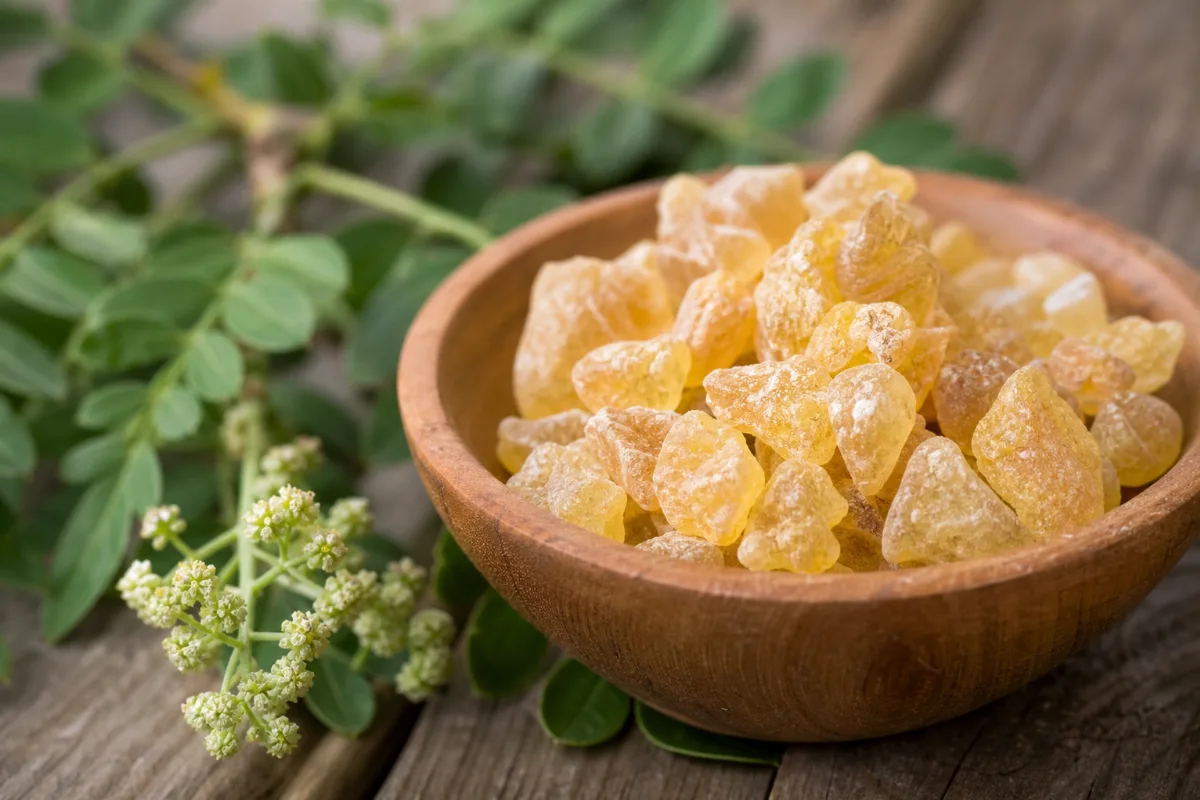
Boswellia extract comes from the gum resin of a tree. NIH says Boswellia serrata is a branching tree native to mountainous regions of Northern Africa, India and the Middle East, and that the extract is made from the gum resin or bark and can be taken by mouth or applied to the skin. [2] The resin of this and other Boswellia species is the source of frankincense. [2] Frankincense essential oil (used for aromatherapy) is a different product, covered on Frankincense Oil.Scientific name and plant part
Boswellia serrata Roxb. ex Colebr. is the accepted name, in the family Burseraceae. [3] The part used is the resin that exudes from the bark; Memorial Sloan Kettering notes that boswellia should not be confused with guggul or myrrh. [1] Other Boswellia species also yield frankincense, so check which species a study or label names. [2]Traditional use
This is tradition, not proof. NIH says boswellia has traditionally been used in Ayurveda to improve arthritis, reduce inflammation and pain, and relieve symptoms of some respiratory and cardiovascular conditions. [2] For the Ayurvedic view, see Boswellia (Shallaki) in Ayurveda.What research shows
NIH says most studies of boswellia are small and low quality, and there is not enough high-quality evidence to say whether it is useful for any health condition. [2]| Use | What the source found | Strength of evidence | Form and population |
|---|---|---|---|
| Osteoarthritis pain (oral) | NIH says several studies suggest boswellia taken by mouth may reduce inflammation and pain, but larger, higher-quality studies are needed. [2] | Promising but limited | Oral extract, adults with osteoarthritis |
| Osteoarthritis, pooled trials (2020) | Seven trials with 545 patients: boswellia or its extract may relieve pain, stiffness and function problems compared with control. [4] | Promising but limited | Oral boswellia versus placebo or conventional medicine, osteoarthritis |
| Knee osteoarthritis, pooled trials (2024) | 13 studies: the overall analysis found no significant effect because the studies differed so much, but a subgroup analysis favored boswellia extracts; the authors call for better trials. [5] | Mixed | Resin extracts, knee osteoarthritis |
| Topical use (frankincense) for arthritis | NIH says there is not enough evidence that it is an effective treatment. [2] | Insufficient evidence | Applied to the skin |
| Asthma | A few small studies suggest oral use may reduce symptoms; NIH says rigorous evidence is lacking. [2] | Insufficient evidence | Oral |
| Cancer, brain swelling | Limited human research; NIH says a small study in malignant glioma suggested less brain swelling but not a smaller tumor, and no complementary approach has been shown to cure cancer. [2] | Insufficient evidence | Oral |
| COVID-19 | NIH says there is no evidence it can prevent or treat COVID-19. [2] | No good evidence of benefit |
Results depend on the extract. Trials often test specific standardized extracts, so a result for one does not transfer to another capsule, powder or resin. Proper evidence not found for boswellia versus other pain treatments in long-term trials; we searched NIH NCCIH and PubMed meta-analyses of boswellia and osteoarthritis.
Forms and why the form matters
Boswellia is sold as capsules, tablets and extracts, and as resin or oil for the skin. [1] Memorial Sloan Kettering says supplements can contain higher amounts of boswellia than Ayurvedic formulas. [1] NIH reports that amounts used in trials were up to 1,000 mg daily of B. serrata extract for up to 6 months, and 2,400 mg for up to 1 month, in clinical trials judged apparently safe; these are trial amounts, not advice. [2]Safety
- General: NIH says boswellia is likely safe when taken by mouth, and may be safe on the skin or for aromatherapy. [2] Memorial Sloan Kettering describes it as generally well tolerated. [1]
- Side effects: allergic skin reactions; case reports include contact dermatitis after boswellia oil or a topical cream, and one report of a stomach mass (bezoar) after excessive frankincense intake in a teenager with celiac disease. [1]
- Medicines: besides blood thinners, lab studies show boswellic acids affect drug transporters such as P-glycoprotein, with clinical meaning not known. [1] Ask a pharmacist, especially about medicines with a narrow safety margin.
- Asthma: NIH says keep following your provider's asthma plan and do not substitute other approaches. [2]
- Pregnancy and breastfeeding: NIH says amounts found in food are likely safe, but little is known about medicinal amounts or frankincense. [2] See pregnancy and breastfeeding.
- Liver, kidney, children, older adults, surgery: the sources we read for this page do not describe specific cautions for these groups. Absence of a warning is not proof of safety; tell your surgical team about any supplement, as described in supplements before surgery.
Quality notes
Products vary in extract type and amount. Check the label for the species name and plant part, and see quality testing and certifications. The sources we read for this page do not describe contamination findings specific to boswellia.Official statements
NIH (NCCIH, United States, updated April 2025) states there is not enough high-quality evidence to determine whether boswellia is useful for any health condition. [2] A European Union herbal monograph for boswellia was not found among the sources we read.A clinician or pharmacist decides what is right for a particular person.
Frequently asked questions
Does boswellia help arthritis?
Some pooled trials suggest less osteoarthritis pain, but NIH says studies are small and low quality, and one 2024 analysis found no significant overall effect. [2] [5]
Is boswellia the same as frankincense?
Frankincense is the resin from Boswellia trees. Supplements use an extract of it, while frankincense oil is an aromatherapy product. [2]
Is it safe with blood thinners?
Possibly not. Boswellia extracts can inhibit platelet clumping and may raise bleeding risk with these drugs. [1]
Can I use it in pregnancy?
Little is known about medicinal amounts. Ask your clinician. [2]
Does topical boswellia work?
NIH says there is not enough evidence to show topical frankincense is an effective treatment for arthritis. [2]
References
- Memorial Sloan Kettering Cancer Center. Boswellia: purported benefits, side effects and more. Read 2026-10-23.
- NIH National Center for Complementary and Integrative Health (NCCIH, US). Boswellia. Last updated April 2025. Read 2026-10-23.
- GBIF Secretariat. Boswellia serrata Roxb. ex Colebr., GBIF Backbone Taxonomy (accepted name). Read 2026-10-23.
- Effectiveness of Boswellia and Boswellia extract for osteoarthritis patients: a systematic review and meta-analysis. BMC Complement Med Ther. 2020. PMID 32680575. Read 2026-10-23.
- Efficacy of extracts of oleogum resin of Boswellia in the treatment of knee osteoarthritis: a systematic review and meta-analysis. Phytother Res. 2024. PMID 39314013. Read 2026-10-23.