Herbs & Botanicals · Herbs · Shepherd's purse herb, heavy periods, small trials, pregnancy warning
Shepherd's Purse
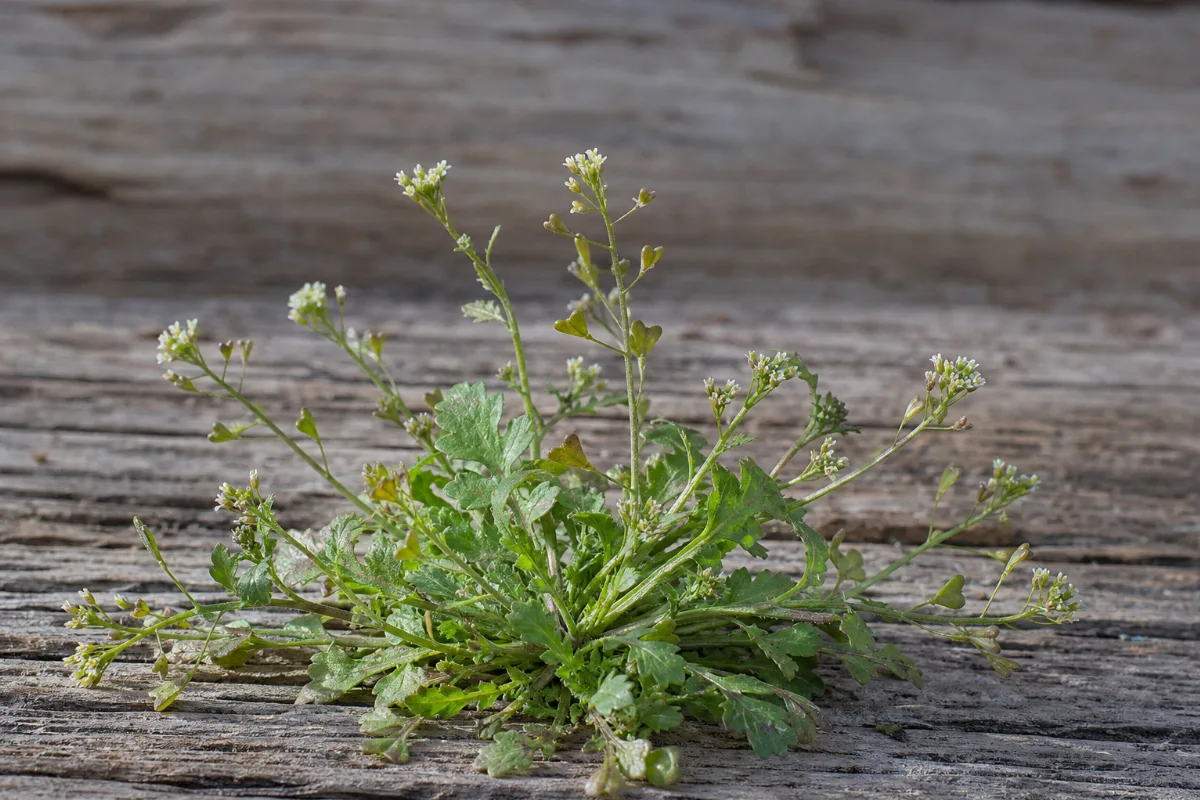
Capsella bursa-pastoris (L.) Medik. · also called Shepherd's purse, Bursae pastoris herba
Shepherd's purse is a common weed in the mustard family. Its above-ground parts are used in Europe as a traditional herbal medicine to reduce heavy periods. The evidence is thin: two small trials that disagree, and an EU view built on long use. It is not recommended in pregnancy, in breastfeeding or under 18.
General information, not medical advice. Last substantive update · Not medically reviewed. A named clinician has not signed off on this page. How this page is made
About Shepherd's Purse
Shepherd's purse is a common weed used for centuries to slow bleeding. In the EU it is a traditional herbal medicine for heavy periods. Human research is very small: two trials from Iran that point different ways, and one hospital trial after birth. Most other claims are lab or animal only. It is not for pregnancy or breastfeeding.
What it is
Shepherd's purse (Capsella bursa-pastoris) is a plant in the mustard family. The part used is the dried or fresh herb above the ground. The plant contains flavonoids such as quercetin, kaempferol and luteolin, plus phenolic acids, amino acids and minerals. Older reports of choline, acetylcholine and histamine are questioned by the review we read.
EMA covers two preparations: the dried, cut herb (as tea) and liquid extracts such as ethanol extracts. Products that mix it with other herbs are not covered.
What the research shows
For heavy periods, the EU view rests on long use. EMA says clinical evidence is insufficient. The best-known trial (84 women, Iran, 2018) gave everyone mefenamic acid and added the herb or a placebo. Blood loss fell in both groups and fell more with the herb (p < 0.001), but the abstract gives no averages. A second trial in women with fibroids found bleeding scores fell in both groups with no significant difference between herb and placebo. Two reviews of herbs for heavy periods did not include a shepherd's purse trial.
For bleeding after birth, one trial of 100 women found a larger fall with extract drops added to oxytocin. A tea study in haemorrhoids reported fewer symptoms, but we could not open it. We found no human trial of the herb alone, and none for blood pressure, cholesterol, inflammation or cancer.
At a glance
Traditional uses history, not proof
- Bleeding, including heavy periods and bleeding from the womb (review and EMA)
- Called a 'uterine agent' by Hippocrates, per a 2024 review
- Oedema, high blood pressure, kidney and nerve complaints in folk medicine (same review)
Studied for research
- Heavy periods, very low certainty (an add-on trial positive, a fibroid trial no difference)
- Bleeding after childbirth, very low certainty (one 100-woman trial, with oxytocin)
- Haemorrhoid symptoms, very low certainty (one tea study, not opened)
- Cholesterol, blood pressure and other claims, lab and animal only
Main compounds
- Quercetin (CID 5280343)
- Kaempferol (CID 5280863)
- Luteolin (CID 5280445)
- Icaritin (CID 5318980)
- Choline, acetylcholine and histamine (older reports, some questioned)
Common forms
- Dried herb as a tea (covered by EMA)
- Liquid extract (covered by EMA)
- Capsules of hydroalcoholic or dry extract (used in the trials)
- Sublingual drops of extract (one hospital trial)
Research links: EMA public summary (2019) · Heavy periods trial (2018) · Bleeding after birth trial (2017) · Review of the plant (2024) · Adulterated blend (2014) · Research Library · Genes & Biomarkers Library
The plant and its history
- Accepted scientific name
- Capsella bursa-pastoris (L.) Medik.
- Naming authority
- (L.) Medik.
- Common names
- Shepherd's purse (English); Bursae pastoris herba (Latin (drug name)); Tasznik (Polish (from the review))
- Botanical family
- Brassicaceae (mustard or cabbage family)
- Classification
- Plantae > Tracheophyta > Magnoliopsida > Brassicales > Brassicaceae > Capsella > Capsella bursa-pastoris
- Native range
- Not verified in a source read
- Habitat
- A common weed; details not verified. The review says it is also eaten as a wild food and used in soil clean-up research.
- What the plant looks like
- Roots: Not described in sources read; Stems: Not described in sources read; Leaves: Not described in sources read; Flowers: Not described in sources read; Fruit: Not described in sources read (the common name refers to the fruit shape; not verified here)
- Cultivation
- Not covered.
- Harvest and processing
- Medicinal use is of the dried and cut above-ground parts or a liquid extract (EMA).
- Sustainability and conservation
- Not covered.
Traditional use and history history, not clinical proof
| Tradition or era | Documented use | Source |
|---|---|---|
| Neolithic Turkey | The review says seeds were found at Catalhoyuk, dated to around 5950 BC. | p39771011 |
| Ancient Greece | The review says Hippocrates recognised it as a 'uterine agent'. | p39771011 |
| Folk medicine in Europe and Asia | Used as a blood-stopping, vessel-narrowing, fever-reducing herb, and for oedema, high blood pressure, kidney and nerve disorders (review). | p39771011 |
| EU traditional herbal medicine | EMA accepts at least 30 years of use (15 in the EU) for reducing heavy menstrual bleeding. | s-ema-bursae-pastoris-summary |
Traditional use shows how a plant was used. It does not show that a supplement works or is safe today.
What is inside, and how it may work
What the plant contains and how those compounds act in cells and animals. Laboratory and animal mechanisms are not proven effects in people.
Main compounds
| Compound | Family | Where it is concentrated | Activity studied | Level of evidence |
|---|---|---|---|---|
| Quercetin (and glycosides) PubChem 5280343 | Flavonol | Aerial parts | Listed as a main flavonoid group; antioxidant in lab tests 4 17 | Laboratory research |
| Kaempferol (and glycosides) PubChem 5280863 | Flavonol | Aerial parts | Listed among the high-content flavonoids 4 17 | Laboratory research |
| Luteolin (and glycosides) PubChem 5280445 | Flavone | Aerial parts | Flavone linked in the review to heart-cell protection in a mouse and cell study 4 17 | Animal research |
| Icaritin PubChem 5318980 | Prenylated flavonoid | Aerial parts (ethanol extract) | The review reports it lowered LDL and total cholesterol in obese mice, via PCSK9 4 17 | Animal research |
| Choline PubChem 305 | Biogenic amine | Herb | Reported at up to 1% in older literature; the review says occurrence is sometimes questioned 4 17 | Literature report |
| Acetylcholine PubChem 187 | Biogenic amine | Herb | Reported in older literature; occurrence sometimes questioned 4 17 | Literature report |
| Histamine PubChem 774 | Biogenic amine | Herb | Reported in older literature; occurrence sometimes questioned 4 17 | Literature report |
Mechanisms, receptors and pathways
| Target or pathway | Gene or receptor | What was found | Level |
|---|---|---|---|
| Uterine muscle tone | Not identified | Water infusion raised tone of isolated rabbit and guinea pig uterus in 1981, weaker than chamomile and calendula. A peptide with an oxytocin-like effect has been proposed but its presence is questioned. 8 4 | In vitro / animal tissue |
| Blood-pressure enzyme ACE | ACE | Hot-water extract inhibited ACE by 33.95% in vitro. 4 | Laboratory research |
| Cholesterol (PCSK9) | PCSK9, SREBP2, HNF-1 alpha | Ethanol extract and icaritin lowered LDL and total cholesterol in obese mice and reduced PCSK9 in liver cells. 4 | Animal / in vitro |
| Acetylcholinesterase | AChE | Hexane extract inhibited the enzyme in vitro; another extract was weak. 4 | Laboratory research |
| Astringent / haemostatic action | Not identified | The traditional explanation for stopping bleeding. No human mechanism study was found. 10 4 | Traditional use |
Absorption, metabolism and elimination
- Absorption
- No human absorption data found. EMA says pharmacokinetic data are not required for traditional-use monographs.
- Distribution
- Not found.
- Metabolism
- Not found.
- Elimination
- Not found.
- Bioavailability
- Not found.
Isolated compounds versus whole extracts
The EU covers only dried herb (as tea) and liquid extracts such as ethanol extracts; combinations are not covered. The trials used hydroalcoholic or dry extracts in capsules or drops, which are not the same as tea. Icaritin and luteolin results come from isolated compounds or lab extracts and cannot be assumed for tea.
Nutritional composition
The review lists vitamins A and C, thiamine, riboflavin and niacin, minerals including calcium, potassium and sodium, amino acids such as tyrosine and arginine, and phytosterols. No amounts were read. It is also eaten as a wild green. The review says nothing on nutrient intake from the herb as medicine.
3 very low certainty1 not enough evidence
What is Shepherd's Purse good for?
The studied uses and how strong the human evidence is. 'Very low' means one or two small studies. 'Insufficient' means no human trial, or animal and lab work only. Safety comes first: see the Safety tab.
Benefits, one by one
Each card is a research question, not a promise. Tap a goal to filter. Open a card to see the studies, doses and limits.
Heavy periods (heavy menstrual bleeding)
Very low certaintyThe EU accepts dried shepherd's purse herb as a traditional medicine for heavy periods. It is accepted on long use, not on proof from trials. One small Iranian trial of 84 women found a bigger fall in blood loss when the herb was added to mefenamic acid, but a second small trial in women with fibroids found no difference between herb and placebo.
9 studiesCapsules of hydroalcoholic or dry extract in the trials; EMA covers d…
Studies, doses and limits
What the trials found
Two small randomised trials of a capsule of dry extract. Trial 1 (Naafe 2018, 84 women, two cycles): all women took mefenamic acid; the herb group had a larger fall in blood loss (p < 0.001; abstract gives no averages). Trial 2 (Danesh 2019, women with fibroids, 3 months, described by a review only): bleeding scores fell in both groups with no significant difference between herb and placebo. EMA also mentions one study of herb plus pain relief against no treatment, and could draw no firm conclusion. Two systematic reviews of herbs for heavy periods did not include a shepherd's purse trial.
Results
Mixed: one add-on trial positive, one fibroid trial no difference.
Effect sizes as reported
No averages or confidence intervals in the abstract of the 84-woman trial; p < 0.001 for the extra fall. Fibroid trial (as quoted by a review): PBAC 464.00 to 323.82 with the herb and 445.92 to 214.36 with placebo; no significant difference between groups.
Why this rating
Two small trials that disagree, one with the herb added to a drug, no numbers in the abstract, and a regulatory view that rests on traditional use because clinical evidence is insufficient.
Form and dose studied
Capsules of hydroalcoholic or dry extract in the trials; EMA covers dried herb as tea and liquid extracts. Combination products are not covered. Ask a doctor or pharmacist about amounts.
Who was studied
Adult women with heavy periods; EMA limits use to women with regular cycles after a doctor has ruled out serious causes. Trial women were in Iran.
Limits
Add-on design, small trials, short follow-up, no iron or haemoglobin results in the abstracts, and no safety numbers.
Why researchers looked
Heavy periods can cause iron-deficiency anaemia and poor quality of life, and shepherd's purse has been used for bleeding for a very long time.
Traditional use
The review describes use since antiquity; Hippocrates is said to have called it a 'uterine agent'. EMA notes at least 30 years of use, including 15 years in the EU.
Proposed mechanism Preliminary mechanism
Traditionally called an astringent. A 1981 lab study found that a water infusion raised the tone of isolated rabbit and guinea pig uterus. No study shows how the herb might cut menstrual blood loss in women.
A proposed mechanism does not show that the effect happens in people.
Not for pregnancy or breastfeeding, and not under 18, per EMA. Heavy bleeding needs a doctor's check first. See the Safety tab.
Bleeding after childbirth (early postpartum haemorrhage)
Very low certaintyOne 100-woman Iranian trial gave shepherd's purse drops under the tongue together with the standard oxytocin drip. Bleeding fell more than with oxytocin plus placebo. It is a single small trial and postpartum bleeding is an emergency that needs hospital care.
2 studiesHydroalcoholic extract as sublingual drops in a hospital. This is not…
Studies, doses and limits
What the trials found
One single-blinded randomised trial (Ghalandari 2017, 100 women after vaginal birth, 50 per group). Ten sublingual drops of extract or placebo were given right after the placenta, with the same oxytocin infusion in both groups. Bleeding fell in both groups and fell more with the herb (p < 0.001). The abstract gives no bleeding volumes and does not report haemoglobin results.
Results
One small trial favouring the herb as an add-on to oxytocin.
Effect sizes as reported
p < 0.001 for the extra fall in bleeding; no volumes or confidence interval in the abstract.
Why this rating
One single-blinded trial, abstract only, no numbers, add-on to a standard drug, and no repeat study found.
Form and dose studied
Hydroalcoholic extract as sublingual drops in a hospital. This is not a home treatment.
Who was studied
Women after vaginal birth in one Iranian hospital.
Limits
Single centre, single blinding, no volumes in the abstract, and no safety numbers. The authors call for more research on efficacy and safety.
Why researchers looked
Postpartum haemorrhage is a leading cause of death in childbirth, and the herb is traditionally used for uterine bleeding.
Traditional use
Used for bleeding after birth in folk medicine; the review lists a hemostatic (blood-stopping) use.
Proposed mechanism Preliminary mechanism
Unknown. A peptide with an oxytocin-like effect and uterine tone-raising action in isolated animal tissue have been described, but the review says the presence of some of these compounds is questioned.
A proposed mechanism does not show that the effect happens in people.
Heavy bleeding after birth is an emergency. Safety in breastfeeding is not established (EMA).
Haemorrhoid symptoms (tea)
Very low certaintyA 2022 randomised study described by a review found fewer symptoms and less bleeding at stool after three months of shepherd's purse tea. We could not open the study, so the size and quality are unknown.
2 studiesTea of the dried herb. Ask a doctor or pharmacist about amounts.
Studies, doses and limits
What the trials found
One prospective randomised study (Mert 2022), tea of 200 mL a day for 3 months: fewer difficulties, less bleeding at stool and lower pain scores than the control group, per the 2024 review. No numbers were given.
Results
Better symptoms than control in one study, as described by a review.
Effect sizes as reported
Not given.
Why this rating
Single study that we could not open; no numbers, no PubMed record found, no replication.
Form and dose studied
Tea of the dried herb. Ask a doctor or pharmacist about amounts.
Who was studied
People with haemorrhoidal disease.
Limits
Described second-hand. Rectal bleeding can have other causes and needs a doctor.
Why researchers looked
The herb is used for bleeding and as an astringent, and haemorrhoids often bleed.
Traditional use
Listed under gut uses in the review.
Proposed mechanism Animal research
Not shown in people. A 2020 rat study of organic acids from the plant on croton-oil haemorrhoids exists; we did not read it.
A proposed mechanism does not show that the effect happens in people.
New or heavy rectal bleeding needs medical review.
Cholesterol, blood pressure, inflammation, cancer cells and memory enzymes (lab and animal only)
Not enough evidenceReviews and popular articles list many other effects, but all of them come from cells, test tubes or animals. We found no human trial for any of them.
2 studiesNot applicable.
Studies, doses and limits
What the trials found
None found for these uses. A popular consumer article lists early lab and animal work and does not report human evidence.
Results
Lab and animal findings only.
Effect sizes as reported
Not applicable to people.
Why this rating
No human studies; findings are from cells, test tubes and mice.
Form and dose studied
Not applicable.
Who was studied
None.
Limits
Cell and animal results often fail in people. Lab extracts differ from teas and capsules.
Why researchers looked
The plant is rich in flavonoids such as quercetin, kaempferol and luteolin, which are active in many lab tests.
Traditional use
Folk uses in the review include oedema, high blood pressure, kidney complaints and nerve disorders.
Proposed mechanism Laboratory research
The 2024 review reports: a hot-water extract inhibited the blood-pressure enzyme ACE by 33.95% in a test tube; an ethanol extract (with icaritin) lowered LDL and total cholesterol in obese mice via the PCSK9 pathway; a hexane extract inhibited the enzyme acetylcholinesterase in vitro; water extracts killed cervical cancer cells in a dish. None of this has been tested in people.
A proposed mechanism does not show that the effect happens in people.
Do not use the herb instead of blood-pressure or cholesterol medicine.
Connections to the rest of health
How Shepherd's Purse connects to the rest of our health knowledge graph. Every link says what kind of connection it is. A safety link (for example to the liver) is a warning, not a benefit. A study that merely mentions a topic never creates a benefit link.
Explore every connection: goals, body systems, organs, symptoms, genes
A. Wellness goals
| Connected to | Kind of connection | Evidence status | Context | Studies |
|---|---|---|---|---|
| Womens Wellness | Traditional use | Very low certainty | Heavy periods (heavy menstrual bleeding): The EU accepts dried shepherd's purse herb as a traditional medicine for heavy periods. It is accepted on long use, not on proof from trials. One small Iranian trial of 84 women found a bigger fall in blood loss when the herb was added to mefenamic acid, but a second small trial in women with fibroids found no difference between herb and placebo. | 6 16 10 11 12 7 2 8 4 |
| Womens Wellness | Potential benefit | Very low certainty | Bleeding after childbirth (early postpartum haemorrhage): One 100-woman Iranian trial gave shepherd's purse drops under the tongue together with the standard oxytocin drip. Bleeding fell more than with oxytocin plus placebo. It is a single small trial and postpartum bleeding is an emergency that needs hospital care. | 1 12 |
| Digestive Support | Potential benefit | Very low certainty | Haemorrhoid symptoms (tea): A 2022 randomised study described by a review found fewer symptoms and less bleeding at stool after three months of shepherd's purse tea. We could not open the study, so the size and quality are unknown. | 15 4 |
| Heart Health | Preliminary mechanism | Not enough evidence | Cholesterol, blood pressure, inflammation, cancer cells and memory enzymes (lab and animal only): Reviews and popular articles list many other effects, but all of them come from cells, test tubes or animals. We found no human trial for any of them. | 4 14 |
| Blood Pressure Support | Preliminary mechanism | Not enough evidence | Cholesterol, blood pressure, inflammation, cancer cells and memory enzymes (lab and animal only): Reviews and popular articles list many other effects, but all of them come from cells, test tubes or animals. We found no human trial for any of them. | 4 14 |
| Cholesterol Balance | Preliminary mechanism | Not enough evidence | Cholesterol, blood pressure, inflammation, cancer cells and memory enzymes (lab and animal only): Reviews and popular articles list many other effects, but all of them come from cells, test tubes or animals. We found no human trial for any of them. | 4 14 |
B. Body systems
| Connected to | Kind of connection | Evidence status | Context | Studies |
|---|---|---|---|---|
| Reproductive System | Biological association | Very low certainty | Studied for: Heavy periods (heavy menstrual bleeding) Studied for: Bleeding after childbirth (early postpartum haemorrhage) | 6 16 10 11 12 7 2 8 4 1 |
| Digestive System | Biological association | Very low certainty | Studied for: Haemorrhoid symptoms (tea) | 15 4 |
| Cardiovascular System | Biological association | Not enough evidence | Studied for: Cholesterol, blood pressure, inflammation, cancer cells and memory enzymes (lab and animal only) | 4 14 |
E. Health conditions
| Connected to | Kind of connection | Evidence status | Context | Studies |
|---|---|---|---|---|
| Heavy menstrual bleeding | Traditional use | Very low certainty | Accepted by EMA on traditional use; two small trials disagree. EMA traditional use; two small trials disagree. Preparation or compound: Dried herb and extracts |
6 11 16 |
| Pregnancy and breastfeeding | Contraindication | Authoritative guidance | Not recommended; safety unknown; uterotonic theory. Preparation or compound: All preparations |
11 8 |
| Adulterated herbal blends | Adverse effect or risk | Case report | One blend contained reserpine. Preparation or compound: Multi-herb supplement |
3 |
| Postpartum haemorrhage | Potential benefit | Very low certainty | One 100-woman trial as an add-on to oxytocin. Preparation or compound: Sublingual extract drops |
1 |
| Pregnancy | Contraindication | Authoritative guidance | Not recommended; safety unknown. Preparation or compound: All preparations |
11 |
I. Biomarkers
| Connected to | Kind of connection | Evidence status | Context | Studies |
|---|---|---|---|---|
| Menstrual blood loss (pictorial chart score) | Biological association | Very low certainty | Measured in trials: mixed. A lab change is not the same as a health benefit. | 6 16 |
| Blood loss after birth | Biological association | Very low certainty | Measured in trials: lowered. A lab change is not the same as a health benefit. | 1 |
| Haemoglobin (blood iron-carrying protein) | Biological association | Not enough evidence | Measured in trials: no-change. A lab change is not the same as a health benefit. | 1 |
| LDL cholesterol | Biological association | Not enough evidence | Measured in trials: lowered. A lab change is not the same as a health benefit. | 4 |
J. Genes, receptors and enzymes
| Connected to | Kind of connection | Evidence status | Context | Studies |
|---|---|---|---|---|
| PCSK9 | Preliminary mechanism | Animal | Lower in obese mice and liver cells with an ethanol extract. | 4 |
| ACE | Preliminary mechanism | In vitro | Inhibited in a test tube by a hot-water extract. | 4 |
| AChE | Preliminary mechanism | In vitro | Inhibited in a test tube by a hexane extract. | 4 |
L. Active compounds
| Connected to | Kind of connection | Evidence status | Context | Studies |
|---|---|---|---|---|
| Quercetin (and glycosides) | Biological association | In vitro | Listed as a main flavonoid group; antioxidant in lab tests Preparation or compound: Aerial parts |
4 17 |
| Kaempferol (and glycosides) | Biological association | In vitro | Listed among the high-content flavonoids Preparation or compound: Aerial parts |
4 17 |
| Luteolin (and glycosides) | Biological association | Animal | Flavone linked in the review to heart-cell protection in a mouse and cell study Preparation or compound: Aerial parts |
4 17 |
| Icaritin | Biological association | Animal | The review reports it lowered LDL and total cholesterol in obese mice, via PCSK9 Preparation or compound: Aerial parts (ethanol extract) |
4 17 |
| Choline | Biological association | Literature report | Reported at up to 1% in older literature; the review says occurrence is sometimes questioned Preparation or compound: Herb |
4 17 |
| Acetylcholine | Biological association | Literature report | Reported in older literature; occurrence sometimes questioned Preparation or compound: Herb |
4 17 |
| Histamine | Biological association | Literature report | Reported in older literature; occurrence sometimes questioned Preparation or compound: Herb |
4 17 |
Each connection is stored with the ingredient, the connected record, the kind of connection, the evidence status, the supporting studies, the preparation or compound involved, and a review date (last reviewed October 25, 2026).
Evidence at a glance: what changed in 4 lab markers
Tap a number to show only those markers. Counts are markers, not people.
The evidence
The research centre for Shepherd's Purse. Every record here was checked against PubMed or the publisher's page; we never list a study we have not verified.
Evidence by outcome
Bars show how many studies we found for each outcome, not how well it works. People are added up across trials only (reviews are not added, to avoid double counting).
How we rate evidence
High certainty
Several well-run trials or reviews agree; further research is unlikely to change the picture much.
Moderate certainty
Good trials point the same way, but some doubt remains.
Low certainty
Small, short or inconsistent trials. The finding could change with better research.
Very low certainty
Very little or very weak human data. Treat as a possibility only.
Mixed findings
Trials or reviews disagree with each other.
Not enough evidence
Not enough human research to say either way.
Evidence against
Good research found no benefit, or found harm.
We take the reviewers' own risk-of-bias and GRADE statements where they exist, and otherwise judge from study size, design, consistency, directness and whether a product matches what is sold. Many publications do not make evidence high. Method note: We searched PubMed, read the abstracts of the trials, read the open full text of a 2024 review, and read the EMA public summary and monograph. Pages that could not be found or opened are marked as not found. Where only a summary was available, we say so.
Study library: every study we checked 17
| Study | Design | People | Product, dose, length | Result |
|---|---|---|---|---|
| Ghalandari 2017 Effect of Hydroalcoholic Extract of Capsella bursa pastoris on Early Postpartum Hemorrhage: A Clinical Trial Study J Altern Complement Med · PMID 28590768 · DOI |
Controlled trial |
100 100 women after vaginal birth, Afzalipour Hospital, Kerman, Iran (50 per group), 2015 |
Hydroalcoholic extract of Capsella bursa-pastoris as sublingual drops (10 drops) given with an oxytocin infusion aerial parts (assumed herb; not stated in abstract) 10 drops, once, right after the placenta came out Single dose · vs Placebo drops plus the same oxytocin infusion |
Bleeding fell in both groups. The fall was larger in the shepherd's purse group (p < 0.001). The abstract gives no bleeding volumes and does not report the haemoglobin results. Less bleeding than oxytocin plus placebo; size not given in the abstract Methods, limits and fundingOutcomes: Amount of bleeding; haemoglobin and haematocrit 6 hours after birth Limitations: Single-blinded. Everyone received oxytocin, so this tests an add-on in a hospital, not the herb as a rescue treatment. Abstract only. Authors call for more research on efficacy and safety. Funding and conflicts: Not stated in the abstract Read: abstract |
| Javan 2016 Herbal Medicines in Idiopathic Heavy Menstrual Bleeding: A Systematic Review Phytother Res · PMID 27397554 · DOI |
Systematic review |
Women with idiopathic heavy menstrual bleeding; 3 randomised trials | Ginger capsules, myrtle fruit syrup, pomegranate flower capsules various Various Various · vs Placebo or tranexamic acid |
Three trials of other herbs (ginger, myrtle, pomegranate flower) reduced bleeding. No shepherd's purse trial was included. Authors say more well-designed trials are needed. Context only Methods, limits and fundingOutcomes: Pictorial blood loss assessment chart score, bleeding duration Limitations: Only three trials, none of shepherd's purse; search ended August 2015. Funding and conflicts: Not stated in the abstract Read: abstract |
| Karioti 2014 Combined HPLC-DAD-MS, HPLC-MS(n) and NMR spectroscopy for quality control of plant extracts: the case of a commercial blend sold as dietary supplement J Pharm Biomed Anal · PMID 24013031 · DOI |
Case report |
One commercial herbal blend that listed hawthorn, olive, shepherd's purse and fumitory; patients collapsed | Commercial dietary supplement blend (declared to contain Capsella bursa-pastoris among others) unspecified Not applicable Not applicable · vs None |
The product lacked the marker compounds of some declared plants, including shepherd's purse, and contained the banned drugs ajmaline, reserpine and yohimbine. Reserpine was in the therapeutic range and the authors say it was responsible for patient collapses. Adulteration with prescription drugs in a blend sold as a supplement Methods, limits and fundingOutcomes: Chemical analysis of the product Limitations: One product. Tells us about adulteration of blends, not about the safety of the herb itself. Funding and conflicts: Not stated Read: abstract |
| Lukaszyk 2024 Traditional Uses, Bioactive Compounds, and New Findings on Pharmacological, Nutritional, Cosmetic and Biotechnology Utility of Capsella bursa-pastoris Nutrients · PMID 39771011 · DOI |
Narrative review |
Review of traditional use, chemistry, lab, animal and human studies of shepherd's purse | Capsella bursa-pastoris herb and extracts (many kinds) aerial parts (herb) Various Various · vs None |
Names flavonoids, phenolic acids, amino acids, phytosterols, vitamins and bioelements as the main constituents. Lists choline (up to 1%), acetylcholine and histamine as reported amines, with the note that their presence is sometimes questioned. Describes most pharmacology as lab or animal work. Describes three small human studies: heavy periods with fibroids (no difference between groups), heavy periods with mefenamic acid (better with the herb), and a tea trial in haemorrhoids (fewer symptoms). Narrative summary; no pooled effect Methods, limits and fundingOutcomes: Traditional uses, constituents, pharmacology, human studies named in the review Limitations: Not a systematic review: no stated search method or quality rating in the abstract. Human studies are described only briefly. We read the open-access full text. Funding and conflicts: Authors declare no conflicts Read: full-text |
| McKenzie 2009 Sulfur-associated polioencephalomalacia in cattle grazing plants in the Family Brassicaceae Aust Vet J · PMID 19178473 · DOI |
Case report animal |
Cattle in Queensland, Australia, grazing Brassicaceae weed pastures | Pasture of 60% London rocket and 40% shepherd's purse (one herd) aerial parts (grazed) Not applicable Weeks · vs None |
8 of 20 steers died on the pasture that included shepherd's purse. Total sulfur in the feed (0.62%) was above the safe level the authors cite (0.5%). Another herd was affected on wild radish alone. Animal brain disease linked to high-sulfur Brassicaceae weeds, not to shepherd's purse alone Methods, limits and fundingOutcomes: Brain disease in cattle and sulfur in feed Limitations: Mixed pasture, so shepherd's purse cannot be blamed alone. Cattle only. Funding and conflicts: Not stated Read: abstract |
| Naafe 2018 Effect of Hydroalcoholic Extracts of Capsella Bursa-Pastoris on Heavy Menstrual Bleeding: A Randomized Clinical Trial J Altern Complement Med · PMID 29641247 · DOI |
Controlled trial |
84 84 women with heavy menstrual bleeding, gynaecology clinics, Tehran, Iran (42 per group) |
Hydroalcoholic extract of Capsella bursa-pastoris in capsules, taken together with mefenamic acid aerial parts (herb) Capsule amount not stated in the abstract (not given here) Menstrual days 1 to 7 for two consecutive cycles (abstract) · vs Mefenamic acid plus placebo capsules |
Bleeding fell in both groups. The fall was larger in the shepherd's purse group (p < 0.001). The abstract gives no group means and no numbers on problems or side effects. Larger drop in menstrual blood loss than mefenamic acid plus placebo; size not given in the abstract Methods, limits and fundingOutcomes: Pictorial blood loss assessment chart (PBLAC) score, bleeding days, problems, satisfaction Limitations: Both groups also took mefenamic acid, so the result is for an add-on, not for the herb alone. Small. Abstract read only; no effect sizes or side-effect numbers. A later review describes the trial as three cycles and the abstract says two; we use the abstract. Authors call for more research on efficacy and safety. Funding and conflicts: Not stated in the abstract Read: abstract |
| Qaraaty 2026 Impact of flavonoid-rich herbal medicines on idiopathic heavy menstrual bleeding: A systematic review and meta-analysis of randomized controlled trials Avicenna J Phytomed · PMID 42740723 · DOI |
Meta-analysis |
425 12 randomised trials, 425 women with idiopathic heavy menstrual bleeding |
Persian-medicine flavonoid-rich plants (various) various Various Various · vs Various |
Authors report potential benefit for PBAC, bleeding duration and quality of life, and a slight rise in haemoglobin (Hedges g 0.31, 95% CI 0.01 to 0.6). In the full text, the overall PBAC and bleeding-duration pools were not significant with high heterogeneity (I2 over 80%). We found no mention of shepherd's purse in the text we read. Mixed; haemoglobin rise small Methods, limits and fundingOutcomes: PBAC, bleeding days, quality of life, haemoglobin Limitations: Many different herbs pooled. High heterogeneity. Does not appear to include shepherd's purse trials, so it is context only. Funding and conflicts: Authors declare none Read: full-text |
| Shipochliev 1981 [Uterotonic action of extracts from a group of medicinal plants] (Bulgarian) Vet Med Nauki · PMID 7314446 |
Animal research in-vitro |
Isolated rabbit and guinea pig uterus tissue | Water infusions of several plants, including shepherd's purse aerial parts (herb) 1 to 2 mg crude drug per cm3 Lab test · vs Other plants |
Shepherd's purse infusion raised uterine tone. It ranked sixth in strength among seven plants that did, behind chamomile, calendula, cockscomb, plantain and comfrey and ahead of St John's wort. Raised uterine tone in isolated animal tissue Methods, limits and fundingOutcomes: Tone (tension) of the isolated uterus Limitations: 1981 lab study on isolated tissue, English abstract only; not shown in women. Cannot tell how strong the effect would be in a body. Funding and conflicts: Not stated Read: abstract |
| Wiese 2001 Suspected nitrite poisoning in pigs caused by Capsella bursa-pastoris (L.) Medik. ('herderstassie', shepherd's purse) J S Afr Vet Assoc · PMID 11811708 · DOI |
Case report animal |
18 18 pigs on a farm in South Africa; 4 died |
Garden weeds and vegetable tops fed to pigs, including shepherd's purse aerial parts (weed in feed) Not stated Daily ration · vs None |
Four of 18 pigs died with brown-coloured blood at autopsy. Of the plants available, only shepherd's purse contained nitrites. The authors call the nitrite poisoning 'suspected' and say it was the first such report. Suspected poisoning in pigs Methods, limits and fundingOutcomes: Cause of death Limitations: One farm report, cause 'suspected', no human data. Animals eating weeds as part of feed. Funding and conflicts: Not stated Read: abstract |
| s-ema-bursae-pastoris-summary 2019 EMA: Bursae pastoris herba - herbal medicinal product (public summary, EMA/164805/2019) · Source |
Authoritative guidance |
Shepherd's purse herb preparations aerial parts (herb) Not given here Not applicable · vs None |
HMPC concluded that, on the basis of long-standing use, dried aerial parts and liquid extracts (tea and liquid forms) can be used to reduce heavy menstrual bleeding in women with regular cycles, after serious conditions have been excluded by a doctor; adult women only. Based on traditional use because clinical evidence is insufficient (at least 30 years of use, 15 in the EU). HMPC noted one study in women with heavy periods (shepherd's purse plus pain relief against no treatment) but could draw no firm conclusion because the extract was not described. No side effects reported at the time of assessment. Combination products are not covered. Not applicable Methods, limits and fundingOutcomes: Regulatory conclusions Limitations: Public summary, not the full assessment report. Status: assessment finalised; first monograph 2011. Funding and conflicts: Public body Read: full-text | |
| s-ema-hmpc-monograph-2011 2011 EMA/HMPC: Community herbal monograph on Capsella bursa-pastoris (L.) Medikus, herba - first version (EMA/HMPC/262766/2010) · Source |
Authoritative guidance |
Shepherd's purse herb preparations aerial parts (herb) Not given here Not applicable · vs None |
Traditional use for reducing heavy menstrual bleeding in women with regular cycles. Contraindication: hypersensitivity. Not recommended under 18. Interactions: none reported. Pregnancy and breastfeeding: safety not established, use not recommended; no fertility data. Undesirable effects: none known. Overdose: no case reported. Reproductive toxicity, genotoxicity and carcinogenicity tests have not been performed. Monograph compiled 12 July 2011. Not applicable Methods, limits and fundingOutcomes: Regulatory conclusions Limitations: First version (2011). We did not check for a later revision. Amounts in the monograph are deliberately not repeated on this page. Funding and conflicts: Public body Read: full-text | |
| s-escop-shepherds-purse 2018 ESCOP: Shepherd's purse (Capsella bursa-pastoris) monograph summary · Source |
Authoritative guidance |
Shepherd's purse herb preparations aerial parts (herb) Not given here Not applicable · vs None |
Per our existing summary of this page: describes the one small trial of a dry-extract capsule in 84 women (the Naafe trial) and traditional use for uterine bleeding. We did not re-open the page for this file. Not applicable Methods, limits and fundingOutcomes: Regulatory conclusions Limitations: Summary-only; page not re-read. Funding and conflicts: Public body Read: summary-only | |
| s-gbif-capsella-bursa-pastoris 2026 GBIF species match: Capsella bursa-pastoris (L.) Medik. (usageKey 5375388) · Source |
Database record |
Shepherd's purse herb preparations aerial parts (herb) Not given here Not applicable · vs None |
Exact match, status ACCEPTED, confidence 99. Kingdom Plantae, order Brassicales, family Brassicaceae, genus Capsella. Not applicable Methods, limits and fundingOutcomes: Regulatory conclusions Limitations: Name and family only; native range not read. Funding and conflicts: Public body Read: full-text | |
| s-healthline-shepherds-purse 2024 Healthline: Shepherd's Purse (consumer article) · Source |
Consumer article |
Shepherd's purse herb preparations aerial parts (herb) Not given here Not applicable · vs None |
Per our existing summary: warns about blood thinners, sedatives and thyroid problems while saying human safety studies are lacking. These warnings are unconfirmed. Not applicable Methods, limits and fundingOutcomes: Regulatory conclusions Limitations: Consumer site, secondary. Claims not checked against primary sources. Summary-only; page not re-read. Funding and conflicts: Public body Read: summary-only | |
| s-hemorrhoid-tea-mert-2022 2022 Mert T, Yigit E. (2022) Shepherd's purse herbal tea and haemorrhoid symptoms: prospective randomised study (as described in PMID 39771011) · Source |
Controlled trial |
People with haemorrhoidal disease | Shepherd's purse herb preparations aerial parts (herb) Not given here Not applicable · vs None |
As described by the 2024 review: after 3 months of tea (200 mL a day), fewer difficulties and less bleeding at stool and lower pain scores than the control group. Not applicable Methods, limits and fundingOutcomes: Regulatory conclusions Limitations: Not opened. Numbers not given by the review. Not found in PubMed by us. Funding and conflicts: Public body Read: summary-only |
| s-hmb-leiomyoma-trial-danesh-2019 2019 Sadat Danesh A, Mojab F, Mohammadbeigi A, et al. (2019) Capsella bursa-pastoris extract, heavy menstrual bleeding and quality of life in women with uterine leiomyoma: double-blind randomised trial, J Pharm Res Int 31:1-10 (as described in PMID 39771011) · Source |
Controlled trial |
Women with heavy menstrual bleeding and uterine leiomyoma | Shepherd's purse herb preparations aerial parts (herb) Not given here Not applicable · vs None |
As described by the 2024 review: a capsule of dry extract against starch placebo for 3 months in women with uterine fibroids. Bleeding score (PBAC) fell in both groups (study group 464.00 to 323.82; control 445.92 to 214.36), quality of life improved in both, and there was no significant difference between groups. Not applicable Methods, limits and fundingOutcomes: Regulatory conclusions Limitations: Not opened. Not found in PubMed by us. Numbers are as quoted by the review. Funding and conflicts: Public body Read: summary-only |
| s-pubchem-cids 2026 PubChem name lookups: quercetin 5280343, kaempferol 5280863, luteolin 5280445, icaritin 5318980, choline 305, acetylcholine 187, histamine 774 · Source |
Database record |
Shepherd's purse herb preparations aerial parts (herb) Not given here Not applicable · vs None |
CIDs and formulas confirmed by the PubChem API on 2026-10-25. Not applicable Methods, limits and fundingOutcomes: Regulatory conclusions Limitations: Identifies the compounds only; amounts in the plant are not given. Funding and conflicts: Public body Read: full-text |
What we do not know yet
- No trial of the herb alone for heavy periods, and none outside Iran.
- The numbers from the 84-woman and 100-woman trials were not in their abstracts; full texts were not read.
- No human safety, pregnancy or interaction study.
- No primary source for the blood thinner, sedative and thyroid warnings.
- No evidence on photosensitivity or kidney stones in people.
- NCCIH page not found; LiverTox and LactMed not read.
- The EMA monograph is from 2011; a later revision was not checked.
How new research is added
New studies are found by a saved PubMed search and placed in a review queue. A person reads each one before it changes any rating or safety wording.
Lab markers
What changed in blood or saliva tests during trials. A changed number is not the same as feeling or being healthier, and we give no "normal ranges".
Metabolic 1
LDL cholesterol
Lowered in trials
The 'bad' cholesterol carried in the blood.
Not enough evidenceResults and what it means
Why it was measured
A common heart-risk marker.
Statistical vs. clinical meaning
Mouse result only.
Safety implication
None established.
| Study | Result | People | Product |
|---|---|---|---|
| 4 | Reported by the review as lower in obese mice given an ethanol extract (via PCSK9); not measured in people | Obese mice | Ethanol extract of the herb (reported in the review) |
Organ function 1
Haemoglobin (blood iron-carrying protein)
No clear change in trials
The protein in red blood cells that carries oxygen. Low levels mean anaemia.
Not enough evidenceResults and what it means
Why it was measured
Heavy bleeding can cause iron-deficiency anaemia.
Statistical vs. clinical meaning
No haemoglobin result is available for shepherd's purse from the abstracts we read.
Safety implication
Anaemia from heavy periods needs a medical check.
| Study | Result | People | Product |
|---|---|---|---|
| 1 | Haemoglobin and haematocrit were measured 6 hours after birth, but the abstract does not report the results | 100 women after vaginal birth | Sublingual extract drops plus oxytocin |
Other 2
Menstrual blood loss (pictorial chart score)
Mixed results in trials
A chart on which women mark how soaked each pad or tampon is. The marks are added up to a score.
Very low certaintyResults and what it means
Why it was measured
It is the common way to estimate blood loss in trials without collecting every pad.
Statistical vs. clinical meaning
A chart score is self-reported. The positive trial used the herb as an add-on to a drug, and the second trial found no difference.
Safety implication
A lower score does not show safety. Cause of heavy bleeding still needs a doctor.
| Study | Result | People | Product |
|---|---|---|---|
| 6 | Larger fall in the herb group than in the placebo group (p < 0.001); no averages in the abstract | 84 women with heavy periods | Capsella extract capsules plus mefenamic acid vs placebo plus mefenamic acid, two cycles |
| 16 | PBAC 464.00 to 323.82 with herb; 445.92 to 214.36 with placebo; no significant difference (as quoted by a review) | Women with fibroids and heavy periods | Dry extract capsule vs starch placebo, 3 months |
Blood loss after birth
Lowered in trials
The amount of bleeding in the hours after delivery.
Very low certaintyResults and what it means
Why it was measured
Excess loss can cause shock and death.
Statistical vs. clinical meaning
The extra effect on top of oxytocin is unmeasured in the abstract, so its clinical size is unknown.
Safety implication
Never a replacement for hospital care or oxytocin.
| Study | Result | People | Product |
|---|---|---|---|
| 1 | Larger fall in bleeding in the herb group than in the placebo group (p < 0.001); volumes not given in the abstract | 100 women after vaginal birth | Sublingual extract drops plus oxytocin vs placebo drops plus oxytocin |
Safety
What studies and official sources say about side effects, medicines and who should check first. Each point shows what kind of evidence it comes from.
Main points to know 6
- Not recommended in pregnancy or breastfeeding. EMA's herbal committee says safety in pregnancy and breastfeeding has not been established and advises against use. The herb is used to reduce uterine bleeding, and a 1981 lab study found that an infusion raised the tone of isolated animal uterus, so a stimulating effect on the womb is a real theory. No pregnancy study exists. No fertility data exist either. Authoritative guidance 11 8
- Heavy bleeding needs a doctor first. The EU use is only for women with regular cycles, after a doctor has excluded serious causes. Symptoms that continue or worsen need medical review. Taking an herb could delay finding fibroids, hormone problems, clotting problems or pregnancy complications. Authoritative guidance 11 10
- Very little human safety data. EMA reports no known side effects and no overdose cases, but the evidence base is traditional use plus two small trials whose abstracts give no side-effect numbers. 'None known' is not the same as 'proven safe'. Reproductive-toxicity, genotoxicity and carcinogenicity tests have not been performed. Authoritative guidance 11 10 6 1
- Not for people under 18. EMA does not recommend use under 18 because of concerns that need medical advice. Authoritative guidance 11 10
- Blends sold as supplements can contain drugs. One laboratory study of a blend that listed shepherd's purse (with hawthorn, olive and fumitory) found it lacked the plant's marker compounds and contained the banned drugs reserpine, ajmaline and yohimbine. Patients collapsed. This is adulteration of one product, not an effect of the herb. Case report 3
- Warnings about blood thinners, sedatives and thyroid are unconfirmed. A consumer article warns about these, while saying human safety studies are lacking. EMA reports no known interactions. We could not find a primary source that supports these warnings, so they are listed as theory only. Pharmacological theory 14 11
Side effects 4
| Effect | How often | Severity and recovery | Evidence |
|---|---|---|---|
| No side effects known to EMA At the time of the assessment no side effects had been reported. If one occurs, EMA says to see a doctor or qualified practitioner. This reflects limited use data, not proof of safety. | Not established | Not applicable Not applicable | Authoritative guidance 11 10 |
| Side effects in the two trials The first trial says it measured the problems that occurred, but the abstract gives no numbers. The postpartum trial reports bleeding only. No harm is described, and no harm can be ruled out. | Not established | Not stated Not stated | Controlled trial 6 1 |
| Allergy to the plant EMA lists hypersensitivity to the plant as a contraindication. We found no case report. | Not established | Not stated Not stated | Authoritative guidance 11 |
| Animal poisoning from grazing or feeding the weed Both reports are from farms, in animals eating large amounts of the plant as feed or pasture. In the cattle report the pasture was 60% another weed, so the herb cannot be blamed alone. They do not describe human tea or capsules. | 4 of 18 pigs died (suspected nitrite poisoning); 8 of 20 steers died on a mixed Brassicaceae pasture (sulfur-linked brain disease) | fatal in animals Not applicable | Case report 9 5 |
Liver
No liver injury entry (LiverTox) or case report for shepherd's purse was found; the LiverTox page could not be opened. Reviews describe liver-protective effects only in cells and animals. 'Not found' does not mean the herb is safe for the liver. 4
How often. No frequency of liver injury is available.
Monitoring. No monitoring advice was found. Stop and seek care for yellow eyes or skin, dark urine, or severe stomach pain.
This is a safety connection. It is not evidence that Shepherd's Purse supports liver health.
Medicines and supplements 7
| With | Why it matters | Importance | Evidence | What to do |
|---|---|---|---|---|
| Oxytocin and other uterine-stimulating drugs prescription | In theory shepherd's purse might add to the womb-contracting effect, because it raised tone of isolated animal uterus. In the postpartum trial, drops were given together with an oxytocin infusion in hospital. | No interaction study. The abstract of the trial does not report side effects of the combination. | Pharmacological theory Not enough evidence 1 8 | Only under medical supervision; never as a self-treatment. |
| Blood thinners and anti-clotting drugs (warfarin, apixaban, aspirin, NSAIDs) prescription | The herb is used to slow bleeding, so a clotting effect is a theory. No source we read shows it changes clotting. A consumer article lists blood thinners as a concern; EMA lists no interactions. | No study of clotting or INR with this herb. The first trial gave everyone mefenamic acid (an NSAID) with the herb, but the abstract reports no interaction result. | Pharmacological theory Not enough evidence 14 11 6 | Ask a pharmacist before combining, especially with warfarin. |
| Tranexamic acid and other medicines that reduce bleeding prescription | In theory both lower bleeding, so effects could add. | No study of the combination was found. | Pharmacological theory Not enough evidence 11 | Tell the prescriber about the herb. |
| Blood pressure medicines prescription | A hot-water extract blocked the enzyme ACE (33.95%) in a test tube, per the 2024 review. No human blood-pressure study exists. | In-vitro only. Do not treat as an effect in people. | Laboratory research Not enough evidence 4 | If you take blood-pressure medicine, ask a pharmacist. |
| Sedatives and sleep medicines prescription | A consumer article warns about sedatives. The review lists 'sedative' among folk-listed properties. No primary source or human study was found. | Unconfirmed. | Pharmacological theory Not enough evidence 14 4 | Ask a pharmacist if you take sedatives. |
| Thyroid medicines prescription | A consumer article warns about thyroid problems; no primary source or mechanism was found in the sources we read. | Unconfirmed; none of the sources we read gives a mechanism or case. | Pharmacological theory Not enough evidence 14 | If you have a thyroid condition, ask a doctor. |
| Other herbs for bleeding or the womb (yarrow, raspberry leaf, black cohosh) herb | Any herb used for the womb might add to it. EMA does not cover combination products. | No study of combinations. | Pharmacological theory Not enough evidence 10 | Do not combine without advice. |
Who should check first 6
| Situation | Advice | Evidence |
|---|---|---|
| Pregnancy or trying to conceive; breastfeeding | Avoid. Safety is not established (EMA). | Authoritative guidance 11 |
| Known allergy to shepherd's purse | Avoid. | Authoritative guidance 11 |
| Under 18 | Not recommended (EMA). | Authoritative guidance 11 10 |
| Heavy, new or irregular bleeding that no doctor has checked | See a doctor first. The EU use is limited to women with regular cycles after serious causes have been excluded. | Authoritative guidance 11 10 |
| History of blood clots, stroke, or taking blood thinners | Ask a doctor first. This is a precaution from theory about a bleeding-slowing herb; no source we read says it causes clots. | Pharmacological theory 14 |
| Kidney stones or kidney disease | Ask a doctor. The 2024 review lists oxalic acid among the plant's acids, and the herb is listed for kidney complaints in folk medicine, but no source we read links the herb to kidney stones or kidney harm in people. Theory only. | Pharmacological theory 4 |
Overdose, product quality and regulators
Summary. There is no human toxicity data beyond 'none known'. EMA reports no overdose cases and says reproductive toxicity, genotoxicity and carcinogenicity tests have not been performed.
Animal. Farm reports: suspected nitrite poisoning killed 4 of 18 pigs fed weeds including shepherd's purse; 8 of 20 steers died on a pasture of London rocket and shepherd's purse with high sulfur. These are livestock eating the plant as bulk feed.
Human doses studied. Trials used extract capsules for up to a few cycles or 3 months and one-off sublingual drops after birth; tea for 3 months in a haemorrhoid study. No amounts are given here.
High dose or long term signals. None found, and no long-term safety study exists.
Overdose response. No case of overdose reported (EMA).
Genotoxicity. Not tested (EMA).
Toxic plant parts. No toxic plant part for people is named in the sources we read. Medicinal use is of the above-ground herb.
Three risks: blends that contain undeclared drugs, wild-picked plant taken from polluted ground, and mistaken identity.
Adulterated blend. A supplement blend that declared shepherd's purse contained reserpine, ajmaline and yohimbine, and lacked markers of some declared plants. The authors link its reserpine content to collapses in patients. 3
Metal uptake. The 2024 review says the plant takes up cadmium from soil and can clean contaminated soil. Wild plants from roadsides, fields or polluted ground could carry metals. The review's element table also lists lead. 4
Mistaken identity. Our existing summary notes that wild-picked material can be misidentified. We found no case report; treat this as a precaution. 12
| Body | Action | Date |
|---|---|---|
| EMA / HMPC (European Union) (EU) | Community herbal monograph (2011) and public summary (2019): traditional herbal medicine to reduce heavy menstrual bleeding in women with regular cycles after serious causes are excluded; based on long use because clinical evidence is insufficient; not for under 18; not recommended in pregnancy or breastfeeding. source | 2011 / 2019 |
When to get medical help
- Bleeding that soaks a pad or tampon every hour for several hours, or bleeding with dizziness, fainting, a racing heart or severe pain: get emergency care.
- Any heavy bleeding after childbirth: call emergency services at once. Do not rely on herbs.
- Bleeding or cramping when you are or might be pregnant.
- Swelling of lips, tongue or throat, hives or trouble breathing after taking it.
- Yellow eyes or skin, or dark urine.
Stop the supplement and contact a clinician or emergency service. In the US, Poison Control is 1-800-222-1222.
General information only, not medical advice. Ask a clinician or pharmacist before use, especially with medicines, in pregnancy or with a health condition. See the Natural Remedy Safety guide.
Frequently asked questions
What is shepherd's purse used for?
Does shepherd's purse stop heavy periods?
Can I use it for bleeding after giving birth?
No. Heavy bleeding after birth is an emergency that needs hospital care. The one trial gave drops together with a standard oxytocin drip, not instead of it.
Is shepherd's purse safe in pregnancy?
What are the side effects?
Does it interact with blood thinners or other medicines?
Does it lower blood pressure or cholesterol?
Not shown in people. A test-tube extract blocked a blood-pressure enzyme and an extract lowered cholesterol in mice. These are early lab findings only.
Can it cause kidney stones or sun sensitivity?
We found no source linking it to either. The plant contains oxalic acid, a substance linked to some kidney stones, but this is only a theory here. No source we read reports photosensitivity.
Is it good for the liver or thyroid?
No human study shows either. Liver-protection findings are from cells and animals. No liver injury reports were found, and the NIH liver database could not be read.
Can I pick it in the wild?
Picking is risky. Wild plants from polluted ground can take up metals such as cadmium, and mistaking one plant for another is possible. Livestock deaths have been reported after eating large amounts as feed. Buy labelled products from a trusted maker, and be wary of blends: one supplement that listed shepherd's purse contained hidden drugs.
Explore by health goal
Womens WellnessDigestive SupportHeart HealthBlood Pressure SupportCholesterol Balance
Editorial transparency
- Written by
- AlternativeMed editorial team. Research compiled with AI assistance, then checked against PubMed records and the EMA pages.
- Medical review
- None. This page has not been reviewed by a physician or pharmacist.
- First published
- 2026-10-25
- Last substantive update
- 2026-10-25
- How we research
- We searched PubMed, read the abstracts of the trials, read the open full text of a 2024 review, and read the EMA public summary and monograph. Pages that could not be found or opened are marked as not found. Where only a summary was available, we say so.
- How we rate evidence
- See "How we rate evidence" in the Evidence tab.
- Independence
- No product is promoted on this page. No affiliate links are shown.
Sources 17
Each source was opened and checked. Where we read only the abstract, it says so. The small numbers in the text point here.
- Ghalandari S, Kariman N, Sheikhan Z, et al.. Effect of Hydroalcoholic Extract of Capsella bursa pastoris on Early Postpartum Hemorrhage: A Clinical Trial Study. J Altern Complement Med. 2017. PMID 28590768. DOI 10.1089/acm.2017.0095. (abstract)
- Javan R, Yousefi M, Nazari SM, et al.. Herbal Medicines in Idiopathic Heavy Menstrual Bleeding: A Systematic Review. Phytother Res. 2016. PMID 27397554. DOI 10.1002/ptr.5675. (abstract)
- Karioti A, Giocaliere E, Guccione C, et al.. Combined HPLC-DAD-MS, HPLC-MS(n) and NMR spectroscopy for quality control of plant extracts: the case of a commercial blend sold as dietary supplement. J Pharm Biomed Anal. 2014. PMID 24013031. DOI 10.1016/j.jpba.2013.07.040. (abstract)
- Lukaszyk A, Kwiecien I, Szopa A. Traditional Uses, Bioactive Compounds, and New Findings on Pharmacological, Nutritional, Cosmetic and Biotechnology Utility of Capsella bursa-pastoris. Nutrients. 2024. PMID 39771011. DOI 10.3390/nu16244390. (full-text)
- McKenzie RA, Carmichael AM, Schibrowski ML, et al.. Sulfur-associated polioencephalomalacia in cattle grazing plants in the Family Brassicaceae. Aust Vet J. 2009. PMID 19178473. DOI 10.1111/j.1751-0813.2008.00387.x. (abstract)
- Naafe M, Kariman N, Keshavarz Z, et al.. Effect of Hydroalcoholic Extracts of Capsella Bursa-Pastoris on Heavy Menstrual Bleeding: A Randomized Clinical Trial. J Altern Complement Med. 2018. PMID 29641247. DOI 10.1089/acm.2017.0267. (abstract)
- Qaraaty M, Enayati A, Rezghi M, et al.. Impact of flavonoid-rich herbal medicines on idiopathic heavy menstrual bleeding: A systematic review and meta-analysis of randomized controlled trials. Avicenna J Phytomed. 2026. PMID 42740723. DOI 10.22038/ajp.2025.26057. (full-text)
- Shipochliev T. [Uterotonic action of extracts from a group of medicinal plants] (Bulgarian). Vet Med Nauki. 1981. PMID 7314446. (abstract)
- Wiese WJ, Joubert JP. Suspected nitrite poisoning in pigs caused by Capsella bursa-pastoris (L.) Medik. ('herderstassie', shepherd's purse). J S Afr Vet Assoc. 2001. PMID 11811708. DOI 10.4102/jsava.v72i3.644. (abstract)
- . EMA: Bursae pastoris herba - herbal medicinal product (public summary, EMA/164805/2019). . 2019. (full-text)
- . EMA/HMPC: Community herbal monograph on Capsella bursa-pastoris (L.) Medikus, herba - first version (EMA/HMPC/262766/2010). . 2011. (full-text)
- . ESCOP: Shepherd's purse (Capsella bursa-pastoris) monograph summary. . 2018. (summary-only)
- . GBIF species match: Capsella bursa-pastoris (L.) Medik. (usageKey 5375388). . 2026. (full-text)
- . Healthline: Shepherd's Purse (consumer article). . 2024. (summary-only)
- . Mert T, Yigit E. (2022) Shepherd's purse herbal tea and haemorrhoid symptoms: prospective randomised study (as described in PMID 39771011). . 2022. (summary-only)
- . Sadat Danesh A, Mojab F, Mohammadbeigi A, et al. (2019) Capsella bursa-pastoris extract, heavy menstrual bleeding and quality of life in women with uterine leiomyoma: double-blind randomised trial, J Pharm Res Int 31:1-10 (as described in PMID 39771011). . 2019. (summary-only)
- . PubChem name lookups: quercetin 5280343, kaempferol 5280863, luteolin 5280445, icaritin 5318980, choline 305, acetylcholine 187, histamine 774. . 2026. (full-text)