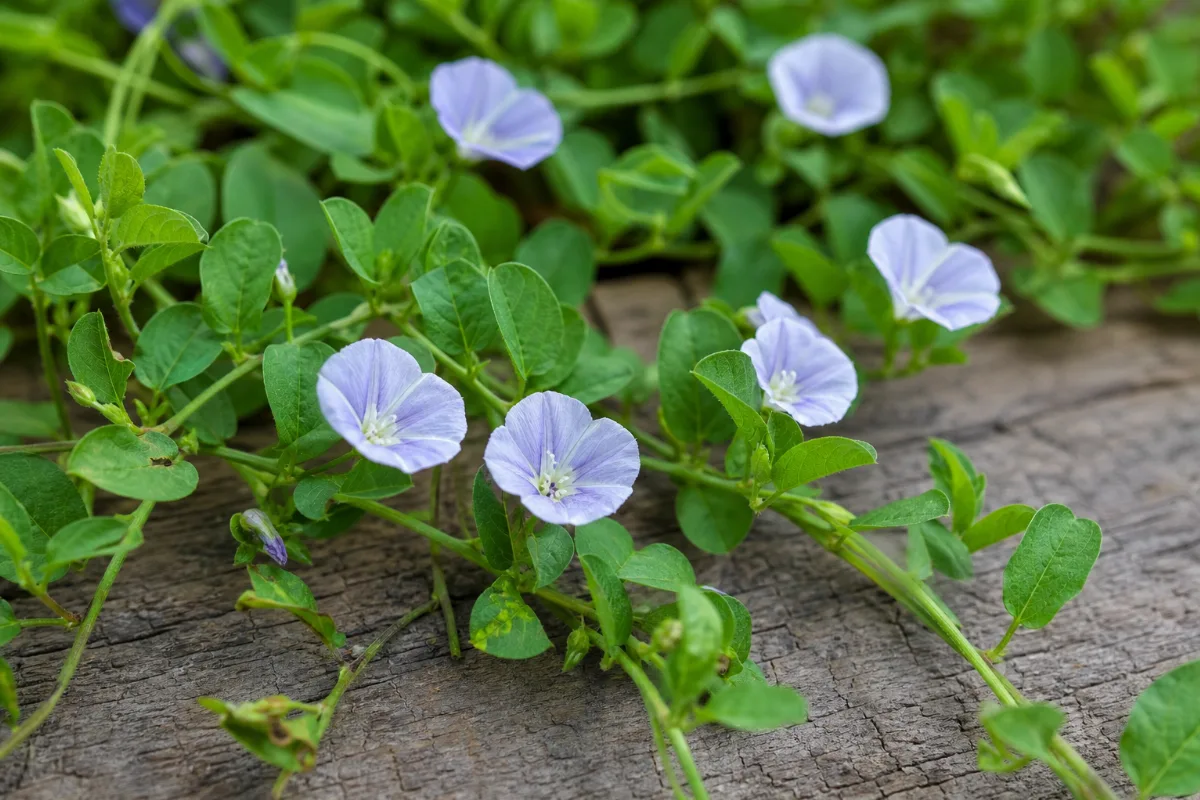
Herbs & Botanicals · Ayurvedic brain tonic herb
Shankhpushpi
Convolvulus prostratus (C. pluricaulis) · also called Shankhapushpi, Shankhahuli
Shankhpushpi is an Ayurvedic herb used as a brain tonic for memory, calm and sleep. The name is shared by several different plants, so a product may not contain the one that was studied. The evidence in people is almost nothing: one tiny pilot trial, with no placebo group. Check with a doctor or pharmacist first if you take sedatives, diabetes medicine or other prescriptions.
General information, not medical advice. Last substantive update · Not medically reviewed. A named clinician has not signed off on this page. How this page is made
About Shankhpushpi
Shankhpushpi is an Ayurvedic brain-tonic herb. The name is shared by several plants. Human research is one tiny pilot trial. Cautions: the product may be the wrong plant, a possible sedative effect, and no safety data in pregnancy.
What it is
Shankhpushpi is a role name in Ayurveda, a 'brain tonic'. It is not one species. The plant most often meant is Convolvulus prostratus, also called Convolvulus pluricaulis, a small creeping herb in the morning-glory family. Other plants sold under the same name are Evolvulus alsinoides (same family), Clitoria ternatea (butterfly pea, a bean-family climber with blue flowers) and Canscora decussata (gentian family). Old Ayurvedic texts left the identity unclear, which is why this happened. Reported compounds include the alkaloid convolamine, scopoletin and kaempferol.
What the research shows
Almost everything is from labs and animals. Reviews list memory, calming, mood, nerve-protecting and anticonvulsant effects, and one mouse study found sedative-type effects. No trial in people for memory, anxiety or sleep was found. The only human trial found is a 2026 pilot of 30 women with menopause-type symptoms after hysterectomy. Symptom and anxiety scores improved with shankhpushpi powder, but also with shatavari powder, and there was no placebo. Blood estrogen did not change significantly with shankhpushpi. Cell work on blood sugar is not yet tested in animals or people. A rat comparison found a different shankhpushpi plant (Evolvulus alsinoides) did better than Convolvulus on memory tasks.
Quality and plant mix-ups
Because four unrelated plants share the name, a product labelled only 'shankhpushpi' may not contain the plant that was studied. They differ in chemistry and in lab effects. A DNA test can detect a 10% mix of Evolvulus in Convolvulus powder, which shows that blending is possible. No testing for metals, pesticides or fillers in shankhpushpi products was found. Choose products that list the Latin name and plant part.
At a glance
Traditional uses history, not proof
- Ayurveda: a brain tonic (medhya rasayana) for memory and intellect
- Calm, mental tension and sleeplessness
- Also listed for cough and epilepsy in older texts
Studied for research
- Memory and thinking (lab and animals), insufficient
- Anxiety and calm (mice and one pilot), insufficient
- Low mood and stress (rats), insufficient
- Nerve protection and Alzheimer's-type disease (cells and animals), insufficient
- Sleep (no trial), insufficient
- Menopause-type symptoms after hysterectomy (one pilot), very low
- Blood sugar (cells only), insufficient
- Antioxidant activity (test tube), insufficient
Main compounds
- Alkaloids such as convolamine
- Coumarins such as scopoletin
- Flavonoids such as kaempferol
Common forms
- Whole-plant powder (used in the one human trial)
- Water or alcohol extracts (animal studies)
- Syrups and tablets (content varies)
- Multi-herb Ayurvedic blends (results cannot be assigned to one herb)
Research links: Menopause symptoms after hysterectomy, pilot trial (2026) · Mouse study: sedative-type and anti-anxiety effects (2023) · Review: Shankhpushpi and brain disorders (2022) · Four plants sold as shankhpushpi, rat comparison (2019) · DNA test to tell two shankhpushpi plants apart (2016) · GBIF: Convolvulus prostratus · Research Library · Genes & Biomarkers Library
The plant and its history
- Accepted scientific name
- Convolvulus prostratus Forssk. (the plant most often meant)
- Naming authority
- ACCEPTED in the GBIF backbone (key 8339877, Convolvulaceae), checked 2026-10-25. Convolvulus pluricaulis Wall. ex Choisy (key 3679942) is a SYNONYM of it, which is why papers use both names. Some papers also use C. microphyllus; not checked in GBIF.
- Synonyms
- Name: Convolvulus pluricaulis Choisy; Note: GBIF synonym of C. prostratus; the name used in most Ayurvedic papers.
- Common names
- Shankhpushpi (Sanskrit / Hindi); Shankhapushpi (alternate spelling); Shankhahuli (Indian name)
- Botanical family
- Convolvulaceae (morning-glory family).
- Classification
- Plantae > Convolvulaceae (morning-glory family) > Convolvulus > Convolvulus prostratus
- Native range
- Not verified at source.
- Habitat
- Not verified.
- What the plant looks like
- Stems: A creeping, hairy herb; the 2014 review says it looks like a morning glory with hairy stems and leaves.; Note: Other plant details were not verified.
- Cultivation
- Not covered.
- Harvest and processing
- Not verified.
- Look-alikes and adulterants
- Name: Evolvulus alsinoides (L.) L.; Note: Same family (Convolvulaceae), accepted in GBIF (key 2928673). Often sold as shankhpushpi. DNA primers separate it from Convolvulus.; Name: Clitoria ternatea L. (butterfly pea); Note: A bean-family (Fabaceae) climber with blue flowers, accepted in GBIF (key 2946519). Used as shankhpushpi in some regions and also as a tea and food colouring.; Name: Canscora decussata Schult.; Note: A gentian-family plant also used under the name. Not checked in GBIF.
- Sustainability and conservation
- Not covered.
Traditional use and history history, not clinical proof
| Tradition or era | Documented use | Source |
|---|---|---|
| Ayurveda | A medhya rasayana (brain tonic) for memory, intellect, calm and sleeplessness; the 2014 review adds cough, epilepsy and hallucinations as traditional uses. | p25182446 |
| Ayurvedic texts (Charaka and Sushruta Samhita) | The 2010 paper says the old texts left the identity of the drug unclear, which is why several plants are used as shankhpushpi. Date and wording of the texts were not checked. | p22247878 |
Traditional use shows how a plant was used. It does not show that a supplement works or is safe today.
What is inside, and how it may work
What the plant contains and how those compounds act in cells and animals. Laboratory and animal mechanisms are not proven effects in people.
Main compounds
| Compound | Family | Where it is concentrated | Activity studied | Level of evidence |
|---|---|---|---|---|
| Convolamine PubChem 420422 | Alkaloid | not stated | Named in a review as an active alkaloid of C. prostratus; lab-level evidence only. 2 | Lab |
| Scopoletin PubChem 5280460 | Coumarin | not stated | The only one of five markers found in the Convolvulus plant in a thin-layer test; antioxidant in the lab. 15 2 | Lab |
| Kaempferol PubChem 5280863 | Flavonoid | not stated | Named in a review as a flavonoid of C. prostratus; lab-level evidence only. 2 | Lab |
Mechanisms, receptors and pathways
| Target or pathway | Gene or receptor | What was found | Level |
|---|---|---|---|
| Serotonin-related pathways | Computer network modelling suggests plant compounds interact with serotonin-related synapses. A rat stress study found restored serotonin and noradrenaline. 18 4 | Computer model | |
| Fat-cell maturation and glucose uptake | PPARG, GLUT-4 (SLC2A4) | The whole-plant extract raised PPAR-gamma and GLUT-4 in mouse fat cells. 6 | Lab |
| Acetylcholine breakdown | Acetylcholinesterase | Extracts of the four shankhpushpi plants blocked the enzyme in a test tube, strongest in Evolvulus alsinoides. 16 7 | Lab |
| Inflammation messengers | IL-1 beta, IL-6, TNF-alpha | Lowered in stressed rats given the extract. 4 | Animal research |
Absorption, metabolism and elimination
- Absorption
- Not found.
- Distribution
- Not found.
- Metabolism
- Not found.
- Elimination
- Not found.
- Bioavailability
- Not found for any compound or plant. No human pharmacokinetic study was found.
Isolated compounds versus whole extracts
The one human trial used whole-plant powder. Animal studies used leaf, aerial-part or whole-plant extracts made with methanol, ethanol-water or other solvents, so results for one extract do not apply to powder or to products. Studies on Clitoria ternatea and Evolvulus alsinoides are different plants.
Nutritional composition
Not covered: no nutrient data were read.
1 very low certainty7 not enough evidence
What is Shankhpushpi good for?
The main studied and promoted uses and how strong the human evidence is. Almost all of it is from labs and animals. There is one tiny human pilot. Where a result is from a different plant sold under the same name, it is said so.
Benefits, one by one
Each card is a research question, not a promise. Tap a goal to filter. Open a card to see the studies, doses and limits.
Memory and thinking
Not enough evidenceReviews report better memory in lab and animal studies. No trial in people was found. In rats, a related plant sold as shankhpushpi (Evolvulus alsinoides) worked better than Convolvulus.
3 studiesWhole plant extracts in lab work; not covered here.
Studies, doses and limits
What the trials found
No human memory trial was found. A 2019 study compared four plants sold as shankhpushpi in rats given a memory-impairing drug and in brain cells; Evolvulus alsinoides came out best and Convolvulus pluricaulis was weaker. Two reviews (2022, 2020) list memory and nootropic effects from lab and animal work and say clinical investigation is still to be done.
Results
No human results. Rat and cell results only.
Effect sizes as reported
None in people.
Why this rating
Only lab and animal work; the best-performing plant in the rat comparison is a different plant from the one most often named.
Form and dose studied
Whole plant extracts in lab work; not covered here.
Who was studied
Rats and cell lines.
Limits
Rat results often do not carry over to people. The plant used in a study may not match the plant in a product.
Why researchers looked
Shankhpushpi is the best-known Ayurvedic memory herb, so memory is the first thing people ask about.
Traditional use
In Ayurveda, shankhpushpi is a 'medhya rasayana', a brain tonic used for memory, calm and sleep. Old texts left the plant's identity unclear, so at least four plants are sold under the name.
Proposed mechanism Animal research
Compounds in the plant blocked the enzyme that breaks down acetylcholine and protected nerve cells in dishes. Network modelling points to serotonin-related pathways. Both are lab and computer findings.
A proposed mechanism does not show that the effect happens in people.
The abstracts report no safety numbers.
Anxiety and calm
Not enough evidenceA mouse study found sedative-type and anti-anxiety behaviour with a leaf extract. In one small human pilot, anxiety scores improved, but there was no placebo group.
3 studiesLeaf extract (mice); whole-plant powder (pilot).
Studies, doses and limits
What the trials found
A 2023 mouse study (Khan) gave a hydroalcoholic leaf extract at three doses and saw CNS depressant and anti-anxiety effects in behaviour tests. In the 2026 pilot of 30 women (Budihal) after hysterectomy, anxiety scores (Hamilton scale) improved with shankhpushpi powder, but so did they with the comparison herb, and no placebo was used.
Results
Anxiety behaviour improved in mice. Hamilton anxiety score improved in both pilot groups (P < 0.001).
Effect sizes as reported
No numbers in the abstracts for the mouse study; pilot gives P values only.
Why this rating
Animal data plus one tiny pilot with no placebo and an active comparison herb.
Form and dose studied
Leaf extract (mice); whole-plant powder (pilot).
Who was studied
Mice; 30 women after hysterectomy.
Limits
Pilot is not about anxiety disorders. Placebo effect cannot be excluded.
Why researchers looked
The traditional uses include 'mental tension'. Anxiety is the use most often promoted.
Traditional use
In Ayurveda, shankhpushpi is a 'medhya rasayana', a brain tonic used for memory, calm and sleep. Old texts left the plant's identity unclear, so at least four plants are sold under the name.
Proposed mechanism Animal research
The animal findings suggest a calming (CNS depressant) action. How it works is not shown.
A proposed mechanism does not show that the effect happens in people.
A calming action could add to sedatives. See the safety tab. Do not use instead of care for anxiety.
Low mood and stress
Not enough evidenceA rat study found antidepressant-like effects at the higher test doses. Reviews also list antistress effects in animals. No human trial was found.
3 studiesAerial-part methanol extract (rats).
Studies, doses and limits
What the trials found
A 2019 rat study (Gupta) tested a methanol extract of aerial parts against fluoxetine. At the two higher doses, behaviour, inflammation messengers and monoamines improved; the lowest dose did not. Review papers (2022, 2014) list antidepressant and anti-stress effects from the same kind of work.
Results
Improved behaviour tests and brain chemistry in stressed rats.
Effect sizes as reported
No numbers in the abstract.
Why this rating
Rat data only; no human mood trial found.
Form and dose studied
Aerial-part methanol extract (rats).
Who was studied
Rats.
Limits
Rat depression models do not diagnose or treat human depression.
Why researchers looked
Traditional texts link the herb to a settled mind, and stress models are common in animal work.
Traditional use
In Ayurveda, shankhpushpi is a 'medhya rasayana', a brain tonic used for memory, calm and sleep. Old texts left the plant's identity unclear, so at least four plants are sold under the name.
Proposed mechanism Animal research
In stressed rats the extract lowered inflammation messengers and raised brain serotonin and noradrenaline, like the antidepressant fluoxetine did in the same study.
A proposed mechanism does not show that the effect happens in people.
People on antidepressants should ask a pharmacist before combining. See the safety tab.
Nerve protection and Alzheimer's-type disease
Not enough evidenceCell and animal studies show nerve-protecting effects, and some are for other plants sold as shankhpushpi. No human trial in dementia was found.
5 studiesExtracts and a prepared Ayurvedic medicine (Clitoria); not covered he…
Studies, doses and limits
What the trials found
The 2022 and 2020 reviews describe nerve protection and Alzheimer's-model effects in cells and animals. A 2019 comparison found Evolvulus alsinoides protected cells better than Convolvulus pluricaulis and Clitoria ternatea. Two Clitoria ternatea studies (2025 cells, 2017 rats) used a different plant and should not be credited to Convolvulus.
Results
Cell and animal results only.
Effect sizes as reported
None in people.
Why this rating
No human trial; some of the work is on different plants.
Form and dose studied
Extracts and a prepared Ayurvedic medicine (Clitoria); not covered here.
Who was studied
Cell lines and rats.
Limits
Findings in cancer cell lines and rats do not show benefit in dementia patients.
Why researchers looked
Alzheimer's disease is a major reason the herb is studied now.
Traditional use
In Ayurveda, shankhpushpi is a 'medhya rasayana', a brain tonic used for memory, calm and sleep. Old texts left the plant's identity unclear, so at least four plants are sold under the name.
Proposed mechanism Lab
Cell studies show protection from beta-amyloid injury and enzyme blocking. A study of Clitoria ternatea (a different plant) showed DNA-repair and lower oxidative stress in cancer cell lines, and less brain-cell loss in rats given a brain injury.
A proposed mechanism does not show that the effect happens in people.
The abstracts report no safety numbers.
Sleep
Not enough evidenceSleeplessness is a traditional use, but no sleep trial of this plant was found.
2 studiesNot covered here.
Studies, doses and limits
What the trials found
A 2014 review lists sleeplessness among the traditional uses and CNS depression among lab and animal effects. No sleep study in people was found.
Results
No human sleep results.
Effect sizes as reported
None.
Why this rating
Traditional claim only.
Form and dose studied
Not covered here.
Who was studied
None studied.
Limits
No test for sleep quality in this plant.
Why researchers looked
A calming tonic is naturally linked with sleep.
Traditional use
In Ayurveda, shankhpushpi is a 'medhya rasayana', a brain tonic used for memory, calm and sleep. Old texts left the plant's identity unclear, so at least four plants are sold under the name.
Proposed mechanism Animal research
A sedative-type effect in mice might explain a link, but this is an inference.
A proposed mechanism does not show that the effect happens in people.
A possible sedative-type effect means extra drowsiness with sleep aids or alcohol is an open question.
Menopause-type symptoms after hysterectomy
Very low certaintyOne small 2026 pilot of 30 women found symptom scores improved with shankhpushpi powder, but the comparison herb improved them just as much and there was no placebo.
1 studiesWhole-plant powder; amount not covered here.
Studies, doses and limits
What the trials found
A 2026 randomised pilot (Budihal) in Karnataka, India, in 30 women. One group took shankhpushpi powder and the other shatavari powder for 45 days. Menopause Rating Scale, Kupperman Index, quality of life and anxiety scores all improved in both groups (P < 0.001). Blood estrogen did not change significantly with shankhpushpi (P = 0.334) but did with shatavari (P < 0.001).
Results
Both groups improved on every symptom scale; estrogen not significantly changed with shankhpushpi.
Effect sizes as reported
P values only; no effect sizes in the abstract.
Why this rating
One 30-person pilot with no placebo group and an active comparison herb. Symptoms often improve on their own or with attention.
Form and dose studied
Whole-plant powder; amount not covered here.
Who was studied
Women after hysterectomy before natural menopause.
Limits
Very small, single centre, not blinded as far as the abstract shows. Side effects are not described.
Why researchers looked
Women who have a hysterectomy before natural menopause can have hot flushes, low mood and poor sleep, and look for non-hormone options.
Traditional use
In Ayurveda, shankhpushpi is a 'medhya rasayana', a brain tonic used for memory, calm and sleep. Old texts left the plant's identity unclear, so at least four plants are sold under the name.
Proposed mechanism Preliminary mechanism
The authors call the plant a phytoestrogen herb, but blood estrogen did not change significantly with shankhpushpi in the trial, so that explanation is not supported by the data.
A proposed mechanism does not show that the effect happens in people.
Women with hormone-sensitive conditions should ask a doctor before trying it. The abstract reports no safety data.
Blood sugar and blood fats
Not enough evidenceCell tests show effects on fat cells and sugar-handling enzymes, but no animal or human blood sugar result for Convolvulus was found in this review of sources.
4 studiesExtract fractions in dishes; not covered here.
Studies, doses and limits
What the trials found
A 2023 study (Melloni) used mouse fat cells in a dish. Two reviews (2014, 2020) list antidiabetic activity from lab and animal work. A 2020 test-tube study used Evolvulus alsinoides, a different plant. No human trial was found.
Results
No human results.
Effect sizes as reported
None.
Why this rating
Cell and test-tube work only.
Form and dose studied
Extract fractions in dishes; not covered here.
Who was studied
Cell lines and test tubes.
Limits
Cell findings often do not carry over to people.
Why researchers looked
Reviews list antidiabetic effects among the lab findings, so people ask about blood sugar.
Traditional use
In Ayurveda, shankhpushpi is a 'medhya rasayana', a brain tonic used for memory, calm and sleep. Old texts left the plant's identity unclear, so at least four plants are sold under the name.
Proposed mechanism Lab
In mouse fat cells the whole-plant extract raised PPAR-gamma and the glucose transporter GLUT-4. A different plant (Evolvulus alsinoides) blocked starch and sugar enzymes in a test tube.
A proposed mechanism does not show that the effect happens in people.
Could add to the effect of diabetes medicine (theory only). Ask a doctor if on these.
Antioxidant activity
Not enough evidenceLab tests find antioxidant activity, but this is a test-tube result. The Convolvulus plant showed fewer marker compounds than the other plants sold as shankhpushpi.
2 studiesExtracts; not covered here.
Studies, doses and limits
What the trials found
A 2013 lab method compared four plants on a thin-layer plate. Convolvulus pluricaulis showed only scopoletin out of five markers; Evolvulus alsinoides, Clitoria ternatea and Canscora decussata showed more. A 2020 test-tube study also found antioxidant activity in Evolvulus alsinoides leaf extracts.
Results
Test-tube results only.
Effect sizes as reported
None.
Why this rating
No human outcome.
Form and dose studied
Extracts; not covered here.
Who was studied
Test tubes.
Limits
A test-tube antioxidant effect is not a health benefit in people.
Why researchers looked
Antioxidants are often linked with ageing of the brain, so labs test them.
Traditional use
In Ayurveda, shankhpushpi is a 'medhya rasayana', a brain tonic used for memory, calm and sleep. Old texts left the plant's identity unclear, so at least four plants are sold under the name.
Proposed mechanism Lab
Plants with scopoletin, chlorogenic acid and others scored well in a test-tube antioxidant assay.
A proposed mechanism does not show that the effect happens in people.
Not assessed.
Connections to the rest of health
How Shankhpushpi connects to the rest of our health knowledge graph. Every link says what kind of connection it is. A safety link (for example to the liver) is a warning, not a benefit. A study that merely mentions a topic never creates a benefit link.
Explore every connection: goals, body systems, organs, symptoms, genes
A. Wellness goals
| Connected to | Kind of connection | Evidence status | Context | Studies |
|---|---|---|---|---|
| Memory Support | Preliminary mechanism | Not enough evidence | Memory and thinking: Reviews report better memory in lab and animal studies. No trial in people was found. In rats, a related plant sold as shankhpushpi (Evolvulus alsinoides) worked better than Convolvulus. Nerve protection and Alzheimer's-type disease: Cell and animal studies show nerve-protecting effects, and some are for other plants sold as shankhpushpi. No human trial in dementia was found. | 18 16 2 8 9 |
| Brain Health | Preliminary mechanism | Not enough evidence | Memory and thinking: Reviews report better memory in lab and animal studies. No trial in people was found. In rats, a related plant sold as shankhpushpi (Evolvulus alsinoides) worked better than Convolvulus. Nerve protection and Alzheimer's-type disease: Cell and animal studies show nerve-protecting effects, and some are for other plants sold as shankhpushpi. No human trial in dementia was found. | 18 16 2 8 9 |
| Anxiety Support | Preliminary mechanism | Not enough evidence | Anxiety and calm: A mouse study found sedative-type and anti-anxiety behaviour with a leaf extract. In one small human pilot, anxiety scores improved, but there was no placebo group. | 5 3 18 |
| Calm Relaxation | Preliminary mechanism | Not enough evidence | Anxiety and calm: A mouse study found sedative-type and anti-anxiety behaviour with a leaf extract. In one small human pilot, anxiety scores improved, but there was no placebo group. | 5 3 18 |
| Stress Reduction | Preliminary mechanism | Not enough evidence | Low mood and stress: A rat study found antidepressant-like effects at the higher test doses. Reviews also list antistress effects in animals. No human trial was found. | 4 18 1 |
| Mood Balance | Preliminary mechanism | Not enough evidence | Low mood and stress: A rat study found antidepressant-like effects at the higher test doses. Reviews also list antistress effects in animals. No human trial was found. | 4 18 1 |
| Better Sleep | Traditional use | Not enough evidence | Sleep: Sleeplessness is a traditional use, but no sleep trial of this plant was found. | 1 5 |
| Menopause Support | Potential benefit | Very low certainty | Menopause-type symptoms after hysterectomy: One small 2026 pilot of 30 women found symptom scores improved with shankhpushpi powder, but the comparison herb improved them just as much and there was no placebo. | 3 |
| Womens Wellness | Potential benefit | Very low certainty | Menopause-type symptoms after hysterectomy: One small 2026 pilot of 30 women found symptom scores improved with shankhpushpi powder, but the comparison herb improved them just as much and there was no placebo. | 3 |
| Blood Sugar Balance | Preliminary mechanism | Not enough evidence | Blood sugar and blood fats: Cell tests show effects on fat cells and sugar-handling enzymes, but no animal or human blood sugar result for Convolvulus was found in this review of sources. | 6 1 2 7 |
| Metabolic Health | Preliminary mechanism | Not enough evidence | Blood sugar and blood fats: Cell tests show effects on fat cells and sugar-handling enzymes, but no animal or human blood sugar result for Convolvulus was found in this review of sources. | 6 1 2 7 |
| Cellular Protection | Preliminary mechanism | Not enough evidence | Antioxidant activity: Lab tests find antioxidant activity, but this is a test-tube result. The Convolvulus plant showed fewer marker compounds than the other plants sold as shankhpushpi. | 15 7 |
B. Body systems
| Connected to | Kind of connection | Evidence status | Context | Studies |
|---|---|---|---|---|
| Nervous system | Potential benefit | Not enough evidence | Memory and calming effects in animals only. Preparation or compound: C. pluricaulis extracts |
18 |
| Brain Focus | Biological association | Not enough evidence | Studied for: Memory and thinking | 18 16 2 |
| Stress Mood | Biological association | Not enough evidence | Studied for: Anxiety and calm Studied for: Low mood and stress | 5 3 18 4 1 |
| Nervous System | Biological association | Not enough evidence | Studied for: Anxiety and calm Studied for: Nerve protection and Alzheimer's-type disease | 5 3 18 16 2 8 9 |
| Sleep Recovery | Biological association | Not enough evidence | Studied for: Sleep | 1 5 |
| Hormone Health | Biological association | Very low certainty | Studied for: Menopause-type symptoms after hysterectomy | 3 |
| Blood Sugar Support | Biological association | Not enough evidence | Studied for: Blood sugar and blood fats | 6 1 2 7 |
| Metabolism Weight | Biological association | Not enough evidence | Studied for: Blood sugar and blood fats | 6 1 2 7 |
| Whole Body Balance | Biological association | Not enough evidence | Studied for: Antioxidant activity | 15 7 |
I. Biomarkers
| Connected to | Kind of connection | Evidence status | Context | Studies |
|---|---|---|---|---|
| Anxiety rating (Hamilton scale) | Biological association | Very low certainty | Measured in trials: lowered. A lab change is not the same as a health benefit. | 3 |
| Menopause symptom scores (MRS and Kupperman) | Biological association | Very low certainty | Measured in trials: lowered. A lab change is not the same as a health benefit. | 3 |
| Blood estrogen | Biological association | Very low certainty | Measured in trials: raised. A lab change is not the same as a health benefit. | 3 |
J. Genes, receptors and enzymes
K. Biological pathways
| Connected to | Kind of connection | Evidence status | Context | Studies |
|---|---|---|---|---|
| Serotonergic synapse | Preliminary mechanism | Computer model | Suggested by network modelling of plant compounds. | 18 |
L. Active compounds
| Connected to | Kind of connection | Evidence status | Context | Studies |
|---|---|---|---|---|
| Convolamine | Biological association | Lab | Named in a review as an active alkaloid of C. prostratus; lab-level evidence only. Preparation or compound: not stated |
2 |
| Scopoletin | Biological association | Lab | The only one of five markers found in the Convolvulus plant in a thin-layer test; antioxidant in the lab. Preparation or compound: not stated |
15 2 |
| Kaempferol | Biological association | Lab | Named in a review as a flavonoid of C. prostratus; lab-level evidence only. Preparation or compound: not stated |
2 |
Each connection is stored with the ingredient, the connected record, the kind of connection, the evidence status, the supporting studies, the preparation or compound involved, and a review date (last reviewed October 25, 2026).
Evidence at a glance: what changed in 3 lab markers
Tap a number to show only those markers. Counts are markers, not people.
The evidence
The research centre for Shankhpushpi. Every record here was checked against PubMed or the publisher's page; we never list a study we have not verified.
Evidence by outcome
Bars show how many studies we found for each outcome, not how well it works. People are added up across trials only (reviews are not added, to avoid double counting).
How we rate evidence
High certainty
Several well-run trials or reviews agree; further research is unlikely to change the picture much.
Moderate certainty
Good trials point the same way, but some doubt remains.
Low certainty
Small, short or inconsistent trials. The finding could change with better research.
Very low certainty
Very little or very weak human data. Treat as a possibility only.
Mixed findings
Trials or reviews disagree with each other.
Not enough evidence
Not enough human research to say either way.
Evidence against
Good research found no benefit, or found harm.
We take the reviewers' own risk-of-bias and GRADE statements where they exist, and otherwise judge from study size, design, consistency, directness and whether a product matches what is sold. Many publications do not make evidence high. Method note: We searched PubMed and read each abstract directly, and checked plant names through GBIF and compound IDs through PubChem. NCCIH had no page; the LiverTox and LactMed search returned nothing; EMA, WHO and FDA records were not opened. Full texts were not read.
Study library: every study we checked 18
| Study | Design | People | Product, dose, length | Result |
|---|---|---|---|---|
| Agarwa 2014 An update on Ayurvedic herb Convolvulus pluricaulis Choisy Asian Pac J Trop Biomed · PMID 25182446 · DOI |
Narrative review review |
Review of literature 1985 to 2012 on C. pluricaulis | Convolvulus pluricaulis whole herb and compounds all parts (per review) not covered here not applicable · vs not applicable |
Lists traditional use for cough, sleeplessness, epilepsy, hallucinations and anxiety, and lab and animal effects including CNS depression, antidiabetic and cardiovascular activity. None (narrative review) Methods, limits and fundingOutcomes: Traditional uses, chemistry, pharmacology and toxicology Limitations: Abstract only. Claims of validation rest on lab and animal work; it describes no human trial. Funding and conflicts: Not stated in the abstract. Read: abstract |
| Balkrishna 2020 Phytochemical Profile, Pharmacological Attributes and Medicinal Properties of Convolvulus prostratus - A Cognitive Enhancer Herb for the Management of Neurodegenerative Etiologies Front Pharmacol · PMID 32194410 · DOI |
Narrative review review |
Review of Convolvulus prostratus (synonym C. pluricaulis) | Convolvulus prostratus extracts and compounds not stated in the abstract not covered here not applicable · vs not applicable |
Lists many pre-clinical effects and compounds (convolamine, kaempferol, scopoletin). States that detailed clinical investigations are yet to be done. None (narrative review) Methods, limits and fundingOutcomes: Chemistry and pre-clinical effects (brain protection, memory, anxiety, antioxidant, antidiabetic, heart) Limitations: Abstract only. Written by authors at an Indian herbal-products company's research institute (Patanjali Research Institute); treat as industry-linked. Funding and conflicts: Authors are at Patanjali Research Institute (Indian herbal-products maker). Industry-linked. Read: abstract |
| Budihal 2026 Efficacy of Shankhapushpi (Convolvulus pluricaulis) in Posthysterectomy Menopausal Syndrome - A Randomized Controlled Pilot Clinical Trial J Midlife Health · PMID 42124828 · DOI |
Controlled trial |
30 30 women with menopause-type symptoms after hysterectomy, one Ayurveda college in Karnataka, India |
C. pluricaulis whole-plant powder not stated in the abstract (powder) not covered here 45 days · vs Shatavari (Asparagus racemosus) powder |
Both groups improved on all four symptom scales (P < 0.001), so the two herbs were comparable. Blood estrogen did not change significantly with shankhpushpi (P = 0.334) but did with the comparison herb (P < 0.001). Both groups improved; no placebo group so the herb's own effect is unknown Methods, limits and fundingOutcomes: Menopause Rating Scale, Modified Kupperman Index, Menopause-Specific Quality of Life, Hamilton Anxiety Rating Scale, blood estrogen Limitations: Tiny pilot, 15 women per group. No placebo. The comparison herb (shatavari) also improved symptoms. Side effects are not described in the abstract. Funding and conflicts: No conflicts declared by the authors. Read: abstract |
| Gupta 2019 Protective effect of Convolvulus pluricaulis against neuroinflammation associated depressive behavior induced by chronic unpredictable mild stress in rat Biomed Pharmacother · PMID 30551424 · DOI |
Animal research animal |
Rats exposed to chronic mild stress | Methanolic extract of C. pluricaulis aerial parts aerial parts not covered here not applicable · vs not applicable |
At the two higher test doses the extract acted like fluoxetine in stressed rats: more sucrose preference, less immobility, lower inflammation messengers, and ALT and AST back toward normal. The lowest dose did nothing significant. Group differences in rats; no numbers in the abstract Methods, limits and fundingOutcomes: Sucrose preference, forced swim test, movement, inflammation messengers, liver enzymes (ALT, AST), brain serotonin and noradrenaline Limitations: Rats only. The ALT and AST finding is in stressed rats and is not a human liver-safety result. Funding and conflicts: Not stated in the abstract. Read: abstract |
| Khan 2023 Evaluation of CNS Depressant and Anti-anxiety Activities of Leaves of Convolvulus pluricaulis Cent Nerv Syst Agents Med Chem · PMID 36825716 · DOI |
Animal research animal |
18 Albino mice (acute toxicity set 18 male mice; behaviour tests in mice) |
Hydroalcoholic extract of C. pluricaulis leaves leaf not covered here not applicable · vs not applicable |
The extract fell into category 4 in the acute toxicity test. At three test doses it showed CNS depressant (sedative-type) and anti-anxiety effects in mice. Behaviour changes in mice; no numbers in the abstract Methods, limits and fundingOutcomes: Acute toxicity (OECD 423), movement, balance, grip, elevated plus maze, hole board and other behaviour tests Limitations: Mice only. Leaf extract made with a lab method; not the same as shop powder. The abstract gives no LD50 number. Funding and conflicts: Not stated in the abstract. Read: abstract |
| Melloni 2023 Convolvulus pluricaulis Choisy's Extraction, Chemical Characterization and Evaluation of the Potential Effects on Glycaemic Balance in a 3T3-L1 Adipocyte Cell Model Nutrients · PMID 37049568 · DOI |
Lab lab |
Mouse fat cells (3T3-L1) in a dish | Medium-polarity extract and fractions of the C. pluricaulis whole plant whole plant not covered here not applicable · vs not applicable |
The extract raised PPAR-gamma and the glucose transporter GLUT-4 and lowered several inflammatory messengers in fat cells. The authors say it could be a possible anti-diabetic aid. None Methods, limits and fundingOutcomes: Fat-cell maturation, PPAR-gamma, GLUT-4 and inflammatory messengers Limitations: Cells only. No animal or human blood sugar result. Funding and conflicts: Not stated in the abstract. Read: abstract |
| Mettupalayam Kaliyannan Sundaramoorthy 2020 In vitro enzyme inhibitory and cytotoxic studies with Evolvulus alsinoides (Linn.) Linn. Leaf extract: a plant from Ayurveda recognized as Dasapushpam for the management of Alzheimer's disease and diabetes mellitus BMC Complement Med Ther · PMID 32345272 · DOI |
Lab lab |
Test-tube enzyme assays and a nerve cell line (SH-SY5Y) | Evolvulus alsinoides leaf extracts (hexane to water) leaf not covered here not applicable · vs not applicable |
Water and methanol extracts blocked all three enzymes in a test tube and were antioxidant. The extract also affected nerve-cell survival in a cytotoxicity test. IC50 values in the micrograms-per-millilitre range (test tube) Methods, limits and fundingOutcomes: Antioxidant strength and inhibition of alpha-amylase, alpha-glucosidase and acetylcholinesterase Limitations: Test tube only. This is Evolvulus alsinoides, not Convolvulus. Funding and conflicts: Not stated in the abstract. Read: abstract |
| Prasad 2025 Promotion of cellular differentiation and DNA repair potential in brain cancer cells by Clitoria ternatea L. with rasayana properties in vitro J Ayurveda Integr Med · PMID 39798267 · DOI |
Lab lab |
Human neuroblastoma (IMR-32) and rat glioblastoma (C6) cell lines | Clitoria ternatea (called Shankhpushpi by the authors) not stated in the abstract not covered here not applicable · vs not applicable |
In cancer cell lines the extract improved DNA repair markers and mitochondrial membrane potential and lowered reactive oxygen species. None Methods, limits and fundingOutcomes: DNA repair, mitochondria, autophagy and cell-maturation markers Limitations: Cells in a dish; cancer cell lines; Clitoria ternatea, not Convolvulus. Funding and conflicts: Not stated in the abstract. Read: abstract |
| Raghu 2017 Age dependent neuroprotective effects of medhya rasayana prepared from Clitoria ternatea Linn. in stress induced rat brain J Ethnopharmacol · PMID 27469198 · DOI |
Animal research animal |
Male Wistar rats aged 1, 12 and 18 months given a brain injury | Medhya rasayana prepared from Clitoria ternatea not stated in the abstract (prepared medicine) not covered here not applicable · vs not applicable |
In the 12- and 18-month-old rats, autophagy fell, a hippocampal area kept more cells and memory scores improved. Group differences in rats; no numbers in the abstract Methods, limits and fundingOutcomes: Brain cell counts, autophagy, memory tests Limitations: Rats only; a prepared Ayurvedic medicine from Clitoria ternatea, a different plant. Funding and conflicts: Not stated in the abstract. Read: abstract |
| Record or database 2026 NCCIH (NIH) page for shankhpushpi: not found · Source |
Regulator record not applicable |
Methods, limits and fundingLimitations: The page address returned 404 on 2026-10-25. This does not prove NCCIH has no statement under another name. Read: not-found | ||
| Record or database 2026 LiverTox and LactMed (NIH Bookshelf): search for shankhpushpi and Convolvulus · Source |
Database search not applicable |
Methods, limits and fundingLimitations: A Bookshelf search for the plant names plus LiverTox or LactMed returned 0 records on 2026-10-25. The LiverTox website itself could not be opened (bot check). Absence is not confirmed. Read: not-found | ||
| Record or database 2026 EMA / HMPC herbal monograph for Convolvulus or shankhpushpi: not checked · Source |
Regulator record not applicable |
Methods, limits and fundingLimitations: Not looked up in this round; NOT verified. Absence of a monograph is not claimed. Read: not-checked | ||
| Record or database 2026 GBIF Backbone Taxonomy species match (Convolvulus prostratus, C. pluricaulis, Evolvulus alsinoides, Clitoria ternatea) · Source |
Database not applicable |
Methods, limits and fundingLimitations: Checked 2026-10-25 by API. Accepted: Convolvulus prostratus Forssk. (key 8339877, Convolvulaceae); Evolvulus alsinoides (L.) L. (2928673, Convolvulaceae); Clitoria ternatea L. (2946519, Fabaceae). Convolvulus pluricaulis Wall. ex Choisy (3679942) is a SYNONYM of C. prostratus. Canscora decussata and C. microphyllus were not checked. Read: full-text | ||
| Sethiya 2010 Comparative pharmacognostical investigation on four ethanobotanicals traditionally used as Shankhpushpi in India J Adv Pharm Technol Res · PMID 22247878 · DOI |
Lab lab |
Four plants called shankhpushpi | Evolvulus alsinoides, Convolvulus pluricaulis, Canscora decussata, Clitoria ternatea root, stem and leaf not covered here not applicable · vs not applicable |
Says old Ayurvedic texts left the identity of the drug unclear, so four plants are used under the name, and gives structure and chemical fingerprints to tell them apart. None Methods, limits and fundingOutcomes: Plant structure and chemical fingerprints (HPTLC, HPLC) Limitations: Plant identification paper; no health outcomes. Funding and conflicts: Not stated in the abstract. Read: abstract |
| Sethiya 2013 Antioxidant markers based TLC-DPPH differentiation on four commercialized botanical sources of Shankhpushpi (A Medhya Rasayana): A preliminary assessment J Adv Pharm Technol Res · PMID 23662279 · DOI |
Lab lab |
Plant material of four plants sold as shankhpushpi | Extracts of Convolvulus pluricaulis, Evolvulus alsinoides, Clitoria ternatea and Canscora decussata not stated in the abstract not covered here not applicable · vs not applicable |
Each plant has a different marker pattern. Convolvulus pluricaulis showed only scopoletin of the five markers tested; the others showed more. None Methods, limits and fundingOutcomes: Marker compounds and antioxidant strength on a thin-layer plate Limitations: Preliminary lab method. Shows the plants can be told apart in the lab; antioxidant activity in a test tube is not a benefit in people. Funding and conflicts: Not stated in the abstract. Read: abstract |
| Sethiya 2019 Neuropharmacological evaluation on four traditional herbs used as nervine tonic and commonly available as Shankhpushpi in India J Ayurveda Integr Med · PMID 29530454 · DOI |
Animal research animal |
Brain cells (Neuro 2A) and rats given scopolamine to impair memory | Methanol extracts of Canscora decussata, Clitoria ternatea, Convolvulus pluricaulis and Evolvulus alsinoides not stated in the abstract not covered here not applicable · vs not applicable |
Evolvulus alsinoides and Canscora decussata protected cells better than Clitoria ternatea and Convolvulus pluricaulis. Evolvulus alsinoides was best in the rat memory tasks. Evolvulus alsinoides ranked highest of the four Methods, limits and fundingOutcomes: Protection from beta-amyloid injury in cells, antioxidant and enzyme tests, memory tasks in rats Limitations: Lab and rat study of four different plants. Shows the plants are not interchangeable; says nothing about people. Funding and conflicts: Not stated in the abstract. Read: abstract |
| Sharma 2016 Internal transcribed spacer guided multiplex PCR for species identification of Convolvulus prostratus and Evolvulus alsinoides Acta Pharm Sin B · PMID 27175337 · DOI |
Lab lab |
DNA from the two plants and simulated blended powders | Convolvulus prostratus and Evolvulus alsinoides plant material whole plant powder not covered here not applicable · vs not applicable |
The test gave a 200 bp band for C. prostratus and 596 bp for E. alsinoides, and could detect a 10% mix of one in the other. None Methods, limits and fundingOutcomes: A DNA test that tells the two plants apart Limitations: Method paper. It shows that mixing of the two plants is possible and detectable; it does not measure how common mixing is in shops. Funding and conflicts: Not stated in the abstract. Read: abstract |
| Sharma 2022 Role of Shankhpushpi (Convolvulus pluricaulis) in neurological disorders: An umbrella review covering evidence from ethnopharmacology to clinical studies Neurosci Biobehav Rev · PMID 35878793 · DOI |
Narrative review review |
Review of C. pluricaulis (also called C. microphyllus and C. prostratus) and brain conditions | Convolvulus pluricaulis crude herb and its compounds whole plant / aerial parts (varies by study) not covered here not applicable · vs not applicable |
Reports memory, anxiety-calming, antidepressant, anti-stress, sedative and anticonvulsant effects in lab and animal studies. Network modelling points to serotonin-related pathways. None (narrative review, no pooled numbers in the abstract) Methods, limits and fundingOutcomes: Memory, anxiety, depression, stress, nerve protection, seizures, pain; computer network modelling Limitations: Abstract only. Despite the title, the abstract describes in vitro and in vivo (animal) effects, not human trials. Reader should treat it as lab and animal evidence. Funding and conflicts: Not stated in the abstract. Read: abstract |
What we do not know yet
- No human trial of shankhpushpi for memory, anxiety, mood or sleep.
- No placebo-controlled trial for menopause symptoms.
- No human safety, interaction, pregnancy or liver data.
- No trial separates Convolvulus from the other plants sold as shankhpushpi.
- EMA, WHO, FDA and LiverTox records were not opened.
How new research is added
New studies are found by a saved PubMed search and placed in a review queue. A person checks each one before it is added.
Lab markers
What changed in blood or saliva tests during trials. A changed number is not the same as feeling or being healthier, and we give no "normal ranges".
Other 3
Anxiety rating (Hamilton scale)
Lowered in trials
A clinician-scored questionnaire of anxiety symptoms. Lower is better.
Very low certaintyResults and what it means
Why it was measured
It tracks how anxious someone feels and shows in the clinic.
Statistical vs. clinical meaning
Both herbs improved the score, and there was no placebo, so the change cannot be credited to shankhpushpi.
Safety implication
Not reported in the abstract.
| Study | Result | People | Product |
|---|---|---|---|
| 3 | Improved in both groups after 45 days (P < 0.001); numbers not in the abstract | 30 women with menopause-type symptoms after hysterectomy | Convolvulus pluricaulis powder or shatavari powder |
Menopause symptom scores (MRS and Kupperman)
Lowered in trials
Questionnaires that score hot flushes, mood, sleep and other menopause symptoms. Lower is better.
Very low certaintyResults and what it means
Why it was measured
They show how much symptoms bother a woman.
Statistical vs. clinical meaning
Both groups improved and there was no placebo, so the herb's own effect is unknown.
Safety implication
Not reported.
| Study | Result | People | Product |
|---|---|---|---|
| 3 | Improved in both groups at 45 days (P < 0.001); values not in the abstract | 30 women after hysterectomy | Convolvulus pluricaulis powder or shatavari powder |
Blood estrogen
Raised in trials
The amount of estrogen hormone in the blood.
Very low certaintyResults and what it means
Why it was measured
Low estrogen after hysterectomy drives many symptoms.
Statistical vs. clinical meaning
Shankhpushpi did not significantly change estrogen. The authors' 'stable estrogen' wording is not a rise.
Safety implication
Hormone effects are unproven either way.
| Study | Result | People | Product |
|---|---|---|---|
| 3 | No significant change with shankhpushpi (P = 0.334); significant change with the comparison herb (P < 0.001) | 30 women after hysterectomy | Convolvulus pluricaulis powder |
Safety
What studies and official sources say about side effects, medicines and who should check first. Each point shows what kind of evidence it comes from.
Main points to know 3
- Which plant is in the bottle? Several unrelated plants share the name. Convolvulus pluricaulis, Evolvulus alsinoides, Clitoria ternatea and Canscora decussata are all sold as shankhpushpi. They are in three different plant families and differ in chemistry and lab effects. Safety facts for one cannot be assumed for another. Lab study 16 14 17
- No human safety data. No human safety study, case report, agency warning or interaction study was found. The one small pilot trial does not describe side effects in its abstract. 'Traditional' does not mean proven safe. None found 3 10 11
- Possible sedative effect. A mouse study found a CNS depressant (sedative-type) effect with a leaf extract. Whether this happens in people is unknown, so extra drowsiness with sleep aids, anti-anxiety drugs, seizure drugs or alcohol is an open question for a pharmacist. Animal research 5
Side effects 2
| Effect | How often | Severity and recovery | Evidence |
|---|---|---|---|
| Drowsiness or slowed reactions (possible) Seen as CNS depressant behaviour in mice. Not reported in people. | Not established | not stated not stated | Animal research 5 |
| Side effects in the only human trial The 30-woman pilot abstract does not report adverse events, so absence of reports is not proof of safety. | Not established | not stated not stated | Controlled trial 3 |
Liver
No human liver injury case reports for shankhpushpi were found in PubMed searches. A NIH Bookshelf search for LiverTox or LactMed records returned nothing, but the LiverTox page itself could not be opened. In stressed rats, liver enzymes (ALT, AST) were higher before and went back toward normal with the extract; that is animal work and not a human safety result. 11 4
How often. No frequency data; no case reports found.
Monitoring. No advice found from any regulator. People with liver disease should ask their doctor.
This is a safety connection. It is not evidence that Shankhpushpi supports liver health.
Medicines and supplements 6
| With | Why it matters | Importance | Evidence | What to do |
|---|---|---|---|---|
| Sedatives, sleep aids, anti-anxiety drugs, seizure medicines, opioids and alcohol drug | A mouse study found CNS depressant effects, so effects could add up. | Unknown in people. Could mean extra drowsiness. | Animal research Not enough evidence 5 | Ask the prescriber or pharmacist first. Be careful driving until you know how you react. |
| Antidepressants and other mood medicines drug | A rat study found changes in brain serotonin and noradrenaline, and network modelling points to serotonin pathways. | Unknown in people. Theory only. | Pharmacological theory Not enough evidence 4 18 | Ask the prescriber before combining. |
| Diabetes medicines (insulin, metformin and others) drug | Cell work shows effects on glucose handling (GLUT-4) and a different plant blocked sugar enzymes in a test tube. | Unknown in people. Theory only. | Pharmacological theory Not enough evidence 6 7 | Ask the prescriber; watch for low blood sugar if you combine them. |
| Blood pressure medicines drug | A review lists cardiovascular activity in lab and animal work. No blood pressure data for Convolvulus were found. | Unknown in people. | Pharmacological theory Not enough evidence 1 | Ask the prescriber if you take blood pressure medicine. |
| Thyroid medicines drug | No thyroid study of shankhpushpi was found in PubMed (searched 2026-10-25). | No data. | None found Not enough evidence 3 | No evidence either way. Ask the prescriber if you take thyroid medicine. |
| Hormone therapy or hormone-sensitive conditions condition | The trial authors call the plant a phytoestrogen herb, but blood estrogen did not change significantly with shankhpushpi. | Unknown. | Pharmacological theory Not enough evidence 3 | Ask a doctor first if you have a hormone-sensitive condition. |
Who should check first 5
| Situation | Advice | Evidence |
|---|---|---|
| Pregnancy | No human or reliable animal pregnancy safety data were found. Avoid unless a doctor advises otherwise. | None found 11 |
| Breastfeeding | No data found (LactMed search returned nothing). Avoid unless a doctor advises otherwise. | None found 11 |
| Children | No safety data found. Ask a pediatrician or an Ayurvedic doctor registered in your country. | None found 10 |
| Before surgery or when taking sedatives | Because a sedative-type effect is possible, tell the anaesthetist and stop only on medical advice. | Animal research 5 |
| Seizure disorders or taking seizure medicine | Anticonvulsant effects are described in animals and traditional use. Do not swap or add it to seizure treatment without the neurologist. | Animal research 18 1 |
Overdose, product quality and regulators
Summary. No human toxicity record was found. In a mouse acute-toxicity test of a leaf extract, the extract fell into category 4 under OECD guideline 423; the abstract gives no LD50 number.
Animal. Mice were observed for 14 days after single doses of a hydroalcoholic leaf extract (OECD 423); category 4.
Human doses studied. Not covered here. The only human trial used a whole-plant powder for 45 days; its abstract gives no safety results.
High dose or long term signals. No long-term human or animal data were read.
Overdose response. Not found. Seek medical help for severe symptoms.
Genotoxicity. Not found.
By species. Toxicity data for the other plants sold as shankhpushpi (Evolvulus, Clitoria, Canscora) were not collected here and should not be assumed to match.
Toxic plant parts. No toxic part is identified in the sources read. Studies use leaf, aerial parts or whole plant, which are not the same product.
The main quality problem is species substitution. A product labelled only 'shankhpushpi' may contain a different plant. No heavy-metal, pesticide or adulterant testing of shankhpushpi products was found.
Four different plants sold under one name. Convolvulus pluricaulis, Evolvulus alsinoides, Clitoria ternatea and Canscora decussata are all used as shankhpushpi. They differ in chemistry and in lab effects, and old texts left the identity unclear. 16 14 15
Mixing of two of them can be detected by DNA. A DNA test can detect a 10% mix of Evolvulus alsinoides in Convolvulus prostratus powder, which shows blending is possible. How common it is in shops was not measured. 17
Contaminants (metals, pesticides, microbes). No testing data for shankhpushpi products were found. 10
| Body | Action | Date |
|---|
When to get medical help
- Severe drowsiness, confusion or difficulty waking after taking it with sedatives or alcohol
- Fainting, shaking or sweating that could be low blood sugar (if you take diabetes medicine)
- Yellow eyes or skin, dark urine or severe stomach pain
- Rash, swelling of the face or throat, or trouble breathing
Stop the supplement and contact a clinician or emergency service. In the US, Poison Control is 1-800-222-1222.
General information only, not medical advice. Ask a clinician or pharmacist before use, especially with medicines, in pregnancy or with a health condition. See the Natural Remedy Safety guide.
Frequently asked questions
What is shankhpushpi?
Why do different websites list different plants?
Does it improve memory?
Does it help anxiety?
Does it help you sleep?
Is it good for menopause symptoms?
One 2026 pilot of 30 women after hysterectomy found symptom scores improved, but a comparison herb did just as well and there was no placebo. Blood estrogen did not change significantly with shankhpushpi.
Can it help Alzheimer's disease or dementia?
Could it make me drowsy or interact with sedatives?
A mouse study found a sedative-type effect. Whether this happens in people is unknown. Ask a pharmacist before combining it with sleep aids, anti-anxiety drugs, seizure medicine, opioids or alcohol.
Could it affect diabetes, blood pressure or thyroid medicine?
Is it safe in pregnancy or while breastfeeding?
No safety data were found, so it is best avoided unless a doctor advises otherwise.
Can it harm the liver?
Explore by health goal
Memory SupportBrain HealthAnxiety SupportCalm RelaxationStress ReductionMood BalanceBetter SleepMenopause SupportWomens WellnessBlood Sugar BalanceMetabolic HealthCellular Protection
Editorial transparency
- Written by
- AlternativeMed editorial team. Research compiled with AI assistance, then checked against the original sources.
- Medical review
- None. This page has not been reviewed by a physician or pharmacist.
- First published
- 2026-10-25
- Last substantive update
- 2026-10-25
- How we research
- We searched PubMed and read each abstract directly, and checked plant names through GBIF and compound IDs through PubChem. NCCIH had no page; the LiverTox and LactMed search returned nothing; EMA, WHO and FDA records were not opened. Full texts were not read.
- How we rate evidence
- See "How we rate evidence" in the Evidence tab.
- Independence
- No product is promoted on this page. No affiliate links are shown.
Sources 18
Each source was opened and checked. Where we read only the abstract, it says so. The small numbers in the text point here.
- Agarwa P, Sharma B, Fatima A, Jain SK. An update on Ayurvedic herb Convolvulus pluricaulis Choisy. Asian Pac J Trop Biomed. 2014. PMID 25182446. DOI 10.1016/S2221-1691(14)60240-9. (abstract)
- Balkrishna A, Thakur P, Varshney A. Phytochemical Profile, Pharmacological Attributes and Medicinal Properties of Convolvulus prostratus - A Cognitive Enhancer Herb for the Management of Neurodegenerative Etiologies. Front Pharmacol. 2020. PMID 32194410. DOI 10.3389/fphar.2020.00171. (abstract)
- Budihal DS, Hiremath KV, Ingale OD, Uppin S. Efficacy of Shankhapushpi (Convolvulus pluricaulis) in Posthysterectomy Menopausal Syndrome - A Randomized Controlled Pilot Clinical Trial. J Midlife Health. 2026. PMID 42124828. DOI 10.4103/jmh.jmh_37_25. (abstract)
- Gupta GL, Fernandes J. Protective effect of Convolvulus pluricaulis against neuroinflammation associated depressive behavior induced by chronic unpredictable mild stress in rat. Biomed Pharmacother. 2019. PMID 30551424. DOI 10.1016/j.biopha.2018.11.046. (abstract)
- Khan S, Kala C, Goyal M, et al.. Evaluation of CNS Depressant and Anti-anxiety Activities of Leaves of Convolvulus pluricaulis. Cent Nerv Syst Agents Med Chem. 2023. PMID 36825716. DOI 10.2174/1871524923666230220144640. (abstract)
- Melloni E, Grassilli S, Romani A, et al.. Convolvulus pluricaulis Choisy's Extraction, Chemical Characterization and Evaluation of the Potential Effects on Glycaemic Balance in a 3T3-L1 Adipocyte Cell Model. Nutrients. 2023. PMID 37049568. DOI 10.3390/nu15071727. (abstract)
- Mettupalayam Kaliyannan Sundaramoorthy P, Kilavan Packiam K. In vitro enzyme inhibitory and cytotoxic studies with Evolvulus alsinoides (Linn.) Linn. Leaf extract: a plant from Ayurveda recognized as Dasapushpam for the management of Alzheimer's disease and diabetes mellitus. BMC Complement Med Ther. 2020. PMID 32345272. DOI 10.1186/s12906-020-02922-7. (abstract)
- Prasad K, Raghu KS, Maruthiyodan S, et al.. Promotion of cellular differentiation and DNA repair potential in brain cancer cells by Clitoria ternatea L. with rasayana properties in vitro. J Ayurveda Integr Med. 2025. PMID 39798267. DOI 10.1016/j.jaim.2024.101050. (abstract)
- Raghu KS, Shamprasad BR, Kabekkodu SP, et al.. Age dependent neuroprotective effects of medhya rasayana prepared from Clitoria ternatea Linn. in stress induced rat brain. J Ethnopharmacol. 2017. PMID 27469198. DOI 10.1016/j.jep.2016.07.068. (abstract)
- Record or database. NCCIH (NIH) page for shankhpushpi: not found. . 2026. (not-found)
- Record or database. LiverTox and LactMed (NIH Bookshelf): search for shankhpushpi and Convolvulus. . 2026. (not-found)
- Record or database. EMA / HMPC herbal monograph for Convolvulus or shankhpushpi: not checked. . 2026. (not-checked)
- Record or database. GBIF Backbone Taxonomy species match (Convolvulus prostratus, C. pluricaulis, Evolvulus alsinoides, Clitoria ternatea). . 2026. (full-text)
- Sethiya NK, Trivedi A, Patel MB, Mishra SH. Comparative pharmacognostical investigation on four ethanobotanicals traditionally used as Shankhpushpi in India. J Adv Pharm Technol Res. 2010. PMID 22247878. DOI 10.4103/0110-5558.76437. (abstract)
- Sethiya NK, Raja MK, Mishra SH. Antioxidant markers based TLC-DPPH differentiation on four commercialized botanical sources of Shankhpushpi (A Medhya Rasayana): A preliminary assessment. J Adv Pharm Technol Res. 2013. PMID 23662279. DOI 10.4103/2231-4040.107497. (abstract)
- Sethiya NK, Nahata A, Singh PK, Mishra SH. Neuropharmacological evaluation on four traditional herbs used as nervine tonic and commonly available as Shankhpushpi in India. J Ayurveda Integr Med. 2019. PMID 29530454. DOI 10.1016/j.jaim.2017.08.012. (abstract)
- Sharma S, Shrivastava N. Internal transcribed spacer guided multiplex PCR for species identification of Convolvulus prostratus and Evolvulus alsinoides. Acta Pharm Sin B. 2016. PMID 27175337. DOI 10.1016/j.apsb.2016.02.003. (abstract)
- Sharma R, Singla RK, Banerjee S, et al.. Role of Shankhpushpi (Convolvulus pluricaulis) in neurological disorders: An umbrella review covering evidence from ethnopharmacology to clinical studies. Neurosci Biobehav Rev. 2022. PMID 35878793. DOI 10.1016/j.neubiorev.2022.104795. (abstract)