Herbs & Botanicals · Stimulant laxative root
Rhubarb root
Rheum palmatum and Rheum officinale · also called Chinese rhubarb, da huang, Turkey rhubarb, rhubarb root
Rhubarb root is the dried root of Chinese rhubarb plants, used for centuries as a strong laxative. The EU recognises it only for short-term relief of occasional constipation. Use in China for pancreatitis, gut bleeding and kidney failure rests on small, low-quality trials. Do not use it in pregnancy, while breastfeeding or for long periods, and do not confuse it with garden rhubarb stalks or the menopause extract ERr 731.
General information, not medical advice. Last substantive update · Not medically reviewed. A named clinician has not signed off on this page. How this page is made
About Rhubarb root
Rhubarb root (da huang) is the dried root of two Chinese rhubarb species. It is a stimulant laxative that the EU allows for short-term occasional constipation. Other uses, mainly from Chinese hospitals, rest on low-quality trials. Cancer-risk, pregnancy, kidney and potassium cautions are important.
What it is
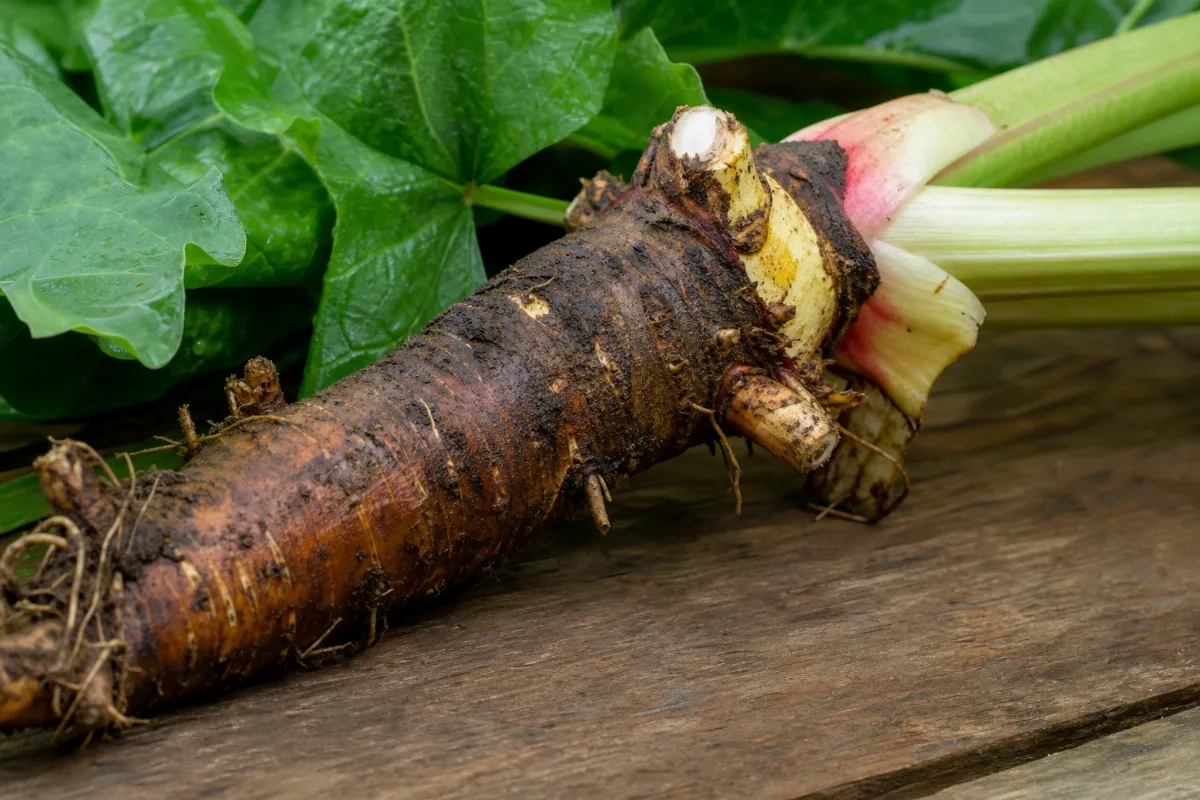
Rhubarb root is the dried root and underground stem of Rheum palmatum and Rheum officinale, plants in the knotweed family. In Chinese medicine it is called da huang. It contains anthraquinones such as rhein and emodin, which stimulate the bowel, and tannins.
It is sold as powder, tablets, teas and liquid extracts. In Chinese medicine the root is often processed before use, which changes its effects and toxicity.
Three different rhubarbs
Garden rhubarb (Rheum rhabarbarum) is a vegetable. Its stalks are eaten but its leaves are poisonous.
Siberian rhubarb (Rheum rhaponticum) is another species. A patented extract of its root, ERr 731, is studied for menopause symptoms. It is not the laxative root, and results for one do not apply to the other.
Traditional and current uses
Chinese medicine uses rhubarb root to purge the bowel, to clear heat and toxins, and to stop bleeding. In the EU it is accepted as a 'well-established use' for short-term occasional constipation, which means the decision rests on long published use rather than new trials.
In Chinese hospitals it is also used with other treatment in severe acute pancreatitis, upper gut bleeding and kidney failure.
What the research shows
For constipation, the evidence is one 30-day Belgian trial of a rhubarb extract and one 8-day Chinese trial of a navel plaster, both better than placebo. Memorial Sloan Kettering notes that clinical trials have not tested rhubarb for everyday constipation.
Reviews of Chinese trials report benefit in severe acute pancreatitis, upper gut bleeding and chronic kidney failure, but the authors describe small, low-quality trials and, for pancreatitis, only Chinese evidence.
For cancer, there are only lab and animal findings.
At a glance
Traditional uses history, not proof
- Purging the bowel and relieving constipation in Chinese medicine (da huang), with processed forms for different purposes (2024 review)
- Cooling blood to stop bleeding, and clearing heat and toxins, in Chinese medicine (2024 review)
- Chronic constipation: rhubarb powder on the navel, an old Chinese practice (2021 trial paper)
- Occasional constipation, a recognised EU 'well-established use' (EMA 2020)
Studied for research
- Short-term occasional constipation: EU recognition, one 30-day trial, low certainty
- Constipation with a rhubarb navel plaster: one 8-day trial, low certainty (topical)
- Severe acute pancreatitis (hospital add-on): Chinese trials, low certainty
- Upper gut bleeding (sprayed at endoscopy): Chinese trials, very low certainty
- Chronic kidney failure (rhubarb or formulas): Chinese trials, very low certainty
- Menopause symptoms: ERr 731 extract of a DIFFERENT species, low certainty
- Radiation side effects, mouth ulcers, cancer: insufficient
Main compounds
- Rhein (PubChem 10168)
- Emodin (PubChem 3220)
- Aloe-emodin (PubChem 10207)
- Sennosides (PubChem 73111, sennoside A)
- Chrysophanol (PubChem 10208)
- Tannins and oxalate
Common forms
- Dried root or powder
- Tablets and capsules
- Teas and liquid extracts
- Processed root (wine, cooked, charcoal) in Chinese medicine
- Standardised extract (Belgian trial)
- Siberian rhubarb extract ERr 731 (different species)
Research links: EMA: rhubarb root herbal medicine summary · PubMed: EFSA opinion on rhubarb root preparations (2024) · PubMed: rhubarb extract and constipation, Belgian trial (2022) · PubMed: rhubarb navel plaster trial (2021) · Memorial Sloan Kettering: Rhubarb · MedlinePlus: Rhubarb leaves poisoning · Research Library · Genes & Biomarkers Library
The plant and its history
- Accepted scientific name
- Rheum palmatum L. (Chinese rhubarb); also Rheum officinale Baill.
- Naming authority
- L. (Linnaeus) for R. palmatum; Baillon for R. officinale. GBIF backbone API 2026-10-25: both are accepted species, exact matches (confidence 100).
- Common names
- Rhubarb root (English); Chinese rhubarb (English); Turkey rhubarb (old trade name) (English); Da huang (Chinese (pinyin)); Rhei radix (Latin (pharmacopoeia))
- Botanical family
- Polygonaceae, the knotweed or buckwheat family. Yellow dock (Rumex) is in the same family.
- Classification
- Plantae > Polygonaceae > Rheum > Rheum palmatum
- Native range
- Not described in the sources read.
- Habitat
- Not described in the sources read.
- What the plant looks like
- Roots: The dried root and underground stem (rhizome) are the medicinal part (EMA).; Stems: Not described in the sources read.; Leaves: Rhubarb leaf blades are poisonous (MedlinePlus). Not used as medicine.; Flowers: Not described in the sources read.; Fruit: Not described in the sources read.
- Cultivation
- Not described in the sources read.
- Harvest and processing
- In Chinese medicine the root is used raw, wine-processed, cooked or as charcoal, which change the active compounds, effects and toxicity (2024 review). EU preparations are dried and comminuted root, standardised to anthraquinone content (EMA).
- Look-alikes and adulterants
- Name: Garden rhubarb (Rheum rhabarbarum); Note: The vegetable plant eaten as cooked stalks. GBIF accepted species. Leaf blades are poisonous; the stalks are food, not the medicine.; Name: Siberian or rhapontic rhubarb (Rheum rhaponticum); Note: A different species. Its root extract ERr 731 is studied for menopause symptoms. It is not the laxative root. GBIF accepted species.; Name: Senna, cascara, aloe latex, frangula; Note: Unrelated plants with similar laxative compounds (hydroxyanthracene derivatives).
- Sustainability and conservation
- Not found in the sources read.
Traditional use and history history, not clinical proof
| Tradition or era | Documented use | Source |
|---|---|---|
| Chinese medicine | Rhubarb (da huang) is used in many forms; records of processing it date back to the Han Dynasty, and the main uses are purging, clearing heat and toxins, cooling blood to stop bleeding, and moving blood stasis. Three species are now used: Rheum palmatum, R. tanguticum and R. officinale. | p39170703 |
| Chinese medicine - navel plasters | Rhubarb navel dressings have been used for constipation for over 2,000 years, as described in the 2021 trial paper. | p32693116 |
| European regulation | The EU herbal committee first published a Community monograph in 2007 and revised it in 2020: 'well-established use' for occasional constipation. Added to the EMA inventory in 2005. | s-ema-rhei-radix |
Traditional use shows how a plant was used. It does not show that a supplement works or is safe today.
What is inside, and how it may work
What the plant contains and how those compounds act in cells and animals. Laboratory and animal mechanisms are not proven effects in people.
Main compounds
| Compound | Family | Where it is concentrated | Activity studied | Level of evidence |
|---|---|---|---|---|
| Rhein PubChem 10168 | anthraquinone | Root Varies between products; no figure was read. | Active laxative metabolite; passes into breast milk in small amounts (EMA); blocks kidney drug pumps OAT1 and OAT3 in cells. 16 10 21 | Authoritative guidance |
| Emodin PubChem 3220 | anthraquinone | Root Not read. | Genotoxic in several lab systems per the EMA monograph; kidney effects in mice; blocks OAT1 and OAT3. 16 10 | Laboratory research |
| Aloe-emodin PubChem 10207 | anthraquinone | Root Up to 213.4 mg/kg in one Italian supplement containing laxative plants (a survey, not rhubarb root alone). | Named with emodin in the EMA pregnancy warning on genotoxic risk; blocks OAT1 and OAT3. 16 13 | Laboratory research |
| Sennosides and sennidins PubChem 73111 | anthraquinone glycosides | Root Not read. | Sugar-bound compounds that gut bacteria convert to active forms in the large bowel (EMA). PubChem CID is for sennoside A. 16 20 | Authoritative guidance |
| Chrysophanol PubChem 10208 | anthraquinone | Root Not read. | Minor anthraquinone; traces found in urine after rhubarb (EMA). 16 | Authoritative guidance |
| Physcion PubChem 10639 | anthraquinone | Root Not read. | Weakly inhibited kidney drug pumps in the lab. 10 | Laboratory research |
| Tannins | polyphenols | Root Not read. | Said to give a constipating effect at low amounts, opposite to the anthraquinones (MSK); implicated with anthraquinones in animal liver signals. 20 | Authoritative guidance |
| Oxalate (oxalic acid) | organic acid | Plant (high in leaves; also in stalks) Not read. | Forms kidney crystals when intake is very high (case report). 2 19 | Case report |
Mechanisms, receptors and pathways
| Target or pathway | Gene or receptor | What was found | Level |
|---|---|---|---|
| Large-bowel movement and fluid secretion | Not a single receptor (anthrone metabolites) | Gut bacteria convert the sugar-bound anthraquinones to active anthrones; these speed colon transit, block absorption of water and salts, and raise secretion of fluid into the bowel. Effect appears 8 to 12 hours later. 16 | Authoritative guidance |
| Kidney drug pumps (OAT1/OAT3) | SLC22A6 / SLC22A8 | Rhein, emodin and aloe-emodin strongly blocked human OAT1 and OAT3 in cells; furosemide exposure rose in rats given rhein or rhubarb extract. 10 | Laboratory research |
| Gut bacteria and short-chain fatty acids | Not applicable | In a 30-day human trial, butyrate-producing Lachnospiraceae and stool short-chain fatty acids rose with a rhubarb extract. Whether this causes the better stool is unknown. 12 | Human data |
| DNA damage (genotoxicity) | Not applicable | Several hydroxyanthracenes were mutagenic or genotoxic in lab tests; a 2022 lab study of one rhubarb extract was negative in two tests; EFSA 2024 still found concern for the preparations. 4 11 16 | Laboratory research |
Absorption, metabolism and elimination
- Absorption
- Sugar-bound anthraquinones are not absorbed in the upper gut; gut bacteria convert them in the large bowel. Mainly the free anthraquinones (aglycones) are absorbed and turned into glucuronide and sulphate forms (EMA).
- Distribution
- Rhein passes into breast milk in small amounts after anthranoid use; animal tests show low placental passage of rhein (EMA).
- Metabolism
- Bacterial conversion to emodin-9-anthrone in the large bowel; liver conjugation. Animal work reports effects on CYP enzymes (MSK, second-hand).
- Elimination
- Rhein, emodin and traces of chrysophanol are found in human urine after rhubarb root preparations (EMA). Urine can turn yellow or red-brown.
- Bioavailability
- Not given in the sources read.
Isolated compounds versus whole extracts
The laxative effect is linked to anthraquinones, but whole-root preparations also contain tannins that work the other way at low amounts, and the amounts differ between products and processing. Safety data on isolated compounds (emodin, aloe-emodin, rhein) do not map exactly onto a whole root, and EFSA still treats root preparations as of concern. A purified extract such as ERr 731 comes from a different species and cannot stand in for the root.
Nutritional composition
Not checked for the root. The garden rhubarb stalk is a food high in oxalate; the root medicine is not a significant food source of any nutrient.
4 low certainty2 very low certainty3 not enough evidence
What is Rhubarb root good for?
The main proposed uses and how strong the human evidence is for each. "Low" and "very low" mean small or poor trials, and "insufficient" means there is not enough to judge. Several rows are Chinese hospital uses, and one row is a different plant (ERr 731).
Benefits, one by one
Each card is a research question, not a promise. Tap a goal to filter. Open a card to see the studies, doses and limits.
Short-term relief of occasional constipation (swallowed root)
Low certaintyRhubarb root is a stimulant laxative. EU regulators recognise it for short-term relief of occasional constipation, for no more than a week. One small, short Belgian trial of a rhubarb extract found better stool frequency and consistency than placebo. It is not a daily or long-term answer.
4 studiesTraditional dried root, powders, tablets, teas and extracts. Strength…
Studies, doses and limits
What the trials found
The EU herbal committee (HMPC) classes this as 'well-established use', meaning the decision rests on at least ten years of published use and literature, not on a fresh set of trials. Memorial Sloan Kettering says clinical trials have not tested rhubarb for constipation. We found one double-blind placebo-controlled trial of a rhubarb extract, in Belgium, in middle-aged adults (95% women): stool frequency and consistency and questionnaire scores for transit improved in both extract groups compared with placebo over 30 days, and the extract was reported as safe at both strengths.
Results
Better stool frequency and stool form versus placebo in one 30-day trial; EU regulator recognises short-term use.
Effect sizes as reported
Numbers are not given in the abstract of the trial.
Why this rating
Regulator recognition and long use, plus one short double-blind trial. No large trials, no comparison with other laxatives, and one author has a company affiliation.
Form and dose studied
Traditional dried root, powders, tablets, teas and extracts. Strength differs between products. Ask a doctor or pharmacist about amounts.
Who was studied
Adults and adolescents over 12 in EU use; not for children under 12, in pregnancy, or while breastfeeding.
Limits
Only 30 days of trial data. The trial used a standardised extract, which may not match other products. The same bowel-stimulating action is also the source of the safety limits on the Safety tab.
Why researchers looked
Rhubarb root contains anthraquinones, such as rhein and emodin, that stimulate the large bowel. It has been used for constipation for a very long time.
Traditional use
Da huang is a major root in Chinese medicine, and a 2024 review traces records of its processing back to the Han Dynasty. It is often processed (raw, wine-processed, cooked or charred) and used inside multi-herb formulas.
Proposed mechanism Pharmacological theory
Gut bacteria turn the sugar-bound anthraquinones into active forms in the large bowel. These speed up the movement of the bowel and pull water and salts into it, which softens the stool. The effect usually comes 8 to 12 hours after a dose (EMA monograph).
A proposed mechanism does not show that the effect happens in people.
Not for more than about a week at a time. Long use can drain potassium, cause dependence and discolour the bowel lining. See the Safety tab.
Chronic constipation (rhubarb powder plaster on the navel)
Low certaintyIn a large Chinese trial, a plaster of rhubarb powder worn on the navel for 8 days improved constipation scores more than a placebo plaster. This is a different way of using rhubarb, not swallowed, so it does not prove that the root works as a swallowed laxative.
2 studiesRhubarb powder on the navel for part of the day; method as in the tri…
Studies, doses and limits
What the trials found
A multicentre randomised trial in six hospitals in China enrolled 374 adults with chronic constipation. Rheum officinale rhubarb powder or placebo flour was placed on the navel for 6 hours a day for 8 days. At day 8 the Cleveland Constipation Score was 5.61 with rhubarb versus 8.62 with placebo (lower is better), the change from the start was 6.04 versus 2.73, and stool frequency and type scores also favoured rhubarb. Adverse events were not significantly different.
Results
Lower constipation scores than placebo after 8 days.
Effect sizes as reported
Cleveland Constipation Score at day 8: 5.61 (95% CI 5.15 to 6.07) vs 8.62 (8.07 to 9.18), P < 0.001.
Why this rating
One reasonably large randomised trial, but 8 days, one country, topical rather than swallowed, and an abstract with few details on blinding.
Form and dose studied
Rhubarb powder on the navel for part of the day; method as in the trial only.
Who was studied
Adults with chronic constipation (Rome III criteria) in China.
Limits
Only 8 days. Not the same as swallowed rhubarb, so safety limits of the swallowed laxative are not tested here. One study; no replication found.
Why researchers looked
Navel plasters have been used for constipation in Chinese medicine for more than 2,000 years, and the trial authors wanted to test the idea properly.
Traditional use
Rhubarb navel dressings are an old Chinese medicine practice (as described in the trial paper).
Proposed mechanism Pharmacological theory
Not established. The authors suggest the topical route may act through the skin or the nerves of the belly wall; this is untested speculation.
A proposed mechanism does not show that the effect happens in people.
No significant difference in adverse events in the trial. Ask a doctor before trying any home remedy for constipation that lasts weeks.
Severe acute pancreatitis (hospital use, usually with other treatment)
Low certaintyIn Chinese hospitals, rhubarb is given to people with severe acute pancreatitis along with usual care. Reviews of Chinese trials report faster recovery and fewer deaths when rhubarb is added, but the trials were small and low quality. This is hospital treatment, never a home remedy.
3 studiesHospital use only, in forms chosen by the treating team (for example …
Studies, doses and limits
What the trials found
A 2018 systematic review of 16 randomised trials (912 people with severe acute pancreatitis) found that adding rhubarb to a trypsin inhibitor drug was linked with lower death, higher overall response, shorter hospital stay, faster pain relief and lower serum amylase than the drug alone; no serious adverse events were reported. The authors warned of publication bias and small, poor-quality trials. A 2026 summary of 15 documents (guidelines, consensus statements and reviews, all from China) says doctors may use rhubarb to help gut function recovery in acute pancreatitis, but that all evidence is Chinese, hard to generalise, and partly low level. Memorial Sloan Kettering lists a similar meta-analysis but notes a separate review does not support rhubarb for gut failure in intensive care.
Results
Reported benefit as an add-on in hospital, in low-quality Chinese trials.
Effect sizes as reported
Direction of benefit reported; exact numbers are not in the abstracts read.
Why this rating
Meta-analysis exists, but its authors and the 2026 summary both flag low trial quality, publication bias and Chinese-only evidence. Add-on to drugs, not rhubarb alone.
Form and dose studied
Hospital use only, in forms chosen by the treating team (for example by mouth or tube).
Who was studied
Hospital patients with severe acute pancreatitis in China.
Limits
Small, poor-quality trials; combined with drugs and nutrition; no trials from outside China found. A different review does not support the related intensive-care gut-failure use.
Why researchers looked
Severe pancreatitis often stops the bowel from working properly. Rhubarb is used in China to help gut function recover, according to the 2026 evidence summary.
Traditional use
Chinese guidelines and expert consensus statements on rhubarb in acute pancreatitis exist (2026 summary).
Proposed mechanism Pharmacological theory
Reviews propose that restoring bowel movement and calming inflammation may help; the details were not read in the abstracts.
A proposed mechanism does not show that the effect happens in people.
Strong laxatives can cause fluid and potassium loss, which matters most in very ill people. Only a hospital team should decide on this.
Upper gut bleeding (rhubarb solution sprayed during endoscopy)
Very low certaintyIn Chinese hospitals, a rhubarb powder solution is sprayed onto a bleeding spot in the stomach or gut during endoscopy. A review of 14 trials says it stopped bleeding more often than the comparison drug, but the trials were small and of weak quality. This is a procedure done by doctors, not swallowing rhubarb.
2 studiesA rhubarb powder solution sprayed under direct vision; strength matte…
Studies, doses and limits
What the trials found
A 2020 meta-analysis of 14 randomised trials (1,493 people with acute upper gut bleeding not from varicose veins) compared a rhubarb powder solution sprayed through a gastroscope with norepinephrine solution sprayed the same way. At 48 hours the higher-strength rhubarb solution stopped bleeding more often (risk ratio 1.18, 95% CI 1.08 to 1.30), re-bleeding within 48 hours was lower (RR 0.42, 0.24 to 0.74) and fewer adverse reactions were reported (RR 0.22, 0.11 to 0.42). The authors say the trials were small and of substandard quality.
Results
Better bleeding control than norepinephrine spray in small Chinese trials.
Effect sizes as reported
48-hour bleeding stopped RR 1.18 (1.08 to 1.30); re-bleeding RR 0.42 (0.24 to 0.74).
Why this rating
Authors describe the trials as small and substandard; all from Chinese literature; the control was a local spray, not a modern standard endoscopic treatment.
Form and dose studied
A rhubarb powder solution sprayed under direct vision; strength matters in the trials. Not a home remedy.
Who was studied
People in hospital with acute upper gut bleeding that was not from varicose veins, in China.
Limits
Gut bleeding is an emergency. The trials did not compare rhubarb with clips or other standard endoscopic treatments.
Why researchers looked
Chinese medicine describes some processed rhubarb as 'cooling blood to stop bleeding', and trials tested it as a spray at the bleeding site.
Traditional use
Rhubarb charcoal and other processed forms are used for bleeding in Chinese medicine (narrative review).
Proposed mechanism Preliminary mechanism
Unclear. Reviews suggest effects on blood clotting; this is lab-level and not proven in people.
A proposed mechanism does not show that the effect happens in people.
Anyone vomiting blood or passing black stools needs emergency care, not rhubarb.
Chronic kidney failure (rhubarb or rhubarb formulas in Chinese trials)
Very low certaintyChinese trials of rhubarb, alone or in formulas, report lower blood urea and uric acid in people with chronic kidney failure. The trials were low quality. Rhubarb can also be risky for kidneys, so this must be supervised by a kidney doctor.
2 studiesRhubarb alone or inside Chinese formulas, in trials only.
Studies, doses and limits
What the trials found
A 2023 meta-analysis of 34 randomised or semi-randomised trials (2,786 people) found that rhubarb alone or in rhubarb-containing Chinese formulas lowered blood urea nitrogen (mean difference -3.26) and uric acid (-42.79) and improved the symptom response rate (Peto odds ratio 4.14) compared with controls. Creatinine clearance and haemoglobin were not clearly better. The authors say the quality of the included studies was low.
Results
Lower urea and uric acid and better symptom response in low-quality Chinese trials.
Effect sizes as reported
BUN MD -3.26 (-4.22 to -2.31); uric acid MD -42.79 (-66.29 to -19.29); response OR 4.14 (3.32 to 5.16).
Why this rating
Low-quality studies, many with formulas, different types of control, and an inconsistent serum creatinine figure in the abstract.
Form and dose studied
Rhubarb alone or inside Chinese formulas, in trials only.
Who was studied
People with chronic renal failure in China.
Limits
Does not show that rhubarb protects the kidneys over years, only that some blood tests moved. Rhubarb plant parts contain oxalate and laxative use can unbalance salts, both of which matter in kidney disease.
Why researchers looked
Chinese medicine uses rhubarb in kidney failure, so Chinese doctors tested it in trials; the abstract does not explain why.
Traditional use
Not described in detail in the abstract read.
Proposed mechanism Pharmacological theory
Not established; the abstract read gives no mechanism.
A proposed mechanism does not show that the effect happens in people.
Kidney doctors must supervise any use. See the Safety tab for oxalate and potassium cautions.
Menopause symptoms (ERr 731 extract of a different species, Siberian rhubarb)
Low certaintyA standardised extract called ERr 731 comes from the root of a different plant, Rheum rhaponticum (Siberian or rhapontic rhubarb). In four small studies it lowered menopause symptom scores more than placebo. This tells us nothing about Chinese rhubarb root, the laxative.
3 studiesA standardised enteric-coated tablet, in trials. Not interchangeable …
Studies, doses and limits
What the trials found
A 2006 double-blind randomised trial of 109 perimenopausal women compared one ERr 731 tablet daily with placebo for 12 weeks: the Menopause Rating Scale II total score fell more with the extract (P < 0.0001), hot flushes were fewer and less severe from week 4, and no adverse events were rated as related to the extract; endometrial biopsies and lab safety checks did not differ. A 2024 meta-analysis of four studies (390 women) found a pooled score difference of -15.12 on the Menopause Rating Scale (P < 0.001), with high heterogeneity noted by the authors.
Results
Lower menopause symptom scores than placebo in short trials of one extract.
Effect sizes as reported
MRS pooled mean difference -15.12 (P < 0.001); 2006 trial MRS II P < 0.0001.
Why this rating
Only four small studies of one patented extract. High heterogeneity. The meta-analysis authors are all listed at a supplement company, and several included trials come from the extract's developers. No independent large trials found.
Form and dose studied
A standardised enteric-coated tablet, in trials. Not interchangeable with Chinese rhubarb root or garden rhubarb. Ask a doctor or pharmacist about suitability.
Who was studied
Perimenopausal women with menopausal complaints.
Limits
Short studies, one product, funding and manufacturer links not clear in the abstracts. Long-term safety for breast and uterus is not settled by these studies.
Why researchers looked
Rhubarb extracts showed estrogen-receptor-modulating effects in lab work (as summarised by Memorial Sloan Kettering, species not specified), and ERr 731 was developed and tested for hot flushes and other menopause symptoms.
Traditional use
Not described in the abstracts read.
Proposed mechanism Preliminary mechanism
Lab work on rhubarb extracts points to estrogen-receptor effects; the abstracts read do not give a human mechanism for ERr 731.
A proposed mechanism does not show that the effect happens in people.
Do not use Chinese rhubarb root laxative products for menopause. Women with breast cancer or hormone-sensitive conditions should ask their specialist.
Reducing radiation side effects in lung cancer (one study)
Not enough evidenceMemorial Sloan Kettering reports one study in lung cancer patients where a rhubarb extract reduced lung damage from radiotherapy. It is a single study and more are needed.
1 studiesNot applicable.
Studies, doses and limits
What the trials found
Only a summary line from Memorial Sloan Kettering is available to us; we did not open the original study.
Results
No numbers read.
Effect sizes as reported
No effect size available.
Why this rating
One study cited by a cancer centre, which says more studies are needed.
Form and dose studied
Not applicable.
Who was studied
People having radiotherapy for lung cancer.
Limits
Original study not re-opened. Cancer treatment decisions belong to the oncology team.
Why researchers looked
Rhubarb compounds showed anti-inflammatory and radioprotective effects in lab and animal work.
Traditional use
Not a traditional use as such.
Proposed mechanism Animal research
Animal and lab work suggests lower inflammatory signalling.
A proposed mechanism does not show that the effect happens in people.
Tell the cancer team before taking any herb during treatment.
Mouth ulcers (one small study)
Not enough evidenceA small study suggested rhubarb may help recurring mouth ulcers, according to Memorial Sloan Kettering. There is not enough evidence to judge.
2 studiesNot applicable.
Studies, doses and limits
What the trials found
We read only a short summary line from Memorial Sloan Kettering. The original study was not opened.
Results
No numbers read.
Effect sizes as reported
No effect size available.
Why this rating
One small study cited by a secondary source.
Form and dose studied
Not applicable.
Who was studied
People with recurring mouth ulcers.
Limits
Original not re-opened. Mouth ulcers lasting more than two weeks need a doctor.
Why researchers looked
Rhubarb is known for tannins and anti-inflammatory compounds.
Traditional use
Not described in the sources we read.
Proposed mechanism Pharmacological theory
Not established.
A proposed mechanism does not show that the effect happens in people.
Rhubarb leaves are poisonous and should never be used in the mouth.
Cancer (lab and animal findings only)
Not enough evidenceIn the lab and in animals, compounds from rhubarb such as aloe-emodin and emodin killed or slowed some cancer cells. Memorial Sloan Kettering says rhubarb has not been shown to treat or prevent cancer in people. The same compounds are a cancer-risk concern in the safety assessments (see the Safety tab).
2 studiesNot applicable.
Studies, doses and limits
What the trials found
No human trial of rhubarb root for treating or preventing cancer was found. Memorial Sloan Kettering states it has not been shown to treat or prevent cancer.
Results
No human results exist.
Effect sizes as reported
No effect sizes exist.
Why this rating
Only lab and animal findings; the same compounds raise genotoxicity concern in regulators' assessments.
Form and dose studied
Not applicable.
Who was studied
None.
Limits
Cell experiments cannot show effects in patients. Using a laxative herb as a cancer treatment is not supported and can cause harm.
Why researchers looked
Anthraquinones from rhubarb are very active in cell experiments.
Traditional use
Rhubarb is a component of the Essiac herbal tea blend (as stated by Memorial Sloan Kettering).
Proposed mechanism Laboratory research
Lab and animal work suggests effects on cell growth and spread; none of this has been shown in people.
A proposed mechanism does not show that the effect happens in people.
See Safety tab: EFSA could not establish safety of these root preparations because of genotoxicity concern.
Connections to the rest of health
How Rhubarb root connects to the rest of our health knowledge graph. Every link says what kind of connection it is. A safety link (for example to the liver) is a warning, not a benefit. A study that merely mentions a topic never creates a benefit link.
Explore every connection: goals, body systems, organs, symptoms, genes
A. Wellness goals
| Connected to | Kind of connection | Evidence status | Context | Studies |
|---|---|---|---|---|
| Digestive Support | Traditional use | Low certainty | Short-term relief of occasional constipation (swallowed root): Rhubarb root is a stimulant laxative. EU regulators recognise it for short-term relief of occasional constipation, for no more than a week. One small, short Belgian trial of a rhubarb extract found better stool frequency and consistency than placebo. It is not a daily or long-term answer. Severe acute pancreatitis (hospital use, usually with other treatment): In Chinese hospitals, rhubarb is given to people with severe acute pancreatitis along with usual care. Reviews of Chinese trials report faster recovery and fewer deaths when rhubarb is added, but the trials were small and low quality. This is hospital treatment, never a home remedy. | 17 16 20 12 7 5 9 15 8 |
| Gut Health | Traditional use | Low certainty | Short-term relief of occasional constipation (swallowed root): Rhubarb root is a stimulant laxative. EU regulators recognise it for short-term relief of occasional constipation, for no more than a week. One small, short Belgian trial of a rhubarb extract found better stool frequency and consistency than placebo. It is not a daily or long-term answer. | 17 16 20 12 |
| Digestive Support | Demonstrated clinical effect | Low certainty | Chronic constipation (rhubarb powder plaster on the navel): In a large Chinese trial, a plaster of rhubarb powder worn on the navel for 8 days improved constipation scores more than a placebo plaster. This is a different way of using rhubarb, not swallowed, so it does not prove that the root works as a swallowed laxative. | 14 20 |
| Gut Health | Demonstrated clinical effect | Low certainty | Chronic constipation (rhubarb powder plaster on the navel): In a large Chinese trial, a plaster of rhubarb powder worn on the navel for 8 days improved constipation scores more than a placebo plaster. This is a different way of using rhubarb, not swallowed, so it does not prove that the root works as a swallowed laxative. | 14 20 |
| Menopause Support | Demonstrated clinical effect | Low certainty | Menopause symptoms (ERr 731 extract of a different species, Siberian rhubarb): A standardised extract called ERr 731 comes from the root of a different plant, Rheum rhaponticum (Siberian or rhapontic rhubarb). In four small studies it lowered menopause symptom scores more than placebo. This tells us nothing about Chinese rhubarb root, the laxative. | 6 3 18 |
| Womens Wellness | Demonstrated clinical effect | Low certainty | Menopause symptoms (ERr 731 extract of a different species, Siberian rhubarb): A standardised extract called ERr 731 comes from the root of a different plant, Rheum rhaponticum (Siberian or rhapontic rhubarb). In four small studies it lowered menopause symptom scores more than placebo. This tells us nothing about Chinese rhubarb root, the laxative. | 6 3 18 |
| Inflammation Balance | Biological association | Not enough evidence | Reducing radiation side effects in lung cancer (one study): Memorial Sloan Kettering reports one study in lung cancer patients where a rhubarb extract reduced lung damage from radiotherapy. It is a single study and more are needed. Mouth ulcers (one small study): A small study suggested rhubarb may help recurring mouth ulcers, according to Memorial Sloan Kettering. There is not enough evidence to judge. | 20 19 |
| Inflammation Balance | Preliminary mechanism | Not enough evidence | Cancer (lab and animal findings only): In the lab and in animals, compounds from rhubarb such as aloe-emodin and emodin killed or slowed some cancer cells. Memorial Sloan Kettering says rhubarb has not been shown to treat or prevent cancer in people. The same compounds are a cancer-risk concern in the safety assessments (see the Safety tab). | 20 4 |
B. Body systems
| Connected to | Kind of connection | Evidence status | Context | Studies |
|---|---|---|---|---|
| Digestive System | Biological association | Low certainty | Studied for: Short-term relief of occasional constipation (swallowed root) Studied for: Chronic constipation (rhubarb powder plaster on the navel) | 17 16 20 12 14 7 5 9 15 8 19 |
| Urinary System | Biological association | Very low certainty | Studied for: Chronic kidney failure (rhubarb or rhubarb formulas in Chinese trials) | 8 16 |
| Reproductive System | Biological association | Low certainty | Studied for: Menopause symptoms (ERr 731 extract of a different species, Siberian rhubarb) | 6 3 18 |
| Endocrine System | Biological association | Low certainty | Studied for: Menopause symptoms (ERr 731 extract of a different species, Siberian rhubarb) | 6 3 18 |
| Respiratory System | Biological association | Not enough evidence | Studied for: Reducing radiation side effects in lung cancer (one study) | 20 |
| Immune System | Biological association | Not enough evidence | Studied for: Cancer (lab and animal findings only) | 20 4 |
C. Body parts and organs
| Connected to | Kind of connection | Evidence status | Context | Studies |
|---|---|---|---|---|
| Kidneys | Adverse effect or risk | Low certainty | Oxalate kidney injury in case reports; salt imbalance and protein in urine with long use. Preparation or compound: Rhubarb plant oxalate and long laxative use |
2 16 |
| Bowel | Adverse effect or risk | Moderate certainty | Dependence, sluggish bowel and melanosis coli with long use. Preparation or compound: Anthraquinone laxatives |
16 1 |
| Liver | Adverse effect or risk | Very low certainty | Toxic hepatitis after chronic overdose of anthranoid medicines (EMA); animal signals. Preparation or compound: Anthraquinones and tannins |
16 20 |
E. Health conditions
| Connected to | Kind of connection | Evidence status | Context | Studies |
|---|---|---|---|---|
| Constipation | Potential benefit | Low certainty | EU-recognised for short-term occasional constipation; one small extract trial. Preparation or compound: Rhubarb root |
16 12 14 |
| Acute pancreatitis | Potential benefit | Low certainty | Add-on in Chinese hospital trials; low quality. Preparation or compound: Rhubarb (with drugs) |
7 5 |
G. Root causes and contributing factors
| Connected to | Kind of connection | Evidence status | Context | Studies |
|---|---|---|---|---|
| Medication side effects | Drug or supplement interaction | Moderate certainty | Potassium loss can strengthen heart-rhythm drugs and digoxin; kidney drug pumps are blocked in lab and rat work. Potassium loss can strengthen digoxin and heart rhythm drugs; kidney drug pumps are blocked in lab work. Preparation or compound: Rhubarb root (anthraquinones) |
16 10 |
I. Biomarkers
| Connected to | Kind of connection | Evidence status | Context | Studies |
|---|---|---|---|---|
| Stool frequency, consistency and constipation scores | Biological association | Low certainty | Measured in trials: lowered. A lab change is not the same as a health benefit. | 14 12 |
| Gut bacteria and short-chain fatty acids (stool) | Biological association | Very low certainty | Measured in trials: raised. A lab change is not the same as a health benefit. | 12 |
| Serum amylase (pancreas enzyme in blood) | Biological association | Low certainty | Measured in trials: lowered. A lab change is not the same as a health benefit. | 7 |
| Blood urea nitrogen, uric acid and creatinine clearance | Biological association | Very low certainty | Measured in trials: lowered. A lab change is not the same as a health benefit. | 8 |
| Menopause Rating Scale score (ERr 731, Rheum rhaponticum) | Biological association | Low certainty | Measured in trials: lowered. A lab change is not the same as a health benefit. | 6 3 |
| Hot flush number and severity (ERr 731) | Biological association | Low certainty | Measured in trials: lowered. A lab change is not the same as a health benefit. | 6 |
J. Genes, receptors and enzymes
| Connected to | Kind of connection | Evidence status | Context | Studies |
|---|---|---|---|---|
| SLC22A6 (OAT1) and SLC22A8 (OAT3) | Preliminary mechanism | In vitro | Kidney drug pumps blocked by rhein, emodin and aloe-emodin in cells. | 10 |
| CYP3A, CYP2D6, CYP2E1, CYP2C9 | Preliminary mechanism | Animal | Animal work reports induction or inhibition by rhubarb or rhein; relevance in people not known. | 20 |
L. Active compounds
| Connected to | Kind of connection | Evidence status | Context | Studies |
|---|---|---|---|---|
| Rhein | Biological association | Authoritative guidance | Active laxative metabolite; passes into breast milk in small amounts (EMA); blocks kidney drug pumps OAT1 and OAT3 in cells. Preparation or compound: Root |
16 10 21 |
| Emodin | Biological association | In vitro | Genotoxic in several lab systems per the EMA monograph; kidney effects in mice; blocks OAT1 and OAT3. Preparation or compound: Root |
16 10 |
| Aloe-emodin | Biological association | In vitro | Named with emodin in the EMA pregnancy warning on genotoxic risk; blocks OAT1 and OAT3. Preparation or compound: Root |
16 13 |
| Sennosides and sennidins | Biological association | Authoritative guidance | Sugar-bound compounds that gut bacteria convert to active forms in the large bowel (EMA). PubChem CID is for sennoside A. Preparation or compound: Root |
16 20 |
| Chrysophanol | Biological association | Authoritative guidance | Minor anthraquinone; traces found in urine after rhubarb (EMA). Preparation or compound: Root |
16 |
| Physcion | Biological association | In vitro | Weakly inhibited kidney drug pumps in the lab. Preparation or compound: Root |
10 |
| Tannins | Biological association | Authoritative guidance | Said to give a constipating effect at low amounts, opposite to the anthraquinones (MSK); implicated with anthraquinones in animal liver signals. Preparation or compound: Root |
20 |
| Oxalate (oxalic acid) | Biological association | Case report | Forms kidney crystals when intake is very high (case report). Preparation or compound: Plant (high in leaves; also in stalks) |
2 19 |
Each connection is stored with the ingredient, the connected record, the kind of connection, the evidence status, the supporting studies, the preparation or compound involved, and a review date (last reviewed October 25, 2026).
Evidence at a glance: what changed in 6 lab markers
Tap a number to show only those markers. Counts are markers, not people.
The evidence
The research centre for Rhubarb root. Every record here was checked against PubMed or the publisher's page; we never list a study we have not verified.
Evidence by outcome
Bars show how many studies we found for each outcome, not how well it works. People are added up across trials only (reviews are not added, to avoid double counting).
How we rate evidence
High certainty
Several well-run trials or reviews agree; further research is unlikely to change the picture much.
Moderate certainty
Good trials point the same way, but some doubt remains.
Low certainty
Small, short or inconsistent trials. The finding could change with better research.
Very low certainty
Very little or very weak human data. Treat as a possibility only.
Mixed findings
Trials or reviews disagree with each other.
Not enough evidence
Not enough human research to say either way.
Evidence against
Good research found no benefit, or found harm.
We take the reviewers' own risk-of-bias and GRADE statements where they exist, and otherwise judge from study size, design, consistency, directness and whether a product matches what is sold. Many publications do not make evidence high. Method note: We built from our existing rhubarb summary and re-read PubMed abstracts for every study cited, read the EMA public summary and full herbal monograph, the Memorial Sloan Kettering page and MedlinePlus, checked the plant names in GBIF and compounds in PubChem. NCCIH had no page and LiverTox and LactMed could not be read.
Study library: every study we checked 22
| Study | Design | People | Product, dose, length | Result |
|---|---|---|---|---|
| Abu Baker 2018 Melanosis Coli: A Helpful Contrast Effect or a Harmful Pigmentation? Clin Med Insights Gastroenterol · PMID 30574001 · DOI |
Retrospective cohort |
2872 718 patients with melanosis coli and 2,154 matched controls at one hospital in Israel over 15 years. |
Chronic anthranoid laxatives (the cause of melanosis coli; rhubarb is one source of anthranoids but the study does not name products) not applicable Not applicable 15-year record review · vs Matched patients without melanosis |
Polyps were found more often in people with melanosis (33.4% vs 21.8%), but colorectal cancer was diagnosed less often (0.3% vs 3.9%). The authors conclude melanosis coli is not linked to more cancer diagnoses and may help doctors see polyps. Polyp detection OR 1.986; cancer diagnoses 0.3% vs 3.9% (P < .001) (OR 1.626 to 2.425) Methods, limits and fundingOutcomes: Polyp detection and colorectal cancer diagnosis at colonoscopy. Limitations: Retrospective, single centre, about anthranoid laxatives in general rather than rhubarb. Cannot show that laxatives are safe over decades. Colonoscopy referrals are a selected group. Funding and conflicts: Authors declare no conflicts. Read: abstract |
| Albersmeyer 2012 Acute kidney injury after ingestion of rhubarb: secondary oxalate nephropathy in a patient with type 1 diabetes. BMC Nephrol · PMID 23110375 · DOI |
Case report |
1 One person with type 1 diabetes and previously normal kidney function, Germany. |
Excessive dietary rhubarb (the abstract says 'rhubarb' and 'dietary intake'; the plant part and species are not stated, but this reads as the vegetable) not stated Excessive intake (not quantified in the abstract) Not stated · vs None |
Acute kidney failure. The kidney biopsy showed oxalate crystals in the kidney tubes and blood oxalate was raised. Single case Methods, limits and fundingOutcomes: Kidney function, kidney biopsy, blood oxalate. Limitations: A single case about food intake, in a person with diabetes. It shows the oxalate risk of a rhubarb plant eaten in large amounts; it does not measure the risk of rhubarb root medicines. Funding and conflicts: Not applicable Read: abstract |
| Dubey 2024 Efficacy evaluation of standardized Rheum rhaponticum root extract (ERr 731) on symptoms of menopause: A systematic review and meta-analysis study. J Biomed Res · PMID 38646867 · DOI |
Meta-analysis |
390 390 women in four studies of ERr 731 for menopausal symptoms (193 extract, 197 control). |
ERr 731, a standardised extract of Rheum rhaponticum (Siberian or rhapontic rhubarb) root. A DIFFERENT SPECIES from the laxative root root Not given in the abstract Varied by study · vs Control therapy (placebo or other) |
ERr 731 lowered the Menopause Rating Scale score more than control (pooled mean difference -15.12, P < 0.001). The authors say bias risk and high heterogeneity call for more trials. MRS pooled MD -15.12 (P < 0.001) Methods, limits and fundingOutcomes: Menopause Rating Scale score. Limitations: Only four studies, high heterogeneity, one extract from one species. All authors are listed at Sundyota Numandis Probioceuticals, a company (author affiliation as printed), although they report no conflict of interest. Several included trials come from the extract's developers. Funding and conflicts: Authors declare no conflicts; all three authors are employees or affiliates of a supplement company per the affiliation line. Read: abstract |
| EFSA Panel on Nutrition 2024 Scientific Opinion on additional scientific data related to the safety of preparations of Rheum palmatum L., Rheum officinale Baill. and their hybrids, Rhamnus purshiana DC., Rhamnus frangula L. and Cassia senna L., submitted pursuant to Article 8(4) of Regulation (EC) No 1925/2006. EFSA J · PMID 38784839 · DOI |
Regulatory opinion n/a |
EU food-safety opinion on root or rhizome preparations of Rheum palmatum, Rheum officinale and hybrids (and senna and buckthorn products) that contain hydroxyanthracene derivatives (HADs). | Plant preparations containing hydroxyanthracene derivatives root or rhizome Not applicable Not applicable · vs Not applicable |
The submitted genotoxicity studies on the plant preparations were all negative. But the tested preparations were not well characterised, and the studies confirmed the presence of a compound known to be genotoxic in vivo and another shown to be genotoxic in vitro (names hidden in the published abstract). EFSA therefore considered the preparations of concern for genotoxicity and said safety could not be established from the submitted studies. Safety could not be established; concern for genotoxicity Methods, limits and fundingOutcomes: Whether new genotoxicity studies could establish safety of these preparations. Limitations: A regulatory opinion in the food-supplement context, not a medicine licence decision, and not a statement about cancer in people. Some wording in the public abstract is redacted. Funding and conflicts: EFSA independent panel; declarations of interest are held by EFSA. Read: abstract |
| Han 2026 A Synthesis of the Best Evidence for Rhubarb Administration in the Treatment of Acute Pancreatitis in China. J Multidiscip Healthc · PMID 42293414 · DOI |
Evidence summary |
15 documents (3 clinical guidelines, 3 expert consensus statements, 9 systematic reviews), all from Chinese sources, on rhubarb in adults with acute pancreatitis. | Rhubarb (Chinese medicine use; preparation and form vary by document) root (assumed; not stated in the abstract) Varies by document; not extracted here Varies · vs Varies |
The authors say clinicians may apply the evidence to improve gut function recovery in acute pancreatitis, but all evidence comes from Chinese studies, generalises poorly, and some findings are low level. No pooled effect size in the abstract Methods, limits and fundingOutcomes: Best-evidence summary: 27 pieces of evidence in four themes (mechanism, feasibility, evaluation, clinical implementation). Limitations: Evidence summary of documents, not a new trial. All sources are Chinese. Quality was graded with AGREE II, JBI and AMSTAR 2.0 but the grades are not given in the abstract. Funding and conflicts: Authors report no conflicts of interest. Registration: ES20246947 Read: abstract |
| Heger 2006 Efficacy and safety of a special extract of Rheum rhaponticum (ERr 731) in perimenopausal women with climacteric complaints: a 12-week randomized, double-blind, placebo-controlled trial. Menopause · PMID 16894335 · DOI |
Controlled trial |
109 109 perimenopausal women with climacteric complaints (multicentre trial). |
ERr 731, an extract of Rheum rhaponticum (Siberian rhubarb) root; enteric-coated tablet. NOT Chinese rhubarb root root One tablet a day 12 weeks · vs Placebo (n = 55; extract n = 54) |
By 12 weeks the Menopause Rating Scale II score fell more with ERr 731 than placebo (P < 0.0001). Hot flush number and severity were lower from week 4. No adverse events were rated as related to the extract, and endometrial biopsies and lab safety measures did not differ. MRS II total P < 0.0001; hot flushes P < 0.0001 (from week 4) Methods, limits and fundingOutcomes: Menopause Rating Scale II total score, hot flushes, quality of life, bleeding days, safety checks. Limitations: One 2006 trial. An erratum and published comments exist (listed in the PubMed record). Funding and manufacturer links are not stated in the abstract. Mostly short-term. Funding and conflicts: Not stated in the abstract. Read: abstract |
| Hu 2018 Rhubarb combined with trypsin inhibitor for severe acute pancreatitis: A systematic review and meta-analysis. Phytother Res · PMID 29672966 · DOI |
Meta-analysis |
912 912 hospital patients with severe acute pancreatitis in 16 randomised trials, searched to 2016 (Chinese hospitals; authors in Beijing). |
Rhubarb (form and preparation varied by trial) added to a trypsin inhibitor drug root (assumed; not stated in the abstract) Varied by trial Varied by trial · vs Trypsin inhibitor alone |
Compared with the trypsin inhibitor alone, adding rhubarb was linked with lower death rates, higher overall efficacy, shorter hospital stay, faster pain relief and lower serum amylase. No serious adverse events were reported in these trials. Direction of effect reported; numbers not given in the abstract Methods, limits and fundingOutcomes: Death, overall efficacy, hospital stay, time to abdominal pain relief, serum amylase. Limitations: The authors note possible publication bias, small trials and poor trial quality. Add-on to a drug, not rhubarb alone. Funding and conflicts: Not stated in the abstract. Read: abstract |
| Huang 2023 Clinical effect of rhubarb on the treatment of chronic renal failure: A meta-analysis. Front Pharmacol · PMID 37153797 · DOI |
Meta-analysis |
2786 2,786 people with chronic renal failure in 34 randomised or semi-randomised trials (Chinese literature, searched to September 2021). |
Rhubarb alone, or traditional Chinese medicine formulas that contain rhubarb root (assumed) Varied by trial Varied by trial · vs Control treatment (usual care or other control) |
The authors report lower blood urea nitrogen and uric acid and a better symptom response rate with rhubarb. Creatinine clearance and haemoglobin were not clearly improved (confidence intervals cross zero). BUN MD -3.26; uric acid MD -42.79; symptom response Peto OR 4.14; creatinine clearance MD 3.95 (not significant); haemoglobin MD 7.70 (not significant) (BUN -4.22 to -2.31; uric acid -66.29 to -19.29; response 3.32 to 5.16; creatinine clearance -0.03 to 7.93; haemoglobin -0.18 to 15.58) Methods, limits and fundingOutcomes: Serum creatinine, blood urea nitrogen, creatinine clearance, haemoglobin, uric acid, symptom response rate. Limitations: The authors say the research methods of the included trials were low quality. The serum creatinine figure printed in the abstract looks inconsistent (a positive value although the authors describe a reduction), so it is not quoted here. Many trials used formulas, so rhubarb alone cannot be separated out. Laxative rhubarb in kidney failure also raises the safety questions on the Safety tab. Funding and conflicts: Authors report no commercial or financial conflicts. Registration: INPLASY2021100052 Read: abstract |
| Liu 2020 Spraying rhubarb powder solution under gastroscope in the treatment of acute non-varicose upper gastrointestinal bleeding: A systematic review and meta-analysis of randomized controlled trials. Complement Ther Med · PMID 32951726 · DOI |
Meta-analysis |
1493 1,493 patients with acute upper gut bleeding that was not from varicose veins, in 14 randomised trials (Chinese literature). |
Rhubarb powder dissolved in water and SPRAYED onto the bleeding site through a gastroscope (not swallowed as a laxative) root powder (assumed) Strength 0.03 to 0.15 g/mL in trials Followed for 24 to 72 hours · vs Norepinephrine solution sprayed the same way |
At the higher strength (0.1 g/mL) the bleeding-stopped rate at 48 hours was higher than with norepinephrine; re-bleeding within 48 hours was lower; the authors report fewer adverse reactions. Bleeding stopped at 48 h: RR 1.18; re-bleeding within 48 h: RR 0.42; adverse reactions: RR 0.22 (48 h hemostasis 1.08 to 1.30; re-bleeding 0.24 to 0.74; adverse reactions 0.11 to 0.42) Methods, limits and fundingOutcomes: Stopping the bleeding at 24, 48 and 72 hours, time to stop bleeding, re-bleeding, adverse reactions. Limitations: The authors say the trials were small and of substandard quality. This is a hospital procedure done by an endoscopist, not something to do at home. Funding and conflicts: Not stated in the abstract. Read: abstract |
| Ma 2014 Interaction of five anthraquinones from rhubarb with human organic anion transporter 1 (SLC22A6) and 3 (SLC22A8) and drug-drug interaction in rats. J Ethnopharmacol · PMID 24685584 · DOI |
Laboratory research animal |
Human kidney drug-transporter proteins (OAT1 and OAT3) in cells, and rats given furosemide with rhein or rhubarb extract. | Rhein, emodin, aloe-emodin, chrysophanol, physcion (isolated rhubarb compounds) and a rhubarb extract root compounds Lab concentrations; rat doses not extracted Lab / rat experiment · vs Furosemide alone |
Rhein, emodin and aloe-emodin strongly blocked the OAT1 and OAT3 kidney drug pumps. In rats, furosemide exposure rose by 65% with rhein and by 32% (single dose) or 52% (repeated dose) with rhubarb extract. Furosemide AUC +65% (rhein); +32% and +52% (extract) Methods, limits and fundingOutcomes: Block of the OAT1 and OAT3 kidney drug pumps; furosemide blood exposure in rats. Limitations: Cell and rat data. Whether this happens in people taking rhubarb root is not known. Funding and conflicts: Not stated in the abstract. Read: abstract |
| Melzi 2022 Lack of genotoxicity of rhubarb (rhizome) in the Ames and micronucleus in vitro tests. Toxicol Rep · PMID 36518439 · DOI |
Laboratory research in-vitro |
Bacteria (Salmonella typhimurium and E. coli) and human blood lymphocytes in the lab. | Ethanolic extract of ground rhubarb rhizome with 1.39% total hydroxyanthracene content (species not stated in the abstract) rhizome Up to 5000 micrograms per plate / per mL (lab) Lab test · vs Without extract |
The extract showed no genotoxic activity in these two lab tests. No genotoxic effect found Methods, limits and fundingOutcomes: Mutation in the Ames test and micronucleus formation in human lymphocytes. Limitations: Two lab tests with one extract. These do not settle the cancer question: EFSA looked at whole-plant preparations and still had concern, and animal and other lab studies point the other way. Funding is not stated in the abstract. Funding and conflicts: Authors report no known competing interests. Read: abstract |
| Neyrinck 2022 Constipation Mitigation by Rhubarb Extract in Middle-Aged Adults Is Linked to Gut Microbiome Modulation: A Double-Blind Randomized Placebo-Controlled Trial. Int J Mol Sci · PMID 36499011 · DOI |
Controlled trial |
Middle-aged adults with constipation complaints in Belgium (95% women, average age 58). Group sizes are not given in the abstract. | Rhubarb extract (species and extract details not stated in the abstract), dosed by its rhein content root (assumed; not stated in the abstract) 12.5 mg or 25 mg rhein per day (as reported) 30 days · vs Maltodextrin placebo |
Stool frequency, stool consistency and questionnaire scores for transit and difficulty emptying improved in both extract groups versus placebo. The extract was reported as safe even at the higher dose over 30 days. Butyrate-producing bacteria and short-chain fatty acids rose with the extract. Direction of effect reported; numbers not given in the abstract Methods, limits and fundingOutcomes: Stool frequency and consistency, perceived transit problems, gut bacteria, short-chain fatty acids in stool. Limitations: Short (30 days), small-looking study, mostly women. Group sizes and the exact extract are not in the abstract. Authors link the effect to gut bacteria, which is a hypothesis. Funding and conflicts: One author is affiliated with CEN Nutriment (Groupe CEN, a company) and other authors disclose patent and company roles unrelated to rhubarb; the funders are said to have had no role in design, analysis or publication. Industry link possible; not clarified in the abstract. Read: abstract |
| Peloso 2025 UPLC-MS/MS Analysis of Hydroxyanthracene Derivatives in Botanical Food Products and Supplements: Surveillance of the Italian Market. Foods · PMID 40238473 · DOI |
Market survey |
43 43 botanical food and supplement samples (aloe, senna, cassia, rhubarb, frangula) on the Italian market. |
Laxative-plant supplements, infusions and drinks measured for hydroxyanthracene compounds mixed Not applicable Single survey · vs Not applicable |
33% of the samples had detectable amounts. The highest levels were in solid supplements from senna, cascara, rhubarb and frangula. Aloe-emodin reached 213.4 mg/kg in one such supplement; no sample contained danthron. 33% of 43 samples above 0.5 mg/kg Methods, limits and fundingOutcomes: Amounts of aloins, aloe-emodin, emodin and danthron. Limitations: Italy only, small sample, mixed products; results are not specific to rhubarb root. The results show that amounts differ widely between products. Funding and conflicts: Authors declare no conflicts. Read: abstract |
| Wei 2021 Topical therapy with rhubarb navel plasters in patients with chronic constipation: Results from a prospective randomized multicenter study. J Ethnopharmacol · PMID 32693116 · DOI |
Controlled trial |
374 374 adults with chronic constipation (Rome III) at six teaching hospitals in China. |
Rheum officinale rhubarb powder applied on the navel (a topical, not swallowed, use) root powder (assumed) Powder on the navel 6 hours a day 8 days · vs Placebo flour on the navel |
Constipation scores improved more with the rhubarb plaster than with placebo (Cleveland score at day 8: 5.61 vs 8.62). Adverse events did not differ significantly. CCS day 8: 5.61 vs 8.62; change from day 0: 6.04 vs 2.73 (P < 0.001) (CCS day 8 CI 5.15 to 6.07 (rhubarb) and 8.07 to 9.18 (placebo)) Methods, limits and fundingOutcomes: Cleveland Constipation Score, Bristol Stool Scale, 24-hour bowel movements. Limitations: Topical use only; the result does not show that swallowed rhubarb works the same way. Chinese hospitals; only 8 days. Blinding details are not in the abstract. Funding and conflicts: Not stated in the abstract. Read: abstract |
| Wen 2024 The application of rhubarb concoctions in traditional Chinese medicine and its compounds, processing methods, pharmacology, toxicology and clinical research. Front Pharmacol · PMID 39170703 · DOI |
Narrative review |
Literature review of rhubarb (Rheum palmatum, R. tanguticum, R. officinale) processing and uses in Chinese medicine. | Raw, wine-processed, cooked and charcoal rhubarb preparations root Not applicable Not applicable · vs Not applicable |
The authors say three species are now used in Chinese medicine and that processing changes the active compounds, the effects and the toxicity, with processing showing advantages in reducing toxicity. Narrative review; no pooled numbers Methods, limits and fundingOutcomes: How processing changes the compounds, effects and toxicity of rhubarb. Limitations: A narrative review that does not grade evidence. It describes the traditional framework in its own terms. Funding and conflicts: Authors declare no commercial or financial relationships. Read: abstract |
| s-ema-monograph-rheum EMA/HMPC: European Union herbal monograph on Rheum palmatum L. and Rheum officinale Baillon, radix - Revision 1 (EMA/HMPC/113700/2019) · Source |
Regulatory monograph n/a |
Methods, limits and fundingRead: full-text | ||
| s-ema-rhei-radix EMA: Rhei radix - herbal medicinal product (public summary of the HMPC conclusions) · Source |
Regulatory summary n/a |
Methods, limits and fundingRead: full-text | ||
| s-gbif-rheum GBIF Backbone Taxonomy: Rheum palmatum L. (2888864), R. officinale Baill. (2888865), R. rhaponticum L. (2888866), R. rhabarbarum L. (2888867) · Source |
Reference database n/a |
Methods, limits and fundingRead: full-text | ||
| s-medlineplus-rhubarb-leaves MedlinePlus: Rhubarb leaves poisoning · Source |
Authoritative guidance n/a |
Methods, limits and fundingRead: full-text | ||
| s-msk-rhubarb Memorial Sloan Kettering Cancer Center: Rhubarb - Purported Benefits, Side Effects and More · Source |
Authoritative guidance n/a |
Methods, limits and fundingRead: full-text | ||
| s-pubchem-rheum PubChem compounds: rhein (CID 10168), emodin (3220), aloe-emodin (10207), chrysophanol (10208), sennoside A (73111), physcion (10639) · Source |
Reference database n/a |
Methods, limits and fundingRead: full-text | ||
| s-regulators-not-found NCCIH, LiverTox and LactMed lookups for rhubarb root · Source |
Regulatory lookup n/a |
Methods, limits and fundingRead: not-read |
What we do not know yet
- What the evidence supports: regulator recognition for short-term constipation, low-quality Chinese hospital trials, and an unresolved cancer-risk concern.
- No trial compares rhubarb root with senna, fibre or other standard laxatives.
- No trial outside China was found for pancreatitis, gut bleeding or kidney failure.
- No LiverTox or LactMed entry could be read, so the human liver risk has no number.
- No long-term human study shows whether rhubarb root affects colorectal cancer risk.
- ERr 731 trials are mostly by the extract's developers and are a different species.
How new research is added
New studies are found by a saved PubMed search and are placed in a review queue. A person reads each one before it changes any evidence rating or safety wording. New publications never change ratings automatically.
Lab markers
What changed in blood or saliva tests during trials. A changed number is not the same as feeling or being healthier, and we give no "normal ranges".
Other 6
Stool frequency, consistency and constipation scores
Lowered in trials
How often you pass stool and how soft or hard it is, measured with questionnaires such as the Bristol Stool Scale and the Cleveland Constipation Score.
Low certaintyResults and what it means
Why it was measured
They are the main outcomes in constipation trials. They are symptoms, so they matter directly to patients.
Statistical vs. clinical meaning
Real symptom improvements, but short trials, one topical, one with a company-linked author.
Safety implication
Faster stool is the intended laxative effect. Too much brings cramps, diarrhoea and potassium loss.
| Study | Result | People | Product |
|---|---|---|---|
| 14 | Cleveland Constipation Score at day 8: 5.61 vs 8.62 with placebo; change from start 6.04 vs 2.73 | 374 adults with chronic constipation, China | Rheum officinale powder on the navel, 6 h/day for 8 days |
| 12 | Stool frequency and consistency and transit questionnaire scores improved in both extract groups compared with placebo (numbers not in abstract) | Middle-aged adults (95% women), Belgium | Rhubarb extract dosed by rhein content, 30 days |
Gut bacteria and short-chain fatty acids (stool)
Raised in trials
Short-chain fatty acids, such as butyrate, are made by gut bacteria and are used as a marker of how bacteria are working.
Very low certaintyResults and what it means
Why it was measured
The Belgian trial tested whether rhubarb extract changes gut bacteria in ways linked to easier stool.
Statistical vs. clinical meaning
A lab marker. It does not prove the bacteria cause the better stool; the authors only call it a possible contributor.
Safety implication
None identified in the abstract.
| Study | Result | People | Product |
|---|---|---|---|
| 12 | Butyrate-producing bacteria (Lachnospiraceae) and short-chain fatty acids rose with extract; fell in placebo | Middle-aged adults, Belgium | Rhubarb extract for 30 days |
Serum amylase (pancreas enzyme in blood)
Lowered in trials
An enzyme that leaks into the blood when the pancreas is inflamed.
Low certaintyResults and what it means
Why it was measured
A blood marker of how active pancreatitis is.
Statistical vs. clinical meaning
A lab marker; the same review also reports death and hospital stay, which matter more but come from poor-quality trials.
Safety implication
Hospital setting only.
| Study | Result | People | Product |
|---|---|---|---|
| 7 | Lower serum amylase with rhubarb plus trypsin inhibitor than with the inhibitor alone (size not given in abstract) | 912 people with severe acute pancreatitis in 16 trials | Rhubarb plus trypsin inhibitor |
Blood urea nitrogen, uric acid and creatinine clearance
Lowered in trials
Blood waste markers that rise when kidneys work poorly (urea nitrogen and uric acid), and a measure of how well the kidneys clear creatinine.
Very low certaintyResults and what it means
Why it was measured
They are the standard lab outcomes in kidney failure trials.
Statistical vs. clinical meaning
Blood tests moved, but a lab change is not the same as kidney protection, and the studies were low quality.
Safety implication
Rhubarb contains oxalate and can unbalance body salts; kidney disease needs specialist supervision.
| Study | Result | People | Product |
|---|---|---|---|
| 8 | BUN MD -3.26 (-4.22 to -2.31); uric acid MD -42.79 (-66.29 to -19.29); creatinine clearance MD 3.95 (-0.03 to 7.93), not significant | 2,786 people with chronic renal failure in 34 trials | Rhubarb alone or in Chinese formulas |
Menopause Rating Scale score (ERr 731, Rheum rhaponticum)
Lowered in trials
A questionnaire score that adds up hot flushes, mood, sleep, sexual and urinary symptoms of menopause. Lower is better.
Low certaintyResults and what it means
Why it was measured
The main outcome in the ERr 731 trials.
Statistical vs. clinical meaning
A symptom score, which matters to patients, but small trials of a single product, with high heterogeneity and company-linked authors.
Safety implication
No treatment-related adverse events in the 2006 trial; safety beyond 12 weeks is not covered here.
Hot flush number and severity (ERr 731)
Lowered in trials
How often hot flushes occur and how strong they are.
Low certaintyResults and what it means
Why it was measured
A key menopause symptom.
Statistical vs. clinical meaning
One 2006 trial with a published erratum and comments; not replicated here by independent groups.
Safety implication
No endometrial biopsy difference reported.
| Study | Result | People | Product |
|---|---|---|---|
| 6 | Fewer and less severe hot flushes with ERr 731 from week 4 (P < 0.0001) | 109 perimenopausal women | ERr 731 vs placebo |
Safety
What studies and official sources say about side effects, medicines and who should check first. Each point shows what kind of evidence it comes from.
Main points to know 6
- A stimulant laxative: short-term use only. Rhubarb root works like senna. The EU herbal committee (EMA/HMPC) allows it only for short-term relief of occasional constipation, for not more than about a week. Longer use can cause loss of water and salts (especially potassium), dependence on laxatives and a bowel that works poorly on its own. Blood or protein in the urine has also been listed as a long-use effect. Authoritative guidance 16 17
- Cancer-risk concern for the active compounds (not settled). The EU food-safety agency (EFSA, 2024) concluded the safety of rhubarb root or rhizome preparations rich in hydroxyanthracene compounds cannot be established, because they contain compounds known to be genotoxic (damaging to DNA) in animals and lab tests. A lab test of one rhubarb extract found no genotoxicity, and the EMA says the DNA damage seen in lab tests was not proven in living animals, though long-term animal studies showed effects on kidney and colon. No study shows that rhubarb root causes cancer in people. Authoritative guidance 4 16 11
- Not for pregnancy, breastfeeding or children under 12. The EU monograph says use is contraindicated in pregnancy because of experimental data on possible genotoxic risk of anthranoids such as emodin and aloe-emodin, and in breastfeeding because the active metabolite rhein passes into breast milk in small amounts. It is also contraindicated under age 12. Authoritative guidance 16 17
- Can lower potassium, which matters with heart and water pills. Laxative-driven potassium loss can make heart rhythm medicines and digoxin riskier, and diuretics, steroids and liquorice can add to the loss. Ask a doctor or pharmacist before combining. Authoritative guidance 16 20
- Oxalate and kidneys. The rhubarb plant is high in oxalate. Case reports describe acute kidney injury after eating very large amounts of rhubarb (the vegetable). Memorial Sloan Kettering advises caution in kidney disease, and the EMA says people with kidney disorders should be aware of salt imbalance. Oxalate is also linked with kidney stones in general. Case report 2 20 16
- Three different 'rhubarbs': the leaves and the garden stalks are not the root medicine. Chinese rhubarb root (da huang) is the laxative. Garden rhubarb stalks are a food; the leaf blades are poisonous. A separate extract, ERr 731, comes from Siberian rhubarb (Rheum rhaponticum) and is studied for menopause. Do not use one as a stand-in for another. Authoritative guidance 19 18 6
Side effects 7
| Effect | How often | Severity and recovery | Evidence |
|---|---|---|---|
| Abdominal pain, cramps and diarrhoea More likely in people with irritable bowel; the EMA frequency is 'not known'. | Not established | mild to moderate Settles when stopped or when the amount is lowered (EMA). | Authoritative guidance 16 |
| Water and salt (electrolyte) imbalance, including low potassium The EMA monograph links this to long-term use and overdose. | Not established | moderate to serious Usually reversible with fluids and electrolyte care; needs monitoring, especially in older people (EMA). | Authoritative guidance 16 |
| Dependence on laxatives and sluggish bowel Why the EU limits use to about a week. | Not established | moderate Not described in the sources read. | Authoritative guidance 16 17 |
| Dark bowel lining (pseudomelanosis or melanosis coli) One 2018 hospital review of 718 people with melanosis coli found no increase in colorectal cancer diagnoses (0.3% vs 3.9% in controls) and more polyps detected; it covers anthranoid laxatives in general, not rhubarb alone. | Not established | mild The EMA says it usually fades when the preparation is stopped; a case report with a rhubarb-containing fibre product reversed after discontinuing and repeat colonoscopy 1.5 years later (MSK). | Case report 16 20 1 |
| Allergic reactions (itching, hives, rash) | Not established | mild to moderate Stop the product; not described further. | Authoritative guidance 16 |
| Protein or blood in the urine; yellow or red-brown urine | Not established | mild (colour) to moderate (protein or blood) The EMA says the colour change is not clinically significant; blood or protein with long use needs medical review. | Authoritative guidance 16 |
| Acute kidney injury from very large amounts of rhubarb as food (oxalate crystals) A person with type 1 diabetes; Memorial Sloan Kettering also cites a 75-year-old man after rhubarb stew over weeks (summary-only). | Not established | serious Not described in the abstract read. | Case report 2 |
Liver
The EMA monograph says chronic overdoses of anthranoid-containing medicines may lead to toxic hepatitis. Memorial Sloan Kettering says animal studies suggest possible liver toxicity at high doses and with long use, partly from rhein, emodin and tannins. We found no human case report series of liver injury from rhubarb root in PubMed, and LiverTox could not be read (bot-check page), so the human liver risk is unquantified. 16 20 22
How often. No frequency of liver injury from rhubarb root was found.
Monitoring. No agency monitoring advice was found. Stop and get medical help for yellow skin or eyes, dark urine, pale stools, severe itching or ongoing nausea and tiredness.
This is a safety connection. It is not evidence that Rhubarb root supports liver health.
Medicines and supplements 6
| With | Why it matters | Importance | Evidence | What to do |
|---|---|---|---|---|
| Digoxin and other heart glycosides; heart rhythm medicines; medicines that lengthen the QT interval prescription | Laxative-driven potassium loss (hypokalaemia) strengthens glycosides and interacts with rhythm medicines. | Based on the pharmacology of laxatives; the EMA monograph warns that patients on these drugs should consult a doctor first. | Pharmacological theory Moderate certainty 16 20 | Do not combine without a doctor's advice. |
| Diuretics (water pills), corticosteroids, and liquorice root prescription | These can also waste potassium, adding to the loss from the laxative. | Warning in the EMA monograph; no controlled trial found. | Pharmacological theory Moderate certainty 16 | Ask a doctor or pharmacist first; do not combine with licorice products without advice. |
| Furosemide (a loop diuretic) and other medicines cleared through the kidney drug pumps OAT1 and OAT3 prescription | Rhein, emodin and aloe-emodin blocked OAT1 and OAT3 in cells; in rats, furosemide exposure rose by 65% with rhein and by 32 to 52% with rhubarb extract. | Lab and rat data; not shown in people. | Animal research Very low certainty 10 | Tell your pharmacist if you use water pills or other kidney-cleared medicines. |
| Cyclosporine and methotrexate prescription | Memorial Sloan Kettering reports lower cyclosporine availability and higher methotrexate exposure with rhubarb in mice. | Mouse data summarised second-hand; clinical relevance not known. | Animal research Not enough evidence 20 | People on transplant or methotrexate medicines must not self-treat with rhubarb. |
| Drugs broken down by CYP liver enzymes (CYP3A, 2D6, 2E1, 2C9) and melatonin prescription | Animal work reports rhubarb induces CYP3A and 2D6, and rhein inhibits several CYP enzymes; human liver cells showed a possible change in melatonin handling. | Not known in people (Memorial Sloan Kettering). | Laboratory research Not enough evidence 20 | Ask a pharmacist if you take narrow-margin medicines. |
| Other laxatives and other anthraquinone herbs (senna, cascara, aloe latex, frangula) supplement | Same type of bowel-stimulating compounds, so effects and potassium loss add up. | Memorial Sloan Kettering notes rhubarb is also a component of Essiac tea and that doctors should be aware of additive effects. | Authoritative guidance Low certainty 20 13 | Avoid stacking stimulant laxatives. |
Who should check first 6
| Situation | Advice | Evidence |
|---|---|---|
| Pregnancy, and breastfeeding | Avoid. The EU monograph contraindicates both: genotoxic concern from experimental data on emodin and aloe-emodin, and the active metabolite rhein passes into breast milk. | Authoritative guidance 16 17 |
| Children under 12 | Avoid (EMA contraindication). | Authoritative guidance 16 17 |
| Bowel blockage or narrowing, bowel paralysis, appendicitis, Crohn's disease or ulcerative colitis, unexplained belly pain, or severe dehydration | Do not use a stimulant laxative. Get the cause of the pain or constipation checked. | Authoritative guidance 16 |
| Kidney disease, kidney stones, or a tendency to oxalate stones | Ask your kidney doctor first. The EMA says people with kidney disorders should watch for salt imbalance, and Memorial Sloan Kettering warns about oxalate. | Authoritative guidance 16 20 2 |
| Taking heart glycosides, rhythm drugs, diuretics, steroids or liquorice | Talk to a doctor or pharmacist before using. | Authoritative guidance 16 |
| Constipation lasting more than a week or needing laxatives every day | See a doctor to look for a cause; the EMA says the cause should be investigated if laxatives are needed every day. | Authoritative guidance 16 |
Overdose, product quality and regulators
Summary. The medicinal part is the dried root. Overuse of the root causes cramps, severe diarrhoea and loss of fluid and salts. Safety questions about DNA damage and long-term bowel and kidney effects remain open.
Animal. The EMA monograph reports that in rats given total rhubarb anthraquinones for 13 weeks, kidney toxicity was seen at the highest amount. An ethanolic extract of Rheum officinale was weakly mutagenic in one bacterial strain. Emodin affected the oestrus cycle and caused kidney damage in mice. In long-term carcinogenicity studies, effects on kidney and colon or caecum were reported. Reproductive toxicity was linked to maternal diarrhoea.
Human doses studied. A 30-day trial of a rhubarb extract reported it was safe at both strengths tested; an 8-day navel plaster trial found no significant difference in adverse events from placebo. These are short trials and cannot show long-term safety.
High dose or long term signals. Long-term use of stimulant laxatives can lead to impaired bowel function and dependence, and electrolyte imbalance (EMA).
Overdose response. Symptoms of overdose or abuse are griping pain and severe diarrhoea with loss of fluid and electrolytes; treatment is supportive with fluids and monitoring of potassium, especially in older people (EMA).
Genotoxicity. EFSA 2024: root and rhizome preparations are of concern for genotoxicity because they contain a compound known to be genotoxic in vivo and another genotoxic in vitro (names redacted in the public abstract). Counter-evidence: a 2022 lab study found one rhubarb extract (1.39% hydroxyanthracenes) negative in the Ames and human lymphocyte micronucleus tests; EFSA noted that all the submitted studies on plant preparations were negative but the preparations were not well characterised. The EMA says in-vitro genotoxicity of several anthracene compounds was not proven in vivo.
Toxic plant parts. The root is the medicinal part. Garden rhubarb (Rheum rhabarbarum) leaf blades are poisonous (oxalic acid, possibly anthraquinone glycosides); the stalk is a food (MedlinePlus). Do not use the leaves.
A 2025 Italian survey found that the amounts of laxative anthraquinones differ hugely between supplements, so two products with the same name can act very differently. The same survey flagged a need for stronger market checks. In the EU these preparations are under scrutiny as food ingredients.
Wide variation in laxative compounds between products. In 43 Italian samples (aloe, senna, cassia, rhubarb, frangula), 33% had detectable hydroxyanthracenes; the highest were in solid supplements, e.g. aloe-emodin up to 213.4 mg/kg in one product. No danthron was found. 13
Processing changes the compounds and the toxicity. A 2024 review says raw, wine-processed, cooked and charcoal rhubarb differ in active compounds, effects and toxicity, with processing showing advantages in reducing toxicity. 15
| Body | Action | Date |
|---|---|---|
| European Medicines Agency (HMPC) (European Union) | EU herbal monograph (revision 1, 2020) on Rheum palmatum L. and Rheum officinale Baillon, radix: 'well-established use' for short-term treatment of occasional constipation. Not for more than a week; contraindicated in pregnancy, breastfeeding and under age 12. Assessment finalised; first monograph 2007. source | 2020-08-18 |
| European Food Safety Authority (EFSA) (European Union) | 2024 opinion: preparations containing hydroxyanthracene derivatives from the root or rhizome of Rheum palmatum, R. officinale and hybrids (also senna and buckthorn products) are of concern for genotoxicity; safety could not be established. These preparations were placed under Union scrutiny in Part C of Annex III of Regulation (EC) 1925/2006 (food). source | 2024-05-23 |
| Memorial Sloan Kettering Cancer Center (United States) | Patient and clinician page: rhubarb acts as a stimulant laxative and has not been shown to treat or prevent cancer; trials of constipation not found; lists kidney and melanosis case reports and drug interactions. source | 2022 |
When to get medical help
- Severe belly pain, a swollen hard belly, vomiting and no passage of stool or gas (possible bowel blockage).
- Black or bloody stools, or vomiting blood.
- Fainting, a racing or uneven heartbeat, severe muscle weakness or cramps (possible low potassium) especially if you take heart medicine or water pills.
- Very little urine, flank pain, or swollen legs after eating a lot of rhubarb or taking a laxative for days.
- Yellow skin or eyes, dark urine or pale stools.
- Severe watery diarrhoea lasting more than a day, or signs of dehydration.
- Swelling of the lips or face, trouble breathing, or a widespread rash.
- Eating rhubarb leaves: call poison control (US: 1-800-222-1222) or an emergency number.
Stop the supplement and contact a clinician or emergency service. In the US, Poison Control is 1-800-222-1222.
General information only, not medical advice. Ask a clinician or pharmacist before use, especially with medicines, in pregnancy or with a health condition. See the Natural Remedy Safety guide.
Frequently asked questions
What is rhubarb root?
Is rhubarb root the same as the rhubarb in pies?
What is rhubarb root used for?
Does rhubarb root work for constipation?
How long can it be used?
Can rhubarb root cause cancer?
That is not known. EFSA (2024) said the safety of root preparations cannot be established because of compounds that damage DNA in lab or animal tests. One lab test of an extract was negative, and no study shows cancer in people. Dark bowel lining (melanosis coli) was not linked with more cancer in one large hospital review of anthranoid laxatives.
Is rhubarb root safe in pregnancy or while breastfeeding?
Can rhubarb root harm the liver or kidneys?
Chronic overdose of this type of laxative may cause toxic hepatitis (EMA), and animal studies suggest liver toxicity at high amounts. The plant is high in oxalate, and very large food intakes have caused kidney injury in case reports. People with kidney or liver disease should ask their doctor first.
Does it interact with medicines?
What is ERr 731 and is it rhubarb root?
What about rhubarb for pancreatitis, gut bleeding or kidney failure?
Who should avoid rhubarb root?
Explore by health goal
Digestive SupportInflammation BalanceGut HealthMenopause SupportWomens Wellness
Editorial transparency
- Written by
- AlternativeMed editorial team. Research compiled with AI assistance, then checked against PubMed records.
- Medical review
- None. This page has not been reviewed by a physician or pharmacist.
- First published
- 2026-10-25
- Last substantive update
- 2026-10-25
- How we research
- We built from our existing rhubarb summary and re-read PubMed abstracts for every study cited, read the EMA public summary and full herbal monograph, the Memorial Sloan Kettering page and MedlinePlus, checked the plant names in GBIF and compounds in PubChem. NCCIH had no page and LiverTox and LactMed could not be read.
- How we rate evidence
- See "How we rate evidence" in the Evidence tab.
- Independence
- No product is promoted on this page. No affiliate links are shown. If one is added later it will be labelled and kept apart from the evidence.
Sources 22
Each source was opened and checked. Where we read only the abstract, it says so. The small numbers in the text point here.
- Abu Baker F, Mari A, Feldman D, et al.. Melanosis Coli: A Helpful Contrast Effect or a Harmful Pigmentation?. Clin Med Insights Gastroenterol. 2018. PMID 30574001. DOI 10.1177/1179552218817321. (abstract)
- Albersmeyer M, Hilge R, Schrottle A, et al.. Acute kidney injury after ingestion of rhubarb: secondary oxalate nephropathy in a patient with type 1 diabetes.. BMC Nephrol. 2012. PMID 23110375. DOI 10.1186/1471-2369-13-141. (abstract)
- Dubey VP, Sureja VP, Kheni DB.. Efficacy evaluation of standardized Rheum rhaponticum root extract (ERr 731) on symptoms of menopause: A systematic review and meta-analysis study.. J Biomed Res. 2024. PMID 38646867. DOI 10.7555/JBR.37.20230219. (abstract)
- EFSA Panel on Nutrition, Novel Foods and Food Allergens (NDA); Turck D, Bohn T, et al.. Scientific Opinion on additional scientific data related to the safety of preparations of Rheum palmatum L., Rheum officinale Baill. and their hybrids, Rhamnus purshiana DC., Rhamnus frangula L. and Cassia senna L., submitted pursuant to Article 8(4) of Regulation (EC) No 1925/2006.. EFSA J. 2024. PMID 38784839. DOI 10.2903/j.efsa.2024.8766. (abstract)
- Han LJ, Pan XW, Zhu J, et al.. A Synthesis of the Best Evidence for Rhubarb Administration in the Treatment of Acute Pancreatitis in China.. J Multidiscip Healthc. 2026. PMID 42293414. DOI 10.2147/JMDH.S598121. (abstract)
- Heger M, Ventskovskiy BM, Borzenko I, et al.. Efficacy and safety of a special extract of Rheum rhaponticum (ERr 731) in perimenopausal women with climacteric complaints: a 12-week randomized, double-blind, placebo-controlled trial.. Menopause. 2006. PMID 16894335. DOI 10.1097/01.gme.0000240632.08182.e4. (abstract)
- Hu J, Li P, Zhang T.. Rhubarb combined with trypsin inhibitor for severe acute pancreatitis: A systematic review and meta-analysis.. Phytother Res. 2018. PMID 29672966. DOI 10.1002/ptr.6096. (abstract)
- Huang W, Rao Y, Li L, et al.. Clinical effect of rhubarb on the treatment of chronic renal failure: A meta-analysis.. Front Pharmacol. 2023. PMID 37153797. DOI 10.3389/fphar.2023.1108861. (abstract)
- Liu JT, Wu J, Wang HR, et al.. Spraying rhubarb powder solution under gastroscope in the treatment of acute non-varicose upper gastrointestinal bleeding: A systematic review and meta-analysis of randomized controlled trials.. Complement Ther Med. 2020. PMID 32951726. DOI 10.1016/j.ctim.2020.102476. (abstract)
- Ma L, Zhao L, Hu H, et al.. Interaction of five anthraquinones from rhubarb with human organic anion transporter 1 (SLC22A6) and 3 (SLC22A8) and drug-drug interaction in rats.. J Ethnopharmacol. 2014. PMID 24685584. DOI 10.1016/j.jep.2014.03.055. (abstract)
- Melzi G, Galli CL, Ciliutti P, et al.. Lack of genotoxicity of rhubarb (rhizome) in the Ames and micronucleus in vitro tests.. Toxicol Rep. 2022. PMID 36518439. DOI 10.1016/j.toxrep.2022.07.017. (abstract)
- Neyrinck AM, Rodriguez J, Taminiau B, et al.. Constipation Mitigation by Rhubarb Extract in Middle-Aged Adults Is Linked to Gut Microbiome Modulation: A Double-Blind Randomized Placebo-Controlled Trial.. Int J Mol Sci. 2022. PMID 36499011. DOI 10.3390/ijms232314685. (abstract)
- Peloso M, Capriotti A, Accurso D, et al.. UPLC-MS/MS Analysis of Hydroxyanthracene Derivatives in Botanical Food Products and Supplements: Surveillance of the Italian Market.. Foods. 2025. PMID 40238473. DOI 10.3390/foods14071229. (abstract)
- Wei L, Luo Y, Zhang X, et al.. Topical therapy with rhubarb navel plasters in patients with chronic constipation: Results from a prospective randomized multicenter study.. J Ethnopharmacol. 2021. PMID 32693116. DOI 10.1016/j.jep.2020.113096. (abstract)
- Wen Y, Yan PJ, Fan PX, et al.. The application of rhubarb concoctions in traditional Chinese medicine and its compounds, processing methods, pharmacology, toxicology and clinical research.. Front Pharmacol. 2024. PMID 39170703. DOI 10.3389/fphar.2024.1442297. (abstract)
- . EMA/HMPC: European Union herbal monograph on Rheum palmatum L. and Rheum officinale Baillon, radix - Revision 1 (EMA/HMPC/113700/2019). . . (full-text)
- . EMA: Rhei radix - herbal medicinal product (public summary of the HMPC conclusions). . . (full-text)
- . GBIF Backbone Taxonomy: Rheum palmatum L. (2888864), R. officinale Baill. (2888865), R. rhaponticum L. (2888866), R. rhabarbarum L. (2888867). . . (full-text)
- . MedlinePlus: Rhubarb leaves poisoning. . . (full-text)
- . Memorial Sloan Kettering Cancer Center: Rhubarb - Purported Benefits, Side Effects and More. . . (full-text)
- . PubChem compounds: rhein (CID 10168), emodin (3220), aloe-emodin (10207), chrysophanol (10208), sennoside A (73111), physcion (10639). . . (full-text)
- . NCCIH, LiverTox and LactMed lookups for rhubarb root. . . (not-read)