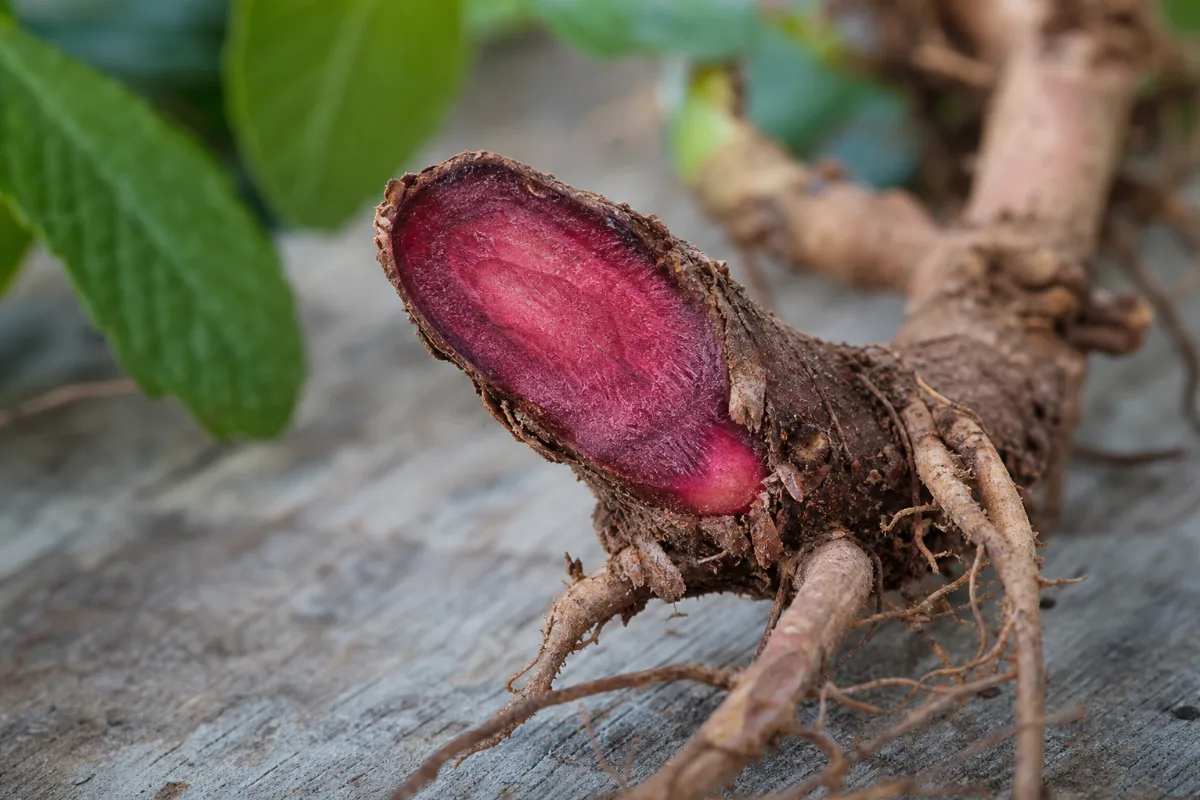
Herbs & Botanicals · Traditional lymph and spleen herb
Red Root
Ceanothus americanus · also called Red root, redroot, New Jersey tea, Jersey tea, wild snowball
Red root is the root of a small North American shrub. Herbalists use it as a lymph and spleen herb, and the leaves were brewed as New Jersey tea. No trial in people has tested it for any use, so we cannot say it works. The key caution: it is traditionally said to speed blood clotting, so ask a doctor or pharmacist first if you take blood thinners.
General information, not medical advice. Last substantive update · Not medically reviewed. A named clinician has not signed off on this page. How this page is made
About Red Root
Red root (Ceanothus americanus) is a North American shrub whose root, root bark and leaf are used. Evidence is extremely thin: the claims are traditional, and the only readable study is a test-tube one. The main caution is a possible effect on clotting.
What it is
Red root is a small shrub of the buckthorn family from eastern and central North America. The root and root bark are the medicinal parts. The leaves were brewed as a tea during the American Revolution, which gave the plant the name New Jersey tea.
Several unrelated plants are also called red root, including danshen (red sage) and Lachnanthes. This page is only about Ceanothus americanus.
What makes it distinctive
The root contains triterpene acids such as ceanothic acid, tannins (about 8 to 10 percent per plant databases) and unusual alkaloids called cyclopeptide alkaloids. Betulinic acid, which has a large lab literature, is said to occur in the genus, but we did not confirm it in the root from a paper.
What people use it for
Herbalists use it for the lymph glands and spleen. Older sources also list colds, cough, fever, bleeding and sexually transmitted infections. A drug reference rates the evidence for every use as insufficient. Long use is not proof that it works.
What the research shows
No human trial was found. In a 1997 lab study, two root acids slowed the growth of four mouth bacteria in a dish. Old papers on clotting time (1928, 1958), alkaloids (1960) and blood pressure in rats (1948) exist, but we could read only titles or an abstract opening, so we do not report their results. A 2023 preprint modelled compounds on a computer and is not evidence of an effect.
At a glance
Traditional uses history, not proof
- Lymph and spleen support (herbalist tradition)
- Colds, cough, fever and chills (tea or root decoction)
- Stopping bleeding and wound washes
- Leaves as a tea substitute (New Jersey tea)
Studied for research
- Lymph and spleen: traditional claim only, no trial
- Clotting time: old animal work and a computer model, not tested in people
- Mouth bacteria: slowed in a test tube by two root acids
- Blood pressure: a 1948 rat study exists (result not read)
Main compounds
- Ceanothic and ceanothetric acids (triterpene acids)
- Tannins (astringent plant compounds)
- Cyclopeptide alkaloids (ceanothine, americine)
- Betulinic acid (reported in the genus, not confirmed in the root)
Common forms
- Root decoction (simmered root)
- Leaf tea
- Tincture or liquid extract
- Capsules of dried root
Research links: Antimicrobial compounds from red root against oral bacteria (1997) · Blood coagulating principles from red root (1958, title only) · Leaf tea and blood pressure in rats (1948, title only) · Interaction between warfarin and Chinese herbal medicines (2015 review) · New Jersey tea drug reference (RxList) · Research Library · Genes & Biomarkers Library
The plant and its history
- Accepted scientific name
- Ceanothus americanus L.
- Naming authority
- L.
- Common names
- red root (English); redroot (English); New Jersey tea (English); Jersey tea (English); wild snowball (English)
- Botanical family
- Rhamnaceae (buckthorn family)
- Classification
- Plantae > Rosales > Rhamnaceae > Ceanothus > Ceanothus americanus
- Native range
- Eastern and central North America (United States and southern Canada), per consumer references; not checked against POWO or USDA.
- Habitat
- Dry woodlands and barrens (per a consumer reference).
- What the plant looks like
- Roots: Deep red root, the medicinal part.; Stems: Small shrub.; Leaves: Toothed leaves, downy beneath; used as a tea substitute.; Flowers: Small white flowers in dense clusters.; Fruit: Not described.; Note: From a consumer reference; not verified in a botanical flora.
- Cultivation
- Not verified.
- Harvest and processing
- Root and root bark are dried and made into decoctions, tinctures or capsules (consumer reference).
- Look-alikes and adulterants
- Name: Other plants called red root; Note: Lachnanthes (family Haemodoraceae) and danshen, Salvia miltiorrhiza (family Lamiaceae), are unrelated plants that share the name. GBIF confirms the different families.; Name: Other Ceanothus species; Note: Species such as C. cuneatus, C. fendleri and C. greggii are also sold as red root; their chemistry is less documented and findings may not transfer.
- Sustainability and conservation
- Not assessed here.
Traditional use and history history, not clinical proof
| Tradition or era | Documented use | Source |
|---|---|---|
| Native American | Root tea or wash for colds, fever, chest and throat complaints, infections, and skin washes. | s-caring-sunshine |
| American colonial period | Leaves used as a tea substitute (hence New Jersey tea), and as a remedy for coughs and colds. | s-pfaf |
| Eclectic and homeopathic medicine, 19th century | Root for an enlarged spleen, lymph glands, and as an astringent. A cautious 1869 dispensatory called it 'not very powerful or reliable' (quoted by a consumer reference). | s-caring-sunshine |
| Modern naturopathic herbalism | Lymph and spleen herb; traditional use for bleeding. | s-rxlist |
Traditional use shows how a plant was used. It does not show that a supplement works or is safe today.
What is inside, and how it may work
What the plant contains and how those compounds act in cells and animals. Laboratory and animal mechanisms are not proven effects in people.
Main compounds
| Compound | Family | Where it is concentrated | Activity studied | Level of evidence |
|---|---|---|---|---|
| Ceanothic acid PubChem 161352 | triterpene acid | root (methanol extract) | Slowed growth of four oral bacteria in culture (42 to 625 micrograms per mL, with ceanothetric acid). 6 12 | Laboratory research |
| Ceanothetric acid PubChem 10720674 | triterpene acid | root (methanol extract) | Slowed growth of the same oral bacteria in culture; new compound in 1997. 6 12 | Laboratory research |
| Betulinic acid PubChem 64971 | lupane triterpene | reported in the Ceanothus genus (consumer reference); not confirmed in a paper we read | Much lab research exists on betulinic acid itself (from birch and other plants), but it was not tested in red root extracts. 2 12 | Laboratory research |
| Tannins | polyphenols | root About 8 to 10 percent, per plant databases and a consumer reference; not confirmed in a paper we read. | Astringent; can bind iron and some drugs in the gut. 11 2 | Other observational |
| Cyclopeptide alkaloids (ceanothine, americine) | alkaloids | root | Said to underlie lymph and clotting effects; not tested in people. A 1960 paper studied the alkaloids; findings not read. 13 2 | Other observational |
| Maesopsin and its glucoside (flavonoids) | flavonoid | root | Inactive against the four oral bacteria below 500 micrograms per mL. A 1985 paper describes flavonoid glycosides; details not read. 6 10 | Laboratory research |
Mechanisms, receptors and pathways
| Target or pathway | Gene or receptor | What was found | Level |
|---|---|---|---|
| Blood clotting | Not established | Reported to shorten clotting time in rat blood; mechanism unclear. A 2023 preprint modelled compounds on the computer only. 7 1 2 | Animal research |
| Oral bacteria growth | Not established | Two triterpene acids slowed growth in culture. 6 | Laboratory research |
Absorption, metabolism and elimination
- Absorption
- Not studied in people or animals that we could find.
- Distribution
- Not studied.
- Metabolism
- Not studied.
- Elimination
- Not studied.
- Bioavailability
- Unknown. A computer preprint predicted properties but this is not a measurement.
Isolated compounds versus whole extracts
The lab results come from a methanol extract and purified compounds, and the clotting claims from an 'acid fraction'. These do not match a hot-water tea or a tincture. Results from one form should not be carried to another. The betulinic acid literature concerns the pure compound, not red root.
Nutritional composition
Red root is a medicinal herb, not a nutrient. Its tannins may interfere with iron absorption.
1 very low certainty6 not enough evidence
What is Red Root good for?
What red root has been used for and how strong the evidence is. Nothing here is proven in people.
Benefits, one by one
Each card is a research question, not a promise. Tap a goal to filter. Open a card to see the studies, doses and limits.
Stopping bleeding and speeding clotting (traditional)
Not enough evidenceRoot bark was used on wounds and taken for bleeding. Only old animal work and a computer model exist. There is no test in people, and the effect is a safety question for anyone on blood thinners.
5 studiesTraditionally a root-bark decoction or tincture; no tested product.
Studies, doses and limits
What the trials found
No human trial was found. A drug reference rates the evidence for bleeding as insufficient.
Results
A 1958 paper and a 1928 abstract on clotting time exist, but we could read only the titles or the start of the abstract. A 2023 preprint is a computer prediction, not a test.
Effect sizes as reported
None available.
Why this rating
Old rat work we could not read in full, plus tradition. Nothing in people.
Form and dose studied
Traditionally a root-bark decoction or tincture; no tested product.
Who was studied
Not studied in any group.
Limits
Species and part differ between sources; claims about 'acid fractions' and dose-dependence come from secondary summaries.
Why researchers looked
Old herbal books say the root bark stopped bleeding, so chemists in the 1920s to 1950s tested whether it shortens clotting time.
Traditional use
Used as a wound wash and taken as a decoction for bleeding in Native American, colonial and 19th-century medicine.
Proposed mechanism Animal research
Not established. Consumer references describe an acid fraction of the root shortening clotting time in rat blood, and say that at higher amounts it may act the other way. We could not confirm this from the original papers.
A proposed mechanism does not show that the effect happens in people.
Do not use it for bleeding. Heavy or lasting bleeding needs a doctor. See the Safety tab for blood thinners.
Lymph and spleen support (traditional)
Not enough evidenceHerbalists call red root a lymph mover and a spleen remedy. These are traditional claims. We found no trial, and one consumer reference says this is the least supported area.
2 studiesTraditionally a root tincture or decoction; no tested product.
Studies, doses and limits
What the trials found
No human trial of the herb. A 2010 homeopathy paper (very dilute preparation, not the herb) appeared in our search; we did not read it and do not use it.
Results
No results exist.
Effect sizes as reported
None available.
Why this rating
Tradition only; no trial of the herb.
Form and dose studied
Traditionally a root tincture or decoction; no tested product.
Who was studied
Not studied.
Limits
Swollen glands or a swollen spleen can signal serious illness and need a medical check, not a herb.
Why researchers looked
In 19th-century Eclectic and homeopathic books the root was linked to a swollen spleen and to swollen lymph glands.
Traditional use
Eclectic physicians listed an enlarged spleen as a main sign for it; modern naturopathic herbalists use it for lymph glands.
Proposed mechanism Pharmacological theory
Not established. Herbalists propose that its alkaloids move lymph; this has not been tested.
A proposed mechanism does not show that the effect happens in people.
A swollen spleen or lymph nodes that last more than two weeks, or come with fever, night sweats or weight loss, need a doctor.
Colds, cough, fever and chills (traditional)
Not enough evidenceThe root, bark or leaf was brewed for colds, coughs, fever and chills. No trial in people was found, so we cannot say it helps.
2 studiesLeaf tea or root decoction; no tested product.
Studies, doses and limits
What the trials found
No human trial was found. A drug reference rates the evidence for cough, colds, fever and chills as insufficient.
Results
No results exist.
Effect sizes as reported
None available.
Why this rating
Tradition only.
Form and dose studied
Leaf tea or root decoction; no tested product.
Who was studied
Not studied.
Limits
Tradition is not proof; many such herbs have never been tested.
Why researchers looked
It was a common household remedy for chest and throat complaints in North America.
Traditional use
Tea or root decoction; the leaves were also a tea substitute in the American Revolution, which gave it the name New Jersey tea.
Proposed mechanism Pharmacological theory
Not established. Its tannins are astringent, which may explain traditional throat uses, but this is untested.
A proposed mechanism does not show that the effect happens in people.
Fever with a stiff neck, trouble breathing, or a cough lasting more than two weeks needs medical care.
Activity against mouth bacteria (test tube)
Very low certaintyTwo triterpene acids from a red root extract slowed the growth of four mouth bacteria in the lab. It has not been tried in a mouth rinse, toothpaste or in people.
1 studiesA methanol extract in the lab; not a tea, rinse or capsule.
Studies, doses and limits
What the trials found
None.
Results
Ceanothic acid and ceanothetric acid slowed four oral bacteria at concentrations of 42 to 625 micrograms per mL; two other compounds (maesopsin, its glucoside) and 27-hydroxy ceanothic acid did not below 500 micrograms per mL.
Effect sizes as reported
Minimum inhibitory concentrations 42 to 625 micrograms per mL.
Why this rating
One test-tube study with a solvent extract.
Form and dose studied
A methanol extract in the lab; not a tea, rinse or capsule.
Who was studied
Not applicable.
Limits
A lab result does not mean a rinse or tea would work in a mouth, and the study never tested this.
Why researchers looked
Researchers screened plants for compounds that could fight gum disease and tooth decay bacteria.
Traditional use
The root has been used as a mouth and throat rinse in historical accounts.
Proposed mechanism Laboratory research
Ceanothic acid and ceanothetric acid, two triterpene acids, slowed bacterial growth in culture.
A proposed mechanism does not show that the effect happens in people.
Do not replace brushing or dental care with a herb.
Blood pressure (rat study, result unknown)
Not enough evidenceA 1948 rat study tested the leaf tea on blood pressure. We could read only the title, so we do not know the result. Nothing was found in people.
2 studiesLeaf tea in rats.
Studies, doses and limits
What the trials found
None.
Results
Result not read.
Effect sizes as reported
None available.
Why this rating
Title-only record of an old rat study.
Form and dose studied
Leaf tea in rats.
Who was studied
Not applicable.
Limits
Old, unreplicated, and its result is unknown to us.
Why researchers looked
The leaf tea was tested in rats with high blood pressure.
Traditional use
The root alkaloids are said in a plant database to be mildly blood-pressure-lowering; not confirmed.
Proposed mechanism Animal research
Not established.
A proposed mechanism does not show that the effect happens in people.
If you take blood pressure medicine, ask your doctor or pharmacist before adding any new herb.
Astringent tannins and the gut (traditional)
Not enough evidenceThe root is rich in tannins, which tighten tissue and are used for loose stools and sore mouths. This is traditional use. Tannins can also upset the stomach and block some iron.
2 studiesDecoction; no tested product.
Studies, doses and limits
What the trials found
No human trial.
Results
No results exist.
Effect sizes as reported
None available.
Why this rating
Tradition and general chemistry.
Form and dose studied
Decoction; no tested product.
Who was studied
Not studied.
Limits
Tannin levels (about 8 to 10 percent) are quoted by databases, not measured here.
Why researchers looked
Traditional books list it for dysentery and digestive complaints.
Traditional use
Decoctions were used for digestive problems and as a wound wash.
Proposed mechanism Pharmacological theory
Tannins bind proteins and metals. This is general plant chemistry, not shown for red root in people.
A proposed mechanism does not show that the effect happens in people.
See the Safety tab for stomach upset and iron.
Sexually transmitted infections and skin washes (traditional)
Not enough evidenceOlder sources list red root for gonorrhea and syphilis. A drug reference rates the evidence as insufficient. These infections need proper medical treatment.
1 studiesDecoction; no tested product.
Studies, doses and limits
What the trials found
No human trial.
Results
No results exist.
Effect sizes as reported
None available.
Why this rating
Tradition only.
Form and dose studied
Decoction; no tested product.
Who was studied
Not studied.
Limits
Listed in old books that also record uses we now know do not work.
Why researchers looked
Historical medical books recorded these uses.
Traditional use
Washes and decoctions in Native American, colonial and Eclectic medicine.
Proposed mechanism Pharmacological theory
Not established.
A proposed mechanism does not show that the effect happens in people.
Untreated gonorrhea and syphilis can cause lasting harm. Get tested and treated by a clinician.
Connections to the rest of health
How Red Root connects to the rest of our health knowledge graph. Every link says what kind of connection it is. A safety link (for example to the liver) is a warning, not a benefit. A study that merely mentions a topic never creates a benefit link.
Explore every connection: goals, body systems, organs, symptoms, genes
A. Wellness goals
| Connected to | Kind of connection | Evidence status | Context | Studies |
|---|---|---|---|---|
| Healthy Circulation | Traditional use | Not enough evidence | Stopping bleeding and speeding clotting (traditional): Root bark was used on wounds and taken for bleeding. Only old animal work and a computer model exist. There is no test in people, and the effect is a safety question for anyone on blood thinners. | 7 9 1 14 2 |
| Immune Support | Traditional use | Not enough evidence | Lymph and spleen support (traditional): Herbalists call red root a lymph mover and a spleen remedy. These are traditional claims. We found no trial, and one consumer reference says this is the least supported area. Colds, cough, fever and chills (traditional): The root, bark or leaf was brewed for colds, coughs, fever and chills. No trial in people was found, so we cannot say it helps. | 2 14 11 |
| Seasonal Wellness | Traditional use | Not enough evidence | Colds, cough, fever and chills (traditional): The root, bark or leaf was brewed for colds, coughs, fever and chills. No trial in people was found, so we cannot say it helps. | 14 11 |
| Lung Support | Traditional use | Not enough evidence | Colds, cough, fever and chills (traditional): The root, bark or leaf was brewed for colds, coughs, fever and chills. No trial in people was found, so we cannot say it helps. | 14 11 |
| Immune Support | Preliminary mechanism | Very low certainty | Activity against mouth bacteria (test tube): Two triterpene acids from a red root extract slowed the growth of four mouth bacteria in the lab. It has not been tried in a mouth rinse, toothpaste or in people. | 6 |
| Blood Pressure Support | Preliminary mechanism | Not enough evidence | Blood pressure (rat study, result unknown): A 1948 rat study tested the leaf tea on blood pressure. We could read only the title, so we do not know the result. Nothing was found in people. | 15 11 |
| Digestive Support | Traditional use | Not enough evidence | Astringent tannins and the gut (traditional): The root is rich in tannins, which tighten tissue and are used for loose stools and sore mouths. This is traditional use. Tannins can also upset the stomach and block some iron. | 11 2 |
B. Body systems
| Connected to | Kind of connection | Evidence status | Context | Studies |
|---|---|---|---|---|
| Cardiovascular System | Biological association | Not enough evidence | Studied for: Stopping bleeding and speeding clotting (traditional) Studied for: Blood pressure (rat study, result unknown) | 7 9 1 14 2 15 11 |
| Immune System | Biological association | Not enough evidence | Studied for: Lymph and spleen support (traditional) Studied for: Activity against mouth bacteria (test tube) | 2 14 6 |
| Respiratory Health | Biological association | Not enough evidence | Studied for: Colds, cough, fever and chills (traditional) | 14 11 |
| Digestive System | Biological association | Not enough evidence | Studied for: Astringent tannins and the gut (traditional) | 11 2 |
I. Biomarkers
| Connected to | Kind of connection | Evidence status | Context | Studies |
|---|---|---|---|---|
| Prothrombin time / INR | Very low certainty | The blood test used to monitor warfarin; relevant if a clotting effect exists in people. Preparation or compound: root bark |
2 | |
| Blood clotting time (rat blood) | Biological association | Very low certainty | Measured in trials: reportedly shortened (animal; original not read). A lab change is not the same as a health benefit. | 2 |
| Growth of mouth bacteria in culture | Biological association | Very low certainty | Measured in trials: lowered (test tube). A lab change is not the same as a health benefit. | 6 |
K. Biological pathways
L. Active compounds
| Connected to | Kind of connection | Evidence status | Context | Studies |
|---|---|---|---|---|
| Ceanothic acid | Biological association | In vitro | Slowed growth of four oral bacteria in culture (42 to 625 micrograms per mL, with ceanothetric acid). Preparation or compound: root (methanol extract) |
6 12 |
| Ceanothetric acid | Biological association | In vitro | Slowed growth of the same oral bacteria in culture; new compound in 1997. Preparation or compound: root (methanol extract) |
6 12 |
| Betulinic acid | Biological association | In vitro | Much lab research exists on betulinic acid itself (from birch and other plants), but it was not tested in red root extracts. Preparation or compound: reported in the Ceanothus genus (consumer reference); not confirmed in a paper we read |
2 12 |
| Tannins | Biological association | Other observational | Astringent; can bind iron and some drugs in the gut. Preparation or compound: root |
11 2 |
| Cyclopeptide alkaloids (ceanothine, americine) | Biological association | Other observational | Said to underlie lymph and clotting effects; not tested in people. A 1960 paper studied the alkaloids; findings not read. Preparation or compound: root |
13 2 |
| Maesopsin and its glucoside (flavonoids) | Biological association | In vitro | Inactive against the four oral bacteria below 500 micrograms per mL. A 1985 paper describes flavonoid glycosides; details not read. Preparation or compound: root |
6 10 |
Each connection is stored with the ingredient, the connected record, the kind of connection, the evidence status, the supporting studies, the preparation or compound involved, and a review date (last reviewed October 25, 2026).
The evidence
The research centre for Red Root. Every record here was checked against PubMed or the publisher's page; we never list a study we have not verified.
Evidence by outcome
Bars show how many studies we found for each outcome, not how well it works. People are added up across trials only (reviews are not added, to avoid double counting).
How we rate evidence
High certainty
Several well-run trials or reviews agree; further research is unlikely to change the picture much.
Moderate certainty
Good trials point the same way, but some doubt remains.
Low certainty
Small, short or inconsistent trials. The finding could change with better research.
Very low certainty
Very little or very weak human data. Treat as a possibility only.
Mixed findings
Trials or reviews disagree with each other.
Not enough evidence
Not enough human research to say either way.
Evidence against
Good research found no benefit, or found harm.
We take the reviewers' own risk-of-bias and GRADE statements where they exist, and otherwise judge from study size, design, consistency, directness and whether a product matches what is sold. Many publications do not make evidence high. Method note: We built on our existing summary, read the one PubMed abstract that exists, checked GBIF and PubChem, and re-read two consumer references. Several old papers have only a title on PubMed and are marked as title-only. Consumer references are not regulators.
Study library: every study we checked 15
| Study | Design | People | Product, dose, length | Result |
|---|---|---|---|---|
| Authors not recorded here 2023 Evaluating the potential blood coagulant activity of Ceanothus americanus compounds: computational analysis bioRxiv (preprint, not peer reviewed) · Source |
In silico plant |
not applicable | Red root (Ceanothus americanus) root bark and leaf not given here not given here · vs none |
Computer modelling (docking and predicted drug-like properties) of compounds from red root for possible clotting activity. A preprint, not peer reviewed, not tested in any animal or person. Carried over from our existing summary; only the opening of the text was read earlier, not re-opened. not applicable Methods, limits and fundingOutcomes: see results Limitations: Computer prediction only; not evidence of any effect. Funding and conflicts: not applicable Read: summary-only |
| Caring Sunshine 2026 Red root (Caring Sunshine ingredient monograph) Caring Sunshine · Source |
Consumer reference plant |
not applicable | Red root (Ceanothus americanus) root bark and leaf not given here not given here · vs none |
Read 2026-10-25. Long consumer monograph. Says no human trials exist for any use; the lymph and spleen uses are the least supported. Describes old rat work on clotting and a dose-dependent coagulant-then-anticoagulant idea from secondary sources. Says people on anticoagulants or who are pregnant should not take it; notes about 10 percent tannin and possible reduced iron absorption; lists other Ceanothus species sold as red root. Its own statements on interactions are precautions from animal data, not reported cases. not applicable Methods, limits and fundingOutcomes: see results Limitations: Commercial consumer reference; some statements are secondary summaries and some details (author names, mechanisms) could not be matched to primary papers. Funding and conflicts: not applicable Read: full-text |
| Chua 2015 Interaction between warfarin and Chinese herbal medicines Singapore Med J · PMID 25640094 · DOI |
Systematic review |
Review for doctors | Chinese herbal medicines in general (red root is not named in the abstract) not applicable not given here not given here · vs none |
The abstract says warfarin is especially prone to herb-drug interactions because of its narrow therapeutic range and that reports of such interactions are increasing. It does not mention red root (Ceanothus americanus). Used here only as general support for checking any herb with a blood thinner. General caution only Methods, limits and fundingOutcomes: Herb-warfarin interactions Limitations: Not about red root; abstract only. Funding and conflicts: Not stated Read: abstract |
| GBIF 2026 GBIF species match: Ceanothus americanus L. (key 3039318) GBIF · Source |
Registry or database plant |
not applicable | Red root (Ceanothus americanus) root bark and leaf not given here not given here · vs none |
GBIF API on 2026-10-25: Ceanothus americanus L. is ACCEPTED (exact match), family Rhamnaceae, order Rosales. not applicable Methods, limits and fundingOutcomes: see results Limitations: Taxonomy database record. NCBI Taxonomy not checked. Funding and conflicts: not applicable Read: full-text |
| GBIF 2026 GBIF species matches: Lachnanthes tinctoria (synonym of Lachnanthes caroliniana, family Haemodoraceae) and Salvia miltiorrhiza Bunge (family Lamiaceae) GBIF · Source |
Registry or database plant |
not applicable | Other plants called red root roots not given here not given here · vs none |
GBIF API on 2026-10-25: Lachnanthes tinctoria is a SYNONYM of Lachnanthes caroliniana (Lam.) Dandy, family Haemodoraceae. Salvia miltiorrhiza Bunge is ACCEPTED, family Lamiaceae. Both are in different plant families from red root (Rhamnaceae), so they are unrelated plants that share a common name. not applicable Methods, limits and fundingOutcomes: see results Limitations: Taxonomy only; says nothing about their safety. Funding and conflicts: not applicable Read: full-text |
| Li 1997 Antimicrobial compounds from Ceanothus americanus against oral pathogens Phytochemistry · PMID 9276981 · DOI |
Laboratory research bacteria in culture |
Bacteria grown in the lab | Red root methanol extract and compounds purified from it plant part not stated in abstract not given here not given here · vs none |
A methanol extract slowed oral bacteria. Three triterpene acids (ceanothic acid, 27-hydroxy ceanothic acid, ceanothetric acid) and two flavonoids (maesopsin and its glucoside) were identified. Ceanothic acid and ceanothetric acid slowed the growth of Streptococcus mutans, Actinomyces viscosus, Porphyromonas gingivalis and Prevotella intermedia at 42 to 625 micrograms per mL. Maesopsin, its glucoside and 27-hydroxy ceanothic acid were inactive below 500 micrograms per mL. Lab growth inhibition only Methods, limits and fundingOutcomes: Growth of four oral bacteria (minimum inhibitory concentration) Limitations: Test tube only; solvent extract, not tea; no test in a mouth product or in people. Funding and conflicts: Not stated Read: abstract |
| Lynch 1958 An investigation of the blood coagulating principles from Ceanothus americanus J Am Pharm Assoc Am Pharm Assoc · PMID 13587327 |
Animal research rat (per secondary description) |
Not available (title only) | Red root root bark (per a consumer reference) not given here not given here · vs none |
Title only. PubMed holds no abstract. We did not read the findings and use only the title: it shows blood-clotting work on red root was published in 1958. A consumer reference describes the work as using calcium-treated rat blood, but we did not confirm this from the paper. Not read Methods, limits and fundingOutcomes: Not available Limitations: Title only; findings not read. Funding and conflicts: Not stated Read: title-only |
| NCCIH 2026 NCCIH: no red root page (URL returned 404 on 2026-10-25) NCCIH · Source |
Registry or database plant |
not applicable | Red root (Ceanothus americanus) root bark and leaf not given here not given here · vs none |
Checked 2026-10-25: nccih.nih.gov/health/red-root returned HTTP 404. No NCCIH, EMA/HMPC, WHO or LiverTox page for red root was found or read. not applicable Methods, limits and fundingOutcomes: see results Limitations: Absence of a page is not evidence of safety. Funding and conflicts: not applicable Read: not-found |
| Not recorded here 1928 Ceanothus americanus: its effect on the coagulation time of the blood (Arch Otolaryngol, abstract opening only) Archives of Otolaryngology · Source |
Animal research plant |
not applicable | Red root (Ceanothus americanus) root bark and leaf not given here not given here · vs none |
Carried over from our existing summary; not re-opened. The opening of the abstract describes the traditional bleeding use. The findings were not read. not applicable Methods, limits and fundingOutcomes: see results Limitations: Abstract opening only; findings not read. Funding and conflicts: not applicable Read: summary-only |
| Pichon-Prum 1985 Flavonic heterosides of Ceanothus americanus L., Rhamnaceae (French journal) Ann Pharm Fr · PMID 4062178 |
Other observational plant |
Plant chemistry | Red root not stated not given here not given here · vs none |
Title only. No abstract on PubMed. Shows flavonoid glycosides from red root were described in 1985; details not read. Not read Methods, limits and fundingOutcomes: Flavonoid glycoside chemistry Limitations: Title only. Funding and conflicts: Not stated Read: title-only |
| Plants For A Future 2026 Ceanothus americanus (Plants For A Future database) Plants For A Future · Source |
Consumer reference plant |
not applicable | Red root (Ceanothus americanus) root bark and leaf not given here not given here · vs none |
Carried over from our existing summary; not re-opened. Lists traditional uses (colds, cough, fever, STIs), about 8 percent tannin in the root and a mildly lowering-blood-pressure alkaloid. These were not confirmed in primary papers. not applicable Methods, limits and fundingOutcomes: see results Limitations: Plant database; not a regulator; claims not traced to trials. Funding and conflicts: not applicable Read: summary-only |
| PubChem 2026 PubChem compound records: ceanothic acid, betulinic acid, ceanothetric acid PubChem · Source |
Registry or database plant |
not applicable | Red root (Ceanothus americanus) root bark and leaf not given here not given here · vs none |
PubChem API on 2026-10-25: ceanothic acid CID 161352 (C30H46O5); betulinic acid CID 64971 (C30H48O3); ceanothetric acid CID 10720674 (C30H44O7). Names matched. not applicable Methods, limits and fundingOutcomes: see results Limitations: Compound database record. Funding and conflicts: not applicable Read: full-text |
| Roscoe 1960 A preliminary study of the alkaloidal principles of Ceanothus americanus and Ceanothus velutinus J Am Pharm Assoc Am Pharm Assoc · PMID 13854556 · DOI |
Other observational plant |
Plant chemistry | Red root and a second Ceanothus species (C. velutinus) not stated not given here not given here · vs none |
Title only. No abstract on PubMed. Shows alkaloids from red root were studied in 1960; no findings were read. Not read Methods, limits and fundingOutcomes: Alkaloid chemistry Limitations: Title only; findings not read. Funding and conflicts: Not stated Read: title-only |
| RxList 2026 New Jersey Tea: Health Benefits, Side Effects, Uses, Dose & Precautions (RxList, from Natural Medicines Comprehensive Database) RxList · Source |
Consumer reference plant |
not applicable | Red root (Ceanothus americanus) root bark and leaf not given here not given here · vs none |
Read 2026-10-25. Says the root, root bark and leaf are used. Evidence is rated insufficient to rate for cough, spasms, bleeding, gonorrhea, syphilis, colds, fever and chills. Animal research suggests it might shorten blood clotting time. No harmful side effects reported so far, but pregnancy and breast-feeding: not enough is known, so avoid. States there is not enough information to set a range of doses. Lists no drug interactions. not applicable Methods, limits and fundingOutcomes: see results Limitations: Consumer drug reference summary, short, with old references (1997-1998 handbooks). Not a regulator. Funding and conflicts: not applicable Read: full-text |
| Wastl 1948 Influence of tea from leaves of Ceanothus americanus on blood pressure of hypertensive rats Fed Proc · PMID 18934656 |
Animal research rat |
Rats with high blood pressure | Red root leaf tea leaf not given here not given here · vs none |
Title only. PubMed holds no abstract and we did not read the result. It shows only that a rat blood-pressure study of the leaf tea was reported in 1948. We cannot say whether blood pressure went up, down or stayed the same. Not read Methods, limits and fundingOutcomes: Blood pressure Limitations: Title only; result unknown; never repeated in people as far as we found. Funding and conflicts: Not stated Read: title-only |
What we do not know yet
- No trial in people for any use.
- The 1928, 1958, 1960 and 1948 papers could not be read beyond titles.
- No test of the clotting claim in people or with blood thinners.
- No safety data for pregnancy, breastfeeding or children.
- No NCCIH, EMA/HMPC, LiverTox or LactMed record found.
How new research is added
New studies are found by a saved PubMed search and are placed in a review queue. A person reads each one before it changes any evidence rating or safety wording.
Lab markers
What changed in blood or saliva tests during trials. A changed number is not the same as feeling or being healthier, and we give no "normal ranges".
Other 2
Blood clotting time (rat blood)
Reportedly shortened (animal; original not read) in trials
How long blood takes to clot in a test.
Very low certaintyResults and what it means
Why it was measured
The traditional use was to stop bleeding.
Statistical vs. clinical meaning
Old animal result only; unconfirmed here. Not a result in people.
Safety implication
If real in people, it could matter with blood thinners. See the Safety tab.
| Study | Result | People | Product |
|---|---|---|---|
| 2 | A consumer reference reports that an acid fraction of the root shortened clotting time in rat blood for about an hour. We did not read the original paper. | Rats (as described by a secondary source) | Acid fraction of red root |
Growth of mouth bacteria in culture
Lowered (test tube) in trials
How strongly a compound slows bacteria grown in a dish.
Very low certaintyResults and what it means
Why it was measured
A first screen for antibacterial activity.
Statistical vs. clinical meaning
Lab screen only; not a result in people.
Safety implication
None for people from this test.
| Study | Result | People | Product |
|---|---|---|---|
| 6 | Ceanothic acid and ceanothetric acid slowed growth of four oral bacteria at 42 to 625 micrograms per mL. | Bacteria in culture | Red root triterpene acids from a methanol extract |
Safety
What studies and official sources say about side effects, medicines and who should check first. Each point shows what kind of evidence it comes from.
Main points to know 4
- It is traditionally said to speed blood clotting, so ask first if you take blood thinners. Old animal work and consumer references say red root may shorten clotting time. This is not shown in people and no case report was found. Because the idea is unproven in both directions, people who take warfarin, heparin, newer blood thinners (such as apixaban or rivaroxaban) or aspirin-type antiplatelet drugs, who have a clotting disorder, or who face surgery should talk to a doctor or pharmacist first. Animal research 7 2 14
- Very little safety research exists. No human safety study of red root was found. A drug reference says no harmful side effects have been reported, but that reflects a lack of research, not proof of safety. Other observational 14 2
- Avoid in pregnancy and breastfeeding. Both consumer references advise avoiding it because safety is unknown. This is a precaution, not a report of harm. Other observational 14 2
- Other plants are also called red root. Red root here is Ceanothus americanus (family Rhamnaceae). Lachnanthes (family Haemodoraceae, another plant called redroot) and danshen (Salvia miltiorrhiza, family Lamiaceae, also sold as red sage) are unrelated plants with different safety profiles. Other Ceanothus species are also sold as red root. Do not apply this page to them, or theirs to this one. Other observational 4 5 2
Side effects 3
| Effect | How often | Severity and recovery | Evidence |
|---|---|---|---|
| Stomach upset or constipation (from tannins) A consumer reference says high intake may upset the stomach because of the tannins. No trial data. | Not established | mild Expected to settle when stopped | Other observational 2 |
| Altered clotting (theoretical) Based on old animal work described by secondary sources. No human report was found. | Not established | unknown Unknown | Animal research 2 14 |
| No adverse effects reported A drug reference says none have been reported; this reflects little use data or research, not proven safety. | Not established | unknown Unknown | Other observational 14 |
Liver
No case of liver injury from red root was found. No LiverTox record for Ceanothus was found. Liver safety is unknown. 8
How often. Unknown.
Monitoring. No official advice exists. Yellow skin or eyes, dark urine or severe tiredness need prompt medical care.
This is a safety connection. It is not evidence that Red Root supports liver health.
Medicines and supplements 4
| With | Why it matters | Importance | Evidence | What to do |
|---|---|---|---|---|
| Blood thinners: warfarin, heparin, apixaban, rivaroxaban and similar prescription | Old animal work, as described by consumer references, suggests an acid fraction of the root shortens clotting time and may act the other way at higher amounts. | Unknown. No human interaction study or case report was found. RxList lists no interactions; Caring Sunshine advises against combining. | Animal research Very low certainty 2 14 3 | Ask your doctor or pharmacist before use. Do not stop or change your medicine yourself. Warfarin in particular is easily affected by herbs. |
| Antiplatelet drugs and aspirin-type medicines prescription | Theoretical, from the same clotting claim. The consumer reference also proposes that tannins promote platelet clumping; unverified. | Unknown; no study. | Other observational Very low certainty 2 | Ask your doctor or pharmacist before use. |
| Blood pressure medicines prescription | A plant database says a root alkaloid is mildly blood-pressure-lowering and a 1948 rat study looked at the leaf tea. The result of that study is unknown to us. | Unknown; theoretical. | Animal research Very low certainty 15 11 | If you take blood pressure medicine, ask your doctor or pharmacist before adding red root, and check your pressure as advised. |
| Iron supplements and some other medicines taken at the same time supplement | Tannins can bind iron and some drugs in the gut and reduce absorption. This is general tannin chemistry; the tannin content of red root itself was not measured here. | Unknown for red root. | Other observational Very low certainty 2 11 | If you are iron-deficient or take iron or other medicines that matter, ask a pharmacist about timing. |
Who should check first 5
| Situation | Advice | Evidence |
|---|---|---|
| Taking blood thinners or antiplatelet drugs | Ask a doctor or pharmacist before use. This is a precaution from animal data and consumer references, not a regulator rule. | Animal research 2 |
| Clotting or bleeding disorders, or planned surgery | Ask your doctor first; the herb is claimed to affect clotting. | Animal research 2 |
| Pregnancy and breastfeeding | Avoid; safety is unknown. | Other observational 14 2 |
| Children | No safety data were found; avoid. | Other observational 14 |
| Iron-deficiency anemia or constipation | The tannins may worsen both; ask a pharmacist or doctor. | Other observational 2 |
Overdose, product quality and regulators
Summary. No toxicity test was found. A consumer reference says toxicity is 'none known', which reflects an absence of reports, not proof.
Animal. No animal toxicity study was read.
Human doses studied. Not given here.
High dose or long term signals. No human long-term data. Tannins may upset the stomach.
Overdose response. Not described.
Genotoxicity. Not found in the sources read.
Toxic plant parts. None known to be toxic; the root and root bark are the medicinal parts and the leaf is used as a tea. This is from consumer references.
Products can be confused or mislabelled, and quality is unchecked.
Name confusion. Several unrelated plants are called red root: Ceanothus americanus (Rhamnaceae), Lachnanthes (Haemodoraceae) and Salvia miltiorrhiza or danshen (Lamiaceae, sold as red sage). GBIF confirms they sit in different plant families. Other Ceanothus species are also sold as red root. 4 5 2
Product quality. Consumer references say content and quality of tinctures and capsules vary. No testing study was found. 2
| Body | Action | Date |
|---|---|---|
| Drug reference (Natural Medicines, via RxList) (United States) | Evidence insufficient to rate for all uses; avoid in pregnancy and breastfeeding. source | 2026 |
When to get medical help
- Unusual or heavy bleeding, easy bruising, or a new clot (swollen painful leg, sudden chest pain or breathlessness) while using it, especially with blood thinners
- Black or bloody stools, or vomiting blood
- Severe stomach pain or constipation lasting days
- Yellow skin or eyes, dark urine or severe tiredness
- A swollen spleen or glands with fever, night sweats or weight loss: see a doctor, do not treat with a herb
Stop the supplement and contact a clinician or emergency service. In the US, Poison Control is 1-800-222-1222.
General information only, not medical advice. Ask a clinician or pharmacist before use, especially with medicines, in pregnancy or with a health condition. See the Natural Remedy Safety guide.
Frequently asked questions
What is red root?
Does red root work for the lymph glands or spleen?
It is a traditional claim only. We found no trial of the herb, and one consumer reference calls this the least supported use.
Does it help colds, coughs or fever?
It is a traditional remedy, but a drug reference rates the evidence as insufficient and we found no trial.
Does red root stop bleeding or speed clotting?
Is it safe with blood thinners?
Does red root change blood pressure?
Can I use it in pregnancy or while breastfeeding?
Can the tannins cause problems?
Is red root the same as danshen or red sage?
Do the test-tube results mean it is an antibacterial?
No. Two root acids slowed mouth bacteria in a dish at the levels tested. This was never tried as a rinse or in people.
Has a regulator approved it?
Where can I find amounts to use?
We cannot give amounts because no tested amount exists. Ask a doctor or pharmacist before using it.
Explore by health goal
Immune SupportHealthy CirculationSeasonal WellnessLung SupportBlood Pressure SupportDigestive Support
Editorial transparency
- Written by
- AlternativeMed editorial team. Research compiled with AI assistance, then checked against PubMed records.
- Medical review
- None. This page has not been reviewed by a physician or pharmacist.
- First published
- 2026-10-25
- Last substantive update
- 2026-10-25
- How we research
- We built on our existing summary, read the one PubMed abstract that exists, checked GBIF and PubChem, and re-read two consumer references. Several old papers have only a title on PubMed and are marked as title-only. Consumer references are not regulators.
- How we rate evidence
- See "How we rate evidence" in the Evidence tab.
- Independence
- No product is promoted on this page. No affiliate links are shown. If one is added later it will be labelled and kept apart from the evidence.
Sources 15
Each source was opened and checked. Where we read only the abstract, it says so. The small numbers in the text point here.
- Authors not recorded here. Evaluating the potential blood coagulant activity of Ceanothus americanus compounds: computational analysis. bioRxiv (preprint, not peer reviewed). 2023. (summary-only)
- Caring Sunshine. Red root (Caring Sunshine ingredient monograph). Caring Sunshine. 2026. (full-text)
- Chua YT, Ang XL, Zhong XM, Khoo KS. Interaction between warfarin and Chinese herbal medicines. Singapore Med J. 2015. PMID 25640094. DOI 10.11622/smedj.2015004. (abstract)
- GBIF. GBIF species match: Ceanothus americanus L. (key 3039318). GBIF. 2026. (full-text)
- GBIF. GBIF species matches: Lachnanthes tinctoria (synonym of Lachnanthes caroliniana, family Haemodoraceae) and Salvia miltiorrhiza Bunge (family Lamiaceae). GBIF. 2026. (full-text)
- Li XC, Cai L, Wu CD. Antimicrobial compounds from Ceanothus americanus against oral pathogens. Phytochemistry. 1997. PMID 9276981. DOI 10.1016/s0031-9422(97)00222-7. (abstract)
- Lynch TA, Miya TS, Carr CJ. An investigation of the blood coagulating principles from Ceanothus americanus. J Am Pharm Assoc Am Pharm Assoc. 1958. PMID 13587327. (title-only)
- NCCIH. NCCIH: no red root page (URL returned 404 on 2026-10-25). NCCIH. 2026. (not-found)
- Not recorded here. Ceanothus americanus: its effect on the coagulation time of the blood (Arch Otolaryngol, abstract opening only). Archives of Otolaryngology. 1928. (summary-only)
- Pichon-Prum N, Raynaud J, Mure C, Reynaud J. Flavonic heterosides of Ceanothus americanus L., Rhamnaceae (French journal). Ann Pharm Fr. 1985. PMID 4062178. (title-only)
- Plants For A Future. Ceanothus americanus (Plants For A Future database). Plants For A Future. 2026. (summary-only)
- PubChem. PubChem compound records: ceanothic acid, betulinic acid, ceanothetric acid. PubChem. 2026. (full-text)
- Roscoe CW, Hall NA. A preliminary study of the alkaloidal principles of Ceanothus americanus and Ceanothus velutinus. J Am Pharm Assoc Am Pharm Assoc. 1960. PMID 13854556. DOI 10.1002/jps.3030490216. (title-only)
- RxList. New Jersey Tea: Health Benefits, Side Effects, Uses, Dose & Precautions (RxList, from Natural Medicines Comprehensive Database). RxList. 2026. (full-text)
- Wastl H. Influence of tea from leaves of Ceanothus americanus on blood pressure of hypertensive rats. Fed Proc. 1948. PMID 18934656. (title-only)