Herbs & Botanicals · Chinese calming seed
Platycladus seed
Platycladus orientalis · also called Bai zi ren, Chinese arborvitae seed, oriental arborvitae seed, Platycladi Semen
Platycladus seed (bai zi ren) is the oily kernel of the Chinese arborvitae tree. In Chinese medicine it is used to calm the heart and mind, ease sleeplessness and palpitations, and loosen dry constipation. We found no human trial of the plain seed, only tradition, animal studies and one trial of a processed oil extract for knee pain. The main cautions are mouldy, rancid seed, possible loose stools, and formulas that contain mercury.
General information, not medical advice. Last substantive update · Not medically reviewed. A named clinician has not signed off on this page. How this page is made
About Platycladus seed
Platycladus seed is a Chinese medicine used for sleeplessness, palpitations and dry constipation. The best human evidence is one industry-linked trial of a processed seed oil extract in knee osteoarthritis; the rest is tradition and animal work. Safety questions centre on mould toxins in stored seed, rancid oil, possible loose stools, pregnancy, sedatives, and formulas that contain mercury. No agency monograph was found.
What it is
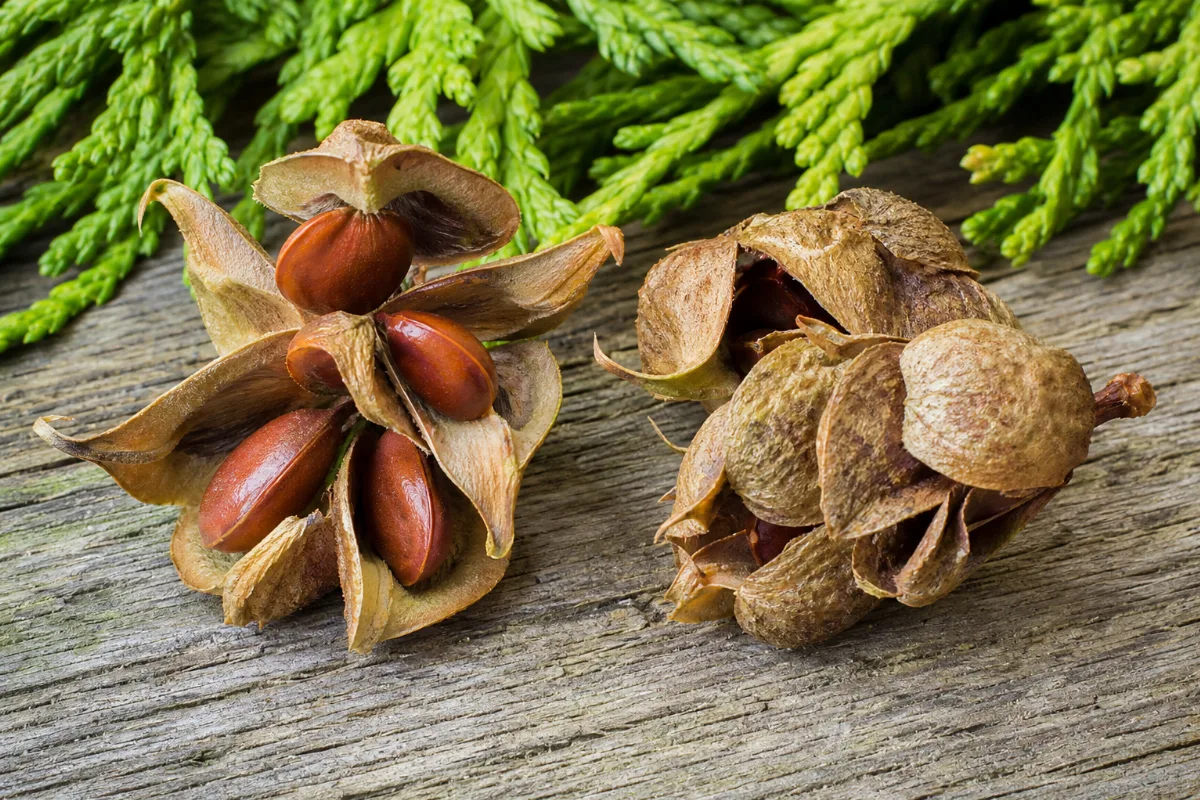
Platycladus seed, bai zi ren in Chinese, is the dried ripe kernel of Platycladus orientalis, a conifer in the cypress family. Older books call the tree Biota orientalis. The kernel is soft, oily and mildly aromatic.
It is not the same as Thuja, another arborvitae whose leaf contains thujone. See the Thuja profile for that plant.
Traditional and current uses
In Chinese medicine the seed is a heart-nourishing calming herb. It is listed for insomnia with restlessness and palpitations, for night sweating, and for constipation from dryness. It is often paired with jujube seed in insomnia formulas, which a 2024 study of 104 prescriptions confirmed as a common pairing.
Modern practitioners also use it for anxiety, according to the authors of a 2023 mouse paper.
What is in it and how it works
The seed oil is rich in oleic, linoleic and alpha-linolenic acids. Extracts also hold terpenoids, plant sterols and flavonoids. Our notes name pinene-type oil and saponins, which we could not confirm in a source we read.
In mice and rats, extracts and the oil changed fat-handling pathways, brain chemicals such as serotonin and dopamine, and a sphingolipid pathway. These are animal and computer findings, not proven effects in people.
What the research shows
A 2022 trial gave 223 adults with knee osteoarthritis a processed seed oil extract or placebo for 56 days. Pain fell by about 36 to 38 points on a 100-point scale in every extract group, more than placebo. The maker helped run it, and it is not the whole seed.
For sleep, anxiety, mood and memory there are only mouse and rat studies. Heart-rhythm trials are of Yangxin Dingji Capsules, said to derive from a licorice-based formula; the abstracts do not name the seed as an ingredient, so they are formula evidence only. A 2022 trial of these capsules was retracted and is not used.
At a glance
Traditional uses history, not proof
- Chinese medicine: to nourish the heart and calm the mind for insomnia with restlessness and palpitations
- Chinese medicine: to moisten the bowel in constipation from dryness
- Chinese medicine: for night sweating from yin deficiency
- Used in multi-herb formulas, often paired with jujube seed for sleep
Studied for research
- Knee osteoarthritis pain, low (one industry-linked trial of a processed oil extract)
- Sleep, insufficient (tradition and mouse work)
- Anxiety, insufficient (mouse study)
- Low mood, insufficient (rat study)
- Memory, insufficient (mouse study of the oil)
- Constipation and night sweats, insufficient (tradition only)
- Heart rhythm, insufficient (trials are of a formula that may not contain the seed)
Main compounds
- Seed oil rich in oleic, linoleic and alpha-linolenic acids
- Terpenoids, plant sterols and flavonoids in extracts
- Pinene-type volatile oil and saponins named in our notes, not confirmed in a source we read
Common forms
- Dried kernel, used in decoctions and formulas
- Seed oil and oil extracts
- Water extracts
- Multi-herb pills and capsules (some contain cinnabar, a mercury mineral)
Research links: Knee osteoarthritis trial of a seed oil extract (Inflammopharmacology, 2022) · Mould toxins in 190 batches (J Chromatogr A, 2025) · Anxiety study in mice (J Ethnopharmacol, 2023) · Research Library · Genes & Biomarkers Library
The plant and its history
- Accepted scientific name
- Platycladus orientalis (L.) Franco
- Naming authority
- (L.) Franco
- Synonyms
- Biota orientalis (L.) Endl.
- Common names
- Chinese arborvitae seed (English); Oriental arborvitae seed (English); Bai zi ren (Chinese (pinyin)); Platycladi Semen (Latin (pharmacopoeial))
- Botanical family
- Cupressaceae (cypress family). A conifer, so the "seed" is a kernel from a small cone.
- Classification
- Plantae > Tracheophyta > Pinopsida > Pinales > Cupressaceae > Platycladus > Platycladus orientalis
- Native range
- Not verified from a source read.
- Habitat
- Not verified from a source read.
- What the plant looks like
- Roots: Not verified.; Stems: Not verified.; Leaves: Not covered here.; Flowers: Not covered here.; Fruit: The ripe seed is long ovoid, 0.4-0.7 cm long, yellowish-white to pale yellowish-brown with a membranous coat; soft and oily; slightly aromatic, bland taste (Hong Kong standard).
- Cultivation
- Not verified.
- Harvest and processing
- Per the Hong Kong standard: the ripe seed is collected in autumn and winter, dried in the sun, and the testa removed to give the kernel.
- Look-alikes and adulterants
- Name: Thuja occidentalis (eastern arborvitae); Note: A different genus. Its leaf contains thujone. Do not mix up safety information. See the Thuja profile.; Name: Other seeds sold as bai zi ren; Note: Not verified. Check the Latin name Platycladus orientalis on any product.
- Sustainability and conservation
- Not verified.
Traditional use and history history, not clinical proof
| Tradition or era | Documented use | Source |
|---|---|---|
| Chinese medicine, classical | A 2023 paper says the seed is recorded in Shen Nong Ben Cao Jing and in many insomnia prescriptions, and was regarded as low in toxicity with long use. | p37201666 |
| Chinese medicine, modern database | Heart-nourishing calming herb: insomnia with fidgetiness and palpitation, night sweating from yin deficiency, and constipation from intestinal dryness. Sweet and neutral; heart, kidney and large-intestine meridians. | s-polyu |
| Chinese medicine, about 2,000 years | Used for insomnia and constipation in China for about 2,000 years, per a 2020 paper. | p33193220 |
Traditional use shows how a plant was used. It does not show that a supplement works or is safe today.
What is inside, and how it may work
What the plant contains and how those compounds act in cells and animals. Laboratory and animal mechanisms are not proven effects in people.
Main compounds
| Compound | Family | Where it is concentrated | Activity studied | Level of evidence |
|---|---|---|---|---|
| Oleic acid PubChem 445639 | fatty acid | Seed oil | Used as an identification marker in the Hong Kong standard. 6 13 | Regulatory standard |
| Linoleic acid PubChem 5280450 | fatty acid | Seed oil | A main oil component in a 2023 mouse study; bound sphingolipid-pathway proteins in docking. 6 18 13 | Animal research |
| alpha-Linolenic acid PubChem 5280934 | fatty acid | Seed oil | Also an identification marker; the other most abundant oil component in the mouse study. 6 18 13 | Animal research |
| alpha-Pinene (pinene-type volatile oil) PubChem 6654 | monoterpene | Volatile oil | Named in our earlier notes as a seed volatile oil type. Its presence and amount in the seed were not confirmed in a source we read. Chemical identity only. 13 | Not verified in seed |
| Terpenoids, plant sterols, amino acids and flavonoids | mixed | Seed | 41 compounds identified in a seed extract across these groups. Diterpenes and saponins are named in our earlier notes; saponins are said to be sedative in mice (summary-only). 16 3 | Laboratory research |
Mechanisms, receptors and pathways
| Target or pathway | Gene or receptor | What was found | Level |
|---|---|---|---|
| Fat-handling (lipid) pathways; PPAR-alpha, PPAR-delta, PPAR-gamma, FABP3, FABP5, FAAH | PPARA, PPARD, PPARG, FABP3, FABP5, FAAH (docking predictions) | In stressed mice, seed extracts changed blood lipid metabolites; computer docking suggested the seed compounds can bind these proteins. 15 | In silico |
| Serotonin, noradrenaline and dopamine levels; possible monoamine reuptake and MAO effects | Not specified in the abstract | In stressed rats a seed extract restored these brain chemicals; in zebrafish it increased rest. 16 | Animal research |
| Sphingolipid pathway SPHK1/S1P/S1PR5 and gut bacteria | SPHK1, S1PR5 | In mice with amyloid injury the seed oil improved memory and altered this pathway; the two main oil fatty acids bound both proteins in docking. 18 | Animal research |
| cAMP, HIF-1, PI3K-Akt and prolactin signalling (predicted) | Not specified in the abstract | A prediction from 104 insomnia prescriptions, not a test of the seed. 5 | In silico |
| Serotonin and GABA pathways (sleep) | Not specified | Our earlier summary of a 2025 mouse paper on seed essential oil and saponin. Not re-opened. 3 | Animal research |
Absorption, metabolism and elimination
- Absorption
- No human absorption study of the seed was found.
- Distribution
- Not established.
- Metabolism
- Not established.
- Elimination
- Not established.
- Bioavailability
- Not established.
Isolated compounds versus whole extracts
Most pharmacology is on extracts, the seed oil, or computer prediction. The one human trial used a processed oil extract. Results on extracts cannot be assumed for the whole seed as used in decoctions.
Nutritional composition
The kernel is an oily seed with oleic, linoleic and alpha-linolenic acids identified in the Hong Kong standard. No nutrient analysis was read, so no nutrition claim is made. Oily seeds spoil if stored warm and damp.
1 low certainty7 not enough evidence
What is Platycladus seed good for?
The main proposed uses and how strong the human evidence is for each. "Low" means one trial with limits, "insufficient" means tradition or animal work only. No use of the plain seed is shown in people.
Benefits, one by one
Each card is a research question, not a promise. Tap a goal to filter. Open a card to see the studies, doses and limits.
Sleep and insomnia
Not enough evidencePlatycladus seed is a classic Chinese remedy for sleeplessness with restlessness and a racing heart. We found no human trial of the seed on its own. The sleep evidence is tradition, a habit of using it with jujube seed in insomnia formulas, and mouse studies.
4 studiesNo human trial of the seed alone was found. Animal studies used water…
Studies, doses and limits
What the trials found
No human trial of the seed was found. A 2024 data-mining study of 104 insomnia prescriptions found the seed paired with jujube seed was one of six common herb pairs, which describes habit and not benefit.
Results
Mouse extracts: shorter time to fall asleep and longer sleep (summary-only). Data mining: a common pairing, no outcomes.
Effect sizes as reported
None for people.
Why this rating
Tradition, mouse work and a prescription-pattern study. No human trial of the seed alone, so effects on sleep in people are unknown.
Form and dose studied
No human trial of the seed alone was found. Animal studies used water extracts, a fatty oil or an essential oil, not the dried seed. Ask a doctor or pharmacist about amounts.
Who was studied
Mice; no human group.
Limits
Mouse sleep paper not re-opened (summary-only). Data mining does not test benefit. The seed is almost always used in multi-herb formulas, so any effect cannot be credited to it alone.
Why researchers looked
Used for about 2,000 years in China for insomnia, according to a 2020 paper.
Traditional use
The Hong Kong Polytechnic University database lists the seed for insomnia with fidgetiness and palpitation, and files it as a heart-nourishing calming herb. This is tradition, not proof.
Proposed mechanism Lab animal
A 2025 mouse report (read from our earlier summary only) found seed extracts shortened the time to fall asleep and lengthened sleep, pointing to serotonin and GABA pathways. A 2023 computer-and-mouse study pointed to fat-handling pathways instead. Neither is shown in people.
A proposed mechanism does not show that the effect happens in people.
If sleeplessness lasts more than a few weeks, see a doctor. Sedating medicines may add to any calming effect; ask a pharmacist.
Anxiety and restlessness
Not enough evidencePractitioners commonly use the seed for anxiety, and a 2023 mouse study found a water extract and the seed oil made stressed mice more willing to explore open spaces. No human trial was found.
2 studiesNo human trial of the seed alone was found. Animal studies used water…
Studies, doses and limits
What the trials found
No human trial was found.
Results
Both the water extract and the fatty oil raised open-arm time and entries in the elevated plus maze in stressed mice (2023).
Effect sizes as reported
Not given in the abstract.
Why this rating
One mouse study with a computer analysis. Nothing in people.
Form and dose studied
No human trial of the seed alone was found. Animal studies used water extracts, a fatty oil or an essential oil, not the dried seed. Ask a doctor or pharmacist about amounts.
Who was studied
Mice.
Limits
Mouse behaviour tests do not map neatly onto human anxiety.
Why researchers looked
Modern practitioners in China use the seed for anxiety disorders, say the authors of the mouse paper.
Traditional use
Seen in Chinese medicine as calming the heart and mind, with restlessness and palpitations as classic signs.
Proposed mechanism Lab animal
In stressed mice the seed extracts changed fat-handling (lipid) pathways in the blood and, in computer docking, bound proteins such as PPAR-alpha and FABP5. These are predictions, not proven mechanisms.
A proposed mechanism does not show that the effect happens in people.
Anxiety that affects daily life needs a doctor. Do not replace prescribed treatment with the seed.
Low mood and depression
Not enough evidenceA rat study found a seed extract restored brain chemicals such as serotonin and dopamine in stressed rats. No human trial of mood was found.
1 studiesNo human trial of the seed alone was found. Animal studies used water…
Studies, doses and limits
What the trials found
No human trial was found.
Results
In stressed rats the extract restored brain monoamines; in zebrafish it increased rest.
Effect sizes as reported
Not given in the abstract.
Why this rating
One rat and zebrafish study (with a 2024 erratum). Nothing in people.
Form and dose studied
No human trial of the seed alone was found. Animal studies used water extracts, a fatty oil or an essential oil, not the dried seed. Ask a doctor or pharmacist about amounts.
Who was studied
Rats and zebrafish.
Limits
A published correction exists and was not opened. Animal depression models are weak guides to human depression.
Why researchers looked
The authors cite old texts that record the seed for mood and activity.
Traditional use
Old Chinese texts such as Shen Nong Ben Cao Jing mention the seed in formulas that affect mood and activity, according to the paper.
Proposed mechanism Lab animal
In stressed rats, a seed extract raised serotonin, noradrenaline and dopamine in two brain regions, and the authors suggest it may block the recycling of these chemicals. This is a hypothesis from rat, zebrafish and computer work.
A proposed mechanism does not show that the effect happens in people.
Low mood that lasts needs a doctor. If you take an antidepressant, ask a pharmacist before adding any herb that may act on serotonin; no human interaction data exist.
Memory and brain protection
Not enough evidenceIn mice with an amyloid injury, a seed oil improved learning and memory and lowered amyloid and tau markers. This is an early animal finding with no human test.
1 studiesA seed oil was tested in mice. Ask a doctor or pharmacist about amoun…
Studies, doses and limits
What the trials found
No human trial was found.
Results
Better learning and memory, less hippocampal damage and lower amyloid and p-Tau markers in injured mice (2023).
Effect sizes as reported
Not given in the abstract.
Why this rating
One mouse study.
Form and dose studied
A seed oil was tested in mice. Ask a doctor or pharmacist about amounts.
Who was studied
Mice with injected amyloid.
Limits
The model mimics one feature of Alzheimer disease and does not show prevention or treatment in people.
Why researchers looked
Researchers are looking at the seed oil, rich in linolenic and linoleic acids, as a possible brain-protective fat.
Traditional use
Not a traditional headline use of the seed.
Proposed mechanism Lab animal
In mice, the oil appeared to act through a sphingolipid (S1P) pathway and gut bacteria. This is from mice and computer docking.
A proposed mechanism does not show that the effect happens in people.
Memory problems need a doctor.
Knee osteoarthritis pain
Low certaintyA processed oil extract from Biota orientalis (now Platycladus orientalis) seeds cut knee pain more than placebo in a 56-day trial of 223 adults. The maker helped run the trial, it was a pilot, and the product is a proprietary extract, not the dried seed.
1 studiesA proprietary hydrolysed oil extract of Biota orientalis seeds, taken…
Studies, doses and limits
What the trials found
One randomised, blinded, placebo-controlled pilot (Mitchell 2022, 223 adults aged 40-65, 56 days).
Results
Knee pain scores fell by roughly 36 to 38 points in each seed-oil group versus a smaller fall on placebo (p < 0.0001). WOMAC, SF-36 and responder measures moved the same way. No serious adverse events were reported.
Effect sizes as reported
LS-mean falls 36.4, 37.9 and 35.7 in the three hBO groups; the placebo figure in the abstract looks mis-typed and is not quoted.
Why this rating
A single randomised trial with a clear result, but a pilot, short, a proprietary extract, and run with the maker. It has not been repeated by others.
Form and dose studied
A proprietary hydrolysed oil extract of Biota orientalis seeds, taken as capsules. Amounts are not given here. Ask a doctor or pharmacist about amounts.
Who was studied
Adults aged 40-65 with X-ray knee osteoarthritis and moderate to severe pain.
Limits
Industry-linked: two authors own the maker, Interpath, and others work for the trial company. 56 days only. The three amounts gave similar benefit. Cannot be applied to eating the whole seed. Abstract read only.
Why researchers looked
Researchers tested a hydrolysed seed oil in people with knee osteoarthritis.
Traditional use
Not a traditional use of the seed.
Proposed mechanism Lab animal
The mechanism in joints is not established in the abstract.
A proposed mechanism does not show that the effect happens in people.
If you take medicine for arthritis or blood thinners, ask a pharmacist before adding an oil supplement.
Constipation from dryness
Not enough evidenceThe seed is soft and oily, and Chinese medicine uses it to moisten the bowel in dry constipation. We found no modern trial.
2 studiesDried kernel, usually in decoctions or formulas. Ask a doctor or phar…
Studies, doses and limits
What the trials found
No human trial of the seed for constipation was found.
Results
None.
Effect sizes as reported
None.
Why this rating
Tradition only; no trial found.
Form and dose studied
Dried kernel, usually in decoctions or formulas. Ask a doctor or pharmacist about amounts.
Who was studied
n/a
Limits
Nothing has been tested.
Why researchers looked
A 2,000-year traditional use, listed in the Hong Kong Polytechnic database.
Traditional use
Listed as constipation due to intestinal dryness; actions include moistening the intestines.
Proposed mechanism Traditional
It is often assumed the seed oil explains this, but we did not find a source that tests it.
A proposed mechanism does not show that the effect happens in people.
Because the seed is oily and traditionally moistening, loose stools are plausible by theory. See the safety file.
Palpitations and heart rhythm (formula evidence)
Not enough evidenceTraditional texts list the seed for palpitations with restlessness. The only human trials we found are of multi-herb heart-rhythm products whose herb lists we could not confirm include the seed. That is formula evidence, not evidence for the seed.
3 studiesCapsules in the trials; not the seed alone. Ask a doctor or pharmacis…
Studies, doses and limits
What the trials found
A 2021 meta-analysis of 15 trials (1,371 patients) of Yangxin Dingji Capsules plus usual heart-rhythm medicine. A 2022 single trial of the same capsules was retracted and is not used. The capsule is said to be derived from Zhigancao Decoction; the abstracts do not name platycladus seed as an ingredient.
Results
Added to usual medicine, the capsule was linked to better clinical response (RR 1.23), higher ejection fraction (+4.31) and fewer adverse reactions (RR 0.53). Authors call for better trials.
Effect sizes as reported
RR 1.23 (95% CI 1.17-1.30); ejection fraction MD 4.31 (3.10-5.52).
Why this rating
For the seed itself, nothing: the formula tested may not contain it. For the formula in arrhythmia, the authors themselves rate quality as limited.
Form and dose studied
Capsules in the trials; not the seed alone. Ask a doctor or pharmacist about amounts.
Who was studied
Patients with arrhythmia on usual medicine.
Limits
Cannot credit the seed. Add-on to medicine. A related product, Baizi Yangxin Pills, has been studied for mercury safety (see the safety file). Palpitations can be serious; do not self-treat.
Why researchers looked
Palpitations with restlessness are a classic indication in the Hong Kong database.
Traditional use
Palpitation with fidgetiness is an indication listed for the seed.
Proposed mechanism Traditional
No mechanism was established for the seed.
A proposed mechanism does not show that the effect happens in people.
Palpitations, fainting or chest pain need a doctor.
Night sweating
Not enough evidenceTraditional texts list the seed for night sweats from "yin deficiency". There is no modern evidence.
1 studiesNot applicable.
Studies, doses and limits
What the trials found
No human trial was found.
Results
None.
Effect sizes as reported
None.
Why this rating
Tradition only.
Form and dose studied
Not applicable.
Who was studied
n/a
Limits
Nothing has been tested.
Why researchers looked
Listed in the Hong Kong database.
Traditional use
Actions include checking excessive perspiration.
Proposed mechanism Traditional
No mechanism established.
A proposed mechanism does not show that the effect happens in people.
Night sweats can have medical causes; see a doctor if they persist.
Connections to the rest of health
How Platycladus seed connects to the rest of our health knowledge graph. Every link says what kind of connection it is. A safety link (for example to the liver) is a warning, not a benefit. A study that merely mentions a topic never creates a benefit link.
Explore every connection: goals, body systems, organs, symptoms, genes
A. Wellness goals
| Connected to | Kind of connection | Evidence status | Context | Studies |
|---|---|---|---|---|
| Better Sleep | Traditional use | Not enough evidence | Sleep and insomnia: Platycladus seed is a classic Chinese remedy for sleeplessness with restlessness and a racing heart. We found no human trial of the seed on its own. The sleep evidence is tradition, a habit of using it with jujube seed in insomnia formulas, and mouse studies. | 3 7 5 15 |
| Sleep Quality | Traditional use | Not enough evidence | Sleep and insomnia: Platycladus seed is a classic Chinese remedy for sleeplessness with restlessness and a racing heart. We found no human trial of the seed on its own. The sleep evidence is tradition, a habit of using it with jujube seed in insomnia formulas, and mouse studies. | 3 7 5 15 |
| Anxiety Support | Traditional use | Not enough evidence | Anxiety and restlessness: Practitioners commonly use the seed for anxiety, and a 2023 mouse study found a water extract and the seed oil made stressed mice more willing to explore open spaces. No human trial was found. | 15 7 |
| Stress Reduction | Traditional use | Not enough evidence | Anxiety and restlessness: Practitioners commonly use the seed for anxiety, and a 2023 mouse study found a water extract and the seed oil made stressed mice more willing to explore open spaces. No human trial was found. | 15 7 |
| Mood Balance | Traditional use | Not enough evidence | Low mood and depression: A rat study found a seed extract restored brain chemicals such as serotonin and dopamine in stressed rats. No human trial of mood was found. | 16 |
| Memory Support | Potential benefit | Not enough evidence | Memory and brain protection: In mice with an amyloid injury, a seed oil improved learning and memory and lowered amyloid and tau markers. This is an early animal finding with no human test. | 18 |
| Joint Support | Potential benefit | Low certainty | Knee osteoarthritis pain: A processed oil extract from Biota orientalis (now Platycladus orientalis) seeds cut knee pain more than placebo in a 56-day trial of 223 adults. The maker helped run the trial, it was a pilot, and the product is a proprietary extract, not the dried seed. | 11 |
| Digestive Support | Traditional use | Not enough evidence | Constipation from dryness: The seed is soft and oily, and Chinese medicine uses it to moisten the bowel in dry constipation. We found no modern trial. | 7 17 |
| Regularity | Traditional use | Not enough evidence | Constipation from dryness: The seed is soft and oily, and Chinese medicine uses it to moisten the bowel in dry constipation. We found no modern trial. | 7 17 |
| Heart Health | Traditional use | Not enough evidence | Palpitations and heart rhythm (formula evidence): Traditional texts list the seed for palpitations with restlessness. The only human trials we found are of multi-herb heart-rhythm products whose herb lists we could not confirm include the seed. That is formula evidence, not evidence for the seed. | 14 10 7 |
| Night Sweats | Traditional use | Not enough evidence | Night sweating: Traditional texts list the seed for night sweats from "yin deficiency". There is no modern evidence. | 7 |
B. Body systems
| Connected to | Kind of connection | Evidence status | Context | Studies |
|---|---|---|---|---|
| Gut health | Adverse effect or risk | Not enough evidence | Loose stools are a plausible effect of an oily, moistening seed by theory; not documented. Preparation or compound: Platycladus seed (oily kernel) |
7 |
| Sleep Recovery | Biological association | Not enough evidence | Studied for: Sleep and insomnia | 3 7 5 15 |
| Nervous System | Biological association | Not enough evidence | Studied for: Sleep and insomnia Studied for: Anxiety and restlessness | 3 7 5 15 16 18 |
| Stress Mood | Biological association | Not enough evidence | Studied for: Anxiety and restlessness Studied for: Low mood and depression | 15 7 16 |
| Brain Health | Biological association | Not enough evidence | Studied for: Memory and brain protection | 18 |
| Joints Bones | Biological association | Low certainty | Studied for: Knee osteoarthritis pain | 11 |
| Musculoskeletal | Biological association | Low certainty | Studied for: Knee osteoarthritis pain | 11 |
| Gut Health | Biological association | Not enough evidence | Studied for: Constipation from dryness | 7 17 |
| Digestive System | Biological association | Not enough evidence | Studied for: Constipation from dryness | 7 17 |
| Cardiovascular | Biological association | Not enough evidence | Studied for: Palpitations and heart rhythm (formula evidence) | 14 10 7 |
| Heart | Biological association | Not enough evidence | Studied for: Palpitations and heart rhythm (formula evidence) | 14 10 7 |
| Hormonal Balance | Biological association | Not enough evidence | Studied for: Night sweating | 7 |
| Menopause | Biological association | Not enough evidence | Studied for: Night sweating | 7 |
G. Root causes and contributing factors
| Connected to | Kind of connection | Evidence status | Context | Studies |
|---|---|---|---|---|
| Herb contamination (mould toxins) | Moderate certainty | Mycotoxins were found in 188 of 190 batches in one 2025 survey. Mycotoxins were found in 188 of 190 batches in one 2025 survey and aflatoxin in 5 of 11 samples in a 2020 study. A safety relationship, not a benefit. Preparation or compound: Stored seed kernel |
2 17 |
I. Biomarkers
| Connected to | Kind of connection | Evidence status | Context | Studies |
|---|---|---|---|---|
| Knee pain score (100-point scale) | Biological association | Low certainty | Measured in trials: lowered. A lab change is not the same as a health benefit. | 11 |
| Modified WOMAC (pain, stiffness, function) | Biological association | Low certainty | Measured in trials: lowered. A lab change is not the same as a health benefit. | 11 |
| Left ventricular ejection fraction (formula evidence) | Biological association | Not enough evidence | Measured in trials: increased. A lab change is not the same as a health benefit. | 14 |
| Heart rate (formula evidence) | Biological association | Not enough evidence | Measured in trials: lowered. A lab change is not the same as a health benefit. | 14 |
| NT-proBNP (formula evidence) | Biological association | Not enough evidence | Measured in trials: lowered. A lab change is not the same as a health benefit. | 14 |
J. Genes, receptors and enzymes
| Connected to | Kind of connection | Evidence status | Context | Studies |
|---|---|---|---|---|
| PPARA, PPARD, PPARG (PPAR family) | Preliminary mechanism | In silico | Predicted docking targets of seed compounds in a stressed-mouse study. | 15 |
| SPHK1 and S1PR5 | Preliminary mechanism | In silico | Predicted targets of the seed oil fatty acids in an amyloid-injury mouse study. | 18 |
L. Active compounds
| Connected to | Kind of connection | Evidence status | Context | Studies |
|---|---|---|---|---|
| Oleic acid | Biological association | Regulatory standard | Used as an identification marker in the Hong Kong standard. Preparation or compound: Seed oil |
6 13 |
| Linoleic acid | Biological association | Animal | A main oil component in a 2023 mouse study; bound sphingolipid-pathway proteins in docking. Preparation or compound: Seed oil |
6 18 13 |
| alpha-Linolenic acid | Biological association | Animal | Also an identification marker; the other most abundant oil component in the mouse study. Preparation or compound: Seed oil |
6 18 13 |
| alpha-Pinene (pinene-type volatile oil) | Biological association | Not verified in seed | Named in our earlier notes as a seed volatile oil type. Its presence and amount in the seed were not confirmed in a source we read. Chemical identity only. Preparation or compound: Volatile oil |
13 |
| Terpenoids, plant sterols, amino acids and flavonoids | Biological association | In vitro | 41 compounds identified in a seed extract across these groups. Diterpenes and saponins are named in our earlier notes; saponins are said to be sedative in mice (summary-only). Preparation or compound: Seed |
16 3 |
Each connection is stored with the ingredient, the connected record, the kind of connection, the evidence status, the supporting studies, the preparation or compound involved, and a review date (last reviewed October 25, 2026).
Evidence at a glance: what changed in 4 lab markers
Tap a number to show only those markers. Counts are markers, not people.
The evidence
The research centre for Platycladus seed. Every record here was checked against PubMed or the publisher's page; we never list a study we have not verified.
Evidence by outcome
Bars show how many studies we found for each outcome, not how well it works. People are added up across trials only (reviews are not added, to avoid double counting).
How we rate evidence
High certainty
Several well-run trials or reviews agree; further research is unlikely to change the picture much.
Moderate certainty
Good trials point the same way, but some doubt remains.
Low certainty
Small, short or inconsistent trials. The finding could change with better research.
Very low certainty
Very little or very weak human data. Treat as a possibility only.
Mixed findings
Trials or reviews disagree with each other.
Not enough evidence
Not enough human research to say either way.
Evidence against
Good research found no benefit, or found harm.
We take the reviewers' own risk-of-bias and GRADE statements where they exist, and otherwise judge from study size, design, consistency, directness and whether a product matches what is sold. Many publications do not make evidence high. Method note: We started from our earlier summary of the seed, then searched PubMed, read the abstract of every cited study, and checked plant names in GBIF and NCBI Taxonomy and chemical IDs in PubChem. We read the Hong Kong herbal standard and the Hong Kong Polytechnic University herb database. We did not find an EMA, NCCIH, LiverTox or LactMed entry. One 2025 mouse sleep paper is cited from our earlier summary and was not re-opened.
Study library: every study we checked 18
| Study | Design | People | Product, dose, length | Result |
|---|---|---|---|---|
| AlternativeMed editorial team 2026 Search for regulator entries on platycladus seed (EMA/HMPC, NCCIH, FDA, LiverTox, LactMed, Commission E, WHO) Checked 2026-10-25 · Source |
Search record n/a |
Methods, limits and fundingRead: not-found | ||
| Fang 2025 Monte Carlo simulation-based risk assessment of human exposure to multi-mycotoxins in Platycladi semen J Chromatogr A · PMID 40203636 · DOI |
Lab survey n/a |
190 190 batches of Platycladi semen bought from different channels in China |
Dried Platycladi semen (kernel) seed Single survey · vs None |
188 of 190 batches carried one or more mycotoxins (98.95%). Alternariol monomethyl ether (92.63%), fumonisin B2 (91.58%) and sterigmatocystin (87.89%) were commonest. Aflatoxin B1 was over the official limit in 26 batches and total aflatoxins in 18. The risk model flagged aflatoxins and sterigmatocystin as the main concern. Counts as above; no effect size applies. Methods, limits and fundingOutcomes: Mycotoxin levels and modelled human exposure risk Limitations: A survey of products on the market, not a trial. Risk is modelled, not measured in people. Funding and conflicts: Authors declared no competing interests. Read: abstract |
| Food Science and Human Wellness (2025) 2025 Essential oil and saponin from Semen Platycladi exert sedative-hypnotic effect on ICR mice Journal article, summary only · Source |
Animal research n/a |
Methods, limits and fundingRead: summary-only | ||
| GBIF 2026 GBIF Backbone: Platycladus orientalis (L.) Franco (usageKey 2684855) and synonym Biota orientalis (L.) Endl. (usageKey 2684857) GBIF species API, checked 2026-10-25 · Source |
Reference database n/a |
Methods, limits and fundingRead: full-text | ||
| Guo 2024 Medication Rules of Hub Herb Pairs for Insomnia and Mechanism of Action: Results of Data Mining, Network Pharmacology, and Molecular Docking Chin Med Sci J · PMID 39789928 · DOI |
Data mining in-silico |
104 traditional prescriptions for insomnia | Herb pairs, including Semen Platycladi with Semen Ziziphi Spinosae (jujube seed) seed (within formulas) n/a n/a · vs n/a |
Semen Platycladi plus jujube seed (Semen Ziziphi Spinosae) was one of six hub herb pairs found in 104 insomnia prescriptions. The study maps how often herbs are used and predicts pathways by computer. It does not test whether the herbs work. n/a Methods, limits and fundingOutcomes: Which herbs are used together; predicted pathways Limitations: Describes habit and predictions, not benefit. Abstract read only. Funding and conflicts: No conflict statement shown in the abstract. Read: abstract |
| Hong Kong Chinese Medicine Regulatory Office 2026 Hong Kong Chinese Materia Medica Standards, Vol. 8: Platycladi Semen Government herbal standard (PDF), opened 2026-10-25 · Source |
Regulatory standard n/a |
Methods, limits and fundingRead: full-text | ||
| Hong Kong Polytechnic University School of Nursing 2026 Chinese Arborvitae Kernel (Platycladi Semen), Chinese Herbal Medicine Database Web database, opened 2026-10-25 · Source |
Reference database n/a |
Methods, limits and fundingRead: full-text | ||
| Hu 2024 Health risk assessment for human mercury exposure from Cinnabaris-containing Baizi Yangxin Pills in healthy volunteers Po administration J Trace Elem Med Biol · PMID 38245934 · DOI |
Pk study |
Healthy volunteers (number not shown in the abstract) | Baizi Yangxin Pills (contain cinnabar, a mercury mineral) formula Single dose, then repeated dosing for 7 days (reported to describe the study only) Up to 7 days · vs Single versus repeated dosing |
Mercury was cleared slowly and built up with repeated use. Methylmercury, a nerve toxin, appeared in blood after 7 days. The authors conclude that long use of this cinnabar pill can cause mercury poisoning and that such pills should be limited to cases with no alternative. Not given in the abstract. Methods, limits and fundingOutcomes: Mercury in blood and urine after single and repeated doses Limitations: Healthy volunteers, short exposure, abstract read only. The abstract does not list the other herbs. Funding and conflicts: Authors declared potential interests in a statement the abstract cuts off; not read in full. Read: abstract |
| Lu 2020 Toxicity and risk assessment of mercury exposures from cinnabar and Baizi Yangxin Pills based on pharmacokinetic and tissue distribution studies J Ethnopharmacol · PMID 31866510 · DOI |
Animal research rat |
Rats | Baizi Yangxin Pills versus cinnabar alone formula 1x and 10x clinical-equivalent Up to 30 days · vs Cinnabar alone |
The other herbs in the pill increased how much mercury from cinnabar was absorbed and slowed its clearance. Mercury built up in kidney, liver and brain. Kidney and liver showed no clear damage but the brain showed changes and the rats were less active. Not given in the abstract. Methods, limits and fundingOutcomes: Blood and tissue mercury; tissue damage Limitations: Rat study. Funding and conflicts: No conflict statement shown in the abstract. Read: abstract |
| Lu 2026 Comparative Chemical and Pharmacodynamic Evaluation of Different Purification Procedures for Yangxin Dingji Capsules Biomed Chromatogr · PMID 42867275 · DOI |
Animal research rat |
Rats with barium chloride-induced arrhythmia | Yangxin Dingji Capsule extracts, made several ways formula n/a n/a · vs Model rats |
The abstract says the capsules are derived from Zhigancao Decoction (a licorice-based heart formula) and are used for arrhythmia. It does not name the herbs or say that platycladus seed is one of them. n/a Methods, limits and fundingOutcomes: Chemical fingerprint and heart-rhythm measures in rats Limitations: Used here only for what the formula is derived from. Lab and rat work. Funding and conflicts: No conflict statement shown in the abstract. Read: abstract |
| Mitchell 2022 The Biota orientalis, oil extract Epiitalis(R), is efficacious at reducing the symptoms of knee osteoarthritis: a pilot, multi-site, dose-ranging, randomized, blinded, placebo-controlled trial Inflammopharmacology · PMID 35732989 · DOI |
Controlled trial |
223 Adults aged 40-65 with X-ray knee osteoarthritis and knee pain of 60 or more on a 100-point scale (223 in the modified intention-to-treat group) |
Proprietary hydrolyzed oil extract of Biota orientalis seeds (hBO, Epiitalis) seed (oil extract) 160, 320 or 640 mg a day (reported to describe the study only) 56 days · vs Matched placebo oil |
Knee pain fell by about 36 to 38 points in each hBO group (least-square means 36.4, 37.9 and 35.7) compared with a much smaller fall in the placebo group. All hBO groups differed from placebo (p < 0.0001). Similar gains were seen on mWOMAC, SF-36 and the responder index. No serious adverse events and no adverse events ascribed to the treatment. The placebo fall is printed as 9.8 with an interval of 14.5-15.2 in the abstract, which looks mis-typed, so we do not quote it. The three amounts gave similar benefit. Methods, limits and fundingOutcomes: Knee pain (VAS) at day 56; mWOMAC, SF-36 and OMERACT-OARSI responder index as exploratory outcomes Limitations: A pilot, 56 days only, a proprietary processed oil extract (not the whole seed), and the three active groups looked alike, which makes a true dose effect hard to judge. Abstract read only. Funding and conflicts: Industry-linked: two authors own Interpath Pty Ltd, the maker, one is a paid consultant to it, and two authors are employees of the trial contract company Vedic. Registration: NCT04117490 Read: abstract |
| NCBI 2026 NCBI Taxonomy: Platycladus orientalis (taxid 58046) NCBI Taxonomy esearch, checked 2026-10-25 · Source |
Reference database n/a |
Methods, limits and fundingRead: full-text | ||
| NCBI PubChem 2026 PubChem compound records: alpha-pinene (6654), oleic acid (445639), linoleic acid (5280450), alpha-linolenic acid (5280934) PubChem PUG REST, checked 2026-10-25 · Source |
Reference database n/a |
Methods, limits and fundingRead: full-text | ||
| Wang 2021 Systematic review and meta-analysis of efficacy and safety of Yangxin Dingji Capsules in treatment of arrhythmia Zhongguo Zhong Yao Za Zhi · PMID 34738445 · DOI |
Meta-analysis |
1371 Patients with arrhythmia in 15 randomised trials (685 treatment, 686 control) |
Yangxin Dingji Capsules (a multi-herb capsule) plus usual heart-rhythm medicine formula (ingredients not listed in the abstract) Not reported here Varied · vs Usual heart-rhythm medicine alone |
Added to usual medicine, the capsule was linked to more clinical response (RR 1.23), a higher ejection fraction (mean difference 4.31), a slightly lower heart rate (-3.79) and fewer adverse reactions (RR 0.53). The authors say more high-quality trials are needed because of small sample sizes and quality limits. RR 1.23 for response; MD 4.31 for ejection fraction; RR 0.53 for adverse reactions. (RR 1.17-1.30 for response; MD 3.10-5.52 for ejection fraction; RR 0.36-0.79 for adverse reactions) Methods, limits and fundingOutcomes: Clinical response, ejection fraction, heart rate, heart-size measures, NT-proBNP, hs-CRP, adverse reactions Limitations: Add-on to medicine, not the capsule alone. The abstract does not list the herbs, so the seed cannot be credited. Quality limits acknowledged by the authors. Article in Chinese. Funding and conflicts: No conflict statement shown in the abstract. Read: abstract |
| Xie 2023 Integration of non-targeted metabolomics with network pharmacology deciphers the anxiolytic mechanisms of Platycladi Semen extract in CUMS mice J Ethnopharmacol · PMID 37201666 · DOI |
Animal research mouse |
Mice with chronic unpredictable mild stress | Platycladi Semen aqueous extract and methyl-esterified fatty oil seed Not stated in the abstract · vs Stressed untreated mice |
Both the water extract and the fatty oil raised open-arm time and entries in the stressed mice. 34 blood metabolites changed, mostly in fat-handling pathways. Computer docking suggested the seed compounds could bind PPAR and fatty-acid-binding proteins. Not given in the abstract. Methods, limits and fundingOutcomes: Elevated plus maze (open-arm time and entries); serum metabolomics; network pharmacology; molecular docking Limitations: Mouse and computer work only. Docking is a prediction. Funding and conflicts: Authors declared no competing interests. Read: abstract |
| Yan 2022 Platycladus orientalis seed extract as a potential triple reuptake MAO inhibitor rescue depression phenotype through restoring monoamine neurotransmitters J Ethnopharmacol · PMID 35489661 · DOI |
Animal research rat-zebrafish |
Zebrafish and rats with chronic unpredictable mild stress | Seed extract of Platycladus orientalis (called S4) seed Not stated in the abstract · vs Untreated stressed rats |
41 compounds were identified (fatty acids, terpenoids, amino acids, plant sterols, flavonoids). The extract increased rest in zebrafish. In stressed rats it restored serotonin, noradrenaline and dopamine in the prefrontal cortex and dorsal raphe nucleus. Not given in the abstract. Methods, limits and fundingOutcomes: Zebrafish rest and wake behaviour; sucrose preference, tail-suspension and forced-swim tests; brain monoamine levels Limitations: Animal and computer work only. An erratum was published in 2024 (J Ethnopharmacol 318:116821); we did not open it. Funding and conflicts: No conflict statement shown in the abstract. Read: abstract |
| Yu 2020 Assessment of the Microbiome and Potential Aflatoxin Associated With the Medicinal Herb Platycladus orientalis Front Microbiol · PMID 33193220 · DOI |
Lab survey n/a |
11 11 Platycladi Semen samples from herbal markets in Shandong, Anhui and Hebei |
Dried Platycladi Semen seed Single survey · vs None |
Five of 11 samples held aflatoxins and one was over the Chinese Pharmacopoeia limit (2015 edition). Aspergillus was the main fungal group. Four potentially toxin-making fungi, including Aspergillus flavus, were found in all samples. The authors say the seed is prone to fungi and aflatoxin under humid, warm storage. Counts as above. Methods, limits and fundingOutcomes: Aflatoxin levels and fungal community Limitations: Only 11 samples. Funding and conflicts: No conflict statement shown in the abstract. Read: abstract |
| Zeng 2023 Platycladi Semen oil ameliorates A-beta 25-35-induced brain injury in mice based on network pharmacology and gut microbiota Zhongguo Zhong Yao Za Zhi · PMID 37802772 · DOI |
Animal research mouse |
Male mice given a brain injection of amyloid-beta 25-35 | Platycladi Semen oil seed Not stated in the abstract · vs Model mice; donepezil as positive control |
The seed oil improved learning and memory, reduced hippocampal damage and lowered amyloid and p-Tau markers in the injured mice. The two most abundant oil components were linolenic and linoleic acids, which bound well to two sphingolipid-pathway proteins in docking. Not given in the abstract. Methods, limits and fundingOutcomes: Learning and memory tests, neuron damage, amyloid and tau markers, oxidative stress, gut bacteria, network pharmacology Limitations: Mouse model of injury, not people. Article in Chinese; abstract read. Funding and conflicts: No conflict statement shown in the abstract. Read: abstract |
What we do not know yet
- What the evidence supports: one low-certainty trial of a processed seed oil extract for knee pain. Everything else is tradition or animal work.
- What is uncertain: whether the plain seed does anything for sleep, anxiety or constipation in people, and whether formula results apply to it.
- Missing: human trials of the plain seed, pregnancy, breastfeeding, child and interaction data, and agency monographs.
How new research is added
New studies are found by a saved PubMed search and are placed in a review queue. A person reads each one before it changes any evidence rating or safety wording. New publications never change ratings automatically.
Lab markers
What changed in blood or saliva tests during trials. A changed number is not the same as feeling or being healthier, and we give no "normal ranges".
Other 5
Knee pain score (100-point scale)
Lowered in trials
A self-rated line from 0 to 100 for how much the knee hurts. Lower is better.
Low certaintyResults and what it means
Why it was measured
The main outcome in the hydrolysed seed oil trial.
Statistical vs. clinical meaning
A symptom score people rate themselves, in one industry-linked pilot trial.
Safety implication
None specific.
| Study | Result | People | Product |
|---|---|---|---|
| 11 | Pain scores fell by about 36 to 38 points in each seed-oil group (36.4, 37.9, 35.7) and all differed from placebo (p < 0.0001). | 223 adults with knee osteoarthritis | Proprietary hydrolysed oil extract of Biota orientalis seeds, 56 days |
Modified WOMAC (pain, stiffness, function)
Lowered in trials
A questionnaire on knee pain, stiffness and daily function. Lower is better.
Low certaintyResults and what it means
Why it was measured
An exploratory outcome in the same trial.
Statistical vs. clinical meaning
Supports the pain result but with no figures in the abstract.
Safety implication
None specific.
| Study | Result | People | Product |
|---|---|---|---|
| 11 | The abstract says WOMAC, SF-36 and the responder index showed similar benefit to the pain score. No numbers are given in the abstract. | 223 adults with knee osteoarthritis | Hydrolysed seed oil extract, 56 days |
Left ventricular ejection fraction (formula evidence)
Increased in trials
How much blood the left heart chamber pumps out with each beat, as a percentage. Higher is better.
Not enough evidenceResults and what it means
Why it was measured
A heart-function outcome in the Yangxin Dingji meta-analysis.
Statistical vs. clinical meaning
A pooled result for a multi-herb capsule. It cannot be read as an effect of platycladus seed.
Safety implication
None specific.
| Study | Result | People | Product |
|---|---|---|---|
| 14 | Mean difference 4.31 (95% CI 3.10 to 5.52) in favour of the capsule plus usual medicine. | Arrhythmia patients across 15 trials | Yangxin Dingji Capsules plus usual medicine; the seed is not confirmed to be an ingredient |
Heart rate (formula evidence)
Lowered in trials
Beats per minute.
Not enough evidenceResults and what it means
Why it was measured
An outcome in the same meta-analysis.
Statistical vs. clinical meaning
A small, borderline result for a multi-herb capsule.
Safety implication
None specific.
| Study | Result | People | Product |
|---|---|---|---|
| 14 | Mean difference -3.79 beats (95% CI -7.42 to -0.15), P = 0.04. | Arrhythmia patients across 15 trials | Yangxin Dingji Capsules plus usual medicine |
NT-proBNP (formula evidence)
Lowered in trials
A blood marker of heart strain. Lower is better.
Not enough evidenceResults and what it means
Why it was measured
An outcome in the same meta-analysis.
Statistical vs. clinical meaning
A lab marker in a formula meta-analysis; units are not shown in the abstract.
Safety implication
None specific.
| Study | Result | People | Product |
|---|---|---|---|
| 14 | Mean difference -200.51 (95% CI -254.52 to -146.51). | Arrhythmia patients across 15 trials | Yangxin Dingji Capsules plus usual medicine |
Safety
What studies and official sources say about side effects, medicines and who should check first. Each point shows what kind of evidence it comes from.
Main points to know 5
- Mould and aflatoxin in the stored seed. The seed is oily and soft, so it can go mouldy. In a 2025 survey, 188 of 190 batches carried at least one mould toxin, and 26 batches were over the official aflatoxin B1 limit. Do not use seed that is damp, musty, off-smelling or bitter. Other 2 17
- Loose stools or diarrhoea: a plausible effect, not a documented one. The seed is oily and traditionally "moistens the bowel" to ease dry constipation. By theory, people with loose stools may find it worsens them. We found no source that records this as an adverse effect, so treat it as a precaution only. Pharmacological theory 7
- Cinnabar (mercury) in some traditional formulas. Baizi Yangxin Pills are a formula whose name uses the seed's Chinese name. They contain cinnabar, a mercury mineral. A 2024 study in healthy volunteers found mercury built up and methylmercury appeared in blood after 7 days. This concerns that pill, not the plain seed, so check the label of any formula. Other 8 9
- Pregnancy and breastfeeding: no safety data. We found no study or agency guidance on the seed in pregnancy or breastfeeding. Ask a doctor or midwife before using it, especially as a concentrated extract or in a multi-herb formula. No evidence 1
- Sedatives and sleeping pills. No human interaction study was found. Because the seed is used to calm and mouse work points to sleep pathways, added drowsiness is plausible. Ask a pharmacist before combining. Pharmacological theory 3 15
Side effects 3
| Effect | How often | Severity and recovery | Evidence |
|---|---|---|---|
| Loose stools (theoretical) Not recorded in any source we read. The Hong Kong database lists cautions and adverse-effect reports as "No Data". | Not established | mild Not reported. | Pharmacological theory 7 |
| None ascribed to the treatment in a knee oil trial Industry-linked trial of a processed seed oil extract, not the dried seed. Abstract only. | No serious adverse events and no adverse events ascribed to the oil extract in a 56-day trial of 223 adults | none reported n/a | Controlled trial 11 |
| Fewer adverse reactions than control when a multi-herb heart capsule was added to usual medicine A formula whose herb list we could not confirm includes the seed. Not evidence about the seed. | RR 0.53 (95% CI 0.36-0.79) | not detailed n/a | Meta-analysis 14 |
Liver
We found no published human case of liver injury from the seed alone. LiverTox was not searched in depth. A rat study of a cinnabar-containing pill found no clear liver damage but mercury built up in liver, kidney and brain. Not found is not proof of safety. 1 9
How often. Not known.
Monitoring. No agency monitoring advice was found.
This is a safety connection. It is not evidence that Platycladus seed supports liver health.
Medicines and supplements 3
| With | Why it matters | Importance | Evidence | What to do |
|---|---|---|---|---|
| Sleeping pills, sedatives, alcohol and other calming medicines cns-depressant | Theory: mouse studies point to sleep and calming pathways. | No human interaction study was found. Added drowsiness is plausible. | Pharmacological theory Not enough evidence 3 15 | If you take sedating medicines, ask a pharmacist before using the seed. |
| Antidepressants (serotonin-active medicines) serotonergic | Theory: a rat study suggests a seed extract changes serotonin, noradrenaline and dopamine levels. | Never studied in people. We do not know whether it matters. | Pharmacological theory Not enough evidence 16 | Ask a pharmacist first. |
| Heart-rhythm medicines cardiac | The only human data are of a multi-herb capsule taken with usual heart-rhythm medicine. | The meta-analysis reports benefit and fewer adverse reactions, but it does not test the seed or study interactions. | Other Not enough evidence 14 | Do not add herbs to heart-rhythm medicine without a doctor. |
Who should check first 5
| Situation | Advice | Evidence |
|---|---|---|
| Loose stools, diarrhoea or a weak digestion | Precaution by theory: the seed is oily and traditionally moistening. Ask a practitioner or pharmacist first. Not a documented harm. | Pharmacological theory 7 |
| Phlegm-damp pattern (traditional Chinese caution) | Some traditional texts advise caution when there is a lot of phlegm. We did not find this in a source we could read, so treat it as unverified tradition and ask a practitioner. | No evidence 7 |
| Pregnancy and breastfeeding | Avoid until a doctor or midwife agrees. No safety data were found. | No evidence 1 |
| Any formula containing cinnabar | Do not use for long periods; mercury accumulates. Check ingredient lists for cinnabar, zhu sha or HgS. | Other 8 9 |
| Mouldy, damp or off-smelling seed | Discard it. | Other 2 6 |
Overdose, product quality and regulators
Summary. An old Chinese text is said to record the seed as low in toxicity with long use (per a 2023 paper). That is tradition. No modern toxicity study of the plain seed was found.
Animal. No acute or long-term animal toxicity study of the seed was found in the abstracts read. A rat study of a cinnabar-containing pill shows mercury effects that come from cinnabar.
Human doses studied. A 56-day trial of a processed seed oil extract in 223 adults reported no serious events. No safety study of the plain seed in people was found.
High dose or long term signals. None found for the seed. Long-term use of cinnabar-containing pills may poison with mercury.
Overdose response. No overdose report was found.
Genotoxicity. Not found.
Toxic plant parts. No toxic part was identified for the seed. The leaves and twigs of other arborvitae (Thuja) contain thujone; Platycladus seed is a different species and part, and its thujone content was not found in sources read.
Raw vs cooked. Not compared in any source read.
Food tolerance. The seed is a medicine, not a staple food; no safe upper amount is set by any source we read.
Mould toxins are the best-documented quality problem. Rancid or mouldy oily seed is the main practical risk.
Mould toxins. 188 of 190 batches carried at least one mycotoxin; aflatoxin B1 exceeded limits in 26 batches and total aflatoxins in 18. A 2020 study found aflatoxin in 5 of 11 market samples, one over the legal limit. 2 17
Rancidity of stored oily seed. The Hong Kong standard limits the acid value (a measure of free fatty acid and spoilage) to not more than 40.0, and requires heavy metals, pesticides and mycotoxins to meet limits. The seed is described as soft and oily. 6
Look-alike confusion with Thuja (arborvitae). Platycladus orientalis was once named Biota orientalis. Thuja occidentalis is another arborvitae; its leaf contains thujone. Check that a product names Platycladus orientalis seed. 4
| Body | Action | Date |
|---|---|---|
| Hong Kong Chinese Medicine Regulatory Office (Hong Kong) | Published a standard for Platycladi Semen (dried ripe kernel). Limits include acid value not more than 40.0, with heavy metal, pesticide and mycotoxin tests. source |
When to get medical help
- Swelling of the lips, tongue or throat, hives or trouble breathing after taking it.
- Fainting, chest pain or a fast, uneven heartbeat.
- Ongoing vomiting, severe belly pain or bloody diarrhoea.
- Tremor, numbness, mood or memory changes after long use of a formula that may contain cinnabar.
Stop the supplement and contact a clinician or emergency service. In the US, Poison Control is 1-800-222-1222.
General information only, not medical advice. Ask a clinician or pharmacist before use, especially with medicines, in pregnancy or with a health condition. See the Natural Remedy Safety guide.
Frequently asked questions
What is platycladus seed?
Does it help with sleep?
Does it help anxiety or low mood?
What about knee pain?
One trial of 223 adults found a processed seed oil extract cut knee pain more than placebo over 56 days. It was a pilot, the maker helped run it, and the result may not apply to the dried seed.
Is it good for constipation?
Traditionally yes, for dry constipation, because the seed is oily and soft. We found no modern trial.
Can it cause loose stools?
It is plausible by theory because the seed is oily and moistening, but we found no source that records it. If you have loose stools, ask a practitioner or pharmacist first.
What do the Yangxin Dingji and Baizi Yangxin trials show?
They are formula evidence, not evidence for the seed. A 2021 meta-analysis of 15 trials found Yangxin Dingji Capsules plus usual medicine linked to better heart-rhythm outcomes, but its abstracts do not name the seed as an ingredient. Baizi Yangxin Pills have mainly been studied for mercury safety.
Is it safe in pregnancy or breastfeeding?
No data were found. Ask a doctor or midwife before using it, especially as an extract or in a formula.
Can I take it with sedatives or antidepressants?
Can the seed go bad?
Why do some formulas contain mercury?
Does it affect the liver?
No liver injury case was found, but LiverTox was not searched in depth. That is not proof of safety.
Explore by health goal
Better SleepSleep QualityAnxiety SupportStress ReductionMood BalanceMemory SupportJoint SupportDigestive SupportRegularityHeart HealthNight Sweats
Editorial transparency
- Written by
- AlternativeMed editorial team. Research compiled with AI assistance, then checked against PubMed records.
- Medical review
- None. This page has not been reviewed by a physician or pharmacist.
- First published
- 2026-10-25
- Last substantive update
- 2026-10-25
- How we research
- We started from our earlier summary of the seed, then searched PubMed, read the abstract of every cited study, and checked plant names in GBIF and NCBI Taxonomy and chemical IDs in PubChem. We read the Hong Kong herbal standard and the Hong Kong Polytechnic University herb database. We did not find an EMA, NCCIH, LiverTox or LactMed entry. One 2025 mouse sleep paper is cited from our earlier summary and was not re-opened.
- How we rate evidence
- See "How we rate evidence" in the Evidence tab.
- Independence
- No product is promoted on this page. No affiliate links are shown. If one is added later it will be labelled and kept apart from the evidence.
Sources 18
Each source was opened and checked. Where we read only the abstract, it says so. The small numbers in the text point here.
- AlternativeMed editorial team. Search for regulator entries on platycladus seed (EMA/HMPC, NCCIH, FDA, LiverTox, LactMed, Commission E, WHO). Checked 2026-10-25. 2026. (not-found)
- Fang L, Liu X, Feng L, Liu K, Li Z, An Y, Zhang D, Yang W, Guo DA. Monte Carlo simulation-based risk assessment of human exposure to multi-mycotoxins in Platycladi semen. J Chromatogr A. 2025. PMID 40203636. DOI 10.1016/j.chroma.2025.465922. (abstract)
- Food Science and Human Wellness (2025). Essential oil and saponin from Semen Platycladi exert sedative-hypnotic effect on ICR mice. Journal article, summary only. 2025. (summary-only)
- GBIF. GBIF Backbone: Platycladus orientalis (L.) Franco (usageKey 2684855) and synonym Biota orientalis (L.) Endl. (usageKey 2684857). GBIF species API, checked 2026-10-25. 2026. (full-text)
- Guo WL, Jiang HJ, Li YR, Yang JL, Chen YC. Medication Rules of Hub Herb Pairs for Insomnia and Mechanism of Action: Results of Data Mining, Network Pharmacology, and Molecular Docking. Chin Med Sci J. 2024. PMID 39789928. DOI 10.24920/004384. (abstract)
- Hong Kong Chinese Medicine Regulatory Office. Hong Kong Chinese Materia Medica Standards, Vol. 8: Platycladi Semen. Government herbal standard (PDF), opened 2026-10-25. 2026. (full-text)
- Hong Kong Polytechnic University School of Nursing. Chinese Arborvitae Kernel (Platycladi Semen), Chinese Herbal Medicine Database. Web database, opened 2026-10-25. 2026. (full-text)
- Hu Z, Wu X, Du Y, Zou W, Dong H, Song M, Hang T, Lu Y. Health risk assessment for human mercury exposure from Cinnabaris-containing Baizi Yangxin Pills in healthy volunteers Po administration. J Trace Elem Med Biol. 2024. PMID 38245934. DOI 10.1016/j.jtemb.2024.127398. (abstract)
- Lu YT, Qi WZ, Wang S, Song XN, Yang DY, Song M, Hang TJ. Toxicity and risk assessment of mercury exposures from cinnabar and Baizi Yangxin Pills based on pharmacokinetic and tissue distribution studies. J Ethnopharmacol. 2020. PMID 31866510. DOI 10.1016/j.jep.2019.112489. (abstract)
- Lu X, Li D, Hou Z, An Q, Hou F, Xue Z, Xie Z, Liu Y, Zheng Q, Li Y, Guo L, Zhang D. Comparative Chemical and Pharmacodynamic Evaluation of Different Purification Procedures for Yangxin Dingji Capsules. Biomed Chromatogr. 2026. PMID 42867275. DOI 10.1002/bmc.70641. (abstract)
- Mitchell PG, Bright CA, Bright DR, Srivastava SN, Raote SS, Kumar S. The Biota orientalis, oil extract Epiitalis(R), is efficacious at reducing the symptoms of knee osteoarthritis: a pilot, multi-site, dose-ranging, randomized, blinded, placebo-controlled trial. Inflammopharmacology. 2022. PMID 35732989. DOI 10.1007/s10787-022-01013-y. (abstract)
- NCBI. NCBI Taxonomy: Platycladus orientalis (taxid 58046). NCBI Taxonomy esearch, checked 2026-10-25. 2026. (full-text)
- NCBI PubChem. PubChem compound records: alpha-pinene (6654), oleic acid (445639), linoleic acid (5280450), alpha-linolenic acid (5280934). PubChem PUG REST, checked 2026-10-25. 2026. (full-text)
- Wang XY, Hu HY, Ji ZC, Zhai JB, Liu CX, Zhang JH. Systematic review and meta-analysis of efficacy and safety of Yangxin Dingji Capsules in treatment of arrhythmia. Zhongguo Zhong Yao Za Zhi. 2021. PMID 34738445. DOI 10.19540/j.cnki.cjcmm.20210409.502. (abstract)
- Xie J, Li Y, Liang Y, Kui H, Wang C, Huang J. Integration of non-targeted metabolomics with network pharmacology deciphers the anxiolytic mechanisms of Platycladi Semen extract in CUMS mice. J Ethnopharmacol. 2023. PMID 37201666. DOI 10.1016/j.jep.2023.116571. (abstract)
- Yan L, Wang J, He X, Jin Y, Chen P, Bai Y, Li P, Su W. Platycladus orientalis seed extract as a potential triple reuptake MAO inhibitor rescue depression phenotype through restoring monoamine neurotransmitters. J Ethnopharmacol. 2022. PMID 35489661. DOI 10.1016/j.jep.2022.115302. (abstract)
- Yu J, Guo M, Jiang W, Yang M, Pang X. Assessment of the Microbiome and Potential Aflatoxin Associated With the Medicinal Herb Platycladus orientalis. Front Microbiol. 2020. PMID 33193220. DOI 10.3389/fmicb.2020.582679. (abstract)
- Zeng MN, Cao B, Feng AZ, Guo PL, Liu M, Zhang YH, Li M, Zheng XK. Platycladi Semen oil ameliorates A-beta 25-35-induced brain injury in mice based on network pharmacology and gut microbiota. Zhongguo Zhong Yao Za Zhi. 2023. PMID 37802772. DOI 10.19540/j.cnki.cjcmm.20230306.701. (abstract)