Herbs & Botanicals · Chinese calming and digestive seed
Lotus seed
Nelumbo nucifera · also called Lian zi, sacred lotus seed, Nelumbinis semen
Lotus seed is the seed of the sacred lotus, eaten as a food and used in Chinese medicine to calm the mind and firm loose stools. Its green core, the plumule, is a separate bitter product with most of the plant alkaloids. Human research is thin: one small mood trial and one sleep pilot of a mixture. The main cautions are constipation, mould, and sedating or blood-pressure medicines if you use the green core.
General information, not medical advice. Last substantive update · Not medically reviewed. A named clinician has not signed off on this page. How this page is made
About Lotus seed
Lotus seed is a food and a Chinese medicine used to calm the mind and firm loose stools. The best human evidence is one small two-week mood trial of a seed extract and one uncontrolled sleep pilot of a mixture with rhodiola. Cooked seed gave a low blood sugar rise in ten healthy people. Safety questions center on constipation, mould and aflatoxin, pregnancy, allergy, and the green core with sedating or blood-pressure medicines. No agency monograph was found.
What it is
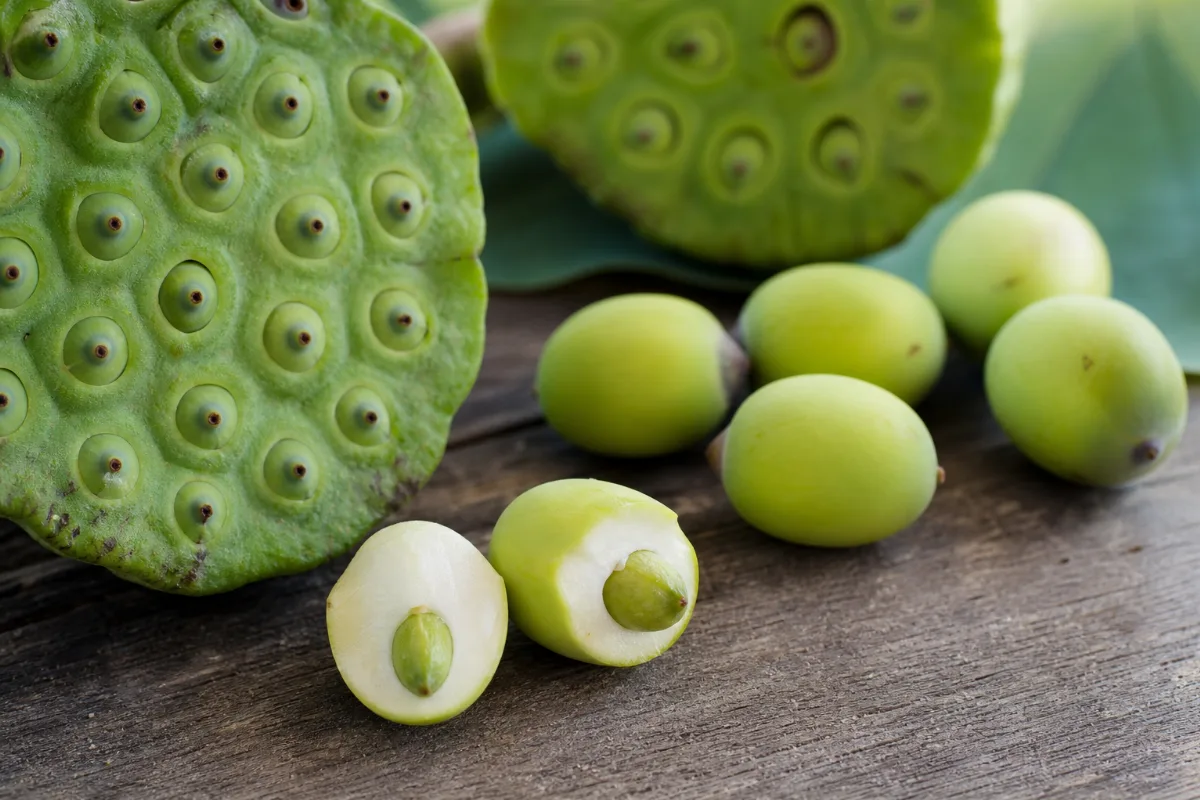
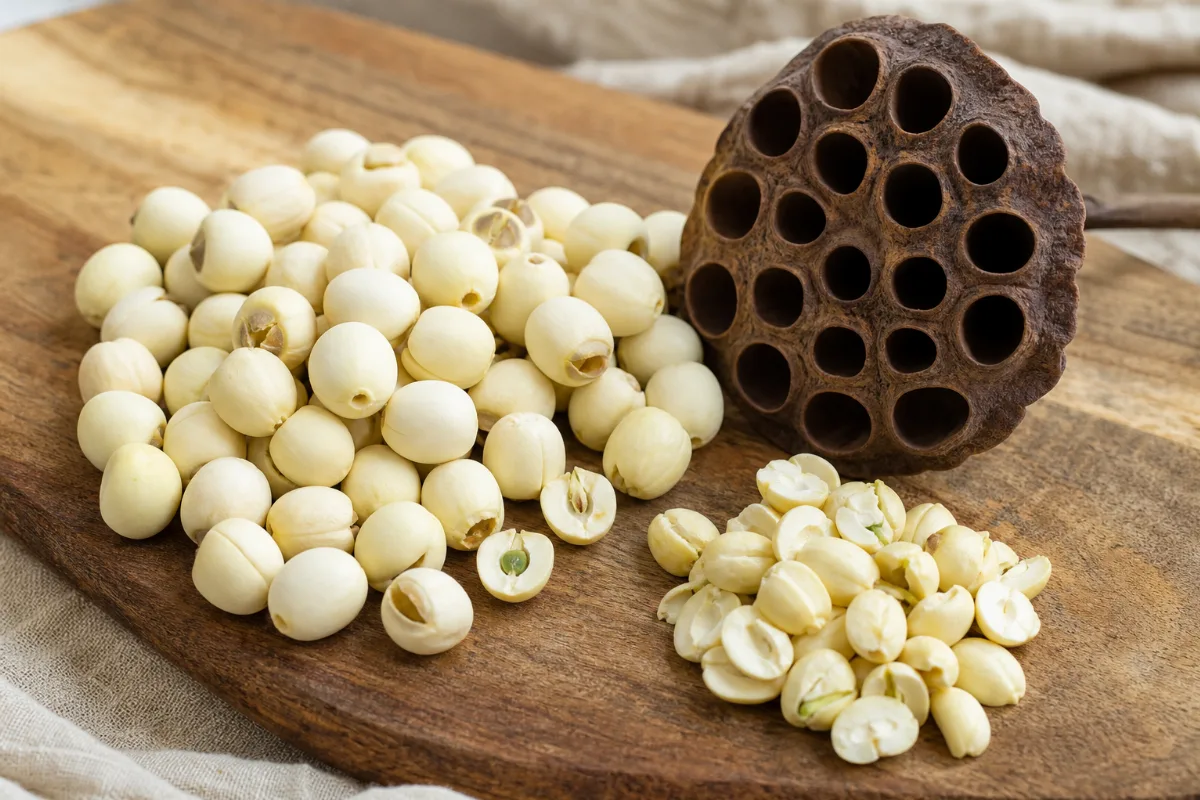
Lotus seed, called lian zi in Chinese, is the seed kernel of the sacred lotus, Nelumbo nucifera. It is eaten in soups and sweets and used dried in Chinese medicine decoctions.
The green embryo inside the seed is the plumule, called lian xin. It is bitter and used as a separate product. Most of the studied lotus alkaloids are described from the plumule. This profile is about the seed, with the plumule noted where it differs.
It is not blue lotus (Nymphaea caerulea), a different water lily sold for relaxation. See the blue lotus profile for that plant.
Traditional and current uses
In Chinese medicine the seed is used to calm the heart and mind, to help sleep and to firm long-lasting diarrhea. The plumule review says the green core has a medical history of over 400 years, and is used for high blood pressure, irregular heartbeat and insomnia as well.
The authors of the mood trial add that the seed has been used for depression for hundreds of years in many Asian countries.
What is in it and how it works
The plumule holds alkaloids such as neferine, liensinine and isoliensinine. In cells and animals they act on calcium signalling and on dopamine, acetylcholine and GABA systems, and neferine slows and relaxes the heart in lab models. Nuciferine, also found in blue lotus, is described mainly from the leaf.
The seed kernel itself is mostly starch. These lab results come from isolated compounds and cannot be assumed for the seed as eaten.
What the research shows
A 2022 randomised trial gave 45 adults with depression a water extract of lotus seed or placebo for two weeks. Mood and stress scores improved at the lower amount, and the higher amount changed brain-wave activity. It is small and short.
A 2024 pilot gave a lotus and rhodiola mixture to 20 adults with mild insomnia. Sleep scores improved, but there was no control group, a third dropped out, and some authors work for the maker. In ten healthy adults, cooked lotus seed raised blood sugar only a little. Diarrhea and heart findings are from mice or the lab.
At a glance
Traditional uses history, not proof
- Chinese medicine: to calm the heart and mind and to help sleep
- Chinese medicine: for long-lasting diarrhea and loose stools
- The green core (lian xin) is used separately to clear heat from the heart and calm the mind
- Eaten as a food in soups and sweets
Studied for research
- Low mood and stress, very low (one small two-week trial)
- Sleep, very low (one uncontrolled pilot of a mixture)
- Calm and anxiety, insufficient (no human trial)
- Loose stools, insufficient (mouse study only)
- Blood sugar response of the cooked seed, very low (ten healthy people)
- Lab-only: nerve protection, antioxidant, heart and blood vessel effects
Main compounds
- Plumule alkaloids neferine, liensinine and isoliensinine
- Nuciferine and armepavine (nuciferine is mainly described from the leaf)
- Starch, plus flavonoids and polysaccharides
Common forms
- Dried seed kernel, eaten or simmered in soups and decoctions
- Plumule (green core) and plumule tea
- Water extracts and capsules (one sleep pilot used a mixture with rhodiola)
- Leaf and flower are different parts of the plant, used separately
Research links: Plumula Nelumbinis review (J Ethnopharmacol, 2021) · Lotus seed water extract and mood trial (IJERPH, 2022) · Lotus and rhodiola sleep pilot (Nutrients, 2024) · Research Library · Genes & Biomarkers Library
The plant and its history
- Accepted scientific name
- Nelumbo nucifera Gaertn. (sacred lotus)
- Naming authority
- Gaertn.
- Synonyms
- Not listed here; GBIF shows the name as accepted.
- Common names
- Lotus seed (English); Sacred lotus seed (English); Lian zi (Chinese (pinyin)); Nelumbinis semen / Semen nelumbinis (Latin pharmacy name); Lotus plumule (lian xin, Plumula nelumbinis) (Chinese / Latin; the green embryo, a separate product)
- Botanical family
- Nelumbonaceae (lotus family), not Nymphaeaceae (water lilies). Blue lotus (Nymphaea) is in the water lily family.
- Classification
- Plantae > Tracheophyta > Magnoliopsida > Proteales > Nelumbonaceae > Nelumbo > Nelumbo nucifera
- Native range
- Not verified from a source read.
- Habitat
- Not verified from a source read. It is an aquatic plant (general knowledge, not checked).
- What the plant looks like
- Roots: Rhizome (lotus root) is another edible part; not covered here.; Stems: Not verified.; Leaves: Leaves are used separately; nuciferine is described from leaves (Liu 2026).; Flowers: Flowers are used separately.; Fruit: The seed kernel is the part called lian zi; the green embryo inside is the plumule (lian xin), a bitter separate product.
- Cultivation
- Not verified.
- Harvest and processing
- Not verified in a source read. Quality and drying are linked to mould risk (see safety).
- Look-alikes and adulterants
- Name: Blue lotus (Nymphaea caerulea); Note: A different plant in a different family, sold as a flower for relaxation. Do not confuse the two; see the blue lotus profile.; Name: Fox nut or other white starchy seeds used in Chinese cooking; Note: Not verified in a source read. Check the Latin name on any product.
- Sustainability and conservation
- Not verified.
The plant and the parts used
Traditional use and history history, not clinical proof
| Tradition or era | Documented use | Source |
|---|---|---|
| Chinese medicine | Lotus seed is used to calm the mind and for long-lasting diarrhea; the green core (plumule) is used for clearing heat from the heart, calming the mind and stopping bleeding. The plumule review says the green core has a medical history of over 400 years and is both food and medicine. | p33011369 |
| Traditional Chinese medicine database | Insomnia, long-lasting diarrhea and calming the heart and mind are listed uses of the seed. | s-polyu-tcm |
| Korea and other Asian countries | The mood trial authors say Nelumbinis semen has been used for depression for hundreds of years in many Asian countries. | p35805620 |
Traditional use shows how a plant was used. It does not show that a supplement works or is safe today.
What is inside, and how it may work
What the plant contains and how those compounds act in cells and animals. Laboratory and animal mechanisms are not proven effects in people.
Main compounds
| Compound | Family | Where it is concentrated | Activity studied | Level of evidence |
|---|---|---|---|---|
| Neferine PubChem 159654 | bisbenzylisoquinoline alkaloid | Plumule (seed embryo) | Lab and animal work describes blood-pressure-lowering, heart-rhythm, anti-platelet, anti-anxiety and nerve-protecting effects. 2 10 | Animal research |
| Liensinine PubChem 160644 | bisbenzylisoquinoline alkaloid | Plumule (seed embryo) | Described with isoliensinine and neferine as antitumor, anti-inflammatory, blood-pressure-lowering and nerve-protecting in preclinical work. 10 | Animal research |
| Isoliensinine PubChem 5274591 | bisbenzylisoquinoline alkaloid | Plumule (seed embryo) | Same group as liensinine and neferine; preclinical. 10 17 | Animal research |
| Nuciferine PubChem 10146 | aporphine alkaloid | Described as extracted from lotus leaves (Liu 2026); its amount in the seed was not established in our sources | Lab and animal work describes antioxidant, nerve-protecting and antipsychotic-like effects. The same alkaloid is also found in blue lotus. A 2025 analysis of lotus leaf, petal and seed extracts listed nuciferine and armepavine among key compounds without separating the parts. 11 7 | Animal research |
| Armepavine PubChem 442169 | benzylisoquinoline alkaloid | Lotus extracts (leaf, petal, seed; parts not separated in the abstract) | Flagged by computer analysis as a key compound for sleep targets. A prediction, not a measured effect. 7 | Laboratory research |
| Starch (resistant starch) | carbohydrate | Seed kernel | The seed is starchy. Lab digestion of cooked lotus seed was slow and its glycemic index was low in ten healthy adults. 19 | Human data |
| Flavonoids and polysaccharides | plant chemicals | Plumule and other parts | Antioxidant action in test tubes. The plumule review lists more than 130 chemicals in total. 3 15 | Laboratory research |
Mechanisms, receptors and pathways
| Target or pathway | Gene or receptor | What was found | Level |
|---|---|---|---|
| Calcium signalling and ion channels; dopamine, acetylcholine and GABA systems | Not specified in the abstract | Lotus alkaloids (neferine, nuciferine, liensinine, isoliensinine) acted on these systems and lowered oxidative stress in nerve cells in cells and animals. 17 | Laboratory research |
| Heart rhythm and blood pressure | Calcium and other ion currents (general description) | Neferine is described as antihypertensive, antiarrhythmic, anti-platelet and negative inotropic (weakens the heartbeat) in lab and animal models. 2 14 | Animal research |
| Sleep-related targets (computer prediction) | DRD2, AKT1, EGFR, PIK3R1; PI3K-Akt pathway | A network pharmacology and docking study of lotus leaf, petal and seed extracts predicted these targets. Predictions only. 7 | Laboratory research |
| Gut movement, water balance and gut bacteria | AQP3 (down), NHE8 (up) in mouse colon | In mice with senna-induced diarrhea, lotus seed extract changed these proteins, slowed an overactive gut and shifted bacteria. 18 | Animal research |
Absorption, metabolism and elimination
- Absorption
- No human absorption study of lotus seed or the plumule alkaloids was found. The plumule review says pharmacokinetics are still incomplete.
- Distribution
- Not established in people.
- Metabolism
- Not established in people.
- Elimination
- Not established in people.
- Bioavailability
- Not established. A 2026 review of nuciferine flags poor bioavailability and drug delivery as open problems.
Isolated compounds versus whole extracts
Most pharmacology is on isolated alkaloids (neferine, liensinine, nuciferine) in cells and animals. The two human studies used a seed water extract and a lotus and rhodiola mixture. Results on isolated compounds cannot be carried over to the seed eaten as food.
Nutritional composition
Lotus seed is a starchy food. In one small trial of ten healthy adults, the cooked seed had a low glycemic index. The sources we read did not give a full nutrient table; see the lotus seeds food page for nutrition values.
3 very low certainty5 not enough evidence
What is Lotus seed good for?
The main proposed uses and how strong the human evidence is for each. "Very low" means one small or unclear study, and "insufficient" means no human study. No use of lotus seed is above very low.
Benefits, one by one
Each card is a research question, not a promise. Tap a goal to filter. Open a card to see the studies, doses and limits.
Low mood and stress symptoms
Very low certaintyOne small two-week trial of a lotus seed water extract in adults with depression found better mood and stress scores than placebo at the lower amount. It is a single small study, so this is only an early signal.
1 studiesThe trial used a standardised water extract of the seed. Amounts used…
Studies, doses and limits
What the trials found
One randomised, double-blind, placebo-controlled trial (Ye 2022, 45 adults with depression or related disorders, two weeks, water extract of lotus seed).
Results
The 2.4 g-a-day group improved on the Beck Depression Inventory and the Stress Response Inventory compared with placebo (p < 0.05). The 4.8 g group showed more alpha/beta brain-wave activity on EEG (p < 0.05).
Effect sizes as reported
Not given in the abstract (only p < 0.05).
Why this rating
A single small, two-week trial with about 15 people per group. The two amounts did not behave the same way, and the abstract gives no effect sizes. It has not been repeated.
Form and dose studied
The trial used a standardised water extract of the seed. Amounts used in the trial are reported here only to describe the study. Ask a doctor or pharmacist about amounts.
Who was studied
Adults diagnosed with major depression or other depressive disorders.
Limits
Two weeks only; small; abstract read only; no long-term follow-up.
Why researchers looked
Lotus seed has been used for hundreds of years in Asian countries for low mood and restlessness, according to the trial authors.
Traditional use
In Chinese medicine lotus seed is used to calm the heart and mind. This is tradition, not proof.
Proposed mechanism Lab animal
Lab and animal work suggests lotus alkaloids act on calcium signalling and on dopamine, acetylcholine and GABA pathways. This has not been shown to explain any effect in people.
A proposed mechanism does not show that the effect happens in people.
Lotus seed is not a replacement for treatment of depression. See a doctor if low mood lasts or you have thoughts of self-harm.
Sleep and mild insomnia
Very low certaintyLotus seed is traditionally used for poor sleep. The only human sleep data are one small pilot of a lotus-and-rhodiola mixture with no control group, so we cannot tell what lotus seed does on its own.
2 studiesA lotus-and-rhodiola extract mixture was used. No lotus-seed-only tri…
Studies, doses and limits
What the trials found
One uncontrolled two-week pilot (Kim 2024) of a mixture of rhodiola and lotus extracts in 20 adults with subthreshold insomnia; 13 finished.
Results
Insomnia and sleep-quality scores improved, time awake after falling asleep fell by 57%, and sleep efficiency improved. Fatigue scores did not change. No placebo group.
Effect sizes as reported
Wake time after sleep onset down 57% (no control).
Why this rating
No control group, 7 of 20 people dropped out, it was a mixture so lotus cannot be separated from rhodiola, and some authors work for the company that makes the product.
Form and dose studied
A lotus-and-rhodiola extract mixture was used. No lotus-seed-only trial was found. Ask a doctor or pharmacist about amounts.
Who was studied
Adults aged 20 to 65 with subthreshold insomnia.
Limits
Small, short, uncontrolled, industry-linked, combination product.
Why researchers looked
A traditional Chinese remedy for insomnia and restlessness.
Traditional use
Chinese sources describe lotus seed and the green core as calming the mind and helping sleep.
Proposed mechanism In silico
A 2025 lab and computer analysis of lotus leaf, petal and seed extracts proposed targets such as the dopamine receptor DRD2 and a PI3K-Akt pathway. These are predictions.
A proposed mechanism does not show that the effect happens in people.
Some people in the pilot reported constipation (2 of 20, from our earlier notes of the full text). See the safety section about sedating medicines.
Calming the mind (traditional use)
Not enough evidenceIn Chinese medicine lotus seed, and especially its green core, is used to calm the heart and mind. We found no human trial of lotus seed for calm or anxiety on its own.
3 studiesDried seed is eaten and used in decoctions; the green core is a separ…
Studies, doses and limits
What the trials found
No human trial of lotus seed or plumule for anxiety or calm was found.
Results
No human result exists for this use.
Effect sizes as reported
None
Why this rating
Tradition and lab work only.
Form and dose studied
Dried seed is eaten and used in decoctions; the green core is a separate bitter product; extracts are also sold.
Who was studied
Not tested.
Limits
No human trial.
Why researchers looked
A long traditional use, described in Chinese medicine references.
Traditional use
Calming the heart and mind is a classic use of the seed and of the green core (lian xin), according to the plumule review.
Proposed mechanism Lab animal
Lab and animal studies of lotus alkaloids describe anti-anxiety and calming-type effects. The 2021 plumule review says the molecular mechanisms are still incomplete.
A proposed mechanism does not show that the effect happens in people.
The green core holds most of the described alkaloids and is the part with more cautions about sedating and blood-pressure medicines.
Nerve-cell protection by lotus alkaloids (lab only)
Not enough evidenceIn cells and animals, lotus alkaloids such as neferine protect nerve cells from damage. This has not been tested in people, and the studied alkaloids are isolated compounds, not the seed as eaten.
2 studiesNot applicable (isolated compounds).
Studies, doses and limits
What the trials found
No human study.
Results
Lab results only.
Effect sizes as reported
None
Why this rating
Cell and animal research on isolated compounds; the authors call for more research.
Form and dose studied
Not applicable (isolated compounds).
Who was studied
Not tested.
Limits
Isolated compounds; not the whole seed.
Why researchers looked
Lotus alkaloids are being studied as possible leads for brain diseases.
Traditional use
Not a traditional claim of the seed.
Proposed mechanism Lab animal
Neferine, nuciferine, liensinine and isoliensinine are described as lowering oxidative stress and inflammation and acting on calcium signalling in nerve cells, in cells and animals.
A proposed mechanism does not show that the effect happens in people.
None specific.
Loose stools and long-lasting diarrhea (traditional use; mouse study)
Not enough evidenceLotus seed is traditionally used to firm loose stools. In mice, a water extract eased diarrhea caused by senna. No human trial was found.
2 studiesWater extract in mice. Traditional use is as dried seed in decoctions.
Studies, doses and limits
What the trials found
No human trial of lotus seed for diarrhea was found.
Results
Mice given each extract alone had fewer loose stools than untreated diarrhea mice (p < 0.05).
Effect sizes as reported
p < 0.05 only.
Why this rating
Tradition and one mouse study; the diarrhea was chemically induced.
Form and dose studied
Water extract in mice. Traditional use is as dried seed in decoctions.
Who was studied
Mice.
Limits
Not people; the three foods were tested separately but the authors discuss them together.
Why researchers looked
A classic use in Chinese medicine for chronic diarrhea.
Traditional use
Listed in the Hong Kong Polytechnic University TCM database as a use for long-lasting diarrhea (read in our earlier notes).
Proposed mechanism Animal research
In mice, lotus seed, jujube and longan aril each lowered the loose-stool rate, slowed overactive gut movement and shifted gut bacteria.
A proposed mechanism does not show that the effect happens in people.
The same seed is cautioned against in constipation and abdominal bloating. See the safety section.
Blood sugar response after eating cooked lotus seed
Very low certaintyIn ten healthy adults, cooked lotus seed raised blood sugar only a little compared with rice. That describes the food, not a treatment for diabetes.
1 studiesCooked, pre-soaked whole seed eaten as food. Not a supplement.
Studies, doses and limits
What the trials found
One randomised crossover trial (Zhu 2019, ten healthy adults, one meal each) of cooked, pre-soaked lotus seed among six starchy foods.
Results
Lotus seed and adzuki bean both had a low glycemic index (reported range 21 to 51); the other foods did not differ from rice.
Effect sizes as reported
Glycemic index 21 to 51 (reported for lotus seed and adzuki bean together).
Why this rating
Ten healthy people, one meal. It says nothing about blood sugar control in diabetes.
Form and dose studied
Cooked, pre-soaked whole seed eaten as food. Not a supplement.
Who was studied
Healthy adults.
Limits
Very small; no people with diabetes; one test meal.
Why researchers looked
Lotus seed is a starchy food, and the glycemic index shows how fast a food raises blood sugar.
Traditional use
Eaten as a food in soups and sweets across Asia (from our earlier summary).
Proposed mechanism Laboratory research
In lab digestion tests, lotus seed starch broke down slowly. Pre-soaking raised the fast-digesting starch in the foods tested.
A proposed mechanism does not show that the effect happens in people.
If you take diabetes medicines, a change in what you eat is worth discussing with your doctor.
Heart rhythm and blood pressure (traditional use; lab work on the green core)
Not enough evidenceReviews list high blood pressure and irregular heartbeat among traditional uses of the green core (plumule). Its alkaloid neferine slows or relaxes heart and blood vessels in lab and animal tests. No clear human trial results were available to us.
4 studiesApplies to the plumule and its isolated alkaloids rather than to the …
Studies, doses and limits
What the trials found
The plumule review mentions clinical uses, but the abstract gives no trial details and we did not read the full text.
Results
No human results were available to us.
Effect sizes as reported
None
Why this rating
Tradition and lab or animal work; mechanisms and toxicology are called incomplete by the reviewers.
Form and dose studied
Applies to the plumule and its isolated alkaloids rather than to the plain seed kernel.
Who was studied
Not established.
Limits
Isolated compounds; abstracts only.
Why researchers looked
A traditional use of the plumule and a lab finding for neferine.
Traditional use
The plumule review lists hypertension and arrhythmia among its traditional and reported clinical uses.
Proposed mechanism Lab animal
Neferine is described as lowering blood pressure, steadying heart rhythm, reducing platelet clumping and weakening the heartbeat, in lab and animal models. A 2002 review covers related alkaloids from other plants.
A proposed mechanism does not show that the effect happens in people.
Because these effects could add to blood-pressure and heart-rhythm medicines, people on such medicines should ask a pharmacist before using plumule products.
Antioxidant, anti-inflammatory, liver, blood-fat and anticancer findings (lab and animal only)
Not enough evidenceReviews list many lab and animal effects of lotus extracts. None of these has been shown in people.
3 studiesNot applicable.
Studies, doses and limits
What the trials found
No human evidence found for these uses.
Results
Lab and animal findings only.
Effect sizes as reported
None
Why this rating
Laboratory and animal work only.
Form and dose studied
Not applicable.
Who was studied
Not tested.
Limits
Findings are from all parts of the plant and isolated compounds.
Why researchers looked
Lotus plants are rich in alkaloids, flavonoids and polysaccharides.
Traditional use
Not a specific traditional claim of the seed.
Proposed mechanism Lab animal
Antioxidant and anti-inflammatory action in cells and animals; reviews also list anticancer, liver-protecting, blood-fat-lowering and blood-sugar-lowering activity. Many reviews mix leaf, flower, seed and root.
A proposed mechanism does not show that the effect happens in people.
None specific.
Connections to the rest of health
How Lotus seed connects to the rest of our health knowledge graph. Every link says what kind of connection it is. A safety link (for example to the liver) is a warning, not a benefit. A study that merely mentions a topic never creates a benefit link.
Explore every connection: goals, body systems, organs, symptoms, genes
A. Wellness goals
| Connected to | Kind of connection | Evidence status | Context | Studies |
|---|---|---|---|---|
| Mood Balance | Potential benefit | Very low certainty | Low mood and stress symptoms: One small two-week trial of a lotus seed water extract in adults with depression found better mood and stress scores than placebo at the lower amount. It is a single small study, so this is only an early signal. | 16 |
| Stress Reduction | Potential benefit | Very low certainty | Low mood and stress symptoms: One small two-week trial of a lotus seed water extract in adults with depression found better mood and stress scores than placebo at the lower amount. It is a single small study, so this is only an early signal. | 16 |
| Better Sleep | Potential benefit | Very low certainty | Sleep and mild insomnia: Lotus seed is traditionally used for poor sleep. The only human sleep data are one small pilot of a lotus-and-rhodiola mixture with no control group, so we cannot tell what lotus seed does on its own. | 9 7 |
| Sleep Quality | Potential benefit | Very low certainty | Sleep and mild insomnia: Lotus seed is traditionally used for poor sleep. The only human sleep data are one small pilot of a lotus-and-rhodiola mixture with no control group, so we cannot tell what lotus seed does on its own. | 9 7 |
| Calm Relaxation | Traditional use | Not enough evidence | Calming the mind (traditional use): In Chinese medicine lotus seed, and especially its green core, is used to calm the heart and mind. We found no human trial of lotus seed for calm or anxiety on its own. | 3 8 2 |
| Stress Reduction | Traditional use | Not enough evidence | Calming the mind (traditional use): In Chinese medicine lotus seed, and especially its green core, is used to calm the heart and mind. We found no human trial of lotus seed for calm or anxiety on its own. | 3 8 2 |
| Brain Health | Preliminary mechanism | Not enough evidence | Nerve-cell protection by lotus alkaloids (lab only): In cells and animals, lotus alkaloids such as neferine protect nerve cells from damage. This has not been tested in people, and the studied alkaloids are isolated compounds, not the seed as eaten. | 17 10 |
| Digestive Support | Traditional use | Not enough evidence | Loose stools and long-lasting diarrhea (traditional use; mouse study): Lotus seed is traditionally used to firm loose stools. In mice, a water extract eased diarrhea caused by senna. No human trial was found. | 18 8 |
| Gut Health | Traditional use | Not enough evidence | Loose stools and long-lasting diarrhea (traditional use; mouse study): Lotus seed is traditionally used to firm loose stools. In mice, a water extract eased diarrhea caused by senna. No human trial was found. | 18 8 |
| Blood Sugar Balance | Biological association | Very low certainty | Blood sugar response after eating cooked lotus seed: In ten healthy adults, cooked lotus seed raised blood sugar only a little compared with rice. That describes the food, not a treatment for diabetes. | 19 |
| Metabolic Health | Biological association | Very low certainty | Blood sugar response after eating cooked lotus seed: In ten healthy adults, cooked lotus seed raised blood sugar only a little compared with rice. That describes the food, not a treatment for diabetes. | 19 |
| Heart Health | Preliminary mechanism | Not enough evidence | Heart rhythm and blood pressure (traditional use; lab work on the green core): Reviews list high blood pressure and irregular heartbeat among traditional uses of the green core (plumule). Its alkaloid neferine slows or relaxes heart and blood vessels in lab and animal tests. No clear human trial results were available to us. | 3 2 10 14 |
| Blood Pressure Support | Preliminary mechanism | Not enough evidence | Heart rhythm and blood pressure (traditional use; lab work on the green core): Reviews list high blood pressure and irregular heartbeat among traditional uses of the green core (plumule). Its alkaloid neferine slows or relaxes heart and blood vessels in lab and animal tests. No clear human trial results were available to us. | 3 2 10 14 |
| Preventive Wellness | Preliminary mechanism | Not enough evidence | Antioxidant, anti-inflammatory, liver, blood-fat and anticancer findings (lab and animal only): Reviews list many lab and animal effects of lotus extracts. None of these has been shown in people. | 15 17 11 |
B. Body systems
| Connected to | Kind of connection | Evidence status | Context | Studies |
|---|---|---|---|---|
| Gut health | Adverse effect or risk | Very low certainty | Constipation and abdominal bloating are traditional reasons for caution; 2 of 20 people in a small pilot reported constipation. Evidence is limited. Constipation and bloating are traditional cautions; 2 of 20 people in a small pilot reported constipation. A safety relationship, not a benefit. Preparation or compound: Lotus seed (kernel, extract) |
5 9 |
| Heart and circulation | Drug or supplement interaction | Not enough evidence | Lab and animal blood-pressure and heart-rhythm effects mean a precaution with heart and blood-pressure medicines. No human study. Preparation or compound: Plumule alkaloids (neferine and related) |
2 14 |
| Stress Mood | Biological association | Very low certainty | Studied for: Low mood and stress symptoms Studied for: Calming the mind (traditional use) | 16 3 8 2 |
| Nervous System | Biological association | Very low certainty | Studied for: Low mood and stress symptoms Studied for: Sleep and mild insomnia | 16 9 7 3 8 2 17 10 15 11 |
| Sleep Recovery | Biological association | Very low certainty | Studied for: Sleep and mild insomnia | 9 7 |
| Gut Health | Biological association | Not enough evidence | Studied for: Loose stools and long-lasting diarrhea (traditional use; mouse study) | 18 8 |
| Blood Sugar Support | Biological association | Very low certainty | Studied for: Blood sugar response after eating cooked lotus seed | 19 |
| Heart Circulation | Biological association | Not enough evidence | Studied for: Heart rhythm and blood pressure (traditional use; lab work on the green core) | 3 2 10 14 |
I. Biomarkers
| Connected to | Kind of connection | Evidence status | Context | Studies |
|---|---|---|---|---|
| Beck Depression Inventory (BDI) score | Biological association | Very low certainty | Measured in trials: lowered. A lab change is not the same as a health benefit. | 16 |
| Stress Response Inventory (SRI) score | Biological association | Very low certainty | Measured in trials: lowered. A lab change is not the same as a health benefit. | 16 |
| EEG alpha/beta brain-wave activity | Biological association | Very low certainty | Measured in trials: raised. A lab change is not the same as a health benefit. | 16 |
| Insomnia Severity Index (ISI) and Pittsburgh Sleep Quality Index (PSQI) | Biological association | Very low certainty | Measured in trials: lowered. A lab change is not the same as a health benefit. | 9 |
| Time awake after falling asleep (sleep diary) | Biological association | Very low certainty | Measured in trials: lowered. A lab change is not the same as a health benefit. | 9 |
| Glycemic index after a cooked lotus seed meal | Biological association | Very low certainty | Measured in trials: lowered. A lab change is not the same as a health benefit. | 19 |
| Loose-stool rate in mice (lab measure) | Biological association | Not enough evidence | Measured in trials: lowered. A lab change is not the same as a health benefit. | 18 |
J. Genes, receptors and enzymes
| Connected to | Kind of connection | Evidence status | Context | Studies |
|---|---|---|---|---|
| DRD2 (dopamine D2 receptor) | Preliminary mechanism | In vitro | Predicted target of lotus seed and other lotus part compounds in a computer analysis for sleep. | 7 |
| AKT1 and PI3K-Akt pathway | Preliminary mechanism | In vitro | Predicted key target and pathway in the same analysis. | 7 |
| AQP3 and NHE8 | Preliminary mechanism | Animal | Changed in mouse colon by lotus seed extract in a diarrhea model. | 18 |
L. Active compounds
| Connected to | Kind of connection | Evidence status | Context | Studies |
|---|---|---|---|---|
| Neferine | Biological association | Animal | Lab and animal work describes blood-pressure-lowering, heart-rhythm, anti-platelet, anti-anxiety and nerve-protecting effects. Preparation or compound: Plumule (seed embryo) |
2 10 |
| Liensinine | Biological association | Animal | Described with isoliensinine and neferine as antitumor, anti-inflammatory, blood-pressure-lowering and nerve-protecting in preclinical work. Preparation or compound: Plumule (seed embryo) |
10 |
| Isoliensinine | Biological association | Animal | Same group as liensinine and neferine; preclinical. Preparation or compound: Plumule (seed embryo) |
10 17 |
| Nuciferine | Biological association | Animal | Lab and animal work describes antioxidant, nerve-protecting and antipsychotic-like effects. The same alkaloid is also found in blue lotus. A 2025 analysis of lotus leaf, petal and seed extracts listed nuciferine and armepavine among key compounds without separating the parts. Preparation or compound: Described as extracted from lotus leaves (Liu 2026); its amount in the seed was not established in our sources |
11 7 |
| Armepavine | Biological association | In vitro | Flagged by computer analysis as a key compound for sleep targets. A prediction, not a measured effect. Preparation or compound: Lotus extracts (leaf, petal, seed; parts not separated in the abstract) |
7 |
| Starch (resistant starch) | Biological association | Human | The seed is starchy. Lab digestion of cooked lotus seed was slow and its glycemic index was low in ten healthy adults. Preparation or compound: Seed kernel |
19 |
| Flavonoids and polysaccharides | Biological association | In vitro | Antioxidant action in test tubes. The plumule review lists more than 130 chemicals in total. Preparation or compound: Plumule and other parts |
3 15 |
Each connection is stored with the ingredient, the connected record, the kind of connection, the evidence status, the supporting studies, the preparation or compound involved, and a review date (last reviewed October 25, 2026).
Evidence at a glance: what changed in 7 lab markers
Tap a number to show only those markers. Counts are markers, not people.
The evidence
The research centre for Lotus seed. Every record here was checked against PubMed or the publisher's page; we never list a study we have not verified.
Evidence by outcome
Bars show how many studies we found for each outcome, not how well it works. People are added up across trials only (reviews are not added, to avoid double counting).
How we rate evidence
High certainty
Several well-run trials or reviews agree; further research is unlikely to change the picture much.
Moderate certainty
Good trials point the same way, but some doubt remains.
Low certainty
Small, short or inconsistent trials. The finding could change with better research.
Very low certainty
Very little or very weak human data. Treat as a possibility only.
Mixed findings
Trials or reviews disagree with each other.
Not enough evidence
Not enough human research to say either way.
Evidence against
Good research found no benefit, or found harm.
We take the reviewers' own risk-of-bias and GRADE statements where they exist, and otherwise judge from study size, design, consistency, directness and whether a product matches what is sold. Many publications do not make evidence high. Method note: We started from our earlier lotus seed summary, then searched PubMed, read the abstracts of every cited study, and checked plant names in GBIF and NCBI Taxonomy and chemical IDs in PubChem. We looked for NCCIH, EMA, LiverTox and LactMed entries and found none we could open. Two supplier and database sources, and the constipation count in the sleep pilot, come from our earlier notes and were not re-opened.
Study library: every study we checked 19
| Study | Design | People | Product, dose, length | Result |
|---|---|---|---|---|
| AlternativeMed editorial team 2026 Search for regulator entries on lotus seed (NCCIH, EMA/HMPC, LiverTox, LactMed) Checked 2026-10-25 · Source |
Search record n/a |
Methods, limits and fundingRead: not-found | ||
| Bharathi Priya 2021 An updated review on pharmacological properties of neferine-A bisbenzylisoquinoline alkaloid from Nelumbo nucifera. J Food Biochem · PMID 34779018 · DOI |
Narrative review lab-animal |
In-vitro and in-vivo literature on neferine | Neferine (isolated compound from the seed embryo) plumule · vs None |
Lists anti-hypertensive, anti-arrhythmic, anti-platelet, negative inotropic (weakens the heartbeat), anti-anxiety and anticancer effects in lab and animal models, and covers pharmacokinetics. None Methods, limits and fundingOutcomes: Pharmacology of neferine Limitations: Lab and animal models; abstract only was read. Funding and conflicts: No conflict statement shown. Read: abstract |
| Chen 2021 Plumula Nelumbinis: A review of traditional uses, phytochemistry, pharmacology, pharmacokinetics and safety. J Ethnopharmacol · PMID 33011369 · DOI |
Narrative review review-of-lab-and-human |
Literature on the green embryo (plumule) of the lotus seed | Plumula Nelumbinis (plumule) plumule · vs None |
Over 130 chemicals found, including alkaloids, flavonoids, polysaccharides and volatile oil. Traditional uses include high blood pressure, irregular heartbeat, insomnia and calming the mind. Lab and animal work on the heart, brain, lung and kidney. The authors say mechanisms, pharmacokinetics and toxicology are still incomplete. None Methods, limits and fundingOutcomes: Traditional uses, chemistry, pharmacology, pharmacokinetics, safety Limitations: A narrative review; abstract only was read; clinical studies are not appraised in the abstract. Funding and conflicts: No conflict statement shown. Read: abstract |
| Chen 2025 Occurrence and Diversity of Fungi and Their Mycotoxin Production in Common Edible and Medicinal Substances from China. J Fungi (Basel) · PMID 40137250 · DOI |
Lab analysis not-applicable |
163 163 commercially available edible and medicinal substances from China |
Mixed dried products including Nelumbinis semen seed (one lotus seed sample) · vs None |
92.0% of the 163 products contained fungi. One Nelumbinis semen sample held 10.75 micrograms per kg aflatoxin B1, above the European and Chinese limits the authors cite. 10.75 ug/kg AFB1 in one lotus seed sample Methods, limits and fundingOutcomes: Fungal counts and mycotoxins Limitations: One sample is not a rate for lotus seed. Abstract only was read. Funding and conflicts: Authors declare no conflicts of interest. Read: abstract |
| Crane Herb Company 2026 Lian Zi (Nelumbinis Semen), supplier reference for practitioners (Crane Herb Company) Supplier product page · Source |
Supplier reference n/a |
Methods, limits and fundingRead: summary-only | ||
| GBIF 2026 GBIF Backbone: Nelumbo nucifera Gaertn. (usageKey 2882449) GBIF species API, checked 2026-10-25 · Source |
Reference database n/a |
Methods, limits and fundingRead: full-text | ||
| He 2025 Assessment of the Properties and Mechanism of Three Lotus (Nelumbo nucifera Gaertn.) Parts for Sleep Improvement. Chem Biodivers · PMID 39888161 · DOI |
Lab in silico lab-animal |
Lotus leaf, petal and seed extracts; literature for a meta-analysis | Lotus leaf, petal and seed extracts seed, leaf, petal · vs None |
Found 48 compounds including 26 alkaloids across the three parts, antioxidant action in tests, and a meta-analysis that the authors say identified potential to improve sleep. Computer analysis flagged targets such as DRD2 and a PI3K-Akt pathway. None Methods, limits and fundingOutcomes: Chemistry, antioxidant tests, meta-analysis, network pharmacology, docking Limitations: Mixes three plant parts; the abstract does not say what the meta-analysis pooled. Computer-predicted targets are not proof. Abstract only was read. Funding and conflicts: No conflict statement shown. Read: abstract |
| Hong Kong Polytechnic University School of Nursing 2015 Lotus Seed (Nelumbinis Semen), Herbal TCM database Herbal TCM database · Source |
Reference database n/a |
Methods, limits and fundingRead: summary-only | ||
| Kim 2024 Mixture of Rhodiola rosea and Nelumbo nucifera Extracts Ameliorates Sleep Quality of Adults with Sleep Disturbance. Nutrients · PMID 38931222 · DOI |
Uncontrolled pilot |
20 Adults aged 20 to 65 with subthreshold insomnia (13 of 20 finished) |
RNE: a mixture of Rhodiola rosea and Nelumbo nucifera extracts (combination product, not lotus seed alone) seed extract (part not stated in abstract), combined with rhodiola 750 mg a day at bedtime 2 weeks · vs None (single group, before and after) |
Of 20 people, 13 finished and showed better ISI and PSQI scores, 57% less time awake after falling asleep, and better sleep efficiency. Fatigue scores did not change. SF-36 physical and mental scores improved. Wake time after sleep onset down 57% (no control group). Methods, limits and fundingOutcomes: Insomnia Severity Index, Pittsburgh Sleep Quality Index, sleep diary, fatigue scale, SF-36 Limitations: No control group, so changes may be due to time or expectation. A third of people dropped out. A mixture, so lotus cannot be separated from rhodiola. Some authors work for the company LG H&H that makes the product. Constipation in 2 of 20 people comes from our earlier notes of the full text and was not re-opened (summary-only). Funding and conflicts: Some authors are employees of LG H&H; the paper says analysis was done independently by university-affiliated authors. Read: abstract |
| Liu 2025 Pharmacological Potential and Mechanisms of Bisbenzylisoquinoline Alkaloids from Lotus Seed Embryos. Biomolecules · PMID 41154606 · DOI |
Narrative review lab-animal |
Preclinical literature on liensinine, isoliensinine and neferine | Three alkaloids from the lotus seed embryo (isolated compounds) plumule · vs None |
Describes antitumor, anti-inflammatory, blood-pressure-lowering, nerve-protecting and anti-fibrosis effects, from preclinical studies. None Methods, limits and fundingOutcomes: Pharmacology of the three alkaloids Limitations: The authors base it on preclinical studies. Abstract only was read. Funding and conflicts: Authors declare no conflicts of interest. Read: abstract |
| Liu 2026 Insights into nuciferine: A natural multifunctional bioactive alkaloid (Review). Mol Med Rep · PMID 42028734 · DOI |
Narrative review lab-animal |
Literature on nuciferine, mostly lab and animal | Nuciferine, an aporphine alkaloid described as extracted from lotus leaves leaf · vs None |
Lists antioxidant, neuroprotective, heart, metabolic, antipsychotic-like and anticancer effects in lab and animal work. The authors flag concerns about toxicity or undesirable effects, poor bioavailability and drug delivery before clinical use. None Methods, limits and fundingOutcomes: Pharmacology of nuciferine Limitations: Nuciferine is described from the leaf, not the seed. Abstract only was read. Funding and conflicts: Authors declare no competing interests. Read: abstract |
| NCBI 2026 NCBI Taxonomy: Nelumbo nucifera (taxid 4432) NCBI Taxonomy esearch, checked 2026-10-25 · Source |
Reference database n/a |
Methods, limits and fundingRead: abstract | ||
| NCBI PubChem 2026 PubChem compound records: nuciferine (CID 10146), neferine (CID 159654), liensinine (CID 160644), isoliensinine (CID 5274591), armepavine (CID 442169) PubChem PUG REST, checked 2026-10-25 · Source |
Database n/a |
Methods, limits and fundingRead: full-text | ||
| Qian 2002 Cardiovascular pharmacological effects of bisbenzylisoquinoline alkaloid derivatives. Acta Pharmacol Sin · PMID 12466045 |
Narrative review lab-animal |
Literature on tetrandrine, dauricine, daurisoline and neferine | Bisbenzylisoquinoline alkaloids including neferine plumule alkaloid · vs None |
Reviews antihypertensive and antiarrhythmic effects, mostly of tetrandrine and dauricine; neferine and daurisoline antiarrhythmic effects have also been studied. None Methods, limits and fundingOutcomes: Heart and blood-vessel effects Limitations: Mostly other plants and other alkaloids; neferine is a small part. A 2002 review. Abstract only was read. Funding and conflicts: No conflict statement shown. Read: abstract |
| Sahu 2024 An Updated Review on Nelumbo Nucifera Gaertn: Chemical Composition, Nutritional Value and Pharmacological Activities. Chem Biodivers · PMID 38327030 · DOI |
Narrative review lab-animal |
Literature on all parts of the lotus plant | Whole lotus plant (leaf, flower, seed, rhizome) mixed · vs None |
Lists many in-vivo and in-vitro activities: anticancer, liver-protecting, antioxidant, blood-fat-lowering, blood-sugar-lowering and anti-inflammatory. Gives no human trial results in the abstract. None Methods, limits and fundingOutcomes: Chemistry, nutrition, pharmacology Limitations: Mixes all plant parts; findings are lab and animal. Abstract only was read. Funding and conflicts: No conflict statement shown. Read: abstract |
| Ye 2022 A Randomized Double-Blind, Placebo-Controlled Study on Anti-Stress Effects of Nelumbinis Semen. Int J Environ Res Public Health · PMID 35805620 · DOI |
Controlled trial |
45 Adults diagnosed with major depression or other depressive disorders |
Water extract of Nelumbinis semen (lotus seed), called WNS seed 2.4 g or 4.8 g a day of the extract 2 weeks · vs Placebo |
The lower-amount group (2.4 g a day) had better BDI and SRI scores than placebo after two weeks (p < 0.05). The higher-amount group (4.8 g a day) showed more alpha/beta brain-wave activity on EEG (p < 0.05). Group differences reported as p < 0.05; no effect sizes in the abstract. Methods, limits and fundingOutcomes: Beck Depression Inventory (BDI), Stress Response Inventory (SRI), EEG Limitations: Only two weeks; about 15 people per group (45 split into three groups); the two doses did not show the same pattern; abstract read only, so funding and adverse events were not seen. Funding and conflicts: Authors declare no competing interests. Read: abstract |
| Zhao 2025 Neuroprotective Potential of Major Alkaloids from Nelumbo nucifera (Lotus): Mechanisms and Therapeutic Implications. Int J Mol Sci · PMID 40943200 · DOI |
Narrative review lab-animal |
Lab and animal literature on neferine, nuciferine, liensinine and isoliensinine | Lotus alkaloids (isolated compounds) mixed · vs None |
Alkaloids showed antioxidant and anti-inflammatory effects, acted on calcium signalling and ion channels, and on dopamine, acetylcholine and GABA pathways, in cells and animals. The authors say more research is needed before clinical use. None Methods, limits and fundingOutcomes: Neuroprotective mechanisms Limitations: Isolated compounds in cells and animals. Abstract only was read. Funding and conflicts: Authors declare no conflicts of interest. Read: abstract |
| Zhao 2026 Modulation of gut microbiota and intestinal barrier by lotus seed, jujube, and longan aril in senna leaf-induced diarrhea in mice. Front Microbiol · PMID 42482939 · DOI |
Animal research animal |
Mice with senna-leaf-induced diarrhea | Water extracts of lotus seed, jujube or longan aril, each given alone seed · vs Untreated diarrhea mice |
All three extracts lowered the loose-stool rate and diarrhea index (p < 0.05), slowed an overactive small intestine, and shifted gut bacteria. The authors call it a basis for clinical use. p < 0.05 for loose stools Methods, limits and fundingOutcomes: Loose stool rate, gut movement, colon tissue, gut bacteria Limitations: Mouse study with a chemical (senna) cause of diarrhea; not people. Abstract only was read. Funding and conflicts: No competing interests stated. Read: abstract |
| Zhu 2019 Acute Effects of Three Cooked Non-Cereal Starchy Foods on Postprandial Glycemic Responses and in Vitro Carbohydrate Digestion in Comparison with Whole Grains: A Randomized Trial. Nutrients · PMID 30875961 · DOI |
Rct crossover |
10 Ten healthy adults |
Cooked, pre-soaked lotus seed eaten as a food (compared with five other starchy foods) seed (food) · vs Other cooked starchy foods and rice |
Lotus seed and adzuki bean both had a low glycemic index (reported range 21 to 51); the other foods did not differ from rice. Lab digestion of both was slower than the others. Glycemic index 21 to 51 (lotus seed and adzuki bean reported together) Methods, limits and fundingOutcomes: Blood sugar rise after eating (glycemic index) and lab starch digestion Limitations: Ten healthy people, one meal each; says nothing about diabetes treatment. Abstract only was read. Funding and conflicts: Authors declare no conflict of interest. Read: abstract |
What we do not know yet
- What the evidence supports: nothing about lotus seed is above very low certainty. One small two-week mood trial and one uncontrolled sleep pilot of a mixture are the only human data. Cooked seed gave a low blood sugar rise in ten healthy adults.
- What is uncertain: whether the seed (rather than the green core) holds enough alkaloids to matter, whether the mood result repeats, and how mood and sleep effects compare with placebo for lotus alone.
- Missing: any human interaction, pregnancy, breastfeeding, children, allergy or raw-versus-cooked safety data; an agency monograph; and human absorption data.
How new research is added
New studies are found by a saved PubMed search and are placed in a review queue. A person reads each one before it changes any evidence rating or safety wording. New publications never change ratings automatically.
Lab markers
What changed in blood or saliva tests during trials. A changed number is not the same as feeling or being healthier, and we give no "normal ranges".
Other 7
Beck Depression Inventory (BDI) score
Lowered in trials
A questionnaire that scores how severe depressive symptoms are. Lower is better.
Very low certaintyResults and what it means
Why it was measured
The main mood outcome in the lotus seed trial.
Statistical vs. clinical meaning
A symptom questionnaire after two weeks in a small trial. It does not show a lasting benefit.
Safety implication
None specific.
| Study | Result | People | Product |
|---|---|---|---|
| 16 | The 2.4 g-a-day extract group improved more than placebo (p < 0.05). Exact scores were not in the abstract. | Adults with depressive disorders (n=45, three groups) | Water extract of lotus seed, two weeks |
Stress Response Inventory (SRI) score
Lowered in trials
A questionnaire that scores how strongly a person reacts to stress. Lower is better.
Very low certaintyResults and what it means
Why it was measured
A second outcome in the same trial.
Statistical vs. clinical meaning
Self-reported, short, small trial.
Safety implication
None specific.
| Study | Result | People | Product |
|---|---|---|---|
| 16 | The 2.4 g-a-day group improved more than placebo (p < 0.05). | Adults with depressive disorders | Water extract of lotus seed, two weeks |
EEG alpha/beta brain-wave activity
Raised in trials
Brain electrical activity recorded through the scalp. The trial authors read more alpha/beta activity as improved symptoms.
Very low certaintyResults and what it means
Why it was measured
An objective measure in the lotus seed trial.
Statistical vs. clinical meaning
The meaning of the EEG change is the authors’ interpretation and was seen in the higher amount group only.
Safety implication
None specific.
| Study | Result | People | Product |
|---|---|---|---|
| 16 | A significant increase in the 4.8 g-a-day group (p < 0.05). | Adults with depressive disorders | Water extract of lotus seed, two weeks |
Insomnia Severity Index (ISI) and Pittsburgh Sleep Quality Index (PSQI)
Lowered in trials
Two questionnaires about sleep problems. Lower scores mean better sleep.
Very low certaintyResults and what it means
Why it was measured
The main outcomes in the sleep pilot.
Statistical vs. clinical meaning
Without a control group, improvement may reflect time or expectation.
Safety implication
None specific.
| Study | Result | People | Product |
|---|---|---|---|
| 9 | Both scores improved in the 13 people who finished (no control group). | Adults with subthreshold insomnia | Rhodiola and lotus extract mixture, two weeks |
Time awake after falling asleep (sleep diary)
Lowered in trials
How long a person is awake during the night after first falling asleep.
Very low certaintyResults and what it means
Why it was measured
A sleep diary outcome in the pilot.
Statistical vs. clinical meaning
Self-reported diary with no comparison group.
Safety implication
None specific.
| Study | Result | People | Product |
|---|---|---|---|
| 9 | A 57% reduction was reported (no control group). | Adults with subthreshold insomnia | Rhodiola and lotus extract mixture, two weeks |
Glycemic index after a cooked lotus seed meal
Lowered in trials
A score for how much a food raises blood sugar compared with a standard food. Lower means a smaller rise.
Very low certaintyResults and what it means
Why it was measured
The main outcome in the glycemic trial.
Statistical vs. clinical meaning
Describes a food in healthy people. It is not a treatment effect.
Safety implication
None specific.
| Study | Result | People | Product |
|---|---|---|---|
| 19 | Glycemic index 21 to 51 for lotus seed and adzuki bean together; the other starchy foods did not differ from rice. | Ten healthy adults | Cooked, pre-soaked lotus seed, one meal |
Loose-stool rate in mice (lab measure)
Lowered in trials
The share of mice with soft stools after a diarrhea-causing chemical.
Not enough evidenceResults and what it means
Why it was measured
The main outcome in the mouse study.
Statistical vs. clinical meaning
Animal data cannot be carried over to people.
Safety implication
None specific.
| Study | Result | People | Product |
|---|---|---|---|
| 18 | Lowered with the lotus seed water extract (p < 0.05). | Mice with senna-induced diarrhea | Lotus seed water extract |
Safety
What studies and official sources say about side effects, medicines and who should check first. Each point shows what kind of evidence it comes from.
Main points to know 4
- Skip it, or ask first, if you are constipated or often bloated. A supplier reference for practitioners lists constipation and abdominal bloating as reasons not to use lotus seed, and 2 of the 20 people in the small sleep pilot reported constipation. This is a traditional caution and a small trial note, not a medical guideline. Other 5 9
- Pregnancy and breastfeeding: no safety data. We found no study or agency guidance on lotus seed or its green core in pregnancy or breastfeeding. Eating the seed as an ordinary food is different from taking concentrated extracts or the bitter core; ask a doctor or midwife before using the latter. No evidence 1 3
- The green core (plumule) may add to sedatives and blood-pressure medicines. Lab and animal work describes calming and blood-pressure-lowering effects of plumule alkaloids. No human interaction study exists, so this is a precaution based on pharmacology, not a proven problem. Pharmacological theory 2 10 3
- Mould and aflatoxin are the clearest quality risk. In a lab survey, 92.0% of 163 dried edible and medicinal products held fungi, and one lotus seed sample held aflatoxin B1 above European and Chinese limits. One sample is not a rate, but damp or old seed should not be eaten. Other 4
Side effects 2
| Effect | How often | Severity and recovery | Evidence |
|---|---|---|---|
| Constipation A supplier reference also lists constipation and abdominal bloating as reasons for caution (traditional caution). | 2 of 20 people in one small uncontrolled pilot of a lotus and rhodiola mixture (from our earlier notes of the full text; not re-opened). | mild Not reported. | Other 9 5 |
| No significant side effects reported in the two small human studies The mood trial authors say it gives preliminary evidence of safety. The pilot authors report no significant side effects. Both are too short and small to find rare problems. | Not a rate: 45 adults for two weeks (seed water extract) and 20 adults for two weeks (mixture). | none reported Not applicable | Controlled trial 16 9 |
Liver
We found no published human case of liver injury from lotus seed and no LiverTox entry. Absence of reports is not proof of safety, and lab work on isolated alkaloids says little about liver safety in people. 1
How often. Not known.
Monitoring. No agency monitoring advice was found.
This is a safety connection. It is not evidence that Lotus seed supports liver health.
Medicines and supplements 3
| With | Why it matters | Importance | Evidence | What to do |
|---|---|---|---|---|
| Sleeping pills, sedatives, alcohol and other calming medicines cns-depressant | Theory: lotus alkaloids are described as calming in lab and animal studies, and the plumule is used traditionally to calm the mind. | No human interaction study was found. Added drowsiness is plausible with concentrated extracts or the plumule; it is unlikely to matter with ordinary food amounts of kernel. | Pharmacological theory Not enough evidence 17 3 | If you take sedating medicines, ask a pharmacist before adding lotus extracts or plumule products. |
| Blood-pressure medicines (including calcium channel blockers) and heart-rhythm medicines prescription | Theory: neferine and related alkaloids lowered blood pressure, steadied rhythm and weakened the heartbeat in lab and animal models; calcium signalling is one described route. | No human study. Mostly relevant to the plumule and isolated alkaloids rather than the plain kernel. | Animal research Not enough evidence 2 14 10 | If you take blood-pressure or heart-rhythm medicines, ask your doctor or pharmacist before using plumule teas or extracts. |
| Diabetes medicines prescription | Cooked lotus seed gave a low blood sugar rise in healthy people, and lab reports describe blood-sugar-lowering effects of extracts. | No interaction study. Food amounts are unlikely to matter much; the effect of extracts is unknown. | Other Not enough evidence 19 15 | Tell your doctor or pharmacist if you start using lotus extracts while on diabetes medicines. |
Who should check first 5
| Situation | Advice | Evidence |
|---|---|---|
| Constipation or abdominal bloating | Traditional caution: avoid or ask a practitioner first. Source is a supplier reference plus a small trial note. | Other 5 9 |
| Pregnancy and breastfeeding (extracts and the green core) | Avoid until a doctor or midwife agrees. No safety data were found. | No evidence 1 |
| Children | No safety data on extracts or the green core were found; ask a paediatrician. | No evidence 1 |
| Allergy to lotus or a past reaction to lotus seed | Do not use. We found no human allergy case or allergen study for lotus seed. Our PubMed search for lotus seed allergy found only mouse studies of lotus seed starch easing experimental food allergy, which does not rule out a reaction in a person. | No evidence 1 |
| Mouldy, damp or old seed | Do not eat. Aflatoxin above legal limits was found in one tested lotus seed sample. | Other 4 |
Overdose, product quality and regulators
Summary. The plumule review says toxicology is still incomplete. No acute toxicity data in people were found. Lotus seed has long been eaten as a food, but that is not a safety study of concentrated extracts.
Animal. Not found in the abstracts read. A 2026 review of nuciferine (a leaf alkaloid) says concerns about toxicity or undesirable effects remain before clinical use.
Human doses studied. Two small human studies: a seed water extract for two weeks in 45 adults, and a rhodiola and lotus mixture for two weeks in 20 adults. No harm signal was reported, but these are too small to rule out rare problems.
High dose or long term signals. None found; long-term effects are unknown.
Overdose response. No overdose report was found.
Genotoxicity. Not found for lotus seed.
Toxic plant parts. No toxic part was identified in the sources read. The green core is bitter and holds most of the described alkaloids; leaf, flower and root are other parts of the same plant and were not assessed here.
Raw vs cooked. No source we read compared raw and cooked seed for safety. The human glycemic trial used cooked, pre-soaked seed. Traditional use is dried seed that is cooked or decocted. Without a source, we make no claim about eating raw seeds; avoid any seed that smells or looks mouldy.
Food tolerance. No source sets a safe upper amount of lotus seed as food. Pay attention to your own digestion: bloating or hard stools are the reason for the traditional caution. Ask a doctor or pharmacist about amounts.
Quality, storage and drying matter. The best data are one lab survey of dried edible and medicinal products.
Mould and aflatoxin. 92.0% of 163 products held fungi. One Nelumbinis semen sample contained 10.75 micrograms per kg aflatoxin B1, above the European and Chinese limits the authors cite. Ochratoxin A was the commonest mycotoxin across all products. 4
Look-alike confusion with blue lotus. Blue lotus (Nymphaea caerulea) is a different plant sold for relaxation, with its own sedation and quality concerns. Make sure a product labelled lotus is Nelumbo nucifera seed. 6
| Body | Action | Date |
|---|
When to get medical help
- Swelling of the lips, tongue or throat, hives, or trouble breathing after eating lotus seed or taking an extract (possible allergy). Seek emergency care.
- Fainting, a very slow or irregular heartbeat, or severe dizziness while taking plumule products with blood-pressure or heart medicines.
- Severe or lasting stomach pain, vomiting, or no bowel movement for several days.
- Fever, vomiting or yellow skin or eyes after eating seed that was mouldy.
Stop the supplement and contact a clinician or emergency service. In the US, Poison Control is 1-800-222-1222.
General information only, not medical advice. Ask a clinician or pharmacist before use, especially with medicines, in pregnancy or with a health condition. See the Natural Remedy Safety guide.
Frequently asked questions
What is lotus seed?
Is lotus seed the same as blue lotus?
Does lotus seed help with sleep?
Does lotus seed help with depression or stress?
A little early evidence. One two-week trial in 45 adults found better mood and stress scores with a seed water extract at the lower amount than with placebo. It is small and has not been repeated, and lotus seed does not replace treatment.
What is the difference between the seed and the plumule?
Can lotus seed cause constipation?
Is lotus seed safe in pregnancy or breastfeeding?
Can I take it with sedatives or blood pressure medicines?
Can I be allergic to lotus seed?
We found no report of lotus seed allergy and no allergen study in people. Mouse studies actually found lotus seed starch eased experimental food allergy, which does not rule out a reaction. If you have had a reaction, avoid it.
Is raw lotus seed safe compared with cooked?
Can lotus seed be mouldy or contaminated?
Yes. In a lab survey of 163 dried edible and medicinal products, 92.0% held fungi, and one lotus seed sample held aflatoxin B1 above European and Chinese limits. One sample is not a rate, but storage and drying matter.
Can I eat lotus seed as a normal food?
Does it affect the liver?
No liver injury case or LiverTox entry was found. This is not proof of safety, and lab studies of isolated alkaloids do not answer it.
Explore by health goal
Stress ReductionMood BalanceBetter SleepSleep QualityCalm RelaxationBrain HealthDigestive SupportGut HealthBlood Sugar BalanceMetabolic HealthHeart HealthBlood Pressure SupportPreventive Wellness
Editorial transparency
- Written by
- AlternativeMed editorial team. Research compiled with AI assistance, then checked against PubMed records.
- Medical review
- None. This page has not been reviewed by a physician or pharmacist.
- First published
- 2026-10-25
- Last substantive update
- 2026-10-25
- How we research
- We started from our earlier lotus seed summary, then searched PubMed, read the abstracts of every cited study, and checked plant names in GBIF and NCBI Taxonomy and chemical IDs in PubChem. We looked for NCCIH, EMA, LiverTox and LactMed entries and found none we could open. Two supplier and database sources, and the constipation count in the sleep pilot, come from our earlier notes and were not re-opened.
- How we rate evidence
- See "How we rate evidence" in the Evidence tab.
- Independence
- No product is promoted on this page. No affiliate links are shown. If one is added later it will be labelled and kept apart from the evidence.
Sources 19
Each source was opened and checked. Where we read only the abstract, it says so. The small numbers in the text point here.
- AlternativeMed editorial team. Search for regulator entries on lotus seed (NCCIH, EMA/HMPC, LiverTox, LactMed). Checked 2026-10-25. 2026. (not-found)
- Bharathi Priya L, Huang CY, Hu RM, Balasubramanian B, et al.. An updated review on pharmacological properties of neferine-A bisbenzylisoquinoline alkaloid from Nelumbo nucifera.. J Food Biochem. 2021. PMID 34779018. DOI 10.1111/jfbc.13986. (abstract)
- Chen S, Li X, Wu J, Li J, Xiao M, Yang Y, et al.. Plumula Nelumbinis: A review of traditional uses, phytochemistry, pharmacology, pharmacokinetics and safety.. J Ethnopharmacol. 2021. PMID 33011369. DOI 10.1016/j.jep.2020.113429. (abstract)
- Chen L, Wu J, Zhang S, Liu X, et al.. Occurrence and Diversity of Fungi and Their Mycotoxin Production in Common Edible and Medicinal Substances from China.. J Fungi (Basel). 2025. PMID 40137250. DOI 10.3390/jof11030212. (abstract)
- Crane Herb Company. Lian Zi (Nelumbinis Semen), supplier reference for practitioners (Crane Herb Company). Supplier product page. 2026. (summary-only)
- GBIF. GBIF Backbone: Nelumbo nucifera Gaertn. (usageKey 2882449). GBIF species API, checked 2026-10-25. 2026. (full-text)
- He S, Wang C, Shi W, Zhou C, et al.. Assessment of the Properties and Mechanism of Three Lotus (Nelumbo nucifera Gaertn.) Parts for Sleep Improvement.. Chem Biodivers. 2025. PMID 39888161. DOI 10.1002/cbdv.202402788. (abstract)
- Hong Kong Polytechnic University School of Nursing. Lotus Seed (Nelumbinis Semen), Herbal TCM database. Herbal TCM database. 2015. (summary-only)
- Kim Y, Lee WK, Jeong H, Choi HJ, et al.. Mixture of Rhodiola rosea and Nelumbo nucifera Extracts Ameliorates Sleep Quality of Adults with Sleep Disturbance.. Nutrients. 2024. PMID 38931222. DOI 10.3390/nu16121867. (abstract)
- Liu Y, Wang C, Liao Q, Du C. Pharmacological Potential and Mechanisms of Bisbenzylisoquinoline Alkaloids from Lotus Seed Embryos.. Biomolecules. 2025. PMID 41154606. DOI 10.3390/biom15101377. (abstract)
- Liu Y, Li X, Huang B, Lai X, et al.. Insights into nuciferine: A natural multifunctional bioactive alkaloid (Review).. Mol Med Rep. 2026. PMID 42028734. DOI 10.3892/mmr.2026.13885. (abstract)
- NCBI. NCBI Taxonomy: Nelumbo nucifera (taxid 4432). NCBI Taxonomy esearch, checked 2026-10-25. 2026. (abstract)
- NCBI PubChem. PubChem compound records: nuciferine (CID 10146), neferine (CID 159654), liensinine (CID 160644), isoliensinine (CID 5274591), armepavine (CID 442169). PubChem PUG REST, checked 2026-10-25. 2026. (full-text)
- Qian JQ. Cardiovascular pharmacological effects of bisbenzylisoquinoline alkaloid derivatives.. Acta Pharmacol Sin. 2002. PMID 12466045. (abstract)
- Sahu B, Sahu M, Sahu M, Yadav M, et al.. An Updated Review on Nelumbo Nucifera Gaertn: Chemical Composition, Nutritional Value and Pharmacological Activities.. Chem Biodivers. 2024. PMID 38327030. DOI 10.1002/cbdv.202301493. (abstract)
- Ye M, Bae H, Park S, Lew J, Kim KS, Shim I. A Randomized Double-Blind, Placebo-Controlled Study on Anti-Stress Effects of Nelumbinis Semen.. Int J Environ Res Public Health. 2022. PMID 35805620. DOI 10.3390/ijerph19137963. (abstract)
- Zhao D, Ma L, Brownlie J, Tonissen K, Pan Y, Feng Y, et al.. Neuroprotective Potential of Major Alkaloids from Nelumbo nucifera (Lotus): Mechanisms and Therapeutic Implications.. Int J Mol Sci. 2025. PMID 40943200. DOI 10.3390/ijms26178280. (abstract)
- Zhao F, Xiao R, Li X, Xin Q, et al.. Modulation of gut microbiota and intestinal barrier by lotus seed, jujube, and longan aril in senna leaf-induced diarrhea in mice.. Front Microbiol. 2026. PMID 42482939. DOI 10.3389/fmicb.2026.1796355. (abstract)
- Zhu R, Fan Z, Han Y, Li S, et al.. Acute Effects of Three Cooked Non-Cereal Starchy Foods on Postprandial Glycemic Responses and in Vitro Carbohydrate Digestion in Comparison with Whole Grains: A Randomized Trial.. Nutrients. 2019. PMID 30875961. DOI 10.3390/nu11030634. (abstract)