Herbs & Botanicals · Soothing mucilage herb
Mallow
Malva sylvestris · also called Common mallow, high mallow, mallow flower, mallow leaf, Malvae flos, Malvae folium
Mallow is a common wayside plant whose flowers and leaves are full of a soothing, gel-like fibre called mucilage. It is used as a tea for sore mouth and throat, dry cough and mild stomach upset. Those uses rest on tradition, not on patient trials; the best human evidence is one small constipation trial of a syrup and a few mouthwash and skin-cream trials. Do not confuse it with marshmallow root, and ask a doctor first if you are pregnant or breastfeeding.
General information, not medical advice. Last substantive update · Not medically reviewed. A named clinician has not signed off on this page. How this page is made
About Mallow
Mallow (Malva sylvestris) is a soothing mucilage herb used as a tea for mouth, throat and stomach complaints. The EU herbal committee accepts these uses on tradition only. Human trials are few and small, so benefits are not confirmed. Safety data are limited, and pregnancy and breastfeeding are not recommended.
What the evidence shows
The EU herbal committee found no clinical trials of mallow flower or leaf tea for its traditional uses. It accepted them because the herb has been used for a very long time.
The best human result is one placebo-controlled trial of a lab-made mallow flower syrup in 110 adults with constipation. It helped, but it has not been repeated and is not tea. Mouthwash and cream trials are small and use other products as comparisons or give mixed results.
Safety first
The EU monograph lists no known side effects, no reported overdose, and no reported interactions, but it also says the safety data are limited and tests for genotoxicity, reproduction and cancer have not been done.
Two case reports describe acute liver injury after people ate mallow as a vegetable meal, one fatal with kidney failure. The species and amounts were unknown and the committee could not confirm mallow as the cause. Pregnancy, breastfeeding and use under age 12 are not recommended.
Do not mix up mallow, marshmallow and musk mallow
Common mallow (Malva sylvestris) is a different plant from marshmallow (Althaea officinalis), whose root is used. The EU monograph for marshmallow root says it may delay absorption of other medicines taken at the same time. No such warning exists for mallow, but mallow also holds mucilage, so a similar effect is possible in theory and has not been tested.
Musk mallow (Malva moschata) and dwarf mallow (Malva neglecta) are separate species. Check the Latin name on any product. Ask a pharmacist about timing with your other medicines, and tell your doctor if you take diabetes medicine.
At a glance
Traditional uses history, not proof
- European handbooks cited by the EU herbal committee list mallow flower tea for throat irritation, dry cough and stomach complaints.
- Young leaves are eaten as a green vegetable in some places.
- In traditional Persian medicine it is used for eczema, per the authors of a skin-cream trial.
Studied for research
- Mouth and throat irritation with dry cough: traditional use only (insufficient evidence)
- Mild stomach and gut discomfort: traditional use only (insufficient)
- Constipation: one trial of a flower syrup (low)
- Chemotherapy mouth sores: one mouthwash trial against chlorhexidine (low)
- Eczema in children: one small cream trial (low)
Main compounds
- Mucilage polysaccharides
- Anthocyanins (purple pigments such as malvidin and delphinidin glucosides)
- Flavonoids
Common forms
- Dried flower tea (infusion or decoction)
- Dried leaf tea
- Mouth and throat rinse (EU monograph)
- Fresh leaves eaten as food
Research links: EMA: EU herbal monograph on Malva sylvestris flos · EMA: assessment report on mallow leaf and flower · PubMed: constipation trial of mallow flower syrup · Research Library · Genes & Biomarkers Library
The plant and its history
- Accepted scientific name
- Malva sylvestris L.
- Naming authority
- Accepted species in the GBIF backbone (key 3152374).
- Common names
- Common mallow; high mallow; mallow flower; mallow leaf; Malvae flos; Malvae folium (English / Latin)
- Botanical family
- Malvaceae (mallow family), per GBIF.
- Classification
- Plantae > Malvaceae > Malva > Malva sylvestris
- Native range
- A review describes it as common in Europe, Asia and Africa; native range not checked against a plant database.
- Habitat
- Not verified.
- What the plant looks like
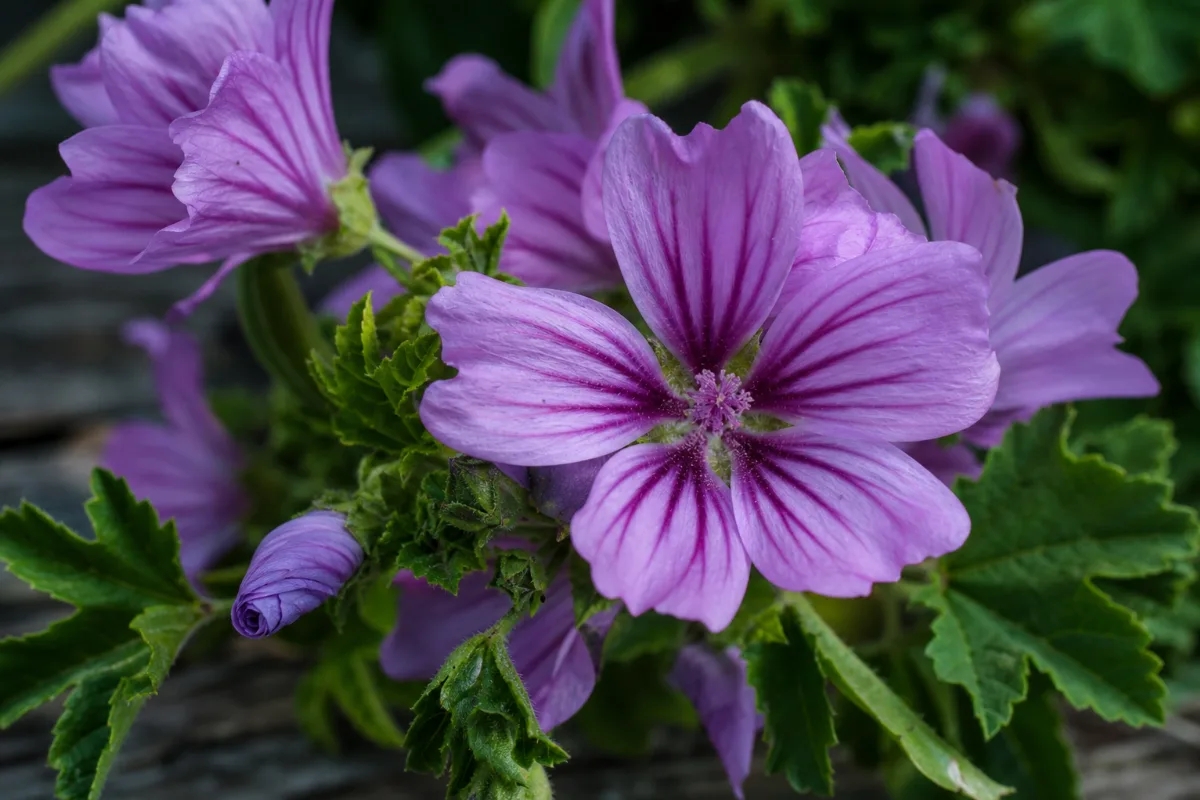
- Flowers: Purple-pink flowers are the part used as Malvae flos (flower).
- Cultivation
- Not verified.
- Harvest and processing
- Flowers and leaves are dried and cut for tea (EU monographs).
- Look-alikes and adulterants
- Name: Marshmallow (Althaea officinalis); Note: A different plant; its root is the herb. Its EU monograph advises spacing from other medicines; mallow's does not. GBIF accepted name, Malvaceae.; Name: Musk mallow (Malva moschata); Note: A separate accepted species (GBIF key 3152379). Not the species in the EU monograph.; Name: Dwarf mallow (Malva neglecta); Note: Separate accepted species (GBIF key 3152373); the EU leaf monograph also allows it as a leaf source.; Name: Small-flowered mallow (Malva parviflora); Note: Another species (GBIF key 3152378) studied in animals; do not assume it matches common mallow.
Traditional use and history history, not clinical proof
| Tradition or era | Documented use | Source |
|---|---|---|
| Traditional European herbal medicine | Handbooks cited by the EU committee list mallow flower infusions or decoctions for throat irritation, dry cough and stomach complaints, from the mid-1900s on. | s-ema-ar-malvae |
| Food use | Young leaves are eaten cooked or raw in some Mediterranean cooking (EU assessment, via the existing summary). | s-ema-ar-malvae |
| Persian traditional medicine | Used for eczema (as stated by the eczema trial authors). | p33100212 |
Traditional use shows how a plant was used. It does not show that a supplement works or is safe today.
What is inside, and how it may work
What the plant contains and how those compounds act in cells and animals. Laboratory and animal mechanisms are not proven effects in people.
Main compounds
| Compound | Family | Where it is concentrated | Activity studied | Level of evidence |
|---|---|---|---|---|
| Mucilage polysaccharides | acidic polysaccharides (rhamnogalacturonan type) | Flower (about 10%) and leaf (about 6 to 8%) | Gel-like fibre responsible for the soothing, coating feel; antitussive in cats. 7 | Animal research |
| Malvidin 3-glucoside PubChem 443652 | anthocyanin | Flower | Purple pigment; antioxidant in lab tests. 12 7 | Laboratory research |
| Delphinidin 3-glucoside PubChem 443650 | anthocyanin | Flower | Purple pigment; antioxidant in lab tests. 12 7 | Laboratory research |
| Malvin (malvidin 3,5-diglucoside) PubChem 441765 | anthocyanin | Flower | Main pigment type in mallow flowers per the EU assessment (total anthocyanin 0.42 to 7.3% of dry flower). 12 7 | Laboratory research |
| Flavonoids (kaempferol and quercetin glycosides, luteolin, apigenin) | flavonoid | Flower and leaf | Antioxidant in lab tests. 7 2 | Laboratory research |
Mechanisms, receptors and pathways
| Target or pathway | Gene or receptor | What was found | Level |
|---|---|---|---|
| Cough reflex (mucilage and rhamnogalacturonan fraction) | not established | In cats, an oral mallow mucilage and a related sugar fraction reduced coughing from mechanical airway irritation; the committee notes the sugar fraction worked about 15% better than the mucilage. Cat study, not human. 7 | Animal research |
| Liver protection against paracetamol | liver enzymes (ALT, AST) | A whole-plant methanol extract given by injection protected mouse liver from paracetamol. Mouse study with an extract not eaten as tea. 7 | Animal research |
| Antioxidant activity | not applicable | Water extracts of fresh flowers and leaves showed antioxidant capacity in test-tube assays. 7 | Laboratory research |
Absorption, metabolism and elimination
- Absorption
- No data for mallow in people (EU documents: not required for traditional-use products).
- Distribution
- No data.
- Metabolism
- No data.
- Elimination
- No data.
- Bioavailability
- No data for mucilage or anthocyanins from mallow.
Isolated compounds versus whole extracts
Mallow is a mixture of mucilage, anthocyanins and flavonoids. The cat cough work used isolated mucilage fractions. Human trials used a lab-made flower syrup, mouthwashes and creams, so none tests plain tea.
Nutritional composition
Young mallow leaves are eaten as a green vegetable in some places. This page does not give nutrient numbers because none were read.
4 low certainty3 not enough evidence1 evidence against
What is Mallow good for?
The main studied uses and how strong the human evidence is. Most mallow uses rest on tradition, and the few trials are small.
Benefits, one by one
Each card is a research question, not a promise. Tap a goal to filter. Open a card to see the studies, doses and limits.
Mouth and throat irritation with dry cough (traditional use)
Not enough evidenceMallow flower and leaf tea is a soothing, coating herb. The EU herbal committee accepts it for mouth or throat irritation with dry cough, but only because it has been used for a very long time. No trial in patients was found.
3 studiesNo amounts or preparation advice are given on this page. Ask a doctor…
Studies, doses and limits
What the trials found
The EU committee found no clinical studies on mallow flower or leaf for this use. It accepted the use on long-standing tradition alone. A 2024 safety review of leaf tea found one mild throat-irritation report.
Results
No patient trial found. Animal cough studies only.
Effect sizes as reported
None in people.
Why this rating
Traditional use only; no human trial; animal data do not prove an effect in people.
Form and dose studied
No amounts or preparation advice are given on this page. Ask a doctor or pharmacist.
Who was studied
Adults and adolescents from age 12 (EU monograph wording).
Limits
Tradition is not proof. Cough with fever, breathlessness or pus-coloured phlegm needs a doctor.
Why researchers looked
Mallow flowers and leaves hold a gel-like fibre called mucilage (about 10 percent in flowers and 6 to 8 percent in leaves), which is thought to coat irritated tissue.
Traditional use
European handbooks list mallow flower infusions or decoctions for throat irritation and dry cough going back to the mid-1900s.
Proposed mechanism Animal research
The mucilage forms a slippery film over irritated lining. This idea comes from lab and animal work: in cats, mucilage and a sugar fraction from mallow flower reduced coughing.
A proposed mechanism does not show that the effect happens in people.
Allergy to the plant is the one contraindication. See the Safety tab.
Mild stomach and gut discomfort (traditional use)
Not enough evidenceThe EU committee also accepts mallow flower and leaf tea for mild stomach and gut discomfort from age 12, again on long use alone. No patient trial was found for this use.
2 studiesNo amounts or preparation advice are given on this page. Ask a doctor…
Studies, doses and limits
What the trials found
No clinical studies were found by the EU committee for this use.
Results
No human trial.
Effect sizes as reported
None.
Why this rating
Tradition only.
Form and dose studied
No amounts or preparation advice are given on this page. Ask a doctor or pharmacist.
Who was studied
Adolescents and adults.
Limits
Symptoms lasting more than 2 weeks should be seen by a doctor (EU monograph wording).
Why researchers looked
Mallow is a mucilage herb, and soothing, coating herbs are traditionally taken for an unsettled stomach.
Traditional use
Old European handbooks list mallow for dyspeptic symptoms and gastroenteritis.
Proposed mechanism Pharmacological theory
Not shown in people. Lab work suggests the mucilage coats lining.
A proposed mechanism does not show that the effect happens in people.
Same cautions as above.
Constipation (one small trial of a syrup)
Low certaintyOne placebo-controlled trial in 110 adults found a lab-made mallow flower syrup helped constipation over 4 weeks. It is a single trial of a syrup, not tea, and has not been repeated.
2 studiesNo amounts or preparation advice are given on this page. Ask a doctor…
Studies, doses and limits
What the trials found
In the trial (110 adults with functional constipation, Iran), a mallow flower extract syrup was compared with placebo for 4 weeks. The syrup group had more bowel movements and fewer constipation symptoms (P < 0.001) and fewer hard stools (45.4 percent versus 9.1 percent). A few people on the syrup had diarrhoea, acid reflux or nausea, and one had hives. The EU committee did not use the trial because the syrup is not an EU product.
Results
Better bowel-movement frequency and stool form than placebo in one trial.
Effect sizes as reported
Hard stool forms reduced 45.4% versus 9.1% (P < 0.001); defecation frequency F = 18.8 (P < 0.001).
Why this rating
One trial, symptoms self-reported, a special syrup, not replicated, no independent review grading.
Form and dose studied
No amounts or preparation advice are given on this page. Ask a doctor or pharmacist.
Who was studied
Adults with functional constipation.
Limits
The syrup is a lab preparation (a concentrated extract in sugar syrup) and does not show that tea works.
Why researchers looked
A review of traditional use lists mallow for constipation, and mucilage is thought to soften stool.
Traditional use
Laxative use is listed in reviews of traditional use.
Proposed mechanism Pharmacological theory
Not established; the trial authors say how it works needs study.
A proposed mechanism does not show that the effect happens in people.
Mild gut side effects in a few people.
Mouth sores from chemotherapy (mouthwash)
Low certaintyIn one trial, a mallow mouthwash worked at least as well as chlorhexidine mouthwash for mouth sores from chemotherapy at one week. By two weeks the difference had faded.
1 studiesNo amounts or preparation advice are given on this page. Ask a doctor…
Studies, doses and limits
What the trials found
A triple-blind trial in 70 people with chemotherapy-related mouth sores compared mallow mouthwash with chlorhexidine mouthwash for 14 days. At day 7 mallow scores for sores and pain were lower (P < 0.001). At day 14 the difference was no longer statistically significant (P = 0.08). There was no placebo group.
Results
Lower sore and pain scores at day 7 than chlorhexidine; no significant difference at day 14.
Effect sizes as reported
P < 0.001 at day 7; P = 0.08 at day 14. Mean scores not in the abstract.
Why this rating
One trial against an active comparator, no placebo, one country.
Form and dose studied
No amounts or preparation advice are given on this page. Ask a doctor or pharmacist.
Who was studied
Adults with cancer having chemotherapy; they should use any mouthwash only with their care team.
Limits
The mouthwash product is not described in the abstract. This is not a tea.
Why researchers looked
Mallow is a soothing herb traditionally used as a rinse for the mouth and throat.
Traditional use
The EU monograph includes oromucosal (mouth lining) use of the tea as a rinse.
Proposed mechanism Pharmacological theory
Not explained in the abstract.
A proposed mechanism does not show that the effect happens in people.
No adverse event data in the abstract.
Dental plaque and gum inflammation (mouthwash)
Low certaintyA short Brazilian trial found a 5 percent mallow mouthwash controlled plaque about as well as chlorhexidine over four days, but was a little less good for gum inflammation.
1 studiesNo amounts or preparation advice are given on this page. Ask a doctor…
Studies, doses and limits
What the trials found
A crossover trial in 44 healthy adults who skipped tooth brushing for 7 days compared 5 percent mallow mouthwash with 0.12 percent chlorhexidine. Plaque and gum inflammation did not differ significantly, but chlorhexidine reduced gum inflammation more (P = 0.02) and was rated as tasting better.
Results
Similar plaque control; chlorhexidine better for gum inflammation.
Effect sizes as reported
Difference in gum inflammation reduction P = 0.02.
Why this rating
One short crossover trial, no placebo, healthy volunteers.
Form and dose studied
No amounts or preparation advice are given on this page. Ask a doctor or pharmacist.
Who was studied
Healthy adults.
Limits
Four days of use only; no placebo; mallow part not stated in abstract.
Why researchers looked
Natural mouthwashes are explored as alternatives to chlorhexidine, which can have side effects with long use.
Traditional use
Mallow rinses have been used for mouth irritation.
Proposed mechanism Pharmacological theory
Not explained in the abstract.
A proposed mechanism does not show that the effect happens in people.
No harms reported in the abstract.
Eczema in children (skin cream)
Low certaintyA small trial in 51 children found a mallow extract cream improved eczema scores more than a placebo cream over 4 weeks. This is a cream on the skin, not a tea.
1 studiesNo amounts or preparation advice are given on this page. Ask a doctor…
Studies, doses and limits
What the trials found
In a double-blind trial of 51 children with atopic dermatitis (Iran), a mallow extract cream used twice daily for 4 weeks improved skin thickening (P = 0.009), redness (P = 0.01) and total SCORAD score (P = 0.03) compared with placebo.
Results
Better SCORAD than placebo in one small trial.
Effect sizes as reported
P = 0.03 for total SCORAD; size of change not in the abstract.
Why this rating
One small trial; effect size not read; not replicated.
Form and dose studied
No amounts or preparation advice are given on this page. Ask a doctor or pharmacist.
Who was studied
Children with atopic dermatitis.
Limits
Skin cream only; does not apply to drinking mallow. Children's skin conditions need a doctor.
Why researchers looked
Mallow is used for eczema in traditional Persian medicine.
Traditional use
Skin poultices and creams of mallow appear in Persian traditional medicine.
Proposed mechanism Laboratory research
Previous lab studies reported anti-inflammatory activity, per the trial authors. Not proven in people.
A proposed mechanism does not show that the effect happens in people.
Skin allergy is possible with any plant cream; stop if the skin worsens.
Healing after childbirth stitches (skin cream)
Evidence againstA trial in 60 women found no benefit of a mallow cream for pain or healing after an episiotomy. It did report less painful urination.
1 studiesNo amounts or preparation advice are given on this page. Ask a doctor…
Studies, doses and limits
What the trials found
A double-blind trial of 60 women found no significant difference in healing (P = 0.89) or pain (P = 0.56) for up to 14 days. The chance of painful urination was 77 percent lower in the mallow group (P = 0.01); this was a secondary finding.
Results
No benefit for healing or pain.
Effect sizes as reported
Healing P = 0.89; pain P = 0.56; dysuria reduced 77% (P = 0.01).
Why this rating
The one trial was negative for its main outcomes.
Form and dose studied
No amounts or preparation advice are given on this page. Ask a doctor or pharmacist.
Who was studied
Women after vaginal birth with an episiotomy.
Limits
One small trial; the dysuria result may be chance.
Why researchers looked
Animal and lab studies suggested mallow helps wound healing.
Traditional use
Traditional use as a poultice for wounds.
Proposed mechanism Animal research
Animal and lab wound-healing findings; the clinical trial did not confirm them.
A proposed mechanism does not show that the effect happens in people.
Postpartum wound care should follow a midwife or doctor's advice.
Antioxidant, wound, liver and other effects (lab and animal only)
Not enough evidenceMany lab and animal studies report antioxidant, anti-inflammatory, wound-healing and liver-protecting effects of mallow extracts. None of this has been shown in people.
3 studiesNo amounts or preparation advice are given on this page. Ask a doctor…
Studies, doses and limits
What the trials found
The reviews found only lab and animal work for these effects. In the sources read we found no human trials of mallow for blood sugar, cholesterol, blood pressure or liver protection.
Results
No human data.
Effect sizes as reported
None in people.
Why this rating
Lab and animal only.
Form and dose studied
No amounts or preparation advice are given on this page. Ask a doctor or pharmacist.
Who was studied
None studied.
Limits
Test-tube and rodent results rarely carry over to people. Do not use mallow in place of treatment for any condition.
Why researchers looked
Mallow flowers hold anthocyanins (purple pigments, about 0.4 to 7 percent of dry flower) and flavonoids as well as mucilage.
Traditional use
General traditional use as a food and folk medicine across Europe, Asia and Africa.
Proposed mechanism Animal research
Antioxidant action in test tubes, and effects in rodents given extracts, including liver protection against paracetamol in mice.
A proposed mechanism does not show that the effect happens in people.
Blood-sugar effects have not been studied in people; anyone on diabetes medicine should tell their doctor before regular use.
Connections to the rest of health
How Mallow connects to the rest of our health knowledge graph. Every link says what kind of connection it is. A safety link (for example to the liver) is a warning, not a benefit. A study that merely mentions a topic never creates a benefit link.
Explore every connection: goals, body systems, organs, symptoms, genes
A. Wellness goals
| Connected to | Kind of connection | Evidence status | Context | Studies |
|---|---|---|---|---|
| Digestive Support | Traditional use | Not enough evidence | Mild stomach and gut discomfort (traditional use): The EU committee also accepts mallow flower and leaf tea for mild stomach and gut discomfort from age 12, again on long use alone. No patient trial was found for this use. | 6 7 |
| Digestive Support | Potential benefit | Low certainty | Constipation (one small trial of a syrup): One placebo-controlled trial in 110 adults found a lab-made mallow flower syrup helped constipation over 4 weeks. It is a single trial of a syrup, not tea, and has not been repeated. | 4 7 |
| Gut Health | Potential benefit | Low certainty | Constipation (one small trial of a syrup): One placebo-controlled trial in 110 adults found a lab-made mallow flower syrup helped constipation over 4 weeks. It is a single trial of a syrup, not tea, and has not been repeated. | 4 7 |
| Healthy Skin | Potential benefit | Low certainty | Eczema in children (skin cream): A small trial in 51 children found a mallow extract cream improved eczema scores more than a placebo cream over 4 weeks. This is a cream on the skin, not a tea. Healing after childbirth stitches (skin cream): A trial in 60 women found no benefit of a mallow cream for pain or healing after an episiotomy. It did report less painful urination. | 10 11 |
B. Body systems
| Connected to | Kind of connection | Evidence status | Context | Studies |
|---|---|---|---|---|
| Liver and kidney | Adverse effect or risk | Not enough evidence | Two case reports of acute liver injury, one with fatal liver and kidney failure; cause not confirmed. Two case reports of acute liver injury, one fatal with kidney failure; cause not confirmed. Preparation or compound: Mallow eaten as a meal (unknown species and amount) |
1 3 7 |
| Stomach and gut | Adverse effect or risk | Low certainty | Mild diarrhoea, reflux and nausea in a minority in one trial. Preparation or compound: Flower extract syrup |
4 7 |
| Respiratory System | Biological association | Not enough evidence | Studied for: Mouth and throat irritation with dry cough (traditional use) | 6 7 8 |
| Digestive System | Biological association | Not enough evidence | Studied for: Mild stomach and gut discomfort (traditional use) Studied for: Constipation (one small trial of a syrup) | 6 7 4 13 14 |
| Integumentary System | Biological association | Low certainty | Studied for: Eczema in children (skin cream) Studied for: Healing after childbirth stitches (skin cream) | 10 11 |
I. Biomarkers
| Connected to | Kind of connection | Evidence status | Context | Studies |
|---|---|---|---|---|
| Bowel movements and hard stools | Biological association | Low certainty | Measured in trials: mixed. A lab change is not the same as a health benefit. | 4 |
| Mouth sore severity and pain | Biological association | Low certainty | Measured in trials: lowered. A lab change is not the same as a health benefit. | 13 |
| Eczema severity score (SCORAD) | Biological association | Low certainty | Measured in trials: lowered. A lab change is not the same as a health benefit. | 10 |
| Wound healing score and pain after episiotomy | Biological association | Low certainty | Measured in trials: no-change. A lab change is not the same as a health benefit. | 11 |
L. Active compounds
| Connected to | Kind of connection | Evidence status | Context | Studies |
|---|---|---|---|---|
| Mucilage polysaccharides | Biological association | Animal | Gel-like fibre responsible for the soothing, coating feel; antitussive in cats. Preparation or compound: Flower (about 10%) and leaf (about 6 to 8%) |
7 |
| Malvidin 3-glucoside | Biological association | In vitro | Purple pigment; antioxidant in lab tests. Preparation or compound: Flower |
12 7 |
| Delphinidin 3-glucoside | Biological association | In vitro | Purple pigment; antioxidant in lab tests. Preparation or compound: Flower |
12 7 |
| Malvin (malvidin 3,5-diglucoside) | Biological association | In vitro | Main pigment type in mallow flowers per the EU assessment (total anthocyanin 0.42 to 7.3% of dry flower). Preparation or compound: Flower |
12 7 |
| Flavonoids (kaempferol and quercetin glycosides, luteolin, apigenin) | Biological association | In vitro | Antioxidant in lab tests. Preparation or compound: Flower and leaf |
7 2 |
Each connection is stored with the ingredient, the connected record, the kind of connection, the evidence status, the supporting studies, the preparation or compound involved, and a review date (last reviewed October 25, 2026).
Evidence at a glance: what changed in 4 lab markers
Tap a number to show only those markers. Counts are markers, not people.
The evidence
The research centre for Mallow. Every record here was checked against PubMed or the publisher's page; we never list a study we have not verified.
Evidence by outcome
Bars show how many studies we found for each outcome, not how well it works. People are added up across trials only (reviews are not added, to avoid double counting).
How we rate evidence
High certainty
Several well-run trials or reviews agree; further research is unlikely to change the picture much.
Moderate certainty
Good trials point the same way, but some doubt remains.
Low certainty
Small, short or inconsistent trials. The finding could change with better research.
Very low certainty
Very little or very weak human data. Treat as a possibility only.
Mixed findings
Trials or reviews disagree with each other.
Not enough evidence
Not enough human research to say either way.
Evidence against
Good research found no benefit, or found harm.
We take the reviewers' own risk-of-bias and GRADE statements where they exist, and otherwise judge from study size, design, consistency, directness and whether a product matches what is sold. Many publications do not make evidence high. Method note: We started from our existing mallow summary, re-read the EU herbal monograph and assessment reports, and checked each trial against its PubMed abstract. The two liver case reports are described as the EU committee reports them; the original letters have no abstract.
Study library: every study we checked 14
| Study | Design | People | Product, dose, length | Result |
|---|---|---|---|---|
| Aktas 2014 Fulminant liver failure and renal failure related with malva sylvestris Turk J Gastroenterol · PMID 25254531 · DOI |
Case report |
1 A 36-year-old woman (details from the EMA assessment) |
Mallow eaten as a meal; species and amount unknown aerial plant Unknown |
The PubMed record has no abstract. The EMA assessment says the woman developed fulminant liver failure and kidney failure after eating mallow and the outcome was fatal; the committee could not confirm mallow as the cause. Single case Methods, limits and fundingOutcomes: Liver and kidney failure Limitations: Single case; the original letter was not read; cause not confirmed. Funding and conflicts: Not applicable Read: summary-only |
| Batiha 2023 The phytochemical profiling, pharmacological activities, and safety of malva sylvestris: a review Naunyn Schmiedebergs Arch Pharmacol · PMID 36418467 · DOI |
Review (narrative) review |
Lab, animal and some clinical studies | Mallow leaf and flower extracts leaf, flower Not given on this page |
The abstract lists flavonoids, mucilages, terpenoids, phenols, coumarins and others in leaves and flowers, and reports anti-inflammatory, antimicrobial, hepatoprotective, laxative, antioxidant and antiproliferative activity in the studies it gathered, mostly lab and animal. Its full text (read by an earlier reviewer, not by us) is the source of the caution about metals taken up from soil. Narrative overview Methods, limits and fundingOutcomes: Plant chemistry and reported activities Limitations: Narrative, not systematic; mostly lab and animal evidence. Funding and conflicts: No conflict declared Read: abstract |
| Ekiz 2010 Liver injury associated with Malva grandifolia Hepatobiliary Pancreat Dis Int · PMID 20688614 |
Case report |
1 A 59-year-old woman (details from the EMA assessment) |
Mallow eaten as a vegetable; species and amount unknown aerial plant Unknown |
The PubMed record has no abstract. The EMA assessment reports liver injury in this woman and says her liver tests returned to normal about 10 days after admission; the committee could not confirm mallow as the cause. Single case Methods, limits and fundingOutcomes: Liver injury Limitations: Single case; the original report was not read. Funding and conflicts: Not applicable Read: summary-only |
| Elsagh 2015 Efficacy of the Malva sylvestris L. flowers aqueous extract for functional constipation: A placebo-controlled trial Complement Ther Clin Pract · PMID 25801702 · DOI |
Controlled trial |
110 Adults with functional constipation, Iran |
Mallow flower aqueous extract syrup (lab-made, 6:1 herb-to-extract), not tea flower About 1 g extract per day (as reported); amounts are not advice 4 weeks · vs Placebo syrup |
Compared with placebo, defecation frequency rose more (F = 18.8, P < 0.001) and all constipation symptoms fell more (F = 16.5 to 25.3, all P < 0.001). Hard stool forms fell more (45.4% versus 9.1%, P < 0.001). The EMA assessment adds that among 55 treated people 4 had diarrhoea, 4 acid regurgitation and 2 nausea, with single cases of worse constipation, upper-belly pain, heartburn and hives. Higher bowel-movement frequency and fewer hard stools than placebo (Registered IRCT2014031617032N1) Methods, limits and fundingOutcomes: Defecation frequency, constipation symptoms, hard stools, self-reported improvement Limitations: Single trial; symptoms self-rated; outcome by telephone; the syrup is not the tea. Effect sizes beyond test statistics not in abstract. Funding and conflicts: Not stated in abstract Read: abstract |
| European Medicines Agency 2016 European Union herbal monograph on Althaea officinalis L., radix (EMA/HMPC/436679/2015) EMA · Source |
Authoritative guidance authoritative-guidance |
Marshmallow root (a different plant) | Marshmallow root preparations root Not given on this page |
For marshmallow root (not mallow), the monograph says absorption of other medicines taken at the same time may be delayed and, as a precaution, advises not taking the product within half an hour to one hour of other medicines. Interactions: none reported. Pregnancy and breastfeeding: not recommended. Regulatory wording for a different plant Methods, limits and fundingOutcomes: Warnings including absorption of other medicines Limitations: Does not apply directly to common mallow; the EU monograph for mallow flower carries no such warning. Funding and conflicts: Not applicable Read: full-text |
| European Medicines Agency 2018 European Union herbal monograph on Malva sylvestris L., flos (EMA/HMPC/749511/2016) EMA · Source |
Authoritative guidance authoritative-guidance |
Adults and adolescents; traditional use | Mallow flower tea (infusion or decoction) and oromucosal rinse flower Not given on this page |
Traditional use only: soothing mouth and throat irritation with dry cough, and mild stomach and gut discomfort (from age 12). Contraindication: allergy to the plant. Interactions: none reported. Pregnancy and breastfeeding: safety not established, use not recommended. Side effects: none known. Overdose: none reported. Genotoxicity, reproductive toxicity and cancer tests have not been done. Regulatory wording, not a trial Methods, limits and fundingOutcomes: Accepted traditional uses, warnings, interactions, pregnancy Limitations: Based on long-standing use, not on clinical trials. Funding and conflicts: Not applicable Read: full-text |
| European Medicines Agency 2018 Assessment report on Malva sylvestris L. and/or Malva neglecta Wallr., folium and Malva sylvestris L., flos (EMA/HMPC/749518/2016) EMA · Source |
Authoritative guidance authoritative-guidance |
Mallow flower and leaf | Mallow flower and leaf preparations flower, leaf Not given on this page |
Found one clinical trial (constipation syrup). No clinical studies met the bar for well-established use. Describes mucilage content (about 10 percent in flowers, 6 to 8 percent in leaves), anthocyanins, animal cough work, two published cases of acute liver and kidney injury after eating mallow as a meal, and says interaction data are not available. Concludes there are no safety concerns for oral or oromucosal use of preparations of common mallow, given long use also as food, while noting the toxicology data are limited. Regulatory assessment Methods, limits and fundingOutcomes: Clinical, lab and safety data reviewed by the committee Limitations: Many lab and animal findings; no patient data apart from one trial. Funding and conflicts: Not applicable Read: full-text |
| European Medicines Agency 2024 Addendum to assessment report on Malva sylvestris L.; Malva neglecta Wallr., folium (EMA/HMPC/408283/2023) EMA · Source |
Authoritative guidance authoritative-guidance |
Mallow leaf tea | Mallow leaf tea leaf Not given on this page |
The review of the EudraVigilance database found one report for leaf tea, a non-serious throat irritation judged a possible link that cleared when the tea was stopped. The committee said this did not trigger a change to the monograph. One mild possible adverse report Methods, limits and fundingOutcomes: Periodic review of new safety and efficacy data to 2023 Limitations: One report only; cannot give a rate. Funding and conflicts: Not applicable Read: full-text |
| GBIF Secretariat 2026 GBIF Backbone Taxonomy: Malva sylvestris L., Malva moschata L., Malva neglecta Wallr., Malva parviflora L., Althaea officinalis L. GBIF species match API · Source |
Database authoritative-guidance |
Plant names | Name check n/a Not given on this page |
All five names matched exactly as ACCEPTED species in the family Malvaceae (usage keys 3152374, 3152379, 3152373, 3152378, 3152520). Name verification Methods, limits and fundingOutcomes: Accepted names and family Limitations: GBIF only; NCBI Taxonomy not queried. Funding and conflicts: Not applicable Read: full-text |
| Meysami 2021 Efficacy of Short Term Topical Malva Sylvestris L. Cream in Pediatric Patients with Atopic Dermatitis: A Randomized Double-Blind Placebo-Controlled Clinical Trial Endocr Metab Immune Disord Drug Targets · PMID 33100212 · DOI |
Controlled trial |
51 Children with atopic dermatitis, Iran |
Mallow extract skin cream unspecified Not advice 4 weeks · vs Placebo cream |
Better skin thickening score (P = 0.009), redness score (P = 0.01) and total SCORAD (P = 0.03) than placebo. Better SCORAD than placebo (Registered IRCT20170107031814N2) Methods, limits and fundingOutcomes: SCORAD severity score Limitations: Small trial; cream applied to the skin, so no information on eating or drinking mallow. Funding and conflicts: Not stated in abstract Read: abstract |
| Mohaghegh 2022 The Effect of Malva Sylvestris Cream on Episiotomy Pain and Healing: A Randomized Controlled Clinical Trial Int J Community Based Nurs Midwifery · PMID 36274662 · DOI |
Controlled trial |
60 Women after childbirth with an episiotomy, Iran |
Mallow extract cream unspecified Not advice Up to 14 days · vs Control group |
No significant difference in healing (P = 0.89) or pain (P = 0.56). Painful urination fell by 77% in the mallow group (P = 0.01). No benefit for healing or pain Methods, limits and fundingOutcomes: Pain (VAS) and perineal healing (REEDA) Limitations: Small trial; the dysuria result was a secondary finding. Funding and conflicts: None declared Read: abstract |
| NCBI PubChem 2026 PubChem: malvidin 3-glucoside, delphinidin 3-glucoside, malvin PubChem PUG REST · Source |
Database authoritative-guidance |
Compound records | Name lookup n/a Not given on this page |
Malvidin 3-glucoside CID 443652; delphinidin 3-O-glucoside CID 443650; malvin (malvidin 3,5-diglucoside) CID 441765. Identifier check Methods, limits and fundingOutcomes: Compound IDs Limitations: IDs only. Funding and conflicts: Not applicable Read: full-text |
| Salmaninejad 2025 The effect of Malva sylvestris mouthwash on chemotherapy-induced stomatitis and associated pain in patients with cancer: a triple-blind randomized clinical trial BMC Cancer · PMID 41184820 · DOI |
Controlled trial |
70 Adults with cancer and chemotherapy-induced mouth sores, Iran |
Mallow mouthwash (product not described in abstract) unspecified Amount not advice 14 days · vs Chlorhexidine mouthwash |
By day 7 the mallow group had lower mouth-sore and pain scores than the chlorhexidine group (P < 0.001). On day 14 the mallow group's scores were still lower but the difference was not statistically significant (P = 0.08). Lower scores at day 7, not significant at day 14 (Registered IRCT20150713023190N15) Methods, limits and fundingOutcomes: WHO mucositis scale and pain scale (VAS) on days 3, 7, 14 Limitations: Comparator was chlorhexidine, not placebo; single country; plant part and extract not stated in abstract. Funding and conflicts: Not stated in abstract Read: abstract |
| Zuttion 2024 Comparison of the anti-plaque and anti-gingivitis efficacy of Chlorhexidine and Malva mouthwashes: Randomized crossover clinical trial J Dent · PMID 39173823 · DOI |
Controlled trial |
44 Healthy adults avoiding tooth brushing for 7 days, Brazil |
5% Malva sylvestris mouthwash unspecified 5% as reported 4 days per phase · vs 0.12% chlorhexidine |
No significant difference between mallow and chlorhexidine for plaque or inflammation, but chlorhexidine reduced gum inflammation more (P = 0.02). Chlorhexidine was rated as tasting better and giving better plaque control. Similar plaque effect; chlorhexidine better for gum inflammation Methods, limits and fundingOutcomes: Plaque and gum inflammation Limitations: Very short, no placebo arm; healthy volunteers. Funding and conflicts: No conflict declared Read: abstract |
What we do not know yet
- No patient trial of mallow tea for cough, throat or stomach use.
- The constipation result is one trial of a syrup and has not been repeated.
- No data on interactions, blood sugar, pregnancy or young children.
- The two liver cases were not fully investigated.
How new research is added
New studies are found by a saved PubMed search and are placed in a review queue. A person reads each one before it changes any evidence rating or safety wording. New publications never change ratings automatically.
Lab markers
What changed in blood or saliva tests during trials. A changed number is not the same as feeling or being healthier, and we give no "normal ranges".
Other 4
Bowel movements and hard stools
Mixed results in trials
How often someone passes stool and how many stools are hard.
Low certaintyResults and what it means
Why it was measured
Main outcomes of the constipation trial.
Statistical vs. clinical meaning
Self-reported symptom measures from one trial. They are clinical symptoms, not lab values.
Safety implication
A few people had diarrhoea, reflux or nausea.
| Study | Result | People | Product |
|---|---|---|---|
| 4 | Defecation frequency rose more with mallow flower syrup than placebo (F = 18.8, P < 0.001); hard stool forms fell 45.4% versus 9.1% (P < 0.001). | 110 adults with functional constipation | Mallow flower extract syrup, 4 weeks |
Mouth sore severity and pain
Lowered in trials
The WHO mucositis scale grades mouth sores; a visual analog scale (VAS) rates pain.
Low certaintyResults and what it means
Why it was measured
Outcomes of the mallow mouthwash trial in chemotherapy patients.
Statistical vs. clinical meaning
Compared with an active rinse, not with placebo. The benefit faded by day 14.
Safety implication
None given in the abstract.
| Study | Result | People | Product |
|---|---|---|---|
| 13 | Scores for sores and pain were lower in the mallow group than the chlorhexidine group at day 7 (P < 0.001); at day 14 sores were not significantly different (P = 0.08). | 70 people with chemotherapy-related mouth sores | Mallow mouthwash versus chlorhexidine, 14 days |
Eczema severity score (SCORAD)
Lowered in trials
A clinician-rated score of how widespread and intense eczema is.
Low certaintyResults and what it means
Why it was measured
Primary outcome of the eczema cream trial.
Statistical vs. clinical meaning
Statistical difference; clinical size unknown.
Safety implication
None reported in the abstract.
| Study | Result | People | Product |
|---|---|---|---|
| 10 | Total SCORAD, skin thickening and redness scores improved more with mallow cream than placebo (P = 0.03, 0.009, 0.01). Actual score changes are not in the abstract. | 51 children with atopic dermatitis | Mallow extract cream twice daily, 4 weeks |
Wound healing score and pain after episiotomy
No clear change in trials
REEDA scores redness, swelling, bruising, discharge and edge closeness; VAS scores pain.
Low certaintyResults and what it means
Why it was measured
Main outcomes of the episiotomy cream trial.
Statistical vs. clinical meaning
A null result from one small trial.
Safety implication
None reported.
| Study | Result | People | Product |
|---|---|---|---|
| 11 | No significant difference in healing (P = 0.89) or pain (P = 0.56). | 60 women after childbirth | Mallow cream up to 14 days |
Safety
What studies and official sources say about side effects, medicines and who should check first. Each point shows what kind of evidence it comes from.
Main points to know 6
- A long-used, gentle herb with limited safety testing. The EU herbal committee found no safety concern for mallow flower or leaf tea used as a soothing preparation, given long use as a food and medicine. It also says formal toxicity tests (genotoxicity, reproduction, cancer) have not been done, and the human safety data are thin. Authoritative guidance 6 7
- Two serious liver and kidney cases after eating mallow as a meal. Two published case reports describe acute liver injury, one with kidney failure that was fatal, after people ate mallow as a vegetable meal. The species and amount were unknown and the EU committee could not confirm mallow as the cause. They are a reason for caution with wild-picked mallow eaten in large amounts, not proof of harm from tea. Case report 1 3 7
- Pregnancy, breastfeeding and children under 12. Safety in pregnancy and breastfeeding has not been established, and the EU monograph says use is not recommended. Use under age 12 is not established either. Authoritative guidance 6
- Other medicines and blood sugar medicines: no data. The EU mallow flower monograph lists interactions as none reported and the assessment says interaction data are not available. The warning to space marshmallow root away from other medicines belongs to a different plant. Mallow also holds mucilage, so a similar effect is possible in theory, but it has not been tested. Pharmacological theory 6 7 5
- Name confusion: mallow is not marshmallow root or musk mallow. Common mallow (Malva sylvestris) is a different plant from marshmallow (Althaea officinalis, used as root) and from musk mallow (Malva moschata). Safety statements for one do not automatically apply to the others, so check the Latin name on the label. Authoritative guidance 9 5
- Allergy. Allergy to the plant is the one contraindication in the EU monograph. In the constipation trial one person on the mallow syrup had hives. Authoritative guidance 6 7
Side effects 4
| Effect | How often | Severity and recovery | Evidence |
|---|---|---|---|
| Diarrhoea, acid regurgitation, nausea; single cases of worse constipation, upper-belly pain, heartburn and hives Syrup, not tea. Placebo-group counts were not read. | In the constipation trial, among 55 people given the syrup: 4 had diarrhoea, 4 acid regurgitation, 2 nausea, and single people the others (per the EMA report). | mild to moderate Not stated | Controlled trial 4 7 |
| Throat irritation The committee called the link possible and made no change to the monograph. | One report in the EU safety database for leaf tea up to 2023; no rate can be given. | mild, non-serious Cleared after the tea was stopped | Case report 8 |
| Less pleasant taste than chlorhexidine as a mouthwash From a patient-rating question in a short trial. | Not given | minor Not applicable | Controlled trial 14 |
| No known side effects in the EU monograph Absence of reports is not proof of safety. | The monograph says none known and no overdose reported; this reflects limited data. | not applicable Not applicable | Authoritative guidance 6 |
Liver
Two published case reports describe liver injury after eating mallow as a meal: a fatal case of liver and kidney failure in a 36-year-old woman, and liver injury in a 59-year-old woman whose liver tests returned to normal about 10 days after admission. The species and amounts were not known, a clear cause was not shown, and we read these only as described by the EU committee. In mice, a mallow extract protected the liver against paracetamol, which is lab evidence and not a benefit shown in people. The US LiverTox page could not be opened (blocked by a security check) and was not read. 1 3 7
How often. No frequency can be given.
Monitoring. No agency monitoring advice was found. People with liver or kidney disease should check with their doctor before using mallow regularly.
- . 36-year-old woman: fulminant liver failure and kidney failure after eating mallow; fatal (per EMA assessment). 1
- . 59-year-old woman: liver injury linked to Malva grandifolia eaten as a vegetable; liver tests normal about 10 days after admission (per EMA assessment). 3
This is a safety connection. It is not evidence that Mallow supports liver health.
Medicines and supplements 3
| With | Why it matters | Importance | Evidence | What to do |
|---|---|---|---|---|
| Other oral medicines taken at the same time prescription and over-the-counter | Mucilage can slow absorption in theory. For marshmallow root the EU monograph advises spacing from other medicines; the mallow monograph has no such advice. | Not tested for mallow. The mallow monograph says none reported; the assessment says no data. | Pharmacological theory Not enough evidence 6 7 5 | Ask a pharmacist or doctor before combining. The spacing advice for marshmallow root is a precaution for that plant, not an official rule for mallow. |
| Diabetes medicines (insulin and tablets) prescription | No interaction has been reported and no study of mallow and blood sugar was read. Mucilage fibre could in theory slow absorption of some medicines, but this is untested for mallow. | No human data found. | No data Not enough evidence 7 | If you take diabetes medicine, tell your doctor or pharmacist before using mallow regularly, and watch your readings. |
| Medicines with a narrow safe range (for example blood thinners, seizure or transplant medicines) prescription | No data. Listed only so readers know the question has not been studied. | Unknown. | No data Not enough evidence 7 | Ask a pharmacist or doctor before combining. |
Who should check first 4
| Situation | Advice | Evidence |
|---|---|---|
| Allergy to mallow or related plants | Do not use. EU monograph contraindication. | Authoritative guidance 6 |
| Pregnancy and breastfeeding | Use is not recommended because safety has not been established. | Authoritative guidance 6 |
| Children under 12 | Not recommended; use has not been established for lack of data. | Authoritative guidance 6 |
| Liver or kidney disease | Ask a doctor first, given the two case reports. This is our caution, not an agency rule. | Case report 1 3 |
Overdose, product quality and regulators
Summary. No overdose has been reported in the EU documents. Tests for genotoxicity, reproductive toxicity and cancer have not been done.
Animal. The EU committee says the animal studies it reviewed gave no cause for safety concern.
Human doses studied. Amounts are not given on this page.
High dose or long term signals. The two liver and kidney cases involved mallow eaten as a meal, with unknown amounts.
Overdose response. If someone becomes unwell after eating a large amount of wild greens, call poison control or emergency services.
Genotoxicity. Not performed (EU monograph).
Toxic plant parts. Leaves, flowers and stems are eaten in some regions. No toxic plant part has been identified in the sources read.
Plants take up metals from soil. A review reports that cadmium, lead, zinc and other metals in mallow leaves depend strongly on the soil.
Heavy metals from soil. A 2023 review (full text read by an earlier reviewer, summary-only here) warns that mallow from contaminated ground can carry metal exposure. 2
Look-alike plants and wrong species. Other mallows (dwarf mallow, M. neglecta, is allowed in the EU leaf monograph) and marshmallow are different plants. Wild-picked plants are hard to identify and may be sprayed. 9 7
| Body | Action | Date |
|---|---|---|
| EMA / HMPC: Malvae sylvestris flos (flower) monograph (European Union) | Traditional-use herbal medicine for mouth and throat irritation with dry cough, and mild stomach and gut discomfort. Not recommended in pregnancy, breastfeeding or under 12. Contraindicated in allergy. source | 2018-11-20 |
| EMA / HMPC: assessment report (leaf and flower) (European Union) | No well-established-use indication; traditional use accepted; no safety concern for oral or oromucosal use, with limited toxicology data. source | 2018 |
| EMA / HMPC: addendum on Malvae folium (leaf), periodic review (European Union) | One mild possible adverse report; no change to the monograph. source | 2024-03-20 |
When to get medical help
- Yellow skin or eyes, dark urine, severe tiredness, belly pain or vomiting after eating mallow greens: get urgent medical care.
- Swelling of the lips, face or throat, hives or trouble breathing after any mallow product: call emergency services.
- Cough with fever, breathlessness or pus-coloured phlegm, or symptoms lasting longer than a week to two weeks: see a doctor instead of waiting.
Stop the supplement and contact a clinician or emergency service. In the US, Poison Control is 1-800-222-1222.
General information only, not medical advice. Ask a clinician or pharmacist before use, especially with medicines, in pregnancy or with a health condition. See the Natural Remedy Safety guide.
Frequently asked questions
What is mallow used for?
Does mallow work for constipation?
One placebo-controlled trial of 110 adults found a lab-made mallow flower syrup helped over 4 weeks. It was a single trial of a syrup and has not been repeated, so tea is untested.
Is mallow the same as marshmallow root?
Can mallow affect how other medicines are absorbed?
Is mallow safe with diabetes medicines?
We found no studies of mallow and blood sugar in people, and no reported interaction. If you take diabetes medicine, tell your doctor or pharmacist before using mallow regularly.
Is mallow safe in pregnancy or while breastfeeding?
The EU monograph says safety has not been established and use is not recommended in pregnancy or breastfeeding.
Can children use mallow?
The EU monograph does not recommend use under age 12 because there are not enough data.
Can mallow harm the liver?
Who should not use mallow?
What are the side effects?
Does mallow have antioxidants?
Explore by health goal
Editorial transparency
- Written by
- AlternativeMed editorial team. Research compiled with AI assistance, then checked against PubMed records.
- Medical review
- None. This page has not been reviewed by a physician or pharmacist.
- First published
- 2026-10-25
- Last substantive update
- 2026-10-25
- How we research
- We started from our existing mallow summary, re-read the EU herbal monograph and assessment reports, and checked each trial against its PubMed abstract. The two liver case reports are described as the EU committee reports them; the original letters have no abstract.
- How we rate evidence
- See "How we rate evidence" in the Evidence tab.
- Independence
- No product is promoted on this page. No affiliate links are shown. If one is added later it will be labelled and kept apart from the evidence.
Sources 14
Each source was opened and checked. Where we read only the abstract, it says so. The small numbers in the text point here.
- Aktas B, Coban S, Basar O, et al.. Fulminant liver failure and renal failure related with malva sylvestris. Turk J Gastroenterol. 2014. PMID 25254531. DOI 10.5152/tjg.2014.4041. (summary-only)
- Batiha GE, Tene ST, Teibo JO, et al.. The phytochemical profiling, pharmacological activities, and safety of malva sylvestris: a review. Naunyn Schmiedebergs Arch Pharmacol. 2023. PMID 36418467. DOI 10.1007/s00210-022-02329-w. (abstract)
- Ekiz F, Yuksel I, Basar O, et al.. Liver injury associated with Malva grandifolia. Hepatobiliary Pancreat Dis Int. 2010. PMID 20688614. (summary-only)
- Elsagh M, Fartookzadeh MR, Kamalinejad M, et al.. Efficacy of the Malva sylvestris L. flowers aqueous extract for functional constipation: A placebo-controlled trial. Complement Ther Clin Pract. 2015. PMID 25801702. DOI 10.1016/j.ctcp.2015.02.003. (abstract)
- European Medicines Agency, HMPC. European Union herbal monograph on Althaea officinalis L., radix (EMA/HMPC/436679/2015). EMA. 2016. (full-text)
- European Medicines Agency, HMPC. European Union herbal monograph on Malva sylvestris L., flos (EMA/HMPC/749511/2016). EMA. 2018. (full-text)
- European Medicines Agency, HMPC. Assessment report on Malva sylvestris L. and/or Malva neglecta Wallr., folium and Malva sylvestris L., flos (EMA/HMPC/749518/2016). EMA. 2018. (full-text)
- European Medicines Agency, HMPC. Addendum to assessment report on Malva sylvestris L.; Malva neglecta Wallr., folium (EMA/HMPC/408283/2023). EMA. 2024. (full-text)
- GBIF Secretariat. GBIF Backbone Taxonomy: Malva sylvestris L., Malva moschata L., Malva neglecta Wallr., Malva parviflora L., Althaea officinalis L.. GBIF species match API. 2026. (full-text)
- Meysami M, Hashempur MH, Kamalinejad M, et al.. Efficacy of Short Term Topical Malva Sylvestris L. Cream in Pediatric Patients with Atopic Dermatitis: A Randomized Double-Blind Placebo-Controlled Clinical Trial. Endocr Metab Immune Disord Drug Targets. 2021. PMID 33100212. DOI 10.2174/1871530320666201023125411. (abstract)
- Mohaghegh Z, Golfakhrabadi F, Faal Siahkal S, et al.. The Effect of Malva Sylvestris Cream on Episiotomy Pain and Healing: A Randomized Controlled Clinical Trial. Int J Community Based Nurs Midwifery. 2022. PMID 36274662. DOI 10.30476/IJCBNM.2022.95772.2082. (abstract)
- NCBI PubChem. PubChem: malvidin 3-glucoside, delphinidin 3-glucoside, malvin. PubChem PUG REST. 2026. (full-text)
- Salmaninejad Z, Mazhari F, Pourhosseini SME, et al.. The effect of Malva sylvestris mouthwash on chemotherapy-induced stomatitis and associated pain in patients with cancer: a triple-blind randomized clinical trial. BMC Cancer. 2025. PMID 41184820. DOI 10.1186/s12885-025-15158-w. (abstract)
- Zuttion GS, Juarez HAB, Lima BD, et al.. Comparison of the anti-plaque and anti-gingivitis efficacy of Chlorhexidine and Malva mouthwashes: Randomized crossover clinical trial. J Dent. 2024. PMID 39173823. DOI 10.1016/j.jdent.2024.105313. (abstract)