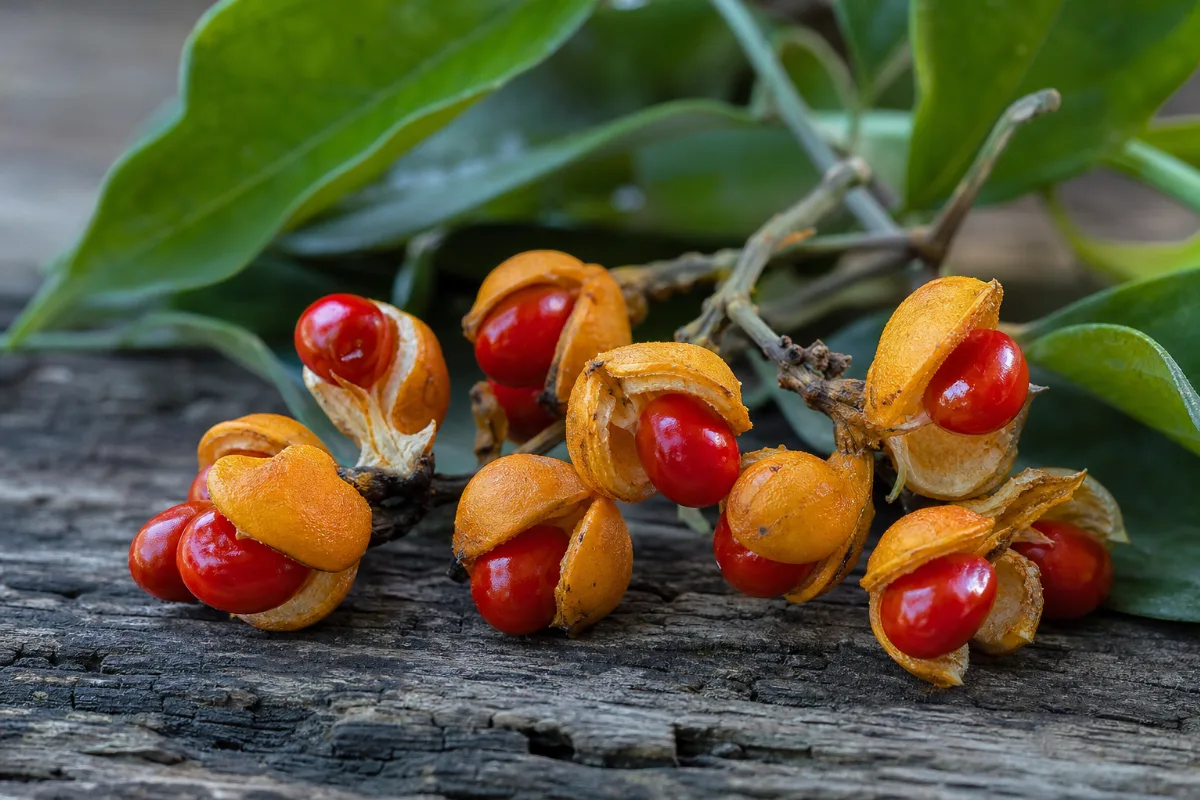
Herbs & Botanicals · Ayurvedic memory tonic seed
Malkangani
Celastrus paniculatus · also called Intellect tree, jyotishmati, malkangni, black oil plant
Malkangani is the seed and dark seed oil of a climbing shrub from India, used in Ayurveda as a memory tonic. It is also traditionally used for anxiety and nerve problems. Evidence comes from rats and mice; no human trial results have been published. The key caution is that human safety is unknown, so avoid it in pregnancy and ask a doctor if you take seizure, mood or blood-thinning medicine.
General information, not medical advice. Last substantive update · Not medically reviewed. A named clinician has not signed off on this page. How this page is made
About Malkangani
Malkangani is an Ayurvedic memory seed and oil with animal research only. Human results are missing. Pregnancy and brain-acting medicines are the main cautions.
What it is
Malkangani is the seed, and the dark oil pressed from it, of Celastrus paniculatus, a climbing shrub used in Ayurveda, Unani and Siddha medicine. It is also called the intellect tree or jyotishmati.
It is used traditionally for memory, anxiety, epilepsy, sleeplessness and joint pain.
How it may work
In rats and mice the oil or extract changed brain chemicals, lowered an enzyme that breaks down acetylcholine in some studies, and calmed inflammation markers. In mice it also blocked an enzyme called MAO-A.
These are animal and lab findings. They have not been shown to help people.
What the research shows
Reviews say no human trials have been reported. A trial against sertraline for anxiety was planned, but we found no results. One small uncontrolled study tested a six-herb formula for blood pressure.
Rat studies show the seed oil reversed a drug-made memory problem and lowered seizure scores in a chemical model. Mouse studies show antidepressant-like effects.
At a glance
Traditional uses history, not proof
- Memory and intellect tonic in Ayurveda
- Epilepsy, paralysis and insomnia
- Rheumatism, arthritis and sciatica
Studied for research
- Memory and thinking, insufficient
- Anxiety (trial planned only), insufficient
- Low mood and stress (mice), insufficient
- Seizures (rats), insufficient
- Fertility effects (rats), safety signal
Main compounds
- Sesquiterpene esters such as malkanguniol
- Alkaloids such as celastrine and paniculatine
- Triterpenoids: lupeol (PubChem CID 259846), pristimerin (CID 159516)
Common forms
- Seed oil
- Seed powder
- Capsules
- Seed extracts
- Mixed Ayurvedic formulas
Research links: Kumar 2026: extensive review of Celastrus paniculatus (PubMed) · Gattu 1997: seed oil and scopolamine memory deficit in rats (PubMed) · Gamne 2023: anxiety trial protocol versus sertraline (PubMed) · Bidwai 1990: antispermatogenic action in rats (PubMed) · Research Library · Genes & Biomarkers Library
The plant and its history
- Accepted scientific name
- Celastrus paniculatus Willd. (GBIF ACCEPTED, exact match, confidence 99, key 7265565)
- Naming authority
- Willd.
- Common names
- Malkangani (also malkangni, malkanguni) (Hindi / English); Jyotishmati (Sanskrit); Intellect tree (English); Black oil plant (English); Climbing staff tree (English)
- Botanical family
- Celastraceae (the staff-tree family)
- Classification
- Plantae > Not pulled > Not pulled > Celastrales > Celastraceae > Celastrus > Celastrus paniculatus
- Native range
- Not verified in this build; described in reviews as an Indian medicinal plant used in Ayurveda, Unani and Siddha.
- Habitat
- A climbing, evergreen shrub (per review abstracts).
- What the plant looks like
- Roots: Not covered.; Stems: Climbing shrub (review abstracts).; Leaves: Not covered.; Flowers: Not covered.; Fruit: Not covered.; Seeds: Seeds are the main medicinal part; they yield a dark oil.; Cultivation: Not covered.
- Harvest and processing
- Seeds are collected from wild plants (from our earlier summary). One regional listing marks the plant Vulnerable in two central Indian states and another marks it Least Concern; no global assessment was read. Check POWO / IUCN before relying on this.
- Look-alikes and adulterants
- Name: Other Celastrus species; Note: Not tested. Species mix-ups in products are possible but we found no identification study.
- Sustainability and conservation
- Mixed regional notes only; unresolved (see harvest).
Traditional use and history history, not clinical proof
| Tradition or era | Documented use | Source |
|---|---|---|
| Ayurveda, Unani and Siddha | Seeds and seed oil used for cognitive problems, paralysis, epilepsy, insomnia, rheumatism, arthritis and sciatica; the plant is known as Jyotishmati. | p34529902 |
| Ayurvedic mind tonic | Seeds used as a memory and intellect remedy; the oil is traditionally called a tranquilizer and memory enhancer. | p36809523 |
| Modern research | Rodent studies of memory, anxiety, mood and seizures; a human anxiety trial against sertraline planned (protocol only). | p39114320 |
Traditional use shows how a plant was used. It does not show that a supplement works or is safe today.
What is inside, and how it may work
What the plant contains and how those compounds act in cells and animals. Laboratory and animal mechanisms are not proven effects in people.
Main compounds
| Compound | Family | Where it is concentrated | Activity studied | Level of evidence |
|---|---|---|---|---|
| Sesquiterpene esters (malkanguniol, malkangunin, agarofuran derivatives) | Beta-dihydroagarofuran sesquiterpenes | Seed | Reviews list these as constituents; the 2023 review says beta-dihydroagarofurans show acetylcholinesterase-blocking and other lab activity. 10 1 | Lab |
| Alkaloids (celapanin, celapagin, paniculatine, celastrine) | Plant alkaloids | Seed | Listed by the reviews; the activity of each alkaloid is not established in the sources read. 10 1 | Lab |
| Pristimerin PubChem 159516 | Triterpenoid | Not stated | Listed as a constituent in the 2022 review. 10 17 | Lab |
| Lupeol PubChem 259846 | Triterpenoid | Not stated | Listed as a constituent in the 2022 review. 10 17 | Lab |
| Beta-amyrin PubChem 73145 | Triterpenoid | Not stated | Listed as a constituent in the 2022 review. 10 17 | Lab |
| Beta-sitosterol PubChem 222284 | Plant sterol | Seed (listed in the review) | Listed as a constituent; also found in many other plants. 10 17 | Lab |
| Fatty acids (palmitic, stearic, oleic, linoleic, linolenic) | Seed oil fatty acids | Seed oil | Make up the oil; effects on the brain are not established. 1 | Lab |
Mechanisms, receptors and pathways
| Target or pathway | Gene or receptor | What was found | Level |
|---|---|---|---|
| Acetylcholine system | Acetylcholinesterase (AChE) | Lower brain AChE with oil in one rat study and a seed water extract in rodents; another rat study found no AChE change. Results differ. 6 3 8 | Animal research |
| Mood chemicals | MAO-A; dopamine D2, serotonin and GABA-B pathways | In mice the oil blocked MAO-A and lowered corticosterone; blocking drugs reduced its effect. 14 | Animal research |
| Oxidative stress and inflammation | SOD, catalase, glutathione, NF-kB, IL-6, TNF-alpha | Antioxidant enzymes rose and inflammation markers fell in rats given the oil. 6 12 | Animal research |
| Serotonin-related anxiolysis | Serotonin pathways (suggested) | Reversal of a buspirone test suggested a serotonin route in rats. 11 | Animal research |
Absorption, metabolism and elimination
- Absorption
- Not found in people.
- Distribution
- Not found.
- Metabolism
- Not found.
- Elimination
- Not found.
- Bioavailability
- No human blood-level study was found.
Isolated compounds versus whole extracts
Most work uses the whole seed oil or crude seed extracts, whose chemistry varies between products. The 2023 review names several seed constituents, but no single compound has been shown to explain the animal memory effects.
Nutritional composition
Malkangani is a medicinal seed oil, not a food or nutrient. The oil contains common fatty acids and plant sterols, but no vitamin or mineral role was established.
9 not enough evidence
What is Malkangani good for?
The studied uses and how strong the human evidence is for each. For malkangani, none is established in people.
Benefits, one by one
Each card is a research question, not a promise. Tap a goal to filter. Open a card to see the studies, doses and limits.
Memory and thinking
Not enough evidenceKnown in Ayurveda as a memory tonic. In rats the seed oil reversed a drug-made memory problem. No trial in people has been published, so we do not know if it helps human memory.
6 studiesStudies used seed oil or seed water extract; the amount of active che…
Studies, doses and limits
What the trials found
No human trial has been published. The 2026 systematic review says randomized controlled trials in humans are currently absent, and the 2023 review reports no clinical studies.
Results
In rats, 14 days of daily seed oil completely reversed a scopolamine-induced water-maze deficit; a single dose did not (1997). A 2023 rat study found the oil improved several memory tests against scopolamine. A seed water extract improved memory tests in rodents (2010).
Effect sizes as reported
No human numbers. Animal results are all against drug-made amnesia.
Why this rating
Only animal and lab studies. No human trial.
Form and dose studied
Studies used seed oil or seed water extract; the amount of active chemicals varies by product.
Who was studied
Rats and mice only.
Limits
Chemical amnesia in rodents is not the same as memory loss in people. Abstracts only were read.
Why researchers looked
Seeds and seed oil are the traditional Ayurvedic memory and intellect remedy, which is where the name intellect tree comes from.
Traditional use
Seeds and oil are used in Ayurveda, Unani and Siddha for cognitive problems, amnesia and dementia (reviews).
Proposed mechanism Lab and animal
In rodent studies the oil or extract lowered brain acetylcholinesterase, raised some brain chemicals and calmed inflammation markers. One rat study found no change in acetylcholinesterase, so results differ.
A proposed mechanism does not show that the effect happens in people.
No human safety trials exist. Pregnancy, seizure medicines, sedatives and blood thinners are cautions; see the Safety tab.
Anxiety
Not enough evidenceA trial comparing a seed capsule with the antidepressant sertraline for anxiety was planned, but we found no results. A rat study suggests a calming effect. Human benefit is unknown.
2 studiesThe planned trial uses a seed capsule against sertraline.
Studies, doses and limits
What the trials found
Only a trial protocol (70 people planned) was found. No results are published that we could find.
Results
In rats the oil reduced anxiety-type behaviour without tolerance and was described as non-sedative at the doses tested (2007).
Effect sizes as reported
No human numbers.
Why this rating
A protocol is not a result, and the animal data are limited.
Form and dose studied
The planned trial uses a seed capsule against sertraline.
Who was studied
Rats; planned adults aged 20-50.
Limits
Very short rat abstract. The planned trial is not complete or not published.
Why researchers looked
The seed oil is described as a traditional tranquilizer, and it is tested in anxiety models.
Traditional use
Used in Ayurveda for anxiety (the condition called Chittodvega) according to the trial protocol.
Proposed mechanism Animal research
A rat study suggested a serotonin-related route. This is not proven.
A proposed mechanism does not show that the effect happens in people.
No human safety trials exist. Pregnancy, seizure medicines, sedatives and blood thinners are cautions; see the Safety tab.
Low mood and stress
Not enough evidenceIn mice the seed oil acted like an antidepressant in lab tests. These are animal tests. No human study of mood was found.
3 studiesOil in mice; no human form studied.
Studies, doses and limits
What the trials found
No human trial of mood or stress was found.
Results
In mice the oil shortened immobility in two despair-type tests, comparable to fluoxetine (2016). In stressed mice the oil with fluoxetine worked better than the oil alone (2023).
Effect sizes as reported
No human numbers. Mouse P values only.
Why this rating
Mouse data only.
Form and dose studied
Oil in mice; no human form studied.
Who was studied
Mice only.
Limits
An effect on the MAO-A enzyme and on serotonin pathways could matter for people on antidepressants. This was not tested in people.
Why researchers looked
The oil is traditionally used for brain and nerve conditions, and mouse models of depression are used to test it.
Traditional use
A reviewed traditional use for nerve and mind conditions.
Proposed mechanism Animal research
In mice the oil blocked the enzyme MAO-A, lowered the stress hormone corticosterone and seemed to involve dopamine D2, serotonin and GABA-B pathways.
A proposed mechanism does not show that the effect happens in people.
Possible interactions with antidepressants are untested; see the Safety tab.
Seizures (epilepsy)
Not enough evidenceTraditional texts list epilepsy as a use. In rats a seed extract reduced seizure scores in a chemical model. It is not known to help or harm people with epilepsy.
3 studiesSeed extract in rats.
Studies, doses and limits
What the trials found
No human data.
Results
In rats with chemical kindling, 14 days of extract alone or with valproate or pergolide cut seizure scores (P<0.05) and improved maze scores (2023).
Effect sizes as reported
No human numbers.
Why this rating
Single rat model, no human data.
Form and dose studied
Seed extract in rats.
Who was studied
Rats.
Limits
A chemical kindling model in rats does not predict what happens in a person on seizure medicine.
Why researchers looked
Epilepsy is among the traditional uses of the seed.
Traditional use
Epilepsy is a listed traditional use of the seeds and oil (reviews).
Proposed mechanism Animal research
In rats the extract raised antioxidant markers and dopamine levels and protected brain cells.
A proposed mechanism does not show that the effect happens in people.
Anyone with epilepsy or on seizure medicine should ask a clinician before using it.
Protecting nerve cells (Alzheimer's, Parkinson's models)
Not enough evidenceReviews describe lab work in which seed extracts protect nerve cells from damage. This has not been shown to prevent or treat any brain disease in people.
3 studiesSeed extracts and oil of varying content.
Studies, doses and limits
What the trials found
No human trial. The 2023 review of neurological use gathers lab and animal research only.
Results
Review summaries only; we did not re-open the individual lab papers.
Effect sizes as reported
None.
Why this rating
Lab and animal findings, summarized by reviews.
Form and dose studied
Seed extracts and oil of varying content.
Who was studied
Cells and animals.
Limits
We read review abstracts, not the underlying lab papers.
Why researchers looked
Seed extracts are tested for protection against oxidative damage and nerve-cell loss.
Traditional use
Used for dementia and nerve conditions in Ayurveda.
Proposed mechanism Lab and animal
Reviews describe antioxidant, anti-inflammatory and anti-acetylcholinesterase effects in cells and animals.
A proposed mechanism does not show that the effect happens in people.
No human safety trials exist. Pregnancy, seizure medicines, sedatives and blood thinners are cautions; see the Safety tab.
Fertility (reduced sperm production in rats)
Not enough evidenceIn rats the seed oil damaged sperm-making tissue. Authors suggested a contraceptive use. It is a safety signal, not a benefit, and it is one reason to avoid the seed in pregnancy or when trying to conceive.
2 studiesOil extract injected into rats.
Studies, doses and limits
What the trials found
No human fertility or pregnancy study was found.
Results
Injected oil extract for 30 days caused testis changes and liver areas of dead cells that were gone 45 days after treatment.
Effect sizes as reported
None in people.
Why this rating
A single old rat study, with the oil injected rather than swallowed.
Form and dose studied
Oil extract injected into rats.
Who was studied
Adult male rats.
Limits
Injection route; effect in people unknown.
Why researchers looked
A 1990 rat study tested whether the oil reduces fertility.
Traditional use
Anti-fertility activity is listed among reported actions in a 2022 review.
Proposed mechanism Animal research
In rat testes the oil caused germ cell loss and arrest of sperm production.
A proposed mechanism does not show that the effect happens in people.
Treat as a caution for anyone trying to conceive. See the Safety tab.
Blood pressure (mixed formula only)
Not enough evidenceOne small uncontrolled study gave a six-herb powder plus a tablet to 40 people with high blood pressure and reported improvement. Malkangani was only one ingredient, so this says nothing about it alone.
1 studiesBrahmyadi Churna (Brahmi, Shankhapushpi, Jatamansi, Jyotishmati, Vach…
Studies, doses and limits
What the trials found
One observational study of 40 people, with no control group.
Results
19 marked, 14 moderate, 5 mild and 2 no improvement; blood pressure reduction reported as significant (no figures in the abstract).
Effect sizes as reported
No separate numbers for malkangani.
Why this rating
Mixed formula, no control group, short, small.
Form and dose studied
Brahmyadi Churna (Brahmi, Shankhapushpi, Jatamansi, Jyotishmati, Vacha, Ashwagandha) plus Shilajatu tablet.
Who was studied
40 adults with essential hypertension in India.
Limits
No control group, six herbs plus a tablet, one month only, abstract read only.
Why researchers looked
Jyotishmati is one of six herbs in a traditional Ayurvedic powder.
Traditional use
Part of a classical-style formula called Brahmyadi Churna.
Proposed mechanism None
Not studied for malkangani.
A proposed mechanism does not show that the effect happens in people.
A blood pressure medicine should never be replaced by an herbal mix. Ask your doctor.
Joints, rheumatism and pain
Not enough evidenceJoint and nerve pain (rheumatism, arthritis, sciatica) are traditional uses. Reviews list lab and animal anti-inflammatory and pain-relieving effects. No human trial was found.
2 studiesSeed oil or extracts.
Studies, doses and limits
What the trials found
No human trial found.
Results
Review lists of analgesic, anti-inflammatory and anti-arthritic effects in lab and animal work. We did not open the underlying studies.
Effect sizes as reported
None.
Why this rating
Review mentions of lab and animal findings only.
Form and dose studied
Seed oil or extracts.
Who was studied
Cells and animals.
Limits
Secondhand through reviews.
Why researchers looked
Seed and oil are used traditionally for rheumatism, arthritis and sciatica.
Traditional use
Rheumatism, arthritis and sciatica are among the traditional uses (2023 review).
Proposed mechanism Lab and animal
Reviews report antioxidant and anti-inflammatory effects in cells and animals.
A proposed mechanism does not show that the effect happens in people.
No human safety trials exist. Pregnancy, seizure medicines, sedatives and blood thinners are cautions; see the Safety tab.
Other lab effects (antioxidant, germ-fighting, skin)
Not enough evidenceReviews list many other lab and animal effects, such as antioxidant, antibacterial and wound-healing action. None has been tested in people.
2 studiesVarious extracts.
Studies, doses and limits
What the trials found
No human trial.
Results
Review lists only.
Effect sizes as reported
None.
Why this rating
Lab and animal only.
Form and dose studied
Various extracts.
Who was studied
Cells and animals.
Limits
Secondhand through reviews.
Why researchers looked
Plant chemicals in the seed show activity in test tubes.
Traditional use
Listed among the plant's reported activities.
Proposed mechanism Lab and animal
Test-tube and animal effects including antioxidant and antibacterial action.
A proposed mechanism does not show that the effect happens in people.
No human safety trials exist. Pregnancy, seizure medicines, sedatives and blood thinners are cautions; see the Safety tab.
Connections to the rest of health
How Malkangani connects to the rest of our health knowledge graph. Every link says what kind of connection it is. A safety link (for example to the liver) is a warning, not a benefit. A study that merely mentions a topic never creates a benefit link.
Explore every connection: goals, body systems, organs, symptoms, genes
A. Wellness goals
| Connected to | Kind of connection | Evidence status | Context | Studies |
|---|---|---|---|---|
| Memory Support | Not enough evidence | Memory and thinking: Known in Ayurveda as a memory tonic. In rats the seed oil reversed a drug-made memory problem. No trial in people has been published, so we do not know if it helps human memory. | 8 6 3 9 1 13 | |
| Anxiety Support | Not enough evidence | Anxiety: A trial comparing a seed capsule with the antidepressant sertraline for anxiety was planned, but we found no results. A rat study suggests a calming effect. Human benefit is unknown. | 7 11 | |
| Mood Balance | Not enough evidence | Low mood and stress: In mice the seed oil acted like an antidepressant in lab tests. These are animal tests. No human study of mood was found. | 14 5 1 | |
| Stress Reduction | Not enough evidence | Low mood and stress: In mice the seed oil acted like an antidepressant in lab tests. These are animal tests. No human study of mood was found. | 14 5 1 | |
| Brain Health | Not enough evidence | Seizures (epilepsy): Traditional texts list epilepsy as a use. In rats a seed extract reduced seizure scores in a chemical model. It is not known to help or harm people with epilepsy. Protecting nerve cells (Alzheimer's, Parkinson's models): Reviews describe lab work in which seed extracts protect nerve cells from damage. This has not been shown to prevent or treat any brain disease in people. | 12 1 13 9 10 | |
| Fertility Support | Not enough evidence | Fertility (reduced sperm production in rats): In rats the seed oil damaged sperm-making tissue. Authors suggested a contraceptive use. It is a safety signal, not a benefit, and it is one reason to avoid the seed in pregnancy or when trying to conceive. | 4 10 | |
| Blood Pressure Support | Not enough evidence | Blood pressure (mixed formula only): One small uncontrolled study gave a six-herb powder plus a tablet to 40 people with high blood pressure and reported improvement. Malkangani was only one ingredient, so this says nothing about it alone. | 2 | |
| Joint Support | Not enough evidence | Joints, rheumatism and pain: Joint and nerve pain (rheumatism, arthritis, sciatica) are traditional uses. Reviews list lab and animal anti-inflammatory and pain-relieving effects. No human trial was found. | 1 10 | |
| Inflammation Balance | Not enough evidence | Joints, rheumatism and pain: Joint and nerve pain (rheumatism, arthritis, sciatica) are traditional uses. Reviews list lab and animal anti-inflammatory and pain-relieving effects. No human trial was found. | 1 10 | |
| Cellular Protection | Not enough evidence | Other lab effects (antioxidant, germ-fighting, skin): Reviews list many other lab and animal effects, such as antioxidant, antibacterial and wound-healing action. None has been tested in people. | 10 1 |
B. Body systems
| Connected to | Kind of connection | Evidence status | Context | Studies |
|---|---|---|---|---|
| Brain Focus | Biological association | Not enough evidence | Studied for: Memory and thinking | 8 6 3 9 1 13 |
| Stress Mood | Biological association | Not enough evidence | Studied for: Anxiety Studied for: Low mood and stress | 7 11 14 5 1 |
| Nervous System | Biological association | Not enough evidence | Studied for: Seizures (epilepsy) Studied for: Protecting nerve cells (Alzheimer's, Parkinson's models) | 12 1 13 9 10 |
| Reproductive System | Biological association | Not enough evidence | Studied for: Fertility (reduced sperm production in rats) | 4 10 |
| Cardiovascular System | Biological association | Not enough evidence | Studied for: Blood pressure (mixed formula only) | 2 |
| Bones Joints Muscles | Biological association | Not enough evidence | Studied for: Joints, rheumatism and pain | 1 10 |
| Whole Body Balance | Biological association | Not enough evidence | Studied for: Other lab effects (antioxidant, germ-fighting, skin) | 10 1 |
E. Health conditions
J. Genes, receptors and enzymes
L. Active compounds
| Connected to | Kind of connection | Evidence status | Context | Studies |
|---|---|---|---|---|
| Sesquiterpene esters (malkanguniol, malkangunin, agarofuran derivatives) | Biological association | Lab | Reviews list these as constituents; the 2023 review says beta-dihydroagarofurans show acetylcholinesterase-blocking and other lab activity. Preparation or compound: Seed |
10 1 |
| Alkaloids (celapanin, celapagin, paniculatine, celastrine) | Biological association | Lab | Listed by the reviews; the activity of each alkaloid is not established in the sources read. Preparation or compound: Seed |
10 1 |
| Pristimerin | Biological association | Lab | Listed as a constituent in the 2022 review. Preparation or compound: Not stated |
10 17 |
| Lupeol | Biological association | Lab | Listed as a constituent in the 2022 review. Preparation or compound: Not stated |
10 17 |
| Beta-amyrin | Biological association | Lab | Listed as a constituent in the 2022 review. Preparation or compound: Not stated |
10 17 |
| Beta-sitosterol | Biological association | Lab | Listed as a constituent; also found in many other plants. Preparation or compound: Seed (listed in the review) |
10 17 |
| Fatty acids (palmitic, stearic, oleic, linoleic, linolenic) | Biological association | Lab | Make up the oil; effects on the brain are not established. Preparation or compound: Seed oil |
1 |
Each connection is stored with the ingredient, the connected record, the kind of connection, the evidence status, the supporting studies, the preparation or compound involved, and a review date (last reviewed October 25, 2026).
The evidence
The research centre for Malkangani. Every record here was checked against PubMed or the publisher's page; we never list a study we have not verified.
Evidence by outcome
Bars show how many studies we found for each outcome, not how well it works. People are added up across trials only (reviews are not added, to avoid double counting).
How we rate evidence
High certainty
Several well-run trials or reviews agree; further research is unlikely to change the picture much.
Moderate certainty
Good trials point the same way, but some doubt remains.
Low certainty
Small, short or inconsistent trials. The finding could change with better research.
Very low certainty
Very little or very weak human data. Treat as a possibility only.
Mixed findings
Trials or reviews disagree with each other.
Not enough evidence
Not enough human research to say either way.
Evidence against
Good research found no benefit, or found harm.
We take the reviewers' own risk-of-bias and GRADE statements where they exist, and otherwise judge from study size, design, consistency, directness and whether a product matches what is sold. Many publications do not make evidence high. Method note: We started from our existing malkangani summary, re-checked its PubMed items, and added rat and mouse studies for anxiety, mood and seizures. Names were checked in GBIF and NCBI Taxonomy and four compounds in PubChem. Regulator pages could not be found.
Study library: every study we checked 18
| Study | Design | People | Product, dose, length | Result |
|---|---|---|---|---|
| Aleem 2023 Phytochemistry and pharmacology of Celastrus paniculatus Wild.: a nootropic drug. J Complement Integr Med · PMID 34529902 · DOI |
Narrative review review of lab and animal work |
Published literature on C. paniculatus | Seed, seed oil and extracts Seed Not stated in the abstract n/a · vs n/a |
Seeds and oil are used traditionally for cognitive problems, paralysis, epilepsy, insomnia, rheumatism and more. The review lists sesquiterpenes, alkaloids, flavonoids, triterpenes, sterols and fatty acids, and reports lab and animal nootropic, anticonvulsant, antidepressant and other effects. It notes the absence of any reported clinical studies. No human effect sizes. Methods, limits and fundingOutcomes: Traditional uses, chemistry and pharmacology Limitations: Narrative review; abstract only. Funding and conflicts: Not stated in the abstract. Read: abstract |
| Ali 2015 Effect of Brahmyadi Churna (Brahmi, Shankhapushpi, Jatamansi, Jyotishmati, Vacha, Ashwagandha) and tablet Shilajatu in essential hypertension: An observational study. J Adv Pharm Technol Res · PMID 26605154 · DOI |
Uncontrolled observational |
40 Adults with essential hypertension (high blood pressure), India |
Brahmyadi Churna (a mixed powder with Jyotishmati plus Brahmi, Shankhapushpi, Jatamansi, Vacha and Ashwagandha) and Shilajatu tablet Mixed formula; Jyotishmati is one of six herbs Not stated in the abstract 1 month · vs None (no control group described) |
The abstract says 19 had marked improvement, 14 moderate, 5 mild and 2 none, with blood pressure reduction reported as significant. Malkangani cannot be separated from the other herbs and tablet. Blood pressure reduced (no figures in the abstract). Methods, limits and fundingOutcomes: Blood pressure Limitations: Mixed formula, no control group, small, short. Does not show anything about malkangani alone. Funding and conflicts: Not stated in the abstract. Read: abstract |
| Bhanumathy 2010 Nootropic activity of Celastrus paniculatus seed. Pharm Biol · PMID 20645820 · DOI |
Animal study rat and mouse |
Rats and mice in memory tests | Seed aqueous (water) extract Seed Animal doses (not a human guide) Not stated in the abstract · vs Piracetam |
The extract significantly improved memory-test results compared with control and lowered brain acetylcholinesterase activity. The authors suggest dose-dependent cholinergic action. Significant improvement versus control in rodents. Methods, limits and fundingOutcomes: Elevated plus maze and passive avoidance after sodium nitrite amnesia; brain acetylcholinesterase Limitations: Rodents. Chemical amnesia model. Funding and conflicts: Not stated in the abstract. Read: abstract |
| Bidwai 1990 Antispermatogenic action of Celastrus paniculatus seed extract in the rat with reversible changes in the liver. J Ethnopharmacol · PMID 2335957 · DOI |
Animal study rat |
Adult male rats | Oily extract of seeds Seed oil extract Injected into the abdomen (not by mouth); animal dose 30 days · vs Untreated rats |
Treated rats showed vacuolization, germ cell loss and arrest of sperm production in the testes. The liver showed focal necrosis (small areas of dead cells) at the end of treatment, and these were gone 45 days after treatment. The authors suggest possible anti-fertility use. Reversible liver changes; testis damage reported. Methods, limits and fundingOutcomes: Testis and liver structure and chemistry Limitations: Rats. The oil was injected, not eaten, so the human meaning is unclear. A 1990 study. Funding and conflicts: Not stated in the abstract. Read: abstract |
| Chahuan 2023 Amelioration of modified chronic unpredictable stress using Celastrus paniculatus seed oil alone and in combination with fluoxetine. Drug Chem Toxicol · PMID 35943180 · DOI |
Animal study mouse |
Mice with chronic unpredictable stress | Seed oil, alone and with fluoxetine Seed oil Animal doses (not a human guide) 21 days of treatment · vs Fluoxetine |
The oil combined with fluoxetine improved behaviour, inflammation and neurotransmitter measures compared with the oil alone. The abstract reports significant effects for the combined groups and not for the oil-alone groups. Combination groups were significant (p < 0.05); oil-alone groups were not. Methods, limits and fundingOutcomes: Stress-related behaviour, inflammation and brain chemicals Limitations: Mice. The result is mainly about the combination, so it does not show the oil alone works. Funding and conflicts: Not stated in the abstract. Read: abstract |
| Faldu 2023 Celastrus paniculatus oil ameliorates NF-KB mediated neuroinflammation and synaptic plasticity in the scopolamine-induced cognitive impairment rat model. Metab Brain Dis · PMID 36809523 · DOI |
Animal study rat |
Rats with scopolamine-induced cognitive impairment | Seed oil Seed oil Animal doses (not a human guide) 15 days · vs Donepezil as reference drug |
The oil improved test results and changed brain markers (higher dopamine, serotonin and antioxidant enzymes; lower acetylcholinesterase and inflammation markers). The authors say it improves cognition in this amnesia model. Improved scores (p < 0.05 to p < 0.001) in rats. Methods, limits and fundingOutcomes: Maze, object recognition and avoidance tests; brain chemicals and inflammation markers Limitations: Rats. Chemical amnesia model. Abstract only. Funding and conflicts: Not stated in the abstract. Read: abstract |
| Gamne 2023 Evaluation of comparative efficacy of Celastrus paniculatus (Jyotishmati) capsule versus sertraline capsule in the management of Chittodvega (generalized anxiety disorder): protocol for a randomized controlled trial. F1000Res · PMID 39114320 · DOI |
Trial protocol Not stated in the abstract. |
70 Planned: adults aged 20-50 with mild to moderate generalized anxiety (India) |
Jyotishmati capsule (C. paniculatus) Seed (per product name; part not stated in the abstract) Per protocol (not reproduced here) 60 days treatment, follow-up to day 90 · vs Sertraline capsule |
This is a protocol only. It describes a planned randomized double-blind equivalence trial of 70 people. No results are in the paper. None: no results. Methods, limits and fundingOutcomes: Planned: HAM-A anxiety score, serum cortisol, quality of life Limitations: A protocol is not evidence of benefit. We found no published results. Funding and conflicts: Protocol only; results not found. Read: human (planned) |
| Gattu 1997 Reversal of scopolamine-induced deficits in navigational memory performance by the seed oil of Celastrus paniculatus. Pharmacol Biochem Behav · PMID 9259008 · DOI |
Animal study rat |
Young adult rats with scopolamine-induced memory deficit | Seed oil Seed oil Animal doses by gavage (not a human guide) 14 days (chronic) or single dose (acute) · vs Scopolamine-only group |
Two weeks of daily oil completely reversed the scopolamine-induced maze deficit at all three doses tested. A single dose did not significantly reverse it. The oil did not change normal movement and did not alter brain acetylcholinesterase. The mechanism is not known. Reversed a drug-induced deficit in rats; no human number. Methods, limits and fundingOutcomes: Morris water maze performance; open-field activity; brain acetylcholinesterase Limitations: Rats, not people. Drug-induced deficit is not the same as human memory problems. Funding and conflicts: Not stated in the abstract. US government research support noted in the record. Read: abstract |
| Kumar 2026 Celastrus paniculatus Willd.: An Extensive Review of Phytochemistry, Traditional Uses, Pharmacological Potential, and Safety Profile. Phytother Res · PMID 41920476 · DOI |
Systematic review review of lab, animal and plant-chemistry papers |
Published literature on C. paniculatus up to August 2024 | Seed, seed oil and other plant parts (various extracts) Seed and others Not stated in the abstract n/a · vs n/a |
The abstract says there is compelling preclinical evidence, but randomized controlled trials in humans are currently absent. It also says quality standardization and clinical validation are still needed. No human trial results exist to pool. Methods, limits and fundingOutcomes: Phytochemistry, traditional uses, pharmacology, toxicology, patents Limitations: Abstract read only; its toxicology section and numbers were not read. Funding and conflicts: Not stated in the abstract. Read: abstract |
| Nagpal 2022 An extensive review on phytochemistry and pharmacological activities of Indian medicinal plant Celastrus paniculatus Willd. Phytother Res · PMID 35199395 · DOI |
Narrative review review of lab and animal work |
Published literature and patents on C. paniculatus | Seed, seed oil, other parts and extracts Seed and other parts Not stated in the abstract n/a · vs n/a |
Lists monoterpenes, sesquiterpene esters (such as malkanguniol and malkangunin), triterpenoids (such as lupeol, pristimerin and beta-amyrin), alkaloids (celapanin, celapagin, paniculatine, celastrine), sterols and fatty acids. Lists many reported activities in lab and animals, including cognition-enhancing, neuroprotective, antidepressant, anxiolytic, anti-fertility, anti-spasmodic and antioxidant. No human effect sizes. Methods, limits and fundingOutcomes: Chemistry and pharmacological activities Limitations: Narrative review; abstract only (the abstract ends mid-sentence). Funding and conflicts: Not stated in the abstract. Read: abstract |
| Rajkumar 2007 Evaluation of anxiolytic potential of Celastrus oil in rat models of behaviour. Fitoterapia · PMID 17169502 · DOI |
Animal study rat |
Rats in behaviour tests of anxiety | Seed oil (Celastrus oil) Seed oil Animal doses (not a human guide) Not stated in the abstract · vs Buspirone reversal test |
The oil showed significant anxiolytic (anxiety-reducing) activity without tolerance. The abstract calls it non-sedative and suggests a serotonin-related route. Significant anxiolytic effect in rats. Methods, limits and fundingOutcomes: Anxiety-type behaviour tests Limitations: Rats; very short abstract. Funding and conflicts: Not stated in the abstract. Read: abstract |
| Ralta 2023 Neuroprotective Effect of Celastrus Paniculatus Seed Extract on Epilepsy and Epilepsy-associated Cognitive Deficits. Basic Clin Neurosci · PMID 37346867 · DOI |
Animal study rat |
Rats with chemical (PTZ) kindling seizures | Seed extract Seed Animal doses (not a human guide) 14 days · vs Sodium valproate; pergolide; combinations |
The extract alone and combined with valproate or pergolide significantly reduced seizure score and improved maze latency (P<0.05). Grip strength was not changed. Lower seizure scores in rats (p < 0.05). Methods, limits and fundingOutcomes: Seizure score; maze performance; antioxidant and dopamine markers Limitations: Rats. Chemical kindling model. It was also tested together with a seizure drug, so this says nothing about safety in people on seizure medicine. Funding and conflicts: Not stated in the abstract. Read: abstract |
| Sankaramourthy 2023 Neuroprotective potential of Celastrus paniculatus seeds against common neurological ailments: a narrative review. J Complement Integr Med · PMID 35005853 · DOI |
Narrative review review |
Published research on C. paniculatus seeds and seed oil | Seeds and seed oil Seed Not stated in the abstract n/a · vs n/a |
Says seeds and seed oil have been used for centuries for epilepsy, dementia, facial paralysis, amnesia, anxiety, sciatica and cognitive problems, and gathers research on their therapeutic potential in neurological disorders. No human effect sizes. Methods, limits and fundingOutcomes: Neuroprotective potential against common neurological conditions Limitations: Narrative review; abstract only. Funding and conflicts: Not stated in the abstract. Read: abstract |
| Valecha 2016 Behavioral and Biochemical Evidences for Antidepressant-Like Activity of Celastrus Paniculatus Seed Oil in Mice. Basic Clin Neurosci · PMID 27303599 |
Animal study mouse |
Young Swiss albino mice | Seed oil Seed oil Animal doses (not a human guide) 14 days · vs Fluoxetine |
The oil shortened immobility in both tests, comparable to fluoxetine, without changing movement. It inhibited brain MAO-A and lowered plasma corticosterone. Blocking drug tests suggested dopamine D2, serotonin and GABA-B receptors are involved. Comparable to fluoxetine in mice (P<0.0001). Methods, limits and fundingOutcomes: Immobility in tail suspension and forced swim tests; MAO-A; plasma corticosterone Limitations: Mice. "Antidepressant-like" tests are not depression in people. Abstract only. Funding and conflicts: Not stated in the abstract. Read: abstract |
| n/a 2020 Toxicity profile of Celastrus paniculatus seeds: a preclinical study Asian Journal of Pharmaceutical and Clinical Research (2020) · Source |
Database or regulator record n/a |
n/a | n/a n/a n/a n/a · vs n/a |
Summary from our earlier notes (abstract and conclusion read from the PDF): in mice given the seed oil, no signs of toxicity or deaths were seen up to 2000 mg per kg over 14 and 28 days, and the authors called it practically non-toxic. n/a Methods, limits and fundingOutcomes: Identity, safety or regulatory status Limitations: Summary-only here: the results tables were not checked and the paper was not re-opened. Mice, not people. Short-term. The paper itself describes the oil as both relaxant and stimulating. Funding and conflicts: n/a Read: summary-only |
| n/a 2026 Regulator and safety-database checks for malkangani (not found) Checks on 2026-10-25 · Source |
Database or regulator record n/a |
n/a | n/a n/a n/a n/a · vs n/a |
An NCBI Bookshelf search for celastrus with LiverTox returned no records. A guessed NCCIH page address returned 404. EMA/HMPC, WHO, LactMed and Commission E were not searched. No regulator statement on malkangani was found or read. n/a Methods, limits and fundingOutcomes: Identity, safety or regulatory status Limitations: Absence of a page we found does not mean no document exists. Funding and conflicts: n/a Read: not-read |
| n/a 2026 PubChem name lookups: pristimerin, lupeol, beta-amyrin, beta-sitosterol PubChem PUG REST (checked 2026-10-25) · Source |
Database or regulator record n/a |
n/a | n/a n/a n/a n/a · vs n/a |
Name lookups returned CID 159516 (pristimerin), CID 259846 (lupeol), CID 73145 (beta-amyrin) and CID 222284 (beta-sitosterol). These four compounds are named as constituents in the 2022 review of this plant. n/a Methods, limits and fundingOutcomes: Identity, safety or regulatory status Limitations: Name lookups only. The sesquiterpene esters (malkanguniol, malkangunin) and the alkaloids were not looked up, so no CID is given for them. Funding and conflicts: n/a Read: abstract |
| n/a 2026 GBIF Backbone Taxonomy species match: Celastrus paniculatus GBIF API (checked 2026-10-25) · Source |
Database or regulator record n/a |
n/a | n/a n/a n/a n/a · vs n/a |
Celastrus paniculatus Willd. returned ACCEPTED, exact match, confidence 99, key 7265565, family Celastraceae, order Celastrales. It is its own accepted name (no synonym redirect). n/a Methods, limits and fundingOutcomes: Identity, safety or regulatory status Limitations: Taxonomy only; says nothing about which species or parts are in a product. Funding and conflicts: n/a Read: full-text |
What we do not know yet
- No published human trial of malkangani seed or seed oil for memory, anxiety, mood or seizures.
- The planned anxiety versus sertraline trial has no published results that we could find.
- No human safety data, and no LiverTox, NCCIH, EMA/HMPC, WHO or LactMed record was read.
- The womb-stimulant claim could not be verified.
How new research is added
New studies are found by a saved PubMed search and placed in a review queue. A person reads each one before it changes any rating or safety wording.
Lab markers
What changed in blood or saliva tests during trials. A changed number is not the same as feeling or being healthier, and we give no "normal ranges".
Safety
What studies and official sources say about side effects, medicines and who should check first. Each point shows what kind of evidence it comes from.
Main points to know 6
- There are no human safety trials. Reviews report that no clinical trials in people have been published. That means side effects, safe amounts, long-term use, and effects in pregnancy, children, and people with liver or kidney disease are all unknown. A mouse study found no toxic signs at high short-term exposure, but that does not prove safety for people. Gap 9 1 15
- Avoid in pregnancy and when trying to conceive. No human pregnancy data exist. A rat study found the seed oil extract reduced sperm production and a review lists anti-fertility activity. Some herbal references also describe the seed as acting on the womb; we could not find a study that confirms uterine-stimulant effects, so this is unverified. Because of this and the missing data, the careful answer is to avoid it in pregnancy. Animal research 4 10 9
- Seizure medicines and brain-active medicines. Animal studies show the seed extract or oil acts on the brain: lowering seizure scores in rats, and in mice blocking MAO-A and involving dopamine, serotonin and GABA-B pathways. This is untested in people, but it is a reason for anyone on anti-seizure drugs, antidepressants (especially MAO inhibitors) or other brain-acting medicines to ask a doctor or pharmacist first. Animal research 12 14 5
- Sedation: sources disagree. Traditionally the oil is called a tranquilizer. A rat study called it non-sedative at the tested doses, while a mouse safety paper we summarised describes it as both relaxing and stimulating. Possible extra drowsiness with sedatives or alcohol has not been tested. Animal research 6 11 15
- Blood thinners: nothing found. We found no study or report of malkangani affecting bleeding or blood-thinning drugs. That is a gap, not proof of safety. Anyone on a blood thinner should ask their prescriber before trying any new herb. Gap 16
- Seed toxicity at high exposure is unclear. In mice the seed oil showed no toxicity signs up to a high short-term amount, but that was a short study that we only summarised. In rats, an injected oil extract caused testis changes and small areas of liver cell death that cleared after treatment. Long-term oral use is not studied. Animal research 15 4
Side effects 4
| Effect | How often | Severity and recovery | Evidence |
|---|---|---|---|
| No adverse effects documented in people No human trials or case reports were found in the sources read, so absence of reports is not proof of safety. | Not established | Unknown Unknown | Gap 9 1 |
| Reduced sperm production (testis changes) in rats Oil extract injected into the abdomen for 30 days; not the usual route in people. | Not established | Unknown in people Not stated for testis | Animal research 4 |
| Small areas of liver cell death in rats (focal necrosis) Injected oil extract; human liver safety is unknown. | Not established | Unknown in people Gone 45 days after treatment in rats | Animal research 4 |
| No toxicity signs in mice at high short-term exposure Summary-only: results tables were not checked. | Not established | None seen n/a | Animal research 15 |
Liver
No human liver injury reports for malkangani were found, and no LiverTox record was found. In rats, an injected seed oil extract caused small liver areas of cell death that cleared within 45 days. Human liver safety is unknown, so people with liver disease should ask a doctor first. 4 16
How often. No rate is known; no human reports found.
Monitoring. No monitoring advice was found. Seek care for yellow skin or eyes, dark urine, pale stools, severe tiredness or belly pain.
This is a safety connection. It is not evidence that Malkangani supports liver health.
Medicines and supplements 5
| With | Why it matters | Importance | Evidence | What to do |
|---|---|---|---|---|
| Anti-seizure medicines prescription | An extract reduced seizure scores in rats, alone and combined with valproate, so it may change how the brain handles seizure medicine. | Unknown in people; changes in seizure control would be serious. | Animal research Very low certainty 12 | Ask the prescriber before use; do not change seizure medicine on your own. |
| Antidepressants and other mood medicines (especially MAO inhibitors and SSRIs) prescription | In mice the oil inhibited MAO-A and involved dopamine, serotonin and GABA-B pathways; a fluoxetine combination worked better than the oil alone in stressed mice. | Untested in people; theoretical risk of too much effect. | Animal research Very low certainty 14 5 | Ask a doctor or pharmacist first. |
| Sedatives, sleep medicines and alcohol prescription | Traditionally called a tranquilizer; animal reports conflict on sedation. | Unknown. | Traditional Very low certainty 6 11 | Take care; ask a pharmacist. |
| Anticoagulants (blood thinners) prescription | No interaction study or report found. | Unknown. | Gap Not enough evidence 16 | Ask the prescriber before combining any herb with a blood thinner. |
| Cholinergic medicines, including Alzheimer's drugs such as donepezil prescription | Some rodent work shows lowered acetylcholinesterase; another rat study found no change. | Unknown. | Animal research Very low certainty 6 8 | Ask a doctor or pharmacist first. |
Who should check first 6
| Situation | Advice | Evidence |
|---|---|---|
| Pregnancy and trying to conceive | Avoid; no human safety data, animal fertility signal, and unverified reports of effects on the womb. | Animal research 4 10 |
| Breastfeeding | Avoid; no data. No LactMed record was found. | Gap 16 |
| Epilepsy or seizure medicine | Ask a clinician first. | Animal research 12 |
| Taking antidepressants, sedatives or blood thinners | Ask a doctor or pharmacist first. | Animal research 14 |
| Children | No data; avoid. Do not give to children. | Gap 9 |
| Liver disease | Ask a doctor first. | Animal research 4 |
Overdose, product quality and regulators
Summary. The only toxicity studies are in animals. In mice, the seed oil showed no toxic signs in short high-exposure tests (summary-only). In rats, an injected oil extract caused testis changes and reversible liver changes.
Animal. Mice: no deaths or toxicity signs at the highest amount tested over 14 and 28 days (our earlier summary). Rats: testis damage and reversible liver changes with an injected extract.
Human doses studied. None as a trial.
High dose or long term signals. Not studied in people.
Overdose response. Not found.
Genotoxicity. Not covered in the sources read.
Toxic plant parts. The seed and seed oil are the parts used. Other parts of the plant (leaves, stem, bark) are less studied; no safe or unsafe part is established.
No testing study of products on sale was found. Seed oil and seed powders vary, and there is no standard strength across studies.
Strength and identity. A review calls for standardization of quality. We found no study that tested products for the right plant, heavy metals or adulteration. 9
Name confusion. It has many local names (malkangani, jyotishmati, black oil plant). The same oil name can be used for different products; this was not tested. 16
| Body | Action | Date |
|---|
When to get medical help
- Seizures that are new or more frequent, or confusion or fainting.
- Yellow skin or eyes, dark urine, pale stools or severe tiredness.
- Vaginal bleeding, cramping or any pregnancy concern after use.
- Extreme drowsiness, agitation, a racing heart or high fever when combined with antidepressants.
Stop the supplement and contact a clinician or emergency service. In the US, Poison Control is 1-800-222-1222.
General information only, not medical advice. Ask a clinician or pharmacist before use, especially with medicines, in pregnancy or with a health condition. See the Natural Remedy Safety guide.
Frequently asked questions
What is malkangani?
Does malkangani improve memory?
Does it help with anxiety?
Is there any human research?
Is malkangani safe in pregnancy?
Can I take it with seizure medicine or antidepressants?
Does it make you sleepy?
Does it interact with blood thinners?
We found no study either way. That is a gap, not proof it is safe. Ask the prescriber before combining.
Are the seeds toxic?
What is in the seeds?
Where can I find advice on how much to take?
No safe or effective amount has been established in people. Ask a doctor or pharmacist about amounts.
Explore by health goal
Brain HealthMemory SupportAnxiety SupportMood BalanceStress ReductionFertility SupportBlood Pressure SupportJoint SupportInflammation BalanceCellular Protection
Editorial transparency
- Written by
- AlternativeMed editorial team. Research compiled with AI assistance, then checked against PubMed records.
- Medical review
- None. This page has not been reviewed by a physician or pharmacist.
- First published
- 2026-10-25
- Last substantive update
- 2026-10-25
- How we research
- We started from our existing malkangani summary, re-checked its PubMed items, and added rat and mouse studies for anxiety, mood and seizures. Names were checked in GBIF and NCBI Taxonomy and four compounds in PubChem. Regulator pages could not be found.
- How we rate evidence
- See "How we rate evidence" in the Evidence tab.
- Independence
- No product is promoted on this page. No affiliate links are shown. Industry funding is flagged where an abstract shows it.
Sources 18
Each source was opened and checked. Where we read only the abstract, it says so. The small numbers in the text point here.
- Aleem M. Phytochemistry and pharmacology of Celastrus paniculatus Wild.: a nootropic drug.. J Complement Integr Med. 2023. PMID 34529902. DOI 10.1515/jcim-2021-0251. (abstract)
- Ali A, Umar D, Farhan M, et al.. Effect of Brahmyadi Churna (Brahmi, Shankhapushpi, Jatamansi, Jyotishmati, Vacha, Ashwagandha) and tablet Shilajatu in essential hypertension: An observational study.. J Adv Pharm Technol Res. 2015. PMID 26605154. DOI 10.4103/2231-4040.165015. (abstract)
- Bhanumathy M, Harish MS, Shivaprasad HN, et al.. Nootropic activity of Celastrus paniculatus seed.. Pharm Biol. 2010. PMID 20645820. DOI 10.3109/13880200903127391. (abstract)
- Bidwai PP, Wangoo D, Bhullar N. Antispermatogenic action of Celastrus paniculatus seed extract in the rat with reversible changes in the liver.. J Ethnopharmacol. 1990. PMID 2335957. DOI 10.1016/0378-8741(90)90080-d. (abstract)
- Chahuan S, Grover S, Singh S. Amelioration of modified chronic unpredictable stress using Celastrus paniculatus seed oil alone and in combination with fluoxetine.. Drug Chem Toxicol. 2023. PMID 35943180. DOI 10.1080/01480545.2022.2105862. (abstract)
- Faldu KG, Patel SS, Shah JS. Celastrus paniculatus oil ameliorates NF-KB mediated neuroinflammation and synaptic plasticity in the scopolamine-induced cognitive impairment rat model.. Metab Brain Dis. 2023. PMID 36809523. DOI 10.1007/s11011-023-01186-7. (abstract)
- Gamne R, Misar S, Rai M. Evaluation of comparative efficacy of Celastrus paniculatus (Jyotishmati) capsule versus sertraline capsule in the management of Chittodvega (generalized anxiety disorder): protocol for a randomized controlled trial.. F1000Res. 2023. PMID 39114320. DOI 10.12688/f1000research.139473.3. (human (planned))
- Gattu M, Boss KL, Terry AV Jr, et al.. Reversal of scopolamine-induced deficits in navigational memory performance by the seed oil of Celastrus paniculatus.. Pharmacol Biochem Behav. 1997. PMID 9259008. DOI 10.1016/s0091-3057(96)00391-7. (abstract)
- Kumar N, Jaitak V. Celastrus paniculatus Willd.: An Extensive Review of Phytochemistry, Traditional Uses, Pharmacological Potential, and Safety Profile.. Phytother Res. 2026. PMID 41920476. DOI 10.1002/ptr.70325. (abstract)
- Nagpal K, Garg M, Arora D, et al.. An extensive review on phytochemistry and pharmacological activities of Indian medicinal plant Celastrus paniculatus Willd.. Phytother Res. 2022. PMID 35199395. DOI 10.1002/ptr.7424. (abstract)
- Rajkumar R, Kumar EP, Sudha S, et al.. Evaluation of anxiolytic potential of Celastrus oil in rat models of behaviour.. Fitoterapia. 2007. PMID 17169502. DOI 10.1016/j.fitote.2006.09.028. (abstract)
- Ralta A, Prakash A, Kumar M P, et al.. Neuroprotective Effect of Celastrus Paniculatus Seed Extract on Epilepsy and Epilepsy-associated Cognitive Deficits.. Basic Clin Neurosci. 2023. PMID 37346867. DOI 10.32598/bcn.2021.3154.1. (abstract)
- Sankaramourthy D, Sankaranarayanan L, Subramanian K, et al.. Neuroprotective potential of Celastrus paniculatus seeds against common neurological ailments: a narrative review.. J Complement Integr Med. 2023. PMID 35005853. DOI 10.1515/jcim-2021-0448. (abstract)
- Valecha R, Dhingra D. Behavioral and Biochemical Evidences for Antidepressant-Like Activity of Celastrus Paniculatus Seed Oil in Mice.. Basic Clin Neurosci. 2016. PMID 27303599. (abstract)
- n/a. Toxicity profile of Celastrus paniculatus seeds: a preclinical study. Asian Journal of Pharmaceutical and Clinical Research (2020). 2020. (summary-only)
- n/a. Regulator and safety-database checks for malkangani (not found). Checks on 2026-10-25. 2026. (not-read)
- n/a. PubChem name lookups: pristimerin, lupeol, beta-amyrin, beta-sitosterol. PubChem PUG REST (checked 2026-10-25). 2026. (abstract)
- n/a. GBIF Backbone Taxonomy species match: Celastrus paniculatus. GBIF API (checked 2026-10-25). 2026. (full-text)