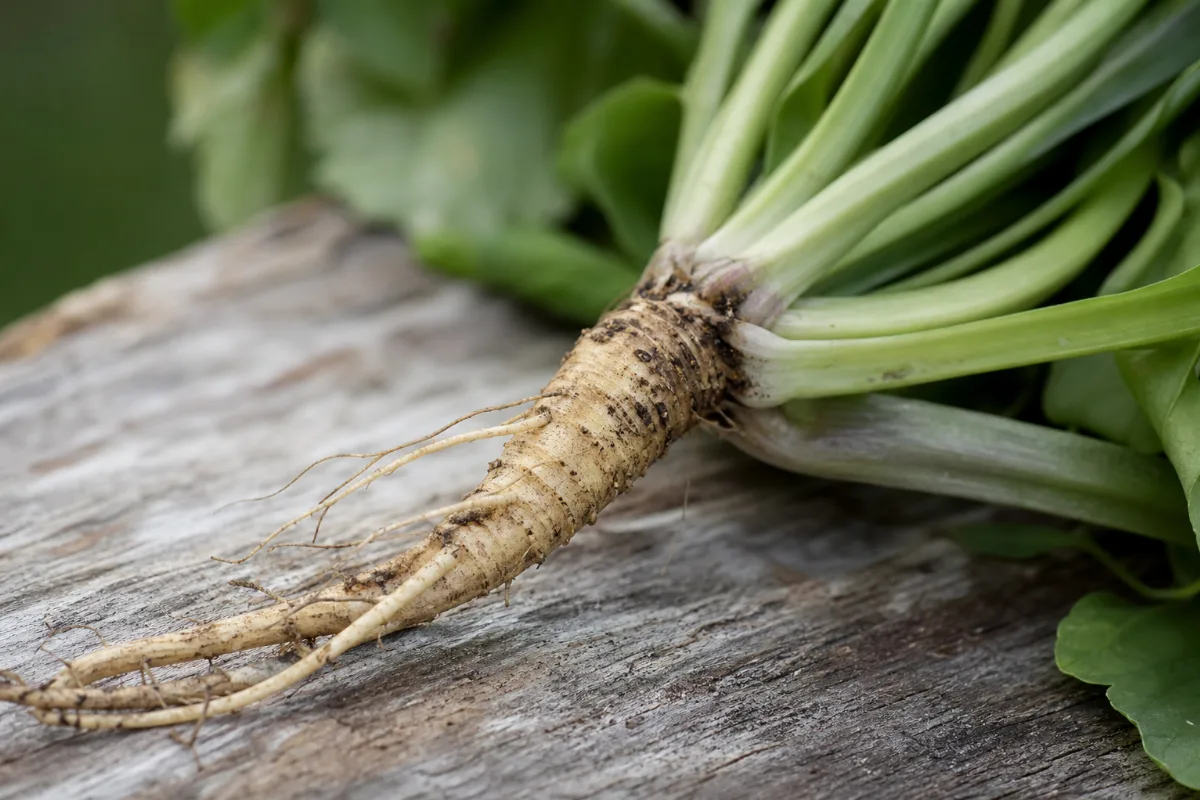
Herbs & Botanicals · Chinese cold and flu root
Isatis
Isatis tinctoria (woad); Isatis indigotica in Chinese medicine · also called Ban lan gen (root), da qing ye (leaf), woad, Chinese indigo, indigowood. Qing dai is a related powder, not the same thing.
Isatis is a mustard-family plant. In China its dried root, ban lan gen, is a very popular remedy for colds and flu. Research is thin: no finished trial showing the root granules work was found, and the best human data are for Qing dai, a different indigo powder. Qing dai has been linked to a serious lung-artery problem, so never mix the products up.
General information, not medical advice. Last substantive update · Not medically reviewed. A named clinician has not signed off on this page. How this page is made
About Isatis
Isatis is the source of the Chinese cold-and-flu root ban lan gen. Human research is limited: a trial plan for flu, one tiny mouth-sore trial, and a short colitis trial of a different indigo powder. Safety questions are clearer than the benefits: lung-artery cases with Qing dai, a possible drug-interaction signal, and no pregnancy data.
What it is
Isatis is a mustard-family plant. Its dried root is ban lan gen and its leaf is da qing ye. GBIF treats Isatis tinctoria (woad) as the accepted species and Isatis indigotica, the Chinese medicine plant, as a synonym, but Chinese texts use them separately.
Qing dai (indigo naturalis) is a powder from indigo plants. It is not the same as root granules and carries different risks.
How it may work
Lab studies report antiviral and anti-inflammatory effects from compounds such as indirubin and tryptanthrin. A 2021 review says the real active parts are still unknown.
For Qing dai in colitis, the trial authors suggest it activates a gut receptor (AHR) and raises interleukin-22, which may help the gut lining heal.
Five products with one family name
Root granules, root extract, leaf or Qing dai powder, purified indirubin and woad skin extracts are different things. The best human results (colitis) are for Qing dai, while the best-known use (flu) is for root granules without results. Multi-herb formulas and injections add more differences.
At a glance
Traditional uses history, not proof
- Root (ban lan gen) used in Chinese medicine for fever, sore throat, mumps and hepatitis, usually in formulas
- Leaf (da qing ye) used separately; the powder Qing dai is a related product
- Chinese guidelines weakly recommend root granules for mild flu (as reported by MSK)
Studied for research
- Colds and flu (root granules): insufficient; no trial results found
- Mouth sores during head and neck radiotherapy (root extract): very low, one 20-person trial
- Ulcerative colitis (Qing dai powder, a different product): low
- Chronic myelocytic leukemia (indirubin and formulas): insufficient
- Skin irritation (woad extract on skin): very low
- Antiviral effects: lab only
Main compounds
- Indirubin (CID 10177)
- Tryptanthrin (CID 73549)
- Goitrin / epigoitrin (CID 7568320)
- Indigo / indigotin (CID 10215)
Common forms
- Root granules dissolved in water
- Root extract (including a mouth rinse used in one trial)
- Leaf and Qing dai (indigo powder), different products
- Multi-herb formulas
- Injections (given only by doctors in China)
Research links: Naganuma 2018: indigo naturalis in ulcerative colitis (PubMed) · Kakdiya 2024: indigo naturalis meta-analysis (PubMed) · Li 2015: Ban-Lan-Gen granules flu trial plan (PubMed) · You 2009: root extract and radiation mucositis (PubMed) · MSK: Isatis Root · Research Library · Genes & Biomarkers Library
The plant and its history
- Accepted scientific name
- Isatis tinctoria L.
- Naming authority
- GBIF lists Isatis tinctoria L. as the accepted species (usageKey 5374118). Isatis indigotica Fortune ex Lindl. (usageKey 5374120) is listed there as a synonym of it. Chinese medicine texts and many papers use I. indigotica as a separate name, so this profile writes both and keeps the products apart.
- Synonyms
- Isatis indigotica Fortune ex Lindl. (GBIF synonym; used separately in Chinese medicine)
- Common names
- Isatis (English); Woad (Isatis tinctoria) (English); Chinese indigo / indigowood (English); Ban lan gen (root) (Chinese (pinyin)); Da qing ye (leaf) (Chinese (pinyin)); Qing dai (indigo powder; a related product) (Chinese (pinyin))
- Botanical family
- Brassicaceae, the mustard and cabbage family (GBIF).
- Classification
- Plantae > Brassicaceae (mustard / cabbage family) > Isatis > Isatis tinctoria
- Native range
- Not found in the sources read.
- Habitat
- Not found in the sources read.
- What the plant looks like
- Roots: The dried root (ban lan gen) is the main medicine part in China.; Stems: Not described in the sources read.; Leaves: The leaf (da qing ye) is used separately in Chinese medicine; a 2021 review reports leaves hold more indigotin and indirubin than roots.; Flowers: Not described in the sources read.; Fruit: Not described in the sources read.
- Cultivation
- Not described in the sources read; grown as a crop in China for medicine and dye (general knowledge, NOT verified from a source here).
- Harvest and processing
- Not described in the sources read. Qing dai is a processed indigo product.
- Look-alikes and adulterants
- Name: Qing dai / indigo naturalis; Note: A powder from indigo plants. It is a different product with its own risks (lung and gut reports). Do not treat it as root granules.; Name: Other indigo plants sold as 'Ban-Lan-Gen'; Note: A 2016 paper says Ban-Lan-Gen is the common name for roots of several indigo plants including Polygonum tinctorium, Isatis indigotica, Isatis tinctoria and Strobilanthes cusia.
- Sustainability and conservation
- Not found.
Traditional use and history history, not clinical proof
| Tradition or era | Documented use | Source |
|---|---|---|
| Traditional Chinese medicine | Root and leaf used for fever, sore throat, mumps, hepatitis and tumors, usually with other herbs. Danggui Longhui Wan, a formula with indigo-type ingredients, is used in China for chronic myelocytic leukemia (as summarised by MSK). | s-msk-isatis-root |
| Ayurveda (as summarised by MSK) | Also used in combination with other herbs for colds, sore throat and fever. | s-msk-isatis-leaf |
| Modern China | Chinese clinical practice guidelines weakly recommend Banlangen granules for mild influenza (reported by MSK; the guideline itself was not read). | s-msk-isatis-root |
| Europe | Woad was a source of blue dye; no medicinal history source read, NOT verified. | p15124080 |
Traditional use shows how a plant was used. It does not show that a supplement works or is safe today.
What is inside, and how it may work
What the plant contains and how those compounds act in cells and animals. Laboratory and animal mechanisms are not proven effects in people.
Main compounds
| Compound | Family | Where it is concentrated | Activity studied | Level of evidence |
|---|---|---|---|---|
| Indirubin PubChem 10177 | bis-indole alkaloid | Root and leaf | Slows cell division in lab tests by blocking cyclin-dependent kinases (MSK); activates CYP3A4 gene via PXR in cells. Poorly water-soluble. 6 13 22 | Laboratory research |
| Tryptanthrin PubChem 73549 | alkaloid | Leaf (woad) | Identified in a woad paper as a dual COX-2 and 5-LOX inhibitor in the lab; mild effect on irritated skin in people. 3 22 | Laboratory research |
| Goitrin (epigoitrin is its S-form) PubChem 7568320 | sulfur compound from a glucosinolate | Root | In rats, absorbed and spread to many organs; a theoretical thyroid-related concern. CID is for (5S)-5-ethenyl-2-oxazolidinethione; the root contains R,S-goitrin. 12 22 | Animal research |
| Indigo (indigotin) PubChem 10215 | dye alkaloid | Leaf more than root | Blue pigment and quality marker; a 2021 review says it breaks down in solution. 1 22 | Laboratory research |
| Sinigrin PubChem 6911854 | glucosinolate | Root | Named by MSK among compounds studied for virus inhibition in the lab. 19 22 | Laboratory research |
| Isatin PubChem 7054 | indole | Root and leaf | Measured with indirubin and indigotin in plant quality studies; no human data. 22 | Laboratory research |
Mechanisms, receptors and pathways
| Target or pathway | Gene or receptor | What was found | Level |
|---|---|---|---|
| Aryl hydrocarbon receptor (gut lining) and interleukin-22 | AHR, IL-22 | The 2018 Qing dai trial authors state that indigo naturalis contains ligands for the aryl hydrocarbon receptor and promotes mucosal regeneration by inducing IL-22 (a hypothesis stated in the trial abstract). 9 | Human (trial authors' explanation, not proven) |
| Pregnane X receptor and CYP3A4 | PXR, CYP3A4 | Ban-Lan-Gen extract and indirubin dose-dependently raised CYP3A4 gene activity in cells, and indirubin raised CYP3A4 mRNA in HepG2 cells. 6 | Laboratory research |
| Cyclin-dependent kinases | CDKs | Indirubin stops cells in the G2/M phase in lab studies (MSK). 19 13 | Laboratory research |
| Nitric oxide synthase in lung arteries | NOS | Experiments in a case paper suggest Qing-Dai may cause pulmonary arterial hypertension via nitric oxide synthase inhibition and damage to the artery lining. 10 | Animal/lab (as described by the authors) |
| Complement C3 / mast cells | C3a, histamine | The Isatidis Radix part of an injection caused a complement-related pseudo-allergic reaction in mice and cell tests. 2 | Animal research |
| COX-2 and 5-LOX | PTGS2, ALOX5 | Tryptanthrin was described as a potent dual inhibitor; on human skin the benefit was modest and not significant for the pure compound. 3 | In vitro and human volunteer |
Absorption, metabolism and elimination
- Absorption
- In rats, R,S-goitrin from root extract had 56.33% bioavailability and higher exposure than the same amount given as a pure compound. No human data found.
- Distribution
- In rats goitrin reached adrenal glands, thymus, lymph nodes, liver, spleen and gut.
- Metabolism
- Not covered for most compounds. Indirubin may raise CYP3A4 activity in cells.
- Elimination
- In rats, 56% of the goitrin dose was excreted in urine.
- Bioavailability
- A 2021 review says indirubin has poor water solubility and poor drug handling. No human numbers found.
Isolated compounds versus whole extracts
Indirubin as a purified drug, the root extract, the leaf, Qing dai powder, woad and multi-herb formulas are all different. Results do not transfer between them. The root extract gave higher goitrin exposure in rats than pure goitrin, so the whole extract is not simply the sum of its parts.
Nutritional composition
Not a food. No USDA nutrition entry was looked up.
1 low certainty2 very low certainty4 not enough evidence
What is Isatis good for?
The studied uses and how strong the human evidence is for each. Root granules, leaf, Qing dai, indirubin and woad are different products, so read each row for its own product.
Benefits, one by one
Each card is a research question, not a promise. Tap a goal to filter. Open a card to see the studies, doses and limits.
Flu and colds: Banlangen (Isatis root) granules
Not enough evidenceBanlangen root granules are widely used in China for colds and flu. We did not find published results of a proper trial showing they work. A large trial was planned in 2015, but only its plan was found.
4 studiesRoot granules (dissolved in water) are the form named in Chinese guid…
Studies, doses and limits
What the trials found
One protocol was found for a three-arm trial (granules, oseltamivir, placebo; 177 adults planned), with no results found. A systematic review exists, but it covers a nine-herb formula that includes Isatis root, so it cannot be credited to the root alone. MSK says no clinical trial evidence confirms use for colds and infections.
Results
No result from a completed, published placebo-controlled trial of Isatis root alone was found.
Effect sizes as reported
No effect sizes available.
Why this rating
Only a trial plan and a formula review were found. The protocol authors are linked to the granule maker.
Form and dose studied
Root granules (dissolved in water) are the form named in Chinese guidance. Root only. A different product from the leaf, from indirubin and from woad.
Who was studied
Adults with mild flu (planned trial); general public.
Limits
No completed trial found. Formula trials are combinations and cannot be credited to Isatis. Several authors have industry links.
Why researchers looked
Banlangen is one of the best known Chinese cold-and-flu remedies, so it is natural to ask if it works.
Traditional use
Root used in traditional Chinese medicine for fever, sore throat and mumps. Chinese guidelines weakly recommend the granules for mild influenza, according to MSK.
Proposed mechanism Laboratory research
Lab studies report antiviral effects of root compounds. The reviewers say the active components and targets are still unknown.
A proposed mechanism does not show that the effect happens in people.
Oral root products: MSK lists no oral adverse reactions, but this is a short summary, not a safety study.
Mouth and throat soreness during head and neck radiotherapy (root extract)
Very low certaintyOne very small trial in Taiwan found that gargling and swallowing an Isatis root extract reduced mouth soreness, loss of appetite and swallowing trouble during radiotherapy. Twenty people took part, so this needs repeating.
2 studiesIsatis indigotica root extract solution, used as a gargle then swallo…
Studies, doses and limits
What the trials found
A randomized trial of 20 people with head and neck cancer (11 root extract, 9 saline) found less severe mucositis (p=0.01), less loss of appetite (p=0.002) and less trouble swallowing (p=0.002). Hemoglobin did not differ. Serum IL-6 was lower in the root group in weeks 1, 5 and 7. MSK describes this as a small randomized study and the only human evidence for this use.
Results
Lower mucositis, appetite and swallowing scores with the root extract than with saline in 20 people.
Effect sizes as reported
p=0.01 to 0.002 for the three outcomes; no confidence intervals in the abstract.
Why this rating
Only one trial, 20 people, single site, saline control, no repeat.
Form and dose studied
Isatis indigotica root extract solution, used as a gargle then swallowed. Root only.
Who was studied
Adults with head and neck cancer having radiotherapy.
Limits
Tiny, single trial from 2009; not repeated. Not a replacement for cancer-team mouth care.
Why researchers looked
Radiotherapy to the head and neck often causes painful mouth sores. Indirubin was suggested as a possible helper.
Traditional use
Root used in traditional medicine for sore throat and swelling.
Proposed mechanism Preliminary mechanism
The authors suggest an anti-inflammatory effect and point to indirubin, but they did not prove the mechanism.
A proposed mechanism does not show that the effect happens in people.
Tell the cancer team before using any herbal product during radiotherapy or chemotherapy. Interaction with cancer drugs (see CYP3A4 note in the safety file) is unstudied.
Antiviral effects in the lab (not shown in people)
Not enough evidenceIn test tubes and animals, compounds from Isatis root and leaf block some viruses, including influenza. This is a reason to study the plant, not proof that it helps people.
2 studiesRoot and leaf extracts and isolated compounds, mixed in lab tests.
Studies, doses and limits
What the trials found
This item is lab and animal work only. No human result is claimed. A 2021 review lists antiviral effects against flu, hepatitis B, mumps, herpes and others in lab models and describes COVID-19 use as something that may be worth studying.
Results
Lab findings only.
Effect sizes as reported
Not applicable (lab work)
Why this rating
No human study backs this effect. Lab effects often do not hold up in people.
Form and dose studied
Root and leaf extracts and isolated compounds, mixed in lab tests.
Who was studied
Cells and animals.
Limits
Lab-only; plant parts, doses and species vary between papers; one review author is linked to industry.
Why researchers looked
Chinese medicine uses Isatis for virus-like illness, so scientists tested its compounds on viruses.
Traditional use
Used for fever, sore throat, mumps and hepatitis in traditional Chinese medicine.
Proposed mechanism Laboratory research
Root compounds such as clemastanin B and sinigrin affect virus entry or enzymes in cell tests, per MSK; a 2021 review says the actual active parts and targets remain unknown.
A proposed mechanism does not show that the effect happens in people.
A false sense of security is a risk. MSK warns not to rely on herbs for serious infections such as SARS.
Hepatitis and mumps (traditional and small reports)
Not enough evidenceIsatis is traditionally used in China for hepatitis and mumps. MSK says clinical trials for hepatitis are lacking. Small Chinese reports mostly use multi-herb formulas, so Isatis cannot be separated out.
2 studiesRoot and leaf; often inside multi-herb formulas.
Studies, doses and limits
What the trials found
No controlled trial of Isatis alone for hepatitis or mumps was found. A review says the plant is frequently used for these conditions but does not grade the evidence.
Results
No trial results found.
Effect sizes as reported
None
Why this rating
Tradition and reports without controlled data; formulas are combinations.
Form and dose studied
Root and leaf; often inside multi-herb formulas.
Who was studied
Unclear.
Limits
No controlled trial found.
Why researchers looked
Traditional Chinese medicine uses the root and leaf for these illnesses.
Traditional use
Listed uses include hepatitis, mumps and sore throat.
Proposed mechanism Pharmacological theory
Not established.
A proposed mechanism does not show that the effect happens in people.
Liver safety is covered in the safety file: liver enzyme rises were seen with indigo naturalis (leaf powder) in one trial.
Ulcerative colitis: Qing dai (indigo naturalis, leaf powder)
Low certaintyA powder made from indigo plants, called Qing dai or indigo naturalis, helped people with active ulcerative colitis in a placebo trial in Japan and in a pooled review. It is a different product from Banlangen root granules, and it has been linked to a serious lung problem, so it should only be used in a clinical trial.
3 studiesIndigo naturalis (Qing dai), a powder from indigo plants (leaf-derive…
Studies, doses and limits
What the trials found
An 8-week placebo-controlled trial of 86 people in Japan found clinical response in 13.6% on placebo vs 69.6%, 75.0% and 81.0% at three Qing dai amounts. Remission was 4.5% on placebo vs 55.0% and 38.1% in the two higher groups. The trial stopped early after a report of pulmonary arterial hypertension in a person using self-bought Qing dai. A 2024 meta-analysis of 9 studies (299 people) found a pooled clinical response rate of 0.796 and, in the 2 randomized trials, a relative risk of response of 3.82 vs placebo, with one reversible pulmonary arterial hypertension case among adverse effects.
Results
Response 69.6 to 81.0% vs 13.6% placebo (86 people); pooled RR 3.82 vs placebo in 2 randomized trials.
Effect sizes as reported
RR 3.82 (95% CI 2.04 to 7.14); pooled response 0.796 (0.7465 to 0.8379)
Why this rating
Large short-term effects, but only 2 randomized trials, small, short, East Asia only, one stopped early, and a serious safety signal. Certainty lowered for size and risk.
Form and dose studied
Indigo naturalis (Qing dai), a powder from indigo plants (leaf-derived). This is NOT Isatis root granules. Mixed with other Qing dai products across studies.
Who was studied
Adults with active ulcerative colitis, Japan and East Asia.
Limits
Only 8 weeks; early stop; not compared with approved colitis drugs. The trial authors conclude it should not yet be used because of possible harms.
Why researchers looked
Qing dai activates a receptor in the gut lining (aryl hydrocarbon receptor), and the trial authors say this may help the gut lining heal.
Traditional use
Qing dai (the powdered leaf-derived product) is used in Chinese medicine, including for colitis.
Proposed mechanism Preliminary mechanism
The 2018 trial authors say Qing dai contains compounds that bind the aryl hydrocarbon receptor and raise interleukin-22, which may promote healing of the gut lining.
A proposed mechanism does not show that the effect happens in people.
Pulmonary arterial hypertension, mild liver enzyme rises, and colitis worsening are reported (see the safety file). MSK says not to use outside clinical trials.
Chronic myelocytic leukemia: indirubin (a compound in the plant)
Not enough evidenceIndirubin is the compound that gave the old Chinese leukemia formulas their reputation, and it has been used in China as a drug for chronic myelocytic leukemia. It is hard for the body to absorb and chemists are working on improved versions. We found no trial data that would let anyone use Isatis from a shop to treat cancer.
3 studiesIndirubin (isolated), multi-herb formulas such as Danggui Longhui Wan…
Studies, doses and limits
What the trials found
A 2021 chemistry review says indirubin monomer has been used in China for chronic myelocytic leukemia but its low water solubility, weak drug handling and low effect limited it, so improved derivatives are being developed. We found no trial figures. MSK says there is no clinical evidence Isatis prevents or treats cancer.
Results
No clinical numbers found.
Effect sizes as reported
None
Why this rating
Lab and chemistry evidence plus tradition. Indirubin is a purified compound or a formula, not a shop herb.
Form and dose studied
Indirubin (isolated), multi-herb formulas such as Danggui Longhui Wan. NOT Isatis root granules.
Who was studied
Chronic myelocytic leukemia (traditional/clinical use in China).
Limits
No controlled data located. Compounds in a formula cannot be credited to one herb.
Why researchers looked
Indirubin slows cell division in lab studies. Formulas such as Danggui Longhui Wan, which contain indigo-type ingredients, are used for this leukemia in China.
Traditional use
Danggui Longhui Wan and Qing-Dai, traditional formulas for chronic myelocytic leukemia in China.
Proposed mechanism Laboratory research
Indirubin blocks enzymes that drive cell division (cyclin-dependent kinases) and halts cells at the G2/M stage in lab tests, per MSK.
A proposed mechanism does not show that the effect happens in people.
Possible interaction with cancer medicines (see the safety file). Do not replace treatment.
Skin inflammation: woad (Isatis tinctoria) leaf extracts on the skin
Very low certaintyIn a small test in healthy volunteers, woad leaf extracts put on skin reduced redness and water loss from artificial skin irritation. They did not help sunburn redness. This is woad (a different species and use) put on skin, not a swallowed product.
2 studiesLipophilic Isatis tinctoria leaf extracts applied to skin, and pure t…
Studies, doses and limits
What the trials found
A 20-volunteer experiment found extracts applied during irritation led to a significantly smaller rise in redness and water loss than untreated skin. Tryptanthrin alone showed a similar but not significant benefit. Treatment after the irritation had developed did not speed recovery, and sunburn redness was not changed.
Results
Smaller rise in redness and water loss when applied during the irritation phase.
Effect sizes as reported
Significance reported; numbers not in abstract
Why this rating
One 2004 experiment, 20 healthy people, artificial irritation, mixed result.
Form and dose studied
Lipophilic Isatis tinctoria leaf extracts applied to skin, and pure tryptanthrin. Not root, not granules.
Who was studied
Healthy volunteers.
Limits
Not patients; one small study; short.
Why researchers looked
Woad leaf contains tryptanthrin, which blocks inflammation enzymes in the lab.
Traditional use
Woad (Isatis tinctoria) is the traditional European blue-dye plant.
Proposed mechanism Laboratory research
Tryptanthrin is a lab-identified dual inhibitor of COX-2 and 5-LOX, as the paper states.
A proposed mechanism does not show that the effect happens in people.
No safety problems were described in the abstract. Not tested in people with skin disease.
Connections to the rest of health
How Isatis connects to the rest of our health knowledge graph. Every link says what kind of connection it is. A safety link (for example to the liver) is a warning, not a benefit. A study that merely mentions a topic never creates a benefit link.
Explore every connection: goals, body systems, organs, symptoms, genes
A. Wellness goals
| Connected to | Kind of connection | Evidence status | Context | Studies |
|---|---|---|---|---|
| Immune Support | Traditional use | Not enough evidence | Flu and colds: Banlangen (Isatis root) granules: Banlangen root granules are widely used in China for colds and flu. We did not find published results of a proper trial showing they work. A large trial was planned in 2015, but only its plan was found. | 7 11 1 19 |
| Inflammation Balance | Potential benefit | Very low certainty | Mouth and throat soreness during head and neck radiotherapy (root extract): One very small trial in Taiwan found that gargling and swallowing an Isatis root extract reduced mouth soreness, loss of appetite and swallowing trouble during radiotherapy. Twenty people took part, so this needs repeating. | 14 19 |
| Immune Support | Preliminary mechanism | Not enough evidence | Antiviral effects in the lab (not shown in people): In test tubes and animals, compounds from Isatis root and leaf block some viruses, including influenza. This is a reason to study the plant, not proof that it helps people. | 1 19 |
| Liver Support | Traditional use | Not enough evidence | Hepatitis and mumps (traditional and small reports): Isatis is traditionally used in China for hepatitis and mumps. MSK says clinical trials for hepatitis are lacking. Small Chinese reports mostly use multi-herb formulas, so Isatis cannot be separated out. | 1 18 |
| Gut Health | Demonstrated clinical effect | Low certainty | Ulcerative colitis: Qing dai (indigo naturalis, leaf powder): A powder made from indigo plants, called Qing dai or indigo naturalis, helped people with active ulcerative colitis in a placebo trial in Japan and in a pooled review. It is a different product from Banlangen root granules, and it has been linked to a serious lung problem, so it should only be used in a clinical trial. | 9 4 18 |
| Inflammation Balance | Demonstrated clinical effect | Low certainty | Ulcerative colitis: Qing dai (indigo naturalis, leaf powder): A powder made from indigo plants, called Qing dai or indigo naturalis, helped people with active ulcerative colitis in a placebo trial in Japan and in a pooled review. It is a different product from Banlangen root granules, and it has been linked to a serious lung problem, so it should only be used in a clinical trial. | 9 4 18 |
| Cellular Protection | Preliminary mechanism | Not enough evidence | Chronic myelocytic leukemia: indirubin (a compound in the plant): Indirubin is the compound that gave the old Chinese leukemia formulas their reputation, and it has been used in China as a drug for chronic myelocytic leukemia. It is hard for the body to absorb and chemists are working on improved versions. We found no trial data that would let anyone use Isatis from a shop to treat cancer. | 13 19 18 |
| Healthy Skin | Preliminary mechanism | Very low certainty | Skin inflammation: woad (Isatis tinctoria) leaf extracts on the skin: In a small test in healthy volunteers, woad leaf extracts put on skin reduced redness and water loss from artificial skin irritation. They did not help sunburn redness. This is woad (a different species and use) put on skin, not a swallowed product. | 3 18 |
| Inflammation Balance | Preliminary mechanism | Very low certainty | Skin inflammation: woad (Isatis tinctoria) leaf extracts on the skin: In a small test in healthy volunteers, woad leaf extracts put on skin reduced redness and water loss from artificial skin irritation. They did not help sunburn redness. This is woad (a different species and use) put on skin, not a swallowed product. | 3 18 |
B. Body systems
| Connected to | Kind of connection | Evidence status | Context | Studies |
|---|---|---|---|---|
| Respiratory system | Adverse effect or risk | Low certainty | Pulmonary arterial hypertension case reports. Preparation or compound: Qing dai (indigo powder) |
5 10 |
| Liver | Adverse effect or risk | Low certainty | Mild liver test rises in a trial. Preparation or compound: Qing dai |
9 |
| Immune System | Biological association | Not enough evidence | Studied for: Flu and colds: Banlangen (Isatis root) granules Studied for: Mouth and throat soreness during head and neck radiotherapy (root extract) | 7 11 1 19 14 18 9 4 13 |
| Respiratory System | Biological association | Not enough evidence | Studied for: Flu and colds: Banlangen (Isatis root) granules | 7 11 1 19 |
| Digestive System | Biological association | Very low certainty | Studied for: Mouth and throat soreness during head and neck radiotherapy (root extract) Studied for: Ulcerative colitis: Qing dai (indigo naturalis, leaf powder) | 14 19 9 4 18 |
| Hepatic System | Biological association | Not enough evidence | Studied for: Hepatitis and mumps (traditional and small reports) | 1 18 |
| Integumentary System | Biological association | Very low certainty | Studied for: Skin inflammation: woad (Isatis tinctoria) leaf extracts on the skin | 3 18 |
E. Health conditions
| Connected to | Kind of connection | Evidence status | Context | Studies |
|---|---|---|---|---|
| Ulcerative colitis | Potential benefit | Low certainty | Short placebo trial and pooled review; lung-artery safety warning. Preparation or compound: Qing dai (indigo naturalis), not root granules |
9 4 |
I. Biomarkers
| Connected to | Kind of connection | Evidence status | Context | Studies |
|---|---|---|---|---|
| Serum interleukin-6 (IL-6) | Biological association | Very low certainty | Measured in trials: lowered. A lab change is not the same as a health benefit. | 14 |
| Mucositis severity (grade 1 to 4) | Biological association | Very low certainty | Measured in trials: lowered. A lab change is not the same as a health benefit. | 14 |
| Hemoglobin | Biological association | Very low certainty | Measured in trials: no-change. A lab change is not the same as a health benefit. | 14 |
| Clinical response in ulcerative colitis (Mayo score) | Biological association | Low certainty | Measured in trials: raised. A lab change is not the same as a health benefit. | 9 4 |
| Clinical remission in ulcerative colitis | Biological association | Low certainty | Measured in trials: raised. A lab change is not the same as a health benefit. | 9 4 |
| Liver function tests | Biological association | Low certainty | Measured in trials: raised. A lab change is not the same as a health benefit. | 9 |
| Water loss through the skin and visual redness | Biological association | Very low certainty | Measured in trials: mixed. A lab change is not the same as a health benefit. | 3 |
J. Genes, receptors and enzymes
| Connected to | Kind of connection | Evidence status | Context | Studies |
|---|---|---|---|---|
| CYP3A4 | Preliminary mechanism | In vitro | Gene activity increased by Ban-Lan-Gen extract and indirubin in cells. | 6 |
| Pregnane X receptor (PXR) | Preliminary mechanism | In vitro | Mediates the CYP3A4 effect in cells. | 6 |
| Aryl hydrocarbon receptor (AHR) | Preliminary mechanism | Hypothesis | Proposed route for indigo naturalis in colitis. | 9 |
L. Active compounds
| Connected to | Kind of connection | Evidence status | Context | Studies |
|---|---|---|---|---|
| Indirubin | Biological association | In vitro | Slows cell division in lab tests by blocking cyclin-dependent kinases (MSK); activates CYP3A4 gene via PXR in cells. Poorly water-soluble. Preparation or compound: Root and leaf |
6 13 22 |
| Tryptanthrin | Biological association | In vitro | Identified in a woad paper as a dual COX-2 and 5-LOX inhibitor in the lab; mild effect on irritated skin in people. Preparation or compound: Leaf (woad) |
3 22 |
| Goitrin (epigoitrin is its S-form) | Biological association | Animal | In rats, absorbed and spread to many organs; a theoretical thyroid-related concern. CID is for (5S)-5-ethenyl-2-oxazolidinethione; the root contains R,S-goitrin. Preparation or compound: Root |
12 22 |
| Indigo (indigotin) | Biological association | In vitro | Blue pigment and quality marker; a 2021 review says it breaks down in solution. Preparation or compound: Leaf more than root |
1 22 |
| Sinigrin | Biological association | In vitro | Named by MSK among compounds studied for virus inhibition in the lab. Preparation or compound: Root |
19 22 |
| Isatin | Biological association | In vitro | Measured with indirubin and indigotin in plant quality studies; no human data. Preparation or compound: Root and leaf |
22 |
Each connection is stored with the ingredient, the connected record, the kind of connection, the evidence status, the supporting studies, the preparation or compound involved, and a review date (last reviewed October 25, 2026).
Evidence at a glance: what changed in 7 lab markers
Tap a number to show only those markers. Counts are markers, not people.
The evidence
The research centre for Isatis. Every record here was checked against PubMed or the publisher's page; we never list a study we have not verified.
Evidence by outcome
Bars show how many studies we found for each outcome, not how well it works. People are added up across trials only (reviews are not added, to avoid double counting).
How we rate evidence
High certainty
Several well-run trials or reviews agree; further research is unlikely to change the picture much.
Moderate certainty
Good trials point the same way, but some doubt remains.
Low certainty
Small, short or inconsistent trials. The finding could change with better research.
Very low certainty
Very little or very weak human data. Treat as a possibility only.
Mixed findings
Trials or reviews disagree with each other.
Not enough evidence
Not enough human research to say either way.
Evidence against
Good research found no benefit, or found harm.
We take the reviewers' own risk-of-bias and GRADE statements where they exist, and otherwise judge from study size, design, consistency, directness and whether a product matches what is sold. Many publications do not make evidence high. Method note: We started from our existing Isatis summary, read the abstract of every PubMed study cited and both MSK patient pages, and checked plant names in GBIF and NCBI Taxonomy and compound IDs in PubChem. NCCIH, EMA and LiverTox were checked and nothing could be found or read.
Study library: every study we checked 22
| Study | Design | People | Product, dose, length | Result |
|---|---|---|---|---|
| Chen 2021 Isatis indigotica: a review of phytochemistry, pharmacological activities and clinical applications J Pharm Pharmacol · PMID 33779758 · DOI |
Narrative review |
Not applicable (review of plant chemistry, lab work and clinical use) | Isatis indigotica leaf and root, many preparations root and leaf Not given in the abstract Not applicable · vs None |
Reports antiviral, antibacterial, immune, anti-inflammatory and bile-flow effects in lab work, and says the plant is often used clinically for flu, mumps and viral hepatitis. Suggests it may be worth studying for COVID-19. No numbers in the abstract (NA) Methods, limits and fundingOutcomes: Chemistry, lab effects and clinical applications of I. indigotica Limitations: Narrative review, not a systematic search. It does not grade the clinical evidence. Only the abstract was read here. Funding and conflicts: One author is listed at Chengdu Brilliant Pharmaceutical Co. Ltd. (an industry link). Read: abstract |
| Gao 2019 Qing-Kai-Ling Injection Induces Immediate Hypersensitivity Reaction via the Activation of Anaphylatoxin C3 Front Pharmacol · PMID 31998128 · DOI |
Animal and lab animal |
Mice and human and mouse mast cells in the lab | Qing-Kai-Ling injection (a multi-ingredient injection) and its Isatidis Radix fraction root (one component of the injection) Not applicable Not applicable · vs Injection without Isatidis Radix |
Of seven fractions, only the Isatidis Radix extract caused blood-vessel leak in mouse paws, and an injection without it did not. The reaction was complement-related pseudo-allergy (not IgE allergy) and could be blocked by histamine or C3a blockers. C3 activation at 0.69% (injection) and 218.6 ug/ml (Isatidis Radix) as reported (NA) Methods, limits and fundingOutcomes: Immediate allergy-like reaction, blood vessel leak, complement activation Limitations: Mouse and cell work on an INJECTION product, not oral granules. Shows a plausible mechanism, not human rates. Funding and conflicts: Not stated in the abstract. Read: abstract |
| Heinemann 2004 Prevention of experimentally induced irritant contact dermatitis by extracts of Isatis tinctoria compared to pure tryptanthrin and its impact on UVB-induced erythema Planta Med · PMID 15124080 · DOI |
Human volunteer experiment |
20 20 healthy volunteers with skin irritation induced on the back |
Lipophilic Isatis tinctoria (woad) leaf extracts and pure tryptanthrin, applied to skin leaf (woad extracts) Not stated 4 days (irritant model); 3 days (UVB model) · vs Untreated skin areas |
Extracts applied during irritation led to a smaller rise in redness scores and water loss than untreated skin. Tryptanthrin alone showed a similar trend that was not significant. Treatment after irritation did not speed recovery. No effect on UVB sunburn redness. Extract vs untreated: significantly smaller rise in visual score and water loss; numbers not in the abstract (NA) Methods, limits and fundingOutcomes: Redness scores and water loss through skin Limitations: Healthy volunteers with artificial irritation, not people with skin disease. Small. A skin cream model, not a swallowed product. Funding and conflicts: Not stated in the abstract. Read: abstract |
| Kakdiya 2024 Indigo naturalis (Qing dai) for inflammatory bowel disease: A systematic review and meta-analysis Clin Res Hepatol Gastroenterol · PMID 38006941 · DOI |
Systematic review and meta analysis |
299 People with inflammatory bowel disease, mostly ulcerative colitis, in 9 studies |
Indigo naturalis (Qing dai) leaf-derived powder Varied Varied · vs Placebo in the 2 randomized trials |
Pooled clinical response 0.796 (95% CI 0.7465 to 0.8379). Remission in UC 0.668 (0.488 to 0.809, I2 85%). Relative risk of response vs placebo in 2 randomized trials: 3.82 (2.04 to 7.14). Except for one reversible pulmonary arterial hypertension case, most adverse effects were mild. RR 3.82 (2.04 to 7.14) vs placebo (95% CI as stated) Methods, limits and fundingOutcomes: Clinical response and remission, endoscopic and histologic response, adverse events Limitations: Only 2 randomized trials, all studies from East Asia, small numbers, high inconsistency for remission. Quality tool used: Joanna Briggs. Funding and conflicts: The authors declare no conflict of interest. Read: abstract |
| Kubota 2023 Dramatically Improved Severe Pulmonary Arterial Hypertension Caused by Qing-Dai (Chinese Herbal Drug) for Ulcerative Colitis Int Heart J · PMID 37005323 · DOI |
Case report |
1 19-year-old woman with ulcerative colitis in Japan |
Qing-Dai (indigo powder) leaf-derived powder Not stated Taken for 8 months · vs Not applicable |
Admitted with breathlessness on exertion. Mean pulmonary artery pressure fell from 72 to 18 mmHg after stopping Qing-Dai and starting medicine for PAH. No relapse after 6 years. Pressure 72 to 18 mmHg (NA) Methods, limits and fundingOutcomes: Pulmonary pressure Limitations: A single case. It cannot show how often this happens. She also received PAH-specific medicines, so recovery cannot be credited to stopping alone. Funding and conflicts: Not stated. Read: abstract |
| Kumagai 2016 Indirubin, a component of Ban-Lan-Gen, activates CYP3A4 gene transcription through the human pregnane X receptor Drug Metab Pharmacokinet · PMID 26987505 · DOI |
Laboratory research in-vitro |
Cell lines (including HepG2 liver cells) | Ban-Lan-Gen extract and indirubin root Not applicable Not applicable · vs Rifampicin used as a reference activator |
Ban-Lan-Gen extract and indirubin both raised CYP3A4 gene reporter activity in a dose-dependent way, through the human pregnane X receptor (PXR). Indirubin also raised CYP3A4 mRNA in HepG2 cells. Dose-dependent increase (no numbers in the abstract) (NA) Methods, limits and fundingOutcomes: CYP3A4 gene activity through the human pregnane X receptor Limitations: Cell-culture work only. No human drug-level data. The size of any real-world effect is unknown. Funding and conflicts: Not stated in the abstract. Read: abstract |
| Li 2015 Efficacy and safety of Ban-Lan-Gen granules in the treatment of seasonal influenza: study protocol for a randomized controlled trial Trials · PMID 25873046 · DOI |
Trial protocol |
177 Planned: adults 18 to 65 with flu confirmed by test, onset within 36 hours, fever 38.0 C or more |
Ban-Lan-Gen (Isatis root) granules root Not discussed here 5 days of treatment, follow-up to day 21 · vs Oseltamivir and placebo |
This is a plan for a trial, not results. We did not find published results. No results (NA) Methods, limits and fundingOutcomes: Planned: flu symptoms, virus tests, safety Limitations: A protocol only. Does not show that the granules work. Results not found. Funding and conflicts: Two authors are at Hutchison Whampoa Guangzhou Baiyunshan Chinese Medicine Company (industry link). Read: abstract |
| Li 2015 Assessment of the embryotoxicity of four Chinese herbal extracts using the embryonic stem cell test Mol Med Rep · PMID 25873199 · DOI |
Laboratory research in-vitro |
Mouse embryonic stem cell test | Radix Isatidis extract (with three other Chinese herbs) root Not applicable Not applicable · vs Other herbs and controls |
The authors classed Radix Isatidis extract as non-embryotoxic in this cell test (Coptis was weak, Flos Genkwa strong). Classification only (NA) Methods, limits and fundingOutcomes: Embryo toxicity prediction Limitations: A cell-culture screening test. It is not proof of safety in human pregnancy. Funding and conflicts: Not stated in the abstract. Read: abstract |
| Naganuma 2018 Efficacy of Indigo Naturalis in a Multicenter Randomized Controlled Trial of Patients With Ulcerative Colitis Gastroenterology · PMID 29174928 · DOI |
Controlled trial |
86 Adults in Japan with active ulcerative colitis (Mayo score 6 or more) |
Indigo naturalis (Qing dai), the powder from indigo-plant leaves, not Isatis root granules leaf-derived powder 0.5, 1.0 or 2.0 g a day (as reported) 8 weeks · vs Placebo |
Clinical response: 13.6% placebo, 69.6% at 0.5 g, 75.0% at 1.0 g, 81.0% at 2.0 g. Remission: 4.5% placebo vs 55.0% (1.0 g) and 38.1% (2.0 g). Mild liver dysfunction in 10 patients on indigo naturalis; no serious adverse events. The trial was stopped early after a report of pulmonary arterial hypertension in a person using self-bought indigo naturalis for 6 months. Response trend P<.0001; remission P=.0004 (1.0 g) and P=.0093 (2.0 g) (Not given in the abstract) Methods, limits and fundingOutcomes: Clinical response, remission and mucosal healing at week 8; safety Limitations: Short (8 weeks), stopped early, 86 people, Japan only. The authors say indigo naturalis should not yet be used because of possible harms such as pulmonary arterial hypertension. Funding and conflicts: Not stated in the abstract. Read: abstract |
| Sato 2019 Chinese herbal medicine Qing-Dai-induced pulmonary arterial hypertension in a patient with ulcerative colitis: A case report and experimental investigation Respir Med Case Rep · PMID 30815357 · DOI |
Case report with lab work |
1 Man with ulcerative colitis diagnosed with idiopathic pulmonary arterial hypertension |
Qing-Dai (self-purchased) leaf-derived powder Not stated Taken for 2 years · vs Not applicable |
Improved after beraprost treatment. In experiments, Qing-Dai may cause PAH through nitric oxide synthase inhibition and damage to the pulmonary artery lining. Japan's health ministry issued a warning about Qing-Dai in 2016. No numbers in the abstract (NA) Methods, limits and fundingOutcomes: Clinical course; lab test of mechanism Limitations: One patient plus lab work (animal or cell, as described by the authors). Frequency unknown. Funding and conflicts: Not stated. Read: abstract |
| Su 2024 Clinical efficacy, pharmacodynamic components, and molecular mechanisms of antiviral granules in the treatment of influenza: A systematic review J Ethnopharmacol · PMID 37567423 · DOI |
Systematic review of a formula |
People with influenza, in trials of a nine-herb formula | Antiviral Granules, a nine-herb formula that includes Isatis root (Banlangen) root (one of nine herbs) Not given in the abstract Not applicable · vs Various |
Reviews a nine-herb formula, not Isatis alone. The abstract states the formula is used for influenza and that its mechanism is unclear. No pooled numbers in the abstract that were read (NA) Methods, limits and fundingOutcomes: Clinical efficacy, active compounds and mechanisms of the formula Limitations: Reviews a COMBINATION product. Results cannot be credited to Isatis. Only the first part of the abstract was read. Funding and conflicts: Authors include staff of Sichuan Guangda Pharmaceutical Co., Ltd. (industry link). Read: abstract |
| Tang 2025 Absorption, distribution, metabolism, and excretion (ADME) of R,S-Goitrin in Radix Isatidis in rats by LC-MS/MS determination Fitoterapia · PMID 40188993 · DOI |
Animal pharmacokinetics animal |
Rats | Radix Isatidis (Isatis indigotica root) extract and R,S-goitrin root Not applicable Not applicable · vs Pure R,S-goitrin |
R,S-goitrin was absorbed (56.33% bioavailability in rats), spread widely including adrenal glands, thymus, lymph nodes, liver, spleen and gut, and 56% was excreted in urine. Extract gave higher exposure than the same amount of pure goitrin. Bioavailability 56.33% (rats) (NA) Methods, limits and fundingOutcomes: Absorption, spread and removal of R,S-goitrin (goitrin is a sulfur compound found in the root) Limitations: Rat study only. It does not measure thyroid effects and says nothing about people. Funding and conflicts: The authors declare no competing interests. Read: abstract |
| Wang 2021 Anticancer potential of indirubins in medicinal chemistry: Biological activity, structural modification, and structure-activity relationship Eur J Med Chem · PMID 34161865 · DOI |
Narrative review mixed (lab and chemistry) |
Not applicable (chemistry and lab review of indirubin and its chemical relatives) | Indirubin and derivatives pure compound Not applicable Not applicable · vs None |
States that indirubin is the key ingredient of Danggui Longhui Wan and Qing-Dai, formulas used in China for chronic myelocytic leukemia, and that monomer indirubin has been used for that disease. Low water solubility, poor drug handling and low effect limited its clinical use, so chemists make improved derivatives. No clinical numbers (NA) Methods, limits and fundingOutcomes: Anti-cancer activity and chemistry of indirubins Limitations: A chemistry review. It gives no trial data on how well indirubin works in patients. Only the abstract was read. Funding and conflicts: The authors declare no competing interests. Read: abstract |
| You 2009 Effect of extracts from indigowood root (Isatis indigotica Fort.) on immune responses in radiation-induced mucositis J Altern Complement Med · PMID 19534614 · DOI |
Controlled trial |
20 Adults with head and neck cancer having radiotherapy in Taiwan |
Isatis indigotica (indigowood) root extract preparation, gargled then swallowed root Not stated in the abstract During radiotherapy (length not stated) · vs Normal saline |
The root group had less severe mucositis (p=0.01), less anorexia (p=0.002) and less trouble swallowing (p=0.002). Hemoglobin did not differ. Serum IL-6 was lower in the root group in weeks 1, 5 and 7. Group differences p=0.01 (mucositis), p=0.002 (appetite, swallowing) (Confidence intervals not given) Methods, limits and fundingOutcomes: Mucositis grade, loss of appetite, trouble swallowing, weight, hemoglobin, serum IL-6 Limitations: Only 20 people (11 vs 9), grade scores compared with a non-parametric test, and the control was saline. Single site. Needs repeating. Funding and conflicts: Not stated in the abstract. Read: abstract |
| s-ema-not-found EMA / HMPC: no Isatis monograph located · Source |
Regulatory search n/a |
Methods, limits and fundingRead: not-found | ||
| s-gbif-isatis GBIF Backbone Taxonomy: Isatis tinctoria L. (usageKey 5374118) and Isatis indigotica Fortune ex Lindl. (usageKey 5374120) · Source |
Reference database n/a |
Methods, limits and fundingRead: full-text | ||
| s-livertox-not-found NIH LiverTox: no Isatis / Banlangen entry located · Source |
Regulatory search n/a |
Methods, limits and fundingRead: not-found | ||
| s-msk-isatis-leaf Memorial Sloan Kettering Cancer Center. Isatis Leaf (About Herbs) · Source |
Authoritative guidance n/a |
Methods, limits and fundingRead: full-text | ||
| s-msk-isatis-root Memorial Sloan Kettering Cancer Center. Isatis Root (About Herbs) · Source |
Authoritative guidance n/a |
Methods, limits and fundingRead: full-text | ||
| s-ncbi-isatis-tinctoria NCBI Taxonomy: Isatis tinctoria (woad), taxonomy ID 161756 · Source |
Reference database n/a |
Methods, limits and fundingRead: full-text | ||
| s-nccih-not-found NCCIH (National Center for Complementary and Integrative Health): no Isatis / Banlangen page found · Source |
Regulatory search n/a |
Methods, limits and fundingRead: not-found | ||
| s-pubchem-isatis PubChem compound records: indirubin, tryptanthrin, goitrin, indigo, sinigrin, isatin · Source |
Reference database n/a |
Methods, limits and fundingRead: full-text |
What we do not know yet
- No published results of a trial of Banlangen granules for flu were found.
- No trial of Isatis leaf.
- Qing dai evidence is small, short and from East Asia.
- Frequency of lung problems with Qing dai is unknown.
- No pregnancy, breastfeeding or child data.
- EMA/HMPC, NCCIH and LiverTox could not be confirmed.
How new research is added
New studies are found by a saved PubMed search and placed in a review queue. A person reads each one before it changes any rating or safety wording.
Lab markers
What changed in blood or saliva tests during trials. A changed number is not the same as feeling or being healthier, and we give no "normal ranges".
Organ function 1
Hemoglobin
No clear change in trials
The oxygen-carrying protein in red blood cells.
Very low certaintyResults and what it means
Why it was measured
A safety and side-effect check in the radiotherapy trial.
Statistical vs. clinical meaning
No difference found in a very small study; it cannot rule out small effects.
Safety implication
None identified.
| Study | Result | People | Product |
|---|---|---|---|
| 14 | No significant difference between groups | 20 adults, radiotherapy | Isatis indigotica root extract |
Other 6
Serum interleukin-6 (IL-6)
Lowered in trials
A blood signal of inflammation.
Very low certaintyResults and what it means
Why it was measured
Measured in the radiotherapy mucositis trial to track inflammation.
Statistical vs. clinical meaning
Statistical difference reported in 20 people. It does not by itself show a clinical benefit.
Safety implication
None identified.
| Study | Result | People | Product |
|---|---|---|---|
| 14 | Lower in the Isatis root group than saline at weeks 1, 5 and 7 (no values in the abstract) | 20 adults with head and neck cancer on radiotherapy | Isatis indigotica root extract gargle and swallow |
Mucositis severity (grade 1 to 4)
Lowered in trials
A clinician score of how severe mouth and throat sores are.
Very low certaintyClinical response in ulcerative colitis (Mayo score)
Raised in trials
A symptom and endoscopy based score; response means a meaningful drop in the Mayo score with less bleeding.
Low certaintyResults and what it means
Why it was measured
Main outcome of the Qing dai trial.
Statistical vs. clinical meaning
Large, but short, small trials and a safety signal.
Safety implication
Pulmonary arterial hypertension reported; trial stopped early.
Clinical remission in ulcerative colitis
Raised in trials
Mayo score of 2 or less with no sub-score above 1.
Low certaintyResults and what it means
Why it was measured
Main secondary outcome.
Statistical vs. clinical meaning
High inconsistency between studies.
Safety implication
As above.
Liver function tests
Raised in trials
Blood tests that show liver stress.
Low certaintyResults and what it means
Why it was measured
Safety check in the Qing dai trial.
Statistical vs. clinical meaning
A safety signal, not a benefit.
Safety implication
See the liver section of the safety file.
| Study | Result | People | Product |
|---|---|---|---|
| 9 | Mild liver dysfunction in 10 patients who received indigo naturalis; no serious adverse events | 86 adults | Indigo naturalis |
Water loss through the skin and visual redness
Mixed results in trials
Measures of skin barrier damage and redness after irritation.
Very low certaintyResults and what it means
Why it was measured
Outcomes of the woad skin experiment.
Statistical vs. clinical meaning
Mixed and small.
Safety implication
None identified.
| Study | Result | People | Product |
|---|---|---|---|
| 3 | Smaller rise with extracts during irritation; no speed-up of recovery afterwards; no effect on UVB redness | 20 healthy volunteers | Isatis tinctoria extracts on skin |
Safety
What studies and official sources say about side effects, medicines and who should check first. Each point shows what kind of evidence it comes from.
Main points to know 6
- Qing dai (indigo powder) has been linked to a serious lung problem. Do not confuse it with Banlangen granules.. Case reports from Japan describe pulmonary arterial hypertension (high blood pressure in the lung arteries) in people with ulcerative colitis who took Qing dai, including one who took it for 8 months (pressure fell from 72 to 18 mmHg after stopping and treatment) and one who took it for 2 years. The 2018 trial of Qing dai was stopped early after a similar report. A pooled review counted one reversible case. How often this happens is unknown. Qing dai is a different product from Banlangen root granules, and no case of this problem with root granules was found, but this has not been tested either. MSK says Qing dai should not be used outside clinical trials. Breathlessness, fainting or chest pain need urgent medical care. Case report 5 10 9 4 18
- Injection forms can cause allergy-like reactions. Oral granules are a different matter.. A mouse and cell study found that the Isatidis Radix part of the multi-herb Qing-Kai-Ling injection caused an immediate allergy-like (pseudo-allergic) reaction through complement activation, and that an injection without it did not. This was an injection and an animal and lab study. We did not find a human case series of anaphylaxis with Isatis granules. Anyone who has reacted to an herbal injection should not use Isatis injections, and injections must only be given by a doctor. Animal research 2
- It may change how the body handles some medicines (CYP3A4).. In cell tests, Ban-Lan-Gen extract and indirubin switched on the CYP3A4 gene through a receptor called PXR, the same pathway rifampicin uses. MSK advises against taking Isatis root or leaf with medicines handled by CYP3A4 and says the clinical importance is unknown. No human drug-level study was found. If you take transplant, cancer, heart, HIV or other critical medicines, ask your pharmacist. Laboratory research 6 19 18
- Safety in pregnancy and breastfeeding is not established.. We found no human pregnancy, breastfeeding or child safety data and no LactMed entry. A cell test labelled Radix Isatidis non-embryotoxic, but that is a screening test, not proof of safety. A careful approach is to avoid it unless a doctor says otherwise. Authoritative guidance 8 15
- Liver: mild liver test rises were seen with Qing dai; root granules are not covered.. In the Qing dai trial, 10 patients on indigo naturalis had mild liver dysfunction and none had serious adverse events. No liver case reports for Banlangen granules were found and the NIH LiverTox page could not be read. Liver safety of Isatis root is therefore unknown, not shown safe. Controlled trial 9 17
- Goitrin (epigoitrin) in the root is a theoretical thyroid concern only.. The root contains goitrin, a sulfur compound also found in cabbage-family plants. In rats it was absorbed and spread to many organs. Whether it affects the thyroid in people who take Isatis was not studied in any source we read. People with thyroid disease should ask a doctor. Pharmacological theory 12
Side effects 6
| Effect | How often | Severity and recovery | Evidence |
|---|---|---|---|
| Gut upset (pain, bloody diarrhea, colitis worsening) with Qing dai MSK lists colitis with wall thickening, abdominal pain and bloody diarrhea associated with Qing dai in people with ulcerative colitis (case reports). No frequency given. | Not established | moderate Not stated | Authoritative guidance 18 |
| Mild liver test rises with Qing dai No serious adverse events were reported in that trial. | 10 of the people given indigo naturalis in an 86-person trial (the abstract does not give the exact number treated) | mild Not stated | Controlled trial 9 |
| Gastrointestinal effects with Banlangen granules MSK reports none for oral root use, based on limited data. A systematic safety study for the granules was not found, so absence of reports is not proof of safety. | Not established | unknown Not stated | Authoritative guidance 19 |
| Eye irritation with root eye drops Eye drops are a different product. | One report each of a foreign-body feeling and eye pain (MSK) | mild Resolved after 3 minutes of rest (as reported by MSK) | Authoritative guidance 19 |
| Allergy-like (pseudo-allergic) reaction with injections Shown in mice and lab cells for an injection that contains Isatidis Radix. | Not established | potentially severe Not stated | Animal research 2 |
| Pulmonary arterial hypertension with Qing dai See the key safety item above. | Unknown; reported as single cases and one case in a trial | severe One report: pressure fell from 72 to 18 mmHg after stopping and treatment; another improved on treatment | Case report 5 10 4 |
Liver
One trial of Qing dai (indigo naturalis, leaf powder) reported mild liver dysfunction in 10 patients and no serious adverse events. No case reports or LiverTox entry for Banlangen root granules were found. The NIH LiverTox page could not be read, so this is marked NOT verified. 9 17
How often. Unknown for root granules. For Qing dai, 10 patients in an 86-person trial.
Monitoring. No agency monitoring advice was found. Stop and see a doctor for yellow skin or eyes, dark urine or strong tiredness.
This is a safety connection. It is not evidence that Isatis supports liver health.
Medicines and supplements 3
| With | Why it matters | Importance | Evidence | What to do |
|---|---|---|---|---|
| Medicines handled by the liver enzyme CYP3A4 (many prescription medicines) prescription | Ban-Lan-Gen extract and indirubin raised CYP3A4 gene activity through the PXR receptor in cells, which could lower levels of some drugs. | Lab-based. MSK says the clinical relevance is not yet known. No human interaction study found. | Laboratory research Very low certainty 6 19 | Ask your pharmacist before combining, especially with narrow-margin medicines. |
| Medicines for blood vessels or lungs, and other products that affect lung pressure prescription | Qing dai may cause lung artery damage via nitric oxide synthase inhibition (lab and case). | Unknown. Not a drug interaction study. | Case report Very low certainty 10 | Report any breathlessness. |
| Other herbs in cold formulas herb | Most Chinese cold products combine Isatis with other herbs. | No interaction data found. | Pharmacological theory Not enough evidence 11 | Check the full ingredient list of any formula. |
Who should check first 4
| Situation | Advice | Evidence |
|---|---|---|
| Ulcerative colitis and any plan to use Qing dai (indigo powder) on your own | MSK says Qing dai should not be used outside clinical trials because of the link to pulmonary arterial hypertension. | Authoritative guidance 18 9 |
| Pregnancy, breastfeeding and children | Safety is not established; no human data found. Avoid unless a doctor advises it. | Insufficient evidence 8 15 |
| Taking medicines that depend on CYP3A4 | Avoid or ask a pharmacist (MSK). | Authoritative guidance 19 6 |
| Past allergic reaction to an herbal injection, and thyroid disease | Do not use Isatis injections. Ask a doctor about the root, because goitrin is a theoretical thyroid concern. | Pharmacological theory 2 12 |
Overdose, product quality and regulators
Summary. No human overdose or poisoning report for Isatis root was found. A 2021 review is said to report possible genotoxicity in mice (bone marrow and sperm changes), but the original studies were not read and this is NOT verified.
Animal. Rat study on how goitrin is absorbed and removed (no toxicity endpoint). Mouse genotoxicity claims not verified.
Human doses studied. Not covered in this profile.
High dose or long term signals. Qing dai taken for months to years was linked to pulmonary arterial hypertension in case reports.
Overdose response. Not reported in the sources read.
Genotoxicity. NOT verified: a review is said to report mouse genotoxicity, but the original studies were not read.
Toxic plant parts. No plant part was reported as toxic in the sources read. Root, leaf and the indigo powder are different products with different risks (leaf powder: lung and gut reports).
The 2021 review says indigotin and indirubin content differs between leaf, stem and root and breaks down in solution, so product quality varies. Qing dai and root products also differ in plant part and in added herbs. No adulteration reports were found.
Variable content. Products differ in plant part, species (I. indigotica vs I. tinctoria, and sometimes other indigo plants) and added herbs. 1
| Body | Action | Date |
|---|---|---|
| Memorial Sloan Kettering Cancer Center (patient information) (United States) | Isatis root: weak recommendation of granules for mild influenza in Chinese guidelines (as reported); CYP3A4 caution. Isatis leaf: Qing dai should not be used outside clinical trials. source | 2022 (root), 2021 (leaf) |
When to get medical help
- Breathlessness, fainting, chest pain or swollen ankles (possible lung artery problem, especially with Qing dai)
- Hives, swelling of face or throat, wheeze or collapse after any injection
- Yellow skin or eyes, dark urine, severe tiredness
- Bloody diarrhea or worsening belly pain in people with colitis
- Any serious illness such as pneumonia or severe flu: see a doctor, do not rely on herbs
Stop the supplement and contact a clinician or emergency service. In the US, Poison Control is 1-800-222-1222.
General information only, not medical advice. Ask a clinician or pharmacist before use, especially with medicines, in pregnancy or with a health condition. See the Natural Remedy Safety guide.
Frequently asked questions
What is Isatis (ban lan gen)?
Does ban lan gen work for the flu?
Is Isatis the same as woad?
Isatis tinctoria is woad. Isatis indigotica, used in Chinese medicine, is listed by GBIF as a synonym, though many papers treat them separately.
What is Qing dai and is it the same as Banlangen?
Can it harm the lungs?
Does it affect the liver or kidneys?
Can it interact with medicines?
Are there allergy risks?
A mouse and cell study found a multi-herb injection with Isatidis Radix caused allergy-like reactions. Injections are given only by doctors. We found no human anaphylaxis series for granules.
Is it safe in pregnancy or breastfeeding?
What about the thyroid?
The root contains goitrin, a sulfur compound also found in cabbage-family plants. A thyroid effect in people is a theory only; it was not studied in the sources we read.
Is it used for cancer?
Explore by health goal
Inflammation BalanceImmune SupportLiver SupportGut HealthCellular ProtectionHealthy Skin
Editorial transparency
- Written by
- AlternativeMed editorial team. Research compiled with AI assistance, then checked against PubMed records.
- Medical review
- None. This page has not been reviewed by a physician or pharmacist.
- First published
- 2026-10-25
- Last substantive update
- 2026-10-25
- How we research
- We started from our existing Isatis summary, read the abstract of every PubMed study cited and both MSK patient pages, and checked plant names in GBIF and NCBI Taxonomy and compound IDs in PubChem. NCCIH, EMA and LiverTox were checked and nothing could be found or read.
- How we rate evidence
- See "How we rate evidence" in the Evidence tab.
- Independence
- No product is promoted on this page. No affiliate links are shown. Industry links of some authors are flagged in the study records.
Sources 22
Each source was opened and checked. Where we read only the abstract, it says so. The small numbers in the text point here.
- Chen Q, Lan HY, Peng W, et al.. Isatis indigotica: a review of phytochemistry, pharmacological activities and clinical applications. J Pharm Pharmacol. 2021. PMID 33779758. DOI 10.1093/jpp/rgab014. (abstract)
- Gao Y, Qi R, Zhang X, et al.. Qing-Kai-Ling Injection Induces Immediate Hypersensitivity Reaction via the Activation of Anaphylatoxin C3. Front Pharmacol. 2019. PMID 31998128. DOI 10.3389/fphar.2019.01524. (abstract)
- Heinemann C, Schliemann-Willers S, Oberthür C, et al.. Prevention of experimentally induced irritant contact dermatitis by extracts of Isatis tinctoria compared to pure tryptanthrin and its impact on UVB-induced erythema. Planta Med. 2004. PMID 15124080. DOI 10.1055/s-2004-818963. (abstract)
- Kakdiya R, Jha DK, Choudhury A, et al.. Indigo naturalis (Qing dai) for inflammatory bowel disease: A systematic review and meta-analysis. Clin Res Hepatol Gastroenterol. 2024. PMID 38006941. DOI 10.1016/j.clinre.2023.102250. (abstract)
- Kubota K, Imai Y, Okuyama T, et al.. Dramatically Improved Severe Pulmonary Arterial Hypertension Caused by Qing-Dai (Chinese Herbal Drug) for Ulcerative Colitis. Int Heart J. 2023. PMID 37005323. DOI 10.1536/ihj.22-563. (abstract)
- Kumagai T, Aratsu Y, Sugawara R, et al.. Indirubin, a component of Ban-Lan-Gen, activates CYP3A4 gene transcription through the human pregnane X receptor. Drug Metab Pharmacokinet. 2016. PMID 26987505. DOI 10.1016/j.dmpk.2016.01.002. (abstract)
- Li ZT, Li L, Chen TT, et al.. Efficacy and safety of Ban-Lan-Gen granules in the treatment of seasonal influenza: study protocol for a randomized controlled trial. Trials. 2015. PMID 25873046. DOI 10.1186/s13063-015-0645-x. (abstract)
- Li LY, Cao FF, Su ZJ, et al.. Assessment of the embryotoxicity of four Chinese herbal extracts using the embryonic stem cell test. Mol Med Rep. 2015. PMID 25873199. DOI 10.3892/mmr.2015.3598. (abstract)
- Naganuma M, Sugimoto S, Mitsuyama K, et al.. Efficacy of Indigo Naturalis in a Multicenter Randomized Controlled Trial of Patients With Ulcerative Colitis. Gastroenterology. 2018. PMID 29174928. DOI 10.1053/j.gastro.2017.11.024. (abstract)
- Sato K, Ohira H, Horinouchi T, et al.. Chinese herbal medicine Qing-Dai-induced pulmonary arterial hypertension in a patient with ulcerative colitis: A case report and experimental investigation. Respir Med Case Rep. 2019. PMID 30815357. DOI 10.1016/j.rmcr.2019.02.007. (abstract)
- Su J, Chen XM, Xie YL, et al.. Clinical efficacy, pharmacodynamic components, and molecular mechanisms of antiviral granules in the treatment of influenza: A systematic review. J Ethnopharmacol. 2024. PMID 37567423. DOI 10.1016/j.jep.2023.117011. (abstract)
- Tang J, Ye L, Wang B. Absorption, distribution, metabolism, and excretion (ADME) of R,S-Goitrin in Radix Isatidis in rats by LC-MS/MS determination. Fitoterapia. 2025. PMID 40188993. DOI 10.1016/j.fitote.2025.106514. (abstract)
- Wang H, Wang Z, Wei C, et al.. Anticancer potential of indirubins in medicinal chemistry: Biological activity, structural modification, and structure-activity relationship. Eur J Med Chem. 2021. PMID 34161865. DOI 10.1016/j.ejmech.2021.113652. (abstract)
- You WC, Hsieh CC, Huang JT. Effect of extracts from indigowood root (Isatis indigotica Fort.) on immune responses in radiation-induced mucositis. J Altern Complement Med. 2009. PMID 19534614. DOI 10.1089/acm.2008.0322. (abstract)
- . EMA / HMPC: no Isatis monograph located. . . (not-found)
- . GBIF Backbone Taxonomy: Isatis tinctoria L. (usageKey 5374118) and Isatis indigotica Fortune ex Lindl. (usageKey 5374120). . . (full-text)
- . NIH LiverTox: no Isatis / Banlangen entry located. . . (not-found)
- . Memorial Sloan Kettering Cancer Center. Isatis Leaf (About Herbs). . . (full-text)
- . Memorial Sloan Kettering Cancer Center. Isatis Root (About Herbs). . . (full-text)
- . NCBI Taxonomy: Isatis tinctoria (woad), taxonomy ID 161756. . . (full-text)
- . NCCIH (National Center for Complementary and Integrative Health): no Isatis / Banlangen page found. . . (not-found)
- . PubChem compound records: indirubin, tryptanthrin, goitrin, indigo, sinigrin, isatin. . . (full-text)