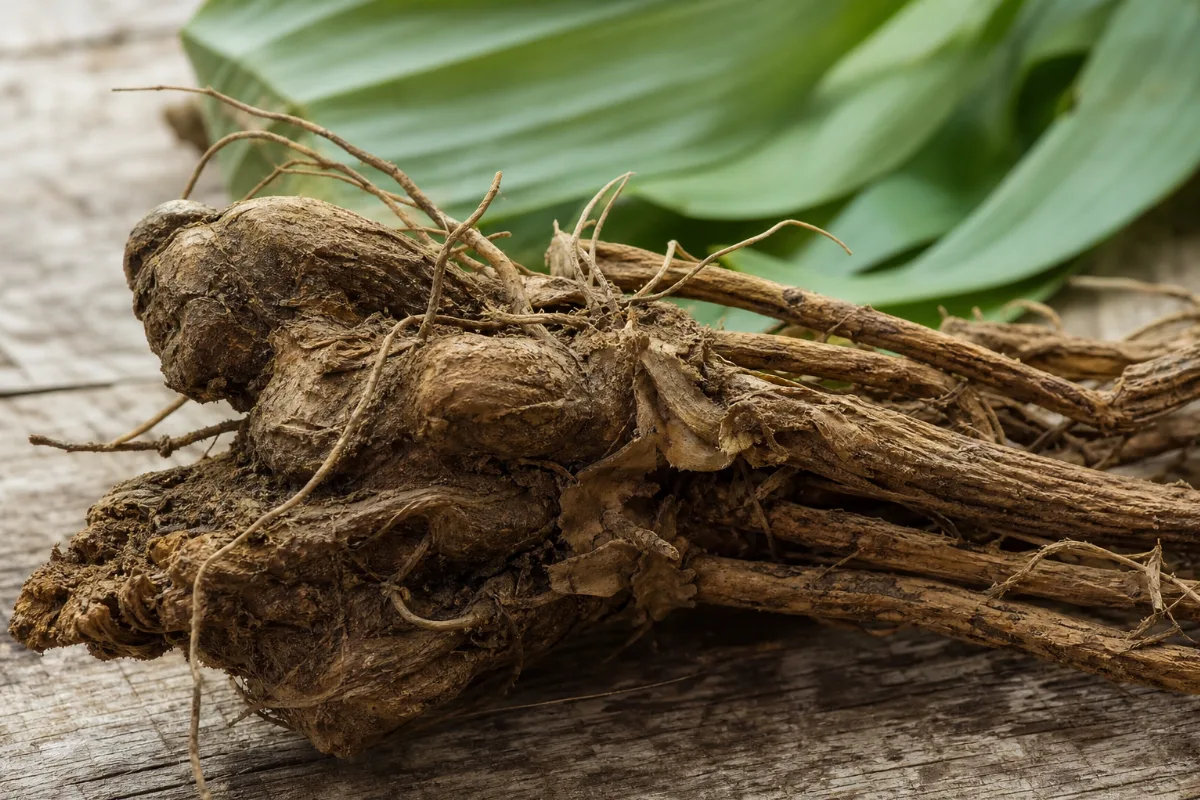
Herbs & Botanicals · Endangered Ayurvedic and Chinese root
Costus
Saussurea costus · also called Costus root, kushta (kushtha), qust, mu xiang, guang mu xiang, Aucklandia lappa, Dolomiaea costus
Costus is the dried root of a Himalayan daisy-family plant used for centuries in Ayurvedic, Unani and Chinese medicine for digestion, cough and skin problems. Almost no human research exists, so its benefits are unproven. The most important cautions: costus oil can cause skin allergy, the name 'mu xiang' is also used for a kidney-toxic Aristolochia root, and wild costus is a protected, endangered plant.
General information, not medical advice. Last substantive update · Not medically reviewed. A named clinician has not signed off on this page. How this page is made
About Costus
Costus (Saussurea costus, also Dolomiaea costus or Aucklandia lappa) is a Himalayan daisy-family plant whose dried root is used in Ayurveda (kushta), Unani medicine (qust) and Chinese medicine (mu xiang). It is traditionally used for digestion, cough and asthma, painful periods and skin problems. Human research is almost absent: one small trial for painful periods (very low certainty) and no other human trial found, so every other use is insufficient. The main facts to know are about harm and identity. Costus oil is a well-documented skin allergen (costunolide and dehydrocostus lactone). The name mu xiang is shared with other roots, including qing mu xiang, which is Aristolochia debilis, whose acids damage the kidneys; the EMA found no evidence of actual substitution among these roots but warned about confusion. Guang mu xiang is costus itself, not Aristolochia. Wild costus is critically endangered and reported to be on CITES Appendix I. No safety data exist for pregnancy, breastfeeding, children, blood pressure or heart effects, and the liver data are animal only. For amounts, ask a doctor or pharmacist.
What it is
Costus root comes from a tall daisy-family plant native to the Himalayan region and now grown in China. The botanical name changes depending on the database: GBIF accepts Dolomiaea costus, most health papers write Saussurea costus, and Chinese medicine uses Aucklandia lappa. They refer to the same medicinal root in the literature we read, though GBIF lists Aucklandia lappa as a separate accepted name.
The root is sold dried, powdered, as extracts and as an essential oil. The oil has been used in perfumery.
Traditional and current uses
In Ayurveda, Unani and Siddha medicine the root is used by mouth for stomach problems and on the skin as a paste for boils, blisters and white patches. In Chinese medicine it is used for Qi stagnation and to improve gut movement. Reviews also list asthma, liver and kidney complaints.
'Traditional' means long use, not proof. The 2020 review notes that earlier studies often had mistakes in identifying the plant, choosing doses and using controls.
What is in it and how it works
The main compounds are the sesquiterpene lactones costunolide and dehydrocostus lactone. In cells and animals they lower inflammation and slow cancer cells. They are also the compounds that cause skin allergy. No study has measured how they are absorbed in people.
What the research shows
Human evidence is almost nil. One small single-blind trial in women with painful periods found lower pain scores after three cycles of root powder with honey, but it had no placebo group and compared costus with Aristolochia rotunda. A 2020 review calls evidence for thyroid conditions inconclusive. All other findings are from cells and animals or from tradition.
At a glance
Traditional uses history, not proof
- Ayurveda (kushtha), Unani (qust) and Siddha: root and powder taken with warm water for stomach problems; paste for swellings, boils and blisters. Known in Ayurvedic products since the 13th century (a review's statement).
- Traditional Chinese medicine (mu xiang): used for Qi stagnation and to improve gut movement.
- Perfumery: costus oil has been used as a fragrance material, and research in the 1970s and 1980s linked it to contact allergy.
Studied for research
- Stomach and gut complaints, insufficient (no human trial)
- Cough and asthma, insufficient (no human trial)
- Painful periods, very low (one small trial, no placebo)
- Thyroid conditions, insufficient (a 2020 review found it inconclusive)
- Skin, liver, cancer and inflammation, insufficient (lab and animal work only)
Main compounds
- Costunolide and dehydrocostus lactone, the two main sesquiterpene lactones, also the skin sensitisers
- Cynaropicrin and saussureamine B, other compounds named in reviews
- Essential oil (costus oil), the form that causes contact allergy
Common forms
- Dried root and root powder
- Root paste and oil used on the skin
- Extracts used in lab studies
- Essential oil (costus oil, perfumery; skin-allergy risk)
Research links: EU public statement on Aristolochia herbs, including the 'Mu Xiang' table (European Medicines Agency) · Costus ethnopharmacology review, 2020 (PubMed) · Allergic contact dermatitis to costus, 1981 (PubMed) · Three confusable 'mu xiang' roots, 2021 review (PubMed) · Research Library · Genes & Biomarkers Library
The plant and its history
- Accepted scientific name
- Dolomiaea costus (Falc.) Kasana & A.K.Pandey (GBIF accepted name); most health literature uses Saussurea costus (Falc.) Lipsch.
- Naming authority
- Falc.; GBIF lists Saussurea costus (Falc.) Lipsch. as a synonym (key 5404129) of Dolomiaea costus (key 10864861).
- Synonyms
- Saussurea costus (Falc.) Lipsch.; Saussurea lappa (Decne.) C.B.Clarke; Aucklandia lappa Decne.; Aucklandia costus Falc.; Note: GBIF holds Aucklandia lappa DC. as a separate ACCEPTED record (key 5403189), while the 2025 review treats Aucklandia lappa as a synonym of Saussurea costus. Databases disagree.
- Common names
- Costus (English); Costus root (English); Kushta / kushtha / kuth (Hindi, Ayurveda); Qust (Unani); Mu xiang (Chinese); Guang mu xiang (Chinese)
- Botanical family
- Asteraceae (daisy family, also called Compositae). The family is known for sesquiterpene lactone allergens.
- Classification
- Plantae > Tracheophyta > Magnoliopsida > Asterales > Asteraceae > Dolomiaea > Dolomiaea costus
- Native range
- Himalayan region (Nadda 2020 abstract); cultivated in China (Chen 2025 abstract).
- Habitat
- Not verified from a primary botanical source.
- What the plant looks like
- Roots: The dried root is the medicinal part.; Stems: Not verified.; Leaves: Not verified.; Flowers: Not verified.; Fruit: Not relevant to medicinal use.
- Cultivation
- Extensively cultivated in China (Chen 2025). Wild collection reported banned in India (summary-only).
- Harvest and processing
- Not verified. A 2025 review discusses processing techniques, not read in detail.
- Look-alikes and adulterants
- Name: Qing mu xiang: Aristolochia debilis (and A. contorta per Shum 2007); Note: Contains aristolochic acids, which are kidney-toxic and cancer-causing. The EMA table lists it under the Mu Xiang name.; Name: Chuan mu xiang: Vladimiria souliei; Note: A different daisy-family root, used historically as a substitute for costus (Zhuang 2021). Only 26 compounds shared with costus.; Name: Tu mu xiang: Inula helenium or I. racemosa (elecampane); Note: Also a daisy-family root; only 22 compounds shared with costus (Zhuang 2021).; Name: Guang mu xiang; Note: In the EMA table, this is Saussurea lappa, i.e. true costus, not an Aristolochia.
- Sustainability and conservation
- Reported on CITES Appendix I and Critically Endangered (IUCN) in a 2019 article summary; Nadda 2020 words CITES status loosely. Not verified at CITES or IUCN.
Traditional use and history history, not clinical proof
| Tradition or era | Documented use | Source |
|---|---|---|
| Ayurveda (kushtha), Unani (qust), Siddha | Root and powder taken with warm water for stomach problems; paste for painful swellings, boils and blisters. Listed for leukoderma, liver, kidney and blood disorders. The root has been known in Ayurvedic products since the 13th century (Nadda 2020). | p32730877 |
| Traditional Chinese medicine (mu xiang) | Root used for Qi stagnation and to improve gut movement (Nadda 2020; Chen 2025). The Chinese health authority has approved it as a functional food (Zhuang 2021, second-hand). | p41158126 |
| Perfumery | Costus oil was used in perfumery, and was found to cause contact allergy (Cheminat 1981). | p6177164 |
| Regulators and historians | No EMA/HMPC monograph, WHO monograph or Commission E entry for costus was found in our searches. | s-ema-aristolochia-2005 |
Traditional use shows how a plant was used. It does not show that a supplement works or is safe today.
What is inside, and how it may work
What the plant contains and how those compounds act in cells and animals. Laboratory and animal mechanisms are not proven effects in people.
Main compounds
| Compound | Family | Where it is concentrated | Activity studied | Level of evidence |
|---|---|---|---|---|
| Costunolide PubChem 5281437 | sesquiterpene lactone | Root | Named as a core active compound (Chen 2025) and as a skin sensitiser in costus oil (Cheminat 1981). Anti-inflammatory and anticancer effects reported in cells and animals. 14 2 1 | Laboratory research |
| Dehydrocostus lactone PubChem 73174 | sesquiterpene lactone | Root | Core active compound (Chen 2025); also a named skin sensitiser. Same lab-level findings as costunolide. 15 2 1 | Laboratory research |
| Cynaropicrin and saussureamine B | sesquiterpene lactone and amino-acid derivative | Root | Named as promising molecules in two reviews; lab findings only. PubChem IDs not looked up. 13 12 | Laboratory research |
| Essential oil (costus oil) | mixed volatile oil | Root | The form that causes contact allergy; oil chemistry can tell costus from look-alike roots (Shum 2007). 1 16 | Human data |
Mechanisms, receptors and pathways
| Target or pathway | Gene or receptor | What was found | Level |
|---|---|---|---|
| Allergy-type inflammation (Th2 signals IL-4 and IL-13, mast-cell degranulation, mucus, eosinophils) | IL4, IL13 | A 2020 review reports costus preparations reduced these in asthma-type models; the model type is not stated in the abstract. 12 | Preclinical |
| Stomach lining protection | Reviews report protection against gastric ulcers and lesions in models. 12 13 | Preclinical | |
| Cancer-cell death (apoptosis) | Sesquiterpene lactones induced apoptotic cascades in cancer cells in the lab (review statement). 12 2 | Laboratory research | |
| Skin sensitisation by protein binding | Costunolide and dehydrocostus lactone are the haptens; guinea pigs were sensitised to the oil but not when the lactones were removed. The reactive exocyclic methylene group on a gamma-lactone is discussed in the patch-test series. 1 4 | Animal research |
Absorption, metabolism and elimination
- Absorption
- No human absorption data were found in the sources read.
- Distribution
- Not studied in the sources read.
- Metabolism
- Not studied in the sources read.
- Elimination
- Not studied in the sources read.
- Bioavailability
- Unknown in people.
Isolated compounds versus whole extracts
Most of the pharmacology is done on isolated costunolide and dehydrocostus lactone or on extracts, not on the root as a whole. These two compounds are also the skin sensitisers, so the same chemistry that attracts researchers is the cause of the best-documented harm. Results from isolated compounds in cells should not be carried over to root powder in people.
Nutritional composition
A nutrient table does not apply: costus root is a medicinal herb, not a food source of vitamins or minerals.
1 very low certainty6 not enough evidence
What is Costus good for?
The main proposed uses and how strong the human evidence is for each. "Very low" means a single small or unclear study, and "insufficient" means there is not enough to judge, often because no human study exists. Nothing about costus is rated higher than very low. Results from lab and animal studies cannot be carried over to people.
Benefits, one by one
Each card is a research question, not a promise. Tap a goal to filter. Open a card to see the studies, doses and limits.
Stomach and gut complaints (indigestion, ulcers, gut movement)
Not enough evidenceCostus root is a traditional stomach and gut remedy in India, the Middle East and China. We found no human trial of it for any stomach or gut condition. The support is traditional use plus lab and animal work, so the certainty is insufficient.
4 studiesRoot, root powder, extracts and isolated compounds were studied in th…
Studies, doses and limits
What the trials found
No human trial for stomach or gut conditions was found in the reviews read or in our searches.
Results
No human results. Reviews describe protection against stomach ulcers and lesions in animals and gut-movement use in Chinese practice.
Effect sizes as reported
Not applicable: no human effect size exists.
Why this rating
Traditional use and lab or animal work only. The 2020 review notes errors in plant identification, dose and controls in earlier studies.
Form and dose studied
Root, root powder, extracts and isolated compounds were studied in the lab; no human product has been tested.
Who was studied
None studied in humans.
Limits
Cannot say whether it helps people. Lab and animal results often do not carry over. Plant identity matters because several roots share the name mu xiang.
Why researchers looked
Costus root is one of the oldest stomach remedies in Ayurveda, Unani and Chinese medicine, so researchers tested it in the lab.
Traditional use
Root and powder are taken by mouth with warm water for stomach problems in traditional medicine (Nadda 2020). In Chinese medicine the root (mu xiang) is used to improve gut movement (Chen 2025).
Proposed mechanism Preclinical
Reviews report anti-ulcer and anti-diarrhea effects of costus extracts and of costunolide and dehydrocostus lactone in cell and animal models. Those are lab and animal findings only.
A proposed mechanism does not show that the effect happens in people.
See the safety section: costus oil can cause skin allergy, wild root is a protected plant, and the name "mu xiang" is also used for kidney-toxic Aristolochia root.
Cough, asthma and breathing
Not enough evidenceCostus is a traditional remedy for asthma and cough. No human trial was found. Lab work shows it lowering allergy-type inflammatory signals, but that is not proof it helps people breathe better. Certainty is insufficient.
2 studiesRoot powder, extract, oil and isolated compounds were all tested in p…
Studies, doses and limits
What the trials found
No human trial for asthma, cough or other lung conditions was found.
Results
No human results. Lab and animal findings point to lower allergic-type inflammation.
Effect sizes as reported
Not applicable.
Why this rating
Traditional use and unspecified preclinical models only.
Form and dose studied
Root powder, extract, oil and isolated compounds were all tested in preclinical work; no human preparation tested.
Who was studied
None studied in humans.
Limits
Animal and cell results; no lung-function data in people. Anyone with asthma should keep their prescribed treatment and ask a doctor before trying herbs.
Why researchers looked
Asthma is among the traditional uses listed for costus in Ayurveda and related systems.
Traditional use
Reviews list asthma and inflammatory diseases among the classical uses (Pandey 2007; Nadda 2020).
Proposed mechanism Preclinical
A 2020 review reports that, in models of asthma-type inflammation, costus preparations reduced degranulation of immune cells, mucus production, eosinophils and the Th2 signals IL-4 and IL-13. The model type is not stated in the abstract.
A proposed mechanism does not show that the effect happens in people.
See the safety section: costus oil can cause skin allergy, wild root is a protected plant, and the name "mu xiang" is also used for kidney-toxic Aristolochia root. People with asthma and a plant allergy should be especially careful.
Painful periods (primary dysmenorrhea)
Very low certaintyOne small Unani trial gave women costus root powder with honey for three cycles and saw their pain scores fall. There was no placebo group and the comparison herb was Aristolochia, so this is a first hint only. Certainty is very low.
1 studiesRoot powder (Qust) with honey, taken on the first five days of the cy…
Studies, doses and limits
What the trials found
Sumaiya 2024 (single-blind randomized comparison in women 18 to 35) compared costus root powder with honey against Aristolochia rotunda root over three cycles.
Results
Both groups improved on the verbal pain grade. The costus group improved more than the Aristolochia group at cycle three and at final follow-up, and its mean pain score fell from 6.43 to 2.67 on a 10 cm scale.
Effect sizes as reported
Pain scale (0 to 10 cm): 6.43 to 2.67 in the costus group, P < .0001 versus its own start (no placebo for comparison).
Why this rating
One small trial, no placebo, single-blind, with a comparator that is itself a toxic plant group. The abstract does not report the number of participants or any side effects.
Form and dose studied
Root powder (Qust) with honey, taken on the first five days of the cycle for three cycles. Not reproduced here as advice.
Who was studied
Young women with period pain.
Limits
No placebo. Improvement could be natural variation or expectation. The authors call the result preliminary.
Why researchers looked
Unani medicine uses costus root (qust) for period pain.
Traditional use
Qust is a traditional Unani remedy for menstrual pain (the trial describes it as consistent with Unani teaching).
Proposed mechanism Pharmacological theory
Not established. The trial authors do not give a tested mechanism in the abstract.
A proposed mechanism does not show that the effect happens in people.
Aristolochia rotunda, the comparison plant, belongs to a group whose acids damage kidneys. Do not use Aristolochia. See the safety section: costus oil can cause skin allergy, wild root is a protected plant, and the name "mu xiang" is also used for kidney-toxic Aristolochia root.
Thyroid conditions
Not enough evidenceCostus is used traditionally in Saudi Arabia for thyroid problems. A 2020 review concluded the evidence is inconclusive. It should not replace thyroid medicine. Certainty is insufficient.
1 studiesNot specified in the abstract.
Studies, doses and limits
What the trials found
No clinical trial was identified in the review; it states that data on a role in thyroid disorders are lacking.
Results
No results from human trials. The review calls the available evidence inconclusive.
Effect sizes as reported
Not applicable.
Why this rating
A narrative review that itself finds the evidence inconclusive.
Form and dose studied
Not specified in the abstract.
Who was studied
Not studied.
Limits
No trial. Thyroid disease needs proper testing and treatment.
Why researchers looked
People in the Middle East use costus for thyroid conditions, which are common there.
Traditional use
Costus is described as extensively used as a traditional medicine in Saudi Arabia (Mujammami 2020).
Proposed mechanism Pharmacological theory
The review suggests flavonoid and antioxidant properties might play a role, but this is a suggestion, not a shown mechanism.
A proposed mechanism does not show that the effect happens in people.
See the safety section: costus oil can cause skin allergy, wild root is a protected plant, and the name "mu xiang" is also used for kidney-toxic Aristolochia root. Anyone on thyroid medicine should ask their doctor first.
Skin conditions (leukoderma, boils, blisters)
Not enough evidenceRoot paste is a traditional skin remedy for boils, blisters and white skin patches. No human trial was found. Costus oil is a known cause of skin allergy, so putting it on skin carries its own risk. Certainty is insufficient.
2 studiesRoot paste and oil are traditional forms; none tested in people.
Studies, doses and limits
What the trials found
No human trial for skin conditions was found.
Results
No results.
Effect sizes as reported
Not applicable.
Why this rating
Traditional use only.
Form and dose studied
Root paste and oil are traditional forms; none tested in people.
Who was studied
None studied.
Limits
Contact allergy to costus is well documented, so a skin remedy may itself cause a rash.
Why researchers looked
Skin diseases are among the traditional uses in Ayurveda and Unani medicine.
Traditional use
Root paste is applied on the skin for boils, blisters and leprosy, and the root is recommended for leukoderma (Nadda 2020).
Proposed mechanism Pharmacological theory
Not established.
A proposed mechanism does not show that the effect happens in people.
Costus oil has caused numerous cases of allergic contact dermatitis (Cheminat 1981). See the safety section: costus oil can cause skin allergy, wild root is a protected plant, and the name "mu xiang" is also used for kidney-toxic Aristolochia root.
Liver protection
Not enough evidenceReviews report that costus extract protected the liver in lab and animal experiments. No human data were found. We cannot say it protects or harms the human liver. Certainty is insufficient.
3 studiesExtracts and isolated compounds in animals or cells.
Studies, doses and limits
What the trials found
No human trial was found.
Results
Animal and cell experiments only.
Effect sizes as reported
Not applicable.
Why this rating
Lab and animal work only.
Form and dose studied
Extracts and isolated compounds in animals or cells.
Who was studied
None in humans.
Limits
Cannot be carried over to people.
Why researchers looked
Liver complaints are among the traditional uses in Ayurveda, Unani and Chinese medicine.
Traditional use
The root is recommended for the liver in traditional systems (Nadda 2020).
Proposed mechanism Preclinical
Reviews list liver-protective activity of costus extract, costunolide and dehydrocostus lactone in lab and animal models.
A proposed mechanism does not show that the effect happens in people.
See the safety section: costus oil can cause skin allergy, wild root is a protected plant, and the name "mu xiang" is also used for kidney-toxic Aristolochia root.
Cancer and inflammation (lab research only)
Not enough evidenceCostus compounds slow cancer cells and calm inflammation in lab dishes and animals. That is early research, not a treatment, and no patient has been shown to benefit. Certainty is insufficient.
3 studiesIsolated compounds are not a product form.
Studies, doses and limits
What the trials found
No human trial of costus or its compounds for cancer or inflammation was found.
Results
Lab and animal results only.
Effect sizes as reported
Not applicable.
Why this rating
Cell and animal work.
Form and dose studied
Isolated compounds are not a product form.
Who was studied
None in humans.
Limits
Do not use costus instead of cancer treatment.
Why researchers looked
Costunolide and dehydrocostus lactone are being studied as possible starting points for drugs.
Traditional use
Not a traditional claim.
Proposed mechanism Laboratory research
Reviews report that these compounds reduce inflammatory signals and trigger cell death in cancer cells in the lab.
A proposed mechanism does not show that the effect happens in people.
See the safety section: costus oil can cause skin allergy, wild root is a protected plant, and the name "mu xiang" is also used for kidney-toxic Aristolochia root.
Connections to the rest of health
How Costus connects to the rest of our health knowledge graph. Every link says what kind of connection it is. A safety link (for example to the liver) is a warning, not a benefit. A study that merely mentions a topic never creates a benefit link.
Explore every connection: goals, body systems, organs, symptoms, genes
A. Wellness goals
| Connected to | Kind of connection | Evidence status | Context | Studies |
|---|---|---|---|---|
| Digestive Support | Potential benefit | Not enough evidence | Stomach and gut complaints (indigestion, ulcers, gut movement): Costus root is a traditional stomach and gut remedy in India, the Middle East and China. We found no human trial of it for any stomach or gut condition. The support is traditional use plus lab and animal work, so the certainty is insufficient. | 2 12 13 18 |
| Breathing Support | Potential benefit | Not enough evidence | Cough, asthma and breathing: Costus is a traditional remedy for asthma and cough. No human trial was found. Lab work shows it lowering allergy-type inflammatory signals, but that is not proof it helps people breathe better. Certainty is insufficient. | 12 13 |
| Womens Wellness | Potential benefit | Very low certainty | Painful periods (primary dysmenorrhea): One small Unani trial gave women costus root powder with honey for three cycles and saw their pain scores fall. There was no placebo group and the comparison herb was Aristolochia, so this is a first hint only. Certainty is very low. | 17 |
| Thyroid Support | Potential benefit | Not enough evidence | Thyroid conditions: Costus is used traditionally in Saudi Arabia for thyroid problems. A 2020 review concluded the evidence is inconclusive. It should not replace thyroid medicine. Certainty is insufficient. | 10 |
| Healthy Skin | Potential benefit | Not enough evidence | Skin conditions (leukoderma, boils, blisters): Root paste is a traditional skin remedy for boils, blisters and white skin patches. No human trial was found. Costus oil is a known cause of skin allergy, so putting it on skin carries its own risk. Certainty is insufficient. | 12 1 |
| Liver Support | Potential benefit | Not enough evidence | Liver protection: Reviews report that costus extract protected the liver in lab and animal experiments. No human data were found. We cannot say it protects or harms the human liver. Certainty is insufficient. | 13 18 12 |
| Inflammation Balance | Potential benefit | Not enough evidence | Cancer and inflammation (lab research only): Costus compounds slow cancer cells and calm inflammation in lab dishes and animals. That is early research, not a treatment, and no patient has been shown to benefit. Certainty is insufficient. | 13 2 12 |
B. Body systems
| Connected to | Kind of connection | Evidence status | Context | Studies |
|---|---|---|---|---|
| Digestive System | Biological association | Not enough evidence | Studied for: Stomach and gut complaints (indigestion, ulcers, gut movement) Studied for: Liver protection | 2 12 13 18 |
| Respiratory System | Biological association | Not enough evidence | Studied for: Cough, asthma and breathing | 12 13 |
| Reproductive System | Biological association | Very low certainty | Studied for: Painful periods (primary dysmenorrhea) | 17 |
| Endocrine System | Biological association | Not enough evidence | Studied for: Thyroid conditions | 10 |
| Integumentary System | Biological association | Not enough evidence | Studied for: Skin conditions (leukoderma, boils, blisters) | 12 1 |
| Immune System | Biological association | Not enough evidence | Studied for: Cancer and inflammation (lab research only) | 13 2 12 |
C. Body parts and organs
| Connected to | Kind of connection | Evidence status | Context | Studies |
|---|---|---|---|---|
| Skin | Adverse effect or risk | Low certainty | Allergic contact dermatitis is well described for the oil, with cross-reactions to other sesquiterpene lactones. Preparation or compound: Costus essential oil; costunolide and dehydrocostus lactone |
1 4 |
| Kidneys | Adverse effect or risk | Very low certainty | Aristolochic acids from Aristolochia roots scar the kidneys. The risk with costus is buying the wrong plant under the shared mu xiang name; no case from true costus was found. Preparation or compound: Aristolochia debilis root (qing mu xiang), a look-alike, not costus |
5 3 |
I. Biomarkers
| Connected to | Kind of connection | Evidence status | Context | Studies |
|---|---|---|---|---|
| Period pain score (10 cm scale) | Biological association | Very low certainty | Measured in trials: lowered. A lab change is not the same as a health benefit. | 17 |
J. Genes, receptors and enzymes
| Connected to | Kind of connection | Evidence status | Context | Studies |
|---|---|---|---|---|
| IL4 and IL13 (Th2 cytokines) | Preliminary mechanism | Preclinical | Reduced by costus preparations in asthma-type models (review statement). | 12 |
L. Active compounds
| Connected to | Kind of connection | Evidence status | Context | Studies |
|---|---|---|---|---|
| Costunolide | Biological association | In vitro | Named as a core active compound (Chen 2025) and as a skin sensitiser in costus oil (Cheminat 1981). Anti-inflammatory and anticancer effects reported in cells and animals. Preparation or compound: Root |
14 2 1 |
| Dehydrocostus lactone | Biological association | In vitro | Core active compound (Chen 2025); also a named skin sensitiser. Same lab-level findings as costunolide. Preparation or compound: Root |
15 2 1 |
| Cynaropicrin and saussureamine B | Biological association | In vitro | Named as promising molecules in two reviews; lab findings only. PubChem IDs not looked up. Preparation or compound: Root |
13 12 |
| Essential oil (costus oil) | Biological association | Human | The form that causes contact allergy; oil chemistry can tell costus from look-alike roots (Shum 2007). Preparation or compound: Root |
1 16 |
Each connection is stored with the ingredient, the connected record, the kind of connection, the evidence status, the supporting studies, the preparation or compound involved, and a review date (last reviewed October 25, 2026).
Evidence at a glance: what changed in 1 lab markers
Tap a number to show only those markers. Counts are markers, not people.
The evidence
The research centre for Costus. Every record here was checked against PubMed or the publisher's page; we never list a study we have not verified.
Evidence by outcome
Bars show how many studies we found for each outcome, not how well it works. People are added up across trials only (reviews are not added, to avoid double counting).
How we rate evidence
High certainty
Several well-run trials or reviews agree; further research is unlikely to change the picture much.
Moderate certainty
Good trials point the same way, but some doubt remains.
Low certainty
Small, short or inconsistent trials. The finding could change with better research.
Very low certainty
Very little or very weak human data. Treat as a possibility only.
Mixed findings
Trials or reviews disagree with each other.
Not enough evidence
Not enough human research to say either way.
Evidence against
Good research found no benefit, or found harm.
We take the reviewers' own risk-of-bias and GRADE statements where they exist, and otherwise judge from study size, design, consistency, directness and whether a product matches what is sold. Many publications do not make evidence high. Method note: We searched PubMed and Europe PMC, read the EU public statement on Aristolochia herbs in full (including its table of plants sold as 'Mu Xiang'), and checked plant names in GBIF and NCBI Taxonomy and compounds in PubChem. Nearly all papers were read as abstracts only. Not verified: CITES and IUCN listings, India's ban, the China food approval and fragrance-industry (IFRA) restrictions; no EMA/HMPC monograph, NCCIH, LactMed or LiverTox entry for costus was found (one LiverTox page request was blocked). We also corrected the premise that guang mu xiang is an Aristolochia: the EMA table lists it as Saussurea lappa. Certainty ratings are the compiler's own reading, not formal grades. No study is cited that we could not verify.
Study library: every study we checked 18
| Study | Design | People | Product, dose, length | Result |
|---|---|---|---|---|
| Cheminat 1981 Allergic contact dermatitis to costus: removal of haptens with polymers Acta Derm Venereol · PMID 6177164 |
Lab study (guinea pig) with clinical background animal |
Guinea pigs; background on human cases | Costus essential oil (Saussurea lappa), perfumery grade root (oil) · vs Polymer-treated oil with the lactones removed |
Costus oil, used in perfumery, is reported to be responsible for numerous cases of allergic contact dermatitis. The sensitising compounds are the sesquiterpene lactones costunolide and dehydrocostus lactone. Guinea pigs were successfully sensitised to the oil, but not when the lactones had been removed with a polymer. Methods, limits and fundingOutcomes: Skin sensitisation in guinea pigs Limitations: Animal experiment; the human cases are background in the abstract, not data from this study. 1981. Read: abstract |
| Chen 2025 Aucklandia lappa Decne.: a review of its botany, cultivation, ethnopharmacology, phytochemistry, pharmacology, and practical applications Front Pharmacol · PMID 41158126 · DOI |
Narrative review mixed |
Review of the plant, mostly lab and animal work | Aucklandia lappa (costus) root, Aucklandiae Radix ("mu xiang") root |
Describes use of the root in Chinese medicine for gut movement, plus germ-killing and anticancer findings; names costunolide and dehydrocostus lactone as core compounds. Says several studies found the extracts may cause adverse reactions and that how it works in many diseases is not fully understood. Methods, limits and fundingOutcomes: Botany, uses, chemistry, pharmacology, processing Limitations: Narrative review (authors searched several databases, but the abstract gives no quality grading). The abstract does not say which adverse reactions or in whom. Read: abstract |
| Debelle 2008 Aristolochic acid nephropathy: a worldwide problem Kidney Int · PMID 18418355 · DOI |
Narrative review |
Patients with aristolochic acid nephropathy (Belgium and worldwide) | Herbs containing aristolochic acid (Aristolochia species) varies |
Aristolochic acid nephropathy is a progressive kidney scarring, often with cancers of the urinary tract, first seen in over 100 Belgian patients after slimming pills containing Aristolochia fangchi. Cases keep appearing worldwide, and the authors point to frequent substitution of botanical products by aristolochic-acid-containing herbs in Asia and to herbs still sold online. Methods, limits and fundingOutcomes: Kidney disease and cancer linked to aristolochic acid Limitations: Narrative review; it does not mention costus. Read: abstract |
| Epstein 1980 Sesquiterpene lactone dermatitis. Cross-sensitivity in costus-sensitized patients Arch Dermatol · PMID 7352764 · DOI |
Case series (patch testing) |
13 13 patients already allergic to costus |
Patch tests with 38 sesquiterpene lactones of five chemical classes n/a (isolated compounds) 2 years |
Patients allergic to costus reacted to other sesquiterpene lactones too (cross-reaction). The ones that cross-reacted were less heavily substituted and more fat-soluble; heavily substituted ones did not react. 13 costus-sensitive patients patch tested with 38 lactones Methods, limits and fundingOutcomes: Which other sesquiterpene lactones the costus-allergic patients reacted to Limitations: Small series from 1980, patients already allergic; says nothing about how common the allergy is. Read: abstract |
| European Medicines Agency (EMEA) 2005 Public statement on the risks associated with the use of herbal products containing Aristolochia species EMEA public statement · Source |
Authoritative guidance |
Herbal products sold in Europe | Aristolochia species and plants confused with them (full document read) varies |
Lists the plants sold under the name Mu Xiang: Qing mu xiang is Aristolochia debilis root; Mu xiang is Aucklandia lappa root; Guang mu xiang is Saussurea lappa root (the same plant as costus); Tu mu xiang is Inula helenium or I. racemosa; Chuan mu xiang is Vladimiria souliei. States that the name Mu Xiang is applied to a number of species, that there is no evidence of substitution between them, but that the common names have the potential for confusion. Documents real substitution with other names: Aristolochia fangchi for Stephania tetrandra (Fang ji, Belgian cases, over 100 kidney failures) and Aristolochia manshuriensis for Mu Tong. Methods, limits and fundingOutcomes: Risk statement and table of plants sold as "Mu Xiang" Limitations: 2005 statement, now dated. It is a risk statement, not a monograph on costus. Read: full-text |
| GBIF Secretariat (API 2026 GBIF Backbone Taxonomy: Saussurea costus, Dolomiaea costus, Aucklandia lappa GBIF · Source |
Database record n/a |
n/a | Plant names n/a |
Name match for Saussurea costus (Falc.) Lipsch. returns a SYNONYM (key 5404129) of the accepted species Dolomiaea costus (Falc.) Kasana & A.K.Pandey (key 10864861), family Asteraceae. A separate match for Aucklandia lappa DC. returns its own ACCEPTED record (key 5403189), so GBIF treats it as a distinct accepted name. Methods, limits and fundingOutcomes: Accepted name and synonyms Limitations: Queried through the GBIF API on 2026-10-25. Plant-name opinions differ between databases and papers. Read: database |
| Journal of Threatened Taxa (2019) 2019 Is cultivation of Saussurea costus sustaining its conservation? J Threatened Taxa · Source |
Secondary source (summary only) n/a |
n/a | Saussurea costus root |
Our earlier internal summary records that this article describes costus as on CITES Appendix I and Critically Endangered (IUCN), with wild collection banned in India. We did not re-open the article here. Methods, limits and fundingOutcomes: Conservation status and cultivation Limitations: Summary-only; not re-read for this profile. CITES and IUCN themselves were not checked. Read: summary-only |
| Li 2014 Molecular identification and cytotoxicity study of herbal medicinal materials that are confused by Aristolochia herbs Food Chem · PMID 24206727 · DOI |
Laboratory analysis in-vitro |
Four traditional Chinese medicines that Aristolochia herbs are confused with, including Aucklandia Radix | Aucklandia Radix and others, by DNA sequencing; cell tests of aristolochic acids root |
Four DNA regions were found to separate the genuine herbs (including Aucklandia Radix) from their adulterants or substitutes. In cell tests, aristolochic acid I was toxic to two kidney-related cell lines; the abstract says Aristolochia-containing herbs were more toxic than the genuine herbs, with Aucklandia Radix listed as the exception. Methods, limits and fundingOutcomes: DNA tests to separate genuine herbs from Aristolochia adulterants; cell toxicity Limitations: Cell and DNA study. The abstract does not describe a real case of Aristolochia sold as Aucklandia. Read: abstract |
| Ma 2014 Molecular identification of aucklandiae radix, vladimiriae radix, inulae radix, aristolochiae radix and kadsurae radix using ITS2 barcode Zhongguo Zhong Yao Za Zhi · PMID 25244738 |
Laboratory analysis (DNA barcoding) lab |
60 60 root samples |
Five "mu xiang"-type roots including costus and Aristolochia debilis root |
The ITS2 DNA barcode could tell costus (Aucklandia lappa), Vladimiria, Inula helenium, Aristolochia debilis and Kadsura longipedunculata roots apart. The authors say this supports safe clinical use. Methods, limits and fundingOutcomes: Whether ITS2 DNA barcodes tell the five roots apart Limitations: DNA method study; says nothing about the share of products that are mislabelled. Journal title in Chinese; abstract in English was read. Read: abstract |
| Mujammami 2020 Clinical significance of Saussurea Costus in thyroid treatment Saudi Med J · PMID 33026044 · DOI |
Narrative review mixed |
Review of thyroid disorders and costus use in Saudi Arabia | Saussurea costus (plant parts not specified in abstract) not specified |
Says costus is widely used as a traditional medicine in Saudi Arabia, and that current data on a role in thyroid disorders are lacking and the available evidence is inconclusive. Methods, limits and fundingOutcomes: Role of costus in thyroid disease Limitations: Narrative review; abstract gives no trial data. Read: abstract |
| NCBI Taxonomy (E-utilities) 2026 NCBI Taxonomy: Dolomiaea costus (taxid 324593) NCBI Taxonomy · Source |
Database record n/a |
n/a | Plant names n/a |
Taxid 324593 is Dolomiaea costus, rank species, status active. Methods, limits and fundingOutcomes: Accepted name Limitations: Queried 2026-10-25. Read: database |
| Nadda 2020 Aucklandia costus (Syn. Saussurea costus): Ethnopharmacology of an endangered medicinal plant of the himalayan region J Ethnopharmacol · PMID 32730877 · DOI |
Narrative review mixed |
Review of traditional use and lab/animal work | Costus root, powder, extract, oil and isolated compounds root |
Root is used in Ayurveda, Unani, Siddha and Chinese medicine (for leukoderma, liver, kidney, blood disorders, Qi stagnation, stomach problems; root paste on skin for boils and blisters). Lab and animal studies relate to stomach ulcers, asthma-type inflammation, liver, skin and cancer. The authors say very few safety and toxicity data exist and that studies had errors in choosing and authenticating the plant material, and in dose and controls. States that CITES included the plant in a critically endangered category because of overexploitation from the wild. Methods, limits and fundingOutcomes: Traditional uses, chemistry, safety and toxicity data, conservation Limitations: Narrative review; the abstract words the CITES status loosely (see conservation notes). Read: abstract |
| Pandey 2007 Saussurea costus: botanical, chemical and pharmacological review of an ayurvedic medicinal plant J Ethnopharmacol · PMID 17306480 |
Narrative review mixed |
Review of lab and animal work | Saussurea costus root and isolated compounds root |
Sesquiterpene lactones are the major compounds. In a number of cell and animal models the plant showed anti-inflammatory, anti-ulcer, anticancer and liver-protective activity. Costunolide, dehydrocostus lactone and cynaropicrin were singled out as promising molecules. Traditional uses include asthma, inflammatory diseases, ulcer and stomach problems. Methods, limits and fundingOutcomes: Botany, chemistry, pharmacology, folklore use Limitations: Narrative review of mostly lab and animal work; no human trial is described in the abstract. Read: abstract |
| PubChem (NCBI) 2026 PubChem CID 5281437: costunolide PubChem · Source |
Database record n/a |
n/a | Costunolide n/a |
Costunolide, C15H20O2, molecular weight 232.32. Methods, limits and fundingOutcomes: Formula and structure Limitations: Database entry only. Read: database |
| PubChem (NCBI) 2026 PubChem CID 73174: dehydrocostus lactone PubChem · Source |
Database record n/a |
n/a | Dehydrocostus lactone n/a |
Dehydrocostus lactone, C15H18O2, molecular weight 230.30. Methods, limits and fundingOutcomes: Formula and structure Limitations: Database entry only. Read: database |
| Shum 2007 Authentication of Radix Aucklandiae and its substitutes by GC-MS and hierarchical clustering analysis J Sep Sci · PMID 18004716 |
Laboratory analysis lab |
Retail-type root samples of costus and look-alike roots | Essential oils of Radix Aucklandiae (Aucklandia lappa) and four look-alike roots root |
States that, because of similar looks and trade names, Chuan-Muxiang (Vladimiria), Tu-Muxiang (Inula) and the kidney-toxic, aristolochic-acid-containing Qing-Muxiang (Aristolochia debilis and A. contorta) are often used confusedly as substitutes for Radix Aucklandiae (costus). Oil chemical profiles separated costus from each substitute. Methods, limits and fundingOutcomes: Whether oil chemistry can tell costus from substitutes Limitations: Lab method study; the abstract does not give how often confusion happens in the market. Read: abstract |
| Sumaiya 2024 Comparative Efficacy of Aristolochia rotunda L. (Zarawand Mudaharaj) and Saussurea lappa C.B. Clarke (Qust) in Primary Dysmenorrhea - A Single-Blind Randomized Clinical Study Altern Ther Health Med · PMID 39110054 |
Controlled trial |
Women aged 18 to 35 with primary dysmenorrhea (painful periods without another cause) | Saussurea lappa (Qust) root powder with honey, Unani preparation root Taken twice daily with honey on days 1 to 5 of the cycle (amount not reproduced here) 3 menstrual cycles · vs Active comparator: Aristolochia rotunda root (no placebo) |
Both groups improved on the verbal pain grade (P < .0001 versus start). The costus group did better than the Aristolochia group on the grade at the third cycle (P = .02) and final follow-up (P = .002), and its mean pain score fell from 6.43 (SD 1.57) to 2.67 (SD 1.69) on the 10 cm scale (P < .0001). VAS mean 6.43 to 2.67 (costus group, P < .0001) Methods, limits and fundingOutcomes: Pain on a 10 cm visual scale (VAS), verbal pain grade (VMSS), quality of life (SF-12), accompanying symptoms Limitations: Single-blind, no placebo; the comparator is itself an Aristolochia species, a plant group with kidney-toxic and cancer-causing acids, so "better than" it is not reassuring. Number of participants not given in the abstract; the authors call the findings preliminary. Follow-up length beyond three cycles is not stated. Read: abstract |
| Zhuang 2021 A comprehensive chemical and pharmacological review of three confusable Chinese herbal medicine-Aucklandiae radix, Vladimiriae radix, and Inulae radix Phytother Res · PMID 34431559 · DOI |
Narrative review mixed |
Review comparing three roots all called "mu xiang" | Aucklandiae radix (costus, "Muxiang"), Vladimiriae radix ("Chuanmuxiang"), Inulae radix ("Tumuxiang") root |
All three roots carry the "Muxiang" name, which makes them confusable, especially costus and Vladimiriae root, which was used as a substitute for costus in a historical period. Only six compounds were shared by all three. Costus extract was reported to be anti-inflammatory, antibacterial, anti-ulcer, anti-diarrhea, anticancer and liver-protective in lab work. China has approved costus root as a functional food; the other two are not listed. Methods, limits and fundingOutcomes: Appearance, chemistry and pharmacology of the three roots Limitations: Narrative review of mostly lab and animal work. This review covers three roots, not Aristolochia. Read: abstract |
What we do not know yet
- What the evidence supports: nothing about costus reaches low certainty. Painful periods are very low (one small trial with no placebo). Stomach and gut, cough and asthma, thyroid, skin, liver, cancer and inflammation are insufficient.
- What is uncertain: the plant's scientific name differs across databases and papers, and earlier studies often did not verify the plant material, so lab results are uneven.
- No human safety trial, pregnancy, breastfeeding, child, blood pressure, heart, interaction or liver case data were found.
- How common costus allergy is has not been measured in the sources read; the allergy research dates from 1980 and 1981.
- No documented case of Aristolochia sold as true costus was found; the EMA found no evidence of substitution among the mu xiang plants but warned about name confusion.
- Not verified: CITES Appendix I, the IUCN Critically Endangered listing, India's wild-collection ban, the Chinese functional-food approval and fragrance-industry restrictions were not checked at their sources.
How new research is added
New studies are found by a saved PubMed search and are placed in a review queue. A person reads each one before it changes any evidence rating or safety wording. New publications never change ratings automatically.
Lab markers
What changed in blood or saliva tests during trials. A changed number is not the same as feeling or being healthier, and we give no "normal ranges".
Other 1
Period pain score (10 cm scale)
Lowered in trials
A line scale where the woman marks her pain from none to the worst possible.
Very low certaintyResults and what it means
Why it was measured
Used to see whether a treatment changes period pain.
Statistical vs. clinical meaning
Statistically significant against the starting value, but there is no placebo group, so it cannot be credited to costus.
Safety implication
None reported in the abstract.
| Study | Result | People | Product |
|---|---|---|---|
| 17 | Mean pain score fell from 6.43 to 2.67 in the costus group (P < .0001 versus start). | Women 18 to 35 with primary dysmenorrhea (number not given in the abstract) | Costus (Qust) root powder with honey, 3 cycles |
Safety
What studies and official sources say about side effects, medicines and who should check first. Each point shows what kind of evidence it comes from.
Main points to know 4
- Costus oil is a known skin allergen. Costus essential oil, used in perfumery, has caused many cases of allergic contact dermatitis (itchy, red, sometimes blistering rash after skin contact). The sensitisers are costunolide and dehydrocostus lactone, which belong to the sesquiterpene lactones, a group found in many plants of the daisy family (Asteraceae). People already allergic to costus reacted to other sesquiterpene lactones in a 13-patient patch-test series, so cross-reactions with other daisy-family plants are possible. We found no figure for how common the allergy is. Whether a ban on costus oil in perfume exists (we believe the fragrance industry restricts it) was NOT verified. Case report 1 4
- The name "mu xiang" covers several roots, and one of them is Aristolochia. Real costus root is called mu xiang or guang mu xiang in Chinese medicine, according to the European Medicines Agency's table. A different root, qing mu xiang, is Aristolochia debilis, which contains aristolochic acids that scar the kidneys and cause urinary-tract cancer. The EMA found no evidence that these roots are actually swapped for each other, but it warned the shared name could cause mistakes. A chemistry study says Aristolochia root is sometimes used confusedly as a substitute for costus. Aristolochic acid nephropathy, a known kidney disease, has been traced to other swaps (Aristolochia in place of Stephania in the Belgian slimming pills, and in place of Mu Tong). We found no documented case of kidney damage from a product sold as costus. Buy only from a source that names the full Latin species, and never use a root sold only as "mu xiang" or "qing mu xiang". Authoritative guidance 5 16 3
- Costus is a protected, endangered plant. Costus is described as critically endangered and listed under CITES because of overharvesting in the wild. A 2019 article summary we hold says wild collection is banned in India. Buying wild-collected root may be illegal and harms the plant. Cross-border trade is controlled; check import rules before ordering. The exact CITES and IUCN wording was not checked at the source. Authoritative guidance 7 12
- Very little human safety data exist. A 2020 review says very few data on the safety and toxicity of costus are available, and a 2025 review says several studies found that extracts may cause adverse reactions. We found no human safety trial, no pregnancy data, no liver case report and no interaction study. Other 12 2
Side effects 3
| Effect | How often | Severity and recovery | Evidence |
|---|---|---|---|
| Allergic contact dermatitis (rash from skin contact with costus oil) Reported for the essential oil used in perfumery. Animal work (guinea pigs) confirmed it can sensitise skin, and patch testing showed cross-reactions with other sesquiterpene lactones. | Not established | moderate Not stated in the abstracts read; allergic rashes usually settle once contact stops, but this was not checked for costus. | Case report 1 4 |
| Unspecified adverse reactions to extracts A 2025 review says multiple studies indicate costus extracts may cause adverse reactions. The abstract does not say which reactions or how often. | Not established | unknown Not stated. | Other 2 |
| Kidney scarring and urinary-tract cancer from Aristolochia look-alike roots (not from costus itself) This is a risk of the wrong plant, not of true costus. It matters because the name mu xiang is shared. | Not established | serious Aristolochic acid nephropathy is described as progressive and often irreversible; in Belgium about a third of patients needed a kidney transplant (EMA). | Case report 5 3 |
Liver
We found no published human case of liver injury from costus in the sources read. Reviews describe liver-protective effects of costus extracts in lab and animal studies, which cannot be carried over to people. We could not open an NIH LiverTox page for costus (the page request was blocked), so no LiverTox likelihood score is given. 13 18
How often. No frequency was found. Not finding reports is not proof of safety, because costus is rarely used and almost never studied in people.
Monitoring. No agency monitoring advice was found. Anyone with liver disease, or who takes medicines that strain the liver, should ask a doctor first.
This is a safety connection. It is not evidence that Costus supports liver health.
Medicines and supplements 3
| With | Why it matters | Importance | Evidence | What to do |
|---|---|---|---|---|
| Thyroid medicines (for example levothyroxine) and anti-thyroid drugs prescription | Unknown. Costus is used traditionally for thyroid problems, but the 2020 review found no good evidence on what it does. | No interaction has been documented. The evidence on thyroid effects is inconclusive, so an effect on thyroid tests cannot be ruled out. | Pharmacological theory Very low certainty 10 | If you take thyroid medicine, do not add costus without asking your doctor, who may want to re-check your thyroid tests. |
| Medicines for blood pressure, heart rhythm, blood clotting or sedation, and drugs cleared by the liver prescription | No data. We found no study of costus on blood pressure, heart rhythm, clotting, sedation or liver enzymes in people. | Unknown. Absence of data does not mean absence of an interaction. | Other Not enough evidence 12 | Tell your doctor or pharmacist before combining costus with any prescription medicine. |
| Other daisy-family (Asteraceae) plants and products (arnica, chamomile, ragweed, elecampane, chrysanthemum and others) herb | Shared sesquiterpene lactone allergens. | Patch tests showed people allergic to costus reacted to other sesquiterpene lactones, so cross-allergy with some daisy-family plants is possible. | Case report Low certainty 4 | If you have a daisy-family allergy, avoid costus products and oil on the skin. |
Who should check first 5
| Situation | Advice | Evidence |
|---|---|---|
| Known allergy to costus oil, perfumes containing it, or sesquiterpene lactones (daisy-family plant allergy) | Avoid costus on the skin and by mouth. Cross-reactions are documented in a small patch-test series. | Case report 4 1 |
| Pregnancy and breastfeeding | No human safety data were found for either. Avoid unless a doctor who knows the product agrees. We did not find a LactMed or EMA entry for costus. | Other 12 |
| Children | No safety data were found. Do not give costus root or oil to children without medical advice. | Other 12 |
| Kidney disease, or any product sold only as "mu xiang" or "qing mu xiang" with no Latin name | Do not use. A product that could be Aristolochia root can damage the kidneys permanently. | Authoritative guidance 5 16 |
| Thyroid disease, liver disease, heart conditions or high or low blood pressure | No data on effects. Ask your doctor first; do not treat these conditions with costus. | Other 10 12 |
Overdose, product quality and regulators
Summary. Almost nothing is known about toxicity in people. The best documented harm is skin allergy to the oil. The most dangerous risk comes from the wrong plant, Aristolochia root, which shares the "mu xiang" name.
Animal. The 2020 review says very few safety and toxicity data exist. No animal toxicity result for true costus was read in the sources used.
Human doses studied. The one small trial gave root powder with honey twice a day for the first five days of three menstrual cycles; its abstract does not report side effects. Amounts are not given here as advice.
High dose or long term signals. None found, and not studied.
Overdose response. No overdose report was found.
Genotoxicity. Not studied in the sources read.
Toxic plant parts. The essential oil (skin sensitiser). Aristolochia debilis root, sold as qing mu xiang, is toxic to kidneys and is not costus.
Identity is the main quality problem: several different roots are sold under the name mu xiang, and one (Aristolochia) is dangerous. We found no survey of pesticides, heavy metals or adulteration of retail costus.
Look-alike roots under the same name. The EMA lists qing mu xiang (Aristolochia debilis), mu xiang (Aucklandia lappa), guang mu xiang (Saussurea lappa, the same plant as costus), tu mu xiang (Inula helenium or I. racemosa, elecampane) and chuan mu xiang (Vladimiria souliei). It found no evidence of substitution between them but warned of confusion. A GC-MS study states these roots are often used confusedly as substitutes for costus, with Aristolochia the kidney-toxic one. 5 16
Tests can tell them apart. DNA barcoding (ITS2) and oil chemistry (GC-MS) separated costus from Vladimiria, Inula and Aristolochia roots in lab samples. This shows that reliable identity tests exist, not that retail products are tested. 9 16 8
Historical substitute. A 2021 review says Vladimiriae root (chuan mu xiang) was used as a substitute for costus during a historical period. 18
| Body | Action | Date |
|---|---|---|
| European Medicines Agency (EMEA), Committee on Herbal Medicinal Products (European Union) | Public statement on the risks of herbal products containing Aristolochia species. Includes a table of plants sold as Mu Xiang and states there is no evidence of substitution among them but a potential for confusion. source | 2005 |
When to get medical help
- Trouble breathing, a swollen face, lips or throat, or a widespread rash soon after contact with or taking costus (call emergency services)
- A spreading, blistering or weeping skin rash after using costus oil or paste
- Passing much less urine, swelling of the legs or face, blood in the urine, or new unexplained tiredness or back pain after taking any Chinese or Ayurvedic root product (possible kidney harm; see a doctor)
- Yellow skin or eyes, dark urine or severe stomach pain after taking costus
Stop the supplement and contact a clinician or emergency service. In the US, Poison Control is 1-800-222-1222.
General information only, not medical advice. Ask a clinician or pharmacist before use, especially with medicines, in pregnancy or with a health condition. See the Natural Remedy Safety guide.
Frequently asked questions
What is costus root?
Costus root is the dried root of a Himalayan plant in the daisy family (Saussurea costus, also called Dolomiaea costus or Aucklandia lappa). It has been used for centuries in Ayurveda (where it is called kushta), Unani medicine (qust) and Chinese medicine (mu xiang) for stomach complaints, cough and asthma, and skin problems. It is now rare in the wild.
Does costus work for digestion?
Does costus help asthma or cough?
Does costus help painful periods?
Possibly, but the evidence is very weak. One small Unani trial of root powder with honey saw pain scores fall over three cycles, but it had no placebo group and compared costus with another herb, Aristolochia rotunda, which is itself unsafe. Certainty is very low.
Can costus treat thyroid problems?
There is no good evidence. A 2020 review calls it inconclusive. If you have a thyroid condition, keep your medicine and ask your doctor before adding costus.
Why does costus cause skin rashes?
Costus oil contains sesquiterpene lactones, mainly costunolide and dehydrocostus lactone, which can make the immune system react to skin contact. The oil used in perfumery caused many cases of allergic contact dermatitis. People allergic to costus also reacted to other sesquiterpene lactones in patch tests, so cross-allergy with other daisy-family plants is possible.
Is 'mu xiang' the same as costus, and is it safe?
Costus root is sold as mu xiang (and guang mu xiang), but the same name is used for several other roots. One of them, qing mu xiang, is Aristolochia debilis, which contains aristolochic acids that scar the kidneys and cause urinary-tract cancer. The European Medicines Agency found no evidence that these roots have actually been swapped, but warned about the confusion. Buy only products that give the full Latin name, and avoid anything sold only as 'mu xiang' or 'qing mu xiang'.
Is guang mu xiang the dangerous Aristolochia root?
No. In the European Medicines Agency's table, guang mu xiang is Saussurea lappa, which is costus. The dangerous one in that table is qing mu xiang (Aristolochia debilis). Kidney damage from Aristolochia has been tied to other swaps, such as Aristolochia fangchi sold as Stephania (fang ji) and Aristolochia manshuriensis sold as mu tong, not to a product sold as costus.
Is costus endangered, and can I buy it legally?
Costus is described as critically endangered and is reported to be on CITES Appendix I, with wild collection banned in India. We could not check the CITES or IUCN listing at the source. Wild-collected root may be illegal to trade, so ask for cultivated, documented material and check your country's import rules.
Is costus safe in pregnancy or breastfeeding?
Unknown. We found no safety data for pregnancy, breastfeeding or children, so it is best avoided unless a doctor who knows the product says otherwise.
Does costus affect the liver, blood pressure or heart?
How much costus should I take?
This profile does not give amounts, because there is no reliable human evidence to set one. Ask a doctor or pharmacist who knows your health and medicines.
Explore by health goal
Digestive SupportBreathing SupportWomens WellnessThyroid SupportHealthy SkinLiver SupportInflammation Balance
Editorial transparency
- Written by
- AlternativeMed editorial team. Research compiled with AI assistance, then checked against PubMed records.
- Medical review
- None. This page has not been reviewed by a physician or pharmacist.
- First published
- 2026-10-25
- Last substantive update
- 2026-10-25
- How we research
- We searched PubMed and Europe PMC, read the EU public statement on Aristolochia herbs in full (including its table of plants sold as 'Mu Xiang'), and checked plant names in GBIF and NCBI Taxonomy and compounds in PubChem. Nearly all papers were read as abstracts only. Not verified: CITES and IUCN listings, India's ban, the China food approval and fragrance-industry (IFRA) restrictions; no EMA/HMPC monograph, NCCIH, LactMed or LiverTox entry for costus was found (one LiverTox page request was blocked). We also corrected the premise that guang mu xiang is an Aristolochia: the EMA table lists it as Saussurea lappa. Certainty ratings are the compiler's own reading, not formal grades. No study is cited that we could not verify.
- How we rate evidence
- See "How we rate evidence" in the Evidence tab.
- Independence
- No product is promoted on this page. No affiliate links are shown. If one is added later it will be labelled and kept apart from the evidence.
Sources 18
Each source was opened and checked. Where we read only the abstract, it says so. The small numbers in the text point here.
- Cheminat A, et al.. Allergic contact dermatitis to costus: removal of haptens with polymers. Acta Derm Venereol. 1981. PMID 6177164. (abstract)
- Chen J, et al.. Aucklandia lappa Decne.: a review of its botany, cultivation, ethnopharmacology, phytochemistry, pharmacology, and practical applications. Front Pharmacol. 2025. PMID 41158126. DOI 10.3389/fphar.2025.1659831. (abstract)
- Debelle FD, Vanherweghem JL, Nortier JL. Aristolochic acid nephropathy: a worldwide problem. Kidney Int. 2008. PMID 18418355. DOI 10.1038/ki.2008.129. (abstract)
- Epstein WL, Reynolds GW, Rodriguez E. Sesquiterpene lactone dermatitis. Cross-sensitivity in costus-sensitized patients. Arch Dermatol. 1980. PMID 7352764. DOI 10.1001/archderm.116.1.59. (abstract)
- European Medicines Agency (EMEA), Committee on Herbal Medicinal Products. Public statement on the risks associated with the use of herbal products containing Aristolochia species. EMEA public statement. 2005. (full-text)
- GBIF Secretariat (API, name match). GBIF Backbone Taxonomy: Saussurea costus, Dolomiaea costus, Aucklandia lappa. GBIF. 2026. (database)
- Journal of Threatened Taxa (2019). Is cultivation of Saussurea costus sustaining its conservation?. J Threatened Taxa. 2019. (summary-only)
- Li M, et al.. Molecular identification and cytotoxicity study of herbal medicinal materials that are confused by Aristolochia herbs. Food Chem. 2014. PMID 24206727. DOI 10.1016/j.foodchem.2013.09.146. (abstract)
- Ma XC, et al.. Molecular identification of aucklandiae radix, vladimiriae radix, inulae radix, aristolochiae radix and kadsurae radix using ITS2 barcode. Zhongguo Zhong Yao Za Zhi. 2014. PMID 25244738. (abstract)
- Mujammami M. Clinical significance of Saussurea Costus in thyroid treatment. Saudi Med J. 2020. PMID 33026044. DOI 10.15537/smj.2020.10.25416. (abstract)
- NCBI Taxonomy (E-utilities). NCBI Taxonomy: Dolomiaea costus (taxid 324593). NCBI Taxonomy. 2026. (database)
- Nadda RK, et al.. Aucklandia costus (Syn. Saussurea costus): Ethnopharmacology of an endangered medicinal plant of the himalayan region. J Ethnopharmacol. 2020. PMID 32730877. DOI 10.1016/j.jep.2020.113199. (abstract)
- Pandey MM, Rastogi S, Rawat AKS. Saussurea costus: botanical, chemical and pharmacological review of an ayurvedic medicinal plant. J Ethnopharmacol. 2007. PMID 17306480. (abstract)
- PubChem (NCBI). PubChem CID 5281437: costunolide. PubChem. 2026. (database)
- PubChem (NCBI). PubChem CID 73174: dehydrocostus lactone. PubChem. 2026. (database)
- Shum KC, et al.. Authentication of Radix Aucklandiae and its substitutes by GC-MS and hierarchical clustering analysis. J Sep Sci. 2007. PMID 18004716. (abstract)
- Sumaiya S, Begum W, Bano S, Husain N. Comparative Efficacy of Aristolochia rotunda L. (Zarawand Mudaharaj) and Saussurea lappa C.B. Clarke (Qust) in Primary Dysmenorrhea - A Single-Blind Randomized Clinical Study. Altern Ther Health Med. 2024. PMID 39110054. (abstract)
- Zhuang K, et al.. A comprehensive chemical and pharmacological review of three confusable Chinese herbal medicine-Aucklandiae radix, Vladimiriae radix, and Inulae radix. Phytother Res. 2021. PMID 34431559. DOI 10.1002/ptr.7250. (abstract)