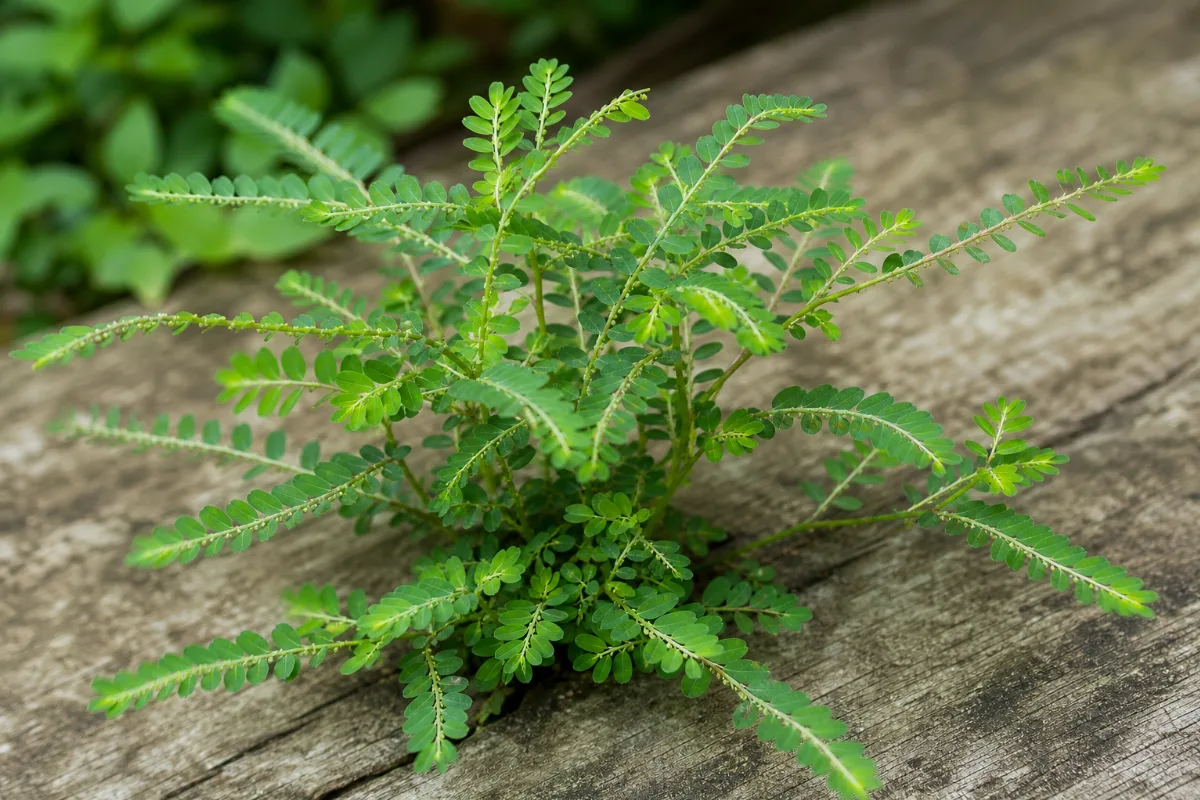
Herbs & Botanicals · Traditional kidney stone herb
Chanca piedra
Phyllanthus niruri, aerial parts · also called Stone breaker, quebra-pedra, gale of the wind, seed under leaf
Chanca piedra, or stone breaker, is a small tropical plant used for generations to help with kidney stones. Its stems and leaves are made into teas and capsules. Studies are small: two controlled studies suggest a modest drop in stone size, but it has not been shown to dissolve stones. Hepatitis B results are weak. If you have stones, see a doctor; avoid it in pregnancy.
General information, not medical advice. Last substantive update · Not medically reviewed. A named clinician has not signed off on this page. How this page is made
About Chanca piedra
Chanca piedra is a small tropical herb best known for kidney stones. Human research is limited to small studies. Hepatitis B and metabolic uses are unproven. Safety questions matter: pregnancy, water pills, blood pressure and diabetes medicines, and stones that need medical care.
What it is
Chanca piedra, or stone breaker, is the plant Phyllanthus niruri. Its name comes from Brazilian use for kidney stones (quebra-pedra). The parts used are the stems and leaves, and sometimes seeds, as teas, capsules and extracts. Several close relatives are sold under similar names; P. amarus and P. urinaria are separate species and are often the plants in hepatitis B studies.
What the research shows
The best human evidence is for kidney stones, and it is small. A 2020 meta-analysis pooled two controlled studies and found a modest drop in stone size and number. A 2006 trial of 150 people found no significant overall gain after shock-wave lithotripsy, but more lower-pole stones cleared. A placebo trial of 69 people found lower urinary calcium only in a subgroup. For chronic hepatitis B, Cochrane found no convincing benefit against placebo, and add-on results were uncertain. A 36-week trial of a chanca piedra and milk thistle capsule showed no difference from placebo. Blood sugar and blood pressure claims rest on a nine-person study of a related species and on animal work.
How it may work
The plant holds lignans such as phyllanthin and hypophyllanthin. Lab and animal work suggests it reduces calcium oxalate crystals clumping together and changes crystal structure. Relaxing the ureter is an unproven idea. In rats, extracts relaxed blood vessels. In rats the lignans were poorly absorbed by mouth (under 5%). None of this has been shown to explain a benefit in people.
At a glance
Traditional uses history, not proof
- Brazilian folk use for kidney stones, hence 'stone breaker' (quebra-pedra)
- Southeast Asian traditional use for diabetes and related problems
- Folk use for liver complaints and as a diuretic (water pill)
Studied for research
- Kidney stone size and number, low
- Help after shock-wave lithotripsy, low
- Urine chemistry and stone prevention, low
- Chronic hepatitis B, very low
- Fatty liver enzymes (combination capsule), insufficient
- Blood sugar and blood pressure, insufficient
- Diuretic effect, very low
- Cancer, infection and inflammation (lab only), insufficient
Main compounds
- Lignans: phyllanthin, hypophyllanthin, niranthin
- Flavonoids and tannins (not verified from a source read)
Common forms
- Tea (infusion or decoction of stems and leaves)
- Capsules of dried herb powder
- Liquid and dry extracts
- Combination capsules, for example with milk thistle
- Not the same as other Phyllanthus plants such as P. amarus or P. urinaria
Research links: Stone breaker meta-analysis, Canadian Journal of Urology (2020) · Trial after shock-wave lithotripsy, J Urol (2006) · Urinary calcium trial in stone formers (2004) · Cochrane: Phyllanthus for chronic hepatitis B (2011) · Fatty liver trial of a combination capsule (2025) · Chanca piedra overview, WebMD · Research Library · Genes & Biomarkers Library
The plant and its history
- Accepted scientific name
- Phyllanthus niruri L.
- Naming authority
- ACCEPTED in the GBIF backbone (species key 5381945, family Phyllanthaceae, checked 2026-10-25).
- Common names
- Chanca piedra (Spanish / trade); Stone breaker (English); Quebra-pedra (Portuguese (Brazil)); Gale of the wind (English); Seed under leaf (English); Dukung anak (Malay (product name in the fatty liver trial))
- Botanical family
- Phyllanthaceae (older papers place the genus in Euphorbiaceae).
- Classification
- Plantae > Tracheophyta > Magnoliopsida > Malpighiales > Phyllanthaceae > Phyllanthus > Phyllanthus niruri
- Native range
- A tropical and subtropical plant; the 2017 review describes it as found throughout the tropics of both hemispheres. Exact native range not verified.
- Habitat
- Not verified.
- What the plant looks like
- Roots: Not verified.; Stems: Not verified.; Leaves: The 2017 review calls it a small annual herb. Details not verified.; Flowers: Not verified.; Fruit: Not verified. The common name 'seed under leaf' refers to small seed capsules under the leaves; this was not checked in a botanical source.; Note: Aerial parts (above-ground stems and leaves) are the part used in products and in the fatty-liver trial.
- Cultivation
- Not verified.
- Harvest and processing
- Not verified. WebMD says growing area, weather, harvest time and processing change the chemical content.
- Look-alikes and adulterants
- Name: Phyllanthus amarus Schumach. & Thonn.; Note: A separate accepted species (GBIF key 5382589). Many hepatitis B and older Indian studies used it; some authors call it a synonym of P. niruri.; Name: Phyllanthus urinaria L.; Note: A separate accepted species (GBIF key 5382780), common in Asian hepatitis B trials.; Name: Phyllanthus emblica L. (amla); Note: A different accepted species (GBIF key 5381660), a fruit tree; do not mix with chanca piedra.
- Sustainability and conservation
- Not verified.
Traditional use and history history, not clinical proof
| Tradition or era | Documented use | Source |
|---|---|---|
| Brazil (quebra-pedra) | Long used in Brazilian medicine for kidney stones; the name 'stone breaker' comes from this use. | s-webmd-chanca |
| Southeast Asia (Malay Peninsula) | Traditional use of P. niruri, P. urinaria and P. acidus for diabetes and related disorders. | p41539677 |
| Ayurvedic and West African folk medicine (Phyllanthus amarus) | A rat paper says P. amarus has a long tradition in Ayurveda and, among the Yoruba of western Nigeria, is used for sterility and difficult childbirth. This is a related species. | p22314905 |
| Modern herbal use | A broad list of traditional uses (antimicrobial, antioxidant, diuretic, liver and others) is summarised in a 2017 review. | p28512988 |
| EMA / HMPC | No monograph found; the agency page could not be read. | s-ema-chanca |
Traditional use shows how a plant was used. It does not show that a supplement works or is safe today.
What is inside, and how it may work
What the plant contains and how those compounds act in cells and animals. Laboratory and animal mechanisms are not proven effects in people.
Main compounds
| Compound | Family | Where it is concentrated | Activity studied | Level of evidence |
|---|---|---|---|---|
| Phyllanthin PubChem 358901 | Lignan | Aerial parts (assumed from plant extracts) | Measured in rat blood after a plant extract; oral bioavailability in rats 0.62%. 14 | Animal research |
| Hypophyllanthin PubChem 182140 | Lignan | Aerial parts (assumed) | Oral bioavailability in rats 1.52%; half-life about 3.9 hours after injection. 14 | Animal research |
| Niranthin PubChem 11575632 | Lignan | Aerial parts (assumed) | Oral bioavailability in rats 2.66%. 14 | Animal research |
| Phyltetralin | Lignan | Aerial parts (assumed) | Oral bioavailability in rats 4.01%. PubChem ID not looked up. 14 | Animal research |
| Rutin PubChem 5280805 | Flavonoid glycoside | Not verified | A computer docking paper names rutin among plant compounds with predicted drug-target binding. Presence in P. niruri was NOT verified from a source read. 7 20 | In silico |
| Quercetin PubChem 5280343 | Flavonoid | Not verified | A common plant flavonoid sometimes listed for the genus. Presence in P. niruri NOT verified from a source read. 20 | Unverified |
Mechanisms, receptors and pathways
| Target or pathway | Gene or receptor | What was found | Level |
|---|---|---|---|
| Calcium oxalate crystal clumping and growth | Lab and animal work: reduces crystals clumping together, changes crystal structure and reduces crystal uptake by kidney cells. Review by authors who ran some of the studies. 3 10 | Laboratory research | |
| Glycosaminoglycan clumping, nucleation | A 2025 systematic review (people and rats) lists promoting glycosaminoglycan aggregation, inhibiting nucleation and changing stone density. 10 | Mixed human and animal | |
| Ureter relaxation | Proposed as a reason it may help stones pass; not confirmed in people. 3 | Hypothesis | |
| Nitric oxide / cGMP and beta-adrenoceptor vessel relaxation | NOS / sGC / beta-adrenoceptor | Extracts relaxed rat aorta rings and lowered blood pressure in hypertensive rats. 2 | Animal research |
| Blood-sugar pathways | A 2026 review describes anti-hyperglycaemic activity in lab and animal studies of Phyllanthus species. 24 | Animal research |
Absorption, metabolism and elimination
- Absorption
- No human data. In rats, four P. niruri lignans were poorly absorbed by mouth: absolute oral bioavailability 0.62% (phyllanthin), 1.52% (hypophyllanthin), 4.01% (phyltetralin), 2.66% (niranthin).
- Distribution
- Not found.
- Metabolism
- Not found.
- Elimination
- After injection in rats the half-lives were 3.35 to 4.40 hours; peak blood levels after oral dosing came at about 1 hour.
- Bioavailability
- Low for the isolated lignans in rats. Not measured in people or for other compounds.
Isolated compounds versus whole extracts
The stone trials used extracts or capsules of P. niruri; the fatty-liver trial used a combination of P. niruri aerial-part extract and milk thistle. Pharmacokinetic work is on isolated lignans in rats. No study compares isolated compounds with the whole plant.
Nutritional composition
Not covered: no nutrition data were found in the sources read. It is sold as a supplement or tea, not a food.
3 low certainty3 very low certainty5 not enough evidence
What is Chanca piedra good for?
The main studied and promoted uses and how strong the human evidence is. Where a result comes from a combination product or from a related Phyllanthus species, it is said so.
Benefits, one by one
Each card is a research question, not a promise. Tap a goal to filter. Open a card to see the studies, doses and limits.
Kidney stone size and number
Low certaintyThis is what chanca piedra is best known for. Two small controlled studies, pooled in one 2020 review, found a modest drop in stone size and number. The reviewers call the evidence limited.
3 studiesNot covered. Products differ in plant part, species and extract.
Studies, doses and limits
What the trials found
A systematic review and meta-analysis (Dhawan 2020) found only two controlled human studies with stone size and number data. A 2025 narrative review of herbal treatments said most studies reported smaller stones or easier passing but that doses, treatment length and which stone types respond are unanswered.
Results
Pooled: stone size SMD -0.39 cm (95% CI -0.68 to -0.09); stone number SMD -0.38 (95% CI -0.68 to -0.09).
Effect sizes as reported
Standardised mean difference about -0.4 for both size and number, fixed-effects model, two studies.
Why this rating
Only two controlled studies were pooled and the authors call the evidence limited; study quality is not described in the abstract.
Form and dose studied
Not covered. Products differ in plant part, species and extract.
Who was studied
Adults with kidney stones (details not given in the abstract).
Limits
Very few studies. Stone types and products are not described. A narrow confidence interval in a pooled analysis of two studies does not make the result firm. It has not been shown to dissolve stones or replace medical stone care.
Why researchers looked
The name 'stone breaker' (quebra-pedra in Brazil) comes from its long use for kidney stones.
Traditional use
A long history of use in Brazilian medicine for kidney stones. Teas and capsules are made from the stems, leaves and seeds.
Proposed mechanism Preliminary mechanism
Lab and animal work suggests it reduces calcium oxalate crystals clumping together, changes crystal structure and reduces crystal uptake by kidney cells. A relaxing effect on the ureter (the tube from kidney to bladder) is a hypothesis that has not been confirmed.
A proposed mechanism does not show that the effect happens in people.
Anyone with kidney stones, blood in urine or severe pain should see a doctor. A stone can block the urine flow and needs medical care (see the safety file).
Help after shock-wave lithotripsy
Low certaintyOne randomised trial of 150 people found stone-free rates were not significantly different overall after shock-wave lithotripsy. For lower-pole stones, more people were stone-free with the herb. This is one trial with no placebo.
2 studiesNot covered. One commercial extract was studied.
Studies, doses and limits
What the trials found
Micali 2006: 150 adults with calcium oxalate stones had 1 to 3 lithotripsy sessions; 78 then took a P. niruri extract (Uriston) for at least 3 months and 72 had no treatment. A 2025 systematic review of 16 studies in people and rats (Iregui-Parra) says it may improve stone-free rates, especially for lower-pole stones.
Results
Stone-free at 180 days: 93.5% with the herb versus 83.3% without (p = 0.48, not significant). Lower-calyx stones (56 people): 93.7% versus 70.8% (p = 0.01). Re-treatment 39.7% versus 43.3% (p = 0.2).
Effect sizes as reported
Overall difference 10.2 percentage points (not significant); lower-calyx subgroup difference 22.9 percentage points.
Why this rating
One open-label randomised trial with a significant result only in a subgroup, plus a mixed human-and-rat systematic review.
Form and dose studied
Not covered. One commercial extract was studied.
Who was studied
Adults with calcium oxalate stones up to 25 mm.
Limits
No placebo, so patients knew their group. Subgroup finding. One product. The review mixes human and rat studies and gives no numbers in its abstract.
Why researchers looked
After stones are broken up by shock waves, fragments can stay in the kidney. An add-on that helps clear them would be useful.
Traditional use
Used by people in Brazil to help pass stones.
Proposed mechanism Pharmacological theory
Proposed: relaxing the ureter and altering crystals so fragments pass more easily. Not shown directly in people.
A proposed mechanism does not show that the effect happens in people.
The trial recorded no side effects. See a doctor for stone care.
Urine chemistry linked to stones (urinary calcium)
Low certaintyA placebo-controlled trial of 69 people who form calcium stones found no overall change in urine chemistry. In the group with high urine calcium, calcium fell. No difference was seen in stones passed or pain.
2 studiesNot covered.
Studies, doses and limits
What the trials found
Nishiura 2004: 69 calcium-stone formers took P. niruri capsules or placebo for 3 months. The authors say larger trials in primary hypercalciuric stone formers are needed.
Results
No significant overall differences in 24-hour urine measures except a slight fall in urinary magnesium that stayed in the normal range. In people with high urine calcium, calcium fell from 4.8 to 3.4 mg/kg/24 h (p < 0.05). No significant difference in stones passed or pain relief.
Effect sizes as reported
Urinary calcium in the high-calcium subset: 4.8 to 3.4 mg/kg/24 h.
Why this rating
A small placebo-controlled trial whose positive result is a subset analysis.
Form and dose studied
Not covered.
Who was studied
Adults who form calcium stones, about 38 years old.
Limits
Subset analysis. 3 months only. The product and plant part are not described in the abstract.
Why researchers looked
High calcium in the urine raises the chance of calcium stones.
Traditional use
Same traditional use as for stones.
Proposed mechanism Preliminary mechanism
The reduction in urinary calcium is observed in a subset; the mechanism is not known.
A proposed mechanism does not show that the effect happens in people.
Urinary magnesium fell slightly (within the normal range). People who take magnesium or potassium supplements are advised to discuss them with a provider.
Preventing calcium oxalate stones coming back
Very low certaintyA 2025 systematic review listed chanca piedra among therapies that reduced both urinary risk factors and stone formation. We found no long, large trial of stone recurrence, so this is only a lead.
2 studiesNot covered.
Studies, doses and limits
What the trials found
Lo 2025 systematic review (38 studies of many treatments) grouped P. niruri, rice bran and magnesium hydroxide as reducing both urinary risk factors and stone formation. The 2025 narrative review says dose, treatment length, drug interactions and stone types remain unanswered.
Results
No chanca piedra-specific numbers in the abstract.
Effect sizes as reported
None given.
Why this rating
Abstract-level support only; no stone-recurrence trial was read.
Form and dose studied
Not covered.
Who was studied
Adults with or without calcium oxalate stones.
Limits
The review pools many treatments and the abstract does not say how many chanca piedra studies there were.
Why researchers looked
About half of people with a stone have another one, so prevention matters.
Traditional use
Used traditionally both to treat and to prevent stones.
Proposed mechanism Preliminary mechanism
See the kidney stone entries: lab effects on crystals and some effect on urinary calcium in a subset.
A proposed mechanism does not show that the effect happens in people.
Prevention advice (fluids, diet, medicines) should come from a doctor who knows the stone type.
Chronic hepatitis B (compared with placebo)
Not enough evidenceCochrane found no convincing evidence that Phyllanthus species help people with chronic hepatitis B, compared with placebo. Only one small trial of 42 people made that comparison.
1 studiesNot covered. The reviewers ask future trials to report the species.
Studies, doses and limits
What the trials found
Cochrane review (Xia 2011) of 16 randomised trials in 1,326 people. One trial of 42 people compared Phyllanthus with placebo or no treatment.
Results
HBeAg seroconversion: RR 0.9 (95% CI 0.73 to 1.25) at end of treatment and RR 1.00 (95% CI 0.63 to 1.60) at follow-up. No other outcomes could be assessed.
Effect sizes as reported
No difference versus placebo in the single trial.
Why this rating
One small trial; the reviewers found no convincing evidence of benefit.
Form and dose studied
Not covered. The reviewers ask future trials to report the species.
Who was studied
Adults with chronic hepatitis B.
Limits
Trials often did not name the Phyllanthus species, so results cannot be assigned to P. niruri.
Why researchers looked
Phyllanthus species, especially P. amarus and P. urinaria, were tested in many hepatitis B trials, partly because of lab signs of activity against the virus.
Traditional use
Phyllanthus plants are used in traditional medicine in Asia and the Americas for liver problems and jaundice.
Proposed mechanism Laboratory research
Antiviral and liver-protecting activity is described in lab and animal studies. This was not tested in the abstracts we read.
A proposed mechanism does not show that the effect happens in people.
Hepatitis B is a serious infection. It needs medical care and monitoring; chanca piedra is not a treatment.
Chronic hepatitis B (added to antiviral drugs, or compared with them)
Very low certaintyFifteen trials suggested more virus-marker clearance when a Phyllanthus product was added to an antiviral drug. The trials were at high risk of bias and the results are uncertain. A second Cochrane review could not say whether Phyllanthus equals or beats antiviral drugs.
2 studiesNot covered. Trials used mostly compound products.
Studies, doses and limits
What the trials found
Cochrane 2011: 15 trials added Phyllanthus to interferon alpha, lamivudine, adefovir, thymosin, vidarabine or conventional treatment. Cochrane 2013: five trials (290 people), all at high risk of bias, compared compound Phyllanthus with lamivudine, interferon alpha or thymosin.
Results
Add-on: HBV DNA RR 0.69 (0.52 to 0.91), HBeAg RR 0.70 (0.60 to 0.81), HBeAg seroconversion RR 0.77 (0.63 to 0.92), with substantial heterogeneity; the HBV DNA result was not supported by trial sequential analysis. Versus antivirals: HBeAg clearance RR 0.76 (0.64 to 0.91) in ordinary analysis but not in trial sequential analysis; no effect on HBsAg (RR 1.00) or HBV DNA (RR 0.83, 0.53 to 1.31). No trial reported deaths, liver disease complications or liver biopsy results.
Effect sizes as reported
Risk ratios 0.69 to 0.77 for add-on outcomes, with heterogeneity (I2 68 to 78%).
Why this rating
All trials at high risk of bias, high heterogeneity and the authors' trial sequential analyses did not confirm the results.
Form and dose studied
Not covered. Trials used mostly compound products.
Who was studied
Adults with chronic hepatitis B.
Limits
Compound products and several species; surrogate lab markers only; no outcomes such as deaths or liver complications.
Why researchers looked
Researchers wanted to know if the herb adds to standard antiviral treatment.
Traditional use
See the previous entry.
Proposed mechanism Laboratory research
Not established in people.
A proposed mechanism does not show that the effect happens in people.
Do not stop prescribed hepatitis B treatment for an herbal product. Only two trials reported side effects, with no significant differences and no serious events.
Liver enzymes in people at risk of fatty liver (NASH)
Not enough evidenceA 36-week trial of 146 people tested a capsule combining chanca piedra aerial-part extract and milk thistle. Liver enzymes fell in the treated groups, but the change was not different from placebo.
1 studiesNot covered.
Studies, doses and limits
What the trials found
Shaker 2025: phase II, double-blind, placebo-controlled trial in Egypt of Heptex capsules (200 mg P. niruri aerial-part extract plus 100 mg milk thistle fruit extract); placebo, one capsule or two capsules daily.
Results
ALT fell 57 to 40 IU/L (low dose, p = 0.026) and 61 to 47.5 IU/L (high dose, p < 0.0001); AST fell 43.5 to 32 IU/L in the high-dose group (p = 0.001). Between groups: ALT p = 0.465, AST p = 0.632, Fib-4 p = 0.985, so no difference from placebo.
Effect sizes as reported
Within-group changes only; no between-group effect.
Why this rating
A single combination-product trial with no between-group difference.
Form and dose studied
Not covered.
Who was studied
146 adults with risk factors for NASH.
Limits
Combination product, so chanca piedra's own effect is unknown. Registered after the trial. One author works for the product company.
Why researchers looked
Both plants have a reputation for supporting the liver.
Traditional use
Phyllanthus plants are used in folk medicine for liver complaints.
Proposed mechanism Pharmacological theory
Antioxidant and anti-inflammatory effects on liver cells are proposed; not tested here.
A proposed mechanism does not show that the effect happens in people.
The authors report the capsules were safe and well tolerated over 36 weeks.
Blood sugar
Not enough evidenceA 2026 review says lab and animal studies suggest blood-sugar lowering, while clinical trials are limited. One tiny 10-day study of 9 people with mild high blood pressure reported lower blood glucose.
2 studiesNot covered.
Studies, doses and limits
What the trials found
Srividya 1995: nine people with mild hypertension (four also had diabetes) took a whole-plant Phyllanthus amarus preparation for 10 days. Wong 2026 review: clinical trials with clear antidiabetic effects are limited.
Results
Blood glucose fell significantly in the treated group (no numbers in the abstract).
Effect sizes as reported
None given in the abstract.
Why this rating
Nine people, 10 days, no clear control group; the rest is lab and animal evidence.
Form and dose studied
Not covered.
Who was studied
Nine adults with mild hypertension.
Limits
Tiny and old study, a related species, subgroup reporting. The review mixes three species.
Why researchers looked
Phyllanthus plants are used in Southeast Asian traditional medicine for diabetes.
Traditional use
Traditional use for diabetes in the Malay Peninsula and Southeast Asia is described in a 2026 review.
Proposed mechanism Animal research
The review describes anti-hyperglycaemic activity in lab and animal studies of Phyllanthus species.
A proposed mechanism does not show that the effect happens in people.
People who take diabetes medicines should ask a doctor or pharmacist first, because of a theoretical low-blood-sugar risk.
Blood pressure
Not enough evidenceExtracts lowered blood pressure in hypertensive rats. In people, one tiny 10-day study reported a drop in systolic pressure in some subgroups. There are no proper trials.
3 studiesNot covered.
Studies, doses and limits
What the trials found
Srividya 1995 (nine people, 10 days). No randomised trial of chanca piedra for blood pressure was found.
Results
Systolic blood pressure fell significantly in non-diabetic hypertensive people and in women. No numbers in the abstract. In rats, all four extracts lowered blood pressure from baseline; the petroleum-ether extract was strongest.
Effect sizes as reported
None given in the abstracts.
Why this rating
A nine-person study and animal work.
Form and dose studied
Not covered.
Who was studied
Nine adults with mild hypertension; spontaneously hypertensive rats.
Limits
Subgroup results, no placebo described, related species. The strongest rat extract was made with a laboratory solvent, unlike home preparations.
Why researchers looked
Traditional use for high blood pressure.
Traditional use
Reported as a traditional treatment for hypertension.
Proposed mechanism Animal research
In rat aorta rings, an extract relaxed the vessel through nitric oxide and beta-adrenoceptor pathways. This is lab and animal work.
A proposed mechanism does not show that the effect happens in people.
If you take blood pressure medicines, ask a doctor or pharmacist first; a combined effect is theoretical.
Diuretic effect (more urine)
Very low certaintyThe herb is traditionally called a diuretic. In the nine-person study urine volume and urine and blood sodium rose. It has not been tested in a proper trial.
2 studiesNot covered.
Studies, doses and limits
What the trials found
Srividya 1995 (nine people).
Results
24-hour urine volume and urine and serum sodium rose significantly (no numbers in the abstract).
Effect sizes as reported
None given in the abstract.
Why this rating
One tiny, old study of a related species.
Form and dose studied
Not covered.
Who was studied
Nine adults with mild hypertension.
Limits
Very small, uncontrolled as far as the abstract says, species Phyllanthus amarus.
Why researchers looked
Traditional use to increase urine flow.
Traditional use
WebMD says it may act as a diuretic.
Proposed mechanism Pharmacological theory
Not established.
A proposed mechanism does not show that the effect happens in people.
A diuretic effect is why diuretics, magnesium and potassium should be discussed with a provider.
Cancer, infection, inflammation and antioxidant claims (lab only)
Not enough evidenceReviews describe antimicrobial, antioxidant, anticancer, anti-inflammatory and antiviral activity in the lab. These are test-tube and animal findings, not treatments.
1 studiesNot covered.
Studies, doses and limits
What the trials found
None found for these uses in the sources read.
Results
No outcome data in people.
Effect sizes as reported
None.
Why this rating
Lab-only evidence.
Form and dose studied
Not covered.
Who was studied
None studied.
Limits
Cell and animal results often do not carry over to people.
Why researchers looked
Many plant compounds show activity in cells.
Traditional use
Traditional uses are broad.
Proposed mechanism Laboratory research
Lab and animal findings only.
A proposed mechanism does not show that the effect happens in people.
Do not use it in place of treatment for cancer or infection.
Connections to the rest of health
How Chanca piedra connects to the rest of our health knowledge graph. Every link says what kind of connection it is. A safety link (for example to the liver) is a warning, not a benefit. A study that merely mentions a topic never creates a benefit link.
Explore every connection: goals, body systems, organs, symptoms, genes
A. Wellness goals
| Connected to | Kind of connection | Evidence status | Context | Studies |
|---|---|---|---|---|
| Liver Support | Potential benefit | Not enough evidence | Chronic hepatitis B (compared with placebo): Cochrane found no convincing evidence that Phyllanthus species help people with chronic hepatitis B, compared with placebo. Only one small trial of 42 people made that comparison. | 25 |
| Liver Support | Preliminary mechanism | Very low certainty | Chronic hepatitis B (added to antiviral drugs, or compared with them): Fifteen trials suggested more virus-marker clearance when a Phyllanthus product was added to an antiviral drug. The trials were at high risk of bias and the results are uncertain. A second Cochrane review could not say whether Phyllanthus equals or beats antiviral drugs. Liver enzymes in people at risk of fatty liver (NASH): A 36-week trial of 146 people tested a capsule combining chanca piedra aerial-part extract and milk thistle. Liver enzymes fell in the treated groups, but the change was not different from placebo. | 25 26 21 |
| Blood Sugar Balance | Preliminary mechanism | Not enough evidence | Blood sugar: A 2026 review says lab and animal studies suggest blood-sugar lowering, while clinical trials are limited. One tiny 10-day study of 9 people with mild high blood pressure reported lower blood glucose. | 22 24 |
| Blood Pressure Support | Preliminary mechanism | Not enough evidence | Blood pressure: Extracts lowered blood pressure in hypertensive rats. In people, one tiny 10-day study reported a drop in systolic pressure in some subgroups. There are no proper trials. | 22 2 7 |
B. Body systems
| Connected to | Kind of connection | Evidence status | Context | Studies |
|---|---|---|---|---|
| Kidney and urinary system | Potential benefit | Low certainty | Small studies for stone size and stone-free rate after lithotripsy. Preparation or compound: P. niruri products |
5 13 18 |
| Liver | Preliminary mechanism | Very low certainty | Cochrane found no convincing benefit versus placebo; add-on results uncertain. Preparation or compound: Phyllanthus species (hepatitis B); P. niruri plus milk thistle (fatty liver) |
25 26 21 |
| Kidney Urinary | Biological association | Low certainty | Studied for: Kidney stone size and number Studied for: Help after shock-wave lithotripsy | 5 15 3 13 10 18 12 22 23 |
| Urinary System | Biological association | Low certainty | Studied for: Kidney stone size and number | 5 15 3 |
| Liver Detox | Biological association | Not enough evidence | Studied for: Chronic hepatitis B (compared with placebo) Studied for: Chronic hepatitis B (added to antiviral drugs, or compared with them) | 25 26 21 |
| Hepatic System | Biological association | Not enough evidence | Studied for: Chronic hepatitis B (compared with placebo) Studied for: Chronic hepatitis B (added to antiviral drugs, or compared with them) | 25 26 21 |
| Blood Sugar Support | Biological association | Not enough evidence | Studied for: Blood sugar | 22 24 |
| Heart Circulation | Biological association | Not enough evidence | Studied for: Blood pressure | 22 2 7 |
| Cardiovascular System | Biological association | Not enough evidence | Studied for: Blood pressure | 22 2 7 |
| Immune System | Biological association | Not enough evidence | Studied for: Cancer, infection, inflammation and antioxidant claims (lab only) | 11 |
E. Health conditions
| Connected to | Kind of connection | Evidence status | Context | Studies |
|---|---|---|---|---|
| Chronic hepatitis B | Preliminary mechanism | Very low certainty | Cochrane: no convincing benefit versus placebo; add-on results uncertain. Preparation or compound: Phyllanthus species |
25 26 |
I. Biomarkers
| Connected to | Kind of connection | Evidence status | Context | Studies |
|---|---|---|---|---|
| Kidney stone size and number | Biological association | Low certainty | Measured in trials: lowered. A lab change is not the same as a health benefit. | 5 |
| Stone-free rate after lithotripsy | Biological association | Low certainty | Measured in trials: mixed. A lab change is not the same as a health benefit. | 13 10 |
| 24-hour urinary calcium | Biological association | Low certainty | Measured in trials: mixed. A lab change is not the same as a health benefit. | 18 |
| 24-hour urinary magnesium | Biological association | Low certainty | Measured in trials: lowered. A lab change is not the same as a health benefit. | 18 |
| HBeAg seroconversion (hepatitis B marker) | Biological association | Very low certainty | Measured in trials: mixed. A lab change is not the same as a health benefit. | 25 26 |
| HBV DNA (viral load) | Biological association | Very low certainty | Measured in trials: mixed. A lab change is not the same as a health benefit. | 25 26 |
| ALT and AST (liver enzymes) | Biological association | Not enough evidence | Measured in trials: no-change. A lab change is not the same as a health benefit. | 21 |
| Systolic blood pressure | Biological association | Not enough evidence | Measured in trials: lowered. A lab change is not the same as a health benefit. | 22 |
| Blood glucose | Biological association | Not enough evidence | Measured in trials: lowered. A lab change is not the same as a health benefit. | 22 24 |
| 24-hour urine volume and sodium | Biological association | Very low certainty | Measured in trials: raised. A lab change is not the same as a health benefit. | 22 |
K. Biological pathways
| Connected to | Kind of connection | Evidence status | Context | Studies |
|---|---|---|---|---|
| Nitric oxide / cGMP signalling | Preliminary mechanism | Animal | Vessel relaxation in rat aorta; relevance in people unknown. | 2 |
| Targets of thiazide-like diuretics, calcium channel blockers, ACE inhibitors, ARBs, CYP enzymes | Preliminary mechanism | In silico | Predicted binding in a computer model. | 7 |
L. Active compounds
| Connected to | Kind of connection | Evidence status | Context | Studies |
|---|---|---|---|---|
| Phyllanthin | Biological association | Animal | Measured in rat blood after a plant extract; oral bioavailability in rats 0.62%. Preparation or compound: Aerial parts (assumed from plant extracts) |
14 |
| Hypophyllanthin | Biological association | Animal | Oral bioavailability in rats 1.52%; half-life about 3.9 hours after injection. Preparation or compound: Aerial parts (assumed) |
14 |
| Niranthin | Biological association | Animal | Oral bioavailability in rats 2.66%. Preparation or compound: Aerial parts (assumed) |
14 |
| Phyltetralin | Biological association | Animal | Oral bioavailability in rats 4.01%. PubChem ID not looked up. Preparation or compound: Aerial parts (assumed) |
14 |
| Rutin | Biological association | In silico | A computer docking paper names rutin among plant compounds with predicted drug-target binding. Presence in P. niruri was NOT verified from a source read. Preparation or compound: Not verified |
7 20 |
| Quercetin | Biological association | Unverified | A common plant flavonoid sometimes listed for the genus. Presence in P. niruri NOT verified from a source read. Preparation or compound: Not verified |
20 |
Each connection is stored with the ingredient, the connected record, the kind of connection, the evidence status, the supporting studies, the preparation or compound involved, and a review date (last reviewed October 25, 2026).
The evidence
The research centre for Chanca piedra. Every record here was checked against PubMed or the publisher's page; we never list a study we have not verified.
Evidence by outcome
Bars show how many studies we found for each outcome, not how well it works. People are added up across trials only (reviews are not added, to avoid double counting).
How we rate evidence
High certainty
Several well-run trials or reviews agree; further research is unlikely to change the picture much.
Moderate certainty
Good trials point the same way, but some doubt remains.
Low certainty
Small, short or inconsistent trials. The finding could change with better research.
Very low certainty
Very little or very weak human data. Treat as a possibility only.
Mixed findings
Trials or reviews disagree with each other.
Not enough evidence
Not enough human research to say either way.
Evidence against
Good research found no benefit, or found harm.
We take the reviewers' own risk-of-bias and GRADE statements where they exist, and otherwise judge from study size, design, consistency, directness and whether a product matches what is sold. Many publications do not make evidence high. Method note: We searched PubMed and read each abstract directly, and checked plant names through GBIF and compound IDs through PubChem. WebMD was read in full. NCCIH has no chanca piedra page; EMA and LiverTox could not be opened; LactMed, Commission E and WHO were not checked. Full texts were mostly not read.
Study library: every study we checked 26
| Study | Design | People | Product, dose, length | Result |
|---|---|---|---|---|
| Asare 2012 Genotoxicity, cytotoxicity and toxicological evaluation of whole plant extracts of the medicinal plant Phyllanthus niruri (Phyllanthaceae) Genet Mol Res · PMID 22290470 · DOI |
Animal research animal |
Laboratory rats; human blood cells in the lab | Ethanol extract of the whole P. niruri plant whole plant 30 or 300 mg/kg by gavage Single dose; 90 days for the subchronic test · vs Saline (negative) and a known DNA-damaging chemical (positive) |
The extract did not cause DNA damage in rat bone marrow (ratio 63 versus 168 for the positive control), was cytotoxic only at high concentrations (CC50 26.3 mg/mL), and showed no liver or kidney toxicity after 90 days in rats. The authors call it generally non-toxic. CC50 26.3 mg/mL (n/a) Methods, limits and fundingOutcomes: Bone-marrow genotoxicity, cell toxicity, 90-day kidney and liver toxicity Limitations: Rats and cells, one ethanol extract of the whole plant. Not a human safety study. Funding and conflicts: Not stated in the abstract. Read: abstract |
| Bello 2020 Blood pressure lowering effect and vascular activity of Phyllanthus niruri extract: The role of NO/cGMP signaling pathway and beta-adrenoceptor mediated relaxation of isolated aortic rings J Ethnopharmacol · PMID 31830549 · DOI |
Animal research animal |
Spontaneously hypertensive rats and isolated rat aorta rings | Four solvent extracts of P. niruri (petroleum ether, chloroform, methanol, water) unspecified Daily oral gavage; amounts not given in the abstract 2 weeks · vs Baseline values / untreated |
All extracts lowered blood pressure in the hypertensive rats compared with baseline, with the petroleum-ether extract the strongest. The same extract relaxed rat aorta rings through endothelium-dependent pathways (nitric oxide) and beta-adrenoceptor activity. Reduction vs baseline; no numbers in the abstract (n/a) Methods, limits and fundingOutcomes: Blood pressure; vessel relaxation Limitations: Rats and isolated tissue only. The strongest extract was a petroleum-ether extract, unlike a tea or capsule. Funding and conflicts: Not stated in the abstract. Read: abstract |
| Boim 2010 Phyllanthus niruri as a promising alternative treatment for nephrolithiasis Int Braz J Urol · PMID 21176271 · DOI |
Narrative review |
Lab, animal and clinical data on P. niruri and stones, partly from the authors' own group | P. niruri unspecified not covered not covered · vs Varies |
The review says P. niruri interferes with several stages of stone formation in lab and animal work (less crystal clumping, changed crystal structure, less crystal uptake by kidney cells). Clinical benefit may relate to relaxing the ureter or to lowering urinary calcium. It reports no adverse kidney, heart, nerve or toxic effects in the studies reviewed, and says longer randomised trials are needed. Not pooled (n/a) Methods, limits and fundingOutcomes: How stones form; clinical effects; safety Limitations: Narrative review by authors who ran some of the studies reviewed. The ureter-relaxing idea is a hypothesis. Funding and conflicts: Not stated in the abstract; the authors review their own group's work. Read: abstract |
| Costa Alves 2025 Phyllanthus niruri L. Administration during pregnancy and breastfeeding: Maternal evaluation and effects on initial development and adult behavior of male rat offspring Brain Res · PMID 39694168 · DOI |
Animal research animal |
24 Pregnant rats, three groups of 8, and their male pups |
Aqueous extract of P. niruri leaves leaf 75 or 150 mg/kg by gavage Through pregnancy and lactation · vs Vehicle |
No significant change in maternal and reproductive measures, but changes in biochemical markers of liver function were seen in the mothers. Pups' growth was not changed, but eyes and ear canal opened early and adult males showed behaviour changes the authors read as anxiolytic. The authors note that use of the plant is contraindicated in pregnancy and breastfeeding in folk medicine, and that earlier reports were scarce and controversial. Liver marker changes in dams; early eye and ear opening in pups (n/a) Methods, limits and fundingOutcomes: Maternal toxicity, pup development, adult behaviour Limitations: Rats only. The abstract does not say which liver markers changed or by how much. Funding and conflicts: Not stated in the abstract. Read: abstract |
| Dhawan 2020 Phyllanthus niruri (stone breaker) herbal therapy for kidney stones; a systematic review and meta-analysis of clinical efficacy, and Google Trends analysis of public interest Can J Urol · PMID 32333735 |
Meta-analysis |
Controlled human studies of P. niruri with stone size and number data; two studies met the criteria | P. niruri products (plant part and product not stated in the abstract) unspecified not stated in abstract not stated in abstract · vs Control groups of the included studies |
Two studies met the criteria. Pooled (fixed-effects) change in mean stone size was SMD -0.39 cm and in stone number SMD -0.38, both favouring P. niruri. The authors conclude limited clinical evidence supports a modest effect, pending further study. Stone size SMD -0.39 cm; stone number SMD -0.38 (Size: 95% CI -0.68 to -0.09, p = 0.01; number: 95% CI -0.68 to -0.09, p = 0.01) Methods, limits and fundingOutcomes: Change in mean stone size and number Limitations: Only two studies were pooled. The abstract does not describe the products, stone types or study quality. The paper also analyses Google search interest, which is not evidence of benefit. Funding and conflicts: None stated in the abstract. Read: abstract |
| European Medicines Agency 2026 EMA / HMPC herbal monograph search for Phyllanthus (not confirmed) European Medicines Agency · Source |
Regulator record |
Chanca piedra (Phyllanthus niruri) unspecified |
Checked 2026-10-25. The EMA search page returned a security check ('unusual traffic') to the command-line request, so no result was read. No monograph is known to have been found; this is not confirmed either way. Methods, limits and fundingLimitations: Access blocked; absence not verified. Read: full-text | |
| Evadgian 2022 Use of Cheminformatics to Determine Potential Drug Interactions between Popular Barbadian Botanical Medicines and Antihypertensive Drugs ACS Omega · PMID 36530331 · DOI |
In silico in-vitro |
Computer docking of 30 plant compounds from 11 Barbadian plants against targets of common blood pressure drugs | Compounds from P. niruri among those screened unspecified n/a n/a · vs n/a |
Compounds from four plants, including P. niruri, showed strong predicted binding to targets of thiazide-like diuretics, calcium channel blockers, ACE inhibitors and ARBs, and to liver enzymes (CYP) and transporters. The authors say these are likely interactions to study, and that in-vitro and in-vivo work is needed. Computer prediction only (n/a) Methods, limits and fundingOutcomes: Predicted binding to drug targets and enzymes Limitations: Computer model, not a measured interaction. Many plants and compounds are grouped together in the abstract. Funding and conflicts: The authors declare no competing financial interest. Read: abstract |
| GBIF 2026 GBIF Backbone Taxonomy species match: Phyllanthus niruri, P. amarus, P. urinaria, P. emblica GBIF · Source |
Database |
Chanca piedra (Phyllanthus niruri) unspecified |
Checked 2026-10-25. Phyllanthus niruri L. (key 5381945) is ACCEPTED, family Phyllanthaceae, order Malpighiales. Phyllanthus amarus Schumach. & Thonn. (key 5382589), Phyllanthus urinaria L. (key 5382780) and Phyllanthus emblica L. (key 5381660) are each separate ACCEPTED species in the same family. Methods, limits and fundingLimitations: Accepted name not cross-checked in Plants of the World Online. Read: full-text | |
| Iranloye 2010 Effect of aqueous extract of Phyllantus amarus leaves on implantation and pregnancy in rats Niger J Physiol Sci · PMID 22314905 |
Animal research animal |
36 Pregnant rats, two groups of 18 |
Aqueous extract of Phyllanthus amarus leaves (a related species, not P. niruri) leaf 0.2 mg/100 g body weight (as reported) From day 1 of pregnancy; groups checked on days 6, 8 and 19 · vs Distilled water |
The extract shortened the time frame for implantation and caused abortion in the pregnant rats. The authors say this abortifacient effect does not support the traditional claim that it treats sterility. Abortion in treated rats; numbers not in the abstract (n/a) Methods, limits and fundingOutcomes: Implantation and pregnancy Limitations: Rats; a different species of Phyllanthus. Small groups; no numbers in the abstract. Funding and conflicts: Not stated in the abstract. Read: abstract |
| Iregui-Parra 2025 Phyllanthus niruri in the management of nephrolithiasis: A systematic review of the literature Actas Urol Esp (Engl Ed) · PMID 40480426 · DOI |
Systematic review |
16 16 studies in people and rats, 1994 to September 2022 (English and Spanish) |
P. niruri (products vary) unspecified not covered not covered · vs Varies |
The authors report that P. niruri works through several lab-described mechanisms (it affects crystal clumping and stone formation), that serial blood tests in the studies showed no harm to electrolytes or liver function, and that it may improve stone-free rates after shock-wave lithotripsy, especially for lower-pole stones. They conclude it is safe and may help when used alongside standard treatment. 16 studies; no pooled number in the abstract (n/a) Methods, limits and fundingOutcomes: Stone-free rate after shock-wave lithotripsy; safety Limitations: Studies were limited to those the authors could access through their institutions. Human and rat studies are mixed together. The abstract gives no numbers, and the authors themselves describe earlier results as mixed. Funding and conflicts: The authors declare no conflicts. Read: abstract |
| Kaur 2017 Phytochemistry and Pharmacology of Phyllanthus niruri L.: A Review Phytother Res · PMID 28512988 · DOI |
Narrative review in-vitro |
Literature on P. niruri chemistry and lab, animal and traditional uses | P. niruri unspecified not covered not covered · vs n/a |
The review lists 83 phytochemicals and reports traditional and lab-described activities (antimicrobial, antioxidant, anticancer, anti-inflammatory, antiplasmodial, antiviral, diuretic, hepatoprotective), with emphasis on anticancer mechanisms. It points to inconsistent plant naming as a gap. 83 compounds (n/a) Methods, limits and fundingOutcomes: Compounds and pharmacological activities Limitations: A review of mostly lab work; the abstract gives no human findings. It places the plant in Euphorbiaceae, an older family placement. Funding and conflicts: Not stated in the abstract. Read: abstract |
| Lo 2025 Systematic review of pharmacological, complementary, and alternative therapies for the prevention of calcium oxalate stones Asian J Urol · PMID 40458577 · DOI |
Systematic review |
38 38 studies of adults with or without calcium oxalate stones, searched to November 2022 |
Many treatments; P. niruri is one unspecified not covered not covered · vs Varies |
P. niruri, rice bran and magnesium hydroxide were grouped as therapies that reduced both urinary risk factors and stone formation. The authors say several therapies may be useful to consider for future prevention guidelines. 38 studies; no chanca piedra numbers in the abstract (n/a) Methods, limits and fundingOutcomes: Urinary stone risk factors and stone formation Limitations: The abstract does not say how many chanca piedra studies there were or how strong they were. Other treatments in the review are not herbal. Funding and conflicts: The authors declare no conflicts. Read: abstract |
| Micali 2006 Can Phyllanthus niruri affect the efficacy of extracorporeal shock wave lithotripsy for renal stones? A randomized, prospective, long-term study J Urol · PMID 16890682 · DOI |
Controlled trial |
150 150 adults with calcium oxalate kidney stones up to 25 mm who had 1 to 3 shock-wave lithotripsy sessions |
Uriston, a P. niruri extract (commercial product) unspecified 2 g daily (as reported) At least 3 months, follow-up 180 days · vs No treatment after lithotripsy (no placebo) |
Stone-free rate at 180 days was 93.5% with P. niruri and 83.3% in the control group (p = 0.48, not significant). In the 56 patients with lower-calyx stones it was 93.7% versus 70.8% (p = 0.01). Re-treatment was 39.7% versus 43.3% (p = 0.2). No side effects were recorded. Overall stone-free 93.5% vs 83.3%; lower-calyx subgroup 93.7% vs 70.8% (Not given in the abstract) Methods, limits and fundingOutcomes: Stone-free rate at 180 days (no stones or fragments under 3 mm), re-treatment, side effects Limitations: No placebo; patients knew which group they were in. The overall difference was not significant, and the lower-calyx result is a subgroup finding. Only calcium oxalate stones. One product. Funding and conflicts: Not stated in the abstract. Read: abstract |
| Murugaiyah 2007 Analysis of lignans from Phyllanthus niruri L. in plasma using a simple HPLC method with fluorescence detection and its application in a pharmacokinetic study J Chromatogr B · PMID 17261384 · DOI |
Animal research animal |
Rats | Four lignans from P. niruri (phyllanthin, hypophyllanthin, phyltetralin, niranthin) unspecified Intravenous and oral (amounts not given in the abstract) Single dose · vs n/a |
After an injection the four lignans cleared slowly, with half-lives of 3.35 to 4.40 hours. After oral doses blood levels peaked at about 1 hour, but absorption was incomplete: absolute oral bioavailability was 0.62% (phyllanthin), 1.52% (hypophyllanthin), 4.01% (phyltetralin) and 2.66% (niranthin). Oral bioavailability 0.62 to 4.01% (n/a) Methods, limits and fundingOutcomes: Blood levels, half-life, bioavailability Limitations: Rats and isolated lignans, not a whole-herb product. No human data. Funding and conflicts: Not stated in the abstract. Read: abstract |
| Mutomba 2025 Phytotherapy in Urolithiasis: An Updated Overview of Current Knowledge J Clin Med · PMID 40363917 · DOI |
Narrative review |
Randomised human studies of herbal medicines for kidney and urinary stones (mixtures and single plants) | Herbal mixtures and single-plant extracts (chanca piedra is one of many) unspecified not covered not covered · vs Varies |
Most studies reviewed reported benefit in reducing stone size and helping stones pass. The authors say questions about dosing, mechanisms, drug interactions, treatment length and which stone types respond remain unanswered, and that herbal therapy is mostly used as an add-on to standard care. Not pooled (n/a) Methods, limits and fundingOutcomes: Stone size, stone expulsion Limitations: Narrative review, not a systematic one. It covers many herbs; the abstract does not give chanca piedra results separately. It says drug interactions are an open question. Funding and conflicts: The authors declare no commercial or financial conflicts. Read: abstract |
| NIH LiverTox 2026 NIH LiverTox (access blocked) NIH LiverTox · Source |
Regulator record |
Chanca piedra (Phyllanthus niruri) unspecified |
Checked 2026-10-25. The NCBI Bookshelf returned a reCAPTCHA browser check to the command-line request, so no LiverTox entry for Phyllanthus or chanca piedra could be read. Whether an entry exists is not confirmed. Methods, limits and fundingLimitations: Access blocked; absence not verified. The nutrient summary also noted LiverTox was blocked. Read: full-text | |
| NIH NCCIH 2026 NCCIH herb page for chanca piedra (not found) NIH NCCIH · Source |
Regulator record |
Chanca piedra (Phyllanthus niruri) unspecified |
Checked 2026-10-25. The address https://www.nccih.nih.gov/health/chanca-piedra returns 'Page not found'. No NCCIH page for this herb was found. Methods, limits and fundingLimitations: Absence of a page, not a statement about safety. Read: full-text | |
| Nishiura 2004 Phyllanthus niruri normalizes elevated urinary calcium levels in calcium stone forming (CSF) patients Urol Res · PMID 15221244 · DOI |
Controlled trial |
69 69 people who form calcium stones (39 men, 30 women, about 38 years old) |
P. niruri capsules unspecified 450 mg capsules three times a day (as reported) 3 months · vs Placebo |
Overall there were no significant differences in urine measures, except a slight fall in urinary magnesium that stayed in the normal range. In a subset with high urine calcium, calcium fell from 4.8 to 3.4 mg/kg/24 h (p < 0.05). No significant differences in stones passed or pain relief were found in this short follow-up. The authors say larger trials are needed. Urinary calcium in the high-calcium subset 4.8 to 3.4 mg/kg/24 h (p < 0.05 (subset)) Methods, limits and fundingOutcomes: 24-hour urine calcium, oxalate, citrate, uric acid, magnesium, sodium, potassium; stone passing and pain Limitations: The calcium result comes from a subset analysis, not the main comparison. Short (3 months). Plant part and product not stated in the abstract. Funding and conflicts: Not stated in the abstract. Read: abstract |
| Paula 2020 Maternal-fetal repercussions of Phyllanthus niruri L. treatment during rat pregnancy J Ethnopharmacol · PMID 32145330 · DOI |
Animal research animal |
Pregnant rats, four groups | Aqueous (water) extract of P. niruri (the authors refer to the leaf extract) leaf 150, 300 or 600 mg/kg by gavage Gestational day 0 to 21 · vs Water |
Treatment did not change reproductive performance outcomes and caused no birth defects. At the top dose (600 mg/kg) the mothers' kidney weight and structure changed, and pups showed macrosomia (larger size) and more ossification sites. The authors say the leaf extract can have detrimental effects during pregnancy. Kidney changes in dams at top dose; larger fetuses (n/a) Methods, limits and fundingOutcomes: Maternal toxicity, reproductive outcomes, fetal anomalies Limitations: Rats. The dose-to-human conversion is unknown. One extract. Funding and conflicts: No competing interests declared. Read: abstract |
| PubChem 2026 PubChem compound records (name lookup) PubChem · Source |
Database |
Chanca piedra (Phyllanthus niruri) unspecified |
Checked 2026-10-25 by name: phyllanthin CID 358901 (C24H34O6); hypophyllanthin CID 182140 (C24H30O7); niranthin CID 11575632 (C24H32O7); quercetin CID 5280343 (C15H10O7); rutin CID 5280805 (C27H30O16). Methods, limits and fundingLimitations: Checked by name only. This does not show that each compound occurs in the plant. Read: full-text | |
| Shaker 2025 The activity of a herbal medicinal product of Phyllanthus niruri and Silybum marianum powdered extracts (Heptex) in patients with apparent risk factors for nonalcoholic steatohepatitis: a phase II, multicentered, randomized, double-blind, placebo-controlled clinical trial BMC Complement Med Ther · PMID 39789561 · DOI |
Controlled trial |
146 146 adults with risk factors for NASH (fatty liver with inflammation), Egypt |
Capsule with 200 mg powdered P. niruri aerial-part extract plus 100 mg milk thistle fruit extract (combination) aerial parts 1 or 2 capsules a day (low or high dose) 36 weeks · vs Placebo |
ALT fell in the low-dose group (57 to 40 IU/L, p = 0.026) and the high-dose group (61 to 47.5 IU/L, p < 0.0001); AST fell in the high-dose group (43.5 to 32 IU/L, p = 0.001). But there was no significant difference between the three groups in the percent change in ALT (p = 0.465) or AST (p = 0.632), or in Fib-4 (p = 0.985). Total cholesterol fell in the low-dose group only. The authors say the capsules were safe and well tolerated over 36 weeks and that the liver effect needs further assessment. No between-group difference in ALT, AST or Fib-4 (ALT between groups p = 0.465; AST p = 0.632) Methods, limits and fundingOutcomes: ALT, AST, Fib-4 score, lipids, liver scans Limitations: Combination product, so effects cannot be given to chanca piedra alone. Within-group falls were not different from placebo. Registered after the trial (April 2022). Not a trial of chanca piedra alone. Funding and conflicts: One author is an employee of the product company (Natural Wellness); the others declare no conflicts. Industry-linked. Read: abstract |
| Srividya 1995 Diuretic, hypotensive and hypoglycaemic effect of Phyllanthus amarus Indian J Exp Biol · PMID 8786163 |
Controlled clinical trial |
9 9 people with mild high blood pressure, 4 of them also with diabetes |
Whole-plant preparation of Phyllanthus amarus (the authors call it a synonym of P. niruri; GBIF lists them as separate species) whole plant not given in the abstract 10 days · vs Not described in the abstract (before-and-after comparison) |
24-hour urine volume and urine and serum sodium rose significantly. Systolic blood pressure fell significantly in the non-diabetic people and in women. Blood glucose fell significantly in the treated group. No harmful side effects were seen on clinical observation. No numbers in the abstract (Not given) Methods, limits and fundingOutcomes: 24-hour urine volume, urine and serum sodium, blood pressure, blood glucose Limitations: Nine people for 10 days, no placebo described, different species name, 1995. Too small to rely on. Results by subgroup. Funding and conflicts: Not stated in the abstract. Read: abstract |
| WebMD 2025 Chanca Piedra: Overview, Uses, Side Effects, Precautions, Interactions, Dosing and Reviews WebMD (consumer drug reference) · Source |
Consumer reference |
Chanca piedra (Phyllanthus niruri) unspecified |
Reference page: made from stems, leaves and seeds of Phyllanthus niruri; traditionally used for kidney stones; may act as a diuretic; small studies in people with liver problems have not shown benefit; most common side effects nausea and vomiting; serious allergic reaction possible. Tell your provider if you have diabetes, gallstones, kidney problems (including kidney stones), hepatitis, or low potassium or magnesium. Medicines and supplements to discuss: diuretics, magnesium and potassium supplements; interaction research is incomplete. Not known whether it affects pregnancy or passes into breast milk. The FDA has not reviewed it for safety and effectiveness. Products vary by plant part and maker. Methods, limits and fundingLimitations: A consumer reference for the public, not primary research. It lists dosing, which this page does not repeat. The page text had no dated clinical citations for the safety statements. Read: full-text | |
| Wong 2026 Unlocking the Potential of Phyllanthus Species From Traditional Knowledge to Clinical Trials: An Updated Review of Metabolomics Approach in Diabetes Intervention Phytother Res · PMID 41539677 · DOI |
Narrative review |
P. niruri, P. urinaria and P. acidus; mostly in-vitro and animal studies, 2010 to 2025 | Phyllanthus species (three species reviewed) unspecified not covered not covered · vs Varies |
The review says in-vitro and animal studies show anti-hyperglycaemic activity of Phyllanthus species, while clinical trials with clear antidiabetic effects are limited. It reports toxicity data suggest lower doses are safe without significant adverse effects. It describes Southeast Asian traditional use. Not pooled (n/a) Methods, limits and fundingOutcomes: Blood sugar, toxicity Limitations: Mostly lab and animal evidence. Species are mixed. The abstract gives no human numbers. Funding and conflicts: Not stated in the abstract. Read: abstract |
| Xia 2011 Phyllanthus species for chronic hepatitis B virus infection Cochrane Database Syst Rev · PMID 21491412 · DOI |
Systematic review |
1326 16 randomised trials, 1,326 people with chronic hepatitis B |
Phyllanthus species (trials often did not name the species) unspecified not covered 3 to 12 months · vs Placebo, or the same antiviral drug alone |
One trial of 42 people compared Phyllanthus with placebo and found no significant difference in HBeAg seroconversion (RR 0.9, 95% CI 0.73 to 1.25 at end of treatment; RR 1.00, 95% CI 0.63 to 1.60 at follow-up). Fifteen trials added Phyllanthus to an antiviral drug: it improved HBV DNA (RR 0.69), HBeAg (RR 0.70) and HBeAg seroconversion (RR 0.77), but heterogeneity was substantial and the HBV DNA result was not supported by trial sequential analysis. No trial reported deaths, liver disease complications, quality of life or liver biopsy results. Only two reported adverse events, with no significant differences and no serious events. The authors conclude there is no convincing evidence against placebo, and that the add-on result is questionable because of bias and random error. Add-on to antivirals: HBV DNA RR 0.69; HBeAg RR 0.70; seroconversion RR 0.77 (HBV DNA 0.52 to 0.91; HBeAg 0.60 to 0.81; seroconversion 0.63 to 0.92) Methods, limits and fundingOutcomes: HBeAg seroconversion, HBV DNA, HBeAg; deaths and liver disease Limitations: Trials covered several Phyllanthus species and were at risk of bias. Heterogeneity was high (I2 68 to 78%). The review is from 2011 (searches to October 2010). Funding and conflicts: Cochrane: none known. Read: abstract |
| Xia 2013 Phyllanthus species versus antiviral drugs for chronic hepatitis B virus infection Cochrane Database Syst Rev · PMID 23633363 · DOI |
Systematic review |
290 5 randomised trials, 290 people with chronic hepatitis B |
Compound Phyllanthus preparations unspecified not covered 3 to 12 months · vs Lamivudine, interferon alpha or thymosin |
All five trials were at high risk of bias. Phyllanthus seemed better for clearing HBeAg at end of treatment in ordinary meta-analysis (RR 0.76, 95% CI 0.64 to 0.91) but not in trial sequential analysis. No significant effect on HBsAg (RR 1.00) or HBV DNA (RR 0.83, 95% CI 0.53 to 1.31). No adverse event data were reported. The authors say evidence is insufficient to support or refute use. HBeAg RR 0.76 (not confirmed by sequential analysis); HBsAg RR 1.00; HBV DNA RR 0.83 (HBeAg 0.64 to 0.91; HBV DNA 0.53 to 1.31) Methods, limits and fundingOutcomes: HBeAg and HBsAg clearance, HBV DNA Limitations: Five small trials, all high risk of bias, compound products, no adverse event data. Searches to October 2012. Funding and conflicts: Cochrane: none known. Read: abstract |
What we do not know yet
- No long trial of stone recurrence; only two controlled studies pooled for stone size.
- Hepatitis B trials rarely name the species, so P. niruri results cannot be separated.
- The blood sugar, blood pressure and diuretic findings rest on one nine-person study of a related species.
- No human pregnancy, breastfeeding or controlled interaction data.
- LiverTox, EMA/HMPC and LactMed could not be confirmed.
How new research is added
New studies are found by a saved PubMed search and placed in a review queue. A person checks each one before it is added.
Lab markers
What changed in blood or saliva tests during trials. A changed number is not the same as feeling or being healthier, and we give no "normal ranges".
Metabolic 1
Blood glucose
Lowered in trials
Sugar in the blood.
Not enough evidenceResults and what it means
Why it was measured
Raised in diabetes.
Statistical vs. clinical meaning
A tiny study; unreliable.
Safety implication
Possible additive effect with diabetes medicines (theoretical).
| Study | Result | People | Product |
|---|---|---|---|
| 22 | Blood glucose fell significantly in the treated group (no numbers in the abstract) | 9 people (4 with diabetes) | Whole-plant Phyllanthus amarus preparation for 10 days |
Other 9
Kidney stone size and number
Lowered in trials
How big the stones are and how many are seen on imaging.
Low certaintyResults and what it means
Why it was measured
Smaller and fewer stones are easier to pass.
Statistical vs. clinical meaning
Statistically significant but based on two studies; the clinical size of the change is unclear.
Safety implication
None found, but stones need a doctor's follow-up.
| Study | Result | People | Product |
|---|---|---|---|
| 5 | Pooled SMD -0.39 cm for size and -0.38 for number (95% CI -0.68 to -0.09 for each) | Two controlled human studies | P. niruri products |
Stone-free rate after lithotripsy
Mixed results in trials
The share of people with no stone or only fragments under 3 mm at follow-up.
Low certaintyResults and what it means
Why it was measured
It shows whether treatment cleared the stones.
Statistical vs. clinical meaning
Not significant overall; significant only in a subgroup.
Safety implication
No side effects recorded in the trial.
| Study | Result | People | Product |
|---|---|---|---|
| 13 | 93.5% vs 83.3% at 180 days overall (p = 0.48); lower-calyx stones 93.7% vs 70.8% (p = 0.01) | 150 adults with calcium oxalate stones after shock-wave lithotripsy | P. niruri extract (Uriston) after lithotripsy vs no treatment |
24-hour urinary calcium
Mixed results in trials
The amount of calcium passed in urine over a day.
Low certaintyResults and what it means
Why it was measured
High urinary calcium raises the chance of calcium stones.
Statistical vs. clinical meaning
A subset finding; it may or may not lead to fewer stones.
Safety implication
None found.
| Study | Result | People | Product |
|---|---|---|---|
| 18 | No overall change; in the high-calcium subset 4.8 to 3.4 mg/kg/24 h (p < 0.05) | 69 calcium-stone formers | P. niruri capsules vs placebo for 3 months |
24-hour urinary magnesium
Lowered in trials
The amount of magnesium passed in urine over a day.
Low certaintyResults and what it means
Why it was measured
Magnesium in urine helps limit stone crystals.
Statistical vs. clinical meaning
Small; within normal range.
Safety implication
WebMD advises discussing magnesium and potassium supplements with a provider; it does not give a reason.
| Study | Result | People | Product |
|---|---|---|---|
| 18 | A slight fall in mean urinary magnesium that stayed within the normal range | 69 calcium-stone formers | P. niruri capsules vs placebo for 3 months |
HBeAg seroconversion (hepatitis B marker)
Mixed results in trials
Loss of the HBeAg protein and appearance of its antibody, which usually means the virus is less active.
Very low certaintyResults and what it means
Why it was measured
Used as a stand-in for controlling hepatitis B.
Statistical vs. clinical meaning
A lab marker, not deaths or liver damage. Not confirmed by trial sequential analysis for related outcomes.
Safety implication
None found.
| Study | Result | People | Product |
|---|---|---|---|
| 25 | Versus placebo: RR 0.9 (0.73 to 1.25) at end of treatment, RR 1.00 (0.63 to 1.60) at follow-up. Added to antivirals: RR 0.77 (0.63 to 0.92) with high heterogeneity | 1 placebo trial of 42 people; 15 add-on trials | Phyllanthus species |
HBV DNA (viral load)
Mixed results in trials
The amount of hepatitis B virus genetic material in the blood.
Very low certaintyResults and what it means
Why it was measured
Higher viral load means more active infection.
Statistical vs. clinical meaning
Unreliable because of bias and heterogeneity.
Safety implication
None found.
ALT and AST (liver enzymes)
No clear change in trials
Enzymes that leak from damaged liver cells into the blood.
Not enough evidenceResults and what it means
Why it was measured
High levels can signal liver injury.
Statistical vs. clinical meaning
No difference from placebo.
Safety implication
No liver safety signal reported in this trial.
| Study | Result | People | Product |
|---|---|---|---|
| 21 | ALT fell in both treated groups (57 to 40 and 61 to 47.5 IU/L) but between-group differences were not significant (ALT p = 0.465, AST p = 0.632) | 146 adults at risk of NASH | P. niruri plus milk thistle capsules vs placebo, 36 weeks |
Systolic blood pressure
Lowered in trials
The top number in a blood pressure reading.
Not enough evidenceResults and what it means
Why it was measured
High pressure raises heart and stroke risk.
Statistical vs. clinical meaning
Subgroup result in a nine-person study.
Safety implication
Possible additive effect with blood pressure medicines (theoretical).
| Study | Result | People | Product |
|---|---|---|---|
| 22 | Significant fall in non-diabetic hypertensive people and in women (no numbers in the abstract) | 9 people with mild hypertension | Whole-plant Phyllanthus amarus preparation for 10 days |
24-hour urine volume and sodium
Raised in trials
How much urine is passed in a day and how much sodium it holds.
Very low certaintyResults and what it means
Why it was measured
Shows a diuretic (water pill) effect.
Statistical vs. clinical meaning
A diuretic effect may change salt and fluid balance.
Safety implication
Relevant to people on diuretics or with low sodium, potassium or magnesium.
| Study | Result | People | Product |
|---|---|---|---|
| 22 | Significant rises in 24-hour urine volume and in urine and serum sodium (no numbers in the abstract) | 9 people with mild hypertension | Whole-plant Phyllanthus amarus preparation for 10 days |
Safety
What studies and official sources say about side effects, medicines and who should check first. Each point shows what kind of evidence it comes from.
Main points to know 4
- See a doctor if you have kidney stones. Chanca piedra is used for kidney stones, but a stone can block the urine flow and cause infection or kidney damage. Severe pain, fever, vomiting or blood in the urine needs medical care. The herb has not been shown to replace it. Authoritative guidance 23 5
- Avoid in pregnancy and breastfeeding. No human pregnancy data were found. In pregnant rats a related species (Phyllanthus amarus leaf extract) caused abortion, and P. niruri leaf extract at the top dose changed the mothers' kidneys and made the pups larger. A 2025 rat paper notes the plant is contraindicated in pregnancy and breastfeeding in folk medicine. WebMD says it is not known if it affects pregnancy or breast milk. Animal research 9 19 4 23
- It may add to water pills and to blood pressure or blood sugar medicines. Diuretics, magnesium and potassium supplements are listed to discuss with a provider. A tiny 1995 study of a related species reported more urine, lower blood pressure in some people, and lower blood glucose. These are theoretical overlaps, not documented harms. Pharmacological theory 23 22
- Human safety data are limited but reassuring so far. The systematic reviews and trials we read report few or no side effects, including 36 weeks of use in a combination capsule. Most trials were small, short and not designed to detect rare harms. Controlled trial 10 21 25
Side effects 5
| Effect | How often | Severity and recovery | Evidence |
|---|---|---|---|
| Nausea and vomiting WebMD lists these as the most common side effects; it gives no rates. The trials we read recorded none. | Not established | mild expected to resolve | Authoritative guidance 23 |
| Severe allergic reaction Listed by WebMD as the most serious but less common risk. Signs include hives, swelling of the face or throat, wheezing and fainting. | Not established | serious unknown | Authoritative guidance 23 |
| No side effects recorded in trials Micali 2006 (150 people, with lithotripsy) recorded none; the 36-week combination trial called the capsules well tolerated; Cochrane found only two hepatitis B trials reporting adverse events, with no serious events. Short, small studies. | Not established | none reported n/a | Controlled trial 13 21 25 |
| Slightly lower urinary magnesium The placebo-controlled stone trial saw a slight fall in urinary magnesium that stayed in the normal range. | Not established | mild unknown | Controlled trial 18 |
| More urine and changes in sodium Urine volume and sodium rose in nine people taking a related species for 10 days. | Not established | unknown unknown | Observational 22 |
Liver
No liver injury case reports for chanca piedra were found in the sources we read, and no LiverTox entry could be opened (the page returned a browser check). A 2025 systematic review says serial blood tests in the studies it covered showed no harm to liver function. A 36-week combination capsule trial reported no safety problems. A 90-day rat study of a whole-plant ethanol extract found no liver or kidney toxicity. But a 2025 pregnant-rat study saw changes in liver-function blood markers in the mothers, and WebMD asks people with hepatitis to tell their provider. In chronic hepatitis B, the herb is not a replacement for antiviral treatment. 10 21 1 4 23 16
How often. No frequency data; no case reports found.
Monitoring. No monitoring advice from a regulator was found. People with liver disease, hepatitis or on liver-affecting medicines should ask their clinician first. Yellow skin or eyes, dark urine or pale stools need urgent medical review.
This is a safety connection. It is not evidence that Chanca piedra supports liver health.
Medicines and supplements 6
| With | Why it matters | Importance | Evidence | What to do |
|---|---|---|---|---|
| Diuretics (water pills) drug | Chanca piedra is traditionally a diuretic, and a small study of a related species reported more urine and sodium loss. | Possible extra fluid and salt loss, dizziness or low potassium. No interaction report was found. | Authoritative guidance Not enough evidence 23 22 | WebMD lists diuretics to discuss with a provider. Ask your doctor or pharmacist before combining. |
| Magnesium and potassium supplements supplement | Not explained by the source. A stone trial saw slightly lower urinary magnesium; a diuretic effect could change mineral balance. | Unknown. | Authoritative guidance Not enough evidence 23 18 | WebMD lists these supplements to discuss with a provider. |
| Blood pressure medicines (including thiazide-like diuretics, calcium channel blockers, ACE inhibitors and ARBs) drug | Extracts lowered blood pressure in rats; a 9-person study of a related species reported lower systolic pressure in subgroups. A computer docking study predicts compounds from P. niruri may bind targets of these drugs and some liver enzymes. | Possible extra blood pressure lowering. Predicted interactions are not measured ones. | Pharmacological theory Not enough evidence 2 22 7 | If you take blood pressure medicine, ask your doctor or pharmacist before use, and watch for dizziness or fainting. |
| Diabetes medicines (insulin, metformin, sulfonylureas and others) drug | A 2026 review describes blood-sugar lowering in lab and animal studies, and the 9-person study reported lower blood glucose. | Possible low blood sugar. No human interaction report was found. | Pharmacological theory Not enough evidence 24 22 | If you take diabetes medicines, ask your doctor or pharmacist and watch for shakiness, sweating or confusion. |
| Drugs broken down by liver enzymes (CYP) or moved by transporters drug | Computer docking predicts P. niruri compounds can bind some of these proteins. | Unknown; not tested in people or cells in the source read. | In silico Not enough evidence 7 | No action beyond telling your pharmacist you take it. |
| Other herbs for stones or liver (for example milk thistle) herb | Used together in a trial product. | The trial product was well tolerated for 36 weeks; effects of each plant cannot be separated. | Controlled trial Low certainty 21 | Products with several herbs need each one checked. |
Who should check first 8
| Situation | Advice | Evidence |
|---|---|---|
| Pregnancy | Avoid. A related species caused abortion in pregnant rats, and P. niruri leaf extract altered maternal kidneys and fetal size at a high dose in rats. Traditional sources warn against use. No human data. | Animal research 9 19 4 23 |
| Breastfeeding | Avoid; not known whether it passes into breast milk (WebMD). A rat study of use through lactation found early eye and ear opening in pups. | Authoritative guidance 23 4 |
| Known kidney stones with pain, fever, vomiting or blood in the urine | See a doctor promptly; do not rely on the herb. A blocked stone can damage the kidney. | Authoritative guidance 23 5 |
| Kidney disease or gallstones | Tell your provider first (WebMD lists kidney problems and gallstones). Reason not given. | Authoritative guidance 23 |
| Liver disease or hepatitis | Tell your provider first (WebMD). Do not replace prescribed hepatitis B treatment. | Authoritative guidance 23 25 |
| Diabetes, high or low blood pressure, or low potassium or magnesium | Ask your provider first: theoretical effects on blood sugar, blood pressure, and mineral balance. | Pharmacological theory 23 22 24 |
| Allergy to the plant | Do not use. | Authoritative guidance 23 |
| Children | No safety data were found; keep out of reach of children (WebMD). | Authoritative guidance 23 |
Overdose, product quality and regulators
Summary. No human toxicity cases were found. Rat studies are mostly reassuring at the doses tested, with exceptions in pregnancy.
Animal. A whole-plant ethanol extract at 30 or 300 mg/kg was not genotoxic to rat bone marrow, and a 90-day rat study showed no liver or kidney toxicity (CC50 26.3 mg/mL in human white blood cells in the lab). Pregnant rats given a leaf aqueous extract had no birth defects, but at 600 mg/kg showed changes in maternal kidneys and larger pups. Pups of mothers given 75 or 150 mg/kg through pregnancy and nursing opened eyes and ears early, and mothers showed liver-marker changes.
Human doses studied. Not repeated here. Trials ran from 10 days to 36 weeks; the combination capsule trial of 36 weeks reported no safety problems.
High dose or long term signals. None identified in people. Longest human data: 36 weeks (combination product).
Overdose response. WebMD advises calling poison control or a doctor after an overdose; no overdose data were found.
Genotoxicity. Not genotoxic in a rat bone-marrow test of one whole-plant ethanol extract.
Toxic plant parts. WebMD says supplements and teas use stems, leaves and seeds; the trials used aerial parts or leaf extracts. Toxicity of individual parts was not compared.
WebMD says the amount of each chemical varies with growing area, weather, harvest and processing, that products use different plant parts, and that the FDA has not tested products to confirm label contents. No heavy-metal or pesticide testing of chanca piedra products was found.
Plant part and species mix-ups. Several Phyllanthus species are sold under similar names and trials often do not name the species; one 1995 study treated P. amarus as a synonym of P. niruri although GBIF lists them separately. 23 8 25
Content varies. WebMD warns that content varies between products and batches and that switching brands may change effects. 23
| Body | Action | Date |
|---|---|---|
| NIH NCCIH (US) (United States) | No chanca piedra page found; the address returns page not found. source | 2026-10-25 |
When to get medical help
- Itching, hives, swelling of lips, face or throat, wheezing or fainting after taking it (possible allergy; seek urgent care).
- Severe flank pain, fever or chills, vomiting, or being unable to pass urine (a blocked stone or infection needs urgent care, not a herb).
- Blood in the urine that does not stop.
- Yellow skin or eyes, dark urine or pale stools (liver warning signs; not reported for chanca piedra but worth acting on).
- Shakiness, sweating or confusion if you also take diabetes medicines (possible low blood sugar).
- Dizziness or fainting if you also take blood pressure medicines or water pills.
- Vaginal bleeding or cramps in pregnancy.
Stop the supplement and contact a clinician or emergency service. In the US, Poison Control is 1-800-222-1222.
General information only, not medical advice. Ask a clinician or pharmacist before use, especially with medicines, in pregnancy or with a health condition. See the Natural Remedy Safety guide.
Frequently asked questions
What is chanca piedra?
Does chanca piedra break up kidney stones?
Can I use it instead of seeing a doctor for stones?
Does it help after lithotripsy?
Does it work for hepatitis B?
Does it help the liver or fatty liver?
Not shown. In a 36-week trial of 146 people, a capsule with chanca piedra and milk thistle lowered enzymes in the treated groups, but not more than placebo. It was a combination product.
Can it lower blood sugar or blood pressure?
Is it a diuretic?
Is it safe for the liver?
Is it safe in pregnancy or breastfeeding?
Can it interact with medicines?
Explore by health goal
Editorial transparency
- Written by
- AlternativeMed editorial team. Research compiled with AI assistance, then checked against the original sources.
- Medical review
- None. This page has not been reviewed by a physician or pharmacist.
- First published
- 2026-10-25
- Last substantive update
- 2026-10-25
- How we research
- We searched PubMed and read each abstract directly, and checked plant names through GBIF and compound IDs through PubChem. WebMD was read in full. NCCIH has no chanca piedra page; EMA and LiverTox could not be opened; LactMed, Commission E and WHO were not checked. Full texts were mostly not read.
- How we rate evidence
- See "How we rate evidence" in the Evidence tab.
- Independence
- No product is promoted on this page. No affiliate links are shown. The fatty-liver trial is linked to the product company, which is flagged.
Sources 26
Each source was opened and checked. Where we read only the abstract, it says so. The small numbers in the text point here.
- Asare GA, Bugyei K, Sittie A et al.. Genotoxicity, cytotoxicity and toxicological evaluation of whole plant extracts of the medicinal plant Phyllanthus niruri (Phyllanthaceae). Genet Mol Res. 2012. PMID 22290470. DOI 10.4238/2012.January.13.3. (abstract)
- Bello I, Usman NS, Dewa A et al.. Blood pressure lowering effect and vascular activity of Phyllanthus niruri extract: The role of NO/cGMP signaling pathway and beta-adrenoceptor mediated relaxation of isolated aortic rings. J Ethnopharmacol. 2020. PMID 31830549. DOI 10.1016/j.jep.2019.112461. (abstract)
- Boim MA, Heilberg IP, Schor N. Phyllanthus niruri as a promising alternative treatment for nephrolithiasis. Int Braz J Urol. 2010. PMID 21176271. DOI 10.1590/s1677-55382010000600002. (abstract)
- Costa Alves MD, Pereira DE, Bido RCA et al.. Phyllanthus niruri L. Administration during pregnancy and breastfeeding: Maternal evaluation and effects on initial development and adult behavior of male rat offspring. Brain Res. 2025. PMID 39694168. DOI 10.1016/j.brainres.2024.149402. (abstract)
- Dhawan S, Olweny EO. Phyllanthus niruri (stone breaker) herbal therapy for kidney stones; a systematic review and meta-analysis of clinical efficacy, and Google Trends analysis of public interest. Can J Urol. 2020. PMID 32333735. (abstract)
- European Medicines Agency. EMA / HMPC herbal monograph search for Phyllanthus (not confirmed). European Medicines Agency. 2026. (full-text)
- Evadgian A, Bharatha A, Cohall D. Use of Cheminformatics to Determine Potential Drug Interactions between Popular Barbadian Botanical Medicines and Antihypertensive Drugs. ACS Omega. 2022. PMID 36530331. DOI 10.1021/acsomega.2c02446. (abstract)
- GBIF. GBIF Backbone Taxonomy species match: Phyllanthus niruri, P. amarus, P. urinaria, P. emblica. GBIF. 2026. (full-text)
- Iranloye B, Oyeusi K, Alada A. Effect of aqueous extract of Phyllantus amarus leaves on implantation and pregnancy in rats. Niger J Physiol Sci. 2010. PMID 22314905. (abstract)
- Iregui-Parra J, Rojas Ossa V, Arias Salazar CM et al.. Phyllanthus niruri in the management of nephrolithiasis: A systematic review of the literature. Actas Urol Esp (Engl Ed). 2025. PMID 40480426. DOI 10.1016/j.acuroe.2025.501791. (abstract)
- Kaur N, Kaur B, Sirhindi G. Phytochemistry and Pharmacology of Phyllanthus niruri L.: A Review. Phytother Res. 2017. PMID 28512988. DOI 10.1002/ptr.5825. (abstract)
- Lo CYZ, Khor QH, Abdullatif VA et al.. Systematic review of pharmacological, complementary, and alternative therapies for the prevention of calcium oxalate stones. Asian J Urol. 2025. PMID 40458577. DOI 10.1016/j.ajur.2024.04.006. (abstract)
- Micali S, Sighinolfi MC, Celia A et al.. Can Phyllanthus niruri affect the efficacy of extracorporeal shock wave lithotripsy for renal stones? A randomized, prospective, long-term study. J Urol. 2006. PMID 16890682. DOI 10.1016/j.juro.2006.04.010. (abstract)
- Murugaiyah V, Chan KL. Analysis of lignans from Phyllanthus niruri L. in plasma using a simple HPLC method with fluorescence detection and its application in a pharmacokinetic study. J Chromatogr B. 2007. PMID 17261384. DOI 10.1016/j.jchromb.2007.01.014. (abstract)
- Mutomba WF, Symeonidis EN, Mykoniatis I et al.. Phytotherapy in Urolithiasis: An Updated Overview of Current Knowledge. J Clin Med. 2025. PMID 40363917. DOI 10.3390/jcm14092885. (abstract)
- NIH LiverTox. NIH LiverTox (access blocked). NIH LiverTox. 2026. (full-text)
- NIH NCCIH. NCCIH herb page for chanca piedra (not found). NIH NCCIH. 2026. (full-text)
- Nishiura JL, Campos AH, Boim MA et al.. Phyllanthus niruri normalizes elevated urinary calcium levels in calcium stone forming (CSF) patients. Urol Res. 2004. PMID 15221244. DOI 10.1007/s00240-004-0432-8. (abstract)
- Paula VG, Cruz LL, Sene LB et al.. Maternal-fetal repercussions of Phyllanthus niruri L. treatment during rat pregnancy. J Ethnopharmacol. 2020. PMID 32145330. DOI 10.1016/j.jep.2020.112728. (abstract)
- PubChem. PubChem compound records (name lookup). PubChem. 2026. (full-text)
- Shaker MK, Hassany M, Eysa B et al.. The activity of a herbal medicinal product of Phyllanthus niruri and Silybum marianum powdered extracts (Heptex) in patients with apparent risk factors for nonalcoholic steatohepatitis: a phase II, multicentered, randomized, double-blind, placebo-controlled clinical trial. BMC Complement Med Ther. 2025. PMID 39789561. DOI 10.1186/s12906-024-04692-y. (abstract)
- Srividya N, Periwal S. Diuretic, hypotensive and hypoglycaemic effect of Phyllanthus amarus. Indian J Exp Biol. 1995. PMID 8786163. (abstract)
- WebMD. Chanca Piedra: Overview, Uses, Side Effects, Precautions, Interactions, Dosing and Reviews. WebMD (consumer drug reference). 2025. (full-text)
- Wong PL, Zafir Khan AA, Zubaidi SN et al.. Unlocking the Potential of Phyllanthus Species From Traditional Knowledge to Clinical Trials: An Updated Review of Metabolomics Approach in Diabetes Intervention. Phytother Res. 2026. PMID 41539677. DOI 10.1002/ptr.70153. (abstract)
- Xia Y, Luo H, Liu JP, Gluud C. Phyllanthus species for chronic hepatitis B virus infection. Cochrane Database Syst Rev. 2011. PMID 21491412. DOI 10.1002/14651858.CD008960.pub2. (abstract)
- Xia Y, Luo H, Liu JP, Gluud C. Phyllanthus species versus antiviral drugs for chronic hepatitis B virus infection. Cochrane Database Syst Rev. 2013. PMID 23633363. DOI 10.1002/14651858.CD009004.pub2. (abstract)