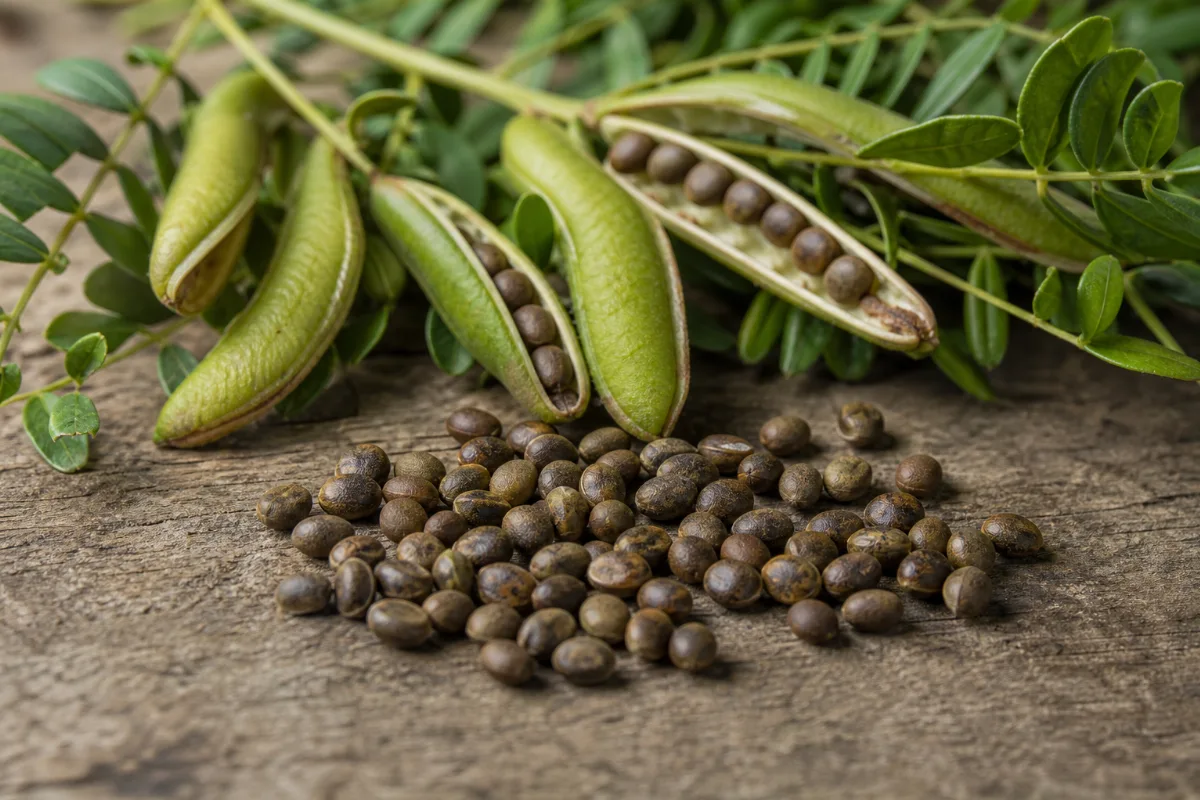
Herbs & Botanicals · Chinese eye and bowel seed
Cassia seed
Senna obtusifolia · also called Jue ming zi, Cassiae semen, sicklepod seed, coffee senna seed, sometimes sold as Cassia tora
Cassia seed, called jue ming zi in Chinese medicine, is the seed of a tropical plant used for tired eyes, "liver heat" and constipation. It contains laxative-type compounds like those in senna and rhubarb. Human research is thin: one eye-tea study and two small cholesterol trials, none strong. The key caution is that it can loosen the bowels, may harm the liver or kidneys in animals, and is not for pregnancy.
General information, not medical advice. Last substantive update · Not medically reviewed. A named clinician has not signed off on this page. How this page is made
About Cassia seed
Cassia seed is the seed of Senna obtusifolia, a tropical weed used in Chinese medicine as jue ming zi. It is used for eyes, constipation and "liver heat". Evidence in people is limited; safety concerns are real.
What it is
Cassia seed is the seed of Senna obtusifolia (also called Cassia obtusifolia or sicklepod), a pea-family plant. In Chinese medicine it is called jue ming zi, "brightens the eyes". The seed contains anthraquinones such as emodin and chrysophanol, the same family of compounds that make senna and rhubarb laxatives.
Some products sold as cassia seed are Senna tora (Cassia tora), a close relative that GBIF lists as a separate species.
Not cassia cinnamon, not Cassia fistula
Cassia cinnamon is the bark of a different tree, Cinnamomum cassia, a spice that contains coumarin, which can harm the liver of sensitive people. Cassia fistula, the golden shower tree, is another plant with laxative pods. Everything here is about the seed of Senna obtusifolia. Check the Latin name on the label.
What it is used for
Traditionally for sore or dry eyes, "liver heat", headache and constipation. We found no EMA, NCCIH or LactMed entry for the seed, and we did not read the Chinese Pharmacopoeia entry.
What the research shows
One 2024 study of seed tea reported eye benefits; its design is unclear. One 36-week trial of seed powder in overweight people with schizophrenia reported a smaller waist and lower cholesterol. A trial in healthy adults used a related species. Reviews of lab and animal work are the rest. Constipation, liver and blood pressure uses have no human trial.
Eyes
The eye-tea experiments reported more tears, lower eye pressure and better close-up vision after about four months of daily tea, compared with plain water plus vitamin C. The abstract does not give group sizes or numbers for most results. Anyone with high eye pressure should stay under an eye doctor.
At a glance
Traditional uses history, not proof
- Tired, dry or red eyes (Chinese medicine)
- "Liver heat", headache and dizziness
- Constipation
- High blood fats and blood pressure (traditional)
Studied for research
- Eye comfort and near vision: one small study, very low certainty
- Blood fats and waist size: one small trial, low certainty
- Cholesterol and antioxidant markers (Cassia tora, healthy adults): very low
- Constipation: traditional only, no trial
- Liver, blood pressure: traditional only
Main compounds
- Anthraquinones (emodin, chrysophanol, physcion, aurantio-obtusin)
- Naphthopyrones
- Polysaccharides
Common forms
- Roasted seed tea
- Raw or dried seed in Chinese medicine
- Seed powder (trial)
- Water and alcohol extracts (lab)
Research links: PubMed: Cassiae tea and presbyopia, dry eye and eye pressure (2024) · PubMed: Cassia seed powder in overweight patients with schizophrenia, 36-week trial (2022) · PubMed: Cassiae Semen comprehensive review (2023) · PubMed: Safety evaluation of Cassiae Semen (2017, Chinese) · EMA: senna leaf (different plant, for context) · Research Library · Genes & Biomarkers Library
The plant and its history
- Accepted scientific name
- Senna obtusifolia (L.) H.S.Irwin & Barneby
- Naming authority
- GBIF backbone: accepted species, exact match, confidence 99.
- Synonyms
- Name: Cassia obtusifolia L.; Note: Older name; still common in papers and trade (not verified synonym status in GBIF record read).; Name: Senna tora (L.) Roxb. / Cassia tora L.; Note: GBIF lists S. tora as a SEPARATE accepted species. Trade and papers often use "Cassia tora" for the same seed. Which species a product contains should be checked.
- Common names
- Cassia seed (English); Sicklepod seed; coffee senna (English); Jue ming zi (Cassiae semen) (Chinese (pinyin)); Semen cassiae (Latin)
- Botanical family
- Fabaceae (pea family).
- Classification
- Plantae > Fabales > Fabaceae > Senna > Senna obtusifolia
- Native range
- Not verified in a source read. Widely described as a tropical weed.
- Habitat
- Weed of pastures and crops (livestock papers describe heavy infestations).
- What the plant looks like
- Roots: Not verified.; Stems: Not verified.; Leaves: Aerial parts are toxic to cattle (Brazil study).; Flowers: Not verified.; Fruit: The seed is the medicinal part; pod details not verified.
- Cultivation
- Not verified.
- Harvest and processing
- Seed is used raw or roasted; roasted seed is the form in the eye-tea study.
- Look-alikes and adulterants
- Name: Cassia tora / Senna tora; Note: Close relative, separate accepted species in GBIF; used interchangeably in trade.; Name: Cassia cinnamon (Cinnamomum cassia); Note: A tree bark spice, unrelated; contains coumarin.; Name: Cassia fistula (golden shower); Note: Pod pulp laxative, a different plant.; Name: Senna (Senna alexandrina); Note: Leaf and pod laxative; see the Senna page.
- Sustainability and conservation
- Not verified; common weed.
Traditional use and history history, not clinical proof
| Tradition or era | Documented use | Source |
|---|---|---|
| Traditional Chinese medicine | Jue ming zi ("brightens the eyes"): eye complaints, "liver heat", headache, constipation. | p36702448 |
| Modern livestock science | Sicklepod is known as a poisonous weed for cattle and poultry. | p25255730 |
Traditional use shows how a plant was used. It does not show that a supplement works or is safe today.
What is inside, and how it may work
What the plant contains and how those compounds act in cells and animals. Laboratory and animal mechanisms are not proven effects in people.
Main compounds
| Compound | Family | Where it is concentrated | Activity studied | Level of evidence |
|---|---|---|---|---|
| Emodin PubChem 3220 | anthraquinone | Seed | Laxative-type anthraquinone; studied in the lab. 19 2 | Laboratory research |
| Chrysophanol PubChem 10208 | anthraquinone | Seed | Anthraquinone found in the seed; lab studies only. 19 2 | Laboratory research |
| Physcion PubChem 10639 | anthraquinone | Seed | Anthraquinone; lab studies only. 19 | Laboratory research |
| Aurantio-obtusin PubChem 155011 | anthraquinone | Seed | Reported to injure the liver in rats at high amounts. 19 11 | Animal research |
| Obtusin PubChem 155380 | anthraquinone | Seed | Seed anthraquinone; lab studies only. 19 | Laboratory research |
| Naphthopyrones (e.g. cassiaside) and polysaccharides | naphthopyrone; sugar polymers | Seed | The 2023 review calls for more research on these. 2 | Laboratory research |
Mechanisms, receptors and pathways
| Target or pathway | Gene or receptor | What was found | Level |
|---|---|---|---|
| Fat metabolism and gut bacteria | Not specified in sources read | Reviews describe lab and animal findings on fat metabolism and gut microbes. No human mechanism shown. 13 | Animal research |
| Cell skeleton (actin) in kidney cells | Actin | Seed water extract damaged rat kidney; proposed to work through actin disruption. 12 | Animal research |
| Antioxidant systems | SOD (blood marker) | Higher serum SOD reported in the eye-tea study and in the C. tora trial. Mechanism unproven. 3 5 | Human data |
Absorption, metabolism and elimination
- Absorption
- No human data; the 2023 review calls for pharmacokinetic work.
- Distribution
- Not established.
- Metabolism
- Not established.
- Elimination
- Not established.
- Bioavailability
- Unknown.
Isolated compounds versus whole extracts
Toxicity findings come from raw seed in feed, water extracts, ethanol extracts and the single compound aurantio-obtusin. Their results differ (for example the ethanol extract of C. tora showed no organ toxicity, while a water extract hurt rat kidneys). Do not assume tea behaves like any of them.
Nutritional composition
The seed is used as medicine or tea, not as a meaningful food source of nutrients.
1 low certainty2 very low certainty3 not enough evidence
What is Cassia seed good for?
The main proposed uses and how strong the human evidence is for each. 'Insufficient' means there are no human studies. Ratings are this profile's own reading, not formal grades.
Benefits, one by one
Each card is a research question, not a promise. Tap a goal to filter. Open a card to see the studies, doses and limits.
Eye comfort, eye pressure and near vision (seed tea)
Very low certaintyOne research group in Taiwan reported that people who drank cassia seed tea for months had more tears, lower eye pressure and better close-up vision. It is a single set of small experiments and has not been repeated.
2 studiesRoasted or dried seed brewed as tea in the study. This is a descripti…
Studies, doses and limits
What the trials found
A 2024 report of eight experiments in 425 people (aged about 52) over 6 months. Tea made from the roasted seed was compared with plain water plus vitamin C. By month four, tear volume was higher and eye pressure lower in people with dry eye or raised pressure, pupils were smaller and near vision was better. More tea was linked with better near vision. The abstract does not say how people were assigned, whether anyone was blinded, or give group sizes and exact numbers for most results.
Results
Increased tear volume, reduced eye pressure (in people with pressure over 30 mmHg to start), smaller pupils, better near vision, higher serum SOD. Exact values are not in the abstract.
Effect sizes as reported
Not available from the abstract.
Why this rating
One research group, one paper, unclear design and blinding, no numbers in the abstract, and no independent repeat.
Form and dose studied
Roasted or dried seed brewed as tea in the study. This is a description of the study, not advice on amounts.
Who was studied
Middle-aged adults, including people with dry eye and people with high eye pressure.
Limits
Raised eye pressure (glaucoma risk) needs an eye doctor. A tea has not been shown to replace treatment. Cassia seed also has laxative-type compounds, so loose stools are possible.
Why researchers looked
Cassia seed (jue ming zi, "brightens the eyes") is a classic Chinese eye herb.
Traditional use
Used in Chinese medicine for red, sore or dry eyes, often described as "liver heat" in the eyes. We did not read the Chinese Pharmacopoeia entry.
Proposed mechanism Preliminary mechanism
The authors credit antioxidant activity. They measured a blood antioxidant enzyme (SOD) and ran a test-tube antioxidant test. This is a proposed explanation, not proof.
A proposed mechanism does not show that the effect happens in people.
See the Safety tab: long-term use of anthraquinone-type laxative herbs is discouraged, and pregnancy and breastfeeding are unstudied.
Constipation (traditional laxative use)
Not enough evidenceCassia seed is used for constipation in Chinese medicine, and it contains anthraquinones, the same family of compounds that make senna and rhubarb work as laxatives. We found no controlled human trial of the seed for constipation.
3 studiesNot established.
Studies, doses and limits
What the trials found
No randomised trial of cassia seed for constipation was found. A 2023 review lists effects on the digestive system among its main findings but the abstract gives no human constipation data. The 2017 Chinese safety review lists diarrhoea and bloating among reported adverse reactions.
Results
No human results for constipation.
Effect sizes as reported
None (no human data).
Why this rating
Tradition and plausible chemistry only. No trial.
Form and dose studied
Not established.
Who was studied
Not studied.
Limits
If it works like senna, regular use could cause the problems listed for senna: dependence, salt and water loss and bowel-lining discolouration. These are cautions by analogy, not proven for this seed.
Why researchers looked
Traditional use plus the chemistry: emodin, chrysophanol and related compounds are laxative-type anthraquinones.
Traditional use
Listed in Chinese materia medica as moistening the bowel and easing constipation. Pharmacopoeia details not read.
Proposed mechanism Pharmacological theory
Anthraquinones of this type are known from senna to irritate the bowel lining and draw water into the gut. That is known for senna; it has not been shown for cassia seed tea in people.
A proposed mechanism does not show that the effect happens in people.
EMA advises that senna-type laxatives are for short-term use only. See Safety tab.
"Liver heat" and headaches (traditional Chinese use)
Not enough evidenceIn Chinese medicine cassia seed is said to clear "liver heat", which covers red eyes, headaches and dizziness. This is a traditional idea, not a measured human effect. Animal studies actually report liver injury at high amounts.
2 studiesNot applicable.
Studies, doses and limits
What the trials found
No human trial of cassia seed for any liver or headache complaint was found. Rat studies of the seed and of its compound aurantio-obtusin report liver injury, and the Chinese safety review lists liver and kidney damage as a main safety risk.
Results
No human benefit results.
Effect sizes as reported
None.
Why this rating
Tradition only; animal and report-level data point to harm, not benefit.
Form and dose studied
Not applicable.
Who was studied
Not studied.
Limits
Do not treat liver disease with it. Liver safety is a concern, not a benefit.
Why researchers looked
Traditional use.
Traditional use
Chinese medicine concept; no Western equivalent. Not verified against the Pharmacopoeia text.
Proposed mechanism Not shown
No mechanism for a human liver benefit has been shown.
A proposed mechanism does not show that the effect happens in people.
See Safety tab, liver section.
Blood fats and waist size (seed powder)
Low certaintyOne 36-week trial in overweight people with schizophrenia found a smaller waist and lower total and LDL cholesterol with seed powder than with a very low amount of the same powder. It is small and the authors call it preliminary.
3 studiesProcessed seed powder in the trial; the trial compared two amounts. T…
Studies, doses and limits
What the trials found
A double-blind randomised trial (2022) in 94 overweight or obese adults with schizophrenia (74 finished). The treatment group took 3.0 g of processed C. obtusifolia seed powder a day; the comparison group took only 0.3 g a day, not a placebo. Waist circumference fell in the treatment group at 24 and 36 weeks, and the group difference in the fall of total cholesterol and LDL at 36 weeks favoured seed powder. Two 2026 review abstracts describe mostly lab and animal research and limited clinical evidence.
Results
Waist circumference 98.35 cm to 95.05 cm at 36 weeks in the treatment group (p=0.002 vs baseline). Total cholesterol and LDL changed more than in the comparison group (p=0.033 and p=0.015).
Effect sizes as reported
Reported as group means and p-values; no confidence intervals in the abstract.
Why this rating
One small randomised trial in a special population, a low-dose comparison rather than placebo, one-fifth of people dropped out, and authors call it preliminary.
Form and dose studied
Processed seed powder in the trial; the trial compared two amounts. This is not advice on amounts.
Who was studied
Overweight or obese adults with schizophrenia, many on antipsychotic drugs.
Limits
Results may not apply to other people. Seed with laxative-type compounds could cause loose stools.
Why researchers looked
Chinese medicine uses cassia seed for high blood fats; its anthraquinones were tested for effects on fat and cholesterol.
Traditional use
Traditional use for high blood fats and "dampness"; not verified against the Pharmacopoeia.
Proposed mechanism Animal research
Reviews describe lab and animal findings on fat metabolism and gut bacteria. No mechanism is proven in people.
A proposed mechanism does not show that the effect happens in people.
See Safety tab. Talk to the prescriber before adding any herb to psychiatric medicine.
Cholesterol and antioxidant markers in healthy adults (Cassia tora)
Very low certaintyA crossover trial in healthy adults with a close relative, Cassia tora (Senna tora), reported higher HDL ("good") cholesterol, lower LDL and higher antioxidant enzymes versus placebo. The plant is not the same species as in the other studies.
1 studiesNot described in the abstract; not advice.
Studies, doses and limits
What the trials found
A randomised, double-blind, placebo-controlled crossover trial in 60 healthy normal-weight adults, two 24-week treatment phases. Supplement was well tolerated and safety markers did not change.
Results
Net effect over placebo: HDL cholesterol +0.83 (CI 0.57 to 1.09), LDL -1.08 (CI -1.63 to -0.54), plus rises in antioxidant enzymes. Units are in the paper and not in the abstract.
Effect sizes as reported
Reported as net effects with 95% intervals; units not stated in the abstract.
Why this rating
Different species (Cassia tora), small trial, abstract lacks units and product details, and healthy people do not show whether blood-fat changes help anyone.
Form and dose studied
Not described in the abstract; not advice.
Who was studied
Healthy adults aged 20-55.
Limits
Biomarker change is not the same as less heart disease. Abstract only.
Why researchers looked
Testing safety and benefit of C. tora in healthy people.
Traditional use
C. tora seed is used like S. obtusifolia in some traditions.
Proposed mechanism Preliminary mechanism
The authors link the antioxidant enzyme rise to the plant's antioxidant compounds. Not proven.
A proposed mechanism does not show that the effect happens in people.
Reported as well tolerated in this trial over 24-week phases.
Blood pressure and other reported uses
Not enough evidenceCassia seed is traditionally used for high blood pressure and is studied in the lab for many effects. We found no human blood pressure trial.
1 studiesNot applicable.
Studies, doses and limits
What the trials found
No human trial of cassia seed for blood pressure was found. The 2023 review reports effects on the cardiovascular system from lab work.
Results
No human results.
Effect sizes as reported
None.
Why this rating
Lab and tradition only.
Form and dose studied
Not applicable.
Who was studied
Not studied.
Limits
Anyone with high blood pressure should follow their doctor, not a seed tea.
Why researchers looked
Traditional use and lab pharmacology.
Traditional use
Chinese medicine lists it for high blood pressure and dizziness.
Proposed mechanism Animal research
Lab and animal work only.
A proposed mechanism does not show that the effect happens in people.
Diarrhoea-related potassium loss could affect heart rhythm; see Safety tab.
Connections to the rest of health
How Cassia seed connects to the rest of our health knowledge graph. Every link says what kind of connection it is. A safety link (for example to the liver) is a warning, not a benefit. A study that merely mentions a topic never creates a benefit link.
Explore every connection: goals, body systems, organs, symptoms, genes
A. Wellness goals
| Connected to | Kind of connection | Evidence status | Context | Studies |
|---|---|---|---|---|
| Healthy Vision | Traditional use | Very low certainty | Eye comfort, eye pressure and near vision (seed tea): One research group in Taiwan reported that people who drank cassia seed tea for months had more tears, lower eye pressure and better close-up vision. It is a single set of small experiments and has not been repeated. | 3 2 |
| Digestive Support | Traditional use | Not enough evidence | Constipation (traditional laxative use): Cassia seed is used for constipation in Chinese medicine, and it contains anthraquinones, the same family of compounds that make senna and rhubarb work as laxatives. We found no controlled human trial of the seed for constipation. | 2 15 16 |
| Gut Health | Traditional use | Not enough evidence | Constipation (traditional laxative use): Cassia seed is used for constipation in Chinese medicine, and it contains anthraquinones, the same family of compounds that make senna and rhubarb work as laxatives. We found no controlled human trial of the seed for constipation. | 2 15 16 |
| Liver Support | Traditional use | Not enough evidence | "Liver heat" and headaches (traditional Chinese use): In Chinese medicine cassia seed is said to clear "liver heat", which covers red eyes, headaches and dizziness. This is a traditional idea, not a measured human effect. Animal studies actually report liver injury at high amounts. | 15 11 |
| Cholesterol Balance | Potential benefit | Low certainty | Blood fats and waist size (seed powder): One 36-week trial in overweight people with schizophrenia found a smaller waist and lower total and LDL cholesterol with seed powder than with a very low amount of the same powder. It is small and the authors call it preliminary. Cholesterol and antioxidant markers in healthy adults (Cassia tora): A crossover trial in healthy adults with a close relative, Cassia tora (Senna tora), reported higher HDL ("good") cholesterol, lower LDL and higher antioxidant enzymes versus placebo. The plant is not the same species as in the other studies. | 7 13 8 5 |
| Weight Management | Potential benefit | Low certainty | Blood fats and waist size (seed powder): One 36-week trial in overweight people with schizophrenia found a smaller waist and lower total and LDL cholesterol with seed powder than with a very low amount of the same powder. It is small and the authors call it preliminary. | 7 13 8 |
| Healthy Aging | Potential benefit | Very low certainty | Cholesterol and antioxidant markers in healthy adults (Cassia tora): A crossover trial in healthy adults with a close relative, Cassia tora (Senna tora), reported higher HDL ("good") cholesterol, lower LDL and higher antioxidant enzymes versus placebo. The plant is not the same species as in the other studies. | 5 |
| Blood Pressure Support | Traditional use | Not enough evidence | Blood pressure and other reported uses: Cassia seed is traditionally used for high blood pressure and is studied in the lab for many effects. We found no human blood pressure trial. | 2 |
B. Body systems
| Connected to | Kind of connection | Evidence status | Context | Studies |
|---|---|---|---|---|
| Sensory System | Biological association | Very low certainty | Studied for: Eye comfort, eye pressure and near vision (seed tea) | 3 2 |
| Digestive System | Biological association | Not enough evidence | Studied for: Constipation (traditional laxative use) | 2 15 16 |
| Hepatic System | Biological association | Not enough evidence | Studied for: "Liver heat" and headaches (traditional Chinese use) | 15 11 |
| Metabolism Weight | Biological association | Low certainty | Studied for: Blood fats and waist size (seed powder) Studied for: Cholesterol and antioxidant markers in healthy adults (Cassia tora) | 7 13 8 5 |
| Cardiovascular System | Biological association | Low certainty | Studied for: Blood fats and waist size (seed powder) Studied for: Cholesterol and antioxidant markers in healthy adults (Cassia tora) | 7 13 8 5 2 |
C. Body parts and organs
| Connected to | Kind of connection | Evidence status | Context | Studies |
|---|---|---|---|---|
| Liver | Adverse effect or risk | Low certainty | Safety concern in animals and reports. Preparation or compound: Seed extract; aurantio-obtusin |
11 15 |
| Kidneys | Adverse effect or risk | Low certainty | Rat kidney injury. Preparation or compound: Water extract |
12 |
D. Symptoms
| Connected to | Kind of connection | Evidence status | Context | Studies |
|---|---|---|---|---|
| Constipation | Traditional use | Not enough evidence | Traditional only; laxative-type cautions apply. Preparation or compound: Seed |
2 |
I. Biomarkers
| Connected to | Kind of connection | Evidence status | Context | Studies |
|---|---|---|---|---|
| Tear volume | Biological association | Very low certainty | Measured in trials: raised. A lab change is not the same as a health benefit. | 3 |
| Eye pressure (intraocular pressure) | Biological association | Very low certainty | Measured in trials: lowered. A lab change is not the same as a health benefit. | 3 |
| LDL cholesterol ("bad" cholesterol) | Biological association | Low certainty | Measured in trials: lowered. A lab change is not the same as a health benefit. | 7 5 |
| Total cholesterol | Biological association | Low certainty | Measured in trials: lowered. A lab change is not the same as a health benefit. | 7 |
| HDL cholesterol ("good" cholesterol) | Biological association | Very low certainty | Measured in trials: raised. A lab change is not the same as a health benefit. | 5 |
| Waist circumference | Biological association | Low certainty | Measured in trials: lowered. A lab change is not the same as a health benefit. | 7 |
K. Biological pathways
| Connected to | Kind of connection | Evidence status | Context | Studies |
|---|---|---|---|---|
| Actin cytoskeleton | Preliminary mechanism | Animal | Proposed route of kidney injury by seed water extract in rats. | 12 |
L. Active compounds
| Connected to | Kind of connection | Evidence status | Context | Studies |
|---|---|---|---|---|
| Emodin | Biological association | In vitro | Laxative-type anthraquinone; studied in the lab. Preparation or compound: Seed |
19 2 |
| Chrysophanol | Biological association | In vitro | Anthraquinone found in the seed; lab studies only. Preparation or compound: Seed |
19 2 |
| Physcion | Biological association | In vitro | Anthraquinone; lab studies only. Preparation or compound: Seed |
19 |
| Aurantio-obtusin | Biological association | Animal | Reported to injure the liver in rats at high amounts. Preparation or compound: Seed |
19 11 |
| Obtusin | Biological association | In vitro | Seed anthraquinone; lab studies only. Preparation or compound: Seed |
19 |
| Naphthopyrones (e.g. cassiaside) and polysaccharides | Biological association | In vitro | The 2023 review calls for more research on these. Preparation or compound: Seed |
2 |
Each connection is stored with the ingredient, the connected record, the kind of connection, the evidence status, the supporting studies, the preparation or compound involved, and a review date (last reviewed October 25, 2026).
The evidence
The research centre for Cassia seed. Every record here was checked against PubMed or the publisher's page; we never list a study we have not verified.
Evidence by outcome
Bars show how many studies we found for each outcome, not how well it works. People are added up across trials only (reviews are not added, to avoid double counting).
How we rate evidence
High certainty
Several well-run trials or reviews agree; further research is unlikely to change the picture much.
Moderate certainty
Good trials point the same way, but some doubt remains.
Low certainty
Small, short or inconsistent trials. The finding could change with better research.
Very low certainty
Very little or very weak human data. Treat as a possibility only.
Mixed findings
Trials or reviews disagree with each other.
Not enough evidence
Not enough human research to say either way.
Evidence against
Good research found no benefit, or found harm.
We take the reviewers' own risk-of-bias and GRADE statements where they exist, and otherwise judge from study size, design, consistency, directness and whether a product matches what is sold. Many publications do not make evidence high. Method note: We started from our existing cassia seed summary, re-read PubMed abstracts for the main studies, checked the GBIF accepted names and PubChem compounds, and read the EMA senna leaf page for context. Several papers were not re-opened and are marked summary-only. Certainty ratings are the compiler's reading. No study is cited that we could not verify.
Study library: every study we checked 20
| Study | Design | People | Product, dose, length | Result |
|---|---|---|---|---|
| Abraham 2010 Toxicology and risk assessment of coumarin: focus on human data Mol Nutr Food Res · PMID 20024932 · DOI |
Toxicology review n/a |
Review of coumarin toxicity (BfR, Germany) | Methods, limits and fundingFunding and conflicts: Government risk-assessment institute authors. Read: abstract | |
| Chen 2023 Cassiae Semen: a comprehensive review of botany, traditional use, phytochemistry, pharmacology, toxicity, and quality control J Ethnopharmacol · PMID 36702448 · DOI |
Narrative review n/a |
Review | Methods, limits and fundingFunding and conflicts: No competing interests declared. Read: abstract | |
| Fan 2024 Improvement of Presbyopia, Dry Eye, Intraocular Pressure, and Near Vision Through Cassiae Tea Consumption Medicina (Kaunas) · PMID 39859017 · DOI |
Uncontrolled or weakly controlled human study (several small experiments) |
425 eyes from 425 people, average age 52.5; several experiments over 6 months | Methods, limits and fundingFunding and conflicts: No conflicts declared. Read: abstract | |
| Furlan 2014 Toxic myopathy and acute hepatic necrosis in cattle caused by ingestion of Senna obtusifolia (sicklepod; coffee senna) in Brazil Toxicon · PMID 25255730 · DOI |
Animal (field outbreak and feeding test) animal |
Cattle; field outbreaks (death rate 100% among sick animals) plus 6 cattle fed the aerial parts | Methods, limits and fundingFunding and conflicts: Not stated in the abstract. Read: abstract | |
| Kambalachenu 2018 A Randomized, Double Blind, Placebo Controlled, Crossover Study to Assess the Safety and Beneficial Effects of Cassia Tora Supplementation in Healthy Adults Rev Recent Clin Trials · PMID 29165093 · DOI |
Rct (crossover) |
60 healthy normal-weight adults aged 20-55 | Methods, limits and fundingFunding and conflicts: Not stated in the abstract. Read: abstract | |
| Lee 2019 Subchronic toxicity evaluation of ethanol extract of Cassia tora L. seeds in rats Regul Toxicol Pharmacol · PMID 31585136 · DOI |
Animal research animal |
Rats, 10 per sex per group, 13 weeks, plus a 4-week recovery group | Methods, limits and fundingFunding and conflicts: Korean government-institute authors; funding not stated in the abstract. Read: abstract | |
| Lee 2022 Oral administration of processed Cassia obtusifolia L. seed powder may reduce body weight and cholesterol in overweight patients with schizophrenia: a 36-week randomized, double-blind, controlled trial of high and low doses J Ethnopharmacol · PMID 35304275 · DOI |
Controlled trial |
94 overweight or obese adults with schizophrenia (74 finished) | Methods, limits and fundingFunding and conflicts: Not stated in the abstract. Read: abstract | |
| Not recorded in our summary 2026 Hyperlipidemia intervention from medicine-food homologous plants Biology (Basel) · PMID 42510689 |
Narrative review n/a |
Review of food-medicine plants | Methods, limits and fundingFunding and conflicts: Not stated. Read: summary-only | |
| Page 1977 Effects on feed consumption and egg production of coffee bean seed (Cassia obtusifolia) fed to White Leghorn hens Avian Dis · PMID 843306 |
Animal research animal |
Laying hens fed ground seed at 2%, 5% and 10% of feed | Methods, limits and fundingFunding and conflicts: Not stated. Read: abstract | |
| Voss 1991 Toxicological and hematological effects of sicklepod (Cassia obtusifolia) seeds in Sprague-Dawley rats: a subchronic feeding study Toxicon · PMID 1814008 · DOI |
Animal research animal |
Rats, 10 per sex per group, 13 weeks, seed mixed into feed | Methods, limits and fundingFunding and conflicts: Government (USDA) researchers. Read: abstract | |
| Xu et al. 2020 Urine metabolomics study on potential hepatotoxic biomarkers identification in rats induced by aurantio-obtusin Frontiers in Pharmacology · Source · DOI |
Animal research animal |
Methods, limits and fundingRead: summary-only | ||
| Yang et al. 2024 Actin Dysregulation Mediates Nephrotoxicity of Cassiae Semen Aqueous Extracts Toxics · Source |
Animal research animal |
Methods, limits and fundingRead: summary-only | ||
| Ye 2026 The anti-obesity potential of Cassiae Semen J Ethnopharmacol · PMID 41791619 · DOI |
Narrative review n/a |
Review | Methods, limits and fundingFunding and conflicts: Not stated. Read: summary-only | |
| Yuan 2026 Safety of medicinal and edible herbs from seed sources for human consumption: a systematic review Integr Med Res · PMID 41322721 · DOI |
Systematic review n/a |
Medicinal and edible seeds | Methods, limits and fundingFunding and conflicts: Not stated. Read: summary-only | |
| Zhao 2017 [Safety evaluation and risk control measures of Cassiae Semen] (Chinese) Zhongguo Zhong Yao Za Zhi · PMID 29271142 · DOI |
Narrative review (safety) n/a |
Review of Chinese and foreign literature and adverse-reaction reports | Methods, limits and fundingFunding and conflicts: No conflicts declared. Read: abstract | |
| s-ema-senna-leaf EMA: Sennae folium (senna leaf), herbal medicine summary of HMPC conclusions · Source |
Regulator guidance n/a |
Methods, limits and fundingRead: page-summary | ||
| s-gbif-obtusifolia GBIF backbone: Senna obtusifolia (L.) H.S.Irwin & Barneby · Source |
Database record n/a |
Methods, limits and fundingRead: full-record | ||
| s-gbif-tora GBIF backbone: Senna tora (L.) Roxb. · Source |
Database record n/a |
Methods, limits and fundingRead: full-record | ||
| s-pubchem-anthraquinones PubChem compound records: emodin 3220, chrysophanol 10208, physcion 10639, aurantio-obtusin 155011, obtusin 155380 · Source |
Database record n/a |
Methods, limits and fundingRead: full-record | ||
| s-regulators-none Regulator and database search for cassia seed (EMA/HMPC, NCCIH, LactMed, LiverTox) · Source |
Negative search n/a |
Methods, limits and fundingRead: searched |
What we do not know yet
- No independent repeat of the eye-tea study.
- No human trial for constipation, liver or blood pressure.
- No interaction, pregnancy, breastfeeding or long-term safety study.
- No EMA, NCCIH or LactMed entry; LiverTox and Pharmacopoeia not read.
- Species used (S. obtusifolia vs S. tora) often unclear.
How new research is added
New studies are found by a saved PubMed search and placed into the data files, then this page is rebuilt.
Lab markers
What changed in blood or saliva tests during trials. A changed number is not the same as feeling or being healthier, and we give no "normal ranges".
Metabolic 3
LDL cholesterol ("bad" cholesterol)
Lowered in trials
Cholesterol carried in LDL particles; high levels raise heart disease risk over time.
Low certaintyResults and what it means
Why it was measured
A standard blood-fat target.
Statistical vs. clinical meaning
Both are small trials; a lab change is not proof of fewer heart events.
Safety implication
None specific.
| Study | Result | People | Product |
|---|---|---|---|
| 7 | Fall from baseline to week 36 greater than comparison group (84.40 vs 102.08 mg/dL, p=0.015, as reported) | 94 overweight adults with schizophrenia | Processed C. obtusifolia seed powder vs low amount of the same powder, 36 weeks |
| 5 | Net -1.08 vs placebo (95% CI -1.63 to -0.54; units not in abstract) | 60 healthy adults | Cassia tora supplement, 24 weeks crossover |
Total cholesterol
Lowered in trials
All cholesterol in the blood.
Low certaintyResults and what it means
HDL cholesterol ("good" cholesterol)
Raised in trials
Cholesterol carried in HDL particles.
Very low certaintyOther 3
Tear volume
Raised in trials
How many tears the eye makes, a measure of dry eye.
Very low certaintyResults and what it means
Why it was measured
Low tear volume goes with dry, gritty eyes.
Statistical vs. clinical meaning
A change in a test measure; the abstract gives no size, so we cannot judge whether it matters to symptoms.
Safety implication
None known.
| Study | Result | People | Product |
|---|---|---|---|
| 3 | Increased by the fourth month (no numbers in the abstract) | People with severe dry eye in a 425-person set of experiments | Cassiae tea (roasted seed) for months |
Eye pressure (intraocular pressure)
Lowered in trials
The fluid pressure inside the eye. High pressure can damage the optic nerve (glaucoma).
Very low certaintyResults and what it means
Why it was measured
Raised pressure is the main treatable risk factor for glaucoma.
Statistical vs. clinical meaning
Cannot be judged without numbers. Anyone with high eye pressure needs eye-doctor care, not tea alone.
Safety implication
Do not stop prescribed eye drops.
| Study | Result | People | Product |
|---|---|---|---|
| 3 | Reduced by the fourth month (no numbers in the abstract) | People starting with eye pressure above 30 mmHg | Cassiae tea (roasted seed) |
Waist circumference
Lowered in trials
Distance around the waist; a rough guide to belly fat.
Low certaintyResults and what it means
Why it was measured
Belly fat is linked to metabolic risk.
Statistical vs. clinical meaning
Small change; comparison group also fell at the last visit.
Safety implication
None.
| Study | Result | People | Product |
|---|---|---|---|
| 7 | 98.35 to 95.05 cm at 36 weeks in treatment group (p=0.002 vs baseline) | 94 overweight adults with schizophrenia (74 finished) | Processed seed powder, 36 weeks |
Safety
What studies and official sources say about side effects, medicines and who should check first. Each point shows what kind of evidence it comes from.
Main points to know 4
- It contains laxative-type anthraquinones: loose stools, cramps and diarrhoea are expected risks. Cassia seed carries emodin, chrysophanol and related anthraquinones, the compound family behind senna and rhubarb. Diarrhoea and bloating are listed among reported adverse reactions. For senna, the EU regulator limits use to the short term because long use can cause dependence, loss of water and salts, and discolouration of the bowel lining. No such limit exists for cassia seed, so treat the senna advice as a caution by analogy. Authoritative guidance 16 15 10
- Do not use in pregnancy or while breastfeeding unless a clinician agrees. No pregnancy or breastfeeding statement for cassia seed was found. EMA says senna leaf must not be used in pregnancy or breastfeeding. A Chinese safety review lists vaginal bleeding among reported reproductive-system problems. Authoritative guidance 16 15 20
- Possible liver and kidney harm at high or prolonged intake. Rat studies of the seed extract and of its compound aurantio-obtusin report liver injury, and a water extract caused kidney injury in rats. A Chinese review lists liver and kidney damage as the main safety risks. Human risk from ordinary tea is unknown. Animal research 11 12 15
- Name confusion: cassia seed is not cassia cinnamon, and not Cassia fistula. Cassia seed (jue ming zi) is a seed of Senna obtusifolia. "Cassia cinnamon" is the bark of Cinnamomum cassia, a spice that contains coumarin, which can harm the liver in sensitive people. Cassia fistula (golden shower tree) is another plant again, used as a pod laxative. Check the Latin name on any label. Authoritative guidance 1 17
Side effects 5
| Effect | How often | Severity and recovery | Evidence |
|---|---|---|---|
| Diarrhoea, abdominal bloating, nausea, loose stools From a Chinese-language review of adverse reactions; no frequency given in the abstract. Mild diarrhoea also occurred in rats at the highest seed level. | Not established | mild to moderate Expected to settle after stopping (not studied) | Case series 15 |
| Allergic reactions: numb mouth, itchy skin, wheeze, lip blueness Listed in the review; no counts in the abstract. Stop and seek help for breathing trouble or lip swelling. | Not established | can be serious Not stated | Case series 15 |
| Fatigue, loss of appetite, dark urine and pale stools (liver/kidney type signs) Clinical features listed under liver and kidney damage in the same review. | Not established | potentially serious Not stated | Case series 15 |
| Vaginal bleeding Listed as a reproductive-system adverse reaction. No details in the abstract. | Not established | not stated Not stated | Case series 15 |
| Water and salt imbalance and bowel-lining discolouration with long use (senna-type) From the EMA senna leaf page. Not shown for cassia seed. | Not established | moderate Discolouration usually reversible (for senna) | Authoritative guidance 16 |
Liver
No LiverTox entry for cassia seed was found (the senna LiverTox page could not be read). Rat studies report liver injury from the seed extract and from aurantio-obtusin; a Chinese review names liver and kidney damage as a main risk and describes tiredness, loss of appetite, dark urine and pale stools. A 2019 Korean rat study of an ethanol extract of C. tora seed found no liver or other organ effects up to the highest level tested, so results differ by species and extract. Cattle fed S. obtusifolia plants showed liver necrosis in some animals. 11 15 6 4 20
How often. No frequency is available.
Monitoring. No agency monitoring advice was found. Anyone on this herb who gets yellow eyes, dark urine or severe tiredness should stop and see a doctor.
This is a safety connection. It is not evidence that Cassia seed supports liver health.
Medicines and supplements 3
| With | Why it matters | Importance | Evidence | What to do |
|---|---|---|---|---|
| Diuretics ("water pills") and corticosteroids prescription | Laxative-type herbs can lower potassium through diarrhoea; so can these drugs. EMA says patients on certain medicines should talk to a doctor before senna leaf; the page did not name the drugs. | Unknown for cassia seed; potassium loss is the known concern for senna-type laxatives. | Pharmacological theory Not enough evidence 16 | If you take a water pill or steroid, ask a pharmacist before using it. |
| Heart glycosides (digoxin) prescription | Low potassium makes digoxin more likely to cause rhythm problems. Diarrhoea from a laxative herb can lower potassium. | Not studied for cassia seed. Known pharmacology of senna-type laxatives. | Pharmacological theory Not enough evidence 16 | Do not combine without medical advice. |
| Other laxatives (senna, rhubarb, cascara, aloe latex) and any oral medicine taken at the same time herb | Stacking laxatives increases loose stools; fast gut transit can reduce absorption of other medicines. | Not studied. | Pharmacological theory Not enough evidence 16 | Avoid stacking laxative herbs. Ask a pharmacist about timing of other medicines. |
Who should check first 5
| Situation | Advice | Evidence |
|---|---|---|
| Pregnancy and breastfeeding | Avoid unless a clinician agrees. Unstudied; EMA advises against senna leaf. | Authoritative guidance 16 20 |
| Bowel blockage, inflammatory bowel disease, unexplained abdominal pain, severe dehydration, appendicitis | Avoid. These are EMA exclusions for senna-type laxatives; assumed to apply by analogy. | Authoritative guidance 16 |
| Children (EMA: senna not under 12) | Avoid. The seed-safety review also notes reports often involve children. | Authoritative guidance 16 14 |
| Liver or kidney disease | Avoid or ask a doctor first, because animal and report-level data point to liver and kidney harm. | Animal research 11 12 15 |
| Diarrhoea or loose stools | Avoid; it can worsen them. | Case series 15 10 |
Overdose, product quality and regulators
Summary. Raw seed is toxic to livestock and to rats at high feed levels, mostly attributed to anthraquinones. Human tea toxicity is not established.
Animal. Rats fed seed for 13 weeks had mild diarrhoea and blood-cell changes from the 0.50% level; no safe level was found below 0.15%. Hens fed 2 to 10% seed laid fewer eggs and had pale, swollen muscle; recovery was incomplete after 4 weeks. Cattle fed the aerial parts of S. obtusifolia developed muscle damage, and some had liver necrosis; field outbreaks had a 100% death rate among sick animals. By contrast an ethanol extract of C. tora seed showed no adverse effects in a 13-week rat study.
Human doses studied. Trials of the seed powder (36 weeks) and of Cassia tora (two 24-week phases) did not report serious problems in their abstracts; the abstracts do not give full adverse-event data.
High dose or long term signals. Liver and kidney injury in rats; blood-cell changes; muscle toxicity in livestock.
Overdose response. Not described for people.
Genotoxicity. Not found in sources read.
Toxic plant parts. Seed and aerial parts are toxic to cattle and poultry; the plant is a livestock-poisoning weed ("sicklepod", "coffee senna").
Seed sold as cassia seed may be Senna obtusifolia or Senna tora, and could be mixed with other seeds; purity and anthraquinone content vary. A US feed-grain contamination case with Cassia seeds was reported in the literature, but we did not read it.
Species mix-up. GBIF lists S. obtusifolia and S. tora as separate accepted species, but papers and trade often use "Cassia tora" and "Cassia obtusifolia" interchangeably. 17 18
Cassia cinnamon (Cinnamomum cassia). A different plant; its bark contains coumarin, hepatotoxic in sensitive people; tolerable daily intake 0.1 mg per kg body weight (BfR/EFSA). Heavy users of cassia cinnamon can approach that limit. 1
| Body | Action | Date |
|---|---|---|
| EMA/HMPC (senna leaf, different plant) (EU) | Short-term use only; not in pregnancy, breastfeeding or under age 12; avoid with bowel blockage, IBD or unexplained abdominal pain. Context only for cassia seed. source | 2026-10-25 |
When to get medical help
- Yellow skin or eyes, very dark urine, pale stools, severe tiredness or loss of appetite: stop and see a doctor.
- Severe or bloody diarrhoea, dehydration, dizziness, a fast or uneven heartbeat or muscle weakness (possible potassium loss).
- Wheeze, lip or face swelling, or a numb mouth after taking it.
- Vaginal bleeding, or any use in pregnancy: contact a clinician.
Stop the supplement and contact a clinician or emergency service. In the US, Poison Control is 1-800-222-1222.
General information only, not medical advice. Ask a clinician or pharmacist before use, especially with medicines, in pregnancy or with a health condition. See the Natural Remedy Safety guide.
Frequently asked questions
What is cassia seed?
Does cassia seed tea help the eyes?
One 2024 study of 425 people reported better tear volume, eye pressure and near vision. Its design is unclear and it has not been repeated, so certainty is very low.
Is it a laxative?
Can it lower cholesterol or help weight loss?
Can it harm the liver or kidneys?
Is it safe in pregnancy or breastfeeding?
Can it be used long term?
Long use is not studied. For senna the EU regulator limits use to the short term because of dependence, salt and water loss and bowel-lining discolouration. The same cautions are likely to apply to cassia seed but have not been shown.
Does it interact with medicines?
No interaction study exists. By analogy to laxative herbs, diarrhoea can lower potassium, which matters with water pills, steroids and digoxin. Ask a pharmacist.
Is cassia seed the same as cassia cinnamon?
No. Cassia cinnamon is bark from Cinnamomum cassia and contains coumarin, which can harm the liver of sensitive people. Cassia seed is a different plant. Cassia fistula is another different plant.
Does it harm fertility or unborn babies?
Is the plant poisonous to animals?
How much should I take?
This page does not give amounts, because the evidence is too weak to set them. Ask a doctor or pharmacist, especially if you take medicines or have liver, kidney or bowel disease.
Explore by health goal
Cholesterol BalanceHealthy VisionDigestive SupportGut HealthLiver SupportWeight ManagementHealthy AgingBlood Pressure Support
Editorial transparency
- Written by
- AlternativeMed editorial team. Research compiled with AI assistance, then checked against PubMed records and plant and chemical databases.
- Medical review
- None. This page has not been reviewed by a physician or pharmacist.
- First published
- 2026-10-25
- Last substantive update
- 2026-10-25
- How we research
- We started from our existing cassia seed summary, re-read PubMed abstracts for the main studies, checked the GBIF accepted names and PubChem compounds, and read the EMA senna leaf page for context. Several papers were not re-opened and are marked summary-only. Certainty ratings are the compiler's reading. No study is cited that we could not verify.
- How we rate evidence
- See "How we rate evidence" in the Evidence tab.
- Independence
- No product is promoted on this page. No affiliate links are shown.
Sources 20
Each source was opened and checked. Where we read only the abstract, it says so. The small numbers in the text point here.
- Abraham K, Wohrlin F, Lindtner O, et al.. Toxicology and risk assessment of coumarin: focus on human data. Mol Nutr Food Res. 2010. PMID 20024932. DOI 10.1002/mnfr.200900281. (abstract)
- Chen Y, Chen X, Yang X, et al.. Cassiae Semen: a comprehensive review of botany, traditional use, phytochemistry, pharmacology, toxicity, and quality control. J Ethnopharmacol. 2023. PMID 36702448. DOI 10.1016/j.jep.2023.116199. (abstract)
- Fan M, Hung JL, Hung SH, et al.. Improvement of Presbyopia, Dry Eye, Intraocular Pressure, and Near Vision Through Cassiae Tea Consumption. Medicina (Kaunas). 2024. PMID 39859017. DOI 10.3390/medicina61010035. (abstract)
- Furlan FH, Zanata C, Damasceno ES, et al.. Toxic myopathy and acute hepatic necrosis in cattle caused by ingestion of Senna obtusifolia (sicklepod; coffee senna) in Brazil. Toxicon. 2014. PMID 25255730. DOI 10.1016/j.toxicon.2014.09.007. (abstract)
- Kambalachenu HR, Reddy TM, Rao SD, et al.. A Randomized, Double Blind, Placebo Controlled, Crossover Study to Assess the Safety and Beneficial Effects of Cassia Tora Supplementation in Healthy Adults. Rev Recent Clin Trials. 2018. PMID 29165093. DOI 10.2174/1574887112666171120094539. (abstract)
- Lee MJ, Nho JH, Yang BD, et al.. Subchronic toxicity evaluation of ethanol extract of Cassia tora L. seeds in rats. Regul Toxicol Pharmacol. 2019. PMID 31585136. DOI 10.1016/j.yrtph.2019.104487. (abstract)
- Lee JY, Liao WL, Liu YH, et al.. Oral administration of processed Cassia obtusifolia L. seed powder may reduce body weight and cholesterol in overweight patients with schizophrenia: a 36-week randomized, double-blind, controlled trial of high and low doses. J Ethnopharmacol. 2022. PMID 35304275. DOI 10.1016/j.jep.2022.115111. (abstract)
- Not recorded in our summary. Hyperlipidemia intervention from medicine-food homologous plants. Biology (Basel). 2026. PMID 42510689. (summary-only)
- Page RK, Vezey S, Charles OW, et al.. Effects on feed consumption and egg production of coffee bean seed (Cassia obtusifolia) fed to White Leghorn hens. Avian Dis. 1977. PMID 843306. (abstract)
- Voss KA, Brennecke LH. Toxicological and hematological effects of sicklepod (Cassia obtusifolia) seeds in Sprague-Dawley rats: a subchronic feeding study. Toxicon. 1991. PMID 1814008. DOI 10.1016/0041-0101(91)90119-c. (abstract)
- Xu et al.. Urine metabolomics study on potential hepatotoxic biomarkers identification in rats induced by aurantio-obtusin. Frontiers in Pharmacology. 2020. DOI 10.3389/fphar.2020.01237. (summary-only)
- Yang et al.. Actin Dysregulation Mediates Nephrotoxicity of Cassiae Semen Aqueous Extracts. Toxics. 2024. (summary-only)
- Ye Y. The anti-obesity potential of Cassiae Semen. J Ethnopharmacol. 2026. PMID 41791619. DOI 10.1016/j.jep.2026.121426. (summary-only)
- Yuan L, Shu B, Zhou J, et al.. Safety of medicinal and edible herbs from seed sources for human consumption: a systematic review. Integr Med Res. 2026. PMID 41322721. DOI 10.1016/j.imr.2025.101263. (summary-only)
- Zhao YM, Wu L, Zhang S, et al.. [Safety evaluation and risk control measures of Cassiae Semen] (Chinese). Zhongguo Zhong Yao Za Zhi. 2017. PMID 29271142. DOI 10.19540/j.cnki.cjcmm.20170919.013. (abstract)
- . EMA: Sennae folium (senna leaf), herbal medicine summary of HMPC conclusions. . . (page-summary)
- . GBIF backbone: Senna obtusifolia (L.) H.S.Irwin & Barneby. . . (full-record)
- . GBIF backbone: Senna tora (L.) Roxb.. . . (full-record)
- . PubChem compound records: emodin 3220, chrysophanol 10208, physcion 10639, aurantio-obtusin 155011, obtusin 155380. . . (full-record)
- . Regulator and database search for cassia seed (EMA/HMPC, NCCIH, LactMed, LiverTox). . . (searched)