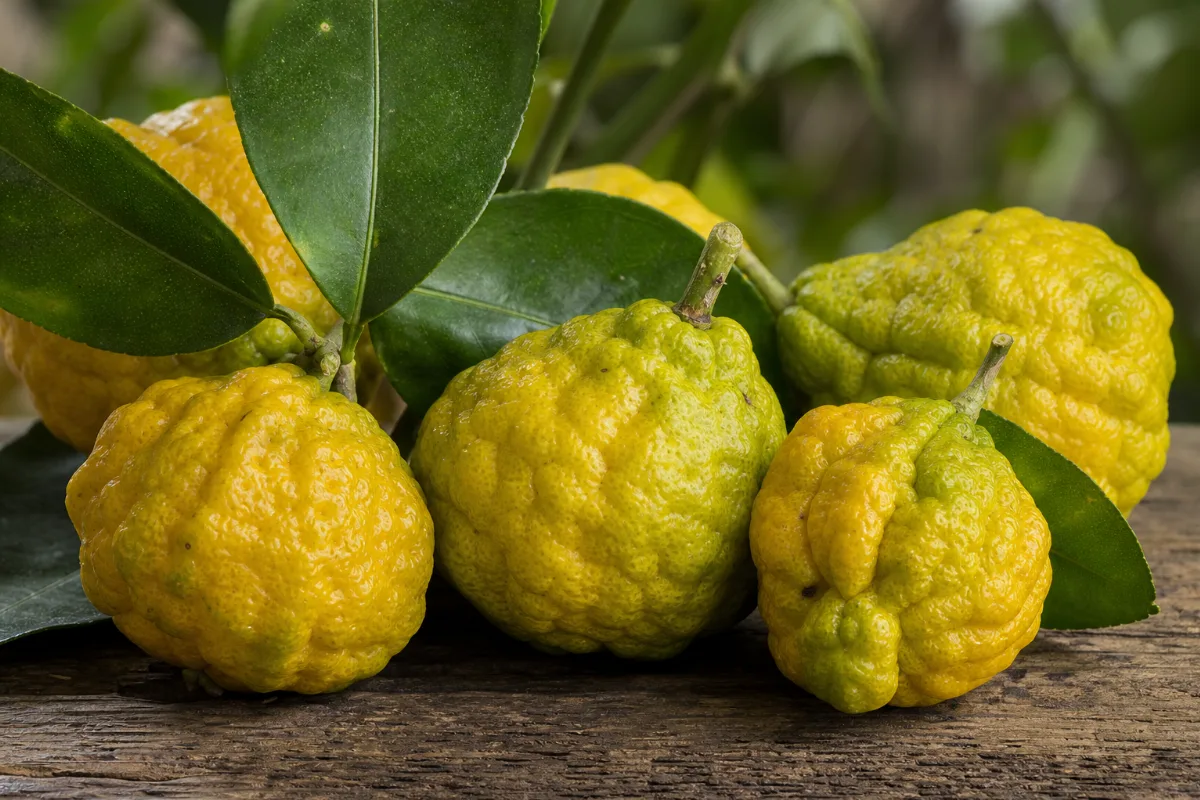
Herbs & Botanicals · Citrus fruit for cholesterol and aroma
Bergamot
Citrus bergamia (family Rutaceae) · also called Bergamot orange, bergamot polyphenolic fraction (BPF), bergamot oil
Bergamot is a citrus fruit from southern Italy. Its juice and peel extract (rich in flavonoids) has been tested for cholesterol and metabolic health, and its peel oil is used in perfume, Earl Grey tea and aromatherapy. Trials often show lower LDL cholesterol, but they were mostly poor quality, so confidence is low. The peel oil can cause burns on skin in sunlight, and the possible mix with statins is not settled, so check with a doctor or pharmacist.
General information, not medical advice. Last substantive update · Not medically reviewed. A named clinician has not signed off on this page. How this page is made
About Bergamot
Bergamot is a citrus fruit grown mostly in Calabria, Italy. Two different products carry its name in research. The fruit juice and polyphenol extract is tested in capsules for cholesterol and metabolic health; the peel essential oil is used in perfume, aromatherapy and Earl Grey tea. The extract shows lower cholesterol in many small trials, but certainty is low to very low. The oil can burn skin in sunlight. Neither is the herb bergamot (bee balm, Monarda).
What it is
Bergamot (Citrus bergamia) is a citrus fruit thought to be a cross between bitter orange and lemon or lime. Its peel gives the essential oil that flavours Earl Grey tea. Its juice and peel hold flavonoids such as naringin and neohesperidin. Brutieridin and melitidin are two unusual ones.
Keep three things apart. First, the fruit extract (often called BPF, bergamot polyphenolic fraction) used in cholesterol trials. Second, the peel oil used in aromatherapy and perfume. Third, bergamot herb (Monarda, bee balm), a different plant. Earl Grey tea only carries the oil as a flavour.
The plant database GBIF treats Citrus bergamia as a synonym of Citrus x limon, but papers and suppliers use the name Citrus bergamia.
How it may work
In test-tube studies, two bergamot flavonoids look a bit like part of a statin and can bind the cholesterol-making enzyme. Cell studies report less cholesterol made. These are lab results. How much of these compounds the body absorbs is poorly known, and a lecithin form raised the absorption of naringin about 2.5-fold in one trial.
The oil works differently. Its sun-sensitising furanocoumarins, mainly bergapten, react with UVA light in skin.
What the human trials found
Extract and cholesterol: pooled results from 9 trials show lower LDL, total cholesterol and triglycerides. Reviewers rated the certainty low to very low, with six trials of poor quality, and said it should not be treated as proof the extract works. A 2026 trial of 108 East Asian adults found about 7% lower LDL; an extract-maker employee is among the authors. An earlier systematic review of 12 human studies pointed the same way and noted heterogeneous designs and limited quality.
Other uses: a pooled analysis found lower weight, BMI and waist but with very high variation. Fatty-liver and artichoke trials used two-herb products. Several trials were linked to extract makers, and none looked at heart attacks or strokes.
Inhaled oil: small open-label trials in students and in a treatment programme found less stress and anxiety. They are short and self-rated, and they cannot be applied to the extract.
At a glance
Traditional uses history, not proof
- Italian folk medicine for fever, wounds and infections (as summarised in a 2026 review)
- Peel oil in perfume, cosmetics and as the flavour of Earl Grey tea
- No traditional use of the fruit extract for cholesterol was found
Studied for research
- Cholesterol (LDL, total, triglycerides) with fruit extract: very low certainty (many small, mostly poor trials)
- Add-on to a statin: very low (one small open-label trial)
- Blood sugar and insulin resistance: very low
- Weight, BMI and waist: very low (very mixed results)
- Fatty liver (two-herb product): low
- Inhaled oil for stress, sleep and exam anxiety: low to very low (small open-label trials)
- Blood pressure: very low (about 2 mmHg)
- Heart attacks and strokes: not studied
Main compounds
- Naringin, PubChem CID 442428 (main flavonoid of the polyphenol fraction)
- Neohesperidin, CID 442439
- Brutieridin, CID 45279710 and melitidin, CID 101485562 (statin-like in the lab)
- Limonene, CID 22311; linalyl acetate, CID 8294; linalool, CID 6549 (peel oil)
- Bergapten, CID 2355 (sun-sensitising) and bergamottin, CID 5471349 (peel oil)
Common forms
- Fruit juice or polyphenol extract (BPF), in capsules or tablets
- Combination tablets (for example with artichoke)
- Cold-pressed peel oil (contains sun-sensitising compounds)
- Furanocoumarin-free peel oil
- Earl Grey tea (flavouring only; not the studied extract)
Research links: Chambari 2026: bergamot and cardiovascular risk factors, meta-analysis (PubMed) · Yu 2026: extract in East Asian adults, placebo-controlled trial (PubMed) · Pujia 2026: weight, BMI and waist, meta-analysis (PubMed) · Lamiquiz-Moneo 2020: bergamot and lipids, systematic review (PubMed) · Carpenito 2025: bergamot beyond lipid lowering (PubMed) · Gliozzi 2013: BPF with rosuvastatin (PubMed) · Krzykwa 2026: dermal safety of botanicals, bergamot oil (PubMed) · Finsterer 2002: Earl Grey tea intoxication (PubMed record) · Research Library · Genes & Biomarkers Library
The plant and its history
- Accepted scientific name
- Citrus bergamia Risso & Poit. (used in research and trade); GBIF treats it as a synonym of Citrus x limon (L.) Osbeck
- Naming authority
- GBIF: Citrus x bergamia (Risso) Risso & Poit. is a SYNONYM of Citrus x limon (L.) Osbeck (accepted key 7647136; synonym key 6433772; exact match, confidence 99-100). NCBI Taxonomy lists Citrus bergamia as a species (taxid 380129).
- Synonyms
- Citrus x bergamia; Citrus aurantium var. bergamia (older name)
- Common names
- Bergamot (English); Bergamot orange (English)
- Botanical family
- Rutaceae (citrus family)
- Classification
- Plantae > Tracheophyta > Magnoliopsida > Sapindales > Rutaceae > Citrus > Citrus bergamia
- Native range
- A review describes it as a hybrid of bitter orange with lemon or lime, cultivated in Italy, Africa, the Americas and China. A 2026 meta-analysis says it is a citrus fruit native to Calabria in southern Italy (author statement; not independently checked).
- Habitat
- Not described in the sources read.
- What the plant looks like
- Roots: Not described in sources read.; Stems: Not described in sources read.; Leaves: Not described in sources read.; Flowers: Not described in sources read.; Fruit: A citrus fruit. The peel holds the essential oil; the juice and the albedo/peel are the sources of the polyphenol extracts.
- Cultivation
- Grown commercially for its peel oil, used in perfume, cosmetics and to flavour Earl Grey tea (Pharm Biol review).
- Harvest and processing
- Cold pressing of the peel makes an oil that contains furanocoumarins; steam distillation or further processing removes them. Polyphenol extracts are made from juice or peel by extraction (not described in detail in the sources read).
- Look-alikes and adulterants
- Name: Bergamot herb (Monarda, bee balm); Note: A different plant from the mint family; its leaf tea and oil are not the same as Citrus bergamia and are not covered here.; Name: Earl Grey tea; Note: Black tea flavoured with bergamot peel oil; not the studied extract.; Name: Other citrus (grapefruit, lemon, bitter orange); Note: Share furanocoumarins and flavonoids; do not assume the same effects.
- Sustainability and conservation
- Not assessed in the sources read.
The plant and the parts used

Traditional use and history history, not clinical proof
| Tradition or era | Documented use | Source |
|---|---|---|
| Italian folk medicine (as summarised in a 2026 review) | Fever, parasitic diseases, wound healing and infections of mouth, skin, breathing and urinary tracts. | p42610438 |
| Modern cosmetics, perfumery and food flavouring | Peel oil in perfumes, creams and as a flavour of Earl Grey tea. | p42610438 |
| EMA / HMPC | No monograph found. The EMA site was not readable. | s-regulators-not-found-bergamot |
| Cholesterol extract (modern Italian research) | The fruit polyphenol extract has been studied mainly by Italian research groups; no traditional use of the extract for cholesterol was found in the sources read. | p40507140 |
Traditional use shows how a plant was used. It does not show that a supplement works or is safe today.
What is inside, and how it may work
What the plant contains and how those compounds act in cells and animals. Laboratory and animal mechanisms are not proven effects in people.
Main compounds
| Compound | Family | Where it is concentrated | Activity studied | Level of evidence |
|---|---|---|---|---|
| Naringin PubChem 442428 | Flavanone glycoside | Fruit juice and peel (polyphenol fraction) Described as the major component of BPF (Mollace 2019 abstract); exact amounts not in sources read | Linked to fat handling in lab work; in humans it is measured in blood after BPF (absorption about 2.5-fold higher in a lecithin form). 15 3 | Human data |
| Neohesperidin PubChem 442439 | Flavanone glycoside | Fruit (polyphenol fraction) Listed as a bergamot polyphenol fraction flavonoid in our summary; not re-checked in a source here; amount not found | Antioxidant in lab work (general citrus flavonoid property; not verified for this compound here). 3 | Lab |
| Brutieridin PubChem 45279710 | Flavonoid with HMG-like group | Fruit (polyphenol fraction) Not in sources read | Shares structural features with the HMG part of statins and binds the cholesterol-making enzyme in lab work. 3 | Lab |
| Melitidin PubChem 101485562 | Flavonoid with HMG-like group | Fruit (polyphenol fraction) Not in sources read | Same as brutieridin: statin-like structure, lab binding only; cells treated with these compounds made 30-40% less cholesterol. 3 | Lab |
| Limonene PubChem 22311 | Monoterpene | Peel essential oil Named as a main volatile component; percentage not in sources read | Fragrance and flavour compound; no human benefit claim made here. 13 25 | Lab |
| Linalyl acetate PubChem 8294 | Monoterpene ester | Peel essential oil Named as a main volatile component; percentage not in sources read | Fragrance compound. 13 | Lab |
| Linalool PubChem 6549 | Monoterpene alcohol | Peel essential oil Named as a main volatile component; percentage not in sources read | Fragrance compound. 13 | Lab |
| Bergapten (5-methoxypsoralen, 5-MOP) PubChem 2355 | Furanocoumarin | Cold-pressed peel essential oil Test amounts 6.8 to 68 ppm in oil dilutions caused redness in human tests; content of oils not given | Makes skin react to UVA light (phototoxic); in mice it raised sunlight-induced skin tumours. 13 11 | Human data |
| Bergamottin PubChem 5471349 | Furanocoumarin | Peel essential oil Not in sources read | Irreversibly blocks intestinal CYP3A4 in grapefruit; in rats it raised atorvastatin levels. Not shown for bergamot in humans. 8 24 13 | Animal research |
Mechanisms, receptors and pathways
| Target or pathway | Gene or receptor | What was found | Level |
|---|---|---|---|
| HMG-CoA reductase (cholesterol-making enzyme) | HMGCR | Brutieridin and melitidin share structural features with the HMG part of statins and bind the enzyme in lab work; cell studies report 30-40% lower cholesterol production. 3 | Laboratory research |
| Fat-handling enzymes (ACAT, MTP) | ACAT, MTP | Bergamot is said to lower triglycerides by inhibiting these enzymes (review of lab work). 3 | Laboratory research |
| Oxidative vascular damage markers | LOX-1, protein kinase B (PKB) | BPF lowered markers of oxidative vascular damage in blood cells of patients on rosuvastatin (open-label trial). 10 | Human data |
| AMPK energy-sensing pathway | AMPK | The pooled review proposes AMPK activation as a way flavonoids might affect cholesterol and glucose; not shown in the included trials. 4 | Hypothesis |
| UVA light reaction in skin | Not specified | Bergapten reacts with UVA light in skin to cause redness and later pigment change. 13 | Human data |
| CYP3A4 drug-handling enzyme | CYP3A4 | Furanocoumarins (bergamottin) inactivate intestinal CYP3A4 in grapefruit; not tested in humans with bergamot. 8 | Laboratory research |
Absorption, metabolism and elimination
- Absorption
- Human data are limited. After a standard BPF the main flavonoid naringin is absorbed poorly; a lecithin form raised absorption at least 2.5-fold in patients.
- Distribution
- Not found.
- Metabolism
- Citrus flavonoids are thought to be metabolised in the gut and liver, mainly by glucuronidation and sulfation (review, not shown for bergamot in humans).
- Elimination
- Not found.
- Bioavailability
- Poor for standard polyphenols; improved with lecithin formulations (one trial).
Isolated compounds versus whole extracts
Several different things are called bergamot. The polyphenol fraction (BPF) and standardised extracts come from the juice or peel and are what the cholesterol trials tested. The cold-pressed peel oil holds volatile terpenes and sun-sensitising furanocoumarins and is used in aromatherapy. Furanocoumarin-free oil is processed to remove them. Earl Grey tea only carries a flavouring. Results for one cannot be applied to another.
Nutritional composition
The extract is a polyphenol supplement, not a nutrient source. The sources read give no vitamin or mineral content.
5 low certainty6 very low certainty4 not enough evidence
What is Bergamot good for?
The studied uses and how strong the human evidence is. For bergamot extract the lab numbers move, but the trials are small, mixed and often linked to the makers. The oil uses are small aroma trials.
Benefits, one by one
Each card is a research question, not a promise. Tap a goal to filter. Open a card to see the studies, doses and limits.
Blood cholesterol (LDL and total) with bergamot fruit extract
Very low certaintyNine trials pooled together show lower LDL, total cholesterol and triglycerides with bergamot extracts. But the trials were mostly poor quality and the certainty is low to very low.
3 studiesMostly standardised fruit polyphenol extracts or juice-based products…
Studies, doses and limits
What the trials found
Chambari 2026 pooled 9 randomised trials (615 adults with high blood fats or metabolic syndrome). An earlier 2020 systematic review of 12 human studies found falls in 75% of them. A 2025 narrative review says lipid effects are backed by several clinical studies.
Results
LDL, total cholesterol and triglycerides fell and HDL rose on average. Six of nine trials were rated poor quality. Reviewers rated certainty low to very low for every outcome and said the results should not be read as proof the extract works.
Effect sizes as reported
Chambari 2026: LDL -39.53 mg/dL (95% CI -53.46 to -25.60); total cholesterol -44.69 (-62.00 to -27.39); triglycerides -52.47 (-66.09 to -38.86); HDL +5.63 (3.75 to 7.51). Lamiquiz-Moneo 2020: LDL fell 7.6% to 40.8% across studies.
Why this rating
The pooled review rates every outcome low to very low, mostly poor-quality trials, with products and doses that differ. Effects may be overstated.
Form and dose studied
Mostly standardised fruit polyphenol extracts or juice-based products; products differ. Not covered here: how much to take.
Who was studied
Adults with raised cholesterol or metabolic syndrome, mostly in Italy.
Limits
Short trials, small groups, mixed products, mostly high risk of bias, no heart-attack or stroke outcomes. Several trials involved extract makers.
Why researchers looked
Bergamot fruit is rich in flavonoids such as naringin and neohesperidin. Italian groups studied a polyphenol fraction (BPF) for people with raised blood fats.
Traditional use
No traditional use of the fruit extract was found in the sources read. The whole fruit is mainly grown for its peel oil, used in perfume and to flavour Earl Grey tea. Italian folk medicine used bergamot preparations for fever, wounds and infections (from a 2026 review, not for cholesterol).
Proposed mechanism Laboratory research
Lab work reports that two bergamot flavonoids, brutieridin and melitidin, resemble the HMG part of a statin and bind the cholesterol-making enzyme in test-tube studies. How much reaches the blood in people is poorly known.
A proposed mechanism does not show that the effect happens in people.
Short trials report few side effects. Stomach burning and dizziness were noted in a few people (see the safety file).
LDL cholesterol in East Asian adults (one placebo-controlled trial)
Low certaintyA 2026 trial in 108 East Asian adults found about 7% lower LDL after four months. The trial was linked to the extract maker.
1 studiesStandardised extract providing 150 mg flavonoids a day in the trial (…
Studies, doses and limits
What the trials found
Yu 2026: double-blind, placebo-controlled, 108 adults with LDL-C 100-159, four months.
Results
Total cholesterol fell 7.3% and LDL-C 7.0%. No clinically relevant changes in liver or kidney blood tests, weight or blood pressure.
Effect sizes as reported
About -7% LDL-C and -7.3% total cholesterol (abstract does not say whether against baseline or placebo).
Why this rating
One trial with a placebo, moderate size; effect is small; maker-linked; the abstract does not clarify the comparison.
Form and dose studied
Standardised extract providing 150 mg flavonoids a day in the trial (trial detail only).
Who was studied
East Asian adults, LDL-C 100-159, Beijing.
Limits
One trial; extract maker's employee is an author; abstract gives few numbers.
Why researchers looked
Earlier trials were in white European people, so this trial asked whether the extract works in East Asian adults.
Traditional use
No traditional use of the fruit extract was found in the sources read. The whole fruit is mainly grown for its peel oil, used in perfume and to flavour Earl Grey tea. Italian folk medicine used bergamot preparations for fever, wounds and infections (from a 2026 review, not for cholesterol).
Proposed mechanism Pharmacological theory
Naringin and naringenin flavonoids are linked to fat handling in the body (described in the paper; not shown in this trial).
A proposed mechanism does not show that the effect happens in people.
No relevant safety changes in blood tests.
Blood fats with a bergamot plus artichoke tablet
Low certaintyA 90-person trial found a bergamot and artichoke tablet lowered LDL and other blood fats against placebo. The effect cannot be credited to bergamot alone.
1 studiesOne tablet with standardised artichoke and bergamot extracts.
Studies, doses and limits
What the trials found
Fogacci 2024: placebo-controlled, 90 healthy adults with slightly raised cholesterol, 6 weeks of treatment and a 12-week follow-up.
Results
Better total cholesterol, LDL-C, non-HDL-C, triglycerides, fatty liver index, hs-CRP and blood-vessel reactivity than placebo at 12 weeks.
Effect sizes as reported
Not given in the abstract.
Why this rating
Combination product; the abstract gives no figures; a product maker is named in the conflict statement.
Form and dose studied
One tablet with standardised artichoke and bergamot extracts.
Who was studied
Healthy adults with suboptimal cholesterol, Bologna.
Limits
Cannot tell which herb did what; short; the abstract states no side-effect data.
Why researchers looked
Bergamot is often sold with artichoke leaf in cholesterol tablets.
Traditional use
No traditional use of the fruit extract was found in the sources read. The whole fruit is mainly grown for its peel oil, used in perfume and to flavour Earl Grey tea. Italian folk medicine used bergamot preparations for fever, wounds and infections (from a 2026 review, not for cholesterol).
Proposed mechanism Pharmacological theory
Not tested in this trial.
A proposed mechanism does not show that the effect happens in people.
None stated in the abstract.
Adding bergamot extract to a statin (rosuvastatin)
Very low certaintyIn one small open-label trial, adding a bergamot polyphenol fraction to rosuvastatin lowered cholesterol more than rosuvastatin alone for 30 days. This is not proof it is safe to combine them.
2 studiesPolyphenol fraction (BPF) 1000 mg/day in the trial; rosuvastatin 10 o…
Studies, doses and limits
What the trials found
Gliozzi 2013: 77 adults with mixed hyperlipidemia in five small groups; 30 days.
Results
Bergamot polyphenol fraction alone and rosuvastatin alone each lowered total cholesterol, LDL-C and the LDL/HDL ratio against control. Bergamot added to rosuvastatin 10 mg lowered lipids more than rosuvastatin alone.
Effect sizes as reported
Numbers not in the abstract.
Why this rating
Open-label, groups of 15 to 16 people, 30 days; adverse events not given.
Form and dose studied
Polyphenol fraction (BPF) 1000 mg/day in the trial; rosuvastatin 10 or 20 mg.
Who was studied
Adults with mixed hyperlipidemia, Italy.
Limits
Open-label, tiny groups, short; no data on whether the combination raises statin side effects.
Why researchers looked
Researchers wanted to see if bergamot could let people reach cholesterol goals on a lower statin dose.
Traditional use
No traditional use of the fruit extract was found in the sources read. The whole fruit is mainly grown for its peel oil, used in perfume and to flavour Earl Grey tea. Italian folk medicine used bergamot preparations for fever, wounds and infections (from a 2026 review, not for cholesterol).
Proposed mechanism Preliminary mechanism
The authors link the effect to lower oxidative vascular damage markers; this is a proposed mechanism.
A proposed mechanism does not show that the effect happens in people.
Interaction data are lacking (2025 review). Anyone on a statin should ask their prescriber before adding bergamot. See safety.
People who cannot take statins
Not enough evidenceSome reviews say bergamot is promising for people who cannot tolerate statins. We found no placebo-controlled trial made for that group.
2 studiesNot covered here.
Studies, doses and limits
What the trials found
The 2020 systematic review calls results promising for statin intolerance. The 2025 narrative review describes an open-label study of 237 people and a 64-patient observational study (summary-only; we did not read those studies).
Results
Reported lower lipids and fewer muscle symptoms in the small studies summarised; not confirmed by placebo-controlled trials.
Effect sizes as reported
Not available.
Why this rating
Based on reviewers' summaries of small, non-randomised or open-label studies we did not read.
Form and dose studied
Not covered here.
Who was studied
People who stopped or cannot take statins.
Limits
No dedicated randomised trial found; second-hand summaries only.
Why researchers looked
Muscle pain stops some people from taking statins, so alternatives are sought.
Traditional use
No traditional use of the fruit extract was found in the sources read. The whole fruit is mainly grown for its peel oil, used in perfume and to flavour Earl Grey tea. Italian folk medicine used bergamot preparations for fever, wounds and infections (from a 2026 review, not for cholesterol).
Proposed mechanism Pharmacological theory
Not established.
A proposed mechanism does not show that the effect happens in people.
Do not stop a prescribed statin on the strength of this. Talk to the prescriber.
Blood sugar and blood fats in type 2 diabetes with high blood fats
Low certaintyA 60-person placebo-controlled trial found lower fasting glucose, LDL and triglycerides with a bergamot polyphenol fraction in people with type 2 diabetes. Extract-maker staff took part.
1 studiesPolyphenol fraction, standard and lecithin form.
Studies, doses and limits
What the trials found
Mollace 2019: 60 adults with type 2 diabetes and mixed hyperlipemia; standard fraction (BPF), a lecithin form (BPF Phyto) and placebo.
Results
Both bergamot groups had lower fasting glucose, LDL-C and triglycerides, higher HDL-C and fewer small dense LDL particles. The lecithin form raised naringin absorption about 2.5-fold.
Effect sizes as reported
Numbers not in the abstract.
Why this rating
One small trial from a group with extract-maker involvement; dose and duration not in the abstract.
Form and dose studied
Polyphenol fraction, standard and lecithin form.
Who was studied
Adults with type 2 diabetes and mixed hyperlipemia.
Limits
Small; no figures in the abstract; product developers co-authored.
Why researchers looked
People with diabetes often have blood-fat problems and want options with fewer statin side effects.
Traditional use
No traditional use of the fruit extract was found in the sources read. The whole fruit is mainly grown for its peel oil, used in perfume and to flavour Earl Grey tea. Italian folk medicine used bergamot preparations for fever, wounds and infections (from a 2026 review, not for cholesterol).
Proposed mechanism Pharmacological theory
Not tested in the trial.
A proposed mechanism does not show that the effect happens in people.
Possible low blood sugar if combined with diabetes medicine (consumer reference). See safety.
Glucose and insulin resistance
Very low certaintyThe pooled review found lower fasting glucose and insulin resistance. The certainty is very low.
1 studiesVarious.
Studies, doses and limits
What the trials found
Chambari 2026 pooled trials in adults with high blood fats or metabolic syndrome.
Results
Glucose, insulin and HOMA-IR were lower than control. Rated low to very low certainty.
Effect sizes as reported
Glucose -12.12 mg/dL (95% CI -17.05 to -7.19); HOMA-IR -0.38 (-0.65 to -0.11); insulin -2.93 IU/L (-5.06 to -0.79).
Why this rating
Same weaknesses as the lipid result: poor-quality trials, mixed products.
Form and dose studied
Various.
Who was studied
Adults with dyslipidemia or metabolic syndrome.
Limits
Not shown to treat diabetes; no long-term data.
Why researchers looked
Metabolic syndrome includes raised blood sugar.
Traditional use
No traditional use of the fruit extract was found in the sources read. The whole fruit is mainly grown for its peel oil, used in perfume and to flavour Earl Grey tea. Italian folk medicine used bergamot preparations for fever, wounds and infections (from a 2026 review, not for cholesterol).
Proposed mechanism Pharmacological theory
Not established.
A proposed mechanism does not show that the effect happens in people.
May add to the effect of diabetes medicine (consumer reference).
Blood pressure
Very low certaintyThe pooled review found a very small fall in the top blood pressure number. It is too small and too uncertain to count on.
1 studiesVarious.
Studies, doses and limits
What the trials found
Chambari 2026 pooled trials.
Results
Systolic blood pressure about 2 mmHg lower than control; certainty low to very low.
Effect sizes as reported
Systolic -2.09 mmHg (95% CI -3.33 to -0.86).
Why this rating
Tiny average change, poor-quality trials.
Form and dose studied
Various.
Who was studied
Adults with metabolic problems.
Limits
Clinical importance unclear.
Why researchers looked
High blood pressure travels with metabolic syndrome.
Traditional use
No traditional use of the fruit extract was found in the sources read. The whole fruit is mainly grown for its peel oil, used in perfume and to flavour Earl Grey tea. Italian folk medicine used bergamot preparations for fever, wounds and infections (from a 2026 review, not for cholesterol).
Proposed mechanism Pharmacological theory
Not established.
A proposed mechanism does not show that the effect happens in people.
None specific.
Body weight, BMI and waist size
Very low certaintyA 2026 meta-analysis of 11 trials found lower weight, BMI and waist with bergamot-containing products, but the trials varied a lot and body-fat percentage did not change.
2 studiesBergamot-containing nutraceuticals, products vary.
Studies, doses and limits
What the trials found
Pujia 2026 pooled 11 randomised trials in adults (4 weeks or longer). Chambari 2026 also found a small fall in waist.
Results
Weight, BMI and waist were lower; no clear change in body-fat percentage or waist-to-hip ratio. Effects looked clearer at 12 weeks or less and in people with overweight or obesity.
Effect sizes as reported
Pujia 2026: weight SMD -0.64 (95% CI -1.15 to -0.13, I2 90%); BMI SMD -0.85 (-1.35 to -0.35, I2 90%); waist SMD -0.41 (-0.65 to -0.16, I2 49%). Chambari 2026: waist -0.96 cm (-1.91 to -0.01).
Why this rating
Very high inconsistency (I2 90%) and no GRADE rating in the abstract (our rating). Chambari rated waist low to very low.
Form and dose studied
Bergamot-containing nutraceuticals, products vary.
Who was studied
Adults, many with overweight or metabolic problems.
Limits
Products are often mixed; not a weight-loss treatment.
Why researchers looked
Metabolic syndrome includes extra belly fat, so trials tracked weight and waist.
Traditional use
No traditional use of the fruit extract was found in the sources read. The whole fruit is mainly grown for its peel oil, used in perfume and to flavour Earl Grey tea. Italian folk medicine used bergamot preparations for fever, wounds and infections (from a 2026 review, not for cholesterol).
Proposed mechanism Pharmacological theory
Not established.
A proposed mechanism does not show that the effect happens in people.
None specific.
Fatty liver (two-herb product)
Low certaintyOne 102-person trial found liver fat fell more with a bergamot plus wild cardoon product than placebo. The benefit shrank after adjusting for weight loss.
3 studiesBPF plus wild cardoon extract 300 mg/day in the trial.
Studies, doses and limits
What the trials found
Ferro 2020: double-blind, placebo-controlled, 102 adults with liver steatosis, 12 weeks. Fogacci 2024 (artichoke plus bergamot) found a better fatty liver index than placebo at 12 weeks.
Results
Liver fat measured by a scan fell more with the product than placebo. After adjusting for weight change, the difference held only in people over 50.
Effect sizes as reported
CAP score change -48.2 +/- 39 vs -26.9 +/- 43 dB/m (p=0.02).
Why this rating
Combination product, small, short, subgroup-only result after adjustment; maker-linked authors.
Form and dose studied
BPF plus wild cardoon extract 300 mg/day in the trial.
Who was studied
Adults with fatty liver, Italy.
Limits
Cannot be credited to bergamot alone. Pooled liver blood tests (ALT, AST, GGT) did not change in the larger review.
Why researchers looked
Fatty liver often comes with high cholesterol and metabolic syndrome.
Traditional use
No traditional use of the fruit extract was found in the sources read. The whole fruit is mainly grown for its peel oil, used in perfume and to flavour Earl Grey tea. Italian folk medicine used bergamot preparations for fever, wounds and infections (from a 2026 review, not for cholesterol).
Proposed mechanism Pharmacological theory
Not tested in the trial.
A proposed mechanism does not show that the effect happens in people.
No liver injury reported in the abstracts; see the safety file.
Short-term anxiety before exams (inhaled oil)
Low certaintyA small 2026 trial found students who inhaled bergamot oil from aroma stones felt less anxious before exams. People knew which group they were in.
2 studiesOil on aroma stones, inhaled.
Studies, doses and limits
What the trials found
Wakui 2026: open-label, parallel, 57 undergraduates, 3 days.
Results
Lower state anxiety than the water-stone control on all three days; no significant difference on DASS-21.
Effect sizes as reported
Cohen's d above 0.8 (large) on state anxiety; exact scores not in the abstract.
Why this rating
One small, single-centre, open-label trial; online ahead of print when read; self-rated.
Form and dose studied
Oil on aroma stones, inhaled.
Who was studied
Japanese university students.
Limits
Everyone knew who had the oil, which can colour self-ratings. The consumer reference RxList says early evidence suggests inhaled bergamot did not help anxiety during radiation treatment (not read in detail).
Why researchers looked
Citrus oils are used in aromatherapy for stress.
Traditional use
Bergamot peel oil is a common fragrance and tea flavouring. No long tradition of inhaling it for anxiety was found in the sources read.
Proposed mechanism Pharmacological theory
Not established in people. Animal work on a brain pathway exists but was not read here.
A proposed mechanism does not show that the effect happens in people.
No adverse events reported. Never swallow or put undiluted oil on skin (see safety).
Stress and sleep (inhaled oil)
Very low certaintyA one-week-each crossover trial in 48 students found better self-rated sleep, mood and stress with a bergamot oil spray than a placebo spray.
2 studiesOil spray or inhaler, a few days to a week.
Studies, doses and limits
What the trials found
Wakui 2023: open-label crossover, 48 students, 1 week per period. Reven 2025: 100 adults in substance-use treatment, 7 days, no placebo (inhaler), feasibility study.
Results
Better sleepiness-on-rising, refreshing on rising and sleep length, and lower depression, anxiety and stress scores in students. In the treatment-programme trial, more ease and lower depression and anxiety scores than standard care alone.
Effect sizes as reported
P values only: Reven 2025 ease P=0.022, depression P=0.007, anxiety P=0.013. Effect sizes not in abstracts.
Why this rating
Two small, open-label trials; one had no placebo; short; self-rated outcomes.
Form and dose studied
Oil spray or inhaler, a few days to a week.
Who was studied
Japanese students; adults in outpatient substance-use treatment (USA).
Limits
Cannot rule out expectation effects. Results are for the essential oil, not the fruit extract.
Why researchers looked
Aromatherapy is popular for sleep and low mood.
Traditional use
No traditional use was found in the sources read.
Proposed mechanism Pharmacological theory
Not established.
A proposed mechanism does not show that the effect happens in people.
No harms reported in the abstracts.
Mental alertness (inhaled oil)
Not enough evidenceA consumer reference rates inhaled bergamot oil as possibly not helpful for mental alertness and says it may reduce alertness because it relaxes.
1 studiesInhaled oil.
Studies, doses and limits
What the trials found
RxList (Natural Medicines content) lists it as 'possibly ineffective'. We did not read the primary studies.
Results
Aromatherapy with bergamot oil did not seem to improve alertness.
Effect sizes as reported
Not available.
Why this rating
Consumer reference only; primary studies not read.
Form and dose studied
Inhaled oil.
Who was studied
Healthy adults.
Limits
Source is second-hand.
Why researchers looked
Some oils are sold for focus.
Traditional use
None found.
Proposed mechanism Pharmacological theory
Not established.
A proposed mechanism does not show that the effect happens in people.
None.
Oil on the skin with UV light (psoriasis, vitiligo)
Not enough evidenceA consumer reference says early research found bergamot oil plus UV light was no better than UV light alone for plaque psoriasis. This use is what causes sun-burn reactions, so it is not a safe home remedy.
1 studiesCold-pressed oil on skin plus UV light (supervised treatment settings…
Studies, doses and limits
What the trials found
RxList summary only; the primary studies were not read.
Results
Not better than UV alone in early research (as summarised).
Effect sizes as reported
Not available.
Why this rating
Consumer reference only; no primary study read.
Form and dose studied
Cold-pressed oil on skin plus UV light (supervised treatment settings only).
Who was studied
People with plaque psoriasis or vitiligo.
Limits
Second-hand; do not try at home.
Why researchers looked
The oil's sun-sensitising compounds (like psoralens) have been tried with UV light for skin disease.
Traditional use
Not described in the sources read.
Proposed mechanism Pharmacological theory
Furanocoumarins react with UVA light in skin (this is the same mechanism that causes burns).
A proposed mechanism does not show that the effect happens in people.
This use carries a burn risk. See the safety file.
Blood-vessel protection and antioxidant effects (lab and animal work)
Not enough evidenceLab and animal studies suggest antioxidant and anti-inflammatory effects of the extract. These have not been shown in people.
1 studiesNot applicable.
Studies, doses and limits
What the trials found
Carpenito 2025 review; Pujia 2026 and Chambari 2026 discuss the same preclinical background.
Results
Lab and animal only.
Effect sizes as reported
Not applicable.
Why this rating
Evidence is in cells and animals.
Form and dose studied
Not applicable.
Who was studied
Cells, rats, mice.
Limits
Animal results often fail in people.
Why researchers looked
Bergamot flavonoids are antioxidants in the test tube.
Traditional use
None.
Proposed mechanism Animal research
Cell and animal studies report effects on fat and sugar handling and oxidative stress; the 2025 review says vascular and inflammatory benefits rest mainly on preclinical work.
A proposed mechanism does not show that the effect happens in people.
None.
Connections to the rest of health
How Bergamot connects to the rest of our health knowledge graph. Every link says what kind of connection it is. A safety link (for example to the liver) is a warning, not a benefit. A study that merely mentions a topic never creates a benefit link.
Explore every connection: goals, body systems, organs, symptoms, genes
A. Wellness goals
| Connected to | Kind of connection | Evidence status | Context | Studies |
|---|---|---|---|---|
| Cholesterol Balance | Potential benefit | Very low certainty | Blood cholesterol (LDL and total) with bergamot fruit extract: Nine trials pooled together show lower LDL, total cholesterol and triglycerides with bergamot extracts. But the trials were mostly poor quality and the certainty is low to very low. LDL cholesterol in East Asian adults (one placebo-controlled trial): A 2026 trial in 108 East Asian adults found about 7% lower LDL after four months. The trial was linked to the extract maker. | 4 14 3 23 7 10 15 |
| Heart Health | Potential benefit | Very low certainty | Blood cholesterol (LDL and total) with bergamot fruit extract: Nine trials pooled together show lower LDL, total cholesterol and triglycerides with bergamot extracts. But the trials were mostly poor quality and the certainty is low to very low. Blood fats with a bergamot plus artichoke tablet: A 90-person trial found a bergamot and artichoke tablet lowered LDL and other blood fats against placebo. The effect cannot be credited to bergamot alone. | 4 14 3 7 |
| Blood Sugar Balance | Potential benefit | Low certainty | Blood sugar and blood fats in type 2 diabetes with high blood fats: A 60-person placebo-controlled trial found lower fasting glucose, LDL and triglycerides with a bergamot polyphenol fraction in people with type 2 diabetes. Extract-maker staff took part. Glucose and insulin resistance: The pooled review found lower fasting glucose and insulin resistance. The certainty is very low. | 15 4 |
| Metabolic Health | Potential benefit | Low certainty | Blood sugar and blood fats in type 2 diabetes with high blood fats: A 60-person placebo-controlled trial found lower fasting glucose, LDL and triglycerides with a bergamot polyphenol fraction in people with type 2 diabetes. Extract-maker staff took part. Glucose and insulin resistance: The pooled review found lower fasting glucose and insulin resistance. The certainty is very low. | 15 4 18 5 7 |
| Blood Pressure Support | Potential benefit | Very low certainty | Blood pressure: The pooled review found a very small fall in the top blood pressure number. It is too small and too uncertain to count on. | 4 |
| Weight Management | Potential benefit | Very low certainty | Body weight, BMI and waist size: A 2026 meta-analysis of 11 trials found lower weight, BMI and waist with bergamot-containing products, but the trials varied a lot and body-fat percentage did not change. | 18 4 |
| Liver Support | Potential benefit | Low certainty | Fatty liver (two-herb product): One 102-person trial found liver fat fell more with a bergamot plus wild cardoon product than placebo. The benefit shrank after adjusting for weight loss. | 5 7 4 |
| Anxiety Support | Potential benefit | Low certainty | Short-term anxiety before exams (inhaled oil): A small 2026 trial found students who inhaled bergamot oil from aroma stones felt less anxious before exams. People knew which group they were in. | 22 20 |
| Calm Relaxation | Potential benefit | Low certainty | Short-term anxiety before exams (inhaled oil): A small 2026 trial found students who inhaled bergamot oil from aroma stones felt less anxious before exams. People knew which group they were in. | 22 20 |
| Stress Reduction | Potential benefit | Low certainty | Short-term anxiety before exams (inhaled oil): A small 2026 trial found students who inhaled bergamot oil from aroma stones felt less anxious before exams. People knew which group they were in. Stress and sleep (inhaled oil): A one-week-each crossover trial in 48 students found better self-rated sleep, mood and stress with a bergamot oil spray than a placebo spray. | 22 20 21 19 |
| Better Sleep | Potential benefit | Very low certainty | Stress and sleep (inhaled oil): A one-week-each crossover trial in 48 students found better self-rated sleep, mood and stress with a bergamot oil spray than a placebo spray. | 21 19 |
| Mood Balance | Potential benefit | Very low certainty | Stress and sleep (inhaled oil): A one-week-each crossover trial in 48 students found better self-rated sleep, mood and stress with a bergamot oil spray than a placebo spray. | 21 19 |
| Mental Clarity | Potential benefit | Not enough evidence | Mental alertness (inhaled oil): A consumer reference rates inhaled bergamot oil as possibly not helpful for mental alertness and says it may reduce alertness because it relaxes. | 20 |
| Healthy Skin | Potential benefit | Not enough evidence | Oil on the skin with UV light (psoriasis, vitiligo): A consumer reference says early research found bergamot oil plus UV light was no better than UV light alone for plaque psoriasis. This use is what causes sun-burn reactions, so it is not a safe home remedy. | 20 |
| Inflammation Balance | Preliminary mechanism | Not enough evidence | Blood-vessel protection and antioxidant effects (lab and animal work): Lab and animal studies suggest antioxidant and anti-inflammatory effects of the extract. These have not been shown in people. | 3 |
B. Body systems
| Connected to | Kind of connection | Evidence status | Context | Studies |
|---|---|---|---|---|
| Cardiovascular System | Biological association | Very low certainty | Studied for: Blood cholesterol (LDL and total) with bergamot fruit extract Studied for: LDL cholesterol in East Asian adults (one placebo-controlled trial) | 4 14 3 23 7 10 |
| Metabolism Weight | Biological association | Very low certainty | Studied for: Blood cholesterol (LDL and total) with bergamot fruit extract Studied for: Blood sugar and blood fats in type 2 diabetes with high blood fats | 4 14 3 15 18 |
| Musculoskeletal System | Biological association | Not enough evidence | Studied for: People who cannot take statins | 14 3 |
| Endocrine System | Biological association | Low certainty | Studied for: Blood sugar and blood fats in type 2 diabetes with high blood fats Studied for: Glucose and insulin resistance | 15 4 |
| Hepatic System | Biological association | Low certainty | Studied for: Fatty liver (two-herb product) | 5 7 4 |
| Digestive System | Biological association | Low certainty | Studied for: Fatty liver (two-herb product) | 5 7 4 |
| Nervous System | Biological association | Low certainty | Studied for: Short-term anxiety before exams (inhaled oil) Studied for: Mental alertness (inhaled oil) | 22 20 |
| Stress Mood | Biological association | Low certainty | Studied for: Short-term anxiety before exams (inhaled oil) Studied for: Stress and sleep (inhaled oil) | 22 20 21 19 |
| Sleep Recovery | Biological association | Very low certainty | Studied for: Stress and sleep (inhaled oil) | 21 19 |
| Integumentary System | Biological association | Not enough evidence | Studied for: Oil on the skin with UV light (psoriasis, vitiligo) | 20 |
E. Health conditions
| Connected to | Kind of connection | Evidence status | Context | Studies |
|---|---|---|---|---|
| Sun-triggered skin reaction (phototoxicity) | Adverse effect or risk | Documented | Skin reaction after oil plus UVA; case report, test studies. Preparation or compound: Cold-pressed peel oil; bergapten |
13 12 11 |
| Pregnancy and breastfeeding | Contraindication | Not enough evidence | Consumer reference advises against; extract data not found. Preparation or compound: Peel oil on skin |
20 |
| High LDL cholesterol | Potential benefit | Not enough evidence | Lower LDL in pooled trials; certainty low to very low; no heart outcomes. Preparation or compound: Fruit polyphenol extract |
4 23 |
| Metabolic syndrome | Potential benefit | Not enough evidence | Lower glucose, waist and blood fats in pooled trials; very low certainty. Preparation or compound: Fruit polyphenol extract |
4 18 |
| Fatty liver (NAFLD) | Potential benefit | Not enough evidence | One 102-person trial; combination only. Preparation or compound: Bergamot plus wild cardoon product |
5 |
| Sun-triggered skin reaction | Adverse effect or risk | Documented | Case report and test studies. Preparation or compound: Cold-pressed peel oil (bergapten) |
13 12 |
I. Biomarkers
| Connected to | Kind of connection | Evidence status | Context | Studies |
|---|---|---|---|---|
| LDL cholesterol | Biological association | Very low certainty | Measured in trials: lowered. A lab change is not the same as a health benefit. | 4 23 7 10 |
| Total cholesterol | Biological association | Very low certainty | Measured in trials: lowered. A lab change is not the same as a health benefit. | 4 23 |
| Triglycerides | Biological association | Very low certainty | Measured in trials: mixed. A lab change is not the same as a health benefit. | 4 7 |
| HDL cholesterol | Biological association | Very low certainty | Measured in trials: raised. A lab change is not the same as a health benefit. | 4 15 |
| Fasting blood glucose | Biological association | Very low certainty | Measured in trials: lowered. A lab change is not the same as a health benefit. | 4 15 |
| Systolic blood pressure | Biological association | Very low certainty | Measured in trials: lowered. A lab change is not the same as a health benefit. | 4 |
| hs-CRP (inflammation marker) | Biological association | Low certainty | Measured in trials: lowered. A lab change is not the same as a health benefit. | 7 |
| Waist circumference | Biological association | Very low certainty | Measured in trials: lowered. A lab change is not the same as a health benefit. | 18 4 |
| Body weight and BMI | Biological association | Very low certainty | Measured in trials: lowered. A lab change is not the same as a health benefit. | 18 |
| Body-fat percentage | Biological association | Low certainty | Measured in trials: no-change. A lab change is not the same as a health benefit. | 18 |
| Liver fat (CAP score, dB/m) | Biological association | Low certainty | Measured in trials: lowered. A lab change is not the same as a health benefit. | 5 |
| Liver blood tests (ALT, AST, GGT) | Biological association | Low certainty | Measured in trials: no-change. A lab change is not the same as a health benefit. | 4 7 |
| State anxiety (SAI score) | Biological association | Low certainty | Measured in trials: lowered. A lab change is not the same as a health benefit. | 22 |
| Depression, anxiety and stress scores (DASS-21) | Biological association | Very low certainty | Measured in trials: mixed. A lab change is not the same as a health benefit. | 21 19 22 |
J. Genes, receptors and enzymes
K. Biological pathways
| Connected to | Kind of connection | Evidence status | Context | Studies |
|---|---|---|---|---|
| Oxidative stress (LOX-1, PKB) | Preliminary mechanism | Human | Markers lowered with BPF plus rosuvastatin in one trial. | 10 |
L. Active compounds
| Connected to | Kind of connection | Evidence status | Context | Studies |
|---|---|---|---|---|
| Naringin | Biological association | Human | Linked to fat handling in lab work; in humans it is measured in blood after BPF (absorption about 2.5-fold higher in a lecithin form). Preparation or compound: Fruit juice and peel (polyphenol fraction) |
15 3 |
| Neohesperidin | Biological association | Lab | Antioxidant in lab work (general citrus flavonoid property; not verified for this compound here). Preparation or compound: Fruit (polyphenol fraction) |
3 |
| Brutieridin | Biological association | Lab | Shares structural features with the HMG part of statins and binds the cholesterol-making enzyme in lab work. Preparation or compound: Fruit (polyphenol fraction) |
3 |
| Melitidin | Biological association | Lab | Same as brutieridin: statin-like structure, lab binding only; cells treated with these compounds made 30-40% less cholesterol. Preparation or compound: Fruit (polyphenol fraction) |
3 |
| Limonene | Biological association | Lab | Fragrance and flavour compound; no human benefit claim made here. Preparation or compound: Peel essential oil |
13 25 |
| Linalyl acetate | Biological association | Lab | Fragrance compound. Preparation or compound: Peel essential oil |
13 |
| Linalool | Biological association | Lab | Fragrance compound. Preparation or compound: Peel essential oil |
13 |
| Bergapten (5-methoxypsoralen, 5-MOP) | Biological association | Human | Makes skin react to UVA light (phototoxic); in mice it raised sunlight-induced skin tumours. Preparation or compound: Cold-pressed peel essential oil |
13 11 |
| Bergamottin | Biological association | Animal | Irreversibly blocks intestinal CYP3A4 in grapefruit; in rats it raised atorvastatin levels. Not shown for bergamot in humans. Preparation or compound: Peel essential oil |
8 24 13 |
Each connection is stored with the ingredient, the connected record, the kind of connection, the evidence status, the supporting studies, the preparation or compound involved, and a review date (last reviewed October 25, 2026).
Evidence at a glance: what changed in 14 lab markers
Tap a number to show only those markers. Counts are markers, not people.
The evidence
The research centre for Bergamot. Every record here was checked against PubMed or the publisher's page; we never list a study we have not verified.
Evidence by outcome
Bars show how many studies we found for each outcome, not how well it works. People are added up across trials only (reviews are not added, to avoid double counting).
How we rate evidence
High certainty
Several well-run trials or reviews agree; further research is unlikely to change the picture much.
Moderate certainty
Good trials point the same way, but some doubt remains.
Low certainty
Small, short or inconsistent trials. The finding could change with better research.
Very low certainty
Very little or very weak human data. Treat as a possibility only.
Mixed findings
Trials or reviews disagree with each other.
Not enough evidence
Not enough human research to say either way.
Evidence against
Good research found no benefit, or found harm.
We take the reviewers' own risk-of-bias and GRADE statements where they exist, and otherwise judge from study size, design, consistency, directness and whether a product matches what is sold. Many publications do not make evidence high. Method note: We started from our existing bergamot summary, read the abstract of every PubMed study cited (and parts of two open-access reviews), read one consumer drug reference, and checked the plant name in GBIF and NCBI Taxonomy and the compounds in PubChem. NCCIH, EMA, LiverTox and LactMed entries for bergamot were not found or could not be read.
Study library: every study we checked 25
| Study | Design | People | Product, dose, length | Result |
|---|---|---|---|---|
| AlternativeMed editorial check 2026 Regulator check for bergamot (NCCIH, LiverTox, LactMed, EMA/HMPC), 2026-10-25 Internal record · Source |
Regulator check guidance |
Not applicable | Bergamot Not applicable Not applicable Not applicable · vs Not applicable |
nccih.nih.gov/health/bergamot returned 404. A PubMed Bookshelf search for bergamot with LiverTox or LactMed returned no records. The EMA site search returned an access error (401) and was not read, so an EMA/HMPC monograph was neither found nor ruled out. MedlinePlus and Memorial Sloan Kettering pages were not found in the earlier check held in our summary. No regulator document found Methods, limits and fundingOutcomes: Regulator status Limitations: Absence of a page we could open is not proof that none exists. Funding and conflicts: Not applicable Read: page checks, 2026-10-25 |
| Berteina-Raboin 2025 Flavonoids and Furanocoumarins Involved in Drug Interactions Molecules · PMID 40333661 · DOI |
Narrative review review |
Review of fruit juices and drug interactions | Citrus and other fruit juices, flavonoids and furanocoumarins fruit juices Not applicable Not applicable · vs Not applicable |
Grapefruit flavonoids and furanocoumarins interact with CYP450 enzymes and transporters and can change drug levels dangerously. The review covers citrus juices in general; bergamot-specific findings were not seen in the abstract. General background (Not applicable) Methods, limits and fundingOutcomes: Interactions with cytochrome P450 enzymes, P-glycoprotein and OATP transporters Limitations: Abstract only read; no bergamot-specific conclusion drawn. Funding and conflicts: No conflict declared. Read: abstract |
| Carpenito 2025 Unveiling the Power of Bergamot: Beyond Lipid-Lowering Effects Nutrients · PMID 40507140 · DOI |
Narrative review review |
Review of clinical and preclinical bergamot literature | Bergamot extracts (mainly polyphenolic fraction) fruit Doses of 500 to 1500 mg/day are discussed Trials up to 120 days · vs Not applicable |
Says lipid effects are supported by several clinical studies, while vascular and inflammation benefits rest mainly on preclinical work. Melitidin and brutieridin share structural features with the HMG part of statins (lab work). Human absorption data are limited. Animal doses up to 150 mg/kg/day showed no liver, kidney or blood toxicity; human trials up to 120 days reported no significant adverse events, but long-term safety data are scarce. Data on interactions are lacking and clinicians should monitor people on several medicines. Summaries (table) mention an open-label study of 237 people and a 64-patient observational study with simvastatin; these were not read directly. Narrative summary; not a systematic review (None) Methods, limits and fundingOutcomes: Lipid effects, mechanisms, safety, use in statin intolerance Limitations: Narrative review; authors describe some trials inconsistently (our summary notes this); several details read from the full text only in part. Funding and conflicts: No conflict declared. Read: abstract + full text (partial, Europe PMC) |
| Chambari 2026 Bergamot (Citrus bergamia) Supplementation and Cardiovascular Disease Risk Factors: A Systematic Review and Meta-Analysis Food Science & Nutrition · PMID 42746152 · DOI |
Meta-analysis |
615 Adults with dyslipidemia or metabolic syndrome (9 randomised trials) |
Bergamot supplements (extracts and juice-based products; the abstract does not list each product) fruit (as reported); products vary Varied across trials; not summarised in the abstract Varied · vs Placebo or control in the included trials |
Compared with control: LDL -39.53 mg/dL, total cholesterol -44.69 mg/dL, triglycerides -52.47 mg/dL, HDL +5.63 mg/dL, glucose -12.12 mg/dL, HOMA-IR -0.38, insulin -2.93 IU/L, systolic blood pressure -2.09 mmHg, waist -0.96 cm. Risk of bias: 6 trials poor, 2 fair, 1 good. GRADE certainty low to very low for all outcomes. The authors say the findings should not be read as proof of clinical efficacy. Pooled liver enzymes (ALT, AST, GGT) did not change significantly (discussion text). Few adverse events were reported; 2 people stopped one extract because of dizziness and a few had mild stomach burning in another trial (discussion text). Large average improvements in blood fats, but very low certainty (LDL 95% CI -53.46 to -25.60; total cholesterol -62.00 to -27.39; triglycerides -66.09 to -38.86; HDL 3.75 to 7.51; glucose -17.05 to -7.19; systolic BP -3.33 to -0.86; waist -1.91 to -0.01) Methods, limits and fundingOutcomes: LDL, total cholesterol, triglycerides, HDL, glucose, insulin, HOMA-IR, waist, systolic blood pressure Limitations: Mostly poor-quality trials; products and doses differ; short trials; adverse-event reporting limited; no heart-attack or stroke outcomes. Funding and conflicts: No funding to report; one author holds an editorial post at a journal; no industry link stated. Registration: PROSPERO CRD420251127505 Read: abstract + discussion text (Europe PMC) |
| Ferro 2020 Randomized Clinical Trial: Bergamot Citrus and Wild Cardoon Reduce Liver Steatosis and Body Weight in Non-diabetic Individuals Aged Over 50 Years Frontiers in Endocrinology · PMID 32849284 · DOI |
Controlled trial |
102 Adults with liver steatosis (fatty liver), Catanzaro, Italy |
Nutraceutical with bergamot polyphenol fraction + Cynara cardunculus (wild cardoon) extract; not bergamot alone fruit polyphenol fraction + cardoon extract 300 mg/day 12 weeks · vs Placebo |
Liver fat fell more with the nutraceutical than placebo (-48.2 +/- 39 vs -26.9 +/- 43 dB/m, p=0.02). After adjusting for weight change, the difference stayed significant only in people over 50. Greater fall in liver fat in a two-herb product (Not given) Methods, limits and fundingOutcomes: Liver fat by transient elastography (CAP score), transaminases, lipids, glucose Limitations: Two-herb product; the main difference lost significance after weight adjustment except in the over-50 subgroup; short. Funding and conflicts: Industry link: an author is from Plantexresearch Srl. Registration: ISRCTN12833814 Read: abstract |
| Finsterer 2002 Earl Grey tea intoxication The Lancet · PMID 11988248 · DOI |
Case report |
1 One adult man (database record: Adult, Male) |
Earl Grey tea (black tea flavoured with bergamot oil) bergamot-flavoured tea The amount of tea is not in the record we could read Not available · vs Not applicable |
The Lancet letter is indexed with muscle cramp, fasciculation (muscle twitching) and vision disorders, and with the bergamot compounds bergamottin and 5,7-dimethoxycoumarin. A reply letter exists (Lancet 2002;360:878). We could not read the text: PubMed has no abstract and the publisher page was blocked. One indexed case report; details not verified (Not applicable) Methods, limits and fundingOutcomes: Muscle cramps, twitching and vision problems (index terms) Limitations: Details (amount of tea, timing, recovery) NOT verified. Cannot show the tea caused it. Funding and conflicts: Not applicable Read: record only (PubMed index terms; no abstract) |
| Fogacci 2024 A Randomized, Double-Blind, Placebo-Controlled Clinical Trial on the Effect of a Dietary Supplement Containing Dry Artichoke and Bergamot Extracts on Metabolic and Vascular Risk Factors in Individuals with Suboptimal Cholesterol Levels Nutrients · PMID 38892519 · DOI |
Controlled trial |
90 Healthy adults with suboptimal cholesterol (Bologna, Italy) |
Combination pill: dry artichoke extract + dry bergamot extract (both standardised for polyphenols); effect cannot be credited to bergamot alone artichoke and bergamot extracts One pill per day (the abstract gives no amount) 6 weeks treatment, 12-week follow-up · vs Placebo |
At 6 weeks, total cholesterol, LDL-C, non-HDL-C and hs-CRP were lower than baseline and placebo. At 12 weeks, TC, LDL-C, non-HDL-C, triglycerides, fatty liver index, hs-CRP and endothelial reactivity were better than placebo (p<0.05). ALT and gGT improved against baseline only. Improvements in blood fats versus placebo in a two-herb tablet (Not in the abstract) Methods, limits and fundingOutcomes: Lipids, hs-CRP, insulin sensitivity, fatty liver indices, blood-vessel measures Limitations: Two herbs in one tablet; 90 healthy people; short; the abstract gives no amounts or adverse-event data. Funding and conflicts: Declared no conflict; names Meda Pharma S.p.A. (product maker) and says it had no role in data, analysis or writing. Read: abstract |
| Fuhr 2023 Physiologically Based Pharmacokinetic Modeling of Bergamottin and 6,7-Dihydroxybergamottin to Describe CYP3A4 Mediated Grapefruit-Drug Interactions Clinical Pharmacology & Therapeutics · PMID 37307228 · DOI |
Pharmacological theory model |
Computer model built on 43 clinical studies of grapefruit juice with 10 CYP3A4-substrate drugs | Grapefruit juice components bergamottin and 6,7-dihydroxybergamottin grapefruit (not bergamot) Not applicable Not applicable · vs Not applicable |
Grapefruit furanocoumarins irreversibly switch off CYP3A4, mostly in the gut; effects on drug levels can last up to 24 hours after juice. The model reproduced interactions with 10 drugs. Explains the grapefruit mechanism; not a bergamot study (Not applicable) Methods, limits and fundingOutcomes: Effect on plasma levels of drugs broken down by CYP3A4 Limitations: About grapefruit, not bergamot extract or tea; no bergamot-specific human study was found. Funding and conflicts: Academic; no conflict listed in abstract. Read: abstract |
| GBIF 2026 GBIF Backbone Taxonomy: Citrus x bergamia (Risso) Risso & Poit. (usage key 6433772) is a SYNONYM of Citrus x limon (L.) Osbeck (accepted key 7647136) GBIF API · Source |
Database record plant |
Plant name | Not applicable Not applicable Not applicable Not applicable · vs Not applicable |
GBIF matches Citrus bergamia exactly (confidence 99-100) to a synonym of Citrus x limon, family Rutaceae, order Sapindales. Research papers and the trade still use Citrus bergamia. Identity check Methods, limits and fundingOutcomes: Accepted name and family Limitations: Taxonomic opinion differs between databases. Funding and conflicts: Not applicable Read: api, 2026-10-25 |
| Gliozzi 2013 Bergamot polyphenolic fraction enhances rosuvastatin-induced effect on LDL-cholesterol, LOX-1 expression and protein kinase B phosphorylation in patients with hyperlipidemia International Journal of Cardiology · PMID 24239156 · DOI |
Controlled trial |
77 Adults with mixed hyperlipidemia (elevated LDL-C and triglycerides), Catanzaro, Italy |
Bergamot polyphenolic fraction (BPF) alone, or with rosuvastatin fruit (polyphenolic fraction) BPF 1000 mg/day; rosuvastatin 10 or 20 mg/day 30 days · vs Placebo (n=15); rosuvastatin alone (10 or 20 mg) |
BPF alone and rosuvastatin each reduced total cholesterol, LDL-C and the LDL/HDL ratio against control. BPF added to rosuvastatin 10 mg enhanced the lipid effect compared with rosuvastatin alone. Add-on effect on blood fats in a small open-label trial (Not in the abstract) Methods, limits and fundingOutcomes: Total cholesterol, LDL-C, LDL/HDL ratio, urinary mevalonate, markers of vascular oxidative damage Limitations: Open-label, small groups (15 to 16 each), 30 days only; adverse events not given in the abstract. Funding and conflicts: Not stated in the abstract. Read: abstract |
| Kejlova 2007 Phototoxicity of bergamot oil assessed by in vitro techniques in combination with human patch tests Toxicology in Vitro · PMID 17669618 · DOI |
Laboratory research in-vitro |
Bergamot oil from four suppliers; lab tests with volunteer photopatch tests | Bergamot essential oil peel essential oil Test concentrations; not applicable to use Not applicable · vs Not applicable |
Chemical and light analysis showed that two of the four oils could be activated by light; those two were classed as phototoxic in the skin-model test. The tests could not yet predict a safe concentration. Oil from different suppliers differs in phototoxic potential (Not applicable) Methods, limits and fundingOutcomes: Phototoxicity in 3T3 and reconstructed human skin tests, plus human photopatch tests Limitations: Lab tests; limited extrapolation to people (authors' words). Funding and conflicts: Government reference centre (Czech Republic); no industry link stated in abstract. Read: abstract |
| Knott 2007 Purely natural: phototoxic dermatitis (German case report) MMW Fortschritte der Medizin · PMID 17619401 · DOI |
Case report |
1 One patient (German-language case report) |
Undiluted bergamot oil on the skin, then sunlight peel essential oil Undiluted Not stated · vs Not applicable |
Undiluted bergamot oil on the skin plus sunlight caused a phototoxic reaction with blisters. The blisters were treated, but dark patches and redness lasted. A documented burn-type reaction (Not applicable) Methods, limits and fundingOutcomes: Skin reaction Limitations: One case; short abstract. Funding and conflicts: Not applicable Read: abstract |
| Krzykwa 2026 A proposed evaluation of new approach methodologies for dermal toxicity assessment of botanicals Pharmaceutical Biology · PMID 42610438 · DOI |
Narrative review review |
Review by the Botanical Safety Consortium (bergamot oil is a reference botanical) | Bergamot essential oil, cold-pressed (contains furanocoumarins) and steam-distilled (furanocoumarins removed) peel essential oil Not applicable Not applicable · vs Not applicable |
Says bergamot's phototoxicity is attributed to furanocoumarins such as bergapten. Methods exist to remove bergapten to make non-phototoxic oil. Bergapten can cause phototoxic reactions after skin application and UVA exposure, often followed by marked dark patches. In a human photopatch test the lowest bergapten level causing visible redness varied from 6.8 to 68 ppm in bergamot oil dilutions. A perfume with 50 ppm bergapten under a UVA-filtering sunscreen caused no clear reaction. Another assessment gives 5 ppm as a threshold for furanocoumarins in leave-on cosmetics. In animals, topical bergapten raised sunlight-induced skin tumours in hairless mice. Authoritative-style safety overview of the oil (Not applicable) Methods, limits and fundingOutcomes: Skin irritation, sensitisation and phototoxicity Limitations: Narrative review of earlier studies; some authors are employed by personal-care or supplement companies (declared). Funding and conflicts: Authors from industry, government and academia; declared no competing interests, with employment by personal-care and supplement companies stated. Read: abstract + full text (Europe PMC) |
| Lamiquiz-Moneo 2020 Effect of bergamot on lipid profile in humans: A systematic review Critical Reviews in Food Science and Nutrition · PMID 31670973 · DOI |
Systematic review |
Humans, 12 studies (interventional and observational) | Bergamot products (various) fruit; products vary Dose-dependent effect suggested Varied · vs Varied |
75% of studies showed a significant fall in total cholesterol, triglycerides and LDL-C. Total cholesterol fell 12.3% to 31.3%, LDL-C 7.6% to 40.8%, triglycerides 11.5% to 39.5%. Eight trials reported a rise in HDL-C. The authors suggest a dose-dependent and possibly additive effect with statins, and call the results promising for statin intolerance. Most studies showed lower blood fats (Not given) Methods, limits and fundingOutcomes: Total cholesterol, LDL-C, triglycerides, HDL-C Limitations: Heterogeneous designs and limited scientific quality (authors' words); includes non-randomised studies. Funding and conflicts: Not stated in the abstract. Read: abstract |
| Mollace 2019 Hypoglycemic and Hypolipemic Effects of a New Lecithin Formulation of Bergamot Polyphenolic Fraction: A Double Blind, Randomized, Placebo-Controlled Study Endocrine, Metabolic & Immune Disorders - Drug Targets · PMID 30501605 · DOI |
Controlled trial |
60 Adults with type 2 diabetes and mixed hyperlipemia |
Standard BPF, or BPF in a lecithin (phytosome) form (BPF Phyto) fruit (polyphenolic fraction) Not stated in the abstract Not stated in the abstract · vs Placebo |
Both BPF groups had lower fasting glucose, LDL-C and triglycerides and higher HDL-C, with fewer small dense LDL particles. The lecithin form raised absorption of naringin about 2.5-fold, with a similar effect on blood fats. Better lipid and glucose numbers vs placebo (Not in the abstract) Methods, limits and fundingOutcomes: Fasting glucose, LDL-C, triglycerides, HDL-C, small dense LDL particles Limitations: Small; dose and duration not in the abstract; product developers took part. Funding and conflicts: Industry link: five authors are listed with the Research and Development Unit of Indena S.p.A. (a plant-extract maker), per the author list. Read: abstract |
| NCBI 2026 NCBI Taxonomy: Citrus bergamia (taxid 380129) NCBI Taxonomy · Source |
Database record plant |
Plant name | Not applicable Not applicable Not applicable Not applicable · vs Not applicable |
NCBI lists Citrus bergamia as a species-level entry with taxonomy ID 380129. Identity check Methods, limits and fundingOutcomes: Taxonomy record Limitations: Record read through the API only. Funding and conflicts: Not applicable Read: api, 2026-10-25 |
| NCBI PubChem 2026 PubChem compound records for bergamot compounds (limonene 22311, linalyl acetate 8294, linalool 6549, bergapten 2355, bergamottin 5471349, naringin 442428, neohesperidin 442439, brutieridin 45279710, melitidin 101485562) PubChem API · Source |
Database record chemical |
Chemical records | Not applicable Not applicable Not applicable Not applicable · vs Not applicable |
Each compound name resolved through the PubChem API to the CID and formula listed in the file. Which compounds a given product holds is a separate matter not covered by PubChem. Identity check Methods, limits and fundingOutcomes: Compound identity and formula Limitations: Identity only; no content figures. Funding and conflicts: Not applicable Read: api, 2026-10-25 |
| Pujia 2026 Effect of Citrus bergamia Supplementation on Body Composition in Humans: A Systematic Review and Meta-Analysis of Randomized Controlled Trials Obesity Reviews · PMID 41572527 · DOI |
Meta-analysis |
Adults in 11 randomised trials (4 weeks or longer) | Nutraceuticals containing Citrus bergamia (various products) fruit-derived; products vary Subgroup: 600 mg/day or less looked best (as reported) 4 weeks or longer; effect clearer at 12 weeks or less · vs Placebo or control |
Body weight SMD -0.64, BMI SMD -0.85 (both I2 90%), waist SMD -0.41 (I2 49%). No significant effect on other body-composition measures. Effects were seen in people with overweight or obesity. Lower weight, BMI and waist; no clear fat-percentage change (Weight -1.15 to -0.13; BMI -1.35 to -0.35; waist -0.65 to -0.16) Methods, limits and fundingOutcomes: Body weight, BMI, waist, waist-to-hip ratio, body-fat percentage Limitations: Very high inconsistency between trials; products are not only bergamot; abstract gives no GRADE rating; the summary we hold mentions possible publication bias (not re-read). Funding and conflicts: No conflict declared; funding line not read in abstract. Registration: PROSPERO CRD42023465541 Read: abstract |
| Reven 2025 Using an aromatherapy intervention with Citrus bergamia (bergamot) essential oil in adults in treatment for substance use disorder: A randomized controlled trial International Journal of Nursing Sciences · PMID 40786851 · DOI |
Controlled trial |
100 Adults in outpatient treatment for substance use disorder, USA |
Bergamot essential oil by inhaler, 3 times a day peel essential oil 3 times a day 7 days · vs Standard care only (n=55); intervention n=45 |
More ease (P=0.022) and lower DASS-21 depression (P=0.007) and anxiety (P=0.013) scores in the oil group. Satisfaction was high. Feasible; small mood benefit with no placebo (Not in the abstract) Methods, limits and fundingOutcomes: Feasibility; ease, comfort and stress (DASS-21) Limitations: No placebo (standard care only); self-rated; the authors call it a feasibility study. Funding and conflicts: No conflict declared. Registration: NCT05660434 Read: abstract |
| RxList (content from the Natural Medicines Comprehensive Database 2026 Bergamot (RxList consumer supplements monograph) RxList · Source |
Authoritative guidance guidance |
Consumer reference | Bergamot oil peel essential oil Not applicable Not applicable · vs Not applicable |
Says bergamot oil is likely safe in food amounts but possibly unsafe on the skin because it can make skin sensitive to sun and more vulnerable to skin cancer; people who work with bergamot can develop blisters, scabs, pigment spots, rashes and cancerous changes. Possibly unsafe in children when swallowed in large amounts (convulsions and death reported). Advises against bergamot oil on the skin in pregnancy and breastfeeding. Says bergamot might lower blood sugar, advises stopping it 2 weeks before surgery, and lists a moderate interaction with sun-sensitising medicines. Rates inhaled oil as possibly ineffective for mental alertness and as having insufficient evidence for anxiety (early evidence suggests no help for anxiety during radiation treatment) and for psoriasis with UV light. Consumer-level guidance; primary studies behind it were not read Methods, limits and fundingOutcomes: Safety statements and effectiveness ratings Limitations: Consumer reference, not a regulator; no primary studies read; mainly about the oil, not the fruit extract. Funding and conflicts: Commercial site; content from a subscription database. Read: page |
| Wakui 2023 Relieving psychological stress and improving sleep quality by bergamot essential oil use before bedtime and upon awakening: A randomized crossover trial Complementary Therapies in Medicine · PMID 37625623 · DOI |
Controlled trial |
48 University students in Japan during the COVID-19 period |
Bergamot essential oil spray (inhaled) peel essential oil (as stated: bergamot essential oil) Spray before bed and on waking; amount not in the abstract 1 week per period, 1-week washout · vs Placebo spray |
Improvements in sleepiness on rising, refreshing on rising and sleep length; depression, anxiety and stress scores also improved. Short-term better self-rated sleep and mood (Not in the abstract) Methods, limits and fundingOutcomes: Sleep inventory (OSA-MA); depression, anxiety and stress (DASS-21) Limitations: Open-label (people knew which spray they used); students only; 1-week periods; self-rated outcomes. Funding and conflicts: Declared no competing interests. Read: abstract |
| Wakui 2026 Evaluation of the Anxiety-Reducing Effects of Aroma Stones with Bergamot Essential Oil before Examinations: A Randomized Controlled Trial Journal of Integrative and Complementary Medicine · PMID 42755326 · DOI |
Controlled trial |
57 University undergraduates before exams, Tokyo |
Aroma stones infused with bergamot essential oil (inhaled) peel essential oil Amount not in the abstract 3 days · vs Stones with water |
Lower state anxiety than control on all 3 days (Cohen's d above 0.8). No significant between-group difference in DASS-21. No intervention-related adverse events. Large short-term drop in exam anxiety in one small open-label trial (Not given) Methods, limits and fundingOutcomes: State Anxiety Inventory (SAI) at 180 minutes; relaxation, sleepiness, DASS-21, happiness scales Limitations: Open-label, single centre, 57 students, 3 days, published online ahead of print at the time we read it. Funding and conflicts: Not stated in the abstract. Read: abstract |
| Yu 2026 Lipid Metabolism Modulation by a Flavonoid-Standardized Citrus Bergamia Extract in an Asian Population: Findings From a Double-Blind, Placebo-Controlled Clinical Trial Journal of Experimental Pharmacology · PMID 42592560 · DOI |
Controlled trial |
108 East Asian adults with LDL-C 100-159 (the abstract prints the unit as mg/day; mg/dL is meant) |
Standardised bergamot extract, 150 mg/day of flavonoids fruit extract (as stated: bergamot extract) 375 mg/day of extract (150 mg flavonoids) 4 months · vs Placebo |
Total cholesterol fell 7.3% and LDL-C 7.0%. No clinically relevant changes in liver or kidney tests, weight or blood pressure. About 7% fall in LDL-C (Not in the abstract) Methods, limits and fundingOutcomes: Total cholesterol, LDL-C, liver and kidney blood tests, weight, blood pressure Limitations: The abstract does not say if the percentages are against baseline or against placebo; single trial; extract maker involved. Funding and conflicts: An author is an employee of Bionap S.r.l. (bergamot extract maker); the paper says this does not alter adherence to journal policies. Read: abstract |
| Zhang 2022 Pharmacokinetics and pharmacodynamic interaction of bergamottin with atorvastatin in rats Xenobiotica · PMID 35699169 · DOI |
Animal research animal |
Hyperlipidaemic Wistar rats | Pure bergamottin (a furanocoumarin found in bergamot and grapefruit) given with atorvastatin isolated compound 2.5 mg/kg bergamottin Not stated in the abstract · vs Atorvastatin alone |
Bergamottin raised atorvastatin Cmax (48 to 89 ng/mL) and AUC (176 to 552 h*ug/L) and slowed its clearance; total cholesterol fell 14%, LDL 20% and triglycerides 12% more than with atorvastatin alone. The authors say it could boost the effect or increase accumulation and side effects. Rats: more statin in the blood (Not given) Methods, limits and fundingOutcomes: Atorvastatin blood levels, lipids Limitations: Rat study with a pure compound, not a bergamot extract; not evidence for people. Funding and conflicts: Not stated in the abstract. Read: abstract |
| Zhang 2026 Citrus Essential Oils: A Review of Chemical Composition, Bioactivity, Safe Use, and Potential Applications Chemistry & Biodiversity · PMID 42105350 · DOI |
Narrative review review |
Review of citrus essential oils | Citrus essential oils including bergamot peel essential oil Not applicable Not applicable · vs Not applicable |
Notes the rising problem of adulteration and pesticide residues in citrus oils and calls furocoumarin-induced photosensitivity a critical safety concern. Background on oil safety (Not applicable) Methods, limits and fundingOutcomes: Composition, extraction, adulteration, pesticide residues, furocoumarin photosensitivity Limitations: Abstract read; details beyond the abstract (for example any GRAS status) NOT verified here. Funding and conflicts: No conflict declared. Read: abstract |
What we do not know yet
- No trial measured heart attacks, strokes or deaths.
- Most trials used extracts from a small number of makers and several involved the makers.
- No human study of bergamot extract or tea with statins or other CYP3A4 medicines.
- No pregnancy, breastfeeding or child data for the extract.
- Aroma trials were short, open-label and self-rated.
- No health-agency monograph was found.
How new research is added
New studies are found by a saved PubMed search and placed in a review queue. A person reads each one before it changes any rating or safety wording.
Lab markers
What changed in blood or saliva tests during trials. A changed number is not the same as feeling or being healthier, and we give no "normal ranges".
Metabolic 6
LDL cholesterol
Lowered in trials
Cholesterol carried in low-density lipoproteins, often called 'bad' cholesterol.
Very low certaintyResults and what it means
Why it was measured
It is a main target in heart-disease prevention.
Statistical vs. clinical meaning
A lower LDL number is a stand-in marker; fewer heart attacks have not been shown. Results vary from about 7% to larger falls.
Safety implication
No problem reported for LDL itself.
| Study | Result | People | Product |
|---|---|---|---|
| 4 | Pooled WMD -39.53 mg/dL (95% CI -53.46 to -25.60) | 9 trials, 615 adults | Bergamot supplements |
| 23 | LDL-C fell 7.0% after 4 months | 108 East Asian adults | Standardised extract, 4 months |
| 7 | LDL-C lower than placebo at 6 and 12 weeks | 90 adults | Bergamot plus artichoke tablet |
| 10 | LDL-C lower than control with BPF alone and BPF plus rosuvastatin | 77 adults | BPF 30 days |
Total cholesterol
Lowered in trials
All cholesterol in the blood.
Very low certaintyResults and what it means
Why it was measured
A common screening number.
Statistical vs. clinical meaning
Marker only; same quality limits.
Safety implication
None specific.
Triglycerides
Mixed results in trials
Fats in the blood.
Very low certaintyResults and what it means
Why it was measured
High levels add to heart risk.
Statistical vs. clinical meaning
Pooled fall is large but based on poor-quality trials.
Safety implication
None specific.
HDL cholesterol
Raised in trials
Cholesterol carried by high-density lipoproteins, often called 'good' cholesterol.
Very low certaintyResults and what it means
Why it was measured
Higher is usually seen as better, but raising it has not been shown to prevent disease.
Statistical vs. clinical meaning
Small average rise; not shown to cut heart events.
Safety implication
None specific.
Fasting blood glucose
Lowered in trials
Sugar in the blood after an overnight fast.
Very low certaintyResults and what it means
Why it was measured
Raised levels signal diabetes risk.
Statistical vs. clinical meaning
Marker only; very low certainty.
Safety implication
Possible low blood sugar with diabetes medicine.
Body weight and BMI
Lowered in trials
Weight and weight-for-height.
Very low certaintyInflammatory 1
hs-CRP (inflammation marker)
Lowered in trials
A blood marker of low-grade inflammation.
Low certaintyResults and what it means
Why it was measured
Used as a marker of heart-disease risk.
Statistical vs. clinical meaning
Combination tablet only; bergamot alone not separated.
Safety implication
None specific.
| Study | Result | People | Product |
|---|---|---|---|
| 7 | hs-CRP lower than baseline and placebo at 6 weeks and at 12 weeks vs placebo | 90 adults | Bergamot plus artichoke tablet, combination |
Organ function 1
Liver blood tests (ALT, AST, GGT)
No clear change in trials
Blood enzymes that rise when the liver is stressed.
Low certaintyResults and what it means
Why it was measured
Used to check liver health and safety.
Statistical vs. clinical meaning
Pooled result null; one combination trial showed within-group changes only.
Safety implication
Liver-safety marker, not a benefit.
Other 6
Systolic blood pressure
Lowered in trials
The top blood pressure number.
Very low certaintyWaist circumference
Lowered in trials
Distance around the waist, a quick sign of belly fat.
Very low certaintyResults and what it means
Why it was measured
Extra belly fat is part of metabolic syndrome.
Statistical vs. clinical meaning
Small change; the interval almost touches zero in one review.
Safety implication
None specific.
Body-fat percentage
No clear change in trials
Share of the body that is fat.
Low certaintyLiver fat (CAP score, dB/m)
Lowered in trials
A scan score of fat in the liver (transient elastography).
Low certaintyResults and what it means
Why it was measured
Fatty liver is common with metabolic syndrome.
Statistical vs. clinical meaning
Combination product; the main effect partly depends on weight change.
Safety implication
No liver harm reported in the abstract.
| Study | Result | People | Product |
|---|---|---|---|
| 5 | -48.2 vs -26.9 dB/m (p=0.02); significant only in people over 50 after weight adjustment | 102 adults with steatosis | BPF plus wild cardoon, 12 weeks |
State anxiety (SAI score)
Lowered in trials
A questionnaire score of how anxious a person feels right now.
Low certaintyResults and what it means
Why it was measured
Used for short-term anxiety.
Statistical vs. clinical meaning
Large effect in one small open-label trial; self-rated.
Safety implication
No adverse events reported.
| Study | Result | People | Product |
|---|---|---|---|
| 22 | Lower than control on all 3 days before exams (Cohen's d above 0.8) | 57 students | Bergamot oil aroma stones, 3 days |
Depression, anxiety and stress scores (DASS-21)
Mixed results in trials
A 21-question self-rating of low mood, anxiety and stress.
Very low certaintyResults and what it means
Why it was measured
Standard short mood screen.
Statistical vs. clinical meaning
Mixed: positive in two trials, null in the third.
Safety implication
None.
Safety
What studies and official sources say about side effects, medicines and who should check first. Each point shows what kind of evidence it comes from.
Main points to know 5
- The peel oil can cause burns and dark patches when skin meets sunlight. Cold-pressed bergamot oil contains furanocoumarins such as bergapten. Put on the skin and followed by UVA light, bergapten can cause a phototoxic reaction (redness, blisters) often followed by dark patches. The lowest bergapten level that caused visible redness in one human test ranged widely, from 6.8 to 68 ppm in oil dilutions. A German case report describes blisters and lasting dark patches after undiluted oil and sun. Oil from different suppliers differs: two of four oils tested could be activated by light. Oil with furanocoumarins removed (steam-distilled or processed) is not expected to cause this reaction. The fruit extract (BPF) is a different product and this skin reaction was not described for it in the sources read. Case report 13 12 11 20
- Possible grapefruit-like drug interaction: unproven for bergamot extract. Furanocoumarins such as bergamottin are linked to grapefruit's effect on the drug-handling enzyme CYP3A4. Bergamot peel contains bergamottin. In rats, pure bergamottin raised atorvastatin blood levels about threefold (AUC). No human study of bergamot extract or tea with a statin or other CYP3A4 drug was found, and we could not confirm how much bergamottin any extract or tea holds. So the concern is a theory, not a documented human interaction. Pharmacological theory 8 24 2
- Statin users: ask before adding it. One small open-label trial added a bergamot polyphenol fraction to rosuvastatin for 30 days and cholesterol fell further. A 2025 review says data on interactions and side effects are lacking and advises monitoring people on several medicines. Statins can themselves cause muscle pain; small observational reports summarised in a review suggest fewer muscle symptoms with bergamot, but we did not read them. A rat study suggests the opposite risk (more statin in the blood). Neither effect is established in people. Controlled trial 10 3 24
- Heavy Earl Grey tea drinking: one old case report. A 2002 Lancet letter is indexed as a case of muscle cramps, twitching and vision problems linked to Earl Grey tea, with the bergamot compound bergamottin among its index terms. The amount of tea, the timing and the outcome were not available to us, and a single case cannot show the tea was the cause. Normal tea drinking is not described as a problem in the sources read. Case report 6
- Short extract trials report few side effects, but long-term safety is unknown. Pooled trials reported little: two people stopped one extract because of dizziness and a few had mild stomach burning in another. The 2025 review says no serious adverse effects were seen in human trials up to 120 days and that long-term and high-dose data are scarce. Meta-analysis 4 3
Side effects 6
| Effect | How often | Severity and recovery | Evidence |
|---|---|---|---|
| Skin redness, blistering and dark patches after oil on skin plus sunlight (peel oil) No frequency figure found. Not described for the fruit extract. | Not established | Moderate to severe Redness and blisters heal; dark patches can last (case report) | Case report 12 13 |
| Dizziness (two people stopped one extract in a trial in the pooled review) From the review's discussion text; the trial and extract are not described in the abstract. | Not established | Mild Not stated | Meta-analysis 4 |
| Mild stomach burning (pyrosis) in a few people on extract Review text says 'a few individuals'; no count. | Not established | Mild Not stated | Meta-analysis 4 |
| Muscle cramps, twitching and vision problems after very heavy Earl Grey tea (one case) Case details NOT verified. | Not established | Not stated Not stated | Case report 6 |
| No safety problems in blood tests (liver, kidney) in a 4-month placebo-controlled trial of 108 adults Reassuring but short and from a trial linked to the extract maker. | Not established | None Not applicable | Controlled trial 23 |
| Low blood sugar when combined with diabetes medicines (possible) A consumer reference says bergamot might lower blood sugar; the pooled review found glucose lower. No report of low blood sugar events was found. | Not established | Unknown Not applicable | Authoritative guidance 20 4 |
Liver
No case of liver injury from bergamot was found. In the pooled trials, liver blood tests (ALT, AST, GGT) did not change significantly. In animals, repeated doses of the polyphenol fraction up to 150 mg/kg/day showed no liver, kidney or blood toxicity (review summary). NIH LiverTox has no bergamot record that we could find. 4 3 1
How often. No frequency data exist.
Monitoring. No monitoring advice was found. Stop and get care for yellow eyes or skin, dark urine, or severe tiredness with belly pain.
This is a safety connection. It is not evidence that Bergamot supports liver health.
Medicines and supplements 6
| With | Why it matters | Importance | Evidence | What to do |
|---|---|---|---|---|
| Statins (for example rosuvastatin): extra cholesterol-lowering effect prescription | Extract and statin both lower cholesterol, so effects may add up. | Possibly meaningful. In one small open-label trial the combination lowered cholesterol more than rosuvastatin alone. Safety (muscle or liver effects) was not reported in the abstract. | Controlled trial Very low certainty 10 3 | If you take a statin, ask your prescriber or pharmacist before adding bergamot; do not stop a prescribed statin. |
| Statins and other CYP3A4-processed drugs: grapefruit-type enzyme block prescription | Furanocoumarins such as bergamottin switch off intestinal CYP3A4 in grapefruit; bergamot peel also holds bergamottin. | Unknown for bergamot extract or tea. In rats, bergamottin raised atorvastatin levels about threefold (AUC). No human study of bergamot found. | Pharmacological theory Not enough evidence 8 2 | Treat like a possible grapefruit-type interaction until a pharmacist says otherwise. This covers extract, oil taken by mouth and large amounts of Earl Grey tea. |
| Atorvastatin (rat study with pure bergamottin) prescription | Pure bergamottin slowed atorvastatin clearance. | Animal only; not a result for people or for bergamot extract. | Animal research Not enough evidence 24 | Not a reason for action by itself; shows why a pharmacist check is sensible. |
| Medicines that make skin sensitive to sunlight (for example some antibiotics) prescription | Bergamot oil on skin plus a photosensitising medicine may add to sun sensitivity. | A consumer reference rates this 'moderate'. No study found. | Authoritative guidance Low certainty 20 | Avoid bergamot oil on the skin if you take sun-sensitising medicines. |
| Diabetes medicines (insulin, tablets) prescription | Bergamot extract lowered fasting glucose in trials, which could add to the medicine's effect. | Unknown. Glucose fell about 12 mg/dL on average in the pooled review (very low certainty). No low-blood-sugar events were reported in what we read. | Authoritative guidance Not enough evidence 20 4 | If you have diabetes, check blood sugar closely and tell your doctor before using bergamot extract. |
| Blood pressure medicines prescription | The pooled review found a very small fall in systolic pressure. | Very small average change (about 2 mmHg); no interaction study found. | Pharmacological theory Not enough evidence 4 | Mention bergamot to your prescriber if you take blood pressure medicine. |
Who should check first 5
| Situation | Advice | Evidence |
|---|---|---|
| Pregnancy and breastfeeding | Avoid bergamot oil on the skin (consumer reference rates it possibly unsafe). No safety data for the fruit extract in pregnancy or breastfeeding were found in the sources read, so ask a doctor or midwife. Nothing was found in NIH LactMed for bergamot. | Authoritative guidance 20 1 |
| Children | Large amounts of bergamot oil by mouth are listed as possibly unsafe in children, with convulsions and death reported (consumer reference, details not verified). Keep oil away from children. | Authoritative guidance 20 |
| Cold-pressed oil on skin before sun, sunbeds or tanning | Do not apply to skin before sun or UV exposure. Choose a furanocoumarin-free oil if used on skin, and still dilute and patch-test. | Case report 13 12 |
| Planned surgery | A consumer reference advises stopping bergamot at least 2 weeks before surgery because it might affect blood sugar control. Check with the surgical team. | Authoritative guidance 20 |
| Taking a statin or other medicine processed by CYP3A4 | Ask a pharmacist first; see interactions. | Pharmacological theory 8 3 |
Overdose, product quality and regulators
Summary. Short human trials of the fruit extract found few harms. The main documented harm is skin phototoxicity from cold-pressed peel oil.
Animal. Repeated doses of the polyphenol fraction up to 150 mg/kg/day did not show liver, kidney or blood toxicity in animals (review summary). In hairless mice, topical bergapten raised sunlight-induced skin tumours.
Human doses studied. Extract trials up to about 4 months. Oil: inhaled for days; applied to skin only in test studies.
High dose or long term signals. Long-term and high-dose safety data are scarce. A consumer reference warns that people who work with bergamot oil can develop blisters, pigment spots and cancerous skin changes.
Overdose response. Swallowed concentrated oil: treat as a poisoning and call a poison centre.
Genotoxicity. Not found in the sources read.
Toxic plant parts. Peel essential oil (furanocoumarins) is the part of concern. The fruit extract (flavonoids) is not described as phototoxic in the sources read.
Citrus oils are adulterated and carry pesticide residues often enough that testing methods are needed, and bergamot oils differ in how phototoxic they are. Extract products differ in flavonoid content.
Adulteration and pesticide residues in citrus oils. A 2026 review notes the rising prevalence of adulteration and pesticide residues in citrus essential oils. 25
Oil lots differ in phototoxic potential. Of four commercial bergamot oils, two showed potential to be activated by light; two did not. 11
Extract products differ. Commercial formulations differ in flavonoid content, standardisation and concentration (review). No product-testing survey was found. 3
| Body | Action | Date |
|---|---|---|
| RxList (consumer reference) (US) | Gives consumer-level safety statements for bergamot oil (see safety text). It is not a regulator. source | 2026-10-25 |
When to get medical help
- Blistering, severe redness or burning after oil on skin plus sun: wash, keep out of light and get medical care.
- A child who has swallowed any essential oil (convulsions, drowsiness, vomiting): call a poison centre or emergency services at once.
- Muscle pain, weakness or dark urine if you take a statin: contact your doctor the same day.
- Yellow eyes or skin, or dark urine.
- Shakiness, sweating or confusion with diabetes medicine (low blood sugar).
- New muscle twitching or vision problems after drinking a lot of Earl Grey tea.
Stop the supplement and contact a clinician or emergency service. In the US, Poison Control is 1-800-222-1222.
General information only, not medical advice. Ask a clinician or pharmacist before use, especially with medicines, in pregnancy or with a health condition. See the Natural Remedy Safety guide.
Frequently asked questions
What is bergamot good for?
Does bergamot lower cholesterol?
Is bergamot a replacement for a statin?
Can bergamot be taken with statins?
Can bergamot oil cause burns in the sun?
Is Earl Grey tea safe?
Normal tea drinking is not described as a problem in the sources read. One 2002 case report links very heavy drinking with muscle cramps and vision problems; we could not read the details.
Is bergamot safe in pregnancy or breastfeeding?
Not established. A consumer reference advises against bergamot oil on the skin in pregnancy and breastfeeding. No data on the extract were found. Ask a doctor or midwife.
Does bergamot help anxiety or sleep?
Does bergamot help with weight loss?
A 2026 pooled analysis found lower weight, BMI and waist, but results varied widely and body-fat percentage did not change. It is not a weight-loss treatment.
Does bergamot help fatty liver?
Is bergamot the same as bee balm (Monarda)?
No. Bergamot (Citrus bergamia) is a citrus tree. Bee balm or wild bergamot (Monarda) is a different plant. This page covers only the citrus.
Do health agencies recommend bergamot?
No agency page was found. NCCIH has no bergamot page, no EMA monograph was found (the EMA site could not be searched), and LiverTox and LactMed have no bergamot record we could find.
Explore by health goal
Cholesterol BalanceMetabolic HealthHeart HealthBlood Sugar BalanceStress ReductionBlood Pressure SupportWeight ManagementLiver SupportAnxiety SupportCalm RelaxationBetter SleepMood BalanceMental ClarityHealthy SkinInflammation Balance
Editorial transparency
- Written by
- AlternativeMed editorial team. Research compiled with AI assistance, then checked against PubMed records.
- Medical review
- None. This page has not been reviewed by a physician or pharmacist.
- First published
- 2026-10-25
- Last substantive update
- 2026-10-25
- How we research
- We started from our existing bergamot summary, read the abstract of every PubMed study cited (and parts of two open-access reviews), read one consumer drug reference, and checked the plant name in GBIF and NCBI Taxonomy and the compounds in PubChem. NCCIH, EMA, LiverTox and LactMed entries for bergamot were not found or could not be read.
- How we rate evidence
- See "How we rate evidence" in the Evidence tab.
- Independence
- No product is promoted on this page. Several cited trials involved extract makers (named in the studies).
Sources 25
Each source was opened and checked. Where we read only the abstract, it says so. The small numbers in the text point here.
- AlternativeMed editorial check. Regulator check for bergamot (NCCIH, LiverTox, LactMed, EMA/HMPC), 2026-10-25. Internal record. 2026. (page checks, 2026-10-25)
- Berteina-Raboin S. Flavonoids and Furanocoumarins Involved in Drug Interactions. Molecules. 2025. PMID 40333661. DOI 10.3390/molecules30081676. (abstract)
- Carpenito M, Coletti F, Muscoli S, et al.. Unveiling the Power of Bergamot: Beyond Lipid-Lowering Effects. Nutrients. 2025. PMID 40507140. DOI 10.3390/nu17111871. (abstract + full text (partial, Europe PMC))
- Chambari M, Mardani H, Roshandel M, et al.. Bergamot (Citrus bergamia) Supplementation and Cardiovascular Disease Risk Factors: A Systematic Review and Meta-Analysis. Food Science & Nutrition. 2026. PMID 42746152. DOI 10.1002/fsn3.72357. (abstract + discussion text (Europe PMC))
- Ferro Y, Montalcini T, Mazza E, et al.. Randomized Clinical Trial: Bergamot Citrus and Wild Cardoon Reduce Liver Steatosis and Body Weight in Non-diabetic Individuals Aged Over 50 Years. Frontiers in Endocrinology. 2020. PMID 32849284. DOI 10.3389/fendo.2020.00494. (abstract)
- Finsterer J. Earl Grey tea intoxication. The Lancet. 2002. PMID 11988248. DOI 10.1016/S0140-6736(02)08436-2. (record only (PubMed index terms; no abstract))
- Fogacci F, Giovannini M, Di Micoli A, et al.. A Randomized, Double-Blind, Placebo-Controlled Clinical Trial on the Effect of a Dietary Supplement Containing Dry Artichoke and Bergamot Extracts on Metabolic and Vascular Risk Factors in Individuals with Suboptimal Cholesterol Levels. Nutrients. 2024. PMID 38892519. DOI 10.3390/nu16111587. (abstract)
- Fuhr LM, Marok FZ, Fuhr U, et al.. Physiologically Based Pharmacokinetic Modeling of Bergamottin and 6,7-Dihydroxybergamottin to Describe CYP3A4 Mediated Grapefruit-Drug Interactions. Clinical Pharmacology & Therapeutics. 2023. PMID 37307228. DOI 10.1002/cpt.2968. (abstract)
- GBIF. GBIF Backbone Taxonomy: Citrus x bergamia (Risso) Risso & Poit. (usage key 6433772) is a SYNONYM of Citrus x limon (L.) Osbeck (accepted key 7647136). GBIF API. 2026. (api, 2026-10-25)
- Gliozzi M, Walker R, Muscoli S, et al.. Bergamot polyphenolic fraction enhances rosuvastatin-induced effect on LDL-cholesterol, LOX-1 expression and protein kinase B phosphorylation in patients with hyperlipidemia. International Journal of Cardiology. 2013. PMID 24239156. DOI 10.1016/j.ijcard.2013.08.125. (abstract)
- Kejlova K, Jirova D, Bendova H, et al.. Phototoxicity of bergamot oil assessed by in vitro techniques in combination with human patch tests. Toxicology in Vitro. 2007. PMID 17669618. DOI 10.1016/j.tiv.2007.05.016. (abstract)
- Knott E, Hofmann H. Purely natural: phototoxic dermatitis (German case report). MMW Fortschritte der Medizin. 2007. PMID 17619401. DOI none. (abstract)
- Krzykwa J, Hilberer A, Ames K, et al.. A proposed evaluation of new approach methodologies for dermal toxicity assessment of botanicals. Pharmaceutical Biology. 2026. PMID 42610438. DOI 10.1080/13880209.2026.2717803. (abstract + full text (Europe PMC))
- Lamiquiz-Moneo I, Gine-Gonzalez J, Alisente S, et al.. Effect of bergamot on lipid profile in humans: A systematic review. Critical Reviews in Food Science and Nutrition. 2020. PMID 31670973. DOI 10.1080/10408398.2019.1677554. (abstract)
- Mollace V, Scicchitano M, Paone S, et al.. Hypoglycemic and Hypolipemic Effects of a New Lecithin Formulation of Bergamot Polyphenolic Fraction: A Double Blind, Randomized, Placebo-Controlled Study. Endocrine, Metabolic & Immune Disorders - Drug Targets. 2019. PMID 30501605. DOI 10.2174/1871530319666181203151513. (abstract)
- NCBI. NCBI Taxonomy: Citrus bergamia (taxid 380129). NCBI Taxonomy. 2026. (api, 2026-10-25)
- NCBI PubChem. PubChem compound records for bergamot compounds (limonene 22311, linalyl acetate 8294, linalool 6549, bergapten 2355, bergamottin 5471349, naringin 442428, neohesperidin 442439, brutieridin 45279710, melitidin 101485562). PubChem API. 2026. (api, 2026-10-25)
- Pujia C, Ferro Y, Castagna A, et al.. Effect of Citrus bergamia Supplementation on Body Composition in Humans: A Systematic Review and Meta-Analysis of Randomized Controlled Trials. Obesity Reviews. 2026. PMID 41572527. DOI 10.1111/obr.70094. (abstract)
- Reven ME, Carpenter R, Smith MJ, et al.. Using an aromatherapy intervention with Citrus bergamia (bergamot) essential oil in adults in treatment for substance use disorder: A randomized controlled trial. International Journal of Nursing Sciences. 2025. PMID 40786851. DOI 10.1016/j.ijnss.2025.04.011. (abstract)
- RxList (content from the Natural Medicines Comprehensive Database, per the page). Bergamot (RxList consumer supplements monograph). RxList. 2026. (page)
- Wakui N, Togawa C, Ichikawa K, et al.. Relieving psychological stress and improving sleep quality by bergamot essential oil use before bedtime and upon awakening: A randomized crossover trial. Complementary Therapies in Medicine. 2023. PMID 37625623. DOI 10.1016/j.ctim.2023.102976. (abstract)
- Wakui N, Kagi H, Hirota Y, et al.. Evaluation of the Anxiety-Reducing Effects of Aroma Stones with Bergamot Essential Oil before Examinations: A Randomized Controlled Trial. Journal of Integrative and Complementary Medicine. 2026. PMID 42755326. DOI 10.1177/27683605261488658. (abstract)
- Yu X, Amone F, Zaccaria V, et al.. Lipid Metabolism Modulation by a Flavonoid-Standardized Citrus Bergamia Extract in an Asian Population: Findings From a Double-Blind, Placebo-Controlled Clinical Trial. Journal of Experimental Pharmacology. 2026. PMID 42592560. DOI 10.2147/JEP.S614937. (abstract)
- Zhang X, Guo J, Li J, et al.. Pharmacokinetics and pharmacodynamic interaction of bergamottin with atorvastatin in rats. Xenobiotica. 2022. PMID 35699169. DOI 10.1080/00498254.2022.2090301. (abstract)
- Zhang Y, Luo R, Yang R, et al.. Citrus Essential Oils: A Review of Chemical Composition, Bioactivity, Safe Use, and Potential Applications. Chemistry & Biodiversity. 2026. PMID 42105350. DOI 10.1002/cbdv.71305. (abstract)