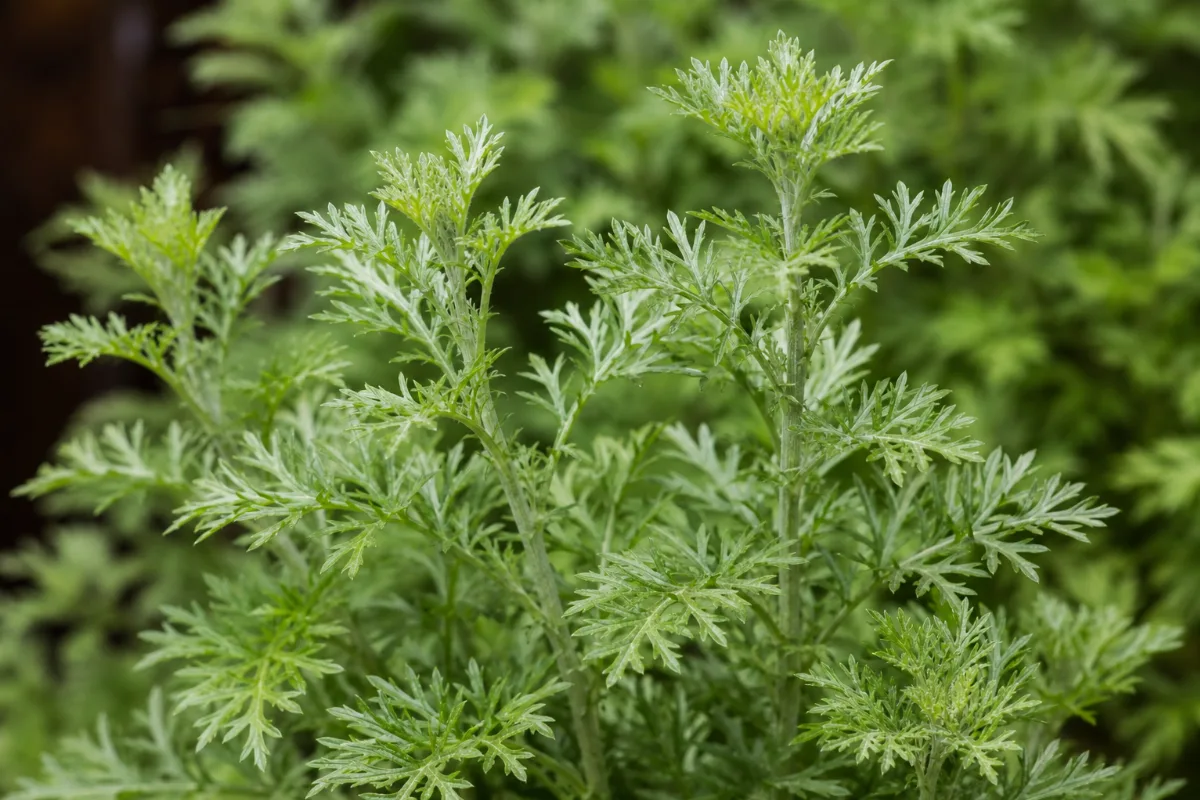
Herbs & Botanicals · Southern African cough herb
African Wormwood
Artemisia afra · also called African wormwood, wilde-als, lengana, umhlonyane
African wormwood is a strongly scented leaf used in southern Africa as a tea or steam for coughs, colds and flu. No trial in people shows that it works for these. It has also been promoted for malaria, COVID-19 and tuberculosis, but the evidence is lab or mouse work only and the two trials that claimed benefit were retracted. The key caution: some plants are high in thujone, a compound that can cause seizures, and there is no safety data for pregnancy or children.
General information, not medical advice. Last substantive update · Not medically reviewed. A named clinician has not signed off on this page. How this page is made
About African Wormwood
African wormwood (Artemisia afra) is a South African shrub brewed as a tea or inhaled as steam for coughs and colds. Its chemistry varies widely, with some plants rich in the seizure-causing compound thujone. Claims for malaria, COVID-19 and TB are not supported by valid human evidence.
What it is
African wormwood is a strongly scented shrub of the daisy family, used in southern Africa. The leaf is the part usually brewed as a tea. It is a different plant from sweet wormwood, absinthe wormwood and mugwort, although the African and sweet wormwoods look very alike.
Names include wilde-als, lengana and umhlonyane.
What makes it distinctive
Its oil comes in very different forms. In a study across five South African sites, two plants had mostly alpha-thujone (62 to 74% of the oil), while three had little thujone and more 1,8-cineole and camphor. Thujone is a compound that blocks a calming receptor in the brain and can cause convulsions in animals.
It makes little or no artemisinin, the malaria drug compound of sweet wormwood, so it should not be treated as a source of it.
What people use it for
Traditionally it is a winter tea or steam for coughs, colds and flu, and it has also been used for fever and malaria. Lengthy use is not proof that it works.
What the research shows
A 2019 review found only weak lab and animal activity. Two trials in Africa that reported strong results were retracted in 2020 and cannot be relied on. A mouse study found no antimalarial effect.
For COVID-19 and TB, only lab and mouse work exists. The TB extract killed bacteria in a test tube but did not lower bacteria in infected mice. In isolated lungs, steam and extract improved lung function.
At a glance
Traditional uses history, not proof
- Coughs, colds and influenza (tea or steam)
- Fever
- Malaria (promoted; not supported by WHO)
- Intestinal worms and general tonic
Studied for research
- Coughs, colds and flu: traditional use only, no trials
- Malaria: not supported; the positive trials were retracted
- COVID-19: lab cell studies only
- Tuberculosis: killed bacteria in test tubes, but no effect in infected mice
- Airway opening and lung inflammation: lab and animal work
Main compounds
- Thujone, a seizure-causing compound that varies by plant
- 1,8-Cineole and camphor (aromatic oil parts)
- Luteolin, a flavonoid
- Chlorogenic acid and scopoletin (marker compounds)
Common forms
- Leaf tea (infusion)
- Steam inhalation
- Dried leaf or powder
- Essential oil (not for swallowing)
Research links: Review: a controversial herbal remedy or treasure trove? (2019) · Essential oil variation and thujone, South Africa (2009) · Thujone toxicology review (2013) · Teas and liver enzymes CYP2B6 and CYP3A4, lab (2022) · Mouse malaria study (2024) · WHO on Artemisia for malaria (2019) · Research Library · Genes & Biomarkers Library
The plant and its history
- Accepted scientific name
- Artemisia afra Jacq.
- Naming authority
- Jacq.
- Common names
- African wormwood (English); Wilde-als (Afrikaans); Lengana (Sesotho/Setswana); Umhlonyane (isiZulu/isiXhosa)
- Botanical family
- Asteraceae (daisy family)
- Classification
- Plantae > Asterales > Asteraceae > Artemisia > Artemisia afra
- Native range
- Africa; most used in southern Africa. A precise native range was not confirmed in a source we read.
- Habitat
- Not described in the sources read.
- What the plant looks like
- Roots: Not described.; Stems: Woody twigs; the twigs were distilled for oil in one study.; Leaves: Highly aromatic; the leaf is the part used as an infusion.; Flowers: Not described.; Fruit: Not described.
- Cultivation
- Not verified.
- Harvest and processing
- Fresh or dried leaves; one study found alpha-thujone higher in dried than fresh leaves.
- Look-alikes and adulterants
- Name: Sweet wormwood (Artemisia annua); Note: Looks very similar and is the source of artemisinin. Per our existing summary, the two African species look very alike and teas are often sold without quality control. See the sweet wormwood page.; Name: Absinthe wormwood (Artemisia absinthium) and mugwort (Artemisia vulgaris); Note: Other Artemisia species; thujone is a shared concern. See their own pages.
- Sustainability and conservation
- Not assessed here.
Traditional use and history history, not clinical proof
| Tradition or era | Documented use | Source |
|---|---|---|
| Southern Africa, traditional | Infusion, steam or powder for coughs, colds, influenza and fever; promoted for malaria. | p31376515 |
| 2013 to 2019, South Africa | Sale for malaria was banned by the Medicines Control Council in 2013; a lawsuit followed in 2017 (as stated in a 2019 review). | p31376515 |
| 2018 to 2020, retracted trials | Two trials of Artemisia teas for schistosomiasis and malaria were published, criticised, and retracted in 2020. | p32972797 |
| 2020, COVID-19 pandemic | Artemisia teas and the Madagascan Covid-Organics drink were promoted; lab studies followed. | p34496903 |
Traditional use shows how a plant was used. It does not show that a supplement works or is safe today.
What is inside, and how it may work
What the plant contains and how those compounds act in cells and animals. Laboratory and animal mechanisms are not proven effects in people.
Main compounds
| Compound | Family | Where it is concentrated | Activity studied | Level of evidence |
|---|---|---|---|---|
| Alpha-thujone PubChem 261491 | monoterpene ketone | leaf and twig essential oil 62 to 74% of the oil at two sites; 3.7 to 20.0% at three others. | Convulsant in animals (GABA-A receptor blocker); the main safety concern. 14 15 16 | Animal research |
| 1,8-Cineole PubChem 2758 | monoterpene oxide | essential oil 13.0 to 49.5% of the oil at low-thujone sites. | Main oil component in low-thujone plants; effects of this plant's oil not shown in people. 14 16 | Laboratory research |
| Camphor PubChem 2537 | monoterpene ketone | essential oil 13.9 to 21.2% at low-thujone sites; 0.1 to 0.6% at high-thujone sites. | Not studied for African wormwood here. 14 16 | Laboratory research |
| Luteolin PubChem 5280445 | flavonoid | leaf extract Higher in the aqueous extract than in the crude leaf. | Contributed to airway-opening in isolated lungs. 6 16 | Animal research |
| Chlorogenic acid PubChem 1794427 | phenolic acid | leaf infusion 0.68 to 14.68 micrograms/mg across samples. | Quality marker; varies with season. 13 16 | Laboratory research |
| Scopoletin PubChem 5280460 | coumarin | leaf infusion 0.10 to 1.14 micrograms/mg across samples. | Quality marker only. 13 16 | Laboratory research |
| Artemisinin | sesquiterpene lactone | leaf 0 to 0.05 mg/g dry leaf in two African wormwood lines, versus 1.6 mg/g in a sweet wormwood line. | The malaria drug compound of sweet wormwood; very low or absent here. 3 | Laboratory research |
Mechanisms, receptors and pathways
| Target or pathway | Gene or receptor | What was found | Level |
|---|---|---|---|
| GABA-A receptor | GABA-A | Thujone blocks the receptor and causes convulsions in animals. 15 | Animal research |
| Liver drug-metabolising enzymes | CYP2B6, CYP3A4 | Teas of African wormwood reduced enzyme activity after the gene was transcribed. 3 | Laboratory research |
| Airway smooth muscle | not identified | Luteolin contributed to better lung function in isolated lungs. 6 | Animal research |
| Mycobacterial growth | not identified | Solvent extracts killed or slowed TB bacteria in culture. 5 12 | Laboratory research |
Absorption, metabolism and elimination
- Absorption
- Not studied in people for African wormwood.
- Distribution
- Not studied.
- Metabolism
- Thujone is broken down mainly by CYP2A6, then CYP3A4 and CYP2B6 (human liver preparations).
- Elimination
- Not studied for this plant.
- Bioavailability
- Not established. The COVID-19 cell-culture authors noted it is unclear whether people can reach the levels used in the lab.
Isolated compounds versus whole extracts
Lab results come mostly from solvent extracts (dichloromethane), steam, nebulised extract and isolated compounds. These do not match a hot-water tea, and tea content varies widely by place and season. Results from one form should not be carried to another.
Nutritional composition
African wormwood is a medicinal herb, not a nutrient.
1 low certainty2 very low certainty2 not enough evidence2 evidence against
What is African Wormwood good for?
What African wormwood has been studied for and how strong the evidence is. Nothing here is proven in people.
Benefits, one by one
Each card is a research question, not a promise. Tap a goal to filter. Open a card to see the studies, doses and limits.
Coughs, colds and flu (traditional use)
Not enough evidenceIn southern Africa African wormwood leaf is mostly brewed as a tea or inhaled as steam for coughs, colds and flu. This rests on tradition. We found no trial in people of the tea for these problems.
2 studiesTraditionally a leaf infusion or steam; no tested product.
Studies, doses and limits
What the trials found
No human trial of African wormwood for cough, cold or flu was found. A 2019 review described the traditional uses and found only weak activity in lab and animal tests.
Results
No human results exist.
Effect sizes as reported
None available.
Why this rating
Tradition and lab work only; no trial in people.
Form and dose studied
Traditionally a leaf infusion or steam; no tested product.
Who was studied
Used by adults and children in tradition, but no safety data exist for children.
Limits
Plant content varies a lot by place, season and drying, so one cup is not like another.
Why researchers looked
It is one of the most widely used home remedies in South Africa, so researchers have tried to find out whether anything in it could explain the use.
Traditional use
Used as an infusion, steam, or powder, mainly in winter, for coughs, colds, influenza and fever. Long use is not proof that it works.
Proposed mechanism Pharmacological theory
Not established. Airway-opening effects were seen in isolated animal lungs (see Airways), but nothing is known in people.
A proposed mechanism does not show that the effect happens in people.
Some plants are high in thujone, which can cause seizures in animals. See the Safety tab.
Malaria (claimed; not supported)
Evidence againstAfrican wormwood tea has been promoted to prevent or treat malaria. WHO does not support Artemisia plants or teas for malaria. Two trials that reported strong results were retracted, and a mouse study found no effect.
6 studiesNot applicable.
Studies, doses and limits
What the trials found
The only human trials reporting benefit (malaria and schistosomiasis, 2018 and 2019) were retracted in 2020 for ethical and methodological concerns. A 2024 mouse study found African wormwood powder did not clear malaria parasites, while sweet wormwood did. A 2019 review found lab activity 1000 to 10 000 times weaker than control drugs.
Results
No valid human result. Mouse study: no antimalarial effect from African wormwood.
Effect sizes as reported
None available.
Why this rating
WHO does not support its use; the positive trials were retracted; a mouse study was negative; proven malaria medicines exist.
Form and dose studied
Not applicable.
Who was studied
Not applicable.
Limits
Cell-test activity at high levels does not show benefit in a person.
Why researchers looked
The related plant sweet wormwood (Artemisia annua) is the source of artemisinin, a malaria drug, so African wormwood was tested too.
Traditional use
Used traditionally for fevers and malaria in parts of Africa.
Proposed mechanism Animal research
African wormwood makes little or no artemisinin, so any activity would have to come from other compounds. This is unproven.
A proposed mechanism does not show that the effect happens in people.
Relying on a tea instead of proven malaria treatment can be dangerous. See a doctor for fever in a malaria area.
COVID-19 (lab cells only)
Not enough evidenceIn a 2021 cell-culture study some Artemisia extracts reduced SARS-CoV-2 infection. That is a lab result. It does not show that tea prevents or treats COVID-19, and no trial in people was found.
2 studiesLab extracts, not tea.
Studies, doses and limits
What the trials found
None. The authors said it is unclear whether people can reach the levels needed after drinking a tea and that clinical studies are required. WHO Africa said herbal COVID-19 products need proper testing.
Results
Several extracts and Covid-Organics reduced infection in cell cultures at levels that did not harm the cells.
Effect sizes as reported
Not reported in the abstract.
Why this rating
Cell-culture finding only; one author group has a financial stake in a company that supplied a sample.
Form and dose studied
Lab extracts, not tea.
Who was studied
Not applicable.
Limits
Abstract does not separate African from sweet wormwood results.
Why researchers looked
Artemisia teas and the Madagascan Covid-Organics drink were promoted in Africa during the pandemic.
Traditional use
A new use promoted in 2020, not a traditional one. Sources describe Covid-Organics as mainly sweet wormwood, so it says little about African wormwood.
Proposed mechanism Laboratory research
Unknown. The study did not identify the active compounds.
A proposed mechanism does not show that the effect happens in people.
Do not use it instead of vaccination, testing or medical care for COVID-19.
Tuberculosis (lab and mouse only)
Evidence againstExtracts of African wormwood killed tuberculosis bacteria in test tubes, but in infected mice the same type of extract did not lower the bacteria. There is no human evidence, and it must never replace TB medicines.
2 studiesSolvent extracts; not a tea.
Studies, doses and limits
What the trials found
None. A 2009 mouse study found no drop in lung or spleen bacteria with a dichloromethane extract or an active fraction, while standard TB drugs cleared the infection. A 2020 lab study found the dichloromethane extract killed the bacteria in culture, less strongly than sweet wormwood.
Results
Lab: kills TB bacteria in culture. Mice: no lowering of bacterial burden.
Effect sizes as reported
Culture IC50 about 270 to 290 micrograms/ml for the 2009 extract; none in mice.
Why this rating
The best animal test was negative; human data absent.
Form and dose studied
Solvent extracts; not a tea.
Who was studied
Not applicable.
Limits
Solvent extracts do not match a water tea.
Why researchers looked
It is used for chest complaints in southern Africa, where TB is common.
Traditional use
Used for coughs and chest complaints; tradition does not show it treats TB.
Proposed mechanism Laboratory research
Sesquiterpene lactones and other compounds in solvent extracts slowed or killed TB bacteria in culture.
A proposed mechanism does not show that the effect happens in people.
Anyone with a cough lasting more than 2 weeks, fever, night sweats or weight loss should be tested for TB; do not delay proper treatment.
Opening the airways (isolated lungs)
Very low certaintySteam and an extract of African wormwood improved lung function in isolated perfused lungs, partly through the flavonoid luteolin. This is a lab organ model, not a study in people.
1 studiesSteam and nebulised extract in the lab; not a tea.
Studies, doses and limits
What the trials found
None.
Results
Dose-dependent improvement in lung function in isolated lungs; nebulised extract gave the largest effect.
Effect sizes as reported
Not given in the abstract.
Why this rating
Isolated animal organ model only.
Form and dose studied
Steam and nebulised extract in the lab; not a tea.
Who was studied
Not applicable.
Limits
No living-person data; inhaling hot steam has its own risks of scalds.
Why researchers looked
To test whether the traditional steam inhalation for chest complaints has a measurable airway effect.
Traditional use
Steam inhalation of the leaves is a traditional respiratory remedy.
Proposed mechanism Animal research
Luteolin, a flavonoid, contributed to the airway-opening effect in the lab model.
A proposed mechanism does not show that the effect happens in people.
Do not inhale the essential oil or strong steam from the plant without medical advice, especially with asthma.
Calming lung inflammation (mice)
Very low certaintyIn the TB mouse study, the water extract did not lower bacteria but appeared to calm lung inflammation early in infection. A single mouse finding.
1 studiesWater extract in mice.
Studies, doses and limits
What the trials found
None.
Results
Water extract regulated lung inflammation early in infection in mice.
Effect sizes as reported
Not given in the abstract.
Why this rating
Single mouse study, summary statement in the abstract only.
Form and dose studied
Water extract in mice.
Who was studied
Not applicable.
Limits
Not shown to help people.
Why researchers looked
Researchers looked for effects on the body's inflammation response, not only on germs.
Traditional use
Used for coughs and chest complaints.
Proposed mechanism Animal research
Not established.
A proposed mechanism does not show that the effect happens in people.
None specific.
Safety signals in rodents (not a benefit)
Low certaintyA water extract made like the traditional decoction had low toxicity in mice and rats, and rats given it daily for 3 months showed no organ damage. Rodent results do not cover pregnancy, seizure risk or drug interactions.
1 studiesAqueous extract in rodents.
Studies, doses and limits
What the trials found
None.
Results
Oral LD50 in mice 8.96 g/kg; no significant organ or blood changes in rats over 3 months apart from a transient drop in AST.
Effect sizes as reported
See results.
Why this rating
Single rodent study; thujone content not reported in the abstract.
Form and dose studied
Aqueous extract in rodents.
Who was studied
Not applicable.
Limits
Rodents tolerate thujone differently from people; plants differ in thujone.
Why researchers looked
The plant is widely used with little formal safety testing.
Traditional use
Used as a decoction or infusion.
Proposed mechanism Animal research
Not studied.
A proposed mechanism does not show that the effect happens in people.
Low toxicity in a rodent test does not make the tea safe for everyone.
Connections to the rest of health
How African Wormwood connects to the rest of our health knowledge graph. Every link says what kind of connection it is. A safety link (for example to the liver) is a warning, not a benefit. A study that merely mentions a topic never creates a benefit link.
Explore every connection: goals, body systems, organs, symptoms, genes
A. Wellness goals
| Connected to | Kind of connection | Evidence status | Context | Studies |
|---|---|---|---|---|
| Immune Support | Traditional use | Not enough evidence | Coughs, colds and flu (traditional use): In southern Africa African wormwood leaf is mostly brewed as a tea or inhaled as steam for coughs, colds and flu. This rests on tradition. We found no trial in people of the tea for these problems. Malaria (claimed; not supported): African wormwood tea has been promoted to prevent or treat malaria. WHO does not support Artemisia plants or teas for malaria. Two trials that reported strong results were retracted, and a mouse study found no effect. | 20 13 18 9 10 19 4 |
| Lung Support | Traditional use | Not enough evidence | Coughs, colds and flu (traditional use): In southern Africa African wormwood leaf is mostly brewed as a tea or inhaled as steam for coughs, colds and flu. This rests on tradition. We found no trial in people of the tea for these problems. | 20 13 |
| Immune Support | Preliminary mechanism | Not enough evidence | COVID-19 (lab cells only): In a 2021 cell-culture study some Artemisia extracts reduced SARS-CoV-2 infection. That is a lab result. It does not show that tea prevents or treats COVID-19, and no trial in people was found. Tuberculosis (lab and mouse only): Extracts of African wormwood killed tuberculosis bacteria in test tubes, but in infected mice the same type of extract did not lower the bacteria. There is no human evidence, and it must never replace TB medicines. | 11 17 12 5 |
| Lung Support | Preliminary mechanism | Very low certainty | Opening the airways (isolated lungs): Steam and an extract of African wormwood improved lung function in isolated perfused lungs, partly through the flavonoid luteolin. This is a lab organ model, not a study in people. Calming lung inflammation (mice): In the TB mouse study, the water extract did not lower bacteria but appeared to calm lung inflammation early in infection. A single mouse finding. | 6 12 |
| Breathing Support | Preliminary mechanism | Very low certainty | Opening the airways (isolated lungs): Steam and an extract of African wormwood improved lung function in isolated perfused lungs, partly through the flavonoid luteolin. This is a lab organ model, not a study in people. | 6 |
B. Body systems
| Connected to | Kind of connection | Evidence status | Context | Studies |
|---|---|---|---|---|
| Respiratory Health | Biological association | Not enough evidence | Studied for: Coughs, colds and flu (traditional use) Studied for: Tuberculosis (lab and mouse only) | 20 13 12 5 6 |
| Immune System | Biological association | Not enough evidence | Studied for: Coughs, colds and flu (traditional use) Studied for: Malaria (claimed; not supported) | 20 13 18 9 10 19 4 11 17 12 5 |
| Hepatic System | Biological association | Low certainty | Studied for: Safety signals in rodents (not a benefit) | 8 |
I. Biomarkers
| Connected to | Kind of connection | Evidence status | Context | Studies |
|---|---|---|---|---|
| SARS-CoV-2 infection in cell culture | Biological association | Not enough evidence | Measured in trials: lowered. A lab change is not the same as a health benefit. | 11 |
| TB bacteria in lung and spleen (mice) | Biological association | Low certainty | Measured in trials: unchanged. A lab change is not the same as a health benefit. | 12 |
| Malaria parasites in mouse blood | Biological association | Low certainty | Measured in trials: unchanged. A lab change is not the same as a health benefit. | 18 |
| Lung function in isolated lungs | Biological association | Very low certainty | Measured in trials: improved. A lab change is not the same as a health benefit. | 6 |
| AST (liver enzyme) in rats | Biological association | Low certainty | Measured in trials: lowered. A lab change is not the same as a health benefit. | 8 |
J. Genes, receptors and enzymes
L. Active compounds
| Connected to | Kind of connection | Evidence status | Context | Studies |
|---|---|---|---|---|
| Thujone | Adverse effect or risk | Low certainty | Convulsant in animals; content varies between plants. Preparation or compound: essential oil of some chemotypes |
15 14 |
| Alpha-thujone | Biological association | Animal | Convulsant in animals (GABA-A receptor blocker); the main safety concern. Preparation or compound: leaf and twig essential oil |
14 15 16 |
| 1,8-Cineole | Biological association | In vitro | Main oil component in low-thujone plants; effects of this plant's oil not shown in people. Preparation or compound: essential oil |
14 16 |
| Camphor | Biological association | In vitro | Not studied for African wormwood here. Preparation or compound: essential oil |
14 16 |
| Luteolin | Biological association | Animal | Contributed to airway-opening in isolated lungs. Preparation or compound: leaf extract |
6 16 |
| Chlorogenic acid | Biological association | In vitro | Quality marker; varies with season. Preparation or compound: leaf infusion |
13 16 |
| Scopoletin | Biological association | In vitro | Quality marker only. Preparation or compound: leaf infusion |
13 16 |
| Artemisinin | Biological association | In vitro | The malaria drug compound of sweet wormwood; very low or absent here. Preparation or compound: leaf |
3 |
Each connection is stored with the ingredient, the connected record, the kind of connection, the evidence status, the supporting studies, the preparation or compound involved, and a review date (last reviewed October 25, 2026).
Evidence at a glance: what changed in 2 lab markers
Tap a number to show only those markers. Counts are markers, not people.
The evidence
The research centre for African Wormwood. Every record here was checked against PubMed or the publisher's page; we never list a study we have not verified.
Evidence by outcome
Bars show how many studies we found for each outcome, not how well it works. People are added up across trials only (reviews are not added, to avoid double counting).
How we rate evidence
High certainty
Several well-run trials or reviews agree; further research is unlikely to change the picture much.
Moderate certainty
Good trials point the same way, but some doubt remains.
Low certainty
Small, short or inconsistent trials. The finding could change with better research.
Very low certainty
Very little or very weak human data. Treat as a possibility only.
Mixed findings
Trials or reviews disagree with each other.
Not enough evidence
Not enough human research to say either way.
Evidence against
Good research found no benefit, or found harm.
We take the reviewers' own risk-of-bias and GRADE statements where they exist, and otherwise judge from study size, design, consistency, directness and whether a product matches what is sold. Many publications do not make evidence high. Method note: We built on our existing summary, read PubMed abstracts, and checked GBIF and PubChem. WHO and several 2025 papers were carried over from that summary and not re-opened. Most studies were read as abstracts only.
Study library: every study we checked 20
| Study | Design | People | Product, dose, length | Result |
|---|---|---|---|---|
| Antibiotics (Basel) 2025 Conventional Antimicrobial and Medicinal Plants from a Traditional Medicine Market in South Africa Antibiotics (Basel) · Source |
Laboratory research in-vitro |
not applicable | African wormwood (Artemisia afra) aerial parts not given here not given here · vs none |
Per our existing summary: in test tubes an African wormwood extract weakened the effect of several antibiotics, and one pairing was toxic to brine shrimp. Relevance to people is unknown. not applicable Methods, limits and fundingOutcomes: see results Limitations: Test-tube result carried over from our earlier summary and not re-opened. Funding and conflicts: not applicable Read: summary-only |
| GBIF 2026 GBIF species match: Artemisia afra Jacq. (key 8078031) GBIF · Source |
Registry or database plant |
not applicable | African wormwood (Artemisia afra) aerial parts not given here not given here · vs none |
GBIF API on 2026-10-25: Artemisia afra Jacq. is ACCEPTED (exact match), family Asteraceae, order Asterales. not applicable Methods, limits and fundingOutcomes: see results Limitations: Taxonomy database record. Funding and conflicts: not applicable Read: full-text |
| Kane 2022 Artemisia extracts differ from artemisinin effects on human hepatic CYP450s 2B6 and 3A4 in vitro J Ethnopharmacol · PMID 35934190 · DOI |
Laboratory research in-vitro |
Human liver cells (HepaRG) and human liver microsomes | Hot-water teas of A. annua and two A. afra types versus artemisinin leaf teas not given here not given here · vs none |
All the teas, including both African wormwood teas, reduced the activity of the liver enzymes CYP2B6 and CYP3A4 in liver preparations. The authors said the effect was probably due to other plant chemicals, not artemisinin. Enzyme inhibition in the lab Methods, limits and fundingOutcomes: CYP2B6 and CYP3A4 gene activity, protein and enzyme activity Limitations: Cell and microsome study; concentrations may differ from what people reach; no human interaction study. Funding and conflicts: No competing interests declared Read: abstract |
| Malaria Journal 2025 Assessment of the in vitro activity and selectivity of Artemisia afra and Artemisia annua aqueous extracts against artemisinin-resistant Plasmodium falciparum Malaria Journal · Source |
Laboratory research in-vitro |
not applicable | African wormwood (Artemisia afra) aerial parts not given here not given here · vs none |
Per our existing summary: water extracts of African wormwood were active against malaria parasites in cell tests, including artemisinin-resistant ones, but only at high levels. In a human liver-cell test the African wormwood extract affected the cells at lower levels than sweet wormwood did. No published human efficacy data were noted. not applicable Methods, limits and fundingOutcomes: see results Limitations: Lab study carried over from our earlier summary and not re-opened. Funding and conflicts: not applicable Read: summary-only |
| Martini 2020 Artemisia annua and Artemisia afra extracts exhibit strong bactericidal activity against Mycobacterium tuberculosis J Ethnopharmacol · PMID 32730878 · DOI |
Laboratory research in-vitro |
M. tuberculosis and M. abscessus in culture | African wormwood dichloromethane extract (compared with A. annua extract) leaf extract (as studied) not given here not given here · vs none |
The dichloromethane extract of A. afra, which makes very little artemisinin, killed M. tuberculosis in culture. The effect was substantial but weaker than that of A. annua. The authors said the extracts have potential and called for combination work with existing antibiotics. Killing in a test tube only Methods, limits and fundingOutcomes: Minimum inhibitory concentration; bacterial killing in culture Limitations: Solvent extract that does not match a tea; culture only; authors' wording is optimistic and no animal or human data were given. Funding and conflicts: Not stated in abstract Read: abstract |
| Mjiqiza 2013 Pulmonary effects and disposition of luteolin and Artemisia afra extracts in isolated perfused lungs J Ethnopharmacol · PMID 23920249 · DOI |
Laboratory research animal |
Isolated perfused lungs (animal organ model; species not given in the abstract) | African wormwood steam, nebulised aqueous extract, luteolin leaf (steam and extract) not given here not given here · vs none |
Steam, nebulised extract and luteolin each gave dose-dependent improvements in lung function in the isolated lungs, with the nebulised extract giving the largest. The authors said luteolin contributes to the airway-opening effect and that the results support the traditional steam-inhalation use. Airway-opening effect in an isolated organ Methods, limits and fundingOutcomes: Lung function measures Limitations: Isolated organ, not a living person; inhalation, not drinking; no clinical data. Funding and conflicts: Not stated in abstract Read: abstract |
| Molecules 2025 Exploring the Phytochemical Diversity and Anti-Plasmodial Potential of Artemisia annua and Artemisia afra from Different Geographical Locations in Cameroon Molecules · Source |
Laboratory research plant |
not applicable | African wormwood (Artemisia afra) aerial parts not given here not given here · vs none |
Per our existing summary: the two species look very alike, teas in Cameroon are often sold without pharmaceutical quality control, A. afra made little or no artemisinin and was much less active against malaria parasites than A. annua in the lab. not applicable Methods, limits and fundingOutcomes: see results Limitations: Carried over from our earlier summary and not re-opened. Funding and conflicts: not applicable Read: summary-only |
| Mukinda 2007 Acute and chronic toxicity of the aqueous extract of Artemisia afra in rodents J Ethnopharmacol · PMID 17367969 · DOI |
Animal research rodent |
Mice (single doses) and rats (3 months) | African wormwood aqueous extract made to mimic the traditional decoction aerial parts (as studied) not given here not given here · vs none |
In mice the oral LD50 was 8.96 g/kg (2.45 g/kg by injection). Rats given the extract daily for 3 months had no significant changes in behaviour, blood counts, chemistry, organ weights or tissue, apart from a transient drop in AST. The authors judged the extract non-toxic when given once and of low chronic toxicity potential in rodents. Low toxicity in rodents Methods, limits and fundingOutcomes: Deaths, behaviour, blood tests, organ weights and tissue under the microscope Limitations: Rodents only; the thujone content of the extract was not reported in the abstract; says nothing about pregnancy, seizure risk or interactions. Funding and conflicts: Not stated in abstract Read: abstract |
| Munyangi 2020 Retraction notice: Effect of Artemisia annua and Artemisia afra tea infusions on schistosomiasis in a large clinical trial Phytomedicine · PMID 32972796 · DOI |
Retraction notice |
not applicable | Artemisia tea trial (retracted) not applicable not given here not given here · vs none |
Notice that the 2018 Phytomedicine schistosomiasis trial of Artemisia teas was retracted. The notice in PubMed carries no reason text; the 2024 mouse study cites ethical and methodological concerns for the retraction of the companion malaria trial. not applicable Methods, limits and fundingOutcomes: Retraction of a 2018 trial report Limitations: Retracted work must not be used as evidence of benefit. Funding and conflicts: not applicable Read: abstract |
| Munyangi 2020 Retraction notice: Artemisia annua and Artemisia afra tea infusions vs. artesunate-amodiaquine (ASAQ) in treating Plasmodium falciparum malaria in a large scale, double blind, randomized clinical trial Phytomedicine · PMID 32972797 · DOI |
Retraction notice |
not applicable | Artemisia tea trial (retracted) not applicable not given here not given here · vs none |
Notice that the 2019 Phytomedicine malaria trial of Artemisia teas versus artesunate-amodiaquine was retracted. A 2024 mouse study states the retraction was due to ethical and methodological concerns. not applicable Methods, limits and fundingOutcomes: Retraction of a 2019 trial report Limitations: Retracted work must not be used as evidence of benefit. Funding and conflicts: not applicable Read: abstract |
| Nie 2021 In vitro efficacy of Artemisia extracts against SARS-CoV-2 Virol J · PMID 34496903 · DOI |
Laboratory research in-vitro |
Cell cultures infected with SARS-CoV-2 or feline coronavirus | Artemisia plant extracts (A. annua and A. afra) and the Madagascan Covid-Organics drink plant extracts not given here not given here · vs none |
Several extracts, and Covid-Organics, reduced SARS-CoV-2 and feline coronavirus infection at levels that did not harm the cells. The authors said it is unclear whether people can reach the blood levels needed after drinking teas, and that clinical studies are needed. Lab inhibition only Methods, limits and fundingOutcomes: Plaque reduction; cell toxicity Limitations: Cell culture; the abstract does not separate A. afra from A. annua results; no human data. Funding and conflicts: Conflict of interest: one author directs ArtemiLife Inc. and two authors hold a financial stake in a company that is a shareholder in it; that company supplied one sample Read: abstract |
| Ntutela 2009 Efficacy of Artemisia afra phytotherapy in experimental tuberculosis Tuberculosis (Edinb) · PMID 20006302 · DOI |
Animal research mouse |
Mycobacteria in culture and M. tuberculosis-infected mice | African wormwood water, methanol and dichloromethane extracts; a sesquiterpene lactone-rich fraction (C8) aerial parts (as studied) not given here not given here · vs none |
Only the dichloromethane extract (and its fraction C8) slowed mycobacterial growth in culture (IC50 about 270 to 290 micrograms/ml for the extract; about 2 micrograms/ml for C8). In infected mice treated for up to 26 weeks, neither the extract nor C8 lowered the bacterial burden, while isoniazid/rifampicin cleared the infection by 8 weeks. The water extract did not lower bacterial numbers but appeared to calm lung inflammation early in infection. No effect on infection in mice Methods, limits and fundingOutcomes: Mycobacterial growth in culture; lung and spleen bacterial burden in mice Limitations: Mouse model; a tolerated dose may have been too low to matter; not a human study. Funding and conflicts: Not stated in abstract Read: abstract |
| Olivier 2023 Geographical and seasonal phytochemical variation of Artemisia afra Jacq. ex Willd. Phytochem Anal · PMID 36464634 · DOI |
Other observational plant |
Plant samples from different places over 12 months | African wormwood infusions (analysed by LC-MS/MS) leaf infusion not given here not given here · vs none |
Marker compounds varied widely by place and month: for example chlorogenic acid ranged 0.68 to 14.68 micrograms/mg and 4,5-dicaffeoylquinic acid 0.005 to 8.110 micrograms/mg. The infusion is mainly used for respiratory ailments. The authors stressed the need for quality control. Large natural variation Methods, limits and fundingOutcomes: Six marker compounds Limitations: Six markers only; thujone was not among them. Funding and conflicts: Not stated in abstract Read: abstract |
| Oyedeji 2009 Compositional variation of the essential oils of Artemisia afra Jacq. from three provinces in South Africa--a case study of its safety Nat Prod Commun · PMID 19634335 |
Other observational plant |
Twigs of wild plants from the Eastern Cape, Free State and KwaZulu-Natal | African wormwood essential oil (hydrodistilled) twigs not given here not given here · vs none |
Alpha-thujone made up 62 to 74% of the oil at two sites (Philippolis and Keiskammahoek), with camphor very low. Three other sites had low alpha-thujone (3.7 to 20.0%), with 1,8-cineole (13.0 to 49.5%) and camphor (13.9 to 21.2%) as the main parts. Alpha-thujone rose significantly in dried leaves compared with fresh leaves. The authors concluded that not all A. afra is high in thujone. Wide chemotype differences between sites Methods, limits and fundingOutcomes: Oil composition by GC and GC-MS Limitations: Oil only, not tea; small number of sites; what ends up in a tea was not measured. Funding and conflicts: Not stated in abstract Read: abstract |
| Pelkonen 2013 Thujone and thujone-containing herbal medicinal and botanical products: toxicological assessment Regul Toxicol Pharmacol · PMID 23201408 · DOI |
Review mixed |
Published toxicology of thujone | Thujone and thujone-containing herbal products (general) not applicable not given here not given here · vs none |
Thujone blocks the GABA-A receptor and causes excitation and convulsions in animals in a dose-dependent way. Neurotoxicity is the main toxic outcome; the review calls its risk to humans a matter of ongoing debate. Thujone is broken down mainly by CYP2A6, then CYP3A4 and CYP2B6, so drug and gene interactions are possible. The authors' best estimates for allowable daily thujone intake from herbs and diet are of the order of 3 to 7 mg a day, and they list key gaps, especially human dose-effect data. Narrative review Methods, limits and fundingOutcomes: Neurotoxicity, metabolism, exposure limits Limitations: Not about African wormwood specifically; human data are missing. Funding and conflicts: Not stated in abstract Read: abstract |
| PubChem 2026 PubChem compound records: thujone, 1,8-cineole, camphor, luteolin, chlorogenic acid, scopoletin PubChem · Source |
Registry or database plant |
not applicable | African wormwood (Artemisia afra) aerial parts not given here not given here · vs none |
PubChem API on 2026-10-25: alpha-thujone CID 261491, beta-thujone CID 91456, 1,8-cineole CID 2758, camphor CID 2537, luteolin CID 5280445, chlorogenic acid CID 1794427, scopoletin CID 5280460 (names and formulas matched). not applicable Methods, limits and fundingOutcomes: see results Limitations: Compound database record. Funding and conflicts: not applicable Read: full-text |
| WHO Regional Office for Africa 2020 WHO supports scientifically-proven traditional medicine WHO Regional Office for Africa · Source |
Authoritative guidance mixed |
not applicable | African wormwood (Artemisia afra) aerial parts not given here not given here · vs none |
WHO Africa said herbal products for COVID-19 need proper scientific testing before use. Taken from our existing summary; the page was not re-opened for this profile. not applicable Methods, limits and fundingOutcomes: see results Limitations: Position statement; carried over from our earlier summary and not re-opened. Funding and conflicts: not applicable Read: summary-only |
| Walz 2024 In vivo antimalarial efficacy of Artemisia afra powder suspensions Phytomedicine · PMID 38761524 · DOI |
Animal research mouse |
Mice infected with Plasmodium berghei | African wormwood powder suspension versus A. annua and artemisinin aerial parts powder not given here not given here · vs none |
Water suspensions of A. annua showed antimalarial activity in mice but A. afra did not. The authors said the experiments did not support the idea that A. afra holds an inactive 'pro-drug' that the body turns into an antimalarial. No antimalarial effect in mice Methods, limits and fundingOutcomes: Parasite clearance Limitations: Mouse malaria model; not a human study. Funding and conflicts: No competing interests declared Read: abstract |
| World Health Organization 2019 The use of non-pharmaceutical forms of Artemisia World Health Organization · Source |
Authoritative guidance mixed |
not applicable | African wormwood (Artemisia afra) aerial parts not given here not given here · vs none |
WHO does not support using Artemisia plant material, including teas, to prevent or treat malaria, citing variable content, too little active compound and the risk of resistance. Taken from our existing summary; the page was not re-opened for this profile. not applicable Methods, limits and fundingOutcomes: see results Limitations: Position statement; carried over from our earlier summary and not re-opened. Funding and conflicts: not applicable Read: summary-only |
| du Toit 2019 Artemisia afra, a controversial herbal remedy or a treasure trove of new drugs? J Ethnopharmacol · PMID 31376515 · DOI |
Systematic review mixed |
Literature 2009 to June 2019 on A. afra chemistry and biological activity | African wormwood extracts and compounds (lab, animal and two trials later retracted) aerial parts (as studied) not given here not given here · vs none |
Reviewers found only weak activity in lab and animal tests (extracts and compounds 1000 to 10 000 times less active than control drugs). They said two recent trials had shown remarkably positive results but had been criticised for design, execution, statistics and ethics. They concluded lab and animal work gave no promising drug leads and that independent, well-designed trials would be needed. Both trials were retracted in 2020. Narrative review; no pooled estimate Methods, limits and fundingOutcomes: Weak activity in lab and animal tests; how the two since-retracted trials were viewed Limitations: Narrative review by two authors; written before the retractions; antimalarial focus. Funding and conflicts: Not stated in abstract Read: abstract |
What we do not know yet
- No valid trial in people for any use.
- No safety data for pregnancy, breastfeeding or children.
- No human test of drug interactions.
- Thujone content of the tea was not measured.
- No EMA, LiverTox, NCCIH or LactMed record could be read.
How new research is added
New studies are found by a saved PubMed search and are placed in a review queue. A person reads each one before it changes any evidence rating or safety wording.
Lab markers
What changed in blood or saliva tests during trials. A changed number is not the same as feeling or being healthier, and we give no "normal ranges".
Organ function 1
AST (liver enzyme) in rats
Lowered in trials
A blood enzyme that rises when liver cells are damaged.
Low certaintyResults and what it means
Why it was measured
A basic liver safety check.
Statistical vs. clinical meaning
No liver injury signal in rats; says nothing about people.
Safety implication
Human liver safety was not studied.
| Study | Result | People | Product |
|---|---|---|---|
| 8 | Only a transient drop in AST over 3 months of daily extract in rats; no tissue changes. | Rats | African wormwood aqueous extract |
Other 4
SARS-CoV-2 infection in cell culture
Lowered in trials
How much virus infects lab cells (counted as plaques).
Not enough evidenceResults and what it means
Why it was measured
A first lab screen for antiviral activity.
Statistical vs. clinical meaning
Lab screen only; not a result in people.
Safety implication
None for people from this test.
| Study | Result | People | Product |
|---|---|---|---|
| 11 | Several Artemisia extracts reduced infection without harming the cells. | Cell cultures | Artemisia plant extracts |
TB bacteria in lung and spleen (mice)
Unchanged in trials
The number of TB bacteria found in the lungs and spleen of infected mice.
Low certaintyResults and what it means
Why it was measured
The standard animal test of a TB treatment.
Statistical vs. clinical meaning
Negative animal result.
Safety implication
Using a herb in place of TB drugs could let TB progress.
| Study | Result | People | Product |
|---|---|---|---|
| 12 | No change with the extract or fraction C8; isoniazid/rifampicin cleared the infection. | M. tuberculosis-infected mice | African wormwood dichloromethane extract or fraction |
Malaria parasites in mouse blood
Unchanged in trials
The share of red blood cells carrying malaria parasites.
Low certaintyResults and what it means
Why it was measured
The standard mouse test of an antimalarial.
Statistical vs. clinical meaning
Negative animal result.
Safety implication
Relying on the herb for malaria is unsafe.
| Study | Result | People | Product |
|---|---|---|---|
| 18 | Sweet wormwood powder showed activity; African wormwood powder did not. | P. berghei-infected mice | African wormwood powder suspension |
Lung function in isolated lungs
Improved in trials
Airway measures such as how easily air moves in an isolated lung preparation.
Very low certaintyResults and what it means
Why it was measured
To test whether the steam opens the airways.
Statistical vs. clinical meaning
Organ-model only.
Safety implication
None established.
| Study | Result | People | Product |
|---|---|---|---|
| 6 | Steam, nebulised extract and luteolin all improved lung function, dose-dependently. | Isolated perfused lungs | African wormwood steam or extract; luteolin |
Safety
What studies and official sources say about side effects, medicines and who should check first. Each point shows what kind of evidence it comes from.
Main points to know 4
- Thujone content varies a lot, and thujone can cause seizures. Some African wormwood plants are very high in the compound thujone and others are low. In one study of the oil from five places in South Africa, alpha-thujone made up 62 to 74% of the oil at two sites and 3.7 to 20% at three others. Thujone is a nerve toxin that causes convulsions in animals. You cannot tell by looking or tasting which plant you have. Anyone with epilepsy or a seizure history should avoid it. Other observational 14 15
- No safety data for pregnancy, breastfeeding or children. We found no study of African wormwood in pregnancy, breastfeeding or children, and no regulator record. Because of the thujone question and the lack of data, the cautious position is to avoid it in these groups. Other 15
- Not a proven treatment for COVID-19, tuberculosis or malaria. The lab and mouse findings do not show it treats any infection. WHO does not support Artemisia teas for malaria. Do not use it instead of proper tests and medicines. Authoritative guidance 19 17 12 18
- It may interfere with liver enzymes that process medicines. Hot-water teas of African wormwood reduced the activity of the liver enzymes CYP2B6 and CYP3A4 in a lab study. No study in people has tested interactions, so the effect on medicines such as HIV drugs or seizure drugs is unknown. Ask a pharmacist. Laboratory research 3
Side effects 3
| Effect | How often | Severity and recovery | Evidence |
|---|---|---|---|
| Seizures or convulsions (thujone-related, from animal data) Shown in animals with thujone; no human report for African wormwood was found. Risk depends on how much thujone the plant holds, which varies. | Not established | potentially serious Unknown | Animal research 15 |
| Harm reports linked to Artemisia teas in general Per our existing summary, a 2025 paper cited case reports of harm with Artemisia teas and called for monitoring of African wormwood use. We did not open the case reports, so details are unknown. | Not established | not specified here Unknown | Other 4 |
| Low toxicity in rodents Rats given the extract for 3 months had no organ damage. This does not predict effects in people. | Not established | none seen in rats not applicable | Animal research 8 |
Liver
No human case of liver injury from African wormwood was found, and LiverTox could not be read (the page was blocked). In rats a 3-month aqueous extract caused no liver changes. In a 2025 human liver-cell test the extract affected the cells at lower levels than sweet wormwood did, so a liver question is open. 8 4
How often. Unknown.
Monitoring. No official monitoring advice found. Yellow skin or eyes, dark urine or severe tiredness need prompt medical care.
This is a safety connection. It is not evidence that African Wormwood supports liver health.
Medicines and supplements 4
| With | Why it matters | Importance | Evidence | What to do |
|---|---|---|---|---|
| Medicines cleared by CYP3A4 or CYP2B6 (this includes some HIV medicines, for example efavirenz and protease inhibitors, and many others) prescription | African wormwood tea lowered the activity of CYP2B6 and CYP3A4 in human liver cells and microsomes in the lab. Thujone is itself cleared by CYP2A6, CYP3A4 and CYP2B6. | Unknown. No study of African wormwood with antiretroviral medicines was found; this is a theoretical concern from lab work. | Laboratory research Very low certainty 3 15 | If you take HIV medicines, tell your clinic or pharmacist before using it. Do not stop or change medicines yourself. |
| Seizure medicines (antiepileptics) prescription | Thujone blocks the GABA-A receptor and causes convulsions in animals, which in theory works against seizure control. Enzyme effects could also change drug levels. | Unknown. No human interaction study was found. | Pharmacological theory Very low certainty 15 3 | Avoid it if you have epilepsy and discuss with your doctor. |
| Antibiotics prescription | In a 2025 test-tube study an extract weakened several antibiotics. | Unknown for people. | Laboratory research Very low certainty 1 | Ask a pharmacist. |
| Herbs and supplements herbal | No interaction study found. | Not found. | Other Not enough evidence | Ask a pharmacist about other thujone-containing herbs, such as wormwood or sage, used at the same time. |
Who should check first 4
| Situation | Advice | Evidence |
|---|---|---|
| Epilepsy or other seizure history | Avoid it. Thujone can cause convulsions in animals and some plants are high in thujone. This is a precaution from animal data, not a regulator rule. | Animal research 15 14 |
| Pregnancy and breastfeeding | Avoid it. No safety data were found. | Other 15 |
| Children | Do not give it to children without medical advice. No safety data were found. | Other |
| Taking HIV, seizure or other prescription medicines | Ask a pharmacist first because of possible liver-enzyme effects. | Laboratory research 3 |
Overdose, product quality and regulators
Summary. Thujone is the main concern. In animals it blocks the GABA-A receptor and causes excitation and convulsions in a dose-dependent way. Estimates for an allowable daily thujone intake from herbs and diet are of the order of 3 to 7 mg a day (an exposure estimate for thujone from all sources, not advice about this plant).
Animal. Mice: oral LD50 8.96 g/kg of aqueous extract. Rats: no significant toxicity in 3 months apart from a transient drop in AST.
Human doses studied. Not given here.
High dose or long term signals. No human long-term data. Rats tolerated 3 months of the extract.
Overdose response. Not described for African wormwood; thujone overdose causes convulsions in animals.
Genotoxicity. Not found in the sources read.
Toxic plant parts. The thujone is concentrated in the essential oil of the leaves and twigs. Alpha-thujone was higher in dried leaves than fresh in one study. Essential oil should not be swallowed.
Thujone and other compound levels vary greatly by place and season, and look-alike plants and unregulated teas add uncertainty.
Chemotype variation (thujone-rich vs cineole/camphor-rich). Oil from five sites: alpha-thujone 62 to 74% at two sites; 3.7 to 20.0% at three sites with 1,8-cineole 13.0 to 49.5% and camphor 13.9 to 21.2%. 14
Season and place. Marker compounds in the infusion varied widely by location and month, and the authors urged quality control. Thujone was not measured. 13
Look-alike species and tea quality. Per our existing summary, African and sweet wormwood look very alike and teas in Cameroon were often sold without pharmaceutical quality control. 7
| Body | Action | Date |
|---|---|---|
| South African Medicines Control Council (South Africa) | A 2019 review states the council banned the sale of African wormwood for malaria in 2013 because evidence of efficacy was lacking. source | 2013 |
When to get medical help
- Seizure, convulsions, confusion or blackouts after using it
- Yellow skin or eyes, dark urine, pale stools or severe tiredness
- Fever in a malaria area, or a cough for more than 2 weeks with fever, night sweats or weight loss (get tested; do not rely on a herb)
- Severe vomiting, tremor or extreme restlessness after a strong tea or oil
Stop the supplement and contact a clinician or emergency service. In the US, Poison Control is 1-800-222-1222.
General information only, not medical advice. Ask a clinician or pharmacist before use, especially with medicines, in pregnancy or with a health condition. See the Natural Remedy Safety guide.
Frequently asked questions
What is African wormwood?
Does African wormwood help coughs and colds?
It is a traditional remedy, but we found no trial in people. So we cannot say it works.
Does it treat malaria?
Can it prevent or treat COVID-19?
Does it treat tuberculosis?
What is thujone and why does it matter?
Is it safe in pregnancy or breastfeeding?
We found no safety data, so it is best avoided.
Is it safe for children?
No safety data in children were found. Do not give it to children without medical advice.
Can it interact with medicines?
Is it the same as sweet wormwood or mugwort?
Has it been tested for toxicity?
In rodents, a water extract had low toxicity, and rats had no organ damage after 3 months. That does not cover pregnancy, seizures or interactions in people.
How much should I take?
We cannot give amounts because no tested dose exists. Ask a doctor or pharmacist before using it.
Explore by health goal
Editorial transparency
- Written by
- AlternativeMed editorial team. Research compiled with AI assistance, then checked against PubMed records.
- Medical review
- None. This page has not been reviewed by a physician or pharmacist.
- First published
- 2026-10-25
- Last substantive update
- 2026-10-25
- How we research
- We built on our existing summary, read PubMed abstracts, and checked GBIF and PubChem. WHO and several 2025 papers were carried over from that summary and not re-opened. Most studies were read as abstracts only.
- How we rate evidence
- See "How we rate evidence" in the Evidence tab.
- Independence
- No product is promoted on this page. No affiliate links are shown. If one is added later it will be labelled and kept apart from the evidence.
Sources 20
Each source was opened and checked. Where we read only the abstract, it says so. The small numbers in the text point here.
- Antibiotics (Basel). Conventional Antimicrobial and Medicinal Plants from a Traditional Medicine Market in South Africa. Antibiotics (Basel). 2025. (summary-only)
- GBIF. GBIF species match: Artemisia afra Jacq. (key 8078031). GBIF. 2026. (full-text)
- Kane NF, Kiani BH, Desrosiers MR, Towler MJ, Weathers PJ. Artemisia extracts differ from artemisinin effects on human hepatic CYP450s 2B6 and 3A4 in vitro. J Ethnopharmacol. 2022. PMID 35934190. DOI 10.1016/j.jep.2022.115587. (abstract)
- Malaria Journal. Assessment of the in vitro activity and selectivity of Artemisia afra and Artemisia annua aqueous extracts against artemisinin-resistant Plasmodium falciparum. Malaria Journal. 2025. (summary-only)
- Martini MC, Zhang T, Williams JT, Abramovitch RB, Weathers PJ, Shell SS. Artemisia annua and Artemisia afra extracts exhibit strong bactericidal activity against Mycobacterium tuberculosis. J Ethnopharmacol. 2020. PMID 32730878. DOI 10.1016/j.jep.2020.113191. (abstract)
- Mjiqiza SJ, Syce JA, Obikeze KC. Pulmonary effects and disposition of luteolin and Artemisia afra extracts in isolated perfused lungs. J Ethnopharmacol. 2013. PMID 23920249. DOI 10.1016/j.jep.2013.07.019. (abstract)
- Molecules. Exploring the Phytochemical Diversity and Anti-Plasmodial Potential of Artemisia annua and Artemisia afra from Different Geographical Locations in Cameroon. Molecules. 2025. (summary-only)
- Mukinda JT, Syce JA. Acute and chronic toxicity of the aqueous extract of Artemisia afra in rodents. J Ethnopharmacol. 2007. PMID 17367969. DOI 10.1016/j.jep.2007.02.011. (abstract)
- Munyangi J, Cornet-Vernet L, et al.. Retraction notice: Effect of Artemisia annua and Artemisia afra tea infusions on schistosomiasis in a large clinical trial. Phytomedicine. 2020. PMID 32972796. DOI 10.1016/j.phymed.2020.153303. (abstract)
- Munyangi J, Cornet-Vernet L, et al.. Retraction notice: Artemisia annua and Artemisia afra tea infusions vs. artesunate-amodiaquine (ASAQ) in treating Plasmodium falciparum malaria in a large scale, double blind, randomized clinical trial. Phytomedicine. 2020. PMID 32972797. DOI 10.1016/j.phymed.2020.153304. (abstract)
- Nie C, Trimpert J, Moon S, Haag R, Gilmore K, Kaufer BB, Seeberger PH. In vitro efficacy of Artemisia extracts against SARS-CoV-2. Virol J. 2021. PMID 34496903. DOI 10.1186/s12985-021-01651-8. (abstract)
- Ntutela S, Smith P, Matika L, et al.. Efficacy of Artemisia afra phytotherapy in experimental tuberculosis. Tuberculosis (Edinb). 2009. PMID 20006302. DOI 10.1016/S1472-9792(09)70009-5. (abstract)
- Olivier D, van der Kooy F, Gerber M. Geographical and seasonal phytochemical variation of Artemisia afra Jacq. ex Willd.. Phytochem Anal. 2023. PMID 36464634. DOI 10.1002/pca.3191. (abstract)
- Oyedeji AO, Afolayan AJ, Hutchings A. Compositional variation of the essential oils of Artemisia afra Jacq. from three provinces in South Africa--a case study of its safety. Nat Prod Commun. 2009. PMID 19634335. (abstract)
- Pelkonen O, Abass K, Wiesner J. Thujone and thujone-containing herbal medicinal and botanical products: toxicological assessment. Regul Toxicol Pharmacol. 2013. PMID 23201408. DOI 10.1016/j.yrtph.2012.11.002. (abstract)
- PubChem. PubChem compound records: thujone, 1,8-cineole, camphor, luteolin, chlorogenic acid, scopoletin. PubChem. 2026. (full-text)
- WHO Regional Office for Africa. WHO supports scientifically-proven traditional medicine. WHO Regional Office for Africa. 2020. (summary-only)
- Walz A, Lehmann U, Duthaler U, Maser P, Wittlin S. In vivo antimalarial efficacy of Artemisia afra powder suspensions. Phytomedicine. 2024. PMID 38761524. DOI 10.1016/j.phymed.2024.155644. (abstract)
- World Health Organization. The use of non-pharmaceutical forms of Artemisia. World Health Organization. 2019. (summary-only)
- du Toit A, van der Kooy F. Artemisia afra, a controversial herbal remedy or a treasure trove of new drugs?. J Ethnopharmacol. 2019. PMID 31376515. DOI 10.1016/j.jep.2019.112127. (abstract)