Leeks: Nutrients, What Research Shows and Safety
Leeks (Allium ampeloprasum) as food: USDA nutrients, what research does and does not show, vitamin K and warfarin, FODMAPs, and washing out the grit.
Content last updated . This page has not been medically reviewed.
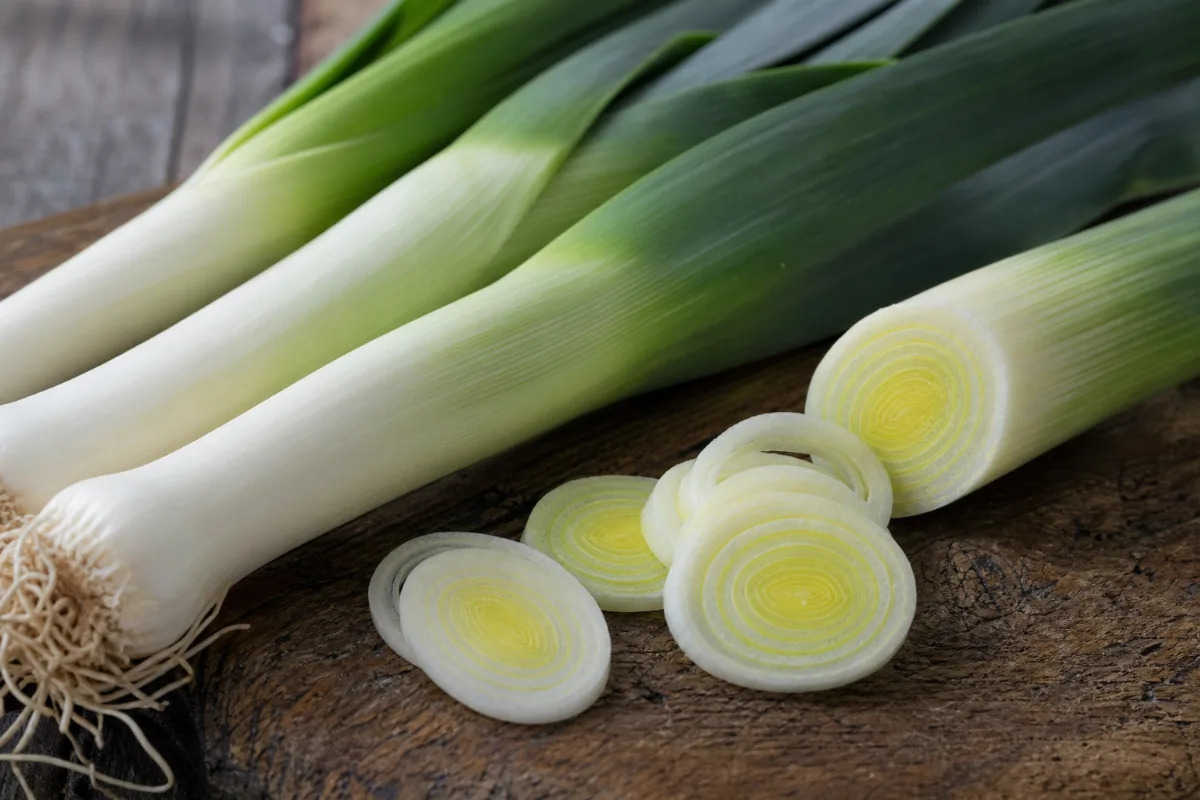
Leeks are the long, white-to-green stalks of Allium ampeloprasum (leek group), in the onion family. People eat the white shaft and the pale-green lower leaves, cooked in soups and stews or sliced raw in small amounts. They are eaten for flavor and as a source of vitamins. This page keeps the food apart from supplements and from hype, and says plainly where evidence is thin.
Read this first
- Warfarin (Coumadin): vitamin K affects how this medicine works, and MedlinePlus advises keeping vitamin K intake about the same from day to day. Leeks contain vitamin K (see the table), so tell the person who manages your warfarin if you eat them often or are about to change how much you eat. [1][2]
- Gut comfort: leeks are an onion-family vegetable, and onion-family vegetables contain fructans, a type of FODMAP that can bother some people with irritable bowel syndrome. We could not read a leek-specific figure, so this is a general caution. [3][4]
- Grit: leeks grow with soil trapped between their layers. Rinse them well, and see the food-safety notes below. [5][6]
- Allergy: for trouble breathing or swelling of the face or throat, call 911.
- Evidence in one line: leeks are a useful low-fat, vitamin K and folate source; we found no leek-specific trials showing they prevent or treat any disease.
What is in it (USDA values)
| Nutrient | Per 100 g | Per 1 cup (89 g) | % Daily Value per serving |
|---|---|---|---|
| Energy | 61 kcal | 54 kcal | n/a |
| Fiber | 1.8 g | 1.6 g | 6% |
| Total sugars | 3.9 g | 3.5 g | n/a |
| Vitamin K | 47 µg | 42 µg | 35% |
| Manganese | 0.48 mg | 0.43 mg | 19% |
| Folate (DFE) | 64 µg | 57 µg | 14% |
| Vitamin B6 | 0.23 mg | 0.20 mg | 12% |
| Vitamin C | 12 mg | 10.7 mg | 12% |
| Copper | 0.12 mg | 0.11 mg | 12% |
| Iron | 2.1 mg | 1.9 mg | 10% |
| Vitamin A (RAE) | 83 µg | 74 µg | 8% |
| Potassium | 180 mg | 160 mg | 3% |
| Lutein + zeaxanthin | 1,900 µg | 1,691 µg | no Daily Value set |
Source: USDA FoodData Central, raw leeks (bulb and lower leaf portion), item 169246, SR Legacy. [1] USDA household portions: 1 cup or 1 leek, each 89 g; 1 slice, 6 g. Per-serving figures are our own arithmetic from the per-100 g values. % Daily Value uses the FDA 2016 Daily Values; values vary with variety, ripeness and storage.
Leeks, like onions and garlic, are described in reviews as containing sulfur compounds and flavonoids (plant pigments), and flavonols such as kaempferol and quercetin are discussed in a 2026 lab-chemistry study of onion and leek. [7][8] Those are laboratory findings; the review says clinical validation in people is limited. [7] USDA also lists carotenoids (beta-carotene and lutein plus zeaxanthin) in raw leeks. [1] We did not find a source giving a leek-specific kaempferol amount that we could read, so we give none.
What research says
| Health goal | What the sources found | Strength of evidence | What was studied |
|---|---|---|---|
| Vitamin K intake | USDA lists 47 µg per 100 g (39% of the Daily Value). [1] | Established (nutrient content, not a treatment claim) | Whole raw food, laboratory analysis |
| Folate and other vitamins | USDA lists folate 64 µg per 100 g (16% of the Daily Value). [1] | Established (nutrient content) | Whole raw food |
| Stomach (gastric) cancer risk | A meta-analysis of observational studies linked the highest intake of allium vegetables (onion, garlic, leek and relatives together) with lower risk; the authors point to confounding. [9] | Promising but limited (observational, whole group, not leeks alone) | 21 observational studies; allium vegetables as a group |
| Overall health outcomes | An umbrella review of 16 meta-analyses found the clearest result for gastric cancer; the other outcomes were mostly less certain. [10] | Mixed | Allium vegetables as a group, mostly observational |
| Antioxidant and anti-inflammatory effects | A 2025 review describes lab and mechanism findings for allium compounds and calls clinical validation limited. [7] | Lab or animal only | Cells and animals; extracts and isolated compounds |
| Leeks on their own | Proper evidence not found in the sources we read: no leek-specific human trial or meta-analysis turned up in our Europe PMC searches. | Insufficient evidence | Not applicable |
Eaten as food vs taken as a supplement or extract. The human data above come from people eating allium vegetables as part of ordinary diets, and they are observational: they cannot prove cause. The mechanism studies use extracts or isolated compounds in the lab. A leek extract or powder is a different product; we found no trial of one that we could read, so we make no claim about it. For garlic, which has its own supplement questions, see Garlic.
How much is a normal serving
- The WHO healthy-diet fact sheet (26 January 2026) says people older than 10 should eat at least 400 g of fruits and vegetables a day. [11]
- The NHS "5 A DAY" guide (last reviewed 9 June 2026) counts 80 g of fresh, canned or frozen vegetables as one portion. [12]
- USDA's household portion for leeks is 1 cup or 1 leek, both 89 g. [1]
- These are official figures for information, not a prescription for you.
- Cooking changes allium compounds in ways that depend on the vegetable, the method, time and temperature, and the authors call for more research on each one. [13] We found no source on how cooking changes the vitamins in leeks, so we make no claim.
Safety, allergy and medicines
- Vitamin K and warfarin. MedlinePlus (reviewed 21 January 2025) says vitamin K, or foods that contain it, can change how warfarin works, and advises keeping vitamin K levels steady day to day by eating about the same amount of vitamin K foods every day. [2] It names leafy greens such as kale, spinach and collards and some other vegetables; it does not name leeks. USDA lists 42 µg of vitamin K in one cup (89 g) of raw leeks, 35% of the Daily Value. [1] The point is steadiness: do not suddenly add or drop a food that is high in vitamin K without telling your care team. This is information, not dosing advice.
- Fructans and IBS (FODMAPs). Fructans are a type of FODMAP, short-chain carbohydrates that ferment quickly and can worsen symptoms in people with irritable bowel syndrome. A 2024 measurement of 40 foods found onion highest in fructans; leeks were not reported in the abstract we read. [3] The NHS says a dietitian may suggest a low FODMAP diet that cuts back on certain vegetables, among other foods (page reviewed 17 March 2025). [4] Leek-specific portion figures: Proper evidence not found in the sources we read (the Monash University tables were not reachable). Ask a dietitian, rather than guessing, if leeks bother you.
- Food allergy. Allergy to onion-family foods is possible; the NCCIH garlic page, summarized on our allium overview, notes that some people react to garlic. We did not find a source on leek-specific allergy that we could read. Call 911 for trouble breathing or swelling of the face or throat.
- Kidney disease and potassium. USDA lists 180 mg of potassium per 100 g, 4% of the Daily Value. [1] People on a restricted potassium plan should follow their own team's list; see Foods, kidney disease, potassium and oxalates.
- Pregnancy. The sources we read did not single out leeks as eaten in meals; ask your prenatal care provider about your whole diet.
- Soil on the plant. Leeks pick up soil between their many layers as they grow. [5] Produce can carry germs from soil, and washing reduces but does not remove them. [6]
- Pesticide residues. We did not read a leek-specific source, so we say nothing about residue levels.
Choosing, storing and food safety
- Washing the grit out. Rinse leeks well. One university extension method is to trim leeks into thin rings and rinse them under cool water to remove soil trapped between layers. [5] The FDA says to wash produce under running water, not with soap, detergent or produce washes, and to dry it with a clean cloth or paper towel. [6]
- Storing. Illinois Extension says to keep unwashed leeks in the refrigerator and use them within a few weeks. [5] The FDA says to refrigerate cut or packaged produce, and keep perishable produce at 40°F or below. [6]
- Cutting boards. After handling raw meat, poultry or seafood, wash boards, knives and counters with soap and hot water before preparing produce. [6]
- After cutting. The CDC lists cut vegetables among perishable foods to refrigerate within 2 hours (1 hour in very hot weather above 90°F). [14]
Related pages
Health connections for Leeks
What research links to eating or drinking this food, and how strong the evidence is. Many studies are observational or use juice, powder, oil or extracts rather than the food as eaten; each card says which.
Vitamin K intake
Established roleRaw leeks contain 47 micrograms of vitamin K per 100 g, about 39% of the Daily Value, and about 35% in one cup (89 g).
Supplements: Food source of a nutrient; no claim that leeks treat any condition.
Folate, manganese and vitamin B6 content
Established roleOne cup (89 g) gives about 14% of the Daily Value for folate, 19% for manganese and 12% for vitamin B6.
Supplements: Nutrient content only.
Fiber content
Established roleLeeks have 1.8 g of fiber per 100 g, about 6% of the Daily Value per 100 g and 6% in one cup.
Supplements: Nutrient content only.
Stomach cancer risk and allium vegetables (group)
Preliminary or mixedA meta-analysis of observational studies linked the highest intake of allium vegetables as a group (leeks included) with lower stomach cancer risk; the authors cite confounding.
Supplements: Not applicable.
Plant compounds: sulfur compounds, flavonols, carotenoids
Lab or animal research onlyReviews describe sulfur compounds and flavonoids in allium vegetables; a lab study detected flavonol breakdown products in onion and leek; USDA lists beta-carotene and lutein plus zeaxanthin in leeks.
Supplements: No good human evidence for leek compounds specifically.
Overall health outcomes of allium vegetables
Preliminary or mixedAn umbrella review of 16 meta-analyses found gastric cancer the clearest outcome among several; results for other outcomes were less certain. Mostly allium vegetables as a group.
Supplements: Not applicable.
Leeks on their own: human trials
Not enough evidenceWe found no leek-specific human trial or meta-analysis in the sources we searched (Europe PMC).
Supplements: Proper evidence not found in the sources we read.
Connected topics
Open a group to see how each topic connects and how strong the evidence is.
Body systems (1)
- Digestive SystemDocumented risk
Leeks belong to the onion family, whose fructans are a FODMAP that can bother some people with IBS; leek-specific amounts were not found.
Body parts (1)
- GutDocumented risk
Fructans in onion-family vegetables can ferment in the gut and worsen IBS symptoms in some people.
Root causes (1)
- Medication Side EffectsDocumented risk
Leeks contain vitamin K, which can change how warfarin works; MedlinePlus advises keeping vitamin K intake steady, so people on warfarin should tell their prescriber about big changes.
Habits (1)
- Balanced NutritionEstablished role
Leeks are a vegetable with vitamin K, folate and manganese; they count toward the WHO advice of at least 400 g of fruits and vegetables a day (an official pattern figure, not a prescription).
Conditions & symptoms (1)
- Irritable Bowel SyndromeDocumented risk
Fructans in onion-family vegetables are a FODMAP that can worsen IBS symptoms in some people; a dietitian may suggest a low FODMAP diet. Leek-specific amounts were not found.
Documented risks and interactions (3)
- Vitamin K and warfarin. Vitamin K can change how warfarin works. MedlinePlus advises keeping vitamin K intake about the same each day; leeks contain vitamin K, so people on warfarin should tell whoever manages it.
- Fructans (FODMAPs) and irritable bowel syndrome. Fructans are a FODMAP that can worsen IBS symptoms; onion was highest among 40 foods measured, and leeks were not reported in the abstract we read. A dietitian may suggest a low FODMAP diet.
- Washing grit and soil from leeks. Leeks collect soil between their layers. Illinois Extension suggests rinsing thin rings under cool water; FDA says wash produce under running water without soap and refrigerate cut produce.
Frequently asked questions
Do leeks affect warfarin?
They can matter because leeks contain vitamin K (USDA: 47 µg per 100 g), and vitamin K changes how warfarin works. [1][2] MedlinePlus advises keeping vitamin K intake about the same each day rather than suddenly changing it. [2] Ask whoever manages your warfarin.
Are leeks high in FODMAPs?
Leeks belong to the onion family, and onion was the highest in fructans among 40 foods in one measurement; leeks were not reported in the abstract we read. [3] We could not read a leek-specific tolerance figure, so ask a dietitian if you have IBS. [4]
How do I get the grit out of leeks?
Leeks collect soil between their layers. Illinois Extension suggests trimming them into thin rings and rinsing under cool water. [5] The FDA says to wash produce under running water without soap and to dry it afterwards. [6]
Do leeks prevent cancer?
No leek-specific trial shows that. A meta-analysis of observational studies linked high intake of allium vegetables as a group to lower stomach cancer risk, but it cannot prove cause. [9][10]
Are leeks a good source of vitamins?
USDA data show one cup of raw leeks gives about 35% of the vitamin K Daily Value, 19% of manganese, and 14% of folate. [1] That is nutrient content, not proof of a disease benefit.
References
- U.S. Department of Agriculture. FoodData Central: Leeks, (bulb and lower leaf-portion), raw (SR Legacy, item 169246). April 2018 release. Read 2026-10-23.
- MedlinePlus (U.S. National Library of Medicine). Vitamin K in diet. Reviewed 21 January 2025. Read 2026-10-23.
- Ferjančič B et al. Fructan content in most commonly consumed Slovenian foods and estimation of daily fructan consumption. Front Nutr 2024. PMID 39155934. Abstract read 2026-10-23.
- NHS. IBS: further help and support. Last reviewed 17 March 2025. Read 2026-10-23.
- Mellendorf C, University of Illinois Extension. Use leeks in your autumn meals. 10 November 2021. Read 2026-10-23.
- U.S. Food and Drug Administration. Selecting and Serving Produce Safely. Current as of 5 March 2024. Read 2026-10-23.
- Ahmed HGMD et al. Beyond seasoning: nutrients, bioactive ingredients and healthcare effects of Allium vegetables. Front Nutr 2025. PMID 41425624. Abstract read 2026-10-23.
- Fokuhl VK et al. Singlet oxygen generated by quercetin and gallic acid leads to oxidative fragmentation of flavonols in onions and leek. 2026. PMID 41642180. Abstract read 2026-10-23.
- Zhou Y et al. Consumption of large amounts of Allium vegetables reduces risk for gastric cancer in a meta-analysis. Gastroenterology 2011. PMID 21473867. As summarized on this site's allium page; read 2026-10-23.
- Wan Q et al. Allium vegetable consumption and health: an umbrella review of meta-analyses of multiple health outcomes. Food Sci Nutr 2019. PMID 31428334. As summarized on this site's allium page; read 2026-10-23.
- World Health Organization. Healthy diet fact sheet. 26 January 2026. Read 2026-10-23.
- NHS. 5 A DAY: what counts. Last reviewed 9 June 2026. Read 2026-10-23.
- Katırcıoğlu B, Navruz-Varlı S. Effects of different preparation and cooking processes on the bioactive molecules of Allium vegetables. Front Nutr 2024. PMID 38962447. Abstract read 2026-10-23.
- Centers for Disease Control and Prevention. Food safety: prevention. Read 2026-10-23.