Butternut Squash: Nutrients, What Research Shows and Safety
What butternut squash (Cucurbita moschata) offers, what research says on vitamin A, fiber and potassium, and the safety facts on kidneys, medicines and food safety.
Content last updated . This page has not been medically reviewed.
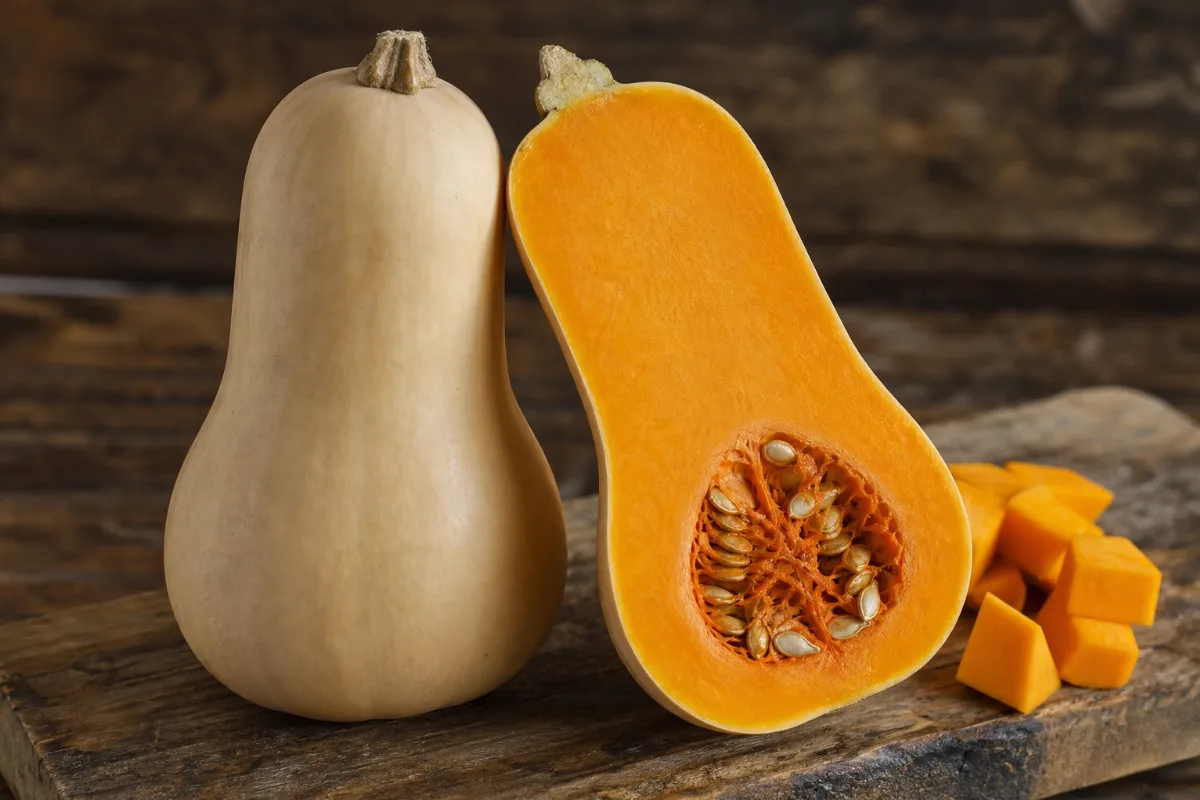
Butternut squash (Cucurbita moschata) is a winter squash in the gourd family (Cucurbitaceae). The orange flesh is cooked and eaten, and people choose it for its carotenoids (orange plant pigments), fiber and potassium. This page keeps the whole food apart from supplements and hype, and says plainly what research does and does not show.
Read this first
- Kidneys and medicines: MedlinePlus lists winter squash as a good source of potassium. People with kidney problems, and people taking ACE inhibitors, ARBs or potassium-sparing diuretics, should ask a clinician about potassium-rich foods. [3]
- Allergy: a food allergy is possible with any food. For trouble breathing or swelling of the face or throat, call 911. See food allergy basics and emergency signs.
- Beta-carotene pills are not the same as squash: in a large trial, beta-carotene supplements raised lung cancer in male smokers. That trial tested a pill, not food. [8]
- Evidence in one line: butternut squash is a real source of vitamin A (from carotenoids), vitamin C and fiber, but we found no trial that tested butternut squash itself for a disease. Findings on fruit, vegetables and fiber in general come mostly from observational studies. [6][7]
What is in it (USDA values)
Raw butternut squash, USDA FoodData Central item 169295 (SR Legacy). [1] USDA household portion: 1 cup of cubes = 140 g.
| Nutrient | Per 100 g | Per typical serving (1 cup raw cubes, 140 g) | % Daily Value per serving |
|---|---|---|---|
| Energy | 45 kcal | 63 kcal | n/a |
| Fiber | 2.0 g | 2.8 g | 10% |
| Total sugars | 2.2 g | 3.1 g | n/a |
| Vitamin A (RAE) | 532 µg | 745 µg | 83% |
| Vitamin C | 21 mg | 29.4 mg | 33% |
| Vitamin E (alpha-tocopherol) | 1.44 mg | 2.0 mg | 13% |
| Manganese | 0.2 mg | 0.28 mg | 12% |
| Vitamin B-6 | 0.15 mg | 0.21 mg | 12% |
| Magnesium | 34 mg | 47.6 mg | 11% |
| Potassium | 352 mg | 493 mg | 10% |
| Folate (DFE) | 27 µg | 37.8 µg | 9% |
| Vitamin K | 1.1 µg | 1.5 µg | 1% |
| Beta-carotene | 4,226 µg | 5,916 µg | no Daily Value set |
% Daily Value uses the FDA 2016 Daily Values; values vary with variety, ripeness and storage. [1]
Plant compounds. USDA lists beta-carotene (4,226 µg per 100 g), alpha-carotene (834 µg) and beta-cryptoxanthin (3,471 µg) in raw butternut squash. [1] These are carotenoids. MedlinePlus says plants supply vitamin A in the form of provitamin A carotenoids, mainly beta-carotene, and that deeper colors generally mean more carotenoids. [2] A 2026 laboratory study of a different Cucurbita moschata variety (the Peruvian "loche" squash) found that boiling the pulp sharply reduced the compounds measured, in a test-tube digestion model, not in people. [10] That is lab evidence about one landrace, not proof about butternut.
What research says
| Health goal | What the sources found | Strength of evidence | What was studied |
|---|---|---|---|
| Vitamin A needs and eyesight | Vitamin A supports eyesight, especially in low light. Low intake can cause night blindness and corneal damage; deficiency is very rare in the United States. [2] | Established (nutrient role) | Vitamin A as a nutrient; butternut is a carotenoid source, not a trial food |
| Vitamin C and scurvy | Vitamin C is needed for tissue repair and collagen. Scurvy is its severe deficiency disease. MedlinePlus lists winter squash among vegetable sources, and says raw foods are the best sources because cooking reduces vitamin C. [5] | Established (nutrient role) | Nutrient information |
| Bowel regularity | MedlinePlus says fiber adds bulk and helps prevent constipation. [4] | Promising but limited for squash (general fiber statement; no squash trial read) | Fiber in general |
| Heart disease, diabetes, some cancers | A 2019 review of 185 observational studies and 58 trials: highest fiber eaters had 15-30% lower rates of several diseases, and trials showed lower body weight, systolic blood pressure and total cholesterol with more fiber. [6] | Promising but limited (observational links; trials on fiber, not squash) | Dietary fiber in general |
| Fruit and vegetable intake and heart disease or death | A 2017 meta-analysis of 95 studies found fruits and vegetables together linked to lower heart disease (RR 0.92 per 200 g a day) and all-cause death (RR 0.90). Green-yellow vegetables were linked to lower cancer risk. [7] | Promising but limited (observational; people who eat more vegetables differ in other ways) | Fruit and vegetables in general |
| Blood carotenoid levels and artery thickness | A 2026 meta-analysis of studies found higher blood beta-carotene only marginally associated with lower carotid artery wall thickness (OR 0.96); the association for lycopene was stronger, but USDA lists no lycopene in butternut squash. [9][1] | Mixed | Blood levels, not food or pills |
| Beta-carotene pills and cancer | In 29,133 male smokers, 20 mg a day of beta-carotene for 5-8 years was followed by 18% more lung cancer. [8] | No good evidence of benefit (harm signal in smokers) | Supplement, not food |
| Lab findings on carotenoid antioxidants | MedlinePlus calls beta-carotene an antioxidant and says foods containing it may reduce cancer risk, but supplements do not. [2] | Lab or animal only for specific effects | Compounds and cells |
Eaten as food vs taken as a supplement or extract. The vitamin A, vitamin C and fiber facts describe the nutrients in the whole food. Observational findings about fruit, vegetables and fiber cannot show that butternut squash itself prevents disease. The beta-carotene trial used a pill, and its result should not be read as a warning about squash. [8] MedlinePlus separates the two: foods containing beta-carotene may reduce cancer risk, while supplements do not and may raise it in smokers and in workers exposed to asbestos. [2] Powders and extracts are different products and are not covered here.
How much is a normal serving
This is information, not a prescription. The WHO healthy diet fact sheet (January 2026) says at least 400 g of fruits and vegetables a day for people older than 10. [14] The NHS counts 80 g of fresh, canned or frozen vegetables as one portion (last reviewed 9 June 2026). [13] The USDA household portion for raw butternut squash is 1 cup of cubes, or 140 g. [1] MedlinePlus gives fiber reference amounts of 21 to 38 g a day for older children, teens and adults. [4] Cooking, freezing and canning effects on butternut squash nutrients: proper evidence not found in the sources we read, beyond the general statement that cooking reduces vitamin C. [5] See fresh, frozen and canned produce.
Safety, allergy and medicines
- Potassium, kidney disease and medicines. MedlinePlus says people with kidney problems, especially on dialysis, should not eat too many potassium-rich foods, and that ACE inhibitors, ARBs and potassium-sparing diuretics (spironolactone, triamterene, amiloride) are common causes of high blood potassium. [3] It names winter squash as a good potassium source, and USDA lists 352 mg per 100 g. [3][1] See foods, kidney disease, potassium and oxalates.
- Too much vitamin A. MedlinePlus ties serious harm, including birth defects with large doses in pregnancy, to preformed vitamin A (from animal foods and supplements). For beta-carotene it says large amounts are not seriously harmful but can turn the skin yellow or orange, which reverses when intake drops. [2] Pregnant people should follow official advice; see foods in pregnancy.
- Beta-carotene supplements. Current and former smokers and workers exposed to asbestos should not take beta-carotene supplements for cancer prevention, per MedlinePlus; the pill trial in smokers is summarized above. [2][8] This does not apply to eating squash.
- Fiber side effects. Eating a lot of fiber quickly can cause gas, bloating and cramps, which often ease as the gut adjusts; adding fiber gradually helps. [4] See how much fiber per day and fiber side effects.
- Bitter squash and cucurbitacins. Plants in the gourd family can contain bitter, toxic compounds called cucurbitacins. The case we read concerns bottle gourd juice (a different plant), which caused vomiting and bleeding from the stomach, with no known antidote. [11] We found no source describing this problem for butternut squash as sold in shops, so we make no claim either way. A sharply bitter taste in any squash is a reason to spit it out and not eat more; that is our caution, not a quoted guideline.
- Allergy. The sources we read did not describe butternut squash allergy, so we give no figures. For trouble breathing or swelling of the face or throat, call 911.
- Oxalate, goitrogens, histamine, FODMAPs, pesticide residues, warfarin: proper evidence not found in the sources we read for butternut squash (USDA lists only 1.1 µg of vitamin K per 100 g [1]), so no claim is made.
Choosing, storing and food safety
- Wash produce under running water before cutting, even if you will peel it, so dirt and bacteria do not move from the surface to the flesh. Do not use soap, detergent or produce wash. [12]
- Scrub firm produce with a clean brush and dry it with a clean towel. Washing reduces bacteria but does not remove all of them. [12]
- Cut away damaged areas. Keep cut or pre-cut squash in a refrigerator at 40°F (4°C) or below. [12]
- Wash hands for at least 20 seconds with soap and warm water before and after handling produce. [12]
Related pages
Health connections for Butternut Squash
What research links to eating or drinking this food, and how strong the evidence is. Many studies are observational or use juice, powder, oil or extracts rather than the food as eaten; each card says which.
Vitamin A from carotenoids and eyesight
Deficiency linkButternut squash is a rich source of provitamin A carotenoids. Vitamin A supports eyesight, and low intake can cause night blindness.
Supplements: Eating the food supplies the nutrient; deficiency is very rare in the United States, so extra intake in well-nourished people is not shown to help.
Fiber and bowel regularity
Preliminary or mixedFiber adds bulk and helps prevent constipation. One cup of cubes gives 2.8 g of fiber (10% Daily Value).
Supplements: Not applicable; whole food. Fiber effects shown for fiber in general, not squash specifically.
Potassium as a normal body nutrient
Established rolePotassium is an electrolyte needed for heart, muscle and nerve function. MedlinePlus lists winter squash as a good source.
Supplements: Eating the food supplies the nutrient; no trial of squash for blood pressure was read.
Vitamin C intake and scurvy prevention
Deficiency linkVitamin C is needed for tissue repair and collagen; scurvy is the severe deficiency disease. Winter squash is listed as a source, and cooking reduces vitamin C.
Supplements: Food provides the nutrient; extra intake beyond need is not shown to help.
Fruit, vegetable and fiber intake and long-term health
Preliminary or mixedObservational studies link more fruit, vegetables and fiber to lower rates of heart disease and death; trials show fiber lowers body weight, blood pressure and total cholesterol.
Supplements: Not a supplement question; observational association is not proof.
Carotenoid antioxidants and blood carotenoid levels
Lab or animal research onlyBeta-carotene is called an antioxidant; higher blood beta-carotene was only marginally linked to thinner artery walls in a 2026 meta-analysis of observational studies. Other specific effects are lab-based.
Supplements: Blood levels are not food intake; no trial of squash tested.
Cooking and carotenoids: lab data only
Lab or animal research onlyA 2026 test-tube study of a related Cucurbita moschata squash found boiling lowered the compounds measured. It is not a study in people and not butternut.
Supplements: Not applicable.
Bitter squash and cucurbitacins
Not enough evidenceGourds can contain toxic bitter cucurbitacins; the case read was bottle gourd juice. No source on butternut squash from shops was found, so no claim is made.
Supplements: Not applicable.
Connected topics
Open a group to see how each topic connects and how strong the evidence is.
Health goals (2)
- Digestive SupportPreliminary or mixed
Fiber helps prevent constipation per MedlinePlus; this is a general fiber statement, not a squash trial.
- Heart HealthPreliminary or mixed
Higher fruit, vegetable and fiber intake is linked to lower heart disease in observational studies; not specific to butternut squash and not proof.
Body systems (3)
- Digestive SystemPreliminary or mixed
Fiber adds bulk and helps prevent constipation (general fiber statement).
- Kidney & UrinaryDocumented risk
Winter squash is a potassium source; people with kidney disease should ask a clinician about potassium-rich foods.
- Cardiovascular SystemPreliminary or mixed
Observational links between fruit, vegetable and fiber intake and heart disease; trials show fiber lowers blood pressure and total cholesterol.
Body parts (4)
- EyesEstablished role
Vitamin A supports eyesight; butternut squash supplies provitamin A carotenoids.
- KidneysDocumented risk
Potassium-rich foods such as winter squash need care in kidney disease.
- GutPreliminary or mixed
Fiber supports bowel regularity.
- SkinEstablished role
MedlinePlus says vitamin A helps maintain skin and mucous membranes; squash is a carotenoid source.
Functional actions (2)
- Digestive SupportPreliminary or mixed
Fiber helps prevent constipation.
- AntioxidantLab or animal research only
Beta-carotene is described as an antioxidant; specific effects shown only in lab studies, and supplements did not reduce cancer.
Root causes (2)
- Medication Side EffectsDocumented risk
ACE inhibitors, ARBs and potassium-sparing diuretics can raise blood potassium; potassium-rich foods such as winter squash need clinician advice.
- Nutrient DeficiencyDeficiency link
Provitamin A and vitamin C from food help prevent vitamin A and C deficiency; vitamin A deficiency is very rare in the United States.
Habits (1)
- Balanced NutritionPreliminary or mixed
Vegetables count toward fruit and vegetable intake linked to lower heart disease and death in observational studies.
Conditions & symptoms (5)
- ConstipationPreliminary or mixed
Fiber helps prevent constipation per MedlinePlus; no squash-specific trial was read.
- HyperkalemiaDocumented risk
Potassium-rich foods can matter for people with kidney problems or on ACE inhibitors, ARBs or potassium-sparing diuretics.
- Vitamin A DeficiencyDeficiency link
Butternut squash supplies provitamin A carotenoids; deficiency is very rare in the United States.
- ScurvyDeficiency link
Winter squash is listed as a vitamin C source; cooking reduces vitamin C.
- XerophthalmiaDeficiency link
Severe vitamin A deficiency can damage the cornea; dietary vitamin A prevents deficiency.
Documented risks and interactions (4)
- Beta-carotene supplements in smokers. In male smokers, 20 mg a day of beta-carotene as a supplement was followed by more lung cancer. MedlinePlus says foods with beta-carotene may reduce cancer risk but supplements do not and may increase it in smokers.
- Potassium, kidney disease and medicines. People with kidney problems and people taking ACE inhibitors, ARBs or potassium-sparing diuretics can develop high blood potassium and should ask a clinician about potassium-rich foods.
- Too much vitamin A versus beta-carotene. Serious harm and birth defects are tied to large amounts of preformed vitamin A; large amounts of beta-carotene are not seriously harmful but can turn skin yellow-orange, which reverses.
- Fiber side effects. Eating a lot of fiber quickly can cause gas, bloating and cramps; adding fiber gradually helps.
Frequently asked questions
Is butternut squash good for vitamin A?
Yes. USDA lists 532 µg of vitamin A (RAE) per 100 g, which is 83% of the Daily Value in one cup of cubes (140 g). [1] The vitamin A comes from carotenoids; MedlinePlus says deficiency is very rare in the United States. [2]
Is butternut squash high in potassium?
It has a fair amount: 352 mg per 100 g, about 10% of the Daily Value per cup of cubes. [1] MedlinePlus names winter squash as a good source and says people with kidney problems or certain blood pressure medicines should ask a clinician about potassium-rich foods. [3]
Can I eat butternut squash if I smoke, given the beta-carotene trial?
The trial gave 20 mg a day of beta-carotene as a pill to male smokers, and lung cancer was higher. [8] MedlinePlus says foods containing beta-carotene may reduce cancer risk while supplements do not. [2] A smoker with concerns can ask a clinician.
Does cooking destroy the nutrients?
MedlinePlus says cooking reduces vitamin C. [5] A lab study of a related Cucurbita moschata squash found boiling reduced the compounds measured, but it was not done in people. [10] We found no study on butternut squash cooked in different ways.
Can squash be poisonous?
Some gourds contain bitter cucurbitacins, and a case report describes serious illness after bottle gourd juice. [11] We found no report for butternut squash from shops. Proper evidence not found in the sources we read.
References
- U.S. Department of Agriculture. FoodData Central: Squash, winter, butternut, raw (FDC ID 169295, SR Legacy). SR Legacy, April 2018 release. Read 2026-10-23.
- MedlinePlus (U.S. National Library of Medicine). Vitamin A. Review date 21 January 2025. Read 2026-10-23.
- MedlinePlus (U.S. National Library of Medicine). Potassium in diet. Review date 30 April 2026. Read 2026-10-23.
- MedlinePlus (U.S. National Library of Medicine). Fiber. Review date 22 July 2026. Read 2026-10-23.
- MedlinePlus (U.S. National Library of Medicine). Vitamin C. Review date 21 January 2025. Read 2026-10-23.
- Reynolds A et al. Carbohydrate quality and human health: a series of systematic reviews and meta-analyses. Lancet 2019. PMID 30638909. Abstract read 2026-10-23.
- Aune D et al. Fruit and vegetable intake and the risk of cardiovascular disease, total cancer and all-cause mortality: a systematic review and dose-response meta-analysis of prospective studies. Int J Epidemiol 2017. PMID 28338764. Abstract read 2026-10-23.
- Alpha-Tocopherol, Beta Carotene Cancer Prevention Study Group. The effect of vitamin E and beta carotene on the incidence of lung cancer and other cancers in male smokers. N Engl J Med 1994. PMID 8127329. Abstract read 2026-10-23.
- Cavero-Redondo I et al. Circulating Lycopene and β-Carotene Levels Are Inversely Associated with Carotid Intima-Media Thickness: A Systematic Review and Meta-Analysis. Nutrients 2026. PMID 41978094. Abstract read 2026-10-23.
- Jiménez-Aspee F et al. 'Loche' Squash (Cucurbita moschata): Phytochemical Profile and Bioaccessibility of Carotenoids, Tocopherols, and (poly)Phenols. Plant Foods Hum Nutr 2026. PMID 42471521. Abstract read 2026-10-23.
- Verma A, Jaiswal S. Bottle gourd (Lagenaria siceraria) juice poisoning. World J Emerg Med 2015. PMID 26693268. Abstract read 2026-10-23.
- U.S. Food and Drug Administration. Selecting and Serving Produce Safely. Read 2026-10-23.
- NHS (UK). 5 A DAY: what counts. Last reviewed 9 June 2026. Read 2026-10-23.
- World Health Organization. Healthy diet fact sheet. Date shown 26 January 2026. Read 2026-10-23.