Globe Artichokes: Nutrients, What Research Shows and Safety
Globe artichokes as a food: USDA nutrients, fiber and inulin, folate and vitamin K, daisy-family allergy, and how this differs from artichoke leaf extract.
Content last updated . This page has not been medically reviewed.
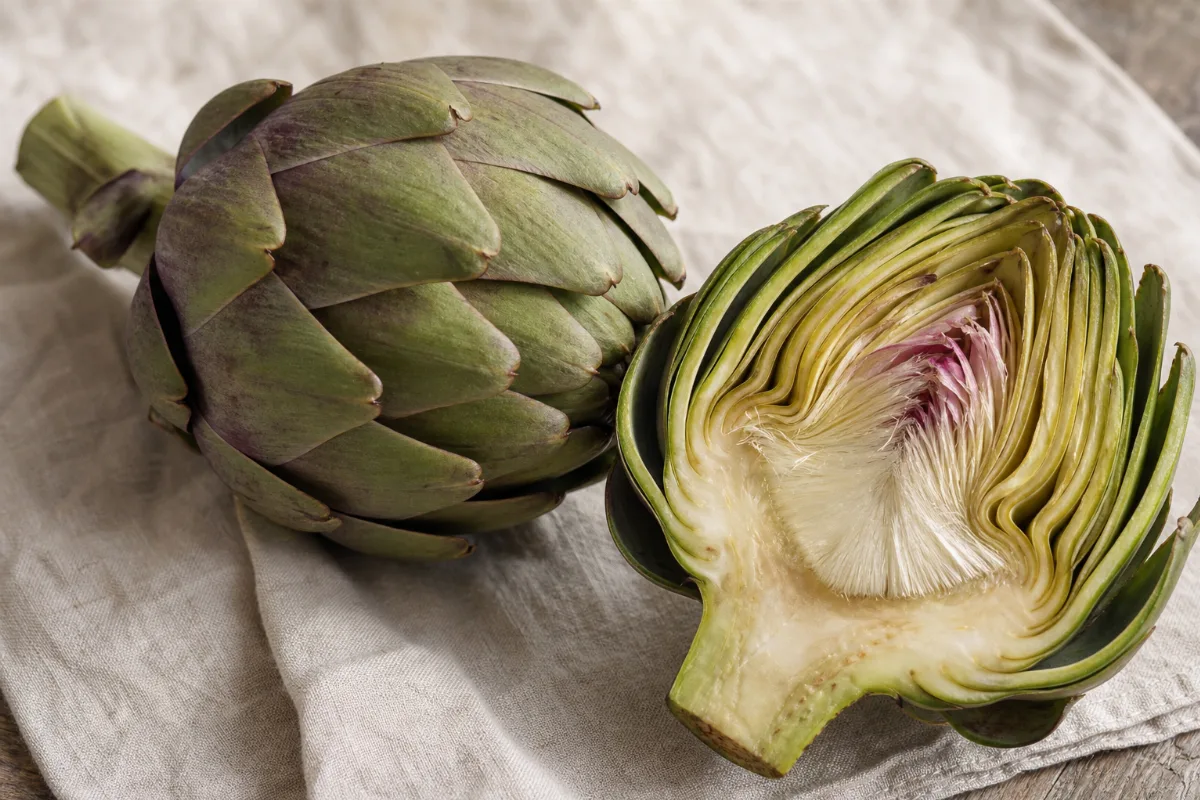
The globe artichoke (Cynara cardunculus var. scolymus) is the immature flower bud of a thistle-like plant in the daisy family (Asteraceae). People eat the tender, fleshy base of each outer leaf (the bracts) and the heart underneath, after the fuzzy "choke" is removed. [1][2] It is eaten for flavor and as a source of fiber and vitamins. This page keeps the vegetable apart from artichoke leaf extract and from hype, and says plainly where evidence is thin.
Read this first
- Allergy: artichoke is in the daisy family, and a small case report from Italy found people with ragweed-type (Compositae) pollen allergy who also reacted to eating artichoke. [3] For trouble breathing or swelling of the face or throat, call 911. See food allergy basics and emergency signs.
- Warfarin (Coumadin): artichoke contains vitamin K (see the table). MedlinePlus advises keeping vitamin K intake about the same from day to day if you take warfarin. [4][8]
- Gut comfort: artichoke is among the vegetables highest in fructans (a fiber type, including inulin) in one laboratory survey, and fructans can cause gas and bloating in some people. [6]
- Not the same as the extract or Jerusalem artichoke: artichoke leaf extract is a herbal product with its own trials and cautions (see below). Jerusalem artichoke is a different plant. [7][5]
- Evidence in one line: artichokes are a good source of fiber and folate; we found no trial of eating the artichoke vegetable that shows it prevents or treats a disease.
What is in it (USDA values)
| Nutrient | Per 100 g | Per 1 medium artichoke (128 g) | % Daily Value per serving |
|---|---|---|---|
| Energy | 47 kcal | 60 kcal | n/a |
| Fiber | 5.4 g | 6.9 g | 25% |
| Total sugars | 0.99 g | 1.3 g | n/a |
| Copper | 0.23 mg | 0.29 mg | 33% |
| Folate (DFE) | 68 µg | 87 µg | 22% |
| Magnesium | 60 mg | 77 mg | 18% |
| Vitamin C | 11.7 mg | 15.0 mg | 17% |
| Vitamin K | 14.8 µg | 18.9 µg | 16% |
| Manganese | 0.26 mg | 0.33 mg | 14% |
| Potassium | 370 mg | 474 mg | 10% |
| Vitamin A (RAE) | 1 µg | 1 µg | 0% |
| Lutein + zeaxanthin | 464 µg | 594 µg | no Daily Value set |
Source: USDA FoodData Central, "Artichokes, (globe or french), raw", item 169205, SR Legacy. [8] USDA household portions: 1 medium artichoke is 128 g and 1 large is 162 g. Per-serving figures are our own arithmetic from the per-100 g values. % Daily Value uses the FDA 2016 Daily Values; values vary with variety, ripeness and storage. USDA gives no values for the canned or marinated hearts in our file, so these numbers are for raw artichoke only.
Artichokes contain polyphenols (plant pigments studied for health effects), mainly caffeoylquinic acids such as chlorogenic-type acids. [9][10] Most work on these compounds is from the lab. In one small human study of healthy volunteers who ate sous-vide cooked artichoke, the compounds were absorbed and broken down into many metabolites, with about 9% recovered in urine within 24 hours; the study measured absorption, not health outcomes. [11] Laboratory work on cooked artichoke found boiling, steaming and frying changed the phenolic pattern, and steaming and boiling raised measured antioxidant capacity in the test tube. [9] That does not show a benefit in people. USDA also lists lutein and zeaxanthin in raw artichoke. [8]
The edible parts
- Bract bases: the soft, pale base of each outer leaf is scraped off with the teeth; the tough tip is not eaten. [1]
- Heart: the fleshy base under the bracts and the choke is the most tender part. [1][2]
- Choke: the fuzzy center is scooped out after cooking. [1]
- Stem: usually edible but tough, and may need peeling. [2]
- A 2025 lab study of one Italian cultivar found the polyphenol makeup differs between the immature flower, the stem and the outer bracts. [12] It is a chemistry study, not a recommendation to eat any part differently.
Fiber and inulin
USDA lists 5.4 g of total fiber per 100 g (19% of the Daily Value). [8] A laboratory survey of 60 vegetables found artichoke among the highest in fructans, which include inulin; the group of top vegetables ranged from 1.2 to 17.4 g per 100 g fresh weight (the abstract does not give the artichoke figure alone). [6] Fructans are not digested in the small intestine and can cause stomach and gut symptoms in some people. [6]Human trials of inulin as an added ingredient (from chicory or Jerusalem artichoke, in snack bars) found more bifidobacteria in the gut and mild gas in a few people. [13] A systematic review of human trials of inulin-type fibers reported prebiotic effects, with improved stool regularity as one reported result. [14] Those trials used isolated inulin, not globe artichoke vegetable. See prebiotic foods: inulin, onions, garlic and more.
What research says
| Health goal | What the sources found | Strength of evidence | What was studied |
|---|---|---|---|
| Fiber and folate intake | USDA lists 5.4 g fiber and 68 µg folate per 100 g. [8] MedlinePlus says folate helps form red blood cells and DNA. [15] | Established (nutrient content and essential role, not a treatment claim) | Whole raw vegetable, laboratory analysis |
| Gut bacteria and bowel regularity | Trials show inulin can feed gut bacteria and improve stool regularity. [13][14] | Promising but limited (for isolated inulin, not for the artichoke vegetable) | Healthy adults; inulin from chicory, Jerusalem artichoke or other sources |
| Antioxidant and anti-inflammatory effects | Polyphenols are measured in the lab and cooking raises test-tube antioxidant capacity. [9][10] | Lab or animal only | Extracts, cooked samples, cells |
| Absorption of the polyphenols | Healthy volunteers absorbed and metabolized them after eating cooked artichoke. [11] | Insufficient evidence for any health outcome | 1 small study of healthy volunteers, cooked whole vegetable |
| Cholesterol, digestion or liver health from eating the vegetable | Proper evidence not found in the sources we read. Trials exist for leaf extract (below), not for the vegetable. | Insufficient evidence | Not applicable |
Eaten as food vs taken as a supplement or extract. The human trials most often quoted for "artichoke" used leaf extract, a different product from the bud you eat. A result for the extract does not transfer to the vegetable, and a result for the vegetable (we found none for health outcomes) would not transfer to the extract. The extract's evidence, EU cautions and safety are on the artichoke leaf page, so we do not repeat them here.
How much is a normal serving
- The WHO healthy-diet fact sheet (26 January 2026) says people older than 10 should eat at least 400 g of fruits and vegetables a day. [16]
- The NHS "5 A DAY" guide (last reviewed 9 June 2026) counts 80 g of fresh, canned or frozen vegetables as one portion. [17]
- USDA's household portion for raw artichoke is 1 medium artichoke (128 g) or 1 large (162 g). [8]
- These are official figures for information, not a prescription for you.
- Cooking changes the phenolic compounds in artichoke (see above), but we found no source we could read on how it changes the vitamins, so we make no claim.
Safety, allergy and medicines
- Daisy-family allergy: artichoke is in the Asteraceae family. [7][18] A conference report described four people with food allergy to artichoke who also tested positive to Compositae pollens, with IgE cross-reactivity shown between mugwort (Artemisia) pollen and artichoke. [3] An earlier case report described allergy to eaten artichoke in people with allergic rhinitis and asthma. [19] A 2025 review says Asteraceae pollen panallergens can cause pollen-food reactions and that sesquiterpene lactones can cause skin reactions and, in sensitized people, possibly reactions after eating. [18] Evidence is limited to case reports, so how common this is remains unknown. If you have a daisy-family or ragweed allergy, ask an allergist before eating artichoke often. See herbal allergy and cross-reactivity.
- Skin contact: a case report describes airborne allergic contact dermatitis in a greengrocer who handled artichokes. [20] This is a skin reaction from handling, reported in a worker.
- Warfarin and vitamin K: one medium artichoke gives about 16% of the vitamin K Daily Value (our arithmetic from USDA). [8] MedlinePlus says sudden changes in vitamin K intake can change how warfarin works, and to keep intake steady day to day and ask your provider. [4] See foods and medicine interactions.
- Folate and B12: MedlinePlus says folic acid above 1,000 mcg a day (from supplements) can mask vitamin B12 deficiency; this applies to supplements and fortified foods, not to the folate in artichoke. [15]
- Gas, bloating and IBS: artichoke is high in fructans. [6] The NHS says a dietitian may recommend a low-FODMAP diet for IBS, which limits some fruit and vegetables that the gut does not break down easily. [21] A dietitian should guide that; we did not find an artichoke-specific tolerance study.
- Kidney disease and potassium: USDA lists 474 mg of potassium in a medium artichoke (10% of the Daily Value). [8] People told to limit potassium should ask their care team; see foods, kidney disease, potassium and oxalates.
- Pregnancy: we found no source we could read giving a food-specific caution for eating cooked artichoke. Official pregnancy food advice is on foods in pregnancy. Extract caution is on the artichoke leaf page.
- Sodium: USDA lists 94 mg sodium per 100 g in raw artichoke. [8] Jarred or canned hearts can differ; check the label (no USDA values in our file).
- Pesticide residues and other topics: we did not read a source on artichoke residues, so we make no claim.
Choosing, storing and food safety
- Wash produce under running water, without soap or produce wash, and dry it; choose items that are not bruised or damaged. [22]
- Refrigerate cut produce, and keep it away from raw meat and seafood. [22]
- Artichokes are usually cooked, for example steamed or boiled, before eating. [1]
Related pages
Health connections for Globe Artichokes
What research links to eating or drinking this food, and how strong the evidence is. Many studies are observational or use juice, powder, oil or extracts rather than the food as eaten; each card says which.
Fiber intake and bowel regularity
Established roleUSDA lists 5.4 g of fiber per 100 g, about a quarter of the Daily Value in one medium artichoke. Fiber is a normal part of a healthy diet; we found no trial of the artichoke vegetable itself for bowel regularity.
Supplements: Not a supplement question; a fiber-rich vegetable is not proof of treating constipation.
Inulin and gut bacteria
Preliminary or mixedArtichoke is among the vegetables highest in fructans (which include inulin) in one lab survey. Trials of isolated inulin found more bifidobacteria and mild gas, but they did not test the artichoke vegetable.
Supplements: Isolated inulin trials do not prove the same effect from eating artichoke.
Folate intake
Deficiency linkUSDA lists 68 µg folate (DFE) per 100 g; a medium artichoke gives about 22% of the Daily Value. Folate helps form red blood cells and DNA.
Supplements: Food folate meets needs; extra folic acid is for specific groups on medical advice, not an artichoke claim.
Vitamin K intake
Established roleUSDA lists 14.8 µg vitamin K per 100 g (about 16% of the Daily Value in a medium artichoke).
Supplements: Nutrient content only; no supplement claim.
Polyphenols and antioxidant activity
Lab or animal research onlyArtichoke contains caffeoylquinic-type polyphenols. Lab work shows cooking changes them and raises test-tube antioxidant capacity; one small human study showed absorption but did not measure health effects.
Supplements: Test-tube antioxidant capacity does not show a benefit in people.
The edible parts: bract bases and heart
Not enough evidenceThe soft base of each outer leaf (bract) and the heart are eaten; the fuzzy choke is removed and the stem is usually tough. Polyphenol makeup differs between parts in one lab study.
Supplements: No health claim; descriptive.
Artichoke leaf extract is a separate product
Not enough evidenceTrials people quote used leaf extract, not the vegetable. The extract has its own evidence and EU cautions on the artichoke leaf page.
Supplements: Extract results do not transfer to the vegetable.
Jerusalem artichoke is a different plant
Not enough evidenceHelianthus tuberosus is a sunflower relative grown for its inulin-rich tuber; globe artichoke is Cynara. Results for one do not apply to the other.
Supplements: No claim.
Connected topics
Open a group to see how each topic connects and how strong the evidence is.
Health goals (3)
- Digestive SupportPreliminary or mixed
Fiber supports normal bowel function; inulin trials show improved stool regularity, but not for artichoke vegetable itself.
- Gut HealthPreliminary or mixed
Inulin-type fibers are prebiotic in trials of isolated ingredients; the vegetable was not tested.
- Microbiome BalancePreliminary or mixed
Isolated inulin raised bifidobacteria in a trial (inulin from chicory or Jerusalem artichoke); not tested with globe artichoke.
Body systems (3)
- Digestive SystemEstablished role
Artichoke is a source of fiber (5.4 g per 100 g, USDA) and fructans; fiber is part of normal digestion. No artichoke-vegetable trial for digestive disease was found.
- Gut HealthPreliminary or mixed
Inulin-type fibers had prebiotic effects in human trials, but those trials used isolated inulin, not the artichoke vegetable.
- Immune SystemDocumented risk
Artichoke is in the daisy family; case reports describe allergic reactions in people with Compositae pollen allergy.
Body parts (2)
Functional actions (2)
- Digestive SupportPreliminary or mixed
Fiber content is documented; benefits from the vegetable itself are untested.
- AntioxidantLab or animal research only
Antioxidant capacity measured in the lab, rising after cooking; not shown in people.
Root causes (3)
- Medication Side EffectsDocumented risk
Vitamin K in artichoke can matter for people on warfarin; keep intake steady and ask the prescriber.
- Digestive DysfunctionDocumented risk
High fructan content can cause gas and bloating in sensitive people, for example with IBS.
- Nutrient DeficiencyDeficiency link
Artichoke provides folate (22% Daily Value per medium artichoke) and vitamin K, which prevent deficiency when intake is low; it is one food among many.
Conditions & symptoms (4)
- Food AllergyDocumented risk
Allergy to eaten artichoke has been described in case reports.
- Hay FeverDocumented risk
Case reports link Compositae pollen allergy with reactions to eating artichoke; evidence is limited.
- Irritable Bowel SyndromeDocumented risk
Artichoke is high in fructans, a FODMAP group that can worsen gas and bloating in some people with IBS; no artichoke-specific tolerance study found.
- Megaloblastic Anemia Due To Folate DeficiencyDeficiency link
Folate helps form red blood cells and deficiency can lead to anemia; artichoke supplies folate but is one food among many.
Documented risks and interactions (3)
- Daisy-family (Asteraceae/ragweed) allergy. Artichoke is in the daisy family. Case reports describe people with Compositae pollen allergy who reacted to eating artichoke, with cross-reactivity to mugwort pollen; a review describes pollen-food reactions in the family. Evidence is limited to case reports.
- Vitamin K and warfarin. Vitamin K foods can change how warfarin works; MedlinePlus advises keeping intake steady and asking the prescriber.
- Fructans, gas and bloating (FODMAPs). Fructans are not digested in the small intestine and can cause gut symptoms in some people; artichoke is among the highest vegetables in one survey.
Frequently asked questions
Is the artichoke vegetable the same as artichoke leaf extract?
No. The vegetable is the flower bud; extract is made from the leaf and has its own trials and cautions. [7] See the artichoke leaf page. Results for one do not apply to the other.
Is a Jerusalem artichoke the same plant?
No. Jerusalem artichoke is Helianthus tuberosus, a sunflower relative grown for its tuber and known for its inulin. [7] Globe artichoke is Cynara. Both are in the daisy family.
Can I eat artichokes if I am allergic to ragweed?
Both are in the daisy family, and case reports show some people with Compositae pollen allergy reacted to artichoke. [3][18] Evidence is small, so ask an allergist. For trouble breathing or swelling of the face or throat, call 911.
Do artichokes affect warfarin?
They contain vitamin K (USDA: 14.8 µg per 100 g), and vitamin K changes how warfarin works. [8][4] MedlinePlus advises keeping intake steady and asking your provider. [4]
Do artichokes cause gas?
They can in some people, because artichoke is high in fructans. [6] A trial of inulin added to foods found mild gas in a few people. [13]
References
- Illinois Extension, University of Illinois. How do you prepare artichokes, they're in season!. 28 June 2016. Read 2026-10-23.
- UC Master Gardener Program, University of California Agriculture and Natural Resources. Artichokes. Read 2026-10-23.
- Macchia L et al. Allergy to pomegranate and artichoke, novel food allergens of the Mediterranean diet. Clin Transl Allergy 2013 (conference abstract). Read 2026-10-23.
- MedlinePlus (U.S. National Library of Medicine). Vitamin K in diet. Read 2026-10-23.
- alternativemed.com. Artichoke leaf. Cites the EU herbal monograph (EMA/HMPC, 2018) for the extract; the cautions there apply to leaf products, not the vegetable. Read 2026-10-23.
- Muir JG et al. Fructan and free fructose content of common Australian vegetables and fruit. J Agric Food Chem 2007. PMID 17625872. Abstract read 2026-10-23.
- Kim DH et al. Phytochemical composition and mechanistic pharmacology of Jerusalem artichoke (Helianthus tuberosus L.). Curr Issues Mol Biol 2026. PMID 41751443. Abstract read 2026-10-23. (Also: European Medicines Agency, HMPC, EU herbal monograph on Cynara cardunculus L. (syn. C. scolymus L.), folium, as summarized on this site's artichoke leaf page.)
- U.S. Department of Agriculture. FoodData Central: Artichokes, (globe or french), raw (SR Legacy, item 169205). April 2018 release. Read 2026-10-23.
- Ferracane R et al. Effects of different cooking methods on antioxidant profile, antioxidant capacity, and physical characteristics of artichoke. J Agric Food Chem 2008. PMID 18759447. Abstract read 2026-10-23.
- Bavaro AR et al. Functional foods in Mediterranean diet: exploring the functional features of vegetable case-studies. Aging Clin Exp Res 2024. PMID 39412623. Abstract read 2026-10-23.
- Domínguez-Fernández M et al. In vivo study of the bioavailability and metabolic profile of (poly)phenols after sous-vide artichoke consumption. Food Chem 2022. PMID 34343812. Abstract read 2026-10-23.
- Tommonaro G et al. A phytochemical and biological characterization of Cynara cardunculus subsp. scolymus cultivar "Carciofo di Procida". Molecules 2025. PMID 40807457. Abstract read 2026-10-23.
- Kleessen B et al. Jerusalem artichoke and chicory inulin in bakery products affect faecal microbiota of healthy volunteers. Br J Nutr 2007. PMID 17445348. Abstract read 2026-10-23.
- Hughes RL et al. The prebiotic potential of inulin-type fructans: a systematic review. Adv Nutr 2022. PMID 34555168. Abstract read 2026-10-23.
- MedlinePlus (U.S. National Library of Medicine). Folic acid in diet. Review date 3 February 2025. Read 2026-10-23.
- World Health Organization. Healthy diet fact sheet. 26 January 2026. Read 2026-10-23.
- NHS. 5 A DAY: what counts. Last reviewed 9 June 2026. Read 2026-10-23.
- Ključevšek T, Kreft S. Allergic potential of medicinal plants from the Asteraceae family. Health Sci Rep 2025. PMID 39995792. Abstract read 2026-10-23.
- Romano C et al. A case of allergy to globe artichoke and other clinical cases of rare food allergy. J Investig Allergol Clin Immunol 2000. PMID 10879999. Abstract read 2026-10-23.
- Gasparini G et al. Airborne allergic contact dermatitis to artichoke (Cynara cardunculus L.) in a greengrocer. Contact Dermatitis 2023. PMID 37121580. Title and citation only; abstract not available to us.
- NHS. IBS: further help and support. Last reviewed 17 March 2025. Read 2026-10-23 (as read for sibling pages).
- U.S. Food and Drug Administration. Selecting and Serving Produce Safely. Current as of 5 March 2024. Read 2026-10-23.