White pepper: Flavor, Cooking Use and Health Facts
White pepper is hot, earthy and a little musty, used where black specks would show; no good human trials exist for food amounts, and isolated piperine supplements can change how medicines work.
Content last updated . This page has not been medically reviewed.
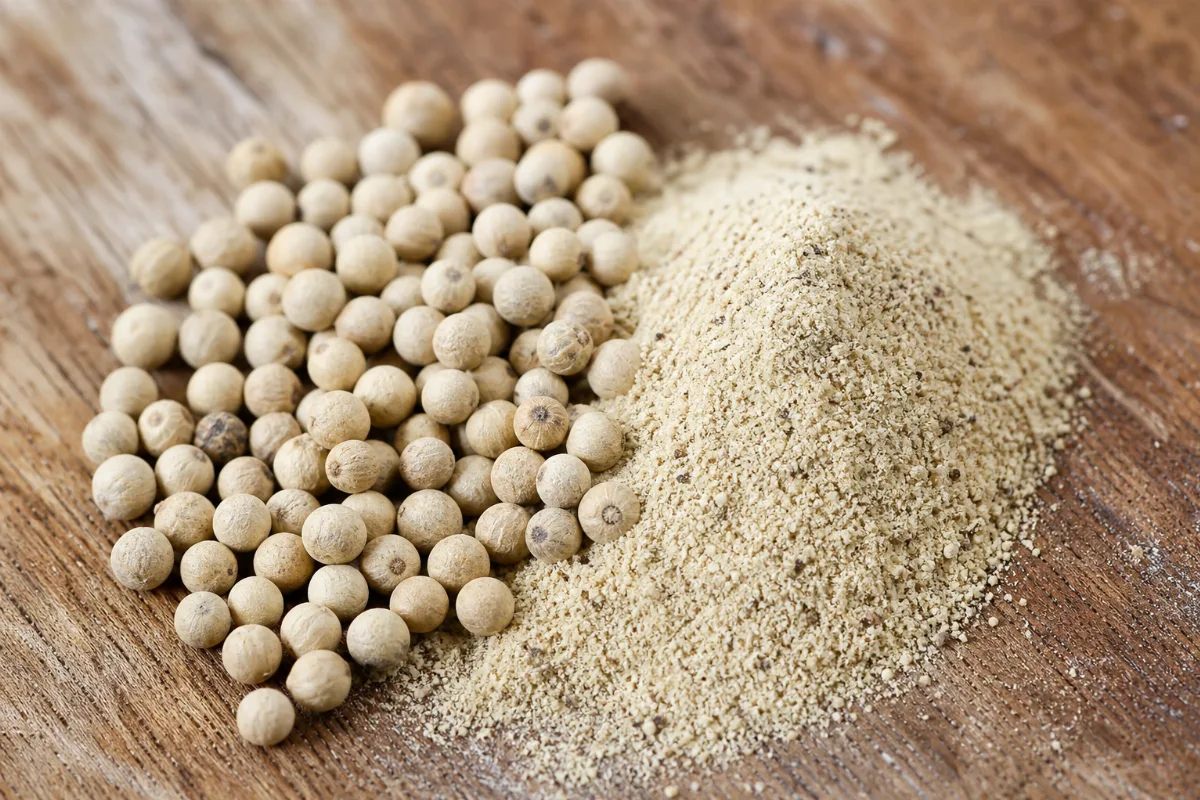
In the kitchen at a glance
Flavor:Hot / pungentEarthy
Aroma: Earthy and a little musty, with less of the citrus and pine of black pepper.
Used in: soups and stews, vegetables, rice and grains, grilling and rubs
Usual amount in food: About 1 teaspoon (2.4 g) of ground white pepper is the USDA household measure; we found no source that sets a usual recipe amount.
What it is
White pepper comes from Piper nigrum, the same climbing vine that gives black pepper. [1] The spice is the fruit, called a peppercorn. [1] The vine is native to South Asia, and Vietnam, Brazil, Indonesia and India lead world pepper production. [1] The difference between white and black is the processing, not the plant. [1]White pepper is made from fully ripe red berries. They soak in water for about a week until the flesh softens, the rest is rubbed off, and the bare seed is dried. [1] Black pepper is made from unripe fruit with the outer layer left on. [1]
Flavor and aroma
White pepper is hot, with a duller, earthier smell than black pepper. The outer layer holds aroma compounds (limonene, pinene and beta-caryophyllene) that give black pepper its citrus, wood and floral notes. White pepper mostly lacks them. [1] Soaking can also leave faint fermented off-notes in some batches. [1]The heat comes mainly from piperine, which is in both the fruit layer and the seed. [1] One source puts black pepper at 4.6 to 9.7% piperine and white pepper slightly higher. [1] Piperine's heat is a different kind of burn from chili. [1]
How it is used in cooking
Ground white pepper is common in Chinese, Thai and Portuguese cooking. [1] Elsewhere it often appears in salads, pale sauces such as béchamel, and mashed potatoes, where black pepper would show as dark specks. [1]- Whole or ground: most sources advise grinding whole peppercorns just before use, because ground pepper loses its aroma quickly. [1]
- Substitute: black pepper stands in for it, at the cost of the dark specks. [1]
The sources we read do not say when to add it during cooking or whether to toast it, so we give no rules here.
Normal food amounts
| Measure | Grams | Source |
|---|---|---|
| 1 teaspoon, ground | 2.4 g | USDA [6] |
| 1 tablespoon, ground | 7.1 g | USDA [6] |
| Typical recipe amount | Not found | We opened no source that states one |
What one teaspoon (2.4 g) of ground white pepper provides, calculated from USDA values per 100 g:
| Nutrient | One teaspoon |
|---|---|
| Energy | about 7 kcal |
| Fiber | about 0.6 g |
| Calcium | about 6 mg |
| Iron | about 0.3 mg |
| Manganese | about 0.1 mg |
| Vitamin C | about 0.5 mg |
The USDA SR Legacy data are from 2018 and real products vary. [6] We did not compare these numbers with official daily values, so we do not call white pepper a "good source" of anything. A pinch is mostly flavor.
Buying, storing and preparing
- Forms: whole peppercorns and ground powder. [1]
- Storing: airtight storage slows the loss of flavor and aroma. Light can turn piperine into a nearly tasteless compound. [1] The sources we read give no shelf life.
- Grinding: a pepper mill just before use keeps the most aroma. [1]
- Quality: the sources we read do not describe adulteration of white pepper.
Health: what research says
Eating white pepper in cooking is very different from taking concentrated piperine or pepper extract. Almost all research is on black pepper or on isolated piperine, not on white pepper itself.Food amounts vs supplements
| In normal cooking | In supplements and extracts | |
|---|---|---|
| Typical amount | About 2.4 g per teaspoon (USDA); no usual recipe amount found [6] | Isolated piperine or pepper extract; no official amount found |
| What studies mostly used | We found no study of white pepper on food | Single doses of isolated piperine, often with another substance such as curcumin [2] |
| What we can say about benefit | Proper evidence not found in the sources we read | Human studies mostly measure blood levels of other substances, not health outcomes [2][3] |
| Main safety limit | Rare allergy [5] | Raised blood levels of some medicines; animal reproductive effects at higher doses [2][3] |
What the evidence shows
| Use | What the sources found | Strength of evidence | Form and population |
|---|---|---|---|
| Any health use of white pepper itself | No study found in the sources we read | Insufficient evidence | White pepper |
| Health uses of black pepper | A review of black pepper research found 60 test-tube studies, 21 animal studies and only one clinical trial. [4] | Lab or animal only | Black pepper and extracts |
| Changing how medicines are absorbed | Reviews say piperine can change how enzymes and transporters handle other drugs, helpful or harmful depending on dose and timing. [3] | Promising but limited | Isolated piperine |
| Traditional uses | Mostly reported in India, for menstrual and ear-nose-throat problems. [4] Tradition is not proof. | Insufficient evidence | Powders, pills, pastes |
For supplement forms, trials and interactions in depth, see the full herb guide: Black pepper.
Official statements
- BfR (Germany), 2021 review: advises weighing the possible health risks of isolated piperine taken as a single dose, for example in some supplements. [2]
- We found no EMA, EFSA or FDA statement on white pepper in the sources we opened.
Related pages
Health connections for White pepper
What research links to this spice, and how strong the evidence is. Most studies use concentrated extracts or doses far above what you eat; each card says which.
Medicine absorption (isolated piperine)
Preliminary or mixedReviews find piperine can change how enzymes and transporters handle other drugs, in most bolus studies raising drug levels.
Supplements: Isolated piperine only; no study of white pepper on food found.
Health uses of pepper in general
Lab or animal research onlyA review of black pepper research found 60 test-tube studies, 21 animal studies and one clinical trial.
Supplements: Lab and animal findings; not shown for food amounts.
Traditional uses
Not enough evidenceTraditional reports, mostly from India, for menstrual and ear-nose-throat problems; tradition is not proof.
Supplements: No evidence of benefit from the sources read.
Connected topics
Open a group to see how each topic connects and how strong the evidence is.
Body systems (1)
- Immune SystemDocumented risk
Pepper allergy is reported as rare, with a case of hives and swelling in a toddler.
Root causes (1)
- Medication Side EffectsDocumented risk
Isolated piperine raised the blood levels of several drugs in studies, which could increase their effects. This is for piperine supplements, not shown for pepper on food.
Conditions & symptoms (1)
- Food AllergyDocumented risk
A case report describes pepper allergy in a toddler; reports call it rare.
Documented risks and interactions (3)
- Reproductive effects in animals (high-dose piperine). In animals, higher daily piperine doses than human interaction studies caused signs of disturbed sperm formation and maternal and embryo effects.
- Medicine interactions with piperine. Piperine may raise blood levels of several drugs and so their effects; the effect can help or harm depending on dose and timing.
- Pepper allergy (rare). A case report describes hives and facial swelling in a toddler after a marinade with black and cayenne pepper; allergy to pepper in children is called rare.
Frequently asked questions
Is white pepper hotter than black pepper?
One source says white pepper holds slightly more piperine, but its smell is duller and earthier. [1] How hot it tastes depends on the batch.
Why use white pepper instead of black?
Mostly for looks in pale dishes such as béchamel and mashed potatoes, and for its different flavor. [1]
How much is normal?
USDA lists 2.4 g per teaspoon of ground white pepper. [6] We found no source for a usual recipe amount.
Is it safe in pregnancy?
The sources we read do not describe pepper as a seasoning in pregnancy. Animal studies of high-dose isolated piperine showed effects on reproduction. [2] Ask your midwife or doctor about supplements.
Can I take it with medicines?
The concern in the sources is isolated piperine, which raised blood levels of some drugs. [2][3] Ask a pharmacist before using piperine supplements.
Is it good for me?
We found no study of white pepper itself. Most research is on black pepper in the lab, with one clinical trial in a review of 82 studies. [4]
More details: evidence, limits and cautions
The details behind this page: cautions, limits of the evidence and where sources disagree. Open any note to read it.
Safety note at a glance
Safety in more detail
- Medicines: the BfR review found isolated piperine raised blood levels of several drugs in most interaction studies, which may increase their effects. [2] A second review says the effect can help or harm depending on dose and timing. [3] The sources we read do not say whether pepper on food does this.
- Pregnancy: in animals, higher daily piperine doses than the human interaction studies caused signs of disturbed sperm formation and effects on mothers and embryos. [2] The sources we read do not describe pregnancy and pepper as a seasoning.
- Breastfeeding: the sources we read do not describe it.
- Children: the sources we read do not describe it, apart from the allergy case below.
- Allergy: a case report describes a 17-month-old with hives and swelling after a marinade containing black and cayenne pepper. Skin tests to black and cayenne pepper were positive, and the paper calls pepper allergy in children rare. [5] Blood tests for white pepper were undetectable in that child. [5]
- Liver and kidney: the sources we read do not describe either.
- Surgery: the sources we read do not describe a surgery warning. Tell the surgical team about any supplement.
- Quality and contamination: the sources we read do not describe any for white pepper.
- Amounts that cause trouble: no limit for pepper on food was found. The BfR review says human piperine studies paid little attention to safety beyond drug interactions. [2]
References
- Wikipedia — Black pepper (includes white pepper production, flavor and use; secondary source). https://en.wikipedia.org/wiki/Black_pepper (accessed 2026-10-24)
- Ziegenhagen R et al. (BfR) — Safety Aspects of the Use of Isolated Piperine Ingested as a Bolus. Foods 2021; abstract read via Europe PMC. https://pubmed.ncbi.nlm.nih.gov/34574230/ (accessed 2026-10-24)
- Lee SH et al. — Piperine-mediated drug interactions and formulation strategy for piperine. Expert Opin Drug Metab Toxicol 2018; abstract read via Europe PMC. https://pubmed.ncbi.nlm.nih.gov/29250980/ (accessed 2026-10-24)
- Takooree H et al. — A systematic review on black pepper: from folk uses to pharmacological applications. Crit Rev Food Sci Nutr 2019; abstract read via Europe PMC. https://pubmed.ncbi.nlm.nih.gov/30740986/ (accessed 2026-10-24)
- Gimenez G, Zacharisen M — Severe pepper allergy in a young child. WMJ 2011; abstract read via Europe PMC. https://pubmed.ncbi.nlm.nih.gov/21748999/ (accessed 2026-10-24)
- USDA FoodData Central, SR Legacy (April 2018) — Spices, pepper, white (fdc_id 170933), per-100 g values and household portions from the site's USDA data file.