Sesame seed: Flavor, Cooking Use and Health Facts
Sesame seed is nutty and rich, especially when toasted, and used in breads, sweets, tahini and stir-fries; it is a major allergen, and the small blood pressure and cholesterol trials are weak.
Content last updated . This page has not been medically reviewed.
In the kitchen at a glance
Flavor:EarthySweetWarm / woody
Aroma: Mild and nutty when raw; toasting brings out a deeper, roasted smell.
Used in: baking, desserts, rice and grains, vegetables
Usual amount in food: USDA lists 9 g per tablespoon of whole dried seeds (about 3 g per teaspoon, our arithmetic); we found no source that sets a usual recipe amount.
What it is
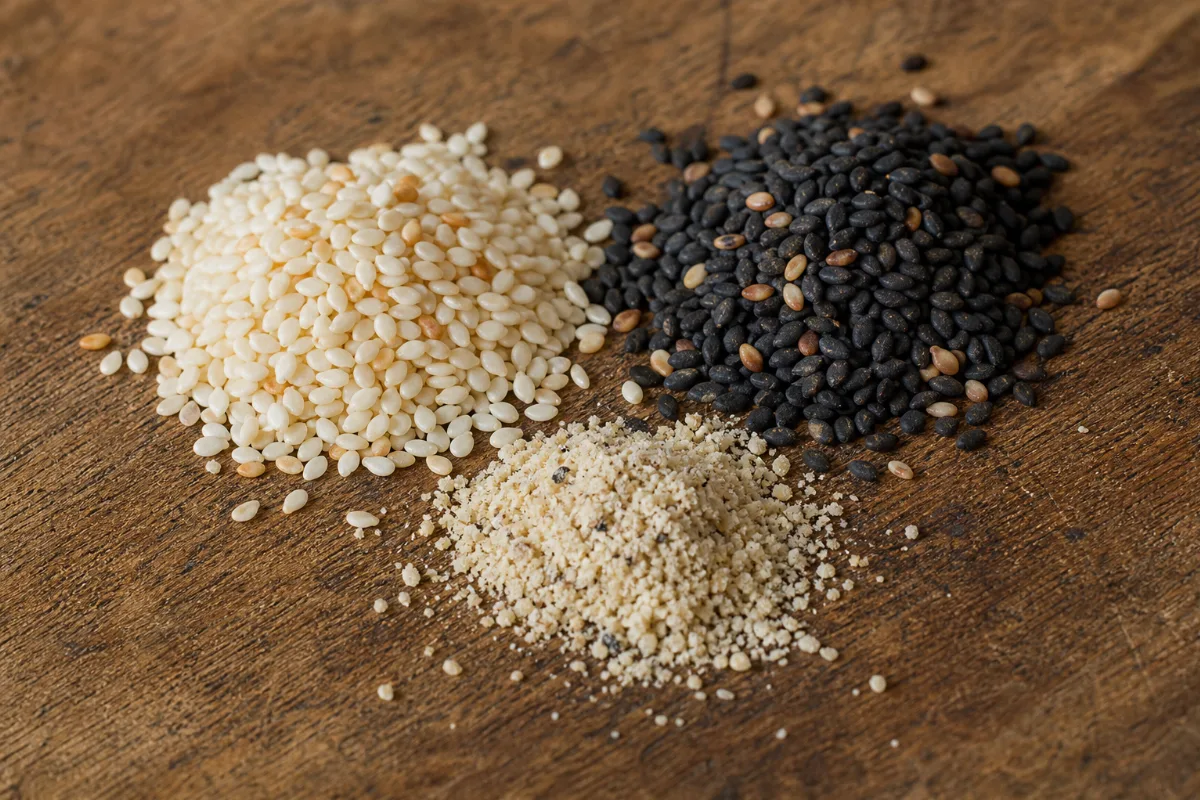
Sesame is Sesamum indicum, a plant in the family Pedaliaceae. The small flat seeds grow in pods and are the part used. [1] It was first cultivated in India. [1] In 2024 the largest producers were India, Myanmar and Sudan. [1] White and pale seeds are common in Europe, the Americas, West Asia and the Indian subcontinent. Black seeds come mostly from China and Southeast Asia. [1] Another name is benne. [1]Flavor and aroma
Sesame seeds have a rich, nutty taste. [1] Raw seeds are mild. Roasting creates the strong aroma and taste that toasted sesame oil is known for. [1] That is why many cooks toast seeds just before using them. Sesame pairs well with honey, sugar, rice, bread and greens. It is also a main ingredient in tahini and halva. [1]How it is used in cooking
Seeds are used whole, toasted, or ground into paste. [1]- Bread and baking: seeds coat ring-shaped breads such as simit and koulouri, and go on baked goods and breadsticks. [1]
- Middle East: tahini (seed paste) and sweet halva. Sesame is also part of za'atar. [1] See za'atar and dukkah.
- Japan: roasted tan and black seeds are made into the seasoning gomashio. Whole, usually unroasted, seeds go in many salads and baked snacks. [1]
- India: seeds and oil are widely used; chikki is a snack of seeds set in heated jaggery or sugar. [1]
- China: ground black sesame with rice makes zhimahu, a dessert and breakfast dish. [1]
A toasting method from a recipe site: dry skillet, medium heat, about 3 to 5 minutes, stirring, until golden and fragrant, then cool on a plate. [5] The sources we read give no firm rule for when to add seeds or what to substitute, so we give none.
Normal food amounts
| Measure | Grams | Source |
|---|---|---|
| 1 tablespoon, whole dried seeds | 9 g | USDA [2] |
| 1 teaspoon, whole dried seeds | about 3 g | Our arithmetic (one third of the tablespoon); USDA lists no teaspoon |
| 1 cup | 144 g | USDA [2] |
| Typical recipe amount | Not found | We opened no source that states one |
What one tablespoon (9 g) provides, calculated from USDA values per 100 g:
| Nutrient | One tablespoon |
|---|---|
| Energy | about 52 kcal |
| Fat | about 4.5 g |
| Fiber | about 1.1 g |
| Calcium | about 88 mg |
| Iron | about 1.3 mg |
| Magnesium | about 32 mg |
| Copper | about 0.37 mg |
Per 100 g USDA lists 573 kcal, 975 mg calcium, 14.55 mg iron and 4.08 mg copper. [2] The data are SR Legacy (2018), and real products vary with variety, hulling and roasting. We did not compare these numbers with official daily values, so we do not call sesame a "good source" of anything. A sprinkle of a teaspoon is mostly texture and flavor.
Buying, storing and preparing
- Forms: whole seeds (hulled or unhulled), toasted seeds, black seeds, tahini and oil. [1]
- Oil is why they spoil: sesame is very high in oil, so seeds can go rancid. The best test is smell: they smell off as the oils break down. [4]
- Storage: a university extension service says to use airtight containers and keep seeds in the fridge or freezer, or in a cool, dark pantry for a shorter time. It gives about a year in the fridge or freezer for raw seeds, and 6 to 12 months in the pantry. For roasted seeds it gives one to three years cold. [4] Recipe sites give far shorter times for home-toasted seeds, often weeks at room temperature, so treat the longer figures with care. [5]
- Quality or adulteration issues: the sources we read do not state any for sesame seed.
Health: what research says
Eating sesame seeds as a food is different from taking concentrated sesame products.Food amounts vs supplements
| In normal cooking | In supplements and extracts | |
|---|---|---|
| Typical amount | About 9 g per tablespoon (USDA); no usual recipe amount found [2] | One pooled analysis found effects at 10 g a day or less, but did not say which product forms were used [8] |
| What studies mostly used | The abstracts we read do not separate seeds from other forms | "Sesame supplementation" and "sesame products," forms not stated in the abstracts [6][7][8] |
| What we can say about benefit | Early signals only; no trial of seeds on food was singled out | Small trials report lower blood pressure and blood fats, rated very low certainty in one analysis [6][7] |
| Main safety limit | Allergy [3] | Allergy; the sources we read do not describe other limits |
What the evidence shows
| Use | What the sources found | Strength of evidence | Form and population |
|---|---|---|---|
| Blood pressure | A pooling of 10 trials (441 people) found lower systolic and diastolic pressure. [6] A pooling of 6 trials (465 people with high or borderline blood pressure, 4 to 8 weeks) found lower pressure but rated all outcomes very low certainty and questioned how plausible the effect sizes were. [7] | Promising but limited | "Sesame supplementation," form not stated; adults [6][7] |
| Total cholesterol and triglycerides | Lower total cholesterol and triglycerides in the 6-trial analysis; LDL did not change significantly. [7] A 13-trial analysis (521 people) reported lower total cholesterol in people with chronic disease. [8] | Mixed | Sesame products, form not stated [7][8] |
| Blood sugar | HbA1c fell in the 10-trial and 13-trial analyses. Fasting glucose fell in one and was a borderline result (p = 0.057) in the other. [6][8] | Promising but limited | Sesame products; adults [6][8] |
| Inflammation markers | CRP and IL-6 fell in the 13-trial analysis. [8] | Promising but limited | Sesame products; 4 to 12 weeks [8] |
| Heart attack, stroke or other disease outcomes | The trials measured blood tests, not these outcomes. | Insufficient evidence | Not applicable |
Official statements
- FDA (US), 2023: sesame became the ninth major food allergen under the FASTER Act; labeling required from January 1, 2023, and sesame in a spice mix or flavor should be named. [3]
- NHS (UK): lists sesame seeds among foods that can cause allergy. [10]
- EU: Wikipedia says the EU requires sesame to be identified among 13 other foods; we did not open the EU text. [1]
- EMA, EFSA, WHO/JECFA, NCCIH: we did not open a statement on sesame seed from these bodies.
Related pages
Health connections for Sesame seed
What research links to this spice, and how strong the evidence is. Most studies use concentrated extracts or doses far above what you eat; each card says which.
Blood pressure (small trials of sesame products)
Preliminary or mixedPooled trials of sesame supplementation found lower blood pressure: 10 trials with 441 people in one analysis, and 6 trials with 465 people with high or borderline pressure in another.
Supplements: Finding is for 'sesame supplementation', form not stated; not shown for seeds eaten as food. Not a treatment for high blood pressure.
Blood sugar markers (HbA1c)
Preliminary or mixedHbA1c fell in a 10-trial and a 13-trial pooling of sesame products; fasting glucose fell in one and was borderline (p = 0.057) in the other.
Supplements: Sesame products, form not stated; the abstract for the 13-trial analysis points to effects at 10 g a day or less, without naming the form.
Cholesterol and triglycerides
Preliminary or mixedA 6-trial analysis found lower total cholesterol and triglycerides but no significant change in LDL; a 13-trial analysis found lower total cholesterol in people with chronic disease.
Supplements: Sesame products, form not stated. Blood tests only, not heart attacks or strokes.
Inflammation markers (CRP, IL-6)
Preliminary or mixedA 13-trial analysis (521 people, 4 to 12 weeks) reported lower CRP and IL-6.
Supplements: Sesame products, form not stated; early signal only.
Heart attack, stroke or disease outcomes
Not enough evidenceThe trials we read measured blood tests, not heart attacks, strokes or deaths.
Supplements: Insufficient evidence for food or supplement forms.
Connected topics
Open a group to see how each topic connects and how strong the evidence is.
Health goals (4)
- Blood Pressure SupportPreliminary or mixed
Small pooled trials of sesame supplementation report lower blood pressure, but certainty is very low and the form is not stated; this is not a treatment.
- Blood Sugar BalancePreliminary or mixed
Pooled trials report lower HbA1c; fasting glucose results were mixed; form not stated.
- Cholesterol BalancePreliminary or mixed
Pooled trials report lower total cholesterol and triglycerides but mixed results for LDL; form not stated.
- Inflammation BalancePreliminary or mixed
One 13-trial analysis reported lower CRP and IL-6; early signal only.
Body systems (3)
- Immune SystemDocumented risk
Sesame is a major food allergen; reactions can be severe, and the allergy often lasts into later childhood.
- Blood Sugar SupportPreliminary or mixed
Pooled trials report lower HbA1c with sesame products; form not stated.
- Heart & CirculationPreliminary or mixed
Small pooled trials of sesame supplementation report lower blood pressure, but certainty is very low and the form is not stated; this is not a treatment.
Body parts (1)
- Immune SystemDocumented risk
Sesame is a major food allergen; the immune reaction can cause anaphylaxis.
Biomarkers (4)
- Blood GlucosePreliminary or mixed
Fasting glucose fell in one analysis and was borderline (p = 0.057) in another.
- CRPPreliminary or mixed
CRP fell in a 13-trial analysis; early signal only.
- HbA1cPreliminary or mixed
HbA1c fell in two pooled analyses of sesame products; small trials, form not stated.
- TriglyceridesPreliminary or mixed
Lower triglycerides in a 6-trial analysis, very low certainty.
Conditions & symptoms (2)
- Food AllergyDocumented risk
Sesame is a major US allergen; labels must name it since 2023.
- Food AnaphylaxisDocumented risk
46.4% of 84 children with confirmed sesame allergy had at least one anaphylactic reaction in one hospital cohort.
Documented risks and interactions (4)
- Sesame allergy (major allergen). Sesame is the ninth major US food allergen; packaged foods must name it since January 1, 2023, even inside 'natural flavor' or 'spice mix'. The NHS lists sesame seeds among foods that can cause allergy.
- Severity and persistence of sesame allergy in children. In 84 children with confirmed sesame allergy, 71.4% had other food allergies, 46.4% had at least one anaphylactic reaction and 82.1% were still allergic at follow-up (median 56.5 months).
- Cross-reaction with peanut and tree nuts. Wikipedia says sesame cross-reacts with peanuts, hazelnuts and almonds, and that allergy is far more common in Middle Eastern countries.
- Rancidity of the oil-rich seed. The seeds are very oil-rich and can go rancid; an extension service advises airtight, cold or cool dark storage and checking by smell.
Frequently asked questions
Is sesame sweet?
Not by itself. Raw seeds are mild and nutty, and toasting makes the taste deeper. [1] It is often paired with sugar or honey in sweets such as halva and chikki. [1]
How much is normal?
USDA lists 9 g per tablespoon of whole dried seeds. [2] We found no source for a usual recipe amount.
Is it safe in pregnancy?
The sources we read describe no pregnancy warning for sesame seeds in food. Ask your midwife or doctor, especially if you take supplements.
Can I take it with medicines?
We found no proven interaction for seeds in food. Small trials of sesame products found lower blood pressure and blood sugar markers, so check with a pharmacist before using supplements if you take medicines for those. [6][7]
Is tahini the same allergy risk?
Tahini is made from sesame, so people with sesame allergy should treat it as sesame. [1][3]
Do the seeds go bad?
Yes. They have a lot of oil and can turn rancid. Smell them; an off smell means they are past their best. [4]
More details: evidence, limits and cautions
The details behind this page: cautions, limits of the evidence and where sources disagree. Open any note to read it.
Safety note at a glance
Safety in more detail
- Medicines: the sources we read do not describe a proven interaction between sesame seeds and a medicine. The trials above lowered blood pressure and blood sugar markers in some people, so ask a pharmacist if you take medicines for those and plan to use a sesame supplement. [6][7]
- Pregnancy: the sources we read do not describe a pregnancy warning for seeds.
- Breastfeeding: the sources we read do not describe this.
- Children: in one hospital group of 84 children with confirmed sesame allergy, 46.4% had at least one anaphylactic reaction and 82.1% were still allergic at follow-up (median about 4.7 years). [9] This is a clinic group, not a population estimate. Ask an allergist or your pediatrician about introducing sesame.
- Allergy: sesame is the ninth major US allergen. Labels must name it, even when it is inside "natural flavor" or "spice mix." Check each purchase, and ask staff about unpackaged bakery items. [3] The NHS lists sesame seeds among foods that can cause allergy. [10] Sesame cross-reacts with peanut, hazelnut and almond, and allergy is described as much more common in Middle Eastern countries. [1] For swelling of the lips or throat, fast or hard breathing, or fainting, call emergency services. [10] See food allergy basics.
- Liver and kidney: the sources we read do not describe liver or kidney problems from sesame seeds.
- Surgery: the sources we read do not describe a surgery warning. Tell the surgical team about any supplement.
- Quality and contamination: the sources we read do not report contamination of sesame seeds. Rancidity is the quality problem they describe. [4]
- Amounts that cause trouble: the sources we read do not give an amount of seeds that causes harm in non-allergic people.
References
- Wikipedia — Sesame. https://en.wikipedia.org/wiki/Sesame (accessed 2026-10-24)
- USDA FoodData Central, SR Legacy (April 2018) — Seeds, sesame seeds, whole, dried (fdc_id 170150); read via the FoodData Central API. https://fdc.nal.usda.gov/food-details/170150/nutrients (accessed 2026-10-24)
- FDA (US) — Allergic to Sesame? Food Labels Now Must List Sesame as an Allergen. https://www.fda.gov/consumers/consumer-updates/allergic-sesame-food-labels-now-must-list-sesame-allergen (accessed 2026-10-24)
- Extension (ask.extension.org) — Storing sesame seeds, FAQ 289037. https://ask.extension.org/kb/faq.php?id=289037 (accessed 2026-10-24)
- Search results summarising recipe sites on toasting and storing sesame seeds (feelgoodfoodie.net, culinaryhill.com); we read only the search summary. https://feelgoodfoodie.net/recipe/how-to-toast-sesame-seeds/ (accessed 2026-10-24)
- Kuo WH et al. — Integrative Evidence on Sesame Supplementation for Cardiometabolic Risk Factors Relevant to Retinopathy. Int J Med Sci 2026; abstract read via Europe PMC. https://pubmed.ncbi.nlm.nih.gov/41799776/ (accessed 2026-10-24)
- Mardani H et al. — Sesame and cardiovascular balance: a GRADE-assessed systematic review and meta-analysis in prehypertension and hypertension. Clin Hypertens 2025; abstract read via Europe PMC. https://pubmed.ncbi.nlm.nih.gov/41089589/ (accessed 2026-10-24)
- Jafari A et al. — Clinical evidence of sesame products and bioactive compounds on cardiovascular disease risk factors: GRADE-assessed systematic review and dose-response meta-analysis. Nutr Metab 2025; abstract read via Europe PMC. https://pubmed.ncbi.nlm.nih.gov/40069782/ (accessed 2026-10-24)
- Kazancioglu A et al. — Natural history of sesame allergy in pediatric patients: insight from a retrospective analysis. Pediatr Allergy Immunol 2025; abstract read via Europe PMC. https://pubmed.ncbi.nlm.nih.gov/39754471/ (accessed 2026-10-24)
- NHS (UK) — Food allergy. https://www.nhs.uk/conditions/food-allergy/ (accessed 2026-10-24)