Kokum: Flavor, Cooking Use and Health Facts
Kokum is a very sour dried fruit rind used in place of tamarind in Indian curries and drinks; nearly all health research is in labs and animals, and its cousin Garcinia cambogia supplements have liver-injury reports.
Content last updated . This page has not been medically reviewed.
In the kitchen at a glance
Flavor:Sour / tangySweet
Aroma: Mainly sour and tangy; we found no source that describes its smell.
Used in: curries, soups and stews, tea and drinks, rice and grains
Usual amount in food: About 3 or 4 dried rind pieces for an average curry, according to one cooking blog; USDA SR Legacy has no entry for kokum.
What it is
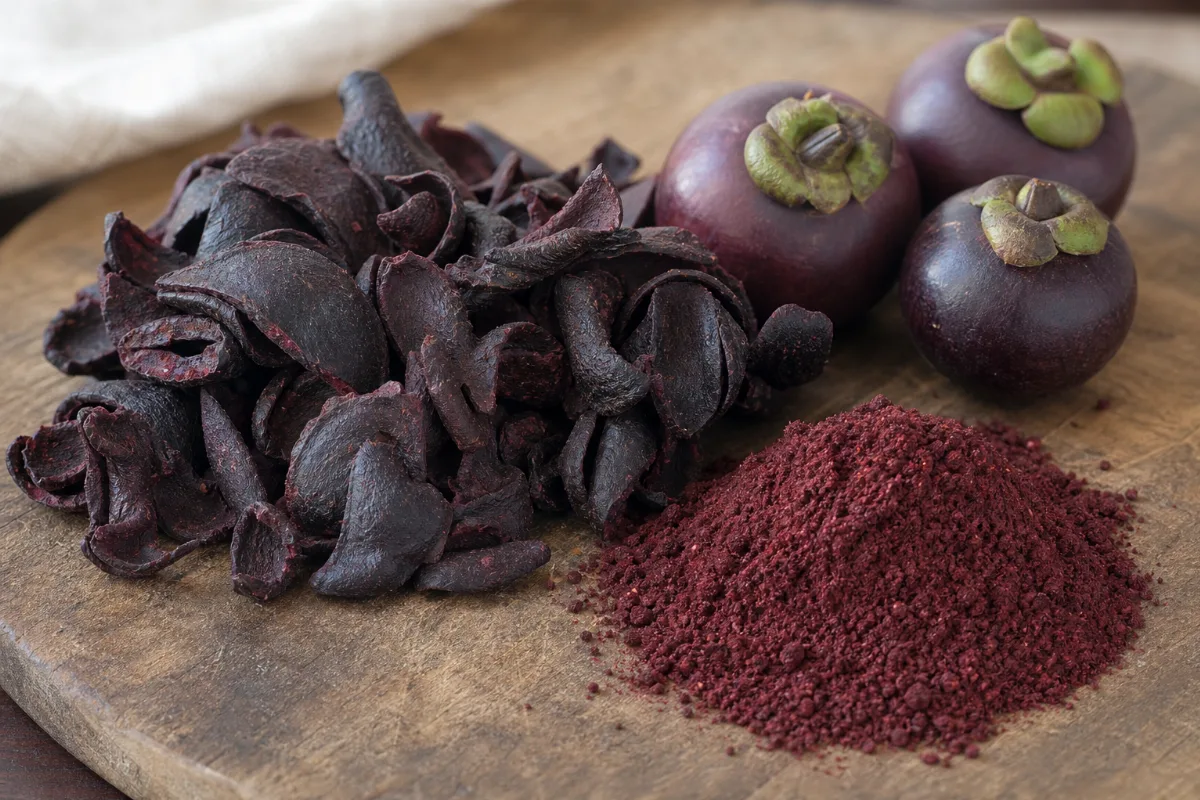
Kokum is the fruit of Garcinia indica, an evergreen tree in the mangosteen family. It is native to the Western Ghats of India, in Maharashtra, Goa, Karnataka and Kerala. [1] The fruit is a round berry about the size of an orange. It ripens from green to red-purple and holds 5 to 8 seeds in sour, fibrous pulp. [1] The outer rind is dried in the sun to make amsul (also aamsul or kokam). The seeds give kokum butter, which is used in chocolate and cosmetics. [1] The tree is listed as Vulnerable on the IUCN Red List. [1]Flavor and aroma
Kokum is mainly a sour spice. One cooking blog says fresh fruit is sweet and acidic, while the dried peel is very sour and slightly metallic, with no sweetness. [3] It also gives dishes a deep red or purple-pink color. [1][2] The review we read names garcinol, hydroxycitric acid (HCA) and two anthocyanin pigments as the main compounds in the fruit, but it does not link them to taste. [4] Sugar or jaggery softens the sourness in drinks and rasam. [3] Coconut milk and green chilli are common partners. [2][3]How it is used in cooking
Cooks use the dried rind as a souring agent in Maharashtrian, Goan, Karnataka, Gujarati and Assamese cooking, often in place of tamarind. [1]- Fish and coconut curries: Goan fish curry (agsol) is flavored with dried rinds. Assamese cooking uses it in masor tenga, a sour fish curry, and tenga dali, a sour dal. [1][3]
- Dal: Gujarati cooks add it for tartness and balance. [1]
- Sol kadhi: a chilled drink from the Konkan coast made with coconut milk, kokum, a little salt and chili-garlic paste. It is served with rice or after a spicy fish meal. [2]
- Sherbet and squash: fresh fruit preserved with sugar makes a bright red squash, diluted with water as kokum sarbat. [1]
- Pickles, chutneys and rasam: listed by a cooking blog and by the pharmacology review. [3][4]
One cooking blog soaks 4 dried pieces in a cup of hot water for 30 minutes, squeezes them lightly, and uses three or four skins for an average curry or fish dish. [3] The same blog says the sun-dried rind can be ground to a powder. [3] Because this is one blog, treat the numbers as a starting point, not a rule.
Substitutes: the blog names tamarind as the best swap, then amchur (dried mango powder), Malabar tamarind and anardana (dried pomegranate). [3] See tamarind.
Normal food amounts
| Measure | Grams | Source |
|---|---|---|
| 1 teaspoon or 1 tablespoon | Not available | USDA SR Legacy has no entry for kokum |
| 3 to 4 dried rind pieces for one dish | Not given in grams | One cooking blog [3] |
USDA SR Legacy has no entry for this spice, so we give no nutrient table and do not invent numbers. Kokum is used in small amounts for sourness, so it is unlikely to be a main source of any nutrient.
Buying, storing and preparing
- Forms: dried rind pieces, powder, syrup and squash. Dried skins, powder and syrups are sold year-round, usually in dried-fruit shops or online. Fresh fruit is sold mainly in growing areas such as Goa during its season. [3]
- Storing: one blog says to keep dried kokum in an airtight container away from moisture, with no refrigeration, for years. [3] We found no official shelf-life figure.
- Salt: the sources we read give no salt figure for dried kokum, so check the label if you limit salt.
- Quality: the sources we read give no quality test or adulteration issue for kokum.
- Preparing: soak in hot water until soft, or add the pieces straight to a simmering curry. [3]
Health: what research says
Eating a little kokum in cooking is different from taking concentrated extracts or capsules.Food amounts vs supplements
| In normal cooking | In supplements and extracts | |
|---|---|---|
| Typical amount | A few dried rind pieces per dish (one blog) [3] | One trial used 10 g of rind extract with 18 g of honey, twice a day, for three weeks [6] |
| What studies mostly used | We found no study of kokum as a cooking spice | Mostly lab and animal studies of extracts; one small human trial [4][6] |
| What we can say about benefit | Nothing, because it has not been studied at food amounts | Mostly unproven in people [4] |
| Main safety limit | The sources we read do not describe a limit at food amounts | Kokum has HCA like Garcinia cambogia, so liver effects need study [4][5] |
What the evidence shows
| Use | What the sources found | Strength of evidence | Form and population |
|---|---|---|---|
| Chronic gastritis symptoms | A 2021 trial of 60 people found symptoms fell in the kokum-and-honey group but not in the warm-water group. The abstract does not report blinding. [6] | Promising but limited | Rind extract with honey; adults with chronic gastritis [6] |
| Weight loss | The 2021 review describes anti-obesity effects only from in vitro and animal studies. [4] For Garcinia cambogia, NCCIH says it is unclear whether it helps. [5] | Lab or animal only | Extracts; cells and animals [4] |
| Inflammation, antioxidant and other effects | The review lists antioxidant, anti-inflammatory, antibacterial, liver-protective, heart-protective and mood effects from lab and animal work. It says human studies are needed. [4] | Lab or animal only | Extracts of rind, fruit or seed [4] |
| Heart protection | One study in the review found no significant effect of the water extract. [4] | No good evidence of benefit | Animal study [4] |
| Any use of kokum as a spice | No study found | Insufficient evidence | Food amounts |
Kokum has no herb page on this site. For the closely related supplement plant, see the Garcinia cambogia guide. It is a different species, so its results do not automatically apply to kokum.
Official statements
- NCCIH (US), 2025: about Garcinia cambogia, not kokum: products may be unsafe, with reports of liver damage, and weight-loss benefit is unclear. [5]
- Other bodies: we did not open an EMA, EFSA, FDA or JECFA statement on kokum, so we cite none.
Related pages
Health connections for Kokum
What research links to this spice, and how strong the evidence is. Most studies use concentrated extracts or doses far above what you eat; each card says which.
Chronic gastritis symptoms
Preliminary or mixedOne small 2021 trial of 60 adults with chronic gastritis found that symptoms fell in a group taking kokum rind extract with honey but not in a warm-water group.
Supplements: Extract finding only (10 g extract with 18 g honey, twice a day, 3 weeks); one small trial; no study of food amounts found.
Weight and fat metabolism
Lab or animal research onlyAnti-obesity effects of kokum are described in cells and animals only; no human weight trial of kokum was found.
Supplements: Lab and animal findings for extracts; none for food amounts.
Antioxidant and anti-inflammatory activity
Lab or animal research onlyExtracts of kokum rind, fruit and seed show antioxidant and anti-inflammatory effects in lab and animal studies.
Supplements: Lab and animal only; human studies still needed.
Heart protection
Lab or animal research onlyOne animal study of a water extract found no significant heart-protective effect.
Supplements: Animal study only; no benefit shown.
Connected topics
Open a group to see how each topic connects and how strong the evidence is.
Health goals (2)
- Digestive SupportPreliminary or mixed
One small gastritis trial of rind extract with honey; no study of kokum as a spice.
- Weight ManagementLab or animal research only
Anti-obesity effects are described only in lab and animal studies of kokum; NCCIH calls the weight-loss benefit of Garcinia cambogia unclear.
Body systems (1)
- Digestive SystemPreliminary or mixed
One small trial of rind extract with honey in chronic gastritis reported fewer symptoms; it is a single trial, not food use.
Body parts (2)
- LiverDocumented risk
No research directly links kokum to acute liver injury, but it contains HCA and garcinia supplements have liver reports, so liver effects need study.
- StomachPreliminary or mixed
The gastritis trial studied rind extract with honey in people with chronic gastritis; one small trial only.
Functional actions (2)
- Anti-InflammatoryLab or animal research only
Extracts show anti-inflammatory activity in lab and animal studies.
- AntioxidantLab or animal research only
Extracts show antioxidant activity in lab and animal studies.
Root causes (1)
- Medication Side EffectsDocumented risk
NCCIH reports Garcinia cambogia may interact with drugs that affect the liver or serotonin; no kokum interactions were described in the sources read.
Conditions & symptoms (2)
- Chronic GastritisPreliminary or mixed
One small 2021 trial (60 adults) of kokum rind extract with honey reported fewer symptoms than warm water; this is not proof, and it is not food use.
- ObesityLab or animal research only
Anti-obesity effects of kokum are reported in cells and animals only; no human trial of kokum for weight was found.
Documented risks and interactions (2)
- Liver effects need more study. A review says no research directly links kokum to acute liver injury, but its liver effects deserve more study because it contains HCA.
- Garcinia cambogia product safety (related species). NCCIH says Garcinia cambogia products may be unsafe, with reports of liver damage, and may interact with drugs that affect the liver or serotonin.
Frequently asked questions
Is kokum sweet?
Not the dried rind. One cooking blog describes it as very sour and slightly metallic. [3] Fresh fruit is sweet and acidic, and sugar is added in drinks. [3][1]
How much is normal?
One blog uses three or four dried pieces in an average curry. [3] USDA has no entry for kokum, and we found no official recipe amount.
What can I use instead of kokum?
A cooking blog names tamarind first, then amchur, Malabar tamarind and anardana. [3] Expect a different flavor.
Is it the same as Garcinia cambogia?
No, but they are in the same genus and both contain HCA. [4] Garcinia cambogia supplements have liver-injury reports. [5] No research directly links kokum to acute liver injury. [4]
Is it safe in pregnancy?
We found no source on kokum in pregnancy. Ask your midwife or doctor, especially about extracts.
Does it help with weight loss?
Claims rest on lab and animal studies. [4] It is not a treatment.
More details: evidence, limits and cautions
The details behind this page: cautions, limits of the evidence and where sources disagree. Open any note to read it.
Safety note at a glance
Safety in more detail
- Medicines: the sources we read name no kokum interactions. NCCIH says Garcinia cambogia products may interact with drugs that affect the liver or serotonin. [5]
- Pregnancy: the sources we read do not describe kokum in pregnancy. NCCIH says little is known about Garcinia cambogia. [5]
- Breastfeeding: the sources we read do not describe kokum while nursing. NCCIH says little is known about Garcinia cambogia. [5]
- Children: the sources we read do not describe this.
- Allergy: the sources we read do not describe kokum allergy.
- Liver and kidney: the review cites a Spanish food-safety agency report on liver concerns about garcinia supplements, mainly Garcinia cambogia and HCA. It says no research directly links G. indica to acute liver injury, but its liver effects deserve more study. [4] The sources we read do not describe kidney problems.
- Surgery: the sources we read do not describe a surgery warning. Tell the surgical team about any supplement.
- Quality and contamination: the sources we read do not describe contamination of kokum. [4]
- Amounts that cause trouble: no formal toxicity studies are reported in the review. [4] NCCIH lists headache, nausea and diarrhea for Garcinia cambogia. [5]
References
- Wikipedia — Garcinia indica. https://en.wikipedia.org/wiki/Garcinia_indica (accessed 2026-10-24)
- Wikipedia — Solkadhi. https://en.wikipedia.org/wiki/Solkadhi (accessed 2026-10-24)
- Go Sumitup (cooking blog) — All About Kokum, Know Your Spice Amsol or Kokam. https://gosumitup.com/all-about-kokum-know-fine-spice-punarpuli-amsol (accessed 2026-10-24)
- Lim et al. — Pharmacological Activity of Garcinia indica (Kokum): An Updated Review. Pharmaceuticals 2021. https://pmc.ncbi.nlm.nih.gov/articles/PMC8708457/ (accessed 2026-10-24; first 100,000 of 116,000 characters read)
- NCCIH (US) — Garcinia Cambogia, last updated February 2025. https://www.nccih.nih.gov/health/garcinia-cambogia (accessed 2026-10-24)
- Effect of Kokum (Garcinia indica) Rind Extract With Honey on Chronic Gastritis: A Randomized Controlled Trial. Nutrition and Food in Health and Disease 2021; abstract page read. https://nfsr.sbmu.ac.ir/article-1-435-fa.html (accessed 2026-10-24)