Sumac: Flavor, Cooking Use and Health Facts
Sumac is a tart, lemony red spice sprinkled on salads, dips and grilled meat; trials on blood sugar are mixed, and people with a cashew allergy should check first.
Content last updated . This page has not been medically reviewed.
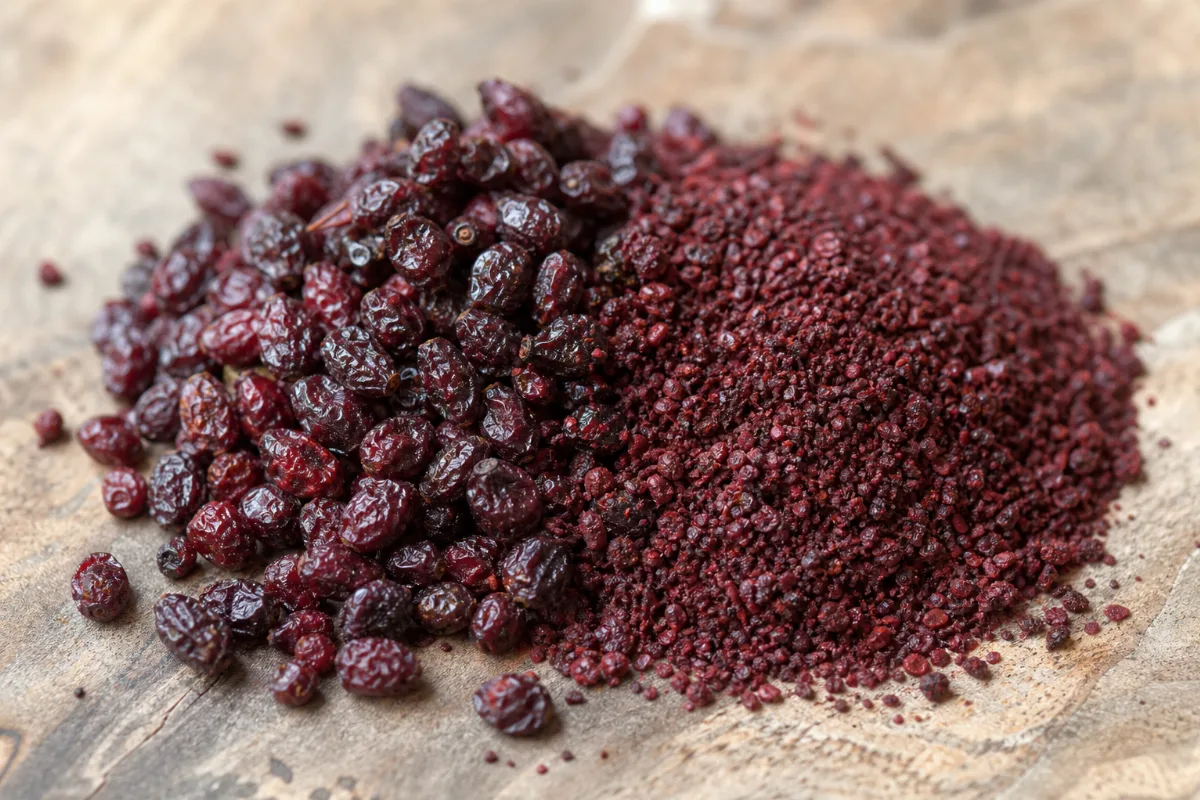
In the kitchen at a glance
Flavor:Sour / tangyCitrusyEarthy
Aroma: Mild and fruity, with a slight earthiness.
Used in: grilling and rubs, vegetables, rice and grains, tea and drinks
Usual amount in food: About 1/2 teaspoon on a dip and 1 teaspoon in a dressing for four, according to one cooking site; USDA SR Legacy has no entry for sumac.
What it is
Sumac spice is the dried, ground fruit of Rhus coriaria, a shrub or small tree in the family Anacardiaceae. [1][4] Its small fruits grow in dense clusters and are dried and ground into a coarse, reddish-purple powder. [1] It is a Middle Eastern and Mediterranean spice. [1][4] "Poison sumac" is a different plant, Toxicodendron vernix, with white fruits rather than red ones. [1] See the herb guide for more on this.Flavor and aroma
Sumac is sour first. The taste is tart and lemony, and the sources link it to its acid content, mainly malic acid. [1] Cooking sites also describe a fruity note, a little earthiness, and a mild dry, astringent feel in the mouth. [2][3] The sources we read say very little about its smell, so we keep that line short.Sumac gives sourness without adding liquid, which is why cooks use it where lemon juice would make a dish wet. [3] Its color is a deep red to burgundy. One cooking site says a brighter red does not mean better quality. [2]
How it is used in cooking
Ground sumac is far more common than whole berries. [2] It is used in several ways around the Middle East and nearby regions:- Dips and starters: sprinkled over hummus, labneh and falafel. [1][2]
- Salads and grilled foods: salads such as fattoush, grilled meats, fish, eggs and potatoes. [1][2]
- Rice and meat dishes: added to rice and grilled meats in Afghan, Armenian, Iraqi, Iranian and Jewish cooking. [1]
- Blends and dishes: one of the ingredients in za'atar, and used in musakhan and sumakiyyah. [1][2]
- Drinks: steeped in water as a sour, lemonade-style drink; straining removes hairs that may irritate the mouth. [1]
- Cooked paste: in Lebanon, Syria and Egypt it is cooked with water into a thick, sour paste for meat and vegetable dishes. [1]
It does not need toasting. [2] Many cooks sprinkle it on at the end or right after roasting, so long heat does not dull it. [3] One site says it can also go in during cooking. [2]
Substitutes: lemon juice, lemon zest, vinegar, pomegranate molasses or tamarind. [2] None matches exactly, and the same site advises using real sumac in dishes built around it. [2]
Normal food amounts
USDA SR Legacy has no entry for this spice, so we have no official grams-per-teaspoon figure and no nutrient table. We do not invent numbers.| Measure | Amount | Source |
|---|---|---|
| Grams per teaspoon | Not found | USDA SR Legacy has no entry for sumac |
| On hummus or labneh | About 1/2 teaspoon | One cooking site [2] |
| Dressing for four | About 1 teaspoon | One cooking site [2] |
| Marinade for chicken or lamb | 1 to 2 tablespoons | One cooking site [2] |
| Musakhan or sumakiyyah | Several tablespoons | One cooking site [2] |
These are one cook's habits, not official amounts. We found no nutrient data for a teaspoon, so we cannot say whether sumac is a good source of anything. As a seasoning, it is mostly flavor.
Buying, storing and preparing
- Forms: mostly ground; whole dried berries are sold in some specialist shops. [2] Some ground sumac is fine powder, and some keeps visible flakes of fruit. [2]
- Added salt: some brands add salt as a filler or preservative. [2][3] Read the label. A pure product lists only sumac, and you may want to taste before adding salt. [2][3]
- Quality: look for a clear tart, fruity taste. Dull or barely sour sumac may be old or low quality. [2]
- Storing: keep it in an airtight container away from heat, light and moisture. [2][3] One site says use within about a year, and another says it stays fresh for several months. [2][3] Replace it if it has little taste or smell. [2]
- Lead: a 2024 study in Lebanon measured heavy metals in 96 samples of 13 spices and herbs. It reported that for black pepper, sumac and dried mint, 25% to 33% of samples were over the Codex lead limit. It did not give a sumac figure alone, and unpackaged products did worst. [11] We found no sumac-specific testing from other countries.
Health: what research says
Eating sumac as a seasoning is different from taking it as powder or capsules in a trial.Food amounts vs supplements
| In normal cooking | In supplements and extracts | |
|---|---|---|
| Typical amount | A sprinkle to a few tablespoons per dish, according to one cooking site [2] | The sources we read do not give the amounts used in trials |
| What studies mostly used | Almost no studies of sumac used as a seasoning were found | Sumac powder or supplements, for 4 to 12 weeks, in adults [5][6] |
| What we can say about benefit | Nothing; no trial of cooking amounts was found | Pooled results for blood sugar are mixed [5][6][7] |
| Main safety limit | Possible allergy if you react to cashew; lead in some products [9][10][11] | Long-term and special-group safety is not described in the sources we read [4] |
What the evidence shows
| Use | What the sources found | Strength of evidence | Form and population |
|---|---|---|---|
| Blood sugar | A 2021 pooling of 6 trials (278 people) found no significant effect on any glycemic measure. [6] A 2024 pooling of 15 trials reported lower fasting glucose, insulin and HbA1c. [7] A 2026 pooling of 15 trials (917 people) also reported glycemic improvement. [5] | Mixed | Sumac powder or supplements; adults [6][7][5] |
| Blood pressure | The 2024 pooling found lower diastolic pressure, by about 3 mmHg on average. [7] | Promising but limited | Sumac consumption; adults [7] |
| Blood fats | A 2018 pooling could not reach a firm conclusion because of too few trials. [8] The 2026 pooling reported better lipid results. [5] | Mixed | Sumac supplements; adults [8][5] |
| Inflammation markers | The 2026 pooling found no significant effect. [5] | No good evidence of benefit | Sumac supplements; adults [5] |
| Weight and waist size | The 2024 pooling found no effect on weight, BMI or waist size. [7] | No good evidence of benefit | Sumac consumption; adults [7] |
| Hemorrhoids, wounds, diarrhea, eye inflammation | Used in traditional medicine; the review we read gives no trial support. [4] | Insufficient evidence | Traditional use [4] |
| Many other effects | Reviews describe antioxidant and other effects in cells and animals. [4] | Lab or animal only | Laboratory and animal studies [4] |
These are changes in test numbers, not proof of fewer heart attacks or diabetes problems. For supplement forms, trials and interactions in depth, see the full herb guide: Sumac.
Official statements
We opened no regulator statement about sumac. We found no EMA/HMPC monograph, EFSA opinion or FDA statement in the sources we read. For the lead check, a Lebanese study applied the Codex limit of 0.3 mg per kg. [11]Related pages
Health connections for Sumac
What research links to this spice, and how strong the evidence is. Most studies use concentrated extracts or doses far above what you eat; each card says which.
Blood sugar markers
Preliminary or mixedA 2021 pooling of 6 trials (278 people) found no significant effect of sumac powder on any blood sugar measure. A 2024 pooling of 15 trials and a 2026 pooling of 15 trials (917 people) reported improvements.
Supplements: Findings are for powder or supplements in trials, not for seasoning amounts; results are mixed.
Diastolic blood pressure
Preliminary or mixedThe 2024 pooling of 15 trials found diastolic pressure about 3 mmHg lower with sumac consumption; systolic pressure was not reported as changed in the abstract.
Supplements: Supplement or powder in trials only; not shown for food amounts.
Blood fats (cholesterol, triglycerides)
Preliminary or mixedA 2018 pooling could not reach a firm conclusion because of too few trials; the 2026 pooling reported improved lipid results.
Supplements: Supplements in trials; the pooled findings disagree.
Inflammation markers
Not enough evidenceThe 2026 pooling of 15 trials found no significant effect of sumac on inflammatory markers.
Supplements: No good evidence of benefit in pooled trials of supplements.
Weight, BMI and waist size
Not enough evidenceThe 2024 pooling found no effect on weight, BMI or waist circumference, with a small change in waist-to-hip ratio.
Supplements: No good evidence of weight benefit.
Antioxidant and other effects in cells and animals
Lab or animal research onlyA 2021 review describes antioxidant, antibacterial and other effects of sumac extracts in laboratory and animal work.
Supplements: Lab or animal findings; do not apply to food or supplements.
Traditional uses (hemorrhoids, wounds, diarrhea, eye inflammation)
Not enough evidenceThe 2021 review lists these traditional uses; the abstract we read gives no trial support.
Supplements: Traditional use only.
Connected topics
Open a group to see how each topic connects and how strong the evidence is.
Health goals (2)
- Blood Pressure SupportPreliminary or mixed
One pooling of 15 trials found lower diastolic pressure; it is a small change and only a test number. Trials used powder or supplements, not seasoning amounts.
- Blood Sugar BalancePreliminary or mixed
Pooled trials of sumac powder or supplements disagree: one found no effect and two reported lower blood sugar markers. Trials used powder or supplements, not seasoning amounts.
Body systems (1)
- Blood Sugar SupportPreliminary or mixed
Mixed trial results for blood sugar markers with powder or supplements.
Functional actions (2)
- AntioxidantLab or animal research only
Reviews describe antioxidant activity in laboratory and animal work; this does not show a benefit in people.
- Blood Sugar RegulationPreliminary or mixed
Some pooled trials report lower fasting glucose and HbA1c; another found no significant effect.
Root causes (1)
- Heavy Metal ExposureDocumented risk
A 2024 study in Lebanon found some sumac-containing sample groups over the Codex lead limit; sumac was not reported separately.
Biomarkers (3)
- Blood GlucosePreliminary or mixed
Fasting glucose was lower in the 2024 pooling (about 5 mg/dL); the 2021 pooling found no significant change.
- HbA1cPreliminary or mixed
The 2024 pooling reported HbA1c about 0.5 percentage points lower; the 2021 pooling did not find a significant change.
- InsulinPreliminary or mixed
The 2024 pooling reported lower insulin; the 2021 pooling found no significant change.
Conditions & symptoms (1)
- Food AllergyDocumented risk
People with a cashew allergy may react to sumac, which is in the same plant family; evidence is one lab study and one case report.
Documented risks and interactions (2)
- Possible reaction in people allergic to cashew. A lab study of blood from 56 children with suspected cashew allergy found signs of reacting to several plants in the cashew family, including sumac; its clinical importance is unknown. One case report describes a teen with cashew allergy who had anaphylaxis, possibly to sumac.
- Lead in some products. A 2024 study in Lebanon reported that 25% to 33% of samples of black pepper, sumac and dried mint were over the Codex lead limit; sumac alone was not separated out.
Frequently asked questions
What does sumac taste like?
It is tart and lemony, with a fruity note and a little earthiness. [1][2] It is sour, not sweet and not hot.
How much is normal?
There is no official amount. One cooking site uses about 1/2 teaspoon on a dip and about 1 teaspoon in a dressing for four. [2]
Is it safe in pregnancy?
The sources we read do not describe pregnancy. Food amounts are common in Middle Eastern cooking, but ask your midwife or doctor about supplements.
Can I take it with medicines?
We found no interaction study. Some trials report lower blood sugar and diastolic pressure, so ask a pharmacist if you take diabetes or blood-pressure medicine. [5][7]
Can I eat sumac if I am allergic to cashews?
Ask your allergy doctor first. Sumac and cashew are in the same plant family, and one case report describes a possible reaction. [9][10]
Is it the same as poison sumac?
No. Culinary sumac is Rhus coriaria, with red fruits. Poison sumac is a different plant with white fruits. [1] Never gather wild sumac to eat.
More details: evidence, limits and cautions
The details behind this page: cautions, limits of the evidence and where sources disagree. Open any note to read it.
Safety note at a glance
Safety in more detail
- Medicines: we found no interaction study. Because some trials report lower blood sugar and diastolic pressure, ask a pharmacist if you take diabetes or blood-pressure medicine. This is a cautious guess, not a documented interaction. [5][7]
- Pregnancy: the sources we read do not describe pregnancy.
- Breastfeeding: the sources we read do not describe breastfeeding.
- Children: the sources we read do not describe children, except that the cashew study tested children's blood samples. [9]
- Allergy: in a lab study of blood from 56 children with suspected cashew allergy, some showed signs of reacting to several plants in the cashew family, including sumac. The authors said whether this causes symptoms is unknown. [9] A 2024 review describes a 14-year-old with a cashew allergy who had anaphylaxis, possibly to sumac, after a fattoush salad. Sumac was not tested directly. [10]
- Liver and kidney: the sources we read do not describe liver or kidney problems. A review of toxicity studies calls sumac very safe, but that is the authors' summary. [4]
- Surgery: the sources we read do not describe a surgery warning. Tell the surgical team about any supplement.
- Quality and contamination: some sumac samples in a Lebanese study had lead above the Codex limit, and some products contain added salt. [11][2]
- Amounts that cause trouble: the sources we read do not describe an amount of culinary sumac that causes harm.
References
- Wikipedia — Sumac (spice), with references to Taste.com.au, The Spruce and Britannica. https://en.wikipedia.org/wiki/Sumac_(spice) (accessed 2026-10-24)
- Lin's Food — What is sumac? Taste, uses, types and substitutes (cooking site; secondary source). https://www.linsfood.com/what-is-sumac/ (accessed 2026-10-24)
- Health Starts in the Kitchen — Sumac spice: how to make it and use it in cooking (cooking site; secondary source). https://healthstartsinthekitchen.com/sumac-spice/ (accessed 2026-10-24)
- Alsamri H et al. — Pharmacological and antioxidant activities of Rhus coriaria L. (sumac). Antioxidants 2021; abstract read via Europe PMC. https://pubmed.ncbi.nlm.nih.gov/33430013/ (accessed 2026-10-24)
- Sumac (Rhus coriaria L.) and human metabolic health: a systematic review and meta-analysis. Endocrinol Diabetes Metab 2026; abstract read via Europe PMC. https://pubmed.ncbi.nlm.nih.gov/41329614/ (accessed 2026-10-24)
- The effect of sumac supplementation on glycemic indices: a systematic review and meta-analysis. Complement Ther Med 2021; abstract read via Europe PMC. https://pubmed.ncbi.nlm.nih.gov/34365008/ (accessed 2026-10-24)
- Effects of sumac consumption on blood pressure, glycemic indices and body composition in adults: a GRADE-assessed meta-analysis. Diabetes Metab Syndr 2024; abstract read via Europe PMC. https://pubmed.ncbi.nlm.nih.gov/39316955/ (accessed 2026-10-24)
- Effect of sumac (Rhus coriaria) on blood lipids: a systematic review and meta-analysis. Complement Ther Med 2018; abstract read via Europe PMC. https://pubmed.ncbi.nlm.nih.gov/30219474/ (accessed 2026-10-24)
- IgE cross-reactivity of cashew nut allergens. Int Arch Allergy Immunol 2019; abstract read via Europe PMC. https://pubmed.ncbi.nlm.nih.gov/30368491/ (accessed 2026-10-24)
- Melethil S, Yousef E — Rare causes of pediatric anaphylaxis due to obscure allergens. Front Allergy 2024 (mentions the Che 2017 cashew-sumac case report). https://www.frontiersin.org/journals/allergy/articles/10.3389/falgy.2024.1456100/full (accessed 2026-10-24)
- Moussa L et al. — Impact of source, packaging and presence of food safety management system on heavy metals levels in spices and herbs. PLOS ONE 2024. https://journals.plos.org/plosone/article?id=10.1371%2Fjournal.pone.0307884 (accessed 2026-10-24)