Dried fenugreek leaf (kasuri methi): Flavor, Cooking Use and Health Facts
Dried fenugreek leaf (kasuri methi) tastes earthy, nutty and slightly bitter and finishes curries and breads; the research is mostly on the seed, and larger medicinal amounts are not advised in pregnancy.
Content last updated . This page has not been medically reviewed.
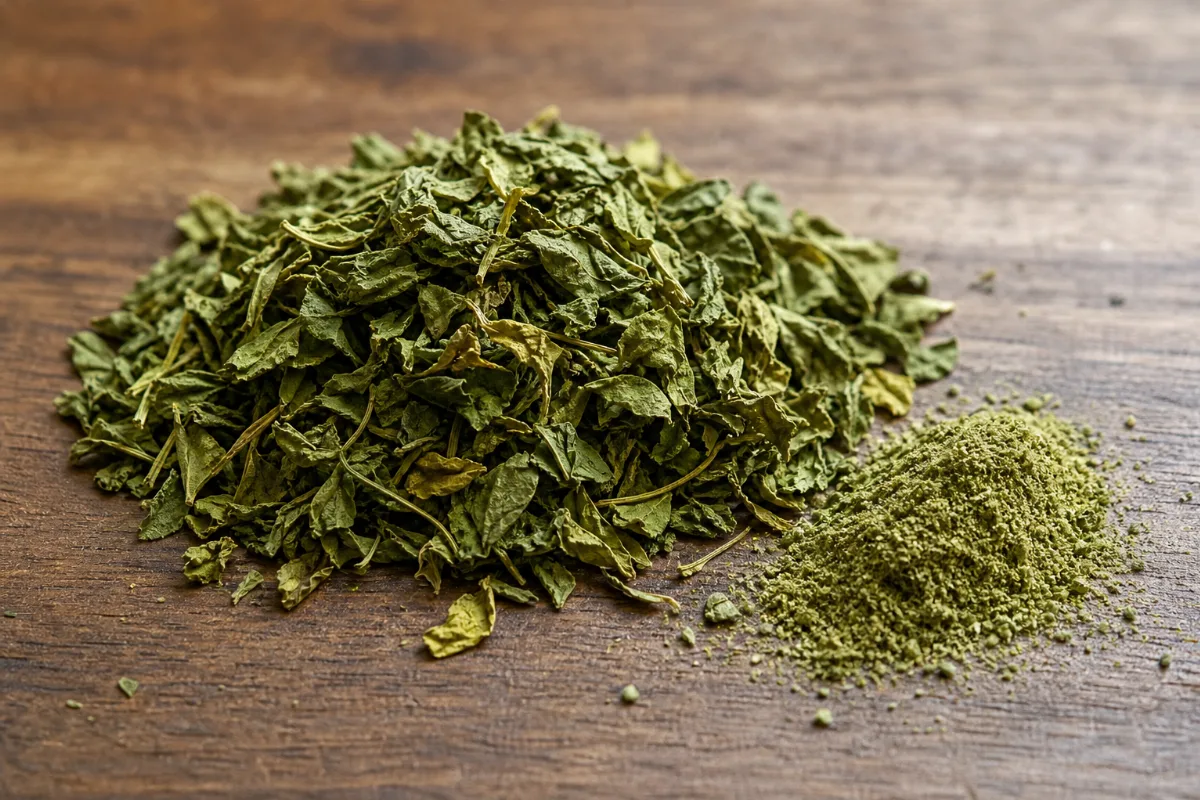
In the kitchen at a glance
Flavor:BitterEarthySweet
Aroma: Strong and pungent in the jar, with a nutty, maple-like sweetness that softens in the pot.
Used in: curries, soups and stews, baking, vegetables
Usual amount in food: A small pinch up to about half a teaspoon of crushed leaves per serving; the cooking pages we read give only loose guidance, and USDA SR Legacy has no entry for the dried leaf.
What it is
Kasuri methi is the dried leaf of fenugreek (Trigonella foenum-graecum), a clover-like legume plant. [6] "Methi" is the Hindi name for fenugreek. [5] The name "kasuri" is said to come from Kasur, a region of Punjab now in Pakistan, where the leaves were traditionally dried and used. [3][4] The seeds of the same plant are a separate spice: smaller, harder and much more bitter. [3][5] See our fenugreek seed page.Flavor and aroma
The leaves are earthy, nutty and slightly bitter, with a hint of maple that turns a little sweeter once cooked. [3][4] The smell in the jar is strong and pungent, but the taste blends in mildly. [4] Fenugreek's maple-and-curry smell comes from a compound called sotolon, found in seeds and leaves. [6] Drying concentrates the aroma. [5] Too much makes a dish bitter. [5] It pairs well with tomato, cream, lentils, chickpeas, potato, pumpkin, chicken and lamb. [3][4]How it is used in cooking
Rub or crush the dried leaves between your palms just before adding them, which releases more aroma. [3][5]- Timing: one source says to stir them in during the last few minutes, because long cooking dulls the flavor. [3] Another says you can add them at the start to spread the flavor, or sprinkle on at the end. [4] The sources disagree a little, so taste as you go.
- North Indian dishes: butter chicken, dal, shahi paneer, tikka masala sauce, and creamy or tomato gravies. [3][5]
- Breads: mixed into dough for parathas, theplas and naan. [3][5]
- Elsewhere: meat rubs, soups and bean stews, dips, eggs and rice. [3][4][5]
- Substitutes: one cooking page suggests fresh methi leaves (about three times as much, sautéed first), celery leaves, or a little toasted, crushed fenugreek seed used very sparingly. [3] Each changes the flavor.
Normal food amounts
| Measure | Grams | Source |
|---|---|---|
| 1 teaspoon, dried leaf | No USDA entry | USDA SR Legacy has no entry for this spice |
| Typical recipe amount | A pinch, or about half a teaspoon of crushed leaves per serving | Cooking pages [3][5] |
USDA SR Legacy has no entry for dried fenugreek leaf, so we give no nutrient numbers. The USDA seed entry is a different product and should not be read as the leaf. One cooking page notes the leaves are rich in fiber, so a large amount on an empty stomach may cause bloating or gas. [5] That page is a seller's, so treat it as a general note. A pinch or two is mostly flavor.
Buying, storing and preparing
- Forms: whole crumbled leaves, finer powder, and fresh leaves (methi) that you dry yourself. Whole leaves suit gravies and garnishes; powder suits blends. [5]
- What good looks like: even green color, a strong fenugreek smell when crushed, crisp and crumbly leaves, few stalks. Yellow or brown patches suggest age or over-drying. [5] A faint or dusty smell means it is time to replace it. [3]
- Storing: an airtight jar, away from heat, light and steam. [3][5] Sources differ on the fridge: one says do not refrigerate and gives 6 to 12 months, another says an opened pack keeps up to 6 months refrigerated. [3][5]
- Drying at home: one page describes 3 to 5 days in a shaded, airy place, or a dehydrator at 40 to 45 degrees C for 4 to 6 hours. [5]
- Adulteration or contamination: the sources we read do not describe any for the dried leaf.
Health: what research says
Eating dried leaf in cooking is very different from taking concentrated fenugreek products. Almost all the research is on seed preparations, not on kasuri methi.Food amounts vs supplements
| In normal cooking | In supplements and extracts | |
|---|---|---|
| Typical amount | A pinch to about half a teaspoon per serving [3][5] | LactMed says amounts used for milk supply are typically 1 to 6 g a day; we found no official dose [8] |
| What studies mostly used | We found no study of dried leaf in cooking | Mostly seed preparations in adults with type 2 diabetes or prediabetes; the abstract does not give the form [7] |
| What we can say about benefit | Nothing specific | Small trials changed blood sugar numbers; NCCIH says many studies were low quality [1][7] |
| Main safety limit | Allergy, especially in people allergic to legumes [1][2] | Not advised in pregnancy; possible low blood sugar; digestive upset [1][2] |
What the evidence shows
| Use | What the sources found | Strength of evidence | Form and population |
|---|---|---|---|
| Blood sugar in type 2 diabetes or prediabetes | A 2023 pooling of 10 trials (706 people) found lower fasting glucose, glucose after a sugar drink and HbA1c. [7] NCCIH says many studies were low quality. [1] | Promising but limited | Seed preparations, not leaf; adults with raised blood sugar [7] |
| Blood fats | The same pooling found better total cholesterol, triglycerides and HDL, and no significant change in LDL or BMI. [7] | Promising but limited | Same trials [7] |
| Breast milk supply | NCCIH says results were mixed. [1] LactMed says the evidence is mixed. [8] | Mixed | Breastfeeding mothers; seed products [1][8] |
| Menstrual cramps | NCCIH says the studies were few and low quality. [1] | Insufficient evidence | Women with cramps [1] |
| Appetite loss; minor skin inflammation | The EU herbal committee accepts these for fenugreek seed on traditional use only. [2] | Insufficient evidence | Seed, by mouth or on skin [2] |
| Hair packs | One page calls this a home remedy, not a proven treatment. [5] | No good evidence of benefit | Leaves on hair, traditional |
For supplement forms, trials and interactions in depth, see the full herb guide: Fenugreek.
Official statements
- NCCIH (US), 2025: believed safe in food amounts; not safe in pregnancy above food amounts; not enough high-quality evidence for diabetes or cramps. [1]
- EMA (EU): the herbal page covers fenugreek seed only, traditional use, not for under 18s, pregnancy or breastfeeding. It does not cover leaves. [2]
- FDA (US), via LactMed: generally recognized as safe as a flavoring. [8]
Related pages
Health connections for Dried fenugreek leaf (kasuri methi)
What research links to this spice, and how strong the evidence is. Most studies use concentrated extracts or doses far above what you eat; each card says which.
Blood sugar in type 2 diabetes and prediabetes
Preliminary or mixedA 2023 pooling of 10 trials (706 people) found lower fasting glucose, post-drink glucose and HbA1c with fenugreek, but NCCIH says many studies were not high quality.
Supplements: Supplement-level finding, not food amounts. Changes in lab numbers, not proven health outcomes. Not a replacement for diabetes treatment.
Cholesterol and blood fats
Preliminary or mixedIn the same pooling, total cholesterol, triglycerides and HDL improved; LDL cholesterol and BMI did not change significantly.
Supplements: Supplement-level finding from small trials; no evidence of fewer heart events.
Breast milk supply
Preliminary or mixedNCCIH says studies on milk supply are mixed. LactMed notes one review found a mild effect with unknown safety and another found no good evidence.
Supplements: Supplement-level, mixed human evidence. EMA advises against seed medicines while breastfeeding.
Menstrual cramps
Not enough evidenceNCCIH says there is not enough high-quality evidence to know whether fenugreek helps.
Supplements: Insufficient evidence; supplement-level.
Loss of appetite and minor skin inflammation (traditional use)
Preliminary or mixedThe EU herbal committee accepts fenugreek seed for temporary loss of appetite (by mouth) and minor skin inflammation (on skin) on long-standing use, not on trials.
Supplements: Traditional use only, for seed medicines; not food amounts and not shown by trials.
Connected topics
Open a group to see how each topic connects and how strong the evidence is.
Health goals (3)
- Blood Sugar BalancePreliminary or mixed
A 2023 pooling of 10 small trials found lower fasting glucose and HbA1c in adults with type 2 diabetes or prediabetes, but NCCIH says many studies were low quality. These were supplements, not food amounts. Based on seed studies, not dried leaf.
- Cholesterol BalancePreliminary or mixed
One pooling found lower total cholesterol and triglycerides but no significant LDL change; trials were small. Based on seed studies, not dried leaf.
- Metabolic HealthPreliminary or mixed
Small trials report modest changes in blood sugar and blood fats in people with diabetes or prediabetes; evidence is limited and was for supplements. Based on seed studies, not dried leaf.
Body systems (6)
- Blood Sugar SupportPreliminary or mixed
Small trials of supplements suggest lower blood sugar markers in type 2 diabetes; quality was mixed. Based on seed studies, not dried leaf.
- Immune SystemDocumented risk
Allergic reactions, sometimes serious, have been reported, especially in people allergic to peanut, soya or other legumes.
- Reproductive HealthDocumented risk
Not safe above food amounts in pregnancy; evidence on milk supply is mixed.
- Digestive SystemDocumented risk
Diarrhea, nausea and gas are the most reported side effects, mainly with larger amounts; EU use for loss of appetite is traditional only.
- Endocrine SystemDocumented risk
Fenugreek may lower blood sugar, so it can add to the effect of diabetes medicines; EMA advises close glucose monitoring.
- Metabolism & WeightPreliminary or mixed
Blood sugar and blood-fat markers changed modestly in small trials; BMI did not change significantly. Based on seed studies, not dried leaf.
Body parts (4)
- Reproductive OrgansDocumented risk
Not safe above food amounts in pregnancy because of links to birth defects.
- PancreasPreliminary or mixed
Blood sugar markers fell in small trials; trials did not test the pancreas directly. Based on seed studies, not dried leaf.
- SkinPreliminary or mixed
The EU committee accepts seed on the skin for minor inflammation on traditional use only.
- StomachDocumented risk
Digestive upset such as nausea and diarrhea is reported.
Functional actions (3)
- Blood Sugar RegulationPreliminary or mixed
Small supplement trials found lower fasting glucose and HbA1c; many studies were low quality. Based on seed studies, not dried leaf.
- Digestive SupportPreliminary or mixed
Accepted in the EU for temporary loss of appetite on traditional use only; no trials. Based on seed studies, not dried leaf.
- Metabolic OptimizationPreliminary or mixed
Modest changes in blood sugar and blood fats in small supplement trials; evidence limited. Based on seed studies, not dried leaf.
Root causes (2)
- Blood Sugar ImbalancePreliminary or mixed
Studied in people with type 2 diabetes and prediabetes; lower glucose markers in small trials; not a replacement for treatment. Based on seed studies, not dried leaf.
- Medication Side EffectsDocumented risk
The blood-sugar-lowering effect can add to diabetes medicines, and LactMed describes a warfarin interaction.
Biomarkers (4)
- Blood GlucosePreliminary or mixed
Fasting and post-drink glucose were lower in the 2023 pooling; study quality varied. Based on seed studies, not dried leaf.
- HbA1cPreliminary or mixed
HbA1c was lower in a 2023 pooling of 10 trials of supplements; study quality varied. Based on seed studies, not dried leaf.
- HDL CholesterolPreliminary or mixed
HDL improved in the same single pooling; rests on one meta-analysis abstract. Based on seed studies, not dried leaf.
- TriglyceridesPreliminary or mixed
Triglycerides improved in the same pooling; small trials. Based on seed studies, not dried leaf.
Conditions & symptoms (3)
- Diabetes MellitusPreliminary or mixed
Small supplement trials suggest lower blood sugar markers, but many were low quality. Fenugreek does not replace diabetes treatment. Based on seed studies, not dried leaf.
- Food AllergyDocumented risk
Fenugreek can cause allergic reactions, sometimes serious; people allergic to peanut, soya or other legumes should take care.
- HypoglycemiaDocumented risk
Large amounts may cause a harmful drop in blood sugar, especially with diabetes medicines.
Documented risks and interactions (7)
- Pregnancy: not safe above food amounts. NCCIH says amounts above food amounts have been linked to birth defects in animals and people. EMA says not to use fenugreek seed medicines in pregnancy.
- Allergy, including to peanut, soya and other legumes. Fenugreek can cause allergic reactions, sometimes serious. EMA lists facial swelling, wheezing, asthma and hay fever and says not to use seed medicines if allergic to peanut, soya or other legumes. LactMed says cross-reaction with chickpeas and peanuts is possible.
- Low blood sugar with diabetes medicines. Large doses may cause a harmful drop in blood sugar (NCCIH). EMA says blood glucose should be monitored closely in people with diabetes who take it by mouth.
- Warfarin and bleeding. LactMed says fenugreek can interact with warfarin to cause bleeding and advises caution with high amounts.
- Digestive side effects and large amounts. Diarrhea, nausea and gas are the most reported effects. EMA says more than 25 g a day of seed powder has caused minor digestive symptoms.
- Liver toxicity reports. LactMed says liver toxicity has been reported, alone and in herbal blends containing fenugreek. The 2023 pooling of trials saw no liver or kidney toxicity.
- Maple-syrup body odor. LactMed says fenugreek can give urine, sweat, feces and possibly breast milk a maple-syrup smell, caused by sotolon.
Frequently asked questions
Is kasuri methi sweet?
Not really. It is earthy and slightly bitter, with a hint of maple that shows more once cooked. [3][4]
How much is normal?
The cooking pages we read say a pinch to about half a teaspoon of crushed leaves per serving, and to add a little at a time. [3][5] There is no USDA entry.
Is it safe in pregnancy?
NCCIH says amounts above food amounts are not considered safe in pregnancy. [1] The sources we read do not describe a problem with the small amounts used to finish a curry. Ask your midwife or doctor.
Can I take it with medicines?
Cooking amounts are not described as a problem in the sources we read. Fenugreek seed supplements may lower blood sugar and may interact with warfarin, so ask a pharmacist. [2][8]
Is it the same as fenugreek seed?
It is the same plant, but a different part with a milder, more herbal taste. [3] Most health research is on the seed. [7]
Can I eat it if I am allergic to peanuts?
Fenugreek is in the legume family and cross-reactions are possible. [2][8] Ask an allergy doctor before using it.
More details: evidence, limits and cautions
The details behind this page: cautions, limits of the evidence and where sources disagree. Open any note to read it.
Safety note at a glance
Safety in more detail
- Medicines: EMA says fenugreek seed may lower blood sugar, so people with diabetes who take it by mouth should watch their glucose closely. [2] LactMed says it can interact with warfarin and raise bleeding risk. [8] These points are about medicine amounts of seed; ask a pharmacist before supplements.
- Pregnancy: NCCIH says amounts above food amounts are not considered safe and have been linked to birth defects in animals and people. [1] EMA says not to use seed medicines in pregnancy. [2]
- Breastfeeding: NCCIH says little is known about amounts above food levels. [1] EMA says not to use seed medicines. [2] LactMed says fenugreek can make urine, sweat and possibly breast milk smell of maple syrup. [8]
- Children: NCCIH believes food amounts are safe for children and says there is not enough information on larger amounts. [1] EMA advises against seed medicines under 18. [2]
- Allergy: NCCIH says reactions can be serious. [1] EMA lists allergy to peanut, soya and other legumes and names facial swelling, wheezing and asthma. [2] LactMed says cross-reaction with chickpeas and peanuts is possible. [8]
- Liver and kidney: LactMed says liver toxicity has been reported, alone and in herbal blends. [8] The 2023 pooling saw no liver or kidney toxicity. [7] The sources we read do not describe kidney problems beyond that.
- Surgery: the sources we read do not describe a surgery warning. Tell the surgical team about any supplement.
- Quality and contamination: the sources we read do not describe contamination of the dried leaf.
- Amounts that cause trouble: EMA does not set a leaf limit. NCCIH says large doses may cause a harmful drop in blood sugar. [1] LactMed lists diarrhea, gas, nausea and vomiting. [8]
References
- NCCIH (US) — Fenugreek (page updated February 2025). https://www.nccih.nih.gov/health/fenugreek (accessed 2026-10-24)
- EMA (EU) — Fenugreek seed (Trigonellae foenugraeci semen), herbal medicinal product page. https://www.ema.europa.eu/en/medicines/herbal/trigonellae-foenugraeci-semen (accessed 2026-10-24)
- Beyond Chutney — Kasuri Methi (Dried Fenugreek Leaves). https://beyondchutney.com/kasuri-methi/ (accessed 2026-10-24)
- The Spice People (Australia) — What is Kasoori Methi or Dried Fenugreek Leaves? https://thespicepeople.com.au/blogs/insites/what-is-kasoori-methi-or-dried-fenugreek-leaves (accessed 2026-10-24)
- Dehydrated Veg — Dry Methi Leaves: Dried Fenugreek Leaves Uses and Buying Guide (seller's page). https://www.dehydratedveg.com/blog/dry-methi-leaves/ (accessed 2026-10-24)
- Wikipedia — Fenugreek. https://en.wikipedia.org/wiki/Fenugreek (accessed 2026-10-24)
- Kim J et al. — The effect of fenugreek in type 2 diabetes and prediabetes: a systematic review and meta-analysis of randomized controlled trials. Int J Mol Sci 2023; abstract read via Europe PMC. https://pubmed.ncbi.nlm.nih.gov/37762302/ (accessed 2026-10-24)
- LactMed, NIH (US) — Fenugreek; read via Europe PMC record. https://pubmed.ncbi.nlm.nih.gov/30000838/ (accessed 2026-10-24)