Curry leaf: Flavor, Cooking Use and Health Facts
Curry leaf is citrusy, slightly bitter and savory and is fried in oil at the start of South Indian dishes; human research on blood sugar is one small 1990 study, and the rest is lab and animal work.
Content last updated . This page has not been medically reviewed.
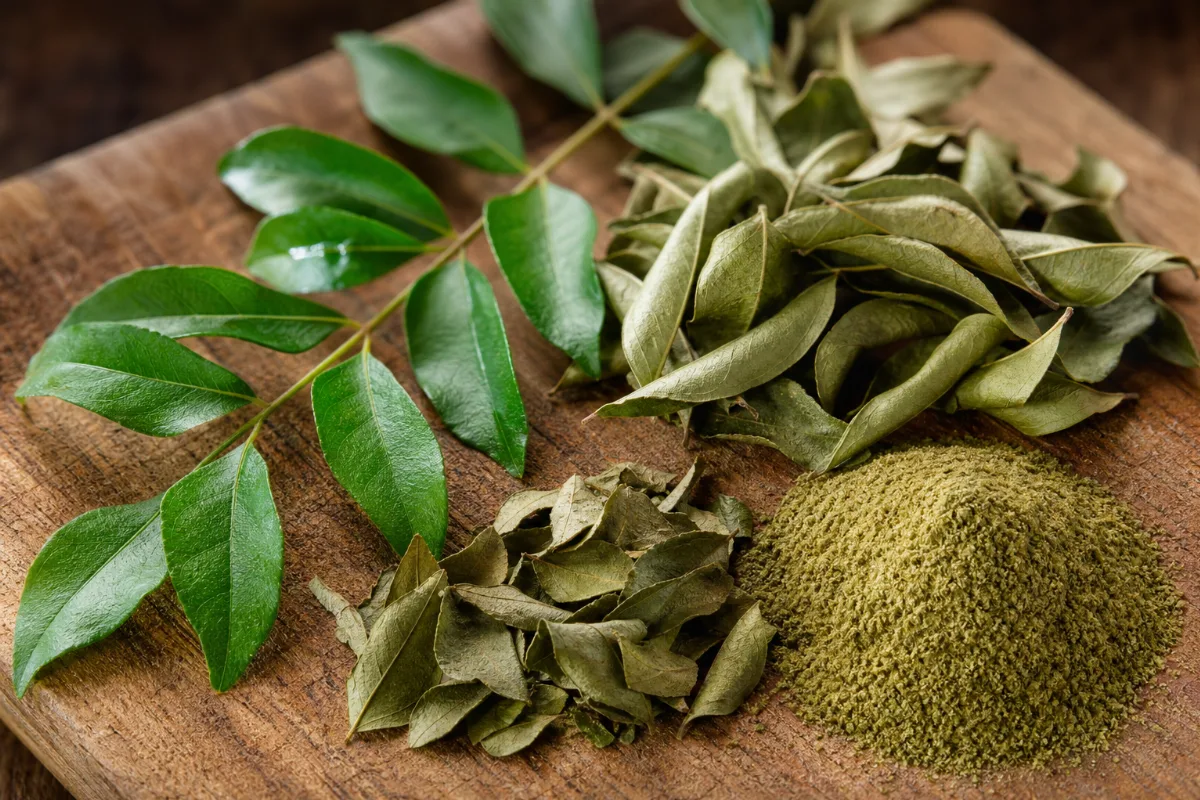
In the kitchen at a glance
Flavor:CitrusyEarthyBitter
Aroma: Bright and citrusy with a savory, slightly sulfury note when fried in oil.
Used in: curries, soups and stews, rice and grains, vegetables
Usual amount in food: Amounts in food are not set by any source we opened; USDA has no entry for curry leaf, so we give no gram measure.
What it is
Curry leaf comes from a small tropical tree, Murraya koenigii (now often called Bergera koenigii), in the citrus family. [1] It is native to the Indian subcontinent, southern China and Indo-China. [1] The leaf is the part used in cooking. The fruit is a small black berry with a sweet, edible pulp, but the seed may be toxic. [1] Curry leaf is not the same thing as curry powder, which is a blend of other spices. [2]Flavor and aroma
Fresh leaves are mild, aromatic and slightly bitter. [1] One cooking source describes the taste as bright and citrusy, with a smooth, slightly waxy texture. [2] Chemists have listed many smell compounds in the leaf, including a sulfury one (1-phenylethanethiol) and a citrusy one (linalool). [1] The smell is strongest when the leaves first hit hot oil. [2] Dried leaves are milder and somewhat bitter. [2]How it is used in cooking
Curry leaf is a staple of southern and west-coast Indian cooking, and it is also used in Sri Lankan and Southeast Asian dishes. [1][2]- Tempering: the leaves are usually fried in oil with mustard seeds, and sometimes chopped onion, at the start of cooking. [1][2]
- Dishes: thoran, vada, rasam, kadhi, sambar, coconut chutney, dal tadka, Kerala fish curry and masala dosa. [1][2]
- Ground blends: the leaves are dry-roasted and ground into masalas such as South Indian sambar masala. [1]
- Elsewhere: roasted leaves go into a Cambodian soup, and they flavor a Javanese stew called gulai. [1]
- Fresh or dried: fresh is clearly better. One source calls the aroma and flavor of dried leaves "greatly inferior." [1] If you use dried, you need more, and crushing them or soaking them in warm water helps release flavor. [2]
- Substitutes: kaffir lime leaf gives a citrusy note and bay leaf gives an earthy one, but neither matches. [2]
Normal food amounts
USDA FoodData Central SR Legacy has no entry for curry leaf, so we give no gram measure and no nutrient numbers. The "Spices, curry powder" entry in USDA is a different product. We opened no source that states a typical recipe amount.| Measure | Grams | Source |
|---|---|---|
| 1 teaspoon or 1 tablespoon | Not available | USDA SR Legacy has no entry |
| Typical recipe amount | Not found | We opened no source that states one |
One review lists leaf values such as about 6 mg of beta-carotene and about 20 mg of calcium per 100 g, but it does not say whether the leaves were fresh or dried. [4] A few leaves weigh very little, so food amounts add little of either. Real products vary.
Buying, storing and preparing
- Forms: fresh leaves on the stem, dried leaves and dried leaf powder. [2]
- Quality: look for green, fragrant leaves. Yellowing, browning, wilting or loss of scent are signs of spoilage. [2]
- Fridge: wash, dry well, take off the stems, wrap in paper towel and keep in a sealed container. One source says this lasts up to two weeks. [2]
- Freezer: dry the leaves fully, freeze them in one layer, then bag them. [2]
- Drying: air-dry washed leaves away from direct sun, then store airtight or grind to powder. [2]
- Washing: studies of pesticide residues in curry leaf exist, so washing fresh leaves before use is sensible. [6]
Health: what research says
Eating curry leaf in cooking is different from taking concentrated products, and almost all the research is on extracts, powders or animals.Food amounts vs supplements
| In normal cooking | In supplements and extracts | |
|---|---|---|
| Typical amount | No usual amount found; no USDA entry | One small trial used 12 g of leaf powder a day for a month [5] |
| What studies mostly used | We found no study of curry leaf as a cooking spice | Cell studies, animal studies and extracts of the leaf, or of single compounds from it [3][4] |
| What we can say about benefit | Nothing proven | Preliminary only; reviews call for more human trials [3][4] |
| Main safety limit | Pesticide residues on leaves [6] | The sources we read give no safety data |
What the evidence shows
| Use | What the sources found | Strength of evidence | Form and population |
|---|---|---|---|
| Blood sugar in type 2 diabetes | In 1990, 30 adults with type 2 diabetes took 12 g of leaf powder daily for a month. Blood sugar fell for a while at day 15, and blood fats did not change at 15 or 30 days. [5] | Insufficient evidence | Leaf powder, much more than a cooking amount; small study [5] |
| Blood sugar and blood fats in animals | Reviews describe lowered glucose and fats in diabetic rats and mice. [3][4] | Lab or animal only | Extracts and compounds in animals [3][4] |
| Inflammation, cell protection, cancer cell effects | Reviews report effects in cell and animal studies. [4] | Lab or animal only | Cell lines and animals [4] |
| Traditional use | The leaf is used in Ayurvedic and Siddha medicine. [1] | No good evidence of benefit | Tradition is not proof [1] |
One review says its main limit is that human evidence is very thin: it describes a single human study, and the rest comes from cells and animals. [3] Another says more work on how well the compounds are absorbed is needed. [4] We found no herb guide for curry leaf on this site.
Official statements
We opened no statement from EMA, EFSA, FDA, WHO or NCCIH about curry leaf.Related pages
Health connections for Curry leaf
What research links to this spice, and how strong the evidence is. Most studies use concentrated extracts or doses far above what you eat; each card says which.
Blood sugar in type 2 diabetes
Preliminary or mixedOne small 1990 study of 30 adults with type 2 diabetes who took 12 g of leaf powder daily for a month found a short-lived drop in blood sugar at day 15 and no change in blood fats.
Supplements: Supplement-level powder only; no study of food amounts found. It does not replace diabetes care.
Blood sugar and blood fats in animals
Lab or animal research onlyReviews describe lower glucose and cholesterol in diabetic rats and mice given leaf extracts or single compounds.
Supplements: Lab and animal only.
Antioxidant and anti-inflammatory activity in the lab
Lab or animal research onlyReviews report antioxidant and anti-inflammatory effects of leaf extracts and carbazole compounds in cell and animal studies.
Supplements: Lab and animal only.
Traditional use in Ayurvedic and Siddha medicine
Not enough evidenceThe leaf is used in traditional medicine; no high-quality clinical evidence was found for these uses.
Supplements: No good evidence of benefit.
Documented risks and interactions (2)
- Pesticide residues on fresh leaves. An Indian monitoring study found curry leaf among the commodities with the highest residues; chlorpyrifos, profenophos and ethion exceeded 4% of the acceptable daily intake, a margin the authors treated as a long-term concern. No acute risk was found.
- Berry seed may be toxic. The fruit pulp is edible but the seed may be toxic to humans.
Frequently asked questions
What does curry leaf taste like?
Fresh leaves are mild, citrusy and slightly bitter, with a savory smell when fried in oil. [1][2] It is not sweet and not hot.
Is curry leaf the same as curry powder?
No. Curry powder is a blend of spices such as turmeric, cumin and coriander. Curry leaf is one fresh leaf. [2]
How much is normal?
We found no source that sets a usual amount, and USDA has no entry for it. Follow your recipe, and use more if the leaves are dried. [2]
Is it safe in pregnancy?
The sources we read do not describe pregnancy safety. Ask your midwife or doctor about large amounts or supplements.
Can I take it with medicines?
The sources we read do not describe interactions. One small study saw lower blood sugar after a large daily amount of powder, so ask a pharmacist if you take diabetes medicine. [5]
Does curry leaf lower blood sugar?
Animal studies say so, but human evidence is one small 1990 study with a short-lived effect. [3][5] It is not a treatment.
More details: evidence, limits and cautions
The details behind this page: cautions, limits of the evidence and where sources disagree. Open any note to read it.
Safety note at a glance
Safety in more detail
- Medicines: the sources we read do not describe interactions. Because one study reported lower blood sugar after a large amount of powder, people on diabetes medicine could ask a pharmacist before taking supplements. [5]
- Pregnancy: the sources we read do not describe pregnancy safety.
- Breastfeeding: the sources we read do not describe breastfeeding safety.
- Children: the sources we read do not describe use in children.
- Allergy: the sources we read do not describe allergy. Curry leaf is in the citrus family, but we found no source on cross-reactions. [1]
- Liver and kidney: the sources we read do not describe liver or kidney problems.
- Surgery: the sources we read do not describe a surgery warning. Tell your surgical team about any supplement.
- Quality and contamination: an Indian monitoring study found curry leaf among the foods with the highest residues. Chlorpyrifos, profenophos and ethion exceeded 4% of the acceptable daily intake, which the authors treated as a margin for long-term risk. No pesticide reached half the acute reference dose, so they found no acute risk. [6]
- Amounts that cause trouble: the sources we read give no amount. The seed of the berry may be toxic, so do not eat the seeds. [1]
References
- Wikipedia — Curry tree. https://en.wikipedia.org/wiki/Curry_tree (accessed 2026-10-24)
- Spice and Life — Curry leaves (cooking guide). https://www.spiceandlife.com/curry-leaves/ (accessed 2026-10-24)
- Abeysinghe DT et al. — Nutritive importance and therapeutic uses of three varieties of curry leaves: an updated review. Evid Based Complement Alternat Med 2021. https://pmc.ncbi.nlm.nih.gov/articles/PMC8572594/ (accessed 2026-10-24)
- Balakrishnan R et al. — Medicinal profile, phytochemistry and pharmacological activities of Murraya koenigii and its primary bioactive compounds. Antioxidants 2020. https://pmc.ncbi.nlm.nih.gov/articles/PMC7070712 (accessed 2026-10-24)
- Iyer UM, Mani UV — Effect of curry leaves supplementation on lipid profile, glycated proteins and amino acids in non-insulin-dependent diabetic patients, 1990; abstract read via Europe PMC. https://pubmed.ncbi.nlm.nih.gov/2174154/ (accessed 2026-10-24)
- Nair KP et al. — Monitoring and risk assessment of pesticide residues in agricultural/horticultural commodities. Entomon. https://entomon.in/index.php/Entomon/article/view/28 (accessed 2026-10-24)