Makrut (kaffir) lime leaf: Flavor, Cooking Use and Health Facts
Makrut (kaffir) lime leaf is floral, lemony and fragrant and flavors Thai and Southeast Asian curries and soups; human health research on the leaf is missing, and the fruit's juice and peel can cause skin reactions in sunlight.
Content last updated . This page has not been medically reviewed.
In the kitchen at a glance
Flavor:CitrusyFloralSweet
Aroma: Bright, floral and lemony, like perfumed lime.
Used in: curries, soups and stews
Usual amount in food: No source we opened sets an amount; each joined pair of leaves counts as two leaves in a recipe, and USDA has no entry, so we give no gram measure.
What it is
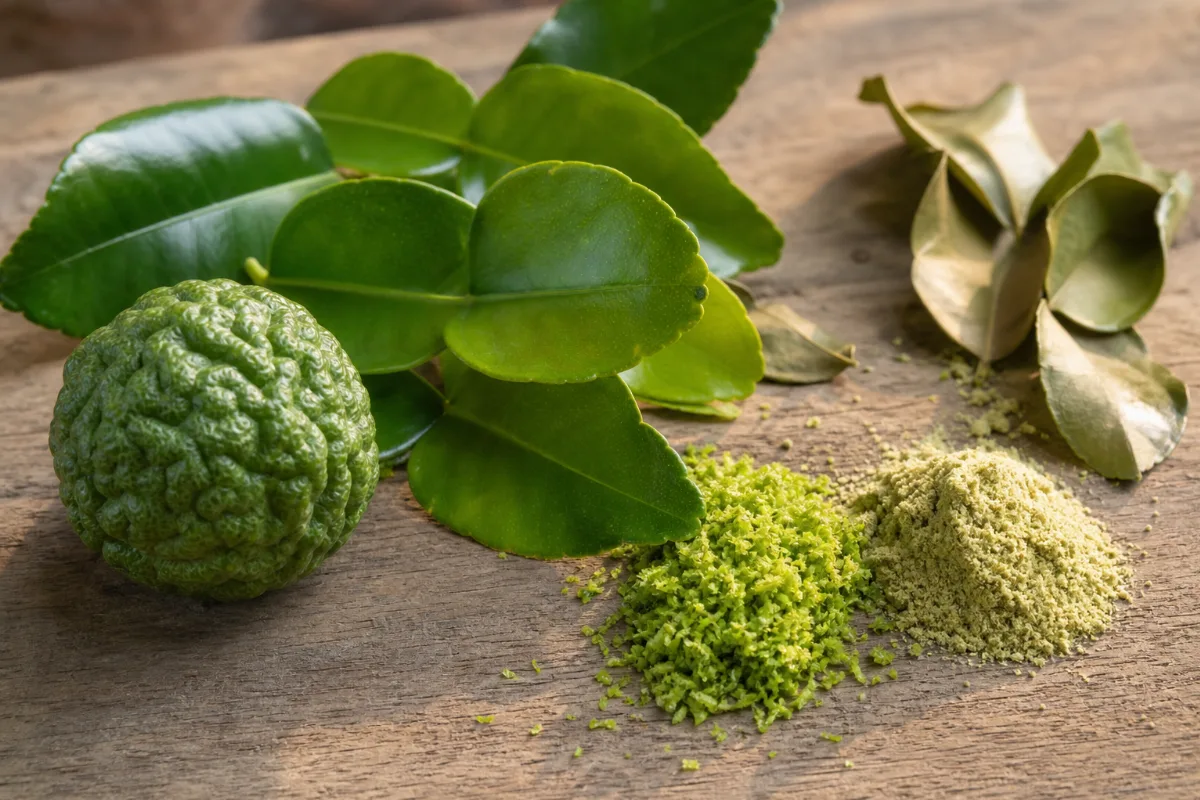
Makrut lime, Citrus hystrix, is a thorny shrub or small tree from tropical Southeast Asia. [1] Its leaves look like two leaves joined end to end, because the stalk is wide and leaf-like. [1][3] The fruit is small, bumpy and very acidic, with a slightly bitter rind. [1] People also call it kaffir lime or Thai lime. Many writers now prefer "makrut" because "kaffir" is considered offensive; this site uses both so you can find it. [1][2]Flavor and aroma
The leaves taste and smell of lemony citrus with a floral, perfume-like note, and they are less sharp than regular lime. [3][4] The main smell compound in the leaf oil is citronellal. A review of Malaysian samples put it at about 62 to 73 percent of the oil, with citronellol, limonene and others in smaller amounts. [5] Oil makeup varies from sample to sample. [5] Heat fades the aroma, so cooks often add leaves late or bruise them to release it. [3] The juice is very sour, and the rind is bitter in its white part. [2]How it is used in cooking
Leaves are used fresh, frozen or dried in Thai, Cambodian, Lao, Indonesian, Malaysian, Burmese and Vietnamese cooking. [1] One cook calls them one of three core Thai aromatics, with lemongrass and galangal. [3]- Whole in simmered dishes: drop in whole leaves like bay leaves, then take them out before eating. They are tough. [2][3] Tom yum soup [1] and Thai green curry [2] are named examples.
- Shredded: take out the hard center vein, roll the leaves tightly and slice very thin to use in salads or as a garnish. [2][3]
- Rind: the zest is pounded into curry pastes such as panang. [3] Thai and Lao curry pastes use it. [1]
- Fresh, frozen or dried: fresh is best, frozen is next, dried is weakest. Use about twice as many dried leaves, and soak them in warm water or crush them first. [2][4] Dried or frozen leaves are not good for salads. [2]
- Substitutes: none is a close match. Lime or lemon zest is the usual stand-in. One source says to use about 1½ teaspoons of finely chopped lime zest for each leaf. [4] Another says plain lime or lemon zest can stand in. [2] Lemongrass adds citrus but plays a different role. [4]
- Other places: the zest is used in Indian Ocean island cooking, and in Cambodia the whole fruit is candied. [1]
Normal food amounts
USDA FoodData Central SR Legacy has no entry for makrut lime leaf, so we give no gram measure and no nutrient numbers. [7] We opened no source that states a standard recipe amount.| Measure | Grams | Source |
|---|---|---|
| 1 teaspoon or 1 tablespoon | Not available | USDA SR Legacy has no entry [7] |
| One joined leaf pair | Counts as two leaves | Cooking sources [2][3] |
| Typical recipe amount | Not found | We opened no source that states one |
Because leaves are removed or used in small amounts, they add flavor and almost no food value. We have no nutrient data, so we do not call the leaf a "good source" of anything.
Buying, storing and preparing
- Forms: fresh leaves in the herb section of supermarkets and Asian grocers, frozen leaves, dried leaves (the easiest to find in the US), and freeze-dried leaves. [3][4][2]
- Quality: fresh leaves are glossy and dark green. Thawed frozen leaves look duller but keep most of their flavor. [2]
- Freezing: wash, dry on a towel, then bag with the air pressed out. One cook says they keep up to a year. [3]
- Shelf life of fresh or dried leaves: the sources we read give none.
- Growing: the tree grows worldwide where the climate suits and does well in containers. [1]
- Buying online: fresh leaves sent by post can arrive wilted. [4]
Health: what research says
Using a leaf or two in a pot is very different from taking concentrated extracts or oil. We found no human studies of makrut lime leaf in food.Food amounts vs supplements
| In normal cooking | In supplements and extracts | |
|---|---|---|
| Typical amount | A few leaves; no official amount found | No official amount found |
| What studies mostly used | We found no study of leaves in food | Lab tests, animal studies, and essential oil [5][6] |
| What we can say about benefit | Nothing, because it has not been studied | A 2022 review says no human studies of the extract for metabolic disorders had been done [6] |
| Main safety limit | None named for eating the leaf in the sources we read | Skin reaction in sun from juice or peel; peel extract ended pregnancies in rats [6] |
What the evidence shows
| Use | What the sources found | Strength of evidence | Form and population |
|---|---|---|---|
| Blood sugar | Extracts blocked sugar-digesting enzymes in lab tests, and one rat study found lower fasting glucose. [6] | Lab or animal only | Leaf extract; lab and rats [6] |
| Blood pressure | Water extract blocked ACE in lab tests, and rat studies found lower blood pressure. [6] | Lab or animal only | Leaf extract; lab and rats [6] |
| Cholesterol | The review calls results inconclusive and notes weak study designs. [6] | Insufficient evidence | Extract; animals [6] |
| Weight | One lab study found a fat-digesting enzyme was blocked. [6] | Lab or animal only | Extract; lab [6] |
| Germ-fighting | Essential oil at 2 percent stopped growth of two bacteria in a dish. [5] | Lab or animal only | Essential oil; lab, not leaf oil only [5] |
| Eating leaves in cooking | No study found | Insufficient evidence | Food amounts |
Traditional uses for flu, fever, blood pressure, belly pain and infant diarrhea are listed in one review, with no trials. [5]
Official statements
We found no EMA, EFSA, FDA, WHO or NCCIH page about makrut lime leaf that we could open, so we cite none.Related pages
Health connections for Makrut (kaffir) lime leaf
What research links to this spice, and how strong the evidence is. Most studies use concentrated extracts or doses far above what you eat; each card says which.
Blood sugar (lab and rat studies)
Lab or animal research onlyLeaf extracts blocked sugar-digesting enzymes in lab tests, and one rat study found lower fasting blood glucose.
Supplements: Extract-level lab and animal findings only; nothing for food amounts or for people.
Blood pressure (lab and rat studies)
Lab or animal research onlyA water extract of the leaf blocked ACE in lab tests, and rat studies reported lower blood pressure.
Supplements: Extract-level lab and animal findings only; nothing for food amounts or for people.
Cholesterol and weight
Not enough evidenceThe review calls cholesterol results inconclusive and notes weak study designs; one lab study found a fat-digesting enzyme was blocked.
Supplements: No evidence for food amounts or supplements in people.
Germ-fighting in the lab
Lab or animal research onlyEssential oil at 2 percent stopped growth of two bacteria in a dish; this was reported for citrus oils generally, not leaf oil alone.
Supplements: Essential oil, lab only.
Connected topics
Open a group to see how each topic connects and how strong the evidence is.
Body systems (1)
- Reproductive HealthDocumented risk
Peel extract caused pregnancy loss in rats; the authors suggest avoiding it in pregnancy. Leaf in food was not studied.
Body parts (1)
- SkinDocumented risk
Juice or peel on the skin followed by sunlight can cause blisters (phytophotodermatitis); this is not about eating the leaf.
Documented risks and interactions (2)
- Skin reaction in sunlight (phytophotodermatitis). The peel and pulp contain furanocoumarins, which can cause a sunlight-triggered skin inflammation; a hiker developed redness and blisters after putting the juice on his skin.
- Pregnancy: peel extract in rats. In rats, peel extract at 100 to 2,500 mg per kg caused dose-related loss of implantation and abortion; the authors suggest avoiding peel extract in pregnancy.
Frequently asked questions
Is makrut lime leaf sweet?
Not really. It tastes lemony and floral, with a perfume-like note, and it is milder than the sharp juice. [3][4]
How much is normal?
We found no official or standard amount, and USDA has no entry. [7] Cooks count each joined pair as two leaves and use more of dried ones. [2]
Is it safe in pregnancy?
The sources we read do not describe leaf in cooking. In rats, peel extract caused pregnancy loss, and the authors suggest avoiding peel extract. [6] Ask your midwife or doctor.
Can I take it with medicines?
The sources we read name no interactions for the leaf in food. We have no data on concentrated products.
Is it the same as kaffir lime or Thai lime?
Yes. They are all Citrus hystrix, and "makrut" is the name many writers now prefer. [1][2]
Can I use regular lime instead?
Lime or lemon zest is the usual stand-in, but cooks say it is not an exact match. [2][4]
More details: evidence, limits and cautions
The details behind this page: cautions, limits of the evidence and where sources disagree. Open any note to read it.
Safety note at a glance
Safety in more detail
- Medicines: the sources we read do not describe medicine interactions.
- Pregnancy: in rats, peel extract at 100 to 2,500 mg per kg caused dose-related loss of implantation and abortion. The authors suggest avoiding peel extract in pregnancy. [6] This was peel extract, not leaf in food, and the sources we read say nothing about cooking amounts.
- Breastfeeding: the sources we read do not describe it.
- Children: the sources we read do not describe it.
- Allergy: the sources we read do not describe food allergy to the leaf.
- Skin and sun: the peel and pulp contain furanocoumarins, which can cause phytophotodermatitis, a skin inflammation triggered by sunlight. [1] A case report describes redness and blisters after a hiker applied the juice to his skin. [6] No dose was recorded. [6]
- Liver and kidney: the sources we read do not describe it.
- Surgery: the sources we read do not describe a surgery warning. Tell the surgical team about any supplement.
- Quality and contamination: the sources we read do not describe any for this leaf. Wash fresh leaves as you would any herb.
- Amounts that cause trouble: none found for the leaf in food. Only two toxicity studies of the plant existed in the 2022 review. [6]
References
- Wikipedia — Citrus hystrix (cites Kew, Missouri Botanical Garden and journal sources). https://en.wikipedia.org/wiki/Citrus_hystrix (accessed 2026-10-24)
- CooksInfo — Makrut lime leaves. https://www.cooksinfo.com/makrut-lime-leaves (accessed 2026-10-24)
- Marion's Kitchen — Let's talk about makrut lime leaves. https://www.marionskitchen.com/?p=45740 (accessed 2026-10-24)
- CulinaryLore — Kaffir lime leaves, fresh vs dried. https://culinarylore.com/specialty-foods:kaffir-lime-leaves-fresh-vs-dried/ (accessed 2026-10-24)
- Essential Oils from the Malaysian Citrus (Rutaceae) Medicinal Plants. Medicines (Basel) 2016; 3(2):13. https://pmc.ncbi.nlm.nih.gov/articles/PMC5456223/ (accessed 2026-10-24)
- Siti HN, Mohamed S, Kamisah Y — Potential Therapeutic Effects of Citrus hystrix DC and Its Bioactive Compounds on Metabolic Disorders. Pharmaceuticals (Basel) 2022; 15(2):167. https://pmc.ncbi.nlm.nih.gov/articles/PMC8875002 (accessed 2026-10-24)
- USDA FoodData Central, SR Legacy (April 2018) — no entry for makrut lime leaf, per the site's USDA data file (docs/research/spices/usda-spices.json).